


The Indonesian island of Sulawesi, located in the Wallacea biodiversity hotspot, has exceptionally high levels of endemism. For example, 62% of its 127 species of mammal are endemic (Whitten et al., Reference Whitten, Henderson and Mustafa1987). This includes several ground-dwelling endemic ungulates: the babirusa Babyrousa celebensis, Sulawesi warty pig Sus celebensis, and anoas Bubalus depressicornis and Bubalus quarlesi. Yet despite this potentially rich prey base, the island's apex mammalian predator is the native Sulawesi civet Macrogalidia musschenbroekii, weighing only 4–6 kg. Excluding feral dogs and cats, the other mammalian carnivore species known from Sulawesi are the Malay civet Viverra tangalunga and common palm civet Paradoxurus hermaphrodites, both introduced to the island in the 19th century. The latter is rare on the island and may not be fully established (Wemmer & Watling, Reference Wemmer and Watling1986; Veron, Reference Veron2001; Veron et al., Reference Veron, Willsch, Dacosta, Patou, Seymour and Bonillo2014).
The Sulawesi civet is a little known carnivore species named in 1877 when a specimen was brought to Leiden Museum, Netherlands (Wemmer & Watling, Reference Wemmer and Watling1986; Veron, Reference Veron2001). It was nearly a century later, however, before studies on captured individuals, from central Sulawesi, provided the first insights into its behaviour and diet, which include rodents and fruit (e.g. Arenga and Pandanus), and indicated a preference for primary forest (Wemmer & Watling, Reference Wemmer and Watling1986).
The Sulawesi civet is categorized as Vulnerable on the IUCN Red List because of a presumed population decline, precipitated by loss of primary forest (Tasirin et al., Reference Tasirin, Dinets, Meijaard, Brodie, Nijman and Loffeld2015). There are, however, no recent and reliable population data, as reflected by the patchy IUCN species range map that depicts four unconnected distribution polygons in various parts of the island, probably a reflection of the low sampling effort for this species. Whether this civet is able to survive outside primary forest is unknown because of the low survey effort in other potential habitat types, a matter that applies to most of Sulawesi's mammals. To address this knowledge gap, we conducted camera-trap surveys to investigate mammalian assemblages across North Sulawesi province, focusing on the province's two main protected areas (Bogani Nani Wartabone National Park, formerly known as Dumoga Bone National Park, and Tangkoko Nature Reserve), and potentially suitable habitat in areas between them. One of our aims was to determine the presence and habitat preferences of the Sulawesi civet across its North Sulawesi range. Survey data from the National Park buffer zone were also collected, to inform a local NGO partner's land purchase scheme, which aims to secure unprotected biodiversity-rich forest corridors, for which the Sulawesi civet is one of several priority species.
Camera traps were employed on a 4 km2 grid cell system with single cameras, set by four-person teams from the Wildlife Conservation Society, Selamatkan Yaki, Ministry of Environment and Forestry, and the community. The placement of cameras was systematic random in a checkerboard pattern in the National Park and Nature Reserve, and random in patches of potentially suitable habitat elsewhere, including in the small Nature Reserve of Gunung Ambang (c. 80 m2). The mean distance between cameras was 3 ± SD 2.3 km. Reconyx (Holmen, USA), Cuddleback (De Pere, USA) or Bushnell (Overland Park, USA) camera traps were fixed to a tree at c. 45 cm above ground and 4–6 m from trails, without bait, and were continuously active. The landscape included the National Park and its buffer zone, with 60 camera stations set during September 2016–April 2017, generating 4,669 trap nights over 669.8 km2 from altitudes of 25–1,260 m. The entire 85 km2 Tangkoko Nature Reserve was surveyed with 27 camera stations set during July–October 2017, generating 1,766 trap nights over 76.9 km2 from altitudes of 21–1,146 m. Forty-nine camera stations were set in forest patches between the National Park and Tangkoko Nature Reserve during March–July 2018, generating 3,936 trap nights over 212 km2 from altitudes of 149–1,492 m. Field teams checked cameras and retrieved data monthly. Eleven cameras malfunctioned or disappeared and were not included in the analysis. The data for the Sulawesi civet from the National Park were supplemented by an opportunistic camera trap record, and subsequent release of a snared individual.
Camera-trap data were compiled for all civet species, with time, date and location recorded. ArcGIS 10.4 (ESRI, Redlands, USA) was used to construct a geospatial database for the camera-trap stations. A land cover map was created using government data for 2015, onto which records of the Sulawesi and Malay civets were overlain, and species encounter rates were calculated (photographs separated by > 30 minutes per 100 trap nights).
The high trapping effort but low detection rate for the Sulawesi civet (n = 17) yielded a low encounter rate in the National Park (0.28 records per 100 trap nights), Tangkoko Nature Reserve (0.11) and other forest patches (0.05, including Gunung Ambang Nature Reserve). Malay civet detections (n = 24) yielded a higher encounter rate in the Tangkoko Nature Reserve (0.51) and other forest patches (0.36), than in the National Park (0.02). We recorded the Sulawesi civet in more locations (12) than the Malay civet (8).
From 979 camera trap nights, Lee et al. (Reference Lee, Riley, Hunowu and Maneasa2003) captured three Sulawesi civet images in Southeast Sulawesi province (encounter rate = 0.30), but none from Central (8,645 camera-trap nights and 302 km of transect surveys) or North Sulawesi province (5,187 trap nights and 683 km). Additionally, they recorded one Malay civet and no common palm civets. Brodie et al. (Reference Brodie, Helmy, Pangau-Adam, Ugiek, Froese and Granados2017) did not record the Sulawesi civet in 1,065 camera-trap nights in Tangkoko Nature Reserve but did record the Malay civet. Thus the Sulawesi civet may be rare and/or ground traps set for a semi-arboreal civet may have a low detection probability.
We recorded the Sulawesi civet 13 times at eight stations in the National Park, and with two opportunistic records from two locations. These records were from altitudes of 271–1,093 m, from primary forest (three of 21 stations), secondary forest (3/17) and farmland (2/9; Table 1, Fig. 1). From the Tangkoko Nature Reserve there were two Sulawesi civet records from farmland (2/5 stations), 85 and 450 m from forest, including one recorded at the same station as a Malay civet. Our study is the first to confirm the presence of the Sulawesi civet with photographic records in both Bogani Nani Wartabone National Park and Tangkoko Nature Reserve (previous records were from tracks and scats). Amongst the other forest patches surveyed, the Sulawesi civet was recorded in primary (1/11) and secondary forest (1/24) inside Gunung Ambang Nature Reserve, and the Malay civet from secondary forest (3/14) and open land (1/4).
Locations of camera-trap records of the Sulawesi civet Macrogalidia musschenbroekii (19 records in 14 locations) and Malay civet Viverra tangalunga (24 records in 8 locations) in Tangkoko Nature Reserve and Bogani Nani Wartabone National Park, and areas between, including in Gunung Ambang Nature Reserve, North Sulawesi province, Indonesia.

Data collected on the Sulawesi civet Macrogalidia musschenbroekii and Malay civet Viverra tangalunga from Bogani Nani Wartabone National Park and Tangkoko Nature Reserve, and from forest patches between them (Fig. 1). Asterisks indicate records from the same location.

Despite the relatively low number of records, our data reveal diverse habitat use by the Sulawesi civet (Wemmer & Watling, Reference Wemmer and Watling1986; Plate 1) and concur with Lee et al.'s (Reference Lee, Riley, Hunowu and Maneasa2003) observation that the species is not restricted by elevation or forest disturbance. Our results showed widespread presence of the Sulawesi civet in Bogani Nani Wartabone National Park, with the single Malay civet record from a shrub-mixed dryland farm 11 km from the Park's border. In its native range of Sumatra, Kalimantan, Malaysia, presumably Brunei, and probably introduced into the Philippines, the Malay civet occupies a variety of habitat types, such as encroached areas (Duckworth et al., Reference Duckworth, Mathai, Wilting, Holden, Hearn and Ross2016), and was more widespread in Tangkoko Nature Reserve than the Sulawesi civet, with both species recorded in the same forest patches between the two protected areas.
Camera-trapped (a) Sulawesi civet Macrogalidia musschenbroekii in primary forest in Bogani Nani Wartabone National Park, showing its characteristic striped tail (February 2017), and (b) Malay civet Viverra tangalunga (August 2017) in Tangkoko Natural Reserve, and (c) snared Sulawesi civet found by a National Park ranger patrol team (March 2018), and (d) examples of bushmeat seen at a road-block patrol for monitoring wildlife trade in Maelang (from left to right Sulawesi civet, black-crested macaque Macaca nigra and babirusa Babyrousa celebensis) in 2013.
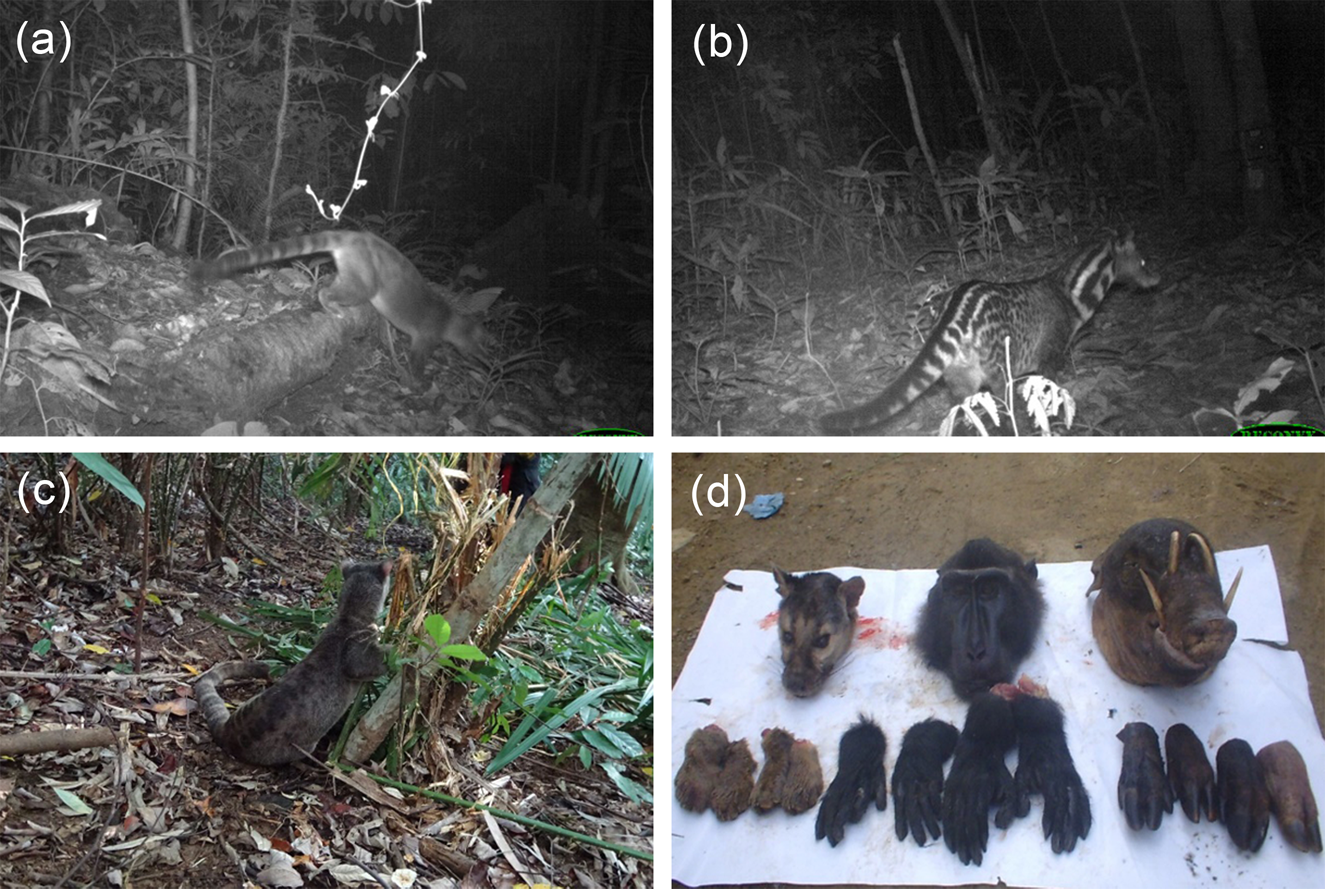
Forest loss is a potential threat to the Sulawesi civet. During 2000–2015 forest cover declined by 2.2% in Bogani Nani Wartabone National Park and 17.4% in Tangkoko Nature Reserve, with increased accessibility being the main explanatory factor (WCS-EPASS, 2017). Roads and fragmented forest increase access for poachers. We released one Sulawesi civet from a snare trap, which was probably set for wild pigs. Bushmeat consumption is widespread in North Sulawesi province. A market survey conducted by Lee et al. (Reference Lee, Gorog, Dwiyahreni, Siwu, Riley and Alexander2005) during 2002–2003 recorded 96,586 wild mammal specimens on sale, including the Sulawesi civet. Nevertheless, new conservation measures are being implemented in the protected areas that we studied, with ranger patrol teams and local informant networks, and law enforcement agency partnerships have implemented an integrated site-based protection strategy since 2017. Camera trapping is now being extended into neighbouring Gorontalo province, which could provide additional information on the Sulawesi civet and help guide the conservation of this species.
Acknowledgements
We are grateful to the Indonesian Ministry of Environment and Forestry, especially Bogani Nani Wartabone National Park and BKSDA-North Sulawesi staff for granting us fieldwork permission and supporting data collection, Fondation Segré, Rainforest Trust, Wildlife Reserves Singapore Conservation Fund, and UN Development Programme/Global Environmental Finance Enhancing the Protected Area System in Sulawesi for supporting various parts of this work, and Jedediah Brodie for lending us camera traps.
Author contributions
Study design: WP, IH, CJ, HH, ML; fieldwork: AP, CJ, RR; data analysis: AP, AC; writing: WP, ID, ML, IH, CJ.
Conflicts of interest
None.
Ethical standards
The research involved no human subjects, experimentation with animals and/or collection of specimens, and otherwise abided by the Oryx guidelines on ethical standards.



