




“There is still room for something else, something more secret, more subterranean: the sorcerer and becomings (expressed in tales instead of myths or rites)”
(Deleuze & Guattari, Reference Deleuze, Guattari and Massumi1987, p. 237)“I don’t know (how to feel)”: journal notes, June 26, 2025
The room was as quiet as the dead of night. Sitting with twenty-four middle-years students, one teacher, and one educational assistant in a make-shift sharing circle bordering a chaotic arrangement of tables and chairs, I hoped to garner conversation about how the present discourses and visible impacts of climate change were affecting these students. I wanted to know how they were feeling in response to one of the planet’s most serious concerns. I tried to make eye contact, attempting to show that I was “safe,” that we were “in this together,” that they could trust me with their insights about their feelings. But as I met their gaze, the students quickly looked away, seeking to divert attention from themselves while shifting awkwardly in the “hot seat;” surely a hotseat shrouded by educational discourse demarcating a pressure zone replete with only fixed and tidy solvable responses surely incommensurate to insoluble problems like global climate change.
Sitting in the sharing circle, I knew this cohort was well studied on the topic of climate change, and the political, ethical, social, and implications of a warming planet. Afterall, this Grade 6-7 class were fortunate to have a conscientious and diligent middle-years teacher who believed in the power of education as an important vehicle to respond to global challenges – like climate change. I had firsthand evidence of this teacher working to support his students to break from the need to vet their responses or having to carefully curate their feelings out of fear vulnerability, exposure, and uncertain outcomes within the social milieu of a middle-years classroom. But the students did not know that I was onboard with this plan. I was a stranger to their classroom, a “researcher from the university,” and probably someone who they thought might disapprove if they deviated from the status-quo; if they strayed from what they thought they should say according to normalisation processes so deeply entrenched in educational discourse and colonial ideologies. I could understand that the students might not trust that I hoped they would confess their raw, physiologically driven, and unfiltered emotions that filtered to a conscious interpretation of feelings. I wanted to know the truth of their pain in these times of climate catastrophe and distress.
And so, I asked again.
“How do you feel about climate change?”
Silence.
Stillness.
Silliness.
Don’t move, or the teacher will call on you.
Don’t you dare show vulnerability.
There is a whole playground out there.
And children can be mean. To me.
Please.
Speak loud
speak unsettling things
and be dangerous (Lorde, Reference Lorde2017)
Silence continued to prevail. I looked helplessly to the teacher, prompting him to try a “word pool” with the class. In the “word pool,” students would take turns, one by one as we went around the circle, to say one word that could encapsulate their feelings about climate change. This could be a word in any language, a body movement, a sound effect; just some form of representation of their feelings that they may utter, mutter, stutter, and then throw into the centre of the circle to be “rid of it.”
If only it could be that easy.
But alas, around the circle we went…
Sadsadsadsadsadscaredworriedcuriousembarrassed(!)anxiousanxiousconfusedanxiousanxiousanxiousworrieddisappointedanxiousanxiousgriefanxioussadsadmixedfeelingsanxcioussadanxiousanxiousworredfearfulanxious.I DON’T KNOW HOW TO FEEL!!!
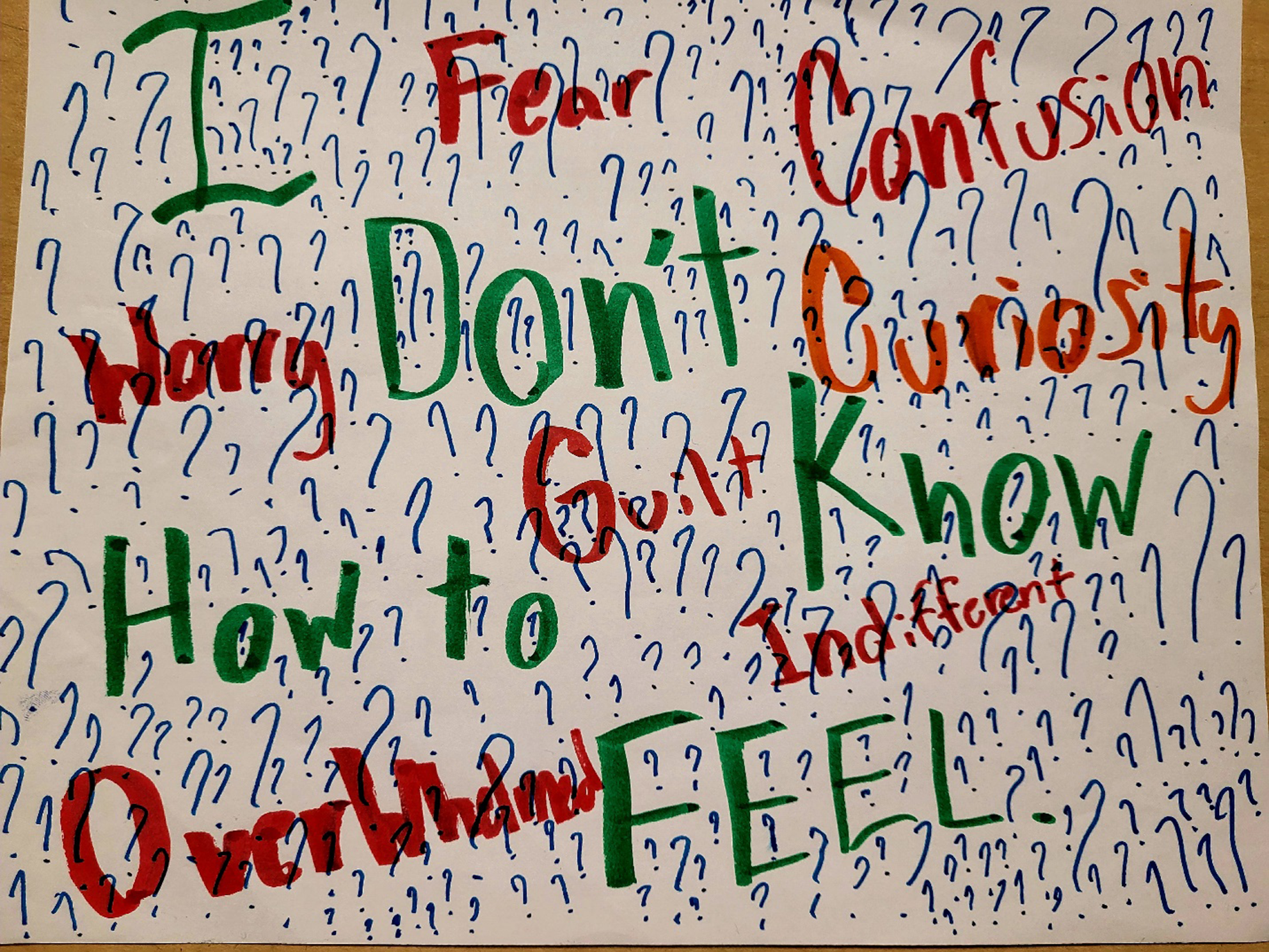
What do you mean you don’t know how to feel? It was now me that sat awkwardly in my chair, shifting uncomfortably as I fumbled for something to say in response. I looked at this student clutching his artwork representing his spoken sentiment (see Figure 1) and I noticed something akin to shock take hold of my body.
BUT WHY!?
I don’t know why this comment affected me in such lively and intense ways, but it seemed to pierce the air like a single thick and full rain drop plummeting from space, landing on skin to say, “change is here.” So, we sat there in silence., Twenty-seven bodies in twenty-seven plastic chairs; twenty-seven pairs of eyes diverted to the floor, to the walls, to the ceiling fans cutting our words together-apart.
Student artwork.

Figure 1 Long description
The illustration features a background filled with numerous blue question marks scattered across the page. The text is written in various colors, including green, red, and orange, and is arranged in a somewhat chaotic manner. The words include 'I', 'Fear', 'Confusion', 'Harry', 'Don't', 'Go', 'How to', 'Overwhelm', 'Feel', 'Indifferent', 'Know', and 'Curiosity'. The text appears to be overlapping and intertwined, creating a sense of complexity and uncertainty.
An anticolonial and posthumanist self-study
There is now an abundance of literature pointing to the relationship between the escalating global impacts of climate change and the adverse effects of irreversible ecological destruction on the emotional worlds of children and young people (see Lee et al., Reference Lee, Gjersoe, O’neill and Barnett2020; Ojala, Reference Ojala2016; Sanson et al., Reference Sanson, Van Hoorn and Burke2019; Verlie & Flynn, Reference Verlie and Flynn2022). Specific research has explored this relationship across a paradigmatic spectrum that ranges from quantitative studies (e.g., quasi experimental: Anwar, Reference Anwar2023; Ronan et al., Reference Ronan and Johnston2003); mixed-methods (e.g., Baker et al., Reference Baker, Clayton and Bragg2020; Bangsund, Reference Bangsund2018; Ojala, Reference Ojala2012a), qualitative studies (e.g., action research: Marks et al., Reference Marks, Atkins, Garrett, Abrams, Shackleton, Hennessy, Mayall, Bennett and Leach2023; ethnography: Gallagher et al., Reference Gallagher, Cardwell, Denichaud and Valve2022; intersectional feminism: Verlie, Reference Verlie2022; phenomenology: Løkken, Reference Løkken2022; Ojala, Reference Ojala2022), and postqualitative studies (e.g., affect, justice, grievability, and overlapping temporalities of entangled past∼present∼futures: Mayes, Reference Mayes2019; Merewether et al., Reference Merewether, Pollitt and Blaise2024; Verlie, Reference Verlie2024). While certainly not an exhaustive list, common emotional terms explored across these paradigmatic positionings include intersections of youth climate anger (e.g., Jones & Whitehouse, Reference Jones and Whitehouse2021); anxiety and worry (e.g., Galway & Field, Reference Galway and Field2023; Pihkala, Reference Pihkala2020); the journey from apathy to action (e.g., Bright & Eames, Reference Bright and Eames2022); despair, (e.g., Stevenson & Peterson, Reference Stevenson and Peterson2016); grief, solastalgia, and sorrow (e.g., Cunsolo, et al., Reference Cunsolo, Harper, Minor, Hayes, Williams and Howard2020; Galway et al., Reference Galway, Beery, Jones-Casey and Tasala2019; Goldman, Reference Goldman2022; Pihkala, Reference Pihkala2024); guilt (e.g., Kleres & Wettergren, Reference Kleres and Wettergren2017); and hope (Lawrence et al., Reference Lawrence, Skuce and Breen2022; Ojala, Reference Ojala2012b).
This brief sketch of some of the current research at the nexus of climate change and child/youth emotions is to emphasise the wide scope of this topic, and the significance and relevance for (western) education models and pedagogical and curricular enactments. As I write from Manitoba, Canada, I can also anecdotally account for important professional strides that take seriously the implications of climate change on child/youth emotions. However, reviewing Manitoba curriculum policy documents and the predominant focus on climate change (education) as located in the Grade 12 Global Issues: Citizenship & Sustainability curriculum (Government of Manitoba, 2017), it is evident that there is still work to be done at governmental and institutional levels. For instance, in the 354 pages of this curriculum document, a search for “emotion(s)” and “feeling(s)” returned ten mentions and six mentions respectively. The representation of emotion(s) and feeling(s) are highlighted across themes of ecoliteracy relating to the head (learning to know), the heart (learning to be), the hands (learning to do), and the spirit (learning to live together) (pp.20 – 21); transitions to sustainability recognising the need for justice, and for physical, emotional, intellectual, cultural, and spiritual sustenance (p.25); the impacts of consumerism causing feelings of frustration (p.98); feelings and emotions associated with homophobia and gender (p.158 & p. 173); media influences on emotions (p.205); questions considering who is emotionally affected by conflict (p.266); and, across various quotes and resources provided in the document. While I am concerned with the lack of frequency and extent that this document considers climate change and emotions, I am more concerned with how the focus on climate change and child/youth emotions is represented.
In response, this article is positioned as a call for a more relationally accountable and response-able engagement with climate change and (child/youth) emotions, supporting pedagogical enactments in (western) education to grapple more ethically with social and ecological threats and injustices of these times. I am not interested in an ontological focus on nature of climate change and child/youth emotions; nor am I interested in an epistemological focus on what can be known about climate change and child/youth emotions, or an axiological focus on the ethics involved in understanding climate change and child/youth emotions. Rather, I am interested in an ethico-onto-epistemological (re)orientation of the child/youth in relationship with climate emotions, with a specific focus on climate anxiety. To do this work, I dwell within and between borders of anticolonial and posthumanist self-study.
I appreciate that posthumanism and self-study might be at odds with each other, given the posthumanist emphasis on troubling notions of a neatly bound and fixed individual self to suggest that a body∼mind comes into being through relational intra/interactions with broader ecologies of the world and that self-study implies a focus on the individual self. Yet self-study is not concerned with just the individual self per se, but that the unit of analysis is always multiple with references to the self in practice, and in relation to others – including more-than-human others (Strom, Mills, Abrams & Dacey Reference Strom, Mills, Abrams and Dacey2018). While self-study involves a coming to know process through dialogic partnerships and critical friends (Hamilton & Pinnegar, Reference Hamilton, Pinnegar, Garbett and Ovens2017; Loughran, Reference Loughran2005), along with Strom and colleagues (Reference Strom, Mills, Abrams and Dacey2018), in this article I also care about the materiality of bodies in addition to discursive constructions of dialogue: how discursive (social) and material (matter) forces co-produce subjectivities.
Through self-study practices as complex, contextualised, dynamic, and situated phenomena, I focus on a research collaboration with a Grade 6 – 7 middle-years cohort to interrogate aspects of my work as a storying encounter in the site of production within a classroom context of Winnipeg, Canada. Attending to the often-ignored aspects of materiality and affect, posthumanist perspectives in this article seek to displace dualistic logics and types of thinking that espouse a rational human as the reference point for the universe, capable autonomous action, and imbued with self-control over nature, society, history, and discourse (Braidotti, Reference Braidotti2013; Strom et al., Reference Strom, Mills, Abrams and Dacey2018). As affect is understood as the capacity for the body to act through its embeddedness in multiplicity, always involving a becoming-in-relation to a collective, the collaborators in this research project – one teacher and cohort of learners – helped me to seed new ideas and directions that problematise climate anxiety (Slater, Reference Slater2018, Reference Slater2020; Verlie, Reference Verlie2022). As such, I am not using their stories garnered from field notes and conversations during multiple pedagogical events and two sharing circles held with the class in an extractive way to quote from or to data mine. Rather, attuning to their stories, the teacher and learners stories help(ed) me to become more relationally accountable to diverse educational scholarship and theories (Springgay, Reference Springgay2022).
Specifically, I seek to embrace anxiety as a political project in leveraging power and privilege a white, western, third-generation settlerFootnote 1 to Naarm (Melbourne), Australia, and a first-generation settler to Treaty 1 (Winnipeg), Canada. This is a project that seeks to transgress societal and educational norms caught in a double bind: as climate anxiety becomes normalised in (western) educational models, (western) educational models continue to enact linear and fixed solutions to problems (e.g., a focus on fixing, or solving, child/youth anxiety). Moreover, as many Indigenous and anticolonial scholars have critically highlighted (e.g., Coulthard, Reference Coulthard2014; Laurendeau, Reference Laurendeau2023; Slater, Reference Slater2020; Watego, Reference Watego2021), there is significant danger in centring white anxiety to the detriment of interrogating paradigms of whiteness within settler-colonialismFootnote 2 and colonial land relationsFootnote 3 driving anthropogenic climate change in the first place; while also arresting possibilities for (re)configuring settler subjectivities within a more ethical and reciprocal relational frame.
To disrupt and suspend settler-colonial certainty and agency to stay with trouble of climate anxiety (Haraway, Reference Haraway2016; Slater, Reference Slater2020; Tuck & Yang, Reference Tuck and Yang2012), I shift the focus from the self, and student empowerment to “feel better” in the face of climate catastrophe and distress, to position the human as part of an entangled/differentiated assemblage (Verlie, Reference Verlie2020). As this assemblage works to continually (re)produce me/us in particular ways, I consider specific events, discourses and social expectations, power relations, and material conditions that coalesce and work through each of us in conceptualising a more radical, anticolonial, and posthumanist account of climate change and child/youth emotions. Departing from a focus on how children/youth experience certain emotions in response to climate change, or how they “found their voice” through emotional empowerment, I query what these emotions do, what the feeling of climate anxiety does; and how staying with the complexity of climate anxiety can function as an anticolonial move for children/youth who have inherited the effects of ongoing settler-colonialism that is leaving social and ecological destruction in its wake.
A settler becoming-with discomfort
Much has been written about the importance of unsettling settler-colonial worlds as an act of decolonisation towards Indigenous futurities and the (re)configuring of different temporal horizons to that of oppressions of the past and contemporary times (Tuck & Gaztambide-Fernandez, Reference Tuck and Gaztambide-Fernandez2013). For example, Regan (Reference Regan2010) authored a compelling book that calls for non-Indigenous Canadians to engage in decolonisation and reconciliation with Indigenous peoples in response to the destructive legacies of colonialism and Residential Schools. In his Reference Fortier2021 book, Fortier considers the politics of unsettling and decolonising to suggest that unsettling involves a collective transformation of the ways territories are inhabited through a critical interrogation of knowledges and worldviews that shape societies. For Eve Tuck and Kevin Yang (Reference Tuck and Yang2012), unsettling through frames of decolonising is looked upon as a pragmatic gesture to suggest that decolonising is not a metaphor and that settler-colonial unsettling, therefore, is related to colonial land relations and settler occupation; a disposition also taken by Morgensen (Reference Morgensen2011) who highlights the work of unsettling as closely related to the displacing settlers from their possession of Indigenous Land. This idea is rather triggering for me, given that I made the active choice to relocate to the Canadian prairies a decade ago now, without a single thought about this move being one of free will, endowed with all power and privileges of someone with white skin and a western (European) ethno-ancestral background. It was not a move bound to necessity in fleeing war, poverty, or my own displacement. It was a move full of entitlement and access to the land and people of Saskatchewan, and now, Manitoba. And knowing all this, I have not left, but continue to settle through full time employment, property ownership, and hopes of building a fence in the future to clearly demarcate “property that is mine.”
Thinking about my own settler-colonial entitlement and access to land amplifies tensions of myself as an academic onlooker, characterised by McKegney (Reference McKegney2013), as “voyeurism, consumption, and lack of accountability” (p.15). Short of removing myself from the land, land that I continue to actively search for belonging with, I am caught in my own double bind: I am stuck between attempts to grapple with specific power positions and privileges from (micro) politics of location as a settler to Canada, yet in doing so, I risk settler moves to innocence (Tuck & Yang, Reference Tuck and Yang2012). If “unsettling is a consciousness towards action” (Steinman, Reference Steinman2020, p.5), then there needs to be a care-full and ongoing interrogation of settler subjectivities that work to recentre whiteness through yet another form of settler appropriation (Tuck & Yang, Reference Tuck and Yang2012). So, I state very clearly that I do not have the answers to this complex predicament; but I do (rather desperately) seek to bring the human body, my human body and perhaps yours, into a vital and lively entangled/differentiated relationship with multispecies kin (Calderon, Reference Calderon2014) - what Williams (Reference Williams2019) called a reshaping of colonial subjectivities through the language of the land. I care deeply about emotional and cognitive processes that work to grapple with (mis)education and ignorance, guilt, identity, and relationships to Land, Place, and Country (Davis et al., Reference Davis, Hiller, James, Lloyd, Nasca, Taylor, Davis, Denis and Sinclair2020) as a way to (re)imagine, (re)story, and (re)world pedagogical models for social and ecological justice.
To this end, it is not feasible for institutions, or myself bound to a western institution, to undo colonial harms (thus, decolonisation). Decolonisation is a loaded term that ostensibly moves me, you, and the institution from settler shame through driving the need for a resolution and (re)establishing the self or institution as good and worthy (Kizuk, Reference Kizuk2020; Laurendeau, Reference Laurendeau2023); or what Slater (Reference Slater2018) calls, “good white people.” As non-performative, decolonising efforts can vastly miss the mark on concerns of justice in undercutting settler-colonialism and associated violences (Ahmed, Reference Ahmed2004). This is why engagement with equity, diversity, inclusion, and access (EDIA) is flawed: it is not enough to simplify and whitewash the legacies of settler-colonialism through custom tools that address social inequalities, while diversifying and including different kinds of people into impoverished systems because of colonial (and neoliberal and capitalist) ideologies. It is also important to address tensions in institutional, curricular, and/or pedagogical attempts at indigenisation. Seeking to expand the academy’s single focused and narrow conceptions of what counts as good knowledge, indigenisation is a move to include Indigenous worldviews in transformative ways (Gaudry & Lorenz, Reference Gaudry and Lorenz2018). However, how indigenisation occurs is the problem at hand, given that indigenisation is often operationalised as a “particular version of inclusion…that leaves the dominant systems and structures themselves intact” (Laurendeau, Reference Laurendeau2023, p.41). Again, this kind of inclusion is non-performative in that it does not only avoid dismantling colonial structures in place, but actively conceals them (Ahmed, Reference Ahmed2012). The academy is not a natural or neutral setting, in which knowledge is represented equally; but very specific power discourses underpin and informs how knowledge is produced and who is producing it. Unsettling the settler self could also be marshalled through considerations and enactments of reconciliation. This is particularly relevant in light of Canada’s Truth and Reconciliation Commission’s Calls to Action in 2015 (TRC, 2015). Yet as Coulthard (Reference Coulthard2014) reminds me, reconciliation discourse works through politics of recognition that function to (re)produce settler hegemony. In other words, suggesting that we should look to the settler state to repair settler∼Indigenous relations only serve to legitimise the settler state and points to a rhetorical gaslighting in believing that we (western societies) can return to previously established harmonious relationships with Indigenous peoples and Indigenous Land (Garneau, Reference Garneau2016; Laurendeau, Reference Laurendeau2023). What exactly are we reconciling and to what world do we seek to return to? (Grenz, Reference Grenz2025).
While it is abundantly clear that there is no linear solution to the task of unsettling the settler self (short of relocating to Wales or Scotland as per the roots of my family’s heritage), a crucial part of this project is bound to an anticolonial praxis. A thinking and doing that prioritises the anti in holding an important relational positionality (Ahmed, Reference Ahmed2004; Liboiron, Reference Liboiron2021); and thus harkens a sustained interrogation of settler belonging and rigorous examinations of settler entanglements in what it is the settler opposes (Laurendeau, Reference Laurendeau2023). Writing this, I can hear the crescendos of posthumanist outcry at the notion of opposing something, and all that is wrong with being “anti” something. In my posthumanist scholarship, I too have critiqued the “anti,” suggesting that it only works to (re)produce oppositional difference through dualistically framed “for and against” positions. Such dichotomy is deeply entrenched in western thought and culture, with vast evidence pointing to its harmful effects on side of the binary that is deemed “less than.” I can also hear the echoes of posthumanist thought reverberating through my home office as I write this, reminding me that “anti” is set within ideas of social determinism, and thus, inadvertently perpetuates agency as solely humancentric in (re)affirming human exceptionalism and supremacism; which by all accounts are at the root of twenty-first century socio-ecological crises narratives in the first place (Braidotti, Reference Braidotti2013; Haraway, Reference Haraway2016). To this end, I have often adopted postcolonial narratives in my scholarship (see: Riley, Reference Riley2020, Reference Riley2021); not to signify that we (society) are past colonialism, but to point to entangled past∼present∼futures that are imbued with various discourse, performances, politics, and values in the everyday derived from colonial histories (Maddison, Reference Maddison2012).
I appreciate that postcolonialism seeks to account for worldmaking as a relationally co-constituted, yet differentiated, entanglement, however, I follow de La Bellacassa (2017) to contemplate what comes after entanglement. That is, paying close attention to the specific and situated acts of care that emanate from specific asymmetrical power hierarchies within these entanglements. In this way, I am not interested in the study of myself as a postcolonial subject, but how my subjectivities are being produced as a settler-coloniser. Thus, my emphasis is not on how I experience a sense of home as a settler, but to upend a sense of belonging through a performative reckoning, refusal, and resistance to (re)world what it means to call Manitoba home; a settler becoming-with discomfort. Crucially, and an angle of arrival that will perhaps please my posthumanist colleagues, I differentiate between the “anti” demarcating subjectivities that contradict colonialism to adopt an “anti” that shows how subjectivities come into being as contrasting colonialism (Stengers, Reference Stengers2005).
Subjectivities coming into being: jogging for mental health: journal notes, August 9, 2025
It’s now over a month later and I am still haunted by the student comment indicating that he didn’t know how to feel in response to climate change. The question of why this comment affected me so deeply churned through my thoughts, as I embarked on a weekend run. It has been a dry summer in Manitoba, and my backyard is full of yellow leaves dying before their time due to the brazen heat and weeks upon weeks of no rainfall. My lungs hurt. They have that scratchy, raspy feel beckoning me to cease incessant deep inhalations. I am running along the Red River, just south of my hometown, weaving through box elder, common chokecherry, bur oak, creeping thistle, and quaking aspen. The river to my left shimmers like a thousand tiny diamonds cast from the sun, scattering across ripples of water now bejeweled and sparkling. Laboring through the thick air alongside the sounds of midsummer buzzing around me, the humidity hugs my sweaty skin like a blanket. My lungs hurt. I need to stop. While jogging might be a healthy pastime in “normal times,” it most certainly is not amidst deteriorating air quality (or so the Air quality index [AQI+] tells me).
But as wildfires have ravaged much of north-western and central Manitoba, these are not “normal times.” My lungs hurt. Anxiety is now the blanket on my skin. Chest muscles feel tight. I panic. I run to resolve my own battles with mental health. I am filled with irony, however, in realising that running no longer provides relief, but works to exacerbate an impending sense of climate anxiety. I am amidst a “fit of white panic.” There could be nothing more anxiety provoking than living with the fears of escalating natural disasters, rising sea levels, species extinction. Pain. Destruction. Death. Wash. Rinse. Repeat. Smoke filled my lungs. They hurt. I know all too well that these fits of white panic reinstate colonial violence (Danowski & de Castro, Reference Danowski and De Castro2017). Who am I to feel anxious, scared, upset, UNCOMFORTABLE, knowing the harms that “my people” continue to inflict on people outside of their category, including here on Treaty 1, and the First Peoples of Turtle Island.
The horror story of fossil fuel dependent societies is a pledge to children’s dystopian futures, to each child sitting in that sharing circle. Now as I run, I have the incessant rumble and hum of capitalist machines buzzing through my head alongside the swath of mosquitoes that I have given up trying to swat. Bite me. I don’t care. Capitalist consumption and colonial control are so interlocked, slippery, and overt, that it can be impossible to understand which is doing what, and which is doing what to whom. To say I feel anxious at our global predicament – at my deep complicity – is an understatement. I also don’t know how to feel. Feeling feels useless. Feelings are too fleeting…
This too shall pass.
Consumption.
Eat me, mosquito,
I am ripe for the picking.
Mum said Vegemite will do the trick. Get my B-Vitamins.
Ward of the mosquitoes.
I could order more Vegemite through Amazon.
Probably have it by tomorrow.
Consumption.
Control the mosquito.
You make me angry and uncomfortable. I must protect myself from you.
There is malaria, you know.
But not really here, in the “developed” country of Canada.
Mosquitoes with their own agency are drawn to my scent; just doing mosquito things.
My thoughts run away.
But my body is BLOODY UNCOMFORTABLE.
I am sitting “in it”.
I sob.
Four new mosquito bites swell on my ankles yearning to be itched.
Do not be distracted.
But for a moment, I no longer feel reverberating anxiety ripping at my seams.
Stay with the tears.
Stay with the itch.
Stay with the grit, the sweat, the clenching of jaw.
Bear with it; live with it; die with it.
And scream upwards to the canopy of trees.
Mocking me and my ridiculous human expressions.
“Of course, you feel uncomfortable,” they whisper.
We are burning, bleeding.
“And you jog for your mental health.”
If I live through fairytales, I might finish this poem with some sort of awakening that heralds insight into lessons learned and a sense of peace or resolve. Yet as Tuck and Yang (Reference Tuck and Yang2012) remind me, there is an ethic of incommensurability when it comes to (western) ideals that signify (western) people to stop feeling uncomfortable; a sentiment also taken up by Haraway (Reference Haraway2016) in her dictum, staying with the trouble; by Slater (Reference Slater2020) in the proposition to stay with the anxiety; by Watego (Reference Watego2021) in compelling arguments to do away with hope; and by de Oliveira (Reference de Oliveira2021) in insightful and inspiring bids that ask us to:
choose depth over drama…to walk toward the storm with the stories you will dance with…to look at the world in the mirror to see what is real and not turn away. This is what “sitting with” means and it is very different from strategies to fix or save the world that promise you validation, triumph, power, and pleasure. p. 40.
Without relying on western ideals of reconciliation, recognition and resolution, Slater (Reference Slater2018) wrote that being disturbed, halted, and unsettled “provides ways to renew our imaginative life” (p. xvii). This work demands a meaningful interrogation of particular forms of (western) thinking, in which the anxious white subject becomes a normative character. This work demands a thorough and meaningful attending to settler-colonial complicity in the ontological disconnect between humans and Earth (Malone, Reference Malone2025). More, this work demands the revision of a universally positioned human driving anthropogenic climate change to understand anthropogenic climate change as explicitly underscored by particular behaviours from a specific kind of Anthropos; namely, settler-colonial land relations (Reibold, Reference Reibold2023; Whyte, Reference Whyte2018). For Slater (Reference Slater2018), anxiety is potentially productive in redoing colonial land relations only when it “disrupts the colonial relationship that underpins the first type of anxiety and unsettles—emotionally and, potentially, literally—the hierarchical, dispossessive, and exploitative settler-native relationship” (p.14). Thus, to stay with the unfinished nature of this work, it is no longer tenable to think of climate change as a problem to be solved; nor is it justifiable to solve the problem of climate anxiety in the face of a time in history that anxiety is well warranted. What is at stake, however, is how climate anxiety is positioned and engaged with.
Climate anxiety as anticolonial activism
I did not know where I would arrive as I commenced writing this article (Loveless, Reference Loveless2019; Springgay, Reference Springgay2022). It has been through the machineries of this text that I am now being produced into something different. It is the machineries of this text that bring me to understand, or at least recognise, the thoughts, feelings, and emotions arising from the affects generated through the sharing circle of June 26. Through discursive (social) and material (matter) forces producing me in particular ways, I turn to the possible openings that “not knowing how to feel” presents; to suspend fleeing into anxiety as a retreat into virtuous identity maintenance; to reckon with hegemonic forms of climate anxiety; to trouble care as a universal ethic in reaffirming my own belonging and white authority (Slater, Reference Slater2018); to move with the messy (unk)now(n) in critically questioning the structures of climate emotions within normalising processes of settler-colonialism’s constitution of specific kinds of subjects. Pushing against settler-colonial logic of containment and rule that “operates through discursive and nondiscursive practices of fixing and arresting the dynamic and ongoing movement of cultures, ideas, and bodies” (Norman et al., Reference Norman, Hart and Petherick2019, p.120), I was forced to question how it got to be that (my own) white voice is of greater importance than those who are most affected by climate catastrophe and distress - including multispecies kin.
I am cognisant of risks in this article, in that I may be unwittingly sidelining any hope of an anticolonial movement through a focus on my own reconfiguring of subjectivity. Yet as subjectivity is an effect of power, not its cause or pre-cursor, to change subjectivity, is to first change power (Foucault, Reference Foucault1982). It is for this reason that I target dominant western, or settler-colonial paradigms that continue to perpetuate the dualistic splitting of problems and solutions, and thus, climate anxiety as something that should be overcome (Verlie, Reference Verlie2020, Verlie, Reference Verlie2022). There is no safe place of reprieve in these times of global climate catastrophe and distress (Evans, Reference Evans2024). These times are asking us, (western folx) to upend normalising patterns and processes that have become the status-quo in colonial land relations. Climate anxiety is real, and I feel it too; but these times are asking us (western folx) to be “different types of humans” - if there is to be any ecologically, and thus, socially, flourishing future.
Land back to itself: journal notes, august 30, 2025
Since the Spring and in the four months that I began writing this article, I decided to conduct a scientific experiment with the riparian zone intersecting “my property” and the Red River. In the riparian zone lives cottonwoods, willows, dogwood, and green ash amongst native grasses, herbaceous flowering plants, and sedges. Yet like any species subjected to incessant trampling and flagrant disregard, these species wither, bend, and break as a result of the many trails splicing across the riparian zone to facilitate access to the river’s banks. I am not a botanist, but from my environmental education training, I do know that riparian zones are crucial in their contributions to ecosystem health. They regulate nutrient and water flow and filter pollutants between aquatic and terrestrial environments; they stabilise stream banks to prevent erosion; they store water to reduce flood impacts; and riparian zones serve as significant habitats for diverse species. Yet the human made trails between land and water are the epitome of a particular hubris defined by litter hemmed into the very ecological structures of the shoreline. For instance, I have discovered tangles of fishing wire and rusty hooks; shards of once plastic containers that once held bait; batteries probably leaching cadmium, led, lithium, and mercury; empty cans that spill capitalism as refined sugar; and half together alcohol bottles with pieces smashed and strewn across rocks, logs, and mud with reckless abandon.
I know all too well that to prevent (or let’s call it was it is, “ban”) people from accessing the river through “my property” is yet another colonial tactic of control and accumulation. I have wrestled with this move again and again and again, understanding the social implications of such an experiment. Who am I to say that my Indigenous neighbours or community members cannot, should not, access this section of the Red River. And maybe, I am going about setting up all the wrong relations, to which I will have to be accountable. But as I said, this was an experiment. I wanted to see firsthand what would happen to the riparian zone if it was simply left to recover itself. Specifically, I wanted to see firsthand what would happen if land was “given back to itself” (Manning, Reference Manning2022).Footnote 4 I expected that without constant human interruptions, that the riparian zone would recover, repair, regenerate; returning to a safe haven for Red River riparian zone critters – frogs, white-tailed deer, beaver, and woodchucks; birds; mallard ducks; and even reptiles like painted turtles and snapping turtles.
And this is exactly what happened (see Figure 2).
But what I did not expect was the way my skin stopped prickling at every scary thought of climate change. Bearing witness to a family of white-tailed deer hunkering in the cottonwoods as Fall fog begins to creep into early September mornings, I met a faint, yet honeyed, wash of healing sweep across charred lungs. Breath came easily, and as I watched sunlight dappling morning clouds, I came to realise that my hope for the Earth lies in knowing the river, the riparian zone, on its own terms. Knowing Land, or Country, or Place on its own terms is very different from producing a Land Acknowledgement (at my next conference). But to know Land, Country, or Place, is to know myself, and to acknowledge the sharp edges of my own (colonial) corners in attuning to the porosity of entangled/differentiated human/ecological wellbeing. As Grenz (Reference Grenz2025) claimed, “Heal the people, heal the land. Heal the land, heal the people” (p. 178). With this dictum in mind, I question how (settler-colonial) belonging might shift from a focus on nationalism to a project grounded in justice (Laurendeau, Reference Laurendeau2023), as a simultaneous move that casts climate anxiety as obligated to anticolonial activism.
Land returning to itself.
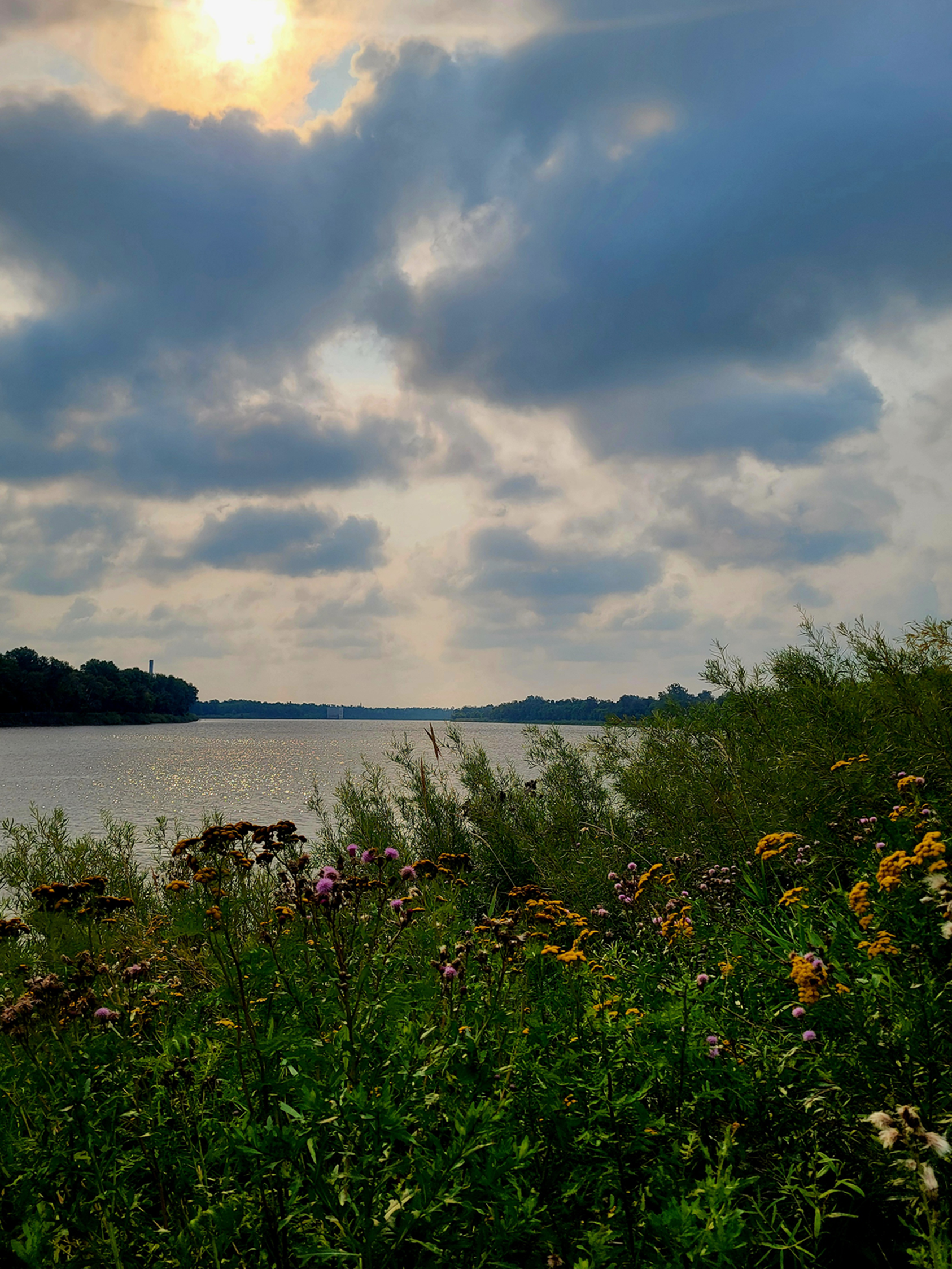
Figure 2 Long description
The image features a serene landscape with a calm lake reflecting the sky. Wildflowers in various colors, including yellow and purple, grow in the foreground. The sky is filled with clouds, and the sun is partially visible, casting a soft light over the scene. The distant shore is lined with trees and greenery, creating a peaceful and natural setting.
Climate anxiety as anticolonial activism is not about transforming climate anxiety to action in a neoliberal sense, in which an individual becomes empowered to take climate action as a result of emotions inciting change. Rather, climate anxiety as anticolonial activism critically interrogates settler-colonial complicity in, and response-ability to, impoverished systems in the bid for different types of relations with Indigenous peoples, Land, and multispecies kin. Climate anxiety as anticolonial activism is a (re)imagining of curricular and pedagogical modes and methods that usher elusively open-ended, ambiguously slippery, and tenuously indefinite engagement with the emotional politics of settler-colonialism. There is no solution to the messy, contingent, and emplaced nature of this work. But there is scope to begin from the ontological understanding that we (settler-colonial humans), are indeed inherently interconnected with the relational tissue holding this planet together. The Land is speaking back. And amidst its wounds, breaks, and bruises, it also whispers:
“Forgiveness is living a good life.”
Acknowledgements
Learning to know myself is a concept gleaned from many conversations with Anishnaabek from Turtle Island. I am forever grateful for their teachings, and for welcoming me into their community with openness, grace, and a continued commitment to healing together. I am also thankful for the middle-years research collaborators (teacher and learners) on this project. I learned so much from spending time in their classroom and I extend my heartfelt gratitude for accepting me into their educational orbit.
Financial support
This research was supported by Research Start-up Funds from the University of Manitoba.
Competing interests
Kathryn would like to disclose that she is in the Editorial Executive of The Australian Journal of Environmental Education (AJEE). In accordance with AJEE protocols, Kathryn was not involved in the editorial process or decision making regarding this manuscript.
Ethical standard
The study was conducted according to the guidelines of the Tri-Council Policy Statement: Ethical Conduct for Research Involving Humans – TCPS 2 (2018) and was approved by the Research Ethics Board at the University of Manitoba on September 10, 2024 (HE2024-0172).
Author Biography
Kathryn Morog, Ph.D., is an Assistant Professor in Curriculum, Teaching and Learning in the Faculty of Education at the University of Manitoba (Winnipeg, Canada). As a past teacher of Physical, Health, and Outdoor Environmental Education, Kathryn’s research is primarily focused on relational ontologies, pedagogies for (w)holistic wellbeing, and an anticolonial praxis for social and ecological justice. Kathryn is currently the Principal Investigator for the Movement as Artivism (University of Manitoba, 2023 – 2028) and Decolonizing Physical Literacy (Research Manitoba, 2024 – 2026) projects. Kathryn is also an Associate Editor with the Australian Journal of Environmental Education.

 Open access

