


Mexico is a country undergoing an epidemiological and nutritional transition(Reference Hawkes1). The nutrition transition observed in developing countries is characterised by rapid changes in dietary composition, including higher intakes of fat and added sugars. These changes have been associated with obesity and chronic diseases(Reference Popkin2,Reference Malik, Popkin and Bray3) . The traditional Mexican diet, prior to the North American Free Trade Agreement (NAFTA) of 1994(Reference Hawkes1), was high in corn tortilla and legume intake, and low in refined sweets and cereals(Reference Rodríguez-Ramírez, Mundo-Rosas and García-Guerra4). However, in the years post NAFTA, there has been a greater availability of energy-dense foods(Reference Hawkes1,Reference Rivera, Barquera and Campirano5–Reference Clark, Hawkes and Murphy7) as the new open trade allowed a free flow of American processed goods into Mexico. This seems to have marked a shift in dietary patterns and dietary intake in the Mexican population. Energy-dense foods or foods with added sugars, fats and salt are defined as processed foods and drink items with >13 % saturated fat and/or >13 % added sugars(Reference Roodenburg, Popkin and Seidell8). Mexico’s nutritional transition has opened the way to a new wave of negative health conditions (e.g. obesity, type 2 diabetes) in the Mexican population. Prior to the 1990s, underweight and anaemia were the predominant problems among preschool and school-age children(Reference Rivera, Barquera and Gonzalez-Cossio6). However, in recent decades, there has been a drastic increase in overweight, obesity and chronic diseases in the entire population(Reference Rivera, Barquera and Campirano5).
According to the most recent Mexican Health and Nutrition Survey (ENSANUT 2012), one-third of children (aged 2–17) are overweight and obese, and 73 % of women and 69 % of men (aged ≥20) are either overweight or obese (one of the highest rates in Latin America)(Reference Guiterrez, Rivera-Dommarco and Shamah-Levy9,Reference Barquera, Campos-Nonato and Hernández-Barrera10) . Overweight and obesity represent an important public health concern due to the association that exists between adipose levels and the risk for chronic health diseases(Reference Fantuzzi11,Reference Wellen and Hotamisligil12) . For example, the risk of developing hypertension is up to four times higher in overweight and obese children than in normal-weight children(Reference Flynn13–Reference Tu, Eckert and DiMeglio15). Likewise, overweight and obese children are 73 % more likely to develop glucose intolerance than children with normal weight(Reference Franks, Hanson and Knowler16), resulting in a higher risk for developing type 2 diabetes. Among adults, the risk of developing type 2 diabetes is higher among individuals with obesity than among individuals with normal weight(Reference Mokdad, Ford and Bowman17–Reference Bell, Kivimaki and Hamer19). According to the Organization for Economic Co-operation and Development, Mexico ranks number one in type 2 diabetes prevalence(20).
Overweight and obesity are associated with high patterns of energy-dense foods such as sugar-sweetened beverages (SSB) and processed snacks, resulting in the development of type 2 diabetes(Reference Rodríguez-Ramírez, Mundo-Rosas and García-Guerra4–Reference Rivera, Barquera and Gonzalez-Cossio6). Between 1999 and 2012, the sales of energy-dense foods in Mexico increased approximately 10 % per year(21). Almost a quarter of all the energy consumed among Mexicans comes from SSB(Reference Barquera, Campirano and Bonvecchio22,Reference Barquera, Hernandez-Barrera and Tolentino23) . Mexico has one of the highest per capita consumption of SSB in the world(Reference Barquera, Campirano and Bonvecchio22–Reference Stuckler, McKee and Ebrahim24). The high SSB consumption could be attributed to the food environment – places where a person can find food for purchase or consumption – that facilitates their access. For instance, having access to a snack bar, vending machine and convenience store increases SSB consumption(Reference Cullen and Zakeri25–Reference Borradaile, Sherman and Vander Veur28).
Using a social-ecological model, the food environment has been typically divided into different interacting levels. These levels include the organisation (i.e. household, school, worksite), consumer (i.e. availability, price, promotion and nutrition information) and community (i.e. type and location of stores)(Reference Glanz, Sallis and Saelens29). Elements in each level (e.g. type of food outlet, price, promotion, placement) have been associated with dietary intake. In the US food environment, the availability of convenience or corner stores facilitates access to energy-dense foods(Reference Rummo, Meyer and Boone-Heinonen30). The availability of convenience stores and corner stores has been linked to higher obesity risk(Reference Drewnowski, Moudon and Jiao31). On the other hand, some research has shown that the availability of supermarkets and grocery stores could be associated with intake of fruit and vegetables (FV) or nutrient-dense foods (defined in this paper as fresh food items like FV), which has been associated with lower obesity risk(Reference Viola, Arno and Maroko32,Reference Jilcott, Keyserling and Crawford33) .
One criticism of food environment studies is that most studies have been done in high-income countries. Multiple literature reviews of the food environment have summarised the relationships between the food environment and dietary intake in the USA(Reference Walker, Keane and Burke34–Reference Charreire, Casey and Salze36); however, to our knowledge, there are no systematic reviews of the Mexican food environment. This review is important because the strength and direction of the association between levels of food environments and dietary intake in the Mexican context have not been fully explored(Reference Feng, Glass and Curriero37). A recent narrative review on the Mexican food environment found that the socioeconomic and nutritional transition in Mexico has reduced the availability of nutrient-dense foods(Reference Aceves-Martins, Llauradó and Tarro38). However, the results of this review are based on self-reported intake from FFQ rather than on both dietary assessments and food environment assessments such as checklists(Reference Ohri-Vachaspati and Leviton39,Reference Oldenburg, Sallis and Harris40) , market baskets(Reference Block and Kouba41,Reference McKinnon, Reedy and Morrissette42) and food inventories(Reference McKinnon, Reedy and Morrissette42,Reference Fulkerson, Nelson and Lytle43) . The objective of this paper was to evaluate the relationship between different levels of food environment and their association with dietary intake in the Mexican population.
Methods
We conducted a systematic literature review of the Mexican food environment and dietary intake to document how the food environment might be influencing dietary intake in the Mexican population. This study was guided by the Model of Community Food Environment and focused on the community, consumer and organisational food environments. The levels of food environment were operationalised using the following variables for each level: for the community food environment – availability, accessibility, type and location of food venues; for the consumer food environment – availability, price, promotion and nutrition information of food items; for the organisational food environment – availability of food items in non-food outlets (e.g. home, work, school)(Reference Glanz, Sallis and Saelens29). Each level is believed to interact with each other to influence dietary intake. Articles were identified by searching Medline (PubMed), PsychInfo, Web of Science and SCIelo (a Latin American database) using combinations of environment (built*, cultural*, household*, local*, neighbourhood*, physical*, rural*, urban*, school*, social*, sociocultural*, socioeconomic*), diet (caloric*, energy*, fat*, fruit*, vegetable*, soda*, soft drink*, sugar-sweetened beverage*), access (accessibility*, availability*) and Mexico* terminology. Observational studies among all age groups from rural and urban populations were included. A rural setting was defined as a community with <2500 residents, whereas an urban setting was defined as a community with >2500 residents(44,45) . Inclusion is limited to papers published in English or Spanish that included at least one systematic measure of both the food environment and dietary intake. A systematic measure was defined as the usage of any assessment tool that can capture food availability. The range of publications extended from 1979 to 2018. Conference proceedings, theses, dissertations, literature reviews, abstracts and presentations were excluded from the review. Studies that manipulated the food environment (e.g. experimental studies) were excluded because they might not reflect a true representation of the food environment. Last, studies with Mexican populations living outside the Mexican territory were excluded. This was primarily the case with studies from the USA. Our study focused on the Mexican food environment rather than the US food environment. The reference section of studies that met the inclusion criteria was reviewed to identify additional studies.
Data extraction included authors’ names, year of publication, setting, sample size, sex, gender, study design, dietary outcome, reliability and validity of assessments, type of data, analysis done, nutrition and environment assessment tools used, and correlates of nutrition intake and food environment. Bias assessment focused on whether studies used random sampling techniques and the type of reporting standards used in the studies. To minimise bias, we did two things: (i) We reviewed all available studies that met our inclusion criteria to avoid a sampling bias. (ii) We reviewed each included study to assess the risk of bias using the reviewers’ judgement on the major sources of bias (selection bias, exposure assessment, outcome assessment, attrition), and studies that were determined to have a high risk of bias were excluded (we did not end up excluding any studies for high risk of bias).
Reviewers 1 and 2 identified and screened papers individually. Reviewer 3 settled disagreement about inclusion eligibility. Reviewers 4 and 5 reviewed summaries of documents for consistency. Studies were first screened at the title level. If authors were not clear on whether articles met inclusion criteria at the title level, the abstracts were screened next. Full papers were obtained and assessed for articles that were not clear at the abstract level. The reference section of studies that met the eligibility criteria was screened for relevant citations, and the same screening procedure was followed for these additional articles. The most common reason for excluding articles at the title level was for unrelated topics. The main reason for discarding studies at the abstract and full-text levels was for lack of an environmental assessment. Most studies screened at this level used self-reported dietary intake and nutritional intake from questionnaires, but did not include assessments of the food environment.
Results
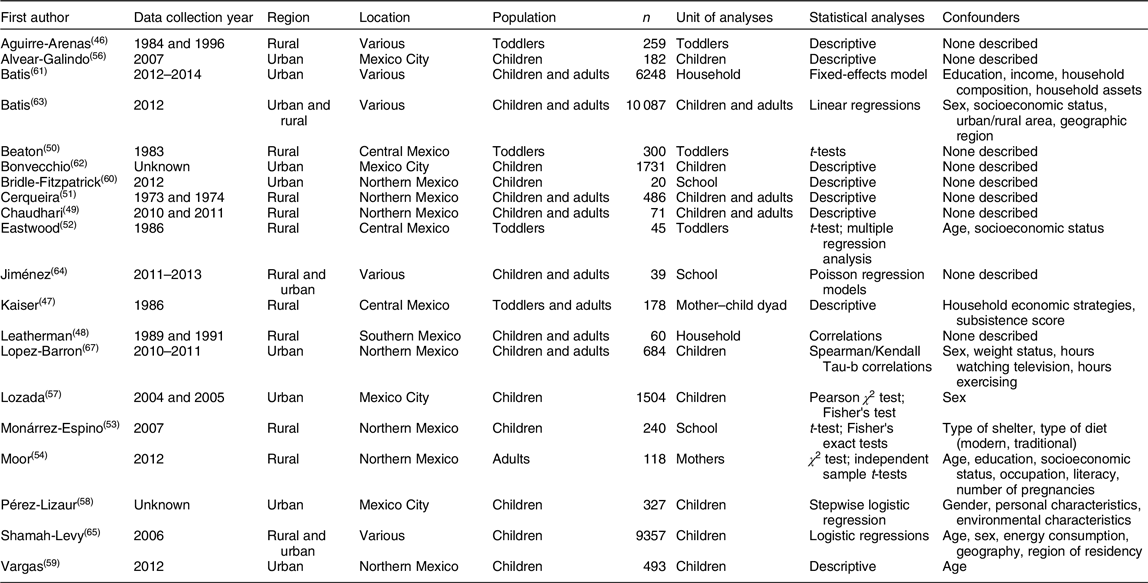
In total, 501 papers were identified in online databases and in screened articles’ reference sections, but only twenty met the inclusion criteria. In cases where the same article was published in English and Spanish, only one paper was counted and reviewed. The Spanish article was kept when the lead investigator’s research institution was based out of Mexico (n 2). Figure 1 shows the study selection flowchart. The studies’ characteristics, including first author’s name, year of data collection, region, population, sample size, unit of analyses and statistical analyses, are reported in Table 1. Table 2 summarises the type of food environment assessed, the assessment methods and the main food available and observations.
Article screening flow diagram

Characteristics of studies assessing the Mexican food environment (n 20)
Environment and nutrition assessment methods used to assess different levels of the Mexican food environment (n 20)
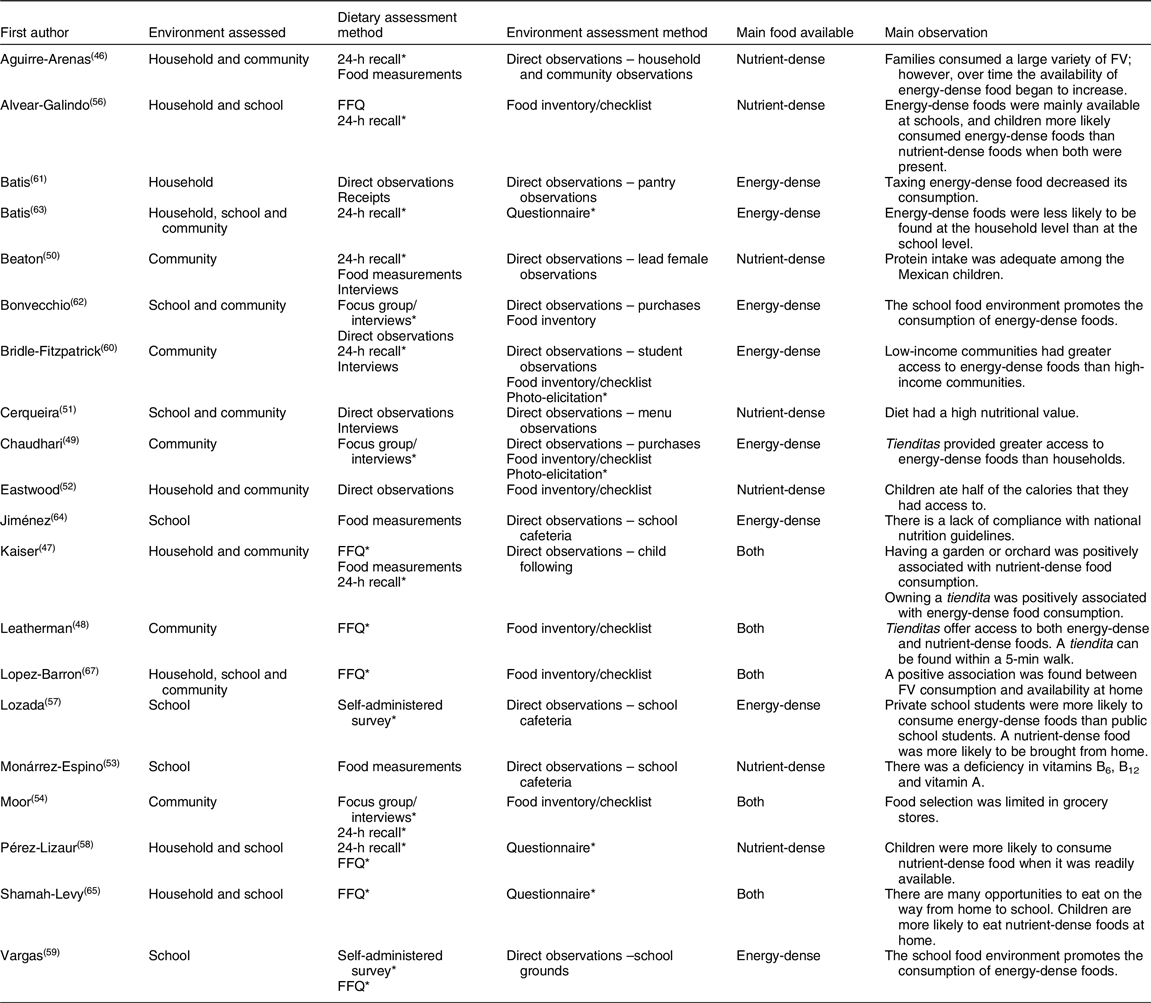
FV, fruit and vegetables.
* Self-reported.
A total of twenty papers met the inclusion criteria (Table 1). Nine articles assessed rural communities(Reference Aguirre-Arenas, Escobar-Perez and Chavez-Villasana46–Reference Moor, Fraga and Garfein54), eight assessed urban communities(Reference López-Barrón, Jiménez-Cruz and Bacardí-Gascón55–Reference Bonvecchio, Théodore and Safdie62) and three assessed both(Reference Batis, Rodríguez-Ramírez and Ariza63–Reference Shamah-Levy, Cuevas-Nasu and Mendez-Gomez-Humaran65). Representation of communities throughout Mexico varied: seven studies represented Northern Mexico(Reference Chaudhari, Begay and Schulz49,Reference Cerqueira, Fry and Connor51,Reference Monárrez-Espino, Béjar-Lío and Vázquez-Mendoza53–Reference López-Barrón, Jiménez-Cruz and Bacardí-Gascón55,Reference Vargas, Jiménez-Cruz and Bacardí-Gascón59,Reference Bridle-Fitzpatrick60) , seven represented Central Mexico(Reference Kaiser and Dewey47,Reference Beaton, Calloway and Murphy50,Reference Eastwood Garcia, Kaiser and Dewey52,Reference Alvear-Galindo, Yamamoto-Kimura and Morán-Álvarez56–Reference Pérez-Lizaur, Kaufer-Horwitz and Plazas58,Reference Bonvecchio, Théodore and Safdie62) , one represented Southern Mexico(Reference Leatherman and Goodman48) and five studies were done in multiple regions throughout Mexico (including Northern, Central and Southern Mexico)(Reference Aguirre-Arenas, Escobar-Perez and Chavez-Villasana46,Reference Batis, Rivera and Popkin61,Reference Batis, Rodríguez-Ramírez and Ariza63–Reference Shamah-Levy, Cuevas-Nasu and Mendez-Gomez-Humaran65) . Most studies were cross-sectional, but three were longitudinal(Reference Leatherman and Goodman48–Reference Beaton, Calloway and Murphy50). Over half of the studies (n 11) used a random sampling technique to recruit participants. The remaining studies (n 9) used convenience samples. Most studies assessed children’s dietary intake, but seven assessed both children’s and adults’ intake(Reference Kaiser and Dewey47–Reference Chaudhari, Begay and Schulz49,Reference Cerqueira, Fry and Connor51,Reference Moor, Fraga and Garfein54,Reference López-Barrón, Jiménez-Cruz and Bacardí-Gascón55,Reference Batis, Rodríguez-Ramírez and Ariza63) , and one assessed adult behaviours only(Reference Batis, Rivera and Popkin61). The number of participants ranged from 45 to 10 087, with the youngest participants being one-and-a-half years old.
Food environment assessment methods
The methods to assess the food environment varied across studies. A systematic approach was taken by all the studies to document food availability, but the names of specific tools were not given (Table 2). Three of the twenty reviewed studies did not have researchers physically present to conduct environmental observations(Reference Pérez-Lizaur, Kaufer-Horwitz and Plazas58,Reference Batis, Rodríguez-Ramírez and Ariza63,Reference Shamah-Levy, Cuevas-Nasu and Mendez-Gomez-Humaran65) . These three studies relied on interviews and questionnaires answered by the participants to assess the food environment. An example of the type of questions was: ‘where were you when you ate this food or beverage?’(Reference Batis, Rodríguez-Ramírez and Ariza63) The remaining seventeen (out of twenty) studies used some form of observations that can be divided into two types: participant observations and direct observations.
Direct observations included observing the participants’ actions without getting involved in their activities. This included actions such as going to local grocery stores to observe the types of foods available and purchased by customers. This method also included strategies where the researchers followed participants at a distance and observed their activities for a period. Direct observations also included documenting food availability in participants’ pantries and observing participants’ food preparations. Twelve of the studies used the direct observation approach(Reference Aguirre-Arenas, Escobar-Perez and Chavez-Villasana46,Reference Kaiser and Dewey47,Reference Chaudhari, Begay and Schulz49–Reference Cerqueira, Fry and Connor51,Reference Monárrez-Espino, Béjar-Lío and Vázquez-Mendoza53,Reference Lozada, Sanchez-Castillo and Cabrera57,Reference Vargas, Jiménez-Cruz and Bacardí-Gascón59–Reference Bonvecchio, Théodore and Safdie62,Reference Jiménez-Aguilar, del Carmen Morales-Ruán and López-Olmedo64) , two used participant observation(Reference Aguirre-Arenas, Escobar-Perez and Chavez-Villasana46,Reference Kaiser and Dewey47) and three used both techniques(Reference Chaudhari, Begay and Schulz49,Reference Lozada, Sanchez-Castillo and Cabrera57,Reference Bonvecchio, Théodore and Safdie62) .
Food inventory was the second most commonly used method to assess food availability and accessibility. This method was used in seven of the twenty studies; three were used to assess household food availability(Reference Leatherman and Goodman48,Reference Eastwood Garcia, Kaiser and Dewey52,Reference Batis, Rivera and Popkin61) , two assessed school food availability(Reference Alvear-Galindo, Yamamoto-Kimura and Morán-Álvarez56,Reference Jiménez-Aguilar, del Carmen Morales-Ruán and López-Olmedo64) , one assessed food availability in the household and school food environment(Reference López-Barrón, Jiménez-Cruz and Bacardí-Gascón55) and one was used to assess the community food environment(Reference Chaudhari, Begay and Schulz49). The third most commonly used method was questionnaires. These questionnaires asked participants and local food vendors about food availability, prices and promotions(Reference Pérez-Lizaur, Kaufer-Horwitz and Plazas58,Reference Bridle-Fitzpatrick60,Reference Batis, Rodríguez-Ramírez and Ariza63,Reference Shamah-Levy, Cuevas-Nasu and Mendez-Gomez-Humaran65) . Photo-elicitation(Reference Chaudhari, Begay and Schulz49,Reference Bridle-Fitzpatrick60) , interviews(Reference Lozada, Sanchez-Castillo and Cabrera57,Reference Bonvecchio, Théodore and Safdie62) and receipt assessments(Reference Batis, Rivera and Popkin61) were also part of food environment assessment methods used in some of the studies. Only two of the twenty studies used geographical information methodology to systematically map communities or areas of observation(Reference Monárrez-Espino, Béjar-Lío and Vázquez-Mendoza53,Reference Bridle-Fitzpatrick60) .
Dietary intake assessment methods
There was great variability in the methods of dietary intake assessment used across the studies (Table 2). The method most commonly used was 24-h food recall. This method was used in eight studies(Reference Aguirre-Arenas, Escobar-Perez and Chavez-Villasana46,Reference Kaiser and Dewey47,Reference Beaton, Calloway and Murphy50,Reference Moor, Fraga and Garfein54,Reference Alvear-Galindo, Yamamoto-Kimura and Morán-Álvarez56,Reference Pérez-Lizaur, Kaufer-Horwitz and Plazas58,Reference Bridle-Fitzpatrick60,Reference Batis, Rodríguez-Ramírez and Ariza63) , of which two 24-h recalls were the most commonly used method(Reference Beaton, Calloway and Murphy50,Reference Pérez-Lizaur, Kaufer-Horwitz and Plazas58,Reference Bridle-Fitzpatrick60) . Seven studies used FFQ. Four of these studies did not report the number of items in the FFQ(Reference Leatherman and Goodman48,Reference Alvear-Galindo, Yamamoto-Kimura and Morán-Álvarez56,Reference Pérez-Lizaur, Kaufer-Horwitz and Plazas58,Reference Vargas, Jiménez-Cruz and Bacardí-Gascón59) . The remaining studies using FFQ used 13 items(Reference López-Barrón, Jiménez-Cruz and Bacardí-Gascón55), 27 items(Reference Kaiser and Dewey47) and 101 items(Reference Shamah-Levy, Cuevas-Nasu and Mendez-Gomez-Humaran65). Measuring utensils were used in two studies(Reference Aguirre-Arenas, Escobar-Perez and Chavez-Villasana46,Reference Kaiser and Dewey47) . Food items were weighted in five studies(Reference Aguirre-Arenas, Escobar-Perez and Chavez-Villasana46,Reference Kaiser and Dewey47,Reference Beaton, Calloway and Murphy50,Reference Monárrez-Espino, Béjar-Lío and Vázquez-Mendoza53,Reference Batis, Rodríguez-Ramírez and Ariza63) . Food intake and eating behaviours were also collected through interviews or surveys in eight of the studies(Reference Chaudhari, Begay and Schulz49–Reference Cerqueira, Fry and Connor51,Reference Moor, Fraga and Garfein54,Reference Lozada, Sanchez-Castillo and Cabrera57,Reference Vargas, Jiménez-Cruz and Bacardí-Gascón59,Reference Bridle-Fitzpatrick60,Reference Bonvecchio, Théodore and Safdie62) . Field observations to document the frequency of food purchase, consumption and preparation were used in five of the studies(Reference Beaton, Calloway and Murphy50–Reference Eastwood Garcia, Kaiser and Dewey52,Reference Batis, Rivera and Popkin61,Reference Bonvecchio, Théodore and Safdie62) .
Food environments assessed
Most studies measured at least two levels of the food environment. The household food environment and the community food environment were measured together in seven studies(Reference Aguirre-Arenas, Escobar-Perez and Chavez-Villasana46–Reference Beaton, Calloway and Murphy50,Reference Eastwood Garcia, Kaiser and Dewey52 , Reference Bridle-Fitzpatrick60); the household food environment and the school food environment were measured together in three studies(Reference Alvear-Galindo, Yamamoto-Kimura and Morán-Álvarez56,Reference Pérez-Lizaur, Kaufer-Horwitz and Plazas58,Reference Shamah-Levy, Cuevas-Nasu and Mendez-Gomez-Humaran65) ; the school and community food environments were measured together in two studies(Reference Cerqueira, Fry and Connor51,Reference Bonvecchio, Théodore and Safdie62) ; four studies were specific to the school food environment(Reference Monárrez-Espino, Béjar-Lío and Vázquez-Mendoza53,Reference Lozada, Sanchez-Castillo and Cabrera57,Reference Vargas, Jiménez-Cruz and Bacardí-Gascón59,Reference Jiménez-Aguilar, del Carmen Morales-Ruán and López-Olmedo64) ; two studies were specific to either the household food environment(Reference Batis, Rivera and Popkin61) or the community food environment(Reference Moor, Fraga and Garfein54); and two studies included all three levels of the food environment(Reference López-Barrón, Jiménez-Cruz and Bacardí-Gascón55,Reference Batis, Rodríguez-Ramírez and Ariza63) .
Food availability and dietary intake
A key characteristic of household food environment studies was that most took place in rural areas (n 8)(Reference Aguirre-Arenas, Escobar-Perez and Chavez-Villasana46–Reference Beaton, Calloway and Murphy50,Reference Eastwood Garcia, Kaiser and Dewey52,Reference Batis, Rodríguez-Ramírez and Ariza63,Reference Shamah-Levy, Cuevas-Nasu and Mendez-Gomez-Humaran65) . In these studies, it was common for participants to use methods such as farming, gardening, hunting and gathering FV to obtain food. However, in more developed rural communities, grocery stores and small convenience stores (tienditas) were the source of FV and energy-dense foods. In urban settings, participants relied primarily on supermarkets, grocery stores and tienditas to purchase food items. Rural settings provided a larger diversity of FV than urban settings. In contrast, urban settings seemed to provide a higher diversity of energy-dense food items high in sugar, fat and salt, such as chips, pastries and SSB, compared to rural settings. Nutrient-dense foods (i.e. FV) were the main foods available in five of the nine studies assessing rural settings(Reference Aguirre-Arenas, Escobar-Perez and Chavez-Villasana46,Reference Beaton, Calloway and Murphy50–Reference Monárrez-Espino, Béjar-Lío and Vázquez-Mendoza53) and in two of the eight studies assessing urban settings(Reference Alvear-Galindo, Yamamoto-Kimura and Morán-Álvarez56,Reference Pérez-Lizaur, Kaufer-Horwitz and Plazas58) . In contrast, energy-dense food was the main food available in five of the eight studies assessing urban settings(Reference Lozada, Sanchez-Castillo and Cabrera57,Reference Vargas, Jiménez-Cruz and Bacardí-Gascón59–Reference Bonvecchio, Théodore and Safdie62) , and it seemed to be the case in one of the nine studies assessing rural settings(Reference Chaudhari, Begay and Schulz49). Of the studies assessing both rural and urban settings, two primarily had energy-dense foods(Reference Batis, Rodríguez-Ramírez and Ariza63,Reference Jiménez-Aguilar, del Carmen Morales-Ruán and López-Olmedo64) and one primarily had nutrient-dense foods(Reference Shamah-Levy, Cuevas-Nasu and Mendez-Gomez-Humaran65). In five studies – three rural(Reference Kaiser and Dewey47,Reference Leatherman and Goodman48,Reference Moor, Fraga and Garfein54) , one urban(Reference López-Barrón, Jiménez-Cruz and Bacardí-Gascón55) and one with both settings(Reference Shamah-Levy, Cuevas-Nasu and Mendez-Gomez-Humaran65) – both nutrient-dense and energy-dense foods were equally available.
Studies assessing the school food environment were primarily done in urban settings (n 6)(Reference López-Barrón, Jiménez-Cruz and Bacardí-Gascón55–Reference Vargas, Jiménez-Cruz and Bacardí-Gascón59,Reference Bonvecchio, Théodore and Safdie62) , and most of these sites were in Mexico City. The most common foods found inside and outside schools were energy-dense foods, including SSB, candies, cookies, pastries, salty snacks, fast foods and ice cream. Nutrient-dense foods were also present but in smaller quantities in comparison to energy-dense foods. Items included cut-up FV and traditional foods such as tacos, tortas, quesadillas and fresh juice. The environment surrounding the participating schools was associated with the presence of street food vendors (n 3)(Reference López-Barrón, Jiménez-Cruz and Bacardí-Gascón55,Reference Lozada, Sanchez-Castillo and Cabrera57,Reference Vargas, Jiménez-Cruz and Bacardí-Gascón59) . These vendors offered primarily energy-dense snacks that children could purchase (n 3)(Reference López-Barrón, Jiménez-Cruz and Bacardí-Gascón55,Reference Lozada, Sanchez-Castillo and Cabrera57,Reference Vargas, Jiménez-Cruz and Bacardí-Gascón59) . Street food vendors were identified around schools in urban settings only (n 3)(Reference López-Barrón, Jiménez-Cruz and Bacardí-Gascón55,Reference Lozada, Sanchez-Castillo and Cabrera57,Reference Vargas, Jiménez-Cruz and Bacardí-Gascón59) . In one of the studies, it was reported that children in schools with open-campus policies would leave school to buy foods that were readily available outside their campus, and adolescents were more likely to do so(Reference Lozada, Sanchez-Castillo and Cabrera57). The healthiest option for children were the foods they brought from home in their lunch bags (n 2)(Reference Lozada, Sanchez-Castillo and Cabrera57,Reference Vargas, Jiménez-Cruz and Bacardí-Gascón59) .
Most studies assessing the community food environment had two key characteristics in common: (i) most took place in rural settings and (ii) most date prior to the 2000s. Data collection for the earliest study happened in 1973(Reference Cerqueira, Fry and Connor51). Results from these studies showed that rural communities had more access to nutrient-dense foods like FV compared to urban communities, but their diet lacked diversity (n 3)(Reference Aguirre-Arenas, Escobar-Perez and Chavez-Villasana46,Reference Leatherman and Goodman48,Reference Cerqueira, Fry and Connor51) . Families in these communities could access nutrient-dense foods via farming, fruit orchards and grocery stores or supermarkets (n 4)(Reference Kaiser and Dewey47–Reference Chaudhari, Begay and Schulz49,Reference Moor, Fraga and Garfein54) . In contrast, urban communities relied primarily on supermarkets or grocery stores to acquire nutrient-dense foods (n 2)(Reference López-Barrón, Jiménez-Cruz and Bacardí-Gascón55,Reference Bridle-Fitzpatrick60) . Results seemed to indicate that as rural communities become more developed, families were more likely to have higher access to energy-dense foods (n 2)(Reference Leatherman and Goodman48,Reference Chaudhari, Begay and Schulz49) . Small family-owned stores provided the main access to energy-dense foods in rural communities (n 4)(Reference Kaiser and Dewey47–Reference Chaudhari, Begay and Schulz49,Reference Moor, Fraga and Garfein54) . In urban communities, access to energy-dense foods was provided by street vendors, convenience stores and fast food restaurants (n 5)(Reference López-Barrón, Jiménez-Cruz and Bacardí-Gascón55,Reference Vargas, Jiménez-Cruz and Bacardí-Gascón59,Reference Bridle-Fitzpatrick60,Reference Bonvecchio, Théodore and Safdie62,Reference Batis, Rodríguez-Ramírez and Ariza63) . Grocery stores were available in both urban and rural communities, but the studies provided very limited data on the food products available in these stores (n 4)(Reference Leatherman and Goodman48,Reference Moor, Fraga and Garfein54,Reference López-Barrón, Jiménez-Cruz and Bacardí-Gascón55,Reference Bridle-Fitzpatrick60) . Likewise, assessments showed that fast food restaurants were present in both urban and rural settings, but limited observations were given on the food composition and amount of food consumed at these food sources (n 5)(Reference Leatherman and Goodman48,Reference Chaudhari, Begay and Schulz49,Reference López-Barrón, Jiménez-Cruz and Bacardí-Gascón55,Reference Bridle-Fitzpatrick60,Reference Batis, Rodríguez-Ramírez and Ariza63) .
Although only a few studies performed statistical analysis to assess the relationship between food availability and dietary intake, two studies found that food availability and access matter: there was a positive correlation between food availability and dietary intake. Participants were more likely to consume a food item that was readily available (n 2)(Reference López-Barrón, Jiménez-Cruz and Bacardí-Gascón55,Reference Pérez-Lizaur, Kaufer-Horwitz and Plazas58) . For example, in the school food environment, there was a close association between the food available in and around the schools and its consumption among children (n 3)(Reference López-Barrón, Jiménez-Cruz and Bacardí-Gascón55–Reference Lozada, Sanchez-Castillo and Cabrera57). Although nutrient-dense foods were available for purchase inside the schools, especially in private schools, there were more energy-dense foods accessible to children (n 4)(Reference López-Barrón, Jiménez-Cruz and Bacardí-Gascón55–Reference Lozada, Sanchez-Castillo and Cabrera57,Reference Vargas, Jiménez-Cruz and Bacardí-Gascón59) . When both nutrient-dense and energy-dense foods were present, children were more likely to buy unhealthy foods than nutrient-dense foods (n 2)(Reference Alvear-Galindo, Yamamoto-Kimura and Morán-Álvarez56,Reference Lozada, Sanchez-Castillo and Cabrera57) . For instance, Alvear-Galindo et al.(Reference Alvear-Galindo, Yamamoto-Kimura and Morán-Álvarez56) found that in schools where both nutrient-dense and energy-dense foods were available for purchase, children would spend money to purchase energy-dense foods like ice cream than nutrient-dense foods like fruit. Furthermore, nutrient-dense foods were more expensive than energy-dense foods(Reference Lozada, Sanchez-Castillo and Cabrera57). Overall, a common observation across the studies was that there was a higher proportion of FV available at the household level than at the school and community food environment levels, and energy-dense foods were more likely to be found in schools or on the streets than at the household level (n 3)(Reference Bonvecchio, Théodore and Safdie62,Reference Batis, Rodríguez-Ramírez and Ariza63,Reference Shamah-Levy, Cuevas-Nasu and Mendez-Gomez-Humaran65) .
Risk of bias assessment
In nine of the studies(Reference Kaiser and Dewey47,Reference Leatherman and Goodman48,Reference Beaton, Calloway and Murphy50,Reference Eastwood Garcia, Kaiser and Dewey52,Reference Monárrez-Espino, Béjar-Lío and Vázquez-Mendoza53,Reference Alvear-Galindo, Yamamoto-Kimura and Morán-Álvarez56,Reference Pérez-Lizaur, Kaufer-Horwitz and Plazas58,Reference Bridle-Fitzpatrick60,Reference Bonvecchio, Théodore and Safdie62) , the participants were identified using specific population characteristics such as income and geographical regions, and then a convenience sample was selected. The remaining studies (n 11)(Reference Aguirre-Arenas, Escobar-Perez and Chavez-Villasana46,Reference Chaudhari, Begay and Schulz49,Reference Cerqueira, Fry and Connor51,Reference Moor, Fraga and Garfein54,Reference López-Barrón, Jiménez-Cruz and Bacardí-Gascón55,Reference Lozada, Sanchez-Castillo and Cabrera57,Reference Vargas, Jiménez-Cruz and Bacardí-Gascón59,Reference Batis, Rivera and Popkin61,Reference Batis, Rodríguez-Ramírez and Ariza63,Reference Jiménez-Aguilar, del Carmen Morales-Ruán and López-Olmedo64) used random sampling techniques to select participants. There might also be a moderate risk of reporting bias with food availability and food environment characteristics. Half of the studies (n 11)(Reference Aguirre-Arenas, Escobar-Perez and Chavez-Villasana46,Reference Kaiser and Dewey47,Reference Beaton, Calloway and Murphy50,Reference Cerqueira, Fry and Connor51,Reference Monárrez-Espino, Béjar-Lío and Vázquez-Mendoza53,Reference Lozada, Sanchez-Castillo and Cabrera57,Reference Vargas, Jiménez-Cruz and Bacardí-Gascón59,Reference Batis, Rivera and Popkin61–Reference Jiménez-Aguilar, del Carmen Morales-Ruán and López-Olmedo64) used observational techniques to measure food availability and environment characteristics. Food environment assessment tools used were not named in any of the studies. The most commonly used tools were food inventories (n 7)(Reference Leatherman and Goodman48,Reference Chaudhari, Begay and Schulz49,Reference Eastwood Garcia, Kaiser and Dewey52,Reference Moor, Fraga and Garfein54–Reference Alvear-Galindo, Yamamoto-Kimura and Morán-Álvarez56,Reference Bridle-Fitzpatrick60) . Only one study mentioned validating the food environment assessment tool(Reference Pérez-Lizaur, Kaufer-Horwitz and Plazas58). The remaining studies (n 10)(Reference Leatherman and Goodman48,Reference Chaudhari, Begay and Schulz49,Reference Eastwood Garcia, Kaiser and Dewey52,Reference Moor, Fraga and Garfein54–Reference Alvear-Galindo, Yamamoto-Kimura and Morán-Álvarez56,Reference Pérez-Lizaur, Kaufer-Horwitz and Plazas58,Reference Bridle-Fitzpatrick60,Reference Batis, Rodríguez-Ramírez and Ariza63,Reference Shamah-Levy, Cuevas-Nasu and Mendez-Gomez-Humaran65) used assessment tools such as food inventories, checklists, photo-elicitation and questionnaires to document food availability, but did not provide a discussion on the validity or reliability of their measurements. A systematic assessment of bias showed that there might be a moderate risk of bias in several of the studies due to a lack of randomisation in the selection of participants and to a lack of standardised and validated food environment assessment methods.
Discussion
The purpose of this review was to document the relationship between the food environment and dietary intake in the Mexican population. Overall, and in line with the social-ecological model(Reference Glanz, Rimer and Viswanath66), this review found that dietary intake can be influenced by the interactions of different food environment factors. Inside the community food environment, we observed that changes to the community food environment are associated with changes to the household food environment(Reference Aguirre-Arenas, Escobar-Perez and Chavez-Villasana46). These changes included a higher availability and accessibility of energy-dense foods via street food vendors(Reference López-Barrón, Jiménez-Cruz and Bacardí-Gascón55,Reference Vargas, Jiménez-Cruz and Bacardí-Gascón59) and tienditas (Reference Leatherman and Goodman48,Reference Bridle-Fitzpatrick60) . The food environment in and around schools was characterised as proving easy access to energy-dense foods(Reference Alvear-Galindo, Yamamoto-Kimura and Morán-Álvarez56,Reference Lozada, Sanchez-Castillo and Cabrera57,Reference Vargas, Jiménez-Cruz and Bacardí-Gascón59,Reference Lopez-Barron, Jimenez-Cruz and Bacardi-Gascon67,Reference Theodore, Bonvecchio and Blanco68) . Although schools offered nutrient-dense foods, children also had access to energy-dense foods that were more affordable than the healthy options(Reference Alvear-Galindo, Yamamoto-Kimura and Morán-Álvarez56,Reference Lozada, Sanchez-Castillo and Cabrera57,Reference Vargas, Jiménez-Cruz and Bacardí-Gascón59) . The lower cost of some foods might have incentivised children to purchase those foods over others(Reference French69–Reference Haws and Winterich71). In general, nutrient-dense foods were more likely to be found at the household level and in rural settings than at the school level and urban settings.
Similar observations have been previously documented in the USA. For example, Borradaile et al. (Reference Borradaile, Sherman and Vander Veur28) found that individuals with access to corner stores would typically buy energy-dense foods from these food venues(Reference Borradaile, Sherman and Vander Veur28). Likewise, studies in the USA have found that children are more likely to consume energy-dense foods that are available at schools(Reference Turner and Chaloupka72). In Mexico, the school environment outside the schools is also associated with energy-dense foods sold by street food vendors(Reference Lopez-Barron, Jimenez-Cruz and Bacardi-Gascon67). The relationship between purchasing food from food carts and obesity risk is uncertain(Reference Soltero, Ortiz Hernández and Jauregui73,Reference Hernandez Barrera, Rothenberg and Barquera74) . For example, a study conducted in Northern Mexico found that there was a lower risk for abdominal obesity among children who had a higher consumption of street taco (more than one time per week)(Reference Wojcicki, Jimenez-Cruz and Bacardi-Gascon75). This finding indicates that not all street food might be unhealthy, and it also shows the importance of assessing the healthfulness of food vendors and their association to health outcomes.
Although studies of the food environment outside schools in the USA showed that fast food restaurants tend to cluster around schools, and that this pattern is associated with higher consumption of energy-dense foods(Reference Davis and Carpenter27,Reference Austin, Melly and Sanchez76) , this could not be assessed in this review of the Mexican food environment. Only five studies mentioned restaurants(Reference Leatherman and Goodman48,Reference Chaudhari, Begay and Schulz49,Reference López-Barrón, Jiménez-Cruz and Bacardí-Gascón55,Reference Bridle-Fitzpatrick60,Reference Batis, Rodríguez-Ramírez and Ariza63) , but there was minimal assessment of food consumption in these food venues. More research is needed to understand the association among fast food, dietary intake and health outcomes in Mexico, and what sectors of the population has access to these types of food.
The food environment might impact vulnerable populations as identified by this review. First, the nutritional transition that Mexico is undergoing has been associated with rapid changes to the food environment(Reference Hawkes1–Reference Malik, Popkin and Bray3). The nutrition transition can adversely affect most vulnerable sectors of the community – those living in poverty(Reference Popkin2). In Mexico, about 43·6 % of the population is classified as living in poverty, and another 7·6 % live in extreme poverty(77). These sectors of the population are more likely to access low-cost energy-dense foods than healthier foods(Reference Drewnowski78,Reference Drewnowski and Specter79) . This represents a serious public health concern as some of these individuals might already be dealing with undernutrition problems(Reference Kroker-Lobos, Pedroza-Tobías and Pedraza80), and an energy-dense diet might exacerbate existing health conditions.
Although this review found that participants were more likely to eat nutrient-dense foods in the household, school and community environments when these foods were available and accessible than in environments with limited availability and accessibility, the findings also showed that participants were more likely to eat energy-dense foods when both options were available(Reference Leatherman and Goodman48,Reference Alvear-Galindo, Yamamoto-Kimura and Morán-Álvarez56,Reference Lozada, Sanchez-Castillo and Cabrera57) . This represents an opportunity for public health practitioners to work with the communities and other stakeholders to implement public policies that can influence food availability and dietary intake. A great example of this is the taxation of SSB, which aims to curb the high SSB consumption in the Mexican population(Reference Barquera, Campos and Rivera81). However, taxing SSB should not be the only solution. Marketing strategies to promote the consumption of nutrient-dense foods and reduce the cost of such foods could lead the Mexican community into a healthier status.
Only four studies in this review assessed the direction of the association between food environment and dietary intake(Reference Pérez-Lizaur, Kaufer-Horwitz and Plazas58,Reference Batis, Rodríguez-Ramírez and Ariza63–Reference Shamah-Levy, Cuevas-Nasu and Mendez-Gomez-Humaran65) . Although descriptive observational studies are important, studies showing the strength and direction of such associations are essential. This could be an important source of information that is missing and that could help public health practitioners understand what components of the food environments could be linked to negative dietary intake and the high overweight and obesity prevalence in Mexico. The information reported in this review can be used to inform food policies and public health efforts that can improve dietary intake and health outcomes in Mexico.
Strengths and limitations of studies reviewed
One of the strengths of these studies was the use of direct and participant observation methods. Researchers physically presented themselves to observe and document the type of foods available and consumed by participants. These methods can help address biases such as recall bias that result when participants must remember whether a food item was present. The use of methods such as photo-elicitation in a couple of studies was also a strength. This method can also address recall bias and provide data for both quantitative and qualitative analyses.
Limitations of the studies reviewed here include the limited usage of validated tools to assess both food environment and nutrition intake in the Mexican context. Considerable variability exists in describing the food environment and nutritional intake. The most commonly used tools were food inventories, FFQ and 24-h dietary recalls. Food inventories have been widely used to assess different types of food environments in places like the USA(Reference McKinnon, Reedy and Morrissette42,Reference Kelly, Flood and Yeatman82,Reference Glanz83) , but most reviewed studies in this paper did not provide evidence on whether those tools had been validated in the Mexican context. Likewise, FFQ and dietary recalls are widely used and have been validated in the nutrition field to assess dietary intake(Reference Gibson84); however, little indication was given on their validation with the Mexican population.
Another limitation includes the lack of randomisation techniques in several of the studies. Participants in some of the studies were not selected at random. Thus, the findings in those studies cannot be generalised to the entire Mexican population. In addition, the cross-sectional nature of the studies and the lack of statistical analyses do not allow causal inferences to be made in most studies. The direction and strength of the association between food environment and dietary intake was assessed only in four studies(Reference Leatherman and Goodman48,Reference Pérez-Lizaur, Kaufer-Horwitz and Plazas58,Reference Vargas, Jiménez-Cruz and Bacardí-Gascón59,Reference Lopez-Barron, Jimenez-Cruz and Bacardi-Gascon67) , thus limiting causal inferences.
Strengths/limitations of this review
To our knowledge, this is the only systematic literature review that integrates measures of food environment with dietary intake in the Mexican population. This review highlights the importance of considering various environmental variables in a comprehensive assessment of dietary intake. Furthermore, this review considers different types of food environments that are important in improving the understanding on how these food environments interact with each other and relate to dietary intake. Two key strengths of this review are the use of an open timeframe that extends from as early as 1973 to as recent as 2018 and the inclusion of Spanish language articles. The longer timeframe resulted in more studies and allowed the comparison of older food environments and dietary intake with those of recent times. This comparison shows that, over time, the traditional Mexican diet has changed from an environment with limited access to energy-dense foods to one where these types of foods are readily available in all three levels of the food environment. Including Spanish articles in this review gave a voice to literature from Mexican researchers and institutions that is otherwise ignored for lack of English translations.
The results of this review must be interpreted with caution for different reasons. First, the assessment of school and community food environments cannot be generalised to the entire Mexican community. Only half of the reviewed studies assessed the community food environment, mostly in rural settings, and there were no school food assessments in rural areas. Given that most Mexican families live in urban environments, it is important to conduct further studies that systematically analyse the urban food environment. Lastly, data in the reviewed studies were insufficient to conduct meta-analyses, preventing us from calculating combined quantitative estimates.
Conclusion
The household, school and community food environments seem to expose participants to energy-dense foods. Energy-dense foods are more likely to be eaten than nutrient-dense foods, even when both types of food options are available. However, most studies did not clearly assess the strengths and directions of the association between food environment and dietary intake. More rigorous research is needed to assess this relationship and to find ways that can improve dietary intake in the household, school and community food environments in the Mexican population.
Acknowledgements
Acknowledgements: The corresponding author would like to thank the faculty members for their time and mentoring. Financial support: There was no funding or support for this project. The project was the corresponding author’s thesis. Conflict of interest: There are no conflicts of interest. Authorship: J.B.R.C. identified and screened relevant papers, extracted data, wrote the manuscript and created tables. L.G. identified and screened relevant papers, extracted data and edited drafts and tables. M.B. reviewed relevant papers, edited drafts and settled disagreements on inclusion criteria between J.R.C. and L.G. M.A.P. and M.J. reviewed relevant papers and provided feedback on drafts. Ethics of human subject participation: No IRB approval was sought since the work is a systematic review.



