




Introduction
Historical textual documentation of horsemeat consumption (hippophagy) is diffuse yet scarce across time and space in Europe, particularly in medieval Hungary. We performed quantitative analyses of horse (Equus caballus) remains among food refuse from 198 settlements in medieval Hungary to complement contemporaneous records of this practice. Mortuary practices involving animals, such as burying people with their mounts, ceased with the arrival of Christianity to various parts of Europe around the turn of the first and second millennium; yet, for (pre)historic communities, sacred worlds and utilitarian needs formed an inseparable complex and in most cultures slaughtering retains a subtle ritual dimension (Gladigow Reference Gladigow1984: 31). Cases of hippophagy fall along a continuum between mundane meat consumption and ritual, and interpretation of such acts as transgressive varied in time, space and between societal situations.
The Christian Kingdom of Hungary was established in AD 1000; the coronation of King Steven I marked the beginning of the Middle Ages (Kristó & Makk Reference Kristó and Makk1996). Steven I was the first and last Hungarian king to recognise and support the Byzantine Church, though he also installed Benedictine priests in key positions (V. Kovács Reference Kovács1975: 103). The period of the Árpád Dynasty (henceforth Árpád-period) fell between AD 1000–1301.
A recent review of horse remains indicative of eleventh- to thirteenth-century rituals in Poland highlights the use of complete horse carcasses or the heads of these animals (Makowiecki et al. Reference Makowiecki, Chudziak, Szczepanik, Janeczek and Pasicka2022), yet analyses of fragmented horse bones in mundane food refuse can complement such work in reconstructing the wider roles played by horses in medieval Central Europe. Evidence for medieval horsemeat consumption from nine settlement assemblages within the confines of modern-day Hungary has recently been summarised (Daróczi-Szabó & Daróczi-Szabó Reference Daróczi-Szabó and Daróczi-Szabó2024); here, we expand the scope of this analysis to cover the territory of medieval Hungary.
Ideological background
Except upon occasions for fasting, Christianity abandoned all Old Testament regulations regarding meat consumption. However, two pontifical letters to Winfried Boniface (died AD 754), the Benedictine missionary who converted the Germanic tribes, suggest that taboos around hippophagy persisted. Both letters were penned by popes of eastern extraction—Gregory III (690–741) from Syria and Zechariah (679–752) from Byzantium—indicating that horsemeat eating was possibly more strongly condemned in the Byzantine tradition (Kolias Reference Kolias and Lazaris2012: 93). Gregory III considered horsemeat “inmundum enim est atque exsecrabile” (“impure and execrable”; Dümmler Reference Dümmler, Dümmer and Gundlach1892: 279), while Zechariah warned against eating certain birds, beavers and especially hares and wild horses (“Etiam et fibri atque lepores et equi silvatici multo amplius vitandi”; Tangl Reference Tangl1916: 196).
These letters are not normative ecclesiastic documents, however, and they do not suggest that horsemeat consumption was a ‘pagan’ custom, a purely religious issue, but rather a matter of purity, social habit or convenience (Bonnassie 2001: 151–52). A Synodic document mentioning horsemeat is the AD 787 report of the legates George and Theophylact from England, discussing the hypocrisy of ecclesiastics: “coram hominibus jejunantes aut abstinentes simulemur, in secretis vero nostris bovem aut equum glutiamus” (“before men we pretend to be fasting or abstinent, but secretly we swallow [the flesh of] an ox or a horse”; Haddan & Stubbs Reference Haddan and Stubbs1871: 459). Notably, beef is equated with horsemeat here, with no apparent emphasis placed on the latter. In contrast, the early-seventh-century Collectio canonum Hibernensis I discusses the unlawful eating of horses (“De esu aequorum inlicito”; Flechner Reference Flechner2019: 421), and the Heimskringla (a collection of Old Norse sagas) reports that when King Haakon Haraldsson ‘the Good’ (c. 920–961) of Norway tried to impose Christianity on his people, the assembly forced him to eat horsemeat (Sturluson trans. Reference Sturluson, Finlay and Faulkes2011: 101).
By the eleventh century, Pope Gregory VII consolidated Western Christianity and the narrative regarding horsemeat became further politicised. The kingship ceremony reported by Gerald of Wales travelling in Ireland around AD 1200 stands out (O’Meara Reference O’Meara1951: 93–94); one cannot help but wonder how much the feast—that included the mass violation of a mare by the king and his entourage and the king bathing in the broth made from the same horse, whose meat was then consumed—can be regarded as impartial reporting. Such an account of a ‘barbaric’ rite possibly also served the propaganda interests of the Norman invaders whom Gerald represented (Figure 1).
An early-thirteenth-century depiction of the Irish kingship ceremony from Topographia Hibernica by Giraldus Cambrensis (British Library Royal MS 13 B. VIII f. 28v; reproduced under Creative Commons licence CC0 1.0).

By the thirteenth century, western Christian descriptions focus on the steppes: the Cumans in the Pontic Region and the Mongols in Central Asia. In the mid-thirteenth century, King Louis IX of France regularly exchanged envoys with the Mongol rulers. According to his representative, the Mongols held horsemeat in high esteem. He also recounted that when a high-ranking Cuman knight died, he had been seated on a chair in stately clothes in a large and broad grave, where the best horse he had, and his best servant were buried with him alive (de Joinville trans. Reference de Joinville and Monfrin1995: 247). These sources reflect the observations of outsiders from ecclesiastic perspectives, since the medieval clergy had a monopoly on writing. Studying the tangible archaeological evidence of hippophagy presents a further avenue for interrogating consumption practices outside of an ecclesiastical narrative.
The archaeology of hippophagy
Small quantities of horse remains regularly appear in the zooarchaeological assemblages of medieval sites as indicators of craft activities. When other signs of butchery are missing, transverse cutmarks on the bones of the feet indicate that horses were skinned, rather than eaten (Lyublyanovics Reference Lyublyanovics2017: 188), although ethnographic accounts from fourteenth- to twentieth-century Hungary indicate that bootmakers considered the skin of horse to be inferior to that of cattle, or even goat, because of its elasticity (Gáborján Reference Gáborján and Paládi-Kovács1991: 296). Horsehair was, however, an important raw material for rope making during the Middle Ages (Viski Reference Viski, Györffy and Viski1934: 298).
Numerous artefacts were made from horse bones. The straight and flat metacarpal bones were eminently suited for carving skates and runners (Choyke & Bartosiewicz Reference Choyke and Bartosiewicz2005; Biller Reference Biller2014: 223, fig. 18). Horse long bones worn flat, similar to runners, occur even at settlements where horses were clearly not eaten (Vörös Reference Vörös1984: 439; Bartosiewicz Reference Bartosiewicz2009: 109, fig. 10). Fisherfolk strung horse metapodia to weigh down the mouths of drag nets (Bartosiewicz Reference Bartosiewicz, Petkes and Sudár2017: 58) and bone ‘anvils’ were used to repair serrated iron sickles, leaving characteristic marks on the bone. Such bone ‘anvils’ were mostly made of robust cattle metapodia and remained popular across Europe until the twentieth century, but in Árpád-period Hungary skeletal elements of horses were randomly used, including dense parts of the mandible and pelvis (Gál et al. Reference Gál, Kovács, Kováts, Zimborán, Gömöri and Kőrösi2010; Tugya Reference Tugya2014: 17–18; Tóth Reference Tóth2018: 126, fig. 1).
Hippophagy may be archaeologically inferred, and differentiated from craft debris, using a broad range of qualitative criteria, including the presence of specific butchering marks (Lyublyanovics Reference Lyublyanovics2017: 199, fig. 5.1.5; Daróczi-Szabó & Daróczi-Szabó Reference Daróczi-Szabó and Daróczi-Szabó2024: 320, figs. 2–4; 199), over-representation of bones from meat-rich body parts (Matolcsi Reference Matolcsi1975: 71–75: Tugya Reference Tugya2014: 394, fig. 5), and age-at-death profiles (Biller Reference Biller2014: 213). In all cases, identification of the archaeological context of the remains is also necessary. Although Lauwerier (Reference Lauwerier1999: 111) warns that the sheer proportion of horse bones in assemblages cannot be taken as proof of hippophagy, we critically review available data from across the geographic extent of medieval Hungary to test the hypothesis that quantitative meta-analyses based on major published assemblages can help identify chronological and geographical patterns of medieval horsemeat consumption.
Materials and methods
Our study focuses on horse remains recovered from refuse contexts in 198 settlements in medieval Hungary (Tugya et al. Reference Tugya2014; Antonić & Lyublyanovics Reference Antonić and Lyublyanovics2016; Merva Reference Merva2019; Gál 2021: 224–37; Gál & Berta Reference Gál and Berta2025; Bielichová pers. comm.). Although data concerning carcass partitioning and butchery marks should directly corroborate each other, these were not consistently published for the settlement assemblages synthesised here; not all qualitative details were recorded systematically by each analyst. Combining data from the literature with materials that could be identified first-hand requires compromise. Thus, the principle of ‘Liebig’s barrel’ applies: knowledge is determined not by the entirety of the available information, but by the scarcest variable that is most widely reported. In our case, this is the number of identifiable specimens (NISP). Empirically, we considered proportions of horse up to 10 per cent of NISP among the remains of livestock (bovids, pig, equids and camel) as ‘normal’. Proportions exceeding this threshold were treated as potential quantitative indicators of hippophagy, although the possibility remains that these high values could also include waste from crafts or other non-meat-related accumulations.
Assemblage size
The effect of assemblage size is critical in inter-site comparisons. Percentages are prone to random bias when based on very few cases, resulting in disproportionately high percentages in small assemblages. The 198 assemblages included in this study are summarised in Table 1. The distribution of assemblages above the median (NISP = 487) is less skewed than the total, and the coefficient of variation for NISP in these sets is also reduced. Although a Kolmogorov–Smirnov test showed that the percentage of horse remains did not differ significantly between small versus large assemblages (D = 0.153, p = 0.184), only large assemblages (livestock NISP > 500) were chosen for detailed evaluation to reduce sampling bias.
Parameters of the studied material. Results in bold font highlight the effect of using assemblages with NISP exceeding the median value.

Geography and settlement types
The geographic extent of medieval Hungary exceeded modern geopolitical borders and thus medieval archaeology needs to consider finds from neighbouring countries. Figure 2 shows the distribution of sites included in the present study, 154 of which lie within the modern-day borders of Hungary and the remaining 44 in Austria, Croatia, Romania, Serbia and Slovakia. Where geographic co-ordinates of the sites were not reported, those of nearby settlements were taken from the public domain for drawing bird’s-eye view summary maps.
The distribution of large and small food refuse assemblages in medieval (larger outline) and present-day (smaller outline) Hungary (figure by authors).

Settlements are considered either rural, urban or elite, and assemblage composition is assessed by settlement type (Table 2). Some early towns differed from villages only in the size of their population, while elite settlements include the seats of royal administration, ecclesiastic and military centres, as well as small castles/noble residences (Gál 2021: 197). The number of urban settlements included in our study is approximately one-third less than the number of rural sites. Urban centres typically also developed later, and self-reliance in the meat provisioning of towns declined as markets emerged. Elite settlements probably relied on rural hinterlands for meat provisioning, acquiring their food directly rather than through markets. Small and large assemblages are equally distributed among the three types (sums in rows in Table 2: χ2 = 2.518, p = 0.284, df = 2), indicating that grouping by settlement type is not biased by the reliance on large datasets. Although assemblages from within and outside the present-day political borders display similar homogeneity (χ2 = 0.816, p = 0.665, df = 2), the small number of large assemblages from outside the modern borders means that peripheral areas of medieval Hungary are less well-represented.
Food refuse assemblages by settlement type.

Radiocarbon dates from medieval Hungary are rare (Gál & Bartosiewicz 2021: 233); dating at most sites is based on artefact styles, numismatics and stratigraphy. Two-thirds of the material included here, mostly rural assemblages, date to the Árpád-period, late medieval villages are fewer. The diachronic distribution of settlements with large zooarchaeological assemblages is shown in half-century time intervals in Figure 3. When estimates spanned centuries, median dates were used in visual presentation.
The diachronic distribution of large assemblages by settlement type (figure by authors).

Recovery and inter-observer bias
Our assemblages represent various types of fieldwork, different in scope and precision and occurring over seven decades of development in archaeological methods. Rural finds often originate from large-surface rescue operations, while elite sites have always attracted particular attention, making it easier to justify funding for research-driven excavations. Urban finds tend to surface during small-scale rescue excavations preceding contemporary development. With two exceptions (Gál & Bartosiewicz 2021; Gál & Berta Reference Gál and Berta2025), all bone assemblages were hand-collected. Fortunately, the lack of fine recovery does not distort the representation of large and robust horse bones, easily distinguishable from those of cattle.
Results and discussion
Evidence for hippophagy was examined within the context of all livestock remains. We used food refuse as a proxy for meat consumption, but the reconstruction of animal husbandry from these remains was not attempted. The slaughter of large, prestigious animals, such as horses and cattle, is usually intended to feed large groups of people (Masson Smith Reference Masson Smith2000). Communal feasting was a tool of communication between people as well as between people and deities. It is not possible, however, to archaeologically identify horse remains representing small-scale feasting. Such evidence is obscured by day-to-day waste disposal, which mixes the bones of livestock from quotidian meat consumption and other activities (Lyublyanovics Reference Lyublyanovics2017: 199).
Diachronic tendencies
Percentages of horse NISP in refuse assemblages form a cloud of scattered data points through time (Figure 4). The first site in the graph displaying less than five per cent horse bone pre-dates the Hungarian conquest. A significant overall decline in horse remains through time is statistically demonstrable when Spearman’s rank correlation is applied (rs = –0.464, p = 0.000). This trend is perhaps accentuated as early sites are typically rural, while non-rural sites contribute a greater proportion of the later assemblages. The decrease is uneven, however. After the tenth-century Hungarian conquest, the percentage of horse remains in food refuse increases, followed by a mid-thirteenth century drop that coincides with the 1241–1242 Mongol invasion. Following this cataclysmic event, the NISP of horse in most assemblages falls well below the 10 per cent limit. Although some fourteenth- to sixteenth-century rural settlements demonstrate a greater than 10 per cent horse NISP, by the mid-sixteenth-century Ottoman occupation, horsemeat eating practically ceased in Hungary.
Percentage of horse remains among the total number of identifiable specimens by settlement type. Note that some points represent multiple settlements due to overlap (figure by authors).

The collapse of hippophagy after the Mongol invasion is noteworthy. Horses were valuable war booty (Master Roger trans. Reference Roger, Rady, Veszprémy, Bak, Bak and Rady2010) and surviving horse stock was probably in high demand for purposes other than food. Legal documents from this period hint at a shortage of horses; documented cases of horse rustling doubled following the Mongol invasion and the number of horses stolen increased tenfold (Vörös 2006: 196). However, any actual decline in horse population size remains to be tested, for example through ancient DNA analyses.
Geographical distribution: Árpád-period sites
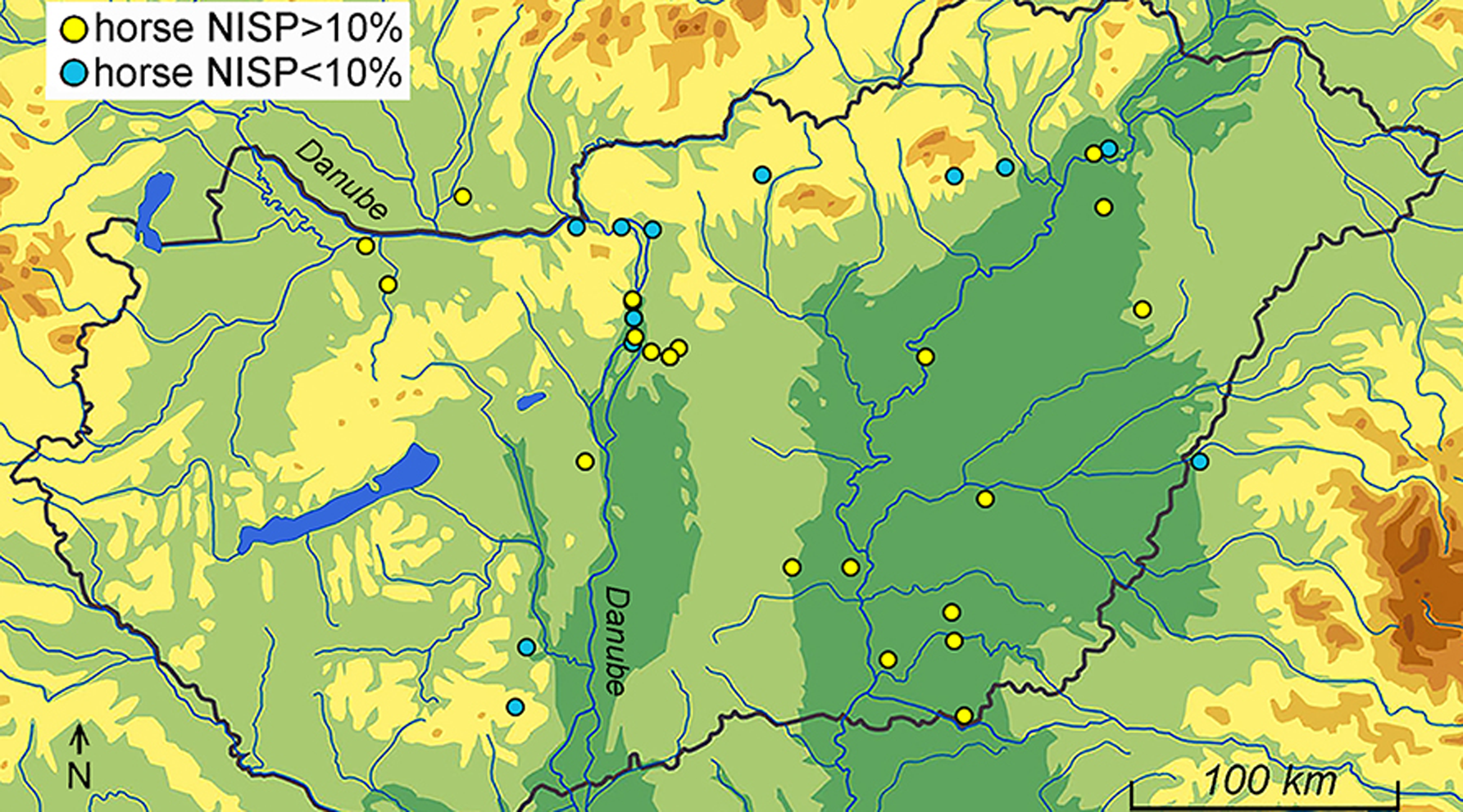
Plotting pre-fourteenth-century assemblages on a topographic map of present-day Hungary facilitates discussion of the environmental context of hippophagy (Figure 5). Horsemeat consumption likely corresponds to the relative emphasis on horse keeping and occurred in lowlands in the east and south, with horse NISP exceeding 30 per cent at several settlements. This tradition is not manifest in the hilly areas of Árpád-period Hungary. Early generations of equestrian pastoralists arriving in the Carpathian Basin from Eurasia possibly preferred familiar grassland habitats in fertile floodplains. This may explain the presence of three settlements on the Danube floodplain toward the north-west. The tight cluster of rural settlements near Budapest reflects the efforts of rescue excavations during large-scale highway development in the plains south-east of the capital, yet many of these also have refuse assemblages containing far more than 10 per cent horse bones, reinforcing the plains/uplands divide.
Pre-fourteenth century, Árpád-period assemblages within the present-day borders of Hungary. Also shown are Bajča, Slovakia, and Oradea, Romania (figure by authors).

When conversion to Christianity began in Hungary in the eleventh century, foreign missionaries supported the royal court in the face of tribal elders representing mobile pastoral tradition. Political tensions culminated in 1046, when most of the Hungarian episcopate was massacred (Kosztolnyik Reference Kosztolnyik1974: 574) and demonic people took to eating horse flesh, and to commit all the worst sins (“populi libaverunt se demoniis et ceperunt comedere equinas pulpas et omnio pessimas facere culpas”; Domanovsky Reference Domanovsky and Szentpétery1937: 338). While zooarchaeological evidence shows that hippophagy was still practised at the time, historical records indicate that the clergy condemned the ritual (Bonnassie 2001: 147) rather than the meat itself, though the tone of this particular account possibly reflects increased condemnation in retrospect, as it was written around 1360, three centuries post festam (Domanovsky Reference Domanovsky and Szentpétery1937).
Geographical distribution: late medieval sites
During the Mongol invasion between April 1241 and March 1242, 50–80 per cent of the settlements in the Hungarian plains were destroyed, while hilly regions were less affected (Sugar et al. Reference Sugar, Hanák and Frank1990: 27). Although some coeval accounts of the onslaught might be exaggerated (Doberdói Breit Reference Doberdói Breit1930), according to contemporary estimates, 40–50 per cent of Hungary’s inhabitants were annihilated (Katona Reference Katona1981: 26). Famine and epidemics exacerbated the population decline. Even a century later (1332–1337; Hungarian National Archives n.d.), a hiatus in the network of parish churches, especially in the plains of the central Carpathian Basin (Figure 6) illustrates depopulation.
Fourteenth- to seventeenth-century assemblages (blue and yellow dots) and twelfth- to thirteenth-centuries Cuman horse burials (triangles) shown against the network of parish churches (red dots) in the fourteenth-century decima tax record across medieval Hungary (base map: Hungarian National Archives, additions by authors).

After this time, the number of assemblages containing more than 10 per cent horse remains decreased, as did the percentage of horse bones within individual assemblages. In advance of the expanding Mongol Empire, Cuman pastoral groups migrated into the Carpathian Basin (Lyublyanovics Reference Lyublyanovics2017). ‘Cuman’ was a generic label that included various Turkic groups forming heterogeneous military and political alliances (Horváth Reference Horváth2001: 236). These newcomers had a changeable and potentially violent relationship with the neophyte Christian Kingdom, their allegiances shifting between being marauding intruders, refugees, allies and settlers (Lyublyanovics Reference Lyublyanovics and Tolan2015: 33).
In Figure 6, all settlements with a horse NISP greater than 10 per cent, except the westernmost outlier, Buda–Szent György Square, were under Cuman influence. Conversion and the adoption of Christian customs were fundamental to assimilating Cumans, but ancestral traditions persisted, including horse burials in the twelfth and thirteenth centuries (Figure 6). The Franciscan missionary, Willem de Rubroeck, describes a Cuman funeral in the Pontic steppe in the early 1250s, in which 16 horsehides were added as grave goods, despite the group having presumably converted to Christianity by this time (de Rubrouck trans. Reference de Rubrouck, Kappler and Kappler1997: 95). Some burials involving horses in the late twelfth to early thirteenth centuries appear to represent first-generation Cumans in Hungary, while others are associated with Cuman immigration post-dating the Mongol invasion (Lyublyanovics Reference Lyublyanovics2017: 203–205, tab. 5.2.1). Horse tack also occurs in some ordinary inhumation graves from this period, indicating a protracted process of assimilation.
Although interpretations of the 1279 ‘Cuman Laws’ by the royal court have been debated (Berend Reference Berend, Bak, Geary and Klaniczay2015), none mention abstaining from horsemeat consumption as a token of Christianity. Should hippophagy still have been condoned in the Hungarian host society, Cumans as new arrivals would have been able to maintain this custom more easily. In the aftermath of the Mongol invasion, royal settlement policy focused on settling Cumans in the deserted Great Plain. Béla IV, king of Hungary and Croatia between 1235 and 1270, also invited German-speaking hospes to repopulate other parts of Hungary. Some of these urbanised groups developed mining towns in the Carpathians. Buda was established as a new, fortified capital, populated by burghers from the German provinces, Croatia and even Flanders (Bartosiewicz Reference Bartosiewicz and Crabtree2001: 37), and the king granted Jewish inhabitants some privileges (Kristó et al. Reference Kristó, Barta and Gergely2002: 75–76). A common feature of these populations was that they tended to avoid eating horsemeat.
Alternative sources of meat
In addition to temporal and spatial trends, the impact of hippophagy on the exploitation of other livestock is worth exploring. In Figure 7, we used the 10 per cent threshold of horse remains as a grouping variable, while the proportions of cattle, caprine and pig NISP (100%) at settlements in each group were plotted against one another. Assemblages characterised by more than 10 per cent horse remains are dominated by cattle (average 64% of NISP), followed by caprines (21%) and pig (15%). These settlements form a tight cluster in the top of the ternary diagram (Figure 7a). Assemblages with less than 10 per cent horse bone (Figure 7b) display a more dispersed pattern, with pig (21%) and caprine (25%) remains contributing relatively more to the NISP and the proportion of cattle remains decreasing (54%). Data points spread into the central quarter of the diagram, indicative of a more balanced representation of taxa. Although the differential fragmentation of bones from large and small stock and the preferential recovery of large specimens may influence this pattern, the fundamental difference between these assemblage groups is evident.
Alternative meat sources in large assemblages where horse remains exceed (a) or do not reach (b) 10 per cent of identifiable specimens among livestock remains (figure by authors).

The pattern in Figure 7a, depicting mainly rural assemblages, fits the stereotypical meat consumption by mobile pastoralists, representing pre-Christian Hungarian and Cuman traditions. Figure 7b, on the other hand, includes urban/elite settlements of mixed ethnic compositions, where horsemeat hardly contributed to the diet. The increased importance of pork consumption is especially noteworthy.
Horsemeat versus pork
Horses are key to mobile pastoralism, while pigs rather characterise sedentism. We compared the NISP of pigs and of horses in large assemblages, distinguished by period (early/late, cut-off point: AD 1301) and region (east/west, cut-off point: 19°E, the north–south section of the Danube). The dashed diagonal line across the graph indicates equal numbers of pig and horse remains (Figure 8). Most assemblages with a greater number of horse than pig bones (falling below this diagonal) represent early rural settlements in eastern Hungary. Late (mostly Cuman) materials in the east track the diagonal. Pig bones occur more frequently than those of horses in the rest of the late assemblages toward the west.
Horsemeat and pork consumption (shown by NISP) in large assemblages (figure by authors).

In terms of meat weight, even an equal NISP would indicate far more horsemeat than pork. Withers height estimates available for 48 Árpád-period horses show that three-quarters were between 1.25m and 1.4m (Vörös Reference Vörös2006: 176). Such horses weighed at most 300kg (Bartosiewicz Reference Bartosiewicz and Mashkour2006: 154). Analysing Mongolian feasting, Masson Smith (Reference Masson Smith2000: 8) estimates that a 275kg horse would provide 110kg of meat, which is more than three times that of an unimproved medieval pig (Vörös Reference Vörös, Bende and Lőrinczy2000: 98).
Crisis hippophagy
While textual and zooarchaeological analyses suggest that hippophagy was practised in pre-sixteenth-century Hungary, it is possible that some of the horse remains in food refuse may reflect necessity rather than preference. During the AD 1070 campaign of William the Conqueror in England, soldiers reportedly resorted to eating their mounts that had died in the marshes (Chibnall Reference Chibnall1969: 172). In 1230–1231, when Novgorod in northern Russia suffered severe crop failure, inhabitants were forced to eat horses, dogs, cats and ultimately humans (Lukin Reference Lukin, Nauman, Jezierski, Reimann and Runefelt2022: 127). In 1287, defenders in the besieged castrum of Augusta in Sicily were reduced to consuming their horses before turning to carrion (Paladino Reference Paladino1921). Hippophagy also became inevitable during the 1315–1317 London famine (Rackham Reference Rackham and Clark1995: 169–74). Yet, while Rogerius of Apulia recorded the misery caused by the invading Mongols in Hungary, he did not mention hippophagy (Master Roger trans. Reference Roger, Rady, Veszprémy, Bak, Bak and Rady2010). It is impossible to tell whether eating horses was still the norm at this time, and thus did not attract his attention, or whether not even horsemeat was available as food.
Butchery marks on bones in the meat-rich regions of the skeleton suggest horsemeat consumption. Intensive butchery is particularly conspicuous in periods when hippophagy had been abandoned; for example, a splinter of equid femur found among the scarce remains of horse at the Ottoman period fort of Dombóvár–Gólyavár in Hungary bears a transverse hack mark (Figure 9), seemingly indicating the consumption of at least one horse during the tumultuous history of the fort (Gál & Berta Reference Gál and Berta2025). In contrast to regular horsemeat consumption in Árpád-period villages, this fragment may be interpreted as rare evidence for crisis hippophagy.
Splinter of equid right femur from the Ottoman-period Dombóvár–Gólyavár fort. Note the hack mark below the trochanter tertius (photograph by Erika Gál).

Conclusions
Contributions of horse to food refuse in medieval Hungary changed dynamically through time, paralleling historical events. Newly arrived steppe pastoralists, their westward-looking elites and sedentary agriculturalists had to reconcile diverse lifestyles within a space limited by state borders. It is difficult to appraise the degree of inter-relatedness between the broader society and these constituent parts, operating in relative isolation and cultivating partial relationships with one another (Yoder Reference Yoder1974: 5). The reasons why hippophagy persisted in this social environment must have been subtle and manifold. Even ethnic identity may have been of secondary importance relative to the maintenance of pastoral traditions and cultural idiosyncrasies in culinary tastes (Horváth Reference Horváth2001: 236).
The proportion of horse bones exceeds 10 per cent in one-quarter of the 99 large assemblages studied here, making a religious ban on horsemeat in Hungary unlikely. Sporadic condemnations of hippophagy in documentary sources across Europe vary between sociopolitical environments. The versatility of the horsemeat-eating taboo is clear in the case of Olaf Tryggvason, the tenth-century king of Norway, mocked by his non-converted Swedish adversaries as a ‘horse eater’ (Golther Reference Golther1895: 565). During the mid-twelfth-century conversion in Iceland, hippophagy by the lower classes remained acceptable, given the harsh winters (Miller Reference Miller1991: 2086). Horsemeat consumption survived for centuries in the more favourable climate of Hungary, where persecution of this pre-Christian custom did not seem a priority for episcopal authorities.
Tropes equating hippophagy with ‘barbarity’ have abounded since Antiquity (Vörös Reference Vörös2006: 177). Ecclesiastic sources in Europe occasionally refer to hippophagy as practised by ‘others’, but this othering is most poignant in sources that post-date the events they are describing, sometimes by centuries, and possibly portray negative generalisations rather than past ‘reality’. Ethnographic examples illustrate the power of othering through food preferences. The Yakut, a Turkic pastoral group in north-eastern Siberia, traditionally raised cattle and horses; in a late nineteenth-century interview, one remarked: “The horse is a pure animal, even purer than humans. You, Russians, are disgusted by horsemeat and eat pork” (Seroshevskiy Reference Seroshevskiy1993 [1896]: 253). Although this comment cannot be directly transposed to medieval Hungary, the sentiment is demonstrative. After the Mongol invasion, replenishment of the eradicated Hungarian population with ethnic groups showing preferences for pork and beef must have accelerated the decline of hippophagy.
Medieval Hungary was an ethnically heterogeneous, vibrant entity that underwent dynamic changes, including conversion to Christianity. The contribution of horse remains to food refuse correlates with general historical trends but needs to be understood in light of the complex interactions between different peoples and their physical and political environments.
Acknowledgements
Archaeologist Adrián Berta (Institute of Archaeology, HUN-REN Research Centre for the Humanities) is thanked for providing the animal bone assemblage from Dombóvár–Gólyavár for this study. Zora Bielichová kindly gave permission to include her unpublished data in our synthesis. Special thanks are due to two anonymous reviewers and Antiquity’s editorial team, whose constructive comments helped clarify the final version of our manuscript.
Funding statement
This research was partially funded by the National Research, Development and Innovation Office of Hungary, Project K-143099 ‘Castles, settlement network, material culture, 1300–1700 – complex micro-regional historical, landscape historical and archaeological research in Transdanubia’ (PI: Gyöngyi Kovács Raczkyné).
Online supplementary material (OSM)
To view supplementary material for this article, please visit https://doi.org/10.15184/aqy.2025.10138 and select the supplementary materials tab.


 Open access

