




1 Introduction
Voice onset time (VOT) is the time interval between the release of a stop consonant closure and the onset of following voicing, which appears as periodicity in the waveform (Lisker & Abramson Reference Lisker and Abramson1964: 422). VOT measurements of different stop categories are situated at particular points on the VOT continuum, allowing them to be taken as a foundation for distinguishing stop categories in languages. Voicing lead, which occurs when the vocal folds begin to vibrate during closure phase, exhibits negative VOT. If the vocal folds begin to vibrate at the same time that the closure is released, VOT has a value of zero. Meanwhile, if the onset of vocal fold vibration begins after the release of the closure, there is a voicing lag and a positive VOT.
The present study examines VOT in stop consonants in Bahdini Kurdish, a Kurdish language. It investigates the categories Kurdish VOT patterns fall into and whether VOT can distinguish its three-way stop contrast. This will furthermore help to identify and locate the Kurdish patterns cross-linguistically. It also aims at investigating the effect of place of articulation, following vowel height and length, and gender in determining VOT values in Kurdish stop consonants.
2 Background
2.1 The typology of VOT
Lisker & Abramson (Reference Lisker and Abramson1964) examined VOT in eleven languages and found that languages which have a two-way contrast in VOT can be divided into two main categories. The first category contains languages with long positive VOT values for voiceless stop consonants and short positive or zero VOT values for voiced stops. These are referred to as aspirating two-way contrast languages, in which all VOT values either coincide with stop release or begin after, meaning that there is no voicing lead (pre-voicing) and all values are positive. This is typical of the Germanic languages (Bruin, Reference Bruin2015) and is considered as the most unmarked opposition (Vaux & Samuels, Reference Vaux and Samuels2005). VOT, however, is able to distinguish stop categories in these languages.
The second category contains languages which demonstrate short positive VOT values for voiceless stop consonants and negative VOT values for voiced stops. This pattern is typical of Slavic and Romance languages, and languages with this contrast are referred to as true voicing languages (Bruin, Reference Bruin2015). According to Keating et al. (Reference Keating, Linker and Huffman1983), languages which employ such a voicing contrast usually have an unaspirated voiceless category with a short lag VOT contrasting a fully voiced category with voice lead. Öğüt et al. (Reference Öğüt, Akif Kiliç, Zeki Engin and Midilli2006), however, found that Turkish VOT showed a voice lead for voiced stops and a long lag for voiceless stops. Similar results were reported by Bijankhan & Nourbakhsh (Reference Bijankhan and Nourbaksh2009) on Persian, Shimizu (Reference Shimizu1989) on Japanese, Kulikov (Reference Kulikov2022) on Qatari Arabic, and Bahrani & Kulikov (Reference Bahrani and Kulikov2023) on Khuzestani Arabic. These authors observed that VOT had a voice lead (sometimes short lag for Persian) for voiced stops and a long lag for voiceless stops. This offers the possibility of the existence of additional language categories based on VOT distribution other than the two categories suggested by Lisker & Abramson (Reference Lisker and Abramson1964) for two-way contrast languages.
Three-way contrast languages employ the whole VOT continuum range and usually include voiced, voiceless aspirated and unaspirated stops. VOT distinguishes stop categories in languages with three-way contrasts such as Korean (Hardcastle, Reference Hardcastle1973), Burmese and Thai (Shimizu, Reference Shimizu1989), Madurese (Indonesian) (Misnadin, Reference Misnadin2016), and Yerevan Armenian (Seyfarth & Garellek, Reference Seyfarth and Garellek2018). Hussain (Reference Hussain2018) investigated Indo-Iranian stop consonants and found that in languages with two or three laryngeal categories, VOT clearly distinguished between homorganic stop categories. Voiced stops were produced with a voice lead, voiceless unaspirated with a short lag and voiceless aspirated with a long lag. More than three laryngeal categories like Urdu and Sindhi, however, were not differentiated by VOT which showed overlap between some categories.
The way VOT is modeled within a language is not based on any phonetic grounds related to ease of articulation or contrast maximizing as predicted (Cho & Ladefoged, Reference Cho and Ladefoged1999). The exact VOT values for each category are language-specific which makes languages different from each other and creates cross-linguistic variation. Furthermore, the way VOT is distributed along the VOT continuum in a certain language is not affected by the phonemic inventory of that language nor by the number of phonological distinctions made in that language (Ladefoged & Cho, Reference Ladefoged and Cho2001). These facts about VOT dictate that, in order to specify and locate the VOTs of any language along the continuum, they have to be extracted and measured from original data rather than predicted from the number or type of categories it has.
2.2 VOT and contextual factors
In connected speech, phonemic features usually overlap and undergo alteration or modification as a result of their phonetic environment. Accordingly, any investigation of the phonetic or acoustic properties of speech sounds should take into consideration the influence of their phonetic context. While VOT is one of the fundamental properties of stop consonants, one which is dependent on laryngeal settings, it is not an absolute value but is context sensitive. VOT variation is proved to be highly structured by its phonetic context. The effects of some contextual factors on VOT are examined below with reference to the results of this study.
VOT is sensitive to the place of stop closure, increasing as the closure moves from the front to the back of the mouth (Cho & Ladefoged, Reference Cho and Ladefoged1999). Thus, VOT tends to be longer in velars than in bilabials and alveolars (Klatt, Reference Klatt1975; Zue, Reference Zue1976). This is observed similarly across different languages, creating universal VOT patterns based on place of stop articulation. Cho & Ladefoged’s (Reference Cho and Ladefoged1999) comparative study of eighteen languages has shown that velars or uvulars, when existent in a language, have the longest VOT values. However, it has also been found that language-specific differences for each place of articulation do exist. In a comparison of the VOT values of over 100 languages, Chodroff et al. (Reference Chodroff, Golden and Wilson2019) observed two forms of structured variation in the mean VOT values of stops based on their place of articulation. Besides the previously observed ordinal relationship indicating an increase in VOT the more posterior the place of articulation is, there is another linear relationship in the mean VOT values of stop series based on place of articulation. They argued that the distances between VOT values of stops with different places of articulations are relatively fixed within a language.
Different vowel contexts are likely to alter the acoustic properties of stop consonants, including their VOT. Klatt (Reference Klatt1975) found that VOT is longer before high vowels in American English. Similar results were also obtained by Bijankhan & Nourbakhsh (Reference Bijankhan and Nourbaksh2009) on Persian, Cheng (Reference Cheng2013) on Sixian Hakka, and Clothier & Loakes (Reference Clothier and Loakes2018) on Australian English. Being a temporal interval, VOT is also influenced by other aspects of the temporal structure of speech such as following vowel length. Port & Rotunno (Reference Port and Rotunno1979) measured both the VOT of English word-initial stops and the duration of the following vowel to investigate the temporal effects of speech timing that extend over a whole syllable and the way they interact. They found that the longer the vowel duration, the longer the VOT (see also Mielke & Nielsen, Reference Mielke and Nielsen2018; Awoonor-Aziaku, Reference Awoonor-Aziaku2021). However, when Kasim (Reference Kasim2019) investigated the effect of vowel duration on VOT in Mosuli Arabic, he found no relationship between stop VOT and the duration of a following vowel. Similarly, Öğüt et al. (Reference Öğüt, Akif Kiliç, Zeki Engin and Midilli2006) found that VOT of Turkish stops is not affected by the identity of the following vowel.
The effect of gender on VOT is also investigated in the literature. Öğüt et al. (Reference Öğüt, Akif Kiliç, Zeki Engin and Midilli2006), Cheng (Reference Cheng2013), Awoonor-Aziaku (Reference Awoonor-Aziaku2021), and Irawan & Riani (Reference Irawan and Riani2021) found that the difference between both genders in VOT production was insignificant for Turkish, Sixian Hakka, Ghanaian English and Sundanese, respectively. Bijankhan & Nourbakhsh (Reference Bijankhan and Nourbaksh2009), however, observed that VOT differences with reference to the gender of the speaker for Persian were only significant for voiced stops but not their voiceless counterparts. Females tended to produce stops with longer VOTs than of those produced by males. Alshahwan (Reference Alshahwan2015), on the other hand, observed the same difference for Arabic but only for voiceless stops, meaning that females produced longer VOT values than males for voiceless stops. This indicates that gender effects on VOT are language-specific rather than universal.
2.3 Kurdish stop categories and VOT
Kurdish is categorized as a member of the western Iranian group of the Indo-Iranian branch of the Indo-European family. The Kurdish language is subdivided into different dialects and Northern Kurmanji (NK) is considered as one of them. It is the dialect that is spoken by the majority of Kurds who live in Turkey, Northwest Iran, Syria and Northwest Iraq. The Northern Kurmanji variety spoken in Iraq is usually referred to as ‘Bahdini’ which is the term adopted in this research.
Bahdini Kurdish stops are divided according to place of articulation into bilabial /ph, p, b/, dental /th, t, d/, velar /kh, k, g/ and uvular /q/. They contrast voiced, voiceless aspirated and voiceless unaspirated categories. Table 1 includes a phonetic description of Bahdini stops, along with relevant examples.
Description of Bahdini stop consonants

VOT has been examined in Sorani and some Iranian Kurdish varieties, but nothing is mentioned in the literature concerning other Kurdish dialects including Bahdini. For Sorani (Central) Kurdish, Ahmed (Reference Ahmed2019) investigated the VOT of word-initial stops in Hawler and Slemani varieties. These varieties have only one series of voiceless stops, which are aspirated. The author found that Sorani Kurdish does not follow the common typology of two-way laryngeal contrast languages described in the literature, and exhibits features of both aspirating languages and true voice languages. Specifically, voiced stops /b/, /d/ and /g/ were found to show voice lead with VOT averages of –64 ms, –79 ms and –60 ms, respectively; while the voiceless aspirated stops /p/, /t/ and /k/ showed a long lag with averages of 48 ms, 54 ms and 66 ms, respectively. These results are in line with the universal tendency for voiceless aspirated stops to have longer VOT values, further increasing with more posterior place of articulation (Cho & Ladefoged, Reference Cho and Ladefoged1999). Although this analysis is carried out on a small scale, including only five participants, it nevertheless provides the first investigation of Sorani Kurdish VOT.
Kahn (Reference Kahn1976) measured VOT of the three-way contrast stops of twenty-five speakers of Iranian Northern Kurmanji. She found that Kurdish voiceless aspirated stops displayed longer voice lag than those of English and Eastern Armenian. The voiceless unaspirated stops of Kurdish and Eastern Armenian displayed short lag VOT values. The voiced stops of these two languages, however, had negative VOT values with voicing lead as opposed to the voiced stops of English which displayed short lag positive VOT. Zirak (Reference Zirak2014) investigated VOT of initial voiceless stops of ten male speakers of Khorasani variety of Kurmanji, which is spoken in Iran. The VOT values of the unaspirated voiceless series /p,t,k/ were 33, 38 ms and 49 ms, respectively. The VOT values of the aspirated voiceless series /ph,th,kh/ were 55 ms, 59 ms and 76 ms, respectively. Her findings show that VOT clearly distinguishes aspirated from unaspirated categories which occupy different ranges along the VOT continuum. She also aimed to measure the contact-induced changes in Khorasani VOT with Persian, based on two generations of speakers. She found that the younger generation produced longer VOT values for both aspirated and unaspirated voiceless stops. This indicates that Khorasani speakers shifted towards the longer VOT values of Persian, the dominant language. This may be attributed to the lack of an aspirated/unaspirated distinction in Persian voiceless stops.
Like in Khorasani Kurmanji, Bahdini Kurdish stops are also characterized by having a three-way distinction between voiced, voiceless aspirated and voiceless unaspirated stops. This study considers whether VOT alone is sufficient to distinguish Kurdish stop categories.
3 Methodology
3.1 Participants
Participants included thirty monolingual adult native speakers of Bahdini Kurdish, fifteen males and fifteen females aged between twenty to fifty years. The age mean (M) of the participants was 30 and the standard deviation (SD) was 10.2. All the speakers were recruited in Duhok. All of them were born in Duhok and studied or worked there, using Bahdini Kurdish in their daily lives. They had mixed educational backgrounds. None of the participants had reported any history of language disorders.
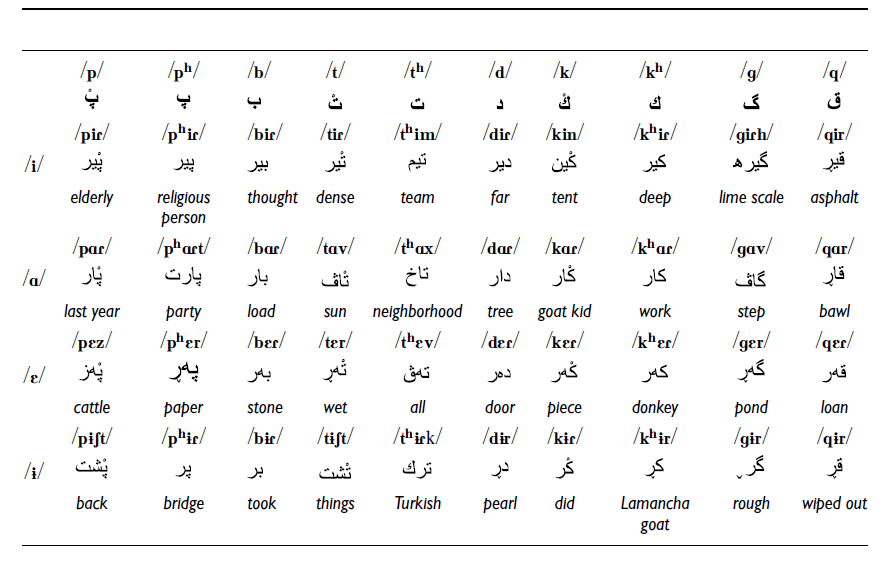
Target words of prevocalic initial stops with their transcriptions (bold), Kurdish orthography and gloss (italics)
3.2 Stimuli
The stimuli, presented in Table 2, consisted of a list of forty words which were chosen based on specific contextual factors. It included four examples of each of /p, ph, b, t, th, d, k, kh, ɡ, q/ representing the ten stops of the target dialect.
The stimuli were selected to examine the three-way laryngeal and four-way place contrasts. All stops occurred word-initially before four different vowels. The vowels chosen were /i/ and /ɑ/, which are characterized as long vowels in Kurdish and /ɛ/ and /ɨ/, which are characterized as short vowels in Kurdish (Bedirxan, Reference Bedirxan1994). Of these four vowels, /i/ and /ɨ/ were high and /ɑ/ and /ɛ/ were low, allowing the effect of following vowel length and height on initial stop VOT to be investigated (Klatt, Reference Klatt1975; Port & Rotunno, Reference Port and Rotunno1979). Only word-initial position was considered to exclude the effect of continuous voicing of voiced stops preceded by other voiced sounds, which makes it hard to provide accurate separate measurements of the onset of voicing for each sound. All words were monosyllabic to eliminate any differences in VOT due to stress placement or length of word which are known to affect VOT (Lisker & Abramson, Reference Lisker and Abramson1967). Many of the target words ended with the same postvocalic consonant to eliminate their effect on initial stop VOT (Mielke & Nielsen, Reference Mielke and Nielsen2018).
3.3 Procedure
The words were presented in their citation form individually in a random order to the participants on a laptop screen to be read in a self-paced reading task. Each word was repeated three times, which provided a total of 3600 tokens for analysis including 120 tokens by each speaker and 360 tokens of each consonant. Participants were asked to repeat a word if they pronounced it incorrectly.
These productions were recorded by the researchers in a quiet room, using a high quality portable digital audio recorder Zoom H1n with a built-in microphone. This microphone was positioned approximately 20 cm from each participant’s mouth for the duration of recording. The recordings were directly stored in WAV format on the digital audio recorder and later transferred to a laptop for analysis. Recordings had a 16-bit sampling depth with a sampling rate of 44.1 kHz. Each meeting with an individual participant lasted for about thirty to forty minutes. All the recordings were then segmented and assigned codes in Audacity into distinct WAV files.
3.4 Acoustic analysis
Each WAV file included one word in the list as preparation for analysis by Dr.VOT, which is a software package for automatic measurement of VOT developed by Shrem et al. (Reference Shrem, Goldrick and Keshet2019). This software reduces the time and effort needed for manual annotation which poses a considerable barrier to expanding phonetic experiments. Dr.VOT can determine the duration of VOT automatically using a model trained through machine learning based on a structured prediction framework. Unlike forced aligners, this trained model can estimate measures automatically without the need for data to be transcribed phonetically or orthographically.
The resulting measurements from the automatic software were then corrected manually through the visual inspection of the waveforms. For voiceless stops, manual correction ensured that the measured interval spanned from the onset of the release to the onset of the first cycle of vocal fold vibration of a following vowel. Voiced stops, however, were checked to see if the estimated duration started from voicing closure onset to the onset of stop release. These corrections were done through Praat (Boersma & Weenink, Reference Boersma and Weenink2019) using a script created by Elvira-García (Reference Elvira-García2013). Figure 1 provides samples of a random participant’s productions along with their visual waveforms and spectrums representing the three types of VOT found in the data.
The three types of VOT produced by speaker 18.

3.5 Statistical analysis
Data were analyzed statistically in R (R Core Team, 2022). The yeo-Johnson transformation was applied to reduce the skewness of the data which shifted from 0.80 to 0.27 (Yeo & Johnson, Reference Yeo and Johnson2000). This transformation brought the distribution of the dependent variable (VOT) closer to normality. The VOT estimates provided in the text and tables were back-transformed to the original scale.
An LME model (1) was used to examine the impact of a number of variables on VOT, conducted using lme4 (Bates et al., Reference Bates, Mächler, Bolker and Walker2015) and lmerTest (Kuznetsova et al., Reference Kuznetsova, Brockhoff and Christensen2017). The fixed factors in the LME model, using an alpha = 0.05 level of significance, were laryngeal (voiceless aspirated, voiceless unaspirated and voiced), place of articulation (POA) (bilabial, dental, velar and uvular), gender (male, female), vowel length (long, short) and vowel quality (high, low), as well as by-speaker and by-word random intercepts.
-
(1) VOT ∼ Laryngeal + POA + Vowel. Height + Vowel. Length + Gender + (1 |Speaker) + (1 |Word) + Laryngeal:POA + Laryngeal:Vowel. Height + Laryngeal:Vowel. Length + Laryngeal:Gender + POA:Vowel. Height + POA:Vowel. Length + POA:Gender + Vowel. Height:Gender
The examination of the residuals of the initially fitted model showed that their distribution was slightly skewed with a value of 0.62. To bring their distribution closer to normality, points with more than 3 SD from the origin were excluded. The model was then refitted to the new data with the removed outliers. The distribution of the refitted model residuals had a skewness value of 0.33, which was closer to normality. The emmeans package (Lenth, 2022) was used to plot the category estimates along with confidence intervals (Appendix A, Table A1). It was also used to do post-hoc pair-wise comparisons to show the contrast between the categories and the direction of difference (Appendix A, Table A2). Figures were plotted using ggplot2 (Wickham, Reference Wickham2016).
4 Results
4.1 Overview
This section begins by presenting descriptive statistics for VOT measurements of Bahdini Kurdish stops by place of articulation and voicing contrast, before presenting the results of a linear mixed-effect model predicting VOT as a function of laryngeal state, place of articulation, vowel height, vowel length, gender and interactions between these variables. Descriptive statistics are given in Table 3, which shows the mean, standard deviation (SD) and range of VOT values of word-initial stops. Voiced stops /b/, /d/ and /g/ are characterized by lead VOT with very close mean values of −119 ms, −120 ms, and −119 ms, respectively. Voiceless unaspirated stops /p/, /t/, /k/ and /q/ are produced with short lag VOT that differs by places of articulation: bilabials have the shortest mean VOT (11 ms) followed by dentals (15 ms), uvulars (18 ms) and velars (24 ms). Voiceless aspirated stops /pʰ/, /tʰ/, and /kʰ/, however, are all produced with a long lag. As indicated by mean VOT values, they show a pattern in which bilabials have the shortest VOT, followed by dentals and then velars with mean values of 53 ms, 56 ms and 76 ms, respectively.
Range, mean and standard deviation (SD) of VOT values of Kurdish stop categories measured in milliseconds (ms)

The analysis of variance results showed significant effects for several fixed factors. The results indicate that the laryngeal and place of articulation factors significantly influenced VOT values, with all associated p-values being less than .001. Additionally, vowel length showed a significant effect at p = .009, while vowel height showed a marginal effect at p = .041. Gender did not have a significant effect on VOT values at p = .448. The output of the LME model including the factors and their corresponding statistics are presented in Table 4 and are further discussed below.
Analysis of variance for fixed factors in the LME model with Satterthwaite’s method for degrees of freedom, indicating F statistic, denominator degree of freedom and p values

Signif. codes: 0 ‘***’ 0.001 ‘**’ 0.01 ‘*’ 0.05 ‘.’ 0.1 ‘ ’ 1
4.2 Laryngeal state
Bahdini Kurdish VOT was measured to examine its ability to distinguish stop categories in this dialect. The results show that there was a significant effect of laryngeal state on the VOT of initial stops in Bahdini Kurdish (F (2, 18) = 1352.08; p < .001; Table 4). Results of Table A1 show that VOT is clearly able to distinguish its homorganic stop categories. Voiced stops are all produced with a voice lead with an estimated mean score of −119 ms. Voiceless unaspirated stops are produced with a short lag with an estimated mean score of 17 ms; while those of voiceless aspirated stops were produced with a long lag with an estimated mean score of 60 ms. The distribution of VOT measurements by stop category is visualized in a histogram in Figure 2.
Histogram of the distribution of VOT values of Kurdish.

The direction of difference is made clear through category contrasts in Table A2. The smallest difference is between voiceless unaspirated and voiceless aspirated stops estimated as –43.7 ms (SE = 2.68, z = –16.30, p < .001). The difference between voiceless unaspirated and voiced stops is estimated as –131.5 ms (SE = 2.69, z = –67.10, p < .001), which in turn is less than the difference between voiceless aspirated and voiced stops, estimated as –185.1 ms (SE = 2.68), indicating the largest effect size. The z-ratio is –50.90, suggesting that the estimated difference is statistically significant (p < .001). These results suggest that the estimated difference is statistically significant with a substantial difference in VOT between all three categories.
4.3 Place of articulation
Place of articulation (POA) of initial Kurdish stops showed a significant effect on VOT (F (3, 18) = 17.80; p < .001; Table 4). Pairwise tests (Table A2) showed that bilabial and velar stops differed from each other significantly with an estimated difference of –11.65 ms (SE = 2.68, z = –4.34, p < .001). However, there was no statistically significant difference in VOT between bilabials and dentals, with a slight difference of –1.81 ms (SE = 2.68, z = –0.68, p = .906); nor with uvulars with a difference of –5.28 ms (SE = 4.10, z = –1.29, p = .570). Dentals differed from velars significantly by –9.84 ms (SE = 2.68, z = –3.66, p = .001), but not with uvulars with only –3.47 ms (SE = 4.10, z = –0.85, p = .832). While bilabials, dentals, and uvulars did not significantly differ from each other, velars exhibited significantly longer VOT values compared to all other places of articulation. These results are visualized in Figure 3.
Boxplots showing the distribution of VOT values of Kurdish stop categories based on place of articulation.

VOT values of the four places of articulation in this study, Table A1, show a pattern across all stop categories. Within voiceless aspirated categories, bilabials have the shortest VOT with an estimated mean of 56 ms, followed by dentals with a mean of 58 ms, and then velars with a mean of 68 ms. While voiceless unaspirated bilabials have the shortest VOT values 12 ms, followed by dentals 14 ms, uvulars 18 ms and then velars 24 ms. The estimated mean scores of voiced stops are –124, –122 and –113 ms for bilabials, dentals and velars, respectively.
4.4 Following vowel height
The analysis of the results of this study concerning vowel height has shown that VOT of initial stops in Kurdish is affected by the height of a following vowel (F (1, 18) = 4.85; p = .041; Table 4). The distinction in VOT between the high vowels /i/ and /ɨ/ and the low vowels /ɑ/ and /ɛ/, displayed in Figure 4, however, was not statistically significant with an estimated difference of 3.87 ms (SE = 2.08, z = 1.86, p = .062; Table A2). The interaction between variables laryngeal and vowel height (F (2, 18) = 6.11; p = .010; Table 4) suggests some differences exist depending on the laryngeal factor. The VOT before high vowels was somewhat longer for voiceless aspirated stops, but not the other stop categories.
Boxplots showing the distribution of VOT values of Kurdish stop categories based on vowel height.

Stops followed by high vowels tended to have slightly longer VOT values than those followed by low vowels. Voiced stops followed by high vowels, with an estimated mean score of –118 ms, had longer VOT values compared to those followed by low vowels, with an estimated mean score of –121 ms. Voiceless unaspirated stops followed by high vowels, with an estimated mean score of 19 ms, had longer VOT values compared to those followed by low vowels, with an estimated mean score of 15 ms. Similarly, voiceless aspirated stops followed by high vowels, with an estimated mean score of 63 ms, had longer VOT values compared to those followed by low vowels, with an estimated mean score of 59 ms (Table A1).
Even though the high vowel effects appear to be small, about 3–4 ms, the direction of this effect is consistent across all stop categories. VOT tends to be longer before high vowels compared to low vowels. This tendency may be influenced by the articulatory characteristics involved in producing high and low vowels. Variations in vowel height seem to impact the tension in vocal folds and consequently voicing initiation (Higgins et al., Reference Higgins, Netsell and Schulte1998).
Boxplots showing the distribution of VOT values of Kurdish stop categories based on vowel length.

4.5 Following vowel length
One of the aims of this study was to measure the effect of following vowel length on the VOT of initial stops in Bahdini Kurdish. Results have shown that VOT is significantly affected by the length of the following vowel (F (1, 18) = 8.61; p = .009; Table 4). The distinction in VOT between stops followed by long vowels /i/ and /ɑ/ and short vowels /ɛ/ and /ɨ/, visualized in Figure 5, reached a statistical level of significance with an estimated difference of 5.64 ms (SE = 2.08, z = 2.71, p = .007; Table A2). The laryngeal variable was also shown to have a significant interaction with the vowel length variable in Table 4 (F (2, 18) = 6.41; p = .008).
Stops followed by long vowels tended to have longer VOT values than those followed by short vowels. Voiced stops followed by long vowels, with an estimated mean score of –117 ms, had longer VOT values compared to those followed by short vowels, with an estimated mean score of –122 ms. Voiceless unaspirated stops followed by long vowels, with an estimated mean score of 20 ms, had longer VOT values compared to those followed by short vowels, with an estimated mean score of 14 ms. Similarly, voiceless aspirated stops followed by long vowels, with an estimated mean score of 64 ms, had longer VOT values compared to those followed by short vowels, with an estimated mean score of 58 ms (Table A1).
The long vowel effects are about 5–6 ms across all stop categories. Generally, the longer duration of the following vowel can impact the timing and duration of various phases of the stop consonant, leading to differences in VOT (Port & Rotunno, 1979). For instance, a longer following vowel might lead to a longer duration of the preceding stop’s closure or a delay in the onset of voicing after the release of the stop. This delay in the onset of voicing can contribute to a longer period of voicelessness after the release of the stop, leading to a longer VOT for stops before longer vowels compared to stops before shorter vowels.
4.6 Gender
Gender did not have a significant effect on VOT of initial stops in Kurdish (F (1, 30) = 0.59; p = .448; Table 4). There was almost no distinction in VOT between genders in any stop category, as shown in Figure 6. For voiced stops, the estimated mean score of males and females were –119 ms and –120 ms respectively. Voiceless unaspirated stops produced by males, with an estimated mean score of 18 ms, had marginally longer VOT values compared to those produced by females, with an estimated mean score of 16 ms. Similarly, voiceless aspirated stops produced by males, with an estimated mean score of 61 ms, were very close to those produced by females, with an estimated mean score of 60 ms (Table A1).
Boxplots of the distribution of VOT of Kurdish stops based on gender.

The contrast estimate for the male–female comparison in Table A2 is 1.26 (SE = 2.11), indicating a small effect size. The z-ratio is 0.60, suggesting that the estimated difference was not statistically significant (p = 0.550). These results suggest that there is no substantial difference in VOT between males and females. The interaction between variables of laryngeal and gender in Table 4 (F (2, 3413) = 3.03; p = .048), however, suggests that there may be some differences depending on the laryngeal category.
5 Discussion
This paper presented an analysis of VOT measurements from Bahdini Kurdish and found that VOT can distinguish the three-way stop contrast of voiced, voiceless unaspirated and voiceless aspirated stops. The findings are compatible with other research on Indo-Iranian languages with three-way laryngeal categories. VOT is an effective means of physically distinguishing homorganic stop categories in Bahdini Kurdish. Voiced stops were characterized by lead VOT. Voiceless unaspirated stops were produced with a short lag VOT. Voiceless aspirated stops, however, were all produced with a long lag. Since VOT is not an absolute value but is context-sensitive, some contextual factors were investigated in this paper including place of stop articulation, following vowel height and length and gender. VOT variation was proved to be structured by all these contextual factors except gender. In terms of place of articulation, VOT values of voiceless stop categories were found to be longer, the more posterior the place of articulation is in the mouth. VOT values of voiced stops did not show such a pattern. There was an effect of variables of following vowel height and length, VOT was longer when stops were followed by high and long vowels.
The findings of this study are compatible with the results of Zirak (Reference Zirak2014) on the VOT of initial voiceless stops in Khorasani variety of Kurmanji and those of Kahn (Reference Kahn1976) on Iranian Northern Kurmanji. Their findings had also shown that VOT in these two dialects clearly distinguished aspirated from unaspirated categories which occupied different ranges along the VOT continuum. They also showed that voiced stops in both dialects were produced with voicing lead. The results of this study are also compatible with other research on Indo-Iranian languages with three-way laryngeal categories (Hussain, Reference Hussain2018), in which VOT clearly distinguishes between homorganic stop categories.
In line with universal VOT patterns based on place of stop articulation as shown by Cho & Ladefoged’s (Reference Cho and Ladefoged1999) analysis of several languages, VOT measurements from Bahdini Kurdish increased as the closure place moved posteriorly in the mouth. VOT tended to be longer in velars than in bilabials and dentals. The velar stops had significantly longer VOT than the other stops for both the unaspirated and aspirated categories. The unaspirated uvular stop had VOT values close to the unaspirated dental stops, shorter than velars and slightly longer than bilabials. Voiced stops did not show such a pattern. The low difference between bilabials, dentals and uvulars of unaspirated stops may be due to the presence of a certain factor in each type that contributes to their VOT measurements in one direction which vary from one language to another. This overlap could be attributed to the articulatory velocity of the stop categories. Hardcastle (Reference Hardcastle1973) noticed that when the articulators move fast, VOT decreases. The speed at which the articulators move is one of the physiological factors that contribute to VOT differences. The movement of the lips and the tongue tip is faster than that of the back of the tongue due to differences in their mass and compliance. This results in a faster release in bilabials and dentals than in velars (Zue, Reference Zue1976). Uvulars, on the other hand, are characterized by having a short contact duration, which is one of the factors that contribute to a shorter VOT (Cho & Ladefoged, Reference Cho and Ladefoged1999). Another reason that may have contributed to this difference is the stop closure duration which is inversely related to VOT. Maddieson (Reference Maddieson, Hardcastle and Laver1999) notices that when closure hold is longer, which is the case in bilabial stops, the time interval for VOT will decrease by the same amount of time. This is based on the idea that the duration of vocal fold opening, which involves both closure and aspiration time, is fixed and is independent from place of articulation. So, when closure duration is short, VOT is long and vice versa. This suggests that there is a constant time interval needed in voiceless aspirated stop production meaning that stop closure and release are adjusted in a way to be complete by the time vocal folds are in position for voicing onset. Docherty (Reference Docherty1992) measured the VOT of Southern British English stops and found that the closure duration for both bilabial and alveolar stops was the same, leading to close VOT measurements. This may also be similar to Kurdish in the case of bilabials and dentals which cause overlapping in their VOT values, a point that needs to be investigated in future research.
Following vowel height and length was also shown to affect VOT of Bahdini Kurdish stops. Similarly to the results of Klatt (Reference Klatt1975), Bijankhan & Nourbakhsh (Reference Bijankhan and Nourbaksh2009), Cheng (Reference Cheng2013) and Clothier & Loakes (Reference Clothier and Loakes2018), VOT was longer before high vowels. Vowel height affects the positioning of the tongue and the constriction of the vocal tract. High vowels often involve a higher tongue position, leading to a more constricted oral cavity. This constriction can impact the airflow and air pressure dynamics during the production of stops, potentially influencing the timing of VOT. This means that in the production of high vowels the passage of air is narrow, causing a delayed drop in air pressure and thus a delay in the onset of voicing producing longer VOTs.
Similarly to the results of Port & Rotunno (Reference Port and Rotunno1979), Mielke & Nielsen (Reference Mielke and Nielsen2018) and Awoonor-Aziaku (Reference Awoonor-Aziaku2021), the following vowel length influenced VOT measurements. The longer the vowel duration, the longer the VOT. This is the result of temporal implementation rules that act as instructions to the articulators to decide on the duration of temporal intervals based on features of the adjacent segments. Longer vowels might allow for a more prolonged oral closure before the release of the stop consonant. This extended closure duration could impact the build-up of air pressure behind the closure, potentially affecting the timing of VOT. This is why VOT and vowel duration are directly related. These patterns fit with typological generalizations made in Cho & Ladefoged (Reference Cho and Ladefoged1999).
Languages show different susceptibility to gender-based phonetic differences. In this study, the gender of the participants had no noticeable impact on Bahdini Kurdish VOT, with almost no distinction in VOT between genders observed across all stop categories, aligning with findings in studies by Öğüt et al. (Reference Öğüt, Akif Kiliç, Zeki Engin and Midilli2006), Cheng (Reference Cheng2013), Awoonor-Aziaku (Reference Awoonor-Aziaku2021) and Irawan & Riani (Reference Irawan and Riani2021).
6 Conclusions
Bahdini Kurdish contrasts three-way laryngeal categories of voiced, voiceless aspirated and voiceless unaspirated stops. VOT of Bahdini Kurdish initial stop categories are measured in this study to find out the category into which the Kurdish VOT patterns fall and locate it cross-linguistically. The effect of place of articulation and other contextual and sociological factors on VOT are also investigated to search for any systematic variation.
The results have demonstrated that VOT can differentiate between three categories of stops in Bahdini Kurdish, with a voicing lead characterizing voiced stops, a short lag for voiceless unaspirated stops, and a long lag for voiceless aspirated stops. These findings are compatible with the results of Zirak (Reference Zirak2014) on the VOT of stops of Khorasani Kurmanji and those of Kahn (Reference Kahn1976) on Iranian Northern Kurmanji. The findings of those studies also showed that VOT in these two dialects clearly distinguished aspirated from unaspirated categories which occupied different ranges along the VOT continuum. They also showed that voiced stops in both dialects were produced with voicing lead. In addition, the results of the current study are compatible with other research on Indo-Iranian languages with three-way laryngeal categories (Hussain, Reference Hussain2018), in which VOT clearly distinguishes between homorganic stop categories. The different range of voiceless unaspirated stops occupied on the VOT continuum supports the view that they form a distinct phonetic category from that of voiceless aspirated stops in Bahdini Kurdish. This supports the fact that Bahdini, with its three stop categories, differs from Sorani which only has two stop categories (Ahmed, Reference Ahmed2019).
The effect of place of articulation (bilabial, dental, velar and uvular) on VOT was examined. The VOT of voiceless aspirated stop categories showed that bilabials seem to have the shortest VOT, followed by dentals and then velars. While voiceless unaspirated bilabials have the shortest VOT values followed by dentals, uvulars and then velars. VOT values of voiced stops, however, did not vary significantly according to place of articulation. The correlation between VOT and other related variables of following vowel height (high vowels and low vowels) and following vowel length (long vowels and short vowels) were also investigated in this study. The interaction between VOT and each of these variables had a statistically significant effect on the VOT of initial stops in Bahdini Kurdish. The relationship between gender of participants and VOT in Bahdini Kurdish, however, had no effect on determining the VOT values of Bahdini Kurdish stops.
These findings could be valuable to Kurdish researchers as it lays ground for future sociophonetic research on Kurdish speakers and the possibility of comparing between different Kurdish varieties with reference to VOT.
Acknowledgements
We express our gratitude to the thirty participants who provided data for this study. We thank Professors Qandeel Hussain, Jeff Mielke and Jane Stuart-Smith for their valuable feedback concerning data collection and analysis. Our thanks to Dr. Joe Pearce for the editing of this text. We also acknowledge the useful comments and suggestions from the editors and anonymous reviewers of JIPA.


 58(2),
  23,
23, 


 Open access

