




A few minutes after 8 PM on March 9, 2022, we joined “Mass Report Hour,” a coordinated effort on Twitter (now X) to curb the spread of misinformation and disinformation. Organized by KpopStans for Leni (referred to as KpopStans henceforth), a collective of K-pop fans endorsing the candidacy of then-Vice President Leni Robredo, the effort was aimed at flagging false content about Robredo that was circulating online. We had been following their main X account since October 2021, shortly after Robredo announced her bid for president in the 2022 Philippine elections. Initially drawn in by our interest in K-pop and the humorous election-related memes shared by mutual friends, our involvement that evening was driven by a mix of curiosity and growing frustration over widespread misinformation on Philippine social media. Much of this disinformation targeted Robredo, who was running against Ferdinand “Bongbong” Marcos Jr., son of former president Ferdinand Marcos Sr. Many of these false narratives were circulated by accounts identified as pro-Marcos (Cabato Reference Cabato2022).
Robredo experienced several political setbacks under President Rodrigo Duterte, including her removal from government roles, which scholars link to his political alliance with the Marcos family (McCargo Reference McCargo2016). By 2021, she had become a vocal critic of Duterte and his administration, condemning his violent anti-drug campaign, attacks on press freedom, and his COVID-19 response, describing it as a “roller coaster” that keeps going in circles (Cepeda Reference Cepeda2021; Hapal Reference Hapal2021; Eadie and Yacub Reference Eadie and Yacub2023). Her stance resonated with young Filipinos, including K-pop fans, who rallied behind her campaign for inclusive leadership and grassroots empowerment (McCargo Reference McCargo2022). Meanwhile, Duterte maintained close ties with the Marcoses, culminating in his daughter, Sara, running alongside Bongbong Marcos in the 2022 elections (Teehankee Reference Teehankee2022). Politically isolated and targeted by misinformation, Robredo announced her candidacy shortly after Marcos, leading to a rematch of their 2016 vice-presidential race. Marcos ultimately won with over 30 million votes, double Robredo’s total.
In the days leading up to March 9, KpopStans created an X thread identifying and listing several X and Facebook accounts that spread false information. The anticipation had been building, and as the hour approached, there was a buzz of excitement and resolve among the participants. The Tweet that signaled the activity’s start was direct and urgent: “Mass Report Hour happening now until 9:00 PM!!! Join us [to] combat fake news mga accla!!! Details sa poster sa baba. #KpopStans4Leni #IntoTheNewPH.” (Mass Report Hour happening now until 9:00 PM!!! Join us to combat fake news, gays!!! Details in the poster below. #KpopStans4Leni #IntoTheNewPH). When the hour started, our X timelines became filled with instructions, screenshots of reported accounts, and celebratory posts whenever an account was suspended. Together with other users, we identified a number of accounts that post false or misleading content, particularly accounts promoting propaganda (e.g., unsubstantiated news stories and altered images of candidates) related to the 2022 Philippine presidential elections.
“Mass Report Hour” felt like a necessary intervention against the unchecked spread of disinformation shaping public perception and influencing the election. Under Duterte, social media functioned as a key site of political communication. State-aligned influencers and coordinated online groups disseminated content that defended his anti-drug campaign, cast activists in a critical light, and harassed journalists who were critical of the government (Buso Reference Buso2024; Ong and Cabañes Reference Ong and Cabañes2019). For instance, the Maria Ressa-led independent media outlet Rappler, along with other fact-checkers, was indicted for cyber libel and tax evasion. Beyond silencing dissent, disinformation campaigns portrayed Marcos Sr.’s martial law period as a “golden era” of economic prosperity, while downplaying documented accounts of human rights violations and corruption (Talamayan and Candelaria Reference Talamayan and Candelaria2025). These revisionist narratives strategically prepared the ground for Marcos Jr.’s presidential bid, framing him as the rightful heir to his father’s legacy while dismissing critics as “yellowtards” or agents of Western influence (Mendoza et al. Reference Mendoza, Deinla, Domingo and Yap2024). In this context, Mass Report Hour was more than flagging individual accounts. as the event became a way for us to push back against the digital machinery that propped up Duterte’s authoritarian governance and to challenge the anticipated transfer of power from Duterte to Marcos in the upcoming election Reference Teehankee2022.
As a fan-driven form of digital vigilantism—where users coordinate online retaliation against perceived offenses (Trottier Reference Trottier2017) — “Mass Report Hour” reflects a broader trend in contemporary fan cultures. Fans increasingly move beyond passive consumption to actively shaping online discourse, enforcing norms, and driving social change. This aligns with scholarly views on fan-based citizenship, emphasizing fandom’s role in mobilizing collective strength for civic and political impact (Hinck Reference Hinck2019). This article explores the role of semiosis in fan-based sociopolitical interventions, focusing on how K-pop signifiers are remixed and repurposed for political action. We investigate how KpopStans used semiotic strategies to support Robredo’s 2022 presidential campaign by repurposing K-pop elements like lyrics and idol imagery, and articulating values that directly challenge Duterte-led dominant political ideologies in the Philippines. In this examination, we ask the following questions: (1) What elements of K-pop were adapted by KpopStans vis-à-vis the presidential campaign; (2) What stances and identities are taken up through the mobilization of such elements?; (3) How does the entextualization of signs associated with K-pop facilitate new forms of political action? Through these inquiries, we argue that the resemiotization of K-pop signifiers constitutes acts of “civic stanning,” which involves reworking semiotic materials (e.g., language, visuals, texts) and promoting non-violent values and conviviality associated locally with progressive sociopolitical change. More broadly, this paper highlights the centrality of language in mediating transnational flows of popular culture and political activism, contributing to ongoing discussions on the semiotic dimensions of fan participation in digital spaces. To contextualize the role of K-pop and semiotic (re)mediation of Filipino fans both on the internet and locally, we draw from and engage with insights from Korean studies, media studies, and linguistic anthropology in the following section.
Hallyu and K-pop in the Philippines
The Korean Wave (hallyu), marked by the global rise of South Korean popular culture and cultural products, first gained momentum in East Asia, with China and Japan serving as key initial markets for K-pop. During the late 1990s to early 2000s, China’s rapid economic growth and Japan’s strong economy created a favorable environment for K-pop’s early expansion (Domingo Reference Domingo2021). By the early 2010s, it had spread further into Southeast Asia. During the initial phase of hallyu (Hallyu 1.0: early 1990–2007; Jin Reference Jin2023), the Korean government adopted a relatively laissez-faire approach to its development (Jin Reference Jin2023). Subsequent iterations, however, witnessed a strategic shift toward global expansion (Hallyu 2.0: 2008–2017 and Hallyu 3.0: 2017–present; Jin Reference Jin2023). In particular, Korean popular music, or K-pop, achieved remarkable success through strategies of “localization.” K-pop agencies and artists tailor their musical output, performance styles, and even the visual aesthetics of their groups to resonate with the specific cultural preferences and aesthetics of targeted Asian audiences (Kyung Reference Kyung2020). This approach, coupled with the rise of digital connectivity, expedited the growing reach of K-pop (Kim et al. Reference Kim, Kim, Park and Choi2022). Correspondingly, these changes encouraged the active participation of global K-pop fans in a larger online community and engaged them in activities such as information sharing, developing vernacular discourses, and fan-driven content (e.g., memes) (Kim Reference Kim2022).
In the Philippines, Korean television series (also known as K-dramas) served as an entry point for exposing Filipinos to K-pop (Igno and Cenidoza Reference Igno and Cenidoza2016). This began with the Tagalog-dubbed version of the Korean drama “Autumn in My Heart” on the television network GMA in 2003 (Igno and Cenidoza Reference Igno and Cenidoza2016; Capistrano et al. Reference Capistrano, Patent and Bergania-De Vega2022). Although the initial rise of K-dramas did not directly translate to radio airplay for K-pop, their soundtracks, some translated or adapted into Tagalog, indirectly contributed to a growing local interest in Korean music. This fascination was exemplified by the inclusion of K-pop music videos on MYX, a prominent local music television channel in 2009 (Benitez Reference Benitez and C2022). K-pop’s local popularity was further bolstered when the Korean Embassy sent the idol group SHINee—who were rising in popularity in the Philippines after singing the theme song for “Boys Over Flowers,” the most popular K-drama in the country at the time—to perform at the first Korean Cultural Festival in 2009 to celebrate the 60th anniversary of Korea-Philippines diplomatic relations (Domingo Reference Domingo2021). Additionally, Sandara Park’s debut in the K-pop group 2NE1, after gaining popularity in a Filipino reality show in 2004, greatly increased Filipino recognition of K-pop. These major mediatized moments helped K-pop enter mainstream Filipino culture, with K-pop music, idol news, and fan-organized events being featured on local TV shows, alongside extensive coverage of K-pop performers visiting the Philippines for concerts and special appearances. In 2022, the Philippines was the third-largest consumer of K-pop globally (Layug Reference Layug2022), demonstrating the significant market for K-pop concerts and fan meetings (i.e., events that include activities such as Q&A sessions, games, photo opportunities, and brief one-on-one interactions with the artist/s). This is further evidenced by the fact that in 2024, about 37.6% of international acts that performed in Manila were Korean artists (Purnell Reference Purnell2024).
Scholarly work on K-pop has expanded significantly, focusing on the industry’s structure, technology’s role, and K-pop’s cultural impact on domestic and international audiences (Choi and Maliangkay Reference Choi and Maliangkay2017; Kim Reference Kim2018, Reference Kim2023; Lee and Jin Reference Lee and Jin2019). Previous studies have explored K-pop fan practices such as online community memberships and fan art (Pulvera Reference Pulvera2021; Soriano Reference Soriano2023) and K-pop fan activism (Jung Reference Jung2012; Kanozia and Ganghariya Reference Kanozia and Ganghariya2021). Jung (Reference Jung2012) highlights how K-pop fandoms shifted toward a participatory culture, where fans promote their idols by engaging in civic activities like donation drives and digital vigilantism. Lynch (Reference Lynch2021) builds upon this occurrence by calling for a reevaluation of fan activism, emphasizing the diverse political orientations among K-pop fans. In this paper, we approach fan activism as a set of semiotic practices that resource elements of popular culture (i.e., K-pop) for political causes (e.g., campaigning). In doing so, we focus on the ways in which fans strategically employ cultural texts and symbols and reconstruct meanings associated with such artifacts to mobilize collective action around specific sociopolitical goals.
Fan activism, resemiotization, and entextualization
The engagement of K-pop fandoms with sociopolitical matters calls attention to the changing nature of fan communities formed by participatory and interpretive practices. Jenkins (Reference Jenkins2006) and Zhang (Reference Zhang2024) note the porous relationship between fandom and political activism, where media consumption informs activism. Previous studies on fan activism highlighted how fans mobilize cultural practices for broader social causes (e.g., Jenkins Reference Jenkins and Geraghty2015; Jin Reference Jin and Kim2022). Brough and Shresthova (Reference Brough and Shresthova2012: 4) expand on this by suggesting that fan activism extends beyond analyzing fan-driven initiatives to exploring how fans recontextualize cultural symbols and references to craft new meanings that resonate with both fandom and activist spaces. Jenkins (Reference Jenkins and Geraghty2015) illustrates this through the Harry Potter Alliance (HPA) and its “cultural acupuncture” strategy, where familiar cultural references to Harry Potter drive fan activism. For example, HPA’s “Deathly Hallows Horcrux” campaign mobilizes participants to confront global injustices like poverty and unfair trade practices. Similarly, KpopStans leverage fandom practices (e.g., repurposing and remixing content from K-pop agencies and idols) into tools for activism vis-à-vis sociopolitical causes (i.e., the presidential elections), which take complicated sociopolitical topics and make them more relatable and emotionally engaging (e.g., using K-pop memes to simplify campaign messaging). This intersection of fandom and civic participation exemplifies “fan-based citizenship” (Hinck Reference Hinck2019), where fans integrate ethical values from fandom culture into civic engagement, including voter drives and fundraising, which are not always about resisting power but rather about participating in and shaping public life. In this context, KpopStans and their collective actions can be seen as an enactment of fan-based citizenship, wherein they strategically mobilize K-pop fan culture to bridge non-civic ethical frameworks—such as the values within K-pop fandom—with civic engagement modalities, such as voter participation. Building on these insights into fan practices, we examine how fans’ creative manipulation and reconstitution of fan objects facilitate the emergence of new indexical meanings associated with them. Jenkins (Reference Jenkins2012: 9) describes this as “textual poaching,” where fans appropriate and recontextualize elements from existing texts to create new meanings and identities. Through fanfiction, cosplay, and fan art, fans actively participate in the reconstruction of cultural products, transforming them into personal and/or communal signifiers. For Chin (2010: 2), however, the concept of “textual poaching,” although still valuable, no longer adequately encapsulates contemporary fan practices and engagement with texts as “fans collaborate with the commercial culture they allegedly poach from as much as they resist commercial culture’s attempts at controlling them.” Given this shift, we draw on entextualization and resemiotization as analytical lenses to examine how KpopStans strategically recontextualize cultural texts—not just as acts of resistance, but as processes of meaning-making that bridge fandom and activism.
Entextualization enables fans to extract and transform fleeting discourse into well-defined, impactful, and enduring textual forms (Bauman and Briggs Reference Bauman and Briggs1990: 73-4) while resemiotization accounts for ‘‘how meaning-making shifts from context to context, from practice to practice, or from one stage of a practice to the next” (Iedema Reference Iedema2003: 40). K-pop fandoms exemplify this by re-editing music videos and performances into “fancams” focused on their preferred idols. Notably, during the #BlackLivesMatter movement, K-pop fans repurposed fancams to flood and disrupt racist content on platforms like X, simultaneously promoting their idols (Haasch Reference Haasch2020). These semiotic transformations can be further understood via forms of stance-taking (Du Bois Reference Bois, John and Englebretson2008), where fans express evaluation (of objects, texts, or social issues), positioning (of themselves in relation to these objects and broader discourses), and alignment (with groups or ideologies). In this context, fans utilize K-pop to articulate their perspective concerning a social issue (evaluation), position themselves as advocates for anti-racism (positioning), and align with the broader #BlackLivesMatter movement (alignment) (Jaffe Reference Jaffe and Coupland2016; Li and Hiramoto Reference Li and Hiramoto2025). Thus, in addition to entextualization and resemiotization as fundamental mechanisms for fan activism, we suggest that these processes enable K-pop and its signifiers to acquire a new set of indexical meanings (e.g., progress, anti-fascism, gender roles), in part through the underlying stances embedded in their use. (Jaffe Reference Jaffe and Coupland2016; Li and Hiramoto Reference Li and Hiramoto2025). These complementary processes from which new social meanings emerge and sediment, enable us to see how fans navigate and negotiate their identities and social realities to articulate creative forms of resistance (Johnson Reference Johnson, Grey, Sandvoss and Harrington2007; Flamenbaum Reference Flamenbaum2022).
By creatively repurposing and reinterpreting K-pop texts, fans engage in practices we term “civic stanning,” a distinct form of civic participation that does not always align with traditional fan activism. Building on Hinck’s (Reference Hinck2019) concept of “fan-based citizenship,” we propose an extended view that accounts for how fans semiotically perform their citizenship through their fandom. Unlike fan activism, which is explicitly oriented toward political resistance, civic stanning encompasses a range of activities where fans engage with social and political life through their fandom without necessarily framing it as opposition to power structures. The semiotic dimensions of this civic activity are characterized by fans exerting their “social power” over K-pop texts via cycles of entextualization and resemiotization on social media (Bauman and Briggs Reference Bauman and Briggs1990; Iedema Reference Iedema2003). That is, fans actively reshape the meaning of K-pop texts and create new interpretations and expressions that resonate with their social and political experiences within local contexts and at different scales. We suggest that this exercise of fan-based citizenship is meaningful as a local tactic in contexts such as the Philippines, where the state and the populace are hostile to public forms of dissent. Civic stanning, then, functions as a pragmatic form of resistance (Chua Reference Chua2012), in which fans utilize their creativity and the K-pop’s cultural resonance with the local context to enact social and political agency. By reconfiguring fan practices into acts of civic engagement, KpopStans not only assert their identities but also participate in a form of grassroots activism that attempts to circumvent traditional barriers to protest and mobilization.
Methodology
This paper adopts a digital ethnographic approach (Pak and Hiramoto Reference Pak and Hiramoto2023) to understand the online discourse surrounding the 2022 Philippine presidential campaign on X. The first author (who joined in 2015) and the second author (who joined in 2013) conducted participant observation of online activities on the platform during the campaign period (October 2021–May 2022), with particular attention to the intersection of K-pop fandom and political engagement. Both authors collected data by tracking relevant hashtags (e.g., #leni2022, #lenikiko2022, #kpopstans4leni) and archiving tweets, screenshots, and videos to document how Filipino K-pop fans deployed elements of K-pop during the election period. We categorized the collected data into two main types of tokens: (1) Linguistic tokens, which include slogans, lyrics, honorifics, and borrowed phrases adapted from K-pop culture; and (2) Visual tokens, such as edited images, memes, and videos (e.g., fancams and campaign posters featuring K-pop idols). Thematic analysis was conducted iteratively to identify emergent patterns and dominant strategies utilized by KpopStans.
To further unpack how these tokens functioned semiotically, we analyzed their lexical choices, intertextual references, and visual design, emphasizing how these elements were entextualized and resemiotized to promote political engagement (Briggs and Baumann Reference Briggs and Bauman1992). Representative samples were selected for close reading to highlight how KpopStans repurposed K-pop elements to frame political narratives, mobilize support for Robredo, and counter dominant political discourses. In this paper, we perform a close reading of representative samples to illustrate the ways in which KpopStans promote political engagement and discourse surrounding the 2022 Philippine presidential campaign. These samples serve as examples of how KpopStans creatively integrate K-pop with political messaging, highlighting their impact on shaping online discourse and mobilizing support for specific candidates, particularly Robredo’s campaign.
Civic stanning through K-pop
During the 2022 Philippine presidential elections, Filipino KpopStans actively supported Robredo’s campaign by producing and sharing campaign materials across X, Facebook, and TikTok, incorporating K-pop imagery, slogans, and fan edits (Cos Reference Cos2022; Wee Reference Wee2022). Using a mix of Filipino, English, and Korean, they mobilized other K-pop fans through their hashtag #KpopStans4Leni, amassing thousands of posts over several months (Patag Reference Patag2021; Abad Reference Abad2022; Cos Reference Cos2022). Their support of Robredo extended into physical fan practices like producing and distributing campaign-themed merchandise, organizing fan meet-ups, and coordinating volunteer initiatives (Abad Reference Abad2022; Patag Reference Patag2022). A key element of KpopStans’ engagement is their entextualization and resemiotization of a wide range of semiotic materials, including K-pop music videos, lyrics, fan art, and memes, to align cultural texts with the campaign’s political messages and goals. These semiotic processes, often characterized by bricolage, were crucial resources for KpopStans to carry out social and political actions and reframe Robredo’s political messaging through the familiar and positive associations of K-pop. Our analysis below focuses on the ways in which KpopStans adapted elements of K-pop to support Leni Robredo’s 2022 presidential campaign. By examining how signs from K-pop are transformed and mobilized, we illustrate the creative strategies employed by K-pop fans to engage in political activism, as well as the broader implications of such cultural hybridity in reshaping political discourse in the Philippines.
Hybridizing sociopolitical progress
A recurrent semiotic practice among KpopStans involves entextualizing and resemiotizing elements from K-pop texts to generate hybridized political messaging aligned with Robredo’s 2022 campaign. KpopStans strategically entextualize linguistic tokens from K-pop fandom to reframe Robredo’s campaign slogans, encouraging supporters to adopt hopeful stances rooted in renewal, progress, and collective transformation. Figure 1 below shows a sign that blends Robredo’s campaign slogan “Sa gobyernong tapat, angat buhay lahat” (With an honest government, a better life for all) with the K-pop phrase “may comeback lahat” (everyone gets a comeback). The term “comeback”—widely recognized in K-pop culture as an artist’s return with a new release—shifts the slogan’s meaning, turning a promise of good governance into a metaphor for personal and collective renewal. This adaptation exemplifies entextualization, where the linguistic token “comeback” is lifted from its original context in K-pop fandom and embedded within a new political discourse. By incorporating “comeback,” KpopStans invite audiences to adopt a hopeful and optimistic stance, framing Robredo’s leadership as a chance for national recovery and fresh beginnings. For K-pop fans, the notion of a comeback evokes reinvention and upward momentum, aligning with Robredo’s message of social progress and revitalization. The promise that “everyone gets a comeback” expands the original political slogan’s scope by suggesting that Robredo’s leadership could provide new opportunities and second chances for all citizens. This stance positions Robredo as a transformative figure capable of reversing setbacks and fostering inclusive growth. The entextualization of “comeback” also functions as a strategic critique of the Duterte administration. In the context of Philippine politics, the idea of a comeback points to perceptions among Robredo supporters of limited social and economic progress during Duterte’s presidency. By embedding this K-pop term into Robredo’s campaign slogan, KpopStans reframe her promise as not just continuity but significant change, effectively positioning her candidacy as a break from the past and a fresh start for the nation. This shift in stance transforms a straightforward campaign slogan into a culturally resonant, emotionally charged message that appeals to K-pop-savvy voters while reinforcing Robredo’s progressive vision.
A sign featuring Robredo’s campaign slogan and referencing the K-pop group GOT7.

Figure 1 Long description
Insufficient visual information to describe this element accurately.
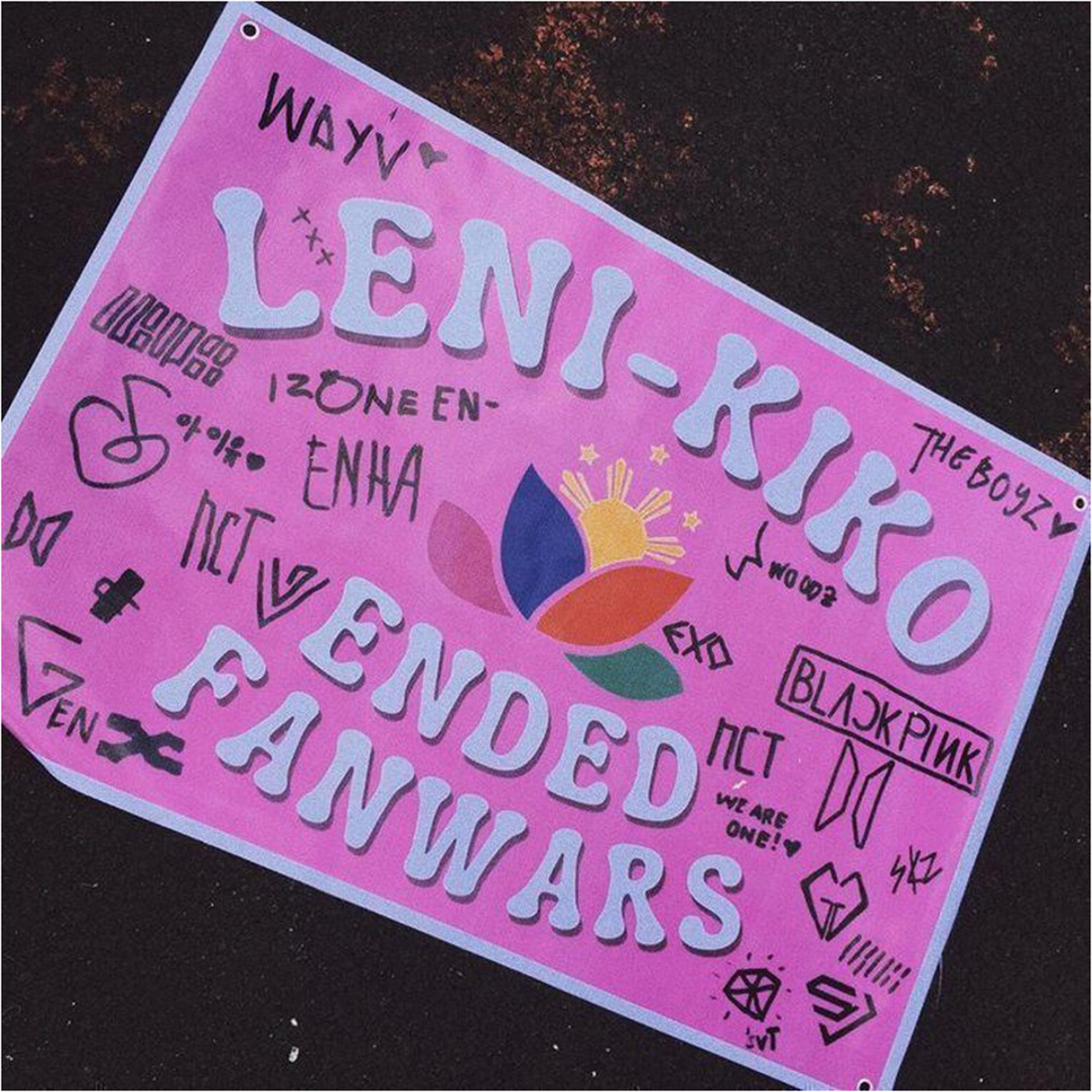
KpopStans also entextualize concepts from K-pop fan culture to position Robredo and Pangilinan (Robredo’s Vice Presidential running mate) as unifying figures. Figure 2 above features a sign stating, “Leni and Kiko ended fan wars,” a reference to the competitive rivalries between K-pop fandoms known as fan wars. By integrating this term into a political context, KpopStans contextualize a concept from fan culture and embed it within campaign discourse to position Robredo and Pangilinan as unifying figures. This entextualization is undergirded by a stance that suggests KpopStans evaluate Robredo’s leadership as conciliatory and inclusive, contrasting it with the divisive rhetoric of the Duterte administration (Montiel, Uyheng, and de Leon Reference Montiel, Uyheng and de Leon2022). The phrase “fan wars” functions as a metaphor for political polarization, and by suggesting that Robredo and Pangilinan can “end” these divisions, KpopStans adopt a position that frames the candidates as agents of reconciliation. Additionally, the sign invites supporters to align with the campaign’s broader message of national unity. By drawing on the notion of resolving fan conflicts, the message positions Robredo’s campaign as capable of bridging divides and fostering social cohesion. The use of a culturally specific term like fan wars allows KpopStans to reframe political discourse in terms that resonate with younger, K-pop-savvy audiences while reinforcing the campaign’s emphasis on collective harmony and inclusive governance.
A sign featuring several K-pop fandoms uniting behind Robredo’s campaign.

Engaging in identity work
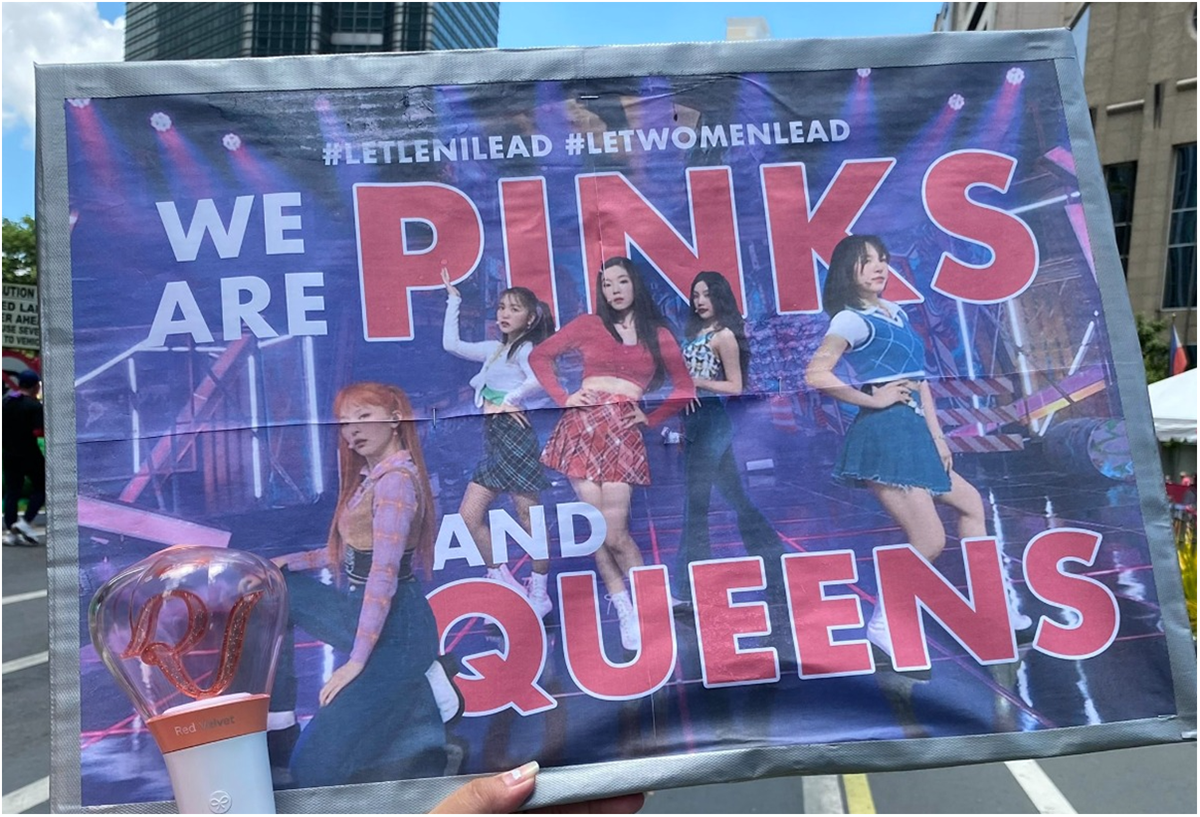
KpopStans also construct and assert their identities as fans and Robredo supporters by entextualizing fan-based discourses and combining them with political advocacy. Figure 3 below captures a sign at Robredo’s Makati rally with a photograph of Red Velvet and the modified text “We are queens and pinks,” adapted from the lyric “We are queens and kings” from their 2022 song Queendom. This adaptation demonstrates how KpopStans merge elements of K-pop discourse with political messaging to signal shared identity and values among Robredo’s supporters. The entextualization of the lyric “We are queens and kings” involves extracting it from its original pop culture context and embedding it into a new political discourse. Through resemiotization, the lyric’s meaning is transformed: what originally served to celebrate group solidarity in a pop song is recontextualized to signify empowerment and inclusivity within a political movement. The replacement of “kings” with “pinks” ties the phrase to Robredo’s campaign color and supporters, the “Kakampinks.” The pronoun “we” fosters a collective identity, inviting K-pop fans to align with the broader community of Robredo’s supporters. The retention of “queens” highlights female empowerment and challenges traditional, gendered perceptions of leadership in the Philippines. This reframing positions Robredo’s campaign within a discourse of inclusion and empowerment, aligning with feminist and LGBTQ+ advocacy. Visually, the emphasis on “queens” and “pinks” through font size and color reinforces the message. The pink color scheme integrates the sign into Robredo’s visual campaign language, while the inclusion of Red Velvet’s photograph establishes a recognizable connection to K-pop culture. This combination of visual and textual elements makes the sign legible as both a campaign material and a fan-derived text, signaling the blending of fandom and political participation. The stance embedded in the phrase “We are queens and pinks” implicitly responds to gendered criticisms directed at Robredo during Duterte’s presidency (Parmanand Reference Parmanand2020) and reframes political leadership as collaborative, diverse, and non-masculinist. The modification of the lyric articulates a political stance that aligns with non-traditional forms of leadership and resonates with supporters familiar with global pop culture while situating it within local political concerns. As such, the sign signals solidarity with Robredo’s campaign, fostering connections across fan communities and political movements.
A sign featuring the K-pop group Red Velvet and their song “Queendom”.

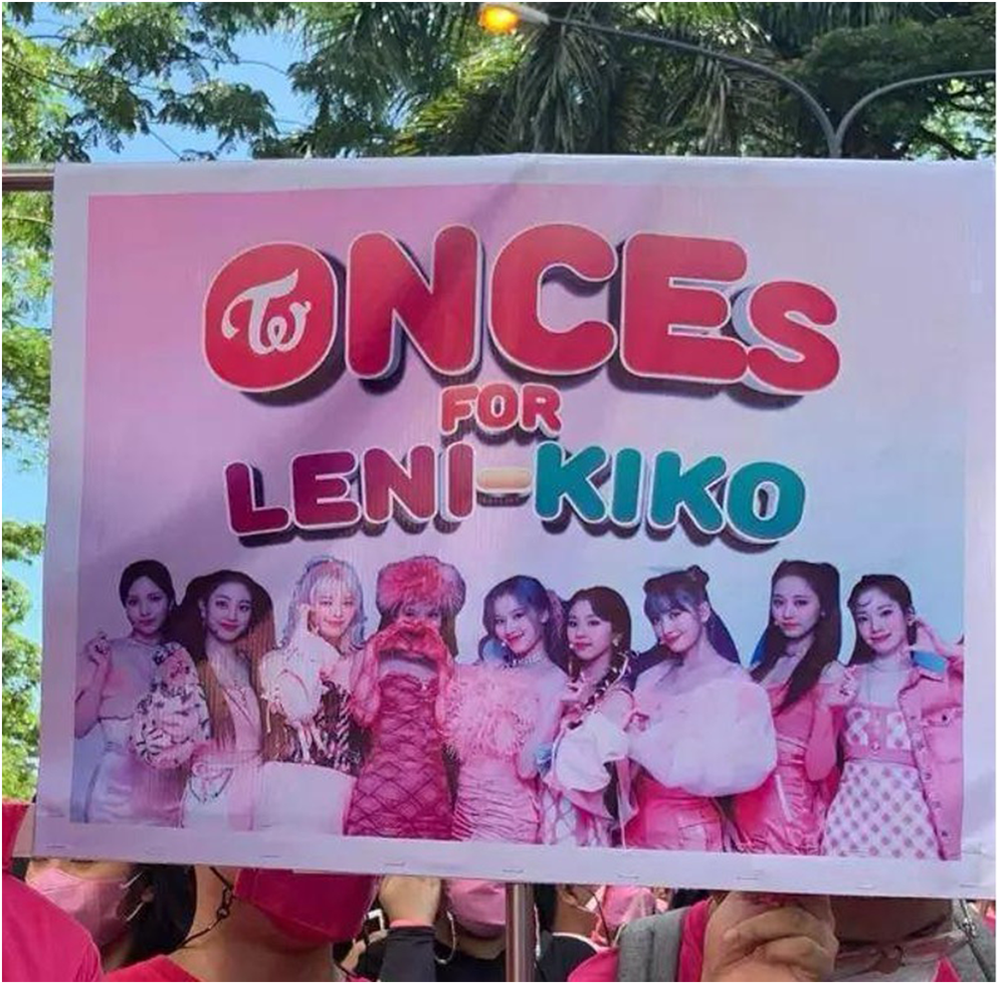
Figure 4 above illustrates the “X for Leni” template, where X is a placeholder for different community and demographic groups declaring their support for Robredo’s campaign. KpopStans adapted this practice by inserting the names of various K-pop fandoms (e.g., Onces for Leni for fans of Twice, ARMYs for Leni for BTS fans, and Carats for Leni for fans of Seventeen). The different groups adopting this label—from students, medical professionals, lawyers, and teachers to LGBTQI+ communities and more niche collectives like Chinitos for Leni (Filipino men of Chinese descent), Mga Pogi for Leni (handsome men), and POZ for Leni (People Living with HIV)—demonstrates the campaign’s ability to resonate across various social strata (Go Reference Go2024) and enables marginalized communities to assert their presence and solidarity within the political arena, which is dominated by the visibility of election candidates. By drawing on this template, these groups could publicly declare their support while simultaneously highlighting their distinct and disparate identities. This act of self-identification becomes a way to signal the inclusivity of the Robredo campaign, suggesting that it is a movement capable of uniting a diverse array of constituents under a common cause.
A sign referencing the K-pop group Twice and its fandom Once.

As the examples illustrate, the remixing of K-pop with political discourse also enables KpopStans to engage in identity work. By appropriating and transforming K-pop lyrics and imagery, fans create a shared cultural and political space where they can construct and take up specific identities. The use of K-pop as a resource for identity construction allows KpopStans to negotiate their positions within the local sociopolitical landscape. In drawing from K-pop and stereotyped associations of vibrance, youthful energy, and solidarity, KpopStans position themselves as convivial agents of social change. Furthermore, by leveraging the positive and non-confrontational aspects of K-pop culture, these fans often communicate nonviolent values within their political activism. Through their fan practices, KpopStans promote messages of inclusivity and unity, offering an alternative to the confrontational and polarizing rhetoric associated with Duterte’s presidency. This approach not only distinguishes KpopStans’ engagement in the political campaign but also aligns with the broader ethos of hallyu, which emphasizes social harmony, respect, and affective connection. As Samosir and Wee (Reference Samosir and Lionel2024) observe, fans’ indirect consumption of linguistic repertoires through K-pop exposes them to cultural values such as deference to seniors and the normalization of aegyo (cuteness) across genders. These sensibilities inform KpopStans’ political participation, shaping an activist style that foregrounds playfulness, inclusivity, and non-confrontational engagement as strategies for social change.
Mobilizing novelty as a political resource
KpopStans’ resemiotization and entextualization practices demonstrate the ways in which the novelty generated by elements of K-pop is mobilized as a political resource to engage voters and reframe political discourse. Figure 5 below displays a fancam of Twice member Sana dancing to their song “Likey,” uploaded to YouTube by user SweatMan on July 24, 2018. In brief, fancams are recordings that focus on individual members of a pop group, usually filmed during a dance performance. These videos capture the movements and expressions of a single performer throughout a performance. This fancam is modified by KpopStans into a Robredo campaign video. While the video of Sana’s performance remains the same as the original, the accompanying song “Likey” is transformed through the addition of another visual element (i.e., fan-made Tagalog song lyrics) (Table 1 below).
A “fancam” of Twice member Sana, overlaid with fan-made lyrics supporting Robredo.

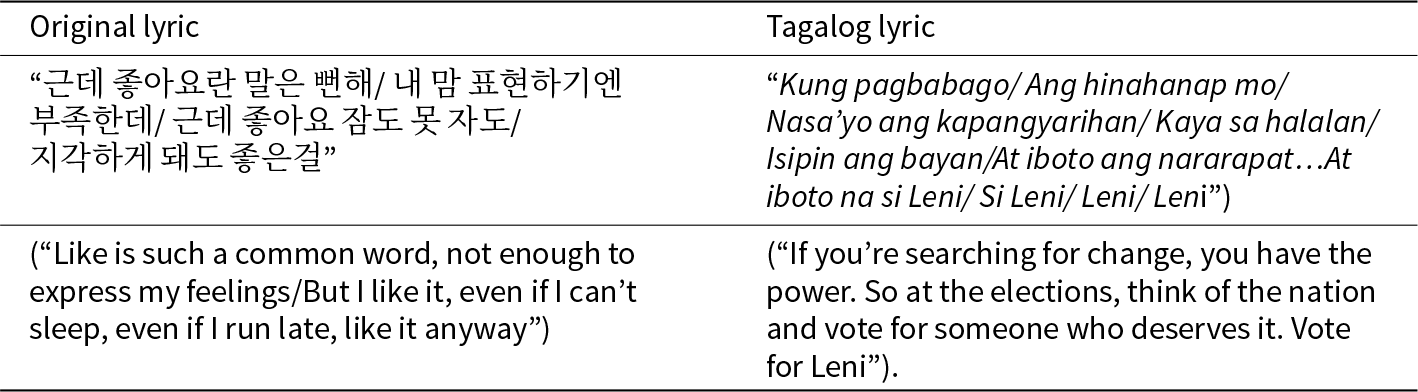
Original Korean lyrics of “Likey” and Tagalog lyrics by KpopStans

Table 1 Long description
The table pairs one excerpt of Korean lyrics with a Tagalog version presented as a corresponding line. The Korean text expresses affection, saying that the word “like” feels too ordinary to convey the speaker’s feelings, yet they still “like” the person even if it causes lost sleep or being late. The Tagalog text shifts to political messaging, stating that people have the power to create change, urging voters to think of the nation during elections, and repeatedly calling to vote for Leni. The main comparison is a change in theme from romantic emotion and personal inconvenience to civic action and campaign-style repetition. Only one lyric pair is shown, so it does not indicate how the rest of the song is translated or adapted.
The modified fancam featuring Twice’s Sana, originally set to the song Likey, replaces the original lyrics with a call for responsible voting and support for Robredo. As can be seen, the more mundane lexicon of the original lyrics (“like,” “sleep,” “late”) is replaced with more action-oriented terms in the new lyrics (“change,” “power,” “elections”). The lyric changes and its visibility on screen reflect the new purpose of the song: to mobilize voters rather than to entertain. In doing so, the fancam situates KpopStans and audiences as active political agents, presenting voter participation as a shared social responsibility. Locally, it reinforces Robredo’s inclusive and participatory campaign ethos, aligning KpopStans with broader movements that seek to reimagine civic engagement through accessible and culturally relevant forms. These elements, juxtaposed with the video of the dancing K-pop idol, create a contrast and novelty that may grab the viewer’s attention and recontextualize the familiar imagery of K-pop into a potent political statement.
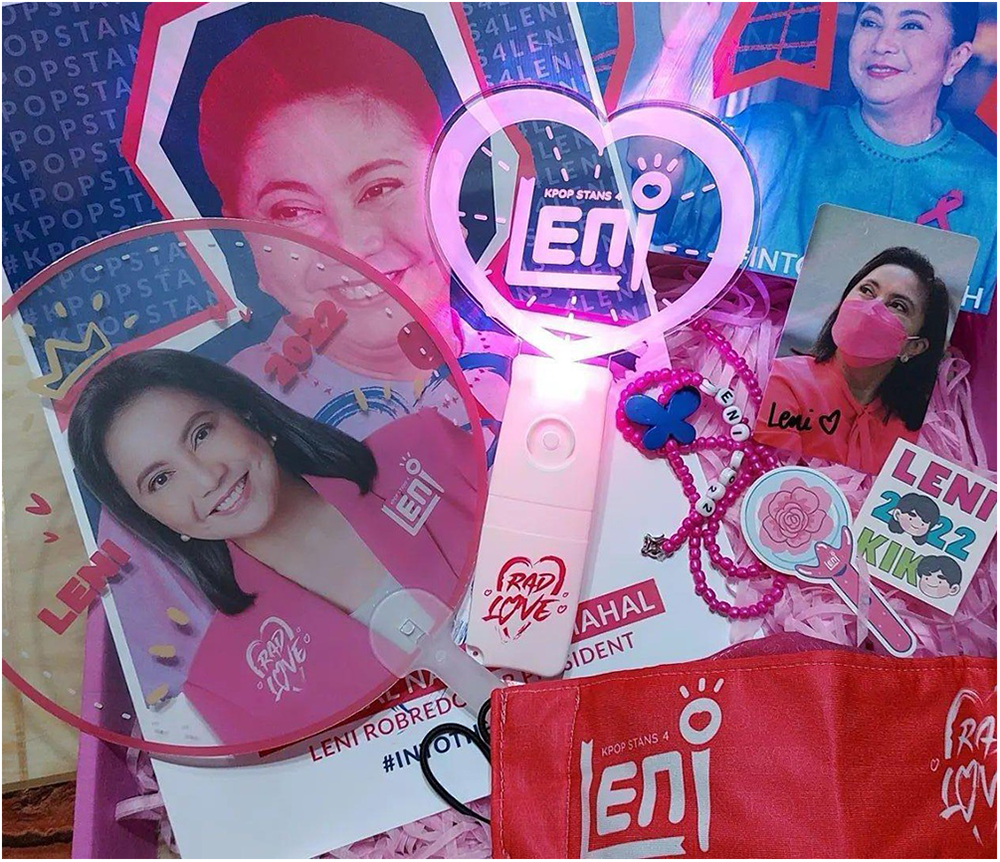
KpopStans further extended their fan practices into political advocacy by producing and distributing Robredo-themed merchandise modeled after K-pop goods. One notable example is the Rad Love kit (Figure 6), whose name reflects a combination of semiotic resources: K-pop girl group ITZY’s “Crazy Love” concept, K-pop idol Key’s “Bad Love” song title, and Robredo’s “Radikal Magmahal” (“Radical love”) tagline. This intertextual naming practice draws from both pop culture and political discourse, creating a hybrid reference that appeals to supporters familiar with these semiotic repertoires. The kit was designed with three primary purposes: to increase the visibility and representation of KpopStans for Leni, to provide campaign materials that double as fan-inspired items, and to raise funds for the group’s continuous campaign efforts (Abad Reference Abad2022). The Rad Love kit performs multiple functions within this hybrid context. Visually, it adopts the aesthetic conventions of K-pop merchandise—photo cards, shirts, and stickers—that are common in fan culture (Guerra and Sousa Reference Guerra and Sousa2021). These items serve as semiotic resources for expressing affiliation and belonging, allowing supporters to position themselves within both K-pop fandom and Robredo’s campaign. In this way, the kit facilitates a blending of political and fan identities, offering a recognizable form of engagement for participants while functioning as campaign paraphernalia. The heart-shaped lightstick provides a key example of this process of resemiotization. In K-pop fandom, lightsticks are highly recognizable symbols of group identity, typically used to display affiliation during concerts. When adapted for the campaign, the lightstick’s design was modified to feature Robredo’s name and campaign branding, replacing the typical fan group insignia. This transformation shifts its indexical meaning, turning it into a political artifact that signals supporters’ alignment with Robredo’s platform. In public events, the lightstick enables embodied stance-taking, where participants visibly display their support in ways that are both familiar to fan culture and distinctive within political spaces. The lightstick’s illumination also acquires new symbolic meanings in the campaign context. While in K-pop concerts, it enhances the collective experience, in the political setting; it aligns with campaign themes of hope and optimism. Its use exemplifies how material objects can be repurposed as semiotic resources for political expression, blending visual, embodied, and symbolic modes of communication. By adopting the semiotic forms of fan merchandise, the Rad Love kit broadens the range of semiotic resources available for political advocacy. Its playful and intertextual design makes it accessible to younger, media-savvy audiences and demonstrates how fandom practices can be mobilized to expand the possibilities for civic engagement.
Rad Love campaign kit featuring Robredo.

Through creative entextualization and resemiotization, KpopStans enact “civic stanning” and repurpose their engagement with and enthusiasm for K-pop as tools for political advocacy. The translation of fan practices into the political domain, specifically the merger of elements within K-pop culture—such as lyrics, videos, and artefacts–with Robredo’s campaign messaging results in a novel form of political participation that combines participatory means that characterize democratic processes as well as consumption behaviors that are associated with fan cultures. While KpopStans and their practices fundamentally constitute a subcultural phenomenon, parallel insights in illiberal settings are highlighted by Khoo (Reference Khoo2019), who, in her analysis of Singapore’s opposition politicians, notes their utilization of non-traditional communication spaces and the incorporation of Singlish, a local vernacular, to communicate with everyday citizens. This emergent “alternative linguistic marketplace” not only reflects shifting language ideologies but also signals a transformation in the boundaries of legitimate political discourse (Khoo Reference Khoo2019: 3). KpopStans engaged in a similar process by resemiotizing elements of K-pop into the language of political advocacy. Although they still operated within the traditional framework of electoral politics, KpopStans introduced novel modes of civic engagement that disrupted dominant norms of political communication, replacing the patriotic and formulaic tone often expected in Philippine political discourse with affect-driven, highly visual, and participatory practices. At the same time, civic stanning also emerged as a pragmatic strategy for navigating the political constraints of Duterte’s presidency, where dissent was frequently met with intimidation and suppression (e.g., unlawful detention). By embedding political advocacy within the playful and seemingly apolitical space of K-pop fandom, KpopStans engaged in indirect forms of resistance that balanced visibility with safety in a restrictive political climate. The affect-driven, highly visual, and participatory nature of these practices not only afforded a protective layer of playful ambiguity but also enabled the fans to sustain their collective identity and safety. While these efforts successfully mobilized support for Robredo—drawing more attention to Robredo’s campaign rallies—these practices ultimately did not translate into an electoral victory. Despite this outcome, KpopStans left a mark on the 2022 elections by reshaping how political messages circulated online and offering new, creative modes of engagement that captured public attention. Notably, following the election, the group rebranded itself as “KpopStans for Good Governance,” signaling a shift from campaign-specific advocacy to broader civic engagement. The group’s transition underscores how civic stanning evolved beyond a single electoral project into a sustained effort to promote political accountability and good governance.
Conclusion
This paper illustrated how K-pop fan practices provide an entry point into civic participation for Filipino youth, particularly by focusing on the semiotic processes that underlie these practices. Specifically, the analysis showed how, through entextualization and resemiotization, commercial K-pop signifiers—song lyrics, imagery, and material artifacts—are turned into vehicles for political expression. While reworking K-pop texts for political advocacy, fans also rework notions of “Koreanness” that are largely filtered through the media of K-pop (Lie Reference Lie2012). We view “Koreanness” not as a fixed or stable set of features but as a dynamic and context-dependent construct produced through semiotic processes. In addition to transposing K-pop into the local political discourse, KpopStans are actively participating in the co-creation of a transnational cultural identity where “Koreanness” points to a global youth culture that values creativity, cosmopolitanism, and social engagement. At the same time, this dynamic reflects broader aspirations inherent in K-pop culture—where the pursuit of excellence, glamorous representation, and an idealized identity resonate with voters. In this way, “Koreanness” becomes a site of ideological investment, where fans project their aspirations for political and social change. Through this aspirational lens, KpopStans leveraged the genre’s global prestige to invigorate their political activism, merging cultural enthusiasm with political fervor.
By integrating popular culture into local political activities, KpopStans imbue K-pop artifacts with new political meanings and engage in sociopolitical action. Leni Robredo’s 2022 Philippine presidential campaign gave these signifiers additional indexical meanings, such as fun, conviviality, harmony, social progress, and honest governance. These meanings reflected the fans’ sociopolitical concerns, their alignment with Robredo’s campaign, and their savvy in navigating the tenuous political situation in the country. Moreover, while adapting K-pop texts to support their preferred candidate, KpopStans assert a form of “textual authority” over both K-pop and political texts (Jones Reference Jones2015). This blending of entertainment and politics allows them to take up stances that steer public opinion and advocate for social and political change. As cultural intermediaries, KpopStans reframe Robredo’s message to resonate with a public captivated by Korean popular culture, making the campaign’s message more accessible for a broader audience, including undecided voters. Furthermore, through their practices, KpopStans articulated their values in relation to the broader themes of the campaign (e.g., toward Robredo’s emphasis on transparency and good governance and away from Marcos’ promise of continuity with the Duterte administration). By doing so, KpopStans express their commitment to Robredo’s success while simultaneously reinforcing their fandom identities.
Notably, no comparable mobilization emerged among Marcos’s supporters in terms of employing K-pop fan practices or aesthetics. Despite the Marcos campaign’s sophisticated use of social media (particularly through TikTok and YouTube vlogs) and influencer networks (Ong Reference Ong2022), there is no documented evidence of organized Marcos-leaning fandoms appropriating K-pop symbols or fan labor. We identified only isolated, ironic references: for instance, an X post asserting that “not all K-pop stans are for Leni” and a few K-pop-related signs displayed at Marcos’ campaign rallies. Yet these instances functioned as gestures meant to mock Robredo and her supporters. Instead of being representative of a K-pop-like mobilization, these instances indicate how K-pop discourse became a metonym for youth-based activism in Robredo’s camp, something to be mocked and satirized rather than modeled. This gap demonstrates how K-pop’s participatory ethos, transnational values, and youth-based cosmopolitanism resonate with Robredo’s reformist and affectively hopeful discourse instead of Marcos’ nostalgic populism. The absence of pro-Marcos K-pop activism thus suggests that K-pop, as a semiotic resource, has affordances that involve semiotic alignment of values. Specifically, the use of K-pop in support of Robredo’s good governance campaign shows how K-pop also has constraints in what political projects it can ostensibly support.
The indexical meanings KpopStans attach to K-pop through resemiotizing practices contribute to an emergent ethos of civic participation that thrives on novelty and creativity. The ludic nature of KpopStans’ interventions demonstrates the generative potential of play in structuring social action. While civic stanning, as practiced by KpopStans, represents an extension of youth activism, particularly in its use of humor, memetic circulation, and hyper-coordinated online mobilization, it does not entirely displace more conventional political strategies. Rather, these practices reflect an orientation toward politics that is affect-driven, collective, and shaped by the participatory culture of social media, even as they overlap with established forms of political mobilization (Epps-Robertson Reference Epps-Robertson and Kim2023). KpopStans’ engagement in the 2022 Philippine elections functioned not only as a conventional political endorsement within established electoral processes but also as a reimagining of civic participation—one where K-pop signifiers are tools for political expression and intervention in a deeply polarized political landscape.
Acknowledgements
We are grateful to the special issue editors, Joyhanna Jung Yoo and Mie Hiramoto, for their time and insightful feedback on previous drafts. This work also benefited from presentations at the Association for Asian Studies 2023 conference and the 8th Philippine Korean Studies Symposium (2022), and we thank the attendees for their engagement. Lastly, we would like to thank the University of the Philippines Diliman for providing the funding to make this article available via Open Access. Any shortcomings are our responsibility.
Author contributions
Christian Go: Conceptualization, methodology, project administration, investigation, formal analysis, writing—original draft, writing—review and editing. Leif A. Garinto: Investigation, formal analysis, writing—original draft, writing—review and editing.
Funding statement
This research received no specific grant from any funding agency.
Competing interests
The author(s) declare none.



 Open access

