

Introduction
The Cone-billed Tanager Conothraupis mesoleuca (Berlioz, Reference Berlioz1939) is a ‘Critically Endangered’ (Birdlife International 2008), poorly-known passerine included in the family Thraupidae (Storer Reference Storer1960, CBRO 2008). It was described based on a single specimen collected by J. A. Vellard in the state of Mato Grosso, western Brazil. This specimen, a male, is still at the Muséum National d’Histoire Naturelle, Paris, France (MNHN 1939.796). The only reference to the type locality is “Juruena, northeast of Cuyaba” (Berlioz Reference Berlioz1939). The exact position of this locality has been impossible to trace (Birdlife International 2008).
After the collection of the type specimen, the Cone-billed Tanager was not observed in the wild again until 2003. The rediscovery occurred in Emas National Park (in the Brazilian state of Goiás), when a female of the species was observed for the first time (Buzzetti and Carlos Reference Buzzeti and Carlos2005). Since then, the Cone-billed Tanager has been observed regularly in four different sites in Emas National Park (Birdlife International 2008), which is the only place where the species is known to occur. Curiously, Emas is c.750 km southeast of Juruena River.
The biology and natural history of the Cone-billed Tanager are essentially unknown. Therefore it was regarded as data deficient in the current version of the Brazilian list of endangered species (IBAMA 2003). Clearly, more information is needed to better define its conservation status, understand its life history, as well as to determine possible conservation strategies to protect this unique species.
In this article we: i) report on a new population of the Cone-billed Tanager that we found in the upper Juruena River basin, Mato Grosso, Brazil; ii) present information on several aspects of its biology (habitat associations, abundance, behaviour, diet, morphology, vocalizations, and systematics), as well as provide a description of the female; and iii) describe and justify the establishment of the true source of the type locality based on previously unused historical documents.
Methods
Study area
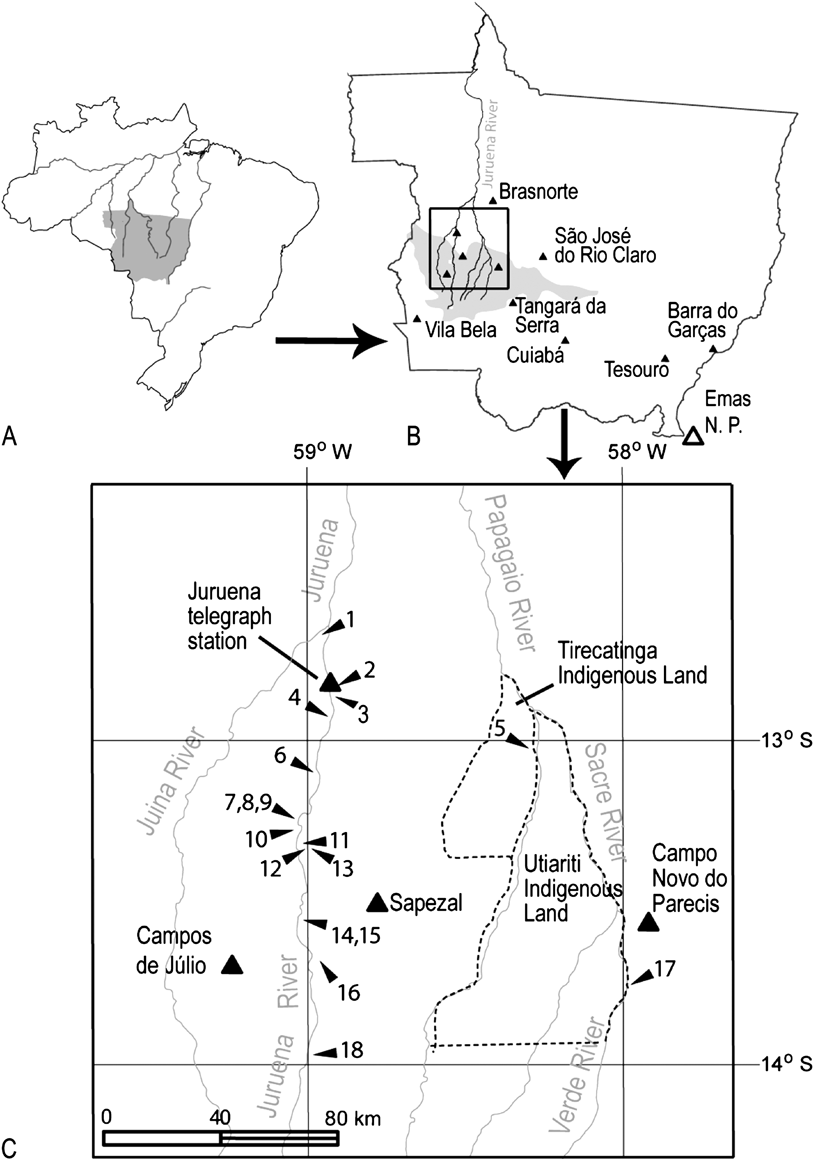
The Juruena River, part of the Amazon basin, is a main tributary of the Tapajós River. Its upper reaches are in the Chapada dos Parecis (Parecis plateau), in the state of Mato Grosso, in western Brazil (Figure 1A and B). The upper Juruena basin, located in the southern part of an ecotone between the Amazon and Cerrado regions, comprises a mosaic of natural and anthropogenic habitats (Souza and Martini Reference Souza and Martini2000) such as: typical and dense savannas (cerrado sensu stricto and cerradão); gallery forests (mata de galeria and mata ciliar); flooded forests; and small patches of marshes of flooded grasslands with scattered shrubs and Moriche Palms Mauritia flexuosa (vegetação aluvial herbáceo-arbustiva) along rivers. Anthropogenic habitats include extensive and mechanized plantations of soybean, corn, sugarcane and cotton. Annual rainfall ranges between 1,400 and 2,000 mm, with a marked dry season between April and September (Rosa et al. Reference Rosa, Sousa, Nascimento, Toledo, Topanotti and Nascimento2007).
Study area map and location: A) Position of the state of Mato Grosso (shaded area) in Brazil and major rivers of southern Amazon basin. Paraná River is also shown; B) Localities sampled or cited in this study. Major rivers of the upper Juruena basin are shown. Chapada dos Parecis region is represented by a shaded area. Emas National Park (in the state of Goiás) is represented by a white triangle. C) Numbered arrows represent Cone-billed Tanager records (see Appendix 1 for details).
Data collection
Following our first record of Cone-billed Tanager in the upper Juruena River (see results) we initiated playback surveys looking for the species throughout Chapada dos Parecis and other areas in central and eastern Mato Grosso: São José do Rio Claro, Brasnorte, Tangará da Serra, Tesouro and Barra do Garças (Figure 1B). Playback trials (n = 146) were carried out at random in places (sampling points) accessible by boat, car or trail. During trials we broadcast a male's loud song (recorded during our first encounter with the species – see results) for 5 minutes followed by 5 minutes of silence. Then we noted: i) presence or absence of the species, ii) the habitat type (cerrado savanna, flooded forest, gallery forest, or flooded grassland), and iii) the geographic coordinates using a GPS (c. 5–15 m precision). Minimum distance between sampling points was 750 m.
We tested the null hypothesis that the species did not select specific habitat types, i.e. that it uses habitats by chance as they were available. We performed a randomization test analogous to the chi-square in Ecosim 7.72 (Gotelli and Entsminger Reference Gotelli and Entsminger2009), in which the expected matrix was randomized (rows and columns) 1,000 times, and a chi-square deviation statistic for each simulated matrix was calculated. We then used the distribution of these deviations to calculate the probability of obtaining our observed matrix if the null hypothesis is correct (Gotelli and Entsminger Reference Gotelli and Entsminger2009). To avoid biasing the results by including as available habitat areas that were not actually available to the species (Jones Reference Jones2001), we used in this analysis only sampling points located within a 3 km-radius buffer around each Cone-billed Tanager record. We arbitrarily defined buffer size since no information about dispersal or home range of the Cone-billed Tanager is available.
We also report here “passive” records, i.e. capture, sightings, or aural records made without the use of playback, as well as records made by collaborators. Once the species was encountered, we observed and noted aspects of its behaviour and biology. Recordings of vocalizations of the species were made on several occasions with shotgun microphones and tape or digital recorders. Playback surveys and observations were carried out in Mato Grosso from September 2006 to May 2008. Additional observations on the species's behaviour and biology were also carried out in Emas National Park in December 2007.
To trace the exact position of the Cone-billed Tanager's type locality we consulted books and historical documents not reviewed in the ornithological literature in an attempt to find the route of J. A. Vellard, the collector of the type specimen.
Results
Cone-billed Tanager records
On 20 September 2006, CCG recorded a loud and unknown song on Juruena riverside (site 13 in Figure 1C). The bird was attracted by song playback, photographed, and identified as a male Cone-billed Tanager following a picture available in Buzzetti and Carlos (Reference Buzzeti and Carlos2005).
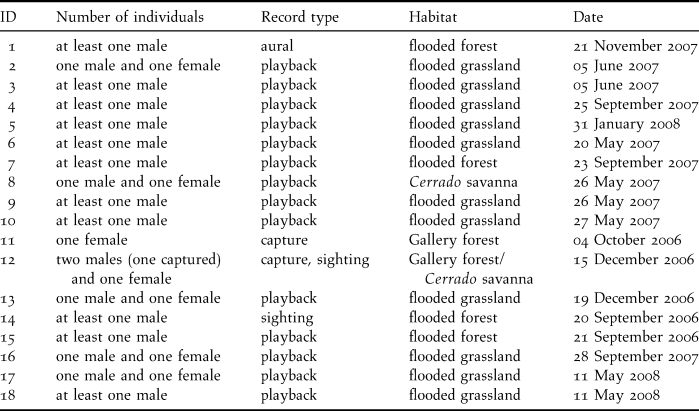
We registered the species in 18 sites in Chapada dos Parecis region, near Sapezal, Campos de Júlio and Campo Novo do Parecis (Figure 1C). Among these records, 14 were made by playback (see Appendix 1 for details). Only two records were made outside the Juruena River: one in the Papagaio River, c.1.2 km upstream of the Utiariti waterfall (Tirecatinga Indigenous Land - site 5 in Figure 1C) and another in its tributary, the Verde River (site 17 in Figure 1C). No records were made outside Chapada dos Parecis region.
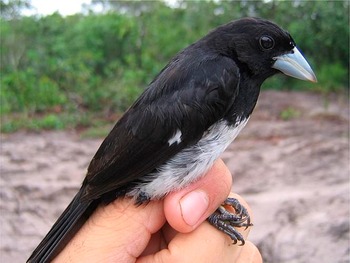
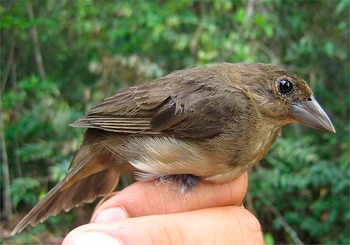
Additionally, two birds were mist-netted on Juruena riverside during a parallel bird survey. A male was captured on 15 December 2006 by CCG between gallery forest (mata ciliar) and cerrado savanna (site 11 in Figure 1C). The bird was banded (CEMAVE aluminium band, number E72436), measured (see below), photographed (Figure 2) and released at the capture site. On 4 October 2006 a female was captured (site 13 in Figure 1C) by E. Santos. The bird was photographed (Figure 3) and collected as a part of the field study, and only later identified as a female Cone-billed Tanager. This specimen was deposited at the Museu de Zoologia da Universidade de São Paulo (MZUSP 76674; see description in below).
Male Cone-billed Tanager Conothraupis mesoleuca from the upper Juruena River, captured at site 11 (Fig. 1C), Sapezal, Mato Grosso, Brazil. Note the slight rictal commissure and the dark coloured bill tip (Photo C. Candia-Gallardo).
Female Cone-billed Tanager Conothraupis mesoleuca from the upper Juruena river, captured at site 13 (Fig. 1C), Sapezal, Mato Grosso, Brazil (Photo E. Santos).
Habitat and abundance
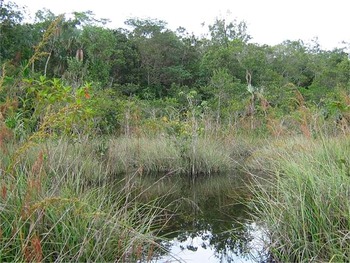
Cone-billed Tanagers were always found in or near (< 120 m) flooded habitats along rivers, such as seasonally flooded forest or flooded grassland with scattered shrubs and Moriche Palms (Figure 4). The randomization test rejected the null hypothesis of no habitat selection by the Cone-billed Tanager (n = 74 sampling points, χ2 = 21.6, P < 0.025). Flooded habitats appear to be preferred by the species, whilst cerrado savanna and gallery forest appear to be avoided (Table 1). The Cone-billed Tanager was also observed in flooded habitats at Emas National Park (Buzzetti Reference Buzzetti2006, De Luca pers. comm. 2007, LFS pers. obs.). These findings suggest that the preferred habitats of the species are flooded or seasonally flooded riverside areas. However, based on the report of the type specimen's collector, and also by analogy with its congener, Black-and-white Tanager Conothraupis speculigera, the favoured habitat was described in the literature as “arid forest or scrub” (Berlioz Reference Berlioz1946, Storer Reference Storer1960), or “bushy vegetation among dry forest” (Isler and Isler Reference Isler and Isler1987). These earlier descriptions suggest cerrado, which is the dominant physiognomy of the Chapada dos Parecis. Thus, if the species really selects flooded areas, those habitat descriptions may have delayed the rediscovery of the species by leading researchers to look in the wrong habitats (Buzzetti Reference Buzzetti2006).
Flooded grassland with scattered shrubs and Moriche Palms Mauritia flexuosa in Juruena riverside (site 12 in Figure 1C; photo C. Candia-Gallardo).
Number (n) and percentage (%) of playback sampling points per habitat type (Sampling points) and of playback sampling points where the Cone-billed Tanager was found (Cone-billed points). Only points located within 3 km radius buffer around each Cone-billed point were considered in this analysis (see results for details).
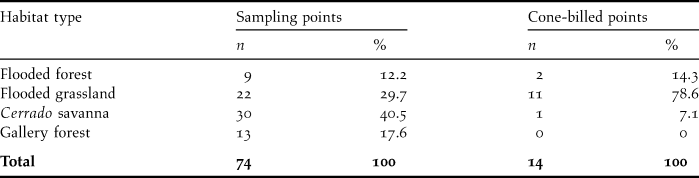
Although the Cone-billed Tanager is strongly responsive to playback (CCG and LFS pers. obs.), it was found in only 14 of 146 playback sampling points. We believe that this could suggest low population density. However, accurate population size estimation will require even more intensive effort in the appropriate habitat types. Here we found around 40 individuals (see Appendix 1), but several areas of potential suitable habitat exist in the Chapada dos Parecis that have not yet been visited by ornithologists; therefore population size could be larger. These areas, comprising a mosaic of private and indigenous lands, are prime targets for new surveys (see discussion).
Behaviour and diet
The Cone-billed Tanager is apparently territorial and solitary or monogamous, as all sightings that we made were of pairs or single males (n > 60, considering repeated sightings in the same places). Males respond strongly and quickly to playback, flying repeatedly over the playback source, suggesting territorial defence. Females also respond to playback, but do not approach as closely as males. The Cone-billed Tanager was never seen by us to join monospecific or mixed species flocks, as is common among many tanagers in the Cerrado region (Isler and Isler Reference Isler and Isler1987).
Both sexes may perch at the top of trees, or more commonly below 5 m in shrubs. During feeding, birds were observed taking small flying insects in rapid sallies to and from the same perch. Also, surprisingly, they were very often observed eating seeds, including bamboo and exotic grasses (such as Brachiaria sp.), consumed in a similar way to Sporophila seedeaters.
Morphology
Measurements of the two captured birds as well as of the type specimen are presented in Table 2. The male we captured displayed signs of neither moult nor brood patch, but rather was in full adult plumage. Rictal commissures were visible (Figure 2), which usually indicate relatively recent fledging in volant birds (Ayala et al. Reference Ayala, Saino, Møller and Anselmi2007). Thus this male was a sub- or young adult. This suggestion is supported by the bill, dark-coloured at the tip (Figure 2). Full adult males have entirely bluish-grey bills (Buzzetti and Carlos Reference Buzzeti and Carlos2005, CCG and LFS pers. obs.), while young males seem to have dark-coloured bills, as suggested by a picture available on the Pantanal Bird Club website (http://www.geocities.com/TheTropics/Cabana/6292/rhynchothraupis.jpg).
Morphological measurements and moult for three individual Cone-billed Tanagers Conothraupis mesoleuca from the upper Juruena River, Mato Grosso, Brazil.
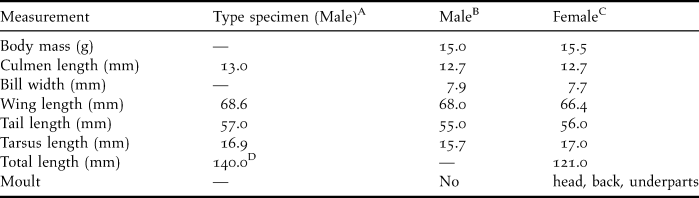
A Collected by J. A. Vellard (Berlioz Reference Berlioz1939), MNHN 1939.796.
B Captured by CCG, banded (band number E72436), and released.
C Collected by E. Santos, MZUSP 76674.
D Measured by Berlioz (Reference Berlioz1946).
The type specimen has a dark bluish, white-tipped bill (LFS pers. obs.), that could be interpreted as a subadult character. Nonetheless, young males apparently change bill colour from the base to the tip, from dark to light bluish-grey (compare Fig. 2 with the picture in the link above). Hence, we support the hypothesis that the type specimen is an adult whose bill colour changed after collection and before Berlioz analyzed it, since he described it as bluish-grey (Berlioz Reference Berlioz1939).
The female collected on 05 October 2006 (Figure 3) had some moulting on the head, back and underparts. Brood patch was not reported by the collector of the specimen. Following the Munsell colour system (Munsell Reference Munsell1976), the colour of the female was: upperparts, wings and tail dark greyish brown (10YR 3/2), lighter in the auriculars; throat brown (10YR 5/3), breast, flanks, and undertail coverts dark brown (10YR 3/3); belly light yellowish brown (2.5Y 6/3), bill and tarsi dark brown; tail rounded and tail feathers slightly pointed (see Table 2 for measurements).
Vocalizations
The song of the Cone-billed Tanager is loud and characteristic, apparently sung exclusively by males (Buzzetti Reference Buzzetti2006, CCG and LFS pers. obs.). Females and males were observed emitting one-note calls, similar to those of the sympatric Silver-beaked Tanager Ramphocelus carbo, but slightly more metallic.
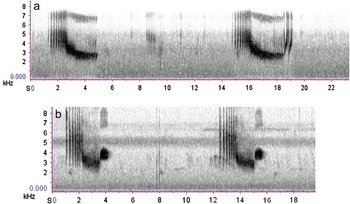
Four voice samples of males from Juruena were compared with four from Emas National Park - ENP (recordings are in the Elias Coelho Sound Archives, ASEC, Rio de Janeiro, and The Bird Section Archives of the MZUSP). A comparison of the spectrograms (Raven 1.2.1, Bioacoustics Research Program, Cornell Laboratory of Ornithology) suggest that loud songs of birds from Juruena are slower than those from ENP. They also descend and end with a metallic, bisyllabic “tzi” (Figure 5a). The faster ENP songs end with a quick (~ 0.5 s), strong, and ascending note (Figure 5b). Perhaps songs are merely local dialects, since plumages are apparently the same in both places. If these two populations are indeed disjunct, then this species can provide interesting information about local isolation and micro-evolutionary processes. Clearly, more information is needed to reveal differences and similarities between the two populations.
Spectrograms of loud songs of male Cone-billed Tanager Conothraupis mesoleuca. A: From the Upper Juruena River, Mato Grosso; B: From Emas National Park, Goiás. Compare timing and final notes.
Systematics
General behaviour, including vocalizations, along with the unexpected diet and foraging behaviour for a tanager, suggest that taxonomy of the Cone-billed Tanager must be re-evaluated. Morphological, vocal, and molecular characters are needed to determine the relationships of this species: whether it is indeed a tanager (family Thraupidae) or an emberizid (Emberizidae, finches and allies), as suggested by Storer (Reference Storer1960). Since the specimen collected at Juruena was prepared before we analyzed it, it is not possible to quickly eliminate Emberizidae as a possibility based on palate structure.
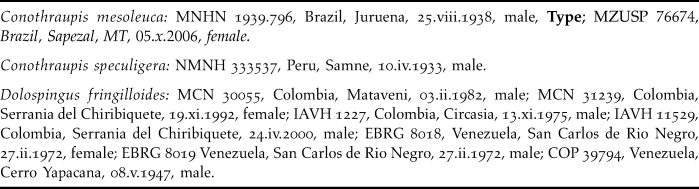
Additionally, the relationship between the Cone-billed Tanager and its congeneric Black-and-white Tanager C. speculigera must also be re-evaluated. For instance, we noted strong similarities between the Cone-billed Tanager and the White-naped Seedeater Dolospingus fringilloides (Emberizidae), a poorly known finch which lives in flooded forest (e. g. IAVH 11259, “bosque inundable”) and in similar habitats in northern Brazil, southern Venezuela and eastern Colombia. We examined seven specimens of White-naped Seedeater, two specimens of Cone-billed Tanager, and one Black-and-white Tanager (see Appendix 2 and Acknowledgements). There is a strong similarity in the plumage of the females of White-naped Seedeater and Cone-billed Tanager, which is brown in both species. On the other hand, Black-and-white Tanager females have olive-yellow in the upperparts and pale yellow in the underparts (see also Isler and Isler Reference Isler and Isler1987). Moreover, measurements (wing, tail, bill, and tarsus - available upon request), bill colour and shape, and especially the tail shape of Cone-billed Tanager and White-naped Seedeater are remarkably similar, suggesting that the Cone-billed Tanager could be closer to the White-naped Seedeater than to the Black-and-white Tanager. Nonetheless, whether these similarities are related to common ancestry or to convergence should be assessed by detailed phylogenetic analysis.
Tracing the type locality
The only reference to the type locality of the Cone-billed Tanager is “Juruena, northeast of Cuyaba” (Berlioz Reference Berlioz1939, Reference Berlioz1946). Juruena is the name of a large river northwest (not northeast) of the city of Cuiabá, as it is now spelt. To the best of our knowledge, no other “Juruena” locality was known in that period. Noting this discrepancy, F. Pacheco in Sick (Reference Sick1997: 736) suggested that “Juruena” might be interpreted as the region of the Juruena headwaters, in the Chapada dos Parecis (Parecis plateau) - about 100 km northeast of Vila Bela de Santíssima Trindade (therefore northwest of Cuiabá). Thus, the true position of the “Juruena” of Berlioz (Reference Berlioz1939) is unclear, as it seems that the original description of the type locality is erroneous. It is unclear as to whom the error should be attributed - J. A. Vellard, the collector of the type specimen, or Berlioz, who described it (Weidensaul Reference Weidensaul2002).
No other published records exist in the ornithological literature that describe either Vellard's work or his route when he collected the Cone-billed Tanager type specimen, hence the confusion. However, we found information about Vellard in historical documents. In 1938 he joined the famous ethnographer Claude Lévi-Strauss in the expedition to the Serra do Norte (northern mountains). This expedition is considered the last great ethnographic expedition of the twentieth century and was reported in the famous book Tristes Tropiques (The Sad Tropics; Lévi-Strauss Reference Lévi-Strauss1955). Yet, the name Vellard is seldom cited in that book, without indicating his role in the expedition. That information only became available upon the publication of the field journal of Castro Faria, a Brazilian anthropologist also on the expedition (Castro Faria Reference Castro Faria2001). That journal proved valuable, since it included a detailed, daily-based description of the expedition route, including the role played by Vellard.
Vellard, an expert in spider taxonomy and toxins (Vital Brazil Reference Vital Brazil1991), was the naturalist and physician of the expedition (Domingues et al. Reference Domingues, Monte-Mór and Sorá1998, Castro Faria Reference Castro Faria2001). He published an article describing the production of curare poison by the Nambiquara Indians that he observed during the expedition (Vellard Reference Vellard1941). Perhaps that he was not an ornithologist explains why he did not publish the list of the bird specimens that he collected there, but rather sent them to France for that purpose.
The route of the Serra do Norte expedition followed the telegraph line built by the Rondon Commission (Lévi-Strauss Reference Lévi-Strauss1955) to link Cuiabá and Porto Velho (Diacon Reference Diacon2004). The line, finished in 1915, crossed a wild and isolated region approximately the size of France, at that time inhabited only by native tribes (Lévi-Strauss Reference Lévi-Strauss1955). This was the only route through the region until 1960 when the Brazilian highway BR-364 was built (Costa Reference Costa2002). According to Castro Faria (Reference Castro Faria2001), Vellard was camped in the Juruena Telegraph Station on 25 August 1938, the date on which the Cone-billed Tanager type specimen was collected (Berlioz Reference Berlioz1939). We visited that locality (site 2 in Figure 1C) and found at least two individual Cone-billed Tanagers in June and September 2007. Thus, we argue that the Juruena Telegraph Station (12°50’S, 58°55’W; Figure 1C) is the locality described as “Juruena” by Berlioz (Reference Berlioz1939), i.e. the type-locality of the Cone-billed Tanager. It is located about 266 km northeast of Vila Bela and 488 km northwest of Cuiabá (Millard Reference Millard2005, Figure 1B).
Discussion
Although we provide the first information on the biology and behaviour of the Cone-billed Tanager, the species remains poorly known. There are many aspects of its natural history that deserve detailed quantitative studies, such as geographic distribution, population size, habitat use patterns, reproduction, and taxonomic relationships. Possible nomadic tendencies should also be investigated.
In order to better understand the distribution limits and population size of the species, we suggest additional areas of the Cerrado biome (as well as its ecotones) to be surveyed: the tributaries of the upper courses of Juruena, Arinos, Teles Pires, Xingu, Araguaia, Ji-Paraná and Aripuanã rivers, as well as the tributaries of the right bank of the Paranaíba and upper Paraná rivers in the states of Goiás and Mato Grosso do Sul. Flooded habitats should be the main target for these surveys, but other habitats should be visited as well.
Our results suggest that the Cone-billed Tanager has a low population density, and would be a naturally rare species. Such a pattern is likely to be related to habitat selection. If the Cone-billed Tanager does select flooded areas along rivers, its habitat would be linear and naturally fragmented, since patches of flooded habitat are not continuously distributed along rivers (CCG, pers. obs.). Thus, Cone-billed Tanager's low population density could be related to the natural rarity of its habitat. If this scenario is correct, habitat loss would be the main threat to the species.
The extension of potential habitats in the upper Juruena basin, along with the relatively large number of individuals found there, suggest that Juruena may currently be a “stronghold”. Thus, the effective protection of Cone-billed Tanager habitat in the upper Juruena basin is essential to protect the species. Because the Cone-billed Tanager is considered to be globally ‘Critically Endangered’ (BirdLife International 2008) and because part of its range in Juruena is becoming settled, more detailed and quantitative research on the species should be carried out as a matter of urgency. Only with this information will we be able to accurately determine its status and design effective conservation strategies to conserve this rare and beautiful bird.
Acknowledgements
A. Cassiano, D. Morassutti, R. Oliveira, E. Sturm, E. Santos, R. Ilário, E. Endrigo and M. Pádua helped in fieldwork. R. Ilário and E. Santos provided two records of the Cone-billed Tanager (records 1 and 11 in Figure 1C). The Nambiquara people from the Tirecatinga Indigenous Land allowed CCG to visit their land. R. Polydoro helped in the preparation of Figure 1. Picture in Figure 3 was taken by E. Santos. Licences to band and collect bird specimens were provided respectively by CEMAVE and IBAMA (IBAMA permission number 056/06 – Supes/MT). F. Amaral, V. Piacentini, M. Somenzari and D. Tubelis commented on earlier versions of the manuscript. V. Piacentini provided photographs of Black-and-white Tanager. The curators and staff of the Colección Ornitológica Phelps (COP, Caracas, Venezuela), Estación Biológica Rancho Grande (EBRG, Maracay, Venezuela), Instituto Alexander von Humboldt (IAVH, Villa de Leiva, Venezuela), Instituto de Ciencias Naturales (ICN, Bogota, Colombia), Muséum National d'Histoire Naturelle (MNHN, Paris, France), and United States National Museum, Smithsonian Institution (USNM, Washington, EUA) for providing access to the specimens under their care. This study was funded by JGP Consultoria e Participações Ltda, Juruena Participações e Investimentos S.A. and Maggi Energia S.A. LFS receives a grant from the Conselho Nacional de Desenvolvimento Científico e Tecnológico (CNPq) and is an Associate Researcher of the World Pheasant Association. Many thanks to J. Roper, A. Giorgi, B. Whitney, and an anonymous reviewer for their critical reading of the English and their useful suggestions.
Appendices
Number of individuals, record type (sighting, aural, capture, or playback), habitat type, and date for each Cone-billed Tanager record made during this study in the upper Juruena basin. ID refers to the numbers given to sites in the figure 1C and is ordered from north to south.
Specimens examined.