





Introduction
Early adolescence, the period marked by the start of pubertal development around the age of 10 years (Shirtcliff et al., Reference Shirtcliff, Dahl and Pollak2009), is associated with increased vulnerability to mental health disorders (Maciejewski et al., Reference Maciejewski, van Lier, Branje, Meeus and Koot2017). It is a critical time for the emergence of internalizing disorders such as anxiety and depression (Hankin et al., Reference Hankin, Abramson, Moffitt, Silva, McGee and Angell1998; Salk et al., Reference Salk, Hyde and Abramson2017), accompanied by rapid changes in the cognitive control functions that support emotional control and self-regulation (Best & Miller, Reference Best and Miller2010; Crone et al., Reference Crone, Peters, Steinbeis, Wiebe and Karbach2017). In the current study we adopt a transdiagnostic approach to identify dimensions of internalizing symptoms across early adolescence (10 through to 12 years) and explore how these relate to executive function at 10 years.
Taxonomies of executive functions, the higher-level processes involved in the top-down volitional control of cognition and behavior, typically include: i) shifting/switching – the ability to flexibly shift attentional focus between activities; ii) inhibition – the ability to inhibit impulsive or unwanted responses, and; iii) working memory – the ability to temporarily hold information in mind and update this information in the course of ongoing cognitive activities (Friedman & Miyake, Reference Friedman and Miyake2017; Miyake et al., Reference Miyake, Friedman, Emerson, Witzki, Howerter and Wager2000; St Clair-Thompson & Gathercole, Reference St Clair-Thompson and Gathercole2006). There are a range of alternative theoretical accounts of the structure of different executive functions, most of which suggest each can be further delineated into separate functions. For example, prominent models of working memory suggest that it can be fractionated into components corresponding to either verbal and visuo-spatial constructs (Shah & Miyake, Reference Shah and Miyake1996) or into a domain-general attentional control component that coordinates the temporary storage of information in two domain-specific stores (e.g., Baddeley & Hitch, Reference Baddeley and Hitch1974; Baddeley, Reference Baddeley2000). Similarly, multiple accounts of inhibition distinguish between different inhibitory processes such as interference control, response inhibition, and attentional control (Dempster, Reference Dempster1995; Friedman & Miyake, Reference Friedman and Miyake2004; Nigg, Reference Nigg2000). The structure and function of executive functions changes across development. Of note, there is an increasing pattern of specialization with developmental age: different executive skills are captured by a unitary executive function construct in early childhood but become more differentiated in adolescence (Malagoli & Usai, Reference Malagoli and Usai2018; Wiebe et al., Reference Wiebe, Espy and Charak2008, Reference Wiebe, Sheffield, Nelson, Clark, Chevalier and Espy2011).
The capacity, or function, of executive skills also improves rapidly in adolescence (Andre et al., Reference Andre, Picchioni, Zhang and Toulopoulou2016; Best & Miller, Reference Best and Miller2010; Crone et al., Reference Crone, Peters, Steinbeis, Wiebe and Karbach2017; Crone, Reference Crone2009; Huizinga et al., Reference Huizinga, Dolan and van der Molen2006), enabling individuals to increasingly master control of their thoughts, behaviors, and emotions. Immature and rapidly changing executive function abilities at a time of substantial biological (Pfeifer & Allen, Reference Pfeifer and Allen2021; Tamnes et al., Reference Tamnes, Herting, Goddings, Meuwese, Blakemore, Dahl, Güroğlu, Raznahan, Sowell, Crone and Mills2017) and social (Blakemore & Mills, Reference Blakemore and Mills2014) change likely contribute to increased vulnerability to mental health difficulties during early adolescence (Crone & Dahl, Reference Crone and Dahl2012; Steinberg et al., Reference Steinberg, Icenogle, Shulman, Breiner, Chein, Bacchini, Chang, Chaudhary, Giunta, Dodge, Fanti, Lansford, Malone, Oburu, Pastorelli, Skinner, Sorbring, Tapanya, Tirado and Takash2018). Consistent with this, poor executive functioning is a common feature of a range of mental disorders across the lifespan (Snyder et al., Reference Snyder, Miyake and Hankin2015) and predicts increased rumination (Zetsche et al., Reference Zetsche, D’Avanzato and Joormann2012) and worry (Crowe et al., Reference Crowe, Matthews and Walkenhorst2007), and the use of maladaptive emotion regulation strategies (McRae et al., Reference McRae, Jacobs, Ray, John and Gross2012). There are multiple accounts of the association between executive function and mental health. These include the interference hypothesis, which suggests psychological distress disrupts cognitive processing by shifting cognitive resources away from task-relevant information (Donati et al., Reference Donati, Meaburn and Dumontheil2021; Llewellyn et al., Reference Llewellyn, Lang, Langa and Huppert2008; Stawski et al., Reference Stawski, Sliwinski and Smyth2006), and the dynamic mutualism hypothesis, which suggests mental health and cognitive function reciprocally interact over time, leading to a dynamic cycle of exacerbation across the lifespan (Fuhrmann et al., Reference Fuhrmann, van Harmelen and Kievit2021). The cognitive reserve hypothesis, which suggests poor cognitive function impairs the downregulation of negative emotional responses, such as worry, fear or sadness, leading to poor mental health (LeMoult & Gotlib, Reference LeMoult and Gotlib2019; Millan et al., Reference Millan, Agid, Brüne, Bullmore, Carter, Clayton, Connor, Davis, Deakin, Derubeis, Dubois, Geyer, Goodwin, Gorwood, Jay, Joëls, Mansuy, Meyer-Lindenberg, Murphy and Young2012), is consistent with the notion that relatively poorer cognitive control in adolescence, combined with increasingly reactive subcortical regions involved in emotional and reward processing, make emotion regulation difficult for adolescents, conferring increased risk for developing mental health difficulties (Crone & Dahl, Reference Crone and Dahl2012). Consistent with this theory and motivated by proactive models of intervention that aim to identify predictors of mental health outcomes that might be amendable to intervention (Fenwick-Smith et al., Reference Fenwick-Smith, Dahlberg and Thompson2018), we explore unidirectional associations between executive function and internalizing symptoms in the current study.
Much of the literature exploring the relationship between executive functioning and mental health in youth focuses on externalizing difficulties, showing that higher executive functioning in childhood is associated concurrently and longitudinally with lower levels of externalizing symptoms (e.g., Nigg, Reference Nigg2001; Olson et al., Reference Olson, Hooper, Collins and Luciana2007; Pollak et al., Reference Pollak, Dekkers, Shoham and Huizenga2019; Yang et al., Reference Yang, Shields, Zhang, Wu, Chen and Romer2022) because better cognitive control facilitates the curbing of inappropriate behaviors (Eisenberg et al., Reference Eisenberg, Spinrad, Fabes, Reiser, Cumberland, Shepard, Valiente, Losoya, Guthrie, Thompson and Murphy2004). Associations between executive control and concurrent and later internalizing difficulties are also well-documented (see Yang et al., Reference Yang, Shields, Zhang, Wu, Chen and Romer2022 for a recent meta-analysis) and show the same patterns of association: better executive function is associated with lower levels of internalizing difficulties as better cognitive control supports the top-down regulation of negative emotions (e.g., Koster et al., Reference Koster, De Lissnyder, Derakshan and De Raedt2011). However, the majority of studies exploring links between executive function and internalizing difficulties focus on later adolescence and adulthood (e.g., Brieant et al., Reference Brieant, King-Casas and Kim-Spoon2020; Yang et al., Reference Yang, Shields, Zhang, Wu, Chen and Romer2022), despite the onset of symptoms occurring in early adolescence around the onset of puberty (Hankin et al., Reference Hankin, Abramson, Moffitt, Silva, McGee and Angell1998; Salk et al., Reference Salk, Hyde and Abramson2017), and very few explore links between different aspects of executive function (e.g., inhibition, working memory, or shifting) and internalizing symptoms across early adolescence (Yang et al., Reference Yang, Shields, Zhang, Wu, Chen and Romer2022).
Many existing studies adopt cross-sectional designs (e.g., McNeilly et al., Reference McNeilly, Peverill, Jung and McLaughlin2021) and rely on diagnostic categories to document and track mental health difficulties (e.g., Baune et al., Reference Baune, Fuhr, Air and Hering2014; Kavanaugh et al., Reference Kavanaugh, Cancilliere, Fryc, Tirrell, Oliveira, Oberman, Wexler, Carpenter and Spirito2020; Vilgis et al., Reference Vilgis, Silk and Vance2015). The diagnostic-led approach runs counter to a wealth of evidence showing that mental health and neurodevelopmental disorders are highly comorbid, heterogeneous, variable across development and the lifespan, explained by multiple causes, and not captured by a cardinal set of symptoms (Astle et al., Reference Astle, Holmes, Kievit and Gathercole2021; Dalgleish et al., Reference Dalgleish, Black, Johnston and Bevan2020). An alternative transdiagnostic approach emphasizes the use of data-driven methods to delineate symptom dimensions that cross-cut traditional diagnostic boundaries and account more easily for comorbidity and heterogeneity (Astle et al., Reference Astle, Bathelt and Holmes2019; Caspi & Moffitt, Reference Caspi and Moffitt2018; Cuthbert & Insel, Reference Cuthbert and Insel2013; Holmes et al., Reference Holmes, Mareva, Bennett, Black, Guy, Bathelt, Bignardi, Bishop, Bottacin, Bridge, Brkic, Bryant, Butterfield, Byrne, Crickmore, Dalmaijer, Daly, Emery, Forde and Zhang2021). To reduce the long term economic and social burden of mental ill health (Knapp & Wong, Reference Knapp and Wong2020; Rehm & Shield, Reference Rehm and Shield2019) and move towards proactive models of intervention, it is necessary to adopt longitudinal designs to understand how internalizing symptoms evolve across early adolescence, and how these changes relate to other aspects of functioning that might be amendable to intervention.
Current study
In the current study, we used a factor analytic approach to identify dimensions of internalizing symptoms measured by the Child Behaviour Checklist (CBCL; Achenbach, Reference Achenbach2011) across early adolescence (at ages 10 and 12) in a sample of nearly 11,000 participants from the nationally representative ABCD longitudinal study (Garavan et al., Reference Garavan, Bartsch, Conway, Decastro, Goldstein, Heeringa, Jernigan, Potter, Thompson and Zahs2018). We explored the factor structure of internalizing symptoms at the two timepoints, and then tested whether the factor structure was invariant across the sample at ages 10 and 12. Multiple studies have confirmed the original dimensional structure of the CBCL and shown it to be invariant across time, informants, gender, ethnicities, and neurodevelopmental conditions (Dedrick et al., Reference Dedrick, Greenbaum, Friedman, Wetherington and Knoff2016; Guttmannova et al., Reference Guttmannova, Szanyi and Cali2008; Ivanova et al., Reference Ivanova, Achenbach, Rescorla, Harder, Ang, Bilenberg, Bjarnadottir, Capron, De Pauw, Dias, Dobrean, Doepfner, Duyme, Eapen, Erol, Esmaeili, Ezpeleta, Frigerio, Gonalves and Verhulst2010; Konold et al., Reference Konold, Walthall and Pianta2004; Pandolfi et al., Reference Pandolfi, Magyar and Dill2009). Due to the large sample size of the ABCD cohort and our interest in the both the structure and stability of internalizing symptoms specifically across early adolescence, we chose to derive the dimensions empirically in the current study. We then investigated whether three key aspects of executive function at age 10 — inhibition, shifting, and working memory (Miyake et al., Reference Miyake, Friedman, Emerson, Witzki, Howerter and Wager2000) — predicted concurrent and later internalizing symptom dimensions. All analyses controlled for externalizing symptoms to test the specificity of associations between executive function and internalizing symptoms (Blanken et al., Reference Blanken, White, Mous, Basten, Muetzel, Jaddoe, Wals, van der Ende, Verhulst and Tiemeier2017; Brislin et al., Reference Brislin, Martz, Joshi, Duval, Gard, Clark, Hyde, Hicks, Taxali, Angstadt, Rutherford, Heitzeg and Sripada2020) and longitudinal analyses controlling for baseline internalizing symptoms were conducted to capture the extent to which executive function was related to change in internalizing symptoms over time. As this was a data-driven study, we did not formulate hypotheses about the dimensional structure of internalizing symptoms, whether it would change across developmental time, or how it would relate to executive function. Instead, we designed the study as an exploratory investigation aiming to address two broad questions: (1) What is the dimensional structure of internalizing symptoms across early adolescence (age 10 and 12) and does it change over time? (2) Do executive functions measured at age 10 predict internalizing symptoms both cross-sectionally (age 10) and longitudinally (age 12)?
Method
Participants
Participants were drawn from the Adolescent Brain and Cognitive Development (ABCD) cohort, a multisite, longitudinal study following more than 11,000 children from age 9 over a 10-year period. The children are tested every year, with three completed timepoints at the time of analysis. Participants were recruited using a probability sampling design to reflect the epidemiological and sociodemographic diversity of the United States (Garavan et al., Reference Garavan, Bartsch, Conway, Decastro, Goldstein, Heeringa, Jernigan, Potter, Thompson and Zahs2018).
This study includes data from the baseline assessment, when children were approximately 10 years old, and 2 years later, when children were approximately 12 years (see Table 1 for sample demographics). We henceforth refer to these two assessment points as Baseline (T0) and Follow Up (T1). After excluding participants with missing data, analyses were conducted on a reduced sample of n = 10,841 at Baseline (T0) and n = 5,846 at Follow up (T1). Data were collected between September 2016 and February 2020.
Sample demographics by time point

Notes. Age reported in years. Differences in demographic composition across time were tested using Chi-square. There were significant differences in the race/ethnic composition, rates of college-educated and married parents, and household income across time. There were no significant gender differences between T0 and T1. *p < .05, ***p < .001.
Ethical approval for the ABCD study was granted by the Institutional Review Board at the University of California San Diego and informed consent (parent) and assent (child) was obtained prior to each assessment (Auchter et al., Reference Auchter, Hernandez Mejia, Heyser, Shilling, Jernigan, Brown, Tapert and Dowling2018). Participants were excluded if they lacked English language proficiency, suffered from severe sensory, intellectual, medical, psychological, or neurological issues, or could not participate in magnetic resonance imaging (MRI) scanning. Parents were required to have either English or Spanish proficiency. Full study details are reported in Garavan et al. (Reference Garavan, Bartsch, Conway, Decastro, Goldstein, Heeringa, Jernigan, Potter, Thompson and Zahs2018).
Measures
Mental health – The 32 items that make up the internalizing subscale of the parent-reported Child Behaviour Checklist (CBCL; Achenbach, Reference Achenbach2011) were used to assess internalizing symptoms at Baseline (T0) and Follow Up (T1). Age-standardised externalizing t-score composites at each time point were also used.
Cognition – Executive function (EF) was measured using three tasks from the NIH Toolbox Cognitive Battery (Weintraub et al., Reference Weintraub, Dikmen, Heaton, Tulsky, Zelazo, Bauer, Carlozzi, Slotkin, Blitz, Wallner-Allen, Fox, Beaumont, Mungas, Nowinski, Richler, Deocampo, Anderson, Manly, Borosh and Gershon2013) at baseline: the Flanker Task (Flanker), a conflict monitoring task was used to measure inhibition; the List Sorting Working Memory Test (List Sort), a sequencing and category-membership task was used to measure working memory (WM); and the Dimensional Change Card Sort Task (Card Sort), an order-switching task was used to measure shifting ability. Fully corrected normed t-scores that account for demographic characteristics, including gender, education, race-ethnicity (Casaletto et al., Reference Casaletto, Umlauf, Beaumont, Gershon, Slotkin, Akshoomoff and Heaton2015), were used. Task administration and scoring details are available in the Supplementary Materials.
Analysis plan
Exploratory factor analysis (EFA) was used to extract and test the underlying factor structure of internalizing symptoms at Baseline (T0) and at the Follow Up (T1) using the 32 items that form the internalizing subscale of the CBCL (Achenbach, Reference Achenbach2011). Data from a randomly selected subset of participants were used to fit the EFA model at each time point (55% of sample). The remaining subsample (45%) was held out to test the fit of the model using confirmatory factor analysis (CFA). Model fits for the EFA and CFA were assessed using the Root Mean Square Error of Approximation (RMSEA), the Tucker-Lewis Index (TLI), and the Comparative Fit Index (CFI) as outlined in Schermelleh-Engel et al. (Reference Schermelleh-Engel, Moosbrugger and Müller2003). Good model fit was defined as RMSEA < .05, TLI > .95, CFI > .95. Reasonable model fit was defined as RMSEA < .08, TLI > .90, CFI > .90. For the EFA, participants with excessive missing data on the CBCL questionnaire (>50%) were excluded. The proportion of participants with missing data for the EFA was less than 1%. The impact of removing cases was therefore negligible and multiple imputation was not needed (Jakobsen et al., Reference Jakobsen, Gluud, Wetterslev and Winkel2017).
All EFA were conducted using the R psych package with an oblimin rotation. A non-parametric Spearman rank correlation matrix was chosen as the preferred method of input for the EFA as the CBCL item-level data was neither normal nor interval. The factor models suggested by the EFA were tested on the held out subsample via CFA using the R lavaan package (version 0.6-7; Rosseel, Reference Rosseel2012) and factor scores were extracted for each participant for the best-fitting model at each timepoint using the Predict function (with maximum likelihood estimation) in the lavaan package in R (version 0.6-7, Rosseel, Reference Rosseel2012). These were converted to t-scores (M = 50, SD = 10).
A series of measurement invariance tests were used to determine whether the factor structure for the internalizing symptoms was stable across time (Steenkamp & Baumgartner, Reference Steenkamp and Baumgartner1998; Van De Schoot et al., Reference Van De Schoot, Schmidt, De Beuckelaer, Lek and Zondervan-Zwijnenburg2015). This was achieved by assessing the overall fit of the model at both time points with configural invariance and testing for metric invariance, which imposes equality constraints on the factor loadings. If the constraints of these parameters did not significantly worsen goodness of fit, the models were considered invariant, and the factors were assumed to be stable across developmental time.
The associations between baseline executive function and internalizing symptoms at T0 and T1 were then examined using a series of weighted multiple regression analyses. Only participants who had data for all three executive measures were included in the analysis. The factor score distributions were characterized by substantial positive skew and kurtosis (Fig. S1), reflecting low levels of symptoms across the sample. We therefore split the sample into two classes using a factor t-score cut-off of 70 and used weights in the regression model such that the minority class (t-score ≥70) and majority class (t-score <70) had equal relative weight (Branco et al., Reference Branco, Torgo and Ribeiro2019; Steininger et al., Reference Steininger, Kobs, Davidson, Krause and Hotho2021; Thai-Nghe et al., Reference Thai-Nghe, Gantner and Schmidt-Thieme2010). In other words, we applied a simple weighted regression technique (e.g., Bell et al., Reference Bell, Onwuegbuzie, Ferron, Jiao, Hibbard and Kromrey2012; Rucci et al., Reference Rucci, Gherardi, Tansella, Piccinelli, Berardi, Bisoffi, Corsino and Pini2003) to account for the low proportion of children with elevated symptoms in our sample. This was necessary to explore the links between elevated internalizing symptoms and executive function. The cut-off of 70 was chosen as it represents the clinical cut-off for the CBCL (Achenbach, Reference Achenbach2011). To validate this approach, we explored how many participants scored above this cut-off. Approximately 10% of the sample scored above this cut-off for each of the factors, which aligns with population estimates of the prevalence of mental health difficulties in children of this age group (Vizard et al., Reference Vizard, Sadler, Ford, Newlove-Delgado, McManus, Marcheselli, Mandalia and Cartwright2020). For transparency, we also report unweighted results in the Supplement (Table S9).
For each regression, internalizing factor scores for each category at each timepoint were input as the dependent variable, with normed t-scores for each of the three cognitive measures at baseline entered as the predictors. Linear models controlled for concurrent externalizing symptoms, measured with the externalizing subscale of the CBCL (Achenbach, Reference Achenbach2011). We also controlled for baseline internalizing factor scores within each category to account for possible covariance between symptoms at ages 10 and 12 and to capture changes in internalizing symptoms across developmental time. To correct for multiple comparisons, a Bonferroni correction was applied. To pre-empt the results, four internalizing dimensions were revealed, which was multiplied by the three cognitive tasks, meaning a correction of 12 was applied, resulting in a critical alpha level of p < .004 (.05/12 = .004).
Results
Descriptive statistics for the internalizing and externalizing symptom scales at both time points, and for cognitive test performance at baseline are presented in Table 2. Cognitive performance was within the age-expected range for all measures. For the mental health measures, average symptoms were well below the clinical cut-off of 70. Externalizing symptoms were elevated at Follow Up (T1) compared to Baseline (T0), but there were no differences in internalizing symptoms across time across.
Descriptive statistics for internalizing and externalizing symptoms and cognitive measures
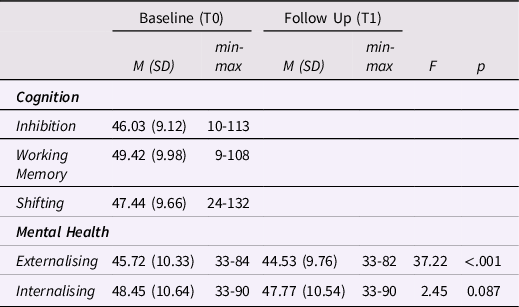
Notes. Cognitive measures (normed t-scores) are generated automatically by the NIH Toolbox computerized battery based on data from in the NIH Toolbox norming project. These scores were chosen because they allow for easy comparison within and across a wide range of existing studies using the same measures with other samples. Indeed, the NIH Toolbox normed t-scores have been used in most NIH longitudinal studies and clinical trials since 2015, including studies using the ABCD dataset, as they represent a “common currency” to allow for easier comparisons across different studies and populations. We chose to do the same for consistency and to facilitate replications with the ABCD data. Higher cognitive scores indicate better performance. Inhibition is measured with the Flanker Task; working memory is measured with the List Sort Task; shifting is measured with the Dimensional Change Card Sort Task. The internalizing and externalizing measures represent the composite subscale t-scores from the Child Behaviour Checklist (Achenbach, Reference Achenbach2011): higher scores indicate greater difficulties. Change in symptom scores over time was tested using repeated measures ANOVA.
Internalising dimensions
EFA and CFA conducted at each time point revealed that a 4-factor solution best captured internalizing symptom data (see Table 3 for fit statistics). Measurement invariance tests were used to determine whether the factor structure for the internalizing symptoms was stable across time. Tests of configural invariance indicated that the 4-factor solution captured the data well at both time points (RMSEA = 0.023 (90% CI = 0.022, 0.023), SRMR = 0.037). Tests of metric invariance indicated that model fit was acceptable when loadings were constrained to be equal across time points (RMSEA = 0.025 (90% CI = 0.025, 0.026); SRMR = 0.039), suggesting there was no difference in the structure of the internalizing symptoms between time points. The items loading most heavily on the Factor 1 measured fearfulness, nervousness, worries, and anxiety. This factor was therefore labeled Anxiety (reliability (ω): T0 = 0.814; T1 = 0.823). Factor 2 included items related physical symptoms, including dizziness, aches and pains, and headaches, so it was labeled Somatic Problems (reliability (ω): T0 = 0.729; T1 = 0.74). Factor 3 contained items measuring the desire to be alone and keep things to oneself, alongside items capturing low energy levels, and was thus labeled Withdrawal (reliability (ω): T0 = 0.736; T1 = 0.768). Items measuring low mood, suicidality, and feelings of worthlessness loaded most highly on Factor 4, which was labeled Depression (reliability (ω): T0 = 0.72; T1 = 0.728). Factor score determinacy was within the acceptable range for all four factors at both timepoints (Anxiety (T0, T1) = 0.96, 0.96; Somatic (T0, T1) = 0.95, 0.95; Withdrawal (T0, T1) = 0.95, 0.96; Depression (T0, T1) = 0.95, 0.96). The CFA structure at Baseline (T0) is shown in Figure 1. The associated EFA solution is presented in Tables S1 and S2 in the Online Resource, along with the EFA and CFA solutions at T1 (Tables S3-and S4; Figure S2).
Four-factor confirmatory model of internalizing symptoms at Baseline (T0). Notes: Confirmatory factor structure for the 27 symptom items that had factor loadings ≥0.3 in the exploratory factor analysis at T0. Factors - Anxt = Anxiety; Smtc = Somatic Problems; Wthdrwl = Withdrawal; Dprs = Depression. Observed variables - Fers = Fears; FrDB = FearsDoBad; Prfc = Perfect; Nrvs = Nervous; Frfl = Fearful; Glty = Guilty; SlfC = SelfConscious; Wrrs = Worries; ; Dzzy = Dizzy; Achs = Aches; Hdch= Headaches; Naus = Nausea; Stmc = Stomachaches; Vmts= Vomits; EnjL = EnjoysLittle; RtBA= RatherbeAlone; WntT = Won'tTalk; Scrt = Secretive; LckE = LacksEnergy; Withrwn = Withdrawn; Shy = Shy; Unlv = Unloved; Wrth = Worthless; ThnS = Thinks Suicide; Sad = Sad. Note that a highly similar model emerged at Follow Up (T1). Factor loadings for the EFA for these models are presented in Tables S1–S4 in the Online Resource, with the CFA model at T1 presented in Fig. S1.

Exploratory and confirmatory factor analysis fit statistics for internalizing symptoms

Notes. Good model fit is defined as RMSEA < .05, TLI > .95, CFI > .95. Reasonable model fit is defined as RMSEA < .08, TLI > .90, CFI > .90.
Links between executive function at age 10 and internalizing symptoms at ages 10 and 12
Prior to exploring links between the internalizing dimensions and executive function we explored whether the three measures of executive function were better captured by a single unitary construct. These analyses were conducted because some argue executive functions may be better captured by a unitary factor in childhood (Malagoli & Usai, Reference Malagoli and Usai2018; Wiebe et al., Reference Wiebe, Espy and Charak2008, Reference Wiebe, Sheffield, Nelson, Clark, Chevalier and Espy2011), and that a common executive component may better capture individual variability in mental health (Hatoum et al., Reference Hatoum, Rhee, Corley, Hewitt and Friedman2018; Snyder et al., Reference Snyder, Friedman and Hankin2019). A CFA testing whether the three executive measures loaded onto a single factor showed poor factor reliability (ω = 0.53) and factor determinacy (FD = 0.77) was not within the acceptable range, suggesting that a single-factor model was a poor psychometric index of individual variability in executive function scores in our sample. We therefore proceeded with the individual measures of executive function in all subsequent analyses.
Simple correlations between the executive function measures and internalizing factor scores are provided for each timepoint in the Supplementary Materials (Table S5). To explore links between executive function and internalizing symptoms, baseline executive function scores were regressed on each of the internalizing factors at Baseline (T0; age 10) and Follow Up (T1; age 12), controlling for concurrent externalizing symptoms and baseline internalizing factor symptoms in the longitudinal regressions (Table 4; full regression results are reported in Table S6).
Multiple regression analyses of the association between baseline executive function and internalizing factors at each time point

Notes. Reported values are the standardized slope (beta) after controlling for concurrent externalizing problems. Longitudinal analyses controlled for baseline factor scores. Bold indicates a significant result after Bonferroni correction (α < .004). Full regression model results, including effects for externalizing symptoms and baseline factor scores, can be viewed in Table S6.
After correcting for multiple comparisons, weaker inhibition at age 10 (T0) was concurrently associated with elevated symptoms of Anxiety, Depression, and Withdrawal. Poorer shifting skills at age 10 (T0) were concurrently associated with greater Anxiety and Withdrawal. Longitudinal analyses showed that weaker inhibition at age 10 remained significantly associated with elevated symptoms of Withdrawal 2 years later, controlling for baseline symptoms. The association between shifting at age 10 at Anxiety also remained significant 2 years later, although the direction of association was the inversed from T0. For transparency, we also report a supplemental set of analyses not controlling for baseline symptom scores (Table S7). We also report a supplemental set of analyses without controlling for externalizing symptoms (Table S8). Larger effect sizes were revealed when externalizing difficulties were not controlled for, suggesting the common variance between externalizing and internalizing symptoms is more strongly related to executive functioning than the variance associated with internalizing symptoms alone. For transparency, also report the results of the analyses without regression weights in the Supplementary Materials (Table S9). Using unweighted scores, many effects disappeared, likely due to the low number of children with elevated internalizing difficulties. Although we used age-standardized executive function and externalizing scores and found no differences in internalizing symptoms between T0 and T1 (Table 2), we ran a supplemental analysis with age included as a covariate for completeness, and confirmed that age-related differences in internalizing factor scores were not driving the observed results (Table S10).
Discussion
This study used a data-driven factor analytic approach to identify dimensions of internalizing symptoms across early adolescence and explore their association with executive functioning. Using symptom-level data, we found that four factors — Anxiety, Depression, Somatic problems, and Withdrawal — captured the structure of internalizing symptoms at age 10 and 12, with an invariant factor structure across time. Inhibition and shifting skills were inversely associated with concurrent symptoms of Anxiety, Withdrawal, and Depression at age 10. Longitudinal links were more limited, with poorer inhibition predicting greater symptoms of Withdrawal 2 years later, and poorer shifting abilities at age 10 predicting decreased Anxiety at age 12.
Identifying the factor structure of internalizing symptoms in early adolescence
The first aim of this study was to identify the factor structure that best captures internalizing symptoms in a nationally representative cohort across early adolescence. A four-factor solution best captured the data and was invariant structure from ages 10 to 12, with similar symptom loadings at both time points. The first factor predominantly captured symptoms of worry (Anxiety), the second related to self-exclusion (Withdrawal), the third to low mood (Depression), and the fourth to physical symptoms (Somatic Problems). These dimensions align with those widely identified in children and adults (e.g., Kotov et al., Reference Kotov, Waszczuk, Krueger, Forbes, Watson, Clark, Achenbach, Althoff, Ivanova, Michael Bagby, Brown, Carpenter, Caspi, Moffitt, Eaton, Forbush, Goldberg, Hasin, Hyman and Zimmerman2017), although finding distinct dimensions for anxiety and depression is inconsistent both with previous models of CBCL data (e.g., Dedrick et al., Reference Dedrick, Greenbaum, Friedman, Wetherington and Knoff2016; Guttmannova et al., Reference Guttmannova, Szanyi and Cali2008; Ivanova et al., Reference Ivanova, Achenbach, Rescorla, Harder, Ang, Bilenberg, Bjarnadottir, Capron, De Pauw, Dias, Dobrean, Doepfner, Duyme, Eapen, Erol, Esmaeili, Ezpeleta, Frigerio, Gonalves and Verhulst2010; Konold et al., Reference Konold, Walthall and Pianta2004; Pandolfi et al., Reference Pandolfi, Magyar and Dill2009) and with results from a recent study using the ABCD baseline data that identified only three factors capturing (1) broad internalizing symptoms (capturing anxiety and depression), (2) somatoform problems, and (3) detachment/social withdrawal (Michelini et al., Reference Michelini, Barch, Tian, Watson, Klein and Kotov2019). These differences could reflect differences in the symptoms included in the samples, data and modeling techniques used. Most attempts to model CBCL data typically include externalizing symptoms and use samples drawn from different developmental periods (e.g., Dedrick et al., Reference Dedrick, Greenbaum, Friedman, Wetherington and Knoff2016; Guttmannova et al., Reference Guttmannova, Szanyi and Cali2008; Ivanova et al., Reference Ivanova, Achenbach, Rescorla, Harder, Ang, Bilenberg, Bjarnadottir, Capron, De Pauw, Dias, Dobrean, Doepfner, Duyme, Eapen, Erol, Esmaeili, Ezpeleta, Frigerio, Gonalves and Verhulst2010; Konold et al., Reference Konold, Walthall and Pianta2004; Pandolfi et al., Reference Pandolfi, Magyar and Dill2009). Michelini et al. (Reference Michelini, Barch, Tian, Watson, Klein and Kotov2019) included symptoms of externalizing difficulties while using a hierarchical modeling approach, whereas we focussed on a narrower set of symptoms within the internalizing domain to identify simple dimensions that may/may not change across time. This approach may have allowed us to capture more fine-grained variance. Crucially, our data show that the dimensional structure of internalizing symptoms remains stable across developmental time in early adolescence. Previous studies have shown substantial change in individual mental health trajectories and symptoms profiles across adolescence (e.g., Bathelt et al., Reference Bathelt, Vignoles and Astle2021; Dugré et al., Reference Dugré, Dugré, Dumais, Dumais, Dumais, Dellazizzo, Dellazizzo, Potvin and Potvin2020; Fuhrmann et al., Reference Fuhrmann, van Harmelen and Kievit2021), but to our knowledge, this is the first study to demonstrate stability in underlying symptom dimensions across this specific period.
Cross-sectional and longitudinal links between executive function internalizing symptoms
Executive function abilities at age 10 were concurrently and longitudinally associated with three of the four internalizing dimensions. Poorer abilities to inhibit prepotent responses (i.e., inhibition) at age 10 were linked to widespread elevated internalizing symptoms spanning Withdrawal, Anxiety, and Depression at age 10, as well as elevated symptoms of Withdrawal at age 12. These multiple links reinforce the importance of inhibitory control for coping with stress and down-regulating negative or maladaptive emotional responses (Kertz & Woodruff-Borden, Reference Kertz and Woodruff-Borden2011; LeMoult & Gotlib, Reference LeMoult and Gotlib2019). The prospective association between poorer inhibitory skills and later Withdrawal is notable, not least because it remained significant after controlling for baseline symptoms, indicating that poor inhibition not only predicts later Withdrawal, but also predicts changes in Withdrawal symptoms over time. The lack of significant associations with working memory is notable given previously reported links between working memory and a range of behavioral and emotional difficulties in children and adults (Fales et al., Reference Fales, Barch, Burgess, Schaefer, Mennin, Gray and Braver2008; Ladouceur et al., Reference Ladouceur, Silk, Dahl, Ostapenko, Kronhaus and Phillips2009; Opris et al., Reference Opris, Cheie, Trifan, Visu-Petra and Visu-Petra2019; Yang et al., Reference Yang, Shields, Zhang, Wu, Chen and Romer2022). Our supplementary analyses reveal that all significant associations between working memory and internalizing symptoms vanish when controlling for concurrent externalizing symptoms, suggesting poor working memory is associated with externalizing symptoms in our sample. This aligns with theoretical accounts that poor working memory contributes to behavioral disinhibition and inappropriate behavioral responses associated with externalizing difficulties (Eisenberg et al., Reference Eisenberg, Spinrad, Fabes, Reiser, Cumberland, Shepard, Valiente, Losoya, Guthrie, Thompson and Murphy2004; Endres et al., Reference Endres, Rickert, Bogg, Lucas and Finn2011).
Social interaction and support is important for mental health and wellbeing across the lifespan and can serve as a protective factor against clinical-level difficulties by fostering support-seeking strategies, enhancing self-esteem and providing a social buffer for stress (Graber et al., Reference Graber, Turner and Madill2016; Van Harmelen et al., Reference Van Harmelen, Kievit, Ioannidis, Neufeld, Jones, Bullmore, Dolan, Fonagy and Goodyer2017). Consistent with this, socially withdrawn young people are at greater risk of detachment, emotional and behavioral problems, peer conflict and academic difficulties (for a review see Rubin et al., Reference Rubin, Coplan and Bowker2009). Executive functions are important for social interactions, enabling individuals to down-regulate impulses that may evoke conflict and negative exchanges with peers (Hay et al., Reference Hay, Payne and Chadwick2004) and use appropriate pragmatic communication skills for positive social interactions (Mareva & Holmes, Reference Mareva and Holmes2019). Finding prospective associations between these abilities at the start of adolescence and social withdrawal suggests there may be a developmental cascade: poor executive function might increase the risk of later psychopathology through the mediating process of social withdrawal, an idea worth exploring in future studies.
The ability to shift or switch focus was also negatively correlated with concurrent levels of Anxiety and Withdrawal at age 10: those with poorer switching skills had greater symptoms. This is consistent with the idea that poor shifting abilities impact on a person’s ability to disengage from threatening or negative stimuli, which can lead to heightened rumination, worry, or sadness (Bloemen et al., Reference Bloemen, Oldehinkel, Laceulle, Ormel, Rommelse and Hartman2018; Yang et al., Reference Yang, Cao, Shields, Teng and Liu2017). However, the relationship between shifting and Anxiety changed direction 2 years later, while remaining significant: individuals who were poorer at shifting or switching their focus at age 10 experienced less anxiety 2 years later. These data suggest there may be a developmental shift in the association between the ability to shift one’s focus and anxiety between 10 and 12 years of age. Although speculative, this might reflect an increased ability to process or rationalize worrying thoughts at age 12, meaning a sustained focus on such thoughts becomes helpful.
Overall, there were more concurrent than longitudinal associations between internalizing symptoms and executive function, suggesting that good executive function skills at the start of adolescence do not necessarily protect against later mental health problems, and likewise that poor cognitive function does not necessarily increase vulnerability to the onset of later mental health problems. This is an unexpected finding given the wealth of literature implicating cognitive impairments in the onset and maintenance of mental health difficulties (e.g., LeMoult & Gotlib, Reference LeMoult and Gotlib2019; Millan et al., Reference Millan, Agid, Brüne, Bullmore, Carter, Clayton, Connor, Davis, Deakin, Derubeis, Dubois, Geyer, Goodwin, Gorwood, Jay, Joëls, Mansuy, Meyer-Lindenberg, Murphy and Young2012; Wagner et al., Reference Wagner, Alloy and Abramson2015). It may be that in early adolescence the impact of cognitive variability on the onset of mental health problems is washed out by other more impactful factors, including hormonal changes (Pfeifer & Allen, Reference Pfeifer and Allen2021) and shifts in the importance and role of peer relationships (Blakemore & Mills, Reference Blakemore and Mills2014). Relatedly, the absence of associations between somatic problems and executive function is likely explained by other factors such as poor sleep, stress or loneliness (Brand & Kirov, Reference Brand and Kirov2011; Greene et al., Reference Greene, Walker, Hickson and Thompson1985; Stickley et al., Reference Stickley, Koyanagi, Koposov, Blatný, Hrdlička, Schwab-Stone and Ruchkin2016), or the complex interplays between symptoms of anxiety and depression and somatic complaints (Bohman et al., Reference Bohman, Jonsson, Päären, von Knorring, Olsson and von Knorring2012).
Limitations and future directions
This study has several strengths, including the use of a data-driven approach uncovering dimensions of internalizing symptoms and their links with executive function across early adolescence. Further, the use of a large nationally representative sample allowed us to capture the entire range of symptom severity, including children that would typically be excluded from traditional diagnostic studies. However, this study also has several limitations. First, it suffered from bias of attrition, an inherent problem of longitudinal studies. Participants for whom data was available at T1 had higher rates of married and college-level educated parents and larger household incomes than the larger sample at T0, and there were differences in the racial/ethnic distribution with a larger proportion of Asian and Other/Multi-racial and T1 than T0. It is also possible that some longitudinal associations, which were similar in size across the two timepoints, did not reach statistical significance at T1 due to the smaller sample size. Second, although we found that internalizing symptoms showed an invariant factor structure across age, we did not consider the role of pubertal development. Future studies using indices of biological development (pubertal stage) to assess the stability of symptoms over time would complement our findings. Third, externalizing problems were added as covariate to explore the specificity of links between internalizing symptoms and executive function. However, externalizing and internalizing problems frequently co-occur in youth (Willner et al., Reference Willner, Gatzke-Kopp and Bray2016), and as our Supplementary analyses demonstrate, executive function is linked more strongly to the shared variance between externalizing and internalizing symptoms. Future studies using hierarchical latent variable models that map the structure of symptoms from both the internalizing and externalizing spectra, while simultaneously controlling for their covariance, may help better disentangle the shared and unique variance associated with internalizing and externalizing symptoms. Additionally, there were few children with elevated internalizing symptoms in our sample, meaning those with the most elevated scores were weighted up to detect links between mental health difficulties and executive function. Without this weighting, there were fewer significant associations between internalizing difficulties and EF, suggesting that these associations only emerge at higher levels of symptom severity, although replication of these findings in populations with elevated symptoms is necessary to validate this hypothesis and ensure the robustness and generalizability of these results. Finally, while our results suggest that aspects of executive function predict change in symptoms over time, we cannot rule out the possibility of a bidirectional association between cognition and mental health (e.g., Donati et al., Reference Donati, Meaburn and Dumontheil2021). Indeed, it is likely that cognitive and emotional vulnerabilities interact over developmental time (Fuhrmann et al., Reference Fuhrmann, van Harmelen and Kievit2021; Lagasse et al., Reference Lagasse, Conradt, Karalunas, Dansereau, Butner, Shankaran, Bada, Bauer, Whitaker and Lester2016), although testing bidirectional associations was beyond the aims and research questions addressed by the present study.
Supplementary material
The supplementary material for this article can be found at https://doi.org/10.1017/S0954579423000524.
Acknowledgements
Data used in the preparation of this article were obtained from the Adolescent Brain Cognitive Development (ABCD) Study (https://abcdstudy.org), held in the NIMH Data Archive (NDA). This is a multisite, longitudinal study designed to recruit more than 10,000 children age 9–10 and follow them over 10 years into early adulthood. A listing of participating sites and a complete listing of the study investigators can be found at https://abcdstudy.org/consortium_members/. ABCD consortium investigators designed and implemented the study and/or provided data but did not participate in analysis or writing of this report. This manuscript reflects the views of the authors and may not reflect the opinions or views of the NIH or ABCD consortium investigators. The ABCD Study is supported by the National Institutes of Health and additional federal partners under award numbers U01DA041048, U01DA050989, U01DA051016, U01DA041022, U01DA051018, U01DA051037, U01DA050987, U01DA041174, U01DA041106, U01DA041117, U01DA041028, U01DA041134, U01DA050988, U01DA051039, U01DA041156, U01DA041025, U01DA041120, U01DA051038, U01DA041148, U01DA041093, U01DA041089, U24DA041123, U24DA041147. A full list of supporters is available at https://abcdstudy.org/federal-partners.html. The ABCD data repository grows and changes over time. The ABCD data used in this report came from 10.15154/1523041. DOIs can be found at http://dx.doi.org/10.15154/1523041.
Competing interests
The authors have no financial or nonfinancial conflicting interests to disclose.
Funding statement
This research was funded by the UK Medical Research Council, Grant MC-A0606-5PQ41.
Open access statement
For the purpose of open access, the authors have applied a Creative Commons Attribution (CC BY) licence to any Author Accepted Manuscript version arising from this submission.


 Open access

