





Empirical data on the precise incidence of treatment-resistant schizophrenia (TRS) remain sparse, with prevalence rates historically ranging from 20 to 50%, depending on cohort and criteria. Reference Elkis1–Reference Weinberger and Harrison3 Earlier estimates often relied on retrospective chart reviews or heterogeneous definitions of resistance, limiting comparability across studies. According to clinical practice guidelines, between 10 and 15% of patients with first-episode psychosis (FEP) and 20–50% of chronically unwell patients develop treatment resistance. 4 A widely cited USA study reported that 7–20% of patients with FEP failed to show sustained treatment response after a year. Reference Robinson, Woerner, Alvir, Geisler, Koreen and Sheitman5 A recent modelling study estimated that around 22% of people with schizophrenia in the USA would be considered treatment-resistant. Reference Mørup, Kymes and Oudin Åström6 Similarly, long-term UK cohort data demonstrated that around 23% of patients developed TRS within 10 years, whereas another study reported 33% over 5 years. Reference Demjaha, Lappin, Stahl, Patel, MacCabe and Howes7,Reference Lally, Ajnakina, Di Forti, Trotta, Demjaha and Kolliakou8 These estimates are supported by a recent meta-analysis, which found that approximately 23% of FEP cohorts become treatment-resistant during the early course of illness. Reference Siskind, Orr, Sinha, Yu, Brijball and Warren9 However, many of these studies reconstructed treatment histories retrospectively from medical records, raising concerns about reliability.
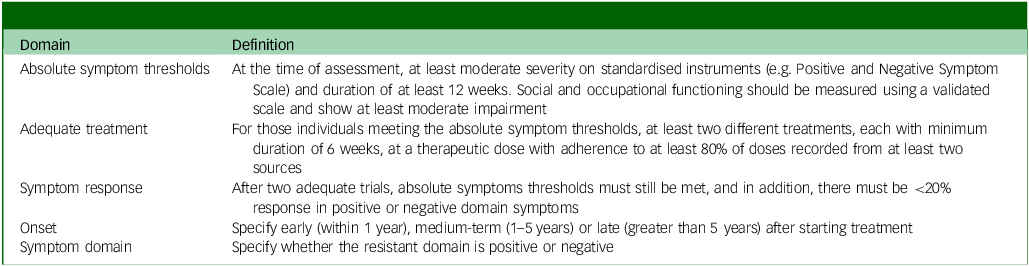
In 2017, the Treatment Response and Resistance in Psychosis (TRRIP) consensus established a unified framework for defining TRS, emphasising prospective evaluation of treatment response and standardised thresholds across symptom, treatment and functional domains. Reference Howes, McCutcheon, Agid, de Bartolomeis, van Beveren and Birnbaum10 The operational criteria used to define treatment resistance according to TRRIP are summarised in Table 1. Since its publication, several international guidelines have reinforced the importance of early and accurate identification of TRS. The National Institute for Health and Care Excellence guideline on psychosis and schizophrenia (2019 update) recommends clozapine initiation after two unsuccessful antipsychotic trials. 11 The World Federation of Societies of Biological Psychiatry 2019 guidelines highlight structured assessment and monitoring of treatment resistance as critical to optimising outcomes. Reference Hasan, Wobrock, Lieberman, Glenthoj, Gattaz and Möller12 Similarly, the Canadian Network for Mood and Anxiety Treatments 2020 guidelines stress the need for timely TRS recognition to reduce delays in clozapine initiation. Reference Correll, Schooler, Addington, Kennedy, Khalid-Khan and Ismail13 Most recently, the European Psychiatric Association has recommended staging models and conceptualising TRS as a continuum of ‘treatment refractoriness’ rather than a binary state. Reference Kane, Correll, Goff, Kirkpatrick, Marder and Vancampfort14 The absence of consensus on the prevalence and onset of TRS complicates efforts to identify predictive variables. Evidence to date points to a range of potential factors, such as the duration of untreated psychosis, the presence of prominent negative or cognitive symptoms, baseline symptom severity, younger age at onset and poorer premorbid functioning. However, findings across studies remain inconsistent, reflecting differences in study design, populations and definitions of TRS. Reference Demjaha, Lappin, Stahl, Patel, MacCabe and Howes7,Reference Lally, Ajnakina, Di Forti, Trotta, Demjaha and Kolliakou8
Criteria for treatment resistance according to the Treatment Response and Resistance in Psychosis consensus

Despite this growing international consensus, no large-scale studies have prospectively applied TRRIP criteria to longitudinal clinical trial data to provide robust estimates of TRS incidence. Thus, despite increasing guideline alignment since 2019, 11–Reference Kane, Correll, Goff, Kirkpatrick, Marder and Vancampfort14 and work to assess TRS in early psychosis cohorts, a critical evidence gap remains: the true incidence of TRS in large, community-based schizophrenia cohorts is still unknown.
We therefore applied the TRRIP consensus criteria to the large Clinical Antipsychotic Trials of Intervention Effectiveness (CATIE) data-set, to (a) generate the first prospective estimates of TRS incidence in a large, community-based cohort of individuals with chronic schizophrenia; and (b) evaluate whether routinely collected clinical and demographic variables at baseline could prospectively predict the emergence of TRS.
Method
Analysis software
All analyses were conducted in R (version 3.4.1; R Foundation for Statistical Computing, Vienna, Austria). Bespoke algorithms were developed to operationalise the minimum TRRIP consensus criteria for TRS. Data preprocessing, imputation and statistical modelling were implemented with established R packages (details provided in the Supplementary Material available at https://doi.org/10.1192/bjo.2026.12041). Analysis scripts and additional methodological details are provided in the Supplementary Material (available via the Open Science Framework (https://doi.org/10.17605/OSF.IO/5Y27D)).
Data sources
We used publicly available data from the CATIE study (study identifier: N01 MH090001-06), a large multi-site, randomised trial conducted between 2001 and 2004 across 57 community clinics in the USA. Reference Lieberman, Stroup, McEvoy, Swartz, Rosenheck and Perkins15 The CATIE study compared the effectiveness of seven antipsychotic medications in patients with chronic schizophrenia by using a sequential multi-phase design, allowing prospective assessment of treatment response across multiple adequate trials.
-
(a) Phase 1 (double-blind randomisation): participants were assigned to olanzapine, quetiapine, risperidone, ziprasidone or perphenazine.
-
(b) Phase 2 (switch after discontinuation): non-responders or intolerant participants could enter one of two randomisation arms – (i) clozapine (open label), olanzapine, quetiapine or risperidone; or (ii) ziprasidone, olanzapine, quetiapine or risperidone.
-
(c) Phase 3 (open-label): participants could choose monotherapy with any trial drug (including perphenazine or flupentixol decanoate), or a combination of two agents.
The trial incorporated detailed longitudinal data on psychopathology, functional outcomes and treatment adherence over up to 18 months of follow-up. This structure enabled robust, prospective operationalisation of the TRRIP criteria for treatment resistance.
Participants
The CATIE study recruited 1444 individuals aged 18–65 years with a DSM-IV diagnosis of schizophrenia, confirmed using the Structured Clinical Interview for DSM-IV. Reference First, Spitzer, Gibbon and Williams16
Exclusion criteria included prior evidence of treatment resistance, previous clozapine exposure, diagnoses other than schizophrenia (e.g. schizoaffective disorder, single psychotic episode), serious active medical illness, known intolerance to study medications and pregnancy or breastfeeding.
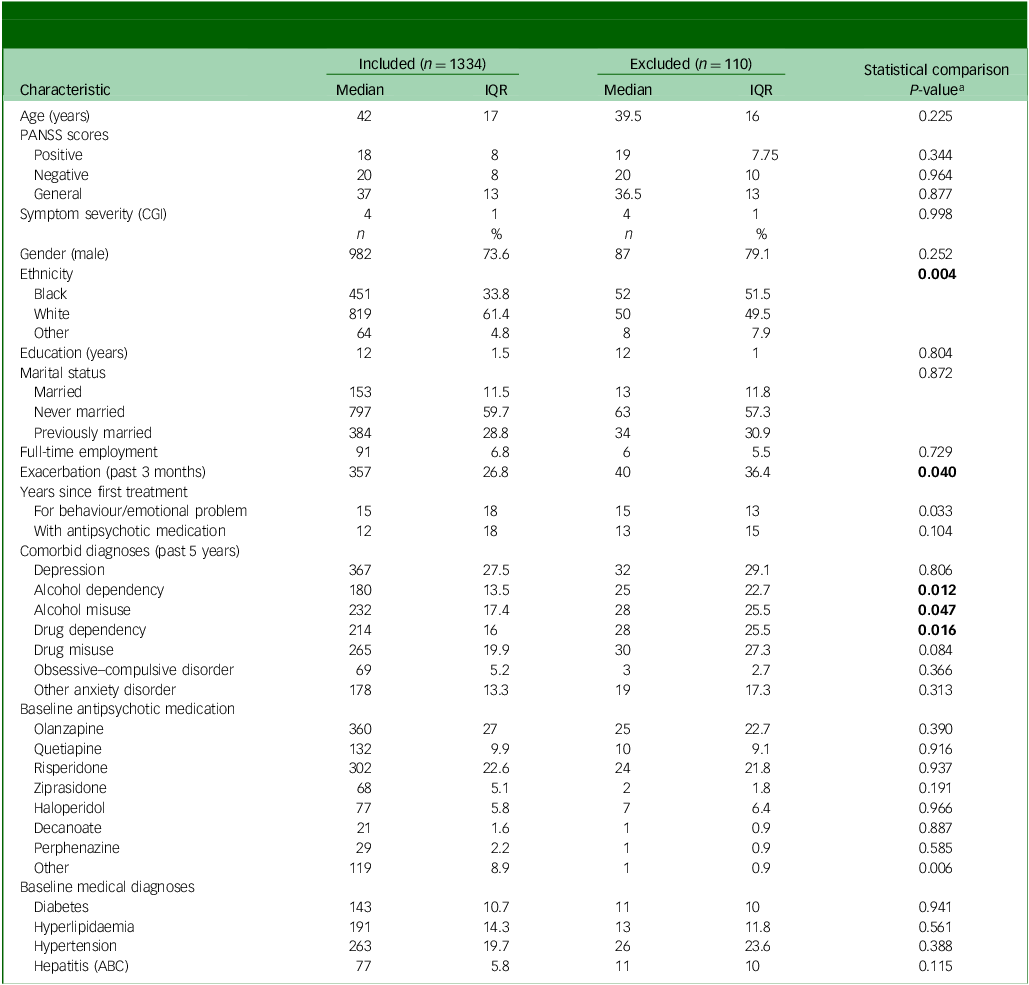
For the present analyses, participants were included if sufficient longitudinal data were available to assess TRRIP domains: absolute symptom thresholds, functional impairment and at least two documented antipsychotic treatment trials. After exclusions for incomplete data, 1334 participants were eligible for analysis. Baseline demographic and clinical characteristics of included and excluded participants are presented in Table 2.
Baseline demographic and clinical characteristics of participants included (n = 1334) and excluded (n = 110) because of availability of follow-up data
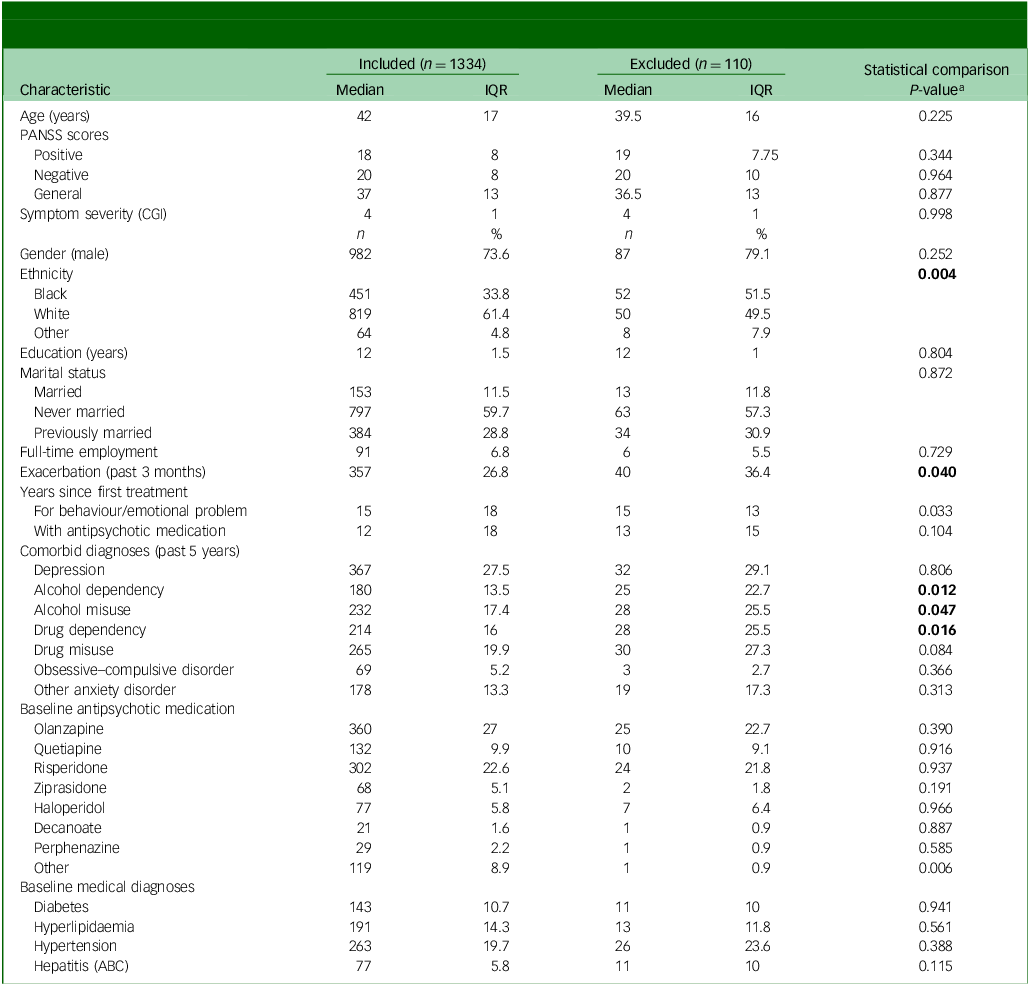
Missing data: PANSS positive scale (n = 1); PANSS negative scale (n = 2); PANSS general scale (n = 1); CGI symptom severity (n = 5); education (n = 8); years since first treated for emotional/behaviour problems (n = 38); years since first treated with antipsychotic medication (n = 33). IQR, interquartile range; PANSS, Positive and Negative Symptom Scale; CGI, Clinical Global Impression Scale.
a. Statistical test: Kolmogorov–Smirnov test for continuous variables; chi-squared test for categorical data. Bold indicates statistical significance (P < 0.05).
Measures
Social and occupational functioning
The TRRIP consensus requires evidence of functional impairment from a standardised tool. The CATIE study did not employ a single validated scale (e.g. personal and social performance (PSP) scale), but multiple measures of social and occupational functioning (SOF) were available. We mapped CATIE items onto the PSP domains and defined a threshold corresponding to moderate impairment, consistent with TRRIP recommendations. The algorithm is described in the Supplementary Material.
Symptom severity
In the CATIE study, psychopathology was assessed with the Positive and Negative Syndrome Scale (PANSS). Reference Kay, Opler and Lindenmayer17 It was administered up to nine times per participant, including at baseline and at each treatment phase change. If at any time point, a participant’s symptoms reach the TRRIP absolute threshold, they are designated above threshold, and their PANSS and SOF scores at that time are recorded and used as their baseline for assessing treatment response. After two contiguous adequate trials, symptom change is calculated (as specified in TRRIP) as the percentage reduction from baseline PANSS. Reference Leucht, Davis, Engel, Kissling and Kane18,Reference Munk-Jorgensen19 If an above-threshold participant has not improved by at least 20% in total PANSS and the domain they were resistant in (positive or negative), and continue to meet the absolute thresholds, including SOF, they are designated as a TRS case. If they have improved in total and/or positive/negative domains or SOF, then they are designated treatment-responsive. Participants can be above threshold, but then have zero or only one adequate trial; these participants are not designated TRS but treated as right-censored when exiting the trial.
In short, in accordance with TRRIP, participants met the absolute symptom threshold if they scored at least moderate severity on two items, or severe on one item, either in the positive or negative domains.
Antipsychotic treatment adequacy
Adequate treatment trials were defined as:
-
(a) a minimum of 6 weeks duration;
-
(b) at either a minimum 600 mg chlorpromazine-equivalent or at or above the mid-point of the licenced dose range (based on each drug’s Summary of Product Characteristics); and
-
(c) ≥80% adherence, assessed using pill counts, clinical records and collateral reports.
The mid-point of the dose range better reflects clinical prescribing whereas chlorpromazine equivalents with established conversion methods yields unrealistic minimum doses. Reference Leucht, Samara, Heres and Davis20 The algorithm and Summary of Product Characteristics mid-point thresholds for doses are provided in the Supplementary Material.
For participants in CATIE phase 3, if two medications were prescribed in combination, either was eligible to count as an adequate trial, provided it differed from prior treatments.
Treatment response
Following two adequate trials, participants were classified as TRS cases if they continued to meet absolute symptom thresholds and demonstrated <20% reduction in PANSS total scores and the resistant domain (positive or negative). Participants who improved beyond these thresholds were designated treatment-responsive. Those with only one or no adequate trials were treated as right-censored.
Statistical analysis
Primary outcome
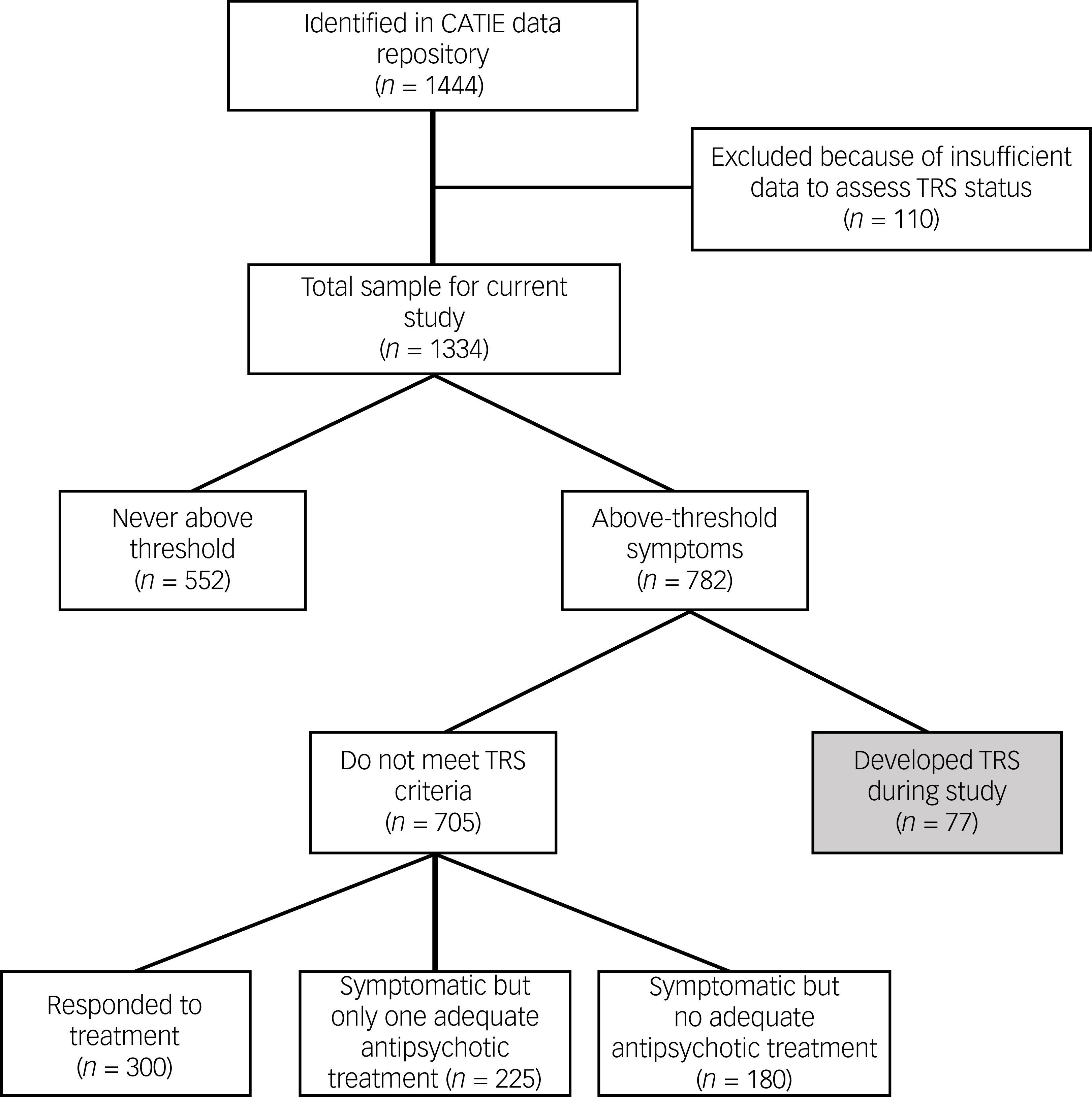
The primary outcome was the presence or absence of TRS, defined prospectively with operationalised TRRIP criteria. TRS classification required participants to meet criteria across three domains: (a) persistent symptoms above threshold, (b) at least two adequate treatment trials and (c) insufficient symptom response. Participants not meeting all domains, particularly those lacking adequate treatment trials, were not classified as TRS. Time-to-event analyses considered the time from baseline to the first designation of TRS. In summary, TRS status is a function of meeting thresholds in all three of (a) social and occupational function; (b) adequate treatment duration, dose and adherence; and (c) symptom response. Participants who did not meet TRRIP thresholds, or who completed fewer than two adequate treatment trials, were treated as right-censored at their last follow-up. Participant flow through the study is illustrated in Fig. 1.
Participant flow. CATIE, Clinical Antipsychotic Trials of Intervention Effectiveness; TRS, treatment-resistant schizophrenia.

Predictor variables
For predicting TRS from data collected when a participant enters the CATIE trial, we used clinical/demographic variables from: Reference Lieberman, Stroup, McEvoy, Swartz, Rosenheck and Perkins15
-
(a) demographics: age, gender, race/ethnicity, years of education, marital status and employment;
-
(b) psychiatric history (exacerbations requiring hospital admission in the 3 months before entering the trial, years since first receiving psychiatric care and years since first treated with antipsychotic medication) and comorbid iagnoses within the past 5 years (drug and alcohol dependence/misuse, depression, anxiety disorder and obsessive–compulsive disorder, determined using the Structured Clinical Interview for DSM-IV); Reference First, Spitzer, Gibbon and Williams16
-
(c) baseline treatment: type and number of antipsychotics;
-
(d) psychopathology data: PANSS positive, negative and general subscale scores, Reference Kay, Opler and Lindenmayer17 and Clinical Global Impression Scale (CGI) clinician-rated symptom severity score. Reference Guy21
Sample size
Participants were extracted from the publicly available CATIE trial data and included if there was sufficient data for measuring absolute symptoms, SOF and records of medication treatments for two or more time points (the minimum data necessary to use TRRIP criteria). From the 1444 participants originally enrolled in the CATIE trial, 1334 met the inclusion criteria with sufficient longitudinal data to assess TRRIP domains.
Missing data
Participants without sufficient longitudinal data for TRRIP were excluded. In the CATIE trial, SOF was assessed less frequently than PANSS; thus, the last SOF observation was carried forward when not synchronised with the PANSS.
For inferential analyses of baseline data, we used the VIM v4.7.0 package to visualise patterns of missing values, finding a total 0.183% of values were missing, and on inspection, they were missing at random. Multivariate imputation by chained equations (mice v3.1.0 package Reference Van Buuren and Groothuis-Oudshoorn22 ) was used to impute the small proportions of data missing at random for eight variables (see Table 2 footnote): (a) years since first psychiatric treatment; (b) years since first antipsychotic treatment (integer); (c) full-time employment (binary); (d) symptom severity as measured by the CGI (integer); (e) years of education (integer) and (f) total positive, (g) negative and (h) general PANSS symptoms (integer).
Plausible imputation methods for each variable were determined by inspecting distributions of imputed against non-missing data. We concluded that predictive mean matching was superior for integer variables, except for years since first psychiatric and antipsychotic treatment, where random resampling most plausibly matched distributions in non-missing data. For binary variables, logistic regression performed well. Sensitivity analyses (for the univariate results shown in Table 2) showed the pattern of significant differences between excluded and included participants did not differ over the 20 imputed sets of baseline data for all 1444 participants.
Incidence estimation
Incidence rates of TRS were estimated with non-parametric bootstrap resampling (with replacement) to calculate person-time incidence and 95% confidence intervals. Rates were reported for the entire cohort and for the subgroup meeting absolute TRRIP thresholds at baseline. We did not perform formal time-to-event (survival) analyses.
Statistical methods
For participants included and excluded (because of insufficient data), differences in baseline variables were established with multiple univariate Kolmogorov–Smirnoff (continuous variables; none were normally distributed) and chi-squared tests (binary variables).
We used non-parametric bootstrap resampling with replacement to compute incidence rates and 95% confidence intervals. We estimated incidence in the total CATIE sample (i.e. every included participant is deemed at risk of developing TRS) and separately, in the subgroup that met absolute TRRIP thresholds.
Regression analyses
To model associations of binary TRS outcome, logistic regression models were estimated over the 20 imputed baseline data and results pooled. Reference Van Buuren and Groothuis-Oudshoorn22,Reference Rubin23 These analyses were performed on the whole sample and separately for the above-threshold subgroup (in case of differences between above-threshold participants and the whole sample).
Models were structured in blocks: model 1, demographics; model 2, psychiatric history and comorbidity; model 3, baseline antipsychotic treatment and model 4, psychopathology.
For models 2, 3 and 4, if any estimated coefficients were significantly different from zero (significance level of 0.05), we repeated the analysis adjusting for demographic variables.
Predictive modelling and validation
To assess whether baseline associations could serve as robust individual-level predictors of TRS, we constructed a multivariable logistic regression model by using candidate predictors identified from models 1–4. Given the rarity of TRS events and the absence of an external validation set, we applied internal validation using resampling methods rather than sample-splitting, in line with recommended type 1b study designs. Reference Collins, Reitsma, Altman and Moons24 After fitting the predictive model on the original data-set (separately for the above-threshold subgroup and the whole sample), model performance was evaluated across 500 bootstrapped resamples, using the rms package (v5.1.2). Reference Harrell25 Discriminative ability was quantified with Somers’ Dxy index, where values range from +1 (perfect agreement between predicted and observed cases) to –1 (complete disagreement). Model calibration was further examined using smoothed calibration curves generated from an additional 500 bootstrap iterations. Reference Harrell25,Reference Austin and Steyerberg26
Results
Participant flow
From the 1444 participants originally enrolled in the CATIE trial, 1334 met the inclusion criteria with sufficient longitudinal data to assess TRRIP domains. Excluded participants (n = 110) differed in demographic and clinical characteristics, but the majority were excluded because of insufficient symptom and treatment data (i.e. fewer than two time points for either); in total 107, 96 and one participant were lacking symptom, treatment and SOF data, respectively. Multiple univariate tests (Table 2) showed that excluded participants were more likely to be Black or other ethnicity; to have experienced an exacerbation of illness in the past 3 months; to have been treated for a median of 15 years for an emotional or behavioural problem; to have alcohol misuse, dependency or other drug dependency; at baseline, not to be on one of the CATIE medications; and to have a sexually transmitted infection at baseline, relative to those included in the study (P < 0.05 for all).
TRRIP outcomes
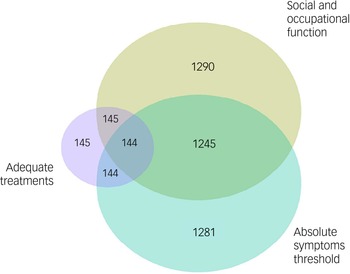
Of the 1334 participants included in analyses, applying our TRRIP algorithm (Fig. 1), a total of 782 (58.6%) participants met absolute symptom threshold (above-threshold group) and 552 (41.4%) participants did not meet absolute symptom threshold (not-above-threshold group). The distribution of participants meeting TRRIP criteria at different stages is shown in Fig. 2.
Participants meeting TRRIP criteria (excluding treatment response) at any time point in the trial. TRRIP, Treatment Response and Resistance in Psychosis.

Within the above-threshold group, 77 participants (9.8%) fulfilled the full TRRIP criteria for TRS. Of these 77 TRS cases, nine had resistance in negative symptoms, 15 had resistance in positive symptoms and 53 had resistance in both domains.
Among the remaining 705 above-threshold participants, 300 were treatment-responsive, whereas 225 and 180 participants were right-censored, because of receiving either one or zero adequate treatment trials, respectively. Thus, definitive response could not be assessed for these participants and they continue to be at risk of developing TRS.
Examination of participant flow through TRRIP domains highlights potential bottlenecks in classification. Although a large proportion met absolute symptom thresholds, fewer progressed to having two adequate trials, and a substantial number were right-censored because of insufficient treatment exposure. This suggests that limitations in treatment adequacy and follow-up duration may contribute to underidentification of TRS cases.
Incidence rates
The median trial duration was 16.6 months (interquartile range (IQR) 10.5 months) with follow-up extending up to 22 months. The estimated incidence rate estimate was 5.68 per 100 person-years (95% CI 4.51–7.02) in the overall sample (N = 1334).
Restricting the incidence rate analyses for the above-threshold subgroup (n = 782) yielded an incidence rate of 9.20 per 100 person-years (95% CI 7.43–11.39). Median follow-up time was similar in above-threshold and not-above-threshold participants (16.7 months (IQR = 8.2) v. 15.7 months (IQR = 12.6), respectively), indicating that above-threshold patients were not simply followed up for longer.
Associations with baseline data
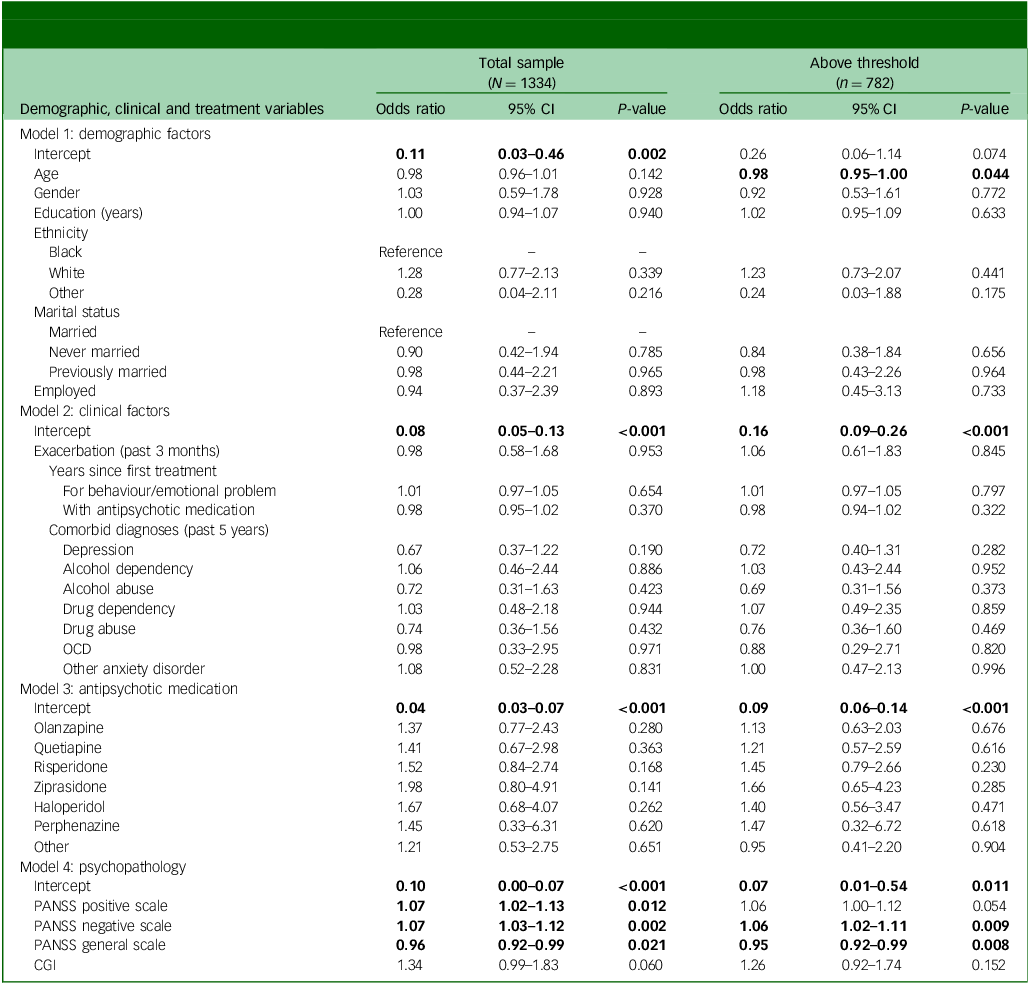
In unadjusted analyses performed over the 20 imputed data-sets for the whole sample, higher baseline PANSS positive, negative and general scores, as well as greater symptom severity, were associated with subsequent TRS (P < 0.05; see Table 3). After adjustment for demographic variables, TRS remained significantly associated with higher PANSS positive (odds ratio 1.074, 95% CI 1.015–1.134) and negative scores (odds ratio 1.071, 95% CI 1.025–1.12), but lower PANSS general scores (odds ratio 0.957, 95% CI 0.922–0.993). It was noted that the effect sizes were small.
Unadjusted logistic regression analyses examining demographic and clinical factors associated with treatment resistance in the total sample (N = 1334) and subgroup of participants with above-threshold symptoms (n = 782)

Table 3 Long description
A table comparing demographic and clinical factors associated with treatment resistance in a total sample of 1334 and a subgroup of 782 participants with above-threshold symptoms. The table is divided into four models: demographic factors, clinical factors, antipsychotic medication, and psychopathology. Each model lists various factors with corresponding odds ratios, 95% confidence intervals, and P-values for both the total sample and the above-threshold subgroup. Model 1 includes factors like age, gender, education, ethnicity, marital status, and employment. Model 2 includes factors like exacerbation in the past 3 months, years since first treatment, behavior/emotional problems, antipsychotic medication use, and comorbid diagnoses. Model 3 lists different types of antipsychotic medications. Model 4 includes PANSS positive scale, PANSS negative scale, PANSS general scale, and CGI. Notable trends include significant associations between treatment resistance and higher PANSS positive and negative scores, as well as lower PANSS general scores after adjustment for demographic variables.
OCD, obsessive–compulsive disorder; PANSS, Positive and Negative Symptom Scale; CGI, Clinical Global Impression Scale; –, not applicable (values are not reported for the reference category). Bold indicates P < 0.05.
Results for the above-threshold subgroup were consistent, although the PANSS positive association was no longer significant. No demographic, treatment or comorbidity variables were significantly associated with TRS status (see Table 3 for full results).
A crude univariate model of polypharmacy at baseline (total antipsychotics) showed no association with TRS.
Predicting TRS from baseline data
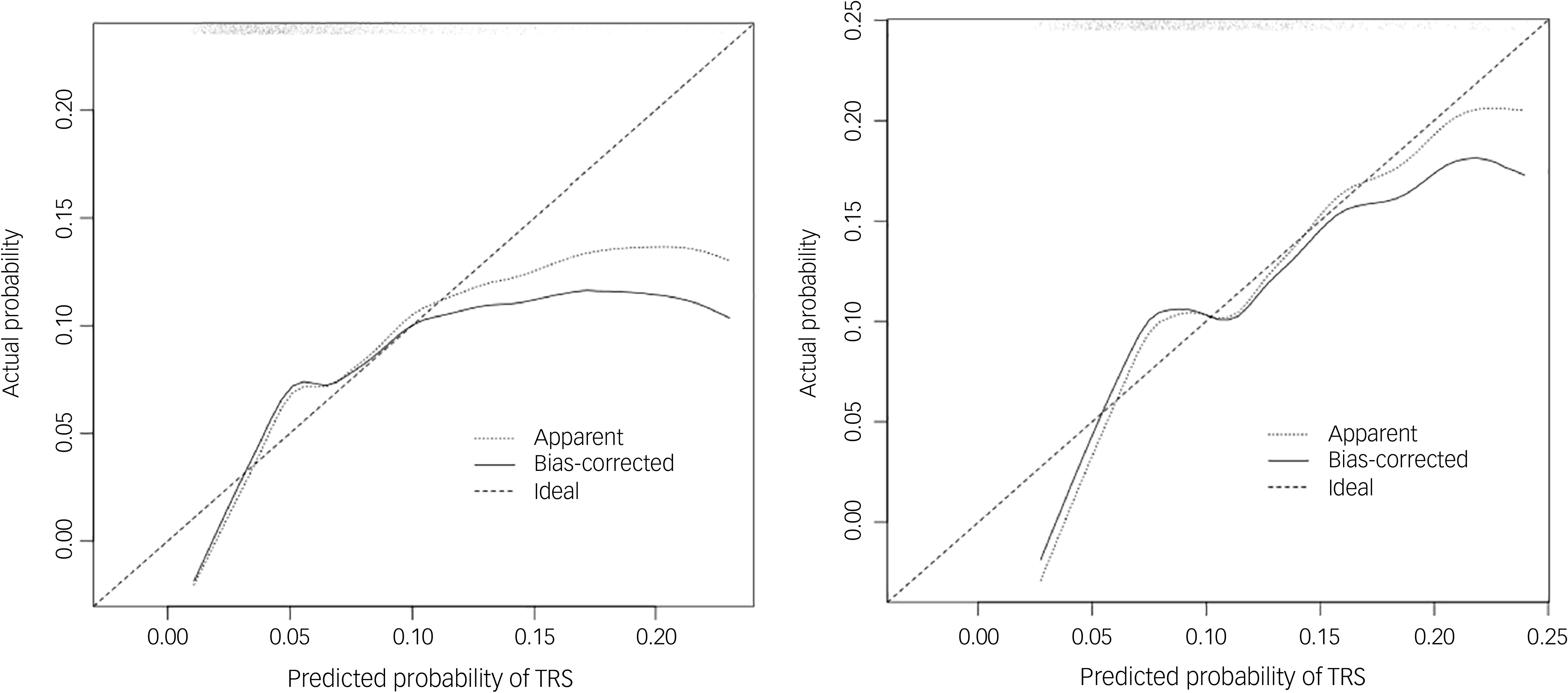
The multivariate logistic regression model included five candidate predictors (age, PANSS positive scores, PANSS negative scores, PANSS general scores and symptom severity). Internal bootstrap validation showed poor discriminative performance, with optimism-corrected Somers’ score Dxy = 0.328 for the whole cohort and 0.212 for the above-threshold subgroup. Calibration curves indicated systematic under- and overestimation of TRS probability, confirming that baseline clinical and demographic variables had limited predictive value. Model calibration is illustrated in Fig. 3.
Calibration curve showing actual against model predicted probability of TRS in the whole sample (left) and the above-threshold subgroup (right). TRS, treatment-resistant schizophrenia.

Discussion
This study represents the first prospective application of the TRRIP consensus criteria to a randomised clinical trial data-set, yielding robust estimates of the incidence of TRS in a community-based cohort.
The CATIE study sample excluded participants with retrospective evidence of TRS; nevertheless, our analyses showed that prospective evaluation revealed new cases emerging over time, at a rate of 5.68 per 100 person-years, increasing to 9.20 per 100 person-years among participants meeting TRRIP absolute symptom thresholds. This finding suggests that heuristic, retrospective judgements cannot adequately rule out treatment resistance.
The existing literature provides widely varying prevalence estimates of TRS across different populations, with inconsistent reporting of incidence and prevalence, making direct comparisons with our results difficult. The crude prevalence of TRS in the CATIE trial was approximately 5%, notably lower than many previous reports. This discrepancy likely reflects the stringency of the TRRIP criteria and the right-censoring of participants who received only one or no adequate treatment trials. In this context, incidence rates are a more meaningful descriptive measure. Our estimates are broadly consistent with previous reports based on retrospective data, despite differences in methodology and populations studied.
In adjusted analyses, we found that older age, higher negative symptom burden and lower general PANSS scores at baseline were associated with an increased likelihood of TRS, although effect sizes were small. Most TRS cases in our study met absolute symptom criteria at trial entry, reinforcing the importance of symptom severity as a potential risk marker. Previous studies in FEP cohorts have reported somewhat different predictors, including duration of untreated psychosis, younger age at service contact, male gender and Black ethnicity. Reference Demjaha, Lappin, Stahl, Patel, MacCabe and Howes7,Reference Lally, Ajnakina, Di Forti, Trotta, Demjaha and Kolliakou8 These differences may reflect variations in diagnostic stage, illness chronicity and study design.
Although certain baseline factors were associated with TRS at the group level, they did not translate into accurate individual-level prediction as their effect sizes were small. Internal validation of our predictive model showed poor discrimination and calibration, indicating that routine clinical and demographic variables are insufficient for forecasting TRS. Overall predictive performance of the model was modest, limiting its usefulness for individual-level prediction. This aligns with the view that TRS is unlikely to be explained by clinical features alone and may require integration of biological, cognitive and environmental data for meaningful prediction.
Several limitations should be noted. First, our operationalisation of TRRIP functional criteria relied on mapping CATIE measures onto PSP domains, which may underestimate impairment. Second, we excluded 110 participants because of incomplete longitudinal data; these individuals were more likely to be of Black heritage, have substance use comorbidity and recent hospital admission, which may have led to underestimation of incidence in these subgroups. This may introduce a degree of selection bias, as individuals with incomplete data or more complex clinical presentations may have been excluded, potentially leading to an underestimation of the true incidence of TRS in this cohort.
Medication adherence estimates within the CATIE trial relied partly on pill count and collateral measures, which may not fully reflect true medication concordance. However, the TRRIP consensus itself recommends plasma level monitoring where feasible and recognises indirect adherence measures, including pill counts, as pragmatic alternatives in large clinical or research settings.
In addition, right-censoring of participants who did not complete two adequate trials means that our reported incidence is likely a conservative estimate. The CATIE data-set reflects data collected between 2001 and 2004. Although the CATIE data-set is archival and treatment pathways and service structures may have evolved since then, it remains one of the few large, publicly available longitudinal schizophrenia data-sets with sufficiently detailed prospective clinical, treatment and adherence data to operationalise the TRRIP consensus criteria at this level of granularity. To our knowledge, there are no newer publicly available data-sets that permit prospective application of TRRIP criteria with equivalent temporal and clinical detail. Therefore, although our findings remain methodologically robust, the incidence estimates may not fully reflect contemporary clinical populations.
Although adherence was operationalised using available CATIE measures (≥75%), this may not fully capture real-world variability in treatment adherence. Suboptimal adherence remains an important confounder in distinguishing true treatment resistance from pseudo-resistance, and future studies should incorporate more precise and longitudinal adherence measures.
Our experience also highlights the practical challenges of applying the TRRIP standards outside highly structured research data-sets. The requirement for detailed prospective symptom ratings, adherence monitoring and sequential treatment documentation may limit implementation in routine clinical settings, and partly explain why TRRIP criteria are not consistently operationalised in everyday psychiatric practice.
Recent developments
Since the publication of TRRIP, progress in applying its criteria prospectively has been limited. A 2024 bibliometric review confirmed the growing research focus on TRS but highlighted continuing deficits in early prediction and trial-based incidence studies. Reference Cai, Du, Zhang, Wang, Li and Yang27 Novel agents such as xanomeline–trospium (Cobenfy), approved in 2024, illustrate renewed interest in non-dopaminergic targets, with significant PANNS score improvement in trials. Reference Citrome, Neugebauer, Meli and Kando28 Evenamide, a glutaminergic modulator, has shown promising add-on efficacy in long-term TRS pilot trials and is currently being evaluated in large phase 3 Enhancing Neuro Imaging Genetics through Meta-Analysis-Treatment Resistant Schizophrenia Working Group trials incorporating TRRIP-based eligibility criteria. Other compounds under development, such as emraclidine and ulotaront, have thus far failed to meet primary end-points in recent trials. Reference Biso, Carli, Scarselli and Longoni29 Collectively, these developments reflect a growing therapeutic pipeline, yet also highlight the urgent need to test new treatments within the structured TRRIP framework.
Explaining the data gap
The scarcity of prospective TRRIP applications is likely attributable to several factors: (a) methodological complexity, as TRRIP requires harmonisation of symptom, functional, treatment and adherence domains; (b) trial design limitations, with most randomised controlled trials not constructed to evaluate treatment resistance systematically; and (c) temporal constraints, as the evolution of TRS often unfolds gradually and requires longer follow-up than many trials permit.
Future directions
To address these gaps, future research should (a) incorporate TRRIP-aligned definitions prospectively into clinical trial protocols; (b) utilise large cohort and registry studies to validate TRRIP algorithms in real-world populations; (c) use survival modelling approaches to provide more granular insights into the temporal dynamic and onset of treatment resistance; (d) integrate biomarkers and digital health measures into predictive models of treatment refractoriness and (e) evaluate the effectiveness of novel agents in TRS cohorts, using prospective TRRIP criteria to enhance comparability across studies.
Currently, all definitions focus on the notion of treatment resistance invoking two unsuccessful treatment trials. There is no biological reason why two treatments should dichotomise people with schizophrenia into illness response or resistance, especially as individuals’ disposition to respond to different medication is poorly understood. Additionally, TRRIP positively defines thresholds for treatment resistance, but some studies define resistance as the negation of remission. Future work should examine a continuum between treatment resistance and response, defining a scale of ‘treatment refractoriness’ rather than a dichotomised state.
Emerging evidence also suggests that TRS may not be a uniform entity and there could be potential neurobiological differences between early onset (primary) and later (secondary) treatment resistance. Reference Lasevoli, Avagliano, DAmbrosio, Barone, Ciccarelli and De Simone30 For example, dopaminergic dysfunction may be less prominent in primary TRS and there might be greater involvement of glutaminergic pathways. Reference Lasevoli, Avagliano, DAmbrosio, Barone, Ciccarelli and De Simone30 Although our data-set does not allow direct exploration of these mechanisms, this distinction may have important implications for treatment stratification and warrants further investigation.
In conclusion, by operationalising TRRIP within the CATIE data-set, we provide the first prospective incidence estimates of TRS in a large, community-based cohort. This approach demonstrates both the feasibility and the value of applying standardised, consensus definitions. The paucity of comparable data highlights the urgent need for purpose-designed trials and longitudinal cohorts that embed TRRIP from the outset. Such efforts will be essential to improve prediction, accelerate access to effective treatments and ultimately reduce the enduring burden of treatment resistance in schizophrenia.
Supplementary material
The supplementary material is available online at https://doi.org/10.1192/bjo.2026.12041
Data availability
The analysis scripts, supplementary methodological details and supporting materials are available via the Open Science Framework (OSF) at https://osf.io/5y27d/files/pnuhg. The CATIE dataset analysed in this study is available from the National Institute of Mental Health Data Archive to qualified researchers upon application and approval.
Author contributions
D.W.J. conceived and designed the study. D.W.J., A.E.C., S.S. and R.B. developed the study methodology. D.W.J. performed the data analysis. D.W.J., A.E.C., S.S. and R.B. interpreted the data. D.W.J. drafted the original manuscript. S.N. revised and edited the manuscript with input from all co-authors. All authors critically reviewed the manuscript, approved the final version for publication and agree to be accountable for all aspects of the work.
Funding
D.W.J. was supported by a National Institute for Health and Care Research (NIHR) Academic Clinical Lecturership. D.W.J. is currently partially supported by the Office for Life Sciences and the NIHR Mental Health Translational Research Collaboration Mission, hosted by the NIHR Oxford Health Biomedical Research Centre. S.N. is supported by an NIHR Academic Clinical Fellowship. S.S. was supported by a Wellcome Trust Mental Health Award.
Declaration of interest
A.E.C. is a member of the BJPsych Open Editorial Board and was not involved in the peer review or editorial decision-making process for this manuscript. Other authors have no conflict of interest.


 Open access


eLetters
No eLetters have been published for this article.