





Introduction
Bahiagrass is a popular low-input forage option for livestock producers in the Coastal Plains Region of the southeastern United States because of its low fertility and input requirements for sustained growth in sandy soils (Beaty et al. Reference Beaty, McCreery and Powell1960). It is a reliable, warm-season perennial forage with above-average persistence in adverse climatic conditions as well as resistance to most diseases and pests (Chambliss and Sollenberger Reference Chambliss and Sollenberger1991; Dias et al. Reference Dias, Sellers, Ferrell, Silveira and Vendramini2018). Bahiagrass is well adapted to the southern half of Georgia, outperforming other warm-season forages where extreme temperatures as well as intermittent flooding or drought can otherwise limit biomass and nutritive value. One disadvantage of bahiagrass production systems is the lack of herbicide options to control highly competitive grass weeds and non-native invasive species that can easily overtake the stand if left unmanaged. Mitigating performance losses to bahiagrass, such as herbage accumulation (HA) and groundcover, will require effectively utilizing novel pest management strategies to deter encroachment of these opportunistic weeds.
Smutgrass is one of the invasive, non-native weeds that has become a major pest in perennial grasslands throughout the US Southeast (Rana et al. Reference Rana, Wilder, Sellers, Ferrell and MacDonald2012). This bunch-type, warm-season perennial grass invades around 1.6 million ha of permanent and temporary pastures across the southeastern United States (Wallau et al. Reference Wallau, Vendramini, Dubeux and Blount2010). The name is derived from the dark-colored fungus [Drechslera ravenelii (M.A. Curtis ex Berk.)] present on the inflorescence that closely resembles smut from a fireplace or chimney (Mislevy et al. Reference Mislevy, Shilling, Martin and Hatch1999). Previous research has identified two varieties of smutgrass populations: small smutgrass [S. indicus (L.) R. Br. var. indicus] and giant smutgrass [S. indicus var. pyramidalis (P. Beauv.) Veldkamp]. Small smutgrass is the dominant variety and has been found in 23 states, whereas giant smutgrass is most predominant in Florida. Regardless of the population, smutgrass grows well in a wide array of environmental conditions, grows rapidly in vegetative and reproductive stages, continuously produces seed, and displays discontinuous germination.
Previous research has been conducted in Florida on controlling smutgrass in bahiagrass pasture systems. Initially, viable control options were focused on isolating responses to single variables such as mowing, fertility management, or intensive rotational grazing (Ferrell and Mullahey Reference Ferrell and Mullahey2006; Kemp and King Reference Kemp, King, Tow and Lazenby2001). McCaleb et al. (Reference McCaleb, Hodges and Kirk1963) first recommended that dalapon be applied at 2.27 kg ai ha–1 in 379 L of water followed by mowing to 7.62 cm every week starting in August and continuing for 13 consecutive weeks. This controlled smutgrass up to 85% without serious injury to the bahiagrass. Later studies discouraged the use of mowing for smutgrass control, as it can broadcast smutgrass seeds and may not be economically feasible with rising fuel costs (Ferrell and Mullahey Reference Ferrell and Mullahey2006; Mislevy et al. Reference Mislevy, Shilling, Martin and Hatch1999; Sellers and Ferrell Reference Sellers and Ferrell2011; Sellers et al. Reference Sellers, Rana, Dias and Devkota2020). Dalapon is no longer recommended and was federally deregistered for use in pastures in the 1980s. Following this decision, DuPont filed for a federal label for hexazinone (Velpar L®; Bayer Crop Science, Whippany, NJ) for smutgrass control in pastures and hayfields (Mislevy et al. Reference Mislevy, Shilling, Martin and Hatch1999).
The efficacy of hexazinone on smutgrass in bahiagrass and bermudagrass [Cynodon dactylon (L.) Pers.] has been researched thoroughly in Florida (Ferrell et al. Reference Ferrell, Mullahey, Dusky and Roka2006; Mislevy et al. Reference Mislevy, Martin and Hall2002; Nolte Reference Nolte2017; Sellers and Ferrell Reference Sellers and Ferrell2011; Sellers et al. Reference Sellers, Rana, Dias and Devkota2020; Wilder et al. Reference Wilder, Ferrell, Sellers and MacDonald2008). Research indicates that the best timing for application is during conditions that are both warm and wet. The mode of action for hexazinone requires rainfall to allow the chemical to infiltrate the soil where it can be absorbed via root uptake. However, precipitation events exceeding 76 mm may lead to lower rates of efficacy as well as possible soil leaching. To achieve >90% control, Sellers and Ferrell (Reference Sellers and Ferrell2011) recommended an application within 7 d before a rainfall event. It is also important that applications be made during the growing season when grasses are actively growing, as hexazinone requires movement into the xylem for translocation as a photosynthesis disruptor (photosystem II inhibitor) so as to achieve maximum herbicidal efficacy. Herbicide options for selective smutgrass control in bahiagrass are currently limited to hexazinone. Additionally, hexazinone presents potential challenges as an herbicide option because of cost to low-input producers as well as initial injury to bahiagrass; these challenges could have an impact on its competitiveness with other opportunistic weeds. In response to these disadvantages, research should explore new technologies such as indaziflam (Rezilon®; Bayer Crop Science, Whippany, NJ). Although a common preemergence herbicide in the turf industry, little is known about the use of indaziflam on smutgrass or other perennial grass weed species in bahiagrass. Previously, pendimethalin (Prowl H2O; BASF Plant Science, Raleigh, NC) was the only recommended preemergence herbicide for use in bahiagrass in Georgia, but Prowl H2O had little impact on smutgrass control (Sellers et al. Reference Sellers, Rana, Dias and Devkota2020). Rezilon® was recently registered by Bayer Crop Science for use in warm-season grass pastures and hayfields. Hurdle et al. (Reference Hurdle, Grey, McCullough, Shilling and Belcher2020) investigated the impact of indaziflam on bermudagrass forage production. The bermudagrass tolerated the indaziflam applications at the recommended rates, and no crop injury was reported. However, the impact of indaziflam on bahiagrass has yet to be determined, and more research will be required.
An IWM plan for removing smutgrass from existing bahiagrass stands must combat rhizomatous growth, as well as the continuous and prolific seed production throughout the growing season (Mislevy et al. Reference Mislevy, Martin and Hall2002). Isolated treatments with singular uses of herbicide or fertilizer may not be adequate for controlling smutgrass in the attempt to improve bahiagrass forage systems. Many nontargeted species could emerge unexpectedly with a broad range of responses outside the scope of targeted treatments (Kemp and King Reference Kemp, King, Tow and Lazenby2001). Thus, the importance of a preemptive plan that expands the range of management in complex forage systems cannot be overemphasized. Few studies have addressed the importance of fertilizing with nitrogen (N) and potassium (K) as part of an IWM plan to improve herbage accumulation and increase bahiagrass vigor by giving it a competitive advantage over weed species (Beaty et al. Reference Beaty, Smith and Powell1974; Silveira et al. Reference Silveira, Vendramini and Sellers2017; Yarborough et al. Reference Yarborough, Vendramini, Silveira, Sollenberger, Leon, Sanchez and Filho2017). Although species differ in their resource needs for space, light, water, and nutrients, changes in these resources can increase the competition between these species (Kemp and King Reference Kemp, King, Tow and Lazenby2001). Therefore, combining herbicides and fertilizer should improve productivity of bahiagrass by eliminating weed competition and increasing plant density of bahiagrass. However, there is much to learn about the interactive effects of an integrated management system. There is currently a paucity of research on how bahiagrass forage systems respond to collective herbicide and fertilizer treatments. The objectives of this experiment were to (1) evaluate the interactive effects of herbicide and fertilizer applications for controlling smutgrass and (2) determine the most efficacious and economical IWM plan for low-input bahiagrass systems in the Coastal Plains region of Georgia.
Materials and Methods
Description of Research Site
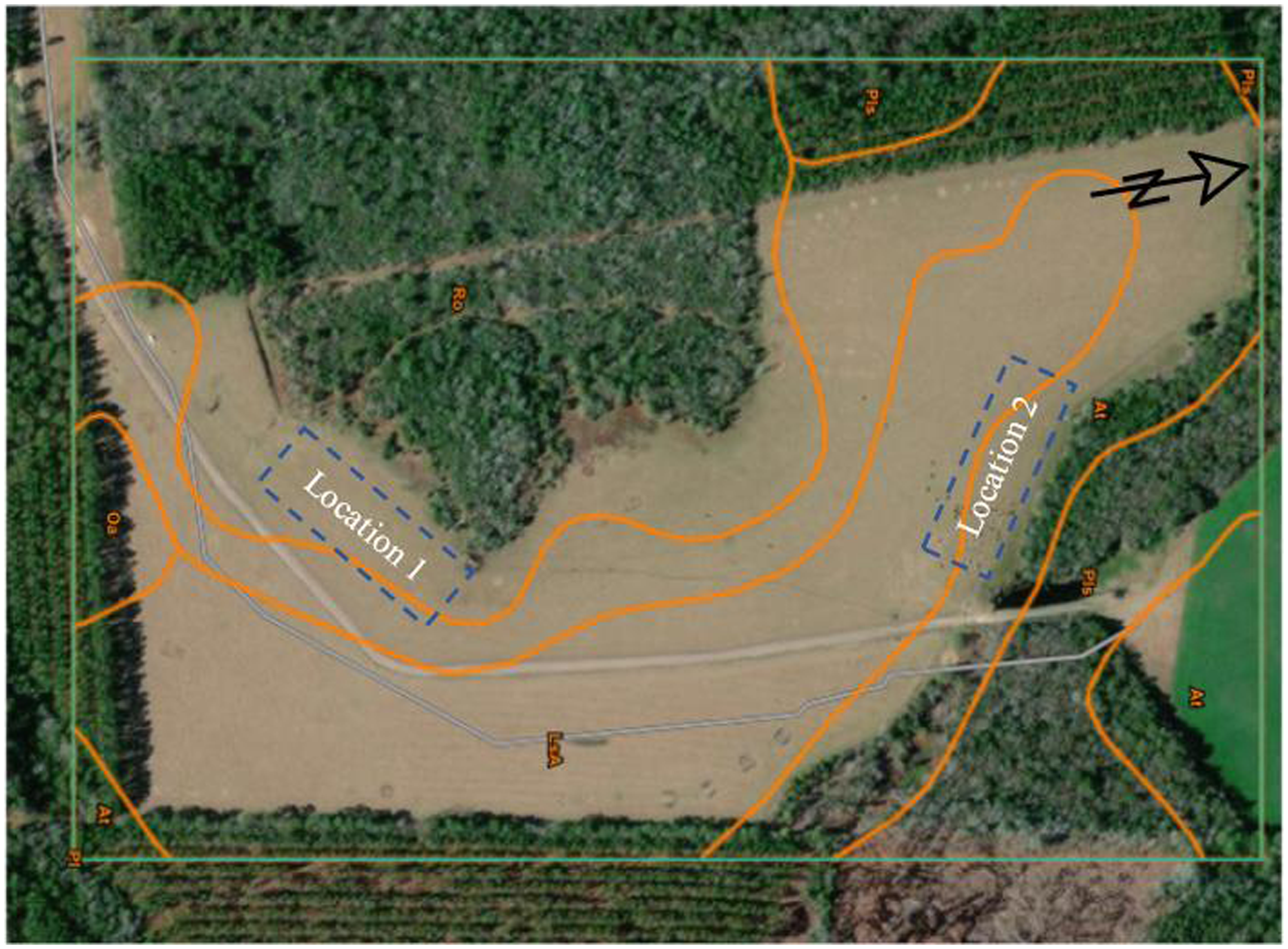
This research was conducted at the University of Georgia Alapaha Beef Station in Alapaha, GA, (31.58° N, 83.58° W; 81 m elev) from April through October in 2020 and 2021. The experimental site (Figure 1) was located in a previously established Tifton-9 and Pensacola bahiagrass pasture with a preexisting population of small smutgrass (percent visual groundcover of smutgrass in location 1 (initiated 2020): average = 42%; range = 20% to 80%; location 2 (initiated 2021): average = 27%; range = 2% to 100%). The experimental areas were fenced off to exclude grazing. The research site is nearly level (<2% slope) and primarily composed of Alapaha loamy sand (loamy, siliceous, subactive, thermic Arenic Plinthic Paleaquults) and Rutledge loamy sand (sandy, siliceous, thermic Typic Humaquepts), with an average soil pH of 5.0 (Web Soil Survey 2022).
Experimental site location 1 and location 2 at the UGA Alapaha Beef Unit near Alapaha, GA (31.58° N, 83.58° W). Research initiated: location 1, 2020; location 2, 2021.
Experimental Design and Treatments
The experiment was arranged in a randomized complete block design with a four-by-three factorial arrangement of treatments and six replications. Treatments included 4 herbicide (factor a) and 3 fertilizer (factor b) combinations, totaling 12 treatment combinations. Treatment combinations were randomly assigned to plots within each replicate. Each 2-m by 5-m plot was surrounded by 1-m alleyways on all sides for distinction.
Herbicide treatment levels consisted of an unsprayed control, preemergence, postemergence, and a combination of both preemergence and postemergence (PRE+POST). Indaziflam was applied preemergence at 0.058 kg ai ha–1 on April 7, 2020 and March 15, 2021. Hexazinone was applied postemergence at 0.98 kg ai ha–1 on August 7, 2020 and August 30, 2021 following harvest 4 (details below in forage sampling section). The combination (PRE+POST) herbicide treatment received both indaziflam and hexazinone applications as previously described. All herbicide treatments were applied using a tractor-mounted, 1.83-m boom sprayer with shield and TeeJet TP8003VS nozzles (TeeJet Technologies Inc., Glendale Heights, IL) calibrated to deliver 205.7 L ha–1.
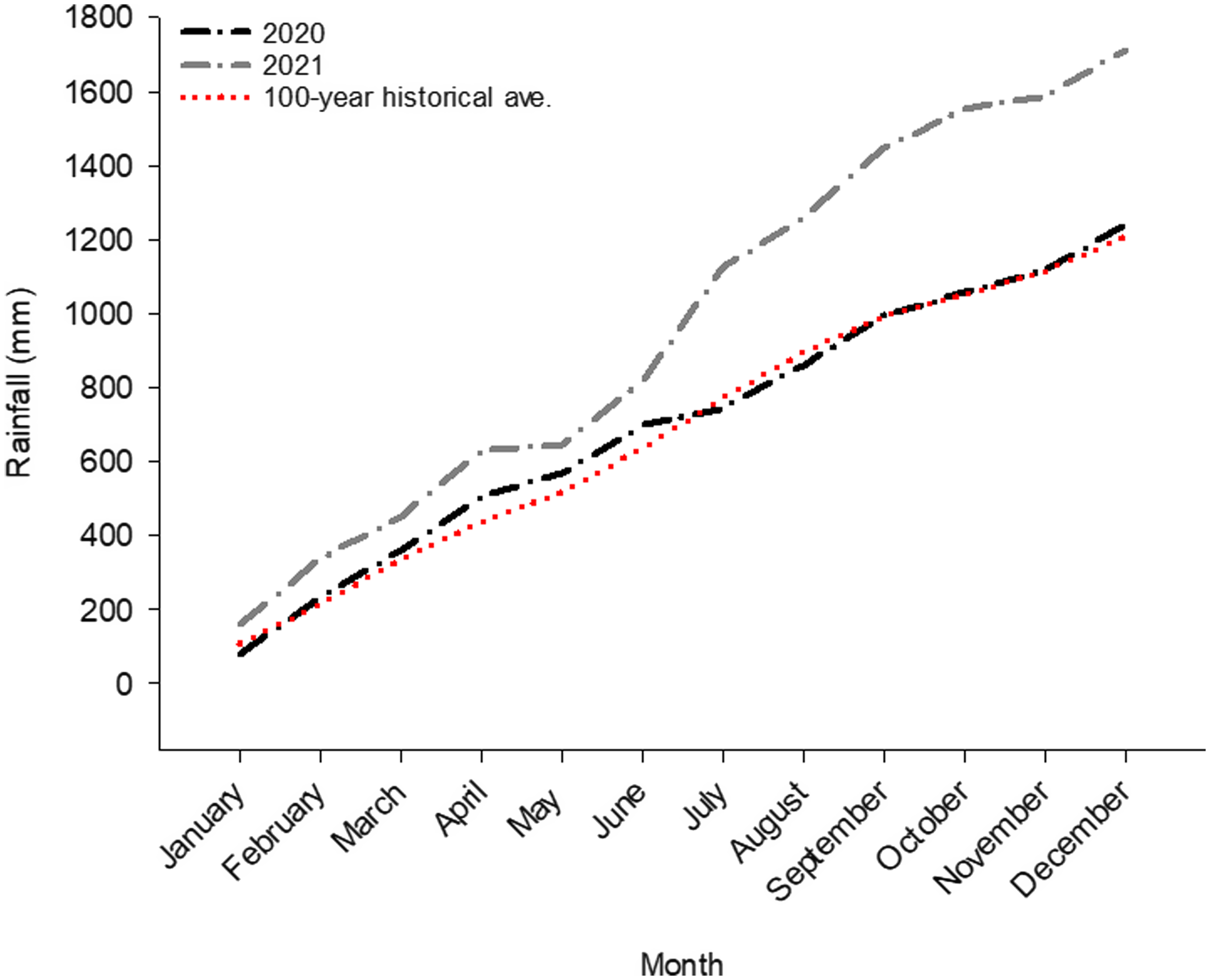
Ideally, the herbicide applications would have been made earlier each season. The preemergence applications were delayed in 2020 because university regulations initially prohibited any research activities following the onset of COVID-19 restrictions. The postemergence application should have been made in June or July; however, in 2020 there was insignificant precipitation forecasted to activate the hexazinone, and in 2021 the plots were flooded and inaccessible in 2021; therefore, the applications were delayed (Figure 2).
Cumulative monthly rainfall from January to December for 2020 and 2021 in Alapaha, GA. The 100-yr historical average and data were collected from Georgia Weather Network (http://www.georgiaweather.net).
Fertilizer treatment levels consisted of an unfertilized control, nitrogen only (N), and nitrogen plus potassium (N+K). Fertilizers were hand-applied following green-up (April 7, 2020; April 23, 2021), and following harvest 3 (July 12, 2020; July 16, 2021). Each fertilizer application included 56.04 kg N ha–1 (applied as ammonium nitrate, 34% N) or 56 kg N ha–1 (applied as ammonium nitrate, 34% N) + 56 kg K2O ha–1 (applied as muriate of potash; N+K). The fertilizer treatments were below the recommendations provided by the University of Georgia Feed and Environmental Water Laboratory in Athens, GA, but are typical of what most bahiagrass fields would receive in South Georgia (Kissel and Sonon Reference Kissel and Sonon2008).
Forage Sampling and Nutritive Value Analyses
Plots were harvested every 4–6 wk from April until winter dormancy (October). Plot borders were mowed to 8 cm prior to each harvest. All plots were visually evaluated for groundcover of bahiagrass, smutgrass, and other plant species before they were harvested to 8 cm with a zero-turn mower with a bagger attachment. The collected material from each plot was weighed using a tarp and tripod before a subsample was collected for dry-matter (DM) determination and nutritive value analysis. Post-harvest, residual forage was removed with the same mower (and to the same height) used for harvest. Subsamples were dried in a forced-air dryer at 55 C for 7 d before grinding to pass through a 1-mm screen in a Thomas Model 4 Wiley Mill (Thomas Scientific, Philadelphia, PA) followed by a Foss CT-293 Cyclotec Cylcone Mill (Foss Analytics, Eden Prairie, MS) with 1-mm screen (McIntosh et al. Reference McIntosh, Anderson-Husmoen, Kern-Lunbery, Goldblatt, Lemus, Griggs, Bauman, Boone, Shewmaker and Teutsch2022). Ground samples were scanned for nutritive value using the 2020 grass hay calibration provided by the NIRS Forage and Feed Testing Consortium (NIRSC 2020). Samples were scanned on a Foss DS2500 near-infrared spectrometer (Metrohm USA Inc., Riverview, FL) that was standardized to the NIRSC master instrument to ensure prediction accuracy. Nutritive value data were reported with predictions fitting the allowable global H < 3.0 statistical comparison with the overall calibration population (Murray and Cowe Reference Murray and Cowe2004). Total digestible nutrients (TDN) were calculated using the grass equation provided in Moore and Undersander (Reference Moore and Undersander2002) as follows using data obtained from NIRS analyses:
 \begin{align}TDN &= \left( {NFC \times .98} \right) + \,(CP{\mkern 1mu} \times {\mkern 1mu} .87) + \left( {FA \times .97 \times 2.25} \right) +\\
&\quad NDFn \times NDFDp/100) - 10\end{align}
\begin{align}TDN &= \left( {NFC \times .98} \right) + \,(CP{\mkern 1mu} \times {\mkern 1mu} .87) + \left( {FA \times .97 \times 2.25} \right) +\\
&\quad NDFn \times NDFDp/100) - 10\end{align}
where NFC is nonfibrous carbohydrate (% of DM) = 100 – (NDFn + CP + EE + ash), CP is crude protein (% of DM), FA is fatty acids (% of DM) = ether extract (EE) – 1, NDFn is nitrogen free NDF = NDF – NDFCP, otherwise estimated as NDFn = NDF × .93, and NDFDp is 22.7 + .664 NDFD, where NDFD is 48-h in vitro NDF digestibility (% of NDF).
Statistical Analyses
Data were analyzed by restricted maximum likelihood using PROC MIXED in SAS 9.4 (Littell et al. Reference Littell, Milliken, Stroup, Wolfinger and Schabenberger2006). A Kenward–Rodgers adjustment was applied to correct the denominator degrees of freedom, ensuring appropriate standard errors and F statistics for each model. Multiple covariance structures were tested, and the Bayesian’s Information Criterion indicated that Autoregressive (1) was the best fit. Differences in HA, nutritive value, and botanical composition were examined within harvest. Fixed effects included treatment, year, and treatment × year. Replicates were the random effect. Means were compared using the LSMEANS procedure with Tukey–Kramer adjustment (P ≤ 0.05). Differences were considered significant at P ≤ 0.05.
Economic Analyses
An economic analysis was made with respect to market costs of the examined treatments and compared to a total bahiagrass renovation. All fertilizer prices were collected from DTN in January 2022. All herbicide prices were collected from Chemical Warehouse herbicide costs in the spring of 2022 (Chemical Warehouse 2022; Quinn Reference Quinn2022). The costs associated with each treatment were calculated by multiplying the quantities of inputs used by the market prices for the region.
Bahiagrass renovations were calculated by modifying the University of Georgia Extension, College and Agricultural and Environmental Sciences–Applied Economics, 2018 hybrid bermudagrass hay–nonirrigated establishment budget to reflect fertilizer rates and seed costs recommended by UGA bahiagrass management bulletin (Hancock et al. Reference Hancock, Lacy, Stewart, Tubbs, Kichler, Green and Hicks2010). This budget included market costs for a glyphosate burndown, 2,4-D for postemergence application, ‘TifQuik’ bahiagrass seed costs (Hancock Seed Company, Dade City, FL), fertilizer at planting and after first mowing, and fuel. In addition, the budget included estimated costs for repairs, maintenance, labor, and interest (Lacy et al. Reference Lacy, Morgan and Russell2016).
Results and Discussion
Weather
Daily air temperatures followed 100-yr historical monthly average temperatures for both 2020 and 2021. Minimum monthly average temperatures for April, July, and October, representing the beginning, mid-point, and the end of the growing season were 12 C, 22 C, and 16 C, respectively. Maximum monthly average temperatures for April, July, and October were 25 C, 34 C, and 28 C respectively (Georgia Weather Network 2021). Rainfall varied year to year, with precipitation following historical average rainfall of 715 mm beginning in April through October for 2020 and above average for 2021 with 1,103 mm (Figure 2) (Georgia Weather Network 2021).
Groundcover Percentage
Year × treatment did not interact to affect smutgrass, bahiagrass, other, or dead groundcover, except at harvest 4 where the interaction was a difference of magnitude (P < 0.01). Again, the data were pooled over both years and analyzed within harvest. Initial observations were recorded at harvest 0 before preemergence herbicide application where no differences were reported (P = 0.59; Table 1; March). Similarly, no differences were reported for harvest 1 (P = 0.82; Table 1; April) following preemergence and fertilizer application. Indaziflam has been well established as a preemergence herbicide in turf, where it reduces seedling emergence, and thus it is not surprising that it did not affect preexisting smutgrass groundcover. No differences in smutgrass cover were found at harvest 2 (June) (P = 0.84) and harvest 3 (July) (P = 0.12). Despite the fertilizer application following harvest 3, harvest 4 (August) also resulted in no differences among treatments (P = 0.28). The postemergence herbicide was applied following harvest 4, and the effects were again seen in subsequent harvests (September and October). Smutgrass groundcover numerically declined for all plots that received postemergence herbicide compared to the unsprayed plots and most plots receiving only preemergence (P < 0.01). Unfortunately, the large variation in the plots at the final harvest event resulted in a large standard error of the mean, and this decline was not always significant among certain pairwise comparisons.
Effect of treatment on smutgrass groundcover percentage of bahiagrass-dominant pasture (includes smutgrass, bahiagrass, other weeds) grown at the Alapaha Beef Unit near Alapaha, GA, during 2020 and 2021.
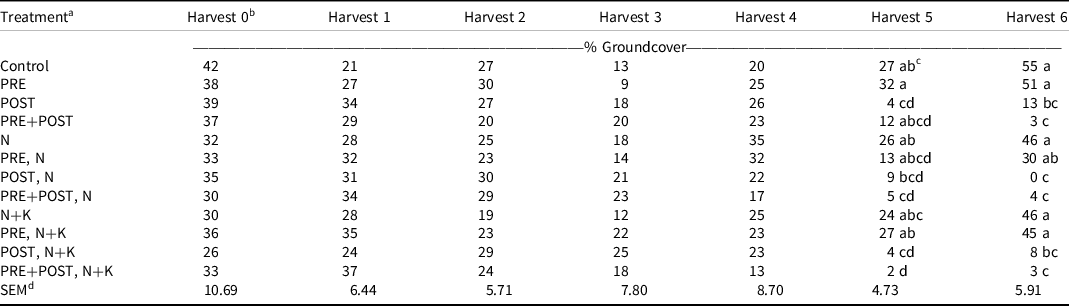
a PRE (preemergence; indaziflam, 0.28 kg ai ha–1). POST (postemergence; hexazinone, 4.82 kg ai ha–1). N (nitrogen, 56.04 kg N ha–1, applied as ammonium nitrate, 34% N). N+K, nitrogen, 56.04 kg N ha–1 (applied as ammonium nitrate, 34% N) + 56.04 kg K2O ha–1 (applied as muriate of potash).
b Harvest periods refer to 2020 and 2021 dates, respectively, as follows: (0, refers to initial observation) April 7 and March 15, (1) May 11 and 21, (2) June 8 and 18, (3) July 12 and 16, (4) August 7 and 27, (5) September 27 and October 1, (6) October 26. Data are pooled across replications and years.
c Least square means within each harvest not sharing a common letter differ according to Tukey-Kramer test (P ≤ 0.05).
d SEM, standard error of the mean.
Similar trends were observed with respect to bahiagrass groundcover (Table 2). Treatment responses did not indicate any differences from the nontreated control for bahiagrass groundcover in harvest 0 through harvest 4 (April–August; Table 2; P > 0.05). Following postemergence application of hexazinone at harvest 4 (August) bahiagrass groundcover generally increased in the respective treatments for the following harvests (September and October; P < 0.01). Other weeds’ groundcover followed similar trends to bahiagrass cover from the initial observation at harvest 0 through harvest 4 (April–August; P > 0.05). Following the application of hexazinone, the PRE+POST+N, POST+N+K, and PRE+POST+N+K treatments reduced other weeds’ groundcover when compared to the nontreated control at harvest 5 (P < 0.01). Data could not be analyzed at harvest 6, because other weeds were not found in any of the plots.
Effect of treatment on bahiagrass groundcover of bahiagrass-dominant pasture (includes smutgrass, bahiagrass, other weeds) grown at the Alapaha Beef Unit near Alapaha, GA, during 2020 and 2021.
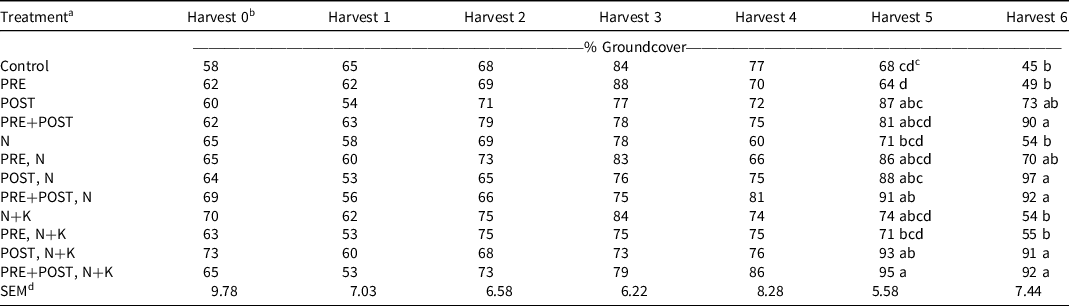
a PRE (preemergence; indaziflam, 0.28 kg ai ha–1). POST (postemergence; hexazinone, 4.82 kg ai ha–1). N (nitrogen, 56.04 kg N ha–1, applied as ammonium nitrate, 34% N). N+K, nitrogen, 56.04 kg N ha–1 (applied as ammonium nitrate, 34% N) + 56.04 kg K2O ha–1 (applied as muriate of potash).
b Harvest periods refer to 2020 and 2021 dates, respectively, as follows: (0, refers to initial observation) April 7 and March 15, (1) May 11 and 21, (2) June 8 and 18, (3) July 12 and 16, (4) August 7 and 27, (5) September 27 and October 1, (6) October 26. Data are pooled across replications and years.
c Least square means within each harvest not sharing a common letter differ according to Tukey-Kramer test (P ≤ 0.05).
d SEM, standard error of the mean.
Data for dead plant material could not be analyzed for harvests 0 through harvest 4 (April–August), because none were found in any of the plots before postemergence application of hexazinone. However, following hexazinone treatment applications, dead plants were observed for all treatments that included some level of postemergence. Witnessing necrosis and terminated plants following postemergence application was expected (Coffman et al. Reference Coffman, Frank and Potts1993). Observations of dead plant material did not negatively affect bahiagrass and were limited to targeted weeds. It should be noted that even though the P value indicated treatment differences at harvest 5 (September) and 6 (October), the results from the Tukey-Kramer tests did not find differences in the pairwise comparisons.
When botanical composition is coupled with the results from herbage accumulation (HA), it is evident that an IWM plan including preemergence, postemergence, and fertilizer produces a more favorable result than the current practice (postemergence alone). An IWM plan would help to reduce the introduction of other weedy species and provide essential nutrients for sustaining bahiagrass long-term that could not be accounted for with a singular application of hexazinone. The results of this research support previous literature on the efficacy of hexazinone as a management tool for controlling smutgrass (Hancock et al. Reference Hancock, Lacy, Stewart, Tubbs, Kichler, Green and Hicks2010; Mislevy et al. Reference Mislevy, Shilling, Martin and Hatch1999; Sellers et al. Reference Sellers, Rana, Dias and Devkota2020). However, their research had a singular focus on postemergence alone or postemergence and fertilizer interactions. One of the many challenges that result from removing smutgrass from bahiagrass forage systems is the disturbance to the preexisting canopy. Reduced groundcover leads to increased light penetration and accessibility to space and nutrients for many opportunistic annual and perennial weedy species. This is a well-known ecological principle among species dynamics and plant–plant interactions (Kemp and King Reference Kemp, King, Tow and Lazenby2001). Integrating indaziflam can benefit bahiagrass by limiting weed competition while it grows to fill the voids left by the mature smutgrass plants. Results indicated that a preemergence application of indaziflam before harvest 1 (May) did not negatively affect bahiagrass cover, supporting similar research conducted by Hurdle et al. (Reference Hurdle, Grey, McCullough, Shilling and Belcher2020) in bermudagrass. This is not surprising, as morphological characteristics between bermudagrass and bahiagrass are similar. Continued research is needed to determine the impact of indaziflam on future smutgrass populations in upcoming seasons.
The benefits of fertilizer to bahiagrass have been well established. However, the lack of postemergence activity may permit smutgrass to outcompete bahiagrass, even when fertilizer is applied without subsequent herbicide. Consequently, a singular focus on fertilizer to increase the competitive advantage of bahiagrass over smutgrass and other weeds may not be the best approach. Vengris et al. (Reference Vengris, Drake, Colby and Bart1953) suggested that weed species can better utilize plant nutrients and are more aggressive than most desired crop species, regardless of the stage of growth, soil fertility relationship, and seasonal weather conditions. Much of the region is prone to acidic soils (pH = 4.5–5.5), and climatic challenges coupled with a high water table disallows forage producers from maintaining a neutral pH. It has been well established that bahiagrass grows best at a pH of 5.5. Rana et al. (Reference Rana, Sellers, Ferrell, MacDonald, Silveira and Vendramini2013) concluded that a pH range that is either too high (6.5) or too low (4.5) provided a distinct competitive advantage for giant smutgrass over bahiagrass. Furthermore, Beaty et al. (Reference Beaty, McCreery and Powell1960) highlighted that the peak performance of bahiagrass is during the hottest months of the year in June and July. Holding to the advantageous characteristics of many other weedy species, smutgrass productivity is not limited by these seasonal patterns and benefits greatly as a result of declining bahiagrass later in the season. Even though bahiagrass is known as a somewhat aggressive warm-season perennial species, forage systems are dynamic, with extreme environmental exposures and antagonistic pests competing for the same resources. As a result, continual shifts in species abundance and distribution is commonplace, making it challenging to manage.
Herbage Accumulation
Year × treatment did not interact to affect HA, so data were pooled over both years (P = 0.75). Data were analyzed within harvest to better isolate the treatment responses (P < 0.01). No differences in HA were reported in harvest 1 (P = 0.15; Table 3; May). Early-season fertilizer generally resulted in an increase in HA of the fertilized treatments at the second harvest (June); however, the increase was not always significantly different from unfertilized treatments. Again, no differences in HA were found at harvest 3 (July) despite the previous fertilizer treatment (P < 0.01). It should be noted that even though the P value indicated treatment differences at harvest 3, the results from the Tukey-Kramer tests did not find differences in the pairwise comparisons. The second fertilizer application was made following harvest 3, so it was not surprising that the treatments receiving N had greater HA at harvest 4 (August) than the unfertilized treatments (P < 0.01). The postemergence herbicide was applied following harvest 4, and the effects are seen in subsequent harvests. In general, HA declined at harvests 5 and 6 (September–October) in treatments including postemergence herbicide (P < 0.01). However, these differences were not always different from the treatments not receiving the postemergence herbicide treatment. This is likely a consequence of biomass differences between bahiagrass, smutgrass, and other weeds. Overall, HA illustrated seasonal trends following low yields at the beginning of the growing season, peaking during the mid-point when daily temperatures were most extreme, and gradually declining into the fall, representing a typical growth pattern for warm-season perennial forages (Beaty et al. Reference Beaty, McCreery and Powell1960). Overall, HA was not a sufficient metric to determine treatment effectiveness in the study.
Effect of treatment on forage accumulation (given as dry matter, DM) of bahiagrass-dominant pasture (includes smutgrass, bahiagrass, other weeds) grown at the Alapaha Beef Unit near Alapaha, GA, during 2020 and 2021.
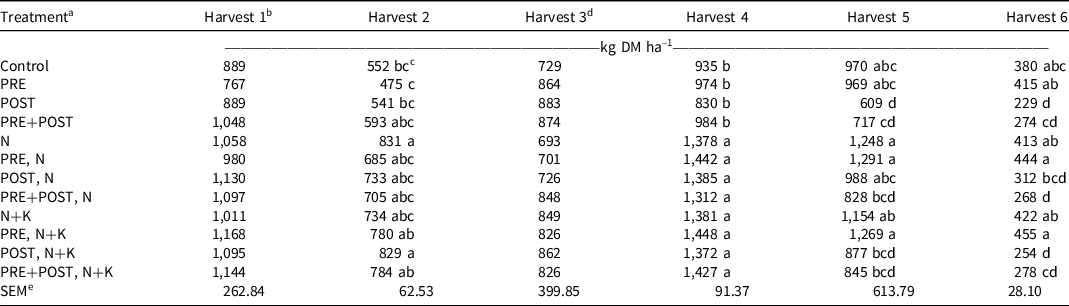
a PRE (preemergence; indaziflam, 0.28 kg ai ha–1). POST (postemergence; hexazinone, 4.82 kg ai ha–1). N (nitrogen, 56.04 kg N ha–1, applied as ammonium nitrate, 34% N). N+K, nitrogen, 56.04 kg N ha–1 (applied as ammonium nitrate, 34% N) + 56.04 kg K2O ha–1 (applied as muriate of potash).
b Harvest periods refer to 2020 and 2021 dates, respectively, as follows: (0) April 7 and March 15, (1) May 11 and 21, (2) June 8 and 18, (3) July 12 and 16, (4) August 7 and 27, (5) September 27 and October 1, (6) October 26. Data are pooled across replications and years.
c Least square means within each harvest not sharing a common letter differ according to Tukey-Kramer test (P ≤ 0.05).
d Note: P-value indicated treatment differences at harvest 3, although results from the Tukey-Kramer tests did not find differences in the pairwise comparisons.
e SEM, standard error of the mean.
Forage Nutritive Values
No interactions between year × treatment for CP and TDN were observed; therefore, data were pooled over years (P = 0.75). Data for CP and TDN were also analyzed within harvest. In harvest 1, CP increased from 7.6 to 9.2 mg g–1 with the addition of N compared to the nontreated control, supporting experimental evidence by Silveira et al. (Reference Silveira, Vendramini and Sellers2017). No differences in CP concentrations were observed with K and herbicide treatments. Furthermore, the relatively low pH found in bahiagrass forage systems in this region (4.5–5.5) is similar to those found in Florida (5.5), where Yarborough et al. (Reference Yarborough, Vendramini, Silveira, Sollenberger, Leon, Sanchez and Filho2017) expressed the impact of this lower pH range to the potential leaching of K. Regardless of treatment combinations, there were no practical differences in TDN throughout the experimental period.
Economics
Costs among the treatments ranged from US$145.00 to 610.00 ha–1, whereas the estimated cost for complete bahiagrass renovation was US$1,079.00 ha–1 (based on Lacy et al. Reference Lacy, Morgan and Russell2016; Table 4). The most common practice for producers in the southeastern United States is to utilize postemergence alone, keeping costs low at US$145.00 ha–1. However, work done by Sollenberger (Reference Sollenberger2019) highlighted the negative impact of neglecting proper fertilization that leads to declining bahiagrass forage systems in Florida. Therefore, the addition of N is highly recommended, with an associated cost of US$415.00 ha–1 for POST+N. Yarborough et al. (Reference Yarborough, Vendramini, Silveira, Sollenberger, Leon, Sanchez and Filho2017) highlighted the benefit of adding K in addition to N for increasing root mass and the importance of this management practice for promoting persistence in extensive grazing systems. Costs for a regime that includes POST+N+K are US$515.00 ha–1.
Market costs for selected integrated management strategies for controlling smutgrass in bahiagrass forage systems compared to a complete bahiagrass renovation following University of Georgia recommendations.

a Fertilizer prices were collected from DTN in January 2022.
b PRE (preemergence; indaziflam, 0.28 kg ai ha–1). POST (postemergence; hexazinone, 4.82 kg ai ha–1). N (nitrogen, 56.04 kg N ha–1, applied as ammonium nitrate, 34% N). N+K, nitrogen, 56.04 kg N ha–1 (applied as ammonium nitrate, 34% N) + 56.04 kg K2O ha–1 (applied as muriate of potash).
c Bahiagrass renovations were calculated by modifying the University of Georgia Extension, College and Agricultural and Environmental Sciences–Applied Economics, 2018 hybrid bermuda hay–nonirrigated establishment budget. Market costs for integrated management strategies were selected based on smutgrass management in bahiagrass forage systems, with the addition of indaziflam for current research.
The greatest return on investment for controlling smutgrass and other invasive weeds should include a preemergence treatment for controlling annual weed emergence, following a postemergence application for controlling preexisting weeds. Incorporating a full-spectrum fertilizer plan that includes at a minimum N+K for boosting bahiagrass growth over competitive weeds increases its overall longevity. The IWM plan (POST+PRE+N+K) costs were US$610.00 ha–1. Many producers will find this costly; however, when compared to the costs of complete bahiagrass renovation at US$1,079.00 ha–1, there are significant savings that can be utilized elsewhere in the operation––not to mention the loss of production time for reestablishment. Because of the significant expense, Sellers et al. (Reference Sellers, Rana, Dias and Devkota2020) recommend only treating fields infested with more than 50% smutgrass. Regardless, rising costs and a potentially limiting supply of both fertilizer and herbicides could negatively affect management decisions. Fortunately, several treatment options (e.g., POST+N; US$415.00 ha–1) (Table 4) are available for reducing smutgrass and limiting weed emergence, giving producers additional options when difficult circumstances arise.
Future Work
Producers should implement an integrated management plan that utilizes a timely application of indaziflam to reduce the introduction and emergence of weed species and hexazinone when preexisting smutgrass infestations are at least 50%. This should be combined with fertilizer applications for enriching bahiagrass productivity that increases both HA and groundcover, providing a competitive advantage in disturbed canopies. This research concluded that treatments that included preemergent (indaziflam) and postemergent (hexazinone) herbicides in addition to N and K2O resulted in an improved bahiagrass stand, as timely weed suppression removed competition, whereas fertilizer provided essential nutrients for optimum growth to fill in the gaps. Combining herbicide and fertilizer is a more economical option for producers when compared to a complete bahiagrass renovation (US$610.00 ha–1 vs US$1079.00 ha–1). Smutgrass was reduced to <15% ground coverage when a postemergent herbicide was applied. The addition of a preemergent herbicide and/or fertilizer further reduced the coverage of smutgrass (P < 0.01). It is important to note that bahiagrass ground coverage increased, whereas other and dead material did not differ by treatment.
Future work will continue to look at preventing further smutgrass infestations utilizing this novel strategy. Research is ongoing to improve the effectiveness of herbicide and fertilizer treatments and screen new herbicide technologies for preventing the introduction of other noxious weeds. Although the need for more research is understood, the scope of this research by expanding novel management strategies will deliver agronomic and economic stability to producers for improving bahiagrass forage utilization and preventing the introduction of other weeds in the southeastern United States.
Acknowledgments
Funding for this research was provided by Georgia Beef Cattle Commodity Commission.
No conflict of interest has been declared.


 Open access

