







1. Introduction
A turbulent plume is a flow generated by a continuous input of buoyancy from a localised source, of which there are a myriad of real-world examples (Woods Reference Woods2010), varying from scales of tens of kilometres, e.g. volcanic plumes, down to a few millimetres, e.g. a plume generated by a heated wire. The buoyancy anomaly may be generated by a surface that is warm or cool relative to the surrounding fluid, for example a wall heated by the sun, or there may be a direct injection of buoyant fluid, for example a chimney releasing hot smoke. If the injected fluid is negatively buoyant, i.e. the buoyancy flux has opposite sign to the momentum flux, then the initial flow moving away from the source is referred to as a starting fountain (Turner Reference Turner1966). In order to mathematically model these complex turbulent flows it is the (suitably long) time-averaged behaviour that is considered. Plumes and starting fountains from point or finite-area round sources are observed to be nominally axisymmetric (Woods Reference Woods2010; Hunt & Burridge Reference Hunt and Burridge2015), whilst those from long slender horizontal line-like sources and adjacent to vertical walls are quasi-two-dimensional (Lee & Emmons Reference Lee and Emmons1961; Kotsovinos Reference Kotsovinos1975).
The pre-eminent works of Zeldovich (Reference Zeldovich1937) and Morton, Taylor & Turner (Reference Morton, Taylor and Turner1956), hereafter Zv and MTT, established the so-called ‘conservation equations’ for quasi-steady, axisymmetric turbulent plumes rising from a localised circular source into a quiescent, miscible environment. These coupled equations, which govern the time-averaged behaviour of the bulk quantities in the plume with vertical distance  $z$ from the source, are based on a number of simplifying assumptions. Readily justifiable in many situations of practical interest, the key assumptions made are that plumes are long and thin flows, the cross-stream profiles of the mean vertical velocity and mean buoyancy are self-similar, and that molecular diffusion may be neglected. On making the Boussinesq approximation (Boussinesq Reference Boussinesq1903), Zv and MTT reduce the Navier–Stokes equations in cylindrical polar coordinates to the following ordinary differential equations, expressed here for ‘top-hat’ profiles of velocity and reduced gravity:
 \begin{equation} \frac{\mathrm{d}}{\mathrm{d}z}(b^2w)=2\alpha bw, \quad \frac{\mathrm{d}}{\mathrm{d}z}(b^2w^2)=b^2g' \quad \mbox{and} \quad \frac{\mathrm{d}}{\mathrm{d}z}(b^2wg')=F(z). \end{equation}
In (1.1),  $b$ is the plume radius, $w$ the vertical velocity, $g'$ the buoyancy or reduced gravity, $\alpha$ the constant entrainment coefficient and $F(z)$ the off-source buoyancy supply or loss. For a stably stratified environment in the absence of off-source buoyancy supply or loss, ${F=-N^2Q}$, where $N^2=-(g/\rho _0) {\mathrm {d}\rho _e/}{\mathrm {d}z}$ is the square of the buoyancy frequency (MTT), g the acceleration due to gravity, $\rho _e(z)$ the density of the environment and $\rho _0$ a reference density. Whilst the solution approach we develop herein is equally valid for Gaussian profiles, for convenience top-hat profiles are adopted throughout. In numerous subsequent works on turbulent axisymmetric plumes, and herein, these equations are routinely expressed in terms of the scaled local fluxes of volume, ${Q=b^2w}$, specific momentum, ${M=b^2w^2}$, and buoyancy, ${B=b^2wg'}$, the actual fluxes being ${\rm \pi} Q$, ${\rm \pi} M$ and ${\rm \pi} B$, respectively.
Focusing on plumes which exhibit dynamical invariance, (1.1) admit power-law solutions (Batchelor Reference Batchelor1954); for a pure plume in unstratified surroundings ( $F\equiv 0$) that emanates from a point source at the origin, for which the source conditions are ${B=B_0 (>0)}$, $Q=Q_0=0$ and $M=M_0=0$ at $z=0$,
 \begin{equation} b\sim z, \quad w\sim B^{1/3} z^{{-}1/3} \quad \mbox{and} \quad g'\sim B^{2/3}z^{{-}5/3}. \end{equation}
Accordingly, the local Richardson number,  $\varGamma (z)\sim Q^2B/M^{5/2}\sim bg'/w^2$ (Morton & Middleton Reference Morton and Middleton1973), is invariant and normally scaled so that for this ‘pure’ plume case ${\varGamma (z)=1}$. Plumes with ${\varGamma =\varGamma _0<1}$ at the source are referred to as ‘forced’ (Morton Reference Morton1959) and those with $\varGamma _0>1$ as ‘lazy’ (Hunt & Kaye Reference Hunt and Kaye2005). If the source buoyancy flux is negative, i.e. $B_0=g'_0\,Q_0<0$ because the source buoyancy $g'_0<0$, $\varGamma _0<0$ and the flow develops as a starting fountain (for a review, see Hunt & Burridge Reference Hunt and Burridge2015).
Central to the original model of Zv and MTT, and the multiplicity of extensions that have followed, is the original entrainment hypothesis proposed by Taylor (Reference Taylor1945) which enabled the governing equations to be closed. Whilst garnering significant debate (e.g. Turner Reference Turner1986; Richardson & Hunt Reference Richardson and Hunt2022), the constant entrainment coefficient  $\alpha$ associated with this closure is nominally $0.1$, meaning that velocities induced in the otherwise quiescent ambient are an order of magnitude smaller than in the plume locally.
Arguably the beauty of the early plume solutions, e.g. (1.1a–c), lies in their simplicity and ease of use. These solutions opened a window to a wider understanding of behaviour, including to plumes from area and non-pure-plume sources (viz. forced plume Morton (Reference Morton1959) and lazy plume Hunt & Kaye (Reference Hunt and Kaye2005) solutions), to virtual origins (Morton Reference Morton1959; Hunt & Kaye Reference Hunt and Kaye2001; Candelier & Vauquelin Reference Candelier and Vauquelin2012; Ciriello & Hunt Reference Ciriello and Hunt2020), dynamical streamwise variability (Ezzamel, Salizzoni & Hunt Reference Ezzamel, Salizzoni and Hunt2015), to stratified surroundings (Caulfield & Woods Reference Caulfield and Woods1998), background turbulence (Hubner Reference Hubner2005) and variable entrainment (Pham, Plourde & Kim Reference Pham, Plourde and Kim2005; van Reeuwijk & Craske Reference van Reeuwijk and Craske2015; Carlotti & Hunt Reference Carlotti and Hunt2017). Moreover, the works of Zv and MTT have been the catalyst for theoretical extensions to non-Boussinesq plumes (Rooney & Linden Reference Rooney and Linden1996; Woods Reference Woods1997; Carlotti & Hunt Reference Carlotti and Hunt2005), including the development of analytical solutions that span Boussinesq and non-Boussinesq sources (van den Bremer & Hunt Reference van den Bremer and Hunt2010) and to different source geometries, including line sources (Lee & Emmons Reference Lee and Emmons1961) and planar area sources (van den Bremer & Hunt Reference van den Bremer and Hunt2014), and to time-dependent plumes (Scase et al. Reference Scase, Caulfield, Dalziel and Hunt2006; Scase & Hewitt Reference Scase and Hewitt2012), amongst others.
Whilst complementary modelling approaches that offer additional insights have been developed (e.g. Carazzo, Kaminski & Tait Reference Carazzo, Kaminski and Tait2006; van Reeuwijk & Craske Reference van Reeuwijk and Craske2015), it is the original integral formulation and solution approach of MTT that has formed the underpinnings of our primary understanding of plumes in nature and industry. These include glacial plumes (Ezhova, Cenedese & Brandt Reference Ezhova, Cenedese and Brandt2017) and reacting plumes (Conroy, Llewellyn Smith & Caulfield Reference Conroy, Llewellyn Smith and Caulfield2005; Cardoso & McHugh Reference Cardoso and McHugh2010). Reversing the sign of the buoyancy flux relative to momentum flux so that  $BQ<0$, the MTT formulations have additionally inspired works on the initial flow in turbulent fountains (Turner Reference Turner1966; Kaye & Hunt Reference Kaye and Hunt2006; Milton-McGurk et al. Reference Milton-McGurk, Williamson, Armfield and Kirkpatrick2022).
In some of the different physical situations given above, there may be buoyancy supplied to the plume away from the source, represented in (1.1) by  $F(z)\neq 0$. This ‘off-source’ buoyancy could be provided by a chemical reaction (Cardoso & McHugh Reference Cardoso and McHugh2010), by the condensation of water vapour in a cumulus cloud (Bhat & Narasimha Reference Bhat and Narasimha1996), or by a heated or cooled surface for a wall (Caudwell, Flór & Negretti Reference Caudwell, Flór and Negretti2016). The natural way to attempt to solve the associated systems of plume equations, systems analogous to (1.1), is to specify the buoyancy distribution $F(z)$, which is typically known for the physical problem under consideration, integrate the resulting equation for the vertical variation of buoyancy flux (cf. (1.1c)), and then to seek solutions for the differential equations for volume and momentum flux, simultaneously. However, it is not obvious a priori which buoyancy distributions, $F(z)$, permit analytical solutions. This provided the motivation for the work herein, in which we propose an alternative route to solving the conservation equations, developing general solutions (of which power-law solutions are a subset) for axisymmetric plumes, starting fountains, line and wall plumes (hereinafter ‘the flows’).
In what follows we take advantage of the structure of the systems of governing differential equations that describe the time-averaged flows. Instead of specifying a function for the buoyancy distribution  $F$, we specify a function for the volume flux, $Q=f(z)$. This allows the momentum flux $M$ to be expressed in terms of $f$, which in turn allows $B$ and $F$ to be expressed in a similar fashion, together with the quantities $b$,
$b$,  $w$,
$w$,  $g'$ and Richardson number $\varGamma$. Our analysis shows that any thrice-differentiable and thus any analytical function $f$ provides a set of solutions to the relevant plume conservation equations.
An immediate benefit of this alternative approach is that it permits the design or synthesis of plumes/fountains with particular properties. Rather than specifying a particular buoyancy distribution  $F$ and attempting to solve for the fluxes $(Q,B,M)$ and associated quantities $(b, w, g', \varGamma )$, a desired volume flux function (or, indeed, vertical variation in width) can be chosen to meet the requirements of a particular application and the buoyancy distribution calculated that would give rise to this desired behaviour.
The remainder of this paper is structured as follows. In § 2 we give the non-dimensional governing equations. In § 3 we develop our approach. In § 4 we apply this approach to develop general solutions to the governing equations for axisymmetric plumes and starting fountains (§ 4.1), and line and wall plumes (§ 4.2). After discussing some of the implications of our approach for power-law solutions, in § 5 we demonstrate the wider merits of our approach by calculating the distribution of off-source buoyancy that would give rise to a designer plume and fountain with specific properties. After outlining some of the practical challenges of plume synthesis, we conclude in § 6.
2. Governing equations
In what follows, the dimensionless forms of the conservation equations for an axisymmetric plume and starting fountain (§ 2.1), then those for a line plume and wall plume (§ 2.2) are stated. Flows have been grouped in pairs this way given the similarities between the forms that their governing equations take. Within each pairing there are differences between the multiplicative coefficients, or prefactors, e.g. a factor of two between the vertical variations of volume flux for line and wall plumes given the entrainment is single-sided for the latter, and as there are numerous ways in which the governing equations could be scaled on non-dimensionalising. To allow for all possible scalings by characteristic constant quantities, the dimensionless coefficients  $\mathfrak {q}>0$, $\mathfrak {m}>0$ and $\mathfrak {b}>0$ are introduced into the governing differential equation for non-dimensional volume, specific momentum and buoyancy flux, respectively. To quantify $\mathfrak {q}$, $\mathfrak {m}$ and $\mathfrak {b}$ for the particular scaling adopted, it is simply a matter of equating coefficients. In what follows, $z$ now denotes the dimensionless vertical coordinate, and $b$,
$b$,  $w$ and $g'$ the dimensionless plume radius (axisymmetric/starting fountain cases) or plume width (line and wall plume cases), vertical velocity and reduced gravity, respectively.
2.1. The axisymmetric plume and starting fountain
With the subscript  $({\cdot })_{r\theta }$ indicating the multiplicative coefficients for the axisymmetric cases, the dimensionless governing equations for an axisymmetric plume ( $M_0B_0>0$) or starting fountain ( $M_0B_0<0$) may be expressed as
 \begin{equation} \frac{\mathrm{d}Q}{\mathrm{d}z}=\mathfrak{q}_{r\theta} M^{1/2}, \quad \frac{\mathrm{d}M}{\mathrm{d}z}=\mathfrak{m}_{r\theta}\frac{BQ}{M} \quad \mathrm{and} \quad \frac{\mathrm{d}B}{\mathrm{d}z}=\mathfrak{b}_{r\theta}F(z), \end{equation}
where  $Q=b^2w$, $M=b^2w^2$ and $B=b^2wg'$ (MTT).
2.2. The line plume and wall plume
With the subscript  $({\cdot })_{xy}$ indicating the multiplicative coefficients for the two-dimensional cases, the dimensionless governing equations for both a two-dimensional line plume (Lee & Emmons Reference Lee and Emmons1961; van den Bremer & Hunt Reference van den Bremer and Hunt2014) and wall plume (Cooper & Hunt Reference Cooper and Hunt2010) may be expressed as
 \begin{equation} \frac{\mathrm{d}Q}{\mathrm{d}z}=\mathfrak{q}_{xy}\frac{M}{Q}, \quad \frac{\mathrm{d}M}{\mathrm{d}z}=\mathfrak{m}_{xy}\frac{BQ}{M} \quad \mathrm{and} \quad \frac{\mathrm{d}B}{\mathrm{d}z}=\mathfrak{b}_{xy}F(z), \end{equation}
where  $Q=bw$, $M=bw^2$ and $B=bwg'$.
3. The solution approach
We take advantage of the fact that, in each set of governing equations (2.1) and (2.2), the variation of  $B$ is only dependent on $F$, and the variation of $Q$ is only dependent on $Q$ and $M$. Taking the conservation equations for the axisymmetric plume as an example, let us assume the solution for the volume flux is $Q=f(z)$. Denoting differentiation with respect to $z$ by a prime, it follows that the general solutions to (2.1) may be expressed as
 \begin{align} Q=f, \quad M=\frac{(f')^2}{\mathfrak{q}_{r\theta}^2}, \quad B=\frac{2(f')^3f''}{\mathfrak{q}_{r\theta}^4\mathfrak{m}_{r\theta}f}, \quad F=\frac{2(f')^2(ff'f'''+3f(f'')^2-(f')^2f'')}{\mathfrak{q}_{r \theta}^4\mathfrak{m}_{r\theta}\mathfrak{b}_{r\theta} f^2}. \end{align}
The highest derivative in (3.1) is three and, therefore, any three times differentiable, or indeed, any analytic, function  $f$ leads to a set of solutions for $M$,
$M$,  $B$ and $F$. The stratification that would give rise to a plume with the above fluxes can also be determined given $N^2=-F/Q$ and $F$ and $Q$ are both known. It should be borne in mind, however, that there is no guarantee that the resulting solutions are physically meaningful.
When attempting to model a particular plume in a particular setting it is unlikely that  $Q$ will be known. Instead, we will probably have knowledge of, or insight into, the buoyancy distribution $F$ that drives the flow and, in general, it will be difficult to solve the non-linear differential equation obtained by equating (3.1d) with that $F$. However, these general solutions can provide insight into properties that any solutions of the conservation equations, and thereby an associated plume, must have. As we shall show in § 5, this approach also enables flows with particular properties to be synthesised.
We explore the solutions of (3.1) for the axisymmetric plume/starting fountain in § 4.1, then apply the same method as outlined above to line/wall plumes in § 4.2.
4. General solutions
4.1. Axisymmetric plumes and starting fountains
From (3.1), the local properties can immediately be expressed as
 \begin{equation} b=\frac{\mathfrak{q}_{r\theta} f}{f'}, \quad w=\frac{(f')^2}{\mathfrak{q}_{r\theta}^2 f}, \quad g'=\frac{2(f')^3f''}{\mathfrak{q}_{r\theta}^4\mathfrak{m}_{r\theta} f^2}. \end{equation}
Additionally, the Richardson number is
 \begin{equation} \varGamma=\frac{5\mathfrak{m}_{r\theta}}{4\mathfrak{q}_{r\theta}}\frac{Q^2 B}{M^{5/2}} = \frac{5ff''}{2(f')^2}. \end{equation}
Whilst deriving solutions for a particular buoyancy distribution may be non-trivial, we are able to find power-law solutions. If  $f=z^\beta$ for $\beta ={\rm const.}$, then
 \begin{align} Q=z^\beta, \quad M=\frac{\beta^2z^{2\beta-2}}{\mathfrak{q}_{r\theta}^2}, \quad B=\frac{2\beta^4(\beta-1)z^{3\beta-5}}{\mathfrak{q}_{r\theta}^4\mathfrak{m}_{r\theta}}, \quad F=\frac{2\beta^4(\beta-1)(3\beta-5)z^{3\beta-6}}{\mathfrak{q}_{r \theta}^4\mathfrak{m}_{r\theta}\mathfrak{b}_{r \theta}}.\end{align}
From (4.3), we see that there are two values of the exponent  $\beta$ for which $F\equiv 0$: $\beta =1$ and $\beta =5/3$. If $\beta =1$ then $Q=z$, $M=1/{\mathfrak {q}_{r\theta }^2}=\textrm {const}.$, $B=0$ and we have recovered the solution for a classic jet from a point source (Fischer et al. Reference Fischer, List, Koh, Imberger and Brooks1979). If $\beta =5/3$, $Q=z^{5/3}$, $M\sim z^{4/3}$, $B=\mathrm {const.}$ and we recover the classic point source pure plume solutions of MTT. From (4.1), we see that $b=\mathfrak {q}_{r\theta } z/\beta$ and, thus, $\beta >0$ is a necessary condition for a physical plume. Additionally, from (4.2),
 \begin{equation} \varGamma=\frac{5(\beta-1)}{2\beta}=\mathrm{const.}, \end{equation}
for any power-law off-source buoyancy distribution, meaning that  ${\varGamma \to -\infty }$ as $\beta \to 0^+$ and $\varGamma \to 5/2$ as $\beta \to \infty$. Therefore, by varying the value of $\beta$ the flow varies continuously from starting fountain, to jet, to forced plume, to pure plume and lazy plume. A plot of the variation of $\varGamma$ with $\beta$ is shown in figure 1(a). A corollary of (4.4) is that if a plume has $\varGamma \geq 5/2$ it cannot be described by power-law solutions. However, other solutions for such plumes, for example the lazy plume solutions of Hunt & Kaye (Reference Hunt and Kaye2005), are entirely consistent with the general solutions (3.1).
Variation of the asymptotic Richardson number  $\varGamma$ with $\beta$ for power-law distributions of source volume flux, $f=z^\beta$. (a) $\varGamma =5(\beta -1)/2\beta$: axisymmetric plumes and starting fountains. (b) ${\varGamma =(2\beta -1)/\beta }$: line and wall plumes. The values of $\beta$ for which a classic jet (dotted line) and a pure plume (dot-dashed-line) are obtained are indicated. The asymptotic values of $\varGamma$ as $\beta \to \infty$ are shown by dashed lines.

Evidently, the plume sides become increasingly steep as  $\beta$ increases ( $b' \sim 1/\beta$), so that in the limit as $\beta \to \infty$ the sides would be vertical. Whilst Hunt & Kaye (Reference Hunt and Kaye2005) show that an axisymmetric plume from an area source is straight-sided at the source (but not above) for a source Richardson number of $5/2$, the power-law variation $Q=z^\beta$ considered here does not permit such straight-sidedness at any height given that $b' \sim 1/\beta$, which is never zero. In § 5 we show that a vertically sided plume can, however, be established with an exponential distribution of off-source buoyancy.
The above analysis shows that the requirement that the volume flux follow a power-law variation with  $z$ leads to a constant and unique value of $\varGamma$ for a given value of $\beta$. In the case of plumes with constant, or linearly increasing, buoyancy flux, i.e. $\beta =5/3$ or $\beta =2$, (4.4) gives $\varGamma =1$ and $\varGamma =5/4$, respectively. These are the asymptotic values of $\varGamma$, i.e. those attained at large $z$, irrespective of the value of $\varGamma _0$ (Hunt & Kaye Reference Hunt and Kaye2005). Asymptotic values of $\varGamma$ for all other values of $\beta$ are also given by (4.4). This assertion can be confirmed as follows. Substitution of (3.1a), (3.1b) and (4.3c) into (4.2) gives
 \begin{equation} \varGamma = \frac{5\beta^4(\beta-1)z^{3\beta-5}f^2}{2(f')^5}, \end{equation}
the variation of  $\varGamma$ with height for any plume with a power-law distribution of off-source buoyancy. The results of Hunt & Kaye (Reference Hunt and Kaye2005) that plumes with no or constant off-source buoyancy input asymptote to $\varGamma =1$ and $\varGamma =5/4$, respectively, suggest that plumes with other power-law distributions of off-source buoyancy input will asymptote to particular values of $\varGamma$. Therefore, we differentiate (4.5) w.r.t. $z$ and set $\varGamma '$ equal to zero:
 \begin{equation} \frac{(3\beta-5)f}{zf'}+2-\frac{5ff''}{(f')^2}=0. \end{equation}
Noting that  $(f/f')'=1-ff''/(f')^2$, (4.6) has solution $f/f'=Cz^{1-3\beta /5}+z/\beta$ for constant $C$, which is valid for all values of $\beta$. Hence, the condition that $f/f'=b/\mathfrak {q}_{r\theta }=0$ at $z=0$ requires $C=0$. Finally, $f/f'=z/\beta$ has solution $f=Az^\beta$ for constant $A>0$. Thus, assuming a power-law distribution of buoyancy flux implies an asymptotic state with a power-law distribution of volume flux, and therefore (4.4) gives the asymptotic value of $\varGamma$ for a plume with a power-law distribution of off-source buoyancy input.
If  $0<\beta <1$ then $\{Q, M, F\}>0$ and ${\{B, \varGamma \}<0\ \forall \, z>0}$. Hence, whilst such releases would be classified as fountains in terms of the source conditions, unlike true fountains these flows never reach a maximum height due to the off-source input of buoyancy, the flow never reversing. If $1<\beta <5/3$, $\{Q,M,B\}>0$ and $F<0\ \forall \, z>0$ and, noting that $N^2=-F/Q\propto z^{2\beta -6}$, means that $N>0\ \forall \, z$, i.e. the environment is stably stratified. These flows are forced plumes given $0<\varGamma <1$ (4.4) and the limiting values of $\beta$ for this flow are in agreement with those identified by Caulfield & Woods (Reference Caulfield and Woods1998) in their examination of plumes in stratified environments. As shown by MTT, fluid in a pure axisymmetric plume in a stably stratified environment will always attain a maximum height at which the local momentum flux has reduced to zero and reduce to a height of neutral buoyancy before spreading laterally. However, for every ${\beta \in (1,5/3)}$ there exists a stratification with ${N^2\propto z^{2\beta -6}}$ in which a forced plume would rise without limit, as $M>0\ \forall \, z$.
4.2. The line plume and wall plume
Starting from (2.2) and using the approach outlined in § 3, one obtains
 \begin{equation} Q=f, \quad M=\frac{ff'}{\mathfrak{q}_{xy}}, \quad B=\frac{ff'f''+(f')^3}{\mathfrak{q}_{xy}^2\mathfrak{m}_{xy}}, \quad F=\frac{ff'f'''+f(f')^2+4(f')^2f''}{\mathfrak{q}_{xy}^2 \mathfrak{m}_{xy}\mathfrak{b}_{xy}}. \end{equation}
The local plume properties are
 \begin{equation} b=\frac{\mathfrak{q}_{xy} f}{f'}, \quad w=\frac{f'}{\mathfrak{q}_{xy}}, \quad g'=\frac{ff'f''+(f')^3}{\mathfrak{q}_{xy}^2\mathfrak{m}_{xy}\mathfrak{b}_{xy} f}, \end{equation}
and the Richardson number is
 \begin{equation} \varGamma = \frac{\mathfrak{m}_{xy}}{\mathfrak{q}_{xy}}\frac{Q^3 B}{M^3} = \frac{ff''}{(f')^2}+1. \end{equation}
As for the axisymmetric cases, power-law solutions are readily obtained. Writing  $f=z^\beta$ we have
 \begin{align} Q=z^\beta, \quad M=\frac{\beta z^{2\beta-1}}{\mathfrak{q}_{xy}}, \quad B=\frac{\beta^2(2\beta-1)z^{3\beta-3}}{\mathfrak{q}_{xy}^2\mathfrak{m}_{xy}}, \quad F=\frac{3\beta^2(\beta-1)(2\beta-1)z^{3\beta-4}}{\mathfrak{q}_{xy}^2 \mathfrak{m}_{xy}\mathfrak{b}_{xy}}. \end{align}
Accordingly, if  ${\beta =4/3}$, ${F=\mathrm {const}.}$ and we recover the solutions of Cooper & Hunt (Reference Cooper and Hunt2010) for a plume adjacent to a wall that provides a uniform buoyancy input. The solutions compatible with no off-source buoyancy input are for ${\beta =1}$, for which we recover the solutions for a pure line plume (cf. Lee & Emmons Reference Lee and Emmons1961), and for ${\beta =1/2}$, for which we recover the solutions for a two-dimensional jet (Fischer et al. Reference Fischer, List, Koh, Imberger and Brooks1979). As in the axisymmetric cases of § 4.1, it is necessary that ${\beta >0}$ to ensure that ${b>0}$. Additionally, from (4.9),
 \begin{equation} \varGamma=\frac{2\beta-1}{\beta}=\mathrm{const}. \end{equation}
The familiar (asymptotic) result that  ${\varGamma =0}$ for a jet $({\beta =1/2})$ and ${\varGamma =1}$ for a pure line plume $({\beta =1})$ are recovered by inspection, as well as the result that $\varGamma \to 2$ as ${\beta \to \infty }$. Indeed, it is readily shown, by the same method as outlined in § 4.1, that (4.11) prescribes the asymptotic value of $\varGamma$ for a power-law distribution of off-source buoyancy. As in the axisymmetric cases, flows with interesting properties result for other values of $\beta$. For example, if ${1/2<\beta <1}$, for which ${0<\varGamma <1}$, (4.10a–d) shows that the resulting line plumes would rise without limit through a stably stratified environment on the grounds that ${\{M,B\}>0}$ and ${N^2=-F/Q>0\ \forall \,z}$. If ${0<\beta <1/2}$, from (4.10a–d) we see that the flow would be a starting fountain but the flow would never reverse as ${M>0}$ and ${B<0\ \forall \,z}$. The dependence of $\varGamma$ and the different flow regimes on ${\beta }$ are shown in figure 1(b).


5. Synthesising plumes and fountains
5.1. A cylindrical plume
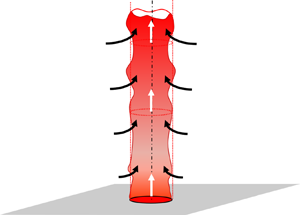
As an example of the potential scope for designing plumes offered by our approach, we consider a circular source and enquire what distribution of centreline off-source buoyancy  $F$ would give rise to a cylindrical plume of constant radius $R$, i.e. such that ${b\equiv R>0\,\forall \,z>0}$. From table 2, we require $f/f'=R/\mathfrak {q}_{r\theta }$, which has solution
 \begin{equation} f=A\,{\rm e}^{\mathfrak{q}_{r\theta} z/R}, \end{equation}
for constant  $A>0$. It follows immediately from the solutions in tables 1 and 2 that
 \begin{equation} F=\frac{6A^3\mathfrak{q}_{r\theta}^2}{\mathfrak{m}_{r\theta} \mathfrak{b}_{r\theta}R^6}\, {\rm e}^{3\mathfrak{q}_{r\theta} z/R}, \quad w=\frac{A}{R^2}\, {\rm e}^{\mathfrak{q}_{r\theta}z/R}, \quad \varGamma=\frac{5}{2}. \end{equation}
Therefore, an exponentially increasing off-source buoyancy distribution (5.2a) produces a plume with constant radius, by means of an exponentially increasing plume velocity (5.2b). Moreover, this plume is dynamically invariant with  ${\varGamma (z)=5/2\ \forall \,z}$. A Richardson number of ${\varGamma =5/2}$ is predicted by Hunt & Kaye (Reference Hunt and Kaye2005) and Kaye & Scase (Reference Kaye and Scase2011) as the value for which an axisymmetric plume would have vertical sides, but only at a particular height as opposed to the entire height of the plume. Note that all plume fluxes and properties are finite at $z=0$.
Following the same procedure for a line or wall plume also shows that an exponentially increasing off-source buoyancy distribution gives rise to a width that is independent of  $z$. In this case $\varGamma (z)=2\ \forall \,z$, which is in accord with the analysis of van den Bremer & Hunt (Reference van den Bremer and Hunt2014) who predicted that the sides of a line plume are vertical for ${\varGamma =2}$.
5.2. Another infinite fountain
In §§ 4.1 and 4.2 it was shown that there exist families of starting fountains that rise without limit for particular power-law distributions of off-source buoyancy. Those are not the only such starting fountains, however. Letting  $f=\tanh {(kz)}$ for an axisymmetric plume, where k is a wavenumber, from tables 1 and 2 it follows immediately that
 \begin{align} b=\frac{\mathfrak{q}_{r\theta}}{k}\sinh{(kz)}\cosh{(kz)}, \quad F=\frac{32k^6}{\mathfrak{q}_{r\theta}^4\mathfrak{m}_{r\theta}\mathfrak{b}_{r\theta}} \frac{\sinh(kz)}{\cosh^9(kz)}, \quad \varGamma={-}5\sinh^2{(kz)}\cosh^2{(kz)}. \end{align}
The other plume fluxes and properties are also well-behaved. Of note is that  ${\varGamma \to -\infty }$ as ${z\to \infty }$, a dynamical behaviour unlike all other flows considered herein where $\varGamma$ asymptotes to a finite value. In this context, this means that the momentum flux in the plume is decaying to zero from above faster than the buoyancy flux is decaying to zero from below.
5.3. Practical considerations
Controlling  $F(z)$ in order to synthesise a particular plume is difficult and presents considerable practical challenges. The most straightforward way to generate a custom $F(z)$ is likely to be by controlling the temperature of a vertical wall, enabling the synthesis of wall plumes. Creating a custom $F(z)$ for an axisymmetric or line plume could perhaps be achieved by a carefully designed grid of individually heated wires, or by creating a particular stratification in a saline environment, e.g. by variations on Oster's ‘double-tank’ method (Oster Reference Oster1965; Economidou & Hunt Reference Economidou and Hunt2009). Whilst diffusion does mean that any ambient stratification will smooth out over time, it occurs over time scales much longer than those of a plume, allowing measurements of a particular plume to be made before the stratification would be meaningfully altered.
6. Conclusions
We have developed a new approach to the solution of the conservation equations for turbulent axisymmetric plumes and starting fountains, line plumes and wall plumes, encompassing off-source buoyancy input as well as stratified environments. At the heart of our approach, we specify a function for the volume flux  $f$, rather than, as is conventional, specifying the buoyancy flux. Whilst at first sight, one might have anticipated little to be gained from this approach, we show that our general analytical solutions offer new insight into plume and fountain behaviour, including, but not limited to, the classic power-law solutions. Our approach shows that any analytic function $f$ can be used to generate a set of solutions to the equations, with $f/f'>0$ being a necessary condition for a physically realisable flow. Crucially, our approach enables us to take the very first steps towards synthesising flows with particular properties, steps that were not apparent on following conventional solution approaches, and has improved our understanding of the role played by particular off-source distributions of buoyancy. Regarding the latter, we show how to synthesise ‘cylindrical’ plumes and negatively buoyant releases that rise perpetually. We anticipate that follow-up studies on plume/fountain synthesis following our approach will potentially reveal further insights, a key next step being the incorporation of an entrainment coefficient that varies with the local properties of the flow.
Declaration of interests
The authors report no conflict of interest.


 Open access

