


Introduction
The silver-backed chevrotain Tragulus versicolor, also known as the Vietnamese mouse-deer, is endemic to Vietnam. It is one of the least known ungulates, categorized as Data Deficient on the IUCN Red List (Timmins et al., Reference Timmins, Duckworth, Samba Kumar, Anwarul Islam, Sagar Baral, Long and Maxwell2015). The species is unique among the genus Tragulus because of its distinctive two-tone pelage, with a rufous anterior and a silver-grey posterior (Thomas, Reference Thomas1910). It was first described based on four specimens collected in 1906 near Nha Trang, southern Vietnam (Thomas, Reference Thomas1910). The silver-backed chevrotain was not recorded again for several decades after its scientific description, until a single specimen was obtained in 1990 in Gia Lai province (Kuznetsov & Borissenko, Reference Kuznetsov and Borissenko2004). It then went undetected again for almost 30 years, until the first camera-trap photographs of the species were obtained in 2017 (Nguyen et al., Reference Nguyen2019).
Prior to our study reported here, little was known regarding the habitat associations and distribution of the silver-backed chevrotain, and any major threats to the species. This lack of information poses challenges for conservation planning and decision-making, as it may hinder the identification of critical habitats and the deployment of effective threat mitigation strategies. There are several reasons to believe the silver-backed chevrotain is in need of conservation interventions. Ungulates in general are at risk in Vietnam, primarily because of the high levels of unsustainable hunting pressure across the country (Gray et al., Reference Gray, Belecky, O’Kelly, Rao, Roberts and Tilker2021). A number of ungulate species, including the Javan rhinoceros Rhinoceros sondaicus, Eld’s deer Rucervus eldii and hog deer Axis porcinus, are now extinct in the country, and others, such as the large-antlered muntjac Muntiacus vuquangensis, are close to extinction (Brook et al., Reference Brook, Dudley, Mahood, Polet, Williams and Duckworth2014; Gray et al., Reference Gray, Brook, McShea, Mahood, Ranjitsingh and Miyunt2015; Timmins et al., Reference Timmins, Duckworth, Samba Kumar, Anwarul Islam, Sagar Baral, Long and Maxwell2015, Reference Timmins, Duckworth, Robichaud, Long, Gray and Tilker2016). It is urgent, therefore, that stakeholders assess the conservation needs of the silver-backed chevrotain, the only ungulate endemic to Vietnam.
We conducted surveys utilizing local ecological knowledge and camera trapping, with the primary goal of assessing the ecology and conservation status of the silver-backed chevrotain across its presumed range. Our study provides the first comprehensive overview of the silver-backed chevrotain, and we discuss how our results can inform the conservation of this little-known species.
Study area and methods
During 2018–2025, we conducted surveys across five provinces in southern Vietnam: Phu Yen, Khanh Hoa, Ninh Thuan, Binh Thuan and Gia Lai. These focused on, but were not limited to, dry forest ecosystems in this region, following preliminary information from camera-trapping surveys conducted shortly after the silver-backed chevrotain was recorded in 2017 (Nguyen et al., Reference Nguyen2019). Interviews with local people were used to assess the likelihood that the silver-backed chevrotain occurred in a given area, and to gain insights into perceived population status and threats. When the information provided by local people indicated that the species may occur in an area, we followed up with camera trapping.
We used a semi-structured interview approach, first asking general questions and then following with open questioning. We focused on local people with experience in the forest, selecting participants via a snowball sampling (Goodman, Reference Goodman1961), whereby initial interviewees, often the village headman, were asked to recommend additional people within a village. We asked local people which chevrotain species they were familiar with, where they had seen them in the forest, and whether they believed that abundance had changed over time. If interviewees were familiar with chevrotain species, photos of silver-backed chevrotain and lesser oriental chevrotain Tragulus kanchil were shown, to seek confirmation of identification. Following each interview, the interviewer confidentially assessed the reliability of the interviewee’s responses and knowledge of the target species. If responses strongly suggested the presence of silver-backed chevrotains, follow-up questions were asked to determine the approximate areas where interviewees believed the species occurred.
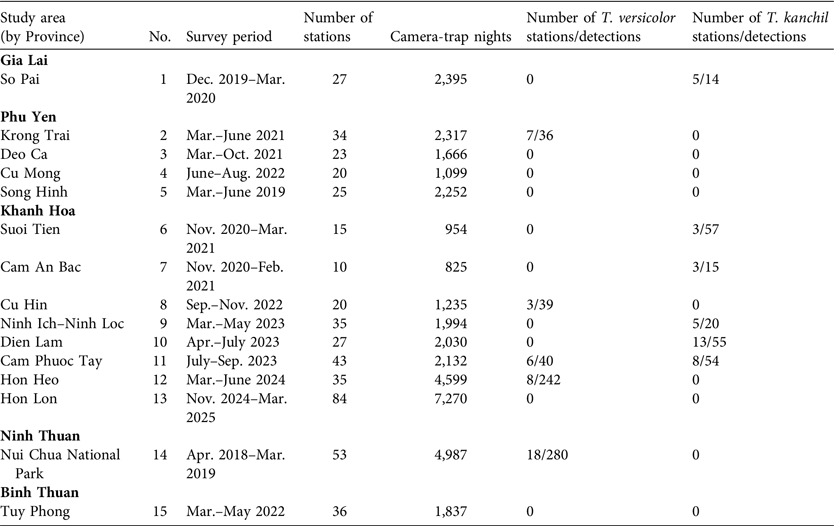
Next, we conducted targeted camera trapping in 15 forest areas in five provinces (Table 1). The sites spanned a range of forest types typical of the south-central coast of Vietnam, where pronounced climatic and topographic gradients form a complex habitat mosaic (Schmid, Reference Schmid1974). The study area included dry coastal, semi-evergreen, evergreen and deciduous forests (Rundel, Reference Rundel1999). There is a well-defined semi-dry forest ecotone between the dry and semi-evergreen forest types (Nguyen et al., Reference Nguyen2025). In Phu Yen and Khanh Hoa provinces, the camera-trap areas were primarily chosen based on information from the local ecological knowledge surveys. We also selected two additional sites for camera trapping based on satellite imagery and expert opinion (Tuy Phong in Binh Thuan, So Pai in Gia Lai). In So Pai, the camera-trap survey was implemented near the locality where a silver-backed chevrotain specimen was collected in 1990 (Kuznetsov & Borissenko, Reference Kuznetsov and Borissenko2004).
Camera-trap deployment details, effort and detections of the silver-backed chevrotain Tragulus versicolor and lesser oriental chevrotain Tragulus kanchil across 15 survey sites in five provinces in Vietnam (Fig. 1). The site numbers correspond to the numbered symbols in Fig. 1. Camera traps were deployed singly on a grid with 500 m spacing, except for Hon Heo where the grid had 2,000 m spacing and two non-facing cameras per station, and Hon Lon where the grid had 1,000 m spacing and a single camera per station. Detections of the same species at the same station were defined as independent if they were separated by at least 60 minutes.

The camera trapping used three different designs: a systematic grid design with a 500 m spacing (13 surveys), and two coarser grids used to cover larger areas, one survey with 1,000 m spacing and one with 2,000 m spacing (Table 1). We used a grid-based design to provide a consistent survey framework, facilitating comparisons between sites. Camera traps were set in specific locations to maximize detections, including on animal trails and near water resources.
We set a single camera trap at each station in all survey areas, except for the survey in Hon Heo (Khanh Hoa province), where two non-facing cameras were deployed per station (Abrams et al., Reference Abrams, Axtner, Bhagwat, Mohamed, Nguyen and Niedballa2018). We used Spartan Lumen (Spartan Camera, USA), Covert MP8 (Covert Scouting Cameras, USA) and Reconyx HyperFire 4K Ultra HD (Reconyx, USA) infrared-triggered cameras with white flash, configured to take 3–5 photographs per trigger without delay. No baiting or attractants were used. Cameras were mounted 30–45 cm above the ground and left in the forest for a minimum of 60 days. Camera-trap images were checked by at least two experienced researchers to confirm chevrotain identifications. Data were processed using the camtrapR 2.0.3 package (Niedballa et al., Reference Niedballa, Sollmann, Courtiol and Wilting2016) in R 4.4.2 (R Core Team, 2024).
Results
We interviewed a total of 96 people (five rangers, eight commune officials, and 83 other local people) across Phu Yen and Khanh Hoa provinces, of which 30 were familiar with chevrotain species. Chevrotain descriptions consistent with the silver-backed chevrotain and lesser oriental chevrotain were each reported by 25 interviewees. Seventeen reports of silver-backed chevrotains came from Khanh Hoa Province and eight from Phu Yen Province. Additionally, 30 respondents were aware of chevrotain species but were unable to distinguish between the two species (nine in Phu Yen, 21 in Khanh Hoa). All interviewees who reported the silver-backed chevrotain said that it had declined over the previous 10 years. According to respondents, this decline was primarily attributed to the expansion of shifting cultivation, which has led to extensive habitat loss and fragmentation, and to widespread illegal hunting using wire snares and other indiscriminate trapping methods. These anthropogenic pressures were reported to be particularly severe in areas adjacent to villages and along forest edges.
During 2018–2025, we set a total of 522 cameras at 487 stations across 15 survey sites, yielding 37,592 camera-trap nights (Table 1). Silver-backed chevrotains were detected in five geographically distinct sites representing separate populations, in dry and semi-dry coastal forest (Nui Chua, Hon Heo, Cu Hin) and semi-dry forest (Krong Trai, Cam Phuoc Tay; Fig 1). Four of these populations are new to the scientific community. The highest numbers of detections were in Nui Chua (280 detections at 12 stations), Hon Heo peninsula (242 detections at 8 stations), and Cam Phuoc Tay (40 detections at 6 stations; Table 1). The silver-backed and lesser oriental chevrotains were both recorded in Cam Phuoc Tay, but at different camera-trap stations. All silver-backed chevrotain records came from dry and semi-dry forest, with no records in semi-evergreen, evergreen or deciduous forest.
The locations of interview surveys for chevrotains, indicating where they were reported, and of camera-trap deployments and detections of the silver-backed chevrotain Tragulus versicolor and lesser oriental chevrotain Tragulus kanchil in five provinces in Vietnam. The numbers correspond to the numbered sites in Table 1.

Discussion
Using a combination of local ecological knowledge and camera trapping, we provide a first assessment of silver-backed chevrotain status and distribution in Vietnam. We recorded four hitherto undocumented populations of the species. Together with the single population in Nui Chua National Park (Nguyen et al., Reference Nguyen2019), this brings the total to five known populations. Although, based on habitat associations, we cannot rule out the possibility that there are additional populations in the coastal provinces of southern Vietnam, we believe any other populations are likely to be few in number, isolated and outside the protected area network. If these assumptions are correct, then the silver-backed chevrotain has one of the smallest ranges of any known ungulate. The fact that its global distribution occurs in one of the epicenters of the Southeast Asian snaring crisis (Gray et al., Reference Gray, Belecky, O’Kelly, Rao, Roberts and Tilker2021) is of concern.
The camera-trapping results provide further evidence that the silver-backed chevrotain is a habitat specialist currently restricted to dry and semi-dry forests. All records came from these habitat types, and we did not detect the species in the other dominant forest types in the region. This is consistent with findings from Nui Chua National Park, where the highest occupancies of silver-backed chevrotains were recorded from the semi-dry forest transition zone (Nguyen et al., Reference Nguyen2025). More work is needed to understand the nuances of silver-backed chevrotain habitat preferences, including micro-habitat associations. However, our findings suggest that the species is probably restricted to habitats characterized by xeric conditions.
The detection of the silver-backed chevrotain in dry and semi-dry forest habitats underscores the conservation value of coastal forest ecosystems in south-central Vietnam, which are increasingly threatened by habitat fragmentation and degradation. Our study provided some evidence that the silver-backed chevrotain has been extirpated from areas of otherwise suitable habitat. No records were obtained from several sites (Deo Ca, Cu Mong, and Ninh Ich–Ninh Loc) with apparently suitable habitat. Local people reported high hunting pressure in these areas, and it is likely that the silver-backed chevrotain no longer occurs at these sites. Local extirpation is not surprising given the extremely high levels of hunting, and subsequent defaunation, in Vietnam (Tilker et al., Reference Tilker, Abrams, Mohamed, Nguyen, Wong and Sollmann2019; Gray et al., Reference Gray, Belecky, O’Kelly, Rao, Roberts and Tilker2021). The likely extirpation of the species in these areas is a warning of the urgency of protecting the remaining population strongholds.
We did not record silver-backed chevrotains at So Pai (Gia Lai), the site where a specimen was collected in 1990 (Kuznetsov & Borissenko, Reference Kuznetsov and Borissenko2004). There are several possible explanations for this. Firstly, the specimen was obtained from local hunters (Kuznetsov & Borissenko, Reference Kuznetsov and Borissenko2004), and although it was assumed to originate from the immediate vicinity, its exact provenance remains unknown and it may have originated from another area. Secondly, given the high levels of hunting pressure across the region (Gray et al., Reference Gray, Belecky, O’Kelly, Rao, Roberts and Tilker2021), it is possible the species has been extirpated from this site. Thirdly, So Pai may be marginal habitat with a low population density of the silver-backed chevrotain, making the population more susceptible to local extinction or requiring more survey effort to detect it. Although these scenarios remain speculative, they underscore the need for further targeted surveys in the broader region surrounding the 1990 record. Expanded efforts in this area would help clarify the distribution of the species, and how the 1990 record fits into this picture.
The two strongholds for the silver-backed chevrotain are Nui Chua National Park and the Hon Heo peninsula. Both had the highest number of independent detections, and are also located in relatively large blocks of suitable habitat. We recommend that future protection efforts prioritize these sites for in situ conservation of the species. Because Nui Chua is a protected area, there is already a basis for conservation activities. This is not the case for the Hon Heo peninsula, which is not legally protected and faces significant threats from snaring and habitat degradation (GreenViet, 2024). The long-term persistence of the other three populations faces serious challenges. The camera-trapping data suggest that these populations are small, and all are subject to the high levels of hunting pressure that is common in the coastal forests of southern Vietnam.
In addition to direct human threats, these small and isolated populations may also be vulnerable to stochastic events, which could accelerate local extirpation. In recognition of these threats, our findings have been used to categorize the silver-backed chevrotain as Critically Endangered on the Vietnam Red List of Threatened Species (VAST, 2024). The species remains categorized as Data Deficient on the IUCN Red List (Timmins et al., Reference Timmins, Duckworth, Samba Kumar, Anwarul Islam, Sagar Baral, Long and Maxwell2015), although a revision of this listing is in progress, and is being informed by our findings. To secure the survival of the silver-backed chevrotain given its restricted distribution and the ever-increasing anthropogenic pressures, a targeted conservation action plan is required. We recommend that such a plan focuses on four key components: (1) strengthening enforcement against snaring and other forms of illegal hunting in known strongholds for the species; (2) protecting key habitats by preventing illegal encroachment and legal land conversion that could lead to habitat loss and degradation; (3) enhancing community participation in forest protection efforts, especially in areas outside formally protected areas; and (4) establishing an ex situ insurance population as a safeguard, ideally incorporating genetic diversity from all existing populations. However, past experiences with species-specific conservation plans in Vietnam, such as those for the saola Pseudoryx nghetinhensis (Saola Working Group, 2020) and Javan rhinoceros (Brook et al., Reference Brook, Dudley, Mahood, Polet, Williams and Duckworth2014), highlight the challenges of translating policy into effective action. The long-term persistence of Vietnam’s only endemic ungulate should therefore not be taken for granted.
Author contributions
Study design: HHQ, AN, QLT; fieldwork: HHQ, QLT, BVT, SA, TLC, PNT, PNQ, QNT, LNTH, TDM; data analysis: AN, HHQ, QLT, DLTK, AT, AW; writing, revision: all authors.
Acknowledgements
We acknowledge the financial support provided by the Leibniz Institute for Zoo and Wildlife Research and Re:wild. We thank the Southern Institute of Ecology for technical assistance; and the provincial forest protection departments, local People’s Committees, and the forest management boards in Phu Yen, Khanh Hoa, Ninh Thuan, Binh Thuan and Gia Lai provinces for their support in facilitating fieldwork permits and logistics. Funding for the surveys was provided by the Eva-Mayr Stihl Foundation, the Manfred Hermsen Stiftung, IDEA Wild, ARTIS Amsterdam Royal Zoo, the Mohamed bin Zayed Species Conservation Fund, Auckland Zoo, DODO Fundacja Wroclaw, Wroclaw Zoo, Sainte-Croix Parc Animalier, and Zoologische Gesellschaft für Arten- und Populationsschutz e.V.
Competing interests
None.
Ethical standards
All research activities were conducted in accordance with national regulations governing scientific research and biodiversity conservation in Vietnam, and with the approval of relevant local authorities in the study sites. Prior, informed, verbal consent was obtained from all interviewees, and no personal or identifying information was recorded.
Data availability
The data supporting this study, including locality information, are not publicly available because of the threatened status of the silver-backed chevrotain. Processed data can be provided by the corresponding author upon reasonable request, for legitimate research or conservation purposes.


 Open access

