

Introduction
The Projeto Vocabulário Político da Antiguidade (Political Vocabulary of Antiquity Project) was established in 2016 at the Federal University of Paraíba (UFPB) by professors and students from undergraduate programs in Classics and History, and it remains active (2025). The project’s primary objective is to develop educational materials that support elementary and high school teachers in teaching Ancient History, with a particular emphasis on political discourse. All materials produced by the project are freely accessible through its official website and social media platforms.Footnote 1
Additionally, we conduct school visits in João PessoaFootnote 2 and nearby areas to implement and evaluate the effectiveness of these resources in the classroom. By utilizing the project’s materials, teachers gain access to an engaging and fun content that makes it easier to study Ancient History while also providing students with an initial exposure to ancient Greek and Latin texts—languages that are not included in the Brazilian standard school curriculum.Footnote 3
Before presenting our project, it is first essential to outline the structure of education in Brazil. To become a history teacher for students aged 11 to 17, one must obtain a degree in History, which typically requires four years of study at undergraduate level. This program encompasses courses broadly categorized into three core areas: (1) the theory and methodology of History; (2) discussions on teaching History and Education; and (3) the study of historical events and social processes of societies of the past. Consequently, most History programs include at least one course dedicated to classical societiesFootnote 4 . It is within this framework—aimed at enhancing the preparation of History students for teaching practice—that our project operates.
In Brazil, basic education spans for 12 years (ages 6 to 17) and is divided into three stages: Early Elementary School (ages 6–10), Middle School (ages 11–14), and High School (ages 15–17). Topics related to Ancient History are introduced in the 6th-grade curriculum, which marks the beginning of Middle School, and may also be revisited in the first year of High School. Given this structure, there is a pressing need to develop teaching materials on Classical Antiquity that engage Brazilian students—who are geographically and temporally distant from ancient Greece and Rome—in a meaningful and compelling way.
The Political Vocabulary of Antiquity Project was initially coordinated by me and Lucas Consolin Dezotti (Classics, UFPB). In 2024, Professor Félix Jácome Neto (Classics, UFPB) joined the team. In addition to the faculty members, an average of five undergraduate students take part in the project each year, making it a significant component of their curricular formation.Footnote 5
The creation of our project was primarily driven by two factors: (1) the political demonstrations that emerged in Brazil from 2014 onward, and that got intensified in the following years, reflecting the growing political polarization in the CountryFootnote 6 ; and (2) the remodelling of the curriculum for the basic education initiated in 2015, which culminated in the approval of a new curriculum in 2018Footnote 7 .
Regarding the first point, public demonstrations openly advocating for regime changes—whether through the establishment of a military dictatorship or the restoration of a monarchy—raised concerns among us. This prompted reflections on the significance of democracy in Brazilian society and on why some individuals sought its dissolution. Consequently, we began to question the broader meanings of terms such as ‘democracy’, ‘monarchy’, ‘tyranny’, and ‘republic’ in public discourse.
Our central inquiry became this question: “Do people truly understand who governs in a monarchy, a republic, or a dictatorship?” These terms, while embedded in everyday political vocabulary, share a common linguistic heritage rooted in Greek and Latin. This observation led us to revisit the study of forms of government, aiming to explore political terminology as a means of re-examining contemporary political attitudes. The study of forms of government examines two fundamental points in politics: (1) the number of rulers (whether one, few, or many) and (2) the quality of the regime (whether it is good or bad). This discussion draws on the ancient political vocabulary used by classical authors to explore the historical context of these terms. It highlights the key aspects deemed essential for a good regime while also identifying what is considered harmful. The discussion regarding the number of rulers and the quality of regimes serves as a starting point for deeper reflections on politics in general. Encouraging students to think critically about what defines good or bad governance helps them analyse the positive and negative aspects of political experiences, both past and present.
Moreover, the decision to introduce the discussion of forms of government into school curricula stems from our belief that education plays a fundamental role in shaping citizenship. A deeper understanding of political concepts enhances the exercise of citizenship, equipping individuals with the critical knowledge necessary to become meaningfully engaged in democratic processes.
We decided to focus on specific words in our project, encouraging students to explore their meanings more deeply. Our approach is inspired by Louis Gernet’s Recherches sur le développement de la pensée juridique et morale en Grèce, which examines legal vocabulary and has also influenced other Hellenistic scholars such as Jean-Pierre Vernant and Marcel Detienne (Gernet, Reference Gernet2002[Reference Gernet1917]). We believe that language is deeply intertwined with social relations, and that specific words can reveal social practices, allowing us to analyse and understand changes in society. Another key inspiration for our project is Paulo Freire’s concept of the Pedagogy of Autonomy.Footnote 8 This approach aims to foster students’ independence by emphasizing the importance of freedom and critical thinking. As a result, students become active participants in their learning, which empowers them to make positive changes in the world. Our main goal is to help students see themselves as agents of change and to understand Politics as a tool for problem-solving through negotiation and participation. This is achieved through a careful analysis and critical reflection of key terms chosen from texts by authors from Classical Antiquity.
During this same period, Brazilian society was also involved in debates regarding proposals for a new school curriculum structure, which brings us to the second point. In 2015, one of these propositions sought to remove Ancient and Medieval History from the elementary school curriculum. This decision provoked strong reactions—from conservative perspectives that regard Greece and Rome as the foundations of Western civilizationFootnote 9 to arguments advocating for broad access to historical knowledge, emphasizing Ancient History’s role in fostering an understanding of otherness.Footnote 10
History scholars actively participated in these debates, leading to various experiments in teaching Ancient History in ways that dialogue more directly with Brazilian society.Footnote 11 Two additional curriculum proposals were subsequently introduced, and the final version—despite its limitations—ultimately included Ancient and Medieval History in the 6th-grade curriculum, corresponding to students around 11 years old.Footnote 12 Thus, Ancient History and Classics’ professionals must now develop resources that facilitate the teaching of Antiquity in ways that align with the educational needs of the 21st-century citizensFootnote 13 .
Development of didactic materials
With this aforementioned objective in mind, the project was initiated. Our initial observation was the limited availability of translations and educational materials on Ancient History specifically designed for young audiences. Most works in use were adaptations of translations from modern languages, with a significant portion focusing on mythology.Footnote 14 Consequently, there was a noticeable lack of teaching materials that addressed the social and political aspects of Greece and Rome.
To address this gap, we decided to concentrate our initial efforts on the development of bilingual (Greek - Portuguese) educational materials that could be readily used in schools. This effort culminated in the publication of our first book (Gontijo Leite & Dezotti, Reference Gontijo Leite and Dezotti2019), that presents selected excerpts from Herodotus (Figure 1), Aristotle, and Polybius, exploring the nature of governance by one, few, and many, and introducing the different terminologies associated with each government.Footnote 15 While other authors could have been included, the constraints inherent to any research project demanded a focused approach. We therefore opted to concentrated the first volume on these three authors for specific reasons: Herodotus, for he is one of the earliest sources to record the term democracy; Aristotle, due to the profound impact of his definitions on Western political thought; and Polybius for his discussion of anacyclosis and his insights into how debates on governance persisted in Antiquity and were used to interpret the Roman expansionist process.
The book is structured to be accessible to both teachers and students, allowing for independent use. It is organized into the following sections: (1) background information on the author and the work; (2) the original Greek text alongside its Portuguese translation; (3) a brief annotated lexicon to assist both specialists and general readers in dealing with the text in its original language; (4) theoretical and contextual commentary, providing historical background and discussions on political vocabulary; and (5) suggested topics for classroom debate.
Example of a page from the book with Greek text, translation and lexicon.

Figure 1 Long description
The image shows a page from a book that includes Greek text, its Portuguese translation, and a lexicon section. The text is organized into three main parts: the original Greek text on the left, the Portuguese translation in the middle, and a lexicon on the right. The Greek text is written in a clear, legible font, while the Portuguese translation is presented in a similar format for easy comparison. The lexicon section provides definitions and explanations of key terms and phrases from the Greek text, aiding in the understanding of the content. The layout is clean and structured, making it easy for readers to follow along and learn from the bilingual presentation.
The book compiled the research conducted by us and serves as reference for the development of additional educational materials, which are available on the project’s website. A variety of lesson plans, quizzes, and interactive activities were created to support classroom instruction on forms of government.
One notable example was a lesson on forms of government in Herodotus, conducted in 2019 for a 6th-grade class.Footnote 16 After reading the Greek text by Herodotus, the class became more interested in the topic. The students requested a second reading, and as a result, they showed increased interest in the translated text, actively trying to identify the Greek words. The majority of the students found the session both engaging, fun and enjoyable, expressing a keen interest in further exploring the topic. During the lesson, students were introduced to Greek terms and participated in an in-depth discussion on democracy, fostering understanding of political concepts. The teacher noted that the lesson effectively motivated students who usually display apathetic behaviour, highlighting the potential for learning through the Classics beyond their subject. In other words, Classics can be interesting for younger people.
After completing the book on Greek authors, we decided to develop a similar volume on Roman authors, following the same structural approach. This book is still in progressFootnote 17 . Excerpts from Cicero’s Republic have been translated, accompanied by supporting texts and lesson plans, and a preliminary version of the translation is available on the project’s website. Both the book on Greek authors and the materials on Cicero played a crucial role in the development of the educational games created by the project.
By 2020, the project had developed several lesson plans featuring playful activities such as word searches, crosswords, and quizzes. These activities are simple, interactive, and easy for teachers to implement since they only require printing materials on a sheet of paper. However, with the social isolation resulting from the 2020’s Pandemic and the gradual return to in-person activities, we realized the need for activities that also encouraged students’ interaction. The solution was to create more elaborate educational games, an initiative proposed by the undergraduate students involved in the project.
From their suggestions, we began to discuss the role of games in teaching. This allowed us to distinguish between commercial games and educational games while acknowledging that it is possible to learn from commercial games, which are significant aspects of contemporary culture.Footnote 18 In line with our project’s commitment to teaching based on democratic values, we decided that the games we created should establish a ‘magic circle’, as proposed by Huizinga (Reference Huizinga2007). This magic circle should serve two primary functions: (1) teaching about Classics and (2) developing specific skills.
To create the games, we utilized the principles of active learning methodologies as proposed by Moran (Reference Moran2013). This approach encourages students to actively participate in the construction of knowledge. It closely aligns with Freire’s ideas, as well.
Another crucial factor for the success of the games was their design. An appealing aesthetic was essential to attract students and enhance their engagement. To achieve this, we aimed to combine artistic elements with visual references from the Ancient World, ensuring that the games’ visuals also served educational purposes. Every aspect of each game was carefully considered, as detailed below.
Super trunfo: formas de governo (Top trumps: forms of government)
Super Trunfo: Formas de Governo (Top Trumps: Forms of Government) is designed for children aged 10 to 12 to encourage discussions about politics based on the concepts of political regimes presented by Aristotle, Cicero and Polybius. The Project aims for this game to provide teachers with fun and engaging material that will spark children’s interest in political debate. For this age group, a key skill to develop is comparison. This skill involves the ability to analyse and recognize similarities and differences among elements, which then allows for the creation of a hierarchy to position them accordingly. Although it may appear to be a simple and routine task, comparison actually requires careful interpretation and reflection.
The game consists of 24 cards (Figure 2) and can be played by 2 to 6 players, and it is suitable for ages 10 and over. It follows the same format as the traditional Top Trumps, a card game in which players aim to collect all the cards by selecting and comparing specific attributes. Each player has a deck of face-down cards and draws the top card during their turn. One player selects a category, and the player with the highest value in that category wins the turn, collecting the other players’ cards. The game continues until one player has won all the cards.
We developed the game during meetings in which all its aspects were thoroughly examined.Footnote 19 After determining the game’s format, we identified key elements necessary for young players to understand what constitutes a good or a bad political regime.
By doing this, students develop their comparative skills, which prepares them for more complex comparisons based on intricate texts. Furthermore, focusing on the distinctions between good and bad regimes is crucial for this age group, helping students understand that tyrannical governments are harmful, and by extension, that governments with dictatorial traits are also detrimental for people. Unfortunately, in Brazil’s public sphere, there are demonstrations supporting dictatorial governments and calling for an end to democracy in the country. This reality impacts students’ lives, and we aim to encourage them to reflect on it. To facilitate this, we chose to assign low scores to cards representing governments with tyrannical characteristics, ensuring that they consistently lose in comparison to others. In contrast, cards representing governments that embody freedom, participation, and respect for the law received higher scores.
To compare good and bad regimes, we considered four main axes:
-
1. Possibility of public participation – the higher the level of public participation, the more closely the government aligns with democratic values.
-
2. Freedom, which encompasses both the guarantee of political participation and the ability of individuals to exercise personal choices.
-
3. Adherence to laws and the security of the legal system, as respect for the law is fundamental to maintaining social harmony.
-
4. Political stability, which is assessed based on the longevity of the political regime and the robustness of its institutions.
To encapsulate these characteristics, we defined four categories: Participation, Freedom, Laws, and Stability.
After defining these categories, the next step was to select the political regimes discussed by classical authors. We chose the following political systems: Monarchy, Democracy, Tyranny, Oligarchy, and Aristocracy. To juxtapose these idealized political models with historical realities, six historical regimes were incorporated: the Athenian Democracy, the Spartan Oligarchy, the Tyranny in Sicily, the Macedonian Monarchy, the Roman Republic, and the Brazilian Republic. The selection of these political regimes was based on the following criteria: the most frequently referenced ancient governments in Brazilian textbooks, namely Athens, Sparta, and Rome; the inclusion of alternative forms of government from the Ancient World, such as Monarchy and Tyranny; and the promotion of discussions on contemporary Brazilian politics, particularly on how Portuguese political terminology is rooted in ancient Greek and Latin vocabulary. This approach allows educators to compare idealized political models with their real-world applications, demonstrating how different societies developed unique political solutions over time.
To this end, we used translations of the Politics by Aristotle, the Histories by Polybius, and the Republic by Cicero, which are available in that book we published in 2019.Footnote 20 We decided to include references to these classical works on each card, enabling students and teachers to access the original text.
Following this, we proceeded to study the game’s visual elements. We observed that 19th-century paintings—imbued with specific historical and cultural values— were often used to depict ancient political themes. These artworks not only illustrate Classical Antiquity but also reflect on how perceptions of the Ancient World evolved over time. Consequently, for the cards featuring Aristotle, Polybius, and Cicero, we selected public-domain paintings and engravings that represent aspects of ancient politics. Among the selected works were Pericles’ Funeral Oration by Philipp von Foltz (1877) and Cicero Denounces Catiline by Cesare Maccari (1889). For the historical regimes photography was chosen for illustration. This included images of public spaces such as the Roman Forum and the Parthenon, as well as sculptures and the photography of the promulgation of the 1988 Brazilian Constitution. The inclusion of this last image was particularly significant, as it highlights Brazil’s recent republican history and the political transition of 1988, marking the end of a long period of military dictatorshipFootnote 21 .
All visual references were incorporated into the game, accompanied by cards explaining the game’s rulesFootnote 22 . The result is a set of cards that, beyond their role in gameplay, allow educators to engage students with ancient texts and encourage critical reflection on historical iconography. In other words, the cards can be used in the classroom separately from the game, allowing this material to perform multiple functions.
Example of cards from the Super Trunfo: formas de governo game.
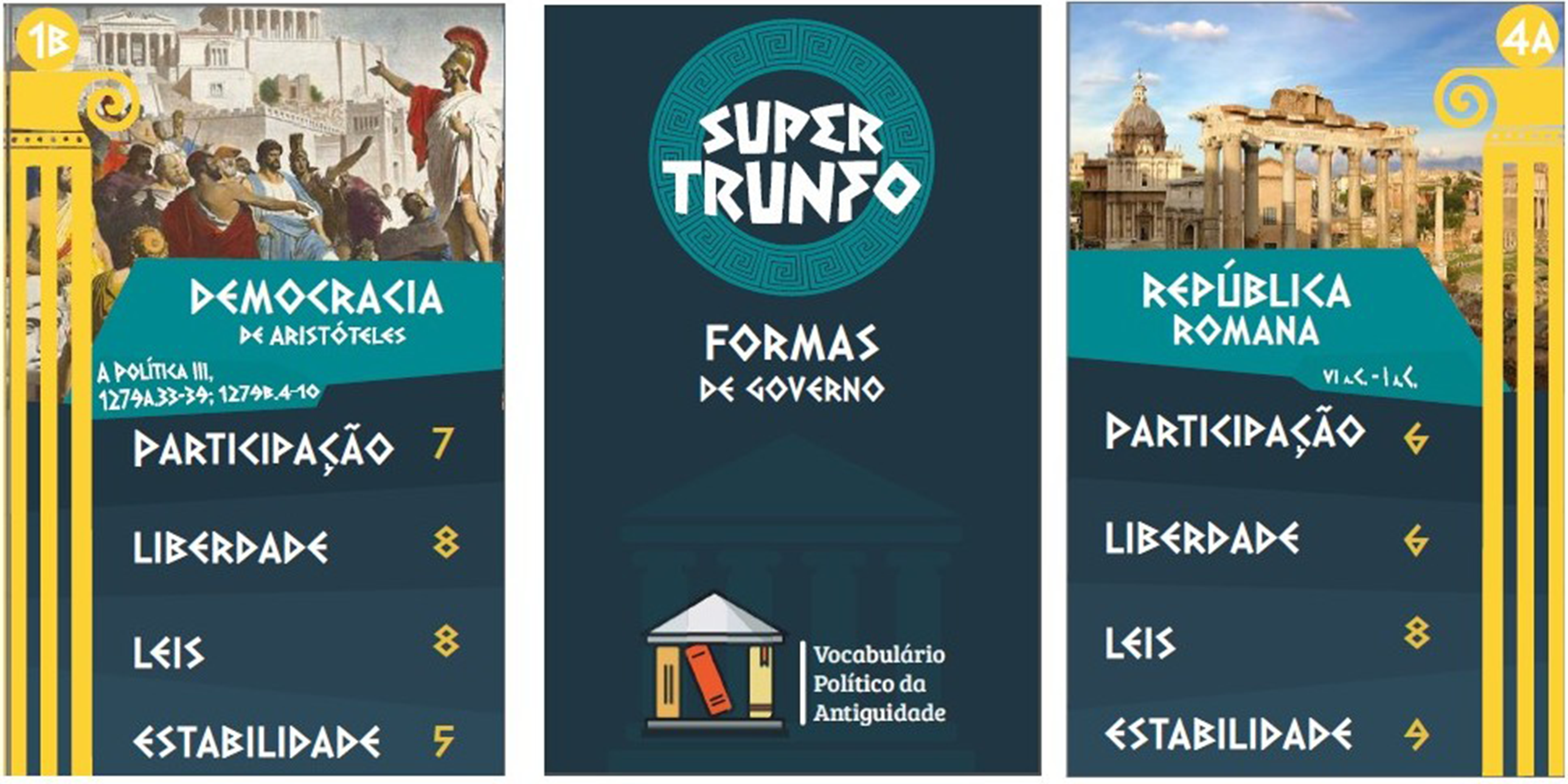
Figure 2 Long description
The image shows three cards from the Super Trunfo: formas de governo game. The first card on the left features Democracy of Aristotle, with an illustration of ancient Greek figures and the Parthenon. The card lists participation as 7, freedom as 8, laws as 8, and stability as 5. The middle card displays the game's title, Super Trunfo formas de governo, with a logo and a small illustration of books. The third card on the right features Republica Romana, with an image of the Roman Forum and the Pantheon. This card lists participation as 6, freedom as 6, laws as 8, and stability as 9.
During the years of 2023 and 2024, Super Trunfo: Formas de Governo was used 9 times in schools in the metropolitan region of João Pessoa in classes of students with ages ranging from 11 to 15. The game supported the discussion of the theory of forms of government and made it more attractive to teenagers, especially because it was fun. For this activity, two 45-minute classes were planned — the average length of a class in Brazilian schools —, totalling 90 minutes distributed as follows: 35 minutes of presentation with the use of slides — the authors Aristotle, Polybius and Cicero were introduced to the students —; 10 minutes for Q&A; 30 minutes to play; 15 minutes to answer the questionnaire. This basic format was adapted to fit the specific needs of each classroom. For example, a modification in the dynamics made for 11-year-old students was to alternate the presentation of the subject with a game, making them even more interested in learning about the authors. For the 15-year-old students, combining subject exposure, discussion, and play was more effective, especially since they already had a basic understanding of the concepts covered.
In the introduction during the first part of the class, a brief biography of each author is presented, along with excerpts from their works displayed on slides. This helps students recognize that the authors came from different time periods and had diverse occupations, yet each exerted a significant influence on the development of Western thought. After this, we discuss important concepts such as anacyclosis and Mixed Constitution. During this part of the class, our focus is not on historical regimes like Democracy in Athens or the Roman Republic. We understand that discussing that subject belongs to a different phase. In some classes, students had already studied this, and the game served as a review and to learn more about forms of government. This demonstrates that the game doesn’t need to be limited to a specific grade or time of the school year.
For students aged 12 and 13, the discussion focuses on vocabulary and on each ancient thinker’s perspective on good and bad government. It highlights how the meanings of words can vary between them and may also change over time. At this age, we prioritize students’ comprehensive understanding of these concepts, which will lay the foundation for their future critical thinking skills. With older students, we can deepen the discussion by incorporating additional texts from classical authors. After reading and analysing these excerpts, we hold a discussion on current political issues. The main objective is to encourage students to reflect on the challenges of the political arena and explore how they can engage with it, ultimately sparking their interest in politics. During the game, some classes had already studied Greece and Rome, so the game acted as a review of that knowledge. Even in classes that had not previously covered this subject, the game generated enthusiasm for learning more about Greece and Rome. In interviews evaluating the game’s effectiveness, teachers noted that classes which had not studied the subject but participated in the game found it easier to teach about Greece and Rome afterwards. Therefore, the game can serve as either an introduction to the subject, a complement to it, or as a review tool.
Overall, these 9 experiences were highly successful, demonstrating a strong learning impact, with 95% of students expressing a desire to play the game again, including outside the school setting, with friends and family.Footnote 23 Furthermore, over 90% of students reported gaining knowledge from the game. Most importantly, many students shifted their perspective on political discussions, no longer viewing them as negative or irrelevant. On the contrary, they began to show interest in political debate and recognized the importance of participation and precise language in fostering conscious and effective discourse.
A particularly noteworthy moment occurred during a session at Francisco Campos Elementary School when an 11-year-old student, immediately after the explanation of Cicero’s concept of the Mixed Constitution, exclaimed: “This Cicero is a copycat!” This reaction initially surprised us but ultimately brought great satisfaction. The student’s spontaneous remark demonstrated not only engagement but also understanding that Cicero’s work was influenced by earlier philosophers. In other words, he was able to identify the intellectual connections between Aristotle, Polybius, and Cicero.
Classroom experiences often present various challenges. After implementing the game Super Trunfo: Formas de Governo for the third time, we identified a particular issue: students who were eliminated early tended to become passive and distracted, losing their initial engagement and showing diminished interest in participating in subsequent rounds. Additionally, the transition to a new round sometimes took longer than expected. To address this, we developed a complementary activity to enhance the game’s experience.
We introduced a memory game, Jogo da Memória: Super Trunfo (Memory Game: Top Trumps), that incorporated the same images representing different forms of government, alongside corresponding textual descriptions (Figure 3).Footnote 24 This allowed students to remain engaged while waiting for their turn in Super Trunfo: Formas de Governo, reinforcing their understanding of political systems in an interactive way. The integration of this additional game significantly improved students’ engagement and deepened their interest in the subject matter.
Example of cards from the Memory Game: Top Trumps.

Figure 3 Long description
The image contains three cards from a memory game, each representing different forms of government with images and text. The first card on the left is titled 'Democracia' and features an illustration of ancient Greek figures in a public gathering. The text on this card reads, 'Na democracia governam os homens livres e os pobres, que constituem a maioria.' The second card in the middle is titled 'Super Trunfo Jogo da Memoria' and features a central circular design with the game's title. Below the title, there is an icon of a building with books labeled 'Vocabulário Político da Antiguidade.' The third card on the right is titled 'República Romana' and features an image of ancient Roman ruins. The text on this card reads, 'Se olharmos somente para o poder dos cônsules, estaríamos inclinados a considerar a constituição romana como despótica; se olharmos só para o Senado, como aristocrática; e se, finalmente, considerarmos o poder dos muitos, pareceria um caso claro de democracia.'
Both games combine familiar and engaging mechanics to facilitate discussions on political structures, encouraging students to reflect on historical and contemporary governments while introducing them to the ideas of classical authors (Figure 4). By employing these games as pedagogical tools, educators can effectively illustrate how political experiences from Antiquity offer valuable insights into the foundations of modern citizenship.
Thus, the primary advantage of these two games is their ability to foster discussions on this topic among students aged 10 and older. As a result, the Political Vocabulary of Antiquity Project successfully developed activities tailored to this specific age group—an area often overlooked in Brazilian schools, where most pedagogical initiatives tend to focus on mythology and religion.
Games in the classroom.

Figure 4 Long description
The image shows four separate scenes of people engaging with educational card games in a classroom. In the top left, a hand holds a deck of cards labeled with political terms such as 'Constituição Mista' and 'Participação.' The top right shows multiple hands holding and arranging similar cards on a table. The bottom left depicts a group of people seated at a table, interacting with cards laid out on a red surface. The bottom right features a close-up of a hand holding a blue box labeled 'Super Trunfo Jogo da Memória,' indicating a memory game related to political vocabulary.
Demokratia: simulating the boule and the ecclesia
Demokratia is a board game designed to immerse players in the role of Athenian citizens during the classical period.Footnote 25 Developed in 2021, it was inspired by Reigns: The Council, a game available as a free print-and-play version under a Creative Commons 4.0 license.Footnote 26 However, due to the constraints imposed by the COVID-19 pandemic, classroom testing was only feasible the following year. Between 2022 and 2024, the game was implemented in high school classes on 10 occasions, comprising students aged 15 to 17. Unlike the last games, Demokratia displays more complex mechanics than Top Trumps: Forms of Government, making it particularly suited for students aged 15 and older.
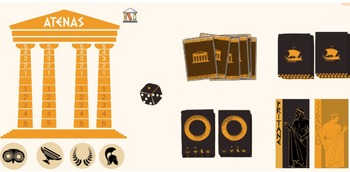
Demokratia consists of a game board featuring four key pillars—Religion, People, Treasury, and the Delian League—as well as four symbolic coins representing each pillar: a cup, an owl, a laurel wreath, and a helmet. The game includes 37 proposal cards, 26 objective cards, 36 event cards, 5 citizen tokens, 1 Prytane token, and a six-sided die (Figure 5). It is designed for a minimum of four players but can be adapted for larger groups.Footnote 27
Game components.

Figure 5 Long description
The image displays a game board titled 'Atenas' with four pillars labeled Religion, People, Treasury, and the Delian League. Each pillar is numbered from one to five. Surrounding the board are various game components: four types of coins with symbols (a cup, an owl, a laurel wreath, and a helmet), a black die, stacks of cards featuring images of buildings and ships, and cards with illustrations of historical figures labeled 'Pritane' and 'Kirane'.
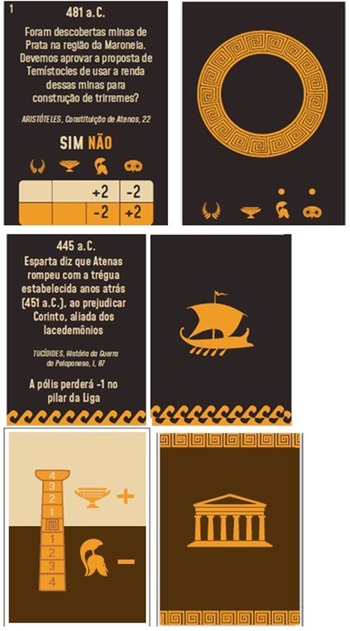
The proposal cards (Figure 6) present historical events from the 5th–4th centuries BCE, drawn from primary sources such as Thucydides’ History of the Peloponnesian War, Aristotle’s Constitution of Athens, and Plutarch’s Parallel Lives (specifically, Pericles and Fabius Maximus). These events must be read and debated in the Assembly, as their approval or rejection directly impacts the game’s pillars. Players must engage in argumentation, defending or opposing the proposed measures.
Proposal cards, event cards, and objective cards.

Figure 6 Long description
The image contains four cards related to a historical strategy game set in ancient Greece. The first card, dated 481 B.C., presents a proposal for using silver mine revenue to build triremes, with options to vote yes or no. The second card features a decorative ring with a Greek key pattern. The third card, dated 445 B.C., describes a conflict between Athens and Sparta, mentioning a penalty for Athens. The fourth card shows a trireme ship sailing on water, with a decorative border. The fifth card displays a bar graph with symbols representing different factions, and the sixth card shows a temple with columns, also with a decorative border.
Objective cards (Figure 6) contain two secret objectives related to strengthening or weakening specific pillars. However, two special objective cards — the Oligarch and the Tyrant — introduce an alternative goal: overthrowing democracy. These two cards not only add greater complexity to the game but also illustrate how private groups can, at times, manipulate democratic institutions to advance their own interests, potentially even leading to the destabilization or overthrow of the democratic system.
Meanwhile, event cards (Figure 6) introduce unforeseen developments that alter the course of the game, narrating significant historical events that affected Athens, based on the consulted sources. In addition, both the proposal and the event cards include the historical event’s date and a reference to the corresponding ancient text, reinforcing the game’s educational and historical accuracy.
The game follows a structured sequence. Each player begins by drawing an objective card, which must remain hidden from the others. Next, all players roll the die, and the one with the highest roll becomes the Prytane for that round. Thus, each player can assume the Prytane role only once, reflecting the historical Athenian practice where citizens could serve on the council only twice in their lifetime.
The game concludes when all players have taken on the role of Prytane or if democracy collapses—this occurs when one of the pillars reaches a value of 5 or drops below it. The player with the highest score, as determined by their objective card, wins. To earn points, players must reveal their objective cards at the end of the game. For instance, if a player’s objective card specifies that the People pillar should remain positive, they gain points based on its final position. If the pillar ends at +3, the player earns three points; however, if it is at -2, they lose two points.
In each round, the Prytane, representing the Council, presents proposal cards to the citizens (the other players) gathered in the assembly. During this phase, the citizens must debate the proposal, arguing either in favour or against it, before deciding the outcome through an open vote. The Prytane does not participate in the vote or express an opinion, as he is the only player aware of how the decision will impact the pillars.
After the vote is concluded and the resulting change is recorded on the board an event card is drawn, read aloud, and its effects are applied. These event cards play a crucial role in demonstrating that certain events—such as natural disasters, wars, or pandemics—can be entirely beyond the control of the population, unexpectedly altering political objectives. Once the round ends, players roll the die again to determine the next Prytane.
The game is accompanied by an explanatory and interactive lesson. In schools, we start by discussing the subject of Greek democracy, including the governments of Solon, Pisistratus, and Cleisthenes. We also explain the main features of the council, the assembly and the tribunal. This lesson addresses the concept of tyranny during the Greek archaic period and highlights how the term gained negative connotations even in ancient times. Interestingly, students often inquire about female citizenship, which remains a topic of debate. This interest in women in Antiquity has inspired the development of two specific lesson plans focused on this subject. One of these lesson plans includes a question-and-answer game called Gynaikes, which will not be discussed further in this paper.Footnote 28
In addition to the game and the lesson plan for using Demokratia, we have also created a “Historical Guide”. This guide summarizes the evolution of Greek democracy and is designed specifically for teachers, empowering them to develop their own lesson plans.
Beyond imparting historical knowledge, the game is designed to cultivate essential skills, including the ability to construct well-founded arguments, engage in dialogue that acknowledges diverse perspectives within a pluralistic group, and participate actively and responsibly in collective decision-making. Additionally, it familiarizes players with democratic governance mechanisms such as elections, lotteries, and public offices. The game also encourages players to recognize and distinguish between public and private interests within an organized society.
Learning through the game extends beyond the study of Greek democracy, as demonstrated by an experience at High School Inothec with a class of 15-year-old students. In one of the groups, two students engaged in intense competition. However, as the rounds progressed, they realized that some of their secret objectives aligned. This led them to collaborate in their arguments, ultimately dominating nearly all the debates. As a result, other players who had previously been more passive observers, were compelled to articulate their own perspectives more frequently. At the end of the class, one of these students approached us with an insightful observation. He noted that once he recognized that he and his main opponent shared common goals, the game ceased to feel competitive, as they were able, in most cases, to persuade the other players to support their decisions. While this critique was acknowledged, it also provided an opportunity to highlight an essential aspect of the game: as a simulation of an assembly, Demokratia mirrors real-world political dynamics. Alliances between players, the dominance of certain groups or individuals, and even disengagement from participation are inherent features of political processes—not only in Antiquity but also in Contemporary society.
The game’s structure, which actively invites debate, clearly engages students, who become eager to present their arguments. It is particularly fascinating to observe how they get immersed in the “magic circle” of the game, defending their perspectives—often drawing connections to contemporary democratic values such as gender equality and the promotion of economic and social justice.
As with Top Trumps, over 98% of students reported that they would like to play Demokratia again and would even engage with it outside school. While some initially found the mechanics challenging, they quickly became familiar with the rules after a few minutes of gameplay. The most cited difficulty was the pronunciation of Greek names and terms; however, students were encouraged to articulate them without pronunciation concerns.
Therefore, Demokratia serves as a valuable pedagogical tool, providing students with a hands-on experience of direct participation in Athenian democracy while fostering reflection on the broader significance of civic engagement in political life.
Some conclusions
Based on the two games developed by the Political Vocabulary of Antiquity Project, it is evident that we have successfully achieved one of our primary objectives: promoting the teaching of Antiquity in alignment with the interests and needs of the Brazilian school community.
The creation of these games has also been a transformative experience for undergraduate students in History and Classical Literature, fostering a pedagogical approach that prioritizes the teacher-researcher model—one that integrates rigorous academic research with classroom practice. The students involved in this project will undoubtedly approach their future teaching with greater creativity while maintaining a strong commitment to working with historical sources in the classroom.
By incorporating playful elements, these games facilitate an educational experience rooted in democratic values, emphasizing the importance of informed political participation in the exercise of citizenship while also being fun. The project’s positive outcomes reinforce the continued relevance of discussing forms of government in 21st-century classrooms. Far from being an outdated topic, this discussion cultivates critical thinking and encourages students to adopt a more assertive and collective-oriented perspective in problem-solving.
At a time when democratic values are under threat, authoritarian narratives are gaining traction, and extreme individualism is on the rise, fostering civic engagement through such discussions is more essential than ever. Classical authors remain invaluable resources for inspiring these reflections, demonstrating their enduring relevance in shaping an informed and active citizenry. Finally, our presence in schools demonstrates that all of this can be done in a very fun way.
Acknowledgments
We would like to thank the students who participated in the Political Vocabulary of Antiquity Project and the teachers at the schools who welcomed us and shared their impressions with us to improve the materials under development. I would like to thank Marina Pelluci Duarte Mortoza for her thorough review of the English.
Appendix
Game Rules: Top Trumps: Forms of Government
-
1. The cards are shuffled and dealt. Each player forms a deck in their hands, so that only the top card can be seen.
-
2. The player to the left of the player who dealt the cards begins the game. They choose one of the attributes from their top card and read it aloud.
-
3. Then, the other players each take turns reading the value corresponding to this attribute from the top card in their deck.
If two or more players have cards with the same attribute value, the others leave their cards on the table, and victory is decided between those who tied.
The players in the tie draw another card from the deck, and the same attribute chosen in step 1 is compared again on the new card. The player with the highest value wins all the cards in the round.
If one of the players in the tie has no card in the deck, the attribute after the one already chosen must be considered.
-
4. The player with the highest value wins the round and receives the cards from the others. They must place it below the other cards already in their deck.
-
5. The player who runs out of cards is eliminated. When only two people remain, only 10 rounds must be played to decide the winner.
-
6. The player with the most cards wins.
Game Rules: Memory Game: Top Trumps
-
1. Players shuffle and place all the cards facing down;
-
2. They draw lots to determine the order of the players;
-
3. The first player to play must turn over two cards for everyone to observe, aiming to find their matching image;
If they find two matching cards in the deck, they can make another play. However, if they make a mistake, they must turn the cards facing down and pass their turn to the next player;
-
4. The next player repeats the process, as do the others;
-
5. The winner is the player who forms the most pairs.
Game Rules: Demokratia
How to play:
Each round consists of two phases: Debate and Voting.
1st PHASE: DEBATE
-
1. The Prytane must draw the first 3 cards from the proposed deck and evaluate which ones favour their objectives.
-
2. The Prytane must read the card’s statement, without revealing what changes the card will cause. Then, he must place the card facing up, so that all other players can see which pillars it affects.
-
3. The Prytane must ask: “Does anyone wish to speak?” If any of the players wish to argue for or against the motion, they must raise their hand. They will then have 1 minute to present their argument. If any other player wishes to argue against, they will also have 1 minute.
2nd PHASE: VOTING
-
1. Once the arguments have concluded, the Prytane must ask: “Who is in favour, please raise your hand.” The Prytane must then count how many citizens are in favour (players with raised hands) and how many are against (players who did not raise their hands).
The group with the most votes wins.
In the event of a tie, the Prytane must roll the dice twice. The first result must be added to the votes in favour and the second to the votes against.
-
2. The Prytane must then turn over the proposed card, revealing its effect. He must move the coin symbols onto the pillars, according to the card.
The round ends.
Before starting the next round, the Prytane must draw an event card from one of the decks and read its contents aloud. If the card contains any changes to the board, they must be done immediately. Any changes to the vote will take effect in the next round.
If democracy is preserved after the final round, players must reveal their objective cards and check each player’s score. The player with the most points wins the game.
However, if democracy collapses before the end of the game, it automatically ends and all players lose.
Exception: If someone with the tyrant or oligarchy objective card collapses one of the pillars specified by it, that player wins the game.
In the event of a tie between two or more players, first check how many times each player participated in a debate. The player with the most participations wins the game. If the tie persists, players must roll a 6-sided die. The player with the highest number wins.
For each coin symbol in one of the two zones shown on their card, they score points according to its position on the pillar.
Let’s look at an example. If the game ends like this, we will have the following result:



 Open access

