




1. Introduction
Given the ubiquitous presence of technology in our daily lives, naturalistic language exposure often occurs within digital spaces (Lai, Reference Lai2023; Lee, Reference Lee2019). Naturalistic language exposure in the informal context is indispensable for learners to accumulate the large amount of vocabulary required for effective communication in a language, as such experiences contribute uniquely and significantly to vocabulary development in addition to in-class learning (Nation, Reference Nation2015; Schmitt, Reference Schmitt2019). Existing literature has established positive links between online informal learning of English (OILE; Sockett, Reference Sockett2014), namely learners’ online naturalistic exposure to and use of English within authentic communicative contexts, and vocabulary knowledge (e.g. De Wilde, Brysbaert & Eyckmans, Reference De Wilde, Brysbaert and Eyckmans2020; Lin & Lin, Reference Lin and Lin2019; Warnby, Reference Warnby2022). These studies have highlighted the vocabulary learning potentials of various informal digital activities, such as consuming audiovisual resources, visiting English websites, playing computer games, and using social media (e.g. Montero Perez, Peters & Desmet, Reference Montero Perez, Peters and Desmet2018; Peters, Noreillie, Heylen, Bulté & Desmet, Reference Peters, Noreillie, Heylen, Bulté and Desmet2019; Schmitt, Reference Schmitt2019; Zhang et al., Reference Zhang, Zou, Cheng, Xie, Wang and Au2021). Despite substantiating the positive association between OILE and vocabulary knowledge, these studies have predominantly employed a technocratic perspective, treating digital activities as fixed and predetermined entities, without fully recognizing the active role of learners in their media usage. The same digital activity can be approached by learners for different purposes and to fulfill various needs. This, in turn, influences how learners engage with the activity and the subsequent learning outcomes (Hu & Yu, Reference Hu and Yu2021; Lai, Hu & Lyu, Reference Lai, Hu and Lyu2018). Neglecting the specific circumstances in which technology is used can lead to misleading or incomplete understanding (Neufeld & Delcore, Reference Neufeld and Delcore2018). Thus, scholars advocate attending to “finer-grained detail about the nature of extramural exposure” (Schmitt, Reference Schmitt2019: 267). Media use purpose, by acknowledging learners’ intentional appropriation of digital resources, can provide a lens for generating more meaningful and nuanced insights into the relationship of OILE with vocabulary knowledge.
2. Literature review
2.1 OILE and incidental vocabulary learning
Incidental vocabulary learning refers to the acquisition of vocabulary as a by-product of meaning-focused tasks (Webb, Uchihara & Yanagisawa, Reference Webb, Uchihara and Yanagisawa2023). Several critical conditions contribute to successful incidental vocabulary learning, including the presence of rich contextual cues and comprehensible input, the richness of encoding, repeated exposure to vocabulary, and high levels of interest and enjoyment (Fievez, Montero Perez, Cornillie & Desmet, Reference Fievez, Montero Perez, Cornillie and Desmet2023; Lee & Pulido, Reference Lee and Pulido2017; Reynolds & Teng, Reference Reynolds and Teng2021). OILE has the potential to meet the cognitive and motivational conditions necessary for incidental vocabulary learning. This is because such experiences often involve interest-driven, self-selected digital activities that provide learners with access to a wide range of multimodal materials (Niitemaa, Reference Niitemaa2020). In effect, Webb and colleagues’ (Reference Webb, Uchihara and Yanagisawa2023) meta-analysis revealed that incidental vocabulary learning does take place in meaning-focused input activities. They reported a learning rate of 7% of the target vocabularies through viewing audiovisual materials, 15% through listening to aural input, and 17% through reading.
Various digital activities, including watching audiovisual English input, playing games, visiting English websites and using social media, are found to contribute positively to incidental vocabulary learning (Fievez et al., Reference Fievez, Montero Perez, Cornillie and Desmet2023; Reynolds, Cui, Kao & Thomas, Reference Reynolds, Cui, Kao and Thomas2022; Zhang et al., Reference Zhang, Zou, Cheng, Xie, Wang and Au2021). However, the effects of these digital activities on vocabulary learning can vary significantly. For instance, research suggests that captioned audiovisual resources and informational audiovisual input, such as documentary and news clips, tend to have a greater impact compared to subtitled audiovisual resources and entertaining audiovisual input, like movies (Montero Perez, Reference Montero Perez2022; Reynolds et al., Reference Reynolds, Cui, Kao and Thomas2022). Additionally, the potential of gameplay for vocabulary learning is contingent on the specific genres of games (Lai & Chen, Reference Lai and Chen2023; Sundqvist, Reference Sundqvist2019). As a result, mixed findings have been consistently reported for various digital activities (Peters et al., Reference Peters, Noreillie, Heylen, Bulté and Desmet2019), which hampers our understanding of their associations with vocabulary knowledge.
More importantly, studies have shown that learners may use the same digital resource in different ways (Peng, Jager & Lowie, Reference Peng, Jager and Lowie2022). Lai et al. (Reference Lai, Hu and Lyu2018) discovered that university English as a foreign language (EFL) learners reported diverse ways of using Facebook. Some participants used the platform to access instructional pages on vocabulary and grammar, while others used it to retrieve information from friends’ posts. Additionally, some participants employed Facebook as a means to connect with native speakers or engage in social exchanges. The varied purposes of interacting with a digital resource resulted in different potentials for language learning. For instance, Hu and Yu (Reference Hu and Yu2021) found that recreational use of social networking sites associated negatively with reading performance, whereas academic use of such resources exhibited a positive association. In Lyu and Lai’s (Reference Lyu and Lai2024) research, adult learners’ perceptions of Lang-8, an online L2 writing sharing community, were found to influence their engagement with feedback received on the platform. Participants who viewed Lang-8 as a language learning platform tended to focus on and respond to instruction-related feedback. However, those who perceived Lang-8 as both a language learning and a social networking platform showed a greater inclination to engage with various types of feedback. Similarly, in a study conducted by Vanderplank (Reference Vanderplank2019), university foreign language learners were instructed to watch self-selected captioned films over a period of 6 to 12 weeks. The findings revealed that these learners exhibited varied viewing behaviors. Some learners primarily focused on enjoying the films, while others utilized the films more intentionally for learning purposes. Given the variation in learners’ agentic appropriation of the same technological resource, scholars advocate for a fine-grained perspective to understand the relationship between informal digital activities and vocabulary knowledge (Lai et al., Reference Lai, Hu and Lyu2018; Schmitt, Reference Schmitt2019). Media use purpose may be one such perspective, since purpose defines learners’ cognitive attention and the direction and intensity of their actions (Vanderplank, Reference Vanderplank2019).
2.2 Purposes of informal digital activities and vocabulary development
Uses and gratifications theory, an influential psychological communication perspective, conceptualizes that people are agentic, purposeful users of media who engage with media selectively and intentionally to fulfill individual needs, wants, and/or interests (Palmgreen, Reference Palmgreen1984; Rubin, Reference Rubin, Nabi and Oliver2009). Katz, Blumler and Gurevitch (Reference Katz, Blumler and Gurevitch1973) underscored four needs that individuals seek to fulfill through media usage: cognitive, tension-release, affective and social needs. Similarly, McQuail (Reference McQuail1987) identified five primary goals of media use, which include being informed or educated, seeking entertainment, relieving daily stress, enhancing social interaction, and identifying with others in the media environment. These goals and needs have been further categorized into three broad media use purposes in various media studies, namely information seeking, entertainment, and socialization (e.g. Chung & Yoo, Reference Chung and Yoo2008; Lin, Lee, Jin & Gilbreath, Reference Lin, Lee, Jin and Gilbreath2017). Uses and gratifications theory further conceptualizes that media use purposes affect individuals’ media consumption behaviors and the resulting attitudes and behaviors (Katz et al., Reference Katz, Blumler and Gurevitch1973; Ruggiero, Reference Ruggiero2000). To use Walther and colleagues’ (Reference Walther, Carr, Choi and Papacharissi2010) words, media use purposes “shape attention to variations in the content and features of the topical information one consumes, affecting its interpretation and recall” (p. 187). Empirical studies have demonstrated that entertainment, information, and socialization motives activate distinct patterns of interaction with and around media content (Chung & Yoo, Reference Chung and Yoo2008; Lin et al., Reference Lin, Lee, Jin and Gilbreath2017). In the context of language learning, these three types of media use purposes have been observed to impact language processing, attention allocation, and the specific features or parts of information that learners focus on (Knutson, Reference Knutson1998).
Media use for the purpose of acquiring information is found to trigger self-regulatory and evaluative processes, strengthen the intensity of engagement with the content, and activate the utilization of metacognitive strategies (Lee & Wu, Reference Lee and Wu2013; Thums, Artelt & Wolter, Reference Thums, Artelt and Wolter2021). This deeper cognitive processing may contribute to vocabulary development. In effect, Swanborn and de Glopper (Reference Swanborn and de Glopper2002) found that reading to learn about a specific topic yielded the highest rate of vocabulary acquisition. Lai, Liu and Lin (Reference Lai, Liu and Lin2023) further revealed that the informational purpose of OILE positively predicted the depth of lexical processing during interaction. But at the same time, researchers caution that the vocabulary learning potential of this media use purpose might be hampered if the input is linguistically too challenging (e.g. Dang, Lu & Webb, Reference Dang, Lu and Webb2023). Considering that OILE is often interest-driven and self-chosen, we hypothesized a positive association between OILE for information purposes and vocabulary:
H1: Media use for information purposes directly and positively predicts vocabulary knowledge.
Media use for socialization purposes is characterized by an increased attention to language to achieve effective communication and a greater focus on accurate language use (Lai et al., Reference Lai, Hu and Lyu2018; Yu, Reference Yu2023), suggesting a potential positive contribution of this type of activities to vocabulary development. However, research evidence on the effect of social media use on vocabulary development is rather mixed (Alharthi, Bown & Pullen, Reference Alharthi, Bown and Pullen2020). The inconsistent findings have been attributed to factors such as the length of engagement and the (im)possibility for collaborative learning (Hu & Yu, Reference Hu and Yu2021). Given that social interaction is the essence of OILE for socialization purpose, which affords collaborative learning, we would expect a positive association between this media use purpose and vocabulary knowledge. Previous studies have, in effect, evidenced positive associations between OILE for socialization purposes and vocabulary knowledge (De Wilde et al., Reference De Wilde, Brysbaert and Eyckmans2020; Lai et al., Reference Lai, Liu and Lin2023). Thus, we hypothesized that
H2: Media use for socialization purposes directly and positively predicts vocabulary knowledge.
Existing literature has yielded rather mixed findings with regard to the relationship of entertainment media, such as TV series, songs and games, with vocabulary knowledge (e.g. Peters et al., Reference Peters, Noreillie, Heylen, Bulté and Desmet2019). Researchers have attributed the inconsistent findings to potential differences in genres, the extent of engagement in interaction (active or passive), and the level of cognitive attention (De Wilde et al., Reference De Wilde, Brysbaert and Eyckmans2020; Lai et al., Reference Lai, Liu and Lin2023; Schmitt, Reference Schmitt2019). Considering that media use for entertainment purposes is often associated with casual browsing, less attention to and involvement with language forms, and a lower level of cognitive engagement (De Wilde, Brysbaert & Eyckmans, Reference De Wilde, Brysbaert and Eyckmans2022; Lai et al., Reference Lai, Hu and Lyu2018; Lee & Wu, Reference Lee and Wu2013; Vanderplank, Reference Vanderplank2019), we would expect the direct contribution of this media use purpose to vocabulary knowledge to be minimal, a hypothesis that is supported by previous studies (Lai et al., Reference Lai, Liu and Lin2023; Leona et al., Reference Leona, van Koert, van der Molen, Rispens, Tijms and Snellings2021; Swanborn & de Glopper, Reference Swanborn and de Glopper2002). However, media use for entertainment purposes may contribute to vocabulary development indirectly, since engaging with media for one purpose may arouse new needs and motives, thereby leading to content congruent exposure (Sundar & Limperos, Reference Sundar and Limperos2013). Shade, Kornfield and Oliver (Reference Shade, Kornfield and Oliver2015) observed that media use for entertainment purposes, such as watching a movie, prompted media migration activities aimed at fulfilling other purposes. After watching a movie (an activity for entertainment purposes), individuals may search the internet to gain a deeper understanding of the movie’s historical context (an activity for information purposes) or participate in online discussion about the movie (an activity for socialization purposes). Moreover, Leona and colleagues (Reference Leona, van Koert, van der Molen, Rispens, Tijms and Snellings2021) observed that consuming entertaining media had a mediated, rather than a direct, influence on young English language learners’ vocabulary knowledge via linguistic self-confidence. Since linguistic self-confidence is critical to the use of English for information seeking and socialization (Lai et al., Reference Lai, Hu and Lyu2018; Trinder, Reference Trinder2016), the effect of entertainment purposes might be mediated by media use for information purposes and for socialization purposes. Furthermore, media use for entertainment and information purposes primarily involve receptive activities, where individuals consume media content. These activities can serve as antecedents to media use for socialization purposes, which often involves more productive activities and requires a higher level of proficiency (Lai et al., Reference Lai, Hu and Lyu2018; Yu, Reference Yu2023; Zhang et al., Reference Zhang, Zou, Cheng, Xie, Wang and Au2021). Thus, we hypothesized that
H3: Media use for entertainment purposes predicts vocabulary knowledge indirectly via media use for information purposes and media use for socialization purposes.
H4: Media use for information purposes predicts vocabulary knowledge indirectly via media use for socialization purposes.
2.3 Strategic use of digital resources and vocabulary development
According to Hulstijn (Reference Hulstijn and Chapelle2013), vocabulary learning is “mainly a matter of selective attention and elaborated processing” (p. 2634). Seminal discussions on vocabulary development underscore the crucial role of diverse resources and experiences, deliberate word learning, and the cognitive operations and attention dedicated to words (Laufer, Reference Laufer2017; Nation, Reference Nation2015; Schmitt, Reference Schmitt2008). Thus, the selection of digital resources and the manner in which learners interact with them can significantly impact the potential of informal digital activities for vocabulary development. Lai and colleagues (Reference Lai, Liu, Hu, Benson and Lyu2022) discovered that both the extent of dual focus on meaning and form during interaction with digital resources, as well as the depth of lexical processing during and after these activities, significantly predicted vocabulary knowledge. More importantly, literature suggests that strategic use of digital resources can also moderate the relationship between language experience and vocabulary development. For instance, Shin, Sok and Do (Reference Shin, Sok and Do2023) found that learners who employed mental translation strategies to a greater extent gained more vocabulary through listening to stories compared to those who used these strategies less frequently. Thus, strategic engagement with digital resources may moderate vocabulary development potentials of digital activities. However, previous studies also show that the moderation effects of strategy use were context-dependent. For instance, Lin, King, Fu and Leung (Reference Lin, King, Fu and Leung2024) found that summarization strategy failed to moderate the link between ICT use inside the school and digital reading performance but significantly moderated that of ICT use outside the school. They revealed that as the use of summarization strategy increased, the negative association of ICT use outside the school and digital reading performance decreased. Thus, the moderation effect of strategic engagement might be more salient in the context with less attention to learning. Informed by these findings, we hypothesized that strategic engagement with digital resources in terms of cognitive attention and lexical processing during and/or after the interaction might moderate the path from media use for information purposes to vocabulary knowledge for two reasons: first, this type of digital experience often involves global text processing with the primary focus on understanding the discourse level rather than on the sentential or word level (Zhou, Reference Zhou2011); second, these activities require a higher vocabulary threshold for comprehension and consume a significant amount of cognitive attention, which can present challenges for incidental vocabulary learning (Dang et al., Reference Dang, Lu and Webb2023; Webb & Nation, Reference Webb, Nation and Chapelle2012; Webb & Rodgers, Reference Webb and Rodgers2009). In contrast, the moderation effect might not be as pronounced in the context of media use for socialization purposes, since such activities often involve a heightened attention to language forms (Lai et al., Reference Lai, Hu and Lyu2018; De Wilde et al., Reference De Wilde, Brysbaert and Eyckmans2022; Yu, Reference Yu2023). Thus, we hypothesized that
H5: Strategic use of digital resources moderates the associations between media use for information purposes and vocabulary knowledge.
3. The study
This study investigated how different purposes of informal digital activities associated with receptive vocabulary knowledge and how strategic use of digital resources might moderate the relationships. Receptive vocabulary knowledge was the focal point due to the prevalence of receptive activities in the informal digital engagement of second language learners (Lai, Reference Lai2018; Trinder, Reference Trinder2016). The study addressed the following research question:
RQ: How do informal digital English activities for different purposes (entertainment, information and socialization) relate to English language learners’ receptive vocabulary knowledge?
In our model, we distinguished between high-frequency and low-frequency vocabulary knowledge, as informal digital activities contribute differently to vocabulary knowledge at different frequency levels (Nation, Reference Nation2015; Niitemaa, Reference Niitemaa2020). A conceptual framework (Figure 1) was proposed based on the literature review.
The conceptual model.

4. Method
4.1 Participants
Participants were 348 undergraduate foreign language learners from two universities in socio-economically well-developed regions in mainland China, where English digital resources are easily accessible. Nonetheless, informal digital English learning was neither a course requirement nor actively promoted at these universities. The participants were all language majors, one third being first- and second-year English majors (35%) and the rest being second- to fourth-year foreign language majors (e.g. Italian, Korean, Arabic) with a strong focus on English (65%). They were of intermediate level (CEFR B2-B3 level) according to Jin, Wu, Alderson and Song (Reference Jin, Wu, Alderson and Song2017). Roughly around 25% of the participants were in each year group of undergraduate education. The participants were predominantly female (83%) with an average age of 20. This study targeted language majors because they might be likely to engage in informal digital activities for language learning in general, which is the prerequisite for examining media use purposes. Students from different year groups were recruited to allow us to include participants with potentially varying vocabulary knowledge. Participants were recruited through convenient sampling, with the help of their English teachers at the two universities.
4.2 Research instrument
The research instrument included a questionnaire (see Appendix 1 in the supplementary material) and a receptive vocabulary knowledge test.
4.2.1 Questionnaire
We measured the frequency of participants’ engagement in informal English digital activities for different purposes in the past six months, using 5-point Likert scale items (1 = almost never; 5 = almost always). A definition of online and digital resources was provided at the beginning of the questionnaire: “It refers to any online and digital English resources that give you exposure to English, including online communities and forums, public channels, online gaming, audiovisual resources, instant messaging tools, blogging and podcasting, social media and mobile apps.” Questionnaire items were adapted from Lai et al. (Reference Lai, Hu and Lyu2018) to measure the three media use purposes: Entertainment Purpose (n = 4, α = 0.87) measured participants’ use of English digital resources for recreation and relaxation purposes, using items like “I use online and digital resources to access interesting entertainment resources in English.” Information Purpose (n = 5, α = 0.82) measured participants’ use of English digital resources to seek information of personal interest and personal needs, using items like “I use online and digital resources to obtain daily life information I need in English.” Socialization Purpose (n = 4, α = 0.90) measured participants’ use of English digital resources to communicate and socialize with others, using items like “I use online and digital resources to expand my social network in English.”
We further assessed participants’ strategic use of digital resources facilitative of vocabulary development, such as attending to multiple medium and dual attention to both language meaning and form (Lai et al., Reference Lai, Liu, Hu, Benson and Lyu2022). Strategic Use of Digital Resources (n = 4, α = 0.80) was measured by having participants rate their agreement with statements like “I focus on both the gist and language use when interacting with the online and digital resources in English.” This construct was measured using a 6-point Likert scale (1 = strongly disagree; 6 = strongly agree). In addition, we collected demographic data including age, gender, major and grade level, as these variables have been found to influence receptive vocabulary learning (De Wilde et al., Reference De Wilde, Brysbaert and Eyckmans2020; Puimège & Peters, Reference Puimège and Peters2019).
4.2.2 Vocabulary test
Nation and Beglar (Reference Nation and Beglar2007)’s Vocabulary Size Test (VST) was used to measure the participants’ receptive vocabulary knowledge. VST measures written meaning recognition knowledge of form-meaning links via a multiple-choice test on 140 vocabularies sampled from the most frequent 14,000-word families of English, 10 from each 1,000-word level. For each test item, the stem contains each word followed by a simple non-defining sentence, which specifies the part of speech and limits the meaning of words that might have homographs without giving much contextual cue on the specific meaning of the word. Four choices are given for each test item (see below for a sample).

The test follows a progression from the most frequent 1,000-word level to the less frequent word levels. This study used the bilingual (Mandarin) version of the test, which has been validated in previous studies (e.g. Zhao & Ji, Reference Zhao and Ji2018). Although the original VST contains 14 levels, previous research conducted in the Chinese university context has indicated that including the first eight levels of the test is adequate for distinguishing different proficiency levels and that the higher levels of the VST, specifically words from the 7th to the 14th frequency level, do not effectively differentiate between intermediate and high proficiency levels (Wang & Fan, Reference Wang and Fan2011; Zhao & Ji, Reference Zhao and Ji2018). Following Nation and Beglar’s (Reference Nation and Beglar2007) recommendation of letting elementary and intermediate learners attempt a few levels beyond their present level, we included the first 10 levels of the VST in this study.
4.3 Data collection and analysis
A bilingual version (English and Chinese) of the questionnaire was administered. To ensure the accuracy of the translation, a process of backward translation was conducted by two bilingual speakers to maintain the original meaning of the questions. Both the questionnaire and the vocabulary test were administered in a paper-based format inside the classroom in the presence of a supervising teacher. Prior to administering the questionnaire and the test, participants were required to sign and submit written consent forms. Ample time was provided for participants to complete both the questionnaire and the test, with all participants finishing within a 40-minute time frame. After removing incomplete questionnaires, a total of 322 valid questionnaires were included in the analysis.
Each test item was scored as either 1 (correct) or 0 (incorrect), and a percentage score was calculated for each level by dividing the number of correct items by the total number of items in that level. To account for the variation in incidental vocabulary learning across different word frequency levels (Pigada & Schmitt, Reference Pigada and Schmitt2006), we calculated sub-scores for high-frequency and low-frequency words. Considering that College English Curriculum Requirement in China covers the first 5,000-word families (Zhao & Ji, Reference Zhao and Ji2018) and that Chinese EFL undergraduate learners’ receptive vocabulary size falls between 4,000- and 5,000-word families (Zhao & Ji, Reference Zhao and Ji2018; Zheng, Reference Zheng2009), we computed the average pooled percentage scores across the first five frequency levels (1st–5th level) as an indicator of high-frequency vocabulary knowledge. These words are more likely to be covered in the participants’ English classes. Similarly, we calculated the average pooled percentage scores of the next five levels (6th–10th level) to indicate low-frequency vocabulary knowledge. The reliability index (Cronbach’s alpha) for the whole test was 0.91 (0.77 for test items on high-frequency words and 0.89 for those on low-frequency words), indicating satisfactory internal consistency (Kline, Reference Kline1999).
Partial least squares structural equation modeling (PLS-SEM) was used to analyze the data. PLS-SEM is a variance-based modeling technique that calculates parameters of the measurement model (loadings) and structural model (regression coefficients) via an iteration-algorithm approach (Hair, Hult, Ringle & Sarstedt, Reference Hair, Hult, Ringle and Sarstedt2021). PLS-SEM was chosen because it is appropriate for exploratory research aimed at theory development and does not require a large sample size nor the assumption of normal distribution for the data (Hair et al., Reference Hair, Hult, Ringle and Sarstedt2021). SmartPLS was used to fit the data, with 5,000 bootstrapping samples, against the conceptual model. Prior to the analysis, we examined the data for common method bias, as the data were self-reported by a single group of respondents at a single time point. Harman’s single factor test via principal components factor analysis yielded a value of 40% (lower than 50%) and the Variance Inflation Factors (VIFs) were all below 2, indicating the absence of common method bias in the data.
5. Results
5.1 Descriptive statistics
The participants reported using digital resources for entertainment purposes most often and for socialization purposes the least often (Table 1). They gave a slightly positive appraisal of their strategic use of digital resources. The VST score revealed an average receptive vocabulary size of 6,600-word families (M = 66.15, SD = 13), slightly below the 8,000 needed to comprehend authentic spoken and written texts (Nation, Reference Nation2006).
Descriptive statistics (N = 322)

Note.
a 5-point scale, where 2 = once in a while and 3 = sometimes;
b 6-point scale, where 4 = slightly agree and 5 = agree.
5.2 The measurement model
Confirmatory factor analysis of the conceptual model yielded satisfactory model fit (CMIN/DF = 1.72, CFI = 0.97, TLI = 0.97, SRMR = 0.05, RMSEA = 0.047, with a 90% confidence interval of [0.036, 0.059]), suggesting that the constructs were well represented by the corresponding indicators.
Standardized loadings of the indicators ranged from 0.68 to 0.90, all exceeding the threshold value of 0.60 (Awang, Reference Awang2012). The average values explained (AVEs) for all the constructs were above 0.50, indicating satisfactory convergent validity (see Table 2). The square root values of the AVEs were all larger than the inter-construct correlations and the HTMT values for all the constructs ranged from 0.04 to 0.78, all below the threshold value of 0.85 (Kline, Reference Kline2011), suggesting satisfactory discriminant validity (Hair et al., Reference Hair, Hult, Ringle and Sarstedt2021). All these results indicate sufficient construct validity of the model. Moreover, all the Cronbach’s alpha (α) values and composite reliability (CR) values were above 0.80, indicating sufficient construct reliability.
Reliability and validity indices of measurement models

Note. Diagonal numbers in parentheses: square root for average values explained (AVEs) from observed variables (items); off-diagonal numbers: correlations between constructs. All the construct correlation values were statistically significant. CR = composite reliability.
5.3 The structural model
PLS-SEM analysis yielded an SRMR value of 0.05, a satisfactory model fit. The model explained 15% of the variance in high-frequency vocabulary size and 23% of the variance in low-frequency vocabulary size (see Figure 2).
The structural model.
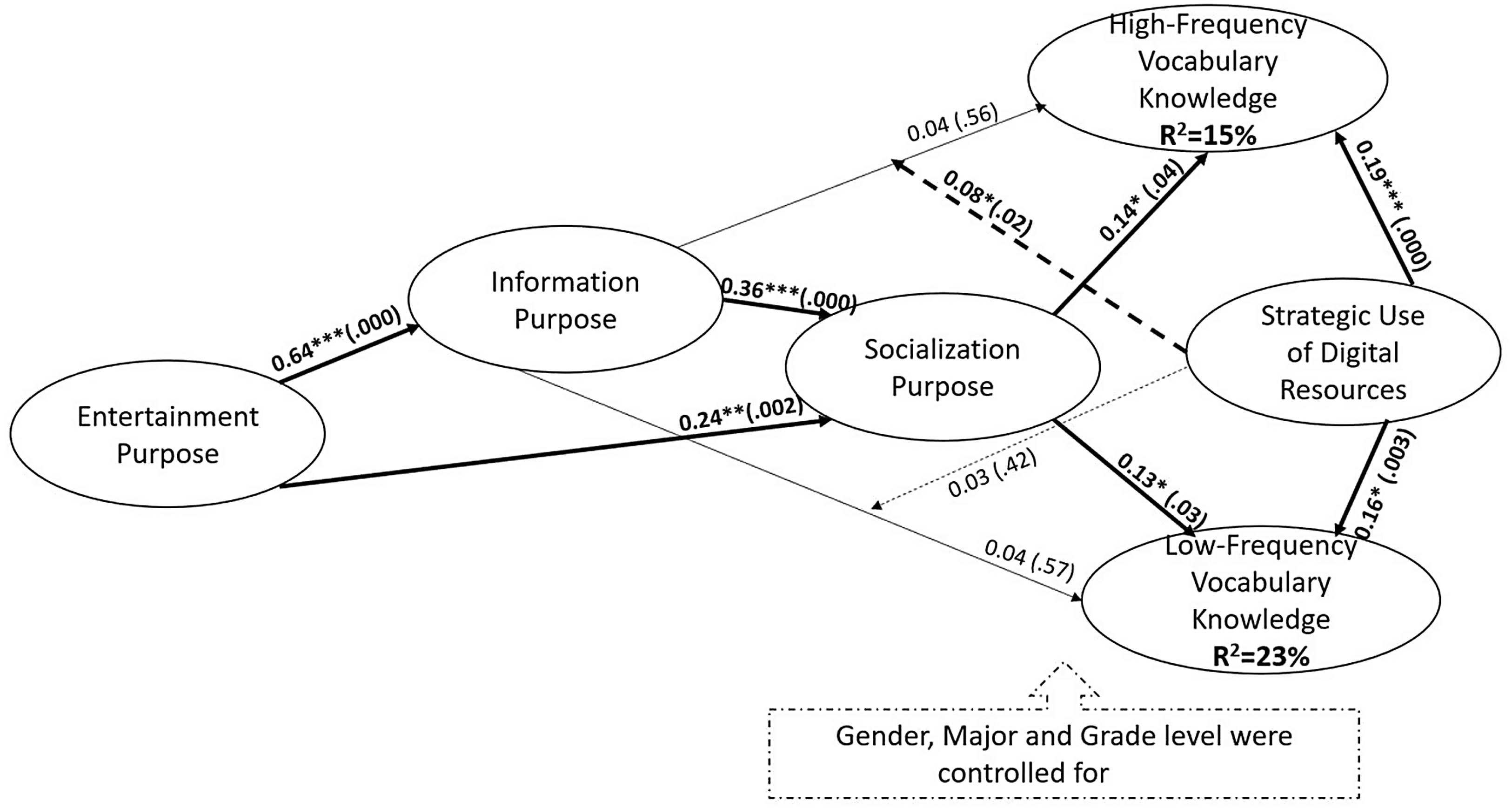
The hypothesized paths among the three media use purposes were all significant: entertainment purposes → information purposes (β = 0.64, p < .001); entertainment purposes → socialization purposes (β = 0.24, p < .01); and information purposes → socialization purposes (β = 0.36, p < .001). The findings suggest that digital activity for entertainment purposes and for information purposes were significant antecedents of digital activity for socialization purposes, with the interplay of these two media use purposes accounting for 29% of its variance. Digital activity for entertainment purposes was also a significant determinant of digital activity for information purposes, accounting for 40% of its variance (see Figure 2).
As hypothesized, media use for socialization purposes demonstrated significant direct associations with receptive vocabulary knowledge: it significantly predicted receptive knowledge of both high-frequency vocabulary (β = 0.14, p < .05) and low-frequency vocabulary (β = 0.13, p < .05) after controlling for grade level, major and gender (see Table 3). Media use for entertainment purposes predicted both high-frequency vocabulary and low-frequency vocabulary knowledge indirectly via the other two media use purposes (βhigh-frequency = 0.09, p < .05; βlow-frequency = 0.09, p < .05). Contrary to the hypothesis, media use for information purposes did not emerge as a significant predictor of receptive vocabulary knowledge, as both its direct and total effect sizes were not found to be significant. The absence of direct associations may be attributed to the inherent difficulty faced by second language learners when utilizing media to retrieve information, which often requires a significant cognitive effort to unpack and comprehend information, leaving limited attentional resources available for the noticing and acquisition of unfamiliar linguistic forms (Dang et al., Reference Dang, Lu and Webb2023). However, the results did reveal a noteworthy indirect effect on the participants’ low-frequency vocabulary knowledge via digital activities for socialization purposes (β = 0.05, p < .05). This suggests that increased involvement in media use for information purposes is associated with a greater likelihood of utilizing media for socialization purposes, which, in turn, contributes to higher levels of receptive knowledge of low-frequency vocabularies. More importantly, the path from media use for information purposes to receptive knowledge of high-frequency vocabulary was positively moderated by strategic use of digital resources (β = 0.08, p < .05). This finding suggests that participants who employed cognitive strategies that facilitated vocabulary development during digital activities exhibited a stronger association between media use for information purposes and high-frequency vocabulary knowledge. However, this moderation effect was not significant for low-frequency vocabulary knowledge (β = 0.03, p = .42), suggesting that strategic engagement with digital resources alone may not be sufficient to strengthen the connection between media use for information purposes and low-frequency vocabulary knowledge.
Direct, indirect and total effects

Note. The bolded numbers are effects that were significant. *p<.05; **p<.01; ***p<.001.
Moreover, strategic use of digital resources was a significant direct predictor of vocabulary knowledge of both high-frequency (β = 0.19, p < .000) and low-frequency vocabulary (β = 0.16, p < .001). Thus, employing cognitive strategies facilitative of vocabulary learning contributed to receptive vocabulary knowledge. Among the control variables examined (grade level, gender and major), only the participants’ major demonstrated a significant association with their vocabulary knowledge. English majors exhibited significantly greater receptive knowledge for both high-frequency and low-frequency vocabulary compared to non-English majors.
6. Discussion
The study revealed that media use purpose accounted for 15%–23% of the variance in learners’ receptive vocabulary knowledge, indicating a medium level of explanatory power (Cohen, Reference Cohen2013). The different purposes of digital activities contributed to receptive vocabulary knowledge in varying degrees. These findings support the notion that media use purposes have an impact on learning (Hu & Yu, Reference Hu and Yu2021; Lai et al., Reference Lai, Liu and Lin2023; Thums et al., Reference Thums, Artelt and Wolter2021; Vanderplank, Reference Vanderplank2019) and suggest that this analytic framework provides meaningful insights into the relationship of informal digital activities and vocabulary knowledge.
6.1 Differential relationships between purposes of informal digital activities and vocabulary knowledge
This study revealed differential associations between informal digital activities for various purposes and vocabulary knowledge. Informal digital activities for socialization purposes were found to play the most prominent role in determining receptive vocabulary knowledge, being both a direct predictor and a significant mediator. The significant association observed between socialization purposes and vocabulary knowledge may be attributed to the greater incentive for sense-making and self-expression. Engaging in online interactions for social connection motivates individuals to actively search for the meaning of unknown words used by their interlocutors (Sivagnanam & Yunus, Reference Sivagnanam and Yunus2020; Zainal & Rahmat, Reference Zainal and Rahmat2020), leading to deeper language processing, heightened cognitive engagement, and increased linguistic engagement (De Wilde et al., Reference De Wilde, Brysbaert and Eyckmans2022; Zhang et al., Reference Zhang, Zou, Cheng, Xie, Wang and Au2021). Furthermore, activities for socialization purposes are characterized by their interactive nature and often involve the use of multimodal materials. The interactive and multimodal environment can lower the comprehension hurdle and prompt conscious attention to linguistic forms, thereby facilitating incidental vocabulary learning (Domingo & Aguillon, Reference Domingo and Aguillon2021; Jin, Reference Jin2018). The findings hence suggest encouraging the use of digital spaces for socialization purposes. However, it is important to note that this finding might have been influenced by the specific research population, which in this case was Chinese EFL learners. The cultural value of saving face and maintaining positive social image (Lim & Basnyat, Reference Lim, Basnyat, Lim and Soriano2016) may result in Chinese EFL learners paying greater attention to linguistic accuracy in their online interactions, contributing to the observed association between these digital activities and vocabulary knowledge.
The study confirmed an indirect association of digital activities for entertainment purposes and vocabulary knowledge. The lack of direct effect may be attributed to the interaction patterns exhibited by learners when using media for pleasure. Learners have been found to avoid games with intense language, prefer L1 subtitled videos, disregard lyrics or captions (De Wilde et al., Reference De Wilde, Brysbaert and Eyckmans2022; Vanderplank, Reference Vanderplank2019), and lack deliberate use of metacognitive strategies (Lee & Wu, Reference Lee and Wu2013), all of which may hinder vocabulary acquisition (De Wilde, Brysbaert & Eyckmans, Reference De Wilde, Brysbaert and Eyckmans2021; Warnby, Reference Warnby2022). Another possible explanation for the lack of a direct effect is the educational culture and discourses within the Chinese EFL learning context, where learning is often not associated with fun but viewed as a disciplined and serious activity (Li, Reference Li2003). Consequently, Chinese EFL learners may perceive entertainment and learning as separate entities, which can diminish the contribution of entertainment activities to vocabulary learning. Instead, this study observed an indirect relationship between digital activities for entertainment purposes and vocabulary knowledge. These activities may either generate motivational sources, such as linguistic self-confidence (Leona et al., Reference Leona, van Koert, van der Molen, Rispens, Tijms and Snellings2021), that activate and fuel other types of digital activities, or provide linguistic sources that need to be supplemented by other types of digital activities, such as utilizing the linguistic form for information retrieval and social interactions, in order to have a notable impact on vocabulary learning. Future research may need to delve deeper into the mediation mechanisms underlying the relationship between digital activities for entertainment purposes and vocabulary learning.
The finding that media use for information purposes was the weakest predictor of receptive vocabulary knowledge is counterintuitive, considering that utilizing digital resources to seek information is typically associated with deeper processing, increased engagement in strategy use, and self-regulatory behaviors (Lee & Wu, Reference Lee and Wu2013; Thums et al., Reference Thums, Artelt and Wolter2021). However, this finding might be biased by the research participants who were of intermediate proficiency level with an average vocabulary size short of the recommended 8,000-word families for effective processing of authentic text, as specified by Nation (Reference Nation2006). The participants’ limited vocabulary size might have hindered them from fully engaging in and benefiting from information-oriented digital activities. Thus, the finding might be different for learners with more advanced language proficiency. Additionally, the study discovered that the association between informal digital activities for information purposes and receptive knowledge of low-frequency vocabulary was mediated by media use for socialization purposes. This finding is consistent with the notion that low-frequency words are not encountered frequently enough in naturalistic exposure to be acquired incidentally (Vilkaitė-Lozdienė & Schmitt, Reference Schmitt2019). Therefore, repeated exposure to such vocabularies in different language use contexts, which can be facilitated through media use for socialization purposes, becomes crucial for their acquisition. The findings hence suggest that media migration activities in the informal learning context play a crucial role in harnessing the potential of informal digital activities, particularly those for entertainment and information purposes, for vocabulary development. Media migration facilitates “linked skill activities” that are essential for incidental vocabulary development (Nation, Reference Nation2015). Findings from this study not only support the significance of considering media use purposes when examining the relationship between informal digital activities and vocabulary knowledge (e.g. Lai et al., Reference Lai, Liu and Lin2023; Vanderplank, Reference Vanderplank2019) but also draw attention to the dynamic interplay and potential mediation effects of various media use purposes. The fluid nature of informal digital activities highlights the need to understand the transitions between different media use purposes in order to gain nuanced insights into the relationship between these activities and vocabulary knowledge.
6.2 Relative associations of purpose of informal digital activities with vocabulary knowledge
This study further revealed that the purpose of informal digital activities accounted for a greater proportion of the variance in receptive knowledge of low-frequency vocabulary compared to high-frequency vocabulary. The finding that the purpose of informal digital activities played a more critical role in the development of less frequently encountered words aligns with previous research indicating a stronger relationship between informal digital activities and low-frequency vocabulary knowledge (Nation, Reference Nation2015; Niitemaa, Reference Niitemaa2020). The finding on the stronger association of informal digital activities with low-frequency vocabulary knowledge suggests the importance of informal digital English learning, especially in the Chinese context, where college English syllabus centers around the 5,000 high-frequency word families (Wang & Fan, Reference Wang and Fan2011; Zhao & Ji, Reference Zhao and Ji2018). The smaller contribution of informal digital activities to high-frequency vocabulary knowledge is understandable given that high-frequency vocabularies are likely to be learned in in-class English learning, hence limiting the add-on value of informal digital activities. However, the limited association might also be biased by the language proficiency level of the research participants in this study, as they were of intermediate-mid to intermediate-high proficiency level and might have already mastered a high proportion of these vocabularies. The finding might be different for learners with lower language proficiency levels.
Furthermore, this study uncovered that the relationship between informal digital activities for information purposes and high-frequency vocabulary size was contingent upon participants’ strategic use of digital resources. Thus, the contribution of digital activities for information purposes to high-frequency vocabulary size was not fixed, but rather depended on how the learners interacted with the resources, specifically their strategic and deliberate use of digital resources in ways that support vocabulary learning. The finding adds to existing arguments that emphasize the significance of strategic engagement in informal digital activities for vocabulary development (e.g. Lai et al., Reference Lai, Liu and Lin2023; Nation, Reference Nation2015; Shin et al., Reference Shin, Sok and Do2023) by demonstrating that strategic engagement serves not only as a direct predictor of vocabulary knowledge but also as a moderator of the relationship between informal digital activities and vocabulary knowledge. It indicates that deliberate and mindful behaviors that maximize vocabulary development are critical to informal digital activities that demand greater cognitive attention, specifically those related to information purposes. Thus, encouraging learners to engage in digital activities for information purposes per se may not contribute to vocabulary development. Rather, it is essential to encourage and support learners to engage in strategic interaction behaviors, such as dual attention to meaning and form, simultaneous attention to multiple medium sources, and deliberate attention to and processing of lexical information, to augment the association of this digital experience with vocabulary.
7. Conclusion
This study uncovered the complexity of the associations of informal digital activities for different purposes with receptive vocabulary knowledge. Specifically, it revealed a direct contribution from digital activities for socialization purposes, a mediated contribution from digital activities for entertainment purposes, and a moderated contribution from digital activities for information purposes. It further found that the purpose of informal digital English activities played a more significant role in low-frequency vocabulary knowledge, while its contribution to the high-frequency vocabulary knowledge was contingent upon participants’ strategic and deliberate use of digital resources for vocabulary learning.
The findings suggest that examining media use purposes provides valuable insights into the relationship between informal extramural digital English activities and vocabulary knowledge at a nuanced level. Given the observed differences in the link between digital activities for different purposes and vocabulary knowledge, future research could delve deeper into how these activities contribute to various motivational and cognitive factors that are crucial for vocabulary development. This would help uncover the mechanisms behind the varying impact of different digital activities on vocabulary development. Moreover, the findings underscore the significance of strategic use of digital resources in augmenting the relationship between informal digital activities and vocabulary knowledge, particularly in the context of digital activities for information purposes, as well as for high-frequency vocabularies. It is essential to raise learners’ awareness of different aspects of strategic use of digital resources that can facilitate vocabulary development.
The study has a few limitations. First of all, the research findings might have been biased by the specific context in which the study was conducted, which involved undergraduate intermediate EFL learners in China. The contribution of digital activities for socialization purposes might have been magnified, while the contribution of digital activities for entertainment purposes might have been underestimated in the Chinese cultural context. Furthermore, learners of varying age levels and language proficiency levels may choose different digital resources, engage with them in distinct ways, and prioritize different aspects of the linguistic information, even when engaging in activities with the same media use purpose (De Wilde et al., Reference De Wilde, Brysbaert and Eyckmans2022; Lai et al., Reference Lai, Hu and Lyu2018; Swanborn & de Glopper, Reference Swanborn and de Glopper2002). Additionally, the linguistic distance between one’s native language and English has been found to impact incidental vocabulary learning from informal digital activities (Puimège & Peters, Reference Puimège and Peters2019). As a result, the contributions of digital activities for different purposes to high-frequency and low-frequency vocabularies might manifest differently in different research contexts. Thus, it is crucial to investigate this research issue in other research contexts. Second, this study only examined written receptive knowledge of individual words. Digital activities for different purposes might have varying effects on other aspects of vocabulary knowledge, such as formulaic expressions, oral receptive vocabulary knowledge, and productive vocabulary knowledge. Therefore, conducting in-depth investigations into the relationship between media use purposes and these different facets of vocabulary knowledge is necessary.
Supplementary material
To view supplementary material referred to in this article, please visit https://doi.org/10.1017/S095834402400017X
Acknowledgements
This study was funded by the Hong Kong General Research Fund (No. 17605518).
Author contributions
Chun Lai: conceptualization; research design; data collection; manuscript write-up and revision. Qiu Wang: research design; data analysis; manuscript revision.
Ethical statement and competing interests
Ethical approvals were gained from the hosting institution. Participation was voluntary and consent forms were collected before data collection. The authors declare no competing interests. The authors declare no use of generative AI.
About the authors
Chun Lai is an associate professor at the University of Hong Kong. Her research interest is in self-directed language learning beyond the classroom.
Qiu Wang is an associate professor at Syracuse University, USA. His research interest is in quantitative research methods.


 Open access

