

The pilot program of the VCUarts Qatar Comics Lab’s Creating Comics Retreat began with two concepts. First, the retreat was not an educational workshop; it was a community effort to develop comic and sequential art around a theme of “third culture kids.” Secondly, the Comics Lab’s role was to facilitate the author/artist’s authentic voice. If people in the community were unable to tell their story, someone else may tell it for them. This last concept was particularly poignant for members of the community who, during lead up to the last World Cup, witnessed the rest of the world develop competing, and often misinformed, narratives of what life was like in the small host country.
The three-day workshop, held in December of 2024 at the VCUarts Qatar Library, was funded by VCUarts Qatar’s Institute for Creative Research to develop a body of work centered on the aforementioned theme. Members of the community, who were selected for participation by Comics Lab faculty, developed scripts through a mediated creation process. The retreat facilitators, faculty members and graphic novel authors from the home campus in Richmond, Virginia, then worked with authors, both independently and as a group, to refine their scripts. The refined scripts are currently being developed further by the comics lab and will be disseminated once they are finished.
A brief history of The Comics Lab
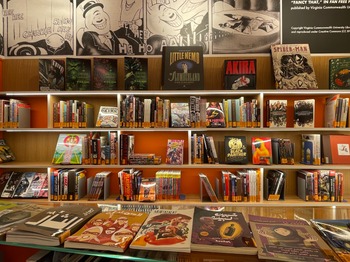
The creation of the Virginia Commonwealth University in Qatar’s Comics Lab (figure 1) was, in part, a response to the absence of access felt during the pandemic. Envisioned while locked away from things like library collections and developed as library access returned, the collection was intended to fulfill library roles that the pandemic denied – principally, the enjoyment of reading a tangible, physical item, and the serendipitous discovery of a browsable collection. Additionally, the collection intended to showcase the versatility that comic and sequential art in the dissemination of narratives – an important aspect to highlight in an art and design institution such as VCUarts Qatar. Comic and sequential art is much more than capes and tights. It is a powerful tool for communication and information dissemination.
The VCUarts Qatar Comics Lab.

The lab was also developed to collect and showcase comic and sequential art of the Middle East and North Africa (MENA) region. Although comics have long been a staple of the region’s children’s literature, only recently have comics aimed at adult readers found a wide audience. Many people credit author and artist Magdy El Shafee with publishing one of the first MENA graphic novels aimed at an adult readership with Metro, a crime noir story set in Cairo in the early 2000s. First published in 2007, the novel was widely seen as a critique of the Mubrak regime, and El Shaffee and his publisher were briefly jailed for its publication.Footnote 1 Metro seemed almost prescient when the Arab Spring erupted only a few years after it was first published. Since that time, MENA comics aimed at an adult audience have risen in popularity. Tuk Tuk in Cairo and Sandmandal in Lebanon are serial comics publications. Cairo holds a regular comic con that is focused mainly on MENA authors and artists, and the American University in Beirut opened the Rada and Mutaz Sawaf Center for Arab Comics Studies in 2023.Footnote 2
However, the portrayals of the MENA region from the outside are often problematic. In Western publications, people from the region are often portrayed as well-worn stereotypes of terrorists and warlords.Footnote 3 Other authors and artists seem to follow in the footsteps of the orientalist painters of the 19th Century – for example, Criag Thompson and his ambitious, but deeply problematic, graphic novel, Habibi.Footnote 4 In an attempt to facilitate the production of more authentic narratives from the region, the Comics Lab expanded their mission to include comic production as well as collection. In 2023 the Comics Lab was recognized as an official research lab under VCU’s Institute for Creative Research.
Planning the Creating Comics Retreat
The concept for the retreat came from a 2022 event held at University of British Columbia Center for Migration Studies. In that event, the Center for Migration Studies combined 39 scholars and community practitioners with nine graphic artists from the Vancouver area. After a series of lectures from several experts in the field, participants divided into nine working groups, presumably one group for each graphic artist, to develop graphic narratives based around the concept of “mobility and belonging.”Footnote 5
According the account of the event on the Center for Migration Studies website: “For most scholars and community practitioners, working with the medium of comics was a new experience. [it] required faculty, graduate students, and practitioners to move outside their comfort zone and let go of conventional notions of ‘expertise.’ For most graphic artists, collaborating with scholars was an equally novel experience.”Footnote 6
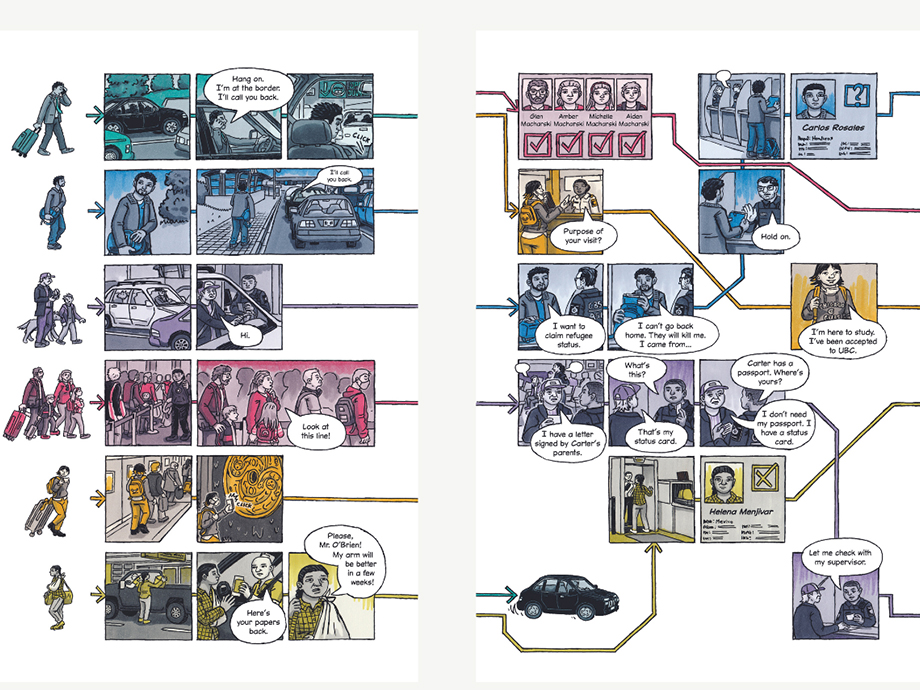
In the end, the workshop produced nine graphic narratives, which were excerpted on their website. Although all were excellent examples of a sequential graphic medium conveying a complex concept, of particular note is the “Crossing Lines” narrative by artist Johnathon Dalton and the “Borders and Human Rights story group.” In this narrative the sequence of events involved with a border crossing were mapped out across several different border crossers. Sequencing the events through intersecting narratives reinforced the idea that migration is not some monolithic concept and the motivations and complications vary greatly. It showed the efficiency with which comic and sequential art are able to convey a complex narrative.Footnote 7
Before the Comics Lab could develop some sort of analogue to the UBC Center for Migration Studies event, it would have to account for the differences in the potential participants. In the Migration Studies event, participants were scholars and community practitioners. Although VCUarts certainly had an availability of scholars and academics, the specific variety was a bit different. As an art and design school, VCUarts’ primary academic was studio based. In other words, instead of having access to 39 academics and nine artists, the Comics Labs’ immediate community was almost the inverse of that. It was decided that the Comics Lab event would have to focus on a different aspect of comics creation – the structure of the narrative. The Comics Lab decided that the focus of the retreat should be on script writing, rather than how the narrative gets translated into imagery.
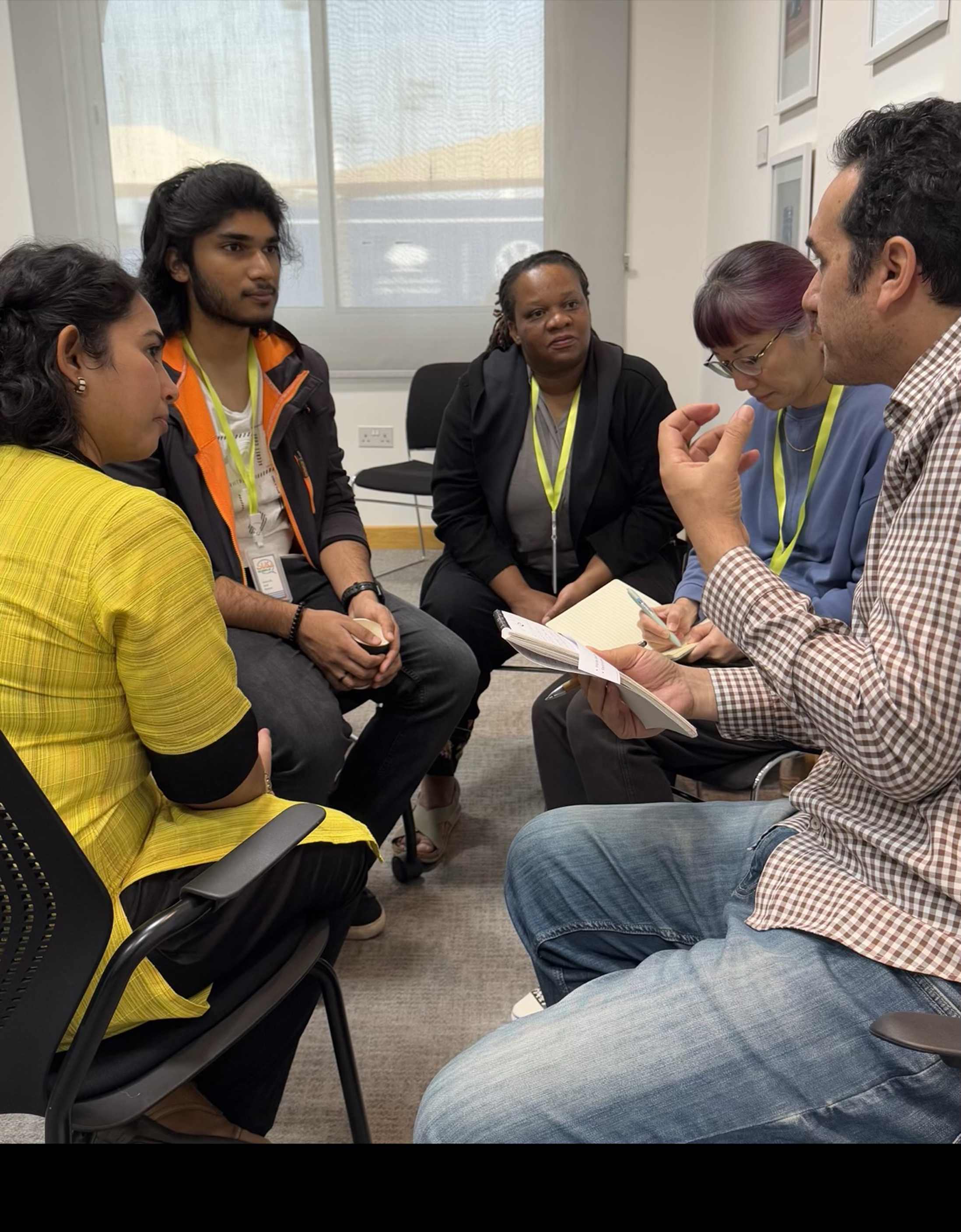
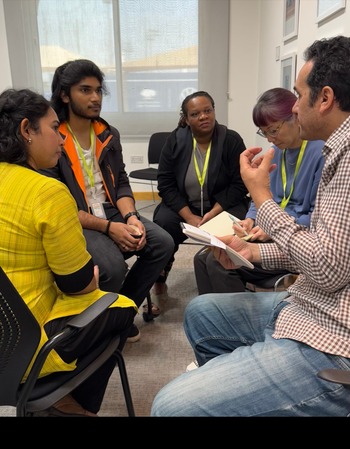
Because Comics Lab faculty had only a basic level of comic and graphic novel scriptwriting themselves, they reached out to two faculty in VCU’s Creative Writing Program on the home campus in Richmond, Virginia. Drs. S.J. Sindu and Geoff Bouvier, who have both authored graphic novels and have experience teaching comic/graphic novel scriptwriting, agreed to serve as creative moderators for the retreat (figure 2).
Dr. S.J. Sindu (left) working with workshop participants in the Comics Lab’s Creating Comics Retreat.
Over the course of several Zoom meetings Drs. Sindu, Bouvier and the three faculty members of the VCUarts Comics Lab devised a work plan for the Creating Comics event. The outline of the retreat, which was to be held over a three-day period, featured a general introduction to communicating using graphic narratives, a discussion of world building, group discussions surrounding the thematic basis of the retreat, a session on graphic poetry, an introduction to scriptwriting for comics and graphic novels, and a discussion of Comics as Social Activism. Drs. Sindu and Bouvier were to conduct all sessions other than the discussion of world building, which featured Hazem Asif, a Lahore-based illustrator, and the discussion of Comics as Social Activism, which would be presented by Dr. James Hodepp, a faculty member at Northwestern University in Qatar. These workshops were planned in addition to a number of writing workshops that were to be facilitated by Drs. Sindu, Bouvier, and the Comics Lab faculty.
The theme of the retreat
In the earliest conceptions of the Creating Comics Retreat, the Comics Lab faculty theorized that the one reason for the success of the Center for Migration Studies event was centralizing the creative potential around the singular concept of Canadian Migration. Comics Lab faculty, informed by prior experience with creative retreats, recognized that open-ended creative explorations often led to indecision and valuable retreat time wasted over determining a topic to explore. It was decided that a pre-determined theme that would focus the creative energy of the group. However, that theme would have to be broad enough to still allow for individual exploration within it.
As mentioned previously, the Comics Lab faculty settled on a theme of “third culture kids,” a term that refers to children raised in a culture other than that of their parents and who build connections to many different cultures but may not feel ownership of any.Footnote 8 Although much of the study of third-culture kids (TCK) has traditionally focused on children, colloquially, the term is used to refer to adults as well. With an 88 percent expatriate population, the theme of third-culture existence is one that resonates throughout Qatar.Footnote 9
The complexity of the theme is further compounded in Qatar due to generations of expatriates continuing to reside in the country. The path to Qatari citizenship for foreigners is practically non-existent, so generations of expatriates often continue to work in the country while holding passports from someplace else. This can lead to a not-uncommon situation where the children or grandchildren of someone who initially immigrated to Qatar still live and work in the country but hold the passport of their parents’ or grandparents’ nationality – sometimes having little or no emotional or cultural connection to the culture of their citizenship.
The theme of growing up as a third-culture kid and then trying to navigate life as a third-culture adult is a common theme for artistic expression among VCUarts’ students. Due to the experience of exploring the theme in the classroom, the Comics Lab faculty determined it should work well as the theme for the Creating Comics Retreat.
The retreat
An important component of the Creating Comics retreat was that participation would not be limited to students and faculty from VCUarts Qatar. The intent was not to set up the retreat as an educational opportunity, but rather a call for the artistic community to participate in a structured exploration of a theme using comic and sequential art.
Several weeks before the event was scheduled to be held, Comics Lab faculty sent out a call for participation through various channels VCUarts Qatar uses for publicity. The lab received 33 responses to the call for participation – about 10 more people than could be comfortably accommodated in the available space. Lab faculty determined that, if they needed to select participants, it would be done on the basis of who could attend the majority of the three-day workshop, one of the questions in the call for participation. However, follow up inquires with the interested participants revealed that several participants wouldn’t be able to attend, leaving a more manageable number of 21 registered participants.
After slight discrepancy with the schedule led to a somewhat tense “meet and greet coffee session” that saw the retreat organizers milling around a massive coffee and pastry table depressingly devoid of any participants, people began to arrive. Many of the participants were VCUarts faculty, staff and students, but there was also a large group of alumni of the school – both from the BFA as well as MFA programs. In addition to those with prior associations with VCUarts Qatar, others also found the time to participate in the retreat. One of the participants was a professional translator who had an interest in comics. Another was a football coach, who attended with a friend who was visiting him from Brazil. Other participants just referred to themselves as artists who were interested in exploring comics as a medium.
Throughout the next three days, the participants were immersed in discussions of comics and sequential art, third culture existence and creative practice. Led by Drs. Sindu and Bouvier, the participants were coached into developing a narrative and then structuring the narrative so it could be further developed as piece of sequential art. Drs. Sindu and Bouvier worked with participants both individually and in group workshopping sessions, some of which became quite emotional as participants drew on their lived experiences to develop unique narratives.
Results
In the final group workshop session, participants presented nine scripts as products of the retreat. Most were individual projects, but a couple were a collaborative effort. In the end, only a couple of the scripts were actual text “scripts.” Most were image based, drawings and comic grids that communicated the sequence of the dialog graphically rather than in a traditional “script.” This wasn’t unexpected as the majority of the participants had a background in the visual arts and were presumably more comfortable conveying the narratives visually rather than textually. Still, the graphic-based scripts all demonstrated many of the principles of narrative development that Drs. Sindu and Bouvier emphasized in the workshop sessions.
One of the text-based scripts was submitted by Samy Heday. In it, Mr. Heday outlined a series of scene-to-scene set of panel transitions that describe a young woman literally reflecting on her “homes” in the Middle East, Brazil and Germany (figure 3). The script starts with the dialog: “I don’t know the first time I left home, because I’ve done it so many times.” Mr. Heday describes the fragmented imagery of the panels as reflecting her self-image. Through a short process of self realization, Mr. Heday describes the imagery in the panels becoming less fragmented. In the end the young woman states: “I’ve finally realized where I belong. Everywhere.”
Page from script by Creating Comics Retreat participant Samy Heday. Image courtesy of Samy Heday.

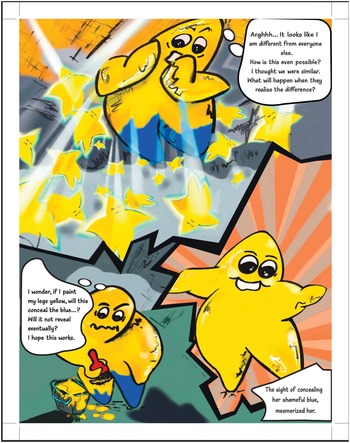
In another by local artist Catherine Mutepfa was more of a fully-realized visual sequential narrative. (figure 4) In it a creature struggles with suddenly seeing themselves as different than the other characters in the narrative, and tries to alter their appearance in an attempt to be accepted. Although the differences are revealed, they find acceptance in the fact that others are different as well. Ms. Mutepfa explained the narrative was a reflection of her life in Doha, feeling conspicuously different but eventually developing friendships with others who felt the same way.
Page from comic by Creating Comics Retreat participant Catherine Mutepfa. Image courtesy of Catherine Mutepfa.

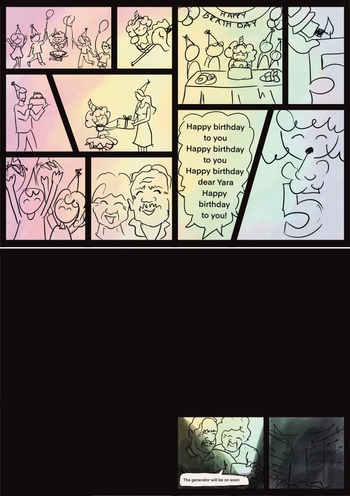
In another more visual script, designer and VCUarts MFA alumna Rania Shamseen explained that thinking of living as a third-culture adult made her remember her childhood in Lebanon during the Lebanese civil war. Her sketch of a comic script tells the story of a girl’s fifth birthday party, complete with a cake, balloons, children signing happy birthday and what appear to be doting grandparents (figure 5). In the last frame of the first page, the girl blows out a candle on the cake. The next page is almost totally filled with black frames as if the girl had extinguished all sources of illumination. In the second to the last frame the doting grandparents reappear in what is presumably a flashlight beam and say “the generator will be on soon.” The final frame shows a lightless city skyline. The narrative is simultaneously an account of people doing their best to live a normal life while a war rages around them, and a terrifying reminder that for many people the story ended at the end of the first page.
Comic draft by Creating Comics Retreat participant Rania Shamseen. Image courtesy of Rania Shamseen.

In a more abstract example, graphic designer Sarah Shaaban uses cut out words, rearranged to develop a series of poetic phrases representative of her associations with third culture (figure 6). The top panel reads: “drinking ameriddine made from dried peaches a pinch of blossom essence and water eating a dish of fried fish with brightly glazed pine nuts and onions, celebrating another year at the table together.” The words are superimposed on the close-up image of an eye, with an image of clasping hands as an iris. The bottom frame of the page is another close up image of an eye superimposed with the words: “listening to the emotional ballad by iconic singer Fairuz to her beloved city of Beirut to connect when I’m so far away.” The iris of the eye contains an image of Beirut’s Pigeon Rock with the phrase “Salam to Beirut” written in Arabic. The rest of the four-page comic continues in a similar vein, using combinations of assembled words and fractured images in a sort of sequential visual poetry to communicate deep connections to people and places.
Graphic poetry by Creating Comics Retreat participant Sarah Shaaban. Image courtesy of Sarah Shaaban.

Conclusion
Currently the Comics Lab faculty are discussing the options of what we might do with the works created as part of the Creating Comics Retreat. In addition to the ones mentioned in this paper, the lab received several that had the potential to be further developed into publishable works. The obvious next step would be to work with illustrators and graphic designers to develop some sort of publication around the theme - a step which would require additional funding, but is certainly in the realm of possibilities. The lab is also considering repeating this same sort of model, informed by the lessons learned from this one, to continue to develop work around pertinent themes.
Although it started with a collection of comics and graphic novels, The Comics Lab’s mission has always been to facilitate the creative voice of a community. The Creating Comics Retreat was a case study in one way the lab was able to make strides toward doing that. Additionally, It demonstrates how a library, by providing the space, time and resources, can be an institution that not only collects, preserves and disseminates information, but creates it as well.



 Open access