





1. Introduction
Over the past two decades, converging evidence from psycholinguistics, corpus linguistics, typology and computational modelling has highlighted the role of pressures arising during language usage in shaping grammatical properties across the world’s languages. In this perspective, intra-linguistic variation, typological differences and their diachronic development are explained in terms of general cognitive and communicative principles such as efficiency, learnability and memory limitations (e.g. Christiansen & Chater, Reference Christiansen and Chater2008; Fedzechkina & Jaeger, Reference Fedzechkina and Jaeger2020; Gibson et al., Reference Gibson, Futrell, Piantadosi, Dautriche, Mahowald, Bergen and Levy2019; Hawkins, Reference Hawkins2014; Jaeger & Tily, Reference Jaeger and Tily2011; Koplenig et al., Reference Koplenig, Wolfer, Rüdiger and Meyer2025; Sinnemäki, Reference Sinnemäki2014).
To investigate the relationship between usage preferences and grammatical structure more directly, recent work increasingly integrates evidence from different behavioural domains. In particular, corpus-based distributional patterns, acceptability judgements and online processing measures have been brought together to capture complementary aspects of speakers’ linguistic behaviour. This reflects a growing consensus that grammatical variation and change are not tied to a single domain, but arise from interactions among multiple behavioural dimensions, such as distribution,Footnote 1 acceptability and processing (e.g. Bosch et al., Reference Bosch, De Cesare, Demske and Felser2021).
Methodological triangulation offers a systematic way to compare such dimensions and assess whether they reveal consistent patterns. Studies combining corpus, judgement and processing data demonstrate the value of methodological synergies: parallels across methods strengthen interpretations, while fine-grained mismatches offer explanatory insights and reveal aspects of speakers’ linguistic knowledge that no single behavioural dimension can capture (e.g. Ford & Bresnan, Reference Ford, Bresnan, Krug and Schlüter2013; Hampton Reference Hampton2023; Papadopoulou et al., Reference Papadopoulou, Amvrazis, Douka and Tantos2024).
The present study applies such a combined-method approach to examine how different behavioural dimensions interact and how they relate to cross-linguistic grammatical variation and its development in English, Dutch and German.
1.1. The role of language usage preferences in shaping typological variation
From a functional, usage-based perspective, grammatical patterns reflect the effects of efficiency-related pressures operating across different dimensions of linguistic behaviour. Crucially, structures that reduce memory load and increase predictability tend to be processed more easily, judged as more acceptable and more likely to become distributionally conventionalized (Gibson et al., Reference Gibson, Futrell, Piantadosi, Dautriche, Mahowald, Bergen and Levy2019; Jaeger & Tily, Reference Jaeger and Tily2011). At the same time, accounts based on the Uniform Information Density hypothesis (Jaeger, Reference Jaeger2010) emphasize that processing is facilitated when information is distributed more evenly across the utterance. These approaches can be understood as targeting different aspects of processing efficiency, which may converge or diverge depending on the structure in question – a tension that is itself relevant to understanding variation in grammatical patterning.
Efficiency-driven conventionalization has also been proposed to explain cross-linguistic variation, for example, in word order differences, which reflect strategies to reduce dependency length or production effort (Fedzechkina & Jaeger, Reference Fedzechkina and Jaeger2020; Hawkins, Reference Hawkins2004). Efficiency in language usage – measured through surprisal, entropy or memory load – thus provides the mechanism through which linguistic preferences emerge, while grammar represents their long-term stabilization (see also Sinnemäki, Reference Sinnemäki2014).
Large-scale quantitative work by Koplenig et al. (Reference Koplenig, Wolfer, Rüdiger and Meyer2025), using multivariate and machine-learning analyses across more than 2,000 languages, shows that languages evolve to balance communicative efficiency with structural complexity, revealing a universal trade-off that constrains linguistic diversity. Additionally, computational simulations implementing the processing constraints proposed by Hawkins (Reference Hawkins2004) yield grammars that mirror natural typological distributions (Christiansen & Kirby, Reference Christiansen and Kirby2003; Perfors, Reference Perfors2002). Similarly, Monte Carlo simulations by Gildea and Jaeger (Reference Gildea and Jaeger2015) show that attested word order systems across languages are near-optimal in terms of dependency length and local lexical predictability. Together, these findings indicate that grammatical structures and their typological distributions arise from pressures associated with language usage preferences. Grammars can thus be viewed as complex adaptive systems (Gell-Mann, Reference Gell-Mann1992), with efficiency in usage driving adaptation in response to prior changes.
While numerous studies relate patterns of grammatical variation to individual behavioural dimensions, such as processing difficulty, acceptability patterns or distributional frequency, these links are typically established along a single dimension at a time. As a consequence, it remains unclear whether findings from one behavioural domain are representative of others, or how the different dimensions relate to one another in shaping or reflecting grammatical variation. This limitation is further compounded across languages.
1.2. Interfaces of linguistic behaviour
To further investigate how typological structures are shaped by language usage preferences, it is essential to examine how different dimensions of linguistic behaviour relate to usage, but also to each other. Production and corpus data reveal which structures are attested and how frequently they occur; acceptability judgements capture speakers’ metalinguistic evaluations of linguistic forms; processing measures (e.g. reaction times, reading times, gaze patterns from eye-tracking or ERP signatures) quantify the cognitive effort involved in real-time comprehension.
A key methodological question is how closely these dimensions converge. While acceptability often correlates with corpus and production patterns (Arppe & Järvikivi, Reference Arppe and Järvikivi2007; Bresnan et al., Reference Bresnan, Cueni, Nikitina, Baayen, Bouma, Kraemer and Zwarts2007; Bresnan & Ford, Reference Bresnan and Ford2010; Lau et al., Reference Lau, Armendariz, Lappin, Purver and Shu2020), it does not necessarily align with online processing measures (Clifton et al., Reference Clifton, Staub, Rayner and Rayner2006; Francis, Reference Francis2010). Acceptability and processing tend to align when processing difficulty stems from structural complexity, but diverge when acceptability is influenced by factors such as frequency, experience or pragmatic context (Dąbrowska, Reference Dąbrowska2017; Hofmeister et al., Reference Hofmeister, Casasanto and Sag2014). No consistent cross-linguistic pattern has emerged so far, underscoring the need for empirical approaches that combine both measures to clarify how processing effort and acceptability jointly reflect grammatical organization.
Speeded acceptability judgements add an important dimension by constraining the time available for metalinguistic reflection. Under time pressure, responses are more closely tied to automatic processing mechanisms and can reveal underlying uncertainty about what is acceptable. Decision dynamics, such as reaction times, can identify transitional zones between clearly acceptable and unacceptable items, that is, intermediate states in metalinguistic evaluation (Mirault & Grainger, Reference Mirault and Grainger2020; Yi & Park, Reference Yi and Park2023). Such synchronically unstable patterns may signal structures undergoing reorganization within the language system. Recent work suggests that this kind of uncertainty can accompany phases of grammatical change (De Vogelaer et al., Reference De Vogelaer, Fanta, Poarch, Schimke, Urbanek, De Vogelaer, Koster and Leuschner2020b), where increased variability and slower judgements correspond to competition between emerging and receding patterns in usage. The present study combines speeded acceptability judgements with self-paced reading, and is, therefore, well positioned to provide new evidence on how behavioural dimensions converge or diverge across languages in relation to typologically distinct grammatical patterns, exemplified here by permissive subjects in English, Dutch and German.
1.3. Permissive subjects as a test case
Permissive subjects (see Example 1) involve non-agentive subjects (in bold) paired with action verbs (underlined) that typically require agentive subjects in a transitive NP–V–NP structure Comrie, Reference Comrie1989; Givón, Reference Givón1984). The term permissive subjects for these constructions is relatively recent and was introduced by Los & Dreschler (Reference Los, Dreschler, Nevalainen and Traugott2012). Other work discusses the relevant constructions under a variety of labels (e.g. secondary subjectivizations in Rohdenburg, Reference Rohdenburg1974; npaparp for a non-prototypical agent with a prototypical agent-requiring predicate in Vandepitte & Hartsuiker, Reference Vandepitte, Hartsuiker, Alvstad, Hild and Tiselius2011; non-human agent in Doms & De Clerck, Reference Doms and De Clerck2015; Doms et al., Reference Doms, De Clerck, Vandepitte, Ruchot and Van Praet2016) and from different theoretical perspectives. These include contrastive approaches in different languages based on corpus data and translation experiments (e.g. Callies, Reference Callies and Arabski2006; Doms & De Clerck, Reference Doms and De Clerck2015; Hawkins, Reference Hawkins1986; Heilmann et al., Reference Heilmann, Serbina, Freiwald and Neumann2021; Kalocsai, Reference Kalocsai2009; Rohdenburg, Reference Rohdenburg1974; Vandepitte & Hartsuiker, Reference Vandepitte, Hartsuiker, Alvstad, Hild and Tiselius2011), as well as diachronic studies focussing on English (e.g. Dreschler, Reference Dreschler2020), resulting in a highly heterogeneous body of literature. The grammatical patterns subsumed under these terms themselves vary considerably with respect to lexical restrictions, argument-structural properties and degrees of conventionalization across languages (see Section 2.2 for more details).
Permissive subjects fall within Hawkins’ (Reference Hawkins1986) loose vs. tight fit typology, which captures how transparently languages map grammatical form onto meaning. English is classified as a loose fit language, where grammatical forms tend to permit greater ambiguity and semantic vagueness, as reflected, for instance, in the broader range of semantic roles associated with grammatical functions such as the subject (cf. Hawkins, Reference Hawkins1986 for an overview of all typological parameters; see Hawkins, Reference Hawkins2026 for a recent comparison of German and English relative clauses in terms of tight vs. loose fit). German, by contrast, lies at the tight fit end of the spectrum, meaning that surface forms are less ambiguous in their semantic interpretation. As Example (1) illustrates, the NP–V–NP clause type in German cannot support the broad range of thematic role combinations attested in English. The typology, later expanded by Müller-Gotama (Reference Müller-Gotama1994) and Levshina (Reference Levshina2020), applies beyond the West Germanic languages to universal cross-linguistic patterns more generally.

Permissive subjects show striking cross-linguistic contrasts aligned with the well-known ‘Germanic Sandwich’, which positions Dutch between English and German (De Vogelaer et al., Reference De Vogelaer, Koster and Leuschner2020a; Van Haeringen, Reference Van Haeringen1956; Van Olmen, Reference Van Olmen2025; Vismans et al., Reference Vismans, Hüning and Weerman2010). In Dutch, they are less frequent than in English, yet more readily attested than in German, as supported by parallel corpora (Doms et al., Reference Doms, De Clerck, Vandepitte, Ruchot and Van Praet2016; Doms & De Clerck, Reference Doms and De Clerck2015; Vandepitte & Hartsuiker, Reference Vandepitte, Hartsuiker, Alvstad, Hild and Tiselius2011). On the basis of corpus-based distributional patterns, Müller-Gotama (Reference Müller-Gotama1994) therefore classifies Dutch as closer to the loose-fit type within the typology.
Renzel et al. (Reference Renzel, De Vogelaer and Bölte2025a, Reference Renzel, De Vogelaer and Bölte2025b) likewise classify Dutch as closer to the loose-fit languages, drawing on processing behaviour. A self-paced reading study examining the processing of permissive subjects across English, Dutch and German shows that reading times in Dutch pattern more closely with those in English: both English and Dutch speakers process permissive subjects more efficiently than German speakers, who display clear processing difficulty. It is suggested that speakers of the three languages appear to employ different strategies for resolving permissive subjects, resulting in varying degrees of processing speed. Dutch and English speakers rely more on anticipatory, look-ahead mechanisms, which imply predictive processing and lead to faster parsing of these constructions, whereas German speakers depend more on retrospective, look-back mechanisms, in which the parser refers back to previously encountered arguments and integrates information during sentence processing rather than engaging in prediction. This results in slower processing of the constructions (see Renzel et al., Reference Renzel, De Vogelaer and Bölte2025a and also Section 3.2 for a more detailed discussion).
1.4. The present study
The present study advances previous research on permissive subjects in English, Dutch and German by integrating speeded acceptability judgements and self-paced reading within a single design. This combined-method approach allows us to examine multiple dimensions of linguistic behaviour simultaneously and to relate them directly to typological variation. The speeded acceptability task targets speakers’ metalinguistic evaluations of different types of permissive subjects and, through reaction times under time pressure, reveals underlying uncertainty about what is considered acceptable. The self-paced reading task measures incremental processing effort, providing a complementary window onto how speakers of the three languages process permissive subjects and whether they employ different processing strategies. Combining these two behavioural dimensions allows us to address broader questions about their relationship and their role in cross-linguistic grammatical variation. We ask how different dimensions of linguistic behaviour, namely, acceptability and processing, relate to typological variation and to what extent they can explain it. We explicitly map the dimensions onto one another, examining their correlations, interactions and the extent to which they reveal consistent cross-linguistic patterns.
Our study not only integrates methods but also compares three closely related West Germanic languages. English, Dutch and German share much of their vocabulary and core grammar, yet differ in typologically relevant parameters such as the semantic diversity of subjects as well as word order and case marking. English is characterized by a rigid SVO word order, whereas both German and Dutch are predominantly verb-final and allow for greater word order flexibility (Dryer & Haspelmath, Reference Dryer and Haspelmath2013; Sabel & Saito, Reference Sabel and Saito2005). This flexibility makes alternative linearizations possible, such as object-fronting, in both languages. At the same time, German exhibits robust case marking on noun phrases, which is largely absent in both English and Dutch (see Renzel et al., Reference Renzel, De Vogelaer and Bölte2025a for a more detailed discussion of typological differences, especially word order differences, across the three languages). Together, the three languages form a typological continuum that allows us to attribute language-specific differences in efficiency, processing and acceptability to shared cognitive mechanisms.
Based on prior corpus and experimental findings, clear contrasts across the three languages can be expected in both acceptability and processing. Previous research has shown that acceptability judgements broadly align with distributional and production patterns: constructions that occur more frequently or are more strongly preferred tend to receive higher acceptability ratings (e.g. Arppe & Järvikivi, Reference Arppe and Järvikivi2007; Bresnan et al., Reference Bresnan, Cueni, Nikitina, Baayen, Bouma, Kraemer and Zwarts2007; Bresnan & Ford, Reference Bresnan and Ford2010; Lau et al., Reference Lau, Armendariz, Lappin, Purver and Shu2020). In line with these findings and based on earlier contrastive corpus research (Doms & De Clerck Reference Doms and De Clerck2015; Dreschler Reference Dreschler2020; Hawkins Reference Hawkins1986; Heilmann et al. Reference Heilmann, Serbina, Freiwald and Neumann2021; Rohdenburg Reference Rohdenburg1974; Vandepitte & Hartsuiker Reference Vandepitte, Hartsuiker, Alvstad, Hild and Tiselius2011), we expect permissive subjects to be rated as most acceptable in English and least acceptable in German, with Dutch occupying an intermediate position. Reaction times in the acceptability task are expected to provide additional insight into the stability and gradience of these judgements. Specifically, we anticipate shorter decision times for highly acceptable and well-established constructions – particularly in English – and longer decision times for constructions that are less entrenched, especially in German. For Dutch, we expect an intermediate pattern, with longer decision times than in English but a less pronounced increase than in German, reflecting greater decision uncertainty and a less stable conventionalization status. With respect to online processing, we expect the strongest processing difficulty for permissive subjects in German, substantially reduced difficulty in English and an intermediate pattern in Dutch, in line with previous self-paced reading findings (Renzel et al., Reference Renzel, De Vogelaer and Bölte2025a). As comparable combined-method experiments on permissive subjects across these languages have not previously been conducted, analyses beyond these general expectations were exploratory in nature.
2. Method: Speeded acceptability judgements combined with self-paced reading
2.1. Participants
We recruited native speakers of English (n = 50; 20 male, 30 female), Dutch (n = 40; 21 male, 19 female) and German (n = 42; 18 male, 24 female). Participants were students tested in Lancaster (England), Aalten (Netherlands) and Münster (Germany), aged between 18 and 35 years (M = 24). All reported normal or corrected-to-normal vision, and no reading or neurological disorders. To assess potential effects of language contact, participants provided self-ratings of their active use of and passive exposure to English, Dutch and German, as well as additional languages learned. Exploratory analyses revealed no reliable effects of age, gender or language contact on the dependent measures, so these variables were not included as covariates in the confirmatory models. Participants received monetary compensation for their participation.
2.2. Materials and design
The design closely followed Renzel et al. (Reference Renzel, De Vogelaer and Bölte2025a). The set of permissive subjects was divided into four categories, following the classification proposed in that study and supported by robust cross-linguistic evidence. This classification is grounded in the degree of (syntactic-)semantic violation that these constructions produce in Dutch and German, and it reflects earlier contrastive corpus studies and translation experiments (Callies, Reference Callies and Arabski2006; Doms et al., Reference Doms, De Clerck, Vandepitte, Ruchot and Van Praet2016; Doms & De Clerck, Reference Doms and De Clerck2015; Dreschler, Reference Dreschler2020; Hawkins, Reference Hawkins1986; Heilmann et al., Reference Heilmann, Serbina, Freiwald and Neumann2021; Rohdenburg, Reference Rohdenburg1974; Vandepitte & Hartsuiker, Reference Vandepitte, Hartsuiker, Alvstad, Hild and Tiselius2011).
Briefly, the four categories are as follows (see Renzel et al., Reference Renzel, De Vogelaer and Bölte2025a for full definitions and motivation):
-
1. Transitivity-altering permissive subjects (TPS): involve a non-agentive subject combined with a verb that is intransitive in Dutch and German, but is used in a transitive syntactic frame with a direct object, resulting in an alternation in transitivity. Thus, TPS entail both a semantic violation – due to the non-agentive subject combined with an action verb – and a syntactic violation. They typically indicate how much of something fits in, on or within something else (e.g. The tent sleeps four people).
-
2. Material permissive subjects (MPS): denote material actions resulting in a tangible product or outcome (e.g. The flour bakes three pizzas).
-
3. Immaterial permissive subjects (IPS): involve abstract or communicative actions adding information or knowledge (e.g. The passport describes the air passenger).
-
4. Pseudo-agentive permissive subjects (PPS): functionally motivated constructions, typically found in media contexts, where a non-agentive subject conceals or backgrounds the true agent (e.g. The train doors injured the passenger).
These four categories capture a gradient from strong to weak violation in Dutch and German (TPS > MPS > IPS > PPS) and vary considerably in their occurrence across the three languages. It is important to emphasize at this point that these categories should not be understood as exhaustive or sharply delimited groups. Rather, they represent analytically motivated groupings intended to introduce some degree of systematicity into the otherwise heterogeneous and fragmented way in which permissive subjects have been discussed in the existing literature. The categories differ in size, as well as in their lexical and semantic flexibility and distribution in different languages (see Section 3.1 for more). Moreover, they do not cover all possible constructions that could plausibly be classified as permissive subjects. Nevertheless, the four categories allow for a more structured comparison across languages and behavioural dimensions within an experimental framework. Their usefulness has also been demonstrated in previous experimental work, where the same classification proved cross-linguistically informative (Renzel et al., Reference Renzel, De Vogelaer and Bölte2025a; see also the Results sections of the present study). This categorization allows systematic testing of cross-linguistic variation in both acceptability and processing.
The overall design included 144 target sentences and 96 filler items. Fillers comprised 48 semantically anomalous, 24 syntactically anomalous and 24 well-formed items to provide a broad acceptability range and prevent task adaptation. The experimental design manipulated Agentivity, contrasting non-agentive permissive subjects with agentive controls. Control items used the same verbs but began with an animate, plausible agent. All target pairs were matched for syllable count and lexical equivalence across English, Dutch and German, and screened for plausibility. Frequency checks were conducted using the SUBTLEX corpora for the three languages (Brysbaert et al., Reference Brysbaert, Buchmeier, Conrad, Jacobs, Bölte and Böhl2011; Brysbaert & New, Reference Brysbaert and New2009; Keuleers et al., Reference Keuleers, Diependaele and Brysbaert2010).
Reading-time analyses focussed on the verb region. As discussed in Renzel et al. (Reference Renzel, De Vogelaer and Bölte2025a), and supported by a large body of research on argument-structure processing (see Friederici & Frisch, Reference Friederici and Frisch2000 for a summary of relevant studies), the verb plays a central role in the mapping of thematic relations, and reading times at the verb region provide crucial evidence about underlying processing mechanisms and strategies. When the verb is encountered, interpretive possibilities become increasingly constrained, and the parser is confronted with strong pressure to integrate the initial constituent with an action-denoting predicate. In English, this integration is more straightforwardly involved in an interpretation of the initial constituent as the subject, due to strict SVO word order. In Dutch and German, by contrast, alternative analyses of the initial noun phrase as something other than the subject may still be available at this point, as both languages allow greater word order flexibility, including object fronting. This applies to a small subset of stimuli in the MPS, PPS and IPS categories, with the exception of TPS constructions, which involve verbs without a direct object. We discuss the implications of these structural differences for processing patterns in more detail in the Results Section 3.2.
Within each category, we manipulated Documentedness by including equal numbers of documented (DOC) constructions attested in English and extended (EXT) variants. EXT constructions were selected based on prior work by Rohdenburg (Reference Rohdenburg1974). They represent hypothetical permissive subjects that were either judged unacceptable by informants in Rohdenburg’s study and/or did not occur in Rohdenburg’s corpus data in German and English. In addition, we consulted the SUBTLEX frequency corpus to corroborate the non-occurrence of these subject–verb combinations in contemporary usage. Importantly, this selection criterion reflects prior judgement-based and corpus-based evidence, but the EXT condition was not intended to distinguish between grammatical and ungrammatical items, since a lack of corpus attestation does not imply ungrammaticality and constructions judged unacceptable in earlier work are not necessarily rejected uniformly by all speakers. Rather, EXT deliberately groups constructions that seem to fall outside what may tentatively be characterized as a conventionalized permissive subject space, although this space is not clearly delimited. This manipulation tests whether acceptability and decision dynamics differ for attested vs. extended permissive subjects and whether constraints reflect exposure to documented forms or more abstract semantic regularities. It thus allows us to examine behavioural patterns independent of construction frequency, revealing deeper contrasts in behavioural patterns across the three languages.
Each stimulus consisted of a noun phrase, a critical verb and post-verbal material (e.g. the tent sleeps four people). All items were presented in random order (see Supplementary Appendix A for all target stimuli).
2.3. Procedure
The experiment was programmed in PsychoPy (Peirce et al., Reference Peirce, Gray, Simpson, MacAskill, Höchenberger, Sogo and Lindeløv2019) and run on a DELL Latitude 3330 laptop. Sessions were conducted in quiet rooms, with one participant tested at a time and the experimenter present throughout. On-screen instructions were provided in the participant’s native language. Participants advanced sentences word by word using the right hand in a self-paced reading paradigm (Aaronson & Scarborough, Reference Aaronson and Scarborough1977; Mitchell & Green, Reference Mitchell and Green1978). Each space-bar press replaced the current word with the next, allowing reading at the participant’s own pace; faster RTs indicate easier processing, slower RTs indicate increased difficulty (Jegerski & VanPatten, Reference Jegerski and VanPatten2013). After each sentence, a binary acceptability question (‘Is this sentence correct?’) appeared. Participants responded as quickly and accurately as possible using the left hand (Q = ‘yes’ with the ring finger; R = ‘no’ with the index finger), keeping both fingers on the keys throughout. No feedback was given. Acceptability was operationalized as a binary decision (correct vs. incorrect) rather than as a graded scale. This choice was motivated by the speeded nature of the task and by our interest in decision dynamics rather than fine-grained metalinguistic judgements. Binary judgements allow for a clear and well-defined decision point, enabling direct comparison between acceptability decisions and online processing measures such as reading times. In contrast, graded acceptability scales often encourage reflective and strategic responding and introduce substantial inter-individual variation in scale use (Schütze, Reference Schütze1996), which can obscure response-time effects. The binary format, therefore, provides a more suitable measure for capturing rapid evaluative decisions and their alignment with processing behaviour.
A short practice block preceded the main experiment to familiarize participants with the procedure and response mapping. The main session consisted of three blocks of roughly 15 minutes each, separated by short breaks. After the experiment, participants completed a background questionnaire on handedness, demographic information, reading or spelling difficulties, neurological or psychiatric diagnoses, language proficiency and language contact. All instructions and communication were conducted in the participant’s native language to match the language of the stimuli.
2.4. Data analysis
All analyses were conducted in R (version 4.5.2) (R Core Team, 2025) using lme4 (Bates et al., Reference Bates, Mächler, Bolker and Walker2015) for (generalized) linear mixed-effects modelling. Following a Winsorizing procedure as a method of replacing extreme values to reduce the influence of outliers (Dixon, Reference Dixon1980), extreme values in decision reaction times and reading times (RTs below 100 ms and above 4,000 ms) were replaced with alternative values adjusted to the next lowest or highest non-extreme value. Categorical predictors were deviation-coded, and continuous predictors were centred and standardized to facilitate interpretation of main effects and interactions (Baayen et al., Reference Baayen, Davidson and Bates2008; Barr et al., Reference Barr2013). Model assumptions were checked via residual and Q–Q plots, and model selection was guided by theoretical criteria and likelihood ratio tests. Random-effect structures were optimized with buildmer (Voeten, Reference Voeten2023) to arrive at parsimonious yet theoretically motivated models, and marginal/conditional R2 values were computed (Nakagawa & Schielzeth, Reference Nakagawa and Schielzeth2013). Pairwise comparisons used emmeans (Lenth, Reference Lenth2023) with Tukey correction; visualizations were produced with ggplot2 (Wickham, Reference Wickham2016).
2.4.1. Analysis of acceptability judgements and decision reaction times
Step 1: Acceptability Judgements
The binary acceptability responses (acceptable vs. unacceptable) were analysed using a binomial generalized linear mixed-effects model (GLMM) with a logit link. Predictors included Language, Agentivity and Category, and all interactions. A preliminary model including Documentedness was also fitted. Model comparison (AIC and χ2 tests) revealed that Documentedness did not improve fit and was therefore excluded from the final confirmatory model. Random effects included intercepts for Participants and Items and a by-participant slope for Agentivity. The model yielded predicted acceptance probabilities (p̂) per condition, language and item, that is, model-based estimates of acceptance likelihood per condition.
Step 2: Decision Reaction Times
Decision RTs were analysed separately with a linear mixed-effects model (LMM). After Winsorizing, decision RTs were log-transformed to reduce right skew following a Box-Cox procedure (Box & Cox, Reference Box and Cox1964), which indicated an optimal λ ≈ 0. The fixed and random structure of the LMM matched the acceptability model.
Step 3: Linking Acceptability and Decision Reaction Times (Decision Uncertainty)
Previous research (Mirault & Grainger, Reference Mirault and Grainger2020; Yi & Park, Reference Yi and Park2023) has shown that the slowest acceptability judgements typically occur around 50% acceptance, reflecting uncertainty and instability in the underlying grammatical representations. Such intermediate judgements are often interpreted as indicators of constructions in the process of reorganization within the language system (De Vogelaer et al., Reference De Vogelaer, Fanta, Poarch, Schimke, Urbanek, De Vogelaer, Koster and Leuschner2020b). To test whether decision RTs reflect this kind of judgement uncertainty, we derived a continuous predictor distance-to-50 (Dist50) from the GLMM predictions:
 $$ \mathrm{Dist}50\;\left(\mathrm{distance}\hbox{-} \mathrm{to}\hbox{-} 50\right)=\mid \hat{p}-0.5\mid $$
In Dist50, $ \hat{p} $
is the predicted probability of an acceptable response for each item, condition and language. A value of 0 corresponds to maximal uncertainty (≈ 50% acceptability), and 0.5 reflects maximal certainty (≈ 0% or 100% acceptability). Dist50 was z-standardized within each language and entered as a covariate in the LMM of decision RTs. Slopes for uncertainty effects were estimated with emtrends per Language × Category to assess whether items closer to 50% acceptability elicited slower decision RTs. A negative slope for Dist50 indicates faster decisions with increasing certainty (responses far from 50%), whereas a positive slope indicates slower responses with increasing certainty.
$ \hat{p} $
is the predicted probability of an acceptable response for each item, condition and language. A value of 0 corresponds to maximal uncertainty (≈ 50% acceptability), and 0.5 reflects maximal certainty (≈ 0% or 100% acceptability). Dist50 was z-standardized within each language and entered as a covariate in the LMM of decision RTs. Slopes for uncertainty effects were estimated with emtrends per Language × Category to assess whether items closer to 50% acceptability elicited slower decision RTs. A negative slope for Dist50 indicates faster decisions with increasing certainty (responses far from 50%), whereas a positive slope indicates slower responses with increasing certainty.
Judgement uncertainty was operationalized primarily using Dist50, which directly measures proximity to the 50% decision boundary. Dist50 is immediately interpretable in percentage points (e.g. an effect per +10 percentage points towards 50%), allowing regression coefficients to be scaled and interpreted transparently. As a robustness check, we also derived Shannon entropy (Shannon, Reference Shannon1948) for each item, here defined as:
 $$ H\left(\hat{p}\right)=-\left[\hat{p}\log \left(\hat{p}\right)+\left(1-\hat{p}\right)\log \left(1-\hat{p}\right)\right] $$
However, entropy is less transparent for interpretation in the present context, as it is expressed in abstract information units and does not map as directly onto proximity to the binary decision boundary as Dist50. Importantly, entropy and Dist50 are equivalent in that they are both symmetric around 0.5, attain their maximum at 0.5 and their minimum at the extremes. Consequently, they impose the same ordinal structure on the data and lead to identical inferential conclusions, differing only in scale and functional form. Because Dist50 behaves approximately linearly around the decision boundary and maps directly onto the binary decision process underlying the task, we report Dist50 in the main text for reasons of interpretability and communicative economy, with entropy confirming the pattern.
This analysis approach allows a direct mapping between metalinguistic evaluation and decision dynamics, identifying items with intermediate, unstable acceptability that elicit slower decision RTs.
2.4.2. Data analysis of reading times and linking analysis
Step 1: Reading time analysis
Reading times were Winsorized and log-transformed (optimal Box-Cox λ = –0.1). An LMM was fitted with fixed effects of Language, Agentivity and Category, random intercepts for Participants and Items and a by-participant slope for Agentivity.
Step 2: Linking processing and speeded acceptability judgements
Uncertainty derivation:
Predicted acceptance probabilities (p̂) from the GLMM were converted to Dist50 values (z-standardized within language). These were averaged per Language, Agentivity, Category, item and verb to obtain item-level uncertainty.
Processing data preparation:
For each participant, log-transformed verb-region RTs were averaged per item and z-standardized, yielding item-level processing costs (logRT_proc).
Linking analyses:
-
A. Processing × uncertainty.
A linking LMM tested whether reading times increased with uncertainty, including fixed effects of Language, Agentivity and Category, plus the interaction of uncertainty with Language x Category. Random intercepts were included for Participants, Items and Verbs.
-
B. Decision RTs × processing cost.
Item-level processing costs were merged with decision RTs, z-standardized, and entered as a covariate in an LMM with fixed effects of Language, Agentivity and Category, and their interactions, plus interactions with processing cost. Random intercepts were included for Participants and Items, with a by-participant slope for Agentivity. Slopes were estimated per Language x Category.
-
C. Cross-measure alignment.
Non-agentive penalties (non-agentive minus agentive RTs) were computed for decision RTs and for processing RTs. A regression model tested whether processing penalties predicted decision penalties across languages and categories.
All data sets, analysis scripts and Supplementary Appendices are publicly available in the Supplementary Appendix at OSF: https://doi.org/10.17605/OSF.IO/VQ9B5
3. Results and Discussion
3.1. Speeded acceptability judgements
Both the GLMM for acceptability and the LMM for decision RTs converged on the same core pattern, revealing a robust Language × Agentivity × Category interaction (full fixed-effects tables in the Supplementary Appendices B and C). This interaction is illustrated in Figure 1. Documentedness (DOC vs. EXT) showed neither a main effect nor reliable interactions. Accordingly, DOC and EXT items are reported together in the main text; full DOC-EXT analyses and figures are provided in Supplementary Appendices B, C and D.
Violin plots (showing the distribution and central tendency of the decision RTs in seconds) and bar plots (mean acceptance rates in %) showing effects of language, agentivity and category.
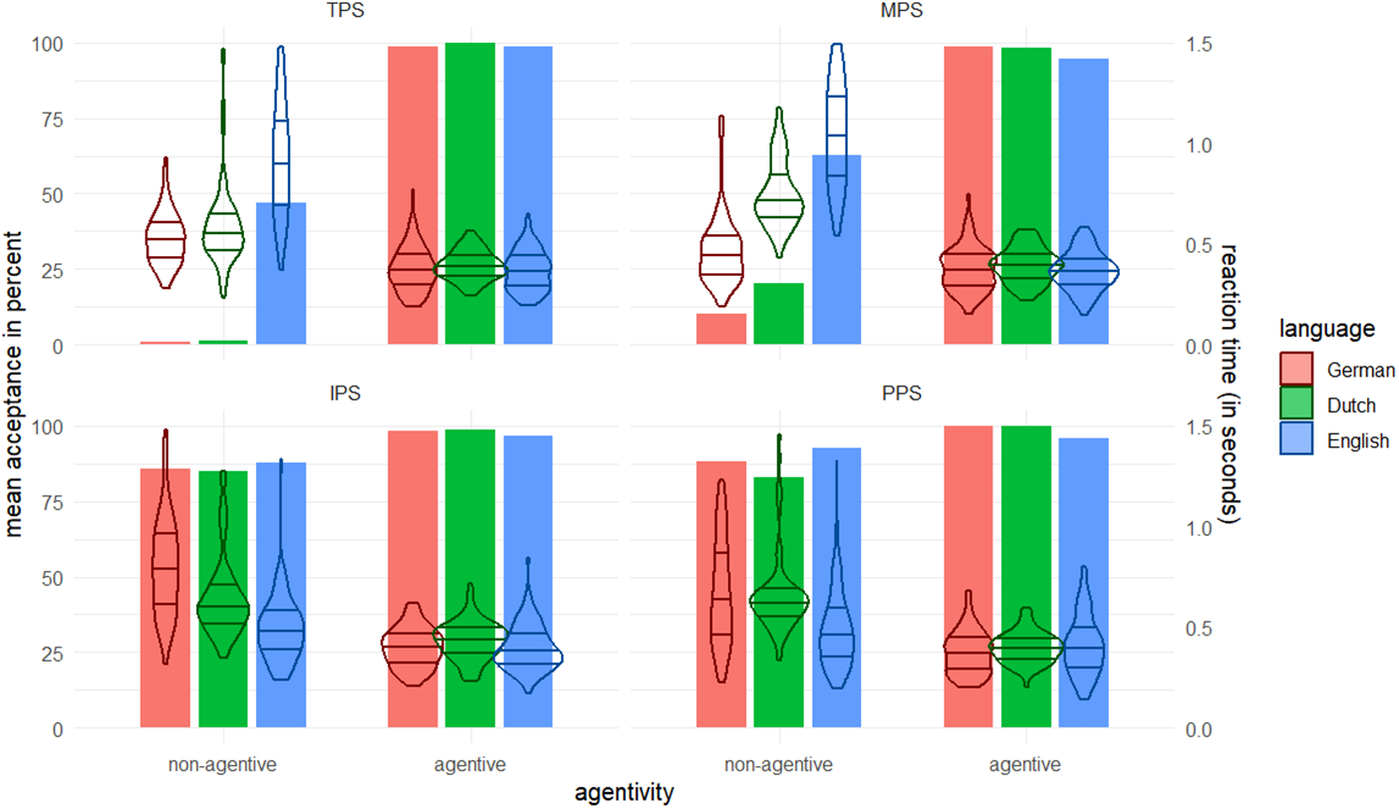
Agentive control items were judged almost categorically acceptable across languages (p̂ ≥ .97), with uniformly fast decision RTs (raw mean = 357 ms), confirming high certainty. For the non-agentive items, both acceptability and decision RTs differed strongly by language and category.
Transitivity-altering permissive subjects (TPS) elicited the lowest acceptance overall, with English showing intermediate acceptance (ENG $ \hat{p} $
. = .31, p < .001) but near-floor responses in Dutch (DUT
$ \hat{p} $
. = .31, p < .001) but near-floor responses in Dutch (DUT $ \hat{p} $
= .004, p < .001) and German (GER
$ \hat{p} $
= .004, p < .001) and German (GER $ \hat{p} $
= .002, p < .001). Acceptance in English was significantly higher than in Dutch (z = 9.12, p < .001) and German (z = 8.10, p < .001), whereas Dutch and German did not differ. Decision RTs mirrored this pattern: TPS were judged more slowly than agentive controls in all languages, with the slowdown most pronounced in English (ENG-DUT: MDiff = 0.27, z = 5.35, p < .001; ENG-GER: MDiff = 0.44, z = 8.50, p < .001). Dutch and German participants rejected TPS rapidly and consistently, whereas English participants showed slower, more variable decisions and split judgements around 50%.
$ \hat{p} $
= .002, p < .001). Acceptance in English was significantly higher than in Dutch (z = 9.12, p < .001) and German (z = 8.10, p < .001), whereas Dutch and German did not differ. Decision RTs mirrored this pattern: TPS were judged more slowly than agentive controls in all languages, with the slowdown most pronounced in English (ENG-DUT: MDiff = 0.27, z = 5.35, p < .001; ENG-GER: MDiff = 0.44, z = 8.50, p < .001). Dutch and German participants rejected TPS rapidly and consistently, whereas English participants showed slower, more variable decisions and split judgements around 50%.
The uncertainty predictor Dist50 revealed that English decision RTs were longest for uncertain TPS items near 50 % acceptance and became faster with increasing certainty (β = –0.091, p = .001). A similar negative slope appeared in Dutch (β = –0.237, p = .037). Although Dutch speakers generally rejected TPS quickly, whenever occasional uncertainty occurred, RTs increased and dropped again for confident rejections. In German, by contrast, the small positive, non-significant slope (β = +0.078, p > .10) suggests that decision uncertainty did not explain RT variation, consistent with stable and fast categorical rejection.
This cross-linguistic pattern can be systematically related to corpus findings. TPS are attested only in English, not in Dutch or German (Rohdenburg, Reference Rohdenburg1974; Hawkins, Reference Hawkins1986). Diachronic studies show that TPS like Object sleeps in English are relatively new, emerging since the early 20th century and becoming gradually more frequent (Dreschler, Reference Dreschler2020; Los, Reference Los, Cuykens, De Smet, Heyvaert and Maekelberghe2018; Van Gelderen, Reference Van Gelderen2011). Our data reflect this transitional state. English participants displayed greater variability in acceptance and high decision RTs, both for documented and extended constructions, indicating uncertainty in that some of these constructions are present in usage but not yet fully integrated into the grammar. This pattern resonates with recent psycholinguistic findings on intermediate judgement zones and theories linking processing variability and uncertainty to grammatical change (De Vogelaer et al., Reference De Vogelaer, Fanta, Poarch, Schimke, Urbanek, De Vogelaer, Koster and Leuschner2020b). The elevated and uncertainty-driven RTs in English, therefore, could provide behavioural evidence for a grammatical transitional phase – a stage where a construction, though attested and increasing in distribution, is not yet fully conventionalized. As the construction consolidates over time in English, both acceptance rates and decision speed would be expected to increase, signalling grammatical entrenchment.
Material permissive subjects (MPS) displayed the strongest cross-linguistic asymmetries in both acceptability and decision cost. For English, the GLMM predicts an acceptance probability slightly above .5 for English (ENG p̂ = .52, p < .001), indicating a moderate tendency towards acceptance. In German, in contrast, the acceptance probability was minimal (GER $ \hat{p}=.05,p<.001 $
). Post hoc comparisons confirmed that Dutch speakers accepted MPS significantly more often than German speakers (z = 3.05, p = .007), but much less often than English speakers (z = 7.05, p < .001; ENG > DUT odds ratio = 7.86). Also, decision RTs show that MPS were judged significantly slower than agentive controls in English (MDiff = –1.09, z = –24.70, p < .001) and Dutch (MDiff = –0.69, z = –14.15, p < .001), with a smaller, non-significant effect in German (MDiff = –0.13, z = –2.77, p = .10). In other words, German speakers rejected MPS quickly and consistently, Dutch speakers took longer and showed slightly higher acceptance and English speakers exhibited both higher acceptance and the slowest, most variable decisions.
$ \hat{p}=.05,p<.001 $
). Post hoc comparisons confirmed that Dutch speakers accepted MPS significantly more often than German speakers (z = 3.05, p = .007), but much less often than English speakers (z = 7.05, p < .001; ENG > DUT odds ratio = 7.86). Also, decision RTs show that MPS were judged significantly slower than agentive controls in English (MDiff = –1.09, z = –24.70, p < .001) and Dutch (MDiff = –0.69, z = –14.15, p < .001), with a smaller, non-significant effect in German (MDiff = –0.13, z = –2.77, p = .10). In other words, German speakers rejected MPS quickly and consistently, Dutch speakers took longer and showed slightly higher acceptance and English speakers exhibited both higher acceptance and the slowest, most variable decisions.
The continuous uncertainty measure Dist50 provides a positive slope in German (β = +0.127, p < .001), indicating that decisions were paradoxically slower for more certain judgements. This pattern can be interpreted as a rigidity or instability effect for this category that is not conventionalized in German (see Heilmann et al., Reference Heilmann, Serbina, Freiwald and Neumann2021). Even when the decision feels certain, it still incurs additional cognitive decision cost. This may be related to the fact that the semantic violation in MPS constructions is weaker than in TPS, as there is no additional transitivity conflict, making them appear more plausible. In contrast, uncertain decisions may be reached more quickly because they allow speakers to suspend commitment and rely on a shallow, heuristic form of evaluation that does not require full semantic verification. In Dutch, the slope was negative (β = –0.048, p = .041), meaning that decisions became slower with increasing uncertainty. Corpus evidence (Doms & De Clerck, Reference Doms and De Clerck2015; Hawkins, Reference Hawkins1986) indicates that Dutch, like German, imposes relatively strict grammatical constraints on MPS constructions. However, contrastive work (Doms et al., Reference Doms, De Clerck, Vandepitte, Ruchot and Van Praet2016; Vandepitte & Hartsuiker, Reference Vandepitte, Hartsuiker, Alvstad, Hild and Tiselius2011) shows that Dutch allows slightly more MPS constructions than German, as they appear in literal translations from English, suggesting incipient flexibility. Together with the higher acceptance and longer decision RTs reflecting uncertainty, this pattern could point to an early transitional stage, in which MPS are beginning to emerge slowly in usage but remain unstable. In English, the slope was non-significant (β = –0.016, p > .10), likely reflecting a plateau near 50 % acceptance and a nonlinear, U-shaped uncertainty curve (as confirmed by the entropy analysis). Corpus data show that MPS have been attested in English since at least the 16th century and remain productive, continuously giving rise to new instantiations (e.g. Money buys constructions; Dreschler, Reference Dreschler2020). The combination of our behavioural data and corpus evidence again suggests a transitional state, but a clearly more advanced one than in Dutch: the construction is distributionally established, yet still induces variability and decision cost. Taken together, MPS show graded entrenchment across the three languages: relatively entrenched but still costly in decision-making in English, incipient and uncertain in Dutch, and largely excluded and stably rejected in German.
Immaterial permissive subjects (IPS) were judged highly acceptable across all three languages (GER $ \hat{p}=.89,p<.001 $
; DUT
$ \hat{p}=.89,p<.001 $
; DUT $ \hat{p}=.86,p<.001 $
; ENG
$ \hat{p}=.86,p<.001 $
; ENG $ \hat{p}=.86,p<.001 $
), with no significant differences in overall acceptance between languages. Nevertheless, all three languages showed clear but smaller agentivity effects (odds ratios = 7.0–25.5, all p < .001), indicating that agentive sentences were still judged more acceptable than their non-agentive counterparts, though the contrast was weaker than for other categories. Decision RTs revealed clear agentivity effects in each language: non-agentive items were judged more slowly in German (MDiff = –0.65, z = –13.70, p < .001), Dutch (MDiff = –0.38, z = –7.84, p < .001) and English (MDiff = –0.16, z = –3.70, p = .005). Despite high acceptance across all languages, post hoc contrasts among the non-agentive items revealed significant cross-linguistic differences in decision RTs (GER-ENG: MDiff = 0.47, z = 9.72, p < .001; GER-DUT: MDiff = 0.15, z = 3.00, p = .032; ENG-DUT: MDiff = –0.32, z = –6.47, p < .001). German participants exhibited the slowest and most variable decision times, Dutch speakers responded faster and English speakers showed the shortest and most stable decisions, closely matching their agentive counterparts.
$ \hat{p}=.86,p<.001 $
), with no significant differences in overall acceptance between languages. Nevertheless, all three languages showed clear but smaller agentivity effects (odds ratios = 7.0–25.5, all p < .001), indicating that agentive sentences were still judged more acceptable than their non-agentive counterparts, though the contrast was weaker than for other categories. Decision RTs revealed clear agentivity effects in each language: non-agentive items were judged more slowly in German (MDiff = –0.65, z = –13.70, p < .001), Dutch (MDiff = –0.38, z = –7.84, p < .001) and English (MDiff = –0.16, z = –3.70, p = .005). Despite high acceptance across all languages, post hoc contrasts among the non-agentive items revealed significant cross-linguistic differences in decision RTs (GER-ENG: MDiff = 0.47, z = 9.72, p < .001; GER-DUT: MDiff = 0.15, z = 3.00, p = .032; ENG-DUT: MDiff = –0.32, z = –6.47, p < .001). German participants exhibited the slowest and most variable decision times, Dutch speakers responded faster and English speakers showed the shortest and most stable decisions, closely matching their agentive counterparts.
This asymmetry is further reflected in the uncertainty slopes. In German, the slope was non-significant (β = –0.010, p > .10), indicating that the typical uncertainty pattern in which items near 50% acceptance yield longer decision RTs due to uncertainty could not account for the slower decision times. The fact that IPS were well accepted, but showed elevated and more dispersed decision RTs, points to residual instability, which may indicate a category-specific transitional phase in German: already quite integrated and accepted, but not yet fully stable in real-time decision dynamics. The high acceptance is somewhat unexpected, given that German–English corpus studies and translation experiments have shown that IPS are often avoided in German, with alternative translation strategies used instead (Heilmann et al., Reference Heilmann, Serbina, Freiwald and Neumann2021). Still, the semantic violation is weaker than in TPS or MPS, and IPS are also attested in German corpora (Hawkins, Reference Hawkins1986), supporting the view that they are undergoing ongoing integration into the grammatical system. In Dutch, the slope was negative (β = –0.123, p < .001), showing that decisions became faster with increasing certainty. High acceptance levels and relatively short RTs indicate that IPS are more established in Dutch than in German. This aligns with corpus data: Dutch–English contrastive studies show that over 60% of IPS in English texts are translated into Dutch in the same form (Doms et al., Reference Doms, De Clerck, Vandepitte, Ruchot and Van Praet2016), and translation experiments even report up to 80% literal correspondences (Vandepitte & Hartsuiker, Reference Vandepitte, Hartsuiker, Alvstad, Hild and Tiselius2011). The combination of high acceptance and more efficient decision dynamics than in German thus suggests that IPS are more entrenched in Dutch, representing a later stage in the integration trajectory than in German. English shows a very similar pattern as Dutch (β = –0.096, p < .001): decisions are fastest when certain, and overall decision RTs are low, paralleling the agentive baseline. High acceptance combined with rapid, stable decisions indicates that IPS are fully entrenched in English grammar, which is consistent with extensive corpus evidence documenting their widespread distribution (Dreschler, Reference Dreschler2020; Komen et al., Reference Komen, Hebing, van Kemenade, Los, Bech and Eide2014; Los, Reference Los, Cuykens, De Smet, Heyvaert and Maekelberghe2018; Los & Dreschler, Reference Los, Dreschler, Nevalainen and Traugott2012; Van Gelderen, Reference Van Gelderen2011). In sum, IPS show a clear gradient of grammatical stability across the three languages. In English, they are fully entrenched, with near-categorical acceptance and rapid, certain decisions. Dutch shows a near-entrenched pattern, marked by high acceptance and modest uncertainty effects, whereas German combines high acceptance with slower and more variable decisions, indicating residual instability.
Pseudo-agentive permissive subjects (PPS) showed a pattern comparable to that of IPS and were largely accepted across all three languages (GER $ \hat{p}=.88,p<.001 $
; DUT
$ \hat{p}=.88,p<.001 $
; DUT $ \hat{p}=.88,p<.001 $
; ENG
$ \hat{p}=.88,p<.001 $
; ENG $ \hat{p}=.96,p<.001 $
). Agentivity effects were absent in English (p = .27) but remained significant in Dutch and German (odds ratios ≈ 43–53, all p < .001), reflecting the more restricted status of non-agentive subjects in the latter ones. Decision RTs showed moderate slowdowns for non-agentive items across all three languages: German (MDiff = –0.52, z = –11.04, p < .001), Dutch (MDiff = –0.50, z = –10.34, p < .001) and English (MDiff = –0.15, z = –3.45, p = .013). Post hoc comparisons among the non-agentive items confirmed no reliable difference between German and Dutch (z = –1.75, p = .50), while both had significantly longer RTs than English (GER-ENG: MDiff = 0.34, z = 7.09, p < .001; ENG-DUT: MDiff = –0.43, z = –8.82, p < .001).
$ \hat{p}=.96,p<.001 $
). Agentivity effects were absent in English (p = .27) but remained significant in Dutch and German (odds ratios ≈ 43–53, all p < .001), reflecting the more restricted status of non-agentive subjects in the latter ones. Decision RTs showed moderate slowdowns for non-agentive items across all three languages: German (MDiff = –0.52, z = –11.04, p < .001), Dutch (MDiff = –0.50, z = –10.34, p < .001) and English (MDiff = –0.15, z = –3.45, p = .013). Post hoc comparisons among the non-agentive items confirmed no reliable difference between German and Dutch (z = –1.75, p = .50), while both had significantly longer RTs than English (GER-ENG: MDiff = 0.34, z = 7.09, p < .001; ENG-DUT: MDiff = –0.43, z = –8.82, p < .001).
The uncertainty slopes corroborated this pattern. In German, the slope was non-significant (β = +0.026, p > .10), indicating that, as in the case of IPS, PPS were well accepted, and decision RT variability was not driven by classic uncertainty effects, although the data suggest that these constructions still incur some decision cost. In Dutch and English, the slopes were negative (DUT: β = –0.073, p = .002; ENG: β = –0.196, p < .001), showing that decisions became faster with increasing certainty.
Despite the surprisingly high acceptance of PPS in German and Dutch, the results align with corpus data. PPS appear to be increasingly frequent in both languages, approaching their established status in English (Rissman et al., Reference Rissman, van Putten and Majid2022). Doms et al., (Reference Doms, De Clerck, Vandepitte, Ruchot and Van Praet2016) note that the gap between English on the one hand and Dutch and German on the other may be smaller than it used to be, consistent with our behavioural findings. Similarly, Callies (Reference Callies and Arabski2006) reports a relaxation of selectional restrictions in German, with non-agentive subjects now occasionally occurring with verbs such as kill or injure, mirroring English distribution. König and Gast (Reference König and Gast2018, p. 110) likewise observe that ‘a growing number of non-agentive subjects in German are slowly creeping into journalese, often as the result of translations from English’. As with IPS, our data suggest that PPS represent advanced transitional stages in German and Dutch, while in English, they have reached near-complete entrenchment. This convergence across our behavioural data and corpus evidence indicates a gradual but ongoing process of grammatical diffusion of pseudo-agentive subjects within the Germanic languages.
In summary, the combined evidence from acceptability judgements, decision times and their relation to uncertainty suggests that the different types of permissive subjects occupy distinct grammatical transitional phases across the three languages, underlining an intermediate position of Dutch between German and English (Van Haeringen, Reference Van Haeringen1956). Our results align closely with corpus-based diachronic findings, though our experimental data reveal generally higher acceptability and weaker grammatical restrictions. The absence of any effect of Documentedness indicates that speakers extend similar evaluative strategies to both attested and novel instances, consistent with accounts of usage-based generalization and pattern extension (Bybee, Reference Bybee2010). Together, these results support the view that these behavioural measures can capture intermediate stages of grammatical change, with acceptability rather reflecting (Ford & Bresnan, Reference Ford, Bresnan, Krug and Schlüter2013) but also extending corpus distributions, and decision times revealing potentially ongoing consolidation within the grammar (De Vogelaer et al., Reference De Vogelaer, Fanta, Poarch, Schimke, Urbanek, De Vogelaer, Koster and Leuschner2020b).
Interestingly, our findings show that not all types of permissive subjects pattern alike across English, Dutch and German in terms of acceptability. Differences between the categories appear to be systematically related to the semantics of the non-agentive subject–verb combinations involved. Permissive subjects expressing immaterial actions, as well as pseudo-agentive permissive subjects in which an implicit human agent can be readily inferred, receive comparatively high acceptability ratings across all three languages. In contrast, transitivity-altering permissive subjects and permissive subjects involving material, more physical actions elicit substantially lower acceptability, particularly in Dutch and German. This contrast suggests that constructions are evaluated more favourably when the non-agentive subject can be integrated into an event structure that either places weaker requirements on the presence of a concrete agent than material actions or readily allows for an interpretation involving an implicit human agent. Where such semantic accommodation is less straightforward, permissive subject types tend to receive lower acceptability ratings. Future studies should examine these factors in greater depth.
3.2. Reading times
The LMM on verb-region RTs yielded a robust Language × Agentivity × Category interaction (full fixed-effects tables in Supplementary Appendix E), which is visualized in Figure 2. Documentedness (DOC vs. EXT) did not yield a main effect or any reliable interactions; results are therefore reported collapsed across DOC and EXT items (see Supplementary Appendices E and F for DOC-EXT specific analyses and figures).
Violin plots with integrated box plots showing effects of language, agentivity and category on RTs.
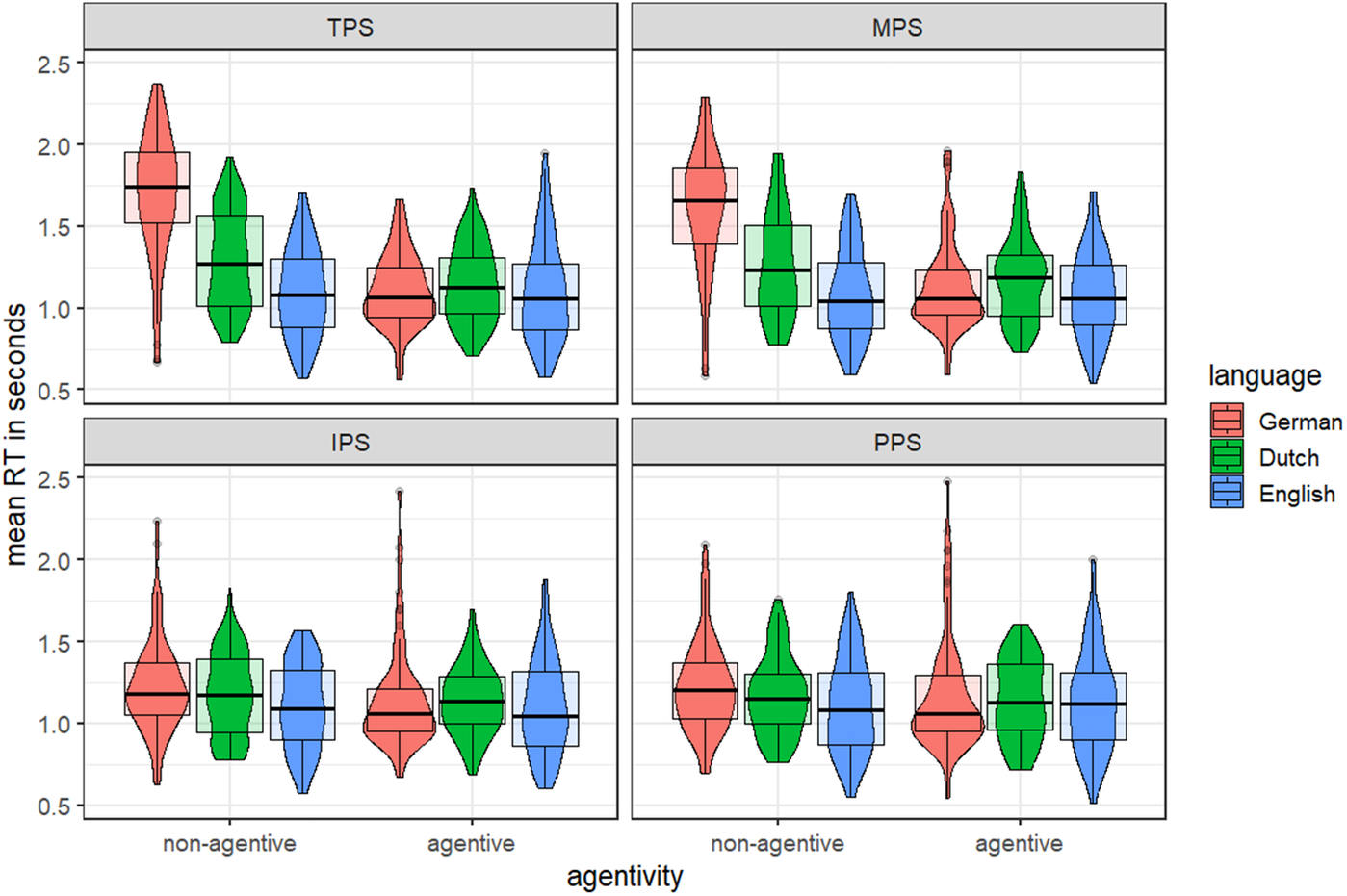
Overall, English showed uniformly fast processing across conditions, German displayed pronounced agentivity- and category-sensitive slowdowns and Dutch patterned in between. The strongest cross-linguistic differences appeared in the non-agentive conditions of TPS and MPS. For TPS, German was significantly slower than both English (MDiff = 0.44, z = 9.06, p < .001) and Dutch (MDiff = 0.27, z = 5.31, p < .001), while Dutch was slower than English (MDiff = –0.17, z = –3.41, p = .008). For MPS, both English and Dutch were markedly faster than German (GER-ENG: MDiff = 0.39, z = 8.20, p < .001; GER-DUT: MDiff = 0.25, z = 4.98, p < .001), but did not differ from each other (MDiff = –0.14, z = –2.90, p = .14). Thus, German shows the longest and most variable RTs for non-agentive MPS and TPS, Dutch is again intermediate and English is the fastest, with convergence between English and Dutch for MPS.
Within-language contrasts mirror this gradient. In German, non-agentive sentences were read significantly slower than agentive ones in MPS (MDiff = –0.34, z = –15.26, p < .001) and TPS (MDiff = –0.41, z = –18.38, p < .001), with a smaller effect in IPS (MDiff = –0.08, z = –3.43, p = .008) and none in PPS (p = .13). In Dutch, the non-agentive penalty was strong for TPS (MDiff = –0.11, z = –4.98, p < .001) but negligible for MPS, IPS and PPS (p ≥ .13). Interestingly, in English, agentivity effects were absent across all categories (p ≥ .75), showing that non-agentive and agentive sentences were processed equally quickly.
Together, these findings reproduce the cross-linguistic gradient reported by Renzel et al. (Reference Renzel, De Vogelaer and Bölte2025a): TPS and MPS drive the main differences between the languages (GER ≫ DUT ≈ ENG), whereas IPS and PPS show no processing penalty. The lack of effects of documentedness and the equally fast processing of extended variants of permissive subjects – particularly in English – indicate that the observed patterns are not driven by constructional frequency. Rather, they point to language-specific differences in how argument-structural information is integrated during sentence processing. English and also Dutch speakers process both documented and extended permissive subjects with comparatively low cognitive cost, whereas German speakers show clear processing difficulty in both conditions. These differences are consistent with the view of systematic variation in processing strategies across languages, shaped by cross-linguistic structural differences (e.g. Bornkessel-Schlesewsky, Reference Bornkessel-Schlesewsky, Kretzschmar, Tune, Wang, Genç, Philipp and Schlesewsky2011; Engelhardt et al., Reference Engelhardt, Filipović and Hawkins2024; Hawkins, Reference Hawkins2014). Following Hawkins (Reference Hawkins2014) and Engelhardt et al. (Reference Engelhardt, Filipović and Hawkins2024), more efficient processing of permissive subjects (and more generally of other forms of vagueness and temporally unfolding syntactic ambiguity, such as garden-path constructions; see Hawkins, Reference Hawkins2014 for an overview) can be linked to a stronger reliance on anticipatory mechanisms, referred to as look-ahead processing strategies. Such mechanisms involve predicting upcoming syntactic material on the basis of partial input, which should facilitate the processing of semantically flexible constructions (Hawkins, Reference Hawkins2014). Our data suggest that English speakers, and to a lesser extent Dutch speakers, appear to rely predominantly on these anticipatory routines, which allow permissive subjects to be processed efficiently (see also Renzel et al., Reference Renzel, De Vogelaer and Bölte2025a for similar findings). In contrast, German speakers experience substantially greater difficulty in the processing of permissive subjects. This pattern is in line with strategies in which argument-structural information is integrated more retrospectively, once the verb has been encountered and its requirements must be reconciled with the preceding noun phrase. Such look-back processing strategies, as discussed by Hawkins (Reference Hawkins2014) and Engelhardt et al. (Reference Engelhardt, Filipović and Hawkins2024), involve integration of information rather than prediction and are associated with increased processing cost for flexible argument structures (Hawkins, Reference Hawkins2014). Our findings support this assumption and converge with previous evidence suggesting that German speakers tend to rely more strongly on retrospective integration mechanisms (see Renzel et al., Reference Renzel, De Vogelaer and Bölte2025a, Reference Renzel, De Vogelaer and Bölte2025b for a more extended discussion).
Hawkins (Reference Hawkins2014) and Engelhardt et al. (Reference Engelhardt, Filipović and Hawkins2024) previously assumed that typological differences in word order between the three languages, and specifically whether a language exhibits SVO or SOV structure, should be a primary determinant of differences in processing strategies (see Renzel et al., Reference Renzel, De Vogelaer and Bölte2025a, Reference Renzel, De Vogelaer and Bölte2025b, for a detailed discussion of this line of argumentation). Based on processing results comparable to those reported in the present study, Renzel et al. (Reference Renzel, De Vogelaer and Bölte2025a) argue that typological differences in word order alone cannot account for the observed processing differences between English and Dutch on the one hand and German on the other. In particular, Dutch patterns more closely with English in terms of processing strategies than would be expected based on word order, given that Dutch is typologically much closer to German in this respect, as both languages are predominantly verb-final, whereas English has a rigid SVO order. Consequently, word order differences between Dutch and German do not appear to be of a kind that can straightforwardly explain the observed processing differences. Also, the possibility of object-fronting exists in both Dutch and German. However, in our data, Dutch shows faster processing at the verb than German, even though an object-fronting interpretation is sometimes available in both languages.Footnote 2 This pattern supports the view that different processing strategies are employed in Dutch and German (see Section 4.2 for possible explanations for these strategy differences beyond word order).
3.3. Linking processing and speeded judgements
To assess how online processing aligns with metalinguistic evaluation, we directly related verb-region reading times to speeded acceptability judgements for the same items. The verb represents the point at which the parser must integrate a non-agentive constituent with an action verb, making it the most informative region for capturing argument-structure processing difficulty (see Friederici & Frisch, Reference Friederici and Frisch2000 for a summary of relevant studies). Focussing on this region minimizes multiple comparisons and provides a direct, theory-based measure to compare with acceptability judgements (see Francis, Reference Francis2010; Hofmeister et al., Reference Hofmeister, Casasanto and Sag2014 for similar approaches).
In the model linking judgement uncertainty to processing, only a small number of reliable effects emerged. For German TPS, we observed a positive uncertainty effect (β = +0.136, p = .038), indicating that more certain items were read more slowly. This pattern aligns with the finding that TPS in German are difficult to process but consistently rejected with high confidence in the acceptability judgements. Dutch MPS, in contrast, showed a negative slope (β = –0.035, p = .015), indicating faster reading with increasing certainty; that is, the more confident participants were about an item’s acceptability, the more efficiently they processed it. This relationship is consistent with a category in transition. Uncertainty incurs decision costs, but the processing system overall mostly behaves predictively and efficiently. All other slopes across languages were non-significant, suggesting that processing was generally unaffected by judgement uncertainty. In the second linking model, which tested whether items that are slower to process are also slower to decide, slopes were flat, showing that item-level processing costs did not predict decision RTs. Likewise, the cross-measure alignment of non-agentive penalties was not significant (R 2 = .25, p = .101), confirming that processing effort at the verb does not directly mirror decision latencies.
The dissociation observed in most cases indicates that processing mechanisms for permissive subjects differ systematically from both acceptability and decision dynamics. Figure 3 illustrates how the method affects responses to the different categories of permissive subjects. In English, permissive subjects are processed quickly in all categories, yet TPS – and to a lesser extent MPS – show around 50–65% acceptance and high decision RTs, revealing transitional uncertainty and instability in line with the idea that slower and more variable judgements mark phases of grammatical reorganization. Here, processing already seems to anticipate grammatical integration: it is fast and efficient, even beyond what current grammatical norms license. This suggests that processing may serve as an early indicator of ongoing grammatical change – a transitional phase in which permissive subjects are processed effortlessly while grammar and judgements lag behind but gradually begin to adapt. In German, by contrast, TPS are consistently rejected and difficult to process, offering no indication of emerging change. Dutch occupies an intermediate position between English and German: TPS and MPS are often and quickly rejected, yet not similarly difficult to process – sometimes even approaching English processing speeds (MPS) – which may signal incipient developments (especially MPS) not yet clearly reflected in usage or acceptability patterns. IPS and PPS reinforce this interpretation, representing a more advanced stage of integration across all three languages, although cross-linguistic differences remain. Here, processing is fast and acceptability is high in all languages, though decision RTs remain somewhat elevated in Dutch and especially in German, reflecting residual uncertainty in grammatical forms that appear to be increasingly attested in corpora. In English, by contrast, both decisions and processing are fast, consistent with full grammatical entrenchment, as confirmed by corpus evidence.
Schematic overview of processing (top) and acceptability (bottom) patterns across languages and categories of permissive subjects. The figure highlights systematic differences between behavioural dimensions, showing that processing is generally more permissive than acceptability, particularly in English and Dutch, and that this asymmetry varies by construction type. The fill colours of the points reflect behavioural efficiency across both methods: green indicates agentive-like or near-agentive efficiency, orange indicates intermediate efficiency and red signals low efficiency. The point outlines in the speeded acceptability judgements represent decision dynamics: green outlines indicate high decision certainty (fast decisions), orange outlines indicate intermediate certainty (intermediate decision times) and red outlines indicate low certainty (slow decisions). The arrow indicates the lead-lag pattern in the cognitive internalization of the different types of permissive subjects, depending on the behavioural dimension captured by each method. The diagonal spatial arrangement of the processing and acceptability dimensions reflects layout choices intended to visually separate the two dimensions and does not carry any additional meaning.
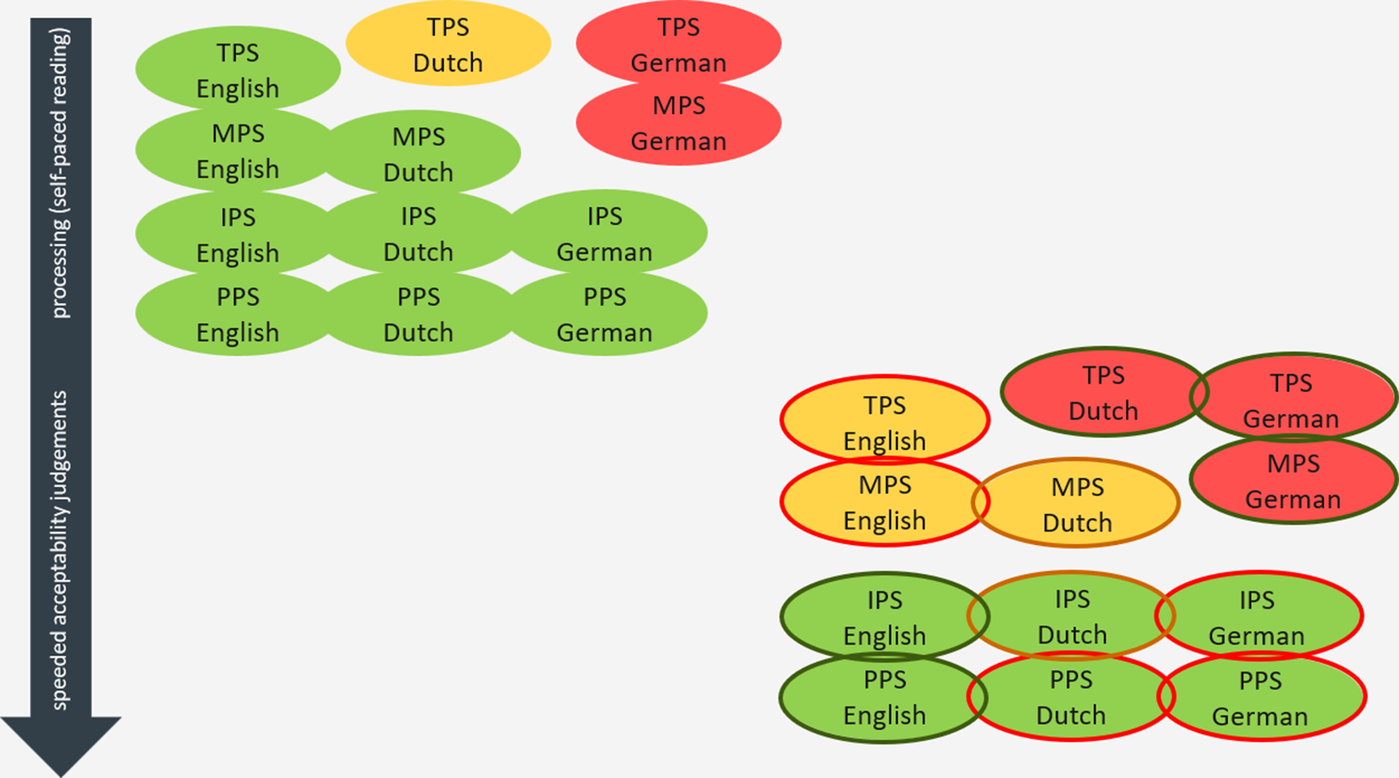
Taken together, the results suggest that processing mechanisms, acceptability and decision dynamics may reflect how grammatical structures are internalized in the cognitive systems of speakers across languages. Mapping the behavioural dimensions against each other reveals how they occupy different positions in a trajectory of grammatical stabilization. Integration within one dimension may indicate a further step towards the stabilization of forms within the grammatical system, while misalignments between dimensions point to transitional states in which reorganization is taking place. Across methods, the behavioural dimensions converge on a consistent cross-linguistic pattern that aligns with previous corpus evidence on permissive subjects, while adding a dynamic, cross-dimensional perspective. Processing efficiency forms the leading edge of the cognitive initialization of grammatical structures and of potential change, opening up mappings that may later be consolidated in grammar. Acceptability follows, reflecting partial adaptation to these pressures, whereas decision dynamics reveal zones of instability that accompany reorganization. This creates the conditions for subsequent adaptation in production and actual language distribution.
4. General discussion
4.1 Trajectories from processing efficiency to uncertainty and change
Using a combined-method approach, this study examined how different dimensions of linguistic behaviour relate to cross-linguistic grammatical variation in three West Germanic languages. By integrating speeded acceptability judgements with self-paced reading, we assessed how speakers of English, Dutch and German evaluate and process different types of permissive subjects. The results support accounts claiming that usage preferences can exert formative influence on typological structure (Fedzechkina & Jaeger, Reference Fedzechkina and Jaeger2020; Gibson et al., Reference Gibson, Futrell, Piantadosi, Dautriche, Mahowald, Bergen and Levy2019; Hawkins, Reference Hawkins2014; Jaeger & Tily, Reference Jaeger and Tily2011; Koplenig et al., Reference Koplenig, Wolfer, Rüdiger and Meyer2025). Crucially, the behavioural dimensions respond to potential change in different temporal orders, producing a lead-lag pattern. Processing emerges as the earliest and most sensitive indicator, driven by language-specific processing strategies (Renzel et al., Reference Renzel, De Vogelaer and Bölte2025a, Reference Renzel, De Vogelaer and Bölte2025b). These strategies even enable efficient processing of hypothetical permissive subjects not yet conventionalized in the grammar. This is consistent with a view of grammatical change in which efficient processing creates the first cognitive conditions. Acceptability follows as a more conservative reflection, closely aligned with grammatical norms and corpus distributions. Where efficiency gains in processing are plausible, acceptability displays mixed signals, though greater variability combined with slower decisions, indicating uncertainty and revealing zones of instability that mark phases of grammatical reorganization (De Vogelaer et al., Reference De Vogelaer, Fanta, Poarch, Schimke, Urbanek, De Vogelaer, Koster and Leuschner2020b). As uncertainty resolves and acceptability stabilizes, distributional rates increase and grammar gradually freezes efficient preferences into conventionalized structure. Production and corpus data represent the most entrenched level, capturing the endpoint of conventionalization at the community level – a process consistent with usage-based models of adaptive conventionalization (Bybee, Reference Bybee2010; Fedzechkina & Jaeger, Reference Fedzechkina and Jaeger2020; Jaeger & Tily, Reference Jaeger and Tily2011).
The cross-linguistic pattern observed for permissive subjects supports this developmental continuum. English largely represents a stage of stable conventionalization, where efficient processing and the highest acceptance converge. Dutch shows emergent acceptance combined with efficient processing, indicating a transitional phase within the grammatical system, while German mostly resists change, displaying low processing efficiency and low acceptability – though this resistance varies across categories. Taken together, the three languages occupy different points along the same developmental trajectory, and the asymmetry in usage preferences supports a gradual progression from processing efficiency to linguistic uncertainty and grammatical change.
These findings suggest that the behavioural dimensions reflect distinct components of underlying cognition. Processing speed captures the parser’s ability to handle novel or extended form–meaning mappings. Acceptability mediates between individual processing patterns and shared grammatical conventions. Decision dynamics can capture the instability inherent in this negotiation, exposing where the system is in flux. Together, these mechanisms provide a multi-layered picture of how grammatical structures and potential grammatical change are cognitively realized and how adaptive pressures in usage can become encoded in grammar. The lead-lag relationships between processing, judgement and distribution suggest that grammar is the result of a dynamic process of cognitive adaptation, in which recurring patterns of efficient usage gradually stabilize and become conventionalized. The progressive alignment of processing and acceptability observed in our data points to a self-organizing system in which efficiency and experience jointly shape the space of grammatical possibilities.
These conclusions require further research and cannot be generalized unconditionally. The mechanisms identified here may apply particularly to permissive subjects and related constructions involving non-agentive argument structure or semantic broadening of grammatical functions. Similar processes may govern other phenomena that increase form–meaning ambiguity, such as raising constructions, which also show Germanic Sandwich patterns (Van der Auwera & Noël, Reference Van der Auwera and Noël2011). Investigating additional structures of this type could clarify whether similar behavioural signatures and processing advantages systematically predict grammatical loosening and typological change.
Furthermore, it is important to emphasize that speaker uncertainty and these synchronic insights in general should not be interpreted as necessarily indicating diachronic change in grammatical patterns, nor do they per se imply transitional stages in all cases. In the present study, uncertainty is treated primarily as a synchronic indicator of weak conventionalization and compatibility with the grammatical system. Where independently documented diachronic developments exist, most notably for permissive subjects in English, such uncertainty can be related to ongoing change. However, whether these patterns develop into stable grammatical options cannot be captured by the present methodology. We, therefore, stress that uncertainty patterns may give rise to different interpretations depending on the construction under investigation and the languages examined, and should not be assigned a uniform diachronic meaning.
Moreover, it should be kept in mind that acceptability judgements should not be interpreted as direct measures of grammaticality alone, but may be influenced by multiple factors such as processing difficulty, familiarity, contextual fit or social norms (see Thiberge & Hemforth, Reference Thiberge and Hemforth2025, for a detailed discussion). In addition, the permissive subjects tested here differ in their degree of lexical restriction, with some patterns limited to a small set of verbs, while others allow greater lexical flexibility and may combine with a wider range of verbs, which could, in turn, have influenced the judgements. Contextual information was deliberately minimized in the present study in order to probe the baseline compatibility of these constructions with the grammatical system, independently of contextual support. Also, we aimed to keep the stimuli as comparable as possible across languages.
4.2. Cross-linguistic trade-offs causally shaped by dimensions of linguistic behaviour
Our findings show that processing speed, shaped by language-specific processing strategies, precedes and constrains grammatical and typological change and relates systematically to other behavioural dimensions. Cross-linguistic differences in how speakers handle permissive subjects, reflecting the ‘sandwich position’ of Dutch between German and English, offer explanatory potential for broader hypotheses about diachronic and causal relationships among typological parameters in the West Germanic languages. Such hypotheses aim to clarify how differences in processing strategies emerged from structural changes and how they may continue to drive further developments.
From a broader typological and diachronic perspective, English has developed loose form–meaning mappings, characterized by greater semantic flexibility and tolerance for temporary ambiguity ((Dreschler, Reference Dreschler2020; Hawkins, Reference Hawkins1986, Reference Hawkins2014). This development has been linked to diachronic changes, including the loss of morphological case marking and the shift from predominantly SOV to rigid SVO word order (Los, Reference Los, Cuykens, De Smet, Heyvaert and Maekelberghe2018; Los & Dreschler, Reference Los, Dreschler, Nevalainen and Traugott2012; van Gelderen, Reference Van Gelderen2011). German, by contrast, has preserved a tight fit between form and meaning through its case system and predominantly verb-final structure, which constrains semantic flexibility (Hawkins, Reference Hawkins2014). In English, strict word order has largely taken over the function of signalling grammatical relations. However, because word order encodes grammatical relations relationally across constituents rather than locally on noun phrases, this occasionally results in a higher degree of vague semantics and temporary ambiguity. Dutch occupies an intermediate position, retaining predominantly verb-final order but losing morphological case (Burridge, Reference Burridge1984; Koster, Reference Koster1975; Van der Horst, Reference Van der Horst2008). In addition to this diachronic perspective, the much greater diversity of semantic roles assigned to the subject position in present-day English can be viewed as the outcome of several interdependent efficiency trade-offs among grammatical parameters, suggesting a causal link between these parameters (e.g. Fedzechkina & Jaeger, Reference Fedzechkina and Jaeger2020; Hawkins, Reference Hawkins2014; Levshina, Reference Levshina2021; Sinnemäki, Reference Sinnemäki2014). Although the complexity of this discussion cannot be fully addressed here, our data indicate that Dutch does not fit neatly into the causal chain proposed by Hawkins (Reference Hawkins2014) and related models. The scenario where case syncretism led to a rigid SVO order (e.g. Dryer & Haspelmath, Reference Dryer and Haspelmath2013; Fedzechkina & Jaeger, Reference Fedzechkina and Jaeger2020; Hawkins, Reference Hawkins2014; Sapir, Reference Sapir1921 and numerous other previous accounts for discussion on the two-dimensional trade-off between case and word order) cannot be confirmed for Dutch. So far, relatively few direct effects of case loss have been observed in Dutch. However, the loosening of argument structure, described as the second step in the causal chain for English (Hawkins, Reference Hawkins1986; Kirkwood, Reference Kirkwood1978), is indeed observable in Dutch. Our results suggest that these structural developments have behavioural origins. Across behavioural dimensions, Dutch patterns more closely align with English than with German, particularly in processing mechanisms. English and Dutch speakers rely on look-ahead strategies which allow efficient parsing of non-agentive subjects, whereas German speakers use retrospective, look-back integration (Renzel et al., Reference Renzel, De Vogelaer and Bölte2025a). This parallel with English is mirrored in acceptability and usage, too, though less pronounced than in processing: certain permissive subjects receive moderate approval in Dutch but remain unacceptable in German, while corpus data show that Dutch is beginning to adopt English-like constructions in translation and production.
A plausible explanation is that the emergence of look-ahead processing in Dutch evolved as a compensatory response to the loss of case marking. With fewer morphological cues on noun phrases, the parser becomes more dependent on the verb and subsequent syntactic material for semantic role assignment (Hawkins, Reference Hawkins2014), which may in turn give rise to more predictive, look-ahead processing. Neurocognitive and eye-tracking evidence supports this assumption: ERP studies reveal parallel contrasts between German–English and German–Dutch processing (Bornkessel-Schlesewsky et al., Reference Bornkessel-Schlesewsky, Kretzschmar, Tune, Wang, Genç, Philipp and Schlesewsky2011), and eye-tracking data show that German case marking facilitates predicate processing, whereas English achieves the same efficiency through anticipatory mechanisms (Kamide et al., Reference Kamide, Altmann and Haywood2003). Taken together, these findings point to a causal link between the loss of case and the rise of look-ahead processing strategies, providing a cognitive foundation for divergent pathways of grammatical change in the West Germanic languages, under the well-supported assumption that processing efficiency lies the groundwork for potential structural change. To substantiate this link, further research should integrate multiple processing measures (eye-tracking and EEG) to test how case marking shapes processing strategies in permissive subjects.
5. Conclusion
In sum, this study provides empirical evidence that cross-linguistic grammatical distributions in the West Germanic languages likely result from the gradual adaptation of the cognitive system across multiple behavioural domains, driven by efficiency and usage preferences. The observed contrasts suggest that grammatical variation aligns with gradual differences in how constructions are processed and evaluated by speakers. These contrasts within the behavioural dimensions of processing and acceptability can help explain the diachronic development of typological variation and causal relationships underlying cross-linguistic grammatical trade-offs. Our results refine usage-based and adaptive models of grammar, which view grammatical structures as the stabilized outcomes of processing and communicative preferences, by showing that different dimensions of linguistic behaviour cognitively internalize grammatical structures gradually, forming a lead-lag pattern. Future work should further examine how efficiency-driven behavioural adaptations crystallize into grammatical structure across languages. More cross-dimensional mapping research is needed to provide a broader empirical foundation for a unified theory of how different behavioural dimensions, such as processing, acceptability and distribution, interact with one another and how they relate to typological variation.
Data availability statement
All data sets, analysis scripts and supplementary appendices are publicly available in the supplementary appendix at OSF: https://doi.org/10.17605/OSF.IO/VQ9B5
Competing interests
The authors declare that they have no known competing financial interests or personal relationships that could have appeared to influence the work reported in this paper.
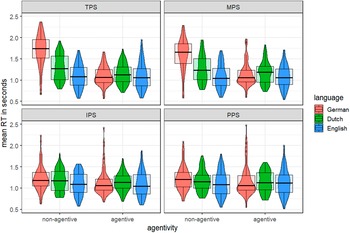
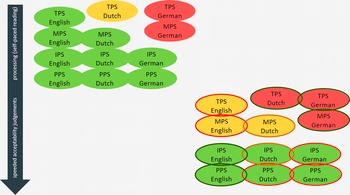

 Open access

