




Background
The state-like polity of Moravia—referred to in historical sources as Megale Moravia (Great Moravia)—dominated the eastern part of Central Europe in the ninth century AD but it was short-lived and disappeared in the tenth century. Its legacy survives only in the collective memory of the local population, rare written records and impressive archaeological finds. A specific feature of Moravia during this period was its inhabitants’ common habitus (including language), traditionally labelled as Slavic. However, it is unclear where the Slavic-speaking Moravians came from, what their cultural identity was and how this highly complex society developed over the centuries following the fall of the Roman Empire. It is an assumption among researchers within this field (e.g. Biermann et al. Reference Biermann, Macháček and Schopper2015) that in Moravia, an open society with a lower standard of living during the sixth–seventh centuries AD was replaced by a hierarchical, closed society in which a noble class, with associated birthrights, emerged during the eighth–tenth centuries in newly established central places (e.g. Pohansko near Břeclav).
The archaeological and anthropological evidence and finds collected in Moravia in the past 70 years have excellent potential for studying dynamics of the region's large-scale polities (archaic states, chieftain confederations, shadow empires, etc.) and past populations. However, to exploit this potential effectively, the research processes need new comparative and interdisciplinary methods, as well as novel theoretical frameworks. To help facilitate this, The Formation of Multi-ethnic Complex Societies in Early Medieval Moravia, Collective Action Theory and Interdisciplinary Approach (FORMOR) project, funded by the Czech Science Foundation, was devised as an ambitious research programme: it comprises a large-scale site survey, archaeometry (isotope and lipid analysis, Energy Dispersive X-ray Fluorescence (EDXRF), scanning electron microscope (SEM), 3D morphometry), archaeogenetics and bioarchaeology.
Settlement archaeology and archaeometry
Large-scale field excavations were conducted on various Early Medieval settlements. The settlement at Lány near Břeclav (Czechia) is associated with the early Slavs. Contacts with the previous Germanic-speaking population and the incoming nomadic Avars have been demonstrated by the discovery of an animal rib, dated to c. AD 600, which is incised with a runic inscription of the Elder Futhark (a writing system used by Germanic-speaking peoples), and a collection of nearly 40 Avar belt-fittings and other bronze casts produced on site (Macháček et al. Reference Macháček2021). At another investigated site, Líbivá near Břeclav, extensive geomagnetic survey revealed more than 370 archaeological features that were then verified by drilling and partial excavation (Figure 1). The results confirmed the concentration of numerous storage pits or silos, some special grain-drying facilities and traces of blacksmithing activity.
Magnetogram of the rural settlement in Břeclav-Líbivá (Czechia) confirms the existence of numerous storage pits (figure by Peter Milo, Petr Dresler, Tomáš Tencer & Michaela Prišťáková).

It is possible that this rural settlement served as a storage facility for surplus food or a collection point for tribute for the nobility residing in the nearby central place of Pohansko, which has been systematically excavated since 1958. It demonstrates the emergence of social inequality and a kind of social action or negotiation that may have differed significantly from the traditional understanding of social processes in the early ‘feudal’ society of Moravia.
Within the project, we challenge this traditional view of the Early Medieval society by the interdisciplinary analysis of various groups of artefacts (Figure 2). Locations of findspots that yielded Late Avar belt-fittings of the similar chemical composition and identical iconography delineated a dense communication network, within the Carpathian Basin and beyond, during the eighth century AD. The artefacts have been examined via a ground-breaking combination of iconography, EDXRF, SEM, lead isotope analysis, digital morphometry and 3D comparative prototyping (Macháček et al. Reference Macháček, Eichert, Nosek and Pernicka2024). New finds of Carolingian helmets from East-Central Europe—representing top-of-the-range military equipment for the horse-mounted warriors and suggesting the extensive exchange of prestige goods within the ruling class—have been dated using stratigraphic and radiocarbon methods and digitally reconstructed (Vlasatý et al. Reference Vlasatý, Dresler, Nosek and Macháček2023).
3D renders of artefacts: A) reconstruction of the Carolingian helmet (Břeclav-Pohansko); B) Avar-style belt-fitting with image of a snake eating a frog (Břeclav-Lány) (figure by Vojtěch Nosek).

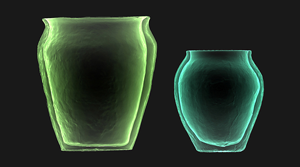
In addition, analysis of pottery samples enabled a detailed study of their morphology and diversity, which had developed in response to the population's shifts in subsistence and habitus. During data collection, we used an Artec Leo 3D to scan 452 vessels, including pots from Zlechov, Roztoky, Přítluky, Pohansko and Čakajovce—which were used for cooking or as urns or grave goods—dating from the fourth–eleventh centuries AD (Figure 3). The 3D digital models, which allow a meticulous examination of individual elements, help provide a more comprehensive understanding of the exchange of bulk goods and the development of ceramic styles between the Migration Period and the Early Middle Ages.
A) Late Antique and Early Medieval sites where the cooking vessels were found (1. Roztoky, 2. Přítluky, 3. Pohansko, 4. Zlechov, 5. Čakajovce); B) four vessel shapes, visualised by x-ray render by Artec Studio 18 (figure by Vojtěch Nosek).

Bioarchaeological approach: archaeogenetics and anthropology
Within the project, a new scientific research infrastructure ArcheoGen was established at Masaryk University Brno (Czechia) in early 2021. The team set up a laboratory for sterile processing of bone/tooth/sediment samples for ancient DNA (aDNA) analysis. The methods for drilling of powder samples and aDNA processing followed published protocols (e.g. Sirak et al. Reference Sirak2017). All types of bones can be used for sampling, but the preferred are pars petrosa ossis temporalis (parts of the skull), teeth and ossicles (bones from the inner ear) because these give the best chance of preserving DNA. For details of sampling procedures, see Ingrová et al. (Reference Ingrová, Zlámalová, Macháček and Hofmanová2021). As a part of this project, 470 aDNA samples of human skeletons from the Migration Period to the Middle Ages were collected using minimally invasive methods. Data from 390 of these samples from Líbivá, Pohansko, Budeč and other sites have been processed and are being compared with a large dataset containing previously published ancient and modern DNA samples; this analysis uses state-of-the-art bioinformatic and population genetic methods (Figures 4 & 5).
Principal component analysis of individuals from the burial sites (Břeclav–Pohansko/Czechia; Mikulčice/Czechia; Gars-Thunau/Austria; Nitra/Slovakia) analysed in the project and reference samples for comparison (figure by Zuzana Hofmanová & Denisa Zlámalová).

Břeclav-Pohansko's second church burial site plan with biologically related and unrelated individuals, according to aDNA analysis (figure by Zuzana Hofmanová & Denisa Zlámalová).

Bioarchaeological research is concentrated on the reconstruction of life histories in relation to sociocultural changes in Early Medieval societies, such as via religion and related buildings. Since 1958, two churches have been excavated at Pohansko. Both have graveyards and one church was interpreted as part of the governor's residence; the second church, with graves in the interior, could be the governor's proprietary church (Macháček & Wihoda Reference Macháček and Wihoda2019).
In this study, the osteobiographic profile of a church founder, who was buried in the interior of the second church in Břeclav-Pohansko, was employed as a model for the sociocultural changes that gave rise to the emergence of a novel type of medieval nobility. The techniques used for the reconstruction of the osteobiographic profile help identify the individual's position within the social hierarchy of the Early Medieval nobility. We also studied postnatal growth and development related to socioeconomic status among non-adults in the cemetery at Pohansko's second church. Finally, the bioarchaeological approach helped us understand social processes related to development in Early Medieval society. This part of the research analysed markers of interpersonal violence discovered on cranial remains among adult individuals (Figure 6). We used a standard osteological approach but also advanced techniques such as CT scanning, microCT scanning, and surface scanning of bone modifications.
Traumata on cranial remains from Břeclav-Pohansko's second church as evidence of interpersonal violence: A) healed perforating fracture on the right parietal; B) unhealed perimortem skull trauma (photographs by Reichmann Wolfgang).

Conclusions
The evidence acquired to date will serve as a baseline for the next stages of the project, which aim to evaluate the patterns of governance in Early Medieval Moravia. In the next few years, the research will focus on identifying kin-based inheritance, dynastic churches, personal and kin networks of powerful leaders and their dependents, variations in settlement size and layout, prestige or bulk goods-exchange systems and horizontal rather than vertical kinds of negotiation within the emerging medieval society.
Funding statement
This work is supported by the Czech Science Foundation (Project No. GX21-17092X).


 Open access

