


Recent provenance studies of obsidian artefacts from Central and Eastern Europe have identified the Carpathian Mountains as a major primary source area (e.g. Biró Reference Biró2006; Rosania et al. Reference Rosania, Boulanger, Biró, Ryzhov, Trnka and Glascock2008). Obsidian from other sources in the Caucasus region and Anatolia (Biagi et al. Reference Biagi, Gratuze, Kiosak, Tubolzev and Popandopulo2014) is rarely found. Here we report the first find of an obsidian artefact in Belarus, and its geochemical analysis.
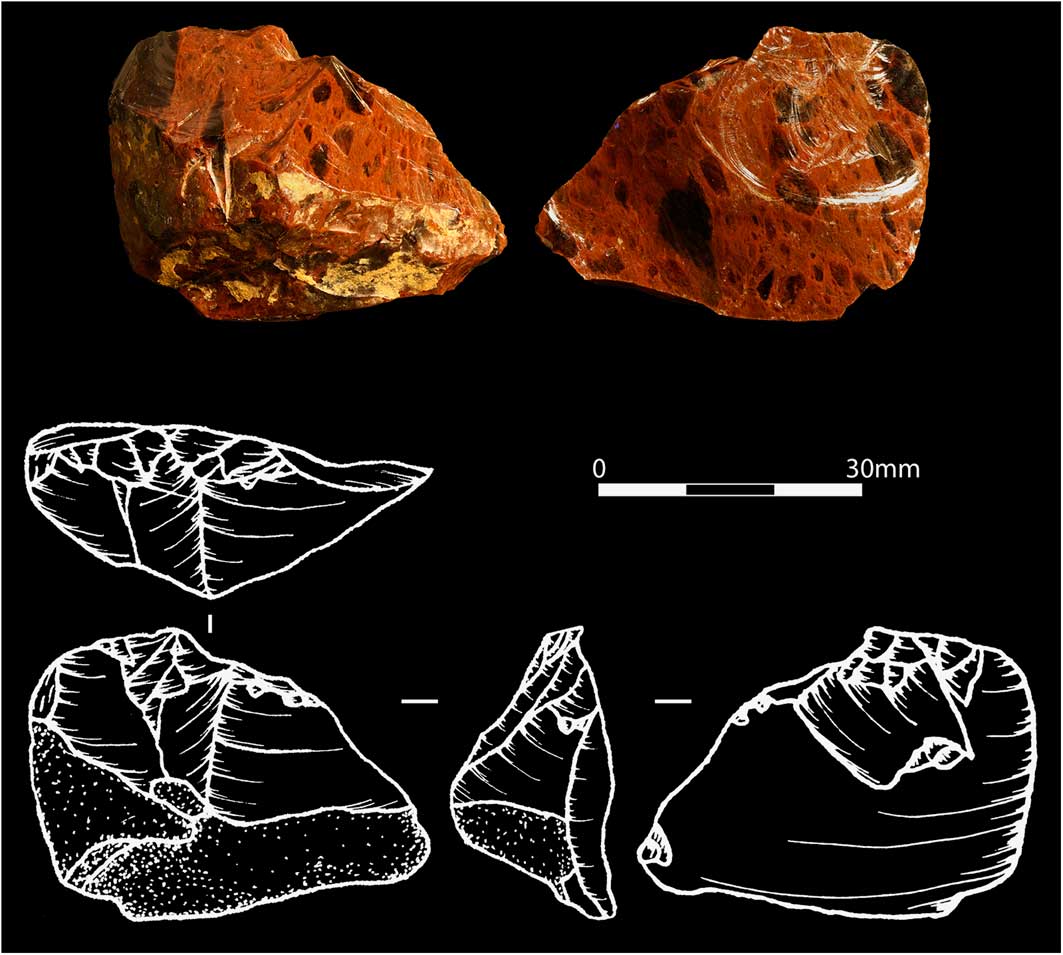
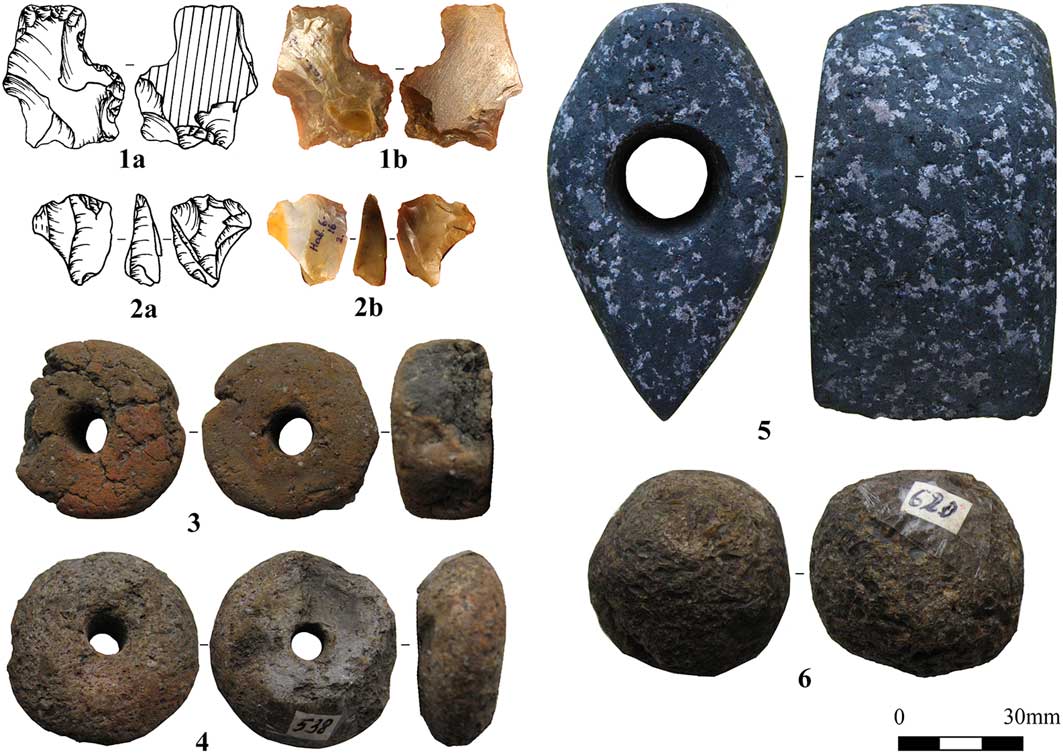
In 2001, a fragment of obsidian (Figure 1) was found near Navasiolki Village in the Brest Province, Belarus (coordinates 52°01'43''N, 24°22'16''E). Subsequent survey from 2014–2017 revealed artefacts on the surface close to the findspot and in test-pits; the site was named Navasiolki 6. The assemblage comprises ceramic and lithic artefacts (Figure 2) estimated to date from the Late Neolithic, Bronze Age and Early Iron Age (third millennium BC to the BC/AD boundary). The close proximity of archaeological materials to the obsidian artefact rules out the possibility that the item is a hoax.
Obsidian artefact from the Navasiolki 6 site (figure by authors).
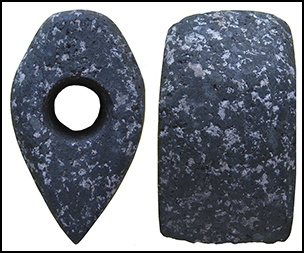
Selected artefacts from the Navasiolki 6 site: 1) fragment of a flint ground item with secondary retouch (a: drawing; b: photograph); 2) flint bipolar piece (a: drawing; b: photograph); 3–4) clay spindle whorls; 5) shaft-hole axe; 6) flint hammerstone (figure by authors).
The artefact is an unmodified flake, or primary spall, of red-black mottled obsidian, measuring 43×33×19mm (Figure 1). It has cortex remaining on its dorsal side, and it was not a river pebble. The flaking negatives are similar to those that result from striking obsidian without suitable platforms. The prehistoric person may have attempted to smash the raw obsidian into a sub-rounded form using a hard hammerstone.
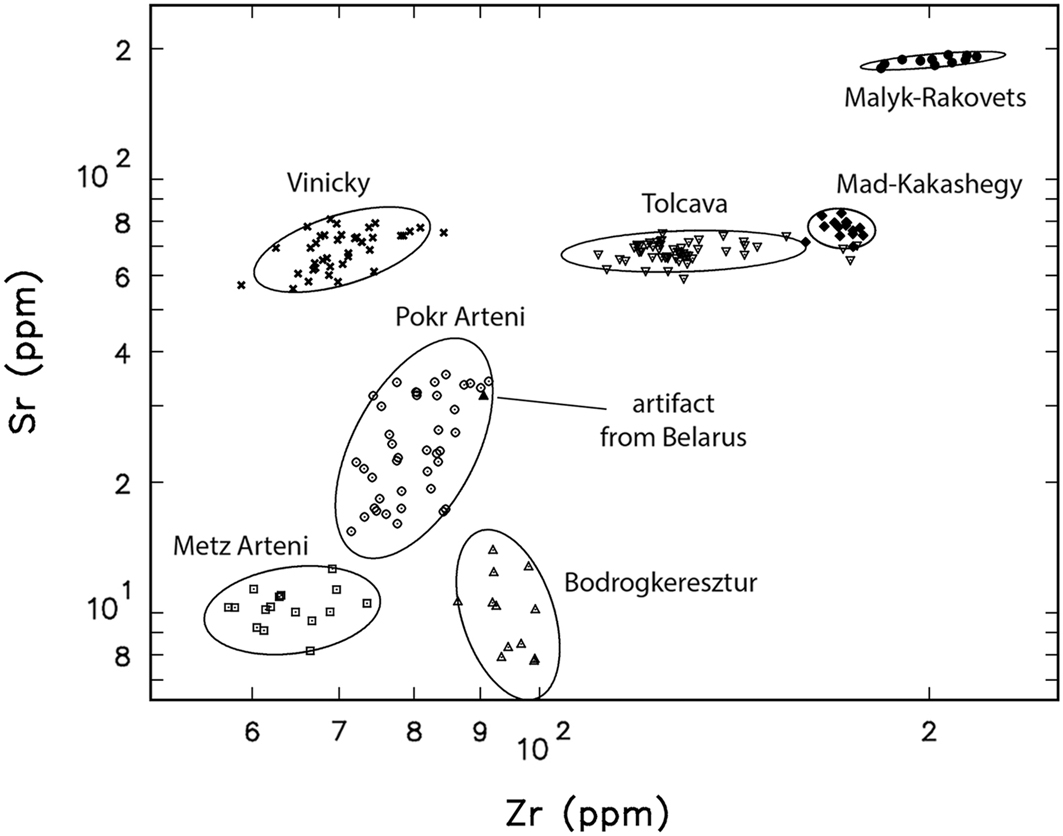
The artefact was examined using X-ray fluorescence (XRF) at the Archaeometry Laboratory in the Research Reactor Center of the Missouri University, using a ThermoScientific ARL Quantx Energy-Dispersive XRF spectrometer, following standard procedure (Glascock et al. Reference Glascock, Barker, Crisan, Drasovean, Gligor and Negrei2016). This established the content of magnesium (Mn), iron (Fe), zinc (Zn), rubidium (Rb), strontium (Sr), yttrium (Y), zirconium (Zr), niobium (Nb) and thorium (Th) (Table 1). Statistical grouping, based on bivariate plots, and on cluster and discriminant classification analyses, was performed by using the GAUSS software (available at: http://archaeometry.missouri.edu/datasets/GAUSS_Download.html), to indicate the source of the obsidian with a 90 per cent probability (see Glascock et al. Reference Glascock, Braswell and Cobean1998).
Composition (parts per million) of elements for the Navasiolki 6 obsidian compared to the Pokr Arteni source (Glascock Reference Glascock2018)
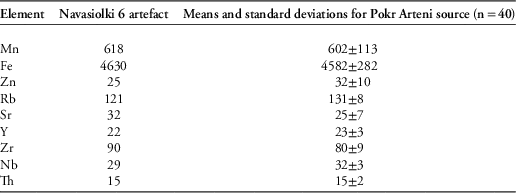
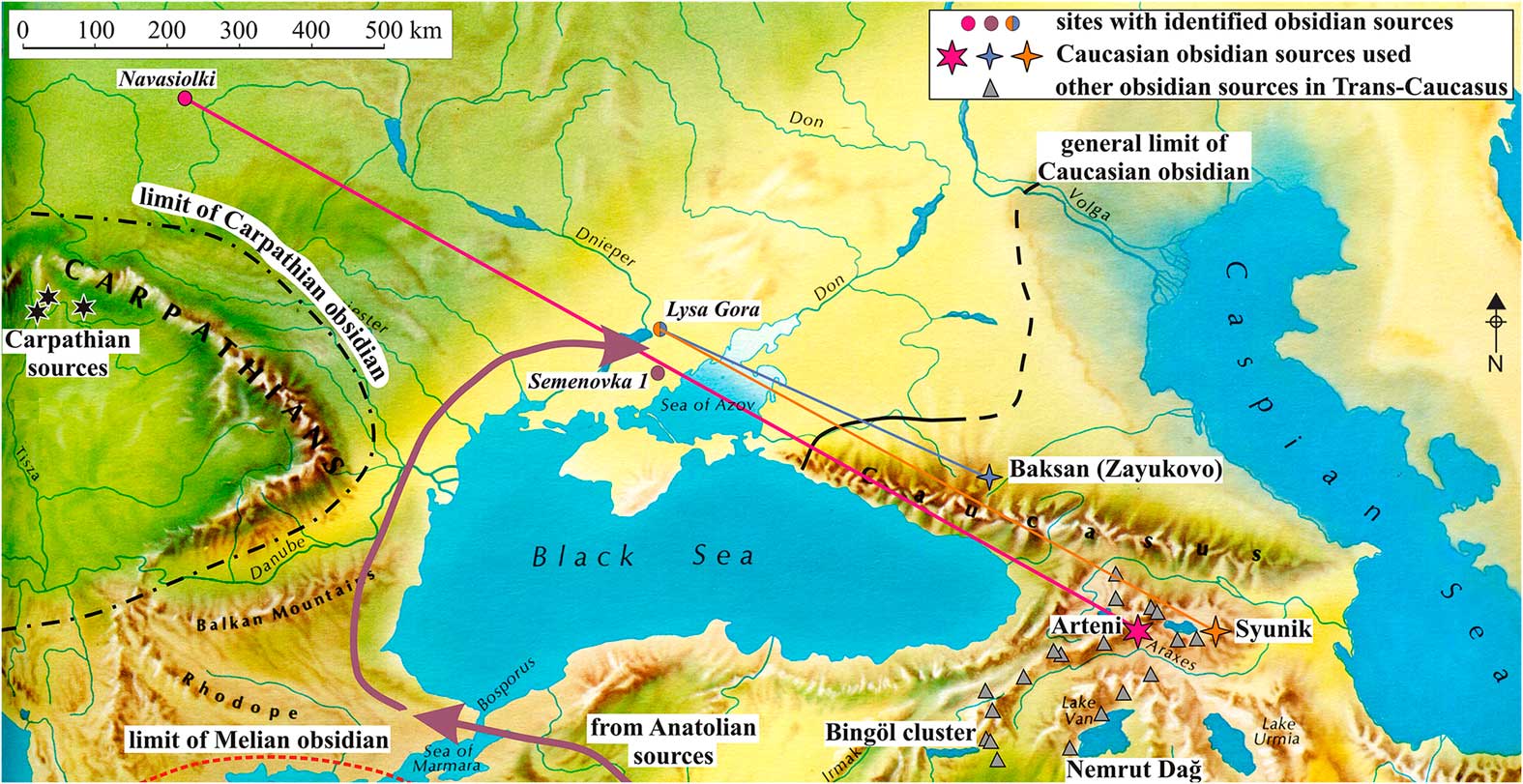
Comparison of the Navosiolki 6 artefact’s geochemical composition with possible primary sources in the Carpathian Mountains and the Caucasus region (Figure 3) shows that the obsidian artefact originates from the Pokr Arteni area in Armenia, Trans-Caucasus (Chataigner & Gratuze Reference Chataigner and Gratuze2014: 28). The distance from source to the Navasiolki 6 site is approximately 1990km (Figure 4). The obsidian artefact therefore probably represents a Late Neolithic or Bronze Age ‘exotic’ import into western Belarus.
Bivariate plot of XRF (zirconium vs. strontium) for the Navasiolki 6 artefact, and for some Carpathian and Caucasian primary obsidian sources; ellipses are 90 per cent confidence areas (figure by authors).
Location of the Navasiolki site and its source of obsidian, and other sites in south-east Ukraine with their sources of obsidian (Biagi et al. Reference Biagi, Gratuze, Kiosak, Tubolzev and Popandopulo2014). Major Trans-Caucasian sources of obsidian are located in Chataigner and Gratuze (Reference Chataigner and Gratuze2014); the extent of obsidian distribution in the archaeological assemblages of the Cis-Caucasian Plain and northern Caspian Sea region is after Formozov (Reference Formozov2003) (figure by authors).
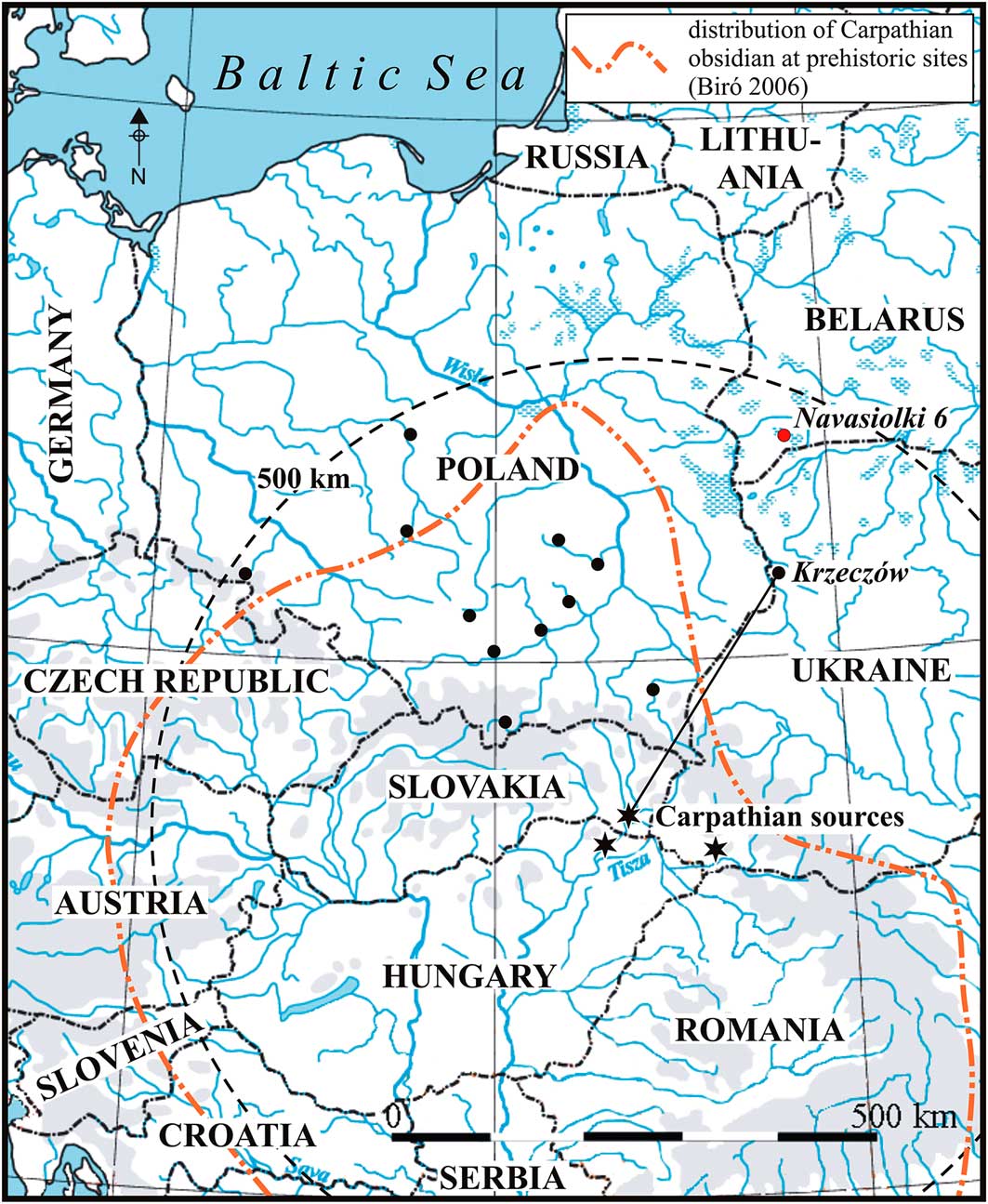
The provenancing of this find is important, as no obsidian from the Caucasus has been found so far north and west; in this part of Eastern Europe, only Carpathian obsidian—at distances up to approximately 500km from the primary source—is known within prehistoric assemblages (Figure 5). Although the Krzeczów site in north-western Ukraine yielded Carpathian obsidian (from the Brehov-Vinićky region in Slovakia; Figure 5) (Hughes et al. Reference Hughes, Werra and Sulgostowska2018), it was not detected farther north and east.
Distribution of Carpathian obsidian in Poland and neighbouring regions (after Biró Reference Biró2006). Black circles indicate sites in Poland and Ukraine with obsidian from Carpathian sources (Hughes et al. Reference Hughes, Werra and Sulgostowska2018) (figure by authors).
Prehistoric obsidian artefacts are very rare outside the Carpathian ‘sphere’ of Central/Eastern European distribution. Some were found in the lower course of the Dnieper River in south-eastern Ukraine, and are associated with the Bronze Age Yamnaya and Catacomb cultures (Razumov Reference Razumov2011). The northern Caucasus, Trans-Caucasus and central Anatolia have been identified as sources of obsidian for the Neolithic sites of Semenovka 1 and Lysa Gora (Biagi et al. Reference Biagi, Gratuze, Kiosak, Tubolzev and Popandopulo2014) (Figure 4). These discoveries changed the view that Carpathian sources were the only suppliers of obsidian to this part of Europe.
Identification of sources of obsidian can supply new information about human contact, exchange and migration that cannot be established by other methods or archaeological data alone (Williams-Thorpe Reference Williams-Thorpe1995: 234–35). The artefact from Belarus provides an excellent illustration of an unexpected connection between this region of prehistoric Eastern Europe and the Caucasus.



