


Ever since an early study suggested that a high degree of maternal control of child feeding was related to impaired ability to self-regulate energy intake in the laboratory (Johnson & Birch, Reference Johnson and Birch1994), there has been a belief that parental feeding style may have contributed to the epidemic of childhood obesity. A possible ‘protective’ effect of breast-feeding on later risk of obesity has also been attributed in part to the observation that infants who have been breast-fed are generally less subject to controlling parental feeding styles in childhood than those who had been formula fed (Taveras et al. Reference Taveras, Scanlon, Birch, Rifas-Shiman, Rich-Edwards and Gillman2004). A series of studies by Birch and colleagues have established the Child Feeding Questionnaire (CFQ) as a valid and reliable measure of various aspects of parental feeding style in early childhood (Birch & Fisher, Reference Birch and Fisher1998, Reference Birch and Fisher2000; Carper et al. Reference Carper, Fisher and Birch2000; Birch et al. Reference Birch, Fisher, Grimm-Thomas, Markey, Sawyer and Johnson2001). These studies have also suggested that girls are subject to greater parental control over feeding than boys, and that various aspects of parental feeding style as measured by the CFQ might be important influences on weight status in childhood.
The evidence on parental feeding style and child weight status using the CFQ is limited in a number of respects. Most previous studies recruited participants who were white and of mid-upper socio-economic status, from a single setting in the USA. Birch and others have recommended that the influence of parental feeding style on child weight status be studied in more diverse samples in terms of ethnicity and socio-economic status (Birch, Reference Birch1998; Birch & Fisher, Reference Birch and Fisher1998; Faith et al. Reference Faith, Scanlon, Birch, Francis and Sherry2004a) to enhance generalisability of the earlier findings. More recent studies of this kind, in minority groups from the USA, have not always been consistent with the findings from earlier studies (e.g. Robinson et al. Reference Robinson, Kiernan, Matheson and Haydel2001), implying possible cultural differences in parental feeding style or the effects of feeding style. To date there have been few studies of parental feeding style using the CFQ in the UK (Cecil et al. Reference Cecil, Palmer, Wrieden, Murrie, Bolton-Smith, Watt, Wallis and Hetherington2005; Wardle et al. Reference Wardle, Carnell and Cooke2005). Most previous studies using the CFQ in the USA have focused on the relationship between parental feeding style and weight status in early childhood as measured by BMI expressed as a standard deviation (sd) score. As influences of parental feeding style are presumed to operate by alterations in habitual appetite, it is surprising that only one study (Birch & Fisher, Reference Birch and Fisher2000) considered free-living energy intake as an outcome of variation of parental feeding style. Longitudinal studies of changes in parental feeding style with age using the CFQ are rare (Faith et al. Reference Faith, Berkowitz, Stallings, Kerns, Storey and Stunkard2004b). Cross-sectional studies have dominated the literature in this area, and it is not clear how or to what extent CFQ measured parental control changes as children get older, or whether high or low degrees of control ‘track’ over time.
The aims of the present study were therefore to use measures of parental feeding style made by the CFQ to: characterise gender differences in parental feeding style; characterise changes over time longitudinally; investigate relationships between degree of control over child feeding and child anthropometry and free-living energy intake in a representative sample of young children in Glasgow, Scotland.
Sample and methods
Sampling
A socio-economically representative sample of 3–5-year-olds from Glasgow, Scotland, were recruited in 1999–2001 to take part in the Study of Preschool Activity, Lifestyle and Energetics (SPARKLE). A total of 209 children and families agreed to participate. The SPARKLE study has been described in detail elsewhere (Jackson et al. Reference Jackson, Reilly, Kelly, Montgomery, Grant and Paton2003; Montgomery et al. Reference Montgomery, Reilly, Jackson, Kelly, Slater, Paton and Grant2004; Reilly et al. Reference Reilly, Jackson, Montgomery, Kelly, Slater, Grant and Paton2004). From the participants recruited to the SPARKLE study, all parents and children were eligible for the present study if they successfully completed the measurement protocols for parental anthropometry, child anthropometry, child energy intake over three days (one weekend and two weekdays) and parental feeding style as measured by the CFQ. A total of fifty-three parent–child pairs (for boys) and sixty-four parent–child pairs (for girls) were eligible for the present study and all were included (n 117). Some parents who consented did not subsequently agree to measurements or attend at appointed times for measurements, in some cases less than three days of energy intake data were available, parent-measured height and weight could not be obtained in all cases, and the CFQ was not completed in all cases and so data were excluded. The socio-economic status and child BMI sd scores of the 117 considered in the present study were not significantly different from the 209 families originally recruited to the SPARKLE study.
Of these 117 parent–child pairs, forty (boys n 22, girls n 18) repeated the measurements 24 months later, providing a longitudinal study. The forty children studied longitudinally did not differ significantly from the other participants for socio-economic status or weight status as measured by the BMI sd score. While we have used the term parental feeding style in the present study, for consistency with previous literature, the present study almost exclusively involved mothers. In one of 117 children the father was the main carer, and in two of 117 a grandmother was the main carer, and in these three cases the father/grandmothers completed the CFQ assessments and outcome measures. In the remaining 114 mother–child pairs the mother was the main carer and was the focus for the parental feeding style assessment and outcome measures. All parents gave informed written consent to participation and the study had the approval of the Yorkhill Hospitals Research Ethics Committee.
Anthropometry
Weight and height of participating children and the main carer were measured using Seca scales (Seca Ltd, Birmingham, UK) to 0·1 kg and a Leicester stadiometer (Child Growth Foundation, London, UK) to 0·001 m respectively. From this, child and parent BMI was derived, and the child BMI sd score relative to UK 1990 growth reference data was calculated using software from the Child Growth Foundation (London, UK). BMI sd score was considered an outcome measure in the present study because of its consistent associations with aspects of control over child feeding as measured by the CFQ in many previous studies by Birch and colleagues.
Dietary energy intake
Child dietary energy intake was assessed using the multiple pass 24-h recall method, over 3 d, a method validated by our group in young children and described in some detail previously (Reilly et al. Reference Reilly, Montgomery, Jackson, MacRitchie and Armstrong2001; Montgomery et al. Reference Montgomery, Reilly, Jackson, Kelly, Slater, Paton and Grant2005). Dietary energy intake of the participating children was considered as an outcome measure in the present study because it is likely that any association between parental control over child feeding and child weight status operates by mechanisms that control habitual energy intake. To reduce the influence of variation in body weight on children's energy intake, we expressed energy intake per kg body weight.
Parental feeding style as measured by the CFQ
Parental feeding style was assessed using the CFQ as described by Birch et al. (Reference Birch, Fisher, Grimm-Thomas, Markey, Sawyer and Johnson2001) and as widely used in other studies in the USA (e.g. Faith et al. Reference Faith, Scanlon, Birch, Francis and Sherry2004a), and to a lesser extent in the UK (Cecil et al. Reference Cecil, Palmer, Wrieden, Murrie, Bolton-Smith, Watt, Wallis and Hetherington2005; Wardle et al. Reference Wardle, Carnell and Cooke2005). In brief, the CFQ consists of questions addressed to parents regarding many aspects of feeding: their degree of responsibility concerning their child's feeding; their perceptions of their own previous and current weight; their perceptions of their child's previous and current weight; their concerns regarding their child's future weight; the measures they use to encourage or restrict eating of specific foods. These latter variables in the CFQ are indices of parental control over child feeding, and are widely thought to influence child energy intake and weight status on the basis of previous studies by Birch and colleagues.
The CFQ parental responses are ordered on a Likert-type scale, each response receiving a score between 1 and 5. The questions are grouped to identify seven factors (perceived responsibility, perceived parental weight, perceived child weight, concern about child weight, restriction, pressure to eat, and monitoring). If, on statistical analyses, the responses to the questions for each factor are consistent, the mean score for all responses for each factor is taken as the factor score, thus a total of seven factor scores are obtained.
Associations between each CFQ factor score and outcome variables (such as child weight status as measured by the BMI sd score) have traditionally been assessed by simple linear correlation (Johnson & Birch, Reference Johnson and Birch1994; Birch & Fisher, Reference Birch and Fisher2000; Birch et al. Reference Birch, Fisher, Grimm-Thomas, Markey, Sawyer and Johnson2001). To replicate this earlier work from the USA, we used the same approach to statistical analysis in the present study.
Statistical analysis and power
The distribution of all ‘outcome’ variables (parent and child anthropometry, child energy intake) and CFQ variables was tested by Shapiro–Wilk normality tests and all variables were found to be normally distributed. Differences between the genders were tested for significance by the two-sample t test. Because of the consistent observations of significant gender differences in parental feeding style made by Birch and colleagues (Johnson & Birch, Reference Johnson and Birch1994; Birch & Fisher, Reference Birch and Fisher1998), namely the difference in feeding of girls v. boys, all analyses were performed on the genders separately in the present study.
The internal consistency of each of the seven CFQ factors in the present study was tested using Cronbach's alpha analysis (where α>0·6 indicates consistency). The items within each CFQ factor showed internal consistency (all α>0·6), thus the mean value for each factor was taken as the factor score. Changes in CFQ factor scores with time were tested using paired t tests.
Power of the study was difficult to assess at the outset, but we noted that in previous studies by Birch and colleagues significant correlations between parental feeding style as measured by the CFQ and the (rather distant) outcome of BMI sd score were detectable with sample sizes of less than 80 mother–child pairs (30–40 boys and 30–40 girls; e.g. Johnson & Birch, Reference Johnson and Birch1994). We predicted that relationships between parental feeding style and free-living energy intake should be stronger than those between parental feeding style and child BMI, and so inclusion of energy intake measurements might increase the power of the study. In addition, we intended to recruit a larger number of mother–child pairs than had been recruited to previous studies using the CFQ (at least 50 pairs of mothers–sons and 50 pairs of mothers–daughters). In practice, we were able to exceed this target sample size.
Results
Parent and child characteristics
Physical characteristics of parents and children, together with CFQ scores, are given in Table 1.
Characteristics of participants and gender differences*
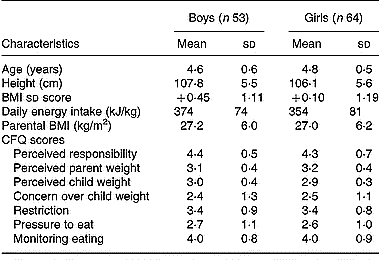
CFQ, Child Feeding Questionnaire.
* No significant differences between the sexes for any variable.
Gender differences in CFQ scores
We found no significant gender differences in any of the domains of parental feeding style as measured by the CFQ (Table 1).
Changes in CFQ factor scores with age
There were no significant changes in CFQ factor scores between ages 3 and 5 years in the longitudinal study.
CFQ factor-outcome correlations, boys
Correlations between CFQ factors and ‘outcome’ variables are shown in Table 2. Parental restriction of child feeding was significantly positively correlated with child energy intake (Table 2) but the other CFQ factors that measure aspects of control over child feeding (pressure to eat, monitoring of eating) were not significantly correlated with either weight status as measured by BMI sd score or energy intake. Parental perceptions of their child's weight status and their own weight status were generally positively correlated with actual weight status as measured by parental BMI and child BMI sd score (Table 2).
Correlation coefficients (r ) between CFQ factors and outcome variables in boys

CFQ, Child Feeding Questionnaire.
* Significant at P < 0·05.
** Significant at P < 0·01.
CFQ factor-outcome correlations, girls
Correlations between CFQ factors and outcome variables in girls are shown in Table 3. None of the CFQ factors that measure aspects of control over child feeding (restriction, pressure to eat, monitoring of eating) was significantly correlated with child energy intake or child weight status as indicated by BMI sd score. Parental perceptions of their own weight status and their child's weight status were generally significantly positively correlated with actual weight status as indicated by parental BMI and child BMI sd score (Table 3).
Correlation coefficients (r ) between CFQ factors and outcome variables in girls

CFQ, Child Feeding Questionnaire.
* Significant at P < 0·05.
** Significant at P < 0·01.
Discussion
Main findings and context
The present study is the first to consider relationships between parental feeding style and child weight status with the CFQ in a representative sample of children from the UK and, as far as we are aware, the first study to use this instrument in this way outside the USA. The CFQ has been used in UK children in at least two other studies, but these had aims that differed from those of the present study (Cecil et al. Reference Cecil, Palmer, Wrieden, Murrie, Bolton-Smith, Watt, Wallis and Hetherington2005; Wardle et al. Reference Wardle, Carnell and Cooke2005). The current study is also unusual in that we studied young children at two age-points, and measured free-living energy intake and its relationship to measures of parental feeding style obtained by the CFQ. Aspects of parental feeding style that were related to perceptions of the child's weight status were generally significantly related to child weight status as measured by the BMI sd score. Similarly, parental perceptions of their own weight status were generally significantly positively correlated with their actual weight status as indicated by the BMI. Mothers in the present study seemed to be able to perceive both their own and their child's weight status regardless of their child's gender.
We found less strong and consistent evidence of relationships between other aspects of parental feeding style and our energy balance ‘outcome’ variables of free-living energy intake and BMI sd score. In particular, there was no clear and consistent evidence of strong relationships between CFQ factors that measure ‘control’ over child feeding (restriction, pressure to eat, monitoring of eating) and the outcomes of BMI sd score and energy intake in the present study. It is possible that differences between the sexes existed in some of the relationships between CFQ variables and outcome variables (e.g. relationships between energy intake and restriction), but the present study was underpowered to determine whether or not such differences exist. The absence from the present study of significant associations reported previously by Birch and colleagues is particularly notable given the large number of correlations tested in the present study (Tables 2 and 3); some significant correlations would have been expected simply by chance. However, parental concern over child weight status was the domain most consistently associated with child weight status and free-living energy intake in the present study, implying a possible role for this aspect of parental feeding style that is consistent with studies of white mid-upper socio-economic status children in Philadelphia by Birch and colleagues.
Comparisons with other evidence
We found no evidence that any aspects of parental feeding style, as measured by the CFQ, differed significantly between boys and girls. In the Birch studies, of predominantly white families of mid-high socio-economic status from a single setting in the USA, girls were consistently found to be subject to a greater degree of parental control over feeding than boys (Johnson & Birch, Reference Johnson and Birch1994; Birch & Fisher, Reference Birch and Fisher1998). The absence of marked gender differences in the present study suggests possible cultural differences in parental feeding style, and this is supported by recent studies in more socially and ethnically diverse populations in the USA that have used the CFQ or alternative measures of parental feeding style (Saelens et al. Reference Saelens, Ernst and Epstein2000; Whitaker et al. Reference Whitaker, Deeks, Baughcum and Specker2000; Robinson et al. Reference Robinson, Kiernan, Matheson and Haydel2001; Spruijt-Metz et al. Reference Spruijt-Metz, Lindquist, Birch, Fisher and Goran2002; Faith et al. Reference Faith, Berkowitz, Stallings, Kerns, Storey and Stunkard2004b; Hughes et al. Reference Hughes, Power, Fisher, Mueller and Nicklas2005). A recent longitudinal study by the Birch group (Spruijt-Metz et al. Reference Spruijt-Metz, Li, Cohen, Birch and Goran2006) found relationships between CFQ variables and later fat mass in white US children, but not in African American children, providing further support for the view that the influence of parental feeding style (as measured by the CFQ) on energy balance might vary by population group.
In a previous longitudinal study that used the CFQ, Faith et al. (Reference Faith, Berkowitz, Stallings, Kerns, Storey and Stunkard2004b) found that parental feeding style was fairly stable over a 2-year period, a finding also observed in the present study.
Limitations
One limitation of early studies using the CFQ was lack of generalisability (Hughes et al. Reference Hughes, Power, Fisher, Mueller and Nicklas2005), but the expanding body of evidence across the USA and now in the UK (present study and others noted later) is addressing this issue. It is also worth noting that the CFQ, though valuable, does not measure every possible aspect of parental feeding style that might influence child energy balance. We have not attempted to relate our findings to the array of studies that have used instruments, other than the CFQ to measure different aspects of parental feeding style, as this would have been beyond the scope of the present study. However, we acknowledge that studies using other instruments have also provided important insights into the possible role of parental feeding style on feeding and child weight status (Baughcum et al. Reference Baughcum, Powers, Johnson, Chamberlin, Deeks, Jain and Whitaker2001; Tiggemann & Lowes, Reference Tiggemann and Lowes2002; Wardle et al. Reference Wardle, Sanderson, Guthrie, Rapoport and Plomin2002). Studies using the CFQ with children in the UK have recently investigated outcomes other than weight status in relation to the CFQ in children, notably important associations between a number of CFQ determined variables and fruit and vegetable consumption (Wardle et al. Reference Wardle, Carnell and Cooke2005) and children's ability to compensate for energy consumed in laboratory ‘preloading’ experiments (Cecil et al. Reference Cecil, Palmer, Wrieden, Murrie, Bolton-Smith, Watt, Wallis and Hetherington2005). Identifying cause–effect relationships between parental feeding style and outcome definitively is problematic with cross-sectional studies and the cross-sectional analyses in the present study were therefore limited in this regard. Nevertheless, the cross-sectional element of the present study was a deliberate attempt to replicate previous cross-sectional work by Birch and colleagues, in order to test the predictions made by their studies from a single setting in the USA. Identifying cause–effect with greater confidence in future research will require larger longitudinal studies that use more complex statistical modelling (Davison & Birch, Reference Davison and Birch2001), but such work presumably depends on first establishing simple relationships between variables that have been described repeatedly by Birch and colleagues in their studies in Philadelphia. Finally, sample sizes in the present study were insufficient to detect subtle differences that may have been present in relationships between CFQ variables and outcome variables, differences between the sexes, for example, as noted above.
Conclusions
The present study comprises a rare longitudinal description of changes in parental feeding style over time, and is only the second attempt to quantify relationships between CFQ variables to energy intake outside the laboratory. The present study suggests that in UK families parental feeding styles, as measured by the CFQ, may be fairly stable over time, and may not differ significantly between boys and girls, in contrast to previous studies in the USA. Parental perceptions of child weight status derived from the CFQ seemed to be broadly in agreement with objective assessment of weight status using the BMI in the present study. In our sample and setting, parental concern over the child's weight status was the dimension of parental feeding style that was most frequently related to child BMI and free-living energy intake. The measures of parental control over child feeding were not consistently correlated with either child BMI sd score or free-living energy intake.
Acknowledgements
We are grateful to the children and families participating in the SPARKLE study. This work was supported by grants from Sports Aiding Medical Research For Kids (SPARKS), registered charity no. 1003825.



