


Introduction
In the midst of a global biodiversity crisis (Butchart et al., Reference Butchart, Walpole, Collen, van Strien, Scharlemann and Almond2010) Europe has been witnessing a resurgence in its wildlife, with several species showing signs of population recovery (Deinet et al., Reference Deinet, Ieronymidou, McRae, Burfield, Foppen, Collen and Böhm2013). Because of the charismatic nature of large carnivores, and the challenges associated with effectively managing and protecting them, their recovery has received considerable public attention in Europe (Chapron et al., Reference Chapron, Kaczensky, Linnell, von Arx, Huber and Andrén2014). Large carnivores have been recovering across the continent, including the Balkan Peninsula (Karamanlidis et al., Reference Karamanlidis, de Gabriel Hernando, Krambokoukis and Gimenez2015; Ivanov et al., Reference Ivanov, Karamanlidis, Stojanov, Melovski and Avukatov2016); however, an exception to this positive development is the Critically Endangered Balkan lynx Lynx lynx balcanicus (Melovski et al., Reference Melovski, Breitenmoser, von Arx, Breitenmoser-Würsten and Lanz2015).
The Balkan lynx was described in the 20th century (Bureš, Reference Bureš1941) but it was not until the early 21st century that genetic evidence indicated its taxonomic status as a subspecies of the Eurasian lynx Lynx lynx (Breitenmoser-Würsten & Obexer-Ruff, Reference Breitenmoser-Würsten and Obexer-Ruff2003; Gugolz et al., Reference Gugolz, Bernasconi, Breitenmoser-Würsten and Wamdeler2008). Although the phylogenetic relationship of the Balkan lynx to other subspecies of Eurasian lynx is still unclear, its morphological distinctiveness and isolation from the nearest lynx subspecies in the Carpathian Mountains (Mirić, Reference Mirić1978) justifies its recognition as a distinct evolutionary significant unit for conservation (Vogler & Desalle, Reference Vogler and Desalle1994).
Historically, the Balkan lynx suffered a fate similar to that of most other large carnivores in Europe, where increased habitat alteration and persecution led to its extermination from large parts of the continent (Breitenmoser, Reference Breitenmoser1998). Following World War II legal and administrative actions resulted in the partial recovery of the subspecies; in 1974 the population was estimated to comprise 280 individuals, located mainly in the south-west of the Balkan Peninsula (Mirić, Reference Mirić1981). However, political unrest in the region at the turn of the century combined with habitat deterioration and poaching are believed to have led to a sharp population decline and range constriction, which has brought the Balkan lynx to the brink of extinction (Melovski, Reference Melovski2012): it is estimated that there are < 50 adult individuals remaining in the wild, hence the subspecies' categorization as Critically Endangered on the IUCN Red List (Melovski et al., Reference Melovski, Breitenmoser, von Arx, Breitenmoser-Würsten and Lanz2015). The Balkan lynx is legally protected in Albania, Kosovo (referred to according to U.N. Security Council Resolution 1244) and Macedonia (for reasons of neutrality and brevity the name Macedonia is used for the country with the constitutional name Republic of Macedonia, admitted to the UN under the provisional designation ‘the former Yugoslav Republic of Macedonia’), and a compensation system for damage to livestock by lynx has been established in Macedonia. Effective conservation of biodiversity requires detailed, quantitative scientific information, which for many wildlife populations is not available (Gilchrist et al., Reference Gilchrist, Mallory and Merkel2005). There has therefore been increasing consensus among conservationists that alternative sources of information are necessary for protecting nature and that local ecological knowledge can provide important information on the status of wildlife populations and should be integrated in environmental management (Drew, Reference Drew2005; Anadón et al., Reference Anadón, Giménez, Ballestar and Pérez2009).
Local ecological knowledge has been used to provide information on species’ distributions and status over large landscapes, with moderate effort (Taubmann et al., Reference Taubmann, Sharma, Uulu, Hines and Mishra2016). However, there are limitations and caveats regarding its use (Caruso et al., Reference Caruso, Vidal, Guerisoli and Lucherini2017), especially when dealing with populations of large carnivores for which detectability is almost certainly < 1 (Louvrier et al., Reference Louvrier, Duchamp, Lauret, Marboutin, Cubaynes and Choquet2018), which can lead to false negatives (Kéry, Reference Kéry2011). Falsely assuming perfect detection can lead to an underestimation of the species’ distribution (Lahoz-Monfort et al., Reference Lahoz-Monfort, Guillera-Arroita and Wintle2014). Therefore, site-occupancy models have been developed specifically to distinguish between non-detection and absence by modelling the imperfect, possibly heterogeneous observation process (MacKenzie, Reference MacKenzie2006). This modelling framework has been used successfully to analyse data from multiple interviewees reporting the detection or non-detection of large carnivores and to infer their distribution, accounting for imperfect detection (e.g. Petracca et al., Reference Petracca, Ramírez-Bravo and Hernández-Santín2014; Taubmann et al., Reference Taubmann, Sharma, Uulu, Hines and Mishra2016).
The main aims of this study were to use a questionnaire survey to (1) evaluate human–lynx interactions to identify potential threats to the survival of the Balkan lynx, and (2) determine the probability of site use. The results are used to identify research and conservation priorities to safeguard the survival of this subspecies.
Study area
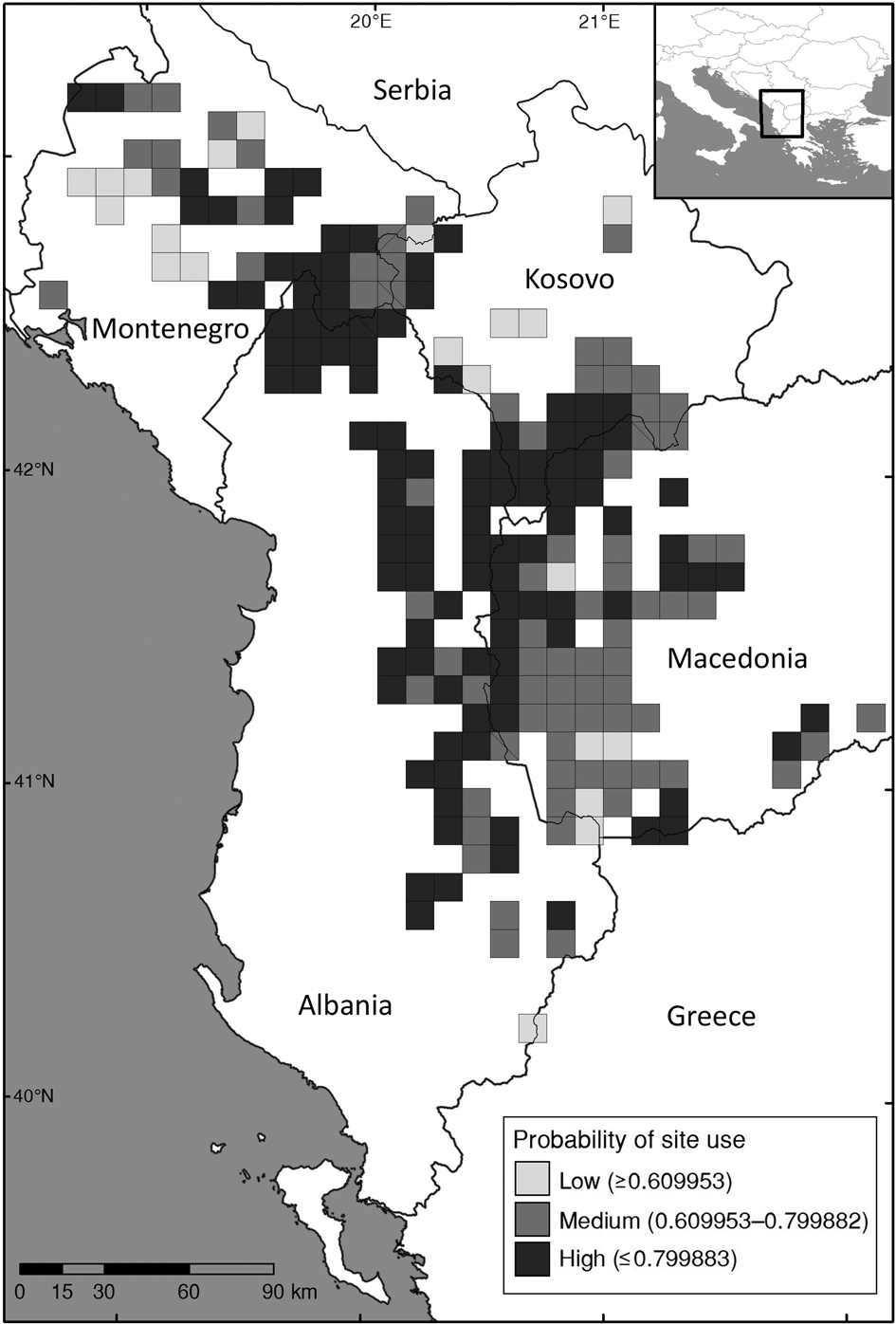
The study was conducted in presumed distribution areas of the Balkan lynx (von Arx et al., Reference von Arx, Breitenmoser-Würsten, Zimmermann and Breitenmoser2004; Kaczensky et al., Reference Kaczensky, Chapron, von Arx, Huber, Andrén and Linnell2013a,Reference Kaczensky, Chapron, von Arx, Huber, Andrén and Linnellb), including areas that were considered by Grubač (Reference Grubač2000, Reference Grubač2002) to be potentially within the subspecies’ range. We also included some localities outside the presumed area of distribution, for which circumstantial evidence indicated the presence of the subspecies (Grubač, Reference Grubač2002). Thus, the study area comprised 20,700 km2 of predominantly mountainous terrain in Albania, Kosovo, Macedonia and Montenegro (Fig. 1). The mean altitude of the villages where questionnaire surveys were carried out was 1,050 m and the mean human population density was 87.5 people per km2 (Kosovo Agency of Statistics, 2016; Institute of Statistics, Albania, 2016; Statistical Office of Montenegro, 2016; State Statistical Office, Macedonia, 2016). The vegetation in the study area is predominantly forest, with beech Fagus sylvatica, fir Abies borisii-regis and various types of oak Quercus spp. The region is characterized by high-mountain pastures, river valleys and rural anthropogenic landscapes.
The survey area in the south-western Balkans, showing the 207 10 × 10 km grid cells in which we conducted questionnaire surveys, with the probability of site use of the Balkan lynx Lynx lynx balcanicus as estimated through occupancy modelling.
Methods
Sampling approach and data collection
Following the design of similar surveys of large carnivores in Europe (e.g. Kaczensky et al., Reference Kaczensky, Chapron, von Arx, Huber, Andrén and Linnell2013a,Reference Kaczensky, Chapron, von Arx, Huber, Andrén and Linnellb; Chapron et al., Reference Chapron, Kaczensky, Linnell, von Arx, Huber and Andrén2014) and taking into account the home ranges of the European (Breitenmoser-Würsten et al., Reference Breitenmoser-Würsten, Zimmermann, Stahl, Vandel, Molinari-Jobin and Molinari2007) and Balkan lynx (D. Melovski, unpubl. data), the study area was overlaid with the 10 × 10 km Universal Transverse Mercator reference grid (UTM34N/WGS84) and 207 grid cells were selected that included the entire potential range of the Balkan lynx (Fig. 1).
During 2006–2014 we conducted systematic, face-to-face questionnaire surveys, using local ecological knowledge to collect information on site use by large carnivores, and their interactions with people. In each of the grid cells we visited at least one village and interviewed up to eight people of various professional backgrounds (e.g. hunters, foresters, livestock breeders, beekeepers, farmers). We asked 55 quantitative and qualitative questions regarding the presence of large carnivores in the area, human–carnivore interactions, husbandry practices, and conservation issues; of the 55 questions, we used six related to human–lynx interactions, seven to lynx presence and one to site use, in the data analysis. We interviewed 1,374 people in total (Albania, 320; Kosovo, 235; Macedonia, 577; Montenegro, 242; mean 6.6 per grid cell). Hunters (34.3%) comprised the largest group of interviewees, followed by livestock breeders (9.7%), farmers (9.6%), foresters (4.7%) and shop owners (4.2%). Local residents comprised 80.8% of interviewees, the remainder being seasonal residents in the study area.
Data analysis
Human–lynx interactions were evaluated using descriptive statistics. To estimate site use of the Balkan lynx we implemented a single-season occupancy model (MacKenzie et al., Reference MacKenzie, Nichols, Lachman, Droege, Andrew Royle and Langtimm2002). Such models use replicates in time and space to distinguish absence from imperfect detection. Grid cells were used as spatial replicates, and each interviewee was considered to be a replicate for one or several cells (Taubmann et al., Reference Taubmann, Sharma, Uulu, Hines and Mishra2016). We added three buffers related to the profiles of the survey participants (see Louvrier et al., Reference Louvrier, Duchamp, Lauret, Marboutin, Cubaynes and Choquet2018, for a similar approach), depending on their area of knowledge (Zeller et al., Reference Zeller, Nijhawan, Salom-Pérez, Potosme and Hines2011). We considered hunters and sheep herders who owned > 30 sheep to have an area of knowledge of 5 km radius around their place of residence; sheep herders who owned < 30 sheep were considered to have an area of knowledge of 3 km radius; and people who did not belong to the aforementioned categories were considered to have an area of knowledge of 1 km radius. We estimated the probability of site use, accounting for imperfect detection. Although the home ranges of female Balkan lynx match the size of our sampling unit, males tend to have larger home ranges. As a consequence, and assuming that movements are random, we interpreted occupancy as site use rather than the proportion of the area occupied by the subspecies (MacKenzie & Nichols, Reference MacKenzie and Nichols2004), usually referred to as third-order selection (Johnson, Reference Johnson1980). As people's various levels of experience in the field can lead to differences in their ability to detect a species (Davis & Wagner, Reference Davis and Wagner2003), we considered a covariate for the level of expertise (i.e. a continuous variable with values of 1–5, from the most to the least experienced observer) on the detection probability, to address this issue. The level of expertise was evaluated subjectively while conducting the interviews. To account for heterogeneity in the sampling effort we also considered the number of interviewees per cell as a covariate potentially affecting the detection probability. With regard to the probability of site use we used the proportion of forest cover (i.e. forest cover was estimated using a selection of natural and semi-natural land-cover categories of the Corine Land Cover 2012 vector data); terrain ruggedness generated from a Shuttle Radar Topography Mission (SRTM) digital elevation model using the ‘ruggedness index’ tool in QGIS v.2.16.2 (Quantum GIS Development Team, 2016); and altitude (SRTM digital elevation model; USGS, 2015) as site-specific covariates potentially affecting site use and detection (Long et al., Reference Long, Donovan, MacKay, Zielinski and Buzas2007; Karanth et al., Reference Karanth, Nichols, Hines, Karanth and Christensen2009; Martínez-Martí et al., Reference Martínez-Martí, Jiménez-Franco, Royle, Palazón and Calvo2016). Site covariates were averaged for the entire sampling unit, standardized by centring on their mean value, scaled by the standard deviation and incorporated in the model through logistic-linear relationships, except for altitude, for which we also considered a potential optimum through a logistic-quadratic relationship. We considered 192 models, which were fitted using the package unmarked in R v.3.5.0 (Fiske & Chandler, Reference Fiske and Chandler2011) and compared using the Akaike information criterion corrected for small sample size (AICc; Burnham & Anderson, Reference Burnham and Anderson2002). To account for model selection uncertainty we used model averaging as implemented in the R package MuMIn (Bartoń, Reference Bartoń2016), considering all models with ΔAIC < 2, where ΔAIC is the difference between the AICc of a given model and the AICc of the model with the lowest AICc. We built an occupancy map by calculating the estimated probability of site use for a given grid cell using the model-averaged parameter estimates and the value of the covariates for this cell. The resulting map depicts lynx presence as reflected in the questionnaires, and we assume that interviewees’ perception of lynx presence indicates actual lynx presence. Probability of site use values were used to group the cells into three categories using the Jenks optimization method (Jenks, Reference Jenks1967): low (probability of site use ≤ 0.609953), medium (0.609953 < probability of site use ≤ 0.799882) and high (probability of site use ≥ 0.799883) (Fig. 1).
Results
Human–lynx interactions
The questionnaires recorded quantitative and qualitative data on various types of human–lynx interactions; however, the data facilitated evaluation of only the following three types of interactions: poaching of lynx, damage to livestock by lynx, and lynx–vehicle collisions.
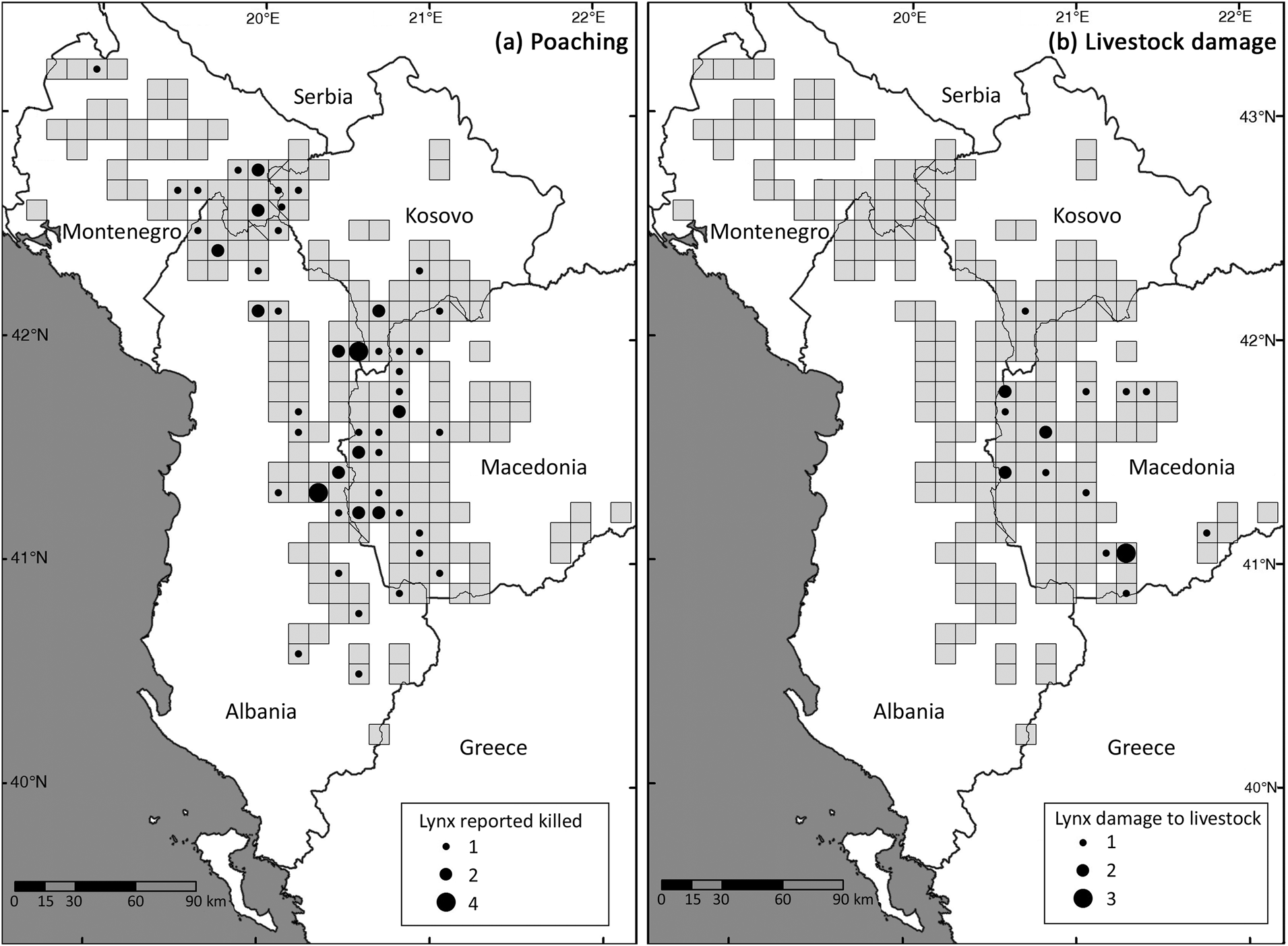
Lynx poaching was reported by 66 interviewees (Albania, 28; Kosovo, 7; Macedonia, 23; Montenegro, 8) in 38 locations in the study area. Eleven interviewees reported killing lynx, and 55 reported indirect knowledge of lynx being killed. Most poaching cases (48) were reported to have taken place in the border areas of Macedonia and Albania, and Albania and Montenegro (Fig. 2a) after 2000. On 24 occasions (Albania, 7; Kosovo, 1; Macedonia, 12; Montenegro, 4) the survey teams were able to verify lynx poaching either by inspecting pelts, trophies and stuffed animals or by evaluating photographs.
On 19 occasions interviewees reported that lynx had attacked their livestock. The attacks occurred in 15 villages, mainly in western and southern Macedonia (Fig. 2b), within 12 months prior to the interview. Attacks were recorded for sheep that were protected by guarding dogs (in 14 cases), shepherds (16) or a combination of shepherds and dogs (13), and sheep that were penned at night (12). Only two cases were reported to the relevant authorities and no compensation was received. To mitigate damage to livestock by lynx, shepherds used various measures, including moving herds to other grazing areas (4 cases), intensifying herding (7), and hunting or poisoning lynx (13). Two collisions of lynx with vehicles on secondary roads in western Macedonia were also recorded.
Survey grid cells in which interviewees indicated Balkan lynx (a) had been poached, and (b) had caused damage to their livestock.
Site use
The top-ranked single-season occupancy models (ΔAICc < 2, cumulative AIC weight 0.98) included an effect of the number of interviewees (model-averaged estimate = 0.19 ± SE 0.03), terrain ruggedness (0.48 ± SE 0.06), forest cover (−0.40 ± SE 0.05) and level of expertise (0.21 ± SE 0.04) on the detection probability, and an effect of forest cover (−0.85 ± SE 0.30) and terrain ruggedness (1.20 ± SE 0.38) on the site use probability (Table 1). There was some uncertainty regarding the altitude covariate and whether or not it had an effect on the probability of site use (model-averaged estimate linear term = −0.18 ± SE 0.27, quadratic term = −0.04 ± SE 0.10).
Model selection results, ranked by Akaike information criterion corrected for small sample size (AICc), for occupancy modelling to identify conservation priorities for the Balkan lynx Lynx lynx balcanicus. Of the 192 models fitted, only those with ΔAICc < 2 are reported.

1 p, detection probability; ψ, occupancy probability. Covariates: forest, proportion of forest cover; expert, level of expertise; rug, terrain ruggedness; sampeff, number of respondents; alt, altitude.
2 ΔAICc, difference between the AICc of the current model and the AICc of the model with the lowest AICc.
The site-use map resulting from the model-averaged parameter estimates included 21 areas with low probability of site use, mainly in south-western Montenegro and central Kosovo, 78 areas with medium probability of site use, mainly in south-western parts of Macedonia and southern Kosovo, and 108 areas with high probabilities of site use, mainly in the border region of Albania–Kosovo and Albania–Macedonia, central and central-south Albania, and in the border region of Albania and Montenegro (Fig. 1).
Discussion
The Balkan lynx is the least studied and known large carnivore in Europe. With an estimated total population of < 50 adult individuals in the wild, identifying human–lynx interactions and estimating site use should be considered important research priorities for the subspecies (Inskip & Zimmermann, Reference Inskip and Zimmermann2009). Our study provides the first wide-scale assessment of the subspecies’ interactions with people, and its potential occupancy throughout its range.
Poaching is a common and globally recognized challenge to the conservation of wildlife, especially for large carnivores (Ripple et al., Reference Ripple, Estes, Beschta, Wilmers, Ritchie and Hebblewhite2014). Although it is difficult, given its illegal nature, to evaluate accurately its effect on population dynamics (Liberg et al., Reference Liberg, Chapron, Wabakken, Pedersen, Hobbs and Sand2012), poaching appears to have been an important factor in the mortality of lynx in Europe, and a threat to the species’ conservation (Červený et al., Reference Červený, Koubek and Bufka2002). This appears also to be the case for the Balkan lynx, with the survey results indicating that since the beginning of this century the equivalent of 50–100% of the total estimated, currently surviving population could have fallen victim to poaching. However, this statement should be considered cautiously, as during our questionnaire we were unable to determine if the 66 reported cases of lynx poaching referred to unique cases or if there was a degree of overlap.
Damage to livestock by large carnivores is one of the most common causes of conflict between people and carnivores worldwide (Kaczensky, Reference Kaczensky1999) and poses an important conservation challenge in the recovery of several lynx populations in Europe (Trouwborst, Reference Trouwborst2010). However, the number of incidents of depredation recorded in our study was small, probably as a result of the relatively good herding practices in the area (i.e. use of guarding dogs and shepherds, and penning at night); however, this could also be regarded as a measure to protect against other, more damaging large carnivores, such as wolves Canis lupus and bears Ursus arctos. The fact that the majority of sheep herders did not seek compensation for damage because of distrust in the compensation system or because they did not know that such a system existed indicates that the design of the damage compensation system needs improvement. Improvements to the damage compensation system in Macedonia should include more rigorous damage evaluation procedures, resulting in the swifter delivery of compensation (Karamanlidis et al., Reference Karamanlidis, Sanopoulos, Georgiadis and Zedrosser2011), and information campaigns to make the compensation system more accessible. Modern compensation schemes can be designed in such a way that they alleviate the financial losses from livestock depredation but also aim to reduce poaching of large carnivores (Treves et al., Reference Treves, Wallace, Naughton-Treves and Morales2006).
Road mortality can affect wildlife through habitat fragmentation and reduced gene flow (Clevenger et al., Reference Clevenger, Chruszcz and Gunson2001). During the study only two road mortalities were recorded throughout the entire potential range of the subspecies, and therefore road mortality should not currently be regarded as a major threat to its survival. However, considering the conservation status of the Balkan lynx and the economic development currently taking place throughout its range, care should be taken in the spatial planning and construction of the road network (Kusak et al., Reference Kusak, Huber, Gomerčić, Schwaderer and Gužvica2009) to avoid the development of a new conservation threat.
As identified in the IUCN Red List assessment (Melovski et al., Reference Melovski, Breitenmoser, von Arx, Breitenmoser-Würsten and Lanz2015), habitat degradation and prey depletion are significant factors contributing to the decline of the Balkan lynx. Forest degradation, which has been reported as one of the main conservation threats for lynx throughout Europe (Breitenmoser et al., Reference Breitenmoser, Breitenmoser-Würsten, Okarma, Kaphegyi, Kaphegyi-Wallmann and Müller2000), appeared to be intensive throughout the entire potential range of the Balkan lynx, including the areas of high probability of site use; this is in accordance with information from the area (Albania, Stahl, Reference Stahl2010; Macedonia, Kolevska et al., Reference Kolevska, Blinkov, Trajkov and Maletić2017). Prey depletion is a conservation threat for lynx in Eastern Europe (Schmidt, Reference Schmidt2008a,Reference Schmidtb; Yom-Tov et al., Reference Yom-Tov, Kvam and Wiig2011) and could also play a negative role in the survival of the Balkan lynx. As no causative effect for prey depletion could be established in this study, dedicated research is necessary to evaluate the impact of this threat on the survival of the subspecies; this should be one of the research priorities for the Balkan lynx.
Interview-based surveys provide a cost-effective and logistically practical alternative to time-consuming and capacity-demanding field surveys, especially for large carnivores that are rare and difficult to detect (Gros et al., Reference Gros, Kelly and Caro1996). However, evaluation of local ecological knowledge is not an objective way to assess people's generic reports (Huntington, Reference Huntington2000). We discovered that rare and/or spectacular events, such as the sighting of a lynx, are remembered for a long time, and this could have influenced the site occupancy analysis. The shortcoming of the low detectability of the lynx, a result of their cryptic nature and low abundance, was accounted for through the occupancy framework, which addresses imperfect detection (Taubmann et al., Reference Taubmann, Sharma, Uulu, Hines and Mishra2016).
Using this methodology we provide the first map of the probability of site use of the Balkan lynx in the south-western Balkans. Lynx detectability was positively affected by the number of interviewees, their level of expertise, and terrain ruggedness, and negatively affected by the percentage of forest cover. These results are consistent with our expectations. However, our occupancy modelling results are more difficult to interpret, as they were positively affected by terrain ruggedness, but negatively affected by forest cover. Lynx presence is generally associated with rugged, forested areas (Lone et al., Reference Lone, Loe, Gobakken, Linnell, Odden, Remmen and Mysterud2014). However, research has shown that in human-modified areas (such as those throughout our study area) lynx may exhibit nuanced behavioural responses and select areas with medium levels of human modification, avoiding areas with high or low levels of modification (Bouyer et al., Reference Bouyer, San Martin, Poncin, Beudels-Jamar, Odden and Linnell2015). Considering that our results depict only the human perception of lynx habitat use, and given the lack of relevant telemetry data, we believe that studying Balkan lynx habitat use should be a research priority.
Information provided by local people in interview-based surveys may include errors (e.g. false positive detections) that can produce biased results in occupancy studies (Miller et al., Reference Miller, Nichols, Gude, Rich, Podruzny, Hines and Mitchell2013). To mitigate such errors we recommend the use of site-occupancy models accounting for false positives, which have been applied to data collected via interview-based surveys (Pillay et al., Reference Pillay, Miller, Hines, Joshi and Madhusudan2014). If a similar survey were to be conducted in 10 years time, we recommend using the same questionnaire, to assess trends in the dynamics of occupancy by considering local extinction and colonization events with dynamic occupancy models (e.g. Taubmann et al., Reference Taubmann, Sharma, Uulu, Hines and Mishra2016).
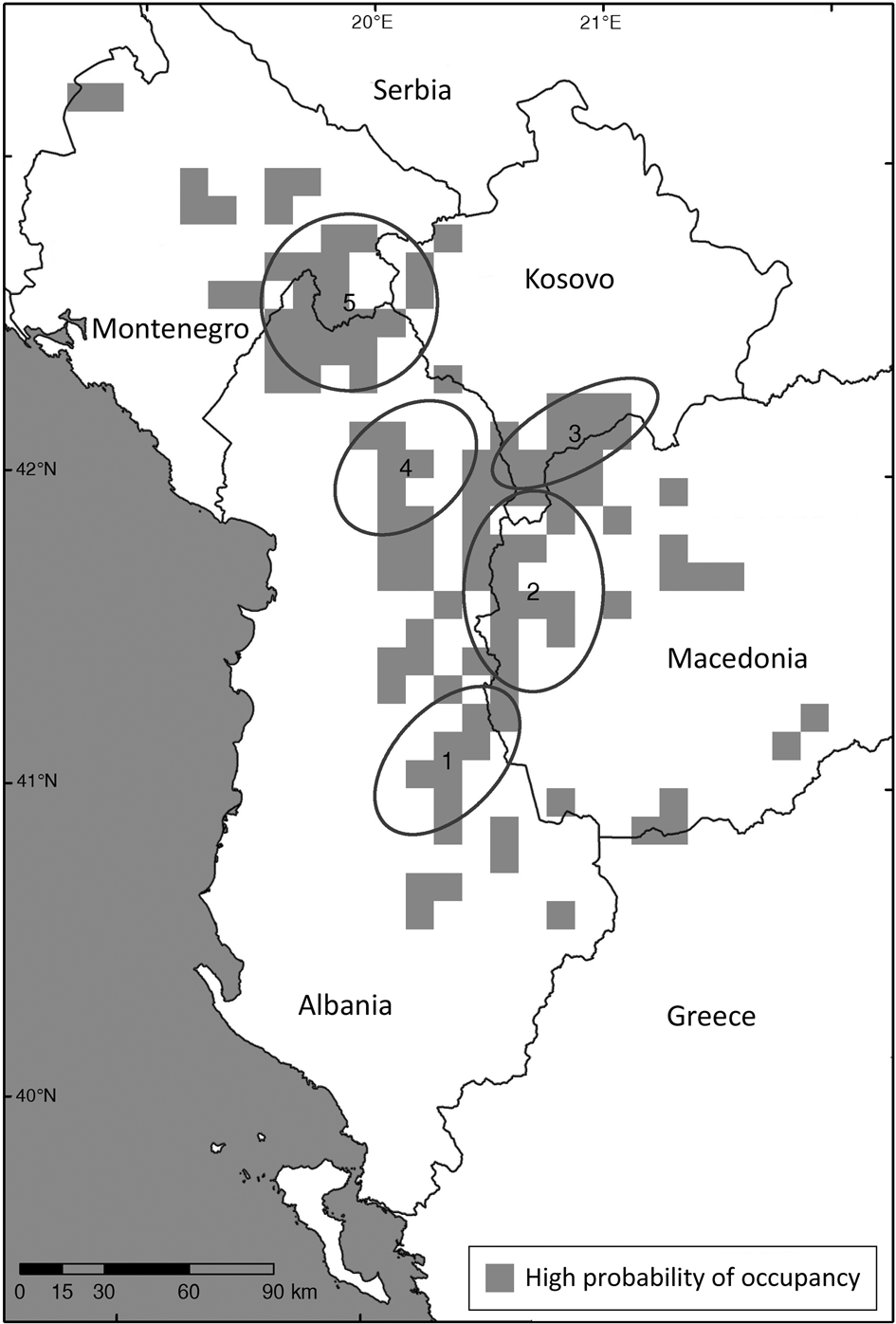
Our results on lynx–human interactions (Fig. 2) and on the probability of site use (Fig. 1) together indicate that the Balkan lynx is most likely to occur in the border region between the four countries in the study area, as well as in some parts of central, northern and southern Albania. Evaluating the results of our study in conjunction with information from dedicated, localized studies on lynx presence and behaviour using various methodologies (Melovski et al., Reference Melovski, Ivanov, Stojanov, Trajçe, Zimmermann and von Arx2009, Reference Melovski, Stojanov and Ivanov2011; PPNEA, 2014; Stojanov et al., Reference Stojanov, Melovski, Sarov, Ivanov and Avukatov2015) we identify five priority conservation areas for the Balkan lynx (Fig. 3). Two of these areas emerge as the core areas of the surviving Balkan lynx population: Mavrovo National Park in Macedonia (Fig. 3, area 2) and the Munella Mountains in central-north Albania (Fig. 3, area 4) (Melovski et al., Reference Melovski, Ivanov, Stojanov, Trajce, Hoxha and von Arx2013). The other three areas that should be considered important for the recovery of the Balkan lynx (Fig. 3) and protected effectively (Schwaderer et al., Reference Schwaderer, Spangenberg, Melovski, Trajçe and Bego2008) are the Macedonian part of the Shar Planina Mountains (Fig. 3, area 3), the Shebenik–Jablanica Mountains (Fig. 3, area 1) and the Albanian Alps (Fig. 3, area 5).
Five important areas for the conservation of the Balkan lynx, identified based on occupancy modelling (Fig. 1) and questionnaire surveys (Fig. 2): 1, Shebenik–Jablanica and surroundings; 2, Mavrovo National Park and surroundings; 3, Shar Planina Mountain; 4, Munella Mountains and surroundings; 5, Albanian Alps.
Conservation priorities
With well-planned conservation action, carnivore populations should continue to survive despite human population growth and modification of habitat. Based on the results and experiences of our interview-based survey, and taking into account conservation threats, priorities and solutions from other, better-studied lynx populations in Europe (Breitenmoser et al., Reference Breitenmoser, Breitenmoser-Würsten, Okarma, Kaphegyi, Kaphegyi-Wallmann and Müller2000), we identify three main conservation priorities for the Balkan lynx that should be implemented on both a local and wider geographical scale:
(1) Conservation efforts should focus on protecting the remaining populations in situ, their critical habitat and their prey base (Breitenmoser et al., Reference Breitenmoser, von Arx, Bego, Ivanov, Keçi and Melovski2008). Actions should focus primarily on the priority conservation areas identified and should include law enforcement and management actions (i.e. scientific monitoring of local lynx populations, forest management, restoration of habitats and improvement of compensation systems) in the areas that already have a legally protected status (Mavrovo National Park), and the designation of new protected areas for the subspecies (Munella Mountains in central-north Albania).
(2) Active participation and involvement of various stakeholder groups in the conservation of this subspecies is important. In the case of the Balkan lynx it is crucial to involve hunters in the conservation process, as they can play an important role in reducing poaching and prey depletion, and in participating in monitoring.
(3) Despite the Balkan lynx being protected throughout its range, trophies can still be found in cafeterias in rural settlements throughout its range, yet cases of poaching of the subspecies have never been prosecuted. It is necessary to improve and enforce the legal framework for the protection of the Balkan lynx effectively, to prevent the extinction of this rare subspecies.
Acknowledgements
The questionnaire surveys were carried out within the framework of the Balkan Lynx Recovery Programme funded by the MAVA foundation, Switzerland. All research activities were carried out under the research permits 11-10190/2/20.11.2009, 11-2186/2/19.02.2010 and 11-546/2/29.01.2013 issued by the Macedonian Ministry of Environment and Physical Planning; and protocol number 2777/22.12.2009 of the Albanian Ministry of Environment, Forests and Water Administration, Directorate of Nature Protection Policies.
Author contributions
Research conceptualization and design: DM, MvA, AAK, SH, GS, ASP, UB; data collection: DM, MĐ, RE, BH, GjI, KM, AP, AR, BS, PS, AST, AT; statistical analysis: DM, VA, OG, AAK; preparation of maps and creation of the common database: VA; writing: all authors.
Conflicts of interest
None.
Ethical standards
All interviews in this study were conducted with prior consent of the interviewees, who had the option of remaining anonymous.



