


In October 1988 a vast procession wound its way across northern India’s fields towards New Delhi. Packed with white-clad men, a dusty stream of bullock carts, trucks, tractors, and motorcycles approached the stately colonial buildings that marked the heart of power. As many as half a million farmers set up camp on the boulevards that lined the capital’s Boat Club, in earshot of the Indian parliament. Barricades were uprooted to fuel their cooking fires, the manicured lawns covered in dung. The city’s media was incredulous: the movement’s leader, the mercurial Mahendra Singh Tikait, was a man so entrenched in the sugarcane farms of western Uttar Pradesh that they could barely decipher his idiolectic Hindi. Hundreds of young urbanites came to goggle at these “‘authentic’ peasants” smoking hookahs and bursting into rousing folk songs. “We can wait here forever,” said Tikait, “maybe we will grow some sugarcane.” The protesters’ own time sightseeing merely confirmed their belief that rural areas were not getting their fair share of development. Chief among the list of demands they put forward, and the single issue that had made Tikait “the new messiah of the farmers,” was the call for cheaper electricity.Footnote 1
The Indian state reacted with force. Police cut off food and water supplies, lobbed teargas canisters, and fired shots in the air. Confirming the gulf between India’s metropolitan rulers and the upstart agriculturalists, they even tried to drown out the protesters with “a cacophony of raucous Rock music [sic].” Delhi’s lieutenant governor dismissed accusations of brutality: “There is nothing wrong if the farmers heard a bit of Bruce Springsteen.”Footnote 2
It was an apt soundtrack. Springsteen, the great balladeer of American petroculture, had shot to fame with his odes to the internal combustion engine in the wake of the United States’ own major energy protests. Son of a sometime truck driver, he had found among the truckers of New Jersey’s shoreline bars some of his earliest audiences. In the United States, it was their ilk who led protests against high energy prices. In 1973–1974 and again in 1979, independent truckers blockaded highways across the country. Peaches rotted in the fields and beef vanished from supermarket shelves. Disrupting the world’s richest country via their control of the kind of huge machines that epitomized Western capitalism, the self-employed big-rig drivers were half a world away both literally and figuratively from the small farms of northwest India. Yet similarities between the two movements illuminate crucial aspects of carbon-intensive energy systems and the powerful constituencies that lock them in place. On the streets as in Springsteen’s songs, American truckers and Indian farmers met in the crisis-wracked interstices of the fossil fuel economy. The carbon-intensive energy technologies that powered their livelihoods played a vital role in the formation of distinctive socioecological interests and identities. Both groups mobilized in reaction to breaches of state-centered moral economies of energy provision, leveraging their power to interrupt supplies within the circulatory systems of fossil fuel society.
India and the United States are seldom compared explicitly—not least because of the strong streaks of exceptionalism that characterize the historiography of both countries—and the two protests at first glance look wildly different.Footnote 3 Big rigs were emblematic of the capital intensity of the American economy. Often drawn from rural landscapes transformed by large agribusiness, their drivers funneled products across long distances to private distributors. Though its economic growth had begun to accelerate, India in the late 1980s remained dramatically poorer. In western Uttar Pradesh, a comparatively prosperous region of the country’s Hindi-speaking heartland, farming remained dominated by owner-cultivators whom contemporaries still labeled “peasants.” Crops were bought and sold on state-regulated markets and overwhelmingly cooked using the traditional fuels of firewood and dung. On one hand was the world’s most energy-intensive society, a hypercapitalist and corporate-dominated “red meat republic.” On the other was the plant-based economy, both heavily state-managed and simultaneously underregulated, of a developing country in which malnutrition remained endemic and electric lights a rural rarity.Footnote 4 These wide divergences make the similarities between the two energy protests all the more striking.
This article aims to analyze an easily overlooked set of actors within energy politics and environmental history, looking beyond the familiar cast of energy producers—like coalminers, oilmen, and nuclear engineers—to large intermediate groups with an almost equally significant relationship to energy. Sketching an energy-centered approach to class analysis with both structural and subjective axes, I suggest that the trucker and farmer protests were the expression of specific class fractions whose material interests were conditioned by heavy dependence on state-mediated energy supplies. Both groups owned significant stakes in the carbon-intensive means of production that left them exposed to volatility in energy quality and pricing. American truckers relied on their expensive truck-trailers and the diesel engines that hauled them along the country’s state-sponsored network of highways, guzzling hydrocarbons left deliberately undertaxed (Figure 1). Indian farmers increasingly depended on electric tubewells, bored deep beneath their valuable small landholdings and using state-subsidized (and increasingly coal-fired) electricity to pump up groundwater for irrigation. These technological complexes structurally located both American truckers and Indian farmers in distinctive nodes of the energy economy: small, self-exploiting capitalists central to economic production and circulation, but simultaneously consumers especially vulnerable to the rising prices of energy inputs. The pocketbook politics of these productive consumers animated recurrent protests over energy prices and reliable access.
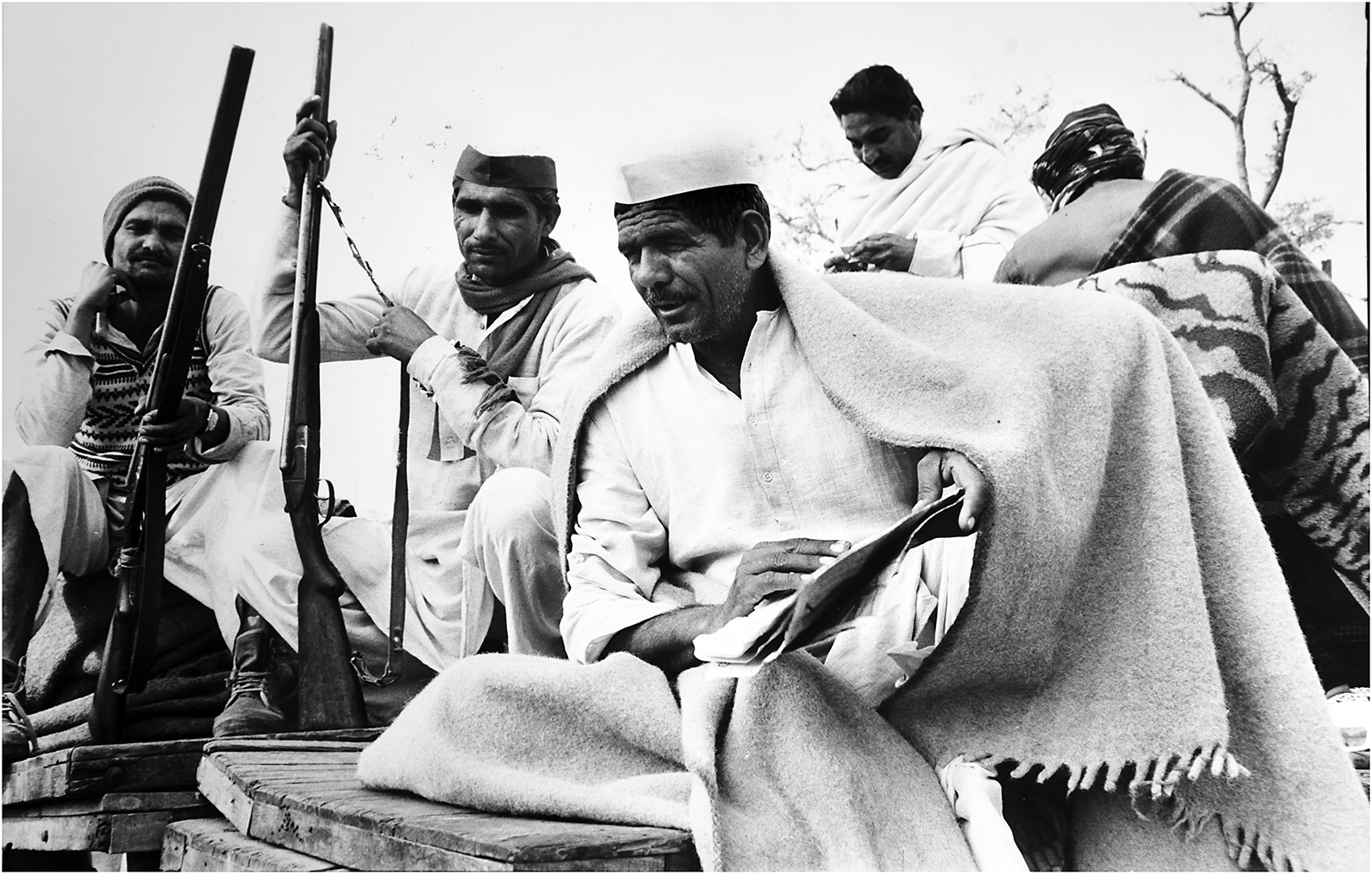
When these class fractions’ expectations of fair access to energy were challenged, they leveraged their positions at these critical intermediary nodes of fossil fuel society to demand lower energy prices. Both sets of protesters appealed to demotic conceptions of economic justice to demand protective state intervention on energy. Both deployed similar strategies of blockading and supply interruption to make their case, often targeting infrastructures of circulation like the highways. Both drew for their cohesion on cultural ideas of rural authenticity and masculine toughness (Figure 2), though this unity was undercut by the individualistic character of the truck and the tubewell. Even as both movements ultimately fragmented, such high-profile resistance would help to lock in place consumer subsidies for carbon-intensive energy by increasing the perceived political risks of major price hikes. Understanding the dynamics of such energy-dependent class fractions has become increasingly urgent in a world contemplating catastrophic damage from climate change. As states consider rolling back heavy subsidies for fossil fuel consumption, these cases are an omen of the politics of the near future.
Truckers on strike, early 1974. © Milwaukee Journal—USA TODAY NETWORK.

Tikait and supporters at the Boat Club protest, New Delhi, 28 October 1988. © Sondeep Shankar/Getty Images.
Beyond “Fuel Riots”: Energy History and Class Analysis
Energy protests have played a momentous role in recent history. The Prague Spring of 1968 was preceded by protests against power cuts in university dormitories, students taking to the streets with the chant Chceme světlo, “We want light!”Footnote 5 In apartheid South Africa, a sharp increase in electricity rates triggered a rent boycott in the township of Soweto from 1985 to 1989, a bottom-up strategy of collective resistance that became “one of the most important and effective tools of the liberation struggle.”Footnote 6 In 1998 a similarly abrupt reduction of fuel subsidies precipitated the end of Suharto’s three-decade-long dictatorship in Indonesia. Over the past decade, energy protests have destabilized regimes in countries as different as Armenia, Chile, Ecuador, Haiti, Iran, Kazakhstan, Lebanon, Mozambique, Nigeria, Pakistan, Sri Lanka, Sudan, Venezuela, and Zimbabwe. Nor has the global North been spared: in 2018 the Gilets jaunes movement blocked fuel tax rises in France, while in recent months truckers have protested high fuel prices in Spain and Italy. While many historians have documented unrest around energy production, such as militancy among miners or local resistance to power plants, such consumer protests over energy access, pricing, and quality have attracted little study despite their prevalence.Footnote 7
Within development studies, the problematic term of art for such protests is the “fuel riot.” The few systematic studies that exist are predominantly quantitative and especially focus on the period since 2008, when global oil prices spiked to unprecedented highs. One macro-level strand of such research draws critical attention to the relationship between popular energy politics and national energy pricing regimes. Its understanding of energy protests themselves, though, is a flattened and ahistorical one: “fuel riots” are cast as discrete and impulsive outbursts generated by international price shocks or the removal of energy subsidies.Footnote 8 As E. P. Thompson warned half a century ago, such a “spasmodic view of popular history” as mechanical flailing against scarcity obliterates local “complexities of motive, behaviour, and function”—obliterates, that is, any real sense of human agency.Footnote 9 Following Thompson’s analysis of eighteenth-century English food riots, a more ethnographic current of research instead understands energy protests as popular responses to breaches of the implicit social contract between citizens and the state, a pursuit of dignity as much as redistribution. In these street-level analyses, high fuel prices often appear as one component of a broader subsistence crisis after 2007–2008, especially as agricultural fossil fuel dependence and land grabs for biofuels translated high energy prices into food insecurity.Footnote 10 Such scholarship convincingly highlights the subjective interpretations that underlie popular mobilizations. Yet collapsing them into the more familiar category of food riots risks obscuring the specificities and ecological stakes of energy protests.
This article seeks to integrate the strengths of both these macroeconomic and subjectivist strands, while suggesting that an alternative approach might fruitfully focus on the intermediate level where macro-level structures and individual agents interact.Footnote 11 It begins by jettisoning the prejudicial frame of the “fuel riot”: we should not presume that such mobilizations were disorganized or disorderly, but recognize their potentially deep historical roots and strategic and self-activating character. Its second step is to disaggregate the homogenous crowd of protesters. If we read against the grain the large-n studies conducted by policy analysts, certain constituencies recur on the streets. Especially prominent are transportation workers (not just truckers, but also taxi, bus, and autorickshaw drivers and other privately employed transport personnel) and farmers (as well as their close analogues, fisherfolk).Footnote 12 In place of the generic crowd, the analysis here seeks to examine more systematically the relationships between energy systems and the kinds of class fractions most likely to protest rising energy prices or declines in quality of supply. Where most existing research relies on patchy coverage by national news media, looking back at unusually well-documented historical cases permits a much more detailed examination of mobilizational dynamics over time.
To systematize such an examination, this article sketches an energy-centered approach to class—an analytic centered on the ways in which control over energy flows constitutes the base of socioeconomic power. This relationship is ultimately grounded in the material basis of the economy: in the age of fossil fuels, the dominant mode of production is highly energy-intensive, from the factory to the fossil fuel-dependent farm. One approach to the energetics of class would proceed deductively, working at the abstract and generalized level of the overall mode of production. As Marx famously declaimed: “The hand-mill gives you society with the feudal lord; the steam-mill society with the industrial capitalist,” incessantly propelled toward further mechanization to undercut the power of working-class revolt.Footnote 13 Here, though, I propose an energetic approach to class not as a totalizing theory, but a practical tool for the empirical analysis of historical actors and conjunctures at a more modest scale. As Marx recognized elsewhere, more granular analyses demonstrate that the relationships between energy and class formation have been much messier and more contingent than his aphorism suggested.Footnote 14
The energetics of class here begins inductively from the material analysis of concrete energy technologies and their applications. This more structural or “objective” axis of the analytic takes inspiration from political theorist Timothy Mitchell’s call to take seriously the material and structural specificities of energy systems. Mitchell argues that the materiality of British coal—its concentration in difficult-to-monitor underground coalmines and narrow transportation channels—created a potent potential for workers to interrupt energy supplies. The threat of interruption democratized political and economic power, he claims, though it was later deliberately undercut by the rise of oil.Footnote 15 The cases here similarly begin with the material characteristics of societal energy technologies, but look beyond the dominant fuel source to significant downstream applications. They suggest that the development of new productive techniques did not merely bifurcate societies into the two primary classes of canonical Marxism, the bourgeoisie that owns and controls the (carbon-intensive) means of production and a dispossessed proletariat.Footnote 16 The increasing technological and occupational complexity of carbon-intensive twentieth-century economies instead generated class differentiation. Just as refineries process crude oil into individual fractionated products like propane, kerosene, and diesel, each separated by their different boiling points, so too have modern energy-intensive techniques of production encouraged the development of secondary class fractions differentiated by their distinctive relationship to particular energy technologies and the political subjectivities that boil up alongside them.
Specifically, I suggest that the material characteristics of the big rig and the Green Revolution farm helped to generate sociologically and politically “awkward” class fractions.Footnote 17 Both America’s owner-operators in the 1970s and India’s owner-cultivators in the 1980s occupied a complex position between capital and wage labor. On the one hand, they owned a valuable—and energy-intensive—but small-scale stake in the means of production: the tractor-trailer and tubewell-fed land, respectively. Competing to maximize their returns from these atomistic technologies may well have played a role in reinforcing cultures of entrepreneurial individualism.Footnote 18 The interests of such proprietors accordingly differed from those of the ideal-typical landless and propertyless proletariat.Footnote 19 On the other hand, their productive activity relied on self-exploitation, often through working very long hours or drawing on unpaid family labor. These small capitalists also found themselves especially vulnerable as consumers, thanks to their self-employed status and the centrality of external energy inputs to their livelihoods.
Further complicating this awkward class location, both American truckers and Indian farmers were obliquely creatures of the state. The emergence of the energy-intensive technological complexes with which they labored was not the inevitable result of superior economic efficiency, but of social relations. Both the diesel-highway complex and electrified tubewell irrigation had been promoted by twentieth-century states with mandates to assure at least the rudimentary welfare of their populations. India and the United States are the world’s two most populous democracies. Both are “consumers’ republics” in which democratic citizenship and political economy had become ideologically and practically defined in terms of mass consumption, albeit in opposing fashions.Footnote 20 The American consumers’ republic was a maximalist one. Citizens came to expect not just sufficiency but choice, epitomized by the extraordinary quantities of produce and other goods distributed via that most American institution, the suburban supermarket.Footnote 21 In the shadow of colonial famines, the postcolonial Indian state’s legitimacy instead became bound up with its attempt to guarantee minimal subsistence for all. This shaped a paternalistic consumers’ republic based on meeting citizens’ basic needs, with both food procurement and retail intermediated by state agencies.Footnote 22 By the 1970s, as we shall see, the state in each country had promoted the development of very different but energy-intensive economic systems to meet these demands.
Structural location within the (energy) economy matters, but it does not determine class consciousness or the character of political mobilization in any strict sense.Footnote 23 In parallel with its structural dimension, the energetic approach to class here also seeks to capture the lived experiences and subjectivities of real people in all their complexity. It is only when we decipher the awkward political subjectivities generated from these awkward and state-mediated political ecologies that we can start to see how protests coalesced. For Thompson and many others after him, the conceptual link between material scarcity and food riots lay in the concept of the moral economy, the subjective sense that paternalistic customs had been violated by the commodification of basic subsistence goods. Modern energy protests may not have been able to appeal to Thompsonian precapitalist entitlements, but in the cases below we see a similar folk political economy at work.Footnote 24 Demotic diagnoses of economic injustice provided the subjective glue that held together otherwise inchoate class fractions at least temporarily, translating their “objective” material interests into collective political formations. While Thompson’s food rioters targeted the proto-capitalist figures of the individual speculator and hoarder, the targets of criticism for the energy protesters were somewhat different. The vast infrastructural investments required to extract, process, and distribute modern fuels had installed powerful, faceless public or state-regulated private corporations at the center of energy systems. In this context, it was not the labor-capital relationship that became the most salient axis of struggle, but the perceived unresponsiveness and corruption of the state.
Once we recognize that shared structural precarity and folk political economy lent these energetic class fractions some coherence, the forms that their protests took appear in a new light. Superficially, the trucker and farmer protests resembled older food riots in their collective takeovers of public space in the attempt “to ‘set the price’ of provisions at the popular level.”Footnote 25 Beneath the surface, though, their mobilization around shared occupations—often through sustained organizations with more than a passing resemblance to trade unions—made them more akin to the labor strike. Scattered (and for the truckers, literally mobile) as their workplaces were, these protests necessarily looked different from the familiar pickets around centralized energy production sites like the coalmine. Both sets of protesters adopted the tools of the blockade, disrupting infrastructures of circulation like the highways and interrupting the flow of key commodities. As observed by scholars examining the upsurge of blockades today, this modality of protest indexed the shifting balance of power between big capital and other class fractions in the context of the decline (the United States) or relative absence (India) of an organized working class.Footnote 26 The truckers were better positioned to exert such infrastructural leverage, though Tikait’s farmers compensated by tapping into India’s more established and sophisticated repertoire of performative crowd actions to claim political attention.Footnote 27 It is a reminder, should one be needed, that the purportedly “new” politics of the twenty-first century has a significant prehistory.
Forging the Diesel-Highway-Food Nexus in the American Heartland
The structural context out of which the 1970s trucker protests would eventually develop arrived on—newly rubberized and pneumatic—wheels. Between 1915 and 1930, the number of trucks on American roads leaped from 158,000 to 3.5 million. By then trucking had become America’s largest wholesale producing industry, bigger than gasoline, rubber, or meatpacking. The truck’s potential for decentralization was recognized almost immediately: “One is struck by the fact that the truck is exhibiting a good deal of independence,” wrote an industry journal in 1930. “Its place in the economic scheme does not seem to be entirely that of a passive agent subject to human planning and direction. People begin using it, for one reason or another, and soon find it is taking them somewhere—possibly somewhere of which they had no notion in the first instance.”Footnote 28
Around cities, trucks accelerated the suburbanization of American living just as profoundly as the automobile.Footnote 29 In the countryside, they reshaped the geography of cultivation. Farmers had been among the first to realize the truck’s utility for hauling produce to market. As a long crisis of agrarian oversupply hit in the 1920s, many farm boys made the leap into full-time trucking. Enticed by ready credit, would-be entrepreneurs opted to buy their own vehicles.Footnote 30 Often they hauled perishable produce on a piecework basis. It was riskily time-sensitive if sometimes lucrative work. Missouri-based trucker Clarence “Junior” Clark, born on a cattle farm in the Ozarks, remembered restocking ice at the truck stops that sprang up along major roads as he hauled chicken carcasses west and gathered the bounty of California—strawberries, lettuce, citrus—to take back east.Footnote 31 These deep rural roots would last: Mike Parkhurst, self-appointed spokesman for independent truckers during the 1970s, described his constituency as “tired ex-farmers.”Footnote 32
A second ingredient was essential, though, to secure the truck’s dominance. In 1919 a young army officer from the Kansas cow town of Abilene traveled with a truck convoy from Washington, D.C. to San Francisco. The legendary trip took sixty-two days, showing Dwight Eisenhower firsthand the dire state of American roads. In its most significant domestic act, in 1956 his administration would create the Interstate Highway System. By 1973 the United States boasted more miles of superhighways than the rest of the world combined, unleashing a trucking boom.
Just as important was the anomalous way that highways were financed. The United States was a latecomer to gasoline taxes, and at first its steadily rising rates looked little different to those in Germany, Britain, or New Zealand. But from the late 1920s onwards, they diverged. In Western Europe, the fiscal crises generated by the Great Depression and dollar-denominated oil imports drove up gasoline taxes. By contrast, though the Depression prompted the first federal gasoline levy in 1932, the United States was shielded by its status as the world’s largest oil producer. Automotive interests and the domestic oil industry found a ready audience among policymakers for minimizing tax rises. By the early 1950s, real German and British gasoline taxes were five or six times the average U.S. rate. In the world’s most motorized society, it would prove a remarkably sticky tradeoff.Footnote 33
As resilient was the unusual American earmarking of motor fuel taxes exclusively for highway spending. In 1926 Britain’s Chancellor Winston Churchill declared such earmarking “an outrage upon the sovereignty of Parliament and upon common sense,” diverting gasoline revenues into the general treasury.Footnote 34 In the United States, trucking firms and their allies proved much more successful in lobbying for permanent protections against diversion. Forty-six states eventually enshrined the exclusive linkage between motor-fuel tax revenues and highways via statute or constitutional amendment. With Eisenhower’s transcontinental highways, this linkage was consolidated federally. Trucking companies joined forces with car makers, home builders, and the oil, asphalt, rubber, cement, and construction industries to form a mighty lobby group that rivaled the defense industry.Footnote 35 This lobby secured a legal requirement that federal taxes on gasoline, diesel, and tires must be dedicated to a Highway Trust Fund. While total road expenditure in Britain was lower in real terms in 1949 than it had been in 1911, American earmarking created a self-replicating system: new highways begat new traffic and longer trips that guzzled more gas, generating more revenues that in turn funded more roads.Footnote 36
Earmarking provided the foundation of a powerful myth that the “user pays,” linking fuel taxes and highways through a social contract between motorists and the state. While making fuel revenue expenditure so sacrosanct it stood outside ordinary politics, it nonetheless made automotive interests unusually sensitive to fluctuations in taxation. For all infrastructure’s much-theorized invisibility, the motor-fuel rate is the most visible price in American life, flashing in foot-high numbers at every gas station. A half-century on, one trucker could still quote the state and federal tax rates on diesel from the 1960s.Footnote 37 While the damage done by ever-heavier trucks intensified, fuel taxes to pay for highway maintenance began to fall in real terms. Automobility was also invisibly cross-subsidized by the general taxpayer via the costs of highway patrols, snow removal, and air pollution. The “freeway” could not have been more misleadingly named, even as this compact established truckers’ politicized relationship with the price of fuel.
By then, the technology of the truck had advanced. Inventor Rudolf Diesel had submitted a patent for an improved internal combustion engine in 1892, convinced that the new “independent machine” would bring a decentralized industrial future outside the cities.Footnote 38 Commercial uptake proved slow. After World War II, though, when Bruce Springsteen’s father drove trucks at the Battle of the Bulge, diesel came to power the more efficient engines of a mushrooming freight fleet. By the 2000s diesel engines would power 91 percent of American heavy trucks.Footnote 39 The ever-larger trailers they hauled also transformed. The mechanically refrigerated trailer or “reefer” replaced ice with air-conditioning units. Trucks now shipped “swinging meat”—halves of frozen beef, hazardously pitching from the trailer roof—from the West directly to coastal wholesalers, helping to create a newly dispersed geography of livestock production that displaced the old Chicago meatpackers.Footnote 40 Pioneered by self-made trucking magnate Malcom McLean, standardized shipping containers further accelerated this movement.Footnote 41 Containers of bananas and coffee arrived at the coasts to be picked up by trucks unloading the state-subsidized foodstuffs flowing out of the American heartland—some of it perhaps the wheat that traveled as food aid to India.
The truckers themselves operated amid an odd mix of heavy regulation and zones of deliberate non-intervention. Chaotic competition had brought regulation to most of the road freight sector in 1935. Much of the “authorized” industry passed under the cartelistic dominance of the International Brotherhood of Teamsters, by 1940 the country’s largest union. Yet agricultural lobbying ensured that farm and food commodities still in their “natural” state would be largely exempted from oversight, and so from unionization. It was in the agro-food industry, then, that independent truckers especially proliferated.Footnote 42 By the late 1960s, these “gypsy” drivers were joined by dissident owner-operators in regulated sectors who raged against the Teamsters. Beginning in 1967 at U.S. Steel in Gary, Indiana, the militant Fraternal Association of Steel Haulers (FASH) emerged from a wildcat strike against the Teamsters’ collective bargaining agreement. It was out of the very different settings of the grain belt and the Rust Belt that the independent truckers’ movement would arise.
For all their self-image as quintessentially blue-collar, these owner-operators occupied an awkward class position. Self-employed, either leasing themselves out by the load or on fixed-term contracts to larger companies, and with expensive investments in their vehicles, they existed “in a limbo between labor and management.” “He is a hustler by nature,” explained one profile, “but still a proud member of the middle class, politically conservative, living in a suburb or small town.”Footnote 43 For all their libertarianism, in practice the independent trucker was “enmeshed in webs of dependency,” from mechanics to the warehousers who sucked up so much of his (unpaid) time waiting for loading and unloading.Footnote 44 He might bring in $100,000 a year but with debts to match: the mortgage on a truck rivaled that on a house, and then there were maintenance and fuel bills. On top was government paperwork, police fines, weighing stations—all the reasons truckers came to despise the state and the local sheriff alike: “You have a feeling of running a blockade in the twenties with a load of booze,” a FASH organizer told Studs Terkel. “Everybody’s preying on the trucker to shake him down.”Footnote 45
Above all, the essential foundation of the diesel-truck-highway technological complex was a generation-long trend of low energy prices invisibly guaranteed by the state. So long as fuel remained cheap, the truckers could overlook the fact that they were in fact “hydrocarbon creatures dependent on oil companies and the federal government.”Footnote 46 This dependency would lurch sharply into focus. With eerie timing, in June 1973 a little-known horror writer published a pulpy short story called “Trucks.” At Stephen King’s truck stop, the big rigs come to life and murderously turn on their drivers. “The stench of petroleum sank into me,” says the narrator, hands blistered from pumping fuel for his new masters, “the same stink that the dinosaurs must have died smelling as they went down into the tar pits.”Footnote 47
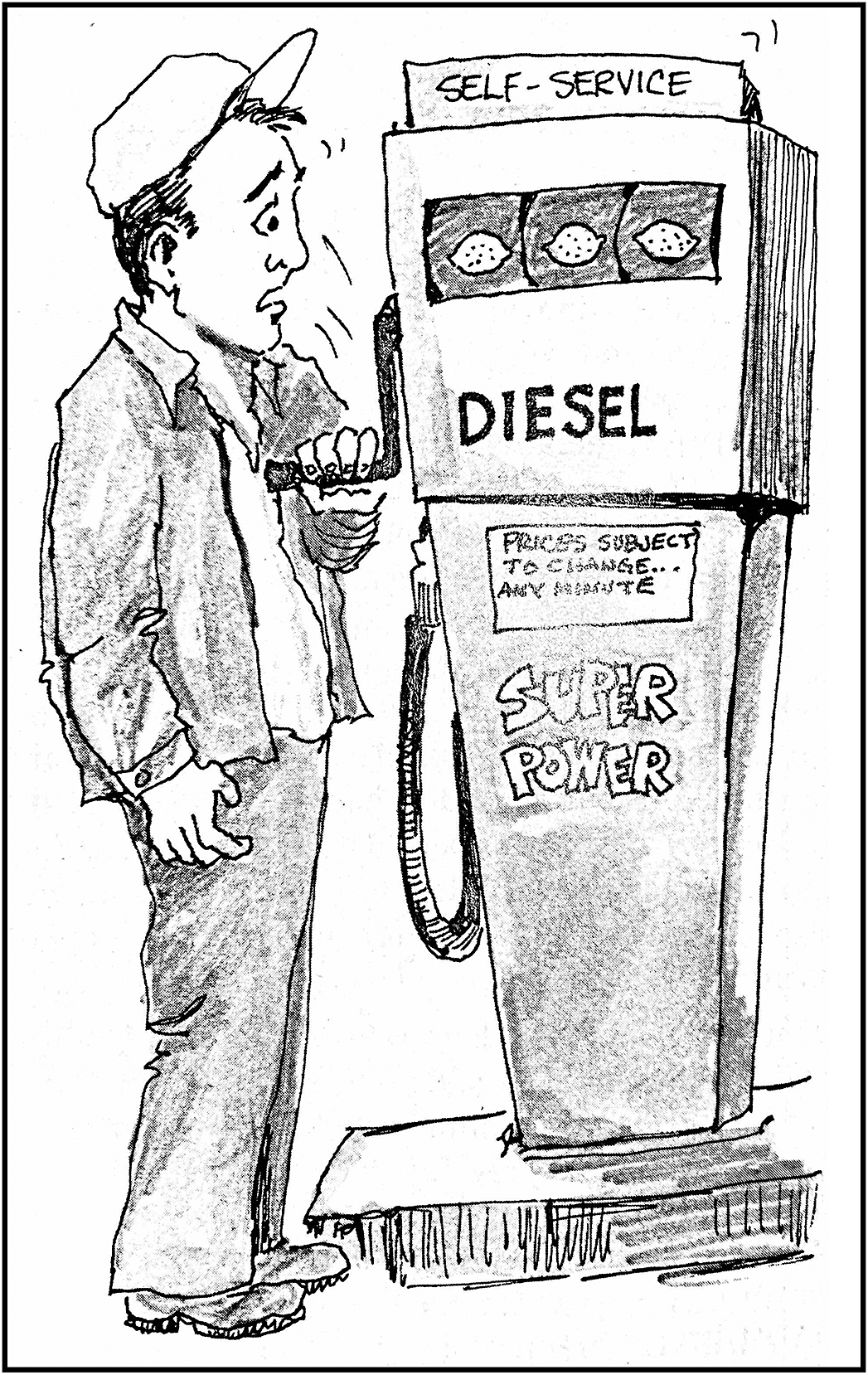
The energy crisis facing independent truckers. Overdrive: The Voice of the American Trucker, January 1974. By permission of Overdrive magazine, OverdriveOnline.com.
Trucker Protests
As stagflation set in across the economy, the truckers found themselves caught in the middle of a tug of war between producers and consumers. No one ought to have appreciated the tension more than President Richard Nixon, who had grown up working at his family’s gas station-grocery, driving a truck to Los Angeles vegetable markets in the small hours. But Nixon owed the farmers: they had helped to put him back in the White House in 1972. At the same time, food prices became a flashpoint as the price of the Thanksgiving turkey shot up from 39 cents a pound in 1972 to 90 cents in 1973. Housewives resorted to beef boycotts, one woman even downing a spoonful of dogfood to demonstrate that pets were living better than their humans.Footnote 48 The Nixon administration’s response lurched between deregulation, pouring cash into the coffers of agribusiness, and gimmicky attempts to freeze meat prices for urban shoppers. The policy was a disaster. Farm prices—exempted, like food trucking, from the overall regime of regulation—kept rising. But processors, wholesalers, and retailers could not pass through the costs.Footnote 49 The burden fell on intermediaries like the independent truckers, caught in the crunch between mighty agribusiness interests and a newly empowered consumer movement.
It seemed that the old principles of hard work, small-town values, and faith in markets were unraveling. Little wonder that one perceptive “psycho-biography” of Nixon was subtitled The Crisis of the Self-Made Man. Footnote 50 Activists urged independent truckers to take action. The former produce hauler Mike Parkhurst deployed his magazine Overdrive to peddle libertarian commentary across the nation’s truck stops, sweetened with racy photos of girls mounting big rigs. In its pages, he documented events in Chile, where forty-five thousand independent truckers shut down the country that August (with a little help from the CIA), paving the way for the military coup against Salvador Allende. “‘Country Roads’ is a pretty song,” he chided. “But it appears that only Chilean truckers have the actual guts to blockade the roads of their country.”Footnote 51
The inflationary spiral was supercharged as the age of energy abundance came to a rude end. Domestic oil production was plateauing, and for the first time Middle Eastern imports contributed a significant share of supply. By the summer of 1973, truckers were already reporting that truck stops were limiting the amount of diesel they could buy. The Arab oil boycott struck that October. A gallon of diesel averaged an already painful 31 cents in May 1973, and more than 50 cents five months later. Hardest hit were the independents (Figure 3). Jim Johnston, later a leader of the independent truckers’ lobby, recalled pulling into a gas station and looking down at the price as the attendant started pumping: “Get that thing outta my truck!” Just as bad was the precious time wasted; he queued for hours, but the allotted ration would only get him to the next truck stop a hundred miles down the road.Footnote 52 A further blow was the imposition of the despised “double nickel,” a 55 mile-per-hour speed limit to save fuel. Increasingly Johnston heard complaints about oil prices and rationing at truck stops and on the two-way citizens’ band (CB) radio that was becoming ubiquitous on the roads. The Oregonian trucker Bob Schmid spoke for many when he blamed “a combination of the oil companies themselves and the federal government”; another newsletter called the fuel crisis “a conspiracy that makes Watergate look like peanuts.”Footnote 53 So the truckers began to mobilize. A FASH activist likened them to the rebellious students of the 1960s, with two big differences: “truckers believe that the establishment should not be overthrown as it would only be replaced by another rule that might be harder to handle”—and the students’ tactics were “far too mild-mannered.”Footnote 54 It signaled the tension between radical methods and less-than-radical market refashioning at which the movement aimed.
The protests were marked from the start by a paradox, as proudly individualistic independents struggled to unite. They started as “an uncoordinated lunge,” Rolling Stone wrote, “an inspired and guttural moan from the bottom of the pile.”Footnote 55 Here and there, a trucker stopped work. The turning point arrived around 3 December, when a trucker from outside Kansas City, CB handle “River Rat,” ran out of diesel on Interstate 80 in Pennsylvania. Thus began an impromptu blockade joined by hundreds of frustrated truckers. Swiftly relayed around the country via landline and CB radio, over the next few days protests spread. The battle-hardened steel haulers of FASH were some of the most committed protesters, forcing the closure of steel mills across the Rust Belt. More importantly, the effect was swiftly felt in the bellies of consumers; perhaps ten million chickens alone failed to reach the shelves: “We got supermarkets begging both coasts,” bragged trucker graffiti.Footnote 56 “The Great White Fathers back in Washington don’t give a damn about truck drivers,” said one Iowan trucker. “They’re so worried about shutting the cities down, the only way we will do anything for ourselves is if we shut down the country.”Footnote 57
Fuel was the prime concern. “The only sign that will really end the strike,” declared one newsletter, “is the one on top of the gas pump.”Footnote 58 Overdrive’s Parkhurst pounced on the blockades to call for a nationwide shutdown, distributing thirty thousand posters across thirty states outlining the movement’s three goals: no fuel rationing for trucks, raising the diesel-truck speed limit, and forcing refineries to increase capacity and disclose reserves.Footnote 59 The FASH steel haulers called for state controls over the oil industry.Footnote 60 In late January 1974, independent truckers across the East Coast and Midwest parked their rigs to block key intersections and picket oil terminals, repurposing vehicles as a tool of infrastructural occupation. The Great White Fathers were finally forced to listen: a Truckers Unity Committee traveled to Washington to negotiate.
There was just one problem: the hydra-headed mobilization of the independents produced no single leader. “They’re all following you,” someone tells “Rubber Duck,” a largely shirtless Kris Kristofferson, in the 1978 trucking movie Convoy; “No, they ain’t,” he answers, “I’m just in front of ’em.” New organizations mushroomed, all claiming to speak for the industry. Overdrive magazine mockingly listed the absurd total membership these competing “parking lot generals” boasted: 21,772,374.Footnote 61 “The organization is so loose, that it’s a lot different than dealing with a recognized union,” Nixon’s (post-Saturday Night Massacre) attorney general complained; “They are just striking against a change in their way of life.”Footnote 62 Others kept driving, hoping to make extra money while there was less competition: “the owner-operator was his own worst enemy.”Footnote 63
Cohesion was accordingly fragile, mass stoppages enforced with violence rather than a robust sense of solidarity. In a single week in February 1974, there were 228 highway shootings across twenty-nine states; one Cleveland firm even hired the Hell’s Angels motorcycle gang to protect their gasoline tankers. The state’s lower echelons became particular targets of ludic violence. The anti-authoritarian slang of CB radio centered on a basic theme of “the good guys v. the cops,” or “Smokey,” and the Philadelphia Inquirer would report during the surge of protests during the second oil shock in 1979 that for many irate truckers “the police had become synonymous with the oil companies.”Footnote 64 With rival leaders proliferating, the truckers secured little from embattled administrations either in 1974 or 1979. Cash-strapped and disillusioned by the chaos, many headed back to work. The last gasp of the great truckers’ protests arrived in 1983, after the Reagan administration took advantage of low oil prices to increase the diesel tax by five cents a gallon and impose higher fees on large trucks. The truckers once again stopped work but proved more fractious than ever. Thousands of trucks were vandalized, and 638 shootings were recorded, even as produce continued to make it to city markets. After eleven days, the strike collapsed. Fuel prices might be a boundary object that united diverse protesters, but leaderless rebellion had its limits.
The truckers’ protests nonetheless arrived at an important inflection point. With criticism of automobile culture mounting from both environmentalists and anti-sprawl activists, the Nixon administration had reluctantly overseen “busting the Trust,” diverting the Highway Trust Fund for investments in public transportation funded by motor fuel taxes.Footnote 65 But the protests helped to ensure that the backlash proved short-lived. Mass transportation options never flourished. While government administrators and advisors publicly touted drastic hikes to motor fuel taxes, President Gerald Ford (whose wife Betty campaigned over the CB radio under the handle “First Mama”) heeded the pleas of those like Republican congressman Tim Lee Carter of Kentucky: “Please, for godsake, don’t mention any more tax on gasoline! This adversely affects every congressional candidate in the United States.… I have travelled from one end of this district to the other and I found only one man who supported the 10¢/gallon tax on gasoline and he was a kook.”Footnote 66 The Reagan administration was forced to quietly roll back other truck-use fees designed to account for the damage the huge vehicles cause to roads; and even after the Reagan tax hike, federal motor-fuel taxes remained at only 9 cents per gallon—one-eighth the level typical in other rich countries.Footnote 67 George H. W. Bush’s defeat in 1992 after a modest fuel tax hike further sensitized politicians to the risk. Federal gasoline and diesel taxes have not been increased since 1993 and have fallen 40 percent in real terms. The costs of highway maintenance and patrolling, let alone air pollution or military intervention in foreign oil economies, have been cross-subsidized ever more heavily by general taxation. U.S. fuel taxes have stagnated at negligible levels more often seen in petrostates.Footnote 68
This undertaxation is an active political choice, and has shaped an equally skewed pattern of carbon emissions. Transportation is the largest contributor to American emissions (29 percent in 2021), more than either power generation or industry; a quarter of this is from medium and heavy trucks.Footnote 69 Motor fuel taxes are widely recognized as a crucial instrument for climate policy, yet American politicians have proved unwilling for a generation to take the short-term political risk of raising them. Independent truckers were not the sole nor even the most important part of the formidable lobbying coalition locking fossil fuels in place, of course. Nonetheless, there is evidence that their leverage continues to matter. When diesel prices rose sharply in the 2000s, legislators began slashing state fuel excise taxes to compensate, especially in states where the freight trucking industry was a significant employer.Footnote 70 The truckers’ protests had helped to make fuel tax rises the third rail of American politics.
Ironically, though, the preservation of the energetic status quo did nothing to protect their broader livelihoods. When the Carter administration unleashed deregulation upon the trucking industry—as independent trucking critics of the Teamsters had long demanded—owner-operators were the losers.Footnote 71 Self-employment served as a wage depressant that served big business. By the 1990s, big rigs had become virtual “sweatshops on wheels.” Once among the best-paid of all blue-collar jobs, their drivers were the original precariously employed gig workers, still working brutally long hours but now for collapsing pay. Cheap drivers had been harnessed to the cheap fuel, cheap freight, and cheap food that underpinned American consumer society.Footnote 72
Forging the Tubewell-Electricity-Food Nexus in the Indian Heartland
If American energy protests erupted out of a diesel-powered horizontal revolution in economic space, those in the Indian heartland arrived from an electrically powered vertical revolution. The Bharatiya Kisan Union (BKU, Indian Farmers’ Union) was the most headline-grabbing among the wave of farmer assertions that shook India in the 1980s, several similarly undergirded by the politicization of electricity. Its roots lay deep in the fertile soils of northwest India. Tikait, leader of the great BKU energy protests of the 1980s, was born in the small town of Sisauli in Muzaffarnagar district of western United Provinces, now Uttar Pradesh (UP). This was the upper portion of the region known as the Doab, the fertile plains between the two holy rivers of the Ganges and Yamuna. Like much of India, the Doab remained vulnerable to the caprice of the monsoon. As its inhabitants had realized for centuries, one solution lay not far beneath their feet. The Gangetic basin was a land of underground rain. Under the loamy soils lay a multilayered aquifer, an immense reservoir of Himalayan glacial runoff and monsoons past into which they sunk wells, water lifted by human effort or teams of bullocks.
Electricity would enable the underground rains to be tapped with new efficiency. Beginning in the late 1920s, a state-sponsored experiment in rural electrification kickstarted an agrarian revolution. The colonial engineer Sir William Stampe oversaw the construction of a series of small, interconnected thermal and hydroelectric power plants along the region’s rivers. In turn, water and energy became bound up via a second technology: the motorized tubewell, which could pump up a continuous cascade of irrigation water from the aquifer. By the early 1940s the 1,700 state-owned tubewells powered by this 23,000-kilowatt “Ganges Grid” were irrigating 800,000 acres in the world’s largest organized groundwater irrigation program. Within two years, the word “hydel” had emerged as a portmanteau in Indian English, as the hydraulic and electric “were blended into one strong pull to drag the cultivator with the aid of electricity a little further from the economic abyss.”Footnote 73
The state, not spontaneous demand, was the driver of this rural electrification. “The general attitude was that irrigation, whether by tube-wells or canals, is a State concern,” reported Stampe, and so “the State should provide the money.”Footnote 74 Ganges Grid power was charged at generously subsidized rates for agricultural use. As cultivators drew ever more water, tubewells quickly became the primary load on the grid. Stampe recognized that the system was “open to abuse,” though he cheerfully anticipated that a successful procedure for payment by volume would be found.Footnote 75 The government’s former electrical advisor agreed that “everyone in the Indian service realized … that electricity did not get mixed up much with politics.”Footnote 76 Here both men would be proven disastrously wrong. After independence in 1947, the notion that the state owed agriculturalists cheap power would take on a life of its own.
The failed monsoons of 1965 and 1966 opened a window of opportunity for rapid state-sponsored expansion of this tubewell-electricity-food nexus. Concentrated in dynamic agrarian areas like western UP, the package of agricultural reforms known as the Green Revolution prescribed the introduction of new high-yielding seeds that required vast inputs of fossil fuel-derived fertilizers, pesticides, and water. Alongside these state-subsidized inputs, food price policy was inverted to prioritize agriculture. In 1965 the state established floor prices for foodgrains and key cash crops that farmers were guaranteed to receive.Footnote 77 By protecting farmer incomes through input subsidies and minimum support prices for outputs, the state sought to incentivize greater domestic production and uptake of the new technologies. The Food Corporation of India purchased vast quantities of grains for national stockpiles, distributed via an expanded network of fair-price shops that delivered cheap staples to consumers. Through this combination of farmer supports and the public distribution system, northwestern India became even more crucial for the urban food economy. Rural producers’ bargaining strength correspondingly increased.Footnote 78
Though hybrid seeds dominate scholarly attention, the truly revolutionary aspect of the Green Revolution was the copious and controlled application of water—and therefore ever more heavily subsidized electricity. While groundwater mining preceded the Green Revolution, it received new impetus from the seeds’ needs. The new crop varieties favored quality of irrigation: water had to flow at the right time and in the right quantities to prepare the soil and assist plant growth across multiple harvests. Canals could provide only uncertain and often inconveniently located supplies. Stampe’s Ganges Grid brought similar problems: by 1969 powerful state-owned tubewells numbered over nine thousand in UP, each irrigating a substantial area, but their financial performance was dismal. A USAID-funded study suggested that higher capital costs—fifteen times that of private tubewells, 50 percent more per unit of water—drove pressure to run the pumps at the limits of their capacity, leading to frequent breakdowns. This irregularity was compounded by slow repairs and the absenteeism and bribe-greased favoritism of state tubewell operators.Footnote 79
A more flexible solution seemed to lie in pushing energized tubewells into the hands of private individuals. In 1969 the Rural Electrification Corporation was established to channel government loans toward farmers. Uttar Pradesh had energized a mere 5,713 irrigation pumpsets and tubewells in 1956 but boasted 260,738 two decades later. The cultivators of northwestern UP were finally liberated from the seasonal caprice of tropical rainfall. Yet anthropologist Akhil Gupta found farmers decrying their new dependence on the equally capricious state electricity board. As one told him, “Nobody feels for anyone else. It is all in the hands of the government.… Whenever it wishes, it sends electricity. Everything is in its hands, water, et cetera, for the farmer, is all in its hands.”Footnote 80
Powered by cheap electricity, the tubewell revolution reshaped social ecologies and rural-urban politics alike. Advocates claimed that the Green Revolution seeds were scale-neutral. In practice, the cost of installing tubewells—which required a minimum amount of land to be most useful—created a bias toward wealthier farmers.Footnote 81 Beyond these larger farms, rural electrification remained limited. Food, fossil fuels, and power became inextricably entangled within an elaborate and expensive web of state subsidies that systematically “leaked” to the politically connected. Agricultural producers became reliant on state-subsidized electricity and state procurement, while consumers came to expect cheap and stable prices for basic foodstuffs, underpinned by government fair-price shops. As the state helped to foster the tubewell-electricity-food nexus, it decentralized production to dispersed networks of wealthier farmers who retained strategic leverage through their critical role in meeting basic needs within the paternalistic consumers’ republic. As the energy and water demands of agriculture expanded, so did its political footprint.
Peasant power and electricity protests
The large Hindu Jat community into which Tikait was born was at the forefront of this agrarian resurgence. This was no rural proletariat: the Jats were becoming western UP’s archetypal middle-caste owner-cultivators. The imperial regime had grudgingly admired them as “hard thrifty men” with a brilliant eye for the best soils, a racialized stereotype of the muscular and industrious cultivator embraced by Jats themselves.Footnote 82 United by an egalitarian ethic of brotherhood, they were intensely proud of their productive smallholdings but hostile to upper-caste merchants and contemptuous of the demeaning condition of landlessness. As one ethnographer wrote, “Jat ‘democracy’ is not for the weak. Only the strong can be equal.”Footnote 83 Theirs was a distinctive political economy summarized by the great leader and organic intellectual of India’s post-independence farmers, Charan Singh, another Hindu Jat born just seventy miles east of Tikait’s village and thirty years his senior. The peasant-proprietor was “owner, labourer, capitalist and even the enterpreneur [sic] or manager all rolled into one,” he declared, thus occupying “a position of mixed interest that offers a stubborn challenge to both the economists’ inquiries and the legislators’ programmes.”Footnote 84 He saw in electricity—powering the dispersed technologies of the rural powerloom and the tubewell—the potential for both economic and political decentralization.Footnote 85 “The peasant is an incorrigible individualist,” Charan Singh concluded, “the only class which is equally democratic without mental reservations.”Footnote 86
The 1967 general election witnessed the first flexing of this agrarian muscle. Rural interests put an end to the Congress’s one-party dominance across many states, with the anti-Congress vote especially strong in areas atop the aquifers tapped by tubewells.Footnote 87 Out of the ferment, Charan Singh rose to become UP’s first non-Congress chief minister and eventually prime minister for a brief and ignominious stint in 1979. If Charan Singh’s electoral ambitions sputtered out, his imprint on agrarian politics was more lasting. In 1978 the BKU began as a small farmers’ organization in the northwestern Green Revolution stronghold of Haryana. A few months later Charan Singh, vying for the prime minister’s seat, called hundreds of thousands of farmers to occupy the lawns of New Delhi. As the glossy new magazine India Today reported, the rally signaled “the vaulting ambition of a whole lot of long-subdued middle castes, newly awakened to their potential power.”Footnote 88
Semi-literate and once interned at the Agra lunatic asylum, Tikait was an unlikely inheritor of Charan Singh’s mantle as the leader of western UP’s farmers. As a child, though, he had become the hereditary headman of the powerful Baliyan khap (territorial clan organization). His family was so poor that the khap held a collection to present him with 15 acres, sufficient to establish him as a moderately large farmer in the area, but a fraction of even small American family farms. Though other communities would join his movement, Jat caste solidarity would provide the backbone of the BKU. Charismatic and rangy, “about as tall as film actor Amitabh Bachchan,” Tikait mobilized traditional clan structures as first among equals.Footnote 89 He nonetheless remained the consummate ordinary farmer: media cartoons depicted him as bristly and gap-toothed, often with his trademark hookah in hand.
By the time of the BKU’s rebirth under Tikait in the mid-1980s, this agrarian mobilization was shifting away from the revolutionary impulse that India Today had feared. The government’s role as price-setter and provider of subsidized electricity and fertilizer brought millions of farmers into a direct relationship with the state. They were now a commodity-producing peasantry in a double sense, both producing commodified foodstuffs and using commodities as inputs.Footnote 90 Land redistribution, the great issue driving older waves of peasant unrest, was replaced by a focus on corporatist negotiations over the prices the state would offer for produce and for critical inputs. Analyzing the BKU, one newspaper commentator cited James C. Scott’s classic The Moral Economy of the Peasant: “the penetration of a cash nexus and the invasion of modern technology has dramatically altered the peasantry’s socio-economic equilibrium,” though the movement was moral as much as material in arguing that the farmers “had a social right of subsistence.”Footnote 91
It was no accident, then, that the immediate trigger for the BKU’s rejuvenation arrived with a hike in UP’s electricity rates. Farmers paid a fixed monthly amount for electricity based on the horsepower of their tubewell motor, regardless of how much they pumped. The primary way that the state utility could regulate the price of electricity was to ration supply. Where once they got by with a single tubewell, a farmer told Akhil Gupta, the current now only flowed for six hours a day, so he and his three brothers had each sunk a new well.Footnote 92 In turn this worsened the pressure on local distribution infrastructure; utility staff responded by delaying repairs to burnt-out transformers to forcibly suppress demand. For the proud Jat cultivators, the erratic supply was proof of the fundamental untrustworthiness of the state and its plot to keep rural areas poor. “It is not a fight between village and city,” Tikait spat, “but with the corrupt, thieving parasites of the city, and these are the government, bureaucrats, and the middlemen.”Footnote 93
The state called the farmers “the backbone of the country,” the BKU argued, but its lavish promises were lies. In the context of deteriorating supply, a hike in UP’s electricity tariffs for agricultural pumpsets in August 1986—from Rs 22.50 per horsepower to Rs. 30.00—was nothing short of enraging, especially as a month earlier a strike by electricity board workers had earned them increased wages. “We are not beggars who ask for handouts from the government,” said Tikait, “we are fighting for what is rightfully ours.”Footnote 94 Farmers in the southern state of Tamil Nadu had successfully mobilized to protest similar rate hikes as early as 1972, and regional newspapers disseminated news of a parallel recent agitation in Gujarat.Footnote 95 The BKU similarly organized a rally at a power substation at Shamli, which Tikait later extended into a more prolonged encirclement—a gherao, in the rich vocabulary of Indian protest—of the local power station. Within days the protest had drawn in as many as eighty thousand farmers. Tikait’s BKU next borrowed the tactic of the rasta roko (road blockade) that Tamil farmers had used against Coimbatore city in 1972, threatening to block the flow of agricultural and dairy produce to urban markets; local activists could point to a mythical precursor when the cowherd god Krishna blocked delivery of butter and milk to the tyrannical King Kansa in the city of Mathura. In response the UP administration conceded several of the BKU’s demands, if only a short-lived rollback of the tariff hike.
A year after the Shamli agitation, climate shocks struck much of the world. A blistering heat wave killed two thousand in Greece; freak rains left many South Africans homeless. In northern India, the monsoon failed. Crops lay brown and stunted. As hydroelectric dam reservoir levels fell, industrialists and city dwellers endured power cuts so that electricity could be diverted to irrigation wells. With power nonetheless flowing erratically, farmers sold off land to invest desperately in ever-deeper wells and more powerful and expensive pumps. They were all too aware that something was awry. Some blamed deforestation for the lack of rain. Others pointed at the falling water table: “Too many tube wells have been sunk.” All agreed that the government should intervene to stop farming from collapse.Footnote 96 Accordingly, the BKU’s list of demands was again headed by cheap and reliable energy supplies. They demanded electricity bill arrears be written off, a fixed power tariff to match the low rates in neighboring states, uninterrupted power for twelve hours a day, easier bill payment, timely transformer repairs, and the right to cut trees for fuelwood.
Evading the state’s attempt to block his entry under national security laws, in early 1988 Tikait led some two hundred thousand agriculturalists to lay peaceful siege to the city of Meerut. It began as an impressively disciplined mass protest, gheraoing key government offices in line with the BKU’s professed commitment to Gandhian nonviolence. Gathering supporters from neighboring states, the farmers couched themselves as true patriots, repurposing the old slogan Jai Jawan, Jai Kisan (“Hail the Soldier, Hail the Farmer”). The BKU regulated traffic and set up stations to dispense food donated by surrounding villages, bonfires glowing in the cold evening air; sympathetic observers likened the sense of hospitality and familiarity to an old-fashioned baraat or marriage party, refuting the “colonial” stereotype of the unruly farmer.Footnote 97 It was, Tikait argued, an insurgency of the authentic rural people against interloping elites: “These people who read in English schools and sit in cities have not looked to us for the last 40 years and have no right to rule us. They have to listen to us now.”Footnote 98 As negotiations stalled, though, violence erupted. When BKU activists tried to impose a rasta roko and accompanying railway blockade (rail roko) upon the city, police opened fire. The bodies of dead farmers—most killed by the cold—were publicly displayed as martyrs. Students supporting the farmers burned down two powerhouses. After twenty-five long days, Tikait called off the protest having won few real concessions.
Much of the Anglophone media dismissed the BKU as a movement of a primordial and nostalgic Jat elite. The sociologist Dipankar Gupta provided a perceptive alternative reading: under Tikait, the BKU lived up to its name as the Indian Farmers’ Union, taking up the specific and economistic demands characteristic of the trade union form.Footnote 99 It was avowedly apolitical—arajnaitik, the word with which its constitution signed off—and snubbed politicians, even keeping Charan Singh’s son at arm’s length. At the same time, the BKU vowed to cultivate discipline in its members, familiarize them with new farming technologies, and encourage entrepreneurialism.Footnote 100 Like the prominence of electricity, this was especially appealing to wealthier farmers with powerful tubewells, not to the landless laborer.Footnote 101
The state nevertheless remained central to this imaginary, and a powerful sense of injustice continued to burn. One farmer captured this paradoxical relationship: “We consider the government which supports us small people as if it were our mother and father.… But the officials in the middle eat it all.”Footnote 102 Yet they did not approach the state as supplicants. In parallel with its rallies, the BKU initiated a campaign of mass noncooperation. Tikait instructed supporters not to pay electricity bills or taxes, the farmers instead helping themselves to free power in the name of the drought.Footnote 103 Many activists deployed the tactic of jail bharo, courting arrest by trespassing on government property to clog the legal system. The lands around Tikait’s hometown of Sisauli were declared an autonomous “liberated area” in which no government servant could enter (a strategy known as gaonbandi, village closure). The BKU also encouraged farmers to fell the area’s rare remaining trees without permission, in “both a symbolic and an economic protest: defying the government and reclaiming land for agriculture and wood for fuel.”Footnote 104 The characteristic political strategies of the farmers’ movement—the rasta roko and rail roko—directly targeted transportation infrastructure to withhold produce from urban markets, while gaonbandi threatened to sever the link between countryside and city entirely.Footnote 105
By July 1989, 60 percent of agricultural electricity dues remained unpaid in the Meerut zone. Tikait’s followers refused to pay for more than four years, eventually securing limited remissions on past electricity bills. As the months went on, though, the campaign did not always honor the BKU’s on-paper commitment to nonviolence. “If Tikait says burn your crops, uproot railway tracks, stop traffic, we will do it,” said one activist. “It’s more honourable to be shot by the police than to seek alms from the Government.”Footnote 106 The farmers reserved particular ire for the tendency of electricity board officials to demand bribes. Tikait commanded his followers to “arrest” any official who attempted to cut power connections. BKU activists stole electrical transformers, damaged equipment, padlocked government offices, attacked the police, and held electricity utility employees hostage, tying them to trees and making them do push-ups. It was, anthropologists speculated, an expression of the sheer transgressive pleasure of violence, deliberately vandalizing symbols of state authority.Footnote 107 Increasingly, though, locals began to fear that the movement was descending into a “vulgar mobocracy.”Footnote 108
The march on Delhi in 1988, with which this piece opened, marked the movement’s high point. There Tikait again demanded that electricity bills in arrears be written off, and electricity delivered at a low and nationally uniform rate. Yet his abrupt and unilateral decision to end the dharna alienated many younger and more radical participants. A year later another mass march alongside other regional farmers’ movements ended in very public infighting, Tikait shoving his most prominent rival off the podium. While the BKU’s absence of a “class perspective” (vargiy drshtikon) had always excluded agricultural laborers, one of Tikait’s former supporters noted, by the 1990s its cohesion had irrevocably shattered along lines of caste and religion. He charged that the BKU’s informal, hydra-headed structure and Tikait’s own localism were its ultimate undoing, failing to convert the farmers’ spontaneous mobilization into a purposeful organization.Footnote 109
Yet it would be foolish to dismiss the BKU’s impact out of hand. Utility reforms and electricity tariff hikes became politically unthinkable in states where farmers remained politically powerful and electoral competition was intense. Well into the twenty-first century, UP’s politicians competed to promise low agricultural electricity tariffs and to facilitate electricity theft, levels of which rise and fall with electoral cycles.Footnote 110 Together theft, non-payment, and ever-lower power tariffs upended the state utility’s already precarious finances. The tubewell revolution had created the new farmers’ movements, and Tikait’s movement and its counterparts would in turn help to shape the country’s unusual carbon emissions profile. Electricity is the single largest contributor to India’s rapidly growing emissions, thanks not least to the dominance of coal-fired power plants. The country remains an outlier among large emitters in the share of this electricity that flows to agriculture, a share that peaked around one-third of all power consumed in the mid-1990s.
Electricity tariffs remained a redoubt of agrarian influence even as the political settlement tilted away from the countryside. Yet, as fiscal austerity and pro-business policy moved into the ascendant in the capital, the terms of trade seemed to swing against the countryside once more. Today small Indian agriculture is in the midst of a generation-long crisis. Jat farmers push their sons to leave the farm and compete for salaried government employment—though, with such jobs scarce, many young men languish in perennial unemployment.Footnote 111 Even the sop of cheap electricity has been revealed as a curse: the anarchic pumping of more than twenty million privately owned electric tubewells transformed India into the world’s largest consumer of groundwater, sucking up a quarter of the world’s annual total. Agriculture today accounts for over 85 percent of Indian water consumption. The resulting crisis of freshwater depletion is perhaps the country’s most immediate ecological emergency.
The Peoples’ Fossil Fuel Lobbies
Under cover of darkness on 7 September 2000, a convoy of cars, trucks, and tractors threaded towards the dockside town of Ellesmere Port in northwest England. An alliance of livestock farmers and lorry owner-operators surrounded Shell’s Stanlow oil refinery to protest a 42 percent rise in the price of fuel in three years, half of the increase justified to prevent global warming. In the following days, blockades radiated across the country’s refineries. Panic buying spread even faster. The “People’s Fuel Lobby,” as the movement’s leaders dubbed it, was far from alone. The Stanlow blockade was inspired by similar action in France. Parallel protests shook much of Western Europe from Sweden to Greece, Ireland to the Czech Republic. Britain’s government announced that fuel duty rates would be frozen, effectively killing off the Fuel Price Accelerator policy in place since 1993. Rises would be repeatedly deferred for the next two decades, costing the exchequer £46.2 billion between 2012 and 2019 alone.Footnote 112 “You wouldn’t pick out truckers and farmers as having the most reason to be aggrieved,” observed critics, pointing to the low-tax “red diesel” on which British farm vehicles run and the state’s rising maintenance costs for roads carrying ever-heavier trucks.Footnote 113 But it was no coincidence that farmers and truckers joined forces. Rather than analyzing “fuel riots” as generic eruptions provoked by price shocks, this paper has piloted an energetic class analytic to understand why such constituencies are especially likely to join and sustain energy protests.
The ecology of class is, first and foremost, a matter of the objective material relationships with energy that shape political economy. In contrast to the premodern forest commons, access to contemporary energy systems is structured by state regulation. In both these cases, the state encouraged the development of energy-intensive technological complexes. In the United States, the decentralized technology-energy nexus centered on state-subsidized highways and undertaxed diesel, via which tractor-trailers hauled goods that also required cheap energy to produce and process. In northwest India, the Green Revolution—popularly associated with hybrid seeds—was also an energy revolution. Energy, water, and food became tightly interconnected through a nexus centered on the electrified tubewell, which used state-subsidized power to pump groundwater for irrigation. American owner-operators and Indian owner-cultivators occupied an awkward position between big capital and wage labor, self-exploiting in order to sweat these individually owned assets. They were at once consumers ensnared in state-mediated energy commodity chains—unusually exposed price-takers when it came to motor fuel and electricity—and producer-intermediaries critical to feed and provision cities.
Equally arresting were the similar subjective experiences informed by this structural location, which echoed across the eight thousand miles that separated them. Resenting their dependence on a far-off metropolitan government, both movements simultaneously protested state corruption and endorsed local productivism as the moral core of the economy, even as they demanded the state’s protective intervention in energy markets. Local officials, whether the figure of the villainous sheriff or the corrupt electricity board official, became especial targets of their ire. Tikait’s farmers, able to draw on long-established caste and clan ties, proved more disciplined than did the American truckers. But the folk political economy animating each movement did not generate the sophisticated revolutionary thought that E. P. Thompson detected amid the nascent English working class, instead shaping more nebulous and reactionary if no less significant political claims and antagonisms. Rejecting formal party-political commitments, both movements were fundamentally defensive and conservative, and not just in their similar juxtaposition of rural authenticity and rugged masculinity with the coddled city.Footnote 114 Neither group aimed at a material reorganization of society so much as the reproduction of the energetic and socioeconomic status quo.
Drawing on their somewhat similar structural locations within the fossil economy, the truckers and farmers shared strategies of protest. Both deployed infrastructural blockades and supply interruption to disrupt the economic systems that the two very different consumers’ republics had come to expect, especially the availability of cheap food, though here the truckers enjoyed greater leverage given their centrality to society’s circulatory systems. Nonetheless, neither movement was capable of the sustained sabotage that had empowered British coalminers at the high noon of their influence—not least because the tubewell and tractor-trailer were atomistic in their ownership and spatial logics, dividing individuals even as shared interests brought them together. In the short term, neither succeeded in winning more than superficial concessions. Political leaders proved capable of standing up to the protesters, a fact that may hearten those seeking to overcome grassroots resistance to climate mitigation policy.
The threat of recurrent protests nonetheless continued to haunt energy policymakers. In India, the state may have driven rural electrification, but it was through the fear of electoral dismissal that agricultural energy subsidies were entrenched. In the United States, raising federal fuel taxes became politically inconceivable. Dismissed by urban elites, neither movement could dictate policy—but they could place very real roadblocks in the way of energy reform. These protests and others like it help to obstruct removal of fossil fuel consumer subsidies that cost more than $1.1 trillion worldwide in 2022.Footnote 115 If the vast unpaid costs of ecological externalities are included too, no less an entity than the International Monetary Fund calculates the total cost of such underpricing at a staggering $7 trillion in 2022, 7.1 percent of global GDP.Footnote 116 In turn, artificially low prices incentivize overconsumption. Energy protests deserve a central role in our environmental histories of fossil fuel society. In the long list of obstacles that block our path to more sustainable energy systems, they represent a source of political resistance that we ignore at our peril.
Yet we should not mistake these plebeian constituencies for the central forces who lock carbon-intensive energy systems in place. Ultimately, both movements found populist energy policies much easier to extract from the state than they did any meaningful protection for their livelihoods. With hindsight, both protest movements appear tinged with pathos. Many American big-rig drivers and Indian farmers today are profoundly embattled. Squeezed again between corporate capital and the seemingly insatiable demands of the consumer societies they serve, their increasing precarity has only intensified the ferocious and divisive competition to work harder and pump more. It is a logic much more powerful and self-devouring than any individual caught in its web.
Acknowledgments
This article began life as a special faculty lecture for the University of Chicago’s brilliant History undergraduates; I am grateful for their incisive questions, feedback, and encouragement to pursue what initially seemed an eccentric comparison. For wise advice at different stages, I thank Fredrik Albritton Jonsson, Venus Bivar, Christopher F. Jones, Stephen Macekura, Carl Wennerlind, Gabriel Winant, my summer research assistants Erin Hanyu Lynch and Navid Mazidabadifarahani, and CSSH’s perceptive anonymous reviewers. Thanks, too, to David Akin and editors Geneviève Zubrzycki and Paul Christopher Johnson at CSSH.


 Open access

