

Hostname: page-component-77f85d65b8-8wtlm Total loading time: 0 Render date: 2026-04-20T16:22:56.960Z Has data issue: false hasContentIssue false

Twin forces: similarity between rotation and stratification effects on wall turbulence

Published online by Cambridge University Press:  22 January 2024

Shengqi Zhang*
Affiliation:
Eastern Institute for Advanced Study, Eastern Institute of Technology, Ningbo 315201, PR China
Chao Sun
Affiliation:
Center for Combustion Energy, Key Laboratory for Thermal Science and Power Engineering of MoE, and Department of Energy and Power Engineering, Tsinghua University, Beijing 100084, PR China Department of Engineering Mechanics, School of Aerospace Engineering, Tsinghua University, Beijing 100084, PR China
*
Email address for correspondence: shengqizhang@eias.ac.cn

Abstract

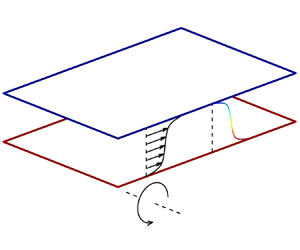
Can the similarity between rotation and stratification provide quantitative predictions for complex turbulence? In this work, we focus on plane Couette turbulence as the background flow, which allows us to eliminate the key differences between Rayleigh–Bénard and Taylor–Couette turbulence, and facilitates a quantitative mapping across many complex turbulent systems involving rotation, stratification and curvature effects. To characterize the separated or coupled effects of rotation and stratification, we introduce an overall Richardson number ${Ri}_\chi$ which is the sum of the Coriolis Richardson number $Ri_\theta$ and the buoyancy Richardson number $Ri_T$. When the Prandtl number $Pr=1$, the heat and inertial-frame momentum transport almost coincide and mainly depend on ${Ri}_\chi$ and the Reynolds number, regardless of the specific ratio between $Ri_\theta$ and $Ri_T$. When $Pr$ varies, the weighted average ${Nu}_\chi$ of the transport coefficients can still remain approximately invariant in most cases. Furthermore, the large-scale structures in purely rotating and purely stratified cases exhibit strikingly similar features. These findings not only indicate a more reasonable analogy for the ultimate Taylor–Couette turbulence but also pave the way for developing new predictive models for natural and industrial processes.

Information

Type
JFM Papers
Copyright
© The Author(s), 2024. Published by Cambridge University Press

Access options

Get access to the full version of this content by using one of the access options below. (Log in options will check for institutional or personal access. Content may require purchase if you do not have access.)

Article purchase

Temporarily unavailable