


Traditionally, nuts have been considered to be unhealthy because of their high content of fat(1, 2). However, recent findings attribute a wide range of health benefits resulting from nut consumption. Nuts are an important source of essential macro- and micronutrients, e.g. fatty acids, vitamins and minerals. In addition, some species provide 10 % of the recommended daily intake of thiamine, niacin, P and Zn under allowance of the daily intake of 40 g nuts a day, according to the US Department of Agriculture(1). Furthermore, nuts contain polyphenols and carotenoids which also have health-improving effects(Reference Anderson, Teuber and Gobeille3, Reference Alasalvar and Shahidi4). Evidence exists that an increased consumption of nuts can protect from CVD(Reference Nash and Westpfal5) and Hu et al. demonstrated that death from heart disease as well as non-lethal heart attacks can be reduced. These effects are probably a cause of the lipid profile of nuts, because they contain mainly MUFA and PUFA which can reduce the levels of LDL-cholesterol(Reference Hu, Stampfer and Manson6). Different studies demonstrated that the protection against CVD is at least partly caused by the modulation of serum lipids through unsaturated fatty acids. The consumption of only four walnuts a day over 3 weeks (in addition to the regular diet), e.g. significantly increased blood levels of α-linoleic acid and its metabolite eicosapentaenoic acid(Reference Marangoni, Colombo and Martiello7–Reference Garg, Blake and Wills9). In addition, Torabian et al. (Reference Torabian, Haddad and Cordero-Macintyre10) demonstrated that including walnuts as part of a habitual diet (free-living situation) also favourably altered the plasma lipid profile. Importantly, no additional weight gain was observed in human studies with nuts(Reference Banel and Hu11–Reference Rajaram and Sabate13). Nuts are also rich in different tocopherol forms and can deliver more than 20 % of the recommended daily allowance(Reference Rainey and Nyguist14). It is notable that different nuts contain divergent tocopherol profiles. For example, hazelnuts and almonds are the best source for α-tocopherol (15 mg/100 g and 16 mg/100 g), pistachios and walnuts contain mainly γ-tocopherol (22 mg/100 g and 21 mg/100 g)(Reference Alasalvar, Karamac and Kosinska15, Reference Dujardin16). Nuts are also an excellent source of health-promoting dietary fibre (DF). They can deliver between 5 and 12 % of the recommended daily intake (30 g) of DF(Reference Alasalvar and Shahidi4, Reference Coates and Howe17, Reference Gray18). This is highly interesting because of the beneficial effects of DF on the digestive tract, especially the large intestine. DF absorb water and thus increase stool bulk and prevent obstipation(Reference Cummings and Spiller19). The beneficial effects also include the reduction of symptoms caused by chronic inflammatory bowel disease and chemoprevention of colorectal cancer(Reference Bingham, Day and Luben20). Reports of Davis & Iwahashi(Reference Davis and Iwahashi21) suggest that nuts can be considered to be a protective factor of the colon. Whole-almond fractions reduced incidences of histological alterations of the colon mucosa of rats. Results of the European Prospective Investigation into Cancer and Nutrition study with 36 994 subjects in ten different countries demonstrated an inverse association between consumption of nuts and seeds and the risk of colorectal cancer in women(Reference Jenab, Ferrari and Slimani22). DF do not only increase stool bulk, they can also increase the amounts of SCFA, like butyrate, propionate and acetate in the lumen of the colon(Reference Cummings, Pomare and Branch23). Butyrate and, to a minor extent, propionate have been shown to inhibit the growth of colon tumour cells, by blocking proliferation and initiating apoptosis(Reference Beyer-Sehlmeyer, Glei and Hartmann24, Reference Borowicki, Stein and Scharlau25). In contrast, butyrate and other metabolites of DF fermentation act as growth factors in non-transformed colon cells and can increase the toxicological defence systems(Reference Pool-Zobel and Sauer26, Reference Sauer, Richter and Pool-Zobel27). Selected DF, termed prebiotic fibre, increases the amounts of SCFA in the colon and stimulates the growth of beneficial lactic acid-producing bacteria(Reference Gibson and Roberfroid28–Reference Gibson, Probert and Loo30). Especially bifidobacteria can improve colonic health by lowering the pH-value in the colonic lumen, thereby inhibiting the growth of pathogenic bacteria(Reference Bernet, Brassart and Neeser31, Reference Gibson and Wang32). Furthermore, prebiotics are able to reduce the genotoxic potential of faecal water and thus reduce the exposure of the colon epithelium with potential carcinogens(Reference Glei, Habermann and Osswald33–Reference Rafter, Bennett and Caderni35). Up till now, the effects of nuts on colonic health have not been well analysed and little is known about the metabolites which are formed during their fermentation. Considering that colorectal cancer is one of the most frequent and deadly cancer forms worldwide(Reference Garcia, Jemal and Ward36), studying these effects may increase the knowledge on the health benefits of nuts, next to their role in the prevention of CVD. Therefore, we generated fermentation supernatants (fs) of five different nut species (almonds, macadamias, hazelnuts, pistachios and walnuts) by using an in vitro fermentation system simulating the human digestion(Reference Borowicki, Stein and Scharlau25, Reference Barry, Hoebler and Macfarlane37, Reference Glei, Hofmann and Kuster38). The first goal of the present work was to characterise and to compare the fermentation products of different nuts regarding concentrations of SCFA (acetate, propionate and butyrate), tocopherols, antioxidant capacity and bile acids (BA). HT29 colon adenocarcinoma cells were treated with these fs and the effects on cell growth, cell cycle modulation as well as the genotoxic/anti-genotoxic potential of the fs were studied.
Material and methods
In vitro fermentation of nuts
The five different nut varieties used in this study were delivered from Blue Diamond Growers (almonds), Max Kiene GmbH (macadamias), Turkish Hazelnut Promotion Group (hazelnuts), Paramount Farms (pistachios) and Mariani Nut Company (walnuts). The nuts were digested using an in vitro simulation of the human gastrointestinal passage according to a previously described protocol(Reference Glei, Hofmann and Kuster38–Reference Stein, Borowicki and Scharlau40). In brief, 2 g of each nut variety were ground and suspended in anaerobic potassium phosphate buffer (0·1 m, pH 7·0). A positive control containing 2 g Synergy1® (inulin enriched with oligofructose; ORAFTI) and a negative control (blank: fermentation buffer only) were included. Pre-digestion was simulated by incubation with α-amylase (Sigma A-0521; 17·36 μl from a 500 U/500 μl stock solution in 20 mM-NaH2PO4 buffer) for 5 min at 37°C (simulation of the mouth) and for 2 h with pepsin (Sigma P-7012) at 37°C (1·11 mg in 0·94 ml 20 mm-HCl; pH 2·0; simulation of the stomach). In order to simulate the small intestine, the samples were incubated with an intestinal extract of pancreatin and oxgall (Sigma P-1750, Fluka-Sigma 70 168, 2·6 mg and 5·0 mg, respectively in 5 ml of 11 mm-bicarbonate buffer; pH 6·5) in a dialysis membrane (molecular weight cut-off: 1000 Da) under a semi-anaerobic condition at 37°C for 6 h. Semi-anaerobic conditions were achieved by removing a part of the air in the fermentation bottles via a cannula at 0·5 bar for 1 min and subsequently injecting a fermentation gas mixture (86 % N2, 10 % CO2 and 4 % H2) at 0·8 bar for 1 min for seven cycles repeated (15 min) according to Stein et al. (Reference Stein, Borowicki and Scharlau41).
For the in vitro fermentation, the suspensions were mixed to equal parts with human faecal slurries (approximately 25 ml pooled suspension from three human donors) and fermented under anaerobic conditions for 24 h at 37°C and a starting pH-value of 6·5. Anaerobic conditions were achieved by gas exchange as described previously for 30 min (fourteen cycles repeated). The fermentation process was stopped by placing the suspensions on ice and the pH was measured.
Preparation of nut fermentation supernatants
fs were obtained by centrifugation of the faeces suspension for 30 min at 4200 g. The supernatant fractions were centrifuged again for 15 min at 4200 g. The fs from three different fermentations were pooled and centrifuged for 15 min at 16 000 g. All centrifugation steps were performed at 4°C. Afterwards, the fs were sterilised by filtration (pore size 0·22 μm) to obtain the final fs for further investigations. Before the sterilised fs were used for the incubation of respective colon cells, they were diluted with cell-culture medium to reach a final concentration of 2·5, 5, 10 or 20 % (v/v).
Cell line and culture conditions
The human colon adenocarcinoma cell line HT29 (American Type Culture Collection no. HTB-38) was used for cell culture experiments in this study. The origin, properties and cell culture conditions of this cell line have been described previously(Reference Borowicki, Stein and Scharlau39). In brief, the cells were grown in Dulbecco's modified Eagle's medium (Gibson BRL) supplemented with 10 % fetal calf serum. For cell culture experiments, HT29 cells were seeded in ninety-six-well plates (determination of cell growth) or in six-well plates (determination of genotoxic- and anti-genotoxic effects), respectively. The cells were grown for 24 h before incubation with the fs (2·5–20 %). After incubation, the cells were used for different assays, as described next. Cells of passages 10–21 were used for the experiments.
Analysis of characteristical constituents of the fermentation supernatant
The fs were analysed considering SCFA, BA, tocopherol content, and also antioxidative capacity. Additionally, the antioxidant potential and tocopherol concentration of raw material (ground nuts) were determined.
To analyse the concentrations of SCFA by GC, the fs were mixed with an internal standard (iso-caproic acid in concentrated formic acid). In brief, 1 μl of the mixture was injected and SCFA were separated on a Zebron™ FFAP Capillary GC Column 15 m (Phenomenex, Inc.). Each measurement followed a defined temperature protocol (105°C 1·5 min → 35°C/min → 170°C 2 min) as described elsewhere(Reference Klein, Friedrich and Vogelsang42).
The BA concentrations of the fs were investigated by tandem MS according to a previous published protocol(Reference Borowicki, Stein and Scharlau25, Reference Burkard, von Eckardstein and Rentsch43). Briefly, the fs were diluted (1:10 in fermentation buffer) and solid phase extraction was carried out using 101 sorbent cartridges (Separtis) and cholic acid − d 4 as an internal standard. The tested BA were cholic acid, lithocholic acid, desoxycholic acid (DCA), dihydroxycholic acid, ursodesoxycholic acid, chenodesoxycholic acid, sodium taurochenodesoxycholic acid and sodium glycochenodesoxycholic acid. BA were eluted and separated on an RP-C8 column (100 × 4 mm, 5 μm; MZ-Analysentechnik); and 10 mm-ammonium acetate buffer (pH 5·0) was used as the mobile phase with eluant A (formic acid, 0·012 %) and eluant B (acetonitrile). The eluants were linearly changed from 70 % A and 30 % B to 30 % A and 70 % B within 38 min, held for 10 min and finally changed to their original ratio. The determination of BA was performed with a tandem mass spectrometer API 4000™ (Applied Biosystems/MDS SCIEX), equipped with an ESI ionisation source operating in the negative mode at − 4·5 kV at 450°C. BA were quantified by external calibration in the multiple reaction monitoring (MRM) mode using the Analyst 1.4 software (Applied Biosystems/MDS SCIEX).
Tocopherol concentrations of the ground nuts and fs were measured by HPLC according to an established protocol(Reference Birringer44). Tocopherols were extracted with n-hexane, ethanol and tert-buthylmethylether and separated on a Knauer Europher 100 DIOL column (250 × 4·0 mm, 7 μm) with a mixture of n-hexane–tert-buthylmethylether (98+2, v/m) as the mobile phase. Tocopherol isomers were determined by fluorescence (λex 292 nm, λem 330 nm) and quantified via an external standard curve.
Analysis of the antioxidant potential
To analyse the antioxidant capacity of the raw material (ground nuts) and the fs, it was necessary to use different extraction methods. Considering that the antioxidant substances could be lipo- or hydrophilic, we used the trolox equivalent antioxidant capacity (TEAC)- and the 1,1-diphenyl-2-picrylhydrazyl (DPPH)-assay. The TEAC-test for foodstuffs with lipophilic antioxidants was used for the ground nuts after a slightly modified protocol(Reference Muller, Theile and Bohm45) of Miller et al. (Reference Miller, Sampson and Candeias46). The ground nuts were extracted in 100 μl hexane. ABTS solution (2,2′-azino-bis (3-ethylbenzothiazoline-6-sulfonic acid) in phosphate buffer) was then added. After centrifugation (30 s), the extinction of the ABTS-nut extract was measured after 2 min with the V-530 spectrophotometer (Jasco). To determine the antioxidant potential considering lipophilic and hydrophilic antioxidants, the DPPH-test modified according to Liua et al. (Reference Liua, Shi and Ibarra47) was used. Therefore, extraction of the ground nuts was done with ethanol and before measuring the extinction at 540 nm with the V-530 spectrophotometer (Jasco) DPPH solution was added. The fs as more hydrophilic mixtures were analysed with a TEAC-test for hydrophilic antioxidants after a protocol described previously(Reference Muller, Theile and Bohm45, Reference Re, Pellegrini and Proteggente48) with an extinction of 743 nm.
Determination of cell growth
The 4′,6-diamidino-2-phenylindol (DAPI) assay was used to examine the time- and dose-dependent effects of fs. HT29 cells were seeded in ninety-six-well plates and grown for 24 h. After an additional 24, 48 or 72 h of incubation with the fs (5–20 %), the relative cell number was quantified using a protocol described previously(Reference Klenow, Pool-Zobel and Glei49). After 30 min of cell incubation with the DNA intercalating fluorescent dye DAPI, the DNA content as a reflection of the remaining number of cells was detected by fluorimetric analysis (excitation 360 nm; emission 465 nm) in a microplate reader (Spectra Fluor Plus Tecan). The results were calculated on the basis of the medium control which was set to 100 %.
Cell cycle analysis
To analyse the influence of nut fs on the cell cycle, HT29 cells were seeded in six-well plates and grown for 24 h. Afterwards, the cells were incubated with fs (5 %) for 24, 48 and 72 h, subsequently trypsinised and dissolved in PBS. After measuring the cell viabilities and cell number with a CASY-cell counter (CASY® model TT; Roche Innovatis AG CASY® Technology), they were stained with NIM-DAPI (0·6 % Nondinet P40 and 10 μg/l DAPI dissolved in PBS). Then, 10 min later, the intercalated DAPI was quantified by flow cytometry, whereas counted cells were allocated to the phases of the cell cycle using cytometry analysis software (Cell Lab Quanta TM SC_MPL 1.0; Beckman Coulter)(Reference Borowicki, Stein and Scharlau25).
Determination of genotoxic and anti-genotoxic effects
To determine the genotoxic/anti-genotoxic potential of the nut fs, the single-cell micro gel electrophoresis (comet assay) was used as has been described elsewhere(Reference Tice, Agurell and Anderson50, Reference Collins51). To identify the genotoxic effects of the nut fs, HT29 cells were seeded in six-well plates and 24 h later they were incubated with different concentrations (2·5 and 5 %) of the nut fs or controls for an additional 1 or 24 h. Subsequently, the cells were washed, trypsinised and dissolved in PBS. H2O2 (75 μm, 5 min at 4°C) and PBS were used as positive and negative controls, respectively. To analyse the anti-genotoxic effects, HT29 cells were grown for 24 h, incubated for 15 min (short term, co-incubation with H2O2) and 24 h (long term) with nut fs and challenged with 75 μm-H2O2 for 15 min at 37°C as has been described elsewhere(Reference Glei, Matuschek and Steiner52). Viabilities and cell numbers were determined with a CASY-cell counter (CASY® model TT; Roche Innovatis AG CASY® Technology) and a defined cell number of 0·4 × 106 cells were mixed with 75 μl 0·7 % low-melting agarose (Biozym) dissolved in PBS and distributed onto microscopic slides coated with 0·5 % normal-melting agarose (Biozym). Further steps were carried out as described elsewhere(Reference Glei, Hofmann and Kuster38, Reference Glei, Matuschek and Steiner52). DNA was stained with the fluorescent dye SYBR® Green (Sigma Aldrich Chemie GmbH) and detected with a fluorescence microscope (ZEISS Axiostar plus; Carl Zeiss Jena GmbH) using an image analysis system (Comet Assay IV, Perceptive Instruments). The degree of DNA damage correlates with the fluorescence in the tail (% tail intensity). For each concentration, means of sixty cells were the basis for calculating the effect in one experiment.
Statistical evaluation
Means and standard deviations were calculated from at least three independent experiments. Statistical differences were analysed by one- or two-way ANOVA, including Bonferroni post-test using GraphPad Prism® version 5 for Windows (GraphPad software). The one-way ANOVA was done to define differences within one group if more than two concentrations were used. The two-way ANOVA was used to define differences between two groups if more than two concentrations were used. Otherwise, the comparison of two groups was done using Student's t test.
Results
Analysis of pH
The in vitro fermentation of all nuts resulted in a significantly decreased pH value (pH 6·12 (SD 0·09)) compared with the fs blank (pH 6·53 (SD 0·05)). The positive control Synergy1® showed the strongest effect (pH 4·58 (SD 0·26)). The lowered pH is a first indication of the generation of acidic metabolites by in vitro fermentation (Table 1).
(Mean values and standard deviations)

CA, cholic acid; DCA, desoxycholic acid; LCA, lithocholic acid; n.d., not detectable.
Mean values were significantly different from those of the fs blank: * P < 0·05, ** P < 0·01 (t test)
† Three different fermentations were pooled, only one determination in triplicate could be conducted. A statistical analysis was therefore not possible.
Analysis of characteristical constituents of the fermentation supernatant
Analysis of SCFA
Table 1 demonstrates that the total amounts of SCFA in the nut fs were explicitly higher (67·83–85·93 mm) than in the blank control (32·15 mm). More importantly, the molar ratio of acetate–propionate–butyrate shifted from 56·94:21·31:21·75 in the blank to an average of 44·50:20·86:34·64 in the nut samples. Thereby, the ratio of acetate was decreased in favour of the highly bioactive SCFA butyrate. No major differences between the nut varieties were found. Fermentation of Synergy1® resulted in the highest amount of SCFA (112·00 mm).
Analysis of bile acids
Only three of eight investigated BA were detectable in noteworthy quantities. Hence, concentrations of the primary BA cholic acid as well as the secondary BA DCA and lithocholic acid are proven in the nut fs (Table 1). The fermentation of all nut varieties lowered especially the DCA concentrations (8·20–88·65 mm) in comparison to fs blank (125·05 μm). Almond-, walnut- and pistachios fs showed comparable DCA concentrations. The lowest concentrations of DCA were detectable in the fs of hazelnuts (16·48 μm) and macadamias (8·20 μm). These very low concentrations of DCA were even lower than the amount found in Synergy1® fs. A further notable finding was that cholic acid was only detectable in the fs of Synergy1® but hardly in that of nuts.
Analysis of tocopherol concentrations
To compare the tocopherol concentrations in nuts before and after in vitro fermentation, ground nuts and the fs were analysed. Table 2 shows that α-tocopherol was the main form found in almonds and hazelnuts. The total amounts of tocopherol in these nut varieties were 16·5 mg/100 g and 25·2 mg/100 g. In contrast, the amounts of tocopherol in pistachios (9·8 mg/100 g) and walnuts (9·3 mg/100 g) were considerably lower. In macadamias, only α-tocotrienol was found at a concentration of 1·4 mg/100 g. On the other hand, only in the fs of hazelnuts and almonds, respectively, rather low amounts of α-tocopherol, α-tocotrienol and β-tocotrienol were detectable (data not shown).
Overview of the analysed vitamin E forms of different nut varieties

n.d., not detectable.
† Three different fermentations were pooled, only one determination in triplicate could be conducted. A statistical analysis was therefore not possible.
Analysis of the antioxidant potential
Using the TEAC and DPPH assays, it was possible to demonstrate (Fig. 1) that different natural nuts have a significant higher antioxidant capacity as the fibre source Synergy1®, which had no effects regarding either the hydrophilic or the lipophilic assay. While hazelnuts, almonds, pistachios and walnuts showed similar effects, macadamias represented a nearly 50 % lower antioxidant potential.
Antioxidant potential of natural nuts analysed with  trolox equivalent antioxidant capacity- and
  1,1-diphenyl-2-picrylhydrazyl-assay. Values are means, with standard deviations represented by vertical bars (n 3). Student's t test was used to calculate differences from Synergy1® (* P < 0·05, ** P < 0·01, *** P < 0·001) and from macadamia († P < 0·05, †† P < 0·01, ††† P < 0·001). TE, tocopherol equivalent.

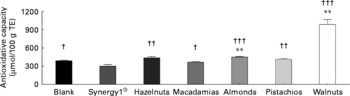
The antioxidant capacity of fermented nuts was measured with the TEAC assay. Apart from macadamias, all nut fs at least tended to show a higher antioxidant capacity than the blank control (Fig. 2). It is noteworthy that walnut fs had the strongest effect with an about 2·5-fold higher antioxidant capacity than the blank control. In comparison to the blank control, fermentation of Synergy1® had no additional effect.
Antioxidant capacity of nut fermentation supernatant determined with hydrophilic trolox equivalent antioxidant capacity-assay. Values are means, with standard deviations represented by vertical bars (n 3). Student`s t test was used to calculate the differences from blank (** P < 0·01) and from Synergy1® († P < 0·05, †† P < 0·01, ††† P < 0·001). TE, tocopherol equivalent.
Determination of cell growth
The fermented nut samples were used to analyse their effect on cell growth of HT29 adenocarcinoma cells. Treatment of cells with the fs affected the cell number in a time- and dose-dependent manner. No effects were observed after an incubation of 24 h (data not shown). However, the cell number was significantly reduced after the incubation of HT29 cells with 20 % of the fs of hazelnuts and almonds for 48 h compared to the medium control (Fig. 3). A significant decrease in cell number was also seen for the fs Synergy1®. After 72 h incubation, apart from pistachios all fs of nuts and Synergy1® were able to decrease the cell number in comparison to the medium control (Fig. 4), but without an additional effect to the blank. Significant results were already seen for 5 % of the almond fs. Surprisingly, low concentrations of pistachio fs resulted in a slight increase in cell growth.
Effects of nut fermentation supernatant (fs) (2·5 , 5  , 10 , 20 % □) on growth of HT29 cells after 48 h incubation obtained by 4′,6-diamidino-2-phenylindol-assay on the basis of the medium control which was set 100 % (dashed line). Values are means, with standard deviations represented by vertical bars (n 3). Statistical variance was analysed with one-way ANOVA/Bonferroni post-test, all fs v. medium control (* P < 0·05, ** P < 0·01, *** P < 0·001).

Effects of nut fermentation supernatant (fs) (2·5 , 5 , 10 , 20 % □) on growth of HT29 cells after 72 h incubation obtained by 4′,6-diamidino-2-phenylindol-assay on the basis of the medium control which was set 100 % (dashed line). Values are means, with standard deviations represented by vertical bars (n 3). Statistical variance was analysed with one-way ANOVA/Bonferroni post-test, all fs v. medium control (* P < 0·05, ** P < 0·01, *** P < 0·001) and two-way ANOVA/Bonferroni post-test, all fs v. blank (†† P < 0·01, ††† P < 0·001).

Cell cycle analysis
Cell cycle distribution was determined to analyse the anti-proliferative effects of the fermented nuts on HT29 cells. However, none of the fs (5 %) were able to modulate the cell cycle progression after short- (24 h) or longer incubation times (48, 72 h) (data not shown).
Determination of genotoxic and anti-genotoxic effects
The treatment of HT29 cells with fs of different nut samples (2·5–10 %) for 1 and 24 h (data not shown) did not induce DNA damage as reflected by tail intensities comparable to the negative control. Therefore, fermented nuts are considered to be not genotoxic in HT29 cells.
To analyse whether treatment with fermented nuts caused an improved protection against oxidative stress, HT29 cells were incubated for 15 min as well as 24 h with the test substances and challenged with H2O2 to induce DNA damage. No cytotoxic impact of either substance was detected at the applied concentrations and times (data not shown). Treatment of HT29 cells for 24 h did not result in reduced levels of DNA damage (data not shown). Co-incubation with the fs of nuts tended to reduce the levels of H2O2-induced DNA damage after 15 min (Fig. 5) in comparison to the positive control. In particular, the treatment with the walnut fs resulted in a significantly reduced level of DNA damage compared to the positive control and the fs of blank and Synergy1®.
Anti-genotoxic effects of nut fermentation supernatant (fs) (positive control (PC) 75 μm-hydrogen peroxide ■; negative control (NC) □, medium incubated cells treated with PBS; blank ; Synergy1® ; hazelnuts
  ; macadamias
  ; almonds
  ; pistachios
  ; walnuts ) in concentrations of 2·5–10 % after 15 min incubation of HT29 cells with nut fs and co-incubation with hydrogen peroxide analysed with comet assay. Values are means, with standard deviations represented by vertical bars (n 3). Statistical variance was analysed with one-way ANOVA/Bonferroni post-test, all fs v. positive control (* P < 0·05, ** P < 0·01, *** P < 0·001) and two-way ANOVA/Bonferroni post-test, all fs v. blank (†† P < 0·01) and two-way ANOVA/Bonferroni post-test, all fs v. Synergy1® (‡‡ P < 0·01).

Discussion
Numerous health-promoting effects were attributed to the consumption of nuts(53). These effects resulted from special ingredients, e.g. unsaturated fatty acids which are responsible for lower cholesterol levels and protection against CVD. However, nuts also contain antioxidant compounds (e.g. tocopherols, polyphenols) and health-promoting DF(Reference Alasalvar and Shahidi4). The consumption of DF might be associated with a reduced risk for developing colorectal cancer, one of the most common types of cancer in industrialised countries(Reference Garcia, Jemal and Ward36). Despite this, a recent national survey showed that in Germany only 2 g of nuts were consumed per day(2, 54). Our knowledge about the positive effects of nuts results almost from human intervention trials and is based on chemical analysis of nut ingredients. So far there are no experimental studies available that explain the mechanism of action in the human gut. Hence, the aim of this project was to investigate the potential health-promoting effects of fermented nuts (hazelnuts, macadamias, almonds, pistachios, walnuts) using the human colon carcinoma cell line HT29.
In vitro fermentation of nuts resulted in an increased level of chemopreventive SCFA. Various studies showed the main faecal SCFA acetate, propionate and butyrate in a ratio of 60:20:20(Reference Hamer, Jonkers and Venema55). The ratio of fs blank of 56·94:21·31:21·75 was almost identical and confirms the comparability to physiological in vivo conditions. Fermentation of DF (Synergy1® and nuts) resulted in an increased level of SCFA and shifted the ratio to a higher level of butyrate. This is in line with former studies(Reference Borowicki, Stein and Scharlau25, Reference McIntyre, Gibson and Young56) investigating the effect of different fibre sources on SCFA production. It is notable that all nut varieties showed a comparable influence on the concentration of SCFA (67·83–85·93 mmol/l) and the butyrate content (20·51–24·41 mmol/l). The increased SCFA level resulted in a significantly reduced pH value of the fs. This might affect the gut microflora by a growth benefit of health-promoting lactobacilli and bifidobacteria(Reference Gibson and Roberfroid28–Reference Gibson, Probert and Loo30, Reference Gibson and Wang32). BA were metabolised during the gut fermentation (7-α-dehydroxylase activity of bacteria) and could be a risk factor for developing colon cancer, because high amounts of secondary BA are associated with tumour-promoting effects(Reference Tong, Ran and Shen57). The presented results show that fermentation of nuts lowered the concentration of the secondary BA DCA compared to fs blank control. Thereby, hazelnuts and macadamias were more effective than the fs of the pure fibre source Synergy1®. One reason for this protective effect might be the lower pH value in these fs which reduces the activity of converting enzymes and increases bacteria strains which are able to bind BA, as has been discussed elsewhere(Reference Borowicki, Stein and Scharlau25). Furthermore, DF are able to bind BA directly(Reference Zampa, Silvi and Fabiani58).
Another mechanism by which nut ingredients (e.g. tocopherols and secondary plant products like polyphenols and flavonoids) could exhibit chemopreventive effects is the prevention of oxidative DNA damage(Reference Byers and Perry59). The present study confirmed that all the nut varieties used are an important source of vitamin E, with substantial differences between the nuts. High tocopherol concentrations were found in almonds and hazelnuts (total tocopherol 16·5/25·2 mg per 100 g). Total tocopherol concentrations of pistachios and walnuts were considerably lower (approximately 9 mg/100 g). Our results are in line with literature data which also concur that macadamias contain only low amounts of vitamin E and only in the form of α-tocotrienol(Reference Alasalvar and Shahidi4).
Alasalvar et al. (Reference Alasalvar, Karamac and Kosinska15) reported about the high antioxidant capacity of hazelnuts, which is due to their high content of phytochemicals. We were able to confirm this statement and disclosed high antioxidant capacities of almost all nut varieties investigated in our present study. Furthermore, for the first time we demonstrated that fs of nuts had an antioxidant capacity, much higher than ground nuts. Particularly, walnut fs showed considerably higher effects than the other fs, maybe as a result of the high content of the bioactive ellagic acid(Reference Anderson, Teuber and Gobeille3). The antioxidant activity of the Synergy1® fs could be caused by the added faeces suspension. This reflects that not only the ingredients of nuts but also so far unidentified metabolites of the faeces inoculum have antioxidant effects and act synergistically with nut phytochemicals. Which and how much phytochemicals are really bioavailable after digestion is currently not clarified. Furthermore, since information about the complete phytochemical profile of nuts is lacking, further research is necessary(Reference Bolling, McKay and Blumberg60, Reference Chen and Blumberg61).
Effects on the cell number of transformed cells such as HT29 are thought to be a useful marker for secondary chemoprevention(Reference Borowicki, Stein and Scharlau25). The present study showed that the number of HT29 cells was efficiently diminished by all fs in a time- and dose-dependent manner. Surprisingly, pistachio fs showed a slight increase of cells, but only after 72 h of incubation. Further studies are necessary to disclose the ingredients responsible for this effect. The nut fs decreased cell growth similar to Synergy1® and both were more effective compared to the medium control. This is due to the content of SCFA in fs. SCFA, especially butyrate, are biologically active and able to diminish the growth of cancer cells as shown recently by Borowicki et al. (Reference Borowicki, Stein and Scharlau25). Beside butyrate, also propionate demonstrated important anti-proliferative properties(Reference Beyer-Sehlmeyer, Glei and Hartmann24, Reference Pool-Zobel and Sauer26, Reference Rafter, Govers and Martel34). Additionally, it has been discussed that also the secondary BA DCA could reduce the cell number(Reference Glei, Hofmann and Kuster38), which could be the reason for the growth inhibitory potential of the control fs blank (DCA 125 μm) despite the low amount of SCFA of only 32 mmol/l and the missing significant difference of the nut fs. Thus, the growth inhibiting effect of the fs is probably not only due to the butyrate content. It may be the result of the additional activities of different partly unidentified fermentation metabolites, ellagic acid(Reference Fjaeraa and Nanberg62) and/or synergistic effects with other SCFA like propionate. To get more insights into the mechanism which could be responsible for the effects on cell growth, the impact of fs on the cell cycle was also investigated. However, cell cycle modulation effects could not be detected. While butyrate in concentrations over 5 mm has been shown to inhibit cell proliferation by arresting cells in the G0/G1 phase of the cell cycle, lower concentrations did not modulate the cell cycle progression(Reference Borowicki, Stein and Scharlau25, Reference Blottiere, Buecher and Galmiche63). The effective dose of butyrate in 5 % fs was too low (only between 1 and 1·2 mm) to stimulate cell cycling modulation effects. In contrast, complex fs of wheat aleurone containing more than 5 mm-butyrate were able to arrest the cell cycle(Reference Borowicki, Michelmann and Stein64).
In addition to the analysis of growth inhibition, the genotoxic and anti-genotoxic potential of fermented nuts, as a relevant marker for primary chemoprevention, were investigated for the first time. All fs of nuts and also the blank fs tended to prevent oxidative damage induced by H2O2. The fermented nuts showed a higher anti-genotoxic potential compared to Synergy1®, but only the fs of walnuts indicated a significant reduction of the formation of oxidative DNA damage caused by H2O2. One reason for the anti-genotoxic effects of the fs walnut could be their high content of phenolic compounds(Reference Pellegrini, Serafini and Salvatore65) and the resulting prominent antioxidant potential. Walnut phenolics are reported to display strong antioxidant and free-radical-scavenging capacities(Reference Martinez, Labuckas and Lamarque66). This could be also shown by the present study. Anti-genotoxicity can be the result of direct antioxidant activities(Reference Stein, Borowicki and Scharlau40, Reference Rosignoli, Fabiani and De Bartolomeo67) and/or modification of DNA repair mechanisms and/or modulation of mRNA expression and activity of biotransformation and detoxification enzymes(Reference Stein, Borowicki and Scharlau40). Given that a long-term incubation (24 h) did not show any protective effect, the measured reduction of DNA damage by nuts might be the result of direct quenching of reactive hydroxyl radicals and this could prevent the formation of mutated cells.
In conclusion, this is the first study which presents the chemopreventive effects (reduction of tumour-promoting DCA, rise in chemopreventive SCFA, protection against oxidative stress) of different nuts after in vitro digestion and fermentation, and shows the potential importance of nuts in the prevention of colon cancer.
Acknowledgements
We would like to thank Nucis e.V. Germany for funding and their cooperate companies (Blue Diamond Growers, Max Kiene GmbH, Turkish Hazelnut Promotion Group, Paramount Farms and Mariani Nut Company) for allocation of the nuts. We express our gratitude to Ines Wienecke for technical assistance. We also thank the staff members of the Department of Nutritional Physiology for their support to analyse SCFA, the Department of Human Nutrition, especially Ms Beate Laube; as well as the AG Bioactive Plant Ingredients, especially Lars Müller for the guidance to analyse the tocopherols and the antioxidant capacity. S. L. was responsible for the practical realisation of the project and writing of the manuscript. W. S. contributed to in vitro fermentation, comet assay and cell growth analysis and the correction of the manuscript. M. B. supported analytical experiments like vitamin E analysis and finally corrected the manuscript. M. G. and D. S. are project leaders and were responsible for coordination and organisation of the project. M. G. finally amended and approved this manuscript for being published. All authors read the paper and approved it for publication. The authors have no conflicts of interest.



