

Although many archaeologists recognize the modern challenges of climate change, many are not familiar with the abbreviation “IPCC.” Furthermore, even those connecting these initials to the Intergovernmental Panel on Climate Change have relatively little familiarity with what it is and how it works. Here, we aim to demystify this organization, which requires us as historical scholars to present an origin story and a brief account of its subsequent development and current structure. Our main interest, however, is to understand why the findings of our discipline have been so little employed by IPCC scientists and to provide some suggestions for making knowledge and practice from and about the human past more relevant to the IPCC and global climate response.
Purpose and Structure of the IPCC
The IPCC was created by the United Nations Environment Programme (UNEP) and the World Meteorological Organization (WMO) in 1988, and it was officially adopted by the UN General Assembly in December of that year (Resolution 43/53). This resolution directed UNEP and WMO to work through the IPCC to “initiate action leading, as soon as possible, to a comprehensive review and recommendations” with respect to the state of knowledge on (1) the climate and climate change; (2) studies on the social and economic impacts of these changes; and (3) strategies to “delay, limit, or mitigate the impacts of adverse climate change” (United Nations General Assembly 1988:134). The resolution also asked the new body to identify and possibly advise on strengthening existing international legal instruments bearing on climate, as well as consider what elements would need to be included in a future international convention on climate.
Requests 1–3 led, respectively, to the three present Working Groups (WG) of the IPCC. WGI deals with the physical science of climate change in the past, present, and future. Scientists contributing to WGI reports tend to include climatologists, meteorologists, physical geographers, atmospheric physicists, hydrologists, and others. Scientists within WGII include biologists (botanists, zoologists, marine biologists, and especially ecologists), geoscientists, and diverse social scientists such as human geographers, urban scientists, agricultural scientists, economists, and sociologists. Their domain includes both the ecological and the social effects of climate impact drivers (e.g., rising sea levels). Authors of WGIII reports come from a variety of disciplines, including international law, political science, engineering, and systems science. In the jargon of the IPCC, mitigation—the domain of WGIII—describes actions that prevent greenhouse gases from entering the atmosphere in the first place or removes them once they are there. The IPCC seems to attract researchers who like working across disciplines, and quite a few have made contributions to more than one WG.
Beginning in 1990, the IPCC has delivered five major Assessment Reports (ARs) and a number of more specialized reports (Table 1). These reports are intended to “provide a scientific basis for governments at all levels to develop climate-related policies” (IPCC 2020a:1) and to be useful for negotiations at the UN Climate Conference—known as the United Nations Framework Convention on Climate Change (UNFCCC). These assessments are designed to be “policy relevant but not policy prescriptive” (IPCC 2020a:1). Although primarily intended for use by its 125 member governments, IPCC reports are widely regarded as the most comprehensive compendium and assessment of climate-related science available, and they often become widely cited in both the primary research literature and popular media. The Sixth Assessment Report (AR6) is currently underway. Its several volumes will be published in 2021 and 2022.
Past Major IPCC Reports and Their Usage of Archaeological/Heritage Information.a
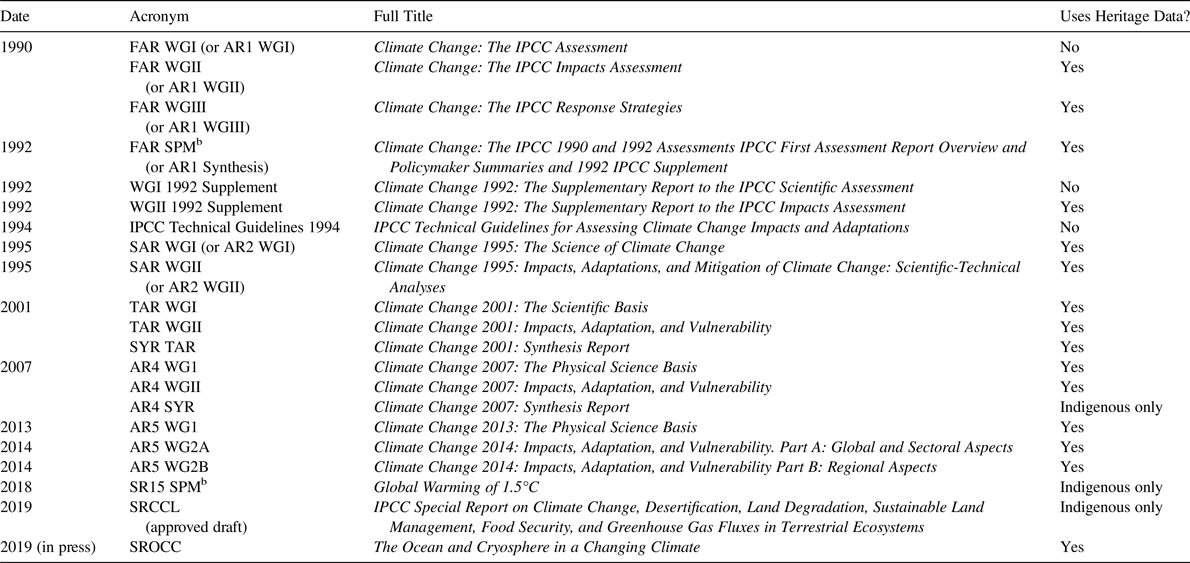
a The text provides illustrative examples of the nature of this information and how it has been employed in the IPCC reports. The listing of specialized reports is not comprehensive.
b Summary for Policy Makers.
The IPCC maintains a Bureau of 34 members who are elected by the member governments of the IPCC Panel for the duration of an assessment cycle. Neither the Bureau members, nor the authors or reviewers of the reports, are paid by the IPCC. The Bureau coordinates many aspects of the production of the reports via the staff of a Technical Support Unit (TSU) attached to each WG and the secretariat of the IPCC, which is headquartered in Geneva. Four main categories of authors are recognized: Coordinating Lead Authors (CLAs), Lead Authors (LAs), and Review Editors (REs). Authors are selected following nominations from governments and IPCC observer organizations, including a number of UN bodies and other international organizations, intergovernmental organizations such as the European Union, and 100 nongovernmental organizations (complete current lists at IPCC 2018). IPCC Bureau members may also make nominations after the outline of a report has been agreed upon (IPCC 2020b). These authors may be assisted by Contributing Authors (CAs), who provide expertise on particular topics at the request of the CLAs or the LAs. Authors of each WG are convened separately several times during each assessment cycle to work face-to-face on their reports, although a great deal of the writing takes place at their home institutions distributed all over the world.
Reports are reviewed in a three-stage process that involves both external experts and governments (IPCC 2013). The first two stages concentrate on scientific issues such as whether all important studies have been included and whether their findings have been weighted properly. Following appropriate revisions, these volumes are then combined into technical reports by the TSU, which become the basis for shorter documents (one for each WG) called the Summaries for Policymakers (SPMs). These are subject to a line-by-line review by government representatives, in which technical experts also participate. The original book-length reports on which the SPMs are based are not subject to this final review.
Origins
We identify two complementary sources of concerns leading the UN to establish the IPCC. On one hand, there is a long chain of increasingly ecocentric thought stretching back at least to George Perkins Marsh (Reference Marsh1864) and continuing through Teddy Roosevelt and the conservation movement of the late nineteenth/early twentieth century—including Gifford Pinchot and John Muir, the latter of whom founded the Sierra Club in 1892 (De Steiguer Reference De Steiguer2006). The geopolitical concerns of two world wars slowed this movement, despite the continued presence of original thinkers such as Aldo Leopold (Reference Leopold1949). But there was a strong resurgence in the 1960s.
First among many prominent contributors to this resurgence was Rachel Carson, whose blockbuster Silent Spring (Reference Carson1962) helped lead to the founding of the U.S. Environmental Protection Agency (EPA) in 1970. Silent Spring was soon followed by a number of influential works, including Scarcity and Growth: The Economics of Natural Resource Availability (Barnett and Morse Reference Barnett and Morse1963), The Quiet Crisis (Reference Udall1963) by the then secretary of the interior, Stewart L. Udall, and Roderick Nash's Wilderness and the American Mind (Reference Nash1967), among others. The mounting interest and widespread concern about environmental matters led to the first Earth Day celebration in 1970, which the senior author remembers as a highly significant public event. Perhaps 10% of the U.S. population “took to the streets, parks and auditoriums to demonstrate for a healthy, sustainable environment in massive coast-to-coast rallies” (EarthDay.org 2020). It may not be too far a stretch to infer that many of the young people coming into archaeology in the 1960s and early 1970s, at least in the United States and Canada, were attracted to the field because of its involvement with ecology—particularly what Trigger called “open-system ecology” (Reference Trigger1971)—and its interest in how societies adapt to their environments (Watson Reference Watson, Bentley, Maschner and Chippindale2008).
Although the 1970s saw a general decrease in environmental fervor (De Steiguer Reference De Steiguer2006), a number of scientific concerns of the 1980s, including acid rain, global warming, depletion of the stratospheric ozone layer, and tropical deforestation achieved widespread public recognition. Scientific and public concern over global warming in particular were important to the formation of the IPCC.
And that leads to the second impetus for its formation: throughout the twentieth century, science on global warming was rapidly accumulating. Svante Arrhenius—the first Swedish Nobel laureate for his work on electrolytes—published a remarkable first draft of how this process works in “On the Influence of Carbonic Acid in the Air upon the Temperature of the Ground” (Reference Arrhenius1896). In it, he consolidated work by earlier researchers—including John Tyndall and Ernst Lecher—demonstrating that atmospheric concentrations of what he called carbonic acid (CO2) and water vapor affect the earth's temperature, eventually deriving the expectation that, all else equal, “any doubling of the percentage of carbon dioxide in the air would raise the temperature of the earth's surface by 4°[C]” (Reference Arrhenius and Borns1908:53). This equilibrium, or “effective” (if an equilibrium cannot be assessed) climate sensitivity, as it is now called, is (remarkably) still within the “medium confidence” range of 1.5°C–4.5°C used by the most recent assessment report (AR5; Stocker et al. Reference Stocker, Qin, Plattner, Tignor, Allen, Boschung, Nauels, Xia, Bex and Midgley2013) and also within the range of the higher sensitivities (of about 1.8°C–5.6°C) that the most current models suggest (Zelinka et al. Reference Zelinka, Myers, McCoy, Po-Chedley, Caldwell, Ceppi, Klein and Taylor2020).
Indeed, the instrumented record of the global (land and ocean) mean surface temperature (GMST) as compiled by NASA (GISTEMP Team Reference Team2020) is completely unambiguous on the recent global temperature increase (Figure 1). Other GMST estimates, produced by the National Oceanic and Atmospheric Administration (NOAA), the Berkeley Earth research group, the Met Office Hadley Centre (MOHC), and the Cowtan and Way analysis, are in essential agreement (NASA 2020). Perhaps surprisingly, given the critical nature of atmospheric CO2 (and other greenhouse gases such as methane), it was not until 1958 that the first systematic series of atmospheric CO2 measurements began, at the Mauna Loa Observatory of Hawaii under the direction of Charles David Keeling (Reference Keeling1960). This series, supplemented by ice-core data processed as explained in Monroe (Reference Monroe2014) for the pre-1958 period, shows continuously increasing levels of atmospheric CO2 from roughly the mid-nineteenth century. It provides a striking match to the instrumented record of the global mean surface temperature observations in Figure 1.
Global mean surface temperatures from 2020 NASA calculations (NASA GISS), overlaid on Keeling curve/ice-core data measuring CO2.

IPCC Use of Heritage Data
Among archaeologists there is a widespread and somewhat accurate perception that the IPCC ignores archaeological and historical data. For example, Ortman (see also Jackson et al. Reference Jackson, Dugmore and Riede2018) writes:
In recent years an increasing number of archaeologists have conducted research that is explicitly designed to address contemporary issues. . . . Despite many exciting results emanating from this work, as of yet it seems to have had little impact on actual public policy discussions. For example, despite extensive research by archaeologists on human responses to climate change, to date the results of such research have been largely absent from reports by the Intergovernmental Panel on Climate Change. . . . Given that the archaeological record is the most extensive compendium of human experience there is, it seems only natural that the results of archaeological research should have an impact on discussions concerning contemporary issues. . . . But so far there seems to have been limited success in this regard. Why is this? [Ortman Reference Ortman2019:1].
Rockman and Hritz (Reference Rockman and Hritz2020) explore some of the factors underlying this frustration. In the United States, for example, heritage is effectively invisible at the level of federal engagement with climate change. Lead responsibility for management of archaeology and other forms of cultural heritage lies with the U.S. National Park Service (NPS), but this responsibility is not recognized in its name, and the NPS prioritizes natural resources in its funding and staffing. The writing and structure of the U.S. National Climate Assessments have followed similar alignments. Rockman and Hritz (Reference Rockman and Hritz2020) argue that this has created a feedback loop such that as visible federal practice does not engage substantively with management or information aspects of archaeology and other forms of heritage with respect to climate change, it is acceptable and standard for subsequent reports and initiatives not to engage with archaeology or heritage either. Given these gaps, it becomes more difficult to demonstrate the utility of archaeology, because practitioners and scientists outside of archaeology have not substantively engaged with applications of archaeology to climate issues. When federal and nongovernmental organizations do address archaeology and heritage with respect to climate change, it is most often with direct reference to Indigenous communities (see, for example, the Global Commission on Adaptation 2019). Although impacts of climate change on Indigenous communities and contributions of traditional and Indigenous communities, knowledge, and practice to sustainable climate responses are critical and although attention to them should be expanded (see also Ford et al. Reference Ford, Cameron, Rubis, Maillet, Nakashima, Willox and Pearce2016), such attention does not embrace all the potential contributions of archaeology to climate science and climate response.
Table 1 demonstrates that IPCC reports often do engage with heritage data that is broadly defined to include information gleaned from archaeological and historical investigation; ethnographies; and Indigenous, local, and traditional knowledge systems and practices—although their use of data that is specifically archaeological is indeed skimpier. We searched all the reports listed in Table 1 for their usage of a number of relevant terms (archaeol* archeol* prehist* tradition* ‘cultural resources’ indigen*). Below, we briefly summarize the contents of the useful hits by AR cycle and WG. Because subsequent reports often raise concerns already mentioned in previous reports, we emphasize those concerns and data usage that were novel in each report cycle.
It is obvious—for us at least—that when archaeologists focus on long-term social processes such as migration, population dynamics, human security, and health, we make contributions that are unobtainable by other social scientists working within the constraints of an instrumented climate record that is only a century or two in length in most areas. Below, however, we admit that archaeologists could do more to make our work on climate change relevant to the IPCC and to nonarchaeologists in general. One suggestion will be to seek to combine the vast number of cases embedded in the archaeological record to make statements about how societies tend to respond to climate variability that are more generalizable and impactful than individual studies by themselves. Another suggestion, based on work of the junior author in the federal government, is to engage archaeological research methods and cultural resources management practices to support conversations about values of place, identity, and story in the development of sustainable and just climate adaptation. Such integrative, comparative work is currently missing.
First Assessment Report (FAR)
The WGII report (Hashimoto et al. Reference Hashimoto, Styrikovich, Nishioka, Rouviere, Williams, Ball, Shinyak, Topping, Nishioka, Ando, Okita, McG. Tegart, Sheldon and Griffiths1990:5–6) notes that climate change could produce large impacts on nomads and traditional societies, such as the Canadian Inuit and the Gwichin of Canada's Northwest Territories and Yukon Territory, by adversely affecting hunting, trapping, and fishing. It is also noted that nomadic inhabitants of the Sahara and the Arabian Peninsula could be adversely affected by warming. It also notes dangers to social and cultural resources due to flooding or sea-level change (Hashimoto et al. Reference Hashimoto, Styrikovich, Nishioka, Rouviere, Williams, Ball, Shinyak, Topping, Nishioka, Ando, Okita, McG. Tegart, Sheldon and Griffiths1990:5–9). Climate change forcing migration may also cause psychological strains due to loss of connection with the original land and traditions (Hashimoto et al. Reference Hashimoto, Styrikovich, Nishioka, Rouviere, Williams, Ball, Shinyak, Topping, Nishioka, Ando, Okita, McG. Tegart, Sheldon and Griffiths1990:5–10).
In the WGIII report, Gilbert and Vellinga note that retreat as an option in the face of sea-level rise could result in loss of “places of great cultural significance, for example, burial grounds, historic places, or religious centers” (Reference Gilbert, Vellinga, Bernthal, Dowdeswell, Luo, Attard and Vellinga1990:153).
In 1992, WGI and WGII published supplements to their 1990 reports. Tsyban and colleagues urged climate modelers to strengthen quantitative information in regional climate models by nesting them in coupled ocean-atmosphere global circulation models, in conjunction with a multidisciplinary effort examining the “historical, geological, and archaeological records” (Reference Tsyban, Everett, Perdomo, McG. Tegart and Sheldon1993:92).
Second Assessment Report (SAR)
The WGI report uses a range of archaeological and geological data to conclude that over the last century, average sea-level rise has accelerated relative to the average computed for the last two millennia (Warrick et al. Reference Warrick, Le Provost, Meier, Oerlemans, Woodworth, Houghton, Meira Filho, Callander, Harris, Kattenberg and Maskell1996:366). Warrick and colleagues also note that the available archaeological sea-level data primarily reflect local tectonic land movement and that the Peltier post-glacial rebound models widely used by scientists studying climate change do not reproduce relative land-sea movements that match those locally calculated using archaeological data (Warrick et al. Reference Warrick, Le Provost, Meier, Oerlemans, Woodworth, Houghton, Meira Filho, Callander, Harris, Kattenberg and Maskell1996:390–391).
WGII authors project a number of effects from climate change in mountainous regions, including disruption of food and fuel for Indigenous populations in many developing countries (Watson et al. Reference Watson, Zinyowera and Moss1996:6). They recognize that forests in many parts of the world are not just of economic importance but also of spiritual importance to many Indigenous people. In Box 7-3, Fitzharris and colleagues (Reference Fitzharris, Allison, Braithwaite, Brown, Foehn, Haeberli, Higuchi, Kotlyakov, Prowse, Rinaldi, Wadhams, Woo, Youyu, Anisimov, Aristarain, Assel, Barry, Brown, Dramis, Hastenrath, Lewkowicz, Malagnino, Neale, Nelson, Robinson, Skvarca, Taylor, Weidick, Watson, Zinyowera and Moss1996) project a number of deleterious changes to tundra lands that are likely to affect the Inuit of North America and Greenland as well as various reindeer-herding groups of Eurasia, including diminution of ice and permafrost affecting size and load limit of vehicular traffic along with changes in migration patterns of polar bears and caribou. Bijlsma and colleagues note that Integrated Coastal Zone Management, “taking into account traditional, cultural, and historical perspectives and conflicting interests and uses” (Bijlsma et al. Reference Bijlsma, Ehler, Klein, Kulshrestha, McLean, Mimura, Nicholls, Nurse, Pérez Nieto, Stakhiv, Turner, Warrick, Watson, Zinyowera and Moss1996:Box 9-5) should be employed to plan for sea-level rise accompanying warming. Levine and colleagues urge contemporary architects and urban planners to learn from the “energy-conscious design principles” (Levine et al. Reference Levine, Akbari, Busch, Dutt, Hogan, Komor, Meyers, Tsuchiya, Henderson, Price, Smith, Siwei, Watson, Zinyowera and Moss1996:730) used in traditional building practices in tropical and Mediterranean countries.
Third Assessment Report (TAR)
WGI authors (Folland et al. Reference Folland, Karl, Christy, Clarke, Gruza, Jouzel, Mann, Oerlemans, Salinger, Wang, Houghton, Yihui, Griggs, Noguer, van der Linden and Dai2001; Stocker et al. Reference Stocker, Clarke, Le Treut, Lindzen, Meleshko, Mugara, Palmer, Pierrehumbert, Sellers, Trenberth, Willebrand, Houghton, Yihui, Griggs, Noguer, van der Linden, Dai, Maskell and Johnson2001) draw on archaeological data (Sandweiss et al. Reference Sandweiss, Richardson, Reitz, Rollins and Maasch1996) interpreted in conjunction with lake cores (Rodbell et al. Reference Rodbell, Seltzer, Anderson, Abbott, Enfield and Newman1999) as evidence for past variations in the strength and frequency of ENSO extremes.
The WGII report again notes dangers to coastal cultural resources under sea-level rise, using data from Fulford and colleagues (Reference Fulford, Champion and Long1997) and Pye and colleagues (Reference Pye and Allen2000) that were not available to SAR authors, and it considers the plight of Venice in particular (Kundzewicz et al. Reference Kundzewicz, Parry, Cramer, Holten, Kaczmarek, Martens, McCarthy, Canziani, Leary, Dokken and White2001). Mata and colleagues (Reference Mata, Campos, Basso, Compagnucci, Fearnside, Magrin, Marengo, Moreno, Suárez, Solman, Villamizar, McCarthy, Canziani, Leary, Dokken and White2001) employ data from Meggers (Reference Meggers1994) to suggest that climate change and human actions may lead to fires in Amazonia on the scale of the catastrophes that she reconstructed for 1500, 1000, 700, and 400 BP, coincident with major El Niño events.
This same report includes the first hint that IPCC authors consider the archaeological record to potentially hold important lessons for how humans might adapt to climate change (Smit et al. Reference Smit, Pilifosova, Burton, Challenger, Huq, Klein, Yohe, McCarthy, Canziani, Leary, Dokken and White2001). They cite Rayner and Malone (Reference Rayner, Malone, Malone and Rayner1998) to the effect that the most promising research strategy is
explicitly to focus attention on the process of adaptation—or, on the other hand, of failure to adapt—that partly condition the impact of the climatic stress in particular societies . . . cases in which societies appear to have been seriously damaged by, or even totally succumbed to, climatic stress should not be taken to demonstrate the determining influence of climate. It is essential to consider ways in which these societies might have coped better, and to focus on the political, cultural, and socioeconomic factors which inhibited them from doing so (Ingram et al. Reference Ingram, Farmer, Wigley, Wigley, Ingram and Farmer1981) [Smit et al. Reference Smit, Pilifosova, Burton, Challenger, Huq, Klein, Yohe, McCarthy, Canziani, Leary, Dokken and White2001:888].
They note that McGovern (Reference McGovern1991) considered the climate stress connected with the extinction of the Greenland Norse to have been “theoretically” within the ability of the Norse to cope—although they did not. Consequently, in considering human adaptive response to climate change, it is important to consider how “adaptive capacity and hence vulnerability” modulate the effects of climate on society, including the possibility that different groups or members within a society may differ in their adaptive capacity (Smit et al. Reference Smit, Pilifosova, Burton, Challenger, Huq, Klein, Yohe, McCarthy, Canziani, Leary, Dokken and White2001:888).
This same chapter, however, exhibits a bit of inconsistency concerning the adaptive capacity of traditional societies in the face of climate change. The authors worry, on one hand, that acceptance of “western economic ideals” (Smit et al. Reference Smit, Pilifosova, Burton, Challenger, Huq, Klein, Yohe, McCarthy, Canziani, Leary, Dokken and White2001:898) and technologies may reduce this capacity by devaluing traditional ecological knowledge and cultural values (Newton Reference Newton1995). On the other hand, they suggest that among the North American Inuit, vulnerability to climate change may have been reduced by “technological enhancement of adaptive capacity through the acquisition of snowmobiles, motorized boats, and even sonar” (Smit et al. Reference Smit, Pilifosova, Burton, Challenger, Huq, Klein, Yohe, McCarthy, Canziani, Leary, Dokken and White2001:898). In general, even though the prognosis for Indigenous peoples with respect to climate change is not always clear, beginning in TAR WGII, these communities receive much more attention than in the first two reports. Below, we emphasize the increasing IPCC use of archaeological and historical data rather than other forms of heritage data.
AR4
We follow IPCC usage in referring to this and subsequent reports in this new format (which avoids ambiguity for the abbreviation “FAR”). In the WGI report, archaeological and historical data are used solely in the paleoclimate chapter (Jansen et al. Reference Jansen, Overpeck, Briffa, Duplessy, Joos, Masson-Delmotte, Olago, Otto-Bliesner, Richard Peltier, Rahmstorf, Ramesh, Raynaud, Rind, Solomina, Villalba, Zhang, Solomon, Qin, Manning, Chen, Marquis, Averyt, Tignor and Miller2007). Well data from the last 2,000 years (Sivan et al. Reference Sivan, Lambeck, Toueg, Raban, Porath and Shirman2004), the timing and placement of Roman and Greek construction, and the placement of Roman fish ponds (Lambeck et al. Reference Lambeck, Anzidei, Antonioli, Benini and Esposito2004) are used to conclude that “the onset of the modern sea level rise occurred between 1850 and 1950” (Jansen et al. Reference Jansen, Overpeck, Briffa, Duplessy, Joos, Masson-Delmotte, Olago, Otto-Bliesner, Richard Peltier, Rahmstorf, Ramesh, Raynaud, Rind, Solomina, Villalba, Zhang, Solomon, Qin, Manning, Chen, Marquis, Averyt, Tignor and Miller2007:413).
This chapter also engages the Ruddiman hypothesis (Ruddiman Reference Ruddiman2003; Ruddiman et al. Reference Ruddiman, Vavrus and Kutzbach2005) that an observed 20 ppm (parts per million) increase in atmospheric CO2 during the Holocene—which contrasts with a decrease of about that same amount during the three previous interglacials—was due to prehistoric agriculture, which released CO2 through the clearing of forests. They find this hypothesis untenable on a number of grounds, including orbital differences in these interglacials and the fact that some interglacials do have somewhat high CO2 levels (Jansen et al. Reference Jansen, Overpeck, Briffa, Duplessy, Joos, Masson-Delmotte, Olago, Otto-Bliesner, Richard Peltier, Rahmstorf, Ramesh, Raynaud, Rind, Solomina, Villalba, Zhang, Solomon, Qin, Manning, Chen, Marquis, Averyt, Tignor and Miller2007:460). Indirectly, of course, this points to the relevance of archaeological data on land use, population size, and subsistence practices to global climate histories in the Holocene.
In the WGII report, Anisimov and colleagues (Reference Anisimov, Vaughan, Callaghan, Furgal, Marchant, Prowse, Vilhjálmsson, Walsh, Parry, Canziani, Palutikof, van der Linden and Hanson2007) use archaeological data to demonstrate that human occupation of the Arctic stretches back at least 40,000 years ago (40 KYA; Pavlov et al. Reference Pavlov, Svendsen and Indrelid2001) and to illustrate the importance of mobility for its past populations in adapting to resource uncertainty and climate change. Mobility options for current Arctic populations, by contrast, are increasingly curtailed by entanglements with the global economy that have entrained shifts in lifestyle and culture. Boko and colleagues make a similar point with respect to Africa, where “droughts have long contributed to human migration, cultural separation, population dislocation and the collapse of prehistoric and early historic societies” (Reference Boko, Niang, Nyong, Vogel, Githeko, Medany, Osman-Elasha, Tabo, Yanda, Parry, Canziani, Palutikof, van der Linden and Hanson2007:437, citing Pandey et al. Reference Pandey, Gupta and Anderson2003).
The Latin America chapter (Magrin et al. Reference Magrin, García, Choque, Giménez, Moreno, Nagy, Nobre, Villamizar, Parry, Canziani, Palutikof, van der Linden and Hanson2007) contains a box (13.2) entitled “Adaptation capacity of the South American highlands’ pre-Colombian communities” that highlights the numerous engineering and agricultural adaptations allowing these populations to deal with temporal and spatial mismatches between water supply and demand. These included engineering feats such as surface and underground irrigation channels, devices to measure the amount of water stored, and interconnections between drainages (Burger Reference Burger1995; Caran and Neely Reference Caran and Neely2006; Treacy Reference Treacy1994; Wright and Zegarra Reference Wright and Zegarra2000) as well as an ability to forecast the El Niño cycles that so powerfully affect water supply in this region (Canziani and Mata Reference Canziani and Mata2004). The larger point is that these capacities could be usefully revisited and updated to provide local adaptations to current and future climate change.
AR5 and Subsequent Special Reports
AR5 is the most recent comprehensive assessment report currently available, published in 2013 and 2014. It engages archaeological information in more detail than did previous reports, although it is also longer in all respects. In the WGI volume, Ciais and colleagues, the authors of the chapter on carbon and other biogeochemical cycles, again wrestle with the effects of anthropogenic land use and land cover change (LULCC) on atmospheric CO2 from the early/mid-Holocene (7 KYA) to the late Holocene (Ciais et al. Reference Ciais, Sabine, Bala, Bopp, Brovkin, Canadell, Chhabra, DeFries, Galloway, Heimann, Jones, Le Quéré, Myneni, Piao, Thornton, Stocker, Qin, Plattner, Tignor, Allen, Boschung, Nauels, Xia, Bex and Midgley2014:Figure 6.5, lower panel). Measurements from air trapped in ice cores reveal that atmospheric concentrations of both CO2 and CH4 (methane) have been trending slowly upward, with some variability, for about the last 6 KYA (Ciais et al. Reference Ciais, Sabine, Bala, Bopp, Brovkin, Canadell, Chhabra, DeFries, Galloway, Heimann, Jones, Le Quéré, Myneni, Piao, Thornton, Stocker, Qin, Plattner, Tignor, Allen, Boschung, Nauels, Xia, Bex and Midgley2014:Figure 6.6), with increases accelerating rapidly beginning around 1750 with the Industrial Revolution (Ciais et al. Reference Ciais, Sabine, Bala, Bopp, Brovkin, Canadell, Chhabra, DeFries, Galloway, Heimann, Jones, Le Quéré, Myneni, Piao, Thornton, Stocker, Qin, Plattner, Tignor, Allen, Boschung, Nauels, Xia, Bex and Midgley2014:Figure 6.7). The authors note that global syntheses of the observational, paleoecological, and archaeological records are not yet available for the Holocene, and they have low confidence that LULCC reconstructions such as the HYDE model (Kaplan et al. Reference Kaplan, Krumhardt, Ellis, Ruddiman, Lemmen and Goldewijk2011; Klein Goldewijk et al. Reference Klein Goldewijk, Beusen, Van Drecht and De Vos2011) accurately reflect regional differences in land-use systems and population densities over the mid- and late Holocene.
Ciais and colleagues consider the available information to indicate that “cumulative Holocene carbon emissions as a result of pre-industrial LULCC were not large enough . . . to have had an influence larger than an increase of ~10 ppm [parts per million] on late Holocene observed CO2 concentration increase” (Ciais et al. Reference Ciais, Sabine, Bala, Bopp, Brovkin, Canadell, Chhabra, DeFries, Galloway, Heimann, Jones, Le Quéré, Myneni, Piao, Thornton, Stocker, Qin, Plattner, Tignor, Allen, Boschung, Nauels, Xia, Bex and Midgley2014:484)—accounting for roughly half of the observed increase over the pre-1850 period. They note, however, that one modeling study (Kaplan et al. Reference Kaplan, Krumhardt, Ellis, Ruddiman, Lemmen and Goldewijk2011) suggested that the entire observed increase could have been released as a result of LULCC between 8000 BP and AD 1850, because this team posits a much stronger loss of soil carbon in response to land-use change than do the other studies. It is clear that archaeologists could have an important role in narrowing these uncertainties, and in fact, some important spatialized estimates of paleodemography and subsistence regime crowdsourced from archaeologists relevant to LULCC have recently become available (Stephens et al. Reference Stephens, Fuller, Boivin, Rick, Gauthier, Kay, Marwick, Armstrong, Michael Barton, Denham, Douglass, Driver, Janz, Roberts, Daniel Rogers, Thakar, Altaweel, Johnson, Sampietro Vattuone, Aldenderfer, Archila, Artioli, Bale, Beach, Borrell, Braje, Buckland, Jiménez Cano, Capriles, Castillo, Çilingiroğlu, Cleary, Conolly, Coutros, Alan Covey, Cremaschi, Crowther, Der, di Lernia, Doershuk, Doolittle, Edwards, Erlandson, Evans, Fairbairn, Faulkner, Feinman, Fernandes, Fitzpatrick, Fyfe, Garcea, Goldstein, Goodman, Guedes, Herrmann, Hiscock, Hommel, Ann Horsburgh, Hritz, Ives, Junno, Kahn, Kaufman, Kearns, Kidder, Lanoë, Lawrence, Lee, Levin, Lindskoug, López-Sáez, Macrae, Marchant, Marston, McClure, McCoy, Miller, Morrison, Matuzeviciute, Müller, Nayak, Noerwidi, Peres, Peterson, Proctor, Randall, Renette, Schug, Ryzewski, Saini, Scheinsohn, Schmidt, Sebillaud, Seitsonen, Simpson, Sołtysiak, Speakman, Spengler, Steffen, Storozum, Strickland, Thompson, Thurston, Ulm, Cemre Ustunkaya, Welker, West, Williams, Wright, Wright, Zahir, Zerboni, Beaudoin, Garcia, Powell, Thornton, Kaplan, Gaillard, Goldewijk and Ellis2019).
The story for methane is somewhat similar. Post-Pleistocene atmospheric levels of CH4 reached a minimum of around 590 ppb (parts per billion) near 5000 BP and increased between then and AD 1750 by about 100 ppb (Ciais et al. Reference Ciais, Sabine, Bala, Bopp, Brovkin, Canadell, Chhabra, DeFries, Galloway, Heimann, Jones, Le Quéré, Myneni, Piao, Thornton, Stocker, Qin, Plattner, Tignor, Allen, Boschung, Nauels, Xia, Bex and Midgley2014:485). Ciais and colleagues (Reference Ciais, Sabine, Bala, Bopp, Brovkin, Canadell, Chhabra, DeFries, Galloway, Heimann, Jones, Le Quéré, Myneni, Piao, Thornton, Stocker, Qin, Plattner, Tignor, Allen, Boschung, Nauels, Xia, Bex and Midgley2014) note that Ruddiman (Reference Ruddiman2007) and Fuller and colleagues (Reference Fuller, van Etten, Manning, Castillo, Kingwell-Banham, Weisskopf, Qin, Sato and Hijmans2011) have attributed this increase to domesticated ruminants after 5000 BP and rice cultivation after 4000 BP. IPCC authors, however, consider the available models as supporting either a natural or an anthropogenic increase: “About as likely as not, the atmospheric CH4 increase after 5,000 years ago [up to the Industrial Revolution] can be attributed to early human activities” (Ciais et al. Reference Ciais, Sabine, Bala, Bopp, Brovkin, Canadell, Chhabra, DeFries, Galloway, Heimann, Jones, Le Quéré, Myneni, Piao, Thornton, Stocker, Qin, Plattner, Tignor, Allen, Boschung, Nauels, Xia, Bex and Midgley2014:485; emphasis in original).
In AR5, the WGII report was divided into two volumes. Part A deals with global and sectoral (that is, a domain of interest, such as transportation or migration) issues. Part B deals with regional aspects. In Part A, several topics that received much greater emphasis in this report have archaeological and historical dimensions. In Chapter 12, Adger and colleagues (Reference Adger, Pulhin, Barnett, Dabelko, Hovelsrud, Levy, Spring, Vogel, Field, Barros, Dokken, Mach, Mastrandrea, Bilir, Chatterjee, Ebi, Estrada, Genova, Girma, Kissel, Levy, MacCracken, Mastrandrea and White2014) assess archaeological and paleoclimatic data for their joint information on the relationship between climate change and human security, including conflict and social collapse. For example, they note evidence that the collapse of the Khmer Empire coincided with an unusually severe and prolonged drought (Buckley et al. Reference Buckley, Anchukaitis, Penny, Fletcher, Cook, Sano, Nam, Wichienkeeo, Minh and Hong2010), mention the review by deMenocal (Reference deMenocal2001) that linked major changes in weather patterns with collapse of societies including the “Anasazi, the Akkadian, Classic Maya, Mochica, and Tiwanaku empires” (Adger et al. Reference Adger, Pulhin, Barnett, Dabelko, Hovelsrud, Levy, Spring, Vogel, Field, Barros, Dokken, Mach, Mastrandrea, Bilir, Chatterjee, Ebi, Estrada, Genova, Girma, Kissel, Levy, MacCracken, Mastrandrea and White2014:772), and cite a number of studies linking political upheaval in Europe, China, and the Ottoman Empire with the Little Ice Age. Overall, however, the tone struck in this chapter is judicious:
These studies all show that climate change can exacerbate major political changes given certain social conditions, including a predominance of subsistence producers, conflict over territory, and autocratic systems of government with limited power in peripheral regions. The precise causal pathways that link these changes in climate to changes in civilizations are not well understood due to data limitations. Therefore, it should be noted that these findings from historical antecedents are not directly transferable to the contemporary globalized world. The literature urges caution in concluding that mean future changes in climate will lead to large-scale political collapse (Butzer Reference Butzer2012) [Adger et al. Reference Adger, Pulhin, Barnett, Dabelko, Hovelsrud, Levy, Spring, Vogel, Field, Barros, Dokken, Mach, Mastrandrea, Bilir, Chatterjee, Ebi, Estrada, Genova, Girma, Kissel, Levy, MacCracken, Mastrandrea and White2014:772; emphasis added].
Chapter 16, which deals with adaptation opportunities, constraints, and limits (Klein et al. Reference Klein, Midgley, Preston, Alam, Berkhout, Dow, Rebecca Shaw, Field, Barros, Dokken, Mach, Mastrandrea, Bilir, Chatterjee, Ebi, Estrada, Genova, Girma, Kissel, Levy, MacCracken, Mastrandrea and White2014), summarizes in Box 16-4 a great deal of archaeological and historical information about possible limits to adaptation visible in these data. Following some cautions to neither oversimplify cause and effect—in particular when matching climatic events with social crises—nor automatically consider that coincidence demonstrates causality, they state:
There are now roughly a dozen case studies of historical societies under stress, from different time ranges and several parts of the world, that are sufficiently detailed (based on field, archival, or other primary sources) for relevant analysis (Butzer and Endfield Reference Butzer and Endfield2012). These include Medieval Greenland and Iceland (Dugmore et al. Reference Dugmore, Keller, McGovern, Casely, Smiarowski, Adger, Lorenzoni and O'Brien2009; Streeter et al. Reference Streeter, Dugmore and Vésteinsson2012), Ancient Egypt (Butzer Reference Butzer2012), Colonial Cyprus (Harris Reference Harris2012), the prehistoric Levant (Rosen and Rivera-Collazo Reference Rosen and Rivera-Collazo2012), Islamic Mesopotamia and Ethiopia (Butzer Reference Butzer2012), the Classic Maya (Dunning et al. Reference Dunning, Beach and Luzzadder-Beach2012; Luzzadder-Beach et al. Reference Luzzadder-Beach, Beach and Dunning2012), and Colonial Mexico (Endfield Reference Endfield2012). Seven such civilizations underwent drastic transformation in the wake of multiple inputs, triggers, and feedbacks, with unpredictable outcomes. These can be seen to have exceeded adaptation limits. Five other examples showed successful adaptation through the interplay of environmental, political, and socio-cultural resilience, which responded to multiple stressors (e.g., insecurity, environmental or crises, epidemics, famine). In these cases, climatic perturbations are identified as only one of many “triggers” of potential crisis, with preconditions necessary for such triggers to stimulate transformational change. These preconditions include human-induced environmental decline mainly through overexploitation [Klein et al. Reference Klein, Midgley, Preston, Alam, Berkhout, Dow, Rebecca Shaw, Field, Barros, Dokken, Mach, Mastrandrea, Bilir, Chatterjee, Ebi, Estrada, Genova, Girma, Kissel, Levy, MacCracken, Mastrandrea and White2014:920].
In Part B of the WGII report—the regional chapters—archaeological sites and culturally valued buildings are noted to be at risk from sea-level rise and extreme events, with eventual results likely to include loss of heritage and declines in tourism (e.g., Kovats et al. Reference Kovats, Valentini, Bouwer, Georgopoulou, Jacob, Martin, Rounsevell, Soussana, Barros, Field, Dokken, Mastrandrea, Mach, Bilir, Chatterjee, Ebi, Estrada, Genova, Girma, Kissel, Levy, MacCracken, Mastrandrea and White2014). The authors of the Small Islands chapter (Nurse et al. Reference Nurse, McLean, Agard, Briguglio, Duvat-Magnan, Pelesikoti, Tompkins, Webb, Field, Barros, Dokken, Mach, Mastrandrea, Bilir, Chatterjee, Ebi, Estrada, Genova, Girma, Kissel, Levy, MacCracken, Mastrandrea and White2014) note disagreement as to whether past climate variability precipitated crises in prehistoric societies in much of the Pacific Basin, as argued by Nunn (Reference Nunn2007). In contrast, Barnett (Reference Barnett2001) has suggested that such past experiences have enabled island populations to develop resilient traits such as a belief in their own capacity and a familiarity with the range of conditions likely to be experienced.
Since AR5, the IPCC has produced three special reports (Table 1). Only one of these, The Ocean and Cryosphere in a Changing Climate (Pörtner et al. Reference Pörtner, Roberts, Masson-Delmotte, Zhai, Tignor, Poloczanska, Mintenbeck, Alegría, Nicolai, Okem, Petzold, Rama and Weyer2019), makes any substantial use of archaeological data. Glacial retreat with warming has been a source of spectacular finds such as Oetzi (Putzer and Festi Reference Putzer and Festi2014) as well as other discoveries in the Wrangell–Saint Elias Range (Dixon et al. Reference Dixon, Manley and Lee2005), the Rocky Mountains (Lee Reference Lee2012), and Norway (Bjørgo et al. Reference Bjørgo, Linge, Skår, Rongved and Slinning2016). This is a mixed blessing, of course, because such materials also become newly exposed to harsh weather and degrade if they are not quickly recovered (Callanan Reference Callanan2016).
In this report we also see the first use of archaeological data as a source of information on previous densities, distributions, and histories of species of contemporary economic interest. Stable isotopes from archaeological cod bone are used to assert the stability of this resource over the last millennium in Norway and its probable future stability over the next 45 years, dependent on level of exploitation (Barrett et al. Reference Barrett, Orton, Johnstone, Harland, Van Neer, Ervynck, Roberts, Locker, Amundsen, Enghoff, Hamilton-Dyer, Heinrich, Hufthammer, Jones, Jonsson, Makowiecki, Pope, O'Connell, de Roo and Richards2011; Eide Reference Eide2017).
Summary
Over its three decades of existence, the work of the IPCC has become more inclusive of Indigenous knowledge and experience. More recently, it has begun to recognize the value of information from archaeology in fulfilling IPCC's mandate to understand both past and contemporary climate change and assess their likely social and economic impacts. Specifically, for the physical scientists of WGI, archaeological data have helped constrain past and current rates of sea-level rise and past variations in the strength and frequency of ENSO extremes. The extent of land-use cover and land-use change in the mid- and late Holocene has been examined to assess whether it was sufficient to have caused the slight contemporaneous increases observed in atmospheric greenhouse gases. Very recently, archaeofauna have been employed to help establish baseline distributions and population dynamics prior to industrial fishing for species of economic importance such as cod.
On the social science side, WGII authors have made some attempts to assess the extent to which past climatic variability can be connected to the fates of societies known mainly through archaeology. To a smaller extent, this has been coupled with an interest in why some societies appear to have been more resilient to climate change than others. In a few cases, specific adaptations developed in prehistory have been suggested as models for current and future populations. There has been a recognition that the vastly increased population levels in the contemporary world preclude the mobility that was clearly one of the main adaptations to climatic variability in prehistory. IPCC authors have been reluctant to draw direct lessons from the experience of ancient societies with relatively simple technology for contemporary globalized industrial society. Finally, IPCC authors have long recognized that archaeological and historical sites, and the information they contain on adaptation and on resource distributions, are themselves threatened by climate-driven impacts such as sea-level rise and glacial wastage.
How Archaeology Can Have More Impact within the IPCC
Advocates for more inclusion of Indigenous knowledge and experience in IPCC reports have noted that in the AR5 of WGII, only 2.9% of the authors had previously published on topics related to climate change and Indigenous peoples (Ford et al. Reference Ford, Vanderbilt and Berrang-Ford2012). Authorship expertise obviously affects both the structure and content of assessment reports—perhaps especially so in areas such as archaeology where the data are cumbersome, complicated, and difficult to deal with. And to be frank, our data surpass the patience of nonarchaeologists! That is why it is essential to have archaeologists on the IPCC writing teams. To date, as far as we can determine, there have been only two: Karl Butzer, who so capably strode across the fields of geography, ecology, and geoarchaeology, serving as a contributing author on Chapter 16 of the WGII report in AR5; and the senior author here, who is also a lead author of Chapter 14 (North America) in AR6, WGII. (Sociocultural anthropology has been better represented.) This leads to the first of our five main recommendations.
Get Archaeologists on the IPCC Writing Teams
The IPCC publishes a brochure called “How to participate in the IPCC” (IPCC 2020b) that provides guidelines for a variety of types of participation (reviewer, contributor to the primary literature, etc.), but of particular interest here is a fact sheet it references on author selection. We reviewed the usual routes to nomination as an author in the section titled “Purpose and Structure of the IPCC.” Self-nominations are also possible by application to a governmental focal point (list available at https://www.ipcc.ch/apps/contact/interface/focalpoints.php). The process by which selection is made from the nominees is not very transparent, but there is an attempt to achieve an appropriate distribution of expertise, regions, developing and developed countries and countries with economies in transition, and younger and more senior researchers, all while also maintaining approximately equal numbers of men and women.
Although attention to these distributions is invaluable for many reasons, conversations of the junior author with several U.S. federal government staff involved in the IPCC nomination process noted the challenges they present for archaeological nominations. The United States, for example, has a high concentration of accomplished climate scientists, many of whom now have IPCC experience. When combined with IPCC preference for geographic and other diversity, this creates a high level of competition for nomination slots for nonclimate disciplines from the United States. Therefore, we recommend expanded coordination between archaeologists and archaeological societies to foster nominations of archaeological colleagues around the world.
Bolster Archaeological Contributions to Paleoclimate Research
Paleoclimates become relevant to IPCC concerns (especially for WGI) by providing quantitative information on the Earth system responses to external forcings (solar, volcanic, and orbital) and to changes in atmospheric composition (Masson-Delmotte et al. Reference Masson-Delmotte, Schulz, Abe-Ouchi, Beer, Ganopolski, González Rouco, Jansen, Lambeck, Luterbacher, Naish, Osborn, Otto-Bliesner, Quinn, Ramesh, Rojas, Shao, Timmermann, Stocker, Qin, Plattner, Tignor, Allen, Boschung, Nauels, Xia, Bex and Midgley2013) that are essential to calibrate climate models. Instrumental records cannot document Earth system feedbacks on time scales longer than two or three centuries, and they do not (yet) bear witness to transitions between different climate states.
The few examples from previous IPCC work reviewed above where archaeological data have been employed to help build or constrain paleoclimatic and paleoenvironmental reconstructions are a vast underestimate of the potential of such records. Archaeological sites are uniquely valuable repositories of coupled environmental and human (behavioral, cultural, demographic) information (Hambrecht et al. Reference Hambrecht, Anderung, Brewington, Dugmore, Edvardsson, Feeley, Gibbons, Harrison, Hicks, Jackson, Ólafsdóttir, Rockman, Smiarowski, Streeter, Szabo and McGovern2018). The profound impact of humans on the globe can really only be appreciated from the long time horizons archaeology provides. The poor health of twenty-first-century fisheries, for example, is starkly cast into relief by zooarchaeological data showing how “fishing down the food web” along the southeastern Atlantic coast of continental North America begins only in the late 1800s (Reitz Reference Reitz2014; St. Amand et al. Reference St. Amand, Terry Childs, Reitz, Heller, Newsom, Rick, Sandweiss and Wheeler2020), following millennia during which this phenomenon was never observed. The power of the long time frame provided by archaeology is again demonstrated by Xu and colleagues (Reference Xu, Kohler, Lenton, Svenning and Scheffer2020), who note that the geographical position of the favored human temperature niche is projected to move more in the next 50 years than it has in the last 6,000.
Sandweiss and colleagues (Reference Sandweiss, Fred, Andrus, Kelley, Maasch, Reitz and Roscoe2020) note that climate proxies that are unavailable or equivocal from more traditional sources have been developed from archaeological sites in coastal Peru. Research by Weiss and colleagues (Reference Weiss, Courty, Wetterstrom, Guichard, Senior, Meadow and Curnow1993) at Tell Leilan on the Habur Plains of northern Mesopotamia (present-day Syria) identified a major aridification episode later verified in a marine core from the Gulf of Oman (Cullen et al. Reference Cullen, deMenocal, Hemming, Hemming, Brown, Guilderson and Sirocko2000). Weiss and a number of other archaeologists attribute the collapse of the Subir civilization in northern Mesopotamia, the disintegration of the Akkadian empire in southern Mesopotamia, and regional upheaval to this climatic episode (Sandweiss and Kelley Reference Sandweiss and Kelley2012).
Get More Archaeologists Working on the Effects of Climate Change on Society
How people in the past, present, and future have dealt or may deal with climate change is central to WGII concerns. Adaptation is defined by the IPCC as “the process of adjustment to actual or expected climate and its effects. In human systems, adaptation seeks to moderate harm or exploit beneficial opportunities” (AR5 WGIII glossary, https://www.ipcc-data.org/guidelines/pages/glossary/glossary_a.html).
Archaeologists will recognize this definition as similar to that favored by processualists such as Binford (Reference Binford1962), following White (Reference White1959). And yet, nearly all of us are also aware of the criticisms leveled at such thinking by other archaeologists beginning in the 1980s—namely, that such adaptive explanations have ties to a functional view of social systems that many now distrust. (It is clear, however, that functional explanations need not endorse a further functional view of social systems, although they do at least imply an evolutionary view of social systems that also came under attack at the same time [Preston Reference Preston, Gardner, Lake and Sommer2014].) Adaptational concepts were also faulted for entailing a “radical occlusion of the individual” (Shanks and Tilley Reference Shanks and Tilley1987:53), for their foregrounding of behaviors rather than the contextual meaning of social acts for the actors, and so forth (see Hodder Reference Hodder1986:18–33; Johnson Reference Johnson2010:68–88, 164–184).
Such criticisms have meant that since the 1980s, attempts to ascertain the extent to which societies have been influenced by climate change have often been characterized as “deterministic” in a distinctly reproachful sense (Arponen et al. Reference Arponen, Dörfler, Feeser, Grimm, Groß, Hinz, Knitter, Müller-Scheeßel, Ott and Ribeiro2019). To operate effectively in the IPCC world, however, archaeologists must minimally be open to the possibility that climate change can ramify through societies in multiple ways. Today, as we see charred remnants of what were rainforests in Australia just last year, as the world sets ever-higher temperature records almost annually, and as global food production systems begin to shift in response to changing climate regimes (Ray et al. Reference Ray, West, Clark, Gerber, Prishchepov and Chatterjee2019), this possibility seems all too plausible, and its denial verges on quaint.
We agree, however, with Arponen and colleagues that in archaeology, the dialogue has moved well beyond the stark oppositions of the 1980s. As they put it, archaeologists today struggle with “precisely where, along the continuum from external influence to internal societal dynamics, to locate the moving forces of prehistoric transformations” (Arponen et al. Reference Arponen, Dörfler, Feeser, Grimm, Groß, Hinz, Knitter, Müller-Scheeßel, Ott and Ribeiro2019:4). Being able to perform such determinations in a way that is maximally faithful to the facts of the record is essential to meeting the demands of working within the IPCC setting.
In addition, we recognize here that archaeology also has the capacity to support contemporary adaptation through conversations and actions enabled by archaeological connections to place, environment, and community. Potential for archaeology to provide such social support broadly has long been discussed, but practical demonstrations of methods and benefits in relation to climate change have only recently begun to develop. Examples include the ShoreDIGs and Learning from Loss projects managed by the SCAPE (Scottish Coastal Archaeology and the Problem of Erosion) Trust, which engages local communities not only in decisions about which elements of sites at risk of loss from erosion they most want to preserve and how but also in the preservation projects themselves (Dawson et al. Reference Dawson, Hambly, Kelley, Lees and Miller2020; SCAPE 2019). Citizen science for archaeological sites at risk from climate impacts is also underway in the United States by the Florida Public Archaeology Network (Miller and Murray Reference Miller and Murray2018) and the Midden Minders project in Maine (Dawson et al. Reference Dawson, Hambly, Kelley, Lees and Miller2020). Rivera-Collazo and colleagues have created the DUNAS (Descendants United for Nature, Adaptation, and Sustainability) project in Puerto Rico, which works with communities to restore coastal ecosystems damaged by Hurricane Maria with a focus on archaeological sites in dunes (Climate Science Alliance 2019). Archaeology is also part of the NPS “Every Place Has a Climate Story” project (Rockman and Maase Reference Rockman, Maase, Dawson, Nimura, Lopez-Romero and Daire2017), which uses heritage and scientific narrative to help park staff connect visitors to climate change and place in a growing number of national parks. As these projects are all relatively new, their benefits for adaptation have not yet been assessed. As work on these projects and others continues to develop, we anticipate this area of connection between archaeology and adaptation also will be of interest to IPCC WGII.
Pay More Attention to Formal Attribution for Sources of Change
The IPCC has developed frameworks for “detection and attribution” that in turn permit a carefully calibrated set of terms reflecting degrees of confidence for claims of detection or attribution. The concept of detection is most easily applied and most commonly invoked to date by WGI. Can we clearly demonstrate that some aspect of climate has changed—for example, that a particular dimension is beyond the variability experienced in the recent past at some defined level of likelihood? The definition of “attribution”—a concept more aligned with WGII interests—is similarly straightforward: “Attribution is . . . the process of evaluating the relative contributions of multiple causal factors to a change or event with an assignment of statistical confidence” (Agard and Schipper Reference Agard, Lisa, Schipper, Barros, Field, Dokken, Mastrandrea, Mach, Bilir, Chatterjee, Ebi, Estrada, Genova, Girma, Kissel, Levy, MacCracken, Mastrandrea and White2014:1763; emphasis added).
In practice, however, attribution becomes quite complex. The IPCC has issued a guidance note on both detection and attribution, which, although somewhat out of date, is still useful (Hegerl et al. Reference Hegerl, Hoegh-Guldberg, Casassa, Hoerling, Kovats, Parmesan, Pierce, Stott, Stocker, Field, Dahe, Barros, Plattner, Tignor, Midgley and Ebi2010). Unfortunately, as a WGI product, none of its examples deals with attribution of change in human societies. Mach and colleagues (Reference Mach, Mastrandrea, Freeman and Field2017) evaluate use of expert judgment in characterizing uncertainty in AR5 and present a series of recommendations for future IPCC practice in this domain. It is clear that the sorts of verbal arguments that archaeologists often use to build cases for causal relationships are less likely to be assessed by IPCC readers as demonstrating causation with high confidence than are arguments that use formal statistical machinery whose probability of error can be read directly.
This is a critical point for archaeology: we cannot be taken seriously by other scientists if they do not judge our causal arguments to be credible. So, we want to take the time to sketch a taxonomy of typical approaches archaeologists use to build causal arguments (here, by way of example, to attribute variability in some aspect of society to variability in some possible climate driver). Assuming that the relationship in question has exactly the same strength of causal coupling for each of the scenarios we sketch, these examples provide a rough hierarchy of increasing confidence in the causation being asserted. The scenarios are motivated by the experience of the Village Ecodynamics Project (Kohler and Varien Reference Kohler, Varien, Kohler and Varien2012), and especially its attempts to understand the relationship between climate and violence in the northern U.S. Southwest in periods when populations were heavily reliant on dry-farmed maize. We believe it will be generally portable to other explananda, times, and places. Your job as reader is to imagine that you are an IPCC author tasked with assigning a confidence level to the assertion that “climate variability that leads to low or highly variable crop production causes interpersonal or interpolity violence” in some specific region and span of years, based on the sorts of information presented in each scenario. So, there are three variables and two linkages between them: climate → agricultural production → violence, all of which require evaluation, minimally considering the concerns listed in Table 2. We add in brackets some legitimate doubts that you might have in each scenario.
Dimensions of Concern in Trustworthiness of Attribution.

Largely Verbal Arguments
Based on pollen, tree rings, or other proxies general to the Southwest, fairly long spans of time can be assessed as generally dry or unusually variable in precipitation. Sites in apparently defensive locations in some subareas of the Southwest seem to be more common in these periods, and a site with an apparent massacre was also in use in one of these periods. [A: Does the chosen climate proxy really apply to this area? B: How large is the effect of the climate variability on critical subsistence resources? C: How precise are the temporal placements of the proxies and their presumed effects? D: What is the distribution of site locations throughout all periods, and how is the “defensiveness” of locations determined? E: Would these relationships rise to statistical significance were they quantified, or could these apparent effects be due to chance alone? F: Are there other (possibly nonclimatic) considerations that could be responsible for the claimed effects?]
Simple Statistics Applied to More Credible Proxies
The situation is as above, except now the locations of all sites are quantified according to a measure of degree of defensibility (see, for example, Bocinsky [Reference Bocinsky2014] for a possible quantification of locational defensibility on the Northwest coast). Sites and climatic proxies are characterized by periods of two centuries in length. A χ2 test shows that the relationship between periods assumed to be favorable/unfavorable to maize production, and site counts in defensive/nondefensive locations, is unlikely to be due to chance. [This strengthens considerations D and E. But what about C? In periods of this length, can we even be sure that the presumed cause precedes the stated effects?]
Simple Statistics with Still-Better Proxies, Higher Levels of Measurement, and Increased Temporal Precision
The situation is as above, but now the incidence of violence preserved on human remains is regressed on a trustworthy ratio-level model for maize production that is sensitive to annual temperature and precipitation variability, as well as spatial variability, and that draws on climate proxies that are local to the subarea with the sites. Violence is quantified by periods of 50 years on average. Regression shows that the relationships between low production, internally variable production, and incidence of violent trauma to human bone are unlikely to be due to chance. [Proxies are now more direct and credible, although there continues to be room for making distinctions among various types of violence (Martin Reference Martin2016); level of measurement is higher; temporal precision (C) is improved; concerns A and B are now directly addressed. This describes the analysis in Kohler and colleagues (Reference Kohler, Grundtisch, Ortman, Fitzpatrick and Cole2014). But what about F? Are there confounding variables that need to be considered?]
Attempts to Control for Confounders and Incorporate Temporal Precedence into Statistical Models
Other work in this same portion of the Southwest has found that periods with high violence not only coincide with climatically induced production decreases but also immediately follow periods of high wealth inequality (Ellyson et al. Reference Ellyson, Kohler and Cameron2019:Figure 6). Was violence perhaps more a reaction to unequal conditions of life than to poor production? (see Turchin [Reference Turchin2013] for possible parallels in U.S. history). Now, we arrive at the limits of Village Ecodynamics Project analyses. Kohler and colleagues (Reference Kohler, Ellyson, Bocinsky, Reide and Sheets2020) construct an informal causal network showing the synchronic and diachronic linkages among measures of inequality, violence, aggregation, population size, and average per capita maize production through time, leading them to (cautiously) conclude that variability in maize production was indeed more directly related to variability in violence than was variability in inequality. [One remaining problem with this causal chain is that there is no demonstration that the poor production of maize during periods of high violence would have been low enough to cause starvation or provoke raiding, so some details about the mechanism linking poor production to violence remain unspecified (B).]
Summary
Distilling the main elements here, causal arguments in archaeology will be more credible as we increase our temporal precision and sample sizes, the directness and credibility of our proxies on both the cause-and-effect sides of the chain and their level of measurement, our ability to demonstrate convincing mechanisms linking climatic variability and its purported effects, the power of our statistical approaches, and our ability to discount competing explanations or to weigh contributing factors appropriately.
This is a tall order for archaeology, but we should not give up hope. We are constantly seeing breakthroughs in chronology building from development of new techniques (Casanova et al. Reference Casanova, Knowles, Bayliss, Dunne, Barański, Denaire, Lefranc, di Lernia, Roffet-Salque, Smyth, Barclay, Gillard, Claßen, Coles, Ilett, Jeunesse, Krueger, Marciniak, Minnitt, Rotunno, van de Velde, van Wijk, Cotton, Daykin and Evershed2020) and better methods for pruning temporal uncertainty given multiple sources of chronological information (Colin et al. Reference Colin, Quiles, Schuster, Schwartz, Duvette, Marchand, Dorry and van Heesch2020). Agroecosystem models incorporating local climate signals are increasingly available in areas beyond the U.S. Southwest (e.g., Contreras et al. Reference Contreras, Bondeau, Guiot, Kirman, Hiriart, Bernard, Suarez and Fader2019). Archaeologists are once again turning their attention to problems of causation, which will be approachable only within the particular temporal coarse-graining allowed by various archaeological records (which must always be explicit). Climatic causation of social change will presumably always be partial; responses to climate change will reflect the specific internal social dynamics of societies in complex and multiscalar ways (Gronenborn et al. Reference Gronenborn, Strien, Wirtz, Turchin, Zielhofer, van Dick, Reide and Sheets2020; Hegmon et al. Reference Hegmon and Peeples2018; Naylor et al. Reference Naylor, Ford, Pearce and Van Alstin2020). Convincing models of causation from climate to society should examine the temporal dynamics of socio-natural systems in ways that also recognize the effects of societies on their ecosystems (Boivin et al. Reference Boivin, Zeder, Fuller, Crowther, Larson, Erlandson, Denham and Petraglia2016)—for example, through agent-based models (e.g., Bocinsky et al. Reference Bocinsky, Cowan, Kohler, Johnson, Kohler and Varien2012). We need to become sophisticated in the use of tools such as Granger causality that honor the order and rate at which variables change through time (Zhang et al. Reference Zhang, Lee, Wang, Li, Pei, Zhang and An2011) and related recently developed methods for formal analysis of causal networks (Stavroglou et al. Reference Stavroglou, Pantelous, Eugene Stanley and Zuev2020); correlation is not enough (Contreras Reference Contreras and Contreras2016). We are not very far along this path, but the direction of travel is fairly clear. It is true that a potent threat to our future is climate change that is largely anthropogenic, and what we can study in the past are the effects of climate change due to largely natural causes. This in itself, however, does not limit the power of the analogies we can draw (Currie Reference Currie2018:293–308).
But these sophisticated demands are being asked of an archaeological record that itself is under threat from development and climate change.
Increase Our Documentation of Loss and Damage to Archaeological/Heritage Sites That Have Been or Will Soon Be Affected by Climate Change Impacts
We place this point last only because it seems so self-evident that detailed argument should not be needed. In 2016, as part of its Cultural Resources Climate Change Strategy (Rockman et al. Reference Rockman, Morgan, Ziaja, Hambrecht and Meadow2016), the NPS released a compilation of observed and projected impacts of climate change on all major types of cultural heritage, including archaeology. Next stages of this work—such as when the impacts described are likely to occur and their geographic distribution—have not yet been developed. Anderson and colleagues (Reference Anderson, Bissett, Yerka, Wells, Kansa, Kansa, Myers, Carl DeMuth and White2017) have demonstrated that a 1 m rise in sea level will result in the loss of >13,000 recorded historic and prehistoric archaeological sites in just eight coastal states in the U.S. Southeast (for similar examples elsewhere in the world, see Dawson et al. Reference Dawson, Hambly, Kelley, Lees and Miller2020; Teruel Cano et al. Reference Cano, Sandra Fatorić and Manders2020). An index developed by Williams and colleagues using tree-ring data, when projected into the future via climate models, suggests that by 2050, the mean forest drought stress in the U.S. Southwest will “exceed that of the most severe droughts in the past 1,000 years” (Reference Williams, Park, Allen, Macalady, Griffin, Woodhouse, Meko, Swetnam, Rauscher, Seager, Grissino-Mayer, Dean, Cook, Cai and McDowell2013:1), with predictable results for forest productivity and mortality, bark-beetle outbreaks, wildfire, and the cultural heritage that forests contain. Permafrost thaw and coastal erosion endanger the information content and, often, the existence of countless archaeological and heritage sites in the Arctic (Hollesen et al. Reference Hollesen, Callanan, Dawson, Fenger-Nielsen, Max Friesen, Jensen, Markham, Martens, Pitulko and Rockman2018).
Our professional ties to global heritage make it difficult to be dispassionate about how this heritage is affected by current and future climate change. As archaeologists, we must move quickly to document threatened sites. Yet, at the same time, we are required to weigh the evidence for climate change and its effects on past societies with professional detachment.
Conclusions
IPCC authors can find many reasons to discount archaeology's possible contributions to understanding current and future climate change. Our data are too coarse, too “gappy,” they might say. Many of the cultures we study appear too distant in time and technology from the present. And even when instances of historical and industrial archaeology are brought to bear, the links between how archaeology approaches and understands the past and the specificity desired of science to inform contemporary policy are too weak.
Our purpose in this article is to provide a firmer basis for addressing such concerns and for strengthening the links between archaeology and climate science. And our effort here does not stand alone. As of the time of our writing, a coalition including the International Council on Monuments and Sites (ICOMOS); the United Nations Educational, Scientific and Cultural Organization (UNESCO); the International Union for Conservation of Nature (IUCN); and Local Governments for Sustainability (ICLEI)—and which is anticipated to also include the Facilitative Working Group of the UN Framework Convention on Climate Change (UNFCCC) Local Communities and Indigenous Peoples Platform—has just received approval from the IPCC of its proposal for an IPCC co-sponsored Expert Meeting on culture, heritage, and climate change. This meeting will assess the status of knowledge of connections between culture, heritage—inclusive of archaeology—and climate change, and it will offer recommendations for how the IPCC may best develop and incorporate this knowledge.
Although we cannot say here what the format and outcomes of this meeting will be, what is clear from approval of the plan by the IPCC is that there is growing recognition that something has been missing from the global approach to climate change. Although climate change itself is recognized to be anthropogenic, the human systems, values, knowledge, and creativity necessary for effective, sustainable, and just solutions to climate change have not yet been fully engaged.
Consequently, we look to our archaeological colleagues to work with us to bring our field as fully into this process as possible. We should be asking questions such as, how large must the shortfall in available food be, relative to population, to precipitate social strife, emigration, or other responses? How large must the swell of climate migrants be relative to the indigenous population of an area to precipitate unrest? What factors of social structure most contribute to social resilience when tested against challenges that are similar in scale? We must demonstrate that there are strong patterns in the answers to such questions across many different types of societies—if indeed there are—through a program of long-term comparative research on archaeological societies of all scales. We should also seek out conversations with nonarchaeological climate colleagues in order to build further collaborations that hold meaning and relevance on both sides. The IPCC co-sponsored Expert Meeting will be one venue for such conversations. The five points raised above could be useful starting points for such discussions.
In arguing for an archaeology committed to studying climate change and its effects on society, we are of course not saying that the myriad other things we do are unimportant or should be discontinued. We build places of meaning where meanings have been forgotten (Hodder Reference Hodder2018). We enrich imaginations with strikingly alien pasts. We possibly provide wronged communities with resources for healing (Atalay Reference Atalay2019). Let us sustain those efforts while also encouraging rapid development of the comparative and predictive study of the effects of climate variability on societies of all types and scales. As the disciplinary custodians of the 98% of our species’ history that is unwritten—and co-custodians of that which is—this is our responsibility.
Acknowledgments
Timothy Kohler thanks the Research Institute for Humanity and Nature in Kyoto, which hosted him as an Invited Scholar as he began work on this article, and Crow Canyon Archaeological Center, where he is a research associate. Three reviewers for American Antiquity—Dan Sandweiss and two anonymous ones—as well as editor Lynn Gamble provided very useful comments on our original draft. Outside of the review process, we are grateful for comments received from Jeff Hicke, Keith Kintigh, and Anne Pisor. Darcy Bird crafted Figure 1, and Isabel Rivera-Collazo translated the abstract. Marcy Rockman thanks Hana Morel from the Institute of Archaeology, University College London, who provided a foundation and inspiration for analysis of heritage terms in IPCC reports, and ICOMOS and UNESCO colleagues for their collaboration in preparing the IPCC cosponsorship proposal. Our experiences working in or on the fringes of large-scale projects and collaborations such as the DAP, VEP, NABO, and LTVTP have undoubtedly influenced many of our opinions, and we thank their conveners and members.
Data Availability Statement
No original data are presented in this article.


 Open access

