





Introduction
Bermudagrass is a warm-season turfgrass utilized primarily in central and southern regions of the United States (Beard Reference Beard1973; Patton et al. Reference Patton, Richardson, Karcher, Boyd, Reicher, Fry, McElroy and Munshaw2008). In the past 10 yr, several hybrid bermudagrass cultivars, such as ‘Iron Cutter’, ‘Latitude 36’, ‘Tahoma 31’, and ‘TifTuf’, have been widely marketed, leading to increased incidence of vegetative turfgrass establishment (Hanna and Schwartz Reference Hanna and Schwartz2016; Taliaferro Reference Taliaferro2020; Wu et al. Reference Wu, Martin, Taliaferro, Anderson and Moss2014; Wu et al. Reference Wu, Martin, Moss, Walker and Fontanier2020). ‘Latitude 36’ is a clonally propagated F1 hybrid from a cross of Cynodon dactylon and C. transvaalensis (Wu et al. Reference Wu, Martin, Taliaferro, Anderson and Moss2014). Although several research studies have characterized the response of bermudagrass sprigs and weed control from preemergence herbicides (Begitschke et al. Reference Begitschke, McCurdy, Tseng, Barickman, Stewart, Baldwin, Richard and Ward2018; Brosnan et al. Reference Brosnan, Breeden, Thoms and Sorochan2014; Fagerness et al. Reference Fagerness, Yelverton and Cooper2002; McCullough et al. Reference McCullough, Schwartz, Grey and Webster2012), few have evaluated POST herbicides (Bingham and Hall Reference Bingham and Hall1985; Brecke et al. Reference Brecke, Stephenson and Unruh2010; Patton et al. Reference Patton, Trappe, Strahan and Beasley2010). The relative impact of foliar-applied quinclorac (Brecke et al. Reference Brecke, Stephenson and Unruh2010) and selected sulfonylurea herbicides (Patton et al. Reference Patton, Trappe, Strahan and Beasley2010) on sprig response during bermudagrass establishment has been reported for some bermudagrass cultivars. Likewise, herbicide programs for newly seeded bermudagrass establishment have been suggested (Johnson Reference Johnson1995; McElroy et al. Reference McElroy, Breeden, Yelverton, Gannon, Askew and Derr2005; Patton et al. Reference Patton, Richardson, Karcher, Boyd, Reicher, Fry, McElroy and Munshaw2008; Willis et al. Reference Willis, Ricker and Askew2007).
Newly established bermudagrass sprigs are more sensitive to herbicide injury than mature turfgrass (Corriher-Olson et al. Reference Corriher-Olson, Redmon and Baumann2020). Diclofop applications 1 to 4 wk after emergence caused severe injury to seedling turfgrass (McCalla et al. Reference McCalla, Richardson, Karcher and Boyd2004) but did not injure mature bermudagrass in several other studies (Johnson Reference Johnson1996). Bermudagrass response to POST herbicides is cultivar-dependent (Abreu et al. Reference Abreu, Rocateli, Manuchehri, Arnall, Goad and Antonangelo2020; Bingham and Hall Reference Bingham and Hall1985). The bermudagrass cultivar ‘Yukon’ was injured more than ‘Princess 77’, ‘Riviera’, and ‘Savannah’ with several POST herbicide treatments, including a premix of 2,4-D + clopyralid + dicamba, quinclorac, and trifloxysulfuron (McElroy et al. Reference McElroy, Breeden, Yelverton, Gannon, Askew and Derr2005). Metribuzin applications at a rate of 0.3 kg ha−1 injured ‘Vamont’ and ‘Midiron’ but caused less injury on ‘Tifway’ hybrid bermudagrass when applied 3 and 5 wk after sprigging (WAS) (Bingham and Hall Reference Bingham and Hall1985). Because sprigging is the most widely utilized method of hybrid bermudagrass establishment due to rapid growth and higher uniformity (Hanna et al. Reference Hanna, Raymer and Schwartz2013; Zhang et al. Reference Zhang, Richardson, Karcher, McCalla, Mai and Luo2021), more information is needed on strategies that ensure acceptable turfgrass tolerance and weed control during establishment.
Goosegrass and smooth crabgrass limit bermudagrass establishment and are challenging to control due to an ever-shrinking list of treatment options resulting from acquired herbicide resistance (Brosnan et al. Reference Brosnan, Elmore and Bagavathiannan2020; Heap Reference Heap2023; Van Wychen Reference Van Wychen2020). Specifically, several goosegrass populations have developed resistance to preemergence herbicides, oxadiazon, and prodiamine (McCullough et al. Reference McCullough, Yu and Gómez de Barreda2013; McElroy et al. Reference McElroy, Head, Wehtje and Spak2017), and smooth crabgrass populations have developed resistance to fenoxaprop and quinclorac (Abdallah et al. Reference Abdallah, Fischer, Elmore, Saltveit and Zaki2006; Kuk et al. Reference Kuk, Wu, Derr and Hatzios1999). Additionally, diclofop has lost regulatory approval, thus further reducing available treatment options for summer annual grass control in managed turfgrass systems (USEPA Reference McElroy, Breeden, Yelverton, Gannon, Askew and Derr2015). Brewer et al. (Reference Brewer, Askew and Askew2021) characterized how topramezone (3.7 g ai ha−1) + metribuzin (210 g ai ha−1) effectively controls mature goosegrass while optimizing turfgrass tolerance in mature bermudagrass, but this program has not been tested in newly sprigged hybrid bermudagrass. Acetolactate synthase (ALS)-inhibiting herbicides, such as foramsulfuron and thiencarbazone, are registered for use during sprig establishment (Anonymous 2022; Willis and Askew Reference Willis and Askew2009), but their use is limited by resistant weed populations and ineffectiveness on mature goosegrass and smooth crabgrass. Although quinclorac is labeled for use on some hybrid bermudagrass cultivars during or after sprigging (Anonymous 2019), it may injure bermudagrass (Brecke et al. Reference Brecke, Stephenson and Unruh2010) sufficiently to threaten establishment success in compressed growing seasons of the northern transition zone or following late-season athletic wear.
Despite some limitations, POST programs that include foramsulfuron, thiencarbazone, and quinclorac have become standard for annual grass weed control during bermudagrass establishment (Anonymous 2019; Anonymous 2022; McCalla et al. Reference McCalla, Richardson, Karcher and Boyd2004; Willis and Askew Reference Willis and Askew2009; Willis et al. Reference Willis, Ricker and Askew2008). Programs that include mesotrione, topramezone, and metribuzin would expand treatment options to control more mature weeds (Post et al. Reference Post, Ricker and Askew2013), enhance efforts to combat herbicide resistance, and broaden the weed control spectrum compared to that of ALS-inhibiting herbicides and quinclorac. Newer hybrid bermudagrass cultivars should also be evaluated for response to both traditional and newer herbicides due to heightened injury concerns inherent to young turfgrass. We hypothesized that combining quinclorac with ALS-inhibiting herbicides or incorporating mesotrione or topramezone into treatment programs will improve goosegrass and smooth crabgrass control but may affect factors associated with hybrid bermudagrass establishment, such as color, density, and shear strength. The primary objectives of the study were (1) to evaluate the response of hybrid bermudagrass sprigs, goosegrass, and smooth crabgrass to several POST herbicide mixtures applied 3 to 5 WAE and (2) to assess the response of hybrid bermudagrass sprigs to topramezone + metribuzin programs as compared to selected standard herbicide programs on ‘Latitude 36’, ‘Tahoma 31’, and ‘TifTuf’ cultivars.
Materials and Methods
Weed and Hybrid Bermudagrass Sprig Response to Herbicide Programs
Four trials were conducted as single-factor, randomized, complete-block designs with four replicates at the Glade Road Research Facility (GRRF) (37.39°N, 80.73°W) and Turfgrass Research Center (TRC) (37.36°N, 80.69°W) at Blacksburg, VA, in 2016 and 2023 (Table 1). Field experiments were conducted to evaluate the efficacy of POST herbicide programs on goosegrass and smooth crabgrass and turfgrass response (Table 1). Two trials were initiated, on August 16, 2016, and on August 8, 2023, which was 5 and 3 WAS ‘Latitude 36’ and ‘Iron Cutter’ hybrid bermudagrass, respectively, at a site naturally infested with smooth crabgrass and goosegrass (Table 1). Two additional experiments were established: at 5 WAS ‘Tahoma 31’ on a site infested with smooth crabgrass and on the fallow ground with treatments applied on August 8, 2023, at both sites (Table 1). The fallow ground experiment was established at a gravel road site (GRS), Blacksburg, VA, to evaluate goosegrass control. Thus hybrid bermudagrass sprig, goosegrass, and smooth crabgrass responses were assessed for 3 site-yr (Table 1). Goosegrass and smooth crabgrass were at the 4- to 6-tiller stage and 8- to 10-tiller stage, respectively, at the time of herbicide application on sprigged sites, while goosegrass was at the >10-tiller stage at the GRS.
Field experiments with bermudagrass cultivars, sprigging events, herbicide applications, and locations of experimental sites.a,b
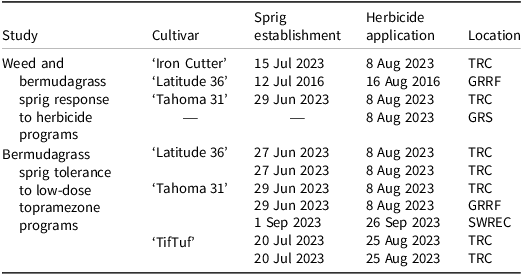
a The bermudagrass sprig tolerance to low-dose topramezone programs study was repeated at least twice for each cultivar, and sprigging and herbicide application timings are listed for each run.
b Abbreviations: GRRF, Glade Road Research Facility, Blacksburg, VA; GRS, Gravel Road Site, Blacksburg, VA; SWREC, Southwest Research and Extension Center, Hope, AR; TRC, Turfgrass Research Center, Blacksburg, VA.
Before sprigging and land preparation, all sprigged sites were sprayed with glyphosate (Roundup Pro® Concentrate, Bayer Crop Science, St. Louis, MO, USA) at 520 g ai ha−1. The sprigged sites were tilled in two directions at a depth of 4 to 5 cm for soil preparation with an RD 145 tiller (Rotadairon®, Mulsanne, France) before pressure-washed sprigs were hand strewn and roller packed with a Dunham cultipacker (Dunham, Dunham, OH, USA). ‘Iron Cutter’ (Middleton Manor Farms, Waldorf, MD, USA), ‘Latitude 36’ (Woodward Turf Farms, Remington, VA, USA), and ‘Tahoma 31’ (Riverside Turf, Charles City, VA, USA) were sprigged at 40,350, 33,625, and 33,625 kg ha−1, respectively. Treated plots were 1.8 m long by 1.2 m wide. Trial sites were fertilized with 50 kg ha−1 of N–P2O5–K2O (Fertilizer 19-19-19, The Andersons®, Maumee, OH, USA) at sprig establishment and followed by fertilizing three times with 20 kg N ha−1 (Urea 46-0-0, The Andersons®, Maumee, OH, USA) at 3-wk intervals after sprigging. All treatments with common names, trade names, manufacturer details, and rates applied during the experiment are presented in Table 2. Additionally, a nontreated control and hand-weeding treatment were also evaluated in each experiment. Quinclorac at 421 g ha−1 was applied sequentially 21 d after initial treatment (DAIT), but other treatments were applied once (Table 2). Herbicide treatments were applied using a CO2-pressurized backpack sprayer calibrated to deliver 374 L ha−1 via two TTI11004 spray tips (TeeJet® Technologies, Wheaton, IL, USA) at a walking speed of 4.8 km h−1.
Herbicide common names, trade names, manufacturer details, and rates used for assessing sprigged hybrid bermudagrass tolerance and weed response to different herbicide programs. a
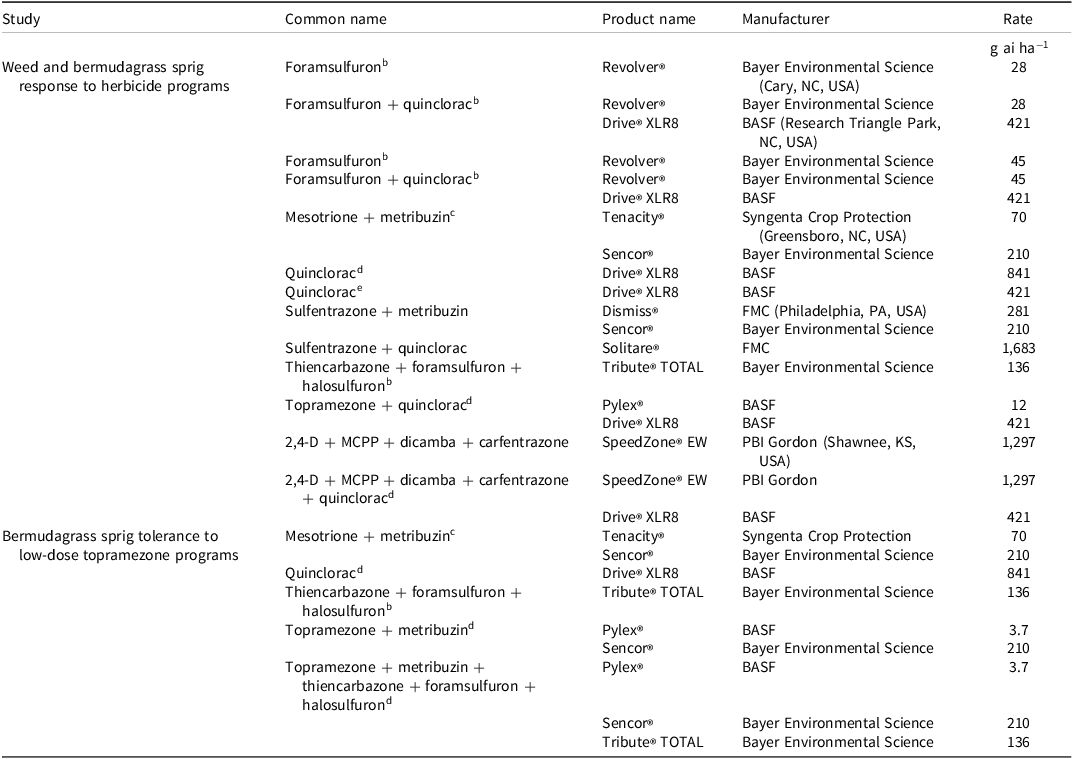
a A nontreated control and hand-weeding treatment were also evaluated in the study assessing weed and bermudagrass sprig response to herbicide programs. A nontreated control was evaluated in the sprig tolerance to low-dose topramezone program study.
b Methylated seed oil at 0.5% v v−1 and ammonium sulfate (100% soluble granule) at 3,360 g ha−1 were added to the treatment.
c Nonionic surfactant at 0.25% v v−1 was added to the treatment.
d Methylated seed oil at 0.5% v v−1 was added to the treatment.
e Methylated seed oil at 0.5% v v−1 was added, and the treatment was applied sequentially at 21-d intervals.
Data assessments for turfgrass injury, turfgrass coverage, smooth crabgrass control, smooth crabgrass coverage, goosegrass control, and goosegrass coverage were conducted visually on a scale of 0 to 100, where 0 = no injury, control, or coverage and 100 = complete plant death, control, or coverage at 0, 7, 14, 21, 28, 42, and 56 DAIT. Goosegrass and smooth crabgrass shoot density measurements were taken in each plot at 0, 28, and 56 DAIT by using a 1 × 1 m quadrant. Turfgrass shear strength assessments were taken at 28 DAIT with three subsamples in each plot with a Turf-Tec shear strength tester (TSHEAR2-M, Turf-Tec International, Tallahassee, FL, USA), and the peak shear resistance (Nm) was recorded (Straw et al. Reference Straw, Samson, Henry and Brown2020). Treatment was considered as a fixed effect, while the experimental run was considered as a random effect. All data were subjected to analysis of variance (ANOVA) using proc glm in SAS 9.3 (SAS Institute, Cary, NC, USA) with sums of squares partitioned to reflect replicate, treatment, and experimental run by treatment. F ratios of treatment were derived by dividing the mean square of treatment by that of Experimental Run × Treatment (McIntosh Reference McIntosh1983). Treatment main effects were reported only if the Experimental Run × Treatment interaction was insignificant (P > 0.05). Appropriate means were separated using Fisher’s protected least significant difference (LSD) (α = 0.05).
Hybrid Bermudagrass Sprig Tolerance to Low-Dose Topramezone Programs
Seven field experiments were conducted at the GRRF and TRC in Blacksburg, VA, and at the University of Arkansas Southwest Research and Extension Center (SWREC) (34.19°N, 93.94°W), in Hope, AR, during the 2023 growing season to assess the tolerance of market-leading cultivars of hybrid bermudagrass sprigs to recently developed herbicide admixtures and newly marketed commercial products (Table 1). Treatments were assessed on three hybrid bermudagrass cultivars (‘Latitude 36’, ‘Tahoma 31’, and ‘TifTuf’) with at least two temporal runs for each cultivar. All trial sites were sprayed with glyphosate at 520 g ai ha−1 to remove existing vegetation, followed by tillage for soil preparation before sprigging as mentioned previously. Pressure-washed sprigs of ‘Latitude 36’, ‘Tahoma 31’, and ‘TifTuf’ hybrid bermudagrass cultivars at GRRF and TRC sites were hand strewn and roller packed on June 27, June 29, and July 20, 2023, respectively, while ‘Tahoma 31’ was sprigged on September 1, 2023, at SWREC (Table 1). ‘Latitude 36’ (Woodward Turf Farms), ‘Tahoma 31’ (Riverside Turf), and ‘TifTuf’ (Buysod, Pinehurst, NC, USA) were sprigged at a rate of 33,625 kg ha−1, 33,625 kg ha−1, and 40,350 kg ha−1, respectively. ‘Tahoma 31’ (Poinsett Turfgrass, Harrisburg, AR, USA) was sprigged at a rate of 33,625 kg ha−1. The fertilizer program was similar to the aforementioned study. Plots were mown at 1.3 cm at weekly intervals beginning 6 WAS. All experiments were implemented as a single-factor (herbicide), randomized, complete-block design with four replicates. Treatments included a nontreated control and single applications of mesotrione + metribuzin, quinclorac, thiencarbazone + foramsulfuron + halosulfuron, topramezone + metribuzin, and topramezone + metribuzin + thiencarbazone + foramsulfuron + halosulfuron (Table 2). All treatments were applied 4 to 5 WAS as herbicides were applied on August 8, August 8, and August 25, 2023, to ‘Latitude 36’, ‘Tahoma 31’, and ‘TifTuf’ cultivars, respectively, and on September 26, 2023, to ‘Tahoma 31’ at SWREC (Table 1). Treated plots were 1.8 × 1.8 m. All herbicides were applied using the same methodology as mentioned previously. Each trial site was hand weeded before herbicide applications to avoid errors in digitally assessed (DIA) green cover, dark green color index (DGCI), and normalized difference vegetation index (NDVI) data collection.
Data were collected for turfgrass visible injury, visual coverage, DIA green cover, and DGCI from aerial images and for turfgrass NDVI at 0, 7, 14, 21, 28, 42, and 56 DAT. Hybrid bermudagrass sprigs were visually rated on a scale of 0% to 100% to assess turfgrass injury and coverage, with 0% being no injury or coverage and 100% being complete plant death or complete turfgrass coverage. Drone images were taken with a DJI Phantom 4 Advanced (DJI, Shenzhen, China) and subjected to Field Analyzer software (Green Research Services, AR, USA) to quantify the proportion of green pixels in each plot to DIA green cover and DGCI. A multispectral radiometer, Crop Circle Model ACS-210 (Holland Scientific, Lincoln, NE, USA), was used for collecting NDVI data via scanning the turfgrass canopy for 17 ± 2 assessments along the middle of each plot covering 0.5 m wide and 1.8 m long. Three assessments were taken for turfgrass shear strength measurements with a Turf-Tec shear strength tester in each plot 28 DAT. All response variables were subjected to ANOVA using proc glm in SAS 9.3. Experimental run was considered a random effect, while treatment was considered a fixed effect, and data were analyzed by cultivar. Three assessments for shear strength and 17 ± 2 samples of NDVI were averaged before subjecting to ANOVA. The mean square of treatment was tested for response variables using the mean square associated with Treatment × Experimental Run (McIntosh Reference McIntosh1983). Means were separated using Fisher’s protected LSD (α = 0.05). A correlations heatmap between response variables for all assessment timings was generated using the corr.test function in R software (version 4.04, R Core Team 2019). A correlation plot was built using the corrplot library, and the size and color intensity of each circle were used to represent the strength of the correlation (Kumari et al. Reference Kumari, Price, Gamble, Li and Jacobson2024).
Results and Discussion
Weed and Hybrid Bermudagrass Sprig Response to Herbicide Programs
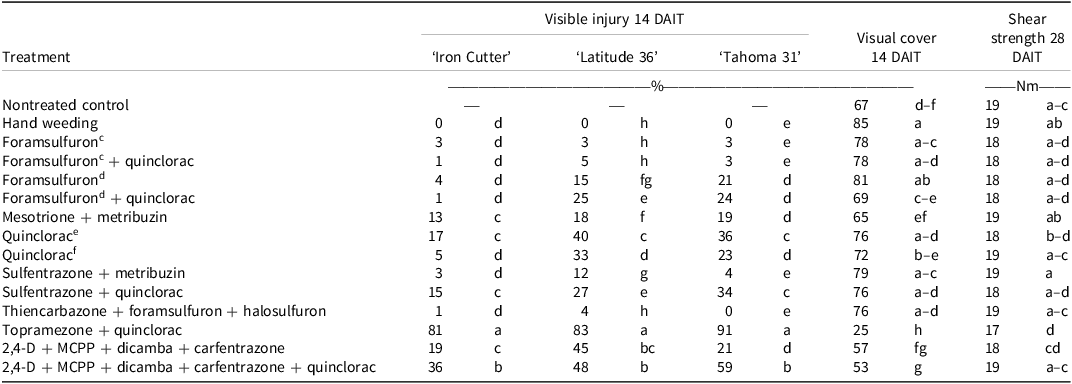
The Experimental Run × Treatment interaction was significant for visual turfgrass injury (P < 0.0001) at 14 DAIT (Supplementary Table S1), and data are separated by the three locations, where turfgrass response was evaluated (Table 3). The interaction was likely due to less injury recorded for the ‘Iron Cutter’ cultivar from quinclorac at any rate and foramsulfuron at 45 g ha−1 (Table 3). Treatments that appeared to injure hybrid bermudagrass <20% across sites included foramsulfuron at 28 g ha−1 alone or mixed with quinclorac, mesotrione + metribuzin, sulfentrazone + metribuzin, and thiencarbazone + foramsulfuron + halosulfuron (Table 3). Quinclorac applied once at 841 g ha−1 or as a premix with sulfentrazone injured hybrid bermudagrass 15% to 17% at the ‘Iron Cutter’ site and 27% to 40% at the ‘Tahoma 31’ and ‘Latitude 36’ sites (Table 3). Previous research conducted by McElroy et al. (Reference McElroy, Breeden, Yelverton, Gannon, Askew and Derr2005) also found that quinclorac applied at 840 g ha−1 caused 20% injury on seeded ‘Yukon’ bermudagrass at 14 DAT. When quinclorac was applied twice at 421 g ha−1, the injury was reduced at all evaluated sites (Table 3). Admixtures of quinclorac with either topramezone or 2,4-D + carfentrazone + dicamba + MCPP injured bermudagrass sprigs 81% to 91% and 36% to 59%, respectively, depending on cultivar, at 14 DAIT (Table 3). In other studies, topramezone also injured mature bermudagrass severely when applied alone or mixed with triclopyr, but the injury was commercially acceptable 28 DAT (Cox et al. Reference Cox, Rana, Brewer and Askew2017). At 14 DAIT, newly sprigged hybrid bermudagrass was injured 19% to 21% at the ‘Iron Cutter’ and ‘Tahoma 31’ sites and 45% at the ‘Latitude 36’ site by 2,4-D + carfentrazone + dicamba + MCPP. These injury values are similar to the 21% injury reported by Kerr et al. (Reference Kerr, McCarty, Brown, Harris and McElroy2019) and 27% injury reported by Carroll et al. (Reference Carroll, Brosnan and Breeden2021) at the same evaluation timing.
Visible injury and visible cover of bermudagrass sprigs at 14 d after initial treatment (DAIT) of herbicides and turfgrass shear strength at 28 DAIT assessed during weed and bermudagrass sprig response to herbicide programs study. a,b
a Means within each column followed by same letter are not significantly different based on Fisher’s protected LSD (α = 0.05).
b Visual cover at 14 DAIT and shear strength at 28 DAIT were averaged over cultivars.
c Foramsulfuron was applied at 28 g ha−1.
d Foramsulfuron was applied at 45 g ha−1.
e Quinclorac was applied at 841 g ha−1.
f Quinclorac at 421 g ha−1 was applied sequentially at 21-d intervals.
The treatment main effect was significant for visual turfgrass cover (P < 0.0001) and not dependent on the experimental run (P = 0.0513) (Supplementary Table S1). Bermudagrass sprig cover in the nontreated control was 67% and significantly less than the hand-weeded (85% cover) treatment due to high weed competition from goosegrass and smooth crabgrass (Table 3). Thus turfgrass cover is not necessarily a reflection of turfgrass injury but is influenced by both herbicide phytotoxicity and displacement by weeds following treatments of poor weed control efficacy. A premix of 2,4-D + sulfentrazone + dicamba + MCPP alone or mixed with quinclorac reduced bermudagrass cover compared to the nontreated check, presumably due to moderate turfgrass injury and uncontrolled weeds (Table 3). Topramezone + quinclorac reduced turfgrass cover to 25% and had significantly higher turfgrass injury than all other treatments at 14 DAIT (Table 3), indicating a causal relationship between the two responses.
The treatment main effect was significant for shear strength (P = 0.0453) and not dependent on the experimental run (P = 0.7612) (Supplementary Table S1). Topramezone + quinclorac reduced bermudagrass shear strength to 17 Nm at 28 DAIT; however, turfgrass shear strength after other herbicide treatments was similar to the nontreated control (19 Nm) (Table 3). This accounts for approximately 10% less resistance when an athlete plants a cleated foot and may lead to human injury as the minimum threshold for hybrid bermudagrass shear strength is 18 Nm (Dickson et al. Reference Dickson, Sorochan, Brosnan, Stier, Lee and Strunk2018). Straw et al. (Reference Straw, Samson, Henry and Brown2018) also reported that 57% of athlete injuries occurred due to poor shear strength of hybrid bermudagrass. Bermudagrass injury by quinclorac (McCalla et al. Reference McCalla, Richardson, Karcher and Boyd2004; McElroy et al. Reference McElroy, Breeden, Yelverton, Gannon, Askew and Derr2005) and topramezone (Boyd et al. Reference Boyd, McElroy, McCurdy, McCullough, Han and Guertal2021; Breeden et al. Reference Breeden, Brosnan, Breeden, Vargas, Eichberger, Tresch and Laforest2017; Cox et al. Reference Cox, Rana, Brewer and Askew2017) is not uncommon. After the initiation of the weed and bermudagrass sprig response study in 2016, additional research has shown that topramezone is less phytotoxic to mature bermudagrass when applied at 3.7 g ha−1 and mixed with metribuzin at 210 g ha−1 (Brewer et al. Reference Brewer, Askew and Askew2021). Thus the topramezone rates evaluated in our study are higher than what is needed for goosegrass control (Brewer et al. Reference Brewer, Askew and Askew2021; Cox et al. Reference Cox, Rana, Brewer and Askew2017) and would not be recommended in the northern transition zone due to unacceptable injury, reduced turfgrass cover, and decreased shear strength (Table 3).
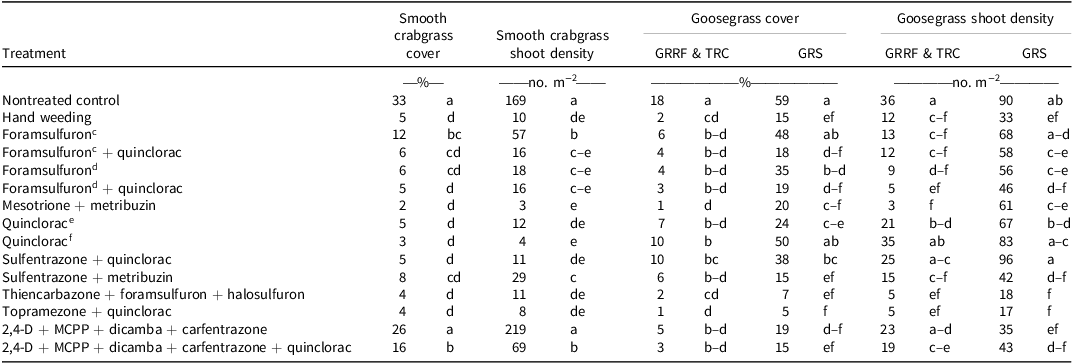
The treatment main effect was significant for smooth crabgrass cover (P = 0.0003), and smooth crabgrass shoot density (P = 0.0011) at 56 DAIT and not dependent on the experimental run (P ≥ 0.0653) (Supplementary Table S1). Of the 14 treatments evaluated for weed control, only 4 did not reduce smooth crabgrass cover to a commercially acceptable level of 80% less than the nontreated check (Table 4). These treatments included 2,4-D + carfentrazone + dicamba + MCPP alone or mixed with quinclorac, sulfentrazone + metribuzin, and foramsulfuron applied alone at 28 g ha−1 (Table 4). Adding quinclorac at 421 g ha−1 to foramsulfuron at 28 g ha−1 reduced smooth crabgrass cover equivalent to foramsulfuron at 45 g ha−1 (Table 4). Although the lower rate of foramsulfuron reduced smooth crabgrass cover better with quinclorac admixture, no improvement in smooth crabgrass cover reduction was noted when quinclorac was applied with a higher rate of foramsulfuron (Table 4). The range of smooth crabgrass cover reduction compared to the nontreated check in our study by foramsulfuron at 28 and 45 g ha−1 with and without quinclorac ranged from 64% to 82% (Table 4). Willis and Askew (Reference Willis and Askew2009) also reported that foramsulfuron at 28 g ha−1 controlled smooth crabgrass up to 74%, with maximum control occurring 2 wk after seeding ‘Riviera’ bermudagrass. Quinclorac applied sequentially at 421 g ha−1 and mesotrione + metribuzin reduced smooth crabgrass cover to 3% or less and not more than 4 shoots m−2 (Table 4). Excellent smooth crabgrass control was also noted in other studies following treatment with quinclorac (Dernoeden et al. Reference Dernoeden, Bigelow, Kaminski and Krouse2003; Willis et al. Reference Willis, Beam, Barker and Askew2006) and mesotrione + metribuzin (Brewer et al. Reference Brewer, Askew and Askew2021). Elmore et al. (Reference Elmore, Brosnan, Breeden and Patton2013) also observed improved annual bluegrass (Poa annua L.) control from mesotrione and photosystem II inhibitor application. Thiencarbazone + foramsulfuron + halosulfuron reduced smooth crabgrass cover to <5% and shoot density to 11 shoots m−2 (Table 4). Previous research observed that thiencarbazone + foramsulfuron + halosulfuron controlled tropical signalgrass [Urochloa subquadripara (Trin.) R. Webster] >80% at 12 WAT in bermudagrass fairways (Cross et al. Reference Cross, McCarty and Estes2016).
a Abbreviations: GRRF, Glade Road Research Facility, Blacksburg, VA; GRS, Gravel Road Site, Blacksburg, VA; TRC, Turfgrass Research Center, Blacksburg, VA.
b Means followed by different letters within each column are statistically different based on Fisher’s protected LSD (α = 0.05).
c Foramsulfuron was applied at 28 g ha−1.
d Foramsulfuron was applied at 45 g ha−1.
e Quinclorac was applied at 841 g ha−1.
f Quinclorac at 421 g ha−1 was applied sequentially at 21-d intervals.
The Treatment × Experimental Run interaction was significant for goosegrass cover (P = 0.0003) and goosegrass counts (P = 0.0047) at 56 DAIT (Supplementary Table S1). Two of the sites infested with goosegrass were renovated, tilled, and sprigged with bermudagrass as discussed previously, but a third site was a fallow site along a gravel road that was heavily infested with mature goosegrass (Table 1). When GRS was removed from the analysis, the Treatment × Experimental Run interaction was no longer significant (data not shown). Thus goosegrass cover and shoot counts from the two sprigged bermudagrass sites were pooled (GRRF & TRC) and compared separately from GRS (Table 4). The mature growth stage and increased goosegrass density, coupled with the lack of bermudagrass competition at the GRS, led to poor response of goosegrass to herbicides and presumably contributed to the experimental run interaction (Supplementary Table S1). More specifically, foramsulfuron and quinclorac alone at either rate and both treatments that contained 2,4-D + dicamba + MCPP + carfentrazone were relatively less effective at GRS based on within-site mean rank (Table 4). The foramsulfuron label recommends that goosegrass at the 1- to 3-tiller stage be treated twice at a 6- to 21-d interval with the 45 g ai ha−1 rate (Anonymous 2023). However, goosegrass was larger than the 4-tiller stage, and the herbicide was applied only once at all evaluated sites. Mesotrione + metribuzin reduced goosegrass cover and shoot density effectively at both sprigged sites but not at GRS, and inconsistency between sites could be explained by the weed growth stage (Table 4). Topramezone + quinclorac reduced goosegrass cover to ≤5% at all evaluated sites and reduced goosegrass shoot density to 5 shoots m−2 averaged over sprigged sites (GRRF and TRC) and 17 shoots m−2 at GRS (Table 4). Research conducted by Cox et al. (Reference Cox, Rana, Brewer and Askew2017) also aligns with our results, as it demonstrates that topramezone-based programs control goosegrass effectively. Thiencarbazone + foramsulfuron + halosulfuron and hand-weeding treatment were also observed to be similar to topramezone + quinclorac in terms of reducing the goosegrass cover and shoot density (Table 4). Thiencarbazone + foramsulfuron + halosulfuron is labeled for goosegrass control up to the early tillering stage (Anonymous 2022). Shekoofa et al. (Reference Shekoofa, Brosnan, Vargas, Tuck and Elmore2020) also documented >90% control of goosegrass from thiencarbazone + foramsulfuron + halosulfuron treatment under adequate moisture conditions.
Hybrid Bermudagrass Sprig Tolerance to Low-Dose Topramezone Programs
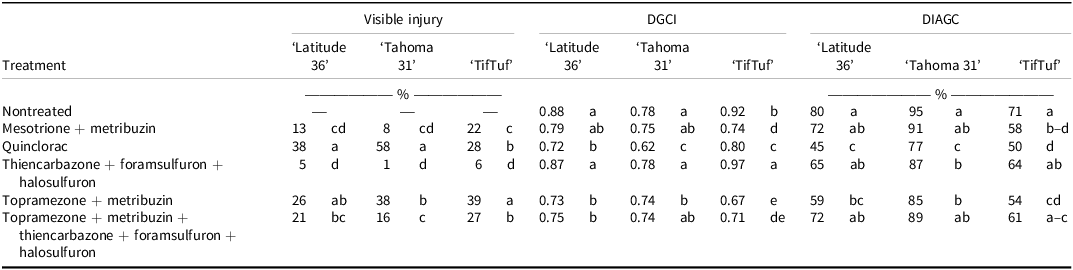
The treatment main effect was significant (P ≤ 0.0037) for visually assessed turfgrass injury at 14 DAT for each of the three bermudagrass cultivars evaluated in the study (Supplementary Table S2). Mesotrione + metribuzin injured all cultivars of bermudagrass >30% at 7 DAT (data not shown), but the injury was ≤22% at 14 DAT (Table 5). Previous research also observed that mesotrione + metribuzin injured mature ‘Tifway’ hybrid bermudagrass up to 58%; however, turfgrass injury was <30% at 14 DAT, which demonstrated the recovery potential after transient injury (Brewer et al. Reference Brewer, Askew and Askew2021). Quinclorac caused 38%, 58%, and 28% injury on ‘Latitude 36’, ‘Tahoma 31’, and ‘TifTuf’, respectively, at 14 DAT (Table 5). Quinclorac injured ‘Latitude 36’ and ‘Tahoma 31’ more than other treatments at 14 DAT (Table 5), which was in contrast to previous research conducted by Brecke et al. (Reference Brecke, Stephenson and Unruh2010), where quinclorac injured sprigged ‘Tifdwarf’ and ‘Tifsport’ bermudagrass <15%. However, variability in tolerance of newly established bermudagrass cultivars to herbicides could potentially be driven by cultivar growth differences (McElroy et al. Reference McElroy, Breeden, Yelverton, Gannon, Askew and Derr2005).
Visible injury, dark green color index (DGCI), and digitally assessed green cover (DIAGC) of newly sprigged hybrid bermudagrass cultivars at 14 days after postemergence herbicide treatment. a
a Means followed by the same letter within each column are not statistically different based on Fisher’s protected LSD (α = 0.05).
Thiencarbazone + foramsulfuron + halosulfuron was safe on all the evaluated cultivars, as the injury was less than 6% (Table 5). Johnston and Henry (Reference Johnston and Henry2016) observed no phytotoxicity on mature ‘Tifway’ hybrid bermudagrass from thiencarbazone + foramsulfuron + halosulfuron treatments. Thiencarbazone + foramsulfuron + halosulfuron is recommended for broad-spectrum weed control at 2 to 3 wk after sprig establishment (Anonymous 2022), and our research findings for newly developed hybrid bermudagrass cultivars align with this recommendation. Topramezone + metribuzin injured bermudagrass sprigs 26%, 38%, and 39% on ‘Latitude 36’, ‘Tahoma 31’, and ‘TifTuf’, respectively, at 14 DAT, but the injury was reduced by 5% to 22%, when topramezone + metribuzin was tank mixed with thiencarbazone + foramsulfuron + halosulfuron (Table 5). Brewer et al. (Reference Brewer, Askew and Askew2021) also documented transient injury on mature bermudagrass from topramezone and metribuzin programs. Sulfonylurea herbicides can antagonize 4-hydroxyphenylpyruvate dioxygenase (HPPD) inhibitors; however, the antagonistic response was species specific, as it reduced control of barnyardgrass [Echinochloa crus-galli (L.) P. Beauv.] and large crabgrass [Digitaria sanguinalis (L.) Scop.] but did not affect foxtail (Setaria spp.) control (Kaastra et al. Reference Kaastra, Swanton, Tardif and Sikkema2008). Thiencarbazone likely stunts bermudagrass leaf growth and reduces white discoloration of bermudagrass by HPPD-inhibiting herbicides, which predominately occurs on new leaves that develop after HPPD herbicide treatment (Goddard et al. Reference Goddard, Willis and Askew2010). Although a few treatments injured bermudagrass, the speed of recovery across all treatments and locations suggests that any of these treatments could be a viable option for weed control during sprig establishment, as turfgrass recovered from transient injury by 28 to 56 DAT.
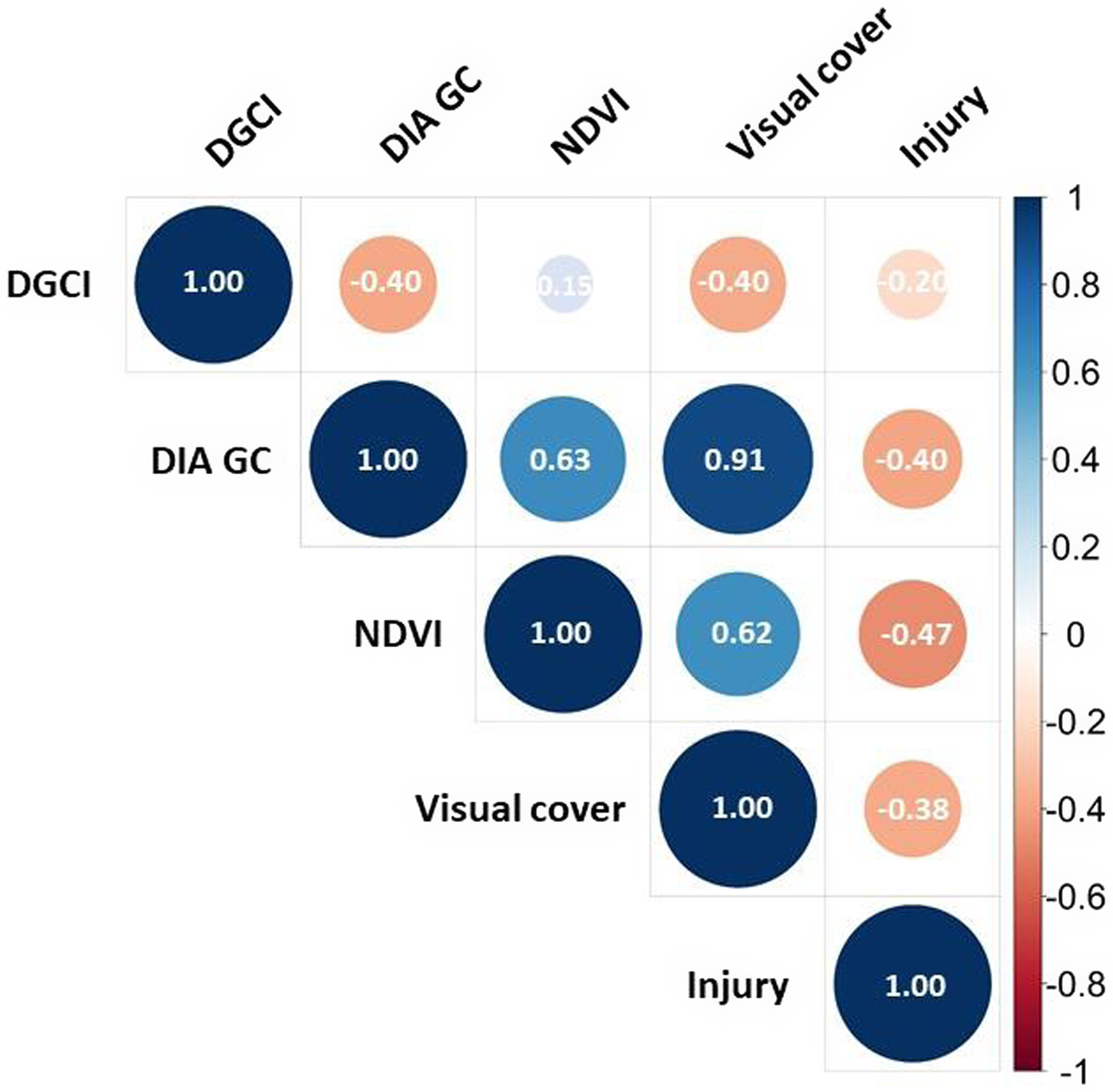
Three spectral responses were collected in this study, and each has a varying degree of usefulness in evaluating herbicide injury or turfgrass quality. Aerial imagery was used to derive DGCI and DIA green cover, while a ground-driven spectral analyzer generated NDVI. DGCI estimates the intensity of the green hue, so it assesses only portions of the turfgrass canopy that remain green following herbicide treatment. It should be considered in tandem with, rather than compared to, DIA green cover, as DIA green cover assesses how much green cover is present in the canopy, and DGCI indicates “how dark green” those portions of the canopy are. In the case of NDVI, all turfgrass canopy other than bare ground is assessed, and an average response is returned. NDVI is a better measure of herbicide injury than DGCI, but the correlation of NDVI to visual turfgrass injury depends on the herbicide mode of action (Koo et al. Reference Koo, Vahidi, Goncalves, Peppers, Shafian and Askew2022). These three responses are unlikely to correlate following turfgrass injury by certain herbicides but often correlate well when evaluating turfgrass phenotypes or responses to fertility (Bell et al. Reference Bell, Howell, Johnson, Raun, Solie and Stone2004; Caturegli et al. Reference Caturegli, Gaetani, Volterrani, Magni, Minelli, Baldi, Brandani, Mancini, Lenzi, Orlandini, Lulli, de Bertoldi, Dubbini and Grossi2019; Leinauer et al. Reference Leinauer, VanLeeuwen, Serena, Schiavon and Sevostianova2014; Trenholm et al. Reference Trenholm, Carrow and Duncan1999). Injury on bermudagrass sprigs was negatively correlated with turfgrass DGCI (r = −0.20), DIA green cover (r = −0.40), NDVI (r = −0.47), and visual cover (r = −0.38) (Figure 1). Herbicide injury is a collective response of the degree of plant chlorosis, necrosis, stunting, and mortality (CWSS Reference McCullough, Yu and Gómez de Barreda2018), which further explains the negative correlation of turfgrass injury with DGCI, NDVI, and turfgrass cover (Figure 1). DIA turfgrass green cover was positively correlated to visually assessed bermudagrass cover (r = 0.91) and NDVI (r = 0.63) but not to DGCI (Figure 1). DGCI tended to fluctuate with nitrogen applications (data not shown), which occurred twice before herbicide treatment, and was not well correlated to other responses when summarized over seven assessment dates (Figure 1). In other studies, DGCI has been highly correlated to nitrogen content and is generally used to measure turfgrass quality (Carlson et al. Reference Carlson, Gaussoin and Puntel2022).
Correlation plot showing significance at α = 0.05 level Pearson correlations between response variables assessed during the bermudagrass sprig tolerance to different postemergence herbicide experiments. Response variables assessed were dark green color index (DGCI), digitally assessed green cover (DIAGC), normalized difference vegetation index (NDVI), visible turfgrass cover, and turfgrass injury. Color intensity and size indicate the direction and strength of correlation, respectively.
The treatment main effect was significant for DGCI (P < 0.05), so data were pooled over experimental runs for each cultivar (Supplementary Table S2). Quinclorac and topramezone + metribuzin treatments reduced the DGCI of all assessed bermudagrass cultivars at 14 DAT (Table 5). Owing to the strong positive correlation between visually assessed green cover and digitally assessed green cover (Figure 1), only DIA turfgrass cover is shown (Table 5). Similar associations between visually and digitally assessed turfgrass cover were observed by Richardson et al. (Reference Richardson, Karcher and Purcell2001). The treatment main effect was significant (P < 0.05) for DIA turfgrass green cover at 14 DAT and not dependent on trial (Supplementary Table S2). Quinclorac reduced DIA green cover of ‘Latitude 36’, ‘Tahoma 31’, and TifTuf to 45%, 77%, and 50%, respectively, at 14 DAT, compared to 80%, 95%, and 71%, respectively, in nontreated plots (Table 5). Topramezone + metribuzin also reduced DIA green cover for all cultivars at 14 DAT, but when thiencarbazone + foramsulfuron + halosulfuron was included as an admixture with topramezone + metribuzin, DIA green cover was equivalent to the nontreated control (Table 5). Our research findings were similar to Brewer et al.’s (Reference Brewer, Askew and Askew2021), which also showed that the topramezone-based program caused a transient reduction in bermudagrass green cover. Despite herbicide responses observed at up to 14 DAT where turfgrass cover, DGCI, and NDVI were reduced by some treatments associated with increased injury, bermudagrass exhibited rapid recovery and improvement in these measured responses at 28 DAT across multiple locations in Virginia and Arkansas.
Practical Implications
Mesotrione-, quinclorac-, thiencarbazone-, and topramezone-based herbicide programs effectively reduce smooth crabgrass cover and shoot density. With the exception of quinclorac alone, the same herbicide programs also reduce goosegrass cover and shoot density, although the topramezone rate in our study that evaluated weed control was higher than that suggested by recent research (Brewer et al. Reference Brewer, Askew and Askew2021; Lindsey et al. Reference Lindsey, DeFrank and Cheng2020). Topramezone + metribuzin causes transient injury to ‘Latitude 36’, ‘Tahoma 31’, and ‘TifTuf’ cultivars, and injury may be reduced by mixing with thiencarbazone + foramsulfuron + halosulfuron. When used alone, thiencarbazone + foramsulfuron + halosulfuron is generally safe on a wide variety of bermudagrass cultivars and offers goosegrass and smooth crabgrass control comparable to other herbicides. Our findings suggest that turfgrass managers have a variety of herbicides that can control smooth crabgrass and goosegrass during bermudagrass sprig establishment, but the margin of selectivity is relatively narrow for mesotrione, quinclorac, and topramezone. Despite possible herbicide injury by some treatments 14 DAT, bermudagrass will typically recover by 28 DAT. Results suggest, however, that bermudagrass response to mesotrione-, quinclorac-, and topramezone-based programs may be cultivar- and rate-dependent. These herbicides are important components of weed control during sprigged bermudagrass establishment (Begitschke et al. Reference Begitschke, McCurdy, Philley, Baldwin, Stewart, Richard and Kalmowitz2017; Brecke et al. Reference Brecke, Stephenson and Unruh2010) but should be used with caution due to the varying magnitude and duration of transient herbicide injury.
Supplementary material
To view supplementary material for this article, please visit https://doi.org/10.1017/wet.2024.55
Acknowledgments
The authors thank John Brewer and Jordan Craft for their assistance in data collection. We also thank John Hinson, David Nistler, the Virginia Tech Turfgrass Research Center staff, and the University of Arkansas Southwest Research and Extension Center staff for their support in trial establishment and site maintenance.
Competing Interests
The authors declare no conflicts of interest.


 Open access

