


Introduction
Uncertainty in decision-making occurs in a range of disciplines, including public health, finance, economics and conservation management. Decision science provides a transparent and credible framework to improve decisions that are based in part on imperfect knowledge (Yokomizo et al., Reference Yokomizo, Coutts and Possingham2014; Bolam et al., Reference Bolam, Grainger, Mengersen, Stewart, Sutherland, Runge and McGowan2019; Hemming et al., Reference Hemming, Camaclang, Adams, Burgman, Carbeck and Carwardine2022). Decision science has increasingly been used in conservation science (Possingham et al., Reference Possingham, Andelman, Noon, Trombulak, Pulliam, Soule and Orians2001; Conroy & Peterson, Reference Conroy and Peterson2013). Conservation practitioners are often required to make decisions based on dynamic and complex systems where empirical evidence is lacking or uncertain, or data are incomplete (Martin et al., Reference Martin, Burgman, Fidler, Kuhnert, Low-Choy, McBride and Mengersen2012). Expert judgement has been used in decision-making to inform a range of conservation management issues from assessing the viability of translocations (Johnson et al., Reference Johnson, Mengersen, de Waal, Marnewick, Cilliers, Houser and Boast2010) to predicting the distribution of a species (Murray et al., Reference Murray, Goldizen, O'Leary, McAlpine, Possingham and Choy2009) and examining the impacts of climate change on population dynamics of species (O'Neill et al., Reference O'Neill, Osborn, Hulme, Lorenzoni and Watkinson2008).
The regent honeyeater Anthochaera phrygia, a Critically Endangered songbird (BirdLife International, 2018) that has < 300 adults remaining in the wild (Heinsohn et al., Reference Heinsohn, Lacy, Elphinstone, Ingwersen, Pitcher and Roderick2022), is facing a major barrier to recovery with nest success at historical low levels (Crates et al., Reference Crates, Olah, Adamski, Aitken, Banks and Ingwersen2019a). Nests are thought to fail primarily because of predation (Taylor et al., Reference Taylor, Ewen, Clarke, Blackburn, Johnson and Ingwersen2018), but other factors could contribute substantially. The seasonal breeding rate of regent honeyeaters has declined from c. 1.51 juveniles per female in the 1990s to c. 0.99 juveniles per female in 2015–2017 (Crates et al., Reference Crates, Rayner, Stojanovic, Webb, Terauds and Heinsohn2019b; Heinsohn et al., Reference Heinsohn, Lacy, Elphinstone, Ingwersen, Pitcher and Roderick2022).
Data from the National Regent Honeyeater Monitoring Program, the long-term zoo breeding, release and wild population monitoring programme that commenced in the 1990s, were recently synthesized in a population viability analysis (Heinsohn et al., Reference Heinsohn, Lacy, Elphinstone, Ingwersen, Pitcher and Roderick2022). This reported that a recruitment rate of 1.5–2.0 juveniles per female per season is needed to arrest population decline (Heinsohn et al., Reference Heinsohn, Lacy, Elphinstone, Ingwersen, Pitcher and Roderick2022). This analysis shows that, coupled with habitat protection/restoration and the reintroduction of zoo-bred birds, boosting the success rate of nests in the wild will be a crucial part of saving regent honeyeaters from extinction over the next decade.
Nest success is highly variable between years and at different sites, and it can vary depending on the position of the nest within the tree crown. Moreover, there is no clear understanding of patterns or trends of the success or failure of these nests. There are also inconsistencies in what is considered a breeding nest versus an ancillary nest (i.e. birds of some species will build multiple nests within a breeding season that are not used for egg-laying; Macqueen & Ruxton, Reference Macqueen and Ruxton2023), and this needs further clarification. However, each breeding nest that fails limits recruitment into the population.
Predation from avian and mammalian predators on eggs, nestlings and attending females is a major cause of nest failure (Taylor et al., Reference Taylor, Ewen, Clarke, Blackburn, Johnson and Ingwersen2018). There are also threats from competitor bird species such as the noisy miner, which aggressively competes with regent honeyeaters through disturbance or nest destruction. This species poses a threat to some of the monitored nesting regent honeyeaters and has been listed as a key threatening process under the Environment Protection and Biodiversity Conservation Act (Commonwealth of Australia, 2014; Crates et al., Reference Crates, McDonald, Melton, Maron, Ingwersen and Mowat2023). Extreme weather events such as bushfires and heavy rain have also led to habitat and nest destruction, affecting fledgling recruitment and nest integrity, and are postulated to be the cause of c. 11% of nest failures (R. Crates, pers. comm., 2022). Regent honeyeaters are most vulnerable during the nest phase because of their immobility, especially during the early stage of development. Once fledged, they have a greater chance of survival and of contributing to the greater population, reinforcing the importance of interventions at the nest stage for the recovery of the species.
Conservation challenge
Providing nest protection to regent honeyeaters is challenging as the birds rarely breed in the same location in consecutive years. This challenge is exacerbated by the critically low population. Regent honeyeaters are largely nomadic and can travel hundreds of kilometres (Crates et al., Reference Crates, Rayner, Stojanovic, Scheele, Roff, MacKenzie and Heinsohn2022). They often construct open-cup nests in the outer canopy that are inaccessible to humans (and thus difficult to manage for conservation) but vulnerable to competition or predation by various birds and mammals.
They mostly breed from late August but can start to breed in late July/early August, so for practitioners to be able to offer nest protection the birds and nests would need to be detected from the commencement of the breeding season to c. early September, to maximize the number of viable nests available. Additional challenges include the initial detectability of the birds, the inaccessibility of nests high in trees and that the birds will only tolerate limited disturbance. Additionally, many nests are located on private land, with associated access challenges for practitioners seeking to protect nests. There are also other challenges, such as engaging with ethics committees and government agencies for permits and licences.
In 2016, an expert elicitation was undertaken to help guide nest protection measures for regent honeyeaters. The research considered three potential actions: (1) the fitting of tree collars to minimize access to nests for mammalian predators; (2) the addition of nest cages to offer further protection to nests in collared trees; and (3) supplementary feeding to improve the ability of breeding adults to successfully rear offspring (Canessa et al., Reference Canessa, Taylor, Clarke, Ingwersen, Vandersteen and Ewen2020). The recovery team dismissed the removal of predators because most were native (and some threatened, such as the squirrel glider Petaurus norfolcensis). As a result of the analysis, tree collaring was deemed a suitable nest protection method. The approach taken by the species managers at the time was intentionally risk averse because of the limited knowledge of any unintended impacts of interventions. However, since then the species has continued to decline, and population modelling has emphasized the need to increase wild recruitment (Heinsohn et al., Reference Heinsohn, Lacy, Elphinstone, Ingwersen, Pitcher and Roderick2022). Here, as part of an adaptive management process, we build on that knowledge and explore further options such as the removal of predators and other innovative measures to protect nesting regent honeyeaters.
Our aim is to develop a collaborative approach amongst conservation practitioners, researchers and key stakeholders to share knowledge and ideas and discuss strategies for protecting regent honeyeater nests. We evaluate the probability of success of the interventions based on expert assessments.
Methods
We adopted a four-stage approach to the development of the nest protection decision strategy tool: brainstorming session, pre-expert elicitation, expert elicitation and future planning. This process initially considered three categories of threats (avian predators, mammalian predators and extreme weather events), with a fourth category, avian competitors, added during the expert elicitation process.
Brainstorming session
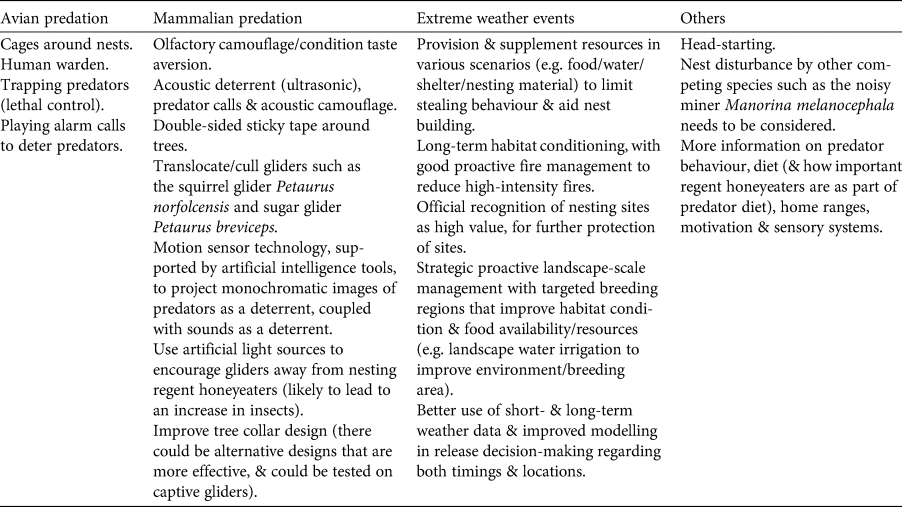
The purpose of the brainstorming workshop was to generate blue-sky thinking on avian predation, mammalian predation and extreme weather events, in which all ideas for nest protection interventions were encouraged; this included additional ideas/interventions that did not fall within the scope of these three categories (Table 1). We held the brainstorming session on 26 April 2022, with 27 participants from government, not-for-profit, academia/research and industry (Supplementary Table 1a). At this workshop we heard from a range of speakers who had worked on regent honeyeaters, including G. Taylor, who presented the results from the expert elicitation that was undertaken on regent honeyeaters in 2016 (Canessa et al., Reference Canessa, Taylor, Clarke, Ingwersen, Vandersteen and Ewen2020), and conservation practitioners who have worked on closely related species and conservation issues. Topics discussed included innovation in conservation science, and several case studies that included olfactory misinformation training for mammalian predators, taste aversion training to protect nesting hooded plovers Thinornis rubricollis, physical barriers around nests to deter predators and the use of acoustic deterrents for nuisance animals. A brief description of the case studies is given in Supplementary Table 1b.
Summary of the ideas discussed in the brainstorming session for protecting the regent honeyeater Anthochaera phrygia from avian predation, mammalian predation and extreme weather events, with additional ideas/interventions that did not fall within the scope of the three categories.
In the second half of the session, breakout groups discussed and developed ideas central to one of the three categories, which were then presented to the whole group for discussion. The group discussed the concept of a set of possible conservation solutions that could be applied depending on the circumstances. For example, in some locations there may be more avian predators, so interventions should be focused on that threat, whereas in other locations a combination of solutions may be required.
Pre-expert elicitation
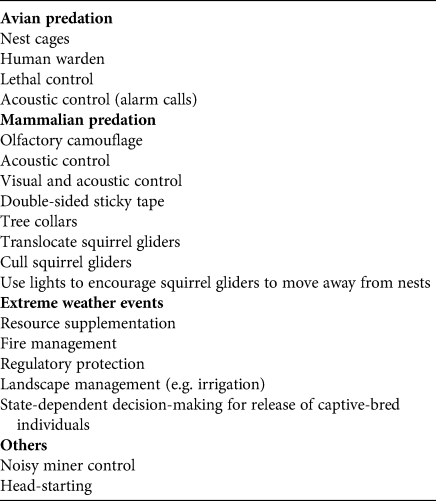
We held a pre-expert elicitation meeting on 14 July 2022, with nine participants involved (Supplementary Table 2). The list of ideas proposed for nest protection from the brainstorming session (Table 1) was reviewed and the feasibility of success of each intervention was discussed, with the aim of synthesizing the list to help guide the expert elicitation discussions. This meeting generated a target list of interventions (Table 2). Additionally, there was group consensus that a nest warden should be used to monitor nests and implement the appropriate nest protection interventions, and should form part of the nest protection process and would therefore not need to be included in the expert elicitation process.
List of interventions for protecting regent honeyeaters, developed during the pre-expert elicitation process from the ideas discussed in the brainstorming session (Table 1).
Expert elicitation
We conducted the expert elicitation process on 29 July 2022, with 15 participants (Supplementary Table 3). Table 3 lists the set of candidate ideas for the protection of regent honeyeater nests, which were synthesized from the list of interventions developed during the pre-expert elicitation (Table 2). This elicitation of expert judgement aimed to follow best practice. Specifically: (1) assessors included a range of professional backgrounds and organizational perspectives, including field ecologists, behavioural ecologists, captive breeding experts and managers (Burgman et al., Reference Burgman, Carr, Godden, Gregory, McBride, Flander and Maguire2011); (2) judgements were made anonymously, to insulate against groupthink and deference to authority (Burgman, Reference Burgman2016); (3) assessment sought to reduce language-based ambiguity through discussion of candidate ideas and factors that could condition prospects of success or failure (Carey & Burgman, Reference Carey and Burgman2008); and (4) a second round of assessment was conducted following the presentation of all first round judgements, to insulate against overconfidence (Hemming et al., Reference Hanea, McBride, Burgman and Wintle2018).
Set of candidate ideas for nest protection developed during the expert elicitation, based on the list of interventions developed during the pre-expert elicitation (Table 2). Ideas sought to mitigate the risk of nest failure from avian predation, mammalian predation, extreme weather events and competition.

The elicitation of judgements followed the formal structured IDEA protocol (Hemming et al., Reference Hemming, Burgman, Hanea, McBride and Wintle2018). In general, formal structured techniques provide answers that are more accurate than unstructured approaches (Burgman, Reference Burgman2016). The IDEA protocol emphasizes anonymity in judgements, feedback, discussion and subsequent revision in a second round of elicitation (Hanea et al., Reference Hanea, McBride, Burgman and Wintle2018). In each round and for each question, experts provide a plausible lower bound, a plausible upper bound, a best estimate (lying between the bounds) and the level of confidence that the truth lies between the specified lower and upper bounds, as a per cent.
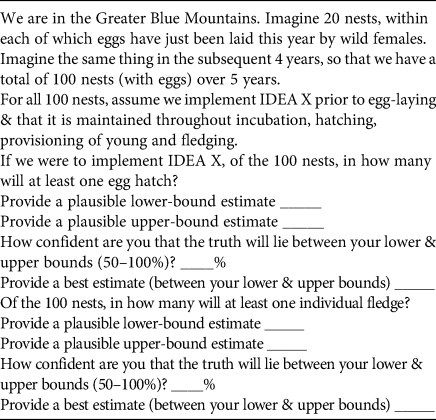
The questions sought estimates of the proportion of nests that succeed, from hatching eggs through to fledging individual birds for nests of both wild and recently released (≤ 12 months ago) birds under the base case of no protection and each candidate idea, one at a time. In their responses, participants were prompted to consider the prevalence of threats collectively, the effectiveness of candidate ideas for mitigating target threats and the residual risk of unaddressed threats. Participants were asked to ignore challenges associated with ethics approval, technical or social feasibility and cost. An example of the format of questions is shown in Table 4.
Format of questions put to workshop participants in the expert elicitation process.
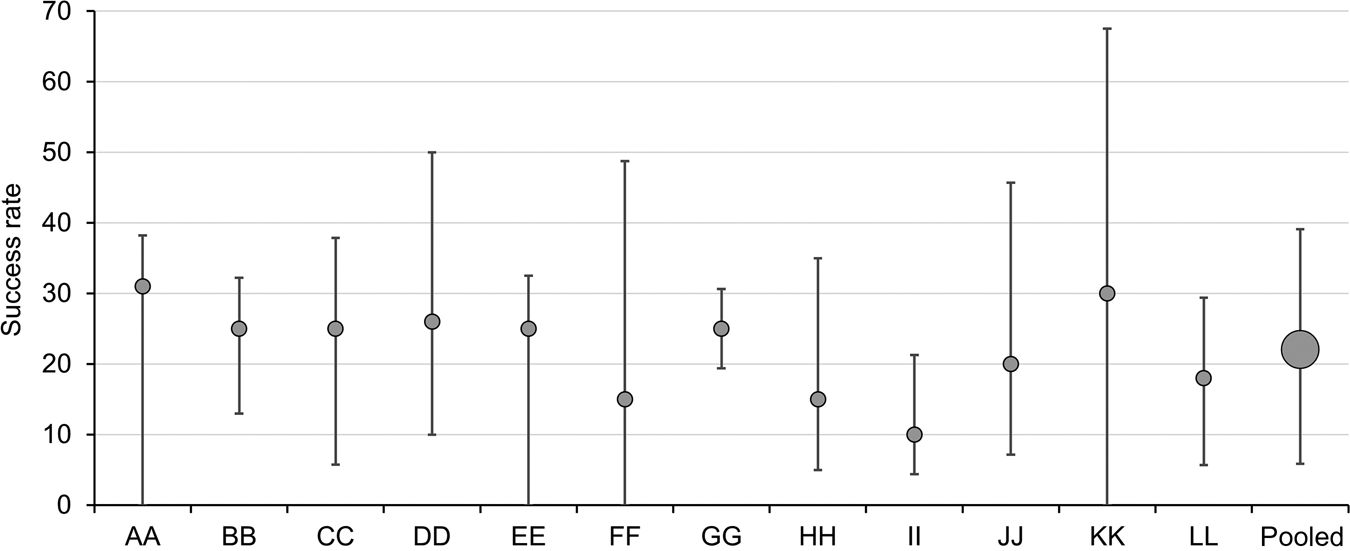
We used pooled judgements in the analyses, employing the arithmetic mean of individual judgements. The unweighted mean of a group of experts comprising independent judgements almost always outperforms the best-performing expert within the group (Burgman, Reference Burgman2016). An example of judgements for a single question is shown in Fig. 1. Responses were provided by 12 anonymous experts (three workshop participants elected not to provide judgments). Plausible bounds for each estimate represent 90% credible intervals, adjusted from the confidence level assigned by each expert using linear extrapolation (Bedford & Cooke, Reference Bedford and Cooke2001). For example, if an expert assigned 75% confidence to the interval [35, 60] with a best estimate of 45, the 90% credible interval would be [45 – (45 – 35)/75 × 90), 45 + (60–45)/75 × 90] = [33, 63]. The pooled outcome is the average of the judgements of the 12 experts.
An example of judgements provided by 12 experts, together with the pooled judgement, in response to the question: ‘Of 100 unprotected nests of recently released regent honeyeaters Anthochaera phrygia, in how many will at least one individual fledge?’ Judgements include 90% credible intervals (see text for details). Names have been anonymized.
Future planning
We held the future planning meeting on 15 August 2022, with six participants (Supplementary Table 4). The expert elicitation results and areas for future development were discussed and a pilot decision-making tool was developed. This tool synthesized the discussion from the expert elicitation process, and its purpose was to provide guidance to conservation practitioners in applying the appropriate method of nest protection.
Results
Expert elicitation
Fig. 2 shows the pooled judgements after the second round of assessment for nest success, where success is defined as at least one individual fledging. Equal weighting linear pooling of best estimates for the success rate of nests of wild regent honeyeaters under protection were 0.32–0.49. For recently released birds the success rate was 0.25–0.40. For the nests of wild birds, the best-performing candidate measures (based on pooled best estimates) for each category of threat were lethal control (of avian predators), cull (of non-threatened mammalian predators), supplementary food resources (to buffer against extreme weather) and noisy miner control (for competition release).
Pooled judgements reporting the success rate of each candidate idea (Table 3) for nests of (a) wild and (b) recently released regent honeyeaters (Table 6). The success rate refers to the number of nests, from a set of 100, that successfully fledge one or more individuals. Judgements include 90% credible intervals. In a base case of no protective measures, the estimated success rates are 31/100 and 22/100 (i.e. 0.31 and 0.22, respectively).
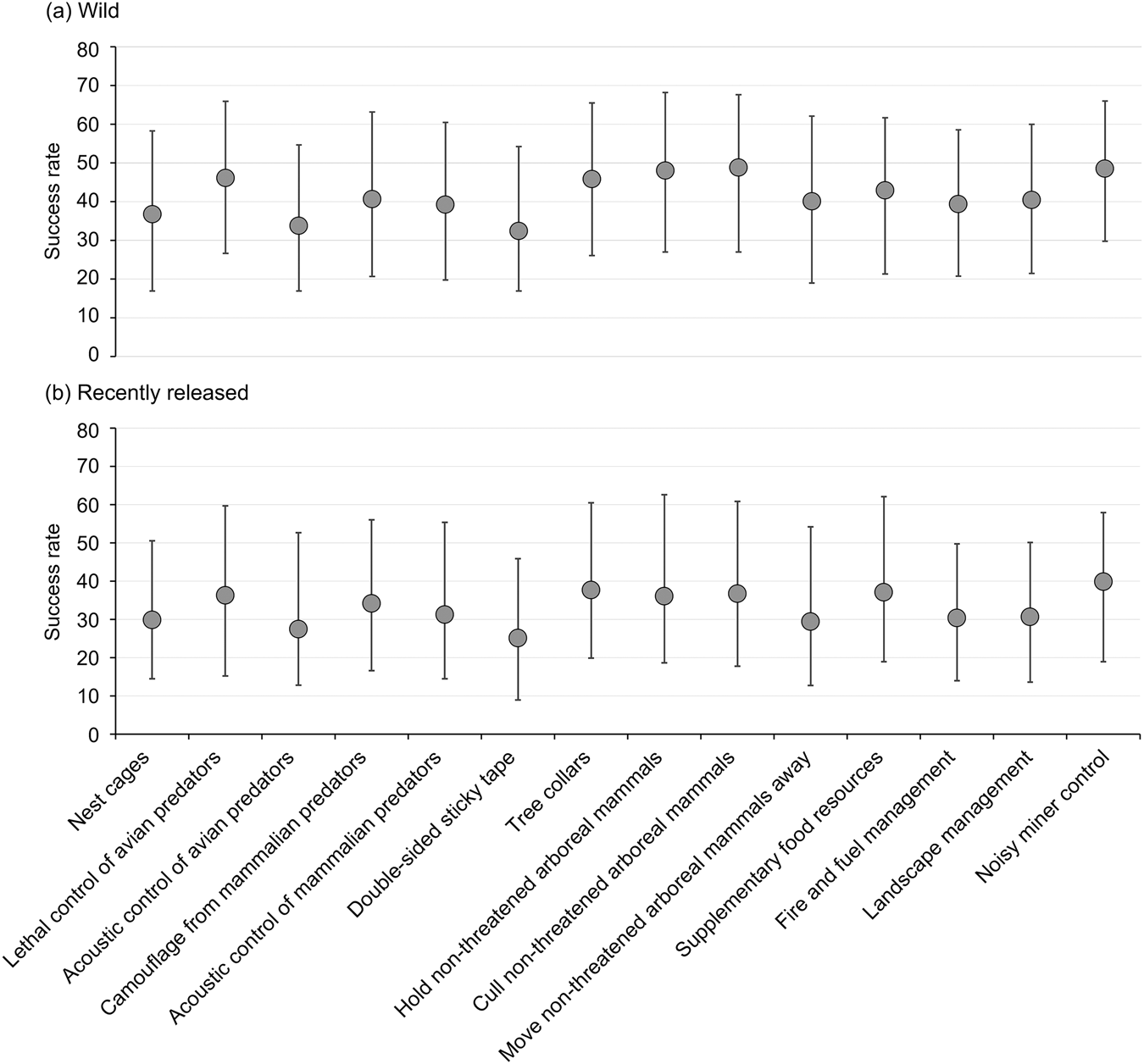
The same candidate measures performed best for recently released birds, except for the threat posed by mammalian predation, for which tree collars were judged to be slightly better than culling or holding non-threatened arboreal mammals. The results in Fig. 2 need to be interpreted in the context of estimated success rates under the base case of no protection. For wild birds the estimate derived from the data is 0.31 (31/100; Heinsohn et al., Reference Heinsohn, Lacy, Elphinstone, Ingwersen, Pitcher and Roderick2022). For recently released birds the pooled best estimate is 0.22 (22/100).
The results also indicate considerable uncertainty in the payoff of protection. With the exception of noisy miner control, the lower bound estimates of all options imply the possibility of outcomes worse than doing nothing (i.e. lower bounds extend substantially beyond 0.31 and 0.22 for wild and recently released birds, respectively). Similarly, uncertainty implies considerable potential for outcomes that are better than expected, especially for holding or culling non-threatened arboreal mammals.
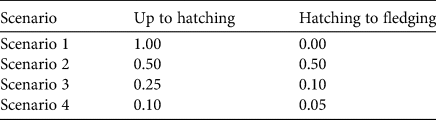
Most of the candidate ideas rely on detecting nests prior to local deployment. The results in Fig. 2 report the success rate conditional on detecting nests at or before the time of eggs being laid. This is equivalent to nest detection Scenario 1 in Table 5. Three other scenarios of imperfect detectability of nests are included in Table 5. Scenarios 3 and 4 appear to be broadly consistent with detection in recent years (D. Ingwersen, pers. comm, 2022).
Hypothetical nest detection scenarios for protecting regent honeyeaters. Scenarios include the proportion of nests detected in the construction or incubation stage and the proportion of nests detected from hatching to fledging.
In Table 6 the estimated implications of imperfect nest detection for the recruitment of juveniles are reported. Where the best (or near-best) four ideas (for each of avian predation, mammalian predation, extreme weather events and competition) are deployed simultaneously, the estimated recruitment rates for wild birds are 1.35 and 1.15 juveniles per female per breeding season for Scenarios 3 and 4, respectively (see calculations in Supplementary Materials 1 & 2). Experts were asked for judgements of the effectiveness of protection measures one at a time. To obtain the aggregate effect of deploying multiple measures, calculations assume independence, such that the effectiveness of any one protection measure is unaffected by the effectiveness of a second, third or fourth measure. For released birds, the rates for Scenarios 3 and 4 are 1.13 and 0.90 juveniles, respectively.
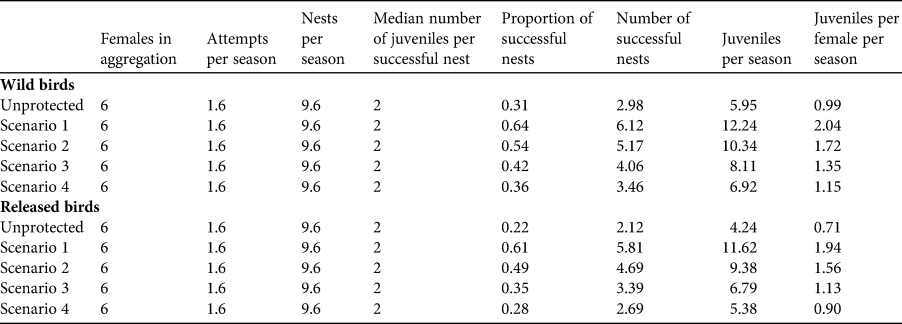
The recruitment rates (Table 6) use best estimates for nest success in the calculation of the proportion of successful nests and the recruitment rate. Using the upper bounds of the 90% credible intervals for nest success (Fig. 2), the recruitment rates for Scenarios 3 and 4, for both wild and released birds, are c. 1.4 and 1.7 juveniles per female per season, respectively. Therefore, with a parallel investment in improving nest detection, it is possible that nest protection can provide a pathway for recovery of the regent honeyeater. Additionally, future nest surveys could usefully include the stage of detection (pre egg-laying, egg to hatching and hatching to fledging) to provide an improved empirical basis for the nest detection scenarios (Table 5) and the recruitment rates (Table 6).
The analyses presented here do not consider all possible ideas. Other ideas that were excluded from the elicitation include: (1) visual and acoustic control of mammalian predators (excluded because the lag time for developing the image display technology was considered too long); (2) protection of high-value sites (e.g. declaration of an Area of Outstanding Biodiversity Value under the New South Wales Biodiversity Conservation Act 2016; excluded because this is an administrative action that, although probably improving the availability of resources for implementation, does not in itself lead to material changes in outcomes); (3) examining site-specific threats (e.g. acoustic monitoring of predators) prior to the release of captive-bred individuals (excluded because the merit of investing in acquiring information on site-specific threats depends on whether there are strong contrasts in beliefs about the intensity of different threats and the effectiveness of actions aimed at threat mitigation); and (4) supplementary resources, such as nesting material (excluded because the elicitation exercise was restricted to the period from the time of egg-laying to the time of fledging).
Although there might be circumstances in which it is worth collecting data on the density of avian predators, mammalian predators and noisy miners, the absence of strong contrasts in the payoffs of ideas aimed at mitigating these threats (Fig. 2) suggests this expenditure is not generally warranted. In contrast, the provision of supplementary nesting material may be worthwhile. The payoff of this idea was not formally assessed in the workshop. However, participants noted it would cost little to deploy and could have non-trivial benefits.
Finally, the modest improvements in recruitment rates under realistic nest detection scenarios and best estimates for nest success (Table 6) prompted broader discussion amongst workshop participants regarding what other avenues could be explored. New ideas presented by participants late in the discussion process (and beyond the scope of the expert assessment here) included increased investment and effort in detection, wider exploration of acoustic control aimed at displacing avian and (possibly) mammalian predators, and taking breeding pairs into captivity upon detection, with release post-fledging.
Future planning
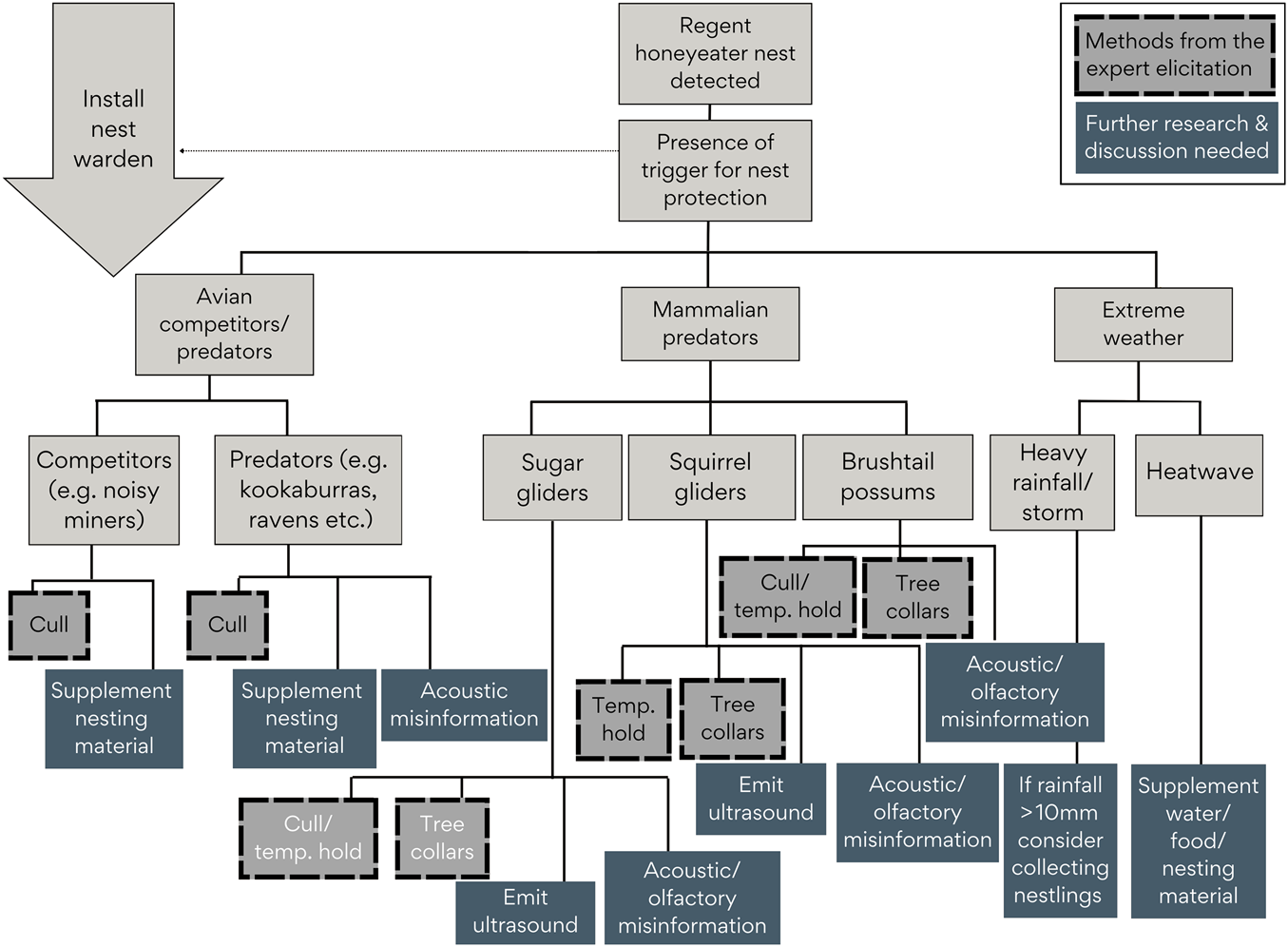
The results from the expert elicitation process were discussed and an action tree was developed to help communicate and guide the implementation of nest protection methods (Fig. 3). This shows the preferred methods from the expert elicitation (from both of the scenarios that considered the individual and combined interventions), and the interventions that require further research and discussion. The current methods for nest protection are lethal control of non-threatened predators (such as noisy miners) and tree collaring. The purpose of this tool is to provide guidance to a nest warden who would evaluate the threats to nest success in an area and then follow the decision flowchart to guide the implementation of the appropriate interventions.
Nest protection action tree for regent honeyeaters, indicating the preferred methods from the expert elicitation (Table 3) and interventions that require further research and discussion. Current methods employed are lethal control of non-threatened predators (e.g. the noisy miner Manorina melanocephala) and tree-collaring.
Discussion
We present a nest protection framework using an expert elicitation process that evaluated interventions to decrease avian and mammalian predation, mitigate the effects of extreme weather events and reduce competition from noisy miners. The study considered the outcomes on fledging success when an individual intervention was implemented versus a combination of interventions. We also developed a decision tool to assist with the proposed management strategy for nest protection. The best estimates for nest success considered a combined approach under realistic nest detection conditions, which include lethal control of avian predators, tree collars that stop arboreal mammals reaching nests, the use of supplementary food resources during extreme weather events such as bushfires or following heavy rain, and avian control of competitors such as noisy miners. Although there are significant gaps in knowledge for each nest protection mitigation measure, and their associated caveats and risks, our findings show that, with parallel investment in detection strategies, nest protection can provide a pathway for the recovery of the species.
Our study demonstrates the iterative nature of adaptive management in conservation. A similar assessment of nest protection measures for regent honeyeaters was undertaken in 2016 (Canessa et al., Reference Canessa, Taylor, Clarke, Ingwersen, Vandersteen and Ewen2020). This research deemed tree collaring to be a suitable nest protection method but dismissed the removal of predators because most are native (and some are threatened, such as the squirrel glider). At the time, the collective management approach favoured a risk-averse strategy as there were concerns that interventions could lead to nest desertion and poorer outcomes for the already threatened species. However, since that research the species has declined further, with the most recent population viability analysis concluding that increased recruitment in the wild, achieved through nest protection measures (coupled with habitat protection/restoration and reintroduction of captive-bred birds) that boost the success rate of nests, is a crucial part of saving the regent honeyeater from extinction over the next decade, and that actions are needed imminently (Heinsohn et al., Reference Heinsohn, Lacy, Elphinstone, Ingwersen, Pitcher and Roderick2022). Further analysis of managing noisy miner competition has shown this intervention to be beneficial (Crates et al., Reference Crates, Terauds, Rayner, Stojanovic, Heinsohn, Wilkie and Webb2018). Subsequently, the structured decision-making analyses conducted here extend the work of Canessa et al. (Reference Canessa, Taylor, Clarke, Ingwersen, Vandersteen and Ewen2020) and also consider not only lethal control of predators but also innovative methods for the protection of regent honeyeater nests and the installation of a nest warden.
The need for the investment of resources in the improvement of the detection of regent honeyeaters and their nests was highlighted throughout the elicitation process. At present, c. 30 nests are found each season, but if we could improve this detection rate, we could then protect more nests and measure more accurately the impacts of these interventions. Potential ways to recruit the additional personnel required include the potential recruitment and training of fire crew personnel and local First Nations rangers, who could help with the detection of nests. Allocation of future funding was also discussed, and its need emphasized.
There are considerable levels of uncertainty in the payoff of nest protection interventions, with the exception of noisy miner control, for which reliable empirical evidence exists (Crates et al., Reference Crates, Rayner, Webb, Stojanovic, Wilkie and Heinsohn2020). The lower-bound estimates of all options imply the possibility of outcomes worse than doing nothing (i.e. lower bounds extend substantially beyond 31/100 and 22/100 for wild and recently released birds, respectively). In some cases, interventions might lead to unintended negative consequences of nest protection, such as inadvertently attracting a predator to the nest, thereby increasing predation on unprotected nests (van Dooren et al., Reference van Dooren, Price, Banks, Berger-Tal, Chrulew and Johnson2023). This increase in payoff from noisy miner control might also be related to the current level of knowledge regarding this approach compared to the other strategies, as this intervention is known to have positive results in reducing noisy miner numbers and increasing numbers of songbirds (Crates et al., Reference Crates, McDonald, Melton, Maron, Ingwersen and Mowat2023). Therefore, more research is needed to investigate the impacts and return on investment of the other interventions (Williams et al., Reference Williams, Eaton and Breininger2011).
The modest improvements in recruitment rates under realistic detection scenarios and best estimates for nest success prompted broader discussion amongst workshop participants about other ideas, including increased investment and effort in the detection of birds, a wider exploration of audible and subaudible acoustic control to displace mammalian and (possibly) avian predators, and the use of chemical/acoustic misinformation techniques to deter predators. Additionally, fire, fuel and landscape management should form part of the overall strategy for the recovery of the species.
During extreme weather events, removing nestlings (or parents and nestlings) from the wild to avoid their death may be warranted. However, this type of intervention would have significant logistical implications (e.g. cost, and time to hand-rear birds) and the risk of potential behavioural modifications if nestlings were to be removed from their parents. However, this option may need to be considered if the species continues to exhibit poor nest success in the wild and/or if conditions deteriorate, and it may be appropriate to remove breeding pairs and then later translocate fledglings/adults within the release programme.
Monitoring of the effectiveness and performance of any intervention will be required (Possingham et al., Reference Possingham, Andelman, Noon, Trombulak, Pulliam, Soule and Orians2001). This would provide evidence for whether the intervention or action should continue. In the breeding season of 2023 and 2024, there was a range of nest protection measures implemented to monitor birds and predators. In addition, we are currently investigating the use of ultrasonic deterrents to temporarily displace squirrel/sugar gliders from regent honeyeater nests, and research how mammalian predators use smell to find avian prey. Our findings from these actions will be published in due course.
Conservation management of the regent honeyeater over the next 5 years will be critical to the persistence of the species, and having a process for prioritizing actions when there is a high degree of both urgency and uncertainty is important. Nest protection is a crucial pathway for arresting decline in regent honeyeaters (Heinsohn et al., Reference Heinsohn, Lacy, Elphinstone, Ingwersen, Pitcher and Roderick2022). Our study suggests that, with parallel investment in improved nest detection, it is possible that nest protection can provide a pathway for recovery of this species.
Acknowledgements
We acknowledge the Traditional Custodians of the lands on which this research was conducted and recognize their care of and connection to Country. We thank R. Crates for his contribution to the discussion on regent honeyeaters and those who participated in the brainstorming, pre-elicitation, expert elicitation and future planning meetings. The decision-making workshops were supported by an Environmental Restoration Fund Grant issued by the Australian Government's Department of Agriculture, Water and Environment and the Australian Government's Environment Restoration Fund. We also acknowledge funding from the Winifred Violet Scott Charitable Trust in support of this research.
Author contributions
Project conception, data collection: JST, DI; decision analysis: TW; idea development, conclusions, writing: all authors.
Conflicts of interest
None
Ethical standards
As no animals were used in this research, no specific ethical approval or licencing were required, and we otherwise abided by the Oryx guidelines on ethical standards.
Data availability
Data is available upon reasonable request to the corresponding author.


 Open access

