


Introduction
Illegal wildlife trade is a major driver of biodiversity loss and a form of environmental crime with ecological, economic and social consequences (Rosen & Smith, Reference Rosen and Smith2010). This trade involves the unauthorized exploitation, trade or possession of wild fauna and is estimated to generate USD 7–23 billion annually, placing it among the most lucrative transnational criminal activities alongside drug and human trafficking (Nellemann et al., Reference Nellemann, Henriksen, Kreilhuber, Stewart, Kotsovou and Raxter2016; Fukushima et al., Reference Fukushima, Mammola and Cardoso2020; UNODC, 2020; Andersson et al., Reference Andersson, Tilley, Lau, Dudgeon, Bonebrake and Dingle2021). This illicit trade accelerates biodiversity loss, with overexploitation recognized as a primary driver of species declines, in some contexts rivalling or exceeding impacts of habitat loss and climate change (Maxwell et al., Reference Maxwell, Fuller, Brooks and Watson2016). Despite international frameworks such as CITES, which regulates international trade in over 38,700 species, enforcement gaps and expanding online marketplaces have enabled illegal wildlife trade to persist and diversify (Barber-Meyer, Reference Barber-Meyer2010; Challender et al., Reference Challender, Harrop and MacMillan2015; Lees et al., Reference Lees, Haskell, Allinson, Bezeng, Burfield and Renjifo2022; CITES, 2024).
Legal and illegal trade in live raptors has been documented across multiple countries, including Indonesia, Japan, Thailand and Russia (Wyatt, Reference Wyatt2009, Reference Wyatt2011; Nijman, Reference Nijman2010; Eaton et al., Reference Eaton, van Balen, Brickle and Rheindt2017; McClure et al., Reference McClure, Westrip, Johnson, Schulwitz, Virani and Davies2018; Vall-Llosera & Su, Reference Vall-Llosera and Su2019; Siriwat & Nijman, Reference Siriwat and Nijman2020). Recent studies have increasingly identified social media as a key conduit for raptor trade because these platforms offer anonymity, wide reach and low barriers to advertising (Iqbal, Reference Iqbal2015; Gunawan et al., Reference Gunawan, Paridi and Noske2017; Sung & Fong, Reference Sung and Fong2018; Nijman, Reference Nijman2020; Panter & White, Reference Panter and White2020). Here, we use the term raptors for diurnal predatory birds (Accipitriformes and Falconiformes), acknowledging that the broader term birds of prey is also sometimes used to include owls (Strigiformes; McClure et al., Reference McClure, Schulwitz, Anderson, Robinson, Mojica and Therrien2019). Raptors contribute to ecosystem functioning as apex predators and ecological indicators, and their removal can alter trophic dynamics and ecosystem stability (Newton, Reference Newton1990; Panter et al., Reference Panter, Jones and White2023). Furthermore, unregulated trade can also elevate public and animal health risks, including zoonotic pathogen transmission, and raptors have been implicated as hosts of highly pathogenic avian influenza A/H5N1 (Van Borm et al., Reference Van Borm, Thomas, Hanquet, Lambrecht, Boschmans and Dupont2005; Steensels et al., Reference Steensels, Van Borm, Boschmans and Van Den Berg2007; Shivakoti et al., Reference Shivakoti, Ito, Otsuki and Ito2010).
In Pakistan, raptors are traded despite provincial wildlife protection laws and international regulation under CITES, with online platforms increasingly facilitating advertising and exchange (Shafiq & Idrees, Reference Shafiq and Idrees2006; Challender et al., Reference Challender, Harrop and MacMillan2015; Aljazeera, 2021; Haq et al., Reference Haq, Abdulabad, Asghar and Szabo2023). Falconry remains culturally important and contributes to demand for high-value taxa, including the saker falcon Falco cherrug and peregrine falcon Falco peregrinus, with both domestic and international demand shaping capture and trade (Roberts, Reference Roberts1991; Wakefield, Reference Wakefield2012; Kovács et al., Reference Kovács, Williams and Galbraith2014; Panter et al., Reference Panter, Jones and White2023). Reported prices can reach tens of thousands in USD, although the same nominal price can represent different purchasing power across countries, influencing incentives to supply and willingness to pay (Aisha & Khan, Reference Aisha and Khan2020). Previous studies have documented social media use and trader activity in Pakistan, including the presence of organized groups and individual traders, but they have offered limited species-specific assessment and limited evaluation of advertised prices over time (Aisha & Khan, Reference Aisha and Khan2020; Haq et al., Reference Haq, Abdulabad, Asghar and Szabo2023).
Here we investigate the scale and dynamics of illegal online trade in wild-caught raptors within Pakistan. Specifically, we (1) analyse species composition and temporal patterns in advertised asking prices, (2) identify geographical and platform-specific trade patterns, and (3) examine socio-economic and ecological drivers associated with trade and price variation. Through integrated descriptive, geospatial and statistical analyses, we aim to provide actionable evidence for policymakers, conservation practitioners and enforcement agencies seeking to curb illegal raptor trade and reduce associated threats to Pakistan’s avifauna, thereby informing conservation measures for raptors in Pakistan and beyond.
Study area
This study was conducted across Pakistan, using digital platforms to monitor illegal online trade in raptors. Pakistan’s position at the intersection of Central, South and West Asia, together with major overland and maritime trade routes, creates opportunities for transboundary wildlife trafficking (UNODC, 2020; Panter et al., Reference Panter, Jones and White2023). Pakistan also lies along the Central Asian Flyway, a key migratory corridor for raptors that breed in Eurasia and winter in the Indian subcontinent or Africa (BirdLife, 2023). These geographical and geopolitical features, combined with growing internet access and social media use, support decentralized online trade networks that operate across urban and semi-urban areas, complicating detection and enforcement.
Methods
Study design
We monitored online posts offering raptors for sale in Pakistan from January 2021 to December 2023 across groups on the social media platforms Facebook (2021), Instagram (2021), YouTube (2021), TikTok (2022) and WhatsApp (2023), and on locally managed e-commerce/classified websites (Gunawan et al., Reference Gunawan, Paridi and Noske2017; Sung & Fong, Reference Sung and Fong2018; Nijman, Reference Nijman2020; Panter & White, Reference Panter and White2020; Siriwat & Nijman, Reference Siriwat and Nijman2020; Haq et al., Reference Haq, Abdulabad, Asghar and Szabo2023). We conducted repeated monthly monitoring throughout the study period across platforms and groups, and during each session we screened newly available content returned by keyword searches, hashtags and group feeds (Siriwat & Nijman, Reference Siriwat and Nijman2020). Searches used English, Urdu, Punjabi and Pashto keywords and hashtags, comprising ‘falcon’, ‘baz/baaz/baaza’ (general falconry term for raptors), ‘shaheen’ (peregrine falcon), ‘bari’ (large raptor), ‘chiri-mar’ (small-bird-hunting hawk/eagle), ‘saker’, ‘peregrine’, ‘baaz for sale’, ‘uqabb’ (eagle), ‘shikari parinday’ (birds of prey) and ‘falconry’ (Sonricker Hansen et al., Reference Sonricker Hansen, Li, Joly, Mekaru and Brownstein2012; Gunawan et al., Reference Gunawan, Paridi and Noske2017; Panter & White, Reference Panter and White2020). Searches were iterative, with additional terms added when new colloquial names or trade phrases appeared. We accessed a WhatsApp group via a publicly shared invitation link posted on Facebook and identified locally managed e-commerce and classified websites through the same keyword-based manual searches.
Where required, we used fictitious identities to join groups and conducted covert observations without interacting with users (Roulet et al., Reference Roulet, Gill, Stenger and Gill2017). Because sellers sometimes avoided direct commercial language, using coded communication such as images without text or vague references to price and availability, we retained records only when species’ identity and listing details could be verified from a seller’s descriptions or visual evidence (Sung & Fong, Reference Sung and Fong2018; Nijman, Reference Nijman2020; Muller et al., Reference Muller, Selier, Drouilly, Broadfield, Leighton, Amar and Naude2022). For each advertisement we recorded the date, platform, species identity, number of individuals offered for sale, stated location and advertised price.
Prices were recorded in PKR and converted to USD using the contemporaneous exchange rate (OANDA, 2024; USD 1 = PKR 280) for data analysis. To reduce duplication and misidentification, each advertisement was independently reviewed by at least three members of the research team and cross-checked across platforms using species’ identity, number of individuals, location, price and accompanying images or videos. Duplicate, reposted or unverifiable records were excluded (Nijman, Reference Nijman2020; Siriwat & Nijman, Reference Siriwat and Nijman2020). We recorded raptor sex when it could be inferred from photographs or explicit descriptions; unclear cases were coded as not assessed (Gunawan et al., Reference Gunawan, Paridi and Noske2017; Nijman, Reference Nijman2020).
Following established practice in online wildlife trade monitoring, we limited data collection to information displayed in posts and group feeds, did not contact sellers or buyers, and did not access private profile content. Seller identifiers were treated as sensitive and were anonymized after duplicate checks, and any downloaded media used for verification were stored securely and used only for research purposes (Roulet et al., Reference Roulet, Gill, Stenger and Gill2017; Sung & Fong, Reference Sung and Fong2018; Nijman, Reference Nijman2020).
Data analysis
We summarized the dataset to describe trade volume (advertisements and individuals), species composition by raptor family, legal and conservation status, seller-reported location, temporal patterns and advertised prices. Where local rarity status was required, we used Roberts (1991–Reference Roberts1992) as a baseline reference because no updated, standardized national assessment of raptor status is currently available for Pakistan. Spatial patterns in seller activity were assessed in ArcGIS 10.5 (Esri, USA) by georeferencing seller-reported locations to districts and mapping hotspots using kernel density estimation. We visualized seller-reported locations with kernel density estimation, and mapped family-level patterns to identify recurring trade hotspots (Lecours et al., Reference Lecours, Devillers, Simms, Lucieer and Brown2017).
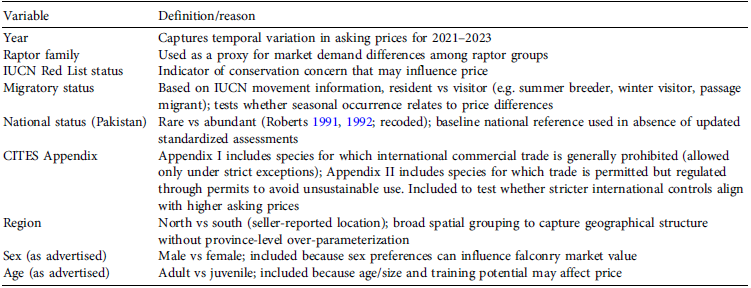
We modelled variation in advertised asking price using R 4.3.2 (R Core Team, 2023). Candidate predictors were defined a priori (Table 1) to represent biological, legal and geographical factors. We checked associations among categorical predictors using the phi coefficient (threshold > 0.5) and retained all predictors as no strong associations were detected. We initially fitted generalized linear mixed models with random effects for year and species, but sparse data across several factor levels caused convergence issues. We therefore fitted a generalized linear model (GLM) (Wood & Scheipl, Reference Wood and Scheipl2025). Asking price was log-transformed to reduce right-skew, and we fitted a gamma distribution with a log link. We used the dredge function in MuMIn (Bartoń, Reference Bartoń2023) to compare all candidate model combinations and ranked models using the Akaike information criterion adjusted for small sample size (AICc). Models with ΔAICc < 2 (difference from the top-ranked model) were retained as the supported set (Burnham & Anderson, Reference Burnham and Anderson2002). Because the top five models all met this criterion, we averaged them to account for model selection uncertainty (Burnham & Anderson, Reference Burnham and Anderson2002). We assessed model fit using residual diagnostics in DHARMa (Hartig et al., Reference Hartig, Lohse and Souza leite2022).
Candidate variables included in the generalized linear model (GLM) to explain advertised asking price of raptors traded online in Pakistan during 2021–2023.

Results
From January 2021 to December 2023, we recorded 310 wild-caught raptors of 24 species advertised for sale online in Pakistan, from 92 unique seller accounts across five international digital platforms (Facebook, Instagram, YouTube, TikTok and WhatsApp) and local e-commerce websites. Most individuals were Falconidae (189, 61.0%) and Accipitridae (115, 37.1%), with fewer Strigidae (5, 1.6%) and Pandionidae (1, 0.3%).
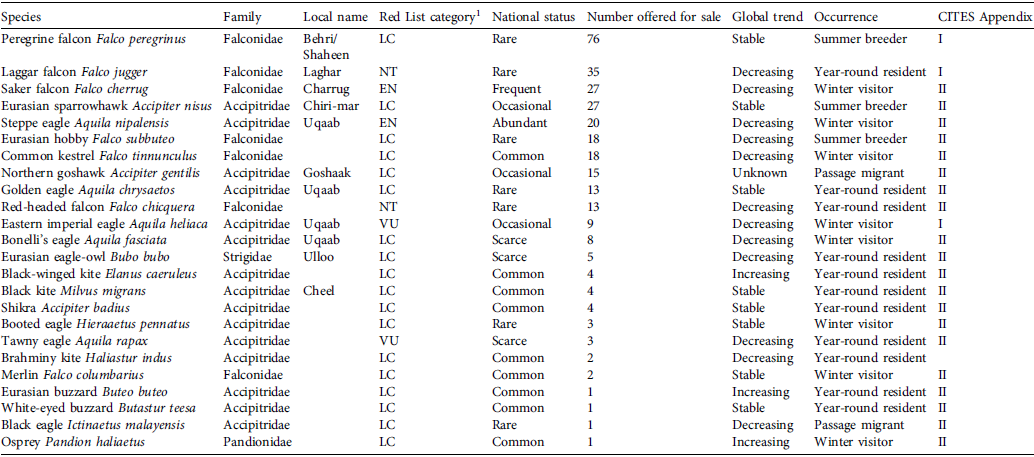
Across the 24 recorded species (Table 2), four (16.7%) are categorized as threatened (Endangered and Vulnerable) and two (8.3%) as Near Threatened on the IUCN Red List (IUCN, 2023), and 18 (75.0%) as Least Concern. Three species are listed in CITES Appendix I and 20 in Appendix II; one species was not recorded in a CITES Appendix. Global population trends were decreasing for 12 species, with 11 listed as stable or increasing, and one recorded as unknown. Species are common to rare in Pakistan (Roberts, 1991–Reference Roberts1992), and occurrence in Pakistan includes year-round residents, winter visitors, summer breeders and passage migrants.
Summary of raptor species advertised for sale online in Pakistan during 2021–2023, with family, local name, IUCN Red List category (IUCN, 2023), national status (Roberts, Reference Roberts1991, Reference Roberts1992), number offered for sale, global population trend (IUCN, 2023), occurrence in Pakistan and CITES Appendix, in descending order by number offered for sale.

1EN, Endangered; VU, Vulnerable; NT, Near Threatened; LC, Least Concern.
Across all records, the combined seller-advertised value was PKR 99,269,146 (USD 354,532). Annual totals varied. We recorded 88 (USD 75,355), 91 (USD 45,207) and 131 (USD 233,970) individuals in 2021, 2022 and 2023, respectively.
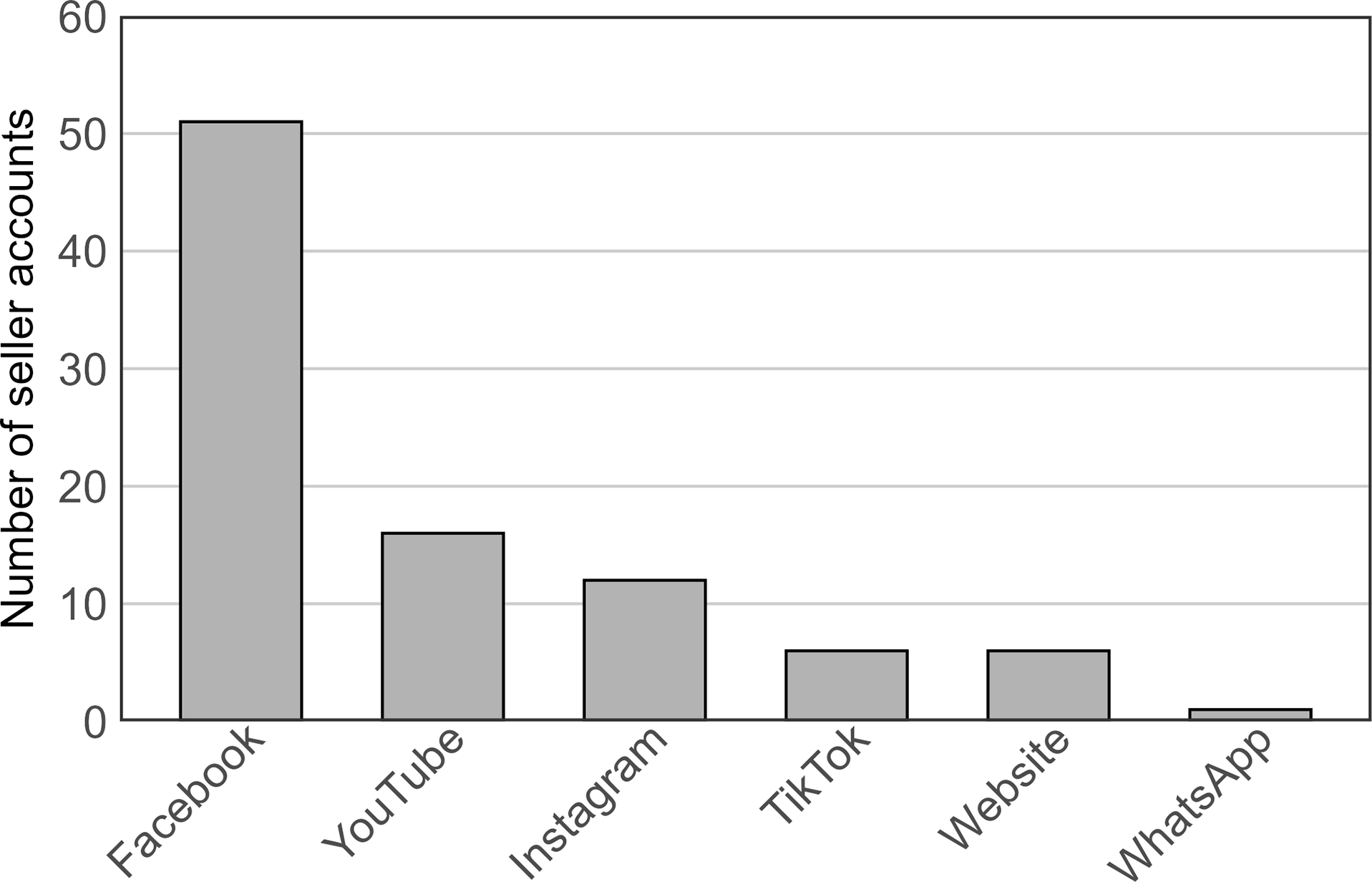
Seller activity was concentrated in Punjab and Khyber Pakhtunkhwa, with additional activity in Sindh and fewer hotspots in Balochistan and Gilgit-Baltistan (Fig. 1). Facebook accounted for the largest share of seller accounts, followed by YouTube and Instagram, with fewer accounts recorded on TikTok, local e-commerce websites and WhatsApp (Fig. 2).
Kernel density map of seller-reported locations in online advertisements of raptors for sale in Pakistan during 2021–2023. Concentrations of activity indicate areas with higher density of unique seller accounts based on the locations provided in posts.

Number of unique seller accounts detected on each digital platform during monitoring of online raptor trade in Pakistan. Seller accounts were counted once per platform after duplicate screening; values are therefore the minimum number of distinct sellers recorded using each platform during 2021–2023. ‘Website’ refers to local e-commerce or classified websites.

Age class was identified more often than sex. Adults were advertised more frequently than juveniles (174 adults, 56.1%; 136 juveniles, 43.9%). Sex was not assessed for 176 individuals (56.8%). Among records with sex reported or assessed, 75 were male (24.2%) and 59 were female (19.0%).
Asking prices varied widely among species. Peregrine falcons were the most frequently recorded species (76 individuals) and had a wide price range (up to PKR 7,000,000, USD 25,000). The highest asking price overall was recorded for the Saker falcon (up to PKR 7,200,000, USD 25,714). Of the Accipitridae, the steppe eagle Aquila nipalensis, Eurasian sparrowhawk Accipiter nisus and golden eagle Aquila chrysaetos were repeatedly advertised, with substantial variation in asking prices among taxa.
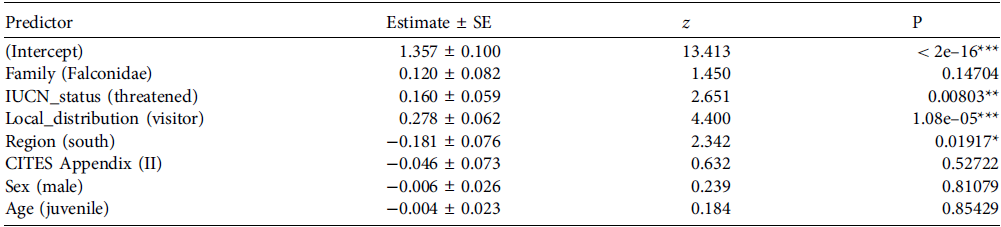
We evaluated 20 candidate GLMs of log-transformed asking price and identified five supported models (ΔAICc < 2; Table 3). In the top-ranked model (ΔAICc = 0), asking prices were higher for species categorized as Threatened and Near Threatened than for Least Concern species (β = 0.160 ± 0.060, P = 0.008), and higher for visitor species than for resident species (β = 0.278 ± 0.063, P < 0.0001; Table 4, Supplementary Fig. 1). Asking prices were lower in the southern than in the northern region (β = −0.181 ± 0.077, P = 0.019). Family was retained in the top-ranked model but was not significant (Table 4). CITES Appendix listing, sex and age were not significant predictors in the supported model set (Table 4). No single model dominated the candidate set (highest Akaike weight = 0.126; Table 3).
Top five supported GLMs explaining variation in log-transformed asking price (USD) for raptors advertised online in Pakistan during 2021–2023.

1Number of parameters.
2Akaike information criterion corrected for small sample size.
3Difference of AICc from the top-ranked model.

Discussion
We documented 310 wild-caught raptors advertised for sale online in Pakistan across 24 species and four families. Falcons were the most frequently advertised group, and high-value falcons (especially peregrine and saker falcons) were prominent in both volume and asking price. This pattern is consistent with work showing that high-demand taxa, especially those perceived as rare or prestigious, often attract the highest attention and prices in illegal online markets (Sonricker Hansen et al., Reference Sonricker Hansen, Li, Joly, Mekaru and Brownstein2012; Stretesky et al., Reference Stretesky, McKie, Lynch, Long and Barrett2018; Sung & Fong, Reference Sung and Fong2018).
Falconry provides the clearest cultural and economic context for these patterns. In Pakistan, falconry has longstanding links to demand from Arabian falconers, and is closely associated with the use of saker and peregrine falcons for hunting of the houbara bustard Chlamydotis undulata (Ali & Ripley, Reference Ali and Ripley1983; Roberts, Reference Roberts1991; Khan et al., Reference Khan, Khan, Ullah, Ali, Mahmood and Sheikh1996; Kovács, et al., Reference Kovács, Williams and Galbraith2014; Koch, Reference Koch2015). Sport falconry has expanded in recent decades, sustaining demand in both domestic and international markets (Wakefield, Reference Wakefield2012; Koch, Reference Koch2015; Panter et al., Reference Panter, Jones and White2023). Enforcement actions and reporting also indicate that trafficking systems prioritize high-value falcons (BBC, 2020; Aljazeera, 2021), which aligns with the dominance of falcons in our online records.
Our findings also show that asking prices were higher for species categorized as globally threatened and for visitor species, and they differed between northern and southern regions of Pakistan. This aligns with the pattern that scarcity, legal status and access can shape market valuation, and is consistent with findings from other regions where rarity and conservation status are linked to higher advertised prices (Sung & Fong, Reference Sung and Fong2018; Leupen et al., Reference Leupen, Gomez, Nguyen, Shepherd and Shepherd2022). However, model support was distributed across several plausible predictor sets, which suggests that asking price variation in this system is not explained by a single dominant factor.
Owls were uncommon in our dataset (five individuals across the study period) despite the global prominence of owls in many wildlife trade contexts (Panter & White, Reference Panter and White2020). In Pakistan, the species pool and price structure we observed appear more consistent with a market shaped by falconry rather than by the pet trade. A second possibility for the low number of owl records is detectability, because different trader networks may use different platforms, posting styles and degrees of openness, which could reduce visibility in our monitoring approach (Iqbal, Reference Iqbal2015; Panter & White, Reference Panter and White2020).
Online trade carries public and animal health considerations. We did not assess pathogens, but handling and movement of live raptors can increase opportunities for pathogen transmission, and reducing such activity may therefore have benefits beyond biodiversity outcomes (Steensels et al., Reference Steensels, Van Borm, Boschmans and Van Den Berg2007; Shivakoti et al., Reference Shivakoti, Ito, Otsuki and Ito2010).
We found strong geographical clustering of seller activity, with a concentration in Punjab and Khyber Pakhtunkhwa. As it is possible that online activity tracks human population density and major towns, we explored this relationship using raster-based population density but found only a weak positive association with seller hotspot density. Given its limited explanatory value, we treat the concentration of seller activity as descriptive rather than causal, and we focus on the implications for monitoring and enforcement priorities.
The distribution of records across platforms suggests where enforcement efforts could be most effectively focused. Facebook accounted for the largest share of seller accounts, followed by YouTube and Instagram, with limited use of other platforms. We only detected WhatsApp activity after encountering a publicly shared invitation link posted on Facebook. This was a single seller account, which is consistent with the largely closed, invitation-based structure and the low visibility of trade activity outside private groups on WhatsApp. Our findings regarding the use of multiple, interconnected platforms reflect the wider literature showing that social media can lower transaction costs and expand market reach for wildlife traders (Sonricker Hansen et al., Reference Sonricker Hansen, Li, Joly, Mekaru and Brownstein2012; Pham & Sakamoto, Reference Pham and Sakamoto2018; Panter & White, Reference Panter and White2020). Online trade also changes how enforcement must operate. Posts are ephemeral, traders use coded language and closed groups, and cross-posting can fragment records across platforms. These constraints likely bias detection toward sellers that operate more openly, and they make market size harder to estimate even when monitoring effort is sustained (Harrison et al., Reference Harrison, Roberts and Hernandez-Castro2016). A practical implication is that online monitoring should be paired with periodic physical market assessments, because without parallel surveillance it is difficult to distinguish any true shift in trade from a shift in detectability (Gunawan et al., Reference Gunawan, Paridi and Noske2017; Siriwat & Nijman, Reference Siriwat and Nijman2020).
Our findings also highlight discrepancies between legal protection and observed online advertising. Raptors listed as protected under provincial wildlife legislation continue to be advertised openly, including in provinces where relevant schedules prohibit hunting, trapping and trade. This pattern points to an enforcement problem rather than a lack of policy, and it supports the need for coordinated monitoring across provinces and stronger operational capacity within wildlife agencies (Aisha & Khan, Reference Aisha and Khan2020).
Several limitations frame the interpretation of our findings. Firstly, our values represent seller-advertised asking prices rather than confirmed transaction values. Actual sale prices may differ because of negotiation, incomplete sales or enforcement actions. Secondly, our coverage was not exhaustive. It was constrained by platform access, changing group visibility, moderation and the use of coded language. These limitations reinforce the case for adaptive monitoring approaches, including automated screening tools that combine image and text-based flagging with human verification (‘t Sas-Rolfes et al., Reference ‘t Sas-Rolfes, Challender, Hinsley, Veríssimo and Milner-Gulland2019). Although our sampling post-dates the peak Covid-19 restrictions in Pakistan and we did not test for pandemic-related effects, post-pandemic shifts in online activity, economic conditions and enforcement capacity may have influenced observed patterns.
Taken together, our findings indicate that online raptor trade in Pakistan is structured around high-demand falcons, includes globally threatened and visitor species, and is concentrated in specific provinces and on particular platforms. We recommend a combined response that matches this structure, with targeted engagement and monitoring on high-use platforms (especially Facebook), clear public reporting pathways, and coordinated enforcement across provinces. Automated screening tools and platforms utilizing artificial intelligence (AI), including image- and text-based detection systems, could support monitoring at scale when paired with verification workflows and consistent legal follow-through. We also recommend monitoring for high-demand species and clarifying how online listings relate to capture locations, movement routes and enforcement pressure, to better target interventions and evaluate outcomes.
Author contributions
Study design: ZK, MJIC; fieldwork: ZK, FK; data analysis: ZK, SF; writing: ZK; revision: MJIC, CM.
Acknowledgements
We thank the reviewers for their constructive comments. This research received no specific grant from any funding agency, or commercial or not-for-profit sectors.
Competing interests
None.
Ethical standards
This research complies with the ethical standards of Oryx. The study involved no direct interaction with live animals or human participants, no experimentation, no specimen collection, and no engagement in wildlife trade. All data were obtained through observational review of publicly accessible online content (social media posts and listings on locally managed e-commerce or classified websites) and were collected in accordance with platform terms of use. Under institutional policy at WWF–Pakistan and applicable provincial and national regulations in Pakistan, formal ethics committee approval is not required for research based exclusively on publicly accessible online data when it does not involve human subjects, animal handling or intervention. The study therefore did not require approval from an institutional ethics committee. Data were aggregated and anonymized prior to analysis, and we excluded personal identifiers and other sensitive information.
Data availability
The data that support the findings of this study are available from the corresponding author upon reasonable request.
Supplementary material
The supplementary material for this article is available at doi.org/10.1017/S0030605326103056




 Open access

