

The archaeological record of the Lower Pecos Canyonlands (LPC) of Southwest Texas and northeast Mexico is best known for the Holocene hunter-gatherer record preserved within rockshelters and caves. The region also contains a record of late Pleistocene archaeology, although it is poorly documented and apparently rarer than on the adjacent Edwards Plateau and Southern High Plains (e.g., Bousman et al. Reference Bousman, Baker, Kerr and Perttula2004; Holliday Reference Holliday1997). Of the dozens of excavated LPC sites, only six report late Pleistocene radiocarbon dates (Turpin and Eling Reference Turpin and Eling2017:Table 2; Supplemental Text 1), and only Bone Bed 2 at Bonfire Shelter demonstrates unequivocal Early Paleoindian (fluted point) use of the LPC (Bousman et al. Reference Bousman, Baker, Kerr and Perttula2004).
Located in the same canyon as Bonfire Shelter, Eagle Cave (EC) is one of the largest occupied rockshelters in the LPC. Although previous excavations at EC were extensive (Davenport Reference Davenport1938; Ross Reference Ross1965), recent work by the Ancient Southwest Texas (ASWT) Project at Texas State University identified an Early Paleoindian occupation. Here we describe results of spatial, faunal, macrobotanical, chronometric, geoarchaeological, and lithic analyses on a discrete Younger Dryas occupation at EC. This component consists of Bison antiquus bones in direct association with chipped stone artifacts and a hearth. Radiocarbon dating and Bayesian age modeling place the age of the assemblage between 12,660 and 12,480 cal BP. The age of the occupation overlaps with the Folsom period, but no Folsom diagnostics were recovered. Faunal and lithic analysis indicates secondary or tertiary processing of at least one juvenile Bison antiquus, whereas macrobotanical analysis of the hearth identified potentially economic plant remains including mesquite (Prosopis sp.), indicating a summer occupation. Based on contrasting artifact assemblages between Eagle Cave and Bone Bed 2 at Bonfire, we consider the possibility that EC represents a camp associated with bison kills at Bonfire.
The Lower Pecos Canyonlands and Paleoindian Archaeology
The LPC archaeological region is centered on the confluence of the Rio Grande and Pecos Rivers in southwest Texas and Coahuila, Mexico (Figure 1). Archaeological work has focused primarily on rockshelters due to their excellent preservation and elaborate Pecos River-style pictographs (e.g., Boyd Reference Boyd2016; Shafer Reference Shafer2013). The Pleistocene megafauna from Cueva Quebrada (Lundelius Reference Lundelius, Genoways and Dawson1984) and Bone Bed 1 at Bonfire Shelter (Bement Reference Bement1986) may represent pre-Clovis occupations, but these components lack stone tools, and whether the broken bones at the sites are archaeological in nature remains contentious (Kilby et al. Reference Kilby, Farrell and Hamilton2021). The remains of a butchered Bison antiquus were recovered from deposits more than 9550 radiocarbon years BP within Arenosa Shelter, but these remains are undated (Jurgens Reference Jurgens2005). Clovis points are present in the region (e.g., Norris et al. Reference Norris, Perrone, Logan Miller, Buchanan, Patten, Bebber and Eren2019), but no Clovis-age components are known.
Top: Plan map of Eagle Cave showing the locations of the 1963 University of Texas and the 2014–2017 ASWT excavations and the location of the LPC (inset); the bold polygon in the center of the trench outlines the location of units discussed in the text. Bottom: Annotated Eagle Cave profile showing the stratigraphic positioning of the 10 major zones used in Bayesian modeling. (Color online)

The only unequivocal LPC fluted-point component is Bone Bed 2 (BB2) at Bonfire Shelter. This rockshelter contains the remains of Bison antiquus associated with Folsom and Plainview projectile points; it may be the oldest and southernmost bison jump in North America (Bement Reference Bement2007; Dibble and Lorrain Reference Dibble and Lorrain1968). Although some question interpretations of BB2 as a jump (Byerly et al. Reference Byerly, Cooper, Meltzer, Hill and LaBelle2005), there is consensus that it reflects bison hunting by late Pleistocene foragers. The discovery of a second Younger Dryas component in the LPC significantly increases knowledge of Paleoindian occupations in both the LPC and Texas, particularly given the rarity of Early Paleoindian rockshelter occupations continentally.
Eagle Cave
Eagle Cave (41VV167) is located in Val Verde County, Texas, approximately 400 m downstream from Bonfire Shelter within Eagle Nest Canyon, a short tributary of the Rio Grande (Koenig et al. Reference Koenig, Willis and Black2017:Figure 1). It was first excavated in the 1930s by Gila Pueblo (Sayles Reference Sayles1935) and the Witte Museum (Davenport Reference Davenport1938), followed by extensive excavations by the University of Texas in the 1960s (Ross Reference Ross1965). These efforts focused on the site's center (Figure 1) and ceased at a stratigraphic zone consisting entirely of rockshelter-derived sediments (Davenport Reference Davenport1938:5; Ross Reference Ross1965:23, Figure 4). Although excavators took one unit to bedrock, they did not screen, made few notes, and recovered no artifacts (Ross Reference Ross1965:Figures 4 and 6). However, there were hints that Eagle Cave contained older cultural material. George C. Martin (Witte Museum) collected a possible Folsom point in 1939, but the whereabouts of this artifact are unknown. Ross (Reference Ross1965:62–63, Figure 13) recovered several lanceolate points but provided only basic descriptions and photographs, and Collins (Reference Collins, Dillehay and Meltzer1991) speculated that Paleoindian deposits might lie toward the mouth of the cave. From 2014 to 2017, ASWT resumed work at Eagle Cave, investigating site formation processes, changes in Holocene subsistence patterns, earth oven intensification, and Paleoindian deposits. Because previous excavations were not backfilled, the slumped south wall of the Witte/UT trench provided an opportunity to conduct intensive stratigraphic excavations (Figure 1; Koenig et al. Reference Koenig, Willis and Black2017).
Feature 14: A Younger Dryas Bison Butchery Component
Feature 14 (F14) is a Paleoindian-age component containing faunal remains, lithic artifacts, and decomposed organics. In total, 22 excavation units across a 6 × 3 m area sampled the F14 assemblage (Figure 2a). Intact F14 deposits were not encountered near the dripline or back wall of Eagle Cave, likely due to cultural and natural disturbances. Archaeological material recovered from F14 included fragmented faunal remains and lithic debitage with several subfeatures, including probable anvil stones (Feature 15), an in situ hearth (Feature 19), and a hearth cleanout (Feature 22; see Supplemental Text 1 for descriptions of Features 15 and 22).
(a) Map of Feature 14 units and the locations of Feature 15 (probable anvil stones), Feature 19 (in situ hearth), and Feature 22 (hearth cleanout). Bold lines indicate horizontal locations of profiles discussed in the text. (b) Plan map of point-provenienced faunal remains with inset showing differential weathering between two refit bison bone fragments recovered approximately 50 cm apart. (Color online)

Stratigraphy and Chronology
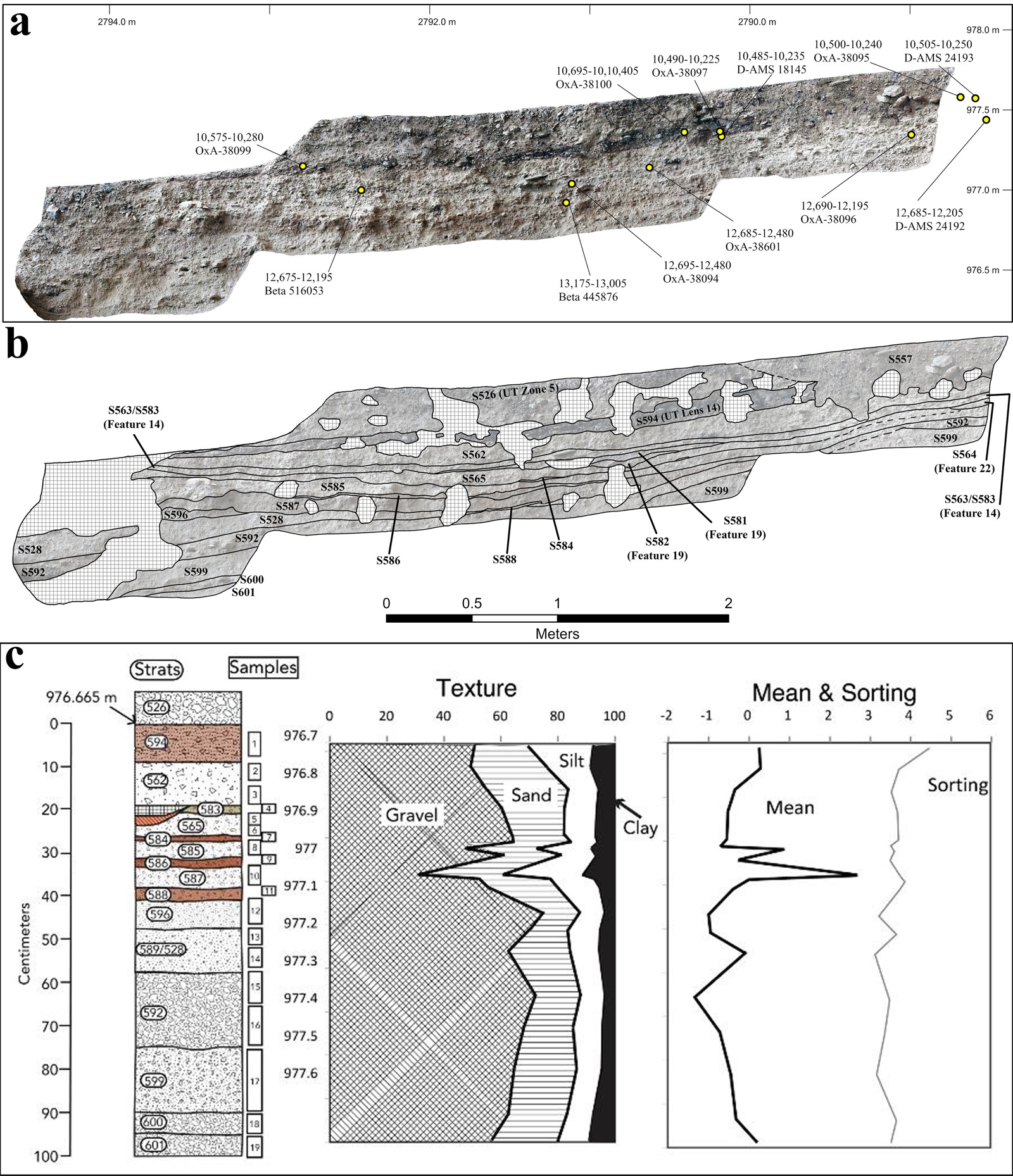
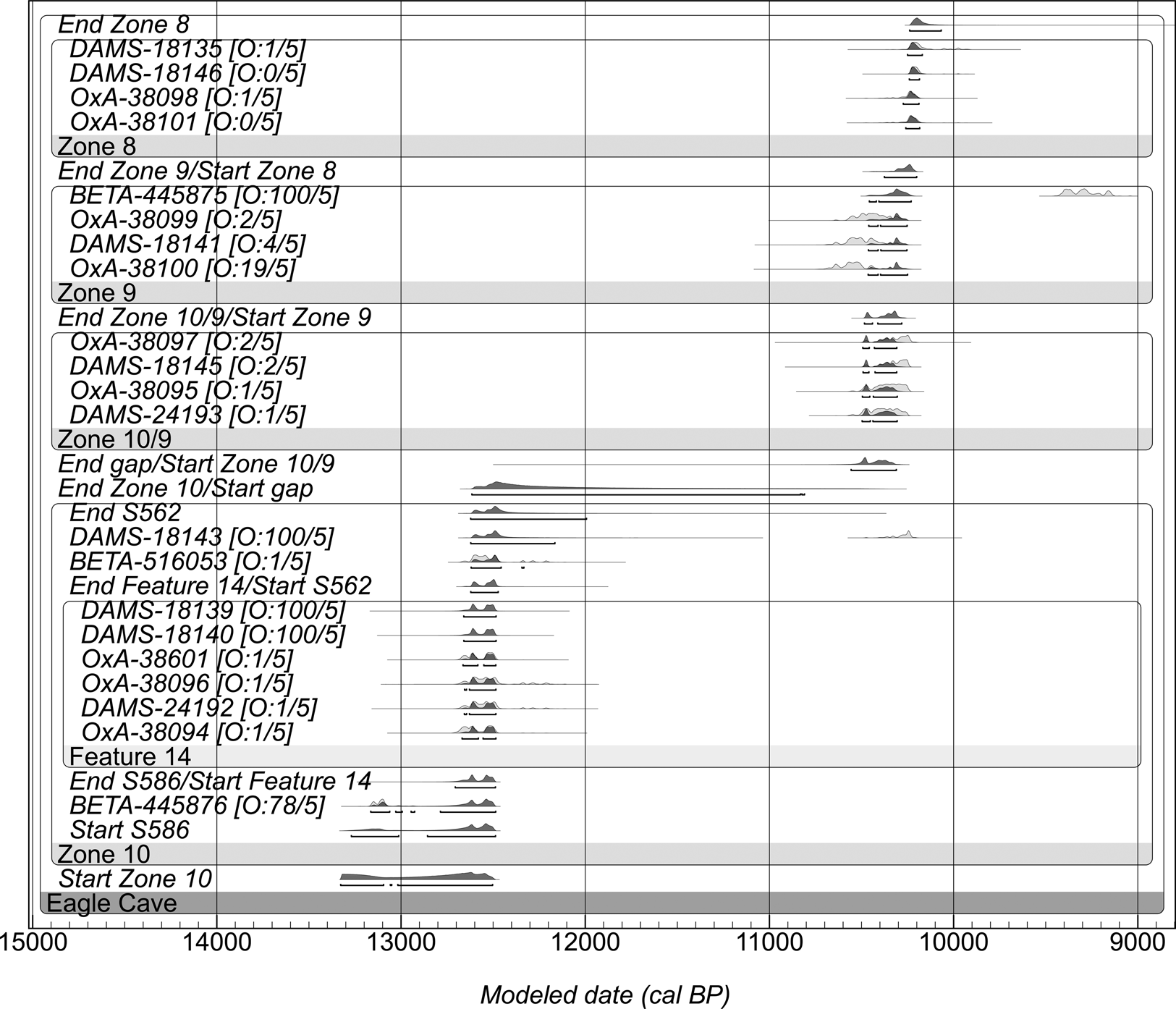
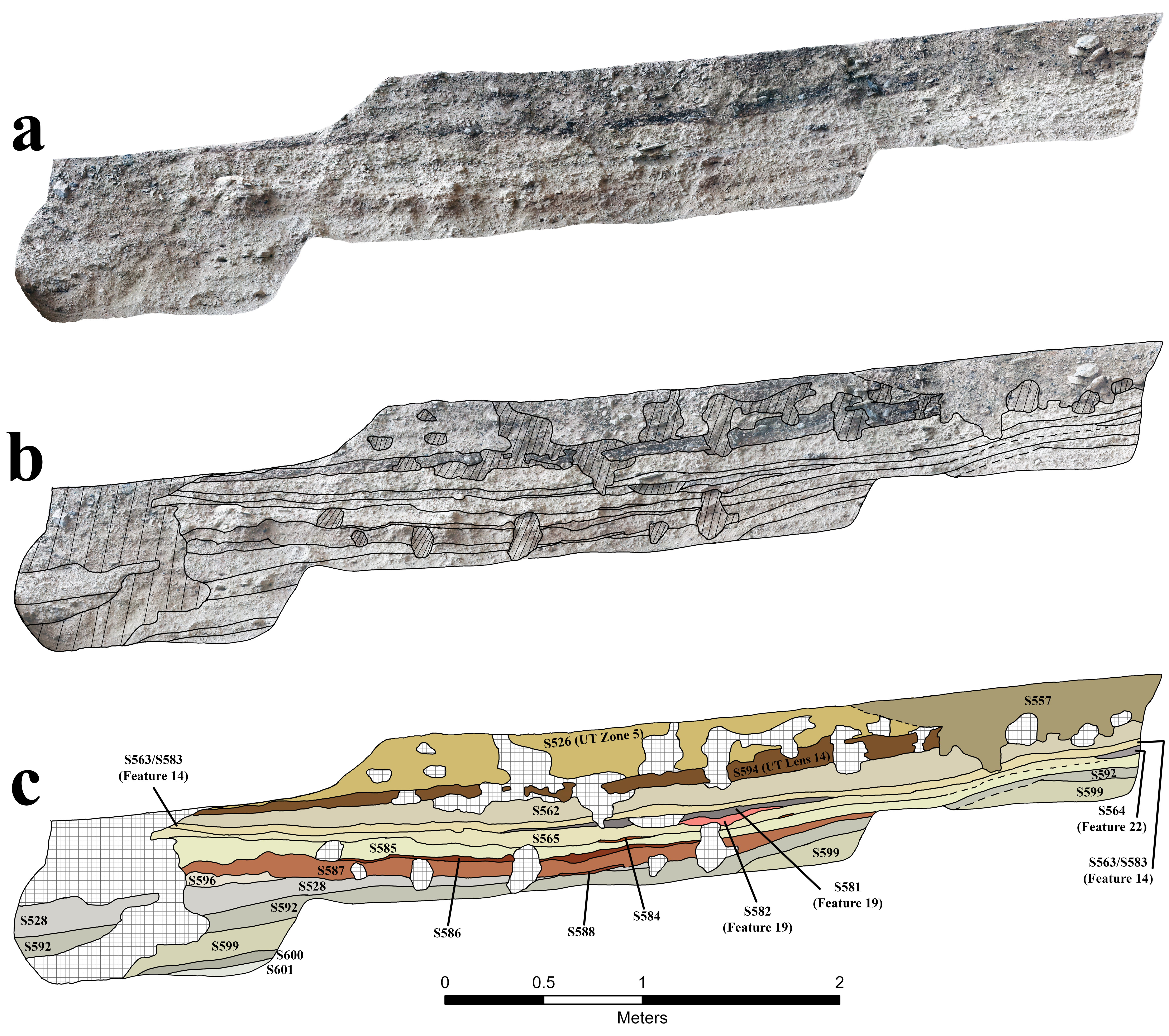
We subdivided the EC stratigraphy into 11 broad zones (Figure 1), with 41 AMS radiocarbon dates providing the chronological framework (Supplemental Table 1; Supplemental Figure 1). Within Zone 10—the Paleoindian-age deposits—we identified 16 strata made up primarily of frost-shattered limestone spalls (eboulis sec) and endogenous sediments, with minor contributions of aeolian sediments (Figure 3; Supplemental Figure 2; Supplemental Table 2). The F14 component is primarily associated with strata S563 and S583, which are stratigraphically separated from the dense cultural deposit associated with Zone 9 (transitional Archaic; S594/UT Lens 14) and with S587, a bioturbated stratum older than 13,000 cal BP. Backplots of F14 artifacts indicate that the occupation is stratigraphically constrained and minimally displaced (Supplemental Figure 3). Bayesian modeling efforts focused on the basal portion of the EC sequence (Zones 10–8), with Zone 10 representing all Paleoindian-age deposits (> ~10,500 cal BP), Zone 10/9 has two in situ hearths at the interface between Zones 10 and 9, and Zones 9 and 8 represent Late Paleoindian/transitional Archaic deposits (Figure 4; Supplemental Text 1). All dates were calibrated/modeled using the IntCal20 curve (Reimer et al. Reference Reimer, Austin, Bard, Bayliss, Blackwell, Bronk Ramsey and Butzin2020) and OxCal 4.4 (Bronk Ramsey Reference Bronk Ramsey2009a) and were assigned a 0.05 probability of being an outlier using the “General” outlier model within OxCal (Bronk Ramsey Reference Bronk Ramsey2009b). Modeled output is noted at a 95.4% credible interval and rounded to five years. Bayesian modeling places the age of F14 at 12,660–12,480 cal BP during the Younger Dryas and contemporary with the Folsom period (Buchanan et al. Reference Buchanan, David Kilby, Hamilton, LaBelle, Meyer, Holland-Lulewicz and Andrews2021).
Orthographic image of late Pleistocene stratigraphy along profile sections (PS) 31, 32, 33, and 34 showing (a) terminal Pleistocene to early Holocene AMS dates; (b) annotated profile, and (c) geoarchaeological sediment analysis (color version online; see Supplemental Figure 2 for colorized annotation of PS31–34).
Bayesian age model of Eagle Cave, Zones 10–8. Outlier analysis output is noted as “O:posterior probability/prior probability.” Outliers are downweighted according to the posterior outlier probability. Oxcal code provided in Supplemental Text 1.
Macrobotanical Analysis of the Feature 19 Hearth
Feature 19 (F19) is a hearth measuring approximately 1 × 1 m across. It consists of an ashy matrix (3–5 cm thick) containing charcoal and burned artifacts overlying a veneer of oxidized sediment (3–7 cm thick; Supplemental Figure 4a). Several burned spalls were recovered from F19 (see Figure 2a), but F19 is a hearth, not an earth oven. Macrobotanical analysis focused on identifying fuelwood taxa and potential edible plants (Supplemental Text 1). The sample yielded 517 wood charcoal fragments larger than 2.0 mm, of which 101 were identified to taxon (Table 1). Mesquite (Prosopis sp.) and juniper (Juniperus sp.) dominate the fuelwood assemblage; it also contains other less abundant taxa, including acacia (Acacia sp., sensu lato), possible joint fir (Ephedra sp.), oak (Quercus sp.), possible four-wing saltbush (Atriplex canescens), and wild grape (Vitis sp.). Except for grape, all identified F19 plant genera are present in roughly contemporaneous Chihuahuan Desert packrat middens (Van Devender Reference Van Devender, Batencourt, Van Devender and Martin1990).
Summary of Feature 19 Macrobotanical Results

* Possibly intrusive, may represent post-use natural deposition.
The most promising evidence for potential vegetal food is provided by several carbonized mesquite pericarp (pod) fragments, one of which was directly dated (D-AMS-24192; Supplemental Table 1). Although mesquite seeds are nutritionally rich (Earle and Jones Reference Earle and Jones1962), human ingestion of the seeds is not as widespread as consumption of the pods, which are rich in sugars, carbohydrates, and protein (Choge et al. Reference Choge, Pasiecznik, Harvey, Wright, Awan and Harris2007). Mesquite is a seasonally dependable summer resource and an important food item across the US Southwest and northwest Mexico (e.g., Felger Reference Felger and Simpson1977). Although it is possible that mesquite pods were introduced into F19 as kindling, it is reasonable to infer that they were used as a summer food resource and that carbonization in F19 was caused by a toasting or parching accident. Regardless, the presence of mesquite pods suggests that the events associated with F14 occurred during the summer.
Although most of the F19 plant material is carbonized, macrobotanical analysis identified some uncarbonized material, including hackberry seeds (Celtis sp.) and juniper leaf scales (Table 1). It is conceivable that these uncarbonized items are intrusive from upper deposits, but the presence of uncarbonized plant material clearly associated with F19—including an uncarbonized fragment of mesquite wood (OxA-38601; Supplemental Table 1)—suggests that some uncarbonized flora are associated with F14. If they are related to human behavior, then hackberry fruits, prickly pear tunas, and bristlegrass grains may also have been on the menu.
Feature 14 Faunal Assemblage
A total of 225 point-provenienced, disarticulated (less than 10 refits) Bison antiquus bone fragments were recovered during excavation (Figure 2b; Supplemental Table 3). Based on mandibular tooth eruption (n = 2) and rib epiphyseal fusion (n = 56), the fragments were likely from a single Bison antiquus (MNI = 1) between four and six years of age (Duffield Reference Duffield1973:Table 1). Additional point-provenienced faunal remains include a large bird, jackrabbit (Lepus californicus), deer (Odocoileus sp.), and mammoth (Mammuthus sp.), but a full faunal analysis—including examination of screened remains—has not been conducted. The mammoth bone (n = 2) is intrusive, originating from a stratum underlying F14, and is currently undergoing analysis.
Cultural modifications of bison bones include cutmarks, helical fractures, and blow marks consistent with marrow removal, roasting pattern burning, and informal tool manufacture. Ninety-eight of the 225 bones (44%) had cutmarks, likely the result of filleting or defleshing consistent with secondary and tertiary butchering (Rixson Reference Rixson1988; Seetah Reference Seetah2006). The frequent occurrence of cutmarks within the F14 assemblage contrasts sharply with Younger Dryas bison kill sites on the southern Plains, further supporting the notion that portions of the bison were transported into Eagle Cave (Bement Reference Bement2003; Bement and Carlson Reference Bement and Carlson2018). Only six bone fragments (ribs, lumbar vertebrae, or ischium) had evidence of primary processing and disarticulation. Sixteen bone fragments (ribs and long bones) had blow marks and helical fractures indicative of marrow or fat harvesting. Seven fragments show burning patterns consistent with roasting, suggesting minimal cooking or discard into F19.
Many of the bone fragments show taphonomic weathering, such as dry-state fractures and cracking (Stage 2 or Stage 3; Behrensmeyer Reference Behrensmeyer1978). Generally, it is expected that the downward side of bone fragments would be better preserved than the upward-facing side; however, some EC specimens were found with the well-preserved side face up, indicating postdepositional disturbance. In at least one instance, two refitting fragments recovered approximately 50 cm apart demonstrate unequivocal postdepositional taphonomy (Figure 2b inset). Given the lack of evidence of carnivore activity and the presence of bighorn sheep dung, we suggest that the F14 assemblage was trampled by bighorn sheep soon after the occupation (Mead et al. Reference Mead, Koenig, Black and Jurgens2021; Supplemental Text 1).
Feature 14 Lithic Assemblage
The F14 lithic assemblage contains 1,040 artifacts: 7 biface fragments, 31 flake tools, and 1,002 pieces of debitage (Figure 5, Supplemental Figure 4b). The bifaces are relatively small, fragmentary, and informal, representing a mix of tools and manufacturing rejects (Supplemental Text 1). One is a basal fragment of a narrow, tapering-stem, concave projectile point resembling the local Langtry variety (Turner et al. Reference Turner, Hester and McReynolds2011:128; artifact 34485; see Figure 5 and Supplemental Figure 4b). However, we suspect for several reasons that this artifact was introduced from the UT/Witte trench: it was recovered from an area with the least vertical separation between F14 and the bottom of that trench, its base is inconsistent with known late Pleistocene types from the region, and it was recovered in relative isolation from other artifacts.
Plan maps of (a) point-plotted lithic tools and (b) randomized debitage by unit. Labeled lithics (a) correspond to formal tools in Supplemental Figure 4.
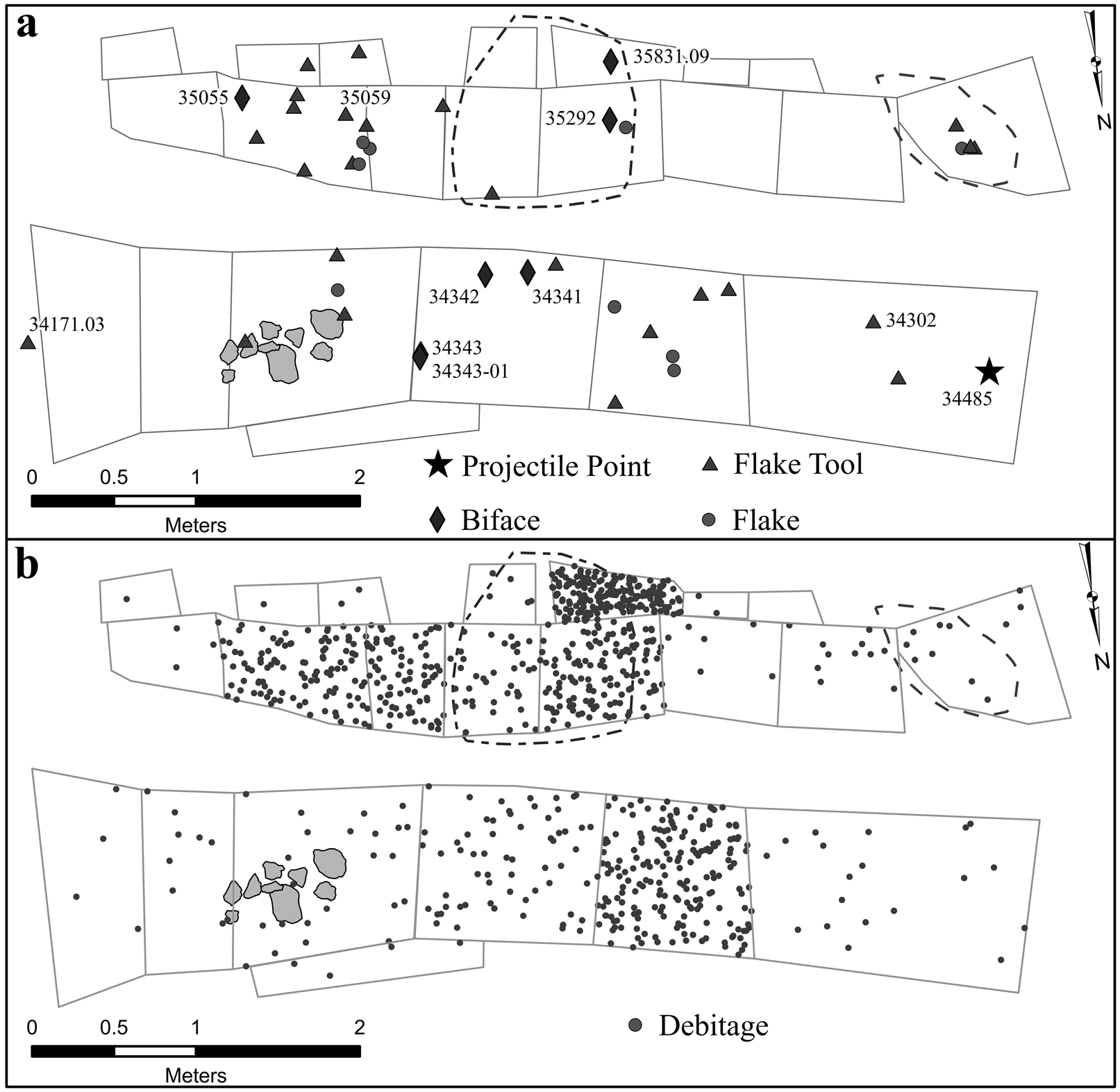
Debitage was distributed across F14 with concentrations surrounding F19 (Figure 5; Supplemental Table 4). It was examined (n = 1,002) using minimum analytic nodule analysis (MANA; Larson and Kornfeld Reference Larson and Kornfeld1997) and technological flake classification (Root Reference Root, Hall and Larson2004) to address raw materials and tool maintenance and manufacture. In total, 18 analytic nodules were identified along with four indeterminate categories (Supplemental Table 5). Nodules 1 and 3 are likely Rio Grande gravels or Quaternary terrace deposits, and Nodule 2 appears to be heat-treated Edwards Plateau Chert. These three nodules comprised 53.3% of all debitage.
Though a limited sample size, F14 debitage provides a glimpse into raw materials, acquisition, tool manufacture, and maintenance activities. Raw materials appear to have been acquired from primary Edwards Plateau Chert sources, Rio Grande gravels, or Quaternary terrace deposits. Assuming that at least some of the Edwards material was curated as cores or blanks (Edwards material is locally available), the use of supplemental local materials is consistent with Folsom behavior (Boldurian Reference Boldurian1990). The overall clarity of the MANA and the presence of tool refits (n = 3) indicate the site was occupied for a labor-intensive short stay. Supporting this interpretation is the lack of ultrathin bifaces, knives, or heavy butchering tools. Debitage analysis indicates extensive bifacial reduction; however, the lack of channel flakes or broken preforms suggests that manufacture stopped short of finished points. In sum, the lithic tool and debitage analysis is consistent with F14 being a short stay during which people butchered and consumed a juvenile bison, maintained existing stone tools, and produced new ones through core reduction and biface manufacture on both transported and locally available raw materials.
Summary and Conclusions
Eagle Cave is a large rockshelter located in the Lower Pecos Canyonlands, and excavations by the Ancient Southwest Texas Project identified an extensive Younger Dryas component, Feature 14. The F14 assemblage consists of lithics, faunal remains, and one hearth with macrobotanical remains. The preliminary results reported here indicate that the artifact and faunal remains are associated with the post-transport processing of at least one juvenile Bison antiquus. Macrobotanical analysis of the hearth suggests the consumption of mesquite pods during a summer occupation. Even though no diagnostic artifacts were identified, Bayesian modeling indicates the occupation occurred between 12,660 and 12,480 cal BP, contemporaneous with Folsom (Buchanan et al. Reference Buchanan, David Kilby, Hamilton, LaBelle, Meyer, Holland-Lulewicz and Andrews2021). Although we lack sufficient chronometric data to demonstrate a behavioral link between F14 and Bone Bed 2 (BB2) at Bonfire Shelter, evaluating this possibility is an important avenue of future research. BB2 represents a summer kill and primary processing location with projectile points and articulated Bison antiquus remains (Bement Reference Bement2007; Byerly et al. Reference Byerly, Cooper, Meltzer, Hill and LaBelle2005; Kilby et al. Reference Kilby, Farrell and Hamilton2021). The distinct differences in the faunal and lithic assemblages suggest that F14 could be a camp or activity area where portions of a bison were transported after a kill at Bonfire. However, the ages of BB2 (12,000–11,500 cal BP; Kilby et al. Reference Kilby, Farrell and Hamilton2021:8) and F14 differ greatly, and additional dating and analysis are needed to evaluate their contemporaneity (Supplemental Text 1).
These results from Eagle Cave also emphasize the importance of conducting research on legacy collections and revisiting previously excavated sites. For instance, the F14 assemblage was not identified until a third round of excavations. Further, except for the diagnostic projectile points, perishable artifacts, and painted pebbles, the previous EC work remains underreported (Davenport Reference Davenport1938; Ross Reference Ross1965)—an unfortunate reality for most LPC rockshelters (Black Reference Black and Shafer2013). Additionally, if Early Paleoindian LPC rockshelter occupations are deeply buried beneath Archaic occupations and contain few diagnostic projectile points (as in EC), the excavation and sampling strategies during the 1930s to 1960s—which emphasized the recovery of formal tools—could have biased the archaeological recovery and recognition of late Pleistocene archaeology. The limited data, chronological and otherwise, from earlier excavated sites make it difficult to determine whether Paleoindian deposits exist unless diagnostic Paleoindian projectile points were recovered during excavations. Renewed work, beginning with analyzing existing collections and obtaining reliable radiocarbon dates, is necessary to expand our understanding of the Paleoindian period in the LPC. Work at EC suggests that new analyses of existing collections, focused study of previous excavations, and intensive radiocarbon dating may identify additional Early Paleoindian rockshelter assemblages in the LPC, as well as in other areas of North America.
Acknowledgments
The Skiles family and especially the late Jack Skiles have been unwavering supporters of archaeological work on their property; our ASWT work would not have been possible without them. Thank you to the 2014–2017 ASWT field crews and volunteers for making this study possible. Fieldwork was supported by the E. Thomas Miller Endowment at Texas State University, and Direct AMS dates were sponsored by Dating Eagle Cave crowdfunding donors. Special thanks to Thomas Higham and the staff of the Oxford Radiocarbon Accelerator Unit for supporting additional Eagle Cave dating efforts. Macrobotanical and geoarchaeological analysis was supported by a Frison Institute grant from the University of Wyoming. Phil Dering assisted the macrobotanical team, and Robert Kelly aided with editing. Diana Rolón graciously provided the Spanish translation of the abstract. Comments from Bryan Hockett and two anonymous reviewers greatly improved the final manuscript.
Data Availability Statement
All ASWT Eagle Cave artifacts and data are housed at Texas State University and the Center for Archaeological Studies.
Supplemental Material
For supplemental material accompanying this report, visit https://doi.org/10.1017/aaq.2021.126.
Supplemental Text 1. Explanations of LPC late Pleistocene sites, excavation methodology, features, radiocarbon dating, macrobotanical, dung, lithic analyses, and the connection between Feature 14 and Bone Bed 2 at Bonfire Shelter.
Supplemental Figure 1. Eagle Cave profile showing locations of all 41 AMS dates.
Supplemental Figure 2. Colorized stratigraphic annotation of combined profile sections 31, 32, 33, and 34.
Supplemental Figure 3. (a) Backplots onto profile sections (PS) 31–34 of all faunal remains; (b) point-provenienced lithic tools; and (c) randomized debitage by unit associated with the Feature 14 assemblage.
Supplemental Figure 4. Cross section of Feature 19: (a) the ash and charcoal-rich layer of the hearth overlaying the oxidized/rubified rockshelter sediments; (b) sample of lithic tools recovered during excavation of Feature 14: Langtry projectile point (34485), flake tools (35059 and 34302), and bifaces (34171.03, 34341, 34342, 35292, 35831.09, 34343, 34343-01, and 35055). Artifact numbers correspond to locations in Figure 5.
Supplemental Table 1. Eagle Cave AMS Radiocarbon Samples Collected by the ASWT Project.
Supplemental Table 2. Descriptions of Stratigraphic Layers.
Supplemental Table 3. Summary of Point-Provenienced Bison antiquus Remains Recovered from Feature 14 and Cultural Modification.
Supplemental Table 4. Debitage Counts by Unit and Analytical Nodule.
Supplemental Table 5. Description of Analytical Nodules Identified during Debitage Analysis.



 Open access

