

1. Introduction
The relationship between international trade, food security, and nutrition is characterized by conflicting views (Montalbano, Reference Montalbano2011; Burnett and Murphy, Reference Burnett and Murphy2014), which relates to all aspects of food and nutrition security – availability, access, use, stability – as well as the various pathways through which trade can affect them (Hawkes, Reference Hawkes2015). The very concept of food security has evolved significantly over time (Clapp et al., Reference Clapp, Moseley, Burlingame and Termine2022), shifting from an early emphasis on availability and stability toward a more holistic approach. In what follows, food and nutrition security are not treated as distinct categories. Rather, in line with the approach adopted within the framework of the Food and Agriculture Organization of the United Nations (FAO), food security is understood as inherently including its nutritional dimension. As clarified by the Committee on World Food Security, the combined expression ‘food and nutrition security’ is used to emphasize that adequate nutrition is not an external or additional objective, but an integral component of food security itself. Accordingly, access to food that is insufficient in quality or nutritional value cannot be regarded as achieving food security (Committee on World Food Security, 2012).Footnote 1
While many scholars claim that an open trading system contributes to global food security by making the system more efficient and responsive to shocks (Rutten et al., Reference Rutten, Shutes and Meijerink2013; Matthews, Reference Matthews2014a), others stress that an over-reliance on global food markets may increase the vulnerability of importing countries (Headey, Reference Headey2011; Puma et al., Reference Puma, Bose, Chon and Cook2015; Distefano et al., Reference Distefano, Laio, Ridolfi and Schiavo2018; Burkholz and Schweitzer, Reference Burkholz and Schweitzer2019; d’Amour and Anderson, Reference d’Amour and Anderson2020). Surprisingly, the role of Preferential Trade Agreements (PTAs) in addressing food security issues and nutritional aspects has attracted relatively little scholarly attention.
At the same time, food security has become an increasingly high-profile topic on the international trade policy agenda, contributing to the political deadlock in the World Trade Organization (WTO), stemming from a large divide between the interests of agricultural exporters and food-importing countries (Margulis, Reference Margulis2017). While this debate revolves around the question of whether the multilateral trading system supports food security or undermines it (Margulis, Reference Margulis, Webster, Gupta and Ambros2020; Häberli, Reference Häberli, Karapinar and Häberli2010; Kaufmann and Heri, Reference Kaufmann and Heri2007), we have, in recent decades, witnessed a parallel and rapid proliferation of PTAs that also considerably affect trade in agricultural commodities and food security issues. This article provides a comprehensive account of how food and nutrition security concerns have been addressed in PTAs, and whether their regulatory approaches align with the provisions of the Agreement on Agriculture (AoA), and how far they drive signatory countries beyond multilateral commitments.
To this end, we first briefly outline the relationship between food security and the international trade regime. Second, we exploit different sources – such as the WTO RTA Database and the Legal Trade Intelligence and Negotiation Adviser (TINA) – to retrieve the legal texts of 599 PTAs on which we perform a text-based keyword search to identify whether and how food security issues are addressed in the trade agreements signed since 1945. We find that 101 agreements (16.9%) contain at least one reference to food security, and we notice that the frequency of mentions has considerably increased over time. Moreover, we observe that until the 2000s food security provisions quite often appeared only in PTAs that involved low-income countries, while from the 2010s onwards, most food security-related provisions can be found in PTAs negotiated among upper-middle and high-income countries. This shift can be explained by the growing salience of food and nutrition security concerns among upper-middle and high-income countries in the aftermath of the 2007–2008 food price crisis and subsequent supply-chain disruptions, which exposed vulnerabilities in global food markets even for net food-importing and high-income economies. From the 2010s onwards, food security increasingly emerged as a strategic concern linked to trade resilience, export restrictions, and the stability of agri-food supply, rather than being framed primarily as a development issue affecting low-income countries.
Our analysis further indicates that most mentions of food and nutrition security in treaties are made in the chapter on agriculture, consistent with the fact that, under the WTO framework, food security is mostly addressed under the AoA. However, we also find that food security issues are addressed in other chapters as well, such as those pertaining to trade and sustainable development or intellectual property rights. This suggests that there has been a broadening and deepening (Gilligan, Reference Gilligan2004) of the notion of food security as reflected in PTAs. On the one hand, this reflects the evolution of the concept itself (Clapp et al., Reference Clapp, Moseley, Burlingame and Termine2022); on the other, it shows that food and nutrition security concerns extend across a wider range of policy areas, while being articulated in a more differentiated manner within the agreements, without necessarily translating into stronger or binding commitments beyond existing WTO disciplines. To better assess the extent to which food-security provisions widen or deepen multilateral commitments regulated by the WTO, we select four PTAs and conduct a detailed case-study analysis that focuses on the similarities and differences between food security provisions in PTAs and those in the WTO framework, particularly the AoA. The analysis shows that PTAs do not feature significant departures from the AoA. Although specific agreements do show small variations that depend on the context, the political sensitivity of food security is reflected in the absence of any well-defined enforceable measures that go beyond existing multilateral commitments. However, in some recent cases, the concept of food security has been broadened, frequently encompassing nutritional considerations and no longer strictly coinciding with the mere availability or quantitative sufficiency of foodstuff.
This paper contributes to the broader understanding of the relationship between international trade and food and nutrition security in several important ways. First, it highlights that food security, once addressed most comprehensively through multilateral trade negotiations (Alabrese, Reference Alabrese2018), has become an increasingly significant aspect of PTAs. Second, we present a new dataset with information on food security provisions that is inter-operational with the WTO Regional Trade Agreements Database and, therefore, can be used easily by scholars for different analytical purposes. Third, the study identifies a shift towards a more systemic and multidimensional approach to food security. This reflects a broader trend in global food governance, whereby food security is increasingly recognized as an interconnected challenge requiring comprehensive solutions that extend beyond agricultural production alone.
The paper proceeds as follows. Section 2 frames the problematic relationship between food security and international trade, setting the context for the subsequent analysis. Section 3 describes the sources and methods used to compile our dataset. Section 4 provides an overview of the empirical trends in how food security issues have been addressed within PTAs over time and across countries, as determined by a text-based keyword search. Section 5 presents a comparative case study of PTAs and the WTO system, focusing on the main provisions that address food and nutrition security. Finally, Section 6 provides concluding remarks and proposes a research agenda based on the identified trends and gaps.
2. Food Security and the International Trade Regime
From the early 1980s till early 2020s, trade in agricultural goods has increased six-fold, driving the emergence of a truly global food system in which about one quarter of agricultural production is traded (D’Odorico et al., Reference D’Odorico, Carr, Laio, Ridolfi and Vandoni2014; Smith and Glauber, Reference Smith and Glauber2020; FAO, 2022). Studies have shown that the total caloric energy carried by trade more than doubled after the beginning of the twenty-first century (FAO, 2024), while the share of food that was traded internationally had increased from 16% to 23% in the years 2000–2021. Similarly, Schwarzmueller and Kastner (Reference Schwarzmueller and Kastner2022) show that food production for export occupies around 23.5% of cropland and pasture worldwide in 2013. As a result, global trade links between countries play a critical role in the transmission of shocks, both natural and man-made. Although there is consensus in the literature that international trade has an impact on food and nutrition security (Fakhri, Reference Fakhri2020; Matthews, Reference Matthews2014b; Hughes and Baker, Reference Hughes and Baker2015; Orford, Reference Orford2015; Kaufmann and Heri, Reference Kaufmann and Heri2007), the jury is still out as to how it can contribute to (or complicate) the challenge of nourishing humanity, and whether the multilateral trade rules are effective in improving food security.
To some scholars, the international trade regime is seen as a catalyst for achieving food security (Stewart and Manaker, Reference Stewart and Bell2015). It plays a crucial role in ensuring access to food in the longer term by moving food from where it is available to where it is needed (Kerr, Reference Kerr2011) and by stabilizing domestic market prices, regardless of whether the food consumed is locally produced (Soares Peres and De Souza Daibert, Reference Soares Peres and de Souza Daibert2017). Following basic principles from international economics, scholars also emphasize that trade liberalization allows countries and regions to specialize based on their comparative advantage, leading to a more efficient allocation of resources. In the case of agriculture, this means that international trade can enable countries to decouple food consumption from local production and from the availability of sufficient natural resources such as land and water (Schiavo, Reference Schiavo2025). In this view, trade liberalization – accompanied with technology transfers and advancements during the ‘green revolution’ – made it possible to sustain high population growth rates, even in countries with little arable land (Soby, Reference Soby2013).
In contrast, other scholars highlight that trade liberalization has increased the fragilities of countries and individuals in terms of food security (De Schutter, Reference De Schutter2009, Reference De Schutter2011; Fakhri, Reference Fakhri2020), for instance by driving local farmers out of business, reducing local production, exacerbating inequalities, and making countries more vulnerable to international shocks and price volatility (Gonzalez, Reference Gonzalez2002). It has been argued that the merits of trade liberalization may have been overestimated, particularly for low-income countries with a comparative disadvantage in agricultural production (Bouët et al., Reference Bouët, Bureau, Decreux and Jean2005; Pyakuryal et al., Reference Pyakuryal, Roy and Thapa2010). Moreover, studies have come to focus on the systemic fragilities associated with the world food economy and have exposed several (potential) adverse effects of trade on food security, such as countries’ increased vulnerability to exchange rate volatility, financial speculation, and price and export shocks (Puma et al., Reference Puma, Bose, Chon and Cook2015; Clapp, Reference Clapp2013; Davis et al., Reference Davis, D’Odorico, Laio and Ridolfi2016; Distefano et al., Reference Distefano, Laio, Ridolfi and Schiavo2018).
What is more, trade does not seem to have unequivocal effects on malnutrition either. Martin and Laborde (Reference Martin and Laborde2018, 23) emphasize that ‘[b]eyond improving food availability and access, international trade can improve nutrition by allowing better access to a diversified food basket’. However, while trade can diversify diets and make healthy foods more accessible, it can also lead to the overconsumption of processed foods and the displacement of higher-quality local produce by cheaper imports (Hawkes, Reference Hawkes2015). Blouin et al. (Reference Blouin, Hawkes, Henson, Drager and Dubé2009) suggest that trade liberalization has increased the availability of nutrient-poor, unhealthy foods in low-income countries. Moreover, trade openness has been linked to a greater availability of oils and fats, correlating with increased obesity in Asian countries (An et al., Reference An, Guan, Liu, Chen and Clarke2019), Pacific islands (Snowdon and Thow, Reference Snowdon and Thow2013; Ravuvu et al., Reference Ravuvu, Lui, Bani, Tavoa, Vuti and Tin2021), and Sub-Saharan Africa (Boysen et al., Reference Boysen, Boysen-Urban, Bradford and Balié2019).
In this multifaceted debate, the role of the WTO regime – whose primary objective has been to foster international trade – has been explicitly questioned. The legal literature clearly shows that the AoA is the main WTO agreement relevant to food security issues. Indeed, food security provisions in the AoA represented a significant departure from previous GATT rounds in that they codified food security into the rules of the multilateral trading system. However, while the AoA emphasizes food security in terms of the global food supply and trade, it neglects the right to adequate, safe, and nutritious food that is a legal entitlement to individuals. This distinction is significant. Food and nutrition security can be framed and addressed at different levels (global, national, household), which has made it more readily accommodated within international trade disciplines. By contrast, food is a human right that entails legally binding obligations on states to ensure access to food for all individuals. Its absence from the AoA reflects both political resistance and structural constraints within WTO negotiations. In particular, the recognition of the right to food has remained contested at the international level, as evidenced by the fact that there are WTO Members, such as the United States, that have never ratified the International Covenant on Economic, Social and Cultural Rights (ICESCR).Footnote 2 Despite overlooking the right to food, the AoA institutionalizes the WTO’s role in global food security governance. This becomes even more significant when considered in light of other international food security agreements and declarations (e.g. those under the auspices of the FAO), which take the form of soft law instruments (Margulis, Reference Margulis2017; Clapp, Reference Clapp2017). In contrast, the AoA is a binding agreement whose long-term objective is to establish a fair and market-oriented agricultural trading system through substantial progressive reductions in agricultural support and protection. At the same time, the AoA explicitly acknowledges food security as a ‘non-trade concern’ in its Preamble, a principle that permeates the entire agreement and should consistently inform the implementation of its commitments. Several provisions of the AoA make explicit reference to food security (Smith, Reference Smith2009; Alabrese, Reference Alabrese2018). Some of these are recalled in Section 5 of this paper, where they serve as a basis for comparison with the relevant provisions contained in the selected PTAs examined in the case studies.
3. Data and Methods
Our main goal is to explore how food security concerns are addressed in PTAs, and whether these instruments align with or diverge from the AoA. To do so, we retrieve the (machine-readable) contents of almost all PTAs signed since 1948, and we subsequently identify the provisions related to food security using a text-based keyword search.Footnote 3
3.1 Data Sources
In spite of the fact that PTAs have been object of extensive research, there is at present no publicly available, up-to-date, and comprehensive database including the full text corpus of all PTAs. Part of the issue arises from the lack of consensus on what a comprehensive list of PTAs would include. The Design of Trade Agreements (DESTA) Database (Dür et al., Reference Dür, Baccini and Elsig2014), in its version updated to December 2023, features 956 base treaties in total, including hundreds not notified to the WTO. Relying on a broad definition, the authors strive to include ‘all agreements that have the potential to liberalize trade’, and have searched through lists held by different institutes, regional organizations, and national trade and economic ministries. The DESTA database is distinctive because of its careful coding of each agreement according to a wide range of criteria but does not feature a full-text version of the treaties themselves.
Unlike DESTA, the Texts of Trade Agreements database (ToTA) by Alschner et al. (Reference Alschner, Seiermann and Skougarevskiy2018) does provide a machine-readable full-text version of 450 treaties based on WTO Regional Trade Agreements Information System data, but it has not been updated since its initial release, making it unsuitable for analyses that aim to capture recent trends. As a point of reference in the field, ToTA serves also as one of the main sources for Legal TINA, an on-line service that allows for full-text search through hundreds of PTAs.Footnote 4 TINA’s interface allows for partial export of search results but it does not allow for its dataset to be downloaded in full; nor does it offer a full list of the PTAs included in its archive. This state of affairs creates a challenge for scholars interested in conducting a text-based analysis of PTAs, as none of the available options is fully satisfying.
In order to investigate trends in the long-term prevalence of references to food security in both absolute and relative terms, a clear delimitation of the universe of cases is needed. In line with ToTA, we decided to rely on the WTO RTA database as an established and routinely updated point of reference in the field with well-documented metadata: each agreement has its own information card with standardized metadata and an identifier that can be used for matching agreements across datasets.
In order to retrieve the full text of all PTAs included in the WTO RTA database, we proceeded with a multi-step procedure. For earlier agreements, we mostly rely on ToTA. For more recent PTAs (or agreements not included in ToTA), we first attempted a semi-automatic procedure for downloading and extracting the text of the agreements through the links to the original document included in the WTO RTA database. Due to numerous cases in which the original web page has been deleted or moved, and the extensive variety of formats in which agreements are published, a third step proved to be necessary in which manual searches were undertaken to identify machine-readable versions of agreements. As an additional measure for identifying potential data issues, we searched keywords associated with food security on TINA, and manually re-imported text when a match in TINA was not previously found in our dataset due to parsing issues. While it is still possible, in spite of our best efforts, that a few isolated references may have been missed due to the imperfect nature of the textual corpus at our disposal, we believe that in context the impact would have been analytically negligible.
In brief, our analysis is based on all trade agreements that entered into force between 1948 and 2024 and that are part of the WTO RTA database for which the original text of the agreement is available on-line. Out of the 611 agreements featured in the WTO RTA database, 448 are available in the ToTA full-text database; this leaves 163 agreements to be retrieved.Footnote 5 Our analysis relies on 599 agreements included in the WTO RTA database from which we could retrieve the full text from either ToTa or the web, in either English (556 agreements), Spanish (40), or French (3). The necessity to include Spanish-language texts along with English stems from the fact that a sizable cluster of agreements among countries in Latin America are seemingly available only in Spanish – excluding them would have implied a risk of biased results. For the same reason, and so as not to lose potentially relevant information, we also included the few French-language agreements.
3.2 Coding Procedure
In order to determine when a PTA includes provisions specifically dedicated to food security, we rely on a list of selected keywords related to trade and food security. Table 1 displays the full list of keywords in English.
List of keywords in English

To ensure that our list of keywords is comprehensive and accurate, the selection process is carried out in several phases. The list is compiled by the authors, building on the specific terminology used in the AoA (e.g. ‘special treatment clause’) as well as terms that appear in the existing literature and the general discourse on food security (e.g., ‘right to food’). Rather than taking a narrow definition of food security, we consider different dimensions of the concept (e.g., ‘nutritional objectives’). We then test whether the keywords capture the relevant food security-related provisions by manually checking the output of our keyword-based search. In case we find erroneous results, these instances feed back into the keyword selection process. Lastly, we translate the keywords into Spanish and French using online translation tools (see Table A.1 in the Appendix).
4. Empirical Trends
Before analysing food security-related provisions in detail (see Section 5), this section provides a descriptive overview of some empirical trends relevant to food-security provisions present in PTAs, such as their evolution over time, their geographical and regional spread, and their mentions within different PTA chapters. An interesting finding of the text analysis is the scant explicit reference to nutrition security in PTAs, which is consided in the two recent agreements signed by the UK and EU with Kenya. This suggests that the language used in trade agreements has not yet integrated the broader shift in the food policy discourse toward nutrition and diet quality.
4.1 Evolution over Time
As it is well known in the literature (see for instance Ruta, Reference Ruta2017) the number of preferential trade agreements has ballooned over the last three decades. Figure 1 shows the proliferation of PTAs – particularly since the 1990s – as well as the number and share of PTAs with food security-related provisions that are steadily increasing over time. The first reference to food security-related issues was made in 1966 in a free trade agreement between Australia and New Zealand, which states that nothing in the PTA should prevent the adoption or enforcement of measures ‘necessary to prevent or relieve critical shortages of foodstuffs or other essential goods’.Footnote 6 This formulation closely mirrors language that was already present in Article XX(j) of the GATT – itself derived from Article 20.2(a) of the Havana Charter – and therefore does not introduce a substantively new approach to food security beyond the existing multilateral framework. Out of the 230 PTAs that entered into force during the twentieth century, only 21 (9.1%) included at least one provision related to food security. During that time period, the Third Convention of Lomé – an agreement signed in 1984 between the European Economic Community (EEC) and 71 African, Caribbean, and Pacific (ACP) countries – stands out as having the highest number of food security-related provisions (20).
From the 2000s onwards, food security-related provisions feature more prominently in PTAs. In total, 369 PTAs entered into force between 2000 and 2024, out of which 80 PTAs (21.7%) include a reference to food security issues. This phenomenon is especially evident in the latest years: 36.9% of the 84 PTAs that entered into force between 2019 and 2024 contain at least one such reference. Some prominent examples include the United States–Mexico–Canada Agreement (2020), the EU–Vietnam Free Trade Agreement (2020), and the Indonesia–Korea Comprehensive Economic Partnership Agreement (2023). Overall, there appears to have been a rise in PTAs with food security-related provisions, with a notable acceleration in the most recent period. This is in line with the process of deepening of PTAs highlighted in the literature (see Matoo et al., Reference Mattoo, Rocha and Ruta2020).
In total, we identify almost 250 provisions that cover food security issues within 101 PTAs (see Figure 1). The dataset reveals that among the PTAs that cover food security issues, there are, on average, 2.4 provisions related to this subject. This number, which has remained relatively stable over time, can be considered as the ‘intensive margin’ of the phenomenon. A handful of PTAs include more than 10 food security-related provisions, while the majority of them (54.4% of 101 PTAs) mention this issue only once, resulting in a rather skewed distribution. Besides the Third Convention of Lomé, other PTAs that contain many references to food security are the UK–Kenya Economic Partnership Agreement (20) and the EU–Kenya Economic Partnership Agreement (21), which entered into force in 2021 and 2024, respectively.Footnote 7
The total number of PTAs and the inclusion of food security-related (FS) provisions.

4.2 Geographic Distribution
Figure 2 provides an overview of the number of PTAs with food security-related provisions by country, and uncovers a number of interesting patterns. First, the map shows that the EU and the UK have negotiated most PTAs with at least one reference to food security. In fact, the EU and UK are involved in 40.6% of the 101 PTAs with food security-related provisions. Many of these PTAs are negotiated with countries of the African continent, but the agreements with food security-related provisions are certainly not limited to that region. For instance, food security issues have also been incorporated in PTAs between the EU and countries such as Singapore, Armenia, Canada, and New Zealand.
The number of PTAs with food security-related provisions by country (created with Datawrapper).

Second, there are a few countries (Eswatini, Croatia, Mauritius, Mexico, and Peru) that have signed between 10 and 14 PTAs with food security-related provisions, while a larger group of countries has implemented between five and nine PTAs that contain references to food security. Most of these PTAs are signed by countries in North America, Sub-Saharan Africa, Oceania, and a few countries in South America and East Asia. In many cases, participation in trading blocs with nearby countries – such as the Southern African Customs Union (SACU) and the Central American Common Market (CACM) – seems to explain the relatively high number of PTAs with food security provisions. In this (sub)regional context, countries may be more likely to make arrangements on food supplies in times of crisis.
Third, the largest set of countries has signed between one and four PTAs in which food security issues are addressed. Major trading countries, such as China (3), India (1), Japan (4), and the Russian Federation (2), belong to this category, but also many countries in North and West Africa and Southeast Asia. Some of them – such as Indonesia and Egypt – are signatories to a range of PTAs, and it is a little surprising to find only a few references to food security in their trade agreements, especially since levels of food insecurity tend to be relatively high in those regions.
Fourth, the countries that have not included any food security-related provisions in PTAs are clustered in (non-Andean) South America and West and Central Asia. In particular, we observe that some important players in the global economy, most notably Brazil and Türkiye, do not seem to give priority to food security issues in their trade deals. Countries that are involved in very few (or zero) trade deals, such as Afghanistan, Iraq, North Korea, Mongolia, and South Sudan, can also be found in this category.
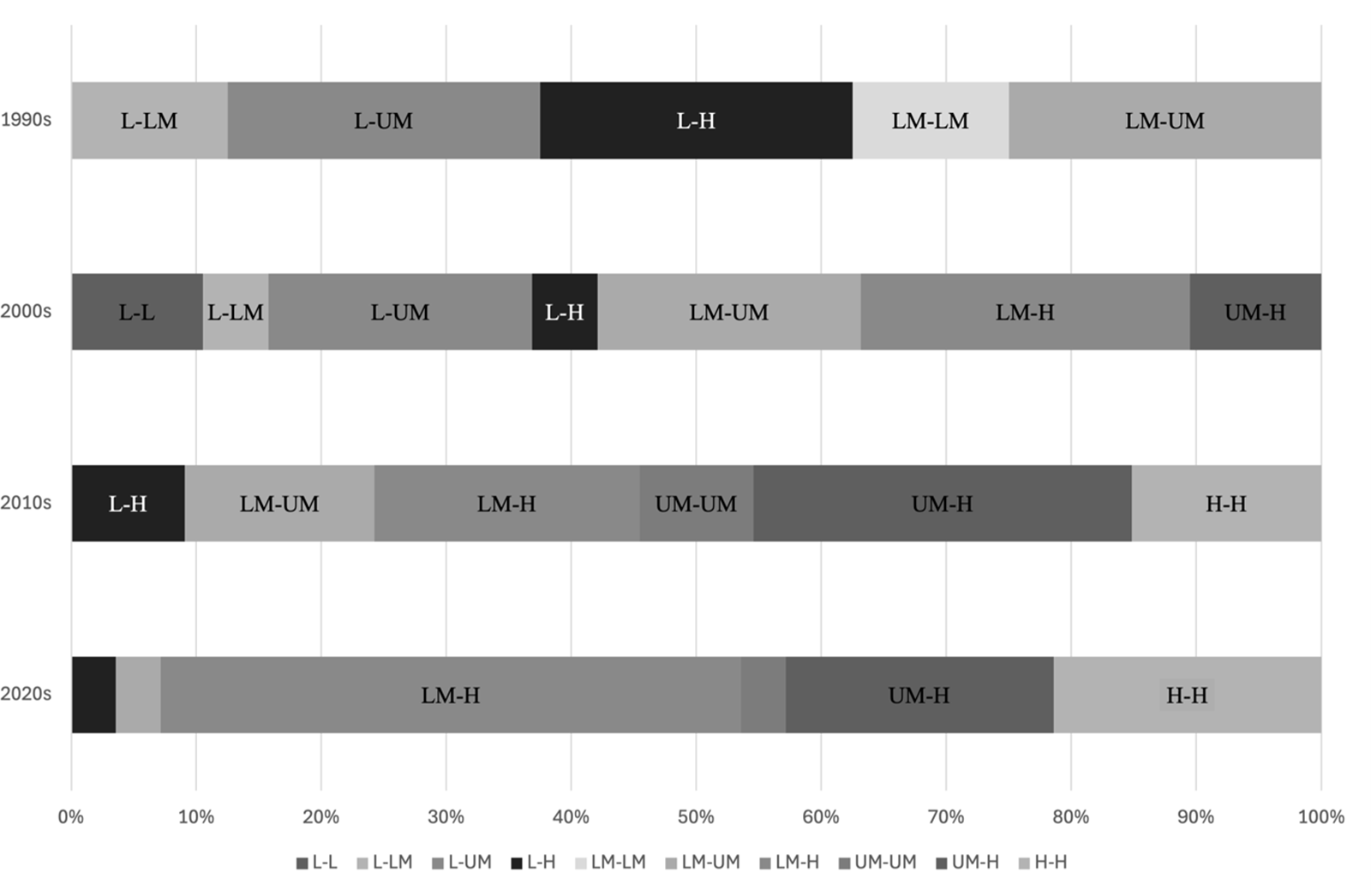
Figure 3 shows the distribution of PTAs with food security-related provisions by countries’ income group (and decade).Footnote 8 In the 1990s, food security concerns are mainly addressed in PTAs between low and upper-middle income countries, and between low- and high-income countries. In the 2000s, low-income countries and lower-middle income countries are also involved in the majority of PTAs in which food security-related provisions are included. Since the 2010s, however, food security-related provisions are increasingly incorporated in PTAs negotiated among high-income countries, which is surprising since this type of agreement (H-H) has in fact declined as a share of the total number of PTAs. Therefore, we highlight this as an empirical pattern – a potential structural break – that deserves further academic scrutiny.
The distribution of PTAs with food security provisions by decade and income group.

4.3 Food and Nutrition Security Provisions within PTAs
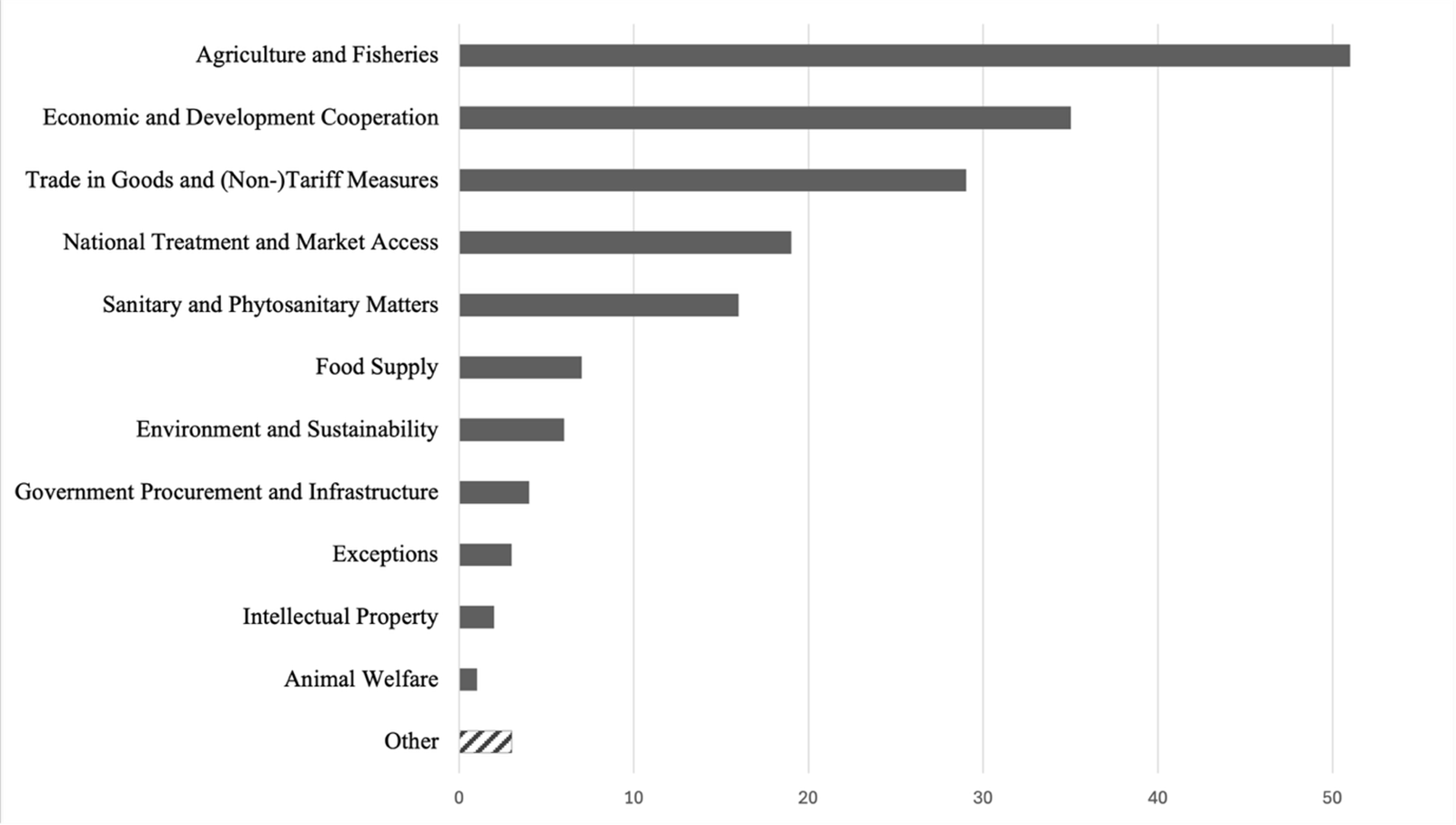
Figure 4 displays the type of chapters in which food and nutrition security provisions are included.Footnote 9 We identify eleven different (broad) chapters of the PTAs in which food security-related provisions are included. For instance, the chapters titled ‘Co-Operation In Trade Liberalization and Development’ and ‘Development Matrix’ and ‘Economic Cooperation’ are all classified under ‘Economic and Development Cooperation’. Under ‘Environment and Sustainability’, we group chapters with titles such as ‘Sustainable Food Systems’ and ‘Drought and Desertification Control’. We provide a more comprehensive overview of this classification in Table A.2 of the Appendix.
An overview of the chapters in which food security issues are mentioned.

Unsurprisingly, around 30% of the food security-related provisions are included in a chapter on agriculture, consistent with the fact that, under the WTO framework, food security is mostly addressed under the AoA. Within this category, 15 PTAs feature chapter titles such as ‘Agriculture and Food Security’ or ‘Agriculture, Fisheries and Food Security’, which make this link more explicit, and this may, in turn, lead to more specific provisions concerning the interrelationship between (domestic) agricultural production and food security.
‘Economic and Development Cooperation’ is another chapter in which food security issues are addressed. Food security is often mentioned together with other goals such as ‘poverty reduction’, ‘integrated rural development’ and strengthening of ‘institutional capabilities’. We further note that food security is also mentioned in conjunction with various topics, including regional integration, public–private partnerships, innovation, and technical cooperation.
Many provisions on food security are incorporated in chapters on ‘Trade in Goods and (Non-)Tariff Measures’, where we often find clauses that allow countries to (temporarily) suspend certain obligations in cases of famine and critical shortages of foodstuffs, or other (emergency) measures that can be taken to address food insecurity. The role of food aid is frequently addressed in chapters on ‘National Treatment and Market Access’. For instance, countries include provisions in PTAs about whether food aid should be counted toward the fulfilment of specific amount under a tariff-rate quota.
Lastly, we find that some food security-related provisions are falling under specific chapters, such as ‘Sanitary and Phytosanitary Matters’, ‘Food Supply’, ‘Environment and Sustainability’, ‘Government Procurement and Infrastructure’, ‘Intellectual Property’, and ‘Animal Welfare’. Again, this indicates that countries approach the concept of food security from different perspectives, and not solely as an issue exclusively dependent on agricultural production. To give an example, the United Kingdom–Colombia, Ecuador and Peru Trade Agreement (2021) includes a provision in which the ‘Parties recognise the need to maintain a balance between the rights of intellectual property holders and the interests of the public, particularly regarding education, culture, research, public health, food security, environment, access to information and technology transfer.’Footnote 10 Such clauses confirm the increasingly multifaceted nature of food security issues in PTAs.
5. Case studies
To provide a more detailed account of how food security concerns are addressed in PTAs, we move beyond the general trends captured by textual analysis. To this purpose, we conduct four qualitative case studies aimed at capturing the similarities and differences between food security provisions in PTAs and those in the AoA, and determine the extent to which PTAs move beyond the framework established by the WTO. We therefore select cases that vary substantially with respect to the levels of GDP per capita, prevalence of undernourishment, date of entry into force, type of agreement (bilateral or plurilateral), the number of food security references, and geographical spread. For each PTA with a food security-related provision, we have gathered additional data on GDP per capita and levels of undernourishment.
Figure 5 shows how the PTAs vary in terms of differences in GDP per capita (highest vs. lowest value among signatories) and the prevalence of undernourishment (highest value among signatories). Not all PTAs are shown (66 out of 101) because data on levels of undernourishment are not available before 2000, and because some outliers are not displayed. From each quadrant, we select one PTA to make sure that the cases represent a broad range of trade agreements between countries. Table 2 gives an overview of how the selected cases vary along (other) key dimensions.
Differences in GDP per capita (horizontal axis) and prevalence of undernourishment (vertical axis) among signatories of the PTA.

Selected cases and variation along key dimensions

Note:
* Data on the prevalence of undernourishment in 2024 are not (yet) available and, therefore, we use the 3-year average for the period 2021−2023.
Source: FAOSTAT SDG Indicators.
After selecting the PTAs, we use the keyword-based search method described in Section 3.2 to identify all provisions related to food security within the four agreements. This allows us to compile a list of provisions that specifically address food security concerns. Upon identifying these provisions, we find that the most meaningful ones to analyse fall into three clusters: the notion of food security emerging from the relevant PTAs, import and export restrictions, and domestic support. Based on this categorization, we conduct a qualitative analysis of each provision to evaluate how food security concerns are addressed within the selected PTAs, the extent to which their regulatory approaches align with the provisions of the AoA, and whether they are capable of addressing some of the shortcomings associated with corresponding multilateral commitments.
The qualitative analysis of the four PTAs is structured as follows: it begins with a brief overview of the relevant multilateral provisions of each of the three clusters. This is followed by an examination of the corresponding provisions in the selected PTAs, which are discussed in the light of the AoA framework. In line with the three-cluster structure, the following sections address the concept of food security (Section 5.1); import and export restrictions (Section 5.2); and domestic support (Section 5.3).
5.1 The Concept of Food Security
The AoA does not provide a formal definition of food security. Nonetheless, the concept is a recurring concern across various parts of the Agreement, from the Preamble to the provisions governing the three pillars – market access, domestic support, and export competition – and, ultimately, to the provision on the continuation of the reform process (Article 20). Within this context, the AoA frames food security as a legitimate objective that may justify exceptions to general trade disciplines. In this respect, food security is treated primarily as a ground for preserving national regulatory space within the broader trade liberalization process. The notion of food security underpinning the AoA is therefore centred on the national and global levels, with a particular emphasis on agricultural self-sufficiency and food self-reliance. The focus mainly remains on availability and access at the macro level, consistent with the state-centred logic of the WTO legal system.
Against this multilateral background, the four agreements analysed as case studies reveal differing levels of attention to the concept of food security. The Mexico–Central America PTA (2012) and the Eurasian Economic Union framework (2015) do not contain definitions or particularly insightful provisions in this respect.
However, the Korea–Australia PTA (2014) addresses the concept of food security in Article 16.9 (Security of Food Supply), which in its first paragraph underscores ‘the importance of … the maintenance of a stable and reliable food supply’. This wording evokes a supply-based understanding of food security, closely aligned with the definition from the 1974 World Food Conference, which described food security as: ‘the availability at all times of adequate world food supplies of basic foodstuffs to sustain a steady expansion of food consumption and to offset fluctuations in production and prices’.Footnote 11 However, the PTA introduces, in the same paragraph, a degree of nuance by also referring to the ‘fulfilment of food security objectives’, suggesting a broader interpretation that may encompass aspects such as economic and physical access to food, utilization, nutrition, and stability over time.
Paragraph 2 of the same article 16.9 highlights opportunities for cooperation in ‘global food security, including through relevant regional and international fora’. Given that both Korea and Australia are high-GDP nations with significant economic influence, their commitment to engaging in global food security initiatives reflects an ambition to shape food governance and contribute to strengthening food security on an international scale. Paragraph 3 acknowledges the essential role that ‘trade and investment play in achieving long term food security’, highlighting the stability dimension. This principle emphasizes that food security extends beyond mere availability and access at a given moment; it necessitates the sustained capacity to secure these conditions over time, even in the face of economic or environmental disruptions, seasonal variations, or the long-term depletion of resources by past generations. Finally, paragraph 4 emphasizes the commitment to ‘high levels of safety in agricultural exports’ and recognizes ‘consumer demand for high-quality food’. By incorporating considerations of food safety and quality into the Security of Food Supply Article, the PTA acknowledges that food security extends beyond mere availability to encompass consumer preferences, dietary needs, and the importance of upholding stringent safety and quality standards throughout food production and distribution.
Taken together, these provisions suggest that while the Korea–Australia PTA remains rooted in a traditional supply-oriented understanding of food security, it also incorporates elements of a more contemporary approach. This broader perspective recognizes the existence of other food security objectives, the importance of food safety and quality, and the role of trade and investment in ensuring long-term food stability.
The EU–Kenya PTA (2024) adopts an even broader perspective than the Korea–Australia PTA. In Part IV, Agriculture, Article 57 (Scope and Definitions), the EU–Kenya PTA explicitly defines food and nutrition security as a condition in which ‘all people at all times have both physical and economic access to safe, sufficient, and nutritious food to meet their needs for a productive and healthy life’. The choice to define food and nutrition security – rather than simply food security – is significant as it signals a shift toward an individual-centred perspective. Unlike traditional food security understandings, nutrition security emphasizes food consumption at the household and individual levels, recognizing the importance of how food is utilized to support health and well-being.Footnote 12 Indeed, the use of the integrated term food and nutrition security highlights the increasing need to embed nutrition considerations more explicitly within food security policies and programs, fostering a more holistic and inclusive approach to addressing food-related challenges.Footnote 13
This broader conceptualization is further reinforced throughout the PTA. Article 58 (Objectives) situates food security within the framework of sustainable agricultural development, explicitly linking it to food and livelihood security, rural development, and poverty reduction in the EAC Partner State(s). The PTA also promotes, in paragraph 2 of the same Article, ‘the sustainable use and management of natural and cultural resources’ through the development of ‘environmentally friendly and sustainable technologies that improve agricultural productivity’. Article 59 (General Principles) underscores the ‘multi-functional role of agriculture’ and commits the Parties to a ‘comprehensive approach to agriculture as a basis for sustainable development’. Finally, Article 64 (Food and Nutrition Security) states that the provisions of the Agreement should enable states to ‘implement effective measures to achieve food and nutrition security and sustainable agricultural development’.
A comparison between the Korea–Australia PTA (2014) and the EU–Kenya PTA (2024) reflects the evolution of the concept of food security over the past decade. While the Korea–Australia PTA primarily embraces a supply-driven approach with elements of trade, investment, and food security, the EU–Kenya PTA adopts a more systemic and multidimensional perspective. The latter integrates food security with nutrition security, sustainable development, sustainable agriculture, and sustainable use of natural resources. This shift reflects a broader trend in global food governance, where food security is increasingly understood as an interlinked challenge requiring holistic solutions that go beyond mere agricultural production to encompass public health, environmental sustainability, and economic stability.
5.2 Import and Export Restrictions
The general provision governing import and export restrictions or prohibitions in the WTO regime is contained in Article XI of the GATT (General Elimination of Quantitative Restrictions). Article 12 of the AoA (Disciplines on Export Prohibitions and Restrictions) elaborates on the matter and is expressly intended to constitute a specification of Article XI:2(a) of the GATT with regard to agricultural products.
Article XI of the GATT generally prohibits quantitative restrictions on imports and exports but permits temporary export limitations intended to address critical shortages of foodstuffs or other essential products, as set out in Article XI:2(a). However, the provision offers limited guidance on how to define ‘critical shortages of foodstuffs’, the criteria for determining whether a product qualifies as ‘essential’, or even on the duration of a temporary measure. The WTO Appellate Body has offered some – albeit not particularly illuminating – clarifications in this regard, suggesting that a critical shortage refers to a severe ‘quantitative deficiency occurring in a situation of decisive gravity or reaching a level of vital importance’,Footnote 14 while ‘essential products’ may include a range of goods considered important or indispensable depending on a country’s particular circumstances (Mavroidis, Reference Mavroidis2016).Footnote 15 Despite its ambiguous language, Article XI:2(a) is aimed at enabling States to retain food production within their domestic borders in the event of food shortages. It thus reflects the paradox whereby a multilateral trade rule prioritizes national food availability, even at the potential expense of global food security. This tension became particularly visible during the COVID-19 pandemic in 2020, when several countries imposed export restrictions on food products, prompting concerns about the destabilization of world markets. Scholars warned that export restrictions might generate the very upward spiral in world prices that they were intended to prevent (Laborde et al., Reference Laborde, Martin, Swinnen and Vos2020). Although most of these measures were lifted relatively quickly and did not play a decisive role in international price increases, unlike during the 2008 food crisis (Kowalska et al., Reference Kowalska, Budzyńska and Białowąs2022), the episode illustrated the systemic risks associated with the use of Article XI:2(a) in times of global shocks.
Some of the negative externalities that may arise from the application of this provision are partially addressed – though not entirely satisfactorily – by Article 12 of the AoA, which establishes rules based on the principles of transparency and cooperation with respect to agricultural export restrictions. In particular, it requires Members: (a) to give ‘due consideration’ to the food security needs of importing Members before imposing bans or restrictions on agricultural exports; (b) to notify the Committee on Agriculture before introducing new export restrictions on food products, except for developing country Members that are not net exporters of the product in question; and (c) to consult affected Members upon request.
The combination of Article XI:2(a) of the GATT and Article 12 of the AoA has proven largely ineffective in safeguarding food security (Karapinar, Reference Karapinar2011). The obligation to give ‘due consideration’ to the food security needs of importing Members is not enforceable as it does not include a duty to refrain from adopting such measures. Therefore, the only instrument available for importing countries to respond to and prepare for potential supply disruptions lies in the notification requirements, which are frequently disregarded by Members.Footnote 16 Against this multilateral background, the selected PTAs generally align with WTO rules but introduce certain variations that merit closer examination.
The Mexico–Central America PTA addresses import and export restrictions in Article 3.9. While this provision does not explicitly mention an exception for food shortages, this should be considered to be implicitly included through the direct reference to GATT Article XI, which forms an integral part of the Agreement. Moreover, since export taxes and export quantitative restrictions are generally regarded as substitutable policy instruments (Hidalgo, Reference Hidalgo2013), Article 3.14 warrants particular attention, as it explicitly refers to critical food shortages in the context of export taxes. This provision allows Parties to impose export taxes to alleviate critical shortages of foodstuffs or to ensure the supply of essential raw materials to national processing industries. These charges may only be applied temporarily, and the agreement attempts to clarify the duration by defining ‘temporariality’ as a period of up to one year – although the Parties retain the discretion to exceed this limit. Therefore, the PTA complements the multilateral framework by specifying conditions for the use of export taxes in response to food shortages, while also introducing a time-related benchmark that is not present in WTO rules.
The Korea–Australia PTA (2014) includes export restriction provisions in Article 2.6, allowing for temporary export prohibitions or restrictions on foodstuffs to prevent or alleviate critical shortages. The PTA explicitly integrates procedural and substantive obligations that mirror those introduced by the AoA. Specifically, the PTA requires the exporting party to limit any export restriction to what is strictly necessary and to consider the ‘possible effects on the other Party’s foodstuff or energy and mineral resources’. This mirrors the AoA’s emphasis on the need to balance the right to regulate exports with the need to minimize adverse impacts on trading partners’ access to essential foodstuffs. Moreover, the PTA mandates advance written notification (‘as far in advance as practicable’), an explanation of the reason for the measure and details of its nature and duration. It also provides for consultations upon request, thereby reinforcing the principles of transparency and cooperation that are prescribed under Article 12 of the AoA.
In contrast, Article 16.9 of the Korea–Australia PTA establishes a specific framework for addressing export restrictions on agricultural goods produced by foreign-owned enterprises, introducing obligations that clearly exceed WTO rules. Indeed, the PTA requires prior bilateral consultations between the parties before ‘the actual implementation of any export prohibition or restrictions’, particularly when the restrictions target products from farms established by investors from the other Party. This provision is intended to address situations in which a company from one country (for example, a Korean-owned farm in Australia) exports goods to its home market, which could exacerbate domestic shortages in the host country. Moreover, the PTA prioritizes preemptive dialogue to mitigate disruptions to bilateral supply chains and protect investor interests, requiring parties to collaborate on remedies before enacting restrictions and to pursue ‘early recovery of open markets’ post-implementation. This creates a reciprocal commitment to balance food security concerns with the rights of foreign agricultural investors.
The Protocol on Measures for Non-Tariff Regulation of the Eurasian Economic Union – an agreement between Armenia, Belarus, Kazakhstan, Kyrgyzstan, and Russia – establishes a regulatory framework that broadly aligns with WTO disciplines. Similar to the WTO provisions, the Protocol establishes a general prohibition on export and import restrictions, with specific exceptions provided under paragraph 12. One key exception permits the temporary imposition of export prohibitions or quantitative restrictions ‘to prevent or relieve critical shortages of foodstuffs or other products essential to the internal market of the EAEU’, closely mirroring the language of GATT Article XI:2(a). The Protocol introduces additional procedural safeguards that bring it in closer conformity with the enhanced transparency and cooperation obligations of Article 12 of the AoA. However, paragraph 15 goes beyond the WTO framework by introducing a quantitative threshold. In fact, paragraph 15 restricts the obligation for prior notification to cases where an importing country’s agricultural trade with the EAEU reaches at least 5%. The notification must still include the nature and duration of the measure, as well as a commitment to provide information upon request. Consequently, before imposing restrictions, the EAEU Commission must evaluate the effect of the measure on food security in third countries importing at least 5% of the affected goods from the EAEU. The EAEU also requires advance notification to be given to the WTO Committee on Agriculture and for consultations to be held upon request from affected states. This also exceeds WTO obligations, which require notifications but leave consultations optional and non-binding.
Finally, significant differences in terms of procedural obligations and transparency requirements emerge in relation to the EU–Kenya EPA. Article 19 shares a structural similarity with the multilateral discipline on export restrictions: both legal texts recognize the legitimacy of such measures in safeguarding the domestic food supply of the exporting party, embedding flexibility within broader commitments to trade liberalization. Moreover, Article 12 of the AoA explicitly requires the exporting member to notify the WTO Committee on Agriculture in advance and provide relevant information. They must also consult with interested importing members, taking into account their food security concerns. However, this does not apply to developing countries unless they are net exporters of the foodstuff in question. Article 19 of the EU–Kenya EPA lacks comparable procedural safeguards. It permits the temporary application of export restrictions, without requiring prior notification or consultation with the importing party. Furthermore, there is no formal obligation to assess or mitigate the impact of such measures on the food security of the other party, nor is there a requirement to disclose the nature or duration of the restriction.
5.3 Domestic Support
The Uruguay Round agricultural package introduced two main categories of domestic support, regulated by Articles 6, 7, and 13 of the AoA: (1) support with no, or minimal, trade-distortive effect on the one hand (‘Green Box’ measures); (2) trade-distorting support on the other hand (‘Amber Box’ measures). Article 6.5 also contemplates a third category (‘Blue Box’) which provides that direct payments under programmes to limit production are exempt from commitments if such payments are made for fixed areas and yields or for a fixed number of livestock. Finally, there are specific exceptions for developing countries (‘Development Box’) under Article 6.2. Among the categories of domestic support under the AoA, the Green Box is particularly relevant in relation to food security objectives. While the AoA disciplines domestic subsidies to limit their trade-distorting effects, it nonetheless provides flexibility for certain types of support that serve public policy goals, including those related to public stockholding and domestic food aid, as explicitly set out in paragraphs 3 and 4 of Annex 2.
According to paragraph 3, member countries may exempt payments for establishing essential food stocks that are integral to national food security programmes, provided that the volume and accumulation of stocks do not exceed predetermined targets solely related to food security, the accumulation and purchase process is fully transparent, and purchases and sales of accumulated products are made at current market prices (Smith, Reference Smith and McMahon2012). In the case of developing countries, the exemption also covers programmes in which food is purchased or sold at administered prices. However, where administered prices are used, the difference between the acquisition price and the external reference price is included in the Aggregate Measurement of Support, as it constitutes price support (i.e. a market-distorting measure) and is therefore subject to reduction commitments.Footnote 17 Paragraph 4, however, exempts domestic food aid programmes intended to improve nutrition. Countries must ensure that food aid is provided in accordance with clearly defined nutritional objectives, either in kind or through the provision of means enabling eligible recipients to purchase food at market or subsidized prices. This exemption is available to all WTO members, irrespective of their status, in accordance with Annex 2, paragraph 1. With regard to developing countries, the measure also covers the provision of subsidized food with the aim of meeting the food needs of the poorest segments of the population, both in urban and rural areas, on a regular basis and at reasonable prices.
Against this backdrop, Article 3.20 of the Mexico–Central America PTA draws directly on paragraph 4 of Annex 2 of the AoA. However, it reflects a less articulated conception of domestic food aid. In particular, the PTA does not explicitly tie food aid eligibility to nutritional objectives. Instead, it merely requires that food aid programmes benefit consumers within the providing party’s territory, without specifying any criteria related to nutritional outcomes or target groups. Furthermore, the PTA primarily enforces compliance through a bilateral consultation mechanism, enabling parties to address concerns regarding the internal focus of aid measures. The text does not include specific references to transparency in financing or procurement practices, nor does it stipulate that purchases must be made at market prices – elements that are considered essential in the AoA framework to prevent trade distortion. Thus, the Mexico–Central America PTA reflects the special needs and flexibilities afforded to developing countries under the AoA. This design allows parties greater policy space to address food security consistent with the principle of special and differential treatment. The PTA’s provisions are thus better understood as a pragmatic adaptation to the context and capacities of developing countries, in line with WTO practice and ongoing debates about the appropriateness of Green Box criteria for the Global South.
The provision on public stockholding for food security purposes under paragraph 16 of the Protocol on Measures of State Support to Agriculture of the EAEU reflects a clear structural alignment with paragraph 3 of Annex 2 of the AoA. Both frameworks establish that expenditures related to the accumulation and holding of public stocks are permissible, provided they are part of a food security program identified in national legislation and meet specific conditions aimed at minimizing trade distortions. Key elements are identical in both texts: the volume and accumulation of stocks must correspond to predetermined targets solely related to food security, the process must be financially transparent, and purchases must occur at current market prices, while sales from the stocks must not undercut the domestic market price. This regulatory symmetry signals a deliberate effort by the EAEU to ensure coherence with the established multilateral criteria, particularly in upholding principles of market orientation and transparency. However, while the formal conditions are virtually identical, a closer reading reveals a potential difference in emphasis. Indeed, the AoA provision allows for government aid to private storage as part of public stockholding programs. The EAEU text, however, focuses solely on public stockholding managed directly by state actors, without explicitly mentioning the private sector’s role. This restriction may reduce the efficiency and responsiveness of food security programs, as public authorities alone may face higher costs and logistical challenges compared to arrangements that leverage private storage networks.
The EAEU Protocol on Measures of State Support to Agriculture incorporates also a domestic food aid provision in paragraph 17, which closely mirrors the structure and conditions set out under paragraph 4 of Annex 2 of the AoA. The EAEU text adopts the same key elements: provision of food aid to populations in need, delivery through direct food distribution or financial means (at market or subsidized prices), procurement at current market prices, and transparency in financing and administration. In formal terms, this alignment indicates the EAEU’s intention to adhere to internationally accepted standards of non-trade-distorting support. However, one crucial difference lies in the framing of eligibility criteria. While the AoA requires that eligibility be tied to clearly defined nutritional objectives, situating domestic food aid within a broader strategy aimed at nutritional adequacy and food security, the EAEU Protocol delegates the determination of eligibility entirely to national legislation of each member State. This effectively shifts the emphasis from a normative, nutrition-centered standard to a more flexible, state-driven approach, where the definition of need and targeting mechanisms may vary, potentially reflecting national policy priorities rather than a harmonized concept of food security.Footnote 18 As a result, the EAEU framework appears primarily concerned with ensuring that domestic food aid remains non-distortive in trade terms, while leaving substantive aspects, such as nutritional goals or social targeting, largely to the discretion of individual member States.
By contrast, the EU–Kenya EPA does not contain specific provisions on domestic support measures as defined under the AoA. Article 71 of the PTA refers explicitly to food aid, albeit not in the context of non-trade-distorting domestic support. Rather, it underscores the Parties’ commitment to ensuring that food aid operations are consistent with relevant requirements, including those aimed at avoiding negative impacts on local agricultural production and markets. This reflects a broader concern for the responsible management of food aid flows, but does not amount to a recognition of food aid as a legitimate exception under the domestic support disciplines. The Korea–Australia Free Trade Agreement, for its part, does not contain any express reference to domestic support in connection with food security-related provisions, nor does it replicate the structure or language of Annex 2 of the AoA.
6. Concluding Remarks
This study explores how PTAs address food and nutrition security issues, and examines whether provisions related to this topic align or diverge from multilateral commitments, most notably the AoA. The number of references to food security in PTAs has significantly increased over the years. Our text-based keyword search reveals that there are almost 250 provisions that cover food security issues within 101 PTAs, and the majority of these provisions are incorporated within PTAs that entered into force since the 2000s. This reflects not only increased attention to the topic, but also the evolution of the concept of food security itself, which has moved beyond its early focus on food availability and stability. At the same time, explicit reference to nutrition security is rare, suggesting that there is an institutional lag between the food policy debate and the legal texts enshrined in preferential trade agreements. At present, nearly all countries are involved in at least one bilateral or plurilateral trade agreement that includes a provision related to food security. While this quantitative growth suggests enhanced international attention to the topic, it necessitates careful qualitative analysis to determine whether such an increase corresponds to more stringent regulatory frameworks genuinely capable of safeguarding food security within a context of promoting international trade.
The four case studies examined through a legal analysis – structured around three thematic clusters, namely the conceptual framing of food security, export restrictions, and domestic support measures – indicate that developments are far more nuanced. Indeed, the AoA remains the fundamental anchor for food security-related provisions within PTAs, which largely replicate multilateral principles without substantial innovation. This limited capacity of PTAs to move beyond existing WTO disciplines can also be explained by the widespread use of standardized language across trade agreements. Food security-related provisions frequently reflect boilerplate formulations, rather than agreement-specific regulatory choices, thereby constraining substantive innovation and reinforcing continuity with the multilateral framework (Peacock, Milewicz, and Snidal, Reference Peacock, Milewicz and Snidal2019). Although preferential agreements incorporate context-specific variations, they tend to reflect the inherent sensitivity of food security by avoiding strong, enforceable measures. Consequently, the overall regulatory landscape emerging from PTAs remains insufficiently robust.
Rather than innovating upon or expanding the multilateral framework, the provisions on domestic support found in the case studies tend to reproduce the AoA discipline. This reproduction is often accompanied by a degree of discretion, particularly with regard to the definition of eligibility criteria for domestic food aid. While the formal structure of these provisions aligns with the Green Box requirements – ensuring that support remains classified as non-trade-distorting – the substantive link to clearly defined nutritional outcomes is frequently weakened or absent. As a result, what emerges is a set of measures that comply procedurally with multilateral standards but risk failing to deliver on the underlying policy objective of improving food security through enhanced nutrition.
The WTO multilateral framework governing export restrictions and related disciplines suffers from persistent ambiguity and weak enforceability, prompting PTAs to seek corrective measures by emphasizing greater transparency and cooperation. Yet, notable disparities remain. In particular, among the case studies examined, countries that are generally less affected by food insecurity appear more inclined to adopt clearer and more detailed regulatory provisions. This tendency may be explained by their comparatively lower dependence on restrictive trade measures to safeguard domestic food supplies, which allows them to prioritize predictability and reciprocity in trade relations. By contrast, more food-insecure countries may seek to preserve greater regulatory flexibility to respond to domestic needs.
Moreover, PTAs attempt to implement balances among domestic supply protection, bilateral commercial interests, and the food security concerns of trade partners. Nonetheless, these efforts reveal substantial limitations in addressing the broader challenge of global food security. Indeed, a tension emerges between national and global food security interests, highlighting a fundamental contradiction within the trade policy regime already present in the multilateral framework and perhaps inevitably carried over into bilateral and regional agreements.
Yet, some PTAs seem to acknowledge this unresolved tension by explicitly incorporating global food security considerations into their regulatory language. The Korea–Australia PTA, for instance, identifies global food security as an area for cooperation through regional and international fora, signalling a willingness to engage with the international and systemic dimension of food governance. While such references remain largely aspirational and lack operational detail, they mark a departure from the rather national framing of food security found in the AoA.
This shift is accompanied by a gradual broadening of the notion of food security itself. Both the Korea–Australia PTA and the EU–Kenya EPA reflect a more comprehensive understanding of food security, incorporating dimensions such as nutrition, sustainability, rural development, and long-term stability. These agreements suggest a move beyond a supply-oriented logic, toward a multidimensional and people-centred approach that better aligns with contemporary challenges in global food governance.
Ultimately, while PTAs signal increased recognition of food security concerns, a qualitative analysis of their provisions reveals a prevailing alignment with the existing AoA framework. This analysis shows that preferential trade agreements have so far struggled to translate the nutritional dimension of food security into concrete trade-related commitments. Nutrition appears to be addressed indirectly and marginally within the trade regulatory framework. Furthermore, these agreements remain bound by the structural tension between national protection and global responsibility. Future research and policy efforts should therefore engage more directly with this tension, with a view to developing clearer and more enforceable international standards capable of effectively reconciling national interests with the imperative of global food security.
Data Availability Statement
The dataset has been published and can be accessed from the WTR dataverse (https://doi.org/10.7910/DVN/GNZZJY.
Acknowledgements
This work received financial support from the project ‘Food Connections. Intended and unintended consequences of trade on food and nutrition security’, funded by the European Union Next generation EU, mission 4, component 2 (CUP E53D23016430001 – Project code P202233ZTR). Giorgio Comai would like to acknowledge that his contribution was supported by a Marie Curie Staff Exchange within the Horizon Europe Programme (grant acronym: ORCA, no: 101182752). Open access funding provided by Università degli Studi di Trento within the CRUI-CARE Agreement.
Appendices
List of keywords associated with food security in English, French, and Spanish

Classification of chapter titles in PTAs




 Open access

