


Introduction
Major depressive disorder (MDD) is prevalent, disabling, and costly [Reference James, Abate, Abate, Abay, Abbafati and Abbasi1, Reference Greenberg, Fournier, Sisitsky, Pike and Kessler2]. First-line treatments, including pharmacotherapy and psychotherapy, are effective for only 50–60% of patients [Reference Cuijpers, Karyotaki, Weitz, Andersson, Hollon and van Straten3–Reference de Maat, Dekker, Schoevers and de Jonghe5], and recurrence is common, with 60% relapsing within five years [Reference Hardeveld, Spijker, De Graaf, Nolen and Beekman6]. Additionally, neither pharmacotherapy nor psychotherapy directly improves physical health, despite MDD’s association with increased somatic morbidity [Reference Dhar and Barton7, Reference Goldbacher, Bromberger and Matthews8], and a reduced life expectancy of nearly 15 years [Reference Firth, Siddiqi, Koyanagi, Siskind, Rosenbaum and Galletly9]. This underscores the need for more holistic treatment approaches.
As a structured and supervised monotherapy, exercise is as effective as psychotherapy and pharmacotherapy in reducing depressive symptoms [Reference Kvam, Kleppe, Nordhus and Hovland10]. The evidence-based prescription for MDD consists of three weekly moderate-intensity 45–60-minute aerobic exercise sessions (of which at least one should be professionally supervised) provided over 10–14 weeks [Reference Rethorst and Trivedi11, 12]. Exercise improves cognition and quality of life [Reference Dauwan, Begemann, Slot, Lee, Scheltens and Sommer13], as well as physical health [Reference Verhoeven, Han, Lever-van Milligen, Hu, Révész and Hoogendoorn14]. Furthermore, exercise enhances memory and learning [Reference Roig, Nordbrandt, Geertsen and Nielsen15], likely by promoting neuroplasticity, and positively influences neurotransmitters such as serotonin [Reference Kandola, Hendrikse, Lucassen and Yücel16, Reference Kandola, Ashdown-Franks, Hendrikse, Sabiston and Stubbs17]. It may therefore complement the core mechanisms of pharmacotherapy and psychotherapy [Reference Beck18–Reference Zhou, Zhong, Zou, Fang, Chen and Deng20]. This makes it a promising adjunct to MDD treatments. Indeed, multiple trials have demonstrated that exercise enhances the effects of pharmacotherapy [Reference Trivedi, Greer, Church, Carmody, Grannemann and Galper21–Reference Schuch, Vasconcelos-Moreno, Borowsky, Zimmermann, Rocha and Fleck23], cognitive behavioural therapy (CBT) [Reference Abdollahi, LeBouthillier, Najafi, Asmundson, Hosseinian and Shahidi24] and their combination [Reference Gourgouvelis, Yielder, Clarke, Behbahani and Murphy25]. This evidence is compelling; however, robust data on long-term effects and cost-effectiveness in routine practice are lacking and urgently needed for the effective implementation of exercise therapy in specialized care.
Therefore, we investigated the clinical and cost-effectiveness of guideline-concordant care as usual (CAU) for MDD outpatients with or without the addition of evidence-based exercise therapy (CAU + EX) in a pragmatic randomised controlled trial [Reference Schmitter, Spijker, Smit, Tendolkar, Derksen and Oostelbos26]. We hypothesised that CAU + EX would be superior to CAU in reducing depressive symptoms, achieving remission, and improving relevant secondary outcomes (i.e., disability, motivation and energy, rumination, self-esteem, negative memory bias, and physical fitness).
Method
Trial design
In this pragmatic multicentre RCT, patients with MDD from four Dutch specialized mental health care centres were randomized to CAU or CAU + EX, with assessments up to 15 months post-baseline. Assessments were conducted online at baseline (i.e., before the start of treatment or before the third treatment week, the latest; T0), and at 3 (T1), 6, (T2), and 9 (T3) weeks during treatment. Post-treatment assessments were conducted online (i.e., questionnaires) and via telephone (i.e., diagnostic interviews to assess remission) at 12 weeks (T4), and during follow-up at 6 (T5), 9 (T6), 12 (T7), and 15 (T8) months. After trial completion, the CAU condition was offered exercise therapy. Methods are detailed in the published protocol paper [Reference Schmitter, Spijker, Smit, Tendolkar, Derksen and Oostelbos26] and summarised below. All procedures complied with the Helsinki Declaration (2013), were approved by the CMO Arnhem-Nijmegen ethical review board (NL72080.091.19), and the trial was registered at the International Clinical Trial Registry Platform (NL8432). We followed CONSORT [Reference Schulz, Altman and Moher27], and Dutch and Cheers guidelines for the economic evaluation [Reference Husereau, Drummond, Petrou, Carswell, Moher and Greenberg28, 29].
Sample size
Before the trial, we calculated a required sample size of N = 120 (α = .05, power (1−β) = 0.80, two-tailed test), based on an expected effect size of g ≥ 0.70, derived from a meta-analysis of similar studies [Reference Schmitter, Spijker, Smit, Tendolkar, Derksen and Oostelbos26]. After consultation with the grant provider, we conducted an interim analysis on available T1 (n = 56) and T4 (n = 52) data. This analysis accounted for the actual pre- and post-treatment correlation of .64 of the main outcome (i.e., depressive symptom severity measured with the Inventory of Depressive Symptomatology-Self Report; IDS-SR), an ICC of .058 (T1) and .107 (T4) (i.e., a smaller design effect than originally expected), and a mean cluster size of three patients per clinician, resulting in a recalibrated sample size of N = 54. To account for 30% dropout based on the rate at the time of the interim analysis, we needed to recruit a minimum of N = 78 (n = 39 per condition) and eventually recruited N = 112 (n = 57 CAU + EX; n = 55 CAU).
Participants
The trial population consisted of patients (> 16 years) with MDD according to the Diagnostic and Statistical Manual of Mental Disorders [30]. Exclusion criteria included: a lifetime history of manic episodes; current psychosis; persistent depression (i.e., the current depressive episode lasting 2 years or longer) or dysthymic disorder; high health risks associated with physical activity, as per the Physical Activity Readiness Questionnaire (PAR-Q) [Reference Warburton, Jamnik, Bredin, McKenzie, Stone and Shephard31], insufficient comprehension of Dutch; physical, cognitive, or intellectual impairments interfering with participation or informed consent; and receiving more than three weeks of CAU before inclusion.
Randomisation and masking
Randomisation was stratified by sex and treatment centre using Castor EDC, which enrolled patients consecutively based on a four, six, or eight block design. Separate blocks were created for each stratum, with a new block randomly generated after the previous one was filled. Patients were randomly allocated within a block. The trained researchers assessing remission from MDD post-exercise-treatment and during follow-up, as well as those performing the statistical analyses, were blinded.
Procedures
Clinicians referred eligible patients to the researchers between March 2020 and January 2023, with the first inclusion on 10 March 2020. Interested patients received information about study participation during a phone call, and an information letter via email, followed by a minimum 48-hour reconsideration period before providing (written) informed consent. Due to local restrictions on in-person interactions, patients were randomised after providing verbal consent via phone at several periods during the COVID-19 pandemic.
Treatment
CAU
The CAU treatment followed the Dutch multidisciplinary guidelines [Reference Spijker, Bockting, Van Vliet, Emmelkamp, Hermens and Balkom32] for managing MDD, incorporating pharmacological (CAU: 61% and CAU + EX: 57% at baseline) and/or psychological treatments (CAU: 97% and CAU + EX: 96% at baseline) provided individually or in groups (see Supplementary Material 1 [SM] for details). By the end of the trial (i.e., 15 months post-baseline), most patients (still) received treatment for MDD (CAU: 67%; CAU + EX: 64%). CAU patients were permitted to receive individual psychomotor therapy and engage in self-directed exercise but did not receive structured exercise therapy.
Adjunct exercise
The 12-week evidence-based exercise therapy for MDD [Reference Rethorst and Trivedi11, 12] consisted of three weekly moderate-intensity aerobic exercise sessions, each lasting 45 min. Patients exercised once a week under the supervision of a psychomotor therapist or trained nurse at the treatment centre, and were committed to exercising twice a week at home. At-home exercise at the required intensity was prescribed using the evidence-based Exercise and Depression Toolkit [Reference Glowacki, Arbour-Nicitopoulos, Burrows, Chesick, Heinemann and Irving33], adapted for the Dutch mental health care setting. It includes behavioural techniques to promote adherence, such as goal setting, scheduling, psychoeducation on mental health benefits, and mood tracking. The toolkit was introduced in the first supervised session.
Supervised sessions typically involved group-based running or indoor cycling (spinning), but other forms of exercise were occasionally offered to accommodate patients’ abilities and preferences. Moderate intensity was defined as 64–76% of HRmax (220 – age) and self-monitored during the sessions with the aid of a non-invasive activity tracker (Fitbit). Patients completed a brief survey at each supervised exercise session, reporting the intensity, duration, and frequency of their weekly exercise, along with any direct mood benefits. At the end of each session, they also shared their exercise experience, including the struggles and benefits, and planned the upcoming week’s exercise with the therapist.
Outcomes
Depressive Symptoms
Severity of depressive symptoms was assessed using the Dutch version of the 30-item IDS-SR (T0-T8) [Reference Rush, Gullion, Basco, Jarrett and Trivedi34]. This scale measures depressive symptoms on a four-point Likert scale, with higher scores indicating greater severity. Cronbach’s alpha was .847 at baseline, indicating high internal consistency. Norms are: 14–25 (mild), 26–38 (moderate), 39–48 (severe), and 49 and above (very severe) [Reference van Eeden, van Hemert, Carlier, Penninx and Giltay35].
Remission
The Structured Clinical Interview for DSM-5 (SCID-5-S) [Reference First, Williams, Karg and Spitzer36] was used to assess MDD remission post-exercise-therapy (T4) and during follow-up assessments (T5-T8), defined as less than five depressive symptoms in the past two weeks.
Exercise and physical activity
To assess physical activity levels, including exercise, the Dutch version of the International Physical Activity Questionnaire (IPAQ) was used (T0-T8), which measures physical activity across different domains (e.g., leisure-time or work-related). Exercise therapy was aimed at increasing frequency and duration of leisure-time exercise; hence we used the minutes spent on leisure-time moderate and vigorous-intensity exercise in the analyses of exercise adherence. Overall physical activity levels were analysed as secondary outcomes (Supplementary Material 9).
Health-related quality of life
As recommended by Dutch guidelines for cost-effectiveness studies [29], quality of life (assessed with the EuroQol 5-dimensions 5-level [EQ-5D-5L] and the Dutch tariff) [Reference Versteegh, Vermeulen, Evers, de Wit, Prenger and Stolk37] was used as an outcome measure for the cost-utility analysis. Patients rated their health across five domains (i.e., mobility, self-care, usual activities, pain/discomfort, and anxiety/depression), which were converted into a utility score in which 0 represents dead and 1 perfect health (note: for severe health states a utility below 0 is possible, indicating a state worse than dead). Utilities were used to calculate quality-adjusted life years (QALYs) post-treatment and over the follow-up period by weighing the time spent in each health state (i.e., linear interpolation).
Cost measures
The Trimbos/iMTA questionnaire for psychiatric illness costs (TiC-P) assessed societal costs of psychiatric treatment [Reference Hakkaart-van Roijen, van Straten, Donker, Tiemens and Rooijen38]. Costs were divided into health care, patient and family, and productivity losses (i.e., productivity losses for (un)paid work, including absenteeism and presentism). After cleaning the data (e.g., hours of (un)paid work set to a maximum of 40 h/week and the maximum GP visits were set to five/week), total costs in euros were calculated by multiplying resource use with unit costs and summing them [Reference Drummond, Sculpher, Claxton, Stoddart and Torrance39]. Health care costs followed Dutch guidelines [29] with commercial prices used when guidelines were lacking. Pharmaceutical costs were based on daily defined doses in line with Dutch guidelines [29], “Medicijnkosten.nl”). Travel costs were estimated from the mean distance to health care providers per Dutch costing guidelines [29]. Productivity losses were calculated with the friction cost method (136 days), adjusted to 2022 prices, with no discounting applied for the 15-month study period.
Statistical approach
Analyses were conducted using R 4.1.2, following the intention-to-treat principle. Descriptive statistics were calculated, followed by mixed model analyses using the lme4 package [Reference Bates, Maechler, Bolker and Walker40]. We assessed exercise adherence by classifying patients based on whether they met the 135-minute exercise prescription, using a logistic mixed model with condition as a predictor and a random effect for patients. To evaluate the adjunct exercise therapy’s effectiveness, missing data were multiple imputed (N = 5), using predictive mean matching via the Multivariate Imputation by Chained Equations (MICE) package [Reference van Buuren and Groothuis-Oudshoorn41], and a linear mixed model assessed the condition-by-time interaction for depressive symptoms, accounting for time [Reference Twisk, Bosman, Hoekstra, Rijnhart, Welten and Heymans42], with a random effect for patients clustered within treatment centres. Results were pooled using Rubin’s rule [Reference Rubin43]. For remission, missing data were (conservatively) treated as no remission and analysed using a logistic mixed model with condition-by-time interaction, condition, and time as predictors, and a random effect for patients.
In the economic evaluation, we performed seemingly unrelated regression equations (SURE) to simultaneously analyse costs and outcomes, while accounting for baseline utility or baseline costs. Since costs are usually non-normally distributed, the SURE models were bootstrapped (5000 times). Missing data were similarly imputed based on predictive mean matching but nested in the nonparametric bootstraps of the SURE models using single imputation for each bootstrap replication [Reference Brand, van Buuren, le Cessie and van den Hout44]. In all imputations (i.e., multiple imputation in effect analysis and single imputation nested in bootstraps in the economic evaluation), we used baseline variables that were predictive of depressive symptoms, costs, or missingness, to impute the missing values. The incremental cost-utility ratio (ICUR) was determined using the differences in costs and QALYs between CAU and CAU + EX. Bootstrapped ICERs/ICURs were plotted on a cost-effectiveness plane, and a cost-effectiveness acceptability curve (CEAC) was generated to assess the likelihood of the exercise treatment being cost-effective at various willingness-to-pay (WTP) values per QALY. For this trial, a WTP threshold of €50,000 per QALY was assumed for moderate to severe depression severity [Reference Vijgen and van45]. A societal perspective was adopted for the cost-utility analysis, incorporating all direct and indirect costs associated with the intervention. Sensitivity analyses, including those from a healthcare perspective, are provided in the Supplementary Material. Additionally, treatment effectiveness and economic evaluations were also conducted on a per-protocol sample, defined as patients from CAU + EX condition completing at least six supervised exercise sessions, with those attending fewer sessions reassigned to the CAU condition for these analyses.
Results
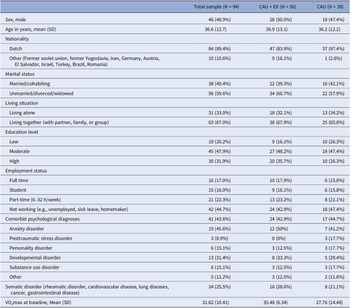
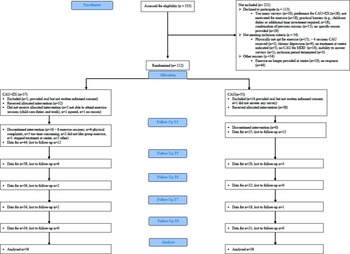
Baseline characteristics are summarised in Table 1. Figure 1 displays the patient flow. Discontinuation rates after randomisation differed significantly between conditions, with more patients withdrawing in the CAU condition (31%) than in the CAU + EX condition (2%), χ 2(1) = 16.14, p < .001, OR = 0.04, 95% CI [0.01, 0.30]. CAU patients cited not receiving exercise therapy as the primary reason for withdrawing.
Baseline characteristics

Note: Age range was 18–65 years. VO2max was used as index of physical fitness. The fitness test was completed in a small subsample of n = 13 from CAU + EX and n = 7 from the CAU condition. Considering the sample’s mean age, both conditions show below-average physical fitness.
CONSORT flow diagram. Note: Two researchers independently assessed the reasons for excluding patients from the trial. Inter-rater agreement was excellent for the exclusion categories (k = 1), indicating perfect agreement. Additionally, the reasons provided by the patients were also evaluated independently by two researchers, showing substantial agreement (k = .802). Agreement between the raters was reached after discussion and resolution of discrepancies.

Exercise adherence
Patients in the CAU + EX condition attended 72% of supervised exercise sessions (M = 9.27) and 50% of home-based sessions (M = 13.04), 73% of which were at moderate or higher intensity. This included four patients who did not start exercise therapy. The per-protocol CAU + EX sample (≥ 6 supervised sessions; n = 40, 71%) attended 92% of supervised sessions (M = 11.08) and 67% of home-based sessions (M = 16.48), 72% of which were at moderate or higher intensity. There were no significant differences in baseline characteristics between patients in the per-protocol sample and patients who attended fewer than six supervised exercise sessions (Supplementary Material 2). The logistic mixed model analysis revealed that patients in the CAU + EX condition were significantly more likely to meet the exercise prescription of 135 min/week moderate to higher-intensity exercise both during the treatment phase (T0-T4), OR = 2.05, 95% CI [0.54, 3.57], p = .008, and during follow-up (T5–T8), OR = 1.23, 95% CI [0.14, 2.33], p = .028, compared to CAU. Patients in the CAU + EX condition exercised more minutes per week during treatment (CAU + EX: M = 98 min; CAU: M = 36 min), and follow-up (CAU + EX: M = 100 min; CAU: M = 48 min; Supplementary Material 3 for details). In the CAU + EX condition, 21% of patients adhered to the prescription during the treatment phase, and 19% during follow-up. Trends in home-based sessions and mood benefits are detailed in Supplementary Material (Supplementary Material 3).
Treatment effectiveness
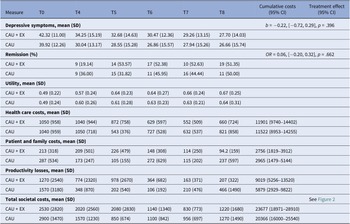
There was a significant effect of time on depressive symptoms, b = −1.02, 95% CI [−1.56, −0.47], p = .001. However, the time-by-condition interaction was not significant (Table 2), indicating both conditions improved similarly in depressive symptoms over time, with an average decrease from severe to moderate levels. Also, when taking remission rates as outcome, the effect of time was significant, OR = 0.73, 95% CI [0.53, 0.94], p > .001, but not the time-by-condition interaction (Table 2).
Depressive symptoms, remission, utility, and costs per condition over time and treatment effects
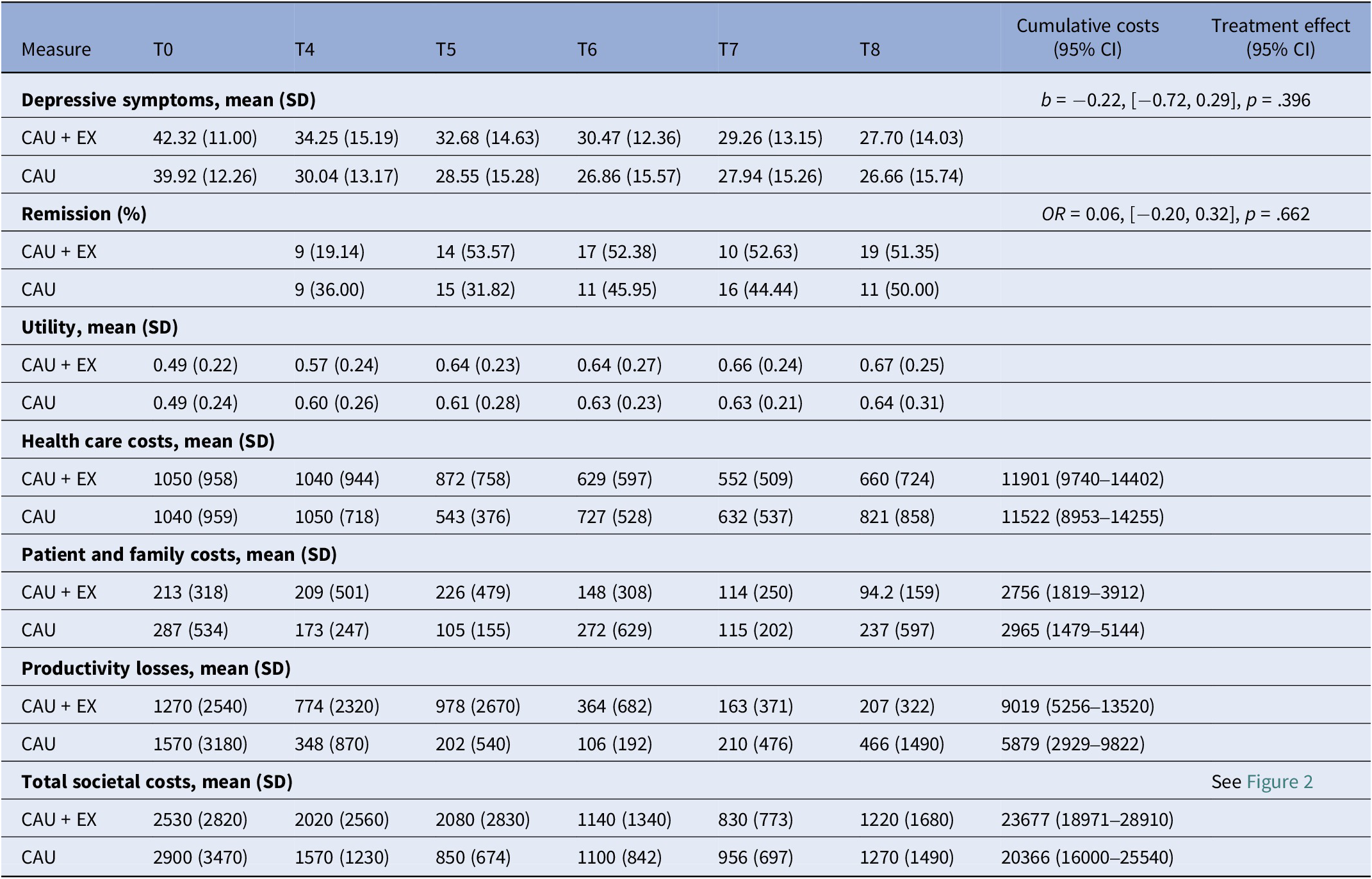
Note: Depressive symptoms were assessed with the IDS-SR and the SCID was used to assess the absence of a MDD classification indicative of remission. The cumulative costs display the imputed costs and bootstrapped confidence intervals. All other costs display raw (non-imputed) data. For the treatment effect, we report the results for the time-by-condition interaction with depressive symptoms and remission as outcome. The estimates, 95% confidence intervals and p values are derived from the mixed model analyses with imputed data.
Results were similar in the per-protocol sample (CAU + EX: n = 40; CAU: n = 54). For depressive symptoms the effect of time was significant, b = −1.02, 95% CI [−1.58, −0.47], p = .002, but not the time-by-condition interaction, b = −0.27, 95% CI [−0.84, 0.29], p = .346, and also for remission the effect of time was significant, OR = 0.81, 95% CI [0.61, 1.00], p > .001, but not the time-by-condition interaction, OR = −0.10, 95% CI [−0.37, 0.17], p = .476. Results showed a similar pattern in the non-imputed analyses (Supplementary Material 4; which includes a plot illustrating individual differences in treatment response), when accounting for possible differences in treatment delivery during the COVID-19 pandemic (Supplementary Material 5), and accounting for baseline exercise (Supplementary Material 6), for IDS-SR subscales as outcome (Supplementary Material 7), the cumulative effect of weekly exercise sessions as predictor (Supplementary Material 8), exploratory moderation and responder prediction analyses (Supplementary Material 9) and for the secondary outcomes (Supplementary Material 10).
Economic evaluation
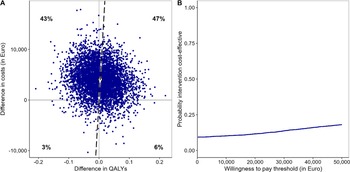
The cost-utility analysis based on bootstrapped data showed a non-significant QALY difference of 0.004, 95% CI [−0.09, 0.11], in favour of CAU + EX, with CAU + EX incurring an additional cost of €4,054, 95% CI [−1998, 10093]. This resulted in ICUR of €1,018,771, which exceeds the WTP threshold of €50,000. The cost-effectiveness plane and CEAC are shown in Figure 2, with the CEAC indicating an 18% probability of CAU + EX being cost-effective at a WTP threshold of €50,000. Similar results were observed in the sensitivity analyses (Supplementary Material 11). From a health care perspective, CAU + EX was neither deemed cost-effective, with a QALY difference of 0.004, 95% CI [−0.09, 0.11], in favour of CAU + EX, and additional costs of €438, 95% CI [−3,030.17, 3,968.81]. This resulted in an ICUR of €109,953, again exceeding the WTP threshold of €50,000 (see Supplementary Material 11 for the cost-effectiveness plan and CEAC).
The cost-effectiveness plane (A) and cost-utility acceptability curve (B) for the economic evaluation of adjunct exercise. Note: The cost-effectiveness plane (A) illustrates the incremental costs and effects of CAU + EX compared to CAU. The dashed line represents the mean incremental cost-effectiveness ratio (ICER) for the comparison. The cost-utility acceptability curve (B) shows the probability that the exercise treatment is cost-effective across a range of WTP thresholds, up to €50,000 per additional QALY gain.

In the per-protocol sample, we found a non-significant QALY difference of 0.044, 95% CI [−0.06; 0.14], in favour of CAU + EX, with an additional cost of only €976, 95% CI [−5389, 7664], leading to an ICUR of €22,269. The CEAC in this case showed that the probability of CAU + EX being cost-effective at a WTP threshold of €50,000 was 61% (see Supplementary Material 12 for cost-effectiveness plane and CEAC). Mean costs, utility, depressive symptoms, and number of patients in remission per measurement occasion are presented in Table 2 (further details Supplementary Material 13).
Adverse events
One serious adverse event occurred: a CAU patient committed suicide, deemed unrelated to the trial interventions by the treating psychiatrist.
Discussion
We evaluated the clinical and cost-effectiveness of evidence-based exercise therapy as an adjunct to guideline-concordant care for MDD outpatients in specialised mental health care. No evidence supported the superiority of adjunct exercise therapy in reducing depressive symptoms or achieving remission. Exercise therapy was cost-effective only for patients who attended at least six supervised sessions in the per-protocol sample.
These results contrast with meta-analytic findings [Reference Lee, Gierc, Vila-Rodriguez, Puterman and Faulkner46], which support the efficacy of exercise augmentation. Unlike other clinical studies [Reference Trivedi, Greer, Church, Carmody, Grannemann and Galper21, Reference Veale, Le Fevre, Pantelis, De Souza, Mann and Sargeant22, Reference Abdollahi, LeBouthillier, Najafi, Asmundson, Hosseinian and Shahidi24], our trial involved patients from routine specialized care with severe depression, comorbidity, and physical health impairments. Furthermore, 60% received combined treatments, and medication adjustments were allowed, reflecting real-world practice [Reference Cleare, Pariante, Young, Anderson, Christmas and Cowen47], which may explain the null findings.
Critical factors that may have influenced our results are exercise dose and adherence. It is possible that the exercise dose prescribed in our study was too low to yield clinical effects in this disabled sample. There is some evidence suggesting that exercise may be most effective when the prescribed dose is high-intensity exercise [Reference Schuch, Vasconcelos-Moreno, Borowsky, Zimmermann, Rocha and Fleck23, Reference Knubben, Reischies, Adli, Schlattmann, Bauer and Dimeo48]. Dose-ranging studies are important to move the literature forward. Especially when considering high-intensity prescriptions, personalising exercise programs, allowing patients to select activities based on their abilities and preferences [Reference Kreppke, Cody, Beck, Brand, Donath and Eckert49, Reference Keller-Varady, Haufe, Schieffer, Kerling, Tegtbur and Kahl50], and offering more supervision [Reference Lee, Gierc, Vila-Rodriguez, Puterman and Faulkner46] may be required for adherence and tolerability. Additionally, offering exercise therapy prior to CBT sessions may help directly address exercise barriers [Reference Uebelacker, Sillice, Epstein-Lubow, Battle, Anderson and Caviness51], negative thoughts related to exercise [Reference Schmitter, Vanderhasselt, Spijker, Smits and Vrijsen52], and logistical challenges such as extra travel time. This approach could leverage both the immediate and cumulative effects of exercise, potentially improving adherence and enhancing symptom reduction.
Interestingly, the augmentation was cost-effective for patients who attended six or more supervised exercise sessions. Though the QALY difference between the per-protocol sample and CAU was small and not significant, it is considered clinically meaningful [Reference McClure, Sayah, Xie, Luo and Johnson53]. The most plausible explanation for this finding is that adjunct exercise may have impacted outcomes not assessed in this trial, such as somatic health. Previous studies suggest that as few as six exercise sessions can significantly improve somatic health in MDD patients [Reference Kerling, von Bohlen, Kück, Tegtbur, Grams and Haufe54, Reference Kerling, Tegtbur, Gützlaff, Kück, Borchert and Ates55], which might explain the observed cost-effectiveness through potential reductions in health care utilization or related costs. However, these results should be interpreted with caution, as the per-protocol analysis was no longer based on a randomised sample. While no baseline differences were found between the per-protocol sample and those who dropped out after fewer than six sessions, it is possible that healthier patients incurred lower costs. Future studies should structurally assess physical health outcomes in patients with severe depression levels, as they are equally important as depression outcomes in this impaired population [Reference Firth, Siddiqi, Koyanagi, Siskind, Rosenbaum and Galletly9].
Strengths and limitations
The trial’s pragmatic design is a key strength, offering high ecological validity. However, varying psychological and pharmacological interventions in the CAU treatment may have obscured exercise effects. The trial was also affected by COVID-19, leading to missing data from telephone interviews (28% on average) and reduced statistical power for remission. Similarly, COVID-19 restrictions limited fitness test completion, resulting in insufficient data for conclusions. Additionally, selection bias may have occurred as patients could not be blinded to their treatment, likely contributing to higher discontinuation rates in the CAU condition. At the same time, this also underscores the appeal of exercise as an adjunct therapy for patients with MDD. Finally, because this sample consisted of patients with severe depression and high rates of comorbidity in specialized care, the results may not generalize to less severely affected patients or those treated in community or primary care settings, where adjunct exercise therapy might augment usual care. In line with this, our exploratory responder analyses suggest that certain subgroups—including patients with lower baseline disability, fewer somatic comorbidities, and less severe depressive symptoms—may be more likely to benefit. Although these trends were not statistically significant and should be interpreted cautiously, they may help generate hypotheses for future research on individual predictors of response. We also found some indication that older patients and women might be less likely to respond to adjunct exercise. Sex has previously been discussed as a potential moderator [Reference Barha, Hsu, Ten Brinke and Liu-Ambrose56, Reference Schuch, Dunn, Kanitz, Delevatti and Fleck57], the roles of both age and sex warrant further investigation. In contrast, patients with comorbid diagnoses may be more likely to respond, which also warrants further study.
Future studies should prioritize improving adherence through personalisation and supervision to reduce dropout rates in patients in specialized care, as our cost-effectiveness findings suggest that benefits depend on attending multiple sessions. Furthermore, even with adequate adherence, the prescribed dose and intensity might require adjustment—such as higher intensity or longer duration—to achieve clinical improvements in this complex patient population. Personalised exercise prescriptions—tailored to individual health profiles and preferences—and offering alternative modalities such as yoga or resistance training [Reference Noetel, Sanders, Gallardo-Gómez, Taylor, del Pozo Cruz and van den Hoek58], combined with more supervision and support, may improve feasibility, adherence, and clinical benefit.
Conclusion
Adjunct evidence-based exercise therapy offers no additional clinical benefits and is not cost-effective in reducing depressive symptoms or achieving remission for MDD outpatients in specialized mental health care. Therefore, the results do not support widespread implementation of the exercise prescription (i.e., one supervised and two home-based moderate-intensity 45-minute sessions per week [Reference Rethorst and Trivedi11]), as an adjunct treatment for MDD. However, when patients attend six or more supervised exercise sessions, adjunct exercise therapy may become cost-effective. This warrants further research to improve treatment adherence in this impaired population and to identify which patients would benefit most from exercise therapy.
Supplementary material
The supplementary material for this article can be found at http://doi.org/10.1192/j.eurpsy.2025.10085.
Data availability statement
The data and R code that support the findings of this study are archived in the Radboud University Data Repository (https://doi.org/10.34973/8v18-zy08) and are available from the corresponding author upon reasonable request. Additionally, to promote open science and facilitate early dissemination, this manuscript has been made available as a preprint on the Open Science Framework prior to peer review and formal publication. The preprint can be accessed at: https://doi.org/10.34973/yfdw-m947.
Acknowledgements
We are deeply grateful to all the patients who participated in this trial, without whom this research would not have been possible. Additionally, the research team would like to thank all dedicated (psychomotor) therapists who referred and treated the patients involved in this trial. In addition, we thank Livia van der Kraats, Mina Maharadjdin, Merve Karadas, Hanneke Dijkman and Kelly Speijers for their invaluable support during the data collection and Santiago Papini for his contributions to the data analysis. The author(s) made use of ChatGPT to assist with the drafting of this article. ChatGPT (versions available between March 2024 and March 2025), based on the GPT-3.5 architecture and developed by OpenAI, was accessed through OpenAI’s platform and used with modification to improve the manuscript. AI-assisted revisions during this period focused on refining language, clarity, and structure, as well as aiding in the development of correct R code. This included improving grammar and spelling, enhancing transitions between text segments, and suggesting synonyms. While ChatGPT contributed to generating certain sentences, all content was reviewed, revised, and integrated by the author(s) to ensure accuracy, coherence, and relevance to the study’s context.
Author contribution
Conceptualization: JV, JS1, and JS2 developed the trial design and, BW, IT and PO provided input; Data curation: MS, Formal analysis: MS and BW; Funding acquisition: JV, JS1, JS2, BW, IT and PO; Investigation: MS; Methodology: MS, BW, JV, JS1, and JS2; Project administration: MS and JV; Resources: BW, PO, DC, AD, IT and JS1; Supervision: JV, JS1 and JS2; Visualization: MS and BW; Writing – original draft: MS; Writing – review & editing: BW, JV, JS1, JS2, DC, AD, IT, PO.
Financial support
Funding for this work was provided by ZonMw (The Netherlands Organization for Health Research and Development), research programme effectiveness research (project number: 852002022).
Competing interests
The authors M.Schmitter, B.Wijnen, D.Creemers, A.van Dorp, P.Oostelbos, I.Tendolkar, J.Spijker, and J.Vrijsen have nothing to disclose. J. Smits has received grants from the National Institutes of Health, the Department of Defense, and the Trauma Research and Combat Casualty Care Collaborative Prevention. He has received personal fees from Big Health, Boston University and Brown University for consulting, and from Elsevier and the American Psychological Association for editorial activities. J. Smits also has equity interest in Earkick and has received royalty payments from various publishers. The terms of these arrangements have been reviewed and approved by the University of Texas at Austin in accordance with its conflicts of interest policies.
Transparency declaration
The authors affirm that this manuscript is an honest, accurate, and transparent account of the study being reported. No important aspects of the study have been omitted, and any discrepancies from the original study plan (and, if applicable, its registered protocol) have been appropriately disclosed and explained.


 Open access


Comments
No Comments have been published for this article.