

The COVID-19 pandemic was unprecedented not just for the speed of its dispersal and virulence worldwide, but also for its politicization. For his part, then President of the United States Donald Trump was a near daily media presence through press conferences, Twitter, and official speeches portraying himself as a wartime leader addressing the “China flu.” In their content analysis of world leader speeches, Dada et al. (Reference Dada, Ashworth, Bewa and Dhatt2021) note that Trump was “the only leader to consistently refer to COVID-19 as ‘the Chinese virus’ rather than using its official or scientific name” (p. 6), even though many, if not most, leaders used wartime metaphors to galvanize their respective populations.
Trump most explicitly and officially attempted to define the COVID-19 pandemic in this manner during his March 11, 2020, Oval Office address to the nation. Trump’s presidential address lasted for 9.5 minutes and saw him seated while using a teleprompter. Within the first minute, he had identified the threat as emanating from China and characterized it as a “foreign virus” while discussing the measures taken to “defeat this virus” (see Figure 1). During this period, Trump displayed one micro-expression (ME), defined as a subtly expressive behavior lasting roughly less than half a second, produced largely involuntarily, and generally perceived outside of awareness (Frank & Svetieva, Reference Frank and Svetieva2015; Porter & ten Brinke, Reference Porter and ten Brinke2008; Svetieva & Frank, Reference Svetieva and Frank2016). MEs are termed “micro” because they are simply shorter and more covert instances of a typical emotion expression, which lasts between 0.5 and 4 seconds (Frank & Svetieva, Reference Frank and Svetieva2015). Unlike more overt expressions of emotions, MEs also tend to differ in form. In other words, they tend to be observable in one half of the face only or feature only one or two key facial action unit (AU) movements that are associated with a particular emotion signal. In this case, Trump’s face displayed a component of a fear expression—the lip stretch (see Figure 1) (Friesen & Ekman, Reference Friesen and Ekman1983). Expressions of fear, like animal distress/alarm calls, are unique in that in addition to signaling the expressor’s emotional state, they also signal to others that there is a threat in the environment (Buck, Reference Buck1994). Trump’s ME can thus be seen as associated with both perceived threat and the resultant experienced fear.
Stimuli from Donald Trump’s March 11, 2020, Oval Office COVID-19 address. Top = screen capture of peak risorious muscle contraction (AU 20) during micro-expression. Bottom = transcript of speech presented in stimulus video.

With this speech, President Trump attempted to define the COVID-19 pandemic for the nation as a “rally-‘round-the-flag” event against a defined enemy (Mueller, Reference Mueller1973). He did so in a manner reminiscent of President George W. Bush in the wake of the September 11, 2001, terrorist attacks (Schubert et al., Reference Schubert, Stewart and Curran2002) and, before him, President George H. W. Bush in the lead-up to the first Iraq War in 1991 (Hetherington & Nelson, Reference Hetherington and Nelson2003; Stewart et al., Reference Stewart, Waller and Schubert2009b). Both Presidents Bush (numbers 41 and 43) experienced substantial gains in public support due to their nationally televised rally addresses, largely through their ability to affect the discrete emotions of viewers in a manner appropriate for the context (Bucy, Reference Bucy2000; Gooty et al., Reference Gooty, Connelly, Griffith and Gupta2010; Stewart et al., Reference Stewart, Salter and Mehu2009a; Van Knippenberg & Van Kleef, Reference Van Knippenberg and Van Kleef2016)—an external threat. As had been the case with previous presidents, gains came predominantly from opposition political party members and unaligned individuals. However, questions remain regarding Trump’s potential for success based upon both the context—a pandemic—and his polarizing leadership style.
Trump’s presidential address offers the opportunity to conceptually replicate and expand upon research considering the emotional impact of leader speeches in times of crisis and threat. Two major research questions arise: first, given the polarized political climate in the United States, would Trump be able to rally followers and non-followers equally? Second, would Trump’s ME, an exemplar of a subtle nonverbal behavior, be seen as “authentic” nonverbal behavior or as discordant with his message? Furthermore, would the interpretation of a facial behavior processed largely outside of conscious awareness be affected based on followership? To address these questions, we first review the salient literature before analyzing an experiment carried out in the early stages of the COVID-19 pandemic, when there was still uncertainty regarding its provenance and potency.
Leaders as managers and harnessers of follower emotion
Leaders emerge because they are able to manage, influence, and harness follower emotion, both positive and negative (Pescosolido, Reference Pescosolido2002). Most of the research on the emotional influence of leaders on followers has focused on positive affect, namely that it has a generally positive influence on followers (Gooty et al., Reference Gooty, Connelly, Griffith and Gupta2010; Joseph et al., Reference Joseph, Dhanani, Shen, McHugh and McCord2015; Stewart et al., Reference Stewart, Salter and Mehu2009a; Van Knippenberg & Van Kleef, Reference Van Knippenberg and Van Kleef2016). Specific findings are that expressions of positive affect enhance leadership perceptions (Trichas et al., Reference Trichas, Schyns, Lord and Hall2017; Trichas & Schyns, Reference Trichas and Schyns2012) and that the charisma of transformational leadership relies upon the optimism and inspiration such behavior engenders in followers (Bono & Ilies, Reference Bono and Ilies2006; Cherulnik et al., Reference Cherulnik, Donley, Wiewel and Miller2006; Sy et al., Reference Sy, Horton and Riggio2018). While negative affect in leadership has received some attention (Staw et al., Reference Staw, DeCelles and de Goey2019; Van Kleef et al., Reference Van Kleef, Homan, Beersma, Van Knippenberg, Van Knippenberg and Damen2009), there is much less known about the function of discrete negative emotions in different contexts as leaders attempt to coerce, rally, apologize to, or otherwise appeal to and influence followers (Gooty et al., Reference Gooty, Connelly, Griffith and Gupta2010; ten Brinke & Adams, Reference ten Brinke and Adams2015; Van Knippenberg & Van Kleef, Reference Van Knippenberg and Van Kleef2016). Indeed, moving beyond a valence-based approach to examining emotion effects in political communication is key to understanding how discrete emotions function in different contexts and by different political actors. For example, in the wake of the 2015 Paris terror attacks, Vasilopoulos et al. (Reference Vasilopoulos2018) found that anger was a stronger driver of support for the French far-right party than fear.
Moreover, understanding these emotion effects is especially important in a newly polarized political global arena, where populist leaders are more frequently dominating the political scene. Recent research using textual data suggests that populist leaders rely more heavily on emotional appeals, specifically anger and fear, in garnering followers and support for their policies (Widmann, Reference Widmann2021). Through the use of morally and emotionally charged language, populist leaders drive negative sentiment toward political opponents from both sides of a political divide, thus driving polarization for both supporters and non-supporters of their populist ideology (Davis et al., Reference Davis, Goodliffe and Hawkins2024). Nonverbal behavior, in conjunction with language, may be seen as operating in a similar fashion.
The “rally-‘round-the-flag” effect
During threatening times, leaders provide followers focus by defining the threat, and thus the framework to process and shape their emotional response to it (Van Kleef et al., Reference Van Kleef, Homan, Beersma, Van Knippenberg, Van Knippenberg and Damen2009). This in turn frames the strategies used (Laustsen, Reference Laustsen2021; Spisak et al., Reference Spisak, O’Brien, Nicholson and van Vugt2015), especially with followers’ shared group membership putting them in “a position of lower power and dependency (that) makes one more attentive to the higher power other” (Van Knippenberg & Van Kleef, Reference Van Knippenberg and Van Kleef2016). Of specific relevance is panel research conducted immediately after the September 11, 2001, terrorist attacks and then again after President George W. Bush’s subsequent national address. This study found that Bush’s address had a measurable emotional impact as the public felt “high threat, anxiety, fear, and anger—but little positive emotion” (Schubert et al., Reference Schubert, Stewart and Curran2002) immediately following the attacks. While Bush’s speech did not reduce the dimension of negative affect, it successfully induced higher levels of positive affect regardless of partisan identity. As pointed out by Schubert et al. (Reference Schubert, Stewart and Curran2002), “(A)pparently, he did not calm their fears, but he did give them hope” (p. 578).
In short, an effective rally speech activates viewers across the political spectrum by harnessing negative emotions like anger toward the enemy, which encourages confrontation and allows for appraisal of greater certainty and individual control (Bossuyt et al., Reference Bossuyt, Moors and De Houwer2014; Carver & Harmon-Jones, Reference Carver and Harmon-Jones2009). At the same time, rally speeches should decrease negative emotions such as sadness and distress that lead to avoidance due to uncertainty and lack of individual control through loss or potential loss (Lerner et al., Reference Lerner, Gonzalez, Small and Fischhoff2003; Scherer et al., Reference Scherer, Mortillaro, Rotondi, Sergi and Trznadel2018; Sherman et al., Reference Sherman, Lee, Cuddy, Renshon, Oveis, Gross and Lerner2012). Finally, effective rally speeches should reassure viewers while enhancing affinity with in-group members. Thus, in contrast to competitive electoral politics where emotional response to nonverbal behavior differs based upon partisanship (Masters et al., Reference Masters, Sullivan, Lanzetta, McHugo and Englis1986; Stewart et al., Reference Stewart, Salter and Mehu2009a), there should be affective congruence in response to speeches that aim to bring a country together (Gooty et al., Reference Gooty, Connelly, Griffith and Gupta2010).
It is no surprise that a dominance-oriented and polarizing leader such as Trump defined COVID-19 as deriving from an identifiable enemy. However, unlike normal rally events, where an external enemy can easily be defined, a virus is an invisible threat with unclear origins, trajectory, and outcome. As a result, there are two reasons to expect the effects of Trump’s presidential address to diverge from typical rally speeches. First, a speech in the context of a pandemic threat would arguably require a leader to produce a different emotional response in viewers than one posed by a distinct and identifiable enemy. Second, levels of political polarization have rapidly increased in the last decade (Hetherington & Weiler, Reference Hetherington and Weiler2009; Mason, Reference Mason2018; Tyler & Iyengar, Reference Tyler and Iyengar2023), along with rises in populism more generally (Jenne et al., Reference Jenne, Hawkins and Silva2021). Driven in large part by Trump’s populist persona (Feinberg et al., Reference Feinberg, Branton and Martinez-Ebers2022; Haslam et al., Reference Haslam, Reicher, Selvanathan, Gaffney, Steffens, Packer, Van Bavel, Ntontis, Neville, Vestergren, Jurstakova and Platow2023), we expect that President Trump’s speech will be reacted to by followers in a manner congruent with rally speeches (Hibbing, Reference Hibbing2023), whereas those not aligned with Trump will react differently.
H1: Emotional response to President Trump’s COVID-19 national address will differ between followers and non-followers.
Micro-expressions as authentic versus inappropriate leader behaviors
Leader emotion displays serve strategic leadership functions through which the leader seeks to influence follower emotion, cognition, and ultimately behavior, and complete concordance between physiology and the behavioral intent communicated need not exist (Ekman & Friesen, Reference Ekman and Friesen1969; Mehu et al., Reference Mehu, Mortillaro, Bänziger and Scherer2011; Scherer et al., Reference Scherer, Mortillaro, Rotondi, Sergi and Trznadel2018). The social-functional account of emotion (Keltner & Haidt, Reference Keltner and Haidt1999; Niedenthal & Brauer, Reference Niedenthal and Brauer2012; Van Kleef et al., Reference Van Kleef, Homan, Beersma, Van Knippenberg, Van Knippenberg and Damen2009) does not demand that emotions expressed are those that are felt, but merely that a leader’s emotion displays have a function in terms of how followers are impacted, motivated, or moved.
MEs, due to their brief and involuntary nature, tend to be less amenable to strategic use by leaders, but can still serve key functions. For example, authenticity in leadership is valued by followers (Avolio & Walumbwa, Reference Avolio, Walumbwa and Day2014), especially in nonverbal expressiveness (Slepian & Carr, Reference Slepian and Carr2019). Because we expect followers to attend to leaders to an even greater extent during affective events that threaten the cohesion of a group (Gooty et al., Reference Gooty, Connelly, Griffith and Gupta2010), even subtle or fleeting changes in facial behavior can be expected to affect those watching. The question is whether a leader’s MEs would be perceived by viewers as an authentic nonverbal affective expression/punctuation or as a leaked emotion display that is inappropriate for the circumstance. In the case of the former, Stewart and Svetieva (Reference Stewart and Svetieva2021) found that the presence of MEs by Trump, which are substantially similar to the one evaluated in this study, increased perceptions of his competence and trustworthiness in a competitive context, albeit early in his 2016 presidential campaign before trait perceptions had crystalized.
H2a: Emotional response to President Trump’s ME of experienced fear/perceived threat will change in a manner congruent with rally speeches (i.e., increased affinity, reassurance, and anger; decreased distress and sadness).
On the other hand, MEs may be perceived quite differently when they are inappropriate to the context. Research examining public apologies by company CEOs found that smiles displayed in contexts where expressions of sadness, regret, and contrition would be more appropriate resulted in less perceived effectiveness of the public apology, more negative perceptions of the leader, and negative firm performance as measured through stock price changes (ten Brinke & Adams, Reference ten Brinke and Adams2015). More pertinently, Stewart et al. (Reference Stewart, Waller and Schubert2009b) found that the effect of President George H. W. Bush’s facial MEs during his 1991 national address upon engaging in military hostilities with Iraq, which mostly involved smiles (i.e., the zygomaticus muscle [AU 12; engaged by pulling the lip corners up and at an angle]), detracted from the potency of the speech. Viewers of his MEs reported decreased feelings of determination, anger, threat, and anxiety, likely due to facial behavior at odds with his persuasive intent. Both of these studies suggest that subtle but incongruous leader nonverbal behavior (such as MEs of happiness during a rally speech) can have a measurable and undesirable emotional impact on viewers/followers.
In the case of President Trump’s ME, a display of fear could be seen as a sign of weakness/vulnerability rather than authenticity, and so could cause doubt and concern in followers that the leader has the strategic ability and confidence to effectively deal with the external threat.
H2b: Emotional response to President Trump’s ME of perceived fear/experienced threat will change in a manner discordant with rally speeches (i.e., decreased affinity, reassurance, and anger; increased distress and sadness).
Research on the nonverbal displays of political leaders has so far focused on instances where a leader’s “rally-‘round-the-flag” speech addresses a shared crisis. We explore the possibility that in a competitive, polarized context, such as the United States in the first half of 2020, followership may play a larger role in the perception of leader nonverbal display. We therefore propose that H2a and H2b might function as competing hypotheses and that MEs are processed differently by followers and non-followers. Specifically, followers can be expected to emotionally respond to MEs as manifestations of authentic leadership (i.e., H2a), whereas non-followers will likely respond to these facial behaviors as inappropriate (i.e., H2b).
Methods
We test our hypotheses using an experiment similar to those used in prior studies of the emotional impacts of leader MEs (Stewart et al., Reference Stewart, Waller and Schubert2009b; Stewart & Svetieva, Reference Stewart and Svetieva2021). This study was preregistered prior to data download and analysis (https://osf.io/tcqr7/?view_only=6a735285b7414dbda069b84ed86dfc47). Below, we describe the sampling approach, participant attributes, materials, and procedure used for the study.
Sample
Based on the effect size of changes in self-reported emotional states found in prior studies of leader MEs (Stewart et al., Reference Stewart, Waller and Schubert2009b; Stewart & Svetieva, Reference Stewart and Svetieva2021), we conducted a power analysis using G*Power 3.1. Results suggested a target sample size of 250 participants (Cohen, Reference Cohen2013), and we provide additional details about the power analysis in Appendix A of the Supplementary Material.
We collected data using snowball sampling, beginning with students enrolled in an introductory political science course. Students received course credit for taking part and recruiting additional participants from different age cohorts (see Appendix A of the Supplementary Material). Data collection occurred from April 14 to May 5, 2020. The average time to complete the study was between 10 and 15 minutes. Of 263 completing the study, 6 were removed for being unable to vote. Five additional participants did not respond to the open-ended manipulation check (“Please list some of the thoughts you had while watching the video clip”), leaving a total sample of 252 (ME removed = 127; ME intact = 125).
Participants ranged from 19 to 82 years old, with an average age of 42.6 (SD = 17.66). Females made up 65% of participants, and the ethnic distribution was 77.1% Caucasian/White, 10.4% Latino, 5.6% African American, 4.4% Asian, and 2.5% First Peoples or “other.”
When participants indicated their voting intention, 38.2% intended to vote for Donald Trump, 48.2% for Joe Biden, and 13.7% for another candidate. Distribution to treatment conditions was nearly equal with 127 in the ME removed condition, and 125 in the control/ME intact condition. We found no significant assignment bias based on vote intent (p = 0.21), gender (p = 0.52), ethnicity (p = 0.25), age (p = 0.97), or COVID-19 risk perception (p = 0.80).
Stimulus and procedure
Prior to the treatment, participants responded to questions regarding their 2020 presidential voting intentions and current emotional state before viewing the treatment video.
The ME was identified, verified, and coded on a frame-by-frame basis by two of the authors (P.A.S. and E.S.), both certified FACS (Facial Action Coding System) coders with extensive experience with this form of facial behavior. Establishing the key emotion signal in an ME involves identifying the crucial facial AU(s) present, and mapping it onto the central AUs defined for each basic emotion in the EMFACS coding scheme (Ekman et al., Reference Ekman, Irwin and Rosenberg1994). The EMFACS coding scheme, based on FACS, is a method of mapping the basic expressions of emotion thought to be universally produced and recognizable across human groups (Ekman, Reference Ekman2003; Izard, Reference Izard1994; Matsumoto et al., Reference Matsumoto, Yoo and Fontaine2008) to the facial AUs that have been associated with each. For example, in the present study, the AU 20 (lip stretch) is identified by the EMFACS system as the key AU in categorizing an emotion as a fear expression.
Trump’s ME, which corresponds with previously observed and investigated MEs (Stewart & Svetieva, Reference Stewart and Svetieva2021) and may be seen as an infrequent but important part of his distinct nonverbal repertoire (Ilgen et al., Reference Ilgen, Israelashvili and Fischer2021), lasted just over half a second (20 frames) and involved a moderately strong lip stretch (AU 20) resulting from the Risorius muscle pulling the lip corners back toward the ears. This intra-vocalization display transitioned from his lips being parted (AU 25) with an open mouth (AU 26) and his lower lip pulled down showing his lower teeth (AU 16) to their roots (see Image 1). Along with his sharp intake of breath, this ME can be seen as reliably linked to the expression of fear and preparing to respond to a threat (Mehu et al., Reference Mehu, Mortillaro, Bänziger and Scherer2011), possibly by preparing loud vocalizations while accentuating its signal power. Across humans and animals, expressions of fear are readily visible and attended to, and signal to conspecifics that a threat may be imminent.
The stimulus material for this study is a segment of President Donald Trump’s nationally televised address to the nation on the COVID-19 pandemic on March 11, 2020. Specifically, we present the first ~51 seconds of the speech in which Trump attempts to define the COVID-19 pandemic. The study used a between-subjects design where participants were randomly assigned to one of two ME conditions (ME-intact and ME-removed). While the ME-removed condition has a slight discontinuity in the video (20 frames), prior research considering the effect of Trump’s MEs on trait attributions during a competitive context found that video discontinuities (in this case 17-frame edits) were statistically equivalent to the control condition in which the MEs were present (Stewart & Svetieva, Reference Stewart and Svetieva2021). Both treatment videos were preceded by a 5-second countdown timer.
Immediately after viewing the video clip, participants completed a second questionnaire including an open-ended manipulation check, their current (i.e., resultant) emotional state, perceptions of Trump’s traits and performance, demographic information, and personal impacts of COVID-19. Fifty percent of participants carried out the study on a smartphone, allowing us to adequately test our hypotheses in a media consumption landscape that sees many individuals watch videos and access the internet via mobile phones.
Measures
We measure pre- and posttreatment emotional states drawing items from the Positive and Negative Affect Schedule (Watson et al., Reference Watson, Clark and Tellegen1988) that have been used extensively in ethologically based research regarding response to nonverbal behavior by political leaders (Bucy, Reference Bucy2000; Masters et al., Reference Masters, Sullivan, Lanzetta, McHugo and Englis1986; Stewart et al., Reference Stewart, Salter and Mehu2009a). Consistent with recent studies using a more micro-analytic approach (Stewart et al., Reference Stewart, Bucy and Mehu2015, Reference Stewart, Senior and Bucy2020), we use the following item pairs to represent discrete emotions: affinity (proud + interested), reassurance (reassured + comforted), sadness (discouraged + depressed), distress (fearful + worried), and anger (irritated + angry). We measure each item by asking the participant “To what extent do you feel this way right now?” on an 11-point scale, ranging from 0 (“Not at all”) to 10 (“Extremely”). We then sum the values in each pair to operationalize each discrete emotion. The reliability of the measures used in the pre- and posttest as well as supporting tables regarding post hoc tests comparing the emotional response of followers to Donald Trump’s COVID-19 rally speech can be found in Appendix B of the Supplementary Material.Footnote 1
We operationalize the treatment using a binary variable and conduct analyses using the control (ME-intact) as the baseline condition. We operationalize voting intention using a categorical variable and conduct analyses using “Trump” as the baseline condition. The comparison categories presented in the analyses are “Biden” and “Other Candidate” to provide a comparison based on the focal actor and sitting president at the time of the study. Table 1 presents descriptive statistics and correlations for these measures. Notably, correlations among some emotion measures are high, with the most problematic correlation exceeding 0.7 between the post measures for affinity and reassure. We retain both measures for consistency with the pre-analysis plan. Moreover, we provide a correlation matrix of the emotion change measures in Appendix B of the Supplementary Material that shows lower (but still significant) correlations between the discrete emotions. These correlations suggest that the affinity and sadness variables, though highly correlated in post measures, do not move together as consistently and provide support for retaining and analyzing the variables separately.
Correlations and descriptive statistics

Note: All correlations >|0.12| are significant at p < 0.05; N = 252.
Analysis
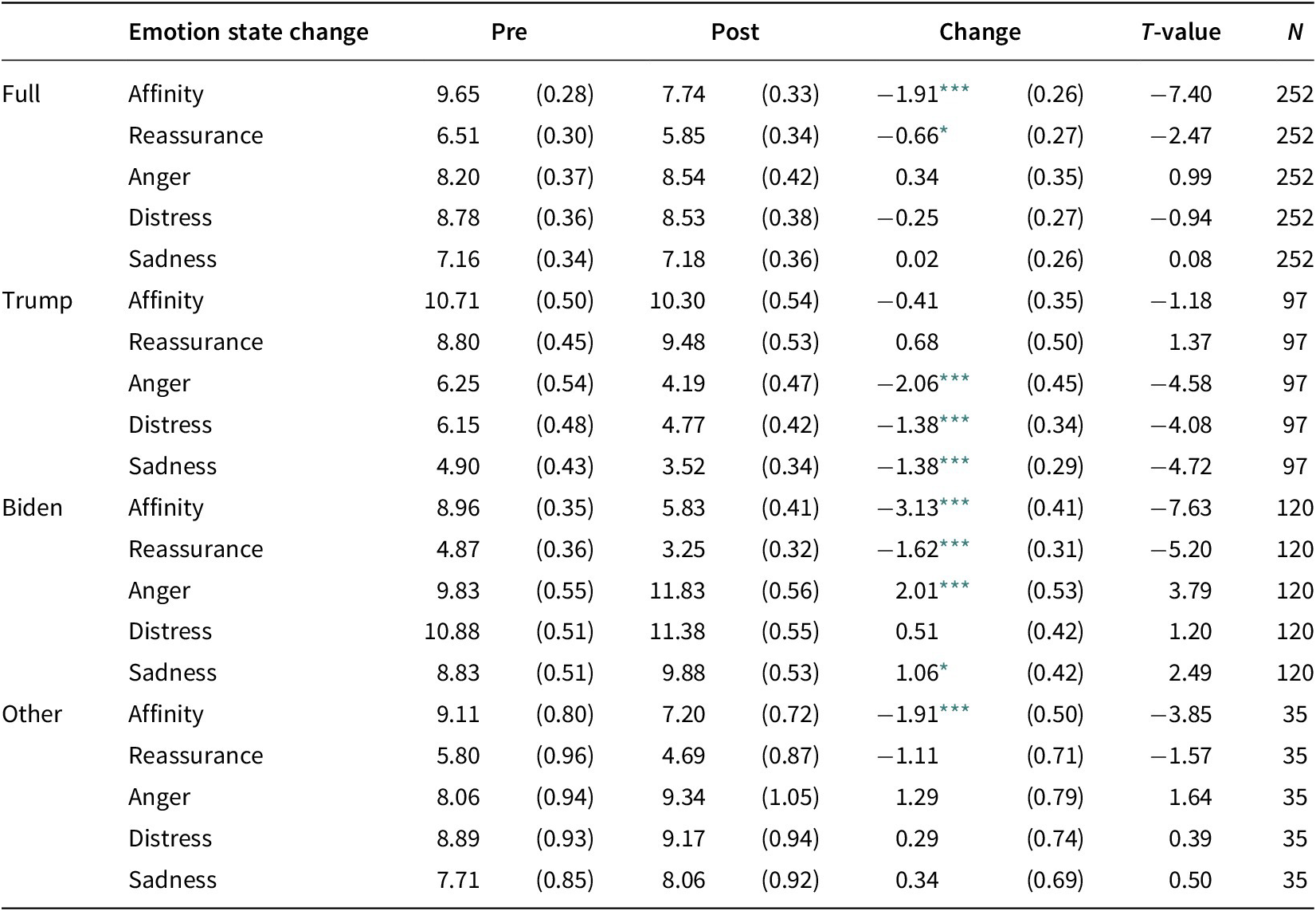
We address H1 to understand how the speech influenced emotional states overall and within subgroups based on voting intention, by conducting a series of within-subject t-tests. Table 2 presents these results.
Changes in emotional states overall and by subgroup
Note: Standard errors in parentheses.
* p < 0.05.
** p < 0.01.
*** p < 0.001.
We address H2a and H2b to understand the effect of the ME and voting intentions on changes in emotional states by using a moderated regression analysis. We use regression analysis for the main analysis because repeated-measures ANOVA (the technique on which we based the power analysis and preregistered study) is a special case of multiple regression, and multiple regression output provides additional useful information (Cohen et al., Reference Cohen, Cohen, West and Aiken2013). We calculate the dependent variable as the change in each emotion state (post minus pre value) and regress this value on the treatment condition (ME-intact = 0; ME-removed = 1) and the categorical variable for voting intention (using Trump as the baseline condition). Table 3 presents these results. For consistency with prior literature investigating the effects of leader MEs on viewers’ emotional responses, and to report results consistent with the original power analysis and plan, we report comparable results using repeated-measures ANOVA in Appendix C of the Supplementary Material.
Emotion state change regression results

Note: N = 252.
Results
Based on within-subject t-tests for the full sample, reactions to the speech were marked by reduced positive emotions of affinity (p < 0.001) and reassurance (p < 0.05), with no significant change detected in negative emotions. Subgroup analyses tell a more nuanced story, with clear differences in the reactions based on followership. Trump’s followers reported reduced negative emotions of anger, distress, and sadness (all p < 0.001), but no significant changes in positive emotions. By contrast, Biden’s followers reported increased negative emotions of anger (p < 0.001) and distress (p < 0.05) accompanied by reduced positive emotions of affinity and reassurance (both p < 0.001). Followers of other candidates displayed greater variability in emotion state changes (based on standard errors, likely due to a smaller sample and “other” encompassing a broader spectrum of political preferences), but overall showed reduced positive emotion of affinity (p < 0.001). The contrasting patterns between subgroups support H1 that Trump’s speech affected followers and non-followers differently.
Based on regression results, and consistent with the above subgroup analyses, all five models show significant differences in responses to the speech based on followership. As compared to Trump’s followers, Biden’s followers reacted with decreased positive emotions of affinity (p < 0.001) and reassurance (p < 0.01), and increased negative emotions of anger (p < 0.001), distress (p < 0.05), and sadness (p < 0.001). This lends additional support to H1 that the speech affected followers and non-followers differently. Supporters of other candidates showed greater variability in emotional state changes; while all coefficients were in the same direction as Biden’s followers, the differences were not significant. Post hoc analyses, available in Appendix C of the Supplementary Material, suggest greater differences between Trump’s followers and all others than between followers of his chief opponent, Joe Biden, and participants aligned behind other candidates.
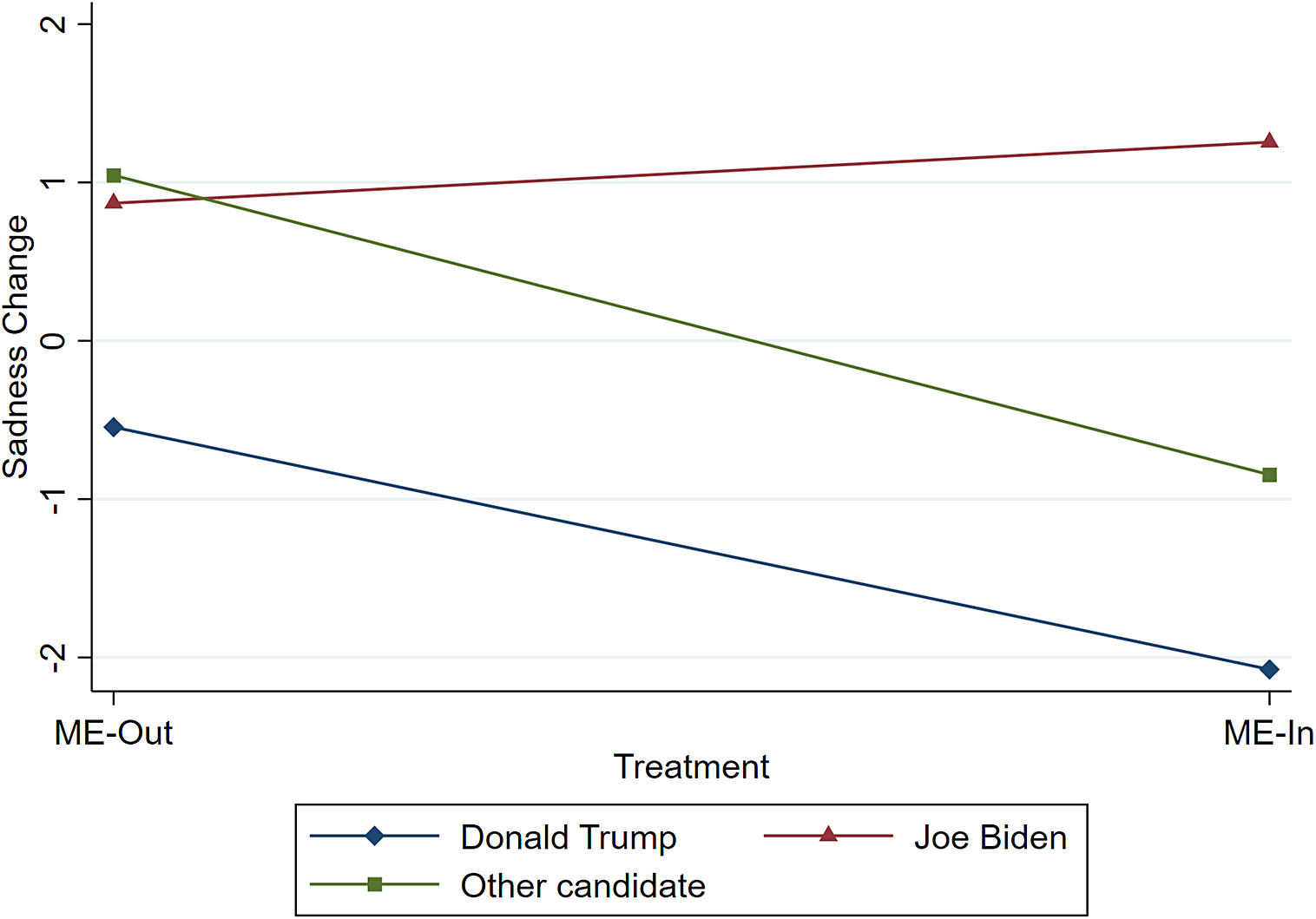
To test H2a and H2b, and whether there would be differences in participant response to Trump’s ME overall and/or contingent on followership, we refer to the main effect and interactions involving the treatment condition in Table 3. Overall, there is limited evidence that the treatment (removal of the ME) influenced participants’ emotional responses. We find no significant differences in the treatment of affinity, reassurance, anger, or distress. However, our results suggest (p = 0.059) a main effect of the treatment, that removal of the ME is associated with an increase in reported sadness. Additionally, this increase in sadness is suppressed for Biden supporters (p = 0.078). Put another way, Trump’s ME may have resulted in lower sadness among his supporters, but not among supporters of his main opponent. We plot the simple effects based on predicted values for each condition in Figure 2.
Interaction of the micro-expression and voting intention on sadness change.
Exploratory textual analysis
Based on responses to the open-ended manipulation check question (“Please list some of the thoughts you had while watching the video clip:”), we use the Linguistic Inventory and Word Count (LIWC) software to conduct post hoc analyses. LIWC is a “transparent text analysis program that counts words in psychologically meaningful categories” (Tausczik & Pennebaker, Reference Tausczik and Pennebaker2010), and is often used to study emotional content in text (Kahn et al., Reference Kahn, Tobin, Massey and Anderson2007; Settanni & Marengo, Reference Settanni and Marengo2015). Within each unit of text, LIWC computes the percentage of words, on a scale of 0 to 100, for each word category. We specifically consider emotion-relevant word types including general positive and negative emotions, and more specifically anger, anxiety, and sadness (which align with the a priori defined types of anger, distress, and sadness). These measures use the default LIWC 2015 dictionary and have been extensively tested and validated in prior literature (Pennebaker et al., Reference Pennebaker, Boyd, Jordan and Blackburn2015). Prior to the analyses, we spell-checked the responses and removed three respondents who answered with “no comment” or “none,” resulting in a sample of 249.
We first present analyses based on correlations between LIWC variables and relevant survey variables, reported in Table 4. General positive emotion in the text correlates with all positive post survey and emotional state change measures. General negative emotion in the text correlates with all negative post survey and emotional state change measures. Specific emotions in the text all correlate with their post survey counterparts: anger, anxiety/distress, and sadness. We do not observe significant correlations for two of the emotional state change measures (distress and sadness), which is consistent with the idea that specific emotion expressions in the text are more reflective of absolute states than relative changes. Taken together, these correlations suggest good construct validity for the text-based emotion measures.
Post-experiment text mining correlations and descriptive statistics

Note: All correlations >|0.12| are significant at p < 0.05; N = 249.
We note three interesting findings in the correlation analysis. First, anger expressed in the text correlates (in the expected directions) with all post survey and emotional state change measures. This suggests the primacy of anger with its increased certainty and personal agency among the emotions, which complements the main study findings related to the polarized political climate and posited by H1. Second, anxiety expressed in the text negatively correlates with the experimental treatment (removal of the ME). That is, Trump’s ME served to reduce viewers’ anxiety. This is in accord with our main findings that the ME serves as authentic expression of emotion/affective punctuation, not a leakage of inappropriate behavior, and illustrates Trump’s nonverbal charisma and perceived authenticity. Third, we note a strong positive correlation between sadness expressed in the text and change in affinity. This may suggest an empathetic response to the address: those who felt greater affinity for Trump as a result of the address shared his sadness about the coming pandemic.
We replicate the main regression analyses using the text-based measures and present the results in Table 5 while acknowledging that the text-based measures are more indicative of absolute emotional states rather than the changes in emotional states as originally hypothesized. Consistent with the main findings, general positive emotion is significantly lower for non-followers (i.e., those following Biden or another candidate) than for Trump’s followers. General negative emotion is significantly higher for Biden’s followers than for Trump’s. Based on the more specific emotion measures, anger expressed in the text is higher for Biden’s followers than for Trump’s. We also test for differences in anxiety and sadness expressed in the text but do not include them in the results due to nonsignificant model F-tests.
Post-experiment text mining regression results

Note: Models for Linguistic Inventory and Word Count measures of anxiety and sadness excluded due to nonsignificant F-values (p > 0.10).
We also conduct between-subjects ANOVA to evaluate differences and report those results in Appendix D of the Supplementary Material. Consistent with the correlational analyses, inclusion of the ME is associated with lower levels of anxiety expressed in the text, and this effect is not dependent on followership (Mean difference = −3.42, SE = 1.42). We did not observe any other effects of the experimental treatment on the text-based emotion measures.
Taken together, the exploratory text analyses reinforce and elaborate upon the main findings, emphasizing that both followership and the nuanced effects of the ME as a nonverbal punctuation served to reduce negative emotions.
Discussion
By definition alone, President Donald Trump’s March 11, 2020, Oval Office national address in response to the COVID-19 pandemic did not attain a “rally-‘round-the-flag effect” (Hetherington & Nelson, Reference Hetherington and Nelson2003; Mueller, Reference Mueller1973; Schubert et al., Reference Schubert, Stewart and Curran2002), either over the course of the pandemic (Gadarian et al., Reference Gadarian, Goodman and Pepinsky2021; Kaushal et al., Reference Kaushal, Lu, Shapiro and So2022) or in this study. For followers of Trump, positive emotional states of affinity and reassurance remained constant or increased slightly, and negative emotional states of anger, distress, and sadness decreased. Respondents who did not report voting for Trump—especially Biden supporters—experienced decreased positive emotions, while their negative emotional response remained constant or increased. Rather than a rally-‘round-the-flag effect, participant responses to his national address instead showed exacerbated polarization in emotional response.
Further, consistently referring to COVID-19 as the “China flu” (Dada et al., Reference Dada, Ashworth, Bewa and Dhatt2021) may be seen as an unsuccessful attempt to manage the emotions of all Americans. By defining the pandemic threat as emanating from China, a nation the United States has had a contentious relationship with, Trump’s framing of a natural threat as enemy-made provided for a specific type of leadership narrative—one requiring wartime leadership skills. At the same time, this narrative was not uniformly accepted by the public, and further impaired his ability to rally and unify the pandemic response across the people, his administration, and public health efforts.
Although leaders can successfully create their own “leadership niches” by defining problems as best met by their particular skills and solutions (Spisak et al., Reference Spisak, O’Brien, Nicholson and van Vugt2015), there are distinct survival-related problems where leadership is adaptive that may not be as easily defined (Hibbing, Reference Hibbing2023; Laustsen, Reference Laustsen2021; Smith et al., Reference Smith, Ortiz, Buhbe and van Vugt2018; Van Vugt & Smith, Reference Van Vugt and Smith2019). Whether broadening and building coalitions through affiliative behavior, tending and befriending in times of loss, or “rallying-‘round-the-flag” when confronted by identifiable external threats, the leader–follower connection might be more easily induced in some situations than in others and require the management of different discrete emotional states. Furthermore, while leaders may be able to redefine certain survival threats (e.g., the threat posed by another country’s political regime) in a manner that is beneficial to the leader, risks posed by pathogens are even more deadly and persistent (Aarøe et al., Reference Aarøe, Petersen and Arceneaux2017; Neuberg et al., Reference Neuberg, Kenrick and Schaller2011) and thus more likely to be identified without the direction of leaders.
While unable to affect participants in the preferred manner, that does not mean that Donald Trump does not have an abundance of charisma or that, to best respond to events such as the COVID-19 pandemic, charismatic leadership is not needed (Antonakis, Reference Antonakis2021; Liu et al., Reference Liu, Chambers and Moore2023). That participants reacted directly to his ME nonverbally punctuating the threat enunciated in the speech suggests attention to the leader (Bucy, Reference Bucy, Doveling, von Scheve and Konijn2011, Reference Bucy, Peterson and Somit2017; Gerpott et al., Reference Gerpott, Lehmann-Willenbrock, Silvis and Van Vugt2018; Mazur, Reference Mazur2005) and the influence of even such subtle and fleeting display behavior as this ME. It further underscores the importance of understanding the nonverbal behavior of leaders when communicating with followers, those who would be followers, and those standing in opposition (Bucy, Reference Bucy2003), as well as its appropriateness for the context (Bucy, Reference Bucy2000; Gong & Bucy, Reference Gong and Bucy2016; Liu et al., Reference Liu, Chambers and Moore2023). This ME as an authentic nonverbal punctuation of leader communication contrasts with findings of President George H. W. Bush’s MEs being inappropriate for the context (Stewart et al., Reference Stewart, Waller and Schubert2009b). Specifically, this ME associated with perceived threat and resultant fear may enhance the “authentic” nature of his communication, regardless of context—whether during a competitive presidential general election campaign (Stewart & Svetieva, Reference Stewart and Svetieva2021) or in the course of responding to a crisis as seen here.
A leader must use emotion to achieve strategic goals, whether that be to reassure and allay the distress of their followers, or to rally them to respond as a group with anger toward an identifiable threat while building affinity for one another. This means harnessing the power of negative emotional states and that, importantly, there is no such thing as a “good” or “bad” emotion; there are only emotions more or less appropriate for achieving a particular goal. Emotions that we think of as normatively positive or negative all play a vital role in meeting the challenges of social and civic life. A leader unable to influence followers using discrete emotions, whether positive or negative, will be less effective in meeting the collective threats and challenges they must face.
Deviations from preregistration and limitations
While this study largely adhered to the preregistered research plan in terms of method and sample size, we note that our expected 100-point measure instead was a 10-point measure. We also ran the study without the COVID-19 threat covariates, given that they were randomly distributed across conditions. Finally, while results are presented here using OLS regression, comparable results using the preregistered method of repeated-measures ANOVA can be found in Appendix C of the Supplementary Material.
We believe this study was able to recruit a motivated and interested sample, as well as one that provided greater diversity in age, by using a snowball sampling approach. However, the lack of geographic diversity and, at the time of the study, lack of exposure to the coronavirus and its effects may have affected perceptions of the COVID-19 pandemic and with it the response to President Donald Trump’s speech. The snowball sampling approach improved the study’s reach (Khoury, Reference Khoury2020), but is still limited due to the baseline demographic of typically upper-middle-class college students predominantly from the American mid-south region providing the entry point into social networks (Dunbar, Reference Dunbar2021). Also, with one half of the study participants relying on smartphones, there is a possibility that the emotional impact of this speech, as well as the ME, was diminished by the comparatively small screen.
The findings of this study are also limited in their generalizability. Emotion is context-dependent, and this is especially important when attempting to examine the communication effects of highly visible, well-known political leaders. It is not possible therefore to conduct this type of research by abstracting the facial expression of emotion from the facial identity of the expressor. Furthermore, by the speech and our study taking place during the 2020 U.S. presidential campaign, competitive elements likely affected viewer perceptions by accentuating polarization.
Finally, while self-reported emotional response provides a well-established approach to understanding affective processing regarding political figures, we enhance our study by considering emotional content in open-ended text after viewing the speech. Future research using more indirect and unobtrusive measures of emotion will be invaluable in understanding these processes further, such as electrodermal activity, electromyography, and facial muscle movement. Indeed, recent research suggests there may be differences between the physiological response of participants and their self-reported emotion experience (Bakker et al., Reference Bakker, Schumacher, Gothreau and Arceneaux2020; Homan et al., Reference Homan, Schumacher and Bakker2023; Schumacher et al., Reference Schumacher, Homan, Rebasso, Fasching, Bakker and Rooduijn2024; Settle et al., Reference Settle, Hibbing, Anspach, Carlson, Coe, Hernandez, Peterson, Stuart and Arceneaux2020). In the present study, participants reported their emotional state after viewing the footage, though not necessarily about President Trump or the pandemic. Future research, even that carried out at a distance, might profitably involve not just self-report data but also collect data on facial behavior via webcam (Joo et al., Reference Joo, Bucy and Seidel2019; Perusquia-Hernandez et al., Reference Perusquia-Hernandez, Ayabe-Kanamura and Suzuki2019), allowing for a dynamic analysis of emotion changes and reactions to key speechmaking moments.
Supplementary material
The supplementary material for this article can be found at http://doi.org/10.1017/pls.2024.8.
Data availability statement
All data and replication materials for this study are available at URL (https://osf.io/svafk/).


 Open access

