


Introduction
India hosts 39 species of ungulates, comprising c. 15% of ungulate species globally (Wilson & Reeder, Reference Wilson and Reeder2005). Ungulates are essential for maintaining the structure and functioning of ecosystems, facilitating seed dispersal and nutrient cycling, and forming the prey base for predators such as the snow leopard Panthera uncia (McNaughton, Reference McNaughton1979). However, human-induced landscape alteration poses a significant threat to wildlife in the Himalayas and increases the risk of species extinction (Flynn et al., Reference Flynn, Gogol-Prokurat, Nogeire, Molinari, Richers and Lin2009; Corlett, Reference Corlett2015). Knowledge of the status of ungulate populations is crucial for long-term conservation and is essential from both ecological and management perspectives. Effective conservation and management planning for species threatened with extinction requires knowledge of how they use their habitat and interact with their environment (Singh et al., Reference Singh, Sharief, Joshi, Kumar, Mukherjee and Chandra2022). Ecologists have explored the idea that the distribution and habitat use of ungulates depends on vegetation, which, in turn, is dependent on factors such as altitude, aspect, slope and precipitation (Green, Reference Green1985; Vinod & Sathyakumar, Reference Vinod and Sathyakumar1999; Sharma et al., Reference Sharma, Charoo and Sathyakumar2010). Identifying the factors that govern habitat use, support survival and ensure the persistence of wildlife species is imperative for their effective management and conservation (Hutchinson, Reference Hutchinson1957).
The Kashmir musk deer Moschus cupreus occurs in high elevation areas of the Himalayan ecosystem and plays an essential role in regulating vegetation structure (Green, Reference Green1987; Bagchi & Ritchie, Reference Bagchi and Ritchie2010). The species is distributed across four Himalayan range countries: Afghanistan, Pakistan, India and Nepal (Ali et al., Reference Ali2014; Ostrowski et al., Reference Ostrowski, Rahmani, Ali, Ali and Zahler2016; Singh et al., Reference Singh, Mainali, Jiang, Thapa, Subedi and Awan2020; Sharief et al., Reference Sharief, Singh, Dutta, Kumar, Bhattacharjee and Mukherjee2023). Nuristan in Afghanistan is the western limit of the species, and the Mustang Valley, Nepal, is the eastern limit (Singh et al., Reference Singh, Mainali, Jiang, Thapa, Subedi and Awan2020). Moschus cupreus is an elusive and secluded forested species with a crepuscular/nocturnal activity pattern (Sharief et al., Reference Sharief, Singh, Dutta, Kumar, Bhattacharjee and Mukherjee2023). It occupies mature coniferous to alpine scrub habitats of the Himalayas at altitudes of 2,200–4,500 m (Khadka et al., Reference Khadka, Kannan, Ilyas, Abbas and James2017).
The species is territorial and marks its territory through the selection of latrine sites, which makes it vulnerable to hunting (Singh et al., Reference Singh, Saud, Cram, Mainali, Thapa and Chhetri2018). Throughout its range, the species is imperilled by poaching for its musk pod, which is used for making perfumes and medicines and for religious purposes, and by habitat loss and anthropogenic activities (Aryal & Subedi, Reference Aryal and Subedi2011; Timmins & Duckworth, Reference Timmins and Duckworth2015; Syed & Ilyas, Reference Syed and Ilyas2016; Khadka et al., Reference Khadka, Kannan, Ilyas, Abbas and James2017). Habitat loss and overexploitation for musk pods are the principal reasons for the decline of M. cupreus throughout its range (Green, Reference Green1986; Singh et al., Reference Singh, Saud, Cram, Mainali, Thapa and Chhetri2018).
Moschus cupreus is categorized as Endangered on the IUCN Reed List (Timmins & Duckworth, Reference Timmins and Duckworth2015), on Appendix I of CITES (2026) and is a Schedule-I species under the Indian Wild Life (Protection) Act, 1972. It is a conservation-dependent species, and effective conservation and management requires knowledge of the factors governing its habitat use (Khadka et al., Reference Khadka, Kannan, Ilyas, Abbas and James2017).
The limited research conducted on M. cupreus includes distribution modelling (Ali, Reference Ali2014; Singh et al., Reference Singh, Mainali, Jiang, Thapa, Subedi and Awan2020) and studies of its ecology (Syed & Ilyas, Reference Syed and Ilyas2012, Reference Syed and Ilyas2016; Ilyas, Reference Ilyas2014; Ostrowski et al., Reference Ostrowski, Rahmani, Ali, Ali and Zahler2016) and genetics (Kumar et al., Reference Kumar, Singh, Sahoo, Gautam and Gupta2022; Sharief et al., Reference Sharief, Singh, Dutta, Kumar, Bhattacharjee and Mukherjee2023). The rugged terrain in which it lives and its elusive habits are a challenge for study, but camera traps have been used to detect the species in the high altitudes of the Himalayas (Rovero & Marshall, Reference Rovero and Marshall2009; Joshi et al., Reference Joshi, Sharief, Kumar, Kumar, Dutta and Devi2019).
Conservationists aim to understand how species respond to environmental factors, and occupancy modelling has emerged as a robust method for this (Mackenzie et al., Reference Mackenzie, Nicholasm, Royale, Pollock, Hines and Bailley2006), being effective for studying habitat use of single or multiple species (e.g. McHugh et al., Reference McHugh, Goldingay, Link and Letnic2019; Sharief et al., Reference Sharief, Joshi, Kumar, Kumar, Dutta and Sharma2020, Reference Sharief, Singh, Joshi, Singh, Mukherjee and Chandra2022), estimating the co-existence of two or more species (e.g. Bailey et al., Reference Bailey, Reid, Forsman and Nichols2009; Sharief et al., Reference Sharief, Singh, Joshi, Singh, Mukherjee and Chandra2022), and quantifying the abundance of a species (Sharief et al., Reference Sharief, Singh, Joshi, Singh, Mukherjee and Chandra2022, Reference Sharief, Singh, Dutta, Kumar, Bhattacharjee and Mukherjee2023). Monitoring and understanding the distribution and habitat use of the Kashmir musk deer is crucial for effective conservation efforts (Singh et al., Reference Singh, Saud, Cram, Mainali, Thapa and Chhetri2018). Environmental factors, such as forest type, slope and elevation, play a significant role in influencing the habitat preferences of this rare and elusive species (Singh et al., Reference Singh, Saud, Cram, Mainali, Thapa and Chhetri2018). To study the species’ habitat use in the case of imperfect detections, ecologists commonly employ occupancy models (Mackenzie et al., Reference MacKenzie, Nichols, Lachman, Droege, Royle and Langtimm2002; Sharief et al., Reference Sharief, Singh, Joshi, Singh, Mukherjee and Chandra2022). Here we use occupancy modelling to investigate the potential influence of a range of environmental factors on habitat use by M. cupreus in Pattan Valley, Himachal Pradesh, and Govind Pashu Vihar National Park, Uttarakhand, India.
Study area
The study area encompasses landscapes of Pattan Valley in Himachal Pradesh and Govind Pashu Vihar National Park in Uttarakhand, in the western Himalayas (Fig. 1). We chose these two sites because they are known distributional areas of M. cupreus yet are poorly explored. Pattan Valley lies in the trans-Himalayan district of Lahaul and Spiti in Himachal Pradesh, and Govind Pashu Vihar National Park is in the Greater Himalayas. Both sites feature diverse topography and climatic conditions that support unique biodiversity. The vegetation is dominated by Himalayan Temperate, Sub-alpine and Alpine Forests, Tropical and Sub-tropical Broad-leaved Forests, Tropical Coniferous Forests, and Dry and Moist Deciduous Forest, and is characterized by elevations of 177–8,569 m (Champion & Seth, Reference Champion and Seth1968). The prominent tree species in the area include Pinus wallichiana, Cedrus deodara, Picea smithiana, Pinus roxburghii, Quercus semecarpifolia, Quercus spp., Abies pindrow, Aesculus indica, Betula utilis and Taxus wallichiana. The climate is harsh, with temperatures ranging from −24 °C in winter to 33 °C in the summer. The study landscapes provide habitat for a number of conservation-priority large mammal species in addition to M. cupreus: the snow leopard, Asiatic black bear Ursus thibetanus and grey wolf Canis lupus.
Locations of Pattan Valley in Himachal Pradesh and Govind Pashu Vihar National Park in Uttarakhand, in the north-western Indian Himalaya. (Readers of the print journal are referred to the online article for a colour version of this figure.)

Fig. 1 Long description
The map illustrates the north-western Indian Himalaya region, highlighting two key locations: Pattan Valley in Himachal Pradesh and Govind Pashu Vihar National Park in Uttarakhand. The map uses elevation shading to indicate high and low areas, with darker shades representing higher elevations. The inset in the top right corner shows the broader context within India. The map also includes labels for surrounding regions such as Jammu and Kashmir and Ladakh. The purpose of the map is to provide a geographical context for the study of ungulate species and their habitats in these regions.
Methods
Study design and data collection
Because of winter snow cover, field surveys were conducted during June–November in 2020 and 2021. To optimize the survey design and determine Kashmir musk deer presence/absence, we first carried out, in May 2020, a reconnaissance survey using a grid of 10 × 10 km cells overlain on the two study areas (Figs 2a & 3a). In this survey, we identified which of the grid cells would be suitable for a detailed survey, excluding cells that were logistically inaccessible or ecologically unsuitable for the musk deer.
Pattan Valley (Fig. 1), showing (a) the 10 × 10 km and 1 ×1 km grids, and sign-survey and camera-trap locations used for surveying the Kashmir musk deer Moschus cupreus, (b) land-cover classes determined by interpretation of LISS IV satellite imagery (see Supplementary Material 1 for details), and (c) predicted probability of occupancy of the deer. (Readers of the print journal are referred to the online article for a colour version of this figure.)

Fig. 2 Long description
The first map displays a 10 x 10 kilometer and 1 x 1 kilometer grid overlay on the Pattan Valley, with markers indicating sign survey and camera trap locations for surveying the Kashmir musk deer. The second map illustrates various land-cover classes, including barren areas, snow, water, juniper forest, agriculture, conifer forest, alpine and subalpine forest, and built-up areas, determined by interpreting LISS IV satellite imagery. The third map shows the predicted probability of occupancy of the Kashmir musk deer, with a color gradient indicating high to low probability and elevation shading from high to low. The maps collectively provide a comprehensive view of the habitat and potential distribution of the Kashmir musk deer in the Pattan Valley.
Govind Pashu Vihar National Park (Fig. 1), showing (a) the 10 ×10 km and 1 × 1 km grids, and sign-survey and camera-trap locations, used for surveying the Kashmir musk deer Moschus cupreus, (b) land-cover classes determined by interpretation of LISS IV satellite imagery (see Supplementary Material 1 for details), and (c) predicted probability of occupancy of the deer. (Readers of the print journal are referred to the online article for a colour version of this figure.)

Fig. 3 Long description
The image consists of three maps of Govind Pashu Vihar National Park. The first map (a) displays a 10 x 10 kilometer and 1 x 1 kilometer grid overlay, with red triangles indicating sign survey locations and green circles marking camera trap locations used for surveying the Kashmir musk deer Moschus cupreus. The second map (b) illustrates various land-cover classes determined by interpretation of LISS IV satellite imagery, including barren areas, snow, water, built-up areas, agriculture, conifer forest, broadleaf forest, mixed forest, alpine and subalpine forest, and grassland. The third map (c) shows the predicted probability of occupancy of the Kashmir musk deer, with a color gradient from low to high probability and green triangles indicating sign survey and camera trap locations. The maps collectively provide insights into the habitat use and distribution of the Kashmir musk deer within the national park.
The following full survey incorporated two spatial scales: extensive surveys in 10 × 10 km grid cells to determine species presence or absence, and intensive surveys in 1 × 1 km grid cells within these larger grid cells, in areas where presence of the species was confirmed, to examine detailed patterns of habitat use. In total, the extensive survey covered seven 10 × 10 km grid cells in Pattan Valley and nine 10 × 10 km grid cells in the National Park, and the intensive survey covered 61 1 × 1 km grid cells in Pattan Valley and 43 1 × 1 km grid cells in the National Park.
In the transects surveys in the 10 ×10 km grid cells, we recorded all direct and indirect signs (sightings, pellets/latrines and hoof marks) of the Kashmir musk deer. We surveyed 54 and 43 transects of 1.5–4 km length in Pattan Valley and the National Park, respectively. As the musk deer marks its territory using laterine sites, this facilitates the identification of its pellets compared to those of non-territorial ungulates.
In the 1 × 1 km grid cells, we installed 43 and 23 camera traps in Pattan Valley and the National Park, respectively, over elevations of 2,200–4,500 m. The camera traps were deployed along the transects used in the extensive surveys. Browning trail cameras (Defender 850, Prometheus Group, USA) or Ultra-compact SpyPoint cameras (Force-11D, SpyPoint, Canada) were deployed on natural trails, on trees, 0.3–1 m above the ground. All camera traps were active for 30 days, and two camera-trap surveys of 30 days each were conducted in both study areas, referred to as Occasion 1 and Occasion 2.
Images from camera traps were examined to identify M. cupreus. The number of camera-trap nights was calculated from the date of camera deployment until the camera was retrieved. Photographic captures of Kashmir musk deer were considered independent if separated by an interval of at least 1 hour (Tobler et al., Reference Tobler, Pitman, Mares and Powell2008).
The human communities inhabiting the study area are primarily agrarian but depend partly on forest resources. As the musk deer is sensitive to anthropogenic disturbance, we therefore recorded any signs of anthropogenic disturbances such as fodder, fuelwood and timber collection, livestock grazing and hunting in the intensive study areas.
Preparation of habitat covariates
We initially used a total of 20 variables to characterize the habitat and environment of the Kashmir musk deer. These variables were of four types: (1) land-use and land-cover classes, (2) distance variables: distances to nearest village, water and road, (3) topographic variables, and (4) anthropogenic variables (Supplementary Table 1).
Land-use and land-cover classes were identified using Linear Imaging Self-Scanning Sensor (LISS) IV imagery at 5.8 m resolution, obtained from NRSC (2022; see Supplementary Material 1 for details of processing). The classes were extracted after classifying the LISS IV satellite imagery using ArcGIS 10.8.1 (Esri, USA). In Pattan Valley, nine land-use and land-cover classes were identified (1) barren area, (2) snow, (3) water bodies, (4) juniper forest (the Juniperus spp. exhibit predominantly shrubby, multi-stemmed or prostrate growth forms that are structurally distinct from conifer forest), (5) conifer forest, (6) subalpine and alpine shrubland, (7) grassland, (8) built-up areas, and (9) agriculture (Fig. 2b). In Govind Pashu Vihar National Park, 10 land-use and land-cover classes were identified: (1) barren area, (2) snow, (3) water bodies, (4) built-up areas, (5) conifer forest, (6) mixed forest, (7) broadleaf forest, (8) agricultural land, (9) scrubland, and (10) grassland (Fig. 3b).
Distances to the nearest village, road and water from presence/absence locations of the Kashmir musk deer, and the aspect, slope and elevation of each location, were recorded during the field survey. Distances were recorded as the Euclidean distance, using a GPS. For variables representing anthropogenic disturbance, at each location we recorded signs of any fodder, fuelwood or timber collection, livestock grazing or hunting (categorizing various combinations of these as low, medium, high or very high disturbance; see Supplementary Table 1 for details), and we obtained the human footprint index for each 1 × 1 km grid cell from WCS & CIESIN (2005).
All variables were tested for collinearity, and those with Pearson correlation < 0.7 (Brun et al., Reference Brun, Thuiller, Chauvier, Pellissier, Wüest and Wang2020) were used for further analysis (Supplementary Table 1). Following this, a total of 14 variables in Pattan valley and 10 variables in Govind Pashu Vihar National Park were used to model occupancy of the Kashmir musk deer.
Occupancy framework
Given the substantial snow coverage in both landscapes, conducting a multi-season analysis was not feasible, and therefore we used single-season occupancy modelling to examine the habitat use of the Kashmir musk deer (MacKenzie et al., Reference MacKenzie, Nichols, Lachman, Droege, Royle and Langtimm2002). The land-use and land-cover variables were binary, where 1 denotes that a survey location falls within a particular land cover type and 0 indicates otherwise. We standardized all other variables using z-score transformation (mean = 0, SD = 1), to ensure comparability among variables and improve model convergence.
To establish standardized detection records, for each site/location (i.e. presence/absence location of Kashmir musk deer recorded through camera trapping or sign survey), we amalgamated data from all sites within each 1 × 1 km grid cell (MacKenzie et al., Reference Mackenzie, Nicholasm, Royale, Pollock, Hines and Bailley2006). A grid cell was deemed occupied if the Kashmir musk deer was recorded during any of the two sampling occasions; otherwise, it was considered unoccupied (Sharief et al., Reference Sharief, Singh, Joshi, Singh, Mukherjee and Chandra2022). Thus, we obtained detection/non-detection histories representing the presence/absence of Kashmir musk deer for each grid cell using sign survey and camera trapping over the 6-month study period. Single-season occupancy analysis was conducted using the unmarked package (Fiske & Chandler, Reference Fiske and Chandler2011) in R 4.0 (R Core Team, 2022) to determine the influence of the predictor variables on Kashmir musk deer habitat use at each sampling site.
Multiple models were created, with each variable modelled individually and in potential combinations. The models incorporated predictors as functions of detection probability while keeping occupancy constant ψ(.), and vice versa. The dredge function using the Mumin (Barton K, Reference Barton2012) package in R was used to develop models with all possible variable combinations. This allowed exploration of a greater number of potential predictors, automatically excluding variables based on user-defined exclusion criteria. All the models were ranked based on the Akaike information criterion (AIC), and models with a ΔAIC of < 2 were considered equally plausible (Akakie, Reference Akaike1973). The AIC values were used to determine the ranking of candidate models (Burnham, Reference Burham and Anderson2002). The sign of the beta estimates for each predictor (positive or negative) indicated the influence of the predictors on Kashmir musk deer occupancy and detection probability in the landscape.
Results
In the extensive survey in 10 × 10 km grid cells in Pattan Valley (54 transects) and the Govind Pashu Vihar National Park (43 transects), we recorded 85 and 37 signs of the Kashmir musk deer in a total of 206 km and 198 km of surveys, respectively. In the intensive camera-trap survey in 1 × 1 km grid cells, we obtained a total of 53 and 8 independent captures of the musk deer in Pattan Valley and Govind Pashu Vihar National Park, respectively.
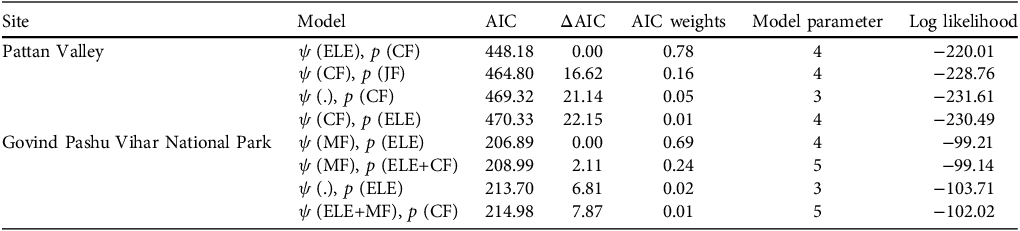
Among the various models, we examined the top four models (i.e. those with the lowest AIC values; Table 1), but restricted interpretation to the top model and the second-best (i.e. supporting) model. For Pattan Valley, the best model indicated that Kashmir musk deer occupancy (ψ, the probability that a species occupies a site; Fig. 2c) and detection probability (p, the probability of detecting a species during a survey given that the species is present) were influenced by elevation and conifer forests, respectively (Table 1), and the beta estimates indicated that these influences were positive (Table 2, Fig. 4a). Although the supporting model indicated that conifer forest positively affected occupancy, and juniper forest negatively affected detection probability, model selection indicated overwhelming support for the top model, with no competing models (all others had ΔAIC > 10).
Summary of the selected top four occupancy models for understanding the habitat use of the Kashmir musk deer Moschus cupreus in Pattan Valley, Himachal Pradesh, and Govind Pashu Vihar National Park, Uttarakhand.

Table 1 Long description
The table presents a comparison of the top four occupancy models for understanding the habitat use of the pashmir musk deer in Pattan Valley, Himachal Pradesh, and Govind Pashu Vihar National Park, Uttarakhand. It includes columns for site, model, AIC, delta AIC, AIC weights, model parameter, and loglikelihood. The table has six rows, each representing a different model with corresponding values. For Pattan Valley, the best model shows that occupancy and detection probability are influenced by elevation and conifer forests, respectively. The supporting model indicates conifer forest positively affects occupancy, and juniper forest negatively affects detection probability. For Govind Pashu Vihar National Park, the best model shows occupancy influenced by elevation and detection probability influenced by conifer forests. The table highlights the top models with the lowest AIC values and their respective influences on habitat use.
ELE, Elevation; CF, Conifer Forest; JF, Juniper Forest; MF, Mixed Forest.
Beta coefficient values and standard errors (SE) of top predictors influencing habitat use of the Kashmir musk deer in Pattan Valley, Himachal Pradesh, and Govind Pashu Vihar National Park, Uttarakhand.
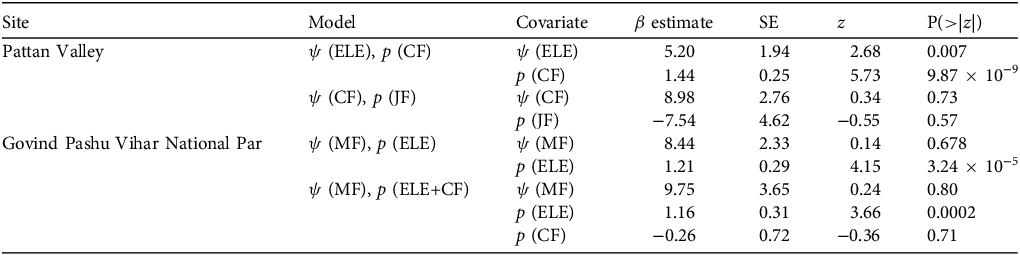
Table 2 Long description
The table presents beta coefficient values of top predictors influencing habitat use of musk deer in Pattan Valley, Himachal Pradesh, and Govind Pashu Vihar National Park, Uttarakhand. It contains four columns: Site, Model, Covariate, and Beta Estimate, Standard Error, Z value, and P greater than absolute Z value. The table has eight rows, each representing different models and covariates for the two sites. For Pattan Valley, the best model shows that elevation positively influences occupancy and conifer forests positively influence detection probability. The supporting model indicates conifer forest positively affects occupancy and juniper forest negatively affects detection probability. For Govind Pashu Vihar National Park, the best model shows mixed forest positively influences occupancy and elevation positively influences detection probability. The supporting model indicates mixed forest positively influences occupancy and elevation positively influences detection probability. The table provides detailed statistical values for each model and covariate, highlighting the significant predictors for musk deer habitat use.
ELE, Elevation; CF, Conifer Forest; JF, Juniper Forest; MF, Mixed Forest.
For (a) Pattan Valley, the influence of elevation on occupancy and of conifer and juniper forests on detection probability (Tables 1 and 2), and (b) Govind Pashu Vihar National Park, the influence of mixed forest on occupancy and of elevation and conifer forest on detection probability (Tables 1 and 2).

Fig. 4 Long description
The line graph consists of six panels, each depicting the relationship between different variables and their impact on occupancy and detection probability. The top row represents data from Pattan Valley, while the bottom row represents data from Govind Pashu Vihar National Park. In Pattan Valley, the left panel shows the positive influence of elevation on occupancy probability, with a solid line indicating the trend and dotted lines representing confidence intervals. The middle panel illustrates the positive effect of conifer forest on detection probability, and the right panel shows the negative effect of juniper forest on detection probability. In Govind Pashu Vihar National Park, the left panel demonstrates the positive influence of mixed forest on occupancy probability. The middle panel shows the positive effect of elevation on detection probability, and the right panel illustrates the negative effect of conifer forest on detection probability. All values are approximated.
In Govind Pashu Vihar National Park, the best model indicated a positive influence of mixed forests on occupancy (Fig. 3c) and of elevation on detection probability (Tables 1 and 2, Fig. 4b). The supporting model also indicated the same, but included a negative effect of conifer forests on detection probability (i.e. as the extent of conifer forests increased, the likelihood of detecting the species decreased).
Discussion
We utilized single-season occupancy models to investigate the influence of habitat and environmental factors on the habitat use of Kashmir musk deer in Pattan Valley and Govind Pashu Vihar National Park. The primary influences were elevation and some forest types, with no apparent influence of distance variables, topographic variables other than elevation, or anthropogenic variables.
For Pattan Valley, our findings indicate that the occupancy of Kashmir musk deer is influenced by elevation, and the likelihood of detection is influenced by the presence of conifer forests (Table 1); i.e. this musk deer is more likely to be found at higher elevations, and in areas with conifer forest. In this valley, Kashmir musk deer inhabit areas dominated by species of Pinus and Abies (i.e. conifer forest) at elevations of 2,946–4,418 m, where anthropogenic disturbance is relatively low (Subedi et al., Reference Subedi, Aryal, Koirala, Timilsina and Meng2012; Khadka, Reference Khadka2017; Singh et al., Reference Singh, Saud, Cram, Mainali, Thapa and Chhetri2018). This finding is consistent with earlier studies that reported an altitudinal range of 2,500–4,200 m for the Kashmir musk deer (Sathyakumar, Reference Sathyakumar1994; Vinod & Sathyakumar, Reference Vinod and Sathyakumar1999; Subedi et al., Reference Subedi, Aryal, Koirala, Timilsina and Meng2012; Ilyas, Reference Ilyas2014; Singh et al., Reference Singh, Saud, Cram, Mainali, Thapa and Chhetri2018). The positive influence of conifer forests on detection probability may be attributed to the thermal advantages provided by dense canopy cover, which helps reduce thermoregulatory costs in high-altitude environments (Dussault et al., Reference Dussault, Ouellet, Courtois, Huot, Breton and Larochelle2004; Maloney et al., Reference Maloney, Moss, Cartmell and Mitchell2005; Khadka & James, Reference Khadka and James2016). These conifer forests include P. smithiana, A. pindrow, T. wallichiana, P. wallichiana, B. utilis and Rhododendron campanulatum, which are widely distributed across the study area (Khadka & James, Reference Khadka and James2016).
However, for Govind Pashu Vihar National Park, mixed forests and elevation are the most influential factors affecting the occupancy and detection probability, respectively, of Kashmir musk deer. Mixed forests positively influence occupancy over an elevation range of 2,145–3,641 m (Table 1). These findings are consistent with previous studies reporting the species in mixed forest dominated by B. utilis, A. spectabilis and Quercus spp. (Singh et al., Reference Singh, Saud, Cram, Mainali, Thapa and Chhetri2018). The supporting model indicates that conifer forests negatively influence detection probability in Govind Pashu Vihar National Park, suggesting reduced detectability of Kashmir musk deer with increasing conifer forest. In our field surveys, we found most pellet and latrine sites in mixed forests comprising B. utilis, Q. semecarpifolia, A. spectabilis and R. campanulatum. These forests likely provide abundant forage, and sufficient cover for avoiding predators such as the common leopard Panthera pardus. As Kashmir musk deer are territorial and use latrine sites for scent marking, mixed forests may provide favourable conditions for territorial behaviour by offering adequate shelter, canopy cover and suitable substrates for latrine establishment (Shrestha & Meng, Reference Shrestha and Meng2014). Dense canopy cover may also help preserve the chemical signals of faecal markings by maintaining moisture and reducing exposure to direct sunlight, thereby facilitating effective chemical communication.
The differing habitat associations of the musk deer in the two landscapes (i.e. with conifer forests in Pattan Valley and mixed forests in Govind Pashu Vihar National Park) suggest the species does not respond uniformly to forest type. The potential negative influence of conifer forests in the National Park does not imply, however, that the deer completely avoids this forest type. Rather, our results indicate that Kashmir musk deer preferentially utilize high-altitude habitats, with habitat use varying according to forest composition within the landscape. These findings are consistent with previous studies showing that musk deer occupy a variety of forest types across the Himalayas, including fir and birch forests in Sagarmatha National Park (Aryal et al., Reference Aryal, Raubenheimer, Subedi and Kattel2010), mixed and rhododendron forests in the Gaurishankar Conservation Area, Nepal (Shrestha & Meng, Reference Shrestha and Meng2014), pine and fir forests in Nepal (Khadka & James, Reference Khadka and James2016), and fir-dominated forests in the Annapurna Conservation Area (Singh et al., Reference Singh, Saud, Cram, Mainali, Thapa and Chhetri2018). The elevations at which we recorded Kashmir musk deer (2,946–4,418 m in Pattan Valley and 2,145–3,641 m in Govind Pashu Vihar National Park) fall within the broadly reported Himalayan altitudinal range of 2,500–4,800 m (Timmins & Duckworth, Reference Timmins and Duckworth2015; Singh et al., Reference Singh, Saud, Cram, Mainali, Thapa and Chhetri2018) and are consistent with earlier studies that documented narrower elevation ranges within this broad interval, including 2,500–4,200 m (Vinod & Sathyakumar, Reference Vinod and Sathyakumar1999; Ilyas, Reference Ilyas2014), 3,200–4,200 m (Singh et al., Reference Singh, Saud, Cram, Mainali, Thapa and Chhetri2018), and 3,600–3,800 m (Subedi et al., Reference Subedi, Aryal, Koirala, Timilsina and Meng2012). Adaptations such as insulating hollow hair and relatively longer hind limbs enable Kashmir musk deer to survive and move efficiently in steep and cold high-elevation environments (Green, Reference Green1985; Futuyma & Moreno, Reference Futuyma and Moreno1988). Our findings and research elsewhere thus indicate the importance of high-altitude forest habitats for the conservation of the Kashmir musk deer in the Himalayas. We recommend that conservation managers in Uttarakhand and Himachal Pradesh prioritize the protection and management of suitable high-elevation forest habitats to support long-term persistence of the species.
The Kashmir musk deer is categorized as Endangered on the IUCN Red List, primarily because of the threats of poaching and habitat loss (Timmins & Duckworth, Reference Timmins and Duckworth2015). Anthropogenic disturbances such as medicinal plant extraction, fodder collection, and extensive livestock grazing pose potential threats to the species (Sharief et al., Reference Sharief, Singh, Dutta, Kumar, Bhattacharjee and Mukherjee2023). Our modelling did not, however, indicate any influence of anthropogenic variables (including hunting) in Pattan Valley and Govind Pashu Vihar National Park. Considering the importance of Pattan Valley as habitat for the Kashmir musk deer, we recommend its designation as a protected area. For Govind Pashu Vihar National Park, we recommend updating its notification to incorporate potential special protected zones for Kashmir musk deer habitat. As high-altitude conifer and mixed forests are of principal importance for the Kashmir musk deer, the conservation focus in Uttarakhand and Himachal Pradesh should be the maintenance of these forest types over the species’ elevation range. Considering the Endangered status of the Kashmir musk deer, and its significance as the state animal of Uttarakhand, we also recommend the establishment of a long-term monitoring programme for the species, to assess the causes of any population decline and inform the implementation of targeted conservation efforts for its long-term viability.
Supplementary material
The supplementary material for this article is available at doi.org/10.1017/S0030605325000262
Authors contributions
Conceptualization, study design: AS, LKS, BDJ; field work: AS, VK, HS; data analysis: AS, BDJ, writing: AS, LKS; revision: LKS, CG, CR, BDJ, MT.
Acknowledgements
We thank the Chief Wildlife Warden, Forest Department, Himachal Pradesh and Uttarakhand, and the Governments of both states for granting the necessary permission to undertake field surveys; Divisional Forest Officers, Lahaul Forest Division, and Govind Pashu Vihar, National Park, Uttarakhand for their support during fieldwork; and the Zoological Survey of India team for logistical support.
Conflicts of interest
None.
Ethical standards
As animals were neither captured nor handled and all data collection was non-invasive, formal ethical clearance was not required. The study followed the Oryx ethical guidelines. Camera traps were deployed in forested areas away from settlements and were used solely for wildlife monitoring purposes. Any inadvertently obtained photographs of people were treated as confidential, were not stored for analysis, and were deleted. No images of individuals were used, shared or published.
Data availability
Data are available from the corresponding author upon reasonable request.




 Open access

