Introduction
The Tibetan antelope or chiru Pantholops hodgsonii, endemic to the Tibetan plateau, is categorized as Endangered on the IUCN Red List (IUCN, 2006) and listed on Appendix I of CITES (CITES, 2000). In China it is a Class I protected species (State Forestry Administration of China, 1998). The distribution of the Tibetan antelope extends from Ngoring Hu in China and the Ladakh region in India in the west to Ganzi of Sichuan Province in the east, and from the Himalayas in the south to the Kunlun and Altun mountains of Xinjiang in the north (Wu & Feng, Reference Wu and Feng1996; Schaller et al., 1998). Most of the species’ range lies at >4,000 m altitude, although in parts of Xinjiang the species formerly occurred as low as 3,250 m. The chiru prefers flat to rolling topography and alpine steppe or similar semi-arid plant associations, and although its distribution was probably continuous in the past it is now fragmented (Schaller, Reference Schaller1998).
There are no accurate historical estimates of chiru numbers (Schaller, Reference Schaller1998), although a few early explorers made some observations (Bonvalot, Reference Bonvalot1892; Wellby, Reference Wellby1898; Deasy, Reference Deasy1901). Schaller (Reference Schaller1998) estimated an historical population of 500,000-1,000,000 based on the limited information available. In the past 30 years the population is believed to have declined rapidly, mainly because of poaching for shahtoosh, and the total population in the mid 1990s may have been as low as 65,000-75,000 (Schaller, Reference Schaller1998).
Seasonal migration is one of the main characteristics of chiru ecology and reproduction. Each summer adult females and their female offspring of the previous year travel c. 300 km from their winter mating grounds to summer calving grounds. Males tend to remain near the wintering grounds. In late June to July single calves are born. Formerly there were at least four, and possibly more, major migratory populations on the Tibetan plateau (Schaller, Reference Schaller1998). The grasslands surrounding Zhuonai and Taiyang lakes, in the north-west of Hoh-xil National Nature Reserve, have been identified as major current calving grounds of Tibetan antelopes (Feng, Reference Feng1991), and females of the population discussed here migrate from Sanjiangyuan to Hoh-xil each summer, and return each autumn.
This population was formerly subjected to poaching but is now one of the best protected chiru populations. However, the newly built Qinghai-Tibet railway and the existing highway both cut across the population’s migration corridor at the boundary between Hoh-xil National and Sanjiangyuan Nature Reserves (Xia & Yang, Reference Xia and Yang2004a,Reference Xia and Yangb,Reference Xia and Yangc), 130-150 km from the calving grounds. The highway (the Xining-Lhasa section of the National Trunk Highway no. 109) begins in Xining, Qinghai Province, in the north and ends in Lhasa in Tibet. Construction began in 1950 and it was opened in December 1954. It crosses the Kunlun mountain, Hoh Xil and Tanggula mountains and the Zangbei plateau, with a total length of 1,900 km; the road is 10 m wide. The highway is the most important transportation lifeline to the Tibetan plateau, carrying nearly 85% of Tibet’s inbound and outbound goods. Construction of the Golmud to Lhasa section of the Qinghai-Tibet railway began in June 2001; it is built along the Golmud river, goes across the Kunlun mountain, through Hoh Xil and Fenghuo mountain, across Tuotuo river and into Tangula mountain, passes along the Damxiong and Yangbajing valley, and ends in Lhasa, Tibet. To ensure that Tibetan antelopes and other species could cross the railway, 15 animal passages were built in the area of their migratory route but no corridors have been built across the highway (Yang et al., Reference Yang, Xia, Lei and Feng2003).
Little is known about the disturbance of Tibetan antelope by road traffic (but see Qiu & Feng, Reference Qiu and Feng2004) and there is almost no information and experience concerning the use of passages. Here we report on the monitoring of the impacts of transportation infrastructures on this migratory herd of Tibetan antelope and suggest some mitigation measures for these impacts.
Study area
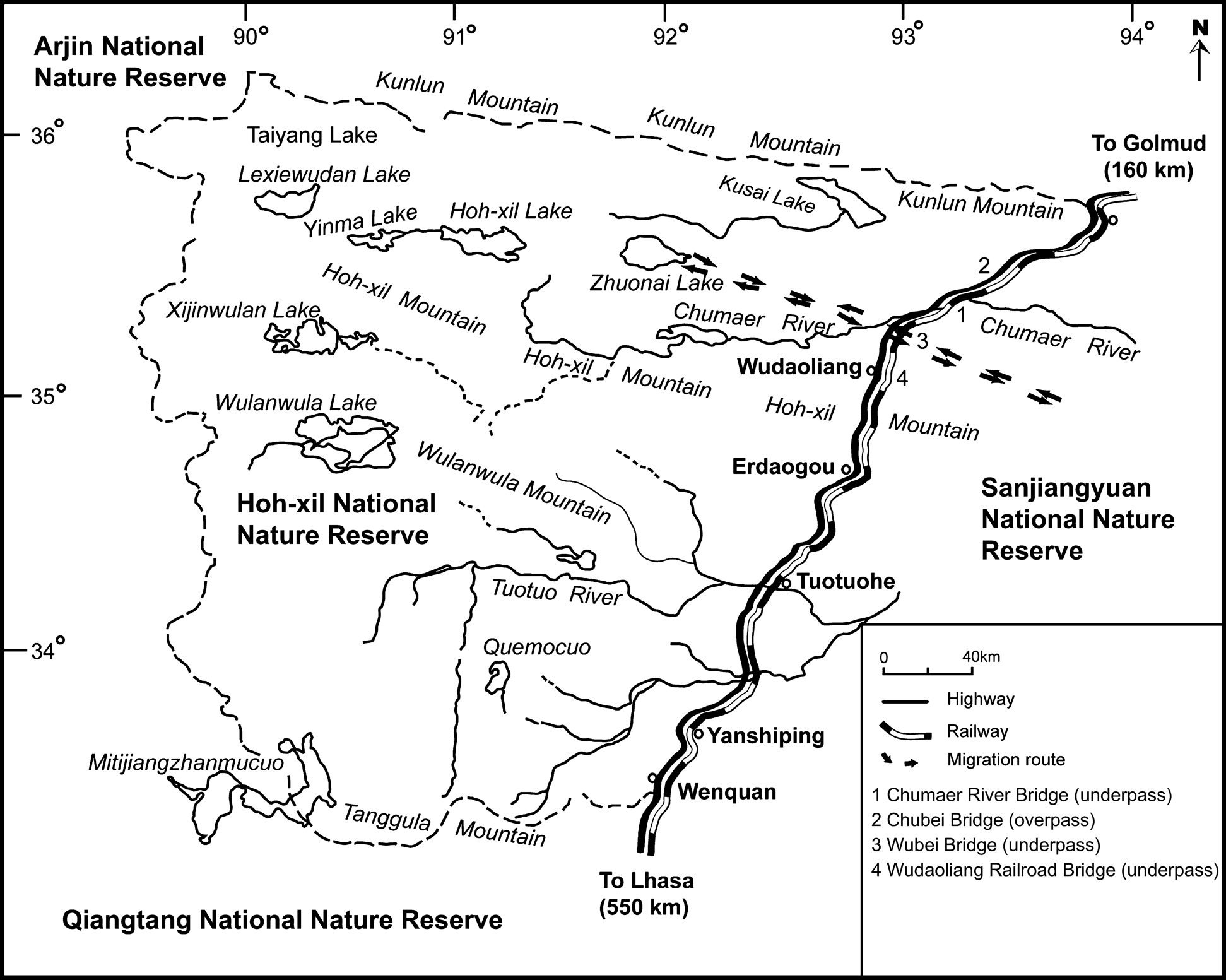
The Hoh-xil National Nature Reserve, Qinghai Province, has an average altitude of 4,500 m (Liu & Yin, Reference Liu and Yin1993). The topography consists of rolling hills and shallow gullies, and the habitat is high altitude steppe, alpine meadow and gravel-filled gullies, entirely without trees or shrubs. Fieldwork was conducted from Chumaer river to North Wudaoliang, along the newly built Qinghai-Tibet railway and the parallel highway on the boundary of Hoh-xil and Shanjianguyan National Nature Reserves (Fig. 1). The monitoring area was a 10 km width of the migration route that included the following crossing structures:
The study area in the Hoh-xil National Nature Reserve, indicating the location of the chiru migration route and the railway crossing structures (see text for further details).

(1) Underpass at Chumaer River Bridge. This location used to be the most important part of the migration route in this area. The main structure was finished in 2003 and put into use in 2004 but the land surface under the bridge was destroyed by construction machinery and not cleared. Although the construction was halted during the chiru migration, the workers remained at the site. (2) Overpass at Chubei Bridge. This is 2 km north-west of Chumaer River Bridge. The construction was unfinished at the time of this study, and human activities continued. (3) Underpass at Wubei Bridge. This has become the main route for Tibetan antelope migration in this area. The main construction was completed in June 2004 and most of the workers departed, together with most of the machinery, but there is still some machinery and debris under the bridge. (4) Wudaoliang Railroad Bridge. This was not designed for passage by Tibetan antelopes but could be used by them as an underpass. There is a large open area near the passage, a construction site nearby, and part of the structure was still being built during this study. (5) Other small bridges and culverts. Most of these are 1-2 m in height and 5-10m long. They are dark, narrow corridors, and the land surface under the bridges has not been cleared of debris or restored.
Methods
Over 15 June-31 August 2004 we used video cameras, counts and observation to monitor the movement of the migrating herd of Tibetan antelopes along the highway and railway. Video cameras were used in two underpasses (Chumaer River Bridge and Wubei Bridge) to record the passage of antelopes. The cameras can work for 8-10 hours continuously, with a solar power supply during the daytime. Four video cameras were mounted under each of the two bridges, i.e. 8 in total, and recording was with a time lapse video recorder.
During the observation period 56% of the days were cloudy, and snow and rain occurred on 28% of the days, limiting video recording. At such times we therefore made direct counts of the number of passing chiru, including group sizes, with a 15–45x telescope in the daytime (chiru rest at night). A group was defined as all individuals within 50 m of each other. Yearlings and adults are difficult to differentiate at a distance, and only composition of those herds for which determinations are judged to be reliable were included in subsequent analysis of herd composition.
In the area of the crossing structures we also carried out daily monitoring, by vehicle, for any chiru that crossed the highway or crossed directly over the railway without using any crossing structures. In addition we recorded human activities brought by the highway, traffic flow on the highway, and crossings by chiru from 09.00 to 20.00 during 6 peak days of the western migration.
Results
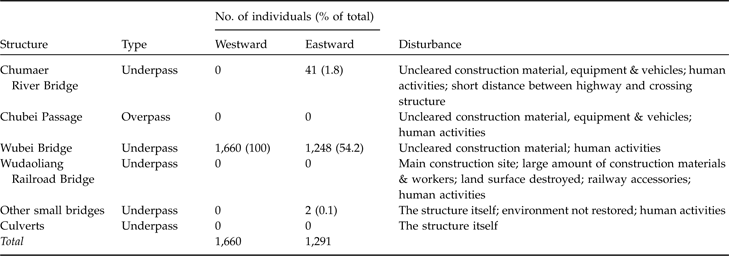
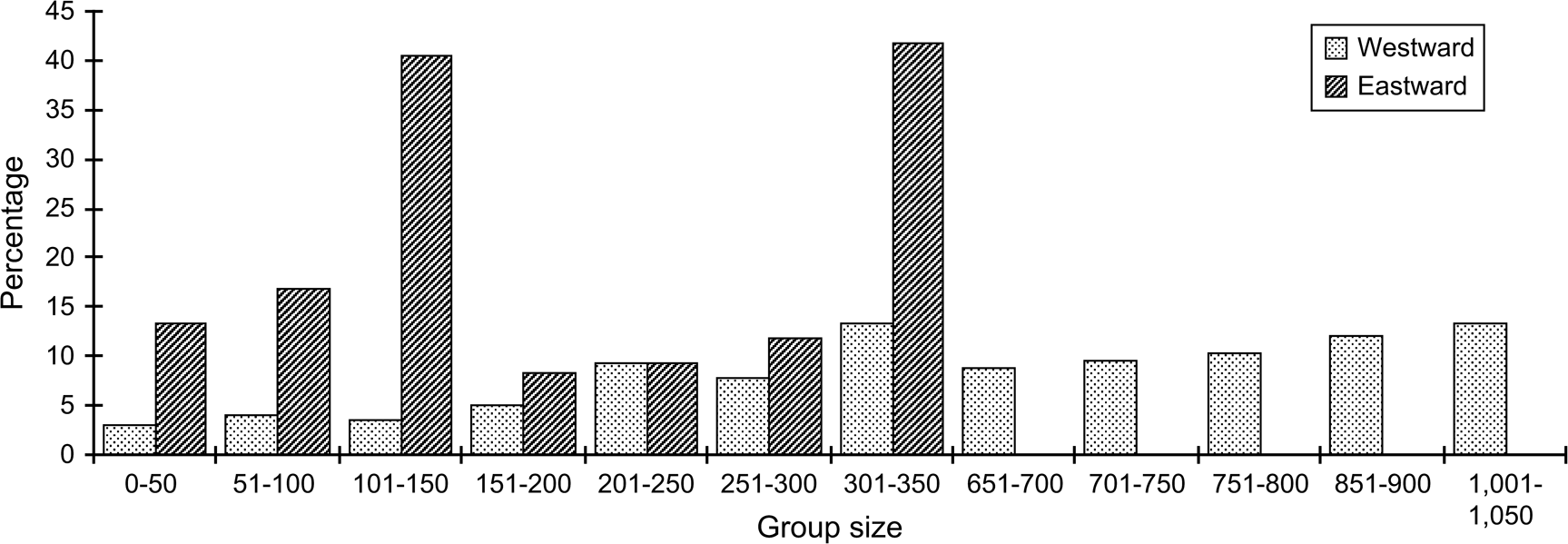
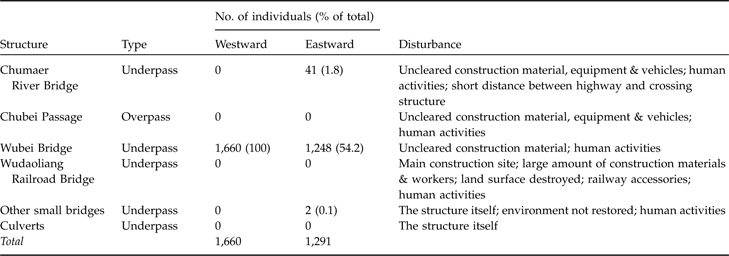
From 21 June to 2 July 2004 1,660 chiru were counted at Wubei Bridge as they moved westward from their wintering range in Sanjiangyuan National Nature Reserve to their calving grounds in Hoh-xil National Nature Reserve, including adult and subadult females and nine newborn (Table 1), and all used the underpass. The construction of the railway near the underpass was halted during the migration. Chiru had a tendency to form large herds in the underpass. We recorded 29 groups, with an average size of 256.9; 67.4% of individuals formed groups >300 (Fig. 2). None of the other passage structures were used by the chiru during this period.
The number of chiru using the various crossing structures (Fig. 1) along a 10 km stretch of the railway during the westward (21/6–2/7) and eastward (8/8-29/8) migrations, and the types of disturbance at each structure.
Percentage of total monitored chiru in different group sizes during the westward (21/6#x2013;2/7) and eastward (8/8-29/8) migrations.
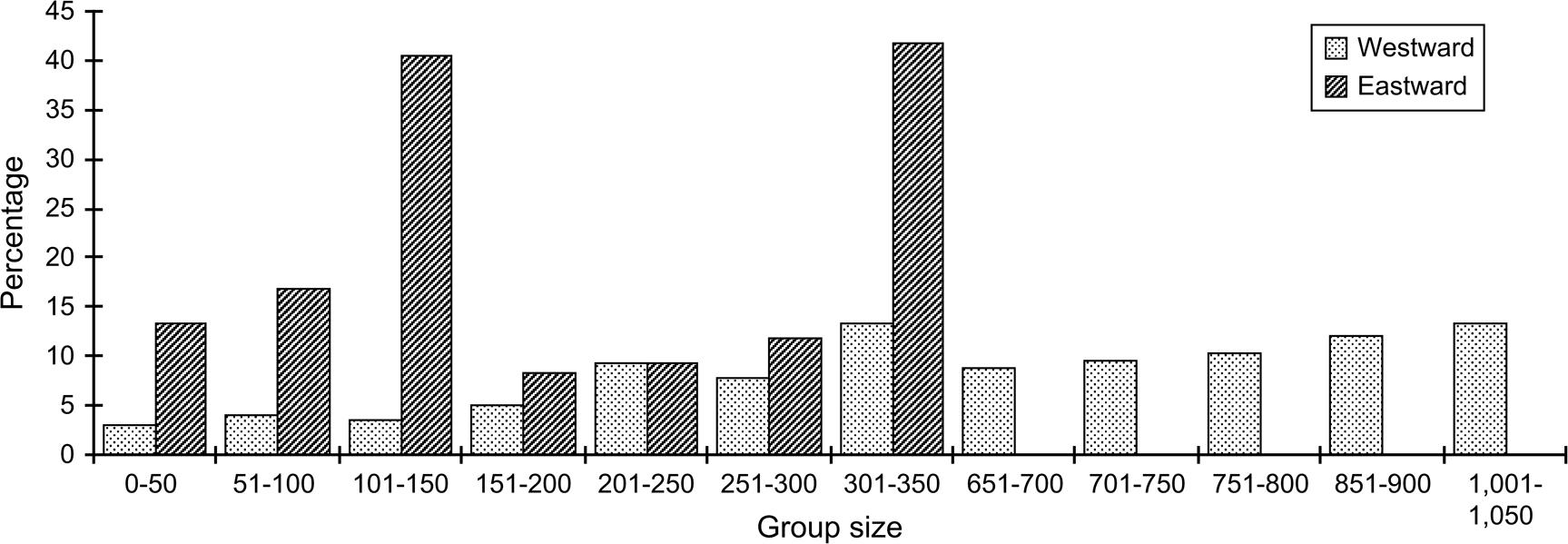
In late July antelopes returned with their newborn from the calving grounds to their winter range. In 51 groups sampled randomly, we recorded 1,008 newborn and 1,894 adult and subadult females, i.e. a ratio of young to females of 53:100. These groups were smaller in size (Fig. 2), but individuals were more dispersed than in the westward migration; no groups had >350 individuals, and average group size was 87.7. Construction was suspended for the migration from 8 August, but after 18 August construction near the underpass at Wubei Bridge resumed and no individual chiru were recorded using underpasses after this date. From 8 to 29 August a total of 2,303 individuals were recorded crossing the railway. Compared to the westward migration, however, a lower percentage of the antelopes used the underpass at Wubei Bridge, a few used the underpass at Chumaer River Bridge, and two passed through a culvert (Table 1). In addition to the 1,291 chiru counted using these crossing structures, 1,202 (44% of the total) were counted crossing the rail bed directly, 517 during the period when construction was suspended and 495 during the construction period.
The railway is a physical barrier and its impact on the activity of chiru was visibly apparent. When antelopes reached the railway they hesitated under the slope of the rail bed and gathered into large groups. The modification of the land surface in the underpasses and along the railway appeared to have a major effect. For example, one afternoon we saw a small group of chiru, which had just crossed the highway, running along the railway. They reached a small bridge 10 m long and 2 m high and made some attempts to cross under it; one adult passed through it successfully but on the other side she stopped by a piece of railway track debris and turned back. This also happened sometimes when a small hole, bricks, or tools used in construction were left in an underpass. The antelopes seemed wary of anything on the land surface of the underpasses, although they sometimes ignored the train running over the railway above.
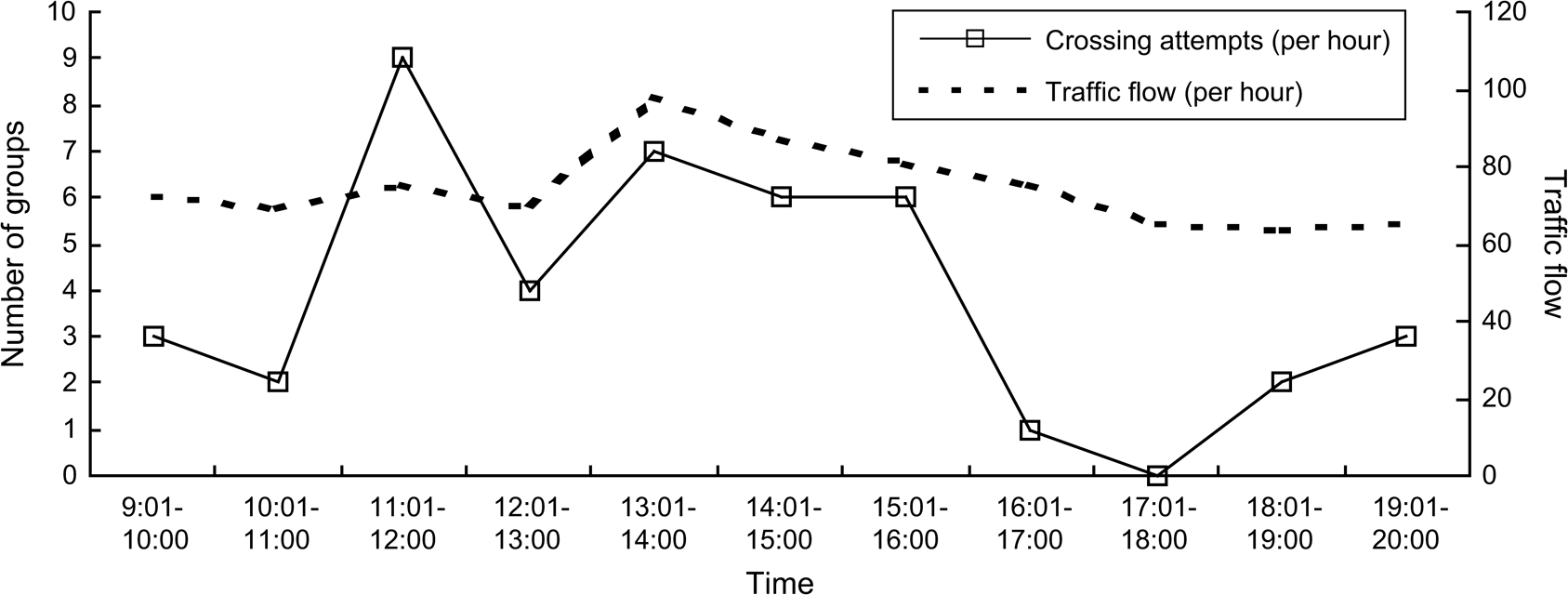
Average traffic flow recorded on the highway during 6 days was 1.2 vehicles per minute, with a maximum at 13.00–14.00 (Fig. 3) when flow reached 3.3 vehicles per minute. There was a high frequency of crossings by chiru during the most busy period of traffic (Fig. 3).
Traffic flow on the highway and crossing attempts made by chiru, recorded during 6 peak days of the western migration.

Discussion
Within the 10 km of railway studied all chiru passed through the crossing structures on their westward migration and 56% used the crossing structures on the return eastward migration. Therefore, although the railway structure itself does have significant impacts on the behaviour of chiru during migration, it does not disrupt the migration corridor. According to railway construction planners and the Qinghai Environmental Protection Bureau the area affected by the rail bed’s construction is to be returned to its original condition, and we saw some turf being transplanted back to the rail bed. In general the swathe of tundra disrupted by railway construction is narrow but the most disturbed areas are the staging areas and sand quarries located off to the side of the railway. As the main structure of the railway is finished the condition of passage for chiru will improve. However, where construction debris still occurs under the crossing structures or along the railway, the use of passages by antelope is affected. Once the railway construction firms have removed all equipment and restored the vegetation we believe that the efficiency of crossing structures will be improved.
The railway does not appear to be disturbing the birth rate of chiru. During 1990-1993 the ratio of young to females ranged from 30:100 to 50:100 during August-October in Qiangtang (Schaller, Reference Schaller1998), another part of the winter range of chiru. We recorded a slightly higher ratio, of 53:100, but mortality of calves can be expected to continue during the migration. We expect the final ratio of young to adult females will drop to 30:100 - 40:100 by the autumn as Schaller (Reference Schaller1998) noted that one third of the young died during the winter and early spring.
On the return, eastward migration, the chiru first meet the highway, and if they fail to cross it they will not then cross the railway. Of the four highways on the Tibetan plateau the condition of the Golmud-Lhasa highway is the best. In the rainy season buses, trucks and other vehicles select this route because of safety considerations. Use of the railway will probably change this situation for the better, reducing traffic flow. By 2007, 16 trains will travel between Golmud and Lhasa every day, and the pressure of road traffic may be reduced.
Human activities, including the activities of tourists, railway construction workers and other persons brought by highway, were the most serious factor that affected the efficiency of all crossing structures. Chiru are active in the daytime and therefore cannot avoid the disturbance of human activities. The migration season is in summer, which was the busiest period for construction of the railway and other activities on the plateau. We observed that activities along the highway such as chasing, shouting, and taking pictures scattered the chiru herd, making it difficult for them to cross. Although during the short periods of the westward and eastward migrations all construction activities were limited near the main wildlife passages, the activities of tourists and truck drivers were not controlled. Increasing human presence associated with railways and highways may be the main threat to this species now and in the future, and may be greater than the threat from the infrastructures per se.
Based on our monitoring and the evaluation of the crossing structures, we make the following recommendations: (1) Continue to halt or limit human activities near wildlife passages in future migration seasons. The activities of tourists, researchers and truck drivers should also be limited by the managers of the neighbouring reserves. (2) Ensure that the Transportation Department removes all equipment and restores the vegetation at all construction and repair sites. (3) The highway will be refurbished by 2009. The refurbishment should include the construction of passages to reduce the negative effects of the road as currently there are no crossing structures on the highway. (4) The railway is at the boundaries of the Hoh-xil and Sanjiangyuan National Nature Reserves but the railway and highway are managed by the Transportation Department. The chiru moves across land managed by all three bodies, however, and there needs to be improved cooperation between the the two reserves and the Transportation Department to reduce disturbance to the migration of the chiru. (5) We found that the local people living in the vicinity of the migration route and people who travel by the road lack general knowledge about the chiru and of wildlife conservation in general. More efforts should be made to strengthen the education of the public, with programmes designed for people with different educational backgrounds, drivers on the highway, and workers on the highway during the forthcoming refurbishment. Efforts are needed not only to improve public awareness of Tibetan antelope conservation and to counter any potential poaching, but also to increase general knowledge of conservation and the importance of the wildlife passages. (6) Further research on the effects of both the railway and road on the migration of chiru are required, including long-term monitoring of the migration. In any future transportation developments in this region the government and Transportation Department will require information to make appropriate conservation plans for any periods of construction.
Our monitoring results and recommendations were passed to the Bureau of Forestry (which manages Sanjiangyuan Nature Reserve), the Transportation Department, and the administration of Hoh-xil National Nature Reserve. The information was used by both the local government and transportation agencies to make conservation plans for the migration season of 2007. Monitoring of migration and evaluation of the wildlife corridors will continue to be supported by the Ministry of Railways. Further research is planned to assess the disturbance to mammals along the railway and the highway up to 2008.
Acknowledgements
This study received financial support from the BP Conservation Programme and the Chinese Ministry of Railways. We express our gratitude to Fauna & Flora International, the Wildlife Conservation Society, Conservation International, and BirdLife International. We also thank William Bleisch and an anonymous reviewer for help in revising the manuscript and for other useful advice.