




Introduction
Whether as ornaments to the main argument or just as credentials demonstrating membership of a certain academic milieu, footnotes are marks of the professional life of historians and scholars in general. They prove or reject other theses in politely explicit or implicit ways. They show the grounds on which explanations are based, tracing archival sources and theoretical affiliations. Footnotes tell us marginal stories or indicate potential ones. These reflections, among many others, were thoroughly examined by Anthony Grafton in his seminal book The Footnote. A Curious History (1997). My contribution to the special issue starts, indeed, from some footnotes in the ground-breaking scholarship of Paul Gootenberg’s history of cocaine developed over the past decades.Footnote 1 These footnotes refer to the marginal, albeit with potential, episode of the Italian pharmacist Enrique Pizzi who claimed to have been the first to isolate cocaine in his Botica y Droguería in La Paz, Bolivia, in the year 1857, some time before Gaedke’s and Niemann’s experiments.
This claim, known to an expert audience as early as the 1880s, has been overlooked or underestimated for reasons that I will explain in this paper; it includes some of the key questions posed recently by global historians regarding the role of archival sources, positionality, and the pre-eminence of Anglo-American scholarship.Footnote 2 Arguably, Pizzi’s discovery fell into oblivion because of his failed professional career in Bolivia, or because the practical orientation of his pharmaceutical knowledge did not lean towards active academic publishing in more structured scientific networks, such as German academia of the time. Histories of cocaine have usually judged Pizzi’s studies as fraudulent or “unsuccessful,” following the intermediation of the Swiss naturalist and diplomat Johann Jakob von Tschudi with German chemist Friedrich Wöhler.Footnote 3 As a parallel case of what Marcos Cueto coined as “scientific excellence on the periphery,” similar to that studied by Gootenberg around the figure of the French immigrant pharmacist Alfredo Bignon and his cocaine research in Peru, Pizzi’s Bolivian discovery (or, in any case, his claim) and the later historization, first in the late nineteenth century and then at the turn of the twentieth-first century, reveal a troubled story in a well-established narrative. Based on new evidence, including archival and primary sources located in Bolivia, Peru, Italy, Germany, Switzerland, and Austria, this contribution resituates Italian scientific networks in South America during the mid-nineteenth century (a period before the more-widely studied mass migration) and problematizes Tschudi’s assertions. As a highly authoritative voice on Andean matters, he first supported Pizzi’s cocaine but then changed his mind when Wöhler proved his “failure.”Footnote 4 By including overlooked sources and critically reading Tschudi’s shifting testimony, the figure of Pizzi and Bolivian cocaine research might be re-evaluated, at least, as a parallel history of simultaneous discovery.
The footnotes in question were published first in Gootenberg’s article in Comparative Studies in Society and History [CSSH] (2007) and then in his acclaimed book Andean Cocaine (2008):
Bignon’s forgotten analogue of “excellence on the periphery” may have been Enrique Pizzi, an Italian pharmacist teaching in La Paz, Bolivia, rumored to have made cocaine in situ in 1857 (at behest of von Tschudi) shortly before both Gaedecke’s contested try (1858) and Niemann’s successful isolation (1860). Wöhler’s test of Pizzi’s preparation falsified it. Cited as fact in some Bolivian texts, we know nothing about Pizzi.Footnote 5
There is the unverified “Bolivian” claim of the very first “industrialization of coca” in La Paz by pharmacist Enrique Pizzi in 1857, three years before Niemann (Mortimer, History of Coca, 294); a few Bolivian coca elixirs also won fame.Footnote 6
Previously, Gootenberg described Pizzi as “an obscure Italian pharmacist working in La Paz.”Footnote 7 Based on the dominant narrative about the “obscurity” of Pizzi and the falsification of his preparation by prominent German chemist Wöhler, Gootenberg pointed to the comparability of Pizzi with the French-Peruvian Bignon as cases of “lost excellence on the periphery.” These two arguments already show the pre-eminence of French and German cutting-edge research over the Italian immigrant, and of the Peruvian research over the Bolivian in a book about “Andean Cocaine.” This hierarchy emphasizes a long tradition of favouring Central European science, something that has been indicated by some historians as part of a hegemonic Anglo-American scholarship about Latin American history of knowledge.Footnote 8 Furthermore, Gootenberg indicated the scarcity of evidence about Pizzi, first stated as “nothing” in the article published in CSSH. In the book, though, he adds a reference to the research of the Bolivian scholar Javier Mendoza about a “true history of cocaine,” which provides an analysis of the few sources about Pizzi.Footnote 9 Despite this reference, he describes in a later footnote once again the “unverified claim” of the first industrialization of coca in Bolivia. As this paper reevaluates, Mendoza’s contribution is backed up by archival evidence and thus the claim “unverified” seems unjustified. Indeed, Mendoza’s argument is based on one of the few available sources written by Pizzi, namely, “Cocaïna: Nueva basis orgánico-vejetal,” published in 1858 in La Paz.Footnote 10 Truth and verification seem to be at the core of the Italo-Bolivian missing link. These are not limited only to the fact of the discovery, but also to the task of historians and their capacity to access and interpret sources, not to mention the platform and circulation of their publications. The footnotes here, as explained by Grafton, worked to demonstrate sufficient comprehensive knowledge about the existing scholarship in a globalizing academia, while pushing to the margins the more complicated, fragmented story of Italian pharmacist Pizzi in Bolivia.
This paper aims to reconstruct and connect both the first historiographical moment of the story about Pizzi in the late-nineteenth century and the second, contemporary account at the turn of the twenty-first century based on the work of Gootenberg. For this purpose, I analyse in the first section the research of Bolivian historian Mendoza and the scarce available sources about Pizzi. In light of these sources and Mendoza’s suggestive interpretation, I then reconsider in the second section the agency of Tschudi in this episode who, as a renowned scholar both in the Andean context and in European scientific networks, turned Pizzi’s discovery into a failure. Tschudi’s overlooked role in shaping the verifiability of this claim is a paradigmatic case in the debates about knowledge circulation in its global setting. Based on Kapil Raj’s critical approach, I take into account the asymmetries of power in the processes of encounter, negotiation, and reconfiguration of knowledge production; in other words, circulation should not be conflated with fluidity.Footnote 11 As a go-between in several transatlantic networks, Tschudi had a decisive influence on first claiming and then delegitimizing Pizzi’s discovery and thus leading him to the footnotes of the history of cocaine.
The asymmetries in the history of cocaine are not only part of the past but also embedded in the historiographies that have shaped it. After several flourishing decades, global history has begun to receive methodological criticism. As Martin Dusinberre put it, different kinds of histories can be heard “when divergent archival contexts and epistemologies are brought into conversation with one other.”Footnote 12 By reconsidering the Italian-Bolivian missing link, this article seeks to recover a crucial episode that has been largely neglected by Anglophone scholarship. I argue that scholars such as Paul Gootenberg and others omitted this episode because they appeared to follow the final conclusions of German chemists and the Swiss naturalist von Tschudi. The article proposes a close reading of Tschudi’s correspondence and publications, which are typically interpreted as objective and factual. However, by reading them against the grain, it demonstrates how Tschudi initially intended to support the claim that Pizzi’s discovery was successful, but later changed his position in alignment with the authoritative voices of German chemists.
By altering his own claims, Tschudi ultimately supported German scientific authority, which subsequently shaped the dominant narrative about cocaine. As Michel de Certeau reminds us, there is a fundamental difference between those who hold the power of writing and those who do not.Footnote 13 Tschudi used his intermediary role to amplify certain perspectives. In contrast to his authoritative role, the biographies of the Italian scientists involved—who moved between Bolivia, Peru, and Chile—highlight the scarcity of available sources by these second-tier figures, especially when compared to scientists like Tschudi who returned to Europe and published extensively. This article addresses that gap by incorporating sources from local archives and libraries in Bolivia, while also critically examining Tschudi’s evidence. Furthermore, this symmetrical treatment of sources engages with current debates in methodologies of global history, particularly those aiming to decenter hegemonic narratives. The proposed, more inclusive interpretation of the history of cocaine does not seek to undermine Gootenberg’s pioneering work, but rather to diversify it—a central aim of global historical research. Such inclusive histories go beyond success-and-failure narratives, as these are often ad hoc interpretations. By revisiting the assumed “failure” of the Italian-Bolivian scientists, this article offers an alternative lens for reframing how global historians of knowledge and drugs assess sources that are fragmented and scarce.
The Viennese scientific networks examined in this paper illuminate, lastly, the often neglected transimperial entanglements of the Habsburg Empire in Latin America, as well as its constitutive role in shaping Germanophone scientific cultures within (post-)colonial contexts. This case further advances recent revisionist scholarship on the Hamburg Empire’s activities in extra-European spaces, which has predominantly underscored its collaborative linkages with other European colonial enterprises in Asia and Africa.Footnote 14 More specifically, the paper foregrounds modes of informal imperialism through which sites such as La Paz and the Bolivian Yungas were integrated into the epistemic and institutional orbit of Vienna. Alongside the bioprospecting of raw materials, mining and cartography in the region constituted two other domains of expertise that anchored Habsburgian economic aspirations and geopolitical interests. Tschudi’s biography exemplifies these interconnections, which demand further scholarly attention in order to foster a global and transimperial historiography of the Habsburg Empire.Footnote 15 Hence, this paper critically reevaluates Habsburgian networks in the development of cocaine’s history and in the attribution of its “discovery” to Niemann.
“Coca vera boliviana”: The Italian connection in the first industrialization of Bolivian coca
The first news an English readership had about Pizzi’s discovery was through the London weekly magazine Chemist and Druggist in the year 1886 (Fig 1).Footnote 16 More than a century before Gootenberg’s Andean Cocaine of 2008, this news was canonized in the classic study History of Coca: “The Divine Plant” of the Incas (1901) by the American surgeon W. Golden Mortimer.Footnote 17 Both references are based on a larger open letter written by another Italian immigrant, Clemente Torretti, a professor of Pharmacology and Chemistry at the University of La Paz working in the same Botica y Droguería as Pizzi, to Bolivian political leader Aniceto Arce in the journal El Nacional in 1885.Footnote 18 There, he referred to his private correspondence with Tschudi and a German physician living in Valparaiso, Achilles Ried, both certifying the veracity of the discovery. More than a mere rumour, as can be deduced from the short, summarized mentions in English, Torretti provided a detailed account of Pizzi’s cocaine and his research in the laboratory of La Paz. This letter reveals the history of Bolivian cocaine research and its commodification, paralleling Gootenberg’s account of Bignon and the Peruvian research commission, which constitutes the core of his book. Indeed, both sides of the “Andean cocaine” story were infused with nationalist narratives in the context of the institutionalization of a scientific research agenda, very well connected with interests in commodification. Torretti’s letter explicitly addressed the potential trade of Bolivian coca in Europe, but also the need to export cocaine itself. This letter should thus be understood within the context of the formation of a Bolivian “commodity” identity.Footnote 19
“Cocaine in 1857,” Chemist and Druggist, 27 March 1886, 226.

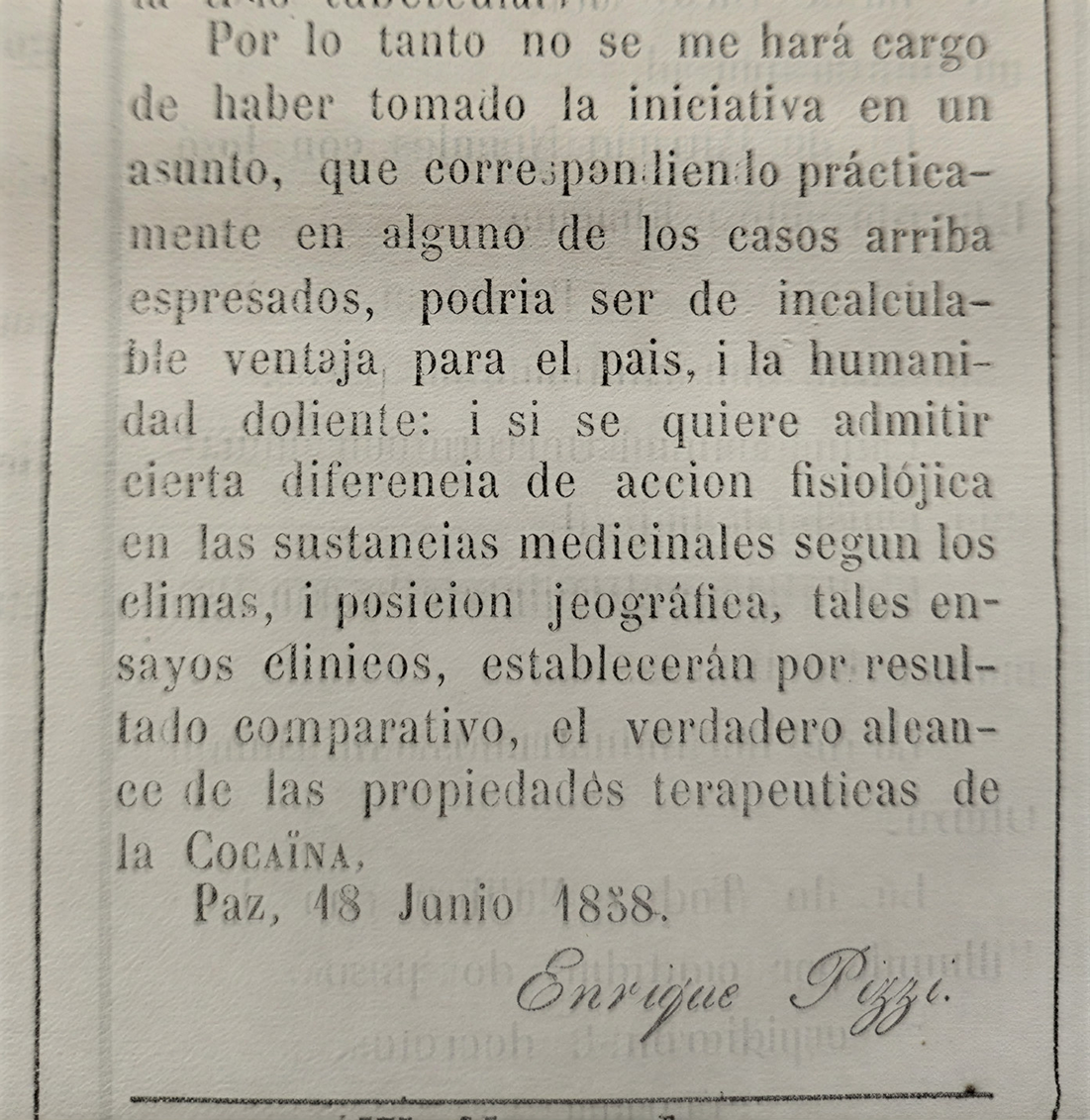
Leaving aside the traditional and millennial Indigenous applications of coca leaves, the “modern” history of Bolivian cocaine science may begin, as already noted by Torretti and later by Bolivian historian Mendoza, with the publication of Pizzi’s discovery in the Bolivian Gaceta Oficial on 30 July 1858 (Fig. 2). This source, inaccessible to an American and European academic community at the time, remained forgotten until 1993 when Mendoza published his “new” history of cocaine. But even today (particularly during the Covid-19 pandemic when the Bolivian National Archives became a testing and vaccination centre) this source remains difficult to access. The broken circulation of Pizzi’s article and its archival (un)availability explains why his discovery became an “unverified” rumour that depended more on the shifting testimony of Tschudi or the account of his Italian colleague Torretti. Indeed, the passage cited below shows an accurate understanding based on several experiments Pizzi carried out in the Botica y Droguería in La Paz:
COCAINE is the active, salifiable principle of COCA. It is an amorphous, porous mass composed of microscopic semi-transparent cubic crystals. In its pure state it is entirely white, unalterable in air, and its organoleptic properties are reminiscent of its origin. Its power of deflection on polarised light, its elemental composition, its modification by heat, its neutralising capacity, and will be the subject of further studies.
It is insoluble in ether and in anhydrous alcohol, a property which has been advantageously exploited. Poorly soluble in water at - l - 15° plus at - l - 80°, very soluble in acidified water. It combines with the idracids and oxacids, producing salts, which follow a crystalloid arrangement always invariable, depending on the neutralising principle used: these salts are very soluble in water, with a slightly pungent and bitter taste, odourless, and efflorescent at - l - 40°. The sulphate of COCAINE crystallises in white, silky, very fragile needles, and the chlorhydrate in transparent cubic surface sheets, both with an equivalent of water in between. The crystalline arrangement of the azotate, and of all the other saline combinations of which this principle seems susceptible, is as yet unknown to me. COCAINE exists in COCA, in the approximate ratio, as 1 i ¼ to 25: and its therapeutic activity may be calculated at 1.=to 25.Footnote 20
Captions of Enrique Pizzi, “Cocaïna: Nueva basis orgánico-vejetal,” Gaceta Oficial, La Paz, 30 July 1858, 3.

Captions of Enrique Pizzi, “Cocaïna: Nueva basis orgánico-vejetal,” Gaceta Oficial, La Paz, 30 July 1858, 3.

Following this brief explanation, there are some typical descriptions of Indigenous uses and potential applications for modern medicine. Both belonged to the standard accounts that Peruvian coca researchers were also addressing to the national interest or that travellers, like Poeppig and Tschudi, translated from missionary sources or experienced directly on their Andean journeys.Footnote 21 Pizzi was also concerned about improving the quantity of used coca leaves for economic benefits in an emerging Bolivian export trade, another issue then addressed by Peruvian scientists. Certainly, Pizzi’s article cannot be compared, in scientific terms, with Niemann’s renowned publication in the canonical journal Archiv der Pharmacie.Footnote 22 It lacks comprehensive experimentation and rigorous scholarship. Nevertheless, one might argue that, as a pharmacist, Pizzi was primarily a practitioner and less accustomed to the publication standards of the German chemical tradition represented by Niemann. However, he possessed local knowledge and had unlimited access to freshly harvested coca leaves, which enabled him to produce the expected Cocaïna. By contrast, Torretti noted critically in his letter that he doubted the quality of the coca leaves arriving in Europe. As Pizzi’s successor at the Botica y Droguería in La Paz, Torretti reported having found papers, documents, and cocaine samples that substantiated Pizzi’s work. He even corrected the date from 1858 to 1857.
Regarding the Italian connection in the history of cocaine, scholars have focused until now on the charismatic figure of Paolo Mantegazza.Footnote 23 In comparison with the forgotten Pizzi and his successor Torretti, Mantegazza belonged to the first league of scientists of the late nineteenth century, adopting Darwinism very early and publishing influential reports about the use of coca in the Italian context.Footnote 24 Indeed, he was a forerunner in Europe, disseminating the purported benefits of coca based on his travels and including self-experiments, which even attracted the attention of Wöhler. It seems that historians have tended to favour the proper “scientific” actors over practitioners like Pizzi and Torretti, something that recent scholarship has been challenging, such as Soto Laveaga and her study on “jungle laboratories.”Footnote 25 It was, indeed, Mantegazza who exemplified what Marcos Cueto described as “scientific excellence on the periphery.”Footnote 26 Like other approaches that have challenged Eurocentric diffusionist narratives in the history of knowledge, the scientific migration of Pizzi and Torretti illustrates a moment of decentralization in knowledge production, giving rise to a form of criollo science during the period of national scientific institutionalization in the modern South American states. Contrary to the contemporary narrative surrounding Niemann’s cocaine, it was Mantegazza who, as early as 1857, reported the discovery of cocaine by an “Italian chemist” in South America. This probable reference to Pizzi appeared in a coca pamphlet published by Mantegazza during his journey to Salta, in northern Argentina:
On the chemical composition of coca, I do not yet know of any work done in Europe and I can only say that an Italian chemist, having analysed it in America, found that it contains a considerable quantity of caffeine, which would make this substance a distant sister of coffee, tea, and yerba mate, all of which contain caffeine.Footnote 27
Another question relating to the Italian connection lies in historiographical traditions about Italian “globality,” recently addressed by Lucy Riall.Footnote 28 Imperial histories have often neglected Italian colonialism and its global entanglements because of its few “successful” enterprises. British, French, German, and Dutch imperial histories defined the “high age of imperialism” of the long nineteenth century.Footnote 29 What is more, the period when the mass movement of workers and farmers out of the Italian peninsula occurred, starting in the 1880s, has dominated the study of Italian migration, particularly to South America.Footnote 30 Transatlantic biographies in the mid-nineteenth century, such as those of Pizzi and Torretti, point towards another trend of Italian migration to this region; the most prominent example might be Antonio Raimondi in Peru.Footnote 31 But the forgotten trajectories of Pizzi and Torretti deserve further explanation. As the other few sources on Pizzi in the Bolivian archives show, his career had ended because of a local dispute with the Bolivian businessman Juan Carlos Ybarguen. According to articles published in 1859 in the Bolivian journal El telégrafo, Pizzi was part of a controversy about the production of quinine. While Pizzi was researching quinine, Ybarguen patented some samples provided by Pizzi and then accused him of plagiarism. The complicated situation, described extensively by Mendoza, ended in the Bolivian courts, with Ybarguen profiting from his local networks. After this episode, Pizzi migrated to Peru.Footnote 32
In contrast, the case of Torretti might be considered a successful one. In the same open letter mentioned above, Torretti provides convincing evidence about his knowledge and agency in the commodification of Bolivian coca and cocaine, including quantitative data on their export in kilograms and prices.Footnote 33 He describes thoroughly his involvement in the intermediation between the booming coca plantations in the Bolivian Yungas and its trade to Milan, where Pizzi came from, and Paris.Footnote 34 Torretti wrote that he exported coca and other Bolivian raw materials to Emil-Justin Menier’s pharmaceutical company, which later became a large-scale chocolate business, in the French capital. Moreover, he detailed how different improvements were made so that the organic quality of the coca leaves was not altered during the transatlantic journey. As a local connoisseur, Torretti added that he usually found very bad coca leaves both in the South American ports awaiting export and in the pharmacies of European metropolis. He claimed that what was being sold as coca preparation in Europe was nothing like real coca. Explicitly, this critical point alludes to the German claim about the discovery of cocaine by Niemann, which I will cover in the next section.
As advertised in several Italian pharmaceutical journals during the 1860s, there was an implicit line connecting the Italo-Bolivian missing link between the migrants Pizzi and Torretti with the famous Mantegazza. “COCA vera BOLIVIANA” (“True Bolivian coca”) was sold in many pharmacies in Northern Italy according to the advert included here (Fig. 3).Footnote 35 This coca import arrived from the Yungas, most probably with Torretti’s intermediation. According to the advert, it was the “Cavaliere” and Professor Mantegazza who attested to the true quality of the coca trading in Signor Faruffini’s pharmacy in Pavia, south of Milan. “Coca vera Boliviana” summarizes then the Italian network in the first industrialization of coca and cocaine, much neglected by American, French, and German historiographical narratives. Moreover, it demonstrates the Bolivian side in the “Andean history”, which has hitherto emphasized Peruvian pre-eminence.
Advertisement “COCA vera BOLIVIANA” in Bartolomeo Panizza and Gaetano Strambio, eds. Gazzeta medica italiana, N. 38, vol. 4, Lombardia (1865), 336. Translation: “‘True Bolivian Coca’. 6 lire per gram. Payable by postal order to: Faruffini, Pharmacist – Pavia. The high quality of this Coca is attested to by Prof. P. Mantegazza in the following letter (Sabbioncello August 30, 1865): Dear Mr. Faruffini, The coca that has arrived directly from the Yungas is of excellent quality and rich in narcotic principles, as well as that precious essence that makes it one of the most digestion-friendly substances. Your coca is currently the best on the market”.

Another aspect of Bolivian coca and cocaine commodification in Torretti’s letter is his collaborative research at the Universidad de La Paz with the physician and professor of anatomy Eduardo Nuñez del Prado. Together, they carried out experiments with the cocaine extracted in the Botica y Droguería in La Paz. Nuñez del Prado published the results of their research in Peruvian journals, which were also quoted by the Peruvian government in ministerial reports about the medical benefits and promising export value of cocaine.Footnote 36 He was one of the leading scholars mentioned by Gootenberg in the select Peruvian circle of cocaine research. Gootenberg alludes to him as “obscure” (the same adjective he uses for Pizzi) and “limeño.”Footnote 37 But Nuñez del Prado was of Bolivian origin and, as a member of an elite criollo family, studied medicine in Lima and then later took a professorship in La Paz.Footnote 38 In comparison with Bolivia, Peru’s Pacific coast historically gave the country an advantage to develop a more established scientific infrastructure, better connected with trade and the international scientific community. Although he was educated in Lima, Nuñez del Prado’s collaborative studies with Torretti took place in La Paz and thus provide sufficient evidence of “Bolivian” cocaine research, not to mention the growing recognition of the Bolivian Yungas as the “true” source of high-quality coca. Torretti’s letter provides ample evidence of his influential role in the commodification of coca and his pharmaceutical research. He was so successful that he received several contracts from the Bolivian state to serve as the official supplier to pharmaceutical manufacturers in national hospitals.Footnote 39 Later, he brought coinage machines from Europe, acquiring a hegemonic position in Bolivian currency production, and moved to coastal Valparaiso, Chile, to improve his export trade business.Footnote 40 Apparently, Torretti’s promising career in cocaine research came to an end due to commercial interests.
Reconsidering Tschudi’s agency: between scientific authority and trustworthy knowledge
With the aim of reconstructing Pizzi’s discovery, this paper has analyzed the few extant nineteenth-century sources by and about him preserved in Bolivian archives and libraries, now made accessible to an English-speaking readership for the first time. These sources have been contextualized within the often-overlooked Italian network operating in Bolivia, particularly through the interconnected histories of Torretti and Mantegazza. Another key source on Pizzi is the account of the Swiss naturalist and diplomat Johann Jakob von Tschudi, who introduced his work to European scientists. Tschudi’s shifting testimony highlights problematic aspects of this history, necessitating a more nuanced and counterintuitive interpretation. It was, in fact, his alternating validation and subsequent repudiation of Pizzi’s discovery that shaped the narrative of Bolivian cocaine research. Issues of truth and verification remain central to Pizzi’s story, intersecting with what some scholars have recently described as “trustworthy knowledge,” a concept that extends beyond simple distinctions of true and false.Footnote 41 By the mid-nineteenth century, the industrialization of drugs and other medical products had begun, creating potential markets for numerous “professional” charlatans operating at the speculative intersections of precarious scientific practices and popular knowledge of so-called “mysterious” cures.Footnote 42 Particularly in the South American context, Italians were renowned for their expertise in marketing innovative medical remedies of ancestral origin, which were subsequently commercialized in Europe.Footnote 43 Based on the evidence provided by Wöhler, Pizzi’s cocaine could be interpreted within this framework. However, Tschudi’s shifting opinion should also be considered in the context of defamatory rumours surrounding pharmaceutical entrepreneurs of the period, which were strongly shaped by discourses contrasting German Protestant “cutting-edge” science—of which Tschudi was a part—with Mediterranean Catholic practices often labelled as charlatanism.
Tschudi was among the most authoritative voices on the Indigenous uses and effects of coca in both American and European contexts during the mid-nineteenth century. His five-year journey in Peru, from 1838 to 1842, provided him with the credentials to be considered part of the “capitalist avant-garde” of European scientists operating in South America during the formation of the new nation-states.Footnote 44 He arrived in Peru commissioned by the Natural History of Neuchâtel to collect zoological specimens, and out of these collections he published canonical works on the subject.Footnote 45 He also published his travelogues, which were rapidly translated into English.Footnote 46 In Travels to Peru, Tschudi explained in detail the local benefits of coca and even his personal use during his travels, an account very much quoted in the press and scientific publications then. Niemann cited this work in his celebrated publication.Footnote 47 Today, the Herbarium of the University of Neuchâtel still holds some coca leaves brought by Tschudi as early as 1842 (Fig. 4). Undoubtedly, Tschudi served as a “living reference” for the promising qualities of coca and cocaine. In addition to his “trustworthy” knowledge, both as a scientist and a translocal expert, he seized the opportunity to act as a trade prospector for the many booming Peruvian commodities of the period.Footnote 48 He took samples of different guano mines from Peru to Europe, which he sent for analysis to the famous German chemist Justus von Liebig in Giessen, publishing the results in his travelogue.Footnote 49 Tschudi gave lectures on Peruvian guano, such as at the Imperial Academy of Sciences in Vienna. This lecture later became a paper, which included maps of the Peruvian coast and economic data gathered by Peruvian diplomat Francisco de Rivero, Peru’s trade representative in London in the 1850s.Footnote 50 Alpaca wool was another fashionable commodity in the mid-nineteenth century, with British traders trying to export live specimens to England and Australia. The Peruvian regime banned the export of live alpacas to keep the monopoly of this wool trade.Footnote 51 In this context, Tschudi wrote about the possible acclimatization of alpacas in the German states and Switzerland based on his in-situ studies about the ancestral way of domesticating them and the equivalent climate conditions of the Andes.Footnote 52
Tschudi’s coca leaves at the Herbarium of the University of Neuchâtel. Photographs by Jason Grant.

Tschudi’s coca leaves at the Herbarium of the University of Neuchâtel. Photographs by Jason Grant.

Tschudi operated in a similar manner in the history of cocaine. As he had with guano, he sent Pizzi’s cocaine to Wöhler for chemical analysis. However, Tschudi’s involvement with cocaine began even before his second South American journey in 1857. According to private correspondence between Mariano de Rivero y Ustariz—a leading political figure in the nascent Peruvian state and Tschudi’s co-author of the formative work Antigüedades Peruanas (1851, Vienna)—and Johann Jakob von Tschudi, the Swiss naturalist intended to trade coca to the Habsburg Empire as early as 1856. This coca was subsequently forwarded to Wöhler in Göttingen.Footnote 53 As a biographical note: Tschudi relocated to Vienna in the early 1850s, establishing himself as the “Andean expert” within the cosmopolitan scientific community of the Habsburg Empire. As an active member of the Imperial Academy of Sciences, he received a request from Wilhelm Haidinger, director of the Imperial Geological Society in Vienna, to import coca leaves. It was ultimately Haidinger who supplied coca to Wöhler’s laboratory, although these shipments were transported, as is well known, by Karl Scherzer aboard the frigate Novara.Footnote 54
The coca leaves could have been provided by Tschudi himself. In letters dated between January and February 1859, Tschudi apologized to Wöhler for not knowing why the arroba of coca leaves he sent directly from the Peruvian port of Callao had not arrived in Göttingen.Footnote 55 To make up for this missing shipment, Tschudi offered to send the coca leaves and seeds he had in Vienna. He added that he could also send samples of cocaine from Bolivia and detailed the same formula Pizzi published in the Gaceta Oficial in 1858. In his letter of 26 February 1858, Tschudi made a categorical assurance: “An analysis of the cocaine does not yet exist. But according to preliminary tests I have carried out, there is no doubt that the base of the active principle in the leaves is cocaine.”Footnote 56 Having written nearly twenty years earlier about his direct experience with the stimulating properties of coca in the Andes, Tschudi confirmed to the renowned German chemist Wöhler that the cocaine processed in Bolivia by Pizzi contained the principal active agent derived from the organic leaves. No other figure could so directly and personally validate the real effects of Bolivian cocaine for the European community as Tschudi.
He himself expressed the same enthusiasm for the Bolivian discovery of cocaine during meetings of the Imperial Academy of Sciences in Vienna. He explicitly attributed the naming, Cocaïna, to the “Mailander pharmacist Enrique Pizzi from La Paz,” also mentioning his research on quinine. He brought to the meeting coca leaves with the Bolivian samples of cocaine and fully explained its production.Footnote 57 Beyond this scientific staging, Tschudi’s affirmative stance toward Pizzi can be interpreted as a self-narrative strategy aimed at consolidating his authoritative position within Viennese academic circles.Footnote 58 Especially as at that very same time, he would have been competing with the quality and quantity of discoveries from the expedition by Scherzer of the frigate Novara and its hundreds of specimens collected around the world. Over the next months, Tschudi became a cocaine prophet of medical promises in German-speaking newspapers and journals.Footnote 59 He even received imperial permission to experiment with Pizzi’s cocaine in the Habsburgian army.Footnote 60 However, Tschudi’s enthusiasm (and his cocaine career) ended when Wöhler sent him the analysis of Pizzi’s samples in December 1858. He immediately notified the Imperial Academy of Sciences of Pizzi’s failure, and hence Tschudi’s as well. The short note cited Wöhler’s letter to Tschudi saying that it was only gypsum and that his disciple Niemann had recently discovered the “real cocaine” which, however, had the same crystallized composition and white colour as described by Pizzi.Footnote 61
As the current historiography has it, this letter written by Wöhler set up the end of Pizzi’s “first” discovery.Footnote 62 Contrary to the main narrative, the Bolivian historian Mendoza provided a suggestive interpretation of Pizzi’s conflicted biography in La Paz.Footnote 63 He argues that Pizzi, aware of claims of discoveries and patents of remedies in Europe as in Bolivia, had deliberately sent false samples of cocaine, which happened to be gypsum. According to Mendoza, Pizzi was a sophisticated pharmacist, and it is most unlikely that he could not have differentiated between gypsum and cocaine. Instead of centring the narrative on the agency of Pizzi, as Mendoza did, I argue that Tschudi’s shifting testimony is decisive in the canonical account of the established history of cocaine, since we could venture numerous hypotheses, from biopiracy to transfer problems, about what happened to Pizzi’s samples in Wöhler’s laboratory. Therefore, rather than Pizzi’s failed cocaine, what the chemical analysis in Göttingen reveals is the opportunistic agency of Tschudi and his speculative performance between scientific circles and commodity interests in the transatlantic context. It illustrates a specific moment in the history of science when authoritative claims were based on systematic experiments in laboratories rather than Tschudi’s local, physical experience with coca leaves in the Andes and later with Pizzi’s cocaine. As Lorraine Daston explained so well, modern science was a matter of “warranted belief.”Footnote 64 The German scientific network in which Wöhler and Niemann were operating, and to which Tschudi belonged and wanted to be recognized as a member, deserved a longer and more sustained infrastructure of warranted belief than the far more “obscure” (to use Gootenberg’s term) and precarious Italo-Bolivian Botica y Droguería in La Paz. In other words, it was reliable, and eventually inevitable, for Tschudi to accept Wöhler’s statement about the failed Bolivian cocaine, even if this meant discrediting his own physical experiments with and knowledge of cocaine. There is sufficient, albeit fragmented, evidence of a Bolivian commodification of coca connected between the Yungas plantations, Torretti’s trade activities and the experiments led by Nuñez del Prado at the University of La Paz. The precarious archivality of the history of Bolivian cocaine should not prevent historians from considering that industrialization of coca could, most probably, have happened on the other side of the Andes. And it could have occurred at the cost of deconstructing the well-preserved sources and much esteemed testimony of Swiss Tschudi and his scientific circles.
Conclusion
The Bolivian claimed discovery will most likely remain a footnote in the history of cocaine, although it may become a longer one. It might also open the doors for a new, expanded chapter in the Andean cocaine narrative that sheds light on the “obscure” first industrialization of coca that occurred between the Bolivian Yungas and the Botica y Droguería of La Paz. By reconsidering the fragmented history of the Italian migrants there, this paper aims to diversify narratives of the pre-eminent science centred in French and German traditions that has much influenced the historiography in Latin America. The transatlantic lives of Pizzi and Torretti shed light on the influence of educated Italian migrants in the formation of criollo science and the development of trade networks operating at multiple levels in the mid-nineteenth century. While the neglected sources concerning Pizzi and Torretti in Bolivian archives arguably challenge the established Peruvian narrative, reading Tschudi’s testimony against the grain enables a critical deconstruction of the primary sources produced by naturalists, which have dominated historiographical research in this case. It is precisely this counterintuitive close reading of canonical nineteenth-century sources that necessitates a contextualization of knowledge production within its global framework. As the latest scholarship has highlighted, questions regarding practitioners and scientific expertise, charlatanism and legitimate science, and the biases embedded in historiographies are crucial for sketching a broader canvas of the early history of cocaine. More recently, a “new global history of drugs” has been established, crowning decades of booming, stimulating scholarship.Footnote 65 Commodity studies and approaches to globalisation and transnationalism were at the core of this research agenda. Simultaneously, global histories and connected area studies have pointed out the need to decentre historiographical production from the North, taking other positions seriously, such as that of the Bolivian Mendoza, and considering the precarious archivality of certain sources. Far from criticizing Gootenberg’s brilliant work on coca and cocaine, this paper seeks to make a modest methodological contribution, namely, how to recover marginalised sources and voices (and related narratives) in the footnotes of the global history of knowledge and drugs.
Acknowledgements
This paper is the result of research I conducted as a postdoctoral fellow at the Swiss Federal Institute of Technology in Zürich between 2019 and 2021 and as a Max Weber Fellow at the European University Institute in Florence between 2021 and 2023. I extend my deepest thanks to Harald Fischer-Tiné and Lucy Riall for their generous support at these institutions. I am grateful to the editors of this special issue, Judith Vitale and Elife Biçer-Deveci, as well as to Jim Mills, Haggai Ram, Diana Kim, Liat Kozma, Miriam Kingsberg, Oleg Benesh, Peter-Paul Bäzinger, and William Clarence-Smith for the feedback I received at the conference “Drugs and the ‘Industrial Situation,’ 1800s–1950,” which took place at ETH Zürich in August 2022. Special thanks are due to Paul Gootenberg for his insightful comments on earlier versions of this article, and to Carlos Gutiérrez, who assisted me in accessing Bolivian sources during the COVID-19 pandemic.
Funding
The workshop from which this paper and special issue derive was supported by the Scientific Exchanges funding of the Swiss National Science Foundation (Grant number 202529).




 Open access

