

Despite their perceived status as static or abandoned traces of bygone times, ruins can also be important generative components of communities and human projects. Informed by a relational ontology that views objects and matter as charged and animate, we argue that ruins collaborate with humans to inspire memory practices that bring together living humans, ancestors, things, and landscapes in recursive relationships. Hosting human occupation for more than 10,000 years, the Nochixtlán Valley of the Mixteca Alta region in Oaxaca, Mexico, presents a landscape rich in the physical remains of past interactions and temporalities defined by multiplicities of forms, sizes, origins, and significance that are constantly engaged with in many ways. Etlatongo, continuously occupied for more than 3,500 years, presents a particularly felicitous locale for our investigations into perceptions, interactions and utilizations of ruins. We explore two archaeological case studies in the persistence of engagements of Mixtecs, or Ñudzhaui, with past things and ruins in this charged landscape.
Ruins, Traces, and Memory
The active practice of social memory is evident in how Mesoamerican people interacted with materials, entities, and vitalities from past temporalities. While the term “ruins” often references a range of past materials, as we tack between case studies that encompass architectural spaces and things, we use “ruins” for the former and “traces” for the latter, acknowledging that ruins are continuous with a larger rubric of traces, and both are etic concepts deployed by archaeologists that differ from more dynamic Indigenous perceptions (for an explanation of these concepts, see the introduction to this special section Joyce and Rosado-Ramirez Reference Joyce and Rosado-Ramirez2026). As a social process of remembering and forgetting grounded in the materiality of human practice through which people bring the past into their present, social memory is interwoven with relations between people and the world around them (Hendon Reference Hendon2010). Socially constructed memories are performed and inscribed on both objects and architecture at different scales, from ceremonies in public spaces to ritual and habitual practices in houses, through incorporating practices centered on repetitive bodily activity (Connerton Reference Connerton1989:72; Hodder Reference Hodder2012). Engagements with ruins and traces in both public and domestic spaces exhibit myriad affordances, and we provide a case study for each type of context. We recognize the especially potent venue of domestic space and daily practice in remembering and forgetting, with material objects indexing diverse interactions, crucial agents in generating and destabilizing house and local histories (Hendon Reference Hendon2010; Hodder Reference Hodder2012).
Our argument is informed by the relational ontologies found among Native American groups, referred to as the anthropological approach to ontology (Alberti Reference Alberti2016; Joyce and Rosado-Ramirez Reference Joyce and Rosado-Ramirez2026). According to these perspectives, things were understood not just as inert matter but as capable of possessing a life force or vitality that endowed them with the ability to engage with other animate beings (Viveiros de Castro Reference Viveiros de Castro2004; Zedeño Reference Zedeño2009). While we recognize their uniqueness, Mesoamerican relational ontologies resonate with discourses on the social lives of things, where humans and other-than-humans are entangled in a complex web of interactions (Hodder Reference Hodder2012). Humans, other-than-humans, and their respective properties are coconstituted through their various engagements. For example, researchers have proposed that some Mesoamerican public buildings were perceived as agentive members of the community because they were capable of indexing various entities through the interment of ritual deposits and the plethora of activities that took place on them (Brzezinski et al. Reference Brzezinski, Joyce and Barber2017; Joyce and Barber Reference Joyce and Barber2015). Here, we focus on the generative dimensions of ruins and material traces, exploring their potential to (re)articulate in subtle ways with an ever-changing present and promoting acts of remembrance to be socially constitutive.
These threads weave together to inform our understanding of ruins and what they do; how they are both embedded in and generative of social memory (Hendon Reference Hendon2010). Ruins’ vitality affords them a particular potency as they pertain to a past that has not passed but still has action; it percolates into other times by way of present interactions. Histories locked in ruins are made to exist by their positional value based on relations to other objects that actualize history in the present. As such, ruins crystallize specific sensibilities according to their interwovenness with other nodes in social entanglements which attract people, things, memories, and affects around them (Hodder Reference Hodder2012). These nodes are containers, points toward which relations converge and from which they move out to entangle other nodes (Gordillo Reference Gordillo2014). This is how ruins, as nodes of complex entanglements, have constitutive potentials.
Etlatongo
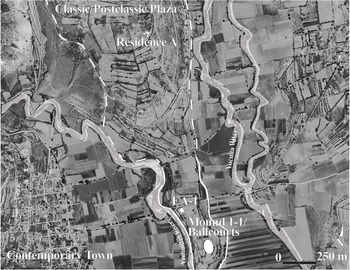
We focus on ruins and traces at the site of Etlatongo, in the Mixteca Alta, in the southern highlands of Mesoamerica (Figure 1). This cultural landscape features a continuous occupation from the earliest villages to a contemporary pueblo, San Mateo Etlatongo (Figure 2).
Location of Etlatongo in Mesoamerica, showing select sites referenced in the text. (Color online)

Calibrated chronology chart for the Nochixtlán Valley and Etlatongo ceramic phases compared with Mesoamerican periods; blurred boundaries between phases indicate their arbitrary nature.

Located close to two rivers’ confluence, Etlatongo grew rapidly in size and complexity during the Cruz B phase. Two projects at Etlatongo, the 1992 Etlatongo Project (ET92) and the Formative Etlatongo Project (FEP) from 2015 to 2017, established that this site extended over 26 ha during the Cruz B phase, sitting atop a reconfigured regional settlement hierarchy. Excavations documented at least one Cruz B area of public space in the site’s southern portion (Figure 3); Mound 1-1 contains the two earliest ballcourts documented in the Mesoamerican highlands (Blomster and Salazar Chávez Reference Blomster and Salazar Chávez2020). A major termination event marked the end of the second ballcourt’s utilization. The ET92 and FEP also recorded higher status Cruz B houses; some villagers participated in extensive interregional interaction, including with the Gulf Olmec. Both projects also exposed substantial Yucuita phase occupations, a time of emerging urbanism at the site, with occupations expanding to encompass parts of a large hill, Cerro Partido, to the north. Recent excavations by the Proyecto Arqueológico Yucunduchi (PAY) focused specifically on the Classic and Postclassic transition on this hill, with monumental architecture centered on a large plaza appearing before the Classic.
Etlatongo with locations of case studies: the Cruz B ballcourts/Mound 1-1, EA-1, and Residence A. The solid white line bounds the Cruz B occupation while the dashed white line indicates the site’s growth during the Late Formative, Classic, and Postclassic occupations. Base image: Google Earth, elaborated by Víctor Salazar Chávez.

Living with Mixtec Ruins and Traces
Recent ethnographies of Indigenous groups’ interactions with the past in the form of “living ruins” emphasizes the great diversity of these responses, although a common thread is ruins’ liminal and intrinsic animacy and the belief they were built by humans from a past or presocial era, who are often conceived of as fundamentally different from modern humans (Erikson and Vapnarsky Reference Erikson, Vapnarsky, Erikson and Vapnarsky2022:3). As materializations in the landscape of a remote past, ruins contribute in myriad ways to political and religious life and a constantly shifting present (Hamann Reference Hamann2008a). For contemporary Santiago Nuyooteco Mixtecs, past people were considered presocial giants who lived in a time of darkness; potent things from distant eras often appear in Mixtec household altars, including strangely shaped rocks (Monaghan Reference Monaghan1995). Ethnohistoric sources document the importance of earlier ruins and the potency of ancient things or traces (Hamann Reference Hamann and Blomster2008b).
An interpretive structure of the long term, fundamental to Mesoamerican societies, extends beyond its extravagant materialization by the Aztecs, who offered thousands of objects from the past (as well as their own archaizing representations) at the Templo Mayor (López Austin and López Luján Reference López Austin and López Luján2009). Mesoamericans conceived of cyclical time, recursive and transformative, with multiple creations and destructions of eras, from the Mixtecs’ First Sunrise to the Aztecs’ Five Suns. Mesoamerican societies connected social memories about the past to social relations and hierarchies in the present by embedding ideas of the sacred covenant, the original debt between humans and divine forces, to the material matrix of daily life and leaders’ interventions into this covenant (Joyce and Barber Reference Joyce and Barber2015).
Mixtecs engaged with a structured and structuring past. Postclassic codical narratives evince the potency of ruined places, illustrating a chiyoyata, or ancient place/foundation, as a platform without a temple atop, interpreted by Hamann (Reference Hamann and Blomster2008b:124) as the still-utilized ruins of past structures, representing physical evidence for the cosmic devastation when the present era’s First Sunrise destroyed a previous creation. Associated with origins, First Sunrises, and dangerous supernatural forces, an architectural chiyo is shown as a platform where ancestors of both past and present ages could be consulted. Objects, often broken, reflected a previous creation and were placed as offerings. Referencing Aztec New Fire ceremonies, with both elite and commoner domestic space hosting rituals where the breakage and disposal of household items reenacted the cosmic destructions of previous Suns, Hamann (Reference Hamann2008a) interprets ruined structures and broken objects as matter out of time and place: tlazolli. A Nahua concept that would have had resonated with contemporaneous Mixtecs who participated in a shared rubric of Postclassic iconography and cosmology, tlazolli encompasses things that lack their original structure, including broken vessels as pot sherds. Reused and reinterpreted, tlazolli, as survivals from a previous creation, crackle with a potent, potentially dangerous but not always undesirable, chthonic energy and animacy (Hamann Reference Hamann2008a).
Thus, pre-Sunrise places pertained to a past that did not pass but continued to have action as liminal spaces where people paid respect to life-death forces and honored their ancestors, with material referents manifesting in myriad forms. In terms of pre-Sunrise objects, in addition to the active creation of tlazolli as things destroyed or banished from the house during the New Fire ceremony, Hamann (Reference Hamann2008a:806) argues that objects simply left in place during this time of transition could passively become tlazolli; both types have agency to act in the world. We argue for similar engagements with past forces and remembrance in Etlatongo’s persistence through time.
Ruins as the Building Blocks of Memory
Ruins at Etlatongo promoted acts of remembrance through the (re)use of building materials from previous structures in new constructions. The FEP documented the selective use of specific kinds of sediments for the construction of building façades and surfaces, primarily the use of bedrock commonly known in the region as “endeque.” The constant use of this material to build structures was significant as buildings in Formative Oaxaca were central to the constitution of communities by bringing together various entities including people, ancestors, other-than-humans, and life-giving forces.
Animacy in the Mixteca appears to be differently conceived and enacted compared with other parts of Oaxaca, where buildings are dedicated and ensouled through offerings and rituals (Joyce and Barber Reference Joyce and Barber2015). In the Mixteca, ritual deposits devoted to animating public buildings are not yet known, suggesting regional nuance compared to their Oaxacan neighbors. We argue that Mixtec ontological particularities may be key in understanding this difference. Ethnographic data from the Mixtecs of Santiago Nuyoo indicates that the sacred force that animates all existence endows everything with vitality, including the earth (Monaghan Reference Monaghan1995:98). Accordingly, contemporary Mixtecs do not enliven structures through dedicatory offerings given that they are perceived as already animated because the building materials come from an alive earth. Nuyoo Mixtecs do, however, make a single offering to the Earth to have permission to build (Monaghan Reference Monaghan and Mock1998:50), and the preparation for building—digging a hole into a hillside—is referred to as cooking a site, transforming it from a wild to a cultural space (Monaghan Reference Monaghan1995:33). Mixtecs enact rituals (prayers, ceremonies) at every construction stage, with a focus on cooking, feeding, and nourishment. Monaghan (Reference Monaghan and Mock1998:49) notes a word for cooking, chiyo, can also mean “altar,” “house site,” or “foundation” (see the preceding text). We interpret this as indicative of a focus on maintaining and potentially transforming vitality rather than enlivening something that was inanimate.
Etlatongo villagers transformed vitality already endowed in objects; the very nature of carving a social landscape from bedrock and constantly reusing it as a building material in new constructions may have afforded them a medium to interact with sacred forces. Beyond obtaining endeque from naturally occurring beds, quarried as soft blocks and left to harden by drying in the sun, they constantly mined past structures. Prior to the construction of the first version of the Cruz B ballcourt, they carved holes into the previous public space to reuse this charged sediment in future constructions; they repeated this activity before building the second ballcourt, carving a large pit into the previous ballcourt to harvest this vibrant material (Figure 4). After the second version of the ballcourt was ritually terminated and partially covered, its materiality was left to ruin but not abandoned, as people visited the space to remove bedrock fills from its façades and excavated additional holes to access its surfaces. Indeed, these materials could have been incorporated into still undocumented post-Cruz B constructions elsewhere at the site.
Photo of the first version of the ballcourt’s alley showing a major pit (Feature 8) dug into it to harvest sediment prior to construction of the second ballcourt. (Color online)

Once the second Cruz B ballcourt was ritually terminated, the area was covered with multiple sediment layers, transforming the space into a prominent mound. The now ruins of the ballcourt, however, remained present in the community’s social memory, as the mound, a chiyoyata, was repurposed for other ceremonies, including funerary practices. From the Middle to Late Formative, the inhabitants buried several adults in this mound; their interment in a communal space may reflect a broader strategy to index a collective identity centered in a strong sense of place. Central to this identity were the memories evoked by the ruins of the ballcourts that became physically present every time a new individual was buried here. Keeping an Indigenous ontology in mind, we interpret the burials as recurrent acts of feeding, or providing sustenance, to maintain the animacy of the mound (Brzezinski et al. Reference Brzezinski, Joyce and Barber2017; Joyce and Barber Reference Joyce and Barber2015). This may indicate that, for precontact Mixtecs, ruins maintained a powerful aura that needed feeding even when they were concealed. By conducting funerals in a communal burial space atop the ruins of previous public space, and participating in subsequent commemorative rites, the community of Etlatongo created a physical and symbolic linkage to the landscape. The mound’s later reuse as the base for a Ramos phase platform attests to its continuing significance in this charged landscape. Due to the colonial-era destruction of the Ramos platform, we cannot determine if it had a temple or other structure atop.
Another important feature that reinforces the previous point is a Las Flores phase offering comprised of significant quantities of burned maize along with fragments of a human skull. While the offering dates to over a millennium after the ballcourts’ utilization, it was located within the fill that covered them; its placement indicates that the mound preserved its powerful vitality within the social memory of the community. The space that was once occupied to play the ballgame, and was later used for burials, continued to be a “bright object” several generations later (Gordillo Reference Gordillo2014:22), this time as the location for an important offering that brought together living people, the remains of ancestors, cosmogonic forces, and the memory of previous occupations, regardless of how it was all remembered. In this way, the mound represented a physical and actual genealogy of Etlatongo’s multiple occupations.
Yucuita Phase Heirlooms, Tlazolli, and Memory in the Extended House
All aspects of Mixtec life invoked some degree of sacrality (Monaghan Reference Monaghan1995), and as loci for domestic actions, rituals, and relations, houses prove foundational to larger sociopolitical processes. Houses inform and materialize social memory, providing contexts for remembering and forgetting a material past that persists through daily practices that both celebrate and dismantle it (see preceding text; Hendon Reference Hendon2010). We recently applied the concept of the “extended house” to sequences of Etlatongo houses spanning over 3,000 years (Vidal Guzmán et al. Reference Vidal Guzmán, Blomster and Chávez2025). Rooted in the Levi-Strauss model of “house society” (Joyce and Gillespie Reference Joyce and Gillespie2000) as a corporate body, constituted by material and immaterial wealth, with membership based on blood or through long-term proximity, we reframe the concept as the extended house to move beyond the frequent economic focus of house society and its structuralist underpinnings. In addition, based on Mixtec ethnohistory and ethnography (Terraciano Reference Terraciano2001), the extended house better aligns with the dynamic ontological orientations that enliven many aspects of quotidian life in Mesoamerican societies, better reflecting Indigenous perspectives on persistence, materiality, and vitality. As an active discourse between past, present, and future members, as well as other-than-humans, the extended house exudes a kind of persistent animacy and a clear physical presence, anchored in the landscape, while accruing different temporal patina. As an ongoing practice, the extended house’s ability to perpetuate itself (Hendon Reference Hendon2010; Vidal Guzmán et al. Reference Vidal Guzmán, Blomster and Chávez2025) manifests in our examples of redeposited and reconceptualized traces. Our second case study encompasses two examples spanning the late Middle Formative to the Terminal Formative / Early Classic.
EA-1: Yucuita Phase Houses
Excavated by the ET92, EA-1 documented a sequence of Yucuita phase houses and associated burials. The continuity and persistence of this extended house’s lineage through time is reflected in engagements with centuries-old traces as well as the corporeal remains of ancestors. The placement on the landscape of the three different iterations (with the earliest referred to here as Occupation 1) of an extended house provides insights as to how Etlatongo people apprehended architectural ruins.
Following what has been called a “corkscrew” pattern for Early Formative Valley of Oaxaca houses (Flannery and Marcus Reference Flannery and Marcus1994:36), when a house was vacated, occupation shifted to land adjacent to it, eventually returning, after generations, above a previous house, in a spiral shape. In this case, EA-1 exposed fragments of three sequential houses, Occupations 1 through 3. The platform or mound-like ruins of an earlier house were ultimately incorporated into the construction of a subsequent house, similar to a Mixtec chiyoyata (see previously mentioned text). Critical to this extended house’s foundation were four burials associated with Occupation 1 (Vidal Guzmán et al. Reference Vidal Guzmán, Blomster and Chávez2025). Burials 1 and 2 were each placed in a small stone and earth chamber atop the actual house floor (Figures 5 and 6). Interpreted as the conjugal ancestral founders of this extended house, their emplacement atop Occupation 1’s living surface precipitated its termination, which was subsequently covered in a thick layer of fill, primarily from a Yucuita phase midden; no Cruz B ceramic sherds were included in this material. An earlier interment (Burial 3) had been deposited in a bell-shaped pit (F7), with an entrance into it from Occupation 1’s floor. During Occupations 2 and 3, access to Occupation 1’s ancestors was maintained by a cylindrical stone and mortar shaft (F4) constructed directly atop F7’s entrance (Figure 6b); F4 conceptually moved through temporal and spatial boundaries, folding time and linking all the individuals emplaced in Occupation 1, particularly the probable extended house founders, Burials 1 and 2, with Occupation 3’s living members (Blomster and Higelin Ponce de León Reference Blomster and Ponce de León2017).
EA-1 showing Burials 1 and 2 on Occupation 1’s surface to the north (viewer’s left), with the stone shaft atop the entrance of F7/Burial 3 exposed to the right. (Color online)

Contexts of figurine heads from EA-1: (a) plan view of Burial 1, with arrow pointing to location of B. 477; (b) lower portion of east profile, with floors relating to Occupations 1 and 3; F7 contains Burial 3, arrow points to approximate location of B. 523-1. F4 connects Occupations 1, 2, and 3.

Four Cruz B figurine heads, traces from 500 to 600 years earlier, were associated with Burials 1 and 3 and exuded chronal vitality, transmitted between extended house agents. Burial 1’s chamber, made of small unworked stones and topped by a series of large lintels (Figure 6a), is oriented 7° to 8° west of north—similar to Etlatongo’s Cruz B ballcourts and reflecting the continuum between domestic and public spaces. Wedged into the stones forming the chamber’s southeast corner, placed face down and pointing north, was B. 477, a worn Cruz B figurine head (Figures 6a and 7a). An additional Cruz B figurine head (B. 470), unusual for the prominent mustache, comes from materials recovered just above Burial 1 (Figure 7b). Two additional Cruz B figurine heads come from Burial 3 in F7, the bell-shaped pit (Figure 6b): a hollow figurine head fragment (B. 523-1) directly atop the Yucuita phase vessel offerings and a solid Cruz B figurine head (B. 523-2) lay among the three bodies (Figure 8).
Figurines associated with Burial 1, EA-1: (a) B. 477; (b) B. 470. (Color online)

Figurines associated with F7/Burial 3: (a) B. 523-2; (b) B. 523-1. (Color online)

Residence A: Late Yucuita / Early Ramos Occupations
Rather than an isolated incident, further evidence across time and space for the incorporation of Cruz B figurine heads into later contexts was documented by excavations at a house (Residence A) occupied continuously from the Late Formative to at least the Early Classic. Located atop Cerro Partido, Residence A is only 30 m directly south of the Classic to Postclassic ballcourt associated with Mound System 4-1 (see Figure 3). The PAY primarily exposed features at Residence A dating to the transition from the Ramos to Las Flores phase, with three carbon dates’ midpoints ranging from 148 to 391 cal AD. The Residence A excavations uncovered two earlier occupations, one from the Ramos phase and the earlier from the late Yucuita to Early Ramos phase transition. A bell-shaped pit (F7) contained materials around 100–200 years later than those from EA-1’s Occupation 1, with no earlier ceramic sherds (Figure 9). This feature probably represents the earliest occupation of an extended house.
Plan view of Residence A excavations, with locations of figurines B. 243 (in F7) and B. 263. (Color online)

Both the ET92 and PAY demonstrated the absence of a Cruz B occupation on Cerro Partido. However, included in F7 was the lower half of a Cruz B figurine head (B.243), with diagnostic elongated head and projecting, trapezoidal mouth (Figure 10a). Additionally, a complete Cruz B head (B. 263) was found nearby, but in construction fill disturbed by recent plowing (Figure 10b); it displays the elongated head shape typical of the most generic style of Cruz B figurines.
Figurines from Residence A: (a) B. 243; (b) B. 263. (Color online)

Discussion
Ubiquitous in domestic contexts, ceramic figurines, both solid and hollow, played important roles in household ritual and negotiations of social identity. As materializations of embodiment, figurines both produce and perform cultural practices, inscribing social processes and political change (Blomster Reference Blomster and Insoll2017). Figurines articulate well with our concept of the extended house, as they are important agents of social identity, agency, and memory. Their portability and divisibility afford flexibility in locations of use, in the different contexts in which relational identities were performed and negotiated among multiple entities (Hendon Reference Hendon2010:171). In addition to what figurines do, their imagery also exhibits great variety. Cruz B figurine fragments recovered from the same house display different styles and foci of the imagery, referred to as stylistic juxtapositions (Blomster Reference Blomster and Insoll2017). Such juxtapositions of different figurine types may index myriad social identities and reinforce social memory.
The curators of these six figurines selected only one part: the head. This focus on the head may reflect a deeper Mesoamerican corporeal concept that the head was the locus of consciousness, reason, and values; it distilled one’s individual qualities (López Austin Reference López Austin1988) and would be especially implicated in social identity and memory. While the two figurine heads from Residence A correspond to the most typical Cruz B figurine stylistic tropes at Etlatongo, it is remarkable that the four EA-1 heads focus on a particular imagery: the Olmec style. Such Olmec-style figurines were both made locally and imported from the Gulf Olmec at San Lorenzo and feature: white to cream slip; elongated, pear-shaped heads; jowly cheeks; L-shaped, trough or narrow eyes; and downturned, trapezoidal mouths (Blomster Reference Blomster and Insoll2017:276). Such heads can be further classified into two groups: Group 1 figurines adhere to the Gulf Olmec style, while Group 2 heads appear to be informed by that style but filtered through local highland aesthetic tropes and innovations (Blomster Reference Blomster and Insoll2017). Two of the EA-1 heads, B. 477 and B. 523-1, conform to Group 1, with B. 477 unusual as simply having slight bulges for eyes; similar heads from San Lorenzo have been interpreted as closed eyes or eyeless (Coe and Diehl Reference Coe and Diehl1980:Figure 326). Heads B. 523-2 and B. 470 are more parsimoniously classified as Group 2, with B. 470 exhibiting a probable Venus symbol on its back, similar in shape to one on a San Lorenzo hollow head (Coe and Diehl Reference Coe and Diehl1980:Figure 326). In addition, the fine paste of B. 477 and B. 523-2 marks them as potential Gulf Olmec imports.
Six Cruz B heads’ placement in two contexts separated by several hundred years and about 1 km suggests similar underlying concepts about traces and social memory, as well as important nuances. These heads were collected, curated, and in EA-1, placed in close association with corporeal remains of buried individuals, including the ancestral founders of this extended house. These Cruz B heads comprise heirlooms, which generally refers to objects that are curated and inherited for multiple generations before entering the archaeological record, symbolically potent as they are inalienable, “kept while given” (Lillios Reference Lillios1999:239). In Mesoamerica imagery, heirlooms, as traces, are often deployed as offerings (Hamann Reference Hamann2008a). Both complicating and enhancing their status as heirlooms is their agency and animacy. We interpret these Cruz B heads as a form of tlazolli, matter out of time, exuding a potent chthonic vitality. The EA-1 curators of these Cruz B heads would have recognized them as something fundamentally different from their Yucuita-phase aesthetic tropes, their alterity potentially representing people or entities from a previous Sun. They selected, reused, and reinterpreted these traces that indexed a distant past, emplacing them with several crucial EA-1 burials, nourishing or transforming probable lineage founders, as well as the extended house, with the vitality from these “pre-Sunrise” objects, potentially evoking a different social order occupied by divergent humans. Similar processes animated the inclusion of a Cruz B head in F7 in Residence A.
Our interpretation resonates with many Native Americans’ responses to traces, imbued with agency and potency, and made by people from a previous creation (Erikson and Vapnarsky Reference Erikson, Vapnarsky, Erikson and Vapnarsky2022). An assemblage of heirloomed figurine heads, documented at the Postclassic central Mexico site of Xaltocan, exhibits an overrepresentation of a particularly divergent earlier head style, interpreted as representing presocial beings from a time before the current social order (Brumfiel and Overholtzer Reference Brumfiel, Overholtzer, Halperin, Faust, Taube and Giguet2009:304). Even though the EA-1 Cruz B heads were out of sight and circulation after their placement, they continued to contribute to the memory, identity, and prestige of the EA-1 extended house.
Differences in discovery contexts and imagery suggest additional agentive distinctions. The four EA-1 heads were deposited just 10–20 m east of a series of Cruz B houses; Yucuita-phase occupants probably frequently discovered earlier materials, such as these heads, during construction activities related to Occupations 1–3. The collectors consistently selected these four heads based on the uncommon Olmec style from a larger sample that would have included more typical Cruz B types; the Olmec-style heads’ alterity, both in imagery as well as the surface properties of those covered in a burnished white slip, appears to have guided their collection, curation, and deployment as offerings to the founding ancestors of this extended house. As tlazolli from a previous era, these four heads’ diagnostic Olmec style suggests social memory referencing less detached relationships with what may have been a time just before the current Sun. Etlatongo’s regional priority in distant interregional interactions, which included the Gulf Olmec (Blomster Reference Blomster and Insoll2017), may have been memorialized, validating the status of the EA-1 ancestral founders and crucial to the persistence and social memory of the extended house. The deployment of these heirlooms in burials informed negotiations of social identity and reproduction within the house, potentially contrasting its collective identity with that of other extended houses (Hendon Reference Hendon2010; Hodder Reference Hodder2012).
In contrast, Residence A’s two heads, depicting typical, local Cruz B figural imagery, were found atop Cerro Partido, a part of Etlatongo devoid of pre-Yucuita phase occupations; thus, Residence A’s occupants would have had less exposure to Cruz B material culture. The PAY did not find these heads in burials, suggesting less of an association with specific individuals but rather with the extended house, where they were curated for many generations. The more diverse Cruz B aesthetic tropes exhibited by these heads may reflect more distant engagements with a previous era, an entanglement of memory and forgetting that elided the Cruz B visual indexing evident in EA-1’s consistently exotic imagery. These Residence A heads may have represented more generic humans or ancestral beings from a more distant Sun, the kinds of pre-social or alien beings deployed in Xaltocan narratives. The more generic and inconsistent imagery in these Cruz B heads, linked more with the extended house rather than specific individuals, afforded different kinds of social and collective memories than those associated with the EA-1 heads.
Conclusion
We have argued that the materiality of past temporalities continues to have generative power despite their physically ruined state. In their material unruliness, ruins are powerful reminders of what was because they evoke memories; detritus from past temporalities fold time and contribute to acts of remembrance tying generations together. At Etlatongo, the reuse of bedrock from previous buildings to create new façades and surfaces was an important practice to interact with sacred forces. By physically using traces from the past in the construction of a new present, residents created a social memory that brought together past generations, present entanglements with life-giving forces, and future expectations of community building. The mound, or chiyoyata, housing the Cruz B ballcourts remained charged with vitality; later burials placed within the ballcourts’ mound continued to nourish and enliven these ruins. The very nature of carving a social landscape from bedrock and constantly reusing endeque as building material in new constructions promoted practices of social remembrance and material persistence.
The vitality of past traces also animates our exploration of the six Cruz B figurine heads placed in Yucuita and Early Ramos phase contexts. We argue that these heads evoked continued entanglements with the past and its active use in constituting and contesting social memory. The curation and deployment of these traces in EA-1 and Residence A indexed different kinds of pasts, representing recursive engagements with social identity, social reproduction, and persistence within the extended house. As portable objects, deployed and performed in a variety of contexts, figurines depicting human-like representations are especially implicated in the semiotics of personhood and in the identity and ongoing practice of the extended house over time (Hendon Reference Hendon2010). While the heads were deposited out of sight in burials and storage pits, they contributed to these two extended houses’ social memory, identity, and prestige compared with other extended houses.
As tlazolli, these six heads, like seeds, nourished and enlivened these extended houses with potent chthonic vitality, similar to Mixtec concepts of feeding also seen with the later burials placed atop the Cruz B ballcourt ruins. The greater spatial and temporal distance from the Cruz B era evident in Residence A, compared with EA-1’s close proximity to Cruz B ruins, may have resulted in the curation of more generic Cruz B heads in the former and the exclusive selection of Olmec-style heads in the latter, where they were emplaced to commemorate and charge both ancestral founders as well as the extended house. Contemporary Mesoamerican groups perceive different types of ancestors, where the more recent retain their names in rituals while those deceased for several generations form a more generic collection of ancestors (Erikson and Vapnarsky Reference Erikson, Vapnarsky, Erikson and Vapnarsky2022). This concept of different types of ancestors resonates in Late Classic Zapotec imagery, where the most temporally distant ancestors are often shown as generic bundle-like beings with few distinguishing features or name glyphs. Residence A occupants may have conceived of their Cruz B traces as representing a more distant era or Sun and a generic ancestral collective, while the consistent imagery of the Olmec-style heads in EA-1 evoked a less distant past. Traces and ruins created different material persistence and histories of these two extended houses.
Acknowledgments
The research was made possible by the support from the officials and people of San Mateo Etlatongo and permits from the Consejo de Arqueología/INAH and the Centro-INAH-Oaxaca. We thank the team and community involved in the research, the symposium organizers and participants, and three anonymous reviewers for a stimulating dialogue.
Funding Statement
The ET92 was supported by a Fulbright (HE) Fellowship, the FEP by the National Science Foundation (Award BCS 1156373) and the PAY by the Wenner-Gren Foundation (Gr. 10247).
Data Availability Statement
The data used in this paper are available in the yearly field reports submitted to INAH, Mexico. Reports can be found following this link: https://etlatongo.jimdofree.com/publications-publicaciones/.
Competing Interests
The authors declare none.




 Open access

