First, a word about the trouble. I won’t dwell too long on this, as it gets too much press already. Not a day goes by without headlines suggesting that the world is heading for disaster if we don’t act swiftly and profoundly. Is that really true? And if so, what should be done about it?
A Planetary Crisis
It may seem that the world is entangled in endless problems, but things are really not so complicated when it comes to sustainability. Perhaps that was the thought of Johan Rockström when, in 2008, he invited a bunch of us to get together in a quiet place in the Swedish countryside to try and define the “safe operating space for humanity.” I was doubtful. How were we going to do that? But I attended, and surprisingly, after a few days of deliberation, we wrote a paper concluding that there were essentially only nine environmental problems that could cause serious trouble on a planetary scale if a critical threshold was passed. We called them our nine “planetary boundaries.”1 We tried to get to ten but couldn’t come up with a final one. Little did we suspect that this would become the most influential paper in any of our careers. I still wonder why that was. You never know. Sometimes, a paper that you consider a fabulous eye-opener remains ignored, while another unexpectedly becomes a ‘hit’ as measured by public attention and scientific citations. My guess is that there were two elements that caused our planetary boundaries paper to cause such a splash. First, we painted things from a positive angle, framing the possibility of a safe operating space for humanity. Instead of warning what could go wrong, we showed how things could go right. Second, we offered a “corridor of clarity,”2 attempting to keep things simple and constructive. Overwhelmingly complex problems can be paralyzing, especially when some aspects are uncertain. Clarifying the core of the matter and leaving out the uncertainties and unimportant sidetracks helps. In hindsight, summarizing nine planetary boundaries was remarkably effective; but in fact, the core of the matter may be even simpler.
Our planetary boundaries had to do with the disruption of global cycles of phosphorus and nitrogen, the health of the ozone layer, the pervasiveness of polluting chemicals, the quality of fresh water, ocean acidification, and the concentration of aerosols in the atmosphere. Simplifying even further, however, one could say that there are two key issues: climate and nature. More precisely, the future of humanity is threatened by global warming and by the deterioration of ecosystems. Many updates later, details have changed, but the overall picture remains the same.3 Humanity’s job is to ensure that climate change stays within safe limits and that we don’t undermine the integrity of the biosphere. Perhaps surprisingly, despite all the complexity in the details, we already know the solutions to both problems: stop mining fossil fuels and eat a largely plant-based diet. The big question, of course, is how to achieve those goals. That will be the focus of this book. But first, let’s ask how big and fast the change needs to be to prevent serious trouble for humanity. Are things really that urgent?
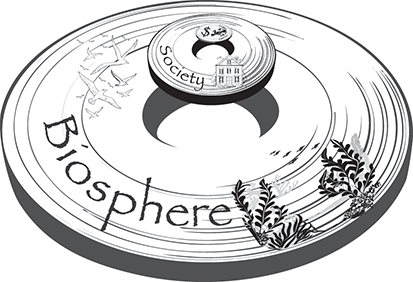
In terms of the loss of nature, this is not so easily answered. Certainly, the scale of the change incurred by humanity is daunting.4 To get an impression, humanity is only one among roughly 5,400 mammal species. Yet we represent one-third of the mammalian biomass globally, and our livestock and pets occupy most of the remaining two-thirds. Only 4 percent of the global mammalian biomass is made up by the remaining thousands of wild species. We have transformed about half of the Earth’s ice-free land surface and are using about half the available fresh water. Meanwhile, we have polluted soil, air, and water in countless ways. As a result, the Earth has entered its sixth mass extinction event, losing species at a rate faster than during any of the five previous such events in the history of our planet, when much of life vanished.5 But is our ravaging of nature really a problem? Certainly not for life on the planet in the long run. Upon each of the previous mass extinction events, evolution allowed the diversity of life to recover, often surpassing previous diversity (even if it took millions of years).6 The question is rather whether the extent to which we are eradicating nature might imply a lurking crisis for humanity. More specifically, will it be a problem for our children, or for the grandchildren of our grandchildren? Certainly, the world would be more boring if so many species were lost and few natural ecosystems survived. But would humans still be able to live safely and feed themselves even if most of nature is lost? Surely we’ll still have our hamburgers and be able to watch movies? Yes, the loss of forests may lead to erosion. Lost plant species could have contained potential medicines, or genes that might have helped produce more resilient crops. Loss of natural habitats may trigger pandemics of unforeseen lethality. But does this all really pose an existential problem? Can we do with fewer species and fewer forests and wetlands? Intuitively it may seem so. However, our intuition gets things terribly wrong.7 It may feel as if economy is what sustains society, and that nature is a luxury add-on. But it is the other way around. Society cannot exist without a functioning biosphere, and economy is irrelevant without society (Figure 1.1). We depend entirely on a functioning biosphere, even if it is hard to determine the critical limit to the destruction of nature that we should avoid.8
It may seem that everything, including nature, is part of the economy. In fact, economy exists without society and no society can exist without a functioning biosphere.
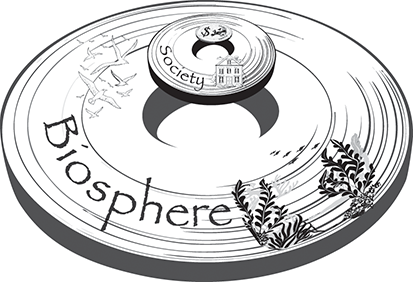
Figure 1.1 Long description
The largest outer ring is inscribed with the word. Within this Biosphere ring, on the left side, there are outlines of birds in flight. On the right side of the Biosphere ring, there are detailed depictions of foliage, including ferns and leafy branches. In the centre of the disk, a smaller, raised circular element is present, inscribed with the word Society. At the very centre of this Society ring, there is a small, detailed drawing of a building.
While the implications of the loss of nature remain difficult to pinpoint, climate change is a different story. The impacts of megadroughts, unprecedented floods, and heatwaves are starting to speak for themselves. There are many ways of sketching the potentially devastating impacts of climate change. Focusing on the economic cost reveals that doing something now is much cheaper than waiting.9 But there is also a human cost.10 The problem really dawned on me in 2017 when I was at a conference on tropical biology on the Yucatan peninsula. The tremendous heat and humidity got my cold-adapted Dutch mind wondering: Surely these conditions can’t be good for humans? At what temperatures do humans actually function best? I started looking for literature, and found surprisingly little about this fundamental question. Some papers showed declining cognitive capacity or rising aggression at elevated temperatures, but those were just a few scattered studies. Home in Holland, my friend Xu Chi from Nanjing University happened to come and visit our lab for several months. We pondered the issue, and, both being rooted in ecology, started wondering whether humans have a definable climate niche. We know the global distribution of species ranging from penguins to palms is restricted to specific conditions, but what about humans? We didn’t expect much of a niche limitation, given that people live from the poles to the tropics. After all, clothes, heating, and air conditioning can make life comfortable almost anywhere. Nonetheless, we did what ecologists looking for niche evidence do: plot human population density as a function of environmental conditions such as mean annual temperature and rainfall. To our surprise, the data indeed suggested a distinct climate niche for our species.11 People live almost everywhere, yet the vast bulk of our species is concentrated in a relatively narrow range of conditions around a mean annual temperature of around 13 °C. Was that just a coincidence? To dig a bit deeper, with the help of colleagues steeped in archaeology and climate history, we reconstructed the climate conditions under which most humans lived up to 6,000 years ago. Strangely, it turned out that, despite all technological advances and increases in ease of migration, the human climate niche seemed unaltered over the millennia. Humans still flock together in the same climate sweet spot as thousands of years ago. Could there be some fundamental mechanism making humans seek out those conditions? Support for this somewhat radical idea came from an unexpected direction. Economists had independently started looking into the effects of climate variations on economic production in 166 countries. Rather than simply plotting GDP against climate, they looked for economic outputs for each individual country as it varied between warmer and colder years. It turned out that any deviation pushing a country further away from a mean annual temperature of around 13 °C reduced its output.13 This was true globally across agricultural and nonagricultural activity in rich and poor countries. Stunningly, this indicated the same optimal temperature we had inferred.
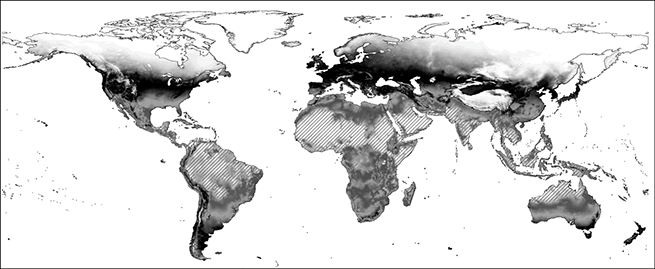
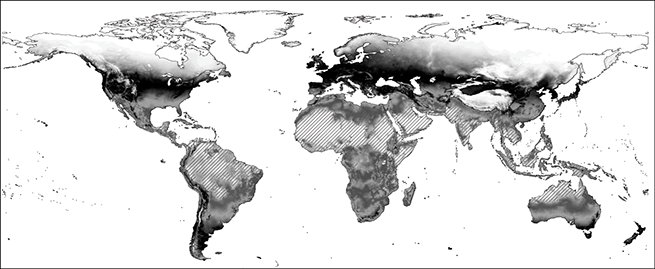
Of course, the robustness of those findings raised a further question: What could this imply for our future? As the planet keeps warming, how many people will be left outside their climate niche fifty years from now? Our estimate was around 3 billion.14 Of course, this estimation involved many assumptions and complicated computations. We therefore took a different angle to double-check the order of magnitude. We asked what the hottest places on Earth were – so hot that few people live there. Mean annual temperatures of above 29.0 °C seemed a good threshold. Such temperature extremes are found in only 0.8 percent of the global land surface, mostly concentrated in the Sahara. Fast-forward half a century from now, those conditions seem likely to prevail on one-fifth of the world’s land, exposing about 3.5 billion humans to potentially uninhabitable conditions (Figure 1.2). A third of humanity is a lot of people. Will they be able to adapt? It’s hard to say, but the fact that those happen to be also the poorest regions will not make it easier. Of course, one way of adapting to the new reality is migration. As some places become too hot to live, others will actually get more livable. Think of Siberia and northern Canada. As argued in Chapter 6 (Buying Time), migration must be part of the adaptation, just as it is for other species and just as it has been for humans for hundreds of thousands of years. If done well, the benefits can be great, both for migrants and for the receiving communities.15 Nonetheless, the social challenge of relocating one-third of humanity within half a century is huge.
Climate suitability in 2070 for a business-as-usual scenario. The striped area – home to about one-third of the world population – is where global warming would cause near-uninhabitable conditions.
A Societal Crisis
Clearly, a planetary crisis driven by humans is starting to endanger humanity. This book is about turning the ship. As we will see, there are different reasons why that is challenging, but one stands out: excessive concentration of wealth in the hands of a few.
Wealth is not so much a problem of consumption. Bill Gates’s favorite food is cheeseburgers, but he can only eat so many of them. Nor is it a problem of unfairness. True, the wealthiest 1 percent own almost half of the world’s wealth, while the bottom half possess only around 0.75 percent.16 Poverty is a huge problem, but the very existence of wealthy people is not usually considered unfair. The real problem of excessive wealth concentration is that it results in ‘state capture.’ Excessively wealthy people change the rules and manipulate perceptions in ways that make it easier to gain even more wealth, often at the cost of the planet and society. Connecting back to climate change, for more than half a century, wealthy parties in the fossil-fuel industry have been working to discredit the science that warns against climate change.17 Those strategies worked. Society still pays an annual $6 trillion worth of explicit and implicit subsidies for fossil-fuel use,18 funding its own demise. Such problems turn out to be difficult to solve, mainly because powerful parties with vested interests work against any solution. We will get back to how this works in detail, but the key point is simple: while lucrative industries are ruining the planet, the resulting concentration of wealth and power also make it hard to do something about that.
As wealth becomes more concentrated, it unavoidably starts affecting democracy. That has been known for millennia. The economist Joseph Stigler received the Nobel Prize for his work in the 1970s analyzing the problem of wealth concentration.19 Half a century earlier the Italian polymath Vilfredo Pareto also suggested that wealth inequality was an inevitable threat to democracy – a young Benito Mussolini attended some of his classes.20 But the problem was noted long before that. In his Politics, Aristotle approves of the practice in ancient Greece of ostracizing individuals who “seemed to predominate too much through their wealth,” noting that “the encroachments of the rich are more destructive to the state than those of the people.” In the Laws, Plato states that the richest should not possess more than four times what the poorest have. Any surplus should be handed over to the state.21 Throughout history, the worry was not so much the unfairness of inequality as how excessive wealth concentration threatens the functioning of societies.
Wealth concentration arose when humans changed from being hunter-gatherers to a sedentary lifestyle.22 You simply cannot carry much around in a nomadic hunter-gatherer life, so there was no way to accumulate substantial property. Interviews with the few remaining hunter-gatherers reveal that they do not see the point of possessing things. That changed with the rise of civilizations.23 Wealth inequality has been with us ever since. What is new is the scale. When the playing field is a village, wealth concentration is less pronounced than in a kingdom or a nation. Nowadays mechanisms of wealth concentration work on a global scale, with spectacular results.24 Not only do the richest 1 percent own most of the wealth, they also produce the same carbon emissions as the poorest 66 percent.25 Moreover, a small group of billionaires globally owns most of the news media,26 and billionaires are heavily overrepresented in political positions, especially in autocracies.27, 28 This is best known for countries such as Russia, Venezuela, Angola, Myanmar, and Sudan. But in 2023 China had 116 billionaires in government, representing 36 percent of political positions.29 And for the USA the link became obvious in 2025 with the massive attack on democratic institutions by the wealthiest person in the world, Elon Musk, together with the freshly elected president and fellow billionaire Donald Trump.
Is wealth concentration inevitable? The short answer is yes. Surprisingly, the laws of mathematics tell us that, even if everyone is equal in intelligence and temperament, large wealth inequality may arise solely by chance.30 That may seem strange, but picture a simple game: everyone in a group starts with $100. Then, in each round, a roll of the dice decides the percentage of cash each player gains or loses. (The total amount of money in the group is kept constant by applying a correction tax after each round; a fixed fraction of each player’s stack is redistributed.) What happens in the long run? By pure chance, one player usually ends up with almost all the cash – not because they are good at the game, but because of the way numbers work. The key is that the gains or losses are computed as a fraction of the capital. If you have very little, you can neither lose nor gain much. This makes poverty ‘sticky.’31 Most of us make an income by working for a salary, which does not depend upon capital. Work can make you rich, but never extremely rich. The game is entirely different when income is derived from capital, which it is for the very wealthy. For instance, for Elon Musk to earn his hundreds of billions on a yearly income of $150,000, he would have had to start working when the Egyptians were still building their pyramids. That is not the way extreme wealth is built up.
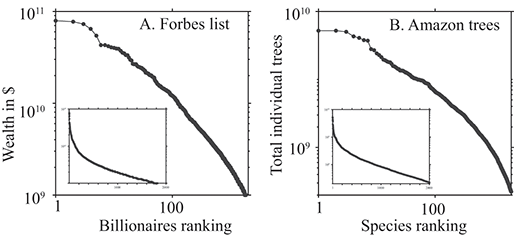
A curious fact we noted when we were working with economists and ecologists on the strange emergence of inequality is that patterns in nature look very similar to those in society.32 Inequality between species resembles inequality between persons in society. Just as a small percentage of humans have most of the money, a small fraction of species form most of the biomass in nature. This is true whether you look at communities of mushrooms, rodents, birds, beetles, trees, or even intestinal bacteria. For instance, in the Amazon rainforest 1 percent of the approximately 4,000 tree species form around 50 percent of the biomass, and biologists cannot identify traits that explain this success.33 Curiously, the dominance pattern of ranked species is almost indistinguishable from that of billionaires (Figure 1.3). Those are the simple pleasures of being a scientist. Finding a remarkable pattern and then trying to figure out why. Our first intuition was that the multiplication mechanism was at work again. Rodents can have good years when food or climate permit the doubling of their populations, or bad years when their population is halved. Indeed, the multiplication game may explain why rarity is a ‘sticky state,’ causing the vast majority of species to be very rare.34 However, the parallel only goes so far. In nature, abundance comes at a cost. The more dominant you become, the more your natural enemies thrive. That is essentially why monocultures require so much pesticide to keep them intact. This is a well-studied mechanism that helps keep nature diverse.
Runaway wealth concentration produces patterns resembling those found among species in nature. Just as 1 percent of the people own half the global wealth, 1 percent of the Amazon tree species accounts for 50 percent of the forest biomass. Adapted from Scheffer et al., “Inequality in nature and society.”35
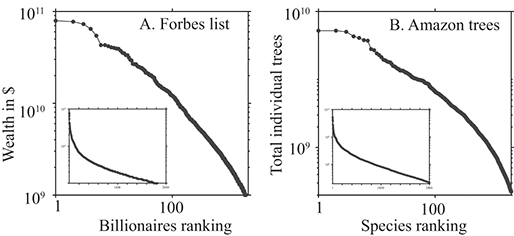
Figure 1.3 Long description
Plot A, titled Forbes list. The x -axis represents Billionaires rank and the y-axis represents Wealth in dollar ranges from 10 to the power 9 to 10 to the power 11. The data points show a sharp decrease in wealth as the rank increases, forming a curve that is concave up. An inset graph in the bottom left corner of plot A provides a wider view of the same data, extending the x-axis to approximately 2500. Plot B, titled Amazon trees. The x-axis represents Species rank and the y-axis represents Total individual trees. Similar to plot A, the data points in plot B also exhibit a steep decline in the total number of individual trees as the species rank increases. An inset graph in the bottom left corner of plot B offers a broader perspective of this data, extending the x-axis to approximately 2500.
In society, things work differently. The mechanism to prevent excessive wealth inequality is straightforward: wealth redistribution. This can be done, for instance, through taxation of wealth (taxation on income is much less effective, for reasons that should be obvious by now). However, the wealthier an individual, the easier it becomes to duck such redistribution by using the power afforded by wealth to shape the rules, or to find ways to circumvent them. Again, this does not require a wealthy individual to be smart. They simply have to hire people who are. Consequently, tax rates paid by the wealthiest people have decreased over the past half-century.36 Wealth inequality also tends to increase during times of crisis, as the richest can better navigate trouble and influence how rules are reshaped during tumultuous periods.37 The Covid-19 pandemic is just the latest example in a pattern that is discernible since medieval times. Billionaires’ wealth has risen $5 trillion since the pandemic, the biggest surge since records began.38
The fact that wealth has become extremely concentrated in the hands of a few has changed the way the world works, and has therefore changed our options for future change. As we will see, the unprecedented wealth concentration of today has been facilitated by the rise of neoliberal policies since the 1970s. Such policies relax taxation and regulation, allowing corporations to thrive, often at the cost of planetary degradation and societal ills. For instance, large profits are made from addictive products such as tobacco, painkillers, and social media. The power that results from the associated wealth concentration leads to distortions of policies and perceptions that make it difficult to break away from the status quo. Meanwhile, rising inequality, weakening institutions, and perceived unfairness help fuel a trend toward far-right populism, xenophobia, and isolationism that is starting to challenge democracies and global cooperation. Also, runaway wealth concentration is increasingly powering autocracies and their opaque relationships with webs of billionaires and corporations, actively challenging the institutions meant to regulate the wealth concentration that threatens the climate, nature, and ordinary people worldwide.39 Those trends and their causal linkages are the topic of Chapter 5. For now, it suffices to note that the trouble mentioned in the book’s title consists of two closely intertwined strains: a planetary strain and a societal strain. Finding ways to tip out of trouble requires seeing the big picture. That is the aim of this book.
Who Are We?
As a last element, before we take off, let me reflect for a minute on the question of agency: what power do we have? What can we really do? And, equally important: whom do I mean when I say ‘we’? When The Economist presented a special issue on the Anthropocene, its cover had a message: “Humans have changed the way the world works. Now they have to change the way they think about it, too.”40 That may seem very true, but if you try to unpack the word “they” it turns out to be a Pandora’s box. Who precisely are the humans The Economist is talking about? Who are ‘they’ and who are ‘we’? ‘We’ is a tricky word. As I use it, sometimes it means the reader and me. Sometimes, me and my colleagues. That should be clear from the context. The danger is when ‘we’ is used more broadly for humanity. When I write, “We are in climate trouble, so we should reduce our carbon footprint,” it is reasonable to ask who I mean. Most of the climate change burden falls on the Global South’s low-income countries, which are least able to cope and most exposed to dangerous new weather patterns. Their climate problem is caused almost entirely by the countries of the Global North. A small, wealthy section of humanity caused most of the climate change, while the most damaging effects hit the majority of people who hardly took part in causing it. So, what should ‘we’ do? A logical thought is there are too many people on the planet, but that misses the main point: consumption.41 The carbon footprint of a citizen of a country such as Malawi, Niger, or Rwanda is more than a hundred times lower than that of the average person in the USA or Australia.42 Family sizes are larger in Africa, but having a single child in the USA still produces an order of magnitude more carbon than a ten-child family in Malawi. A similar pattern holds for the loss of nature. The ecological footprint estimates how many Earths would be needed to sustain humanity in the long run. We would need eight Earths if all humans consumed at the US level. If the living standard of Eritrea was the norm, half an Earth would do.43 It is thus easy to see that in the short run, reducing consumption and carbon emissions in the Global North is many times more effective than changing things in the Global South. You probably already know this, and I am very much aware of it too. I also know that I am a child of the Global North and cannot avoid thinking from that perspective. Throughout the book I will nonetheless keep using the term ‘we,’ broadly meaning citizens of the Global North unless otherwise specified.
So, to sum up: to pass the world on to our grandchildren in the best possible shape, we would need to curb global warming and the loss of nature as quickly as possible. To curb global warming, we need to stop mining fossil fuels. To stop the loss of nature, shifting to a largely plant-based diet is probably the single most effective step we can take, and it has benefits for climate neutrality, too. Of course, it is relevant how many people live on the planet, as humanity’s ecological footprint is the sum of individual ones. Many things are moving in the right direction already. Family size, waste recycling, electric car sales, solar panels, wind turbines, house insulation, the rise of meat substitutes, vegan milk, etc. all contribute to the change we need. Yet, looking at the end result, the rise in atmospheric carbon and loss of nature show little sign of slowing down. Interpreting that isn’t rocket science. We are not doing enough.
A fundamental shift of scale is needed in all those efforts. There are good ideas on what a sustainable economy should look like: a “doughnut economy,”44 a “post-growth” or “degrowth” economy,45 with a focus on well-being rather than economic output,46 built on a different food-production system.47 This work is hugely important, as it shows that a sustainable economy is possible. Yet so far there has been little thinking about how a shift to such a new economy may realistically happen.48 In other words, we know roughly where we want to be, but not how to get there. Filling that gap is the goal of this book. Can we learn from the transformations of past civilizations? Does the information revolution make it easier to succeed? Do markets and transnational corporations make it harder? Should we abandon or tweak the system? I will get back to all of those questions. But first, there is a more fundamental question: Is there any evidence that it could be possible to achieve change that is both massive and fast enough to pass on the world to our grandchildren in good shape? As you will see, I am hopeful, if only because humanity has tipped out of trouble many times before. But before we get into too much detail, I should explain what I mean by tipping. The next chapter provides a simple, intuitive explanation of the tipping point theory on which much of my career has been based. It is also central to my argument, as tipping is the only thing that can deliver what humanity needs so urgently: big change fast.49