




Introduction
One of the most notable transformations in European early medieval funerary practices is the transition from a predominantly furnished to a largely unfurnished inhumation rite. Between the sixth and eighth centuries AD, the inclusion of grave goods in burials ceased across large parts of North-western Europe. This transition has been the subject of multiple regional and national studies, examining both its chronology and causes (e.g. Geake Reference Geake1997; Theune Reference Theune, Hines, Nielsen and Siegmund1999; Hines & Bayliss Reference Hines and Bayliss2013). All of these studies, however, concentrate on local factors, producing small-scale explanations that do not acknowledge other contemporaneous changes. No study has yet attempted to examine the phenomenon as a potentially coordinated development, or to compare the relationships between timings and rate of change in various regions. Using geostatistical methods to analyse data from 237 cemeteries from across Western Europe, this article compares the timing of the change in different regions, and advances new interpretations by focusing on connectivity across early medieval Europe.
Prior to the eighth century, European burial practices were characterised by distinct regional traditions in the types and quantities of grave goods deposited. There were, however, some overlaps between these traditions, with gradual transitions between areas, and boundaries that shifted over time (Brather Reference Brather and Gillett2002: 153). Historically, these differences in material culture have been used to plot the territories of ethnic groups (Hakenbeck Reference Hakenbeck, Semple and Williams2007: 19). It is now recognised that ethnicity is a socially constructed identity (Lucy Reference Lucy, Diaz-Andreu, Lucy, Babic and Edwards2005: 96), and ethnic groups therefore cannot be mapped in such a way. The wholesale transition to a largely unfurnished burial rite represents a homogenisation of practice lacking an ethnic dimension, brought about by extensive interconnectivity that allowed the idea to spread. This is not to say that the reasons for and significance of the change were the same in all areas; it may still have been motivated by and interpreted differently, depending on local factors. To assess these issues, it is necessary to map the chronological and spatial development of the practice across the wider region.
Understanding burial change
Many different potential explanations have been proposed for the widespread adoption of unfurnished burial, ranging from the influence of the Church and changing commemoration strategies, to the emergence of social hierarchies (e.g. Geake Reference Geake1997; Williams Reference Williams2006; Halsall Reference Halsall2010; Scull Reference Scull2015); I have suggested elsewhere changing perceptions of the corpse as another potential factor (Brownlee Reference Brownlee2020). The causes of the transition from furnished to unfurnished burial, however, are undoubtedly complex. Burial practices are rarely influenced by a single factor, and we should therefore not expect to attribute widespread change to one single cause (Rebay-Salisbury Reference Rebay-Salisbury and Sørensen2012: 21). Thus, examining the chronology of the change and how it may have spread between different regions may provide a way forward.
Earlier studies suggested that the use of grave goods in England began to decline around the middle of the seventh century, and was abandoned by AD 720–730 (e.g. Geake Reference Geake1997: 130). This timeline has been refined by recent work, which has dated the start of the decline to the second or third quarter of the sixth century, and the final abandonment to the 680s, at the latest (Hines & Bayliss Reference Hines and Bayliss2013: 465 & 479). This was not a simple decline, but varied by sex. Although furnished male and female burial declined in England after the end of the sixth century, female furnished burial re-emerged in the mid seventh century, when it became six times as common as furnished male burials (Hines & Bayliss Reference Hines and Bayliss2013: 479). Frankish cemeteries also experienced a gradual decrease in the practice of placing objects with the dead over the sixth and seventh centuries. This accelerated between AD 670 and 720, so that by the first half of the eighth century, furnished burial had been almost completely abandoned (Halsall Reference Halsall1995: 15; Theune Reference Theune, Hines, Nielsen and Siegmund1999: 29 & 32; Effros Reference Effros2003: 85). The latest evidence for furnished burial in Western Europe comes from the Lower Rhine, where well-furnished burial continued into the eighth century (Bullough Reference Bullough, Wormald, Bullough and Collins1983: 185). Following final abandonment of the practice, the occasional object was still deliberately deposited with the dead (Hines & Bayliss Reference Hines and Bayliss2013: 526; Corrochano & Soulat Reference Corrochano, Soulat, Larminat, Corbineau, Corrochano, Gleize and Soulat2017: 99–100). These artefacts, however, were drawn from a restricted range of objects, and the practice was rare in comparison to earlier levels of deposition.
Given the potential contemporaneity of the change across these regions, diffusionism may provide a useful explanatory mechanism. Diffusion as a means of explaining change in the archaeological record dominated archaeological thought during the early twentieth century, but fell out of favour with the post-processual movement in the late twentieth century, due to the colonial overtones with which it is often associated (Eerkens & Lipo Reference Eerkens and Lipo2007: 241; Rahmstorf Reference Rahmstorf, Wilkinson, Sherratt and Bennett2011: 101). It is possible, however, to approach diffusion in a way that allows the group adopting practices do so with some agency, rather than assuming that these were imposed by an external authority; such theoretical variants include cultural transmission theory (Eerkens & Lipo Reference Eerkens and Lipo2007: 253).
Many models of diffusion concern the spread of technological innovations. They are more often applied to material culture than to behaviours, such as the adoption of unfurnished burial (Rahmstorf Reference Rahmstorf, Wilkinson, Sherratt and Bennett2011: 102). Models of linguistic diffusion are perhaps more relevant. This approach has been developed successfully, for example, by Deckers (Reference Deckers, Hines and Ijssennaggar2017), who analyses both linguistic and material culture change around the early medieval North Sea world. It is possible to discuss burials through the metaphor of language: they have grammar, regional variation can be analogous to dialects, and they can be viewed as compositions, in the same way as poetry (Carver Reference Carver and Tyler2000: 37–38). While this metaphor should not be taken too literally, linguistic diffusion can provide more sophisticated models for understanding the spread of new burial practices.
Rather than something that is actively chosen, linguistic diffusion posits the adoption of a new behaviour as a subconscious process (Trudgill Reference Trudgill1974: 225). This complements models of changing funerary practices, which suggest that change can be so gradual as to be unnoticeable to the participants (Nilsson Stutz Reference Nilsson Stutz, Brandt, Roland and Prusac2015: 6). It also emphasises the importance of inter-personal networks in encouraging the spread of new behaviours. Similar cultural and social backgrounds between groups encourage the more rapid spread of ideas—something also emphasised by models of diffusion, such as cultural transmission theory (Bailey et al. Reference Bailey, Wikle, Tillery and Sand1993: 366; Eerkens & Lipo Reference Eerkens and Lipo2007: 244). Linguistic diffusion stresses the importance of ‘centres’, in that the greater social connectivity of these places allows the rapid spread of cultural changes, which then spread into their hinterlands (Britain Reference Britain, Chambers and Schilling2013).
Materials and methods
The following analysis is based on data compiled from a large number of well-excavated and published cemeteries, in use between the sixth and eighth centuries AD, and which have been previously subjected to rigorous chronological study (for a full site catalogue, see the online supplementary material (OSM)). The sample comprises over 33 000 graves from 237 cemeteries across six modern-day countries: the UK (specifically England), France, Belgium, the Netherlands, Germany and Switzerland.
Data have been collected for inhumation cemeteries for which a reliable chronological assessment and a full grave catalogue are available. Within mixed-rite cemeteries, only inhumation burials are included. The number of objects per grave was counted as the minimum number of artefacts that could have been present, and for each site, the average number of objects per grave was then calculated. Beads, for example, are quantified as one object, to avoid numerical distortion. Unidentifiable fittings and fragments are also usually classed as a single object, unless there is clear evidence to the contrary. In order to limit the overall sample to a manageable size, only cemeteries with more than 20 graves are included.
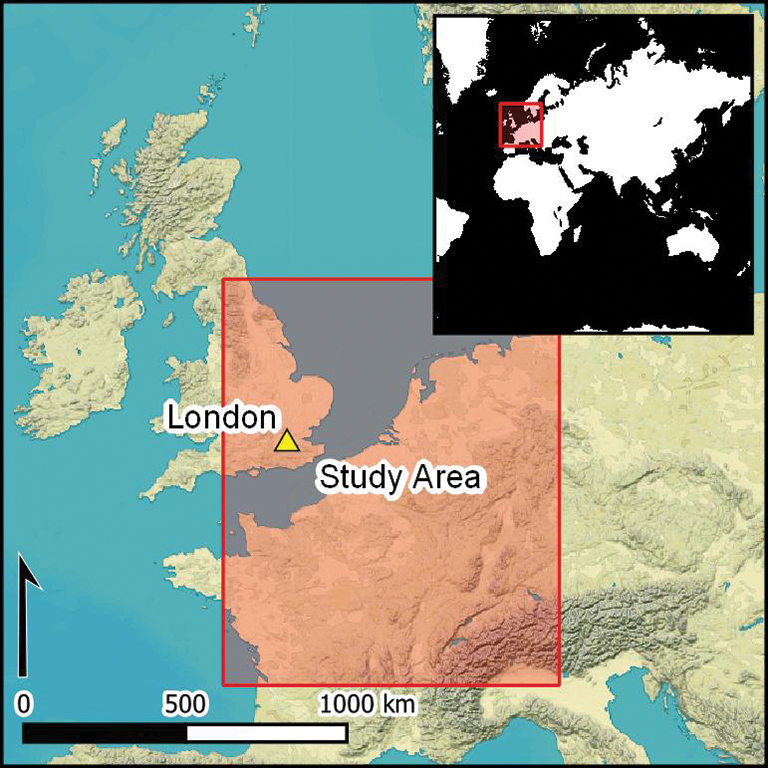
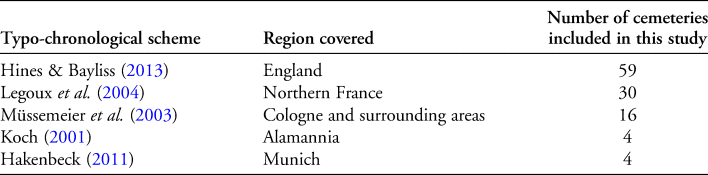
Other information taken into consideration includes the length of time for which a cemetery was in use. For each site, the earliest and latest possible dates of burials were assessed by a review of radiocarbon, dendrochronological and coin dates, and with reference to typo-chronological schemes. Table 1 and Figure 1 summarise the main typo-chronologies. Over such a large area, there is a risk that any chronological variation may be caused by the use of different (absolute) chronological schemes. When compared to Legoux et al. (Reference Legoux, Périn and Vallet2004), Müssemeier et al. (Reference Müssemeier, Nieveler, Plum and Pöppelmann2003) and Koch (Reference Koch2001), however, the chronology of Hines and Bayliss (Reference Hines and Bayliss2013) shows good correlation in the dates of key artefact types, particularly buckles and belt fittings, suggesting that the dates provided by these different schemes are broadly compatible (Hines & Bayliss Reference Hines and Bayliss2013: 480). For England, Hines and Bayliss's (Reference Hines and Bayliss2013) scheme is the primary chronological reference, as it re-dates many antiquarian excavations, providing a large standardised sample. Other regional chronologies have been less comprehensive in re-dating sites in older reports, and in these areas, the reliability of the dating from such reports is assessed on a case-by-case basis. There is some doubt over the absolute dates towards the end of Hines and Bayliss's (Reference Hines and Bayliss2013) sequences, as demonstrated by the disagreement with coin dates—in some instances by up to 20 years (Archibald Reference Archibald, Hines and Bayliss2013: 493 & 508). Where such discrepancies exist, the dates suggested by the coins are preferred.
Cemeteries included in this study and the methods used to date them (figure by E. Brownlee).

The principal typo-chronological schemes used in this study.
The dating evidence for cemeteries that are predominantly unfurnished offers far lower resolution. Many such cemeteries are described as being ninth to tenth century simply because they contain no grave goods. In the absence of grave goods, radiocarbon assay is the primary means of dating these sites, although coins that are occasionally found in graves can provide a terminus post quem. Radiocarbon dating is also hampered by the calibration curve plateau in the eighth and ninth centuries (Hines & Bayliss Reference Hines and Bayliss2013: 35). There is also variation in the frequency with which radiocarbon dating is deployed in different national research traditions; in the collated dataset, it is more common in the UK than elsewhere in Europe (Figure 1). Yet even in England, by 2009, fewer than 50 field cemeteries had been identified as late seventh to tenth century (Astill Reference Astill, Sayer and Williams2009: 224), and over half of these had not been subject to scientific dating. There is therefore a bias in the sample towards earlier, furnished cemeteries. While it is broadly true that unfurnished cemeteries are more likely to be later in date, without firm evidence, these cemeteries must be excluded from the statistical analysis to avoid a circular argument.
In order to investigate the changing use of grave goods, and to adjust for geographic and chronological biases, I use a series of relative kernel density estimates (KDE). A KDE is a method of visualising point data as areas of density (for an in-depth explanation, see Baxter (Reference Baxter2003)). Here, two KDE sets are created, one showing the distribution of cemeteries in use at a particular point in time, the second showing the same distribution, but with each site weighted according to the mean number of objects per grave. As excavation biases inevitably affect these densities (McLaughlin Reference McLaughlin2019: 488), the second set of KDEs weighted by grave-good use are then divided by the first set, which showed the number of cemeteries present. This ensures that areas and time periods that have been subject to more intensive archaeological investigation are not over-represented. The KDEs are repeated at ten-year intervals between AD 500 and 800. The maps presented below show key moments of change (for the full set of maps, see Figures S1–30 in the OSM).
In addition to the KDEs, I also use hotspot analysis to determine the statistical significance of any observed variations. This calculates the Getis-Ord Gi* statistic, which indicates cemeteries of statistically high or low grave-good usage, by comparing the value at a point to those directly around it, and then comparing them as a group to the spread of values from the sample as a whole (Getis & Ord Reference Getis and Ord1992). These maps show which cemeteries were in use at a particular moment in time, as well as the average number of grave goods from the cemetery as a whole. Including only the graves dated to that time would have meant excluding large numbers of unfurnished graves, thus skewing the analysis. Comparing the maps therefore only shows patterns of change resulting from cemeteries going in and out of use. Similarly, the appearance of a hotspot between maps does not mean that the average use of grave goods in that area has increased over time; it could be that the use of grave goods had fallen everywhere else. Any change that occurred within the lifetime of a cemetery, however, will not be visible using this method. I therefore combine this investigation of broad-scale patterns with a more in-depth analysis of changing grave-good deposition within individual cemeteries (Figure 2 & Table 2). These sites were chosen due to the availability of robust chronological information. This allows sufficient numbers of graves to be dated to a specific phase of cemetery use to provide statistical validity. In all instances, the average number of grave goods is plotted against the date for each grave—taken to be the mid-point of the phase to which the grave is assigned—and the statistical validity of any observed trends is tested using a Spearman's Rho test. In almost all instances, no dates could be assigned to the unfurnished graves in the cemetery (Bulles being the only exception due to an unusual level of intercutting between graves). The trends therefore reflect changes within the furnished burials, rather than within burials as a whole. This provides a finer-grained chronological resolution than previously possible at the broader scale.
The locations of cemeteries individually analysed (figure by E. Brownlee).

The cemeteries chosen for individual analysis.

Patterns and timing of spread of unfurnished burial
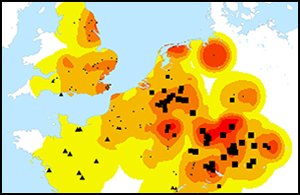
At the outset of the sixth century, the highest concentration of grave-good use was in England, particularly East Anglia, and in Alamannia, while the lowest were in West Frankia and Burgundy (Figure 3). Northumbria appears as an area of particularly high grave-good use, although it is not statistically significant. This contrasts with other studies that have emphasised the low number of furnished burials in this region (e.g. Semple et al. Reference Semple, Buchanan, Harrington, Oliver, Petts, Semple, Orsini and Mui2017: 99). This disparity is potentially due to the many poorly furnished cemeteries from this area for which accurate dates are unavailable, meaning that only the richer, well-dated cemeteries are included here.
Relative kernel density map showing concentrations of grave-good use across Western Europe in AD 500 (figure by E. Brownlee).

England was the earliest region to witness a decrease in the use of grave goods. Here, the process of abandonment appears to have occurred in two stages: first, a decrease in cemeteries with high levels of grave goods between AD 550 (Figure 4a) and 600 (Figure 4b), followed by a period of steady use until AD 650 (Figure 4c). There was then another gradual decline, before a sudden and almost complete abandonment between AD 680 (Figure 5a) and 690 (Figure 5b). Unsurprisingly, this is similar to the pattern proposed by Hines and Bayliss (Reference Hines and Bayliss2013: 476–79), who noted a drop-off in the number of furnished burials after their phase MB (AD 525–565) and FB (AD 510–585), and who place the end of furnished burial in England c. AD 685 at the latest.
Relative kernel density maps showing concentrations of grave-good use across Western Europe between AD 550 and 680. For key, see Figure 3 (figure by E. Brownlee).

Relative kernel density maps showing concentrations of grave-good use across Western Europe between AD 680 and AD 800. For key, see Figure 3 (figure by E. Brownlee).

On the continent, the decline in the level of grave-good use appears to have begun later than in England. The most obvious changes in continental practice are observed from c. AD 680 (Figure 5a), when the richly furnished cemeteries began to be abandoned, resulting in a decrease in grave-good density. This process accelerated into the eighth century. By AD 750 (Figure 5c), a region covering the Lower Rhine and extending into the Low Countries and Frisia, was the sole remaining area of high grave-good use, along with a few isolated cemeteries elsewhere. By the end of the eighth century (Figure 5d), there was very limited use of grave goods anywhere in Europe. Although some cemeteries show up as statistically significant hotspots, given how uncommon grave-good use was at this time, any deviation from unfurnished burial is likely to result in a statistically significant difference. That all of the English cemeteries formed a statistically significant coldspot, however, suggests that the abandonment of furnished burial in England was more comprehensive than elsewhere.
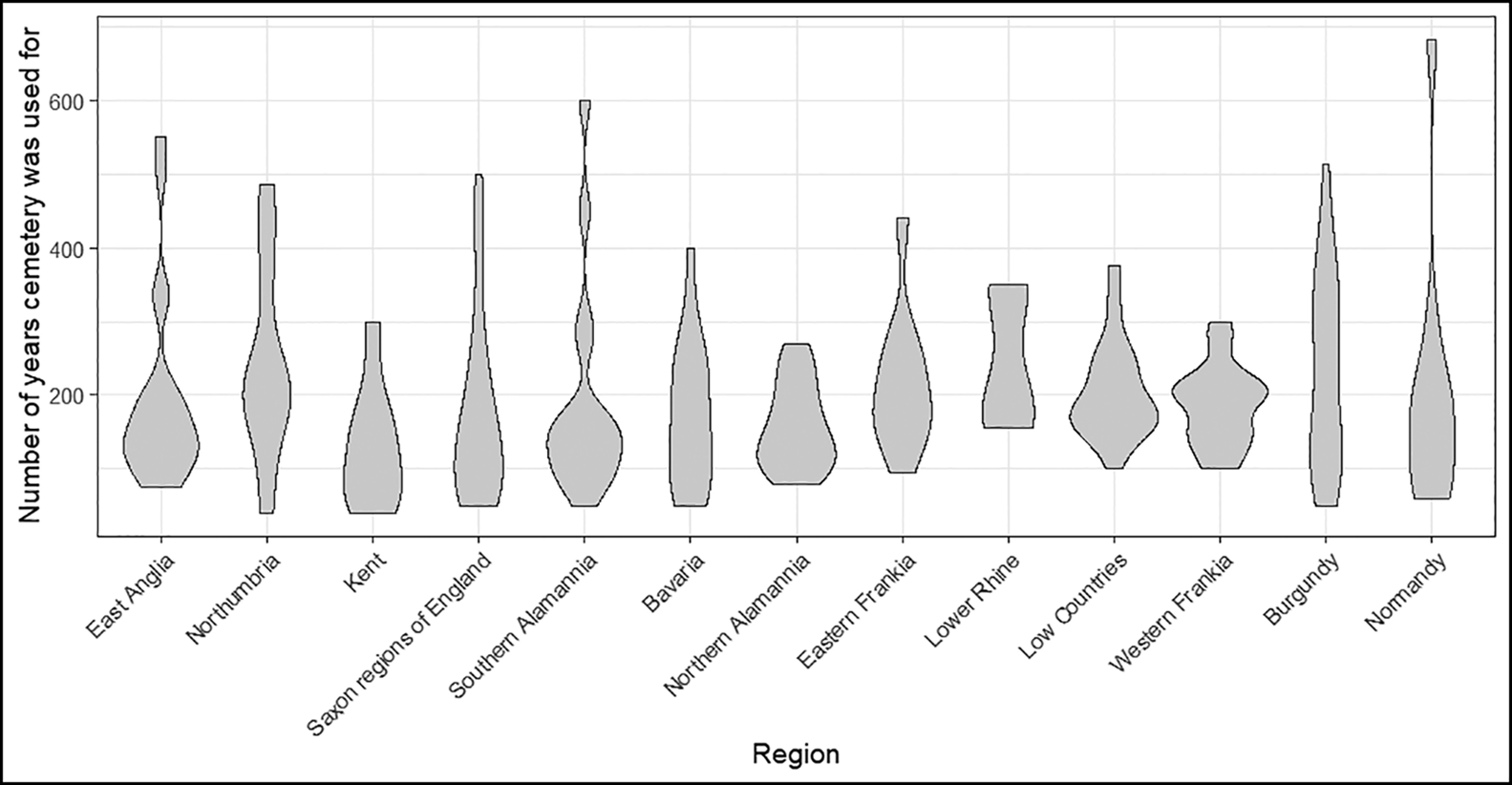
This methodology relies on differences between cemeteries. Thus, it is most effective at displaying change (or lack thereof) when there is a rapid turnover of cemeteries. This raises the question of whether change is most obvious in England because cemeteries went in and out of use fairly rapidly. Figure 6 shows that cemeteries in England were, on average, shorter-lived than in regions such as Burgundy, the Low Countries and eastern Frankia, although not significantly different to parts of southern Germany. Thus, the lack of visible change in these areas is not due to the longevity of cemeteries. Conversely, the impression that grave-good deposition continued for the longest period in the Lower Rhine and Low Countries may relate to cemetery longevity. Many of the cemeteries in this region were used throughout the entire period of furnished burial, making it difficult to visualise change (Brownlee Reference Brownlee2019: 160).
The lifespan of cemeteries in different regions across Europe (figure by E. Brownlee).
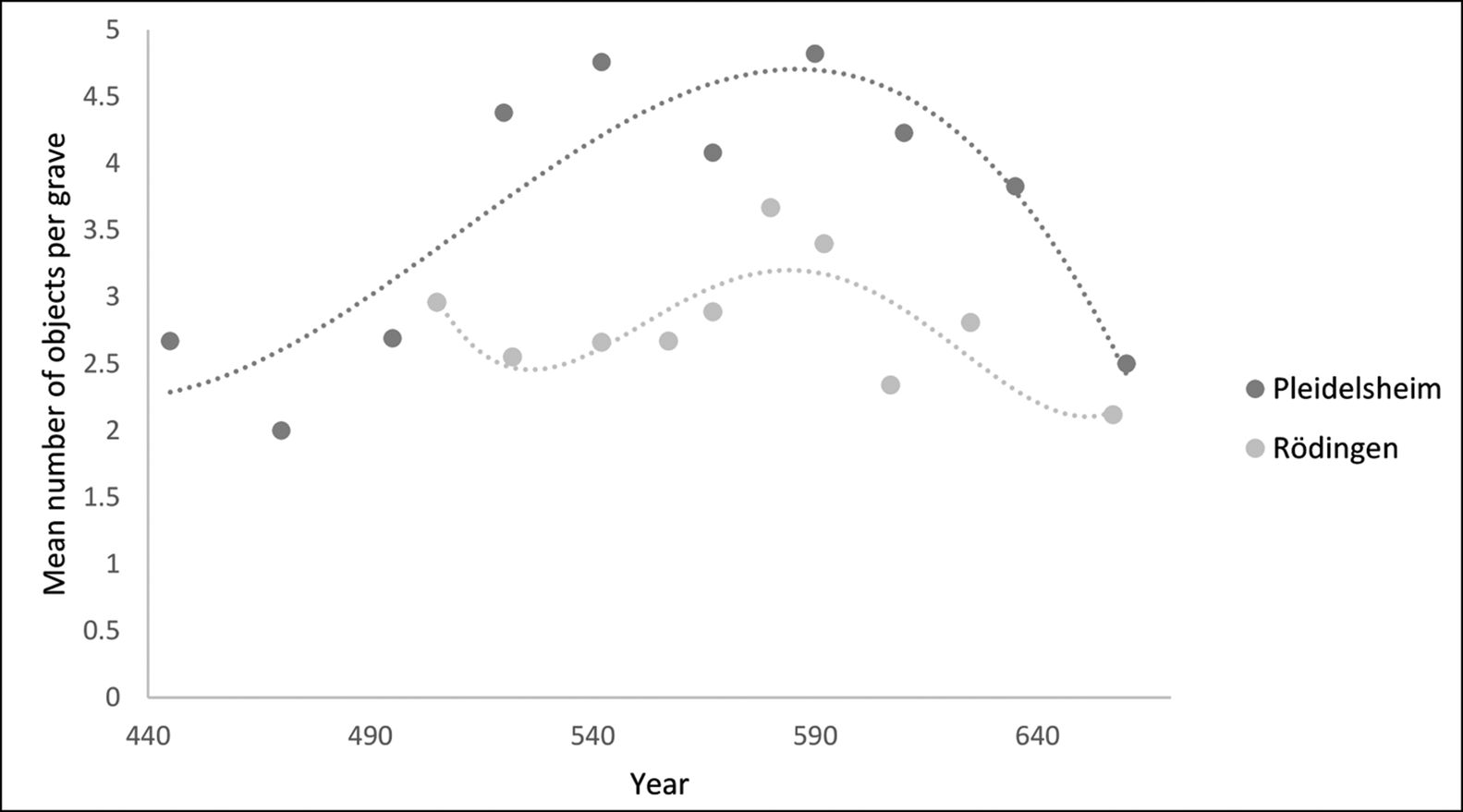
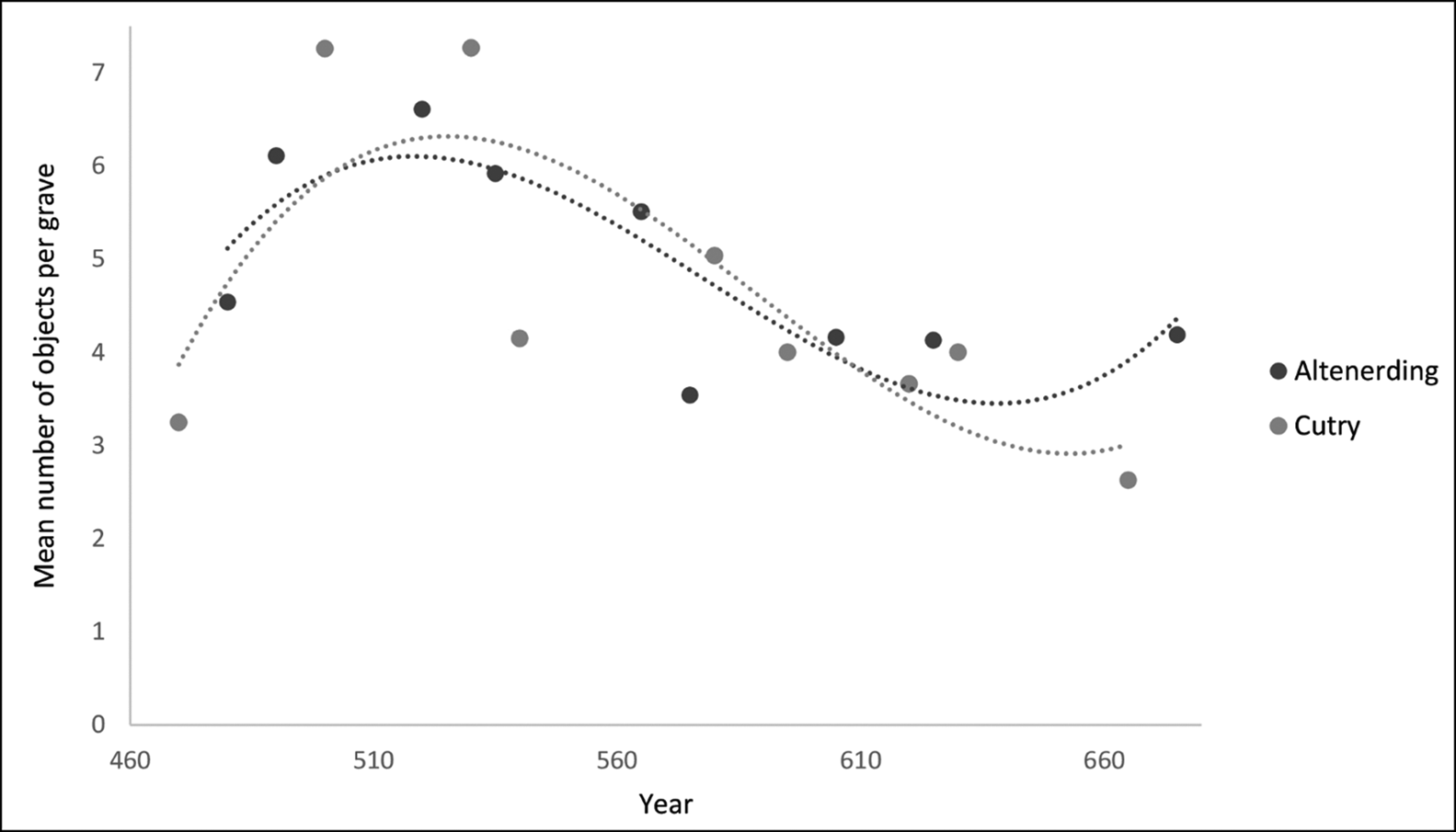
An analysis of individual cemeteries provides a more detailed assessment of the rate of change in grave-good use over time. At each site analysed, there is a decrease in the average number of grave goods being deposited from the earliest to the latest phases, including those in regions where Figures 4 and 5 show little change prior to the end of the seventh century. Rödingen and Pleidelsheim both show steady declines in grave-good deposition after the late sixth century (Figure 7), while Altenerding and Cutry see a sudden decrease between the early and the late sixth century (Figure 8). The use of grave goods at Bulles continuously decreased over time, with the clearest decline beginning around the mid sixth century (Figure 9). The earliest changes within these cemeteries therefore correspond with those that are visible at the larger scale in England, and only at Pleidelsheim and Rödingen was such change delayed until the late sixth century. Certainly, this shift was in process for over a century before grave goods, and the cemeteries at which they were commonly used, were abandoned.
Cemeteries where grave-good use declined after rising to a peak (figure by E. Brownlee).
Cemeteries where grave-good use decreased suddenly between two phases (figure by E. Brownlee).
Cemeteries with a steady decrease of grave goods over time (figure by E. Brownlee).

This analysis shows that the mid sixth century was an important turning point in the use of grave goods across Western Europe: the point at which such practice began declining. The speed and nature of this transition varied, clearly occurring in two stages in England. While the quality of chronological evidence from elsewhere in Europe means that gradual regional changes are less clear, the analysis of individual sites still shows varying rates of change. The regionally specific deposition of grave goods gradually vanished, to be replaced by a more standardised, unfurnished rite. This broadly contemporaneous change refutes some of the regionally specific explanations noted above (e.g. Geake Reference Geake1997; Williams Reference Williams2006; Halsall Reference Halsall2010; Scull Reference Scull2015). Instead, it suggests that these European regions were part of a highly integrated network, which allowed the rapid development and diffusion of such practices.
Diffusion and connectivity in early medieval Europe
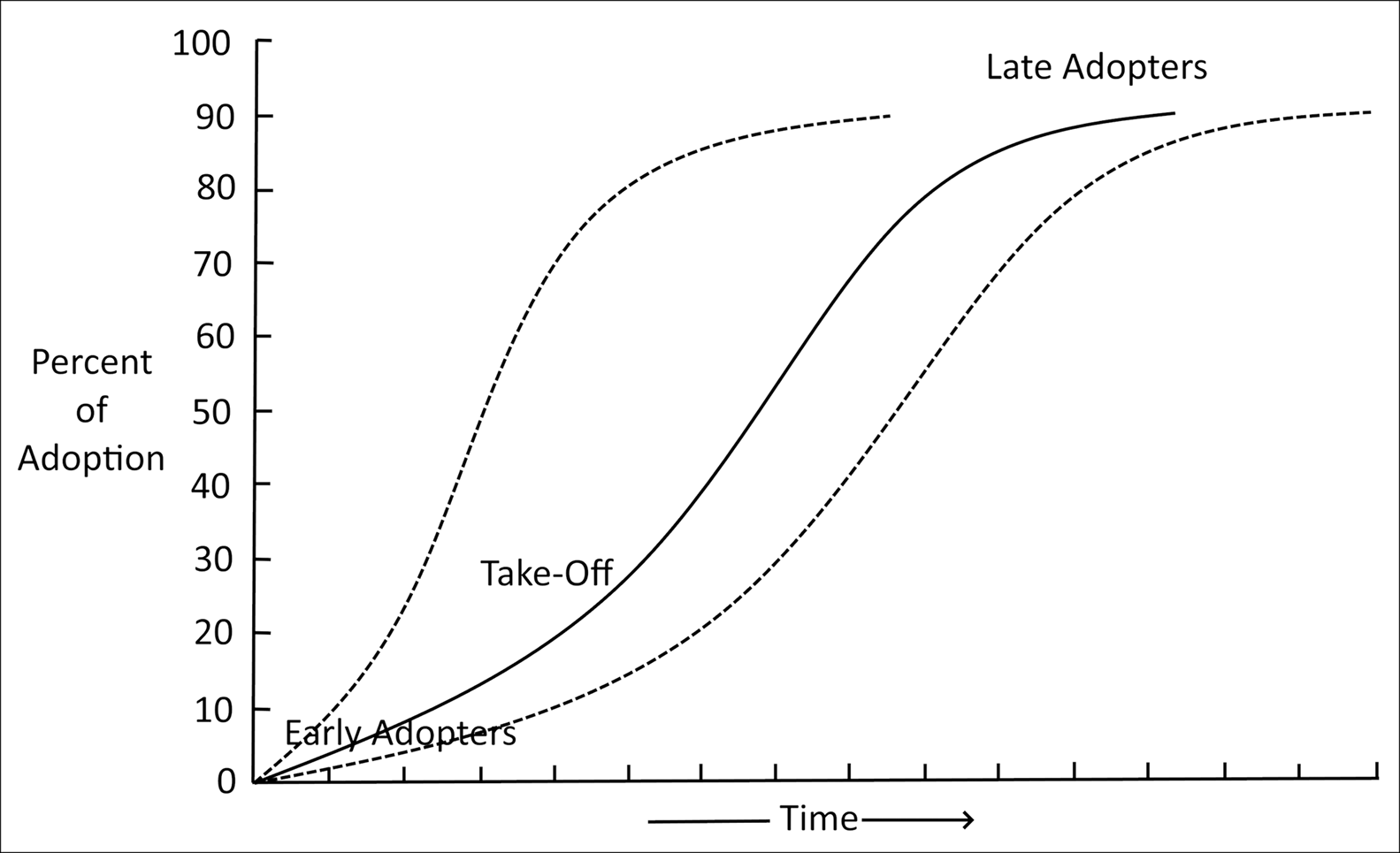
The pattern of change demonstrated above matches that of a typical diffusion curve. Early uptake of a new behaviour is usually slow, as only a few innovators experiment with the new ideas. Once the behaviour is taken up by 10–25 per cent of the population, however, its adoption by the remainder becomes increasingly likely, as the system self-generates the pressure to adopt (Rogers Reference Rogers1983: 11 & 234). Finally, the rate slows due to the resistance of the late adopters, some of whom may never embrace the new behaviour (Figure 10). Taking the study area as a whole, this mirrors how the practice of largely unfurnished burial was adopted. Furnished burial started to decline in popularity as early as the mid sixth century. This was followed by a clear acceleration in the abandonment of furnished cemeteries by the end of the seventh century. The limited deposition by the mid eighth century represents the ‘late adopters’.
Innovation adoption curve (redrawn by E. Brownlee, after Rogers Reference Rogers1983: fig. 1.1).
The standard pattern of diffusion across Europe implies significant connectivity—a situation that is apparent in other aspects of the archaeological record. The evidence for trade provides the most direct testimony for connectivity, creating both cultural and economic connections. Trade can create unified areas in which developments are interrelated, and the regularity, speed and intensity of economic exchanges can moderate the degree of interconnectivity (Beaujard Reference Beaujard, Wilkinson, Sherratt and Bennett2011: 8). Long-distance elite exchange networks are attested by the widespread distributions of high-status objects, such as amethysts, cowrie shells, elephant ivory rings and copper-alloy vessels (Werner Reference Werner1961: 312; Harris Reference Harris2003: 65). Long-distance luxury exchange, however, is a feature of most periods, and is therefore a poor indicator of the actual extent of interconnectivity. A more accurate indicator is the presence of bulk exchange: the large-scale movement of goods such as ceramics, metalwork, clothing or glasswork (Wickham Reference Wickham2006: 699).
The large quantities of imported goods found in rural cemeteries show that bulk exchange was present, to some extent, in the fifth and sixth centuries—prior to the changes in burial rites (Theuws Reference Theuws, Gelichi and Hodges2012: 34). Nor are bulk and luxury exchange entirely distinct, and objects can move between these spheres (Theuws Reference Theuws2004: 125). While coastal sites around the North Sea had access to imported goods from the sixth century onwards (Tys Reference Tys, Effros and Moreira2020: 774), there seems to have been an increase in bulk, long-distance trade during the late seventh century (Tys Reference Tys, Kars, van Oosten, Roxburgh and Verhoeven2018: 173), and a wide range of imported items and materials can be found in coastal and rural settlements along the Flemish and English coasts (Loveluck & Tys Reference Loveluck and Tys2006: 148–50; Tys Reference Tys, Effros and Moreira2020). The increase in sceatta (small silver coins) finds across England and the Low Countries in the late seventh and first half of the eighth century attest to the intensification of exchange during these periods (Theuws Reference Theuws2018: 67), while the absence of specialised trading sites before this time suggests the weak integration of disparate regions (Sindbaek Reference Sindbaek and Hodos2017: 556).
Rivers and sea networks were of great importance (more so than roads) in facilitating these long-distance contacts (Harris Reference Harris2003: 12–15; Brookes & Huynh Reference Brookes and Huynh2018: 488). The development of sails in the seventh to eighth centuries AD allowed for easier passage across the North Sea (Sindbaek Reference Sindbaek and Hodos2017: 554) and facilitated the increase in long-distance contacts. That almost all medieval centres developed along a river or on the coast (Theuws Reference Theuws, Gelichi and Hodges2012: 38) emphasises the importance of these routeways in creating inter-regional links. The importance of rivers is also emphasised by the late seventh- and early eighth-century distributions of sceattas. Despite being found widely in England, where they were produced, sceattas are found concentrated in small areas in the Low Countries, which reflect centres that were heavily involved in long-distance exchange (Theuws Reference Theuws2018: 63). The hinterlands of Flemish coastal trading sites stretched inland along the main river valleys, linking city territories across the Frankish world and facilitating exchange between them (Wickham Reference Wickham2006: 800; Tys Reference Tys, Effros and Moreira2020: 773). All the regions that witnessed the abandonment of furnished burial were therefore linked by these sea and river networks.
It has been suggested that the increase in long-distance trade provided a more accessible mechanism for the profitable exchange and recycling of artefacts, thus making it less likely that they would be deposited in graves (Boddington Reference Boddington and Southworth1990: 189). The value of objects placed in graves was not purely economic, however, and viewing them through this lens ignores the symbolic meaning of objects (Effros Reference Effros2003: 97). Rather, the significance of these emerging trade networks is that they provided the means for the diffusion of cultural practices, such as unfurnished burial, across long distances, and may explain the rapid acceleration in the abandonment of furnished burial in the late seventh century.
The beginnings of the decline in furnished burial precede the late seventh- to eighth-century peak in trade networks and other forms of material culture suggest that connectivity previously existed. Martin's (Reference Martin2020) study of square-headed brooches suggests that brooch styles became increasingly homogeneous from the mid sixth century—a phenomenon that he also attributes to the development of long-distance connections. The strongest similarities appeared not in brooches that were geographically close, but in those that were quite distant (Martin Reference Martin2020: 876 & 881). Meanwhile, multiple aspects of culture in eastern England and along the Frisian coast show convergence between the sixth and eighth centuries, including the development of shared traditions of organic-tempered pottery and the partial koineization of language (the emergence of a new language through the mixing of dialects; Deckers Reference Deckers, Hines and Ijssennaggar2017: 176 & 179). This again suggests that communities from across these areas were in close contact.
Conclusions
The abandonment of furnished burial across Western Europe was a largely contemporaneous process, with the earliest evidence for decline dating to around the mid sixth century. The rate at which unfurnished burial was adopted, however, varied geographically. The early decline in the use of grave goods is much more visible in England than it is in continental Europe, possibly due to the standardised chronology available for almost all English sites. Although there was a decline in the use of grave goods at individual continental sites, this is not visible at the broadest level until the late seventh century. By the end of the eighth century, however, grave-good deposition had been almost entirely abandoned, especially in England. This pattern of decline suggests that a diffusionist approach is important for understanding how unfurnished burial came to be adopted across Europe. The most important contribution of this diffusionist approach is the suggestion that the adoption of unfurnished burial does not necessarily have a single cause or explanation. Instead, it emphasises the contact and communication that existed between different communities, and that is also demonstrated by the evidence for increasing amounts of long-distance bulk exchange and the homogenisation of other types of material culture. This growing interconnectivity led to a ‘global Europe’, which shared not only funerary rites but also many other aspects of culture.
Acknowledgements
I would like to thank Susanne Hakenbeck for her comments on a draft of this paper, as well as the two reviewers for their constructive feedback.
Funding statement
The Arts and Humanities Research Council (reference 1808445) and Cambridge School of Humanities and Social Sciences funded the doctoral research on which this article is based.
Supplementary material
To view supplementary material for this article, please visit https://doi.org/10.15184/aqy.2020.153


 Open access

