

Human difference and the allure of trying to understand it have long fascinated.Footnote 1 Most recently, we have even assumed that others beyond planet earth might share that fascination. With the ‘Murmurs of Earth’, which the Voyager Interstellar satellite launched into outer space in 1977, NASA's scientists posed the question: what do we want the universe to know about us?Footnote 2 A committee chaired by Carl Sagan produced and included a ‘golden record’, with sounds and images selected to portray the diversity of life and culture on Earth. It included: (1) natural sounds, such as those made by wind, thunder, birds, whales, and other animals; (2) spoken greetings from Earth-people in 55 languages, beginning with Akkadian, spoken in Sumer about six thousand years ago; and (3) ninety minutes of musical selections from different cultures and eras. Framed by canonic masterpieces of western classical music – Bach's Brandenburg Concerto no. 2 and the cavatina from Beethoven's String Quartet op. 130 – one could hear music from the Far East (a Javanese court gamelan, Chinese c'hin, Japanese shakuhachi and Indian raga), Africa (Senegalese percussion and a Pygmy girl's initiation ritual in Zaire), Latin America (Peruvian panpipes and drum song and the Mexican ‘El Casabel’) as well as Western folk and popular music (Navajo night chant, Louis Armstrong blues and Chuck Berry's ‘Johnny B. Good’), all juxtaposed with other classical favourites (Mozart's ‘Queen of the Night’ aria from The Magic Flute, Beethoven's Symphony no. 5 and the ‘Sacrificial Dance’ of Stravinsky's Rite of Spring.) Of course, one could debate the assumptions on which the recording was based, these choices of the included and the excluded, the dominance of western music, even its aspirations. But as a reflection of certain tastes and values, it is a time capsule of a particular moment in human history.
In the late nineteenth century, compilations of music from throughout the world were not uncommon. Music was understood as a sign of race. To study it meant describing it and writing it down. In France, Julien Tiersot (1857–1936) used the Paris Universal Exhibitions to hear and notate a wide variety of non-western music, from China to the Congo. As he tended to compare what he heard with what he knew already, this allowed him to look for musical universals. Because ethnographers like Tiersot were stymied by what they heard, or inclined to ignore rhythmic and intonational complexities in non-western music, their transcriptions into western notation tell us more about them than the exotic Other.Footnote 3
In 1900 Léon Azoulay (1862–1926) attempted something closer to the Voyager project, less mediated by Eurocentric perspectives, and leaving to others the work of comparing and drawing conclusions. A French physician living in Algeria and member of the Société d'Anthropologie, he convinced his colleagues to fund the purchase of a phonograph to enable him to make over 400 wax cylinder recordings of peoples from throughout the world during the 1900 Universal Exhibition in Paris. This little-known and, until recently, inaccessible collection includes recordings in various languages and dialects of words (such as numbers), common phrases, conversations, recitations of folk tales, readings from the Bible, poetry, songs and instrumental music. In many cases, Azoulay chose certain material (especially the Prodigal Son story from the Bible, love songs and war songs) so that it could be compared cross-culturally. For each person recorded, Azoulay noted linguistic and sociological characteristics.Footnote 4
In addition, Azoulay engaged the help of someone literate in these languages to provide him with a written version of what was said or sung in indigenous script. Then he made transcriptions in western phonemes and translations. As Paul Ricoeur has pointed out, if translation involves exposure to strangeness and dialogue between self and stranger, it also means dia-legein, welcoming the difference.Footnote 5 In this article, after examining how musicians approached their transcriptions, I explore how Azoulay heard difference and sought to document his experiences and ultimately bridge those differences. With his use of phonemes, Azoulay presumed a certain universality in human languages, like music ethnographers at the time who notated non-western melodies using fixed pitches. But, far more than them, Azoulay faced the crevices between the oral and the written as well as between western and non-western modes of writing. With what he called ‘non-systematic’ transcriptions and ‘semi-literal’ translations, he tried to come to grips with the materiality of human difference as manifested in voice, language, and music. In comparing the recordings, recently digitized, with the transcriptions and translations, we encounter Azoulay seeking resonance with his own knowledge, grasping what he could, and struggling with the remaining untranslatability that inevitably characterized such a context. This is not so much about the pretense of omniscience or omnipotence on the part of the westerner, but rather an acknowledgment that what he heard was not always reducible to what he could notate.
Transcriptions of music and language are thus important, not only for what they tell us about the perceived connections between linguistics and music across the globe around 1900, and, in Azoulay's case, for people from many ethnicities and classes, but also for the light they shed on the aspirations as well as limitations inherent in these genres. What has relevance still today is less what the transcribers achieved, than how they grappled with what they could not achieve. Furthermore, the desire to fix non-western languages through western notation had significant implications when it came to the goals and processes of French colonialism.
Racial Typologies and Music: From the Oral to the Written
Although Azoulay's project was the most ambitious of such compilations to date, it had important predecessors. In his three volumes of Echos du temps passé (1853–57), J. B. Weckerlin reproduced songs from around the world. Juxtaposed with French music – from provincial folksongs to Adam de la Halle, Lully and Rameau – are songs from Mexico, China, India and Haiti. Like NASA's ‘Murmurs of Earth’, these are presented as emblems of race and culture, albeit through the mediation of transcription into western musical notation and translation into French.
In the ‘Chanson mexicaine’, a bolero rhythm lends a certain character and memorable distinctiveness. In a short prose introduction, Weckerlin explains this by pointing to the presence of Spanish people in Mexico. Yet, with its lyrics here translated, he avoids essentialist stereotypes, noting that this text is not necessarily representative of the twenty languages spoken in Mexico, several with distinct grammars and vocabularies. His transcription of the monophonic song and a version for voice and piano follow; however, the two versions differ in important ways, beyond the harmonic accompaniment added in the second one. To support interim harmonic cadences, Weckerlin alters the end of internal phrases in the first one from a falling third to a falling fifth; he also ignores accents on the last beat of many measures in the monody, perhaps because they upset the metric equilibrium. The point here: neither translation nor transcription need be ‘exact’ for the song to fulfill its function as a sign of race. And yet race here is not a simple concept; it refers to a hybrid people and the impact of migration.
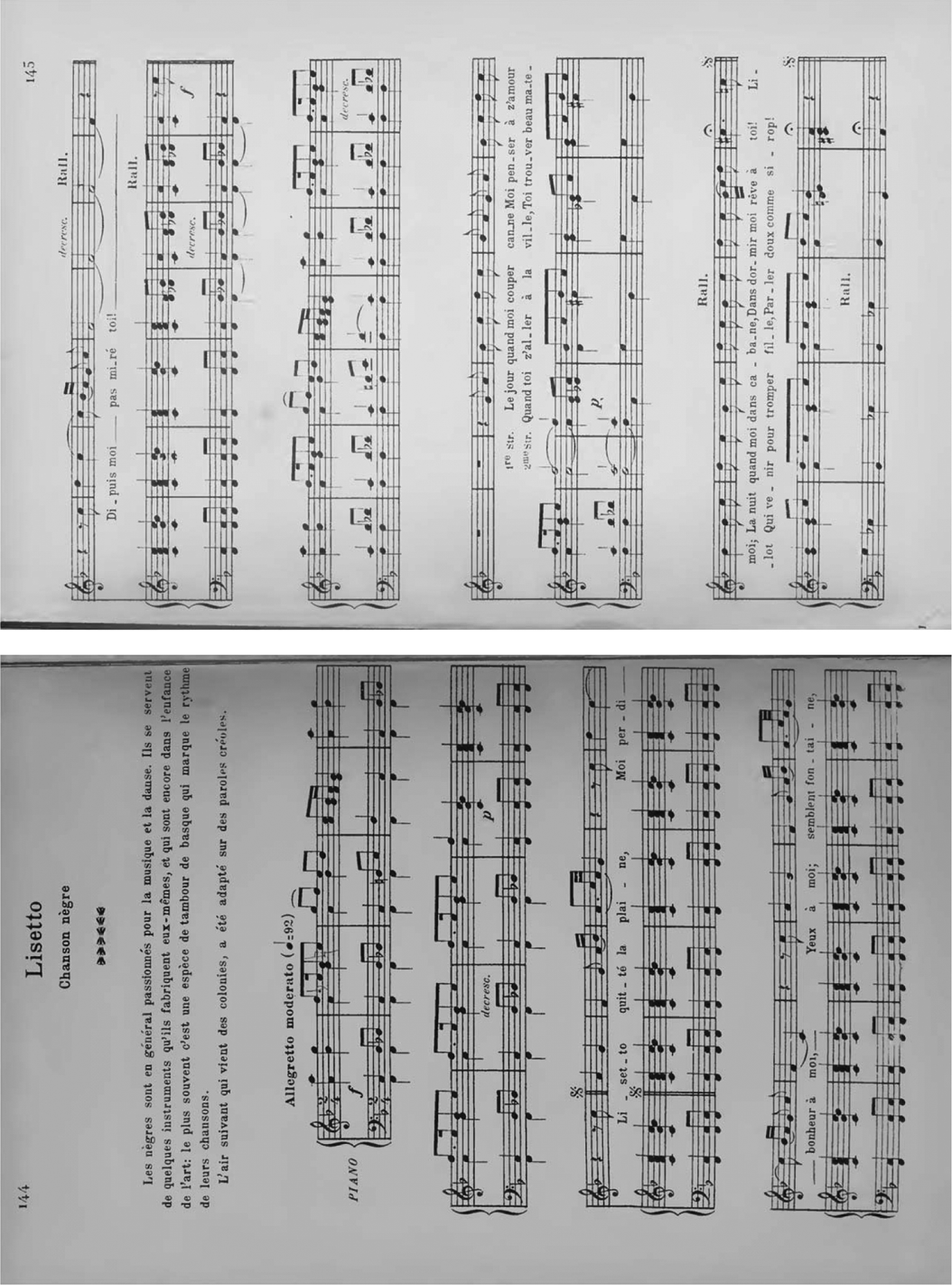
In introducing ‘Lisetto’, a ‘negro song’ ‘coming from colonies’, Weckerlin mentions no specific ethnic or national group (Figure 1). Rather, he begins with stereotypical comments on how ‘negros, in general, are passionate about music and dance’ and often play the drum. Nor does he reproduce the tune upon which the piano/vocal score is based, though he explains that it was ‘adapted to creole words’. Besides the static piano accompaniment in the refrain, consisting of two alternating chords throughout, there are some unusual aspects. Although the vocal line merely undulates stepwise between G and D, it arrives on C♯ at the end of each stanza. In the ten-measure introduction and coda to the refrain there is also chromatic movement (D to D♭ to C) over an ostinato on a low F. Then, in the accompaniment to the four stanzas, chromaticism returns in slides from E to E♭ and the use of F♯ and C♯, suggesting C minor, D major, and A major chords. Was such chromaticism the result of the transcriber's taste, or was he preparing for that strange C♯? Were such diversions from the norm meant to suggest the variability of the oral tradition, or a certain flexibility within the structural stasis of colonial life? Or, with the C♯ accompanying a reference to dreaming of the beloved (or remembering her), did it signify resistance to colonial control? Weckerlin's inclusion of this song at the end of volume 1, after music of the troubadours and trouvères, suggests that, for him, this music contains shards of the distant past, a common assumption about ‘negro’ music. And yet, its chromaticism complicates the stereotype of ‘primitive’ music as simple.
J. B. Weckerlin, ‘Lisetto,’ Echos du temps passé, vol. 1 (Paris: Durand, 1853–57).

In the late nineteenth and early twentieth centuries, the collection, notation and preservation of music was often driven by the desire to understand racial origins and racial distinctions, at home and abroad. But, as Weckerlin's transcriptions suggest, these categories were only useful to the extent that they were not too narrowly defined. Broadly applicable notions of race may have encouraged stereotypical thinking, but they also made possible comparisons, a common mode of learning at the time. Comparison was important to those who, in reaction to the urbanization brought about by the industrial revolution, sought to understand folk traditions around the world. In 1885 the Société des traditions populaires was founded in France. Most issues of their journal, La Revue des traditions populaires (1886–1919), included multiple versions of some story, such as the Medea legend, recounted in Laos as well as in Greece, or an Iroquois fable reminiscent of certain Hindu, Greek and German tales. Such resemblances supported the monogenist project of using culture to suggest the presence of universals in mankind.
Julien Tiersot, Weckerlin's assistant in the Paris Conservatoire library, focused on the study of French folksongs, which he considered ‘the charming debris of the primitive art of our race’. Building on typologies that classified races according to the ‘degree’ of their civilization, he argued that this music consisted of ‘melodic types’.Footnote 6 In his prize-winning Histoire des chansons populaires en France (1889), Tiersot, like other contributors to La Revue des traditions populaires, explored analogies more than differences in this repertoire. Later, calling on the mechanism of racial transformation in analysing the effects of regional differences on musical production, he explained song variants as the results of ‘musical acclimatization’. To facilitate their performance in concert halls, he ‘dressed them with the clothes of harmony’ so that in ‘transporting them into a context so different from their natural one’ they would not be too ‘dépaysé [like fish out of water]’ and could be admitted ‘into a world that would not accept them in their bare simplicity’.Footnote 7 While he mostly restricted accompaniments to doubling the vocal lines, Tiersot also often added lively introductions, turning them into new compositions.Footnote 8
At Universal and Colonial Exhibitions from 1867 to 1937, and in European zoos beginning in the 1870s, Europeans had opportunities to encounter non-westerners and hear their music. Although not all such exhibitions had the same character and purpose, as a whole they were conceived to give visitors ‘a trip around the world … available to everyone’, and occasions to judge the ‘degree of barbarism and civilization’ characterizing each of them.Footnote 9 But if the actual presence of these bodies, languages, and music challenged certain assumptions and stereotypes, it also pointed to inherent problems in westerners' perception, which was often Eurocentric in nature.
The first exhibitions at the Paris zoo from 1877 to 1885 showed relatively small groups of fourteen to twenty-two men, women and children – enough to enable basic studies of physical and social anthropology. These fuelled the study of racial origins, something of crucial significance to monogenists and polygenists, as well as the whole colonialist project. Some groups were understood as living remnants of the past, a past without progress. The Lapps, assumed to have descended from prehistoric times, were wanderers, like Africa's oldest clan, the Bushmen. In 1887, the Achantis seemed ‘the strangest and rarest people from afar, the most interesting specimens of primitive or decadent humanity’.Footnote 10 Most of these people brought no musical instruments. But they did sing. In 1878 and 1889, the Lapps performed ‘melancholic and sweet’ lullabies;Footnote 11 in 1882, the Galibis from Guyana presented laments for the dead, sung by soloists and a chorus. As many came from regions the French were not planning to colonize, perhaps the perceived primitivism of such groups provided a rationale for their exclusion from French imperialist agendas.
When, in 1886, the zoo was transformed into a corporate entity, one driven by profits for their stockholders more than science, it mounted a second kind of exhibition, as evident from their presentation of eighty Ceylonese in August and September. The zoo's brochure described them as ‘the most distant race’ coming from ‘the antique tribe of Tamils who had been on the island of Ceylon for thousands of years’, and Ceylon as the place, legend had it, from which the first man and the first woman came.Footnote 12 Yet, with this visit, entertainment replaced primitive prototypes as the principal attraction. Among the eighty Ceylonese were dancers, jugglers, musicians and twelve elephants. All of them performed in seventeen tableaux daily. A flute-playing snake charmer was one of the hits of the exhibition. The group was so successful that, the following year, a Parisian circus brought in another Ceylonese troop.
A third kind of exhibition, characteristic of those in the 1890s, involved more people (up to 120), and tended to focus on regions France was in the midst of colonizing, especially West Africa. These exhibitions also offered entertainment, but in the form of warrior exercises and warrior dances, accompanied by drum music and war cries. It is interesting to speculate whether the attraction of these displays was not just the spectacle, but also the opportunity to understand why, despite the limits of their race and their technology, Africans had long been able to resist French attacks and succeeded in killing so many French. Beginning in 1887, the Achantis from equatorial Africa presented this genre with ceremonies that included dances of struggle. Perhaps their war dances and mock battles suggested how they had been a worthy opponent of the British, long resisting colonization. In 1891, just a year after 800 Dahomeans, neighbours to the Achantis, attacked and prevailed against French troops, the zoo displayed a troop of Dahomean women warriors. The press was full of praise. The music of their two drums was powerful, with ‘direct influence’ on their movements, controlling their crescendos and supporting an extraordinary animation. In the zoo's 1892 exhibition, the Caribbeans also presented wild-looking dances, but whereas the Dahomeans were characterized as ‘warrior and disciplined’, the Caribbeans were ‘timid, effeminate, and industrious’, a people who ‘loved music’. Also already conquered and known for showing white people respect, the Pai-Pi-Bris from Côte d'Ivoire too performed music described as slow and sweet, as if a symbol of peace, their instruments having rustic harmony and charm.Footnote 13
There is no evidence that French musicians paid much attention to the annual zoo exhibitions, perhaps because of the limited role music played in them, or the kind of ethnic groups they exhibited. However, many did attend non-western performances at the Universal Exhibitions between 1867 and 1900. Especially attractive were those with rich musical traditions that were still thriving in colonial contexts as far away as Indochina and Indonesia. Some collected and transcribed what they heard, such as Louis Bénédictus in his two volumes, Les Musiques bizarres à l'Exposition (1889) and (1900) and Tiersot in his Les Musiques pittoresques (1889) and Notes d'ethnographie musicale (1900–1902; 1905). If the former, compositions entirely for piano,Footnote 14 betray their purpose as aural souvenirs of experiences – curiosities entirely westernized for general consumption – they nonetheless present a kaleidoscope of musical experiences, from the repetitive processional music of the Javanese musicians on their ‘gamelang’ to the discordant juxtapositions of the ‘Charivari annamite’. New compositions could thus result from these experiences, as they did for Debussy, whether or not French musicians respected or captured the authenticity of the original.
At the same time, the aural perception and acoustic legibility of non-western music presented significant challenges. With Javanese music, Edmond Bailly tried ‘in vain … to fix these rhythms through notation, as well as the multiple and diverse intonations of the angklangs’; he eventually gave up.Footnote 15 To overcome the limitations of only hearing it in public performances, Tiersot met privately with non-western musicians. This also allowed him to take down musical examples ‘dictated by an indigenous musician’ and to compare what he heard ‘in the sweetness of a beautiful June morning’ to the ‘furore’ of notes that were otherwise ‘indiscernible’ the night before.Footnote 16 But how did he understand it, and what do we learn from his transcriptions?
Tiersot, given his work on French folksong, was open to what could be learned from the music of peoples who, on the surface, seemed less sophisticated. He looked to non-western music as ‘an occasion to study the musical forms specific to races for whom art is understood differently than ours’. He also believed much was to be learned from ‘inferior art’: it shows us ‘new aspects of music and most likely is much closer to origins than our art today which is so complex and refined’.Footnote 17 In analysing his predecessors' transcriptions, he refers to them as ‘most characteristic of indigenous music’, their purpose being to ‘contribute to knowledge’ about this music among Europeans.Footnote 18 And yet what transcribers published as ‘representative’ was only what they could capture in western notation – in other words, music with precise pitches and rhythms. Tiersot himself admits to having difficulty notating whatever ‘did not seem to be attached to a tonality’. However, he often assumes that ‘alterations’, such as quarter tones and the like, were merely ornaments not affecting ‘the tonal feeling’. He concludes, ‘nothing making up oriental music has a different foundation than that of the West; there are only characteristics, curious to observe, only simple details’.Footnote 19
Transcriptions thus offered westerners a way to study this music: to play it multiple times and compare it to what they knew already. But what to do about different kinds of intonation, ‘airs made for instruments with vague intonations, very low sonorities’? Or extraordinarily free rhythms and tempos that were impossible to notate accurately? As played on the piano, these ‘lose all their character’. When it came to Senegalese music, Tiersot found the themes ‘vague and unfixed; that is, there are not any themes, but simply rhythmic patterns on which musicians improvise as they wish with notes having a more or less melodic character…. It was impossible for me to grasp an entire melodic line, so much did the lines have such little consistency'.Footnote 20 Melodic themes would have allowed for transcription and analysis from a western perspective. But unable to ‘grasp an entire melodic line’, Tiersot abandoned the attempt to notate it.
One could here point out transcribers' tendency to impose western metres on non-western rhythms, superimposing regularity but missing rhythmic subtleties. Also important was one of their principal assumptions: that ‘music’ is based on precise, notatable pitches. And yet pure pitches are learned; they reflect the desire to transcend the rough materiality of language, or what Roland Barthes calls the ‘grain’ of the voice. In the nineteenth century, anything ‘pure’ connoted either the absence of outside influences (in the racial sense), such as was claimed for certain folk songs far from urban centres, or transcendence of material and mundane concerns, a taste for elevated ideas, even the refined world of the upper classes. In reviews of western singers, ‘pure’ meant that their sound was devoid of the distinctions of an individual voice and language. This value was often praised in singers of different nationalities who performed, for example, Mignon in Ambroise Thomas's opera. At the time, ‘pure’ also referred to a quality that rose above national differences, one shared by white Europeans, although, as Ernst Renan had already pointed out, racial purity did not exist in Europe.Footnote 21 In short, ‘pure’ pitches represented an achievement – in some sense, Western music at its finest. In contrast, ‘very irregular intonations’ were associated with ‘the most uneducated [inculte] and savage nations’.Footnote 22 Unable to count on one of the most fundamental elements of his technology, Tiersot thus concentrated on short examples of non-western music – his transcriptions, like those of Weckerlin, being suggestive rather than definitive indices of their culture.
Despite his difficulties with it, Tiersot approached this music with lofty goals, the most important being the search for musical universals across space and time. Indeed, among his most interesting transcriptions are short examples of harmony. Not that in Oceania, Tahiti or the Congo it was particularly complex, but he did find intervals of the third, fourth, and fifth, ‘used logically and with a very tonal feeling’. This led him to surmise that harmony, ‘which we like to consider as the conquest of the modern genius’, had much older traditions outside the West, that it had existed independently of the ancient art of Greece and Rome, and that it ‘seems to have stayed stable since its origins’. In other words, ‘vocal harmonies probably existed in the practices of distant races for a long time’ and, as such, were not the result of ‘European influence’. Tiersot thus inverts conventional assumptions and concludes that harmony is ‘something natural to mankind, even savages or primitive people’.Footnote 23 Might this have been an argument, albeit an unconscious one, for adding harmonies as accompaniment to non-western melodies? On this, Tiersot remains mute.
As western society became increasingly complex and music's capacity for meaning expanded, Tiersot, like others, turned to embracing the cult of beauty for its own sake – that is, the contemplation and admiration of pure form. His few longer transcriptions of non-western music focus on melodic variants, with little explanation of their context or use. In fact, he believed that the Tunisian repertoire he heard at the Café Tunisien in 1889 could be ‘reduced to a single form, characterized by a few short repeated melodic formulas and their variations’, and that this form was one of the oldest in the Orient.Footnote 24 His transcription in Figure 2 indeed seems based on three melodic ideas, W (bb. 1–3), X (bb. 6–7), Y (bb. 8–11) and Z (bb. 14–15), in the following approximate form:
W W W' W'
X Y W' X'
Z Z' Z'' Z''' Z'''' Y'
Julien Tiersot, Tunisian music, Les Musiques pittoresques (Paris: Fischbacher, 1889), 85.
Each motive plays a role in the articulation of the melodic arch of A up to E and back to A. If the lilting, alternating long-short-long-short rhythmic pattern and this arch form repeats in W and W', nonetheless the different metric placement of W', which comes on the downbeat, suggests that Tiersot heard W as a kind of structural upbeat to W'. The intervallic outline of W', arching up to E, is echoed multiple times in X, the oscillation of a fifth between A and E, before slowing and descending back to A. The long phrase that fills in these oscillating notes and begins the descent downward becomes a new motive, Y – with minims and melismatic semiquavers – before returning to the first part of W and the oscillating fifths in X. This arch shape is then retraced more quickly with the Z motive, reiterated five times, functioning almost as a coda, before returning to the extended descent recalling Y, the final phrase, to be sung ‘librement’. Such analyses suggested that the intervals of Western scales could be found almost everywhere, particularly the fourth and the fifth, and that such music proceeded according to what we might today call ‘gap-fill’.
In his transcriptions of Tunisian music made in 1903 and 1904, Erich Hornbostel likewise focused on melodic formulas characterized by outlining and then filling in certain intervals, such as the fourth and fifth.Footnote 25 Hornbostel's notion of both song and instrumental music as spinning out multiple ways of articulating the same basic melodic shapes echoes Tiersot's observations.Footnote 26 However, working from recordings allowed him to slow down and scientifically analyse the nature of intonation and rhythm. In one transcription of a Tunisian melody, he notated six measures in 3/4 in an attempt to capture a short melisma that lasts only a second or two.Footnote 27 Going beyond standard pitch notation, he also placed pluses and minuses over the notes. Hornbostel's analyses are full of commentary on the ‘highly particular intonation’ of this music. But he too threw up his arms when ‘the intonation was too unsteady to be measured’, such as in a Tunisian wedding song.Footnote 28
In trying to come to grips with their attempts to notate Tunisian music, both Tiersot and Hornbostel had to face the limits not only of their perception and their technologies, but also those inherent in any attempt to capture human creativity in written form. Both ethnographers may have perceived opening formulas and variations in this music, but many rhythmic and intonational complexities escaped their notation. Listening carefully to non-western music and attempting to transcribe it, however, had a felicitous secondary effect: it led Tiersot and others to entertain broader definitions of music and to reconsider traditional Western notions of melody, harmony and – especially – rhythm.Footnote 29
Rethinking Race after 1900
In 1900, after more than twenty years of exotic exhibitions and decades of work in measuring skull sizes and bodies, came the publication of Joseph Deniker's Les Races et les peuples de la terre: Eléments d'une anthropologie et d'ethnographie. Polygenists had wanted to understand evolution beginning with the Neolithic age. But here, Deniker put aside the debates between monogenists and polygenists to argue for an important distinction between a race and a people (peuple). For him, race was defined by physical characteristics, and since there are very few examples of individuals from a ‘pure race’, racial types are nothing but theoretical types.Footnote 30 In contrast, he defined a people (or ethnic group) by its linguistic and sociological characteristics. Understanding these characteristics became crucial in the following decades, particularly for anthropologists and colonialists.
Like others, Deniker understood music as the ‘common good of all humanity’, song and poetry being linked in ‘the early stages of civilization’. He also weighed in on the problem of transcribing non-western music, going beyond Eurocentric perspectives: ‘Even specialists find it very difficult to notate the tunes of “savages” and three-quarters of notations published in various places are inexact. This comes from the fact we have always notated them using our eight-note scale. However, this scale, even if used by some uneducated ethnic groups, is not the only one they use’. Deniker's conclusion: ‘It's a people's musical instruments that determine the scales that it uses.Footnote 31
Deniker's focus on ethnic groups drew attention away from racial hierarchies, but did nothing to challenge the view of certain cultures as remnants of the distant past, particularly when it came to music. And indeed, given the increasing presence of westerners all over the globe and the pressures of modernity, some began to worry about the survival of certain species and their cultures because of their purported connection to the distant past. In 1900 Fulbert-Dumonteil, who, since the 1880s, had published a brochure almost annually on people exhibited at the Paris zoo, drew attention to this: ‘These types, these races, these manners, these customs that, intact, have traversed centuries and centuries will no longer exist tomorrow’.Footnote 32 The urgency to use western means to ‘fix’ these traditions before they disappeared was growing.
Along with new attitudes toward race came a new colonial policy of association, one that called for accepting, respecting, and better understanding human difference rather than seeking human universals. Not only had assimilation largely failed in Indochina, but intellectuals such as Leopold de Saussure and Emile Durkheim criticized judging a people's institutions by comparing them with some arbitrarily defined ideal. They insisted instead on the value of indigenous institutions and practices. The 1900 Colonial Congress unanimously voted that these should be maintained.
Tiersot's ‘ethnographic notes’ from the 1900 Paris Exhibition reflect some of these new values. Here, seeking music not ‘contaminated by European influences’, he focused on ‘exclusively the races most different from ours and the people most distant from us’.Footnote 33 Increasingly he realized that such a work should take into account ‘the origins and ethnic character of each musician from whom we have borrowed songs’. And yet, for the most part, as in 1889, he could get neither this information nor what he needed to make more than transcriptions ‘on the fly’ during public performances.Footnote 34 Nonetheless, he was able to spend time with Dahomean musicians, ‘interviewing them individually, notating their rhythms, their melodies, studying the form and mechanism of their instruments’. In three lead articles of Ménéstrel (1903), Tiersot recounted the Dahomean warrior performances he had attended in Paris in 1891 and 1893, reproducing some of the ‘repeated melodic formulas’ he had notated ‘on the fly’ at that time, as well as three warrior songs their singers dictated to him, including an unusually long 28-bar one that he transcribed with its lyrics, albeit untranslated. Another one, he noted, used a scale resembling a European one, ‘in spite of the bizarre nature of the final cadences’ – recalling the final C♯ in the ‘negro song’ transcribed by Weckerlin decades earlier.
Yet the sound produced by Dahomean drums still seemed like ‘noise that was impossible to notate’, the short snippets he notated only a ‘vague melopée’, not dignified enough to call ‘melodies’. And with an eight-measure ‘theme’ transcribed in 6/8, Tiersot confessed that whereas his notation, as played by the first violins of an orchestra, might give the impression of ‘a theme perfectly appropriate for the finale of a ballet’, this was not the case as sung by the ‘harsh and gutteral voices of the indigenous’.Footnote 35 As in 1889, he was drawn to moments of ‘simultaneous’ singing that sounded to him like ‘perfect chords’. However, admitting to having made ‘no progress’ in his understanding of Senegalese music, Tiersot made no further attempt at transcribing it, thereby limiting comparison with other African music.Footnote 36 Despite all this, with his Notes d'ethnographie musicale Tiersot aimed at an integrated approach to non-western music. To completely understand ‘the musical genius of humanity’, he saw ‘real importance’ in all kinds of music: ‘It is thus that the concert becomes truly international, each one taking part for the greater good of the general history and art of humanity’.Footnote 37
‘A New Era of Sounds and Noises’: the Phonograph and Applied Linguistics
Along with these new notions of race and the colonial policy of association came interest in a new medium, ideal for the collection, conservation, publication and dissemination of knowledge about human differences: the phonograph. At the 1889 Universal Exhibition, Tiersot was fascinated with its ability to record simultaneous notes and harmonies with remarkable clarity.Footnote 38 But it wasn't until 1900 that his colleagues at the International Congress on Music History called for use of the phonograph to collect popular melodies in all countries. Just after the 1900 Universal Exhibition opened, in an essay entitled ‘A New Era of Sounds and Noises', Dr. Léon Azoulay argued that, just as photography brought about a revolution in knowledge and human progress, so too would the ‘fixing of sounds and noises’ by the phonograph. As ‘sounds and noises, simple and complex, are an immense and unknown source of information’, the phonograph would allow for studies of which traditional linguistics was incapable. These included:
– tracing the ‘phonetic evolution of a language, which is much more rapid than that of its orthography and syntax’;
– documenting the ‘extreme diversity of pronunciation and intonation’ within the same language, epoch, and country as a function of social class or region;
– understanding the ‘imperceptible aspects that link sister languages’;
– providing examples of ‘unusual métissages’ between two foreign languages; and
– helping us to remember the changeable nature of vowels of languages and dialects of which we are ‘unconscious’.Footnote 39
With such a list, Azoulay showed remarkable sensitivity to the constant mobility of every aspect of language, to the ever-complex interactions between languages (sometimes resulting in métissages, a term more often used to refer to racial mixing or miscegenation), and to the enormous disparity between the practice of language and what could, and should, be studied scientifically. In this sense, he posed challenges to anyone attempting to bridge the gap between oral and written communication.
Azoulay was aware that the implications of these questions and the uses of the phonograph would extend beyond linguistics to biology, physiology, psychology, medicine, and all the arts. He hoped to ‘provoke the creation of methods of acoustical analysis, analogous to optical and graphic analysis’. To facilitate this, he argued for the need to ‘record, conserve, and reproduce … voices, sounds, and noises’; to include ‘song, instrumental music, animal sounds, nature, and industry’; and to take note of ‘the original texts (or transcriptions with their translation), along with linguistic, ethnographic, geographical, and familial indications of the individuals recorded’ – all that was needed, in other words, ‘to address the problems of linguistic anthropology’. Given that such archives would ‘augment the well-being as well as the intellectual and moral heritage of mankind’, Azoulay launched a challenge: ‘perhaps some linguist or businessman might be able to profit from the large numbers of foreigners in Paris for the Universal Exhibition to put these ideas into practice and begin a collection of samples of the most diverse languages’ – that is, the creation of a phonographic archive.
Such a proposal, echoing the importance Deniker would soon ascribe to the linguistic and sociological characteristics of ethnic groups, presented vocal and instrumental music as characteristic of ethnic groups on the same level as physical, physiological, and psychological attributes. And it recognized that in the project to ‘fix languages’, especially those that were poorly known, ‘conventional orthography’ was ‘very imperfect’. ‘Only the phonograph’, Azoulay argued, ‘permits a truly scientific study of the human voice and its variants’. At the May 3 meeting of the Société d'Anthropologie, his colleagues voted to create such a Musée glossophonographique with Azoulay and M. Vinson (a professor at the Eécole des langues orientales) in charge.Footnote 40 Returning to his colleagues in June, Azoulay pleaded for the establishment of an international commission to demand consistency in recording machines. He also proposed that travellers, geographic society members and missionaries be advised of the utility of phonographic recordings and given practical instruction on their use.Footnote 41 Indeed, recording, unlike transcription, required only limited competence.
Thus, despite being an amateur in this domain, Azoulay set out to record the diversity of peoples at the 1900 Universal Exhibition. With the aid of various diplomatic contacts, who secured permission from organizers of the various national pavilions and the Tour du Monde exhibit (as well as two visiting Russian teachers and a few foreigners living in Paris), he got the kind of access to foreign peoples that had largely eluded Tiersot and others. From July through October, he made the following phonograms in 74 languages and dialects:
166 Asian (plus 66 donated by the Chinese)
97 European (many of which were of the French provinces)
63 African
3 Oceanic
3 South American
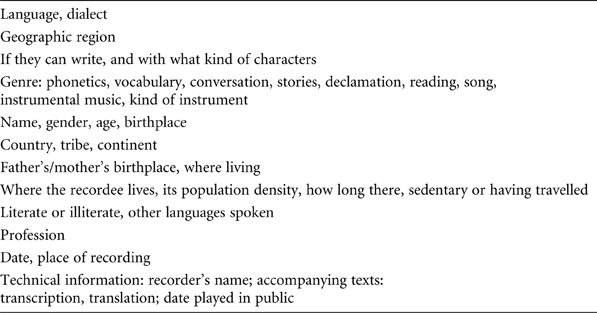
Besides a good number of Annamite, Arab, and Chinese recordings, the largest groups represented are from Madagascar (35) and the six ethnicities from Senegal: Wolof, Serere, Bambara, Mandingue, Peul, and Toucouleur. At the June meeting of the Société d'Anthropologie, Azoulay also presented his methodology in the form of the categories of information he would seek to document with his recordings (see Table 1).
Categories of information documented in Azoulay's recordings.
Clearly, Azoulay was interested in the uniqueness of each voice as well as what it may have shared with others. From the information sheets he filled out for each phonogram (see Figure 3), we learn much about the people he chose to record. Although some forms are incomplete, the twenty-six categories present a kind of ‘thick description’, immensely helpful to analysis. Included were men and women, aged 18 to 48, from a range of social classes, backgrounds, talents and experiences. Other than the unemployed or those whose profession was unknown, the men came from the military (soldiers and navy sergeant), the professions (school teachers and engineers), business (salesmen and hotel worker), artisan trades (painter/decorator, weaver, and jeweller), music (professional musicians, griots, singers), and included an actor, farmer, and peasants. Among the women, Azoulay recorded a school teacher, seamstress, saleswoman, weaver, dancer, geisha, singers and a peasant. Of these, some had travelled, others had been stationary; some were illiterate, others could read; some spoke foreign languages, including French. The oldest person recorded, an illiterate Breton farmer who spoke French quite poorly, sang a folksong in a dialect from the Finistère (phonogram 70). Some were quite sophisticated, especially the older ones. A businessman from Turkestan, who sang three folksongs for him (248), had been to Russia, and spoke Russian, Uzbekturki, and a little French. An unemployed 38-year-old Tamil from near Madras, who read from the Bible (219), was literate and spoke both English and French fairly well. A 45-year-old Portuguese engineer, who also read from the Bible (23), had traveled throughout Europe and spoke French, English, and Spanish. A 43-year-old school teacher from Beirut, who sang Christian marriage songs (275), spoke English and had been as far away as the United States. What is not clear is what brought these people to Paris, or what their relationship was, if any, with their nation's pavilion or the Exhibition. But what a fascinating window on who was there!
Léon Azoulay, notes on a Laotian he recorded on 10 October 1900, Paris.
These characteristics inevitably influenced the activity Azoulay wished to record. But whom he asked to read an assigned text (or just pronounce syllables), and whom to sing – as well as the genres chosen – was not entirely predictable. The Laotian soldier recorded on phonogram 208 (Figure 3) spoke some Siamese as well as Annamite, and was literate – something not normally expected of minority tribes in Indochina. Was he a ‘tirailleur indigène’, an indigenous member of the French army? After speaking his alphabet and numbers, conversing, and reading a ‘récit de voyage’, he performed not a song of war, but one of love. On the recording, we hear something between poetry and song, with spoken as well as sung timbres, syllabic as well as melismatic textures. Azoulay was impressed enough to play it in public on 27 October 1900.
Among the few professional musicians Azoulay recorded, he included a member of the famous female group Ouled Naïls, long beloved of tourists to Algeria. A 25-year-old singer and dancer with the group ‘declaimed’ a lament of the dead and performed various love songs – genres for which they were justly famous (33). Others from whom one might expect a fairly sophisticated kind of performance were an itinerant Senegalese griot, who presented four kinds of songs (256), an actress (tragédienne) from Saigon who offered a love song (15), and a Japanese geisha who played her shamisen (203) – a recording Azoulay also shared in public that autumn. Azoulay also recorded the songs of illiterate peasants from Madagascar and Senegal (244 and 285). And, when the time came to include Dahomean music, he chose genres ignored by Tiersot, who, since the Amazons' visits in the 1890s, had assumed that they were ‘almost exclusively warrior’ in nature. Here, besides a kind of litany in praise of the king and an equally repetitive dance tune, an illiterate young Dahomean female of unknown profession sang two quite lyrical love songs that, while often repeating the same note, arch up frequently into the upper register (149). This recalls one of the tunes Tiersot transcribed which, while rooted on E and G, intersperses patterns that traverse an octave or more. Azoulay also recorded an illiterate Dahomean soldier's expressively lyrical religious song (150). Over the span of a few months, he recorded a few people multiple times and even in multiple genres, such as the Malgache ‘Moullah’ and the Annamite named ‘Ba’.
Azoulay was interested in everything between the spoken and the sung: how people of many ethnicities, classes, and levels of literacy pronounced syllables and words, declamed, conversed, told stories, and read printed texts; how both non-professionals and professionals sang and played musical instruments. The recordings thus include everyday language, language as communication, language as art, sound as language, and sound as art.
When it came to Asian languages, Azoulay recognized that multiple tone languages, such as Chinese and Vietnamese, are well-served by such recordings. For an example of Peking Chinese, he asked a 30 year-old Chinese man, Houé, who worked at the embassy and spoke French, to utter the four tones from this region on the first words of an old Chinese legend from Tao Yuan Min (‘Le Retour du foyer’) and then give the names in the Peking dialect. This system, Azoulay explained, differs from the five or seven tones used in other regions. Later, for purposes of comparison, he included readings of this same legend in various Chinese dialects, conversations between a Nankinois and a Cantonnais, and popular songs.
In general, except for tone languages, Azoulay assumed that all languages reduce to, or can at least be notated using the same or similar phonemes. This meant that, for the most part, in addition to the recordings and the sheets described above, Azoulay attempted to include three written documents: (1) a script of what was recorded, in the local language, probably solicited either from the person recorded or someone literate in the language (albeit unacknowledged); (2) a ‘phonetic transcription’; and (3) a ‘translation’. The last two are apparently in the same handwriting, presumably Azoulay's since he signed many of them, even if others, including Vinson, most likely aided him. To make these, Azoulay had not only to listen, but also to look for the echo of the Other in himself and in his language before attempting to synchronize with it. Asking someone from each ethnicity to start with pronouncing syllables allowed him at least to conceive of phonemes in their own terms. For his Malgache dance song (362), he laid out the various letters of their ‘phonetics’ under his phonetic transcription.
Occasionally, these three genres of transcription intertwine on the same page. For short texts, such as an ‘old Arab tale’ sung by a Lebanese Christian from Syria (274), there are two additional ones in pencil under the Arab script, the upper one a phonetic transcription, the lower one a partial translation into French. A phonetic transcription in pencil of an ‘old legend’ in Ceylonese (216) lies directly under the indigenous script. Azoulay's attempt to come to grips with a Laotian's ‘récit de voyage’ has him writing in multiple vertical lines over the script (Figure 4). Longer texts can take a page or more each for the indigenous script, the transcription, and the translation.
‘Récit de voyage’ read in the ‘Laotian manner’ (Pac-Nam-Hin-Boun, Laos), phonogram 203–204 with word-to-word phonetic transcription by Azoulay.
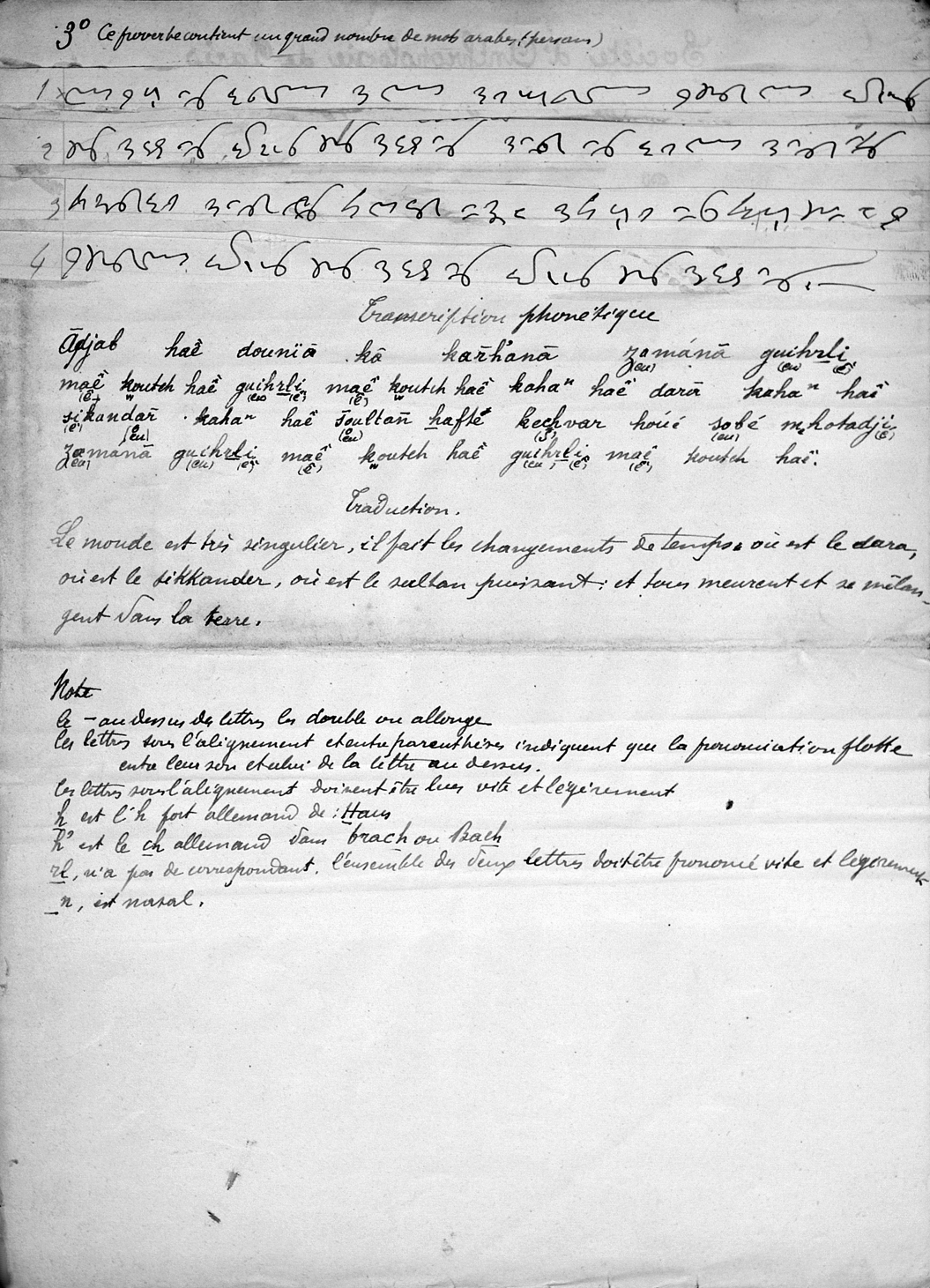
The hesitation and the strain in Azoulay's attempts to notate what he heard is evident in his use of pencil throughout, sometimes very pale; in the blank spaces, as if left for him to return to later; in the non-standard notation he invented to get beyond the standard phonemes in French; and especially in the notes he appended to some transcriptions which explain how to interpret the characters he used to notate the idiosyncracies. These notes show how he tried to bridge the divide between what he heard and his attempts to notate it. They often accompany what Azoulay calls ‘non-systematic transcriptions’. His transcription of the three proverbs sung in Urdu by a Parsi from Adouh (232; see Figure 5), Azoulay notes, was particularly difficult as the third one ‘contains a great number of words in Arabic (Persian)’. A small line over some letters means that the phoneme should be held longer than others, sometimes double the length (a format common in phonetics). Other indications are more unusual. Some letters in parentheses under the transcription mean that the phonemes should ‘float between their sound and that of the letter above it’; others should be read ‘quickly and lightly’. The indication rl has ‘no known equivalent but merely should be pronounced quickly and lightly’; _n means ‘nasal’.
Sung proverb in Urdu (Sadh dialect, India), phonogram 232, no. 3: indigenous script, phonetic transcription, translation, and note on idiosyncratic notation of pronunciation.
Just as French critics often used the words violin and guitar to differentiate bowed or plucked string instruments around the world, so too Azoulay relied on his readers' prior knowledge of other languages. His h and h', he explains, refer to sounds that should be pronounced as the German h, as in ‘Haus’ and ch as in ‘Bach’. At the bottom of his ‘non-systematic transcription’ of an East African children's story (335), he expands these annotations to include reference to the Parisian elites' t, the l in Icelandic and the r in the English ‘bird’. After his ‘non-systematic transcription’ of a Magyar (Hungarian) ‘patriotic song’ (34), he returns to letters in parentheses that ‘indicate that the sound emitted floats between those of the lower and upper letters’. Then he notes that ‘e=eu’, è=very open', (as the French phonemes) and ‘l [with a lowered i]=a wet l’. Not that his references are uniquely to European languages. In his notes accompanying a Swahili narrative (337), he points to a sound, ndi, that resembles one in Senegalese Wolof.
Translation also presented a variety of problems. A translation of a Croatian letter into German, he admits, was only ‘semi-literal’. So too was his translation of a Tunisian painter-decorator's popular tale in Arabic, even though it was long (taking up an entire page), and in a language Azoulay may have understood somewhat, as he lived in Algiers (284).
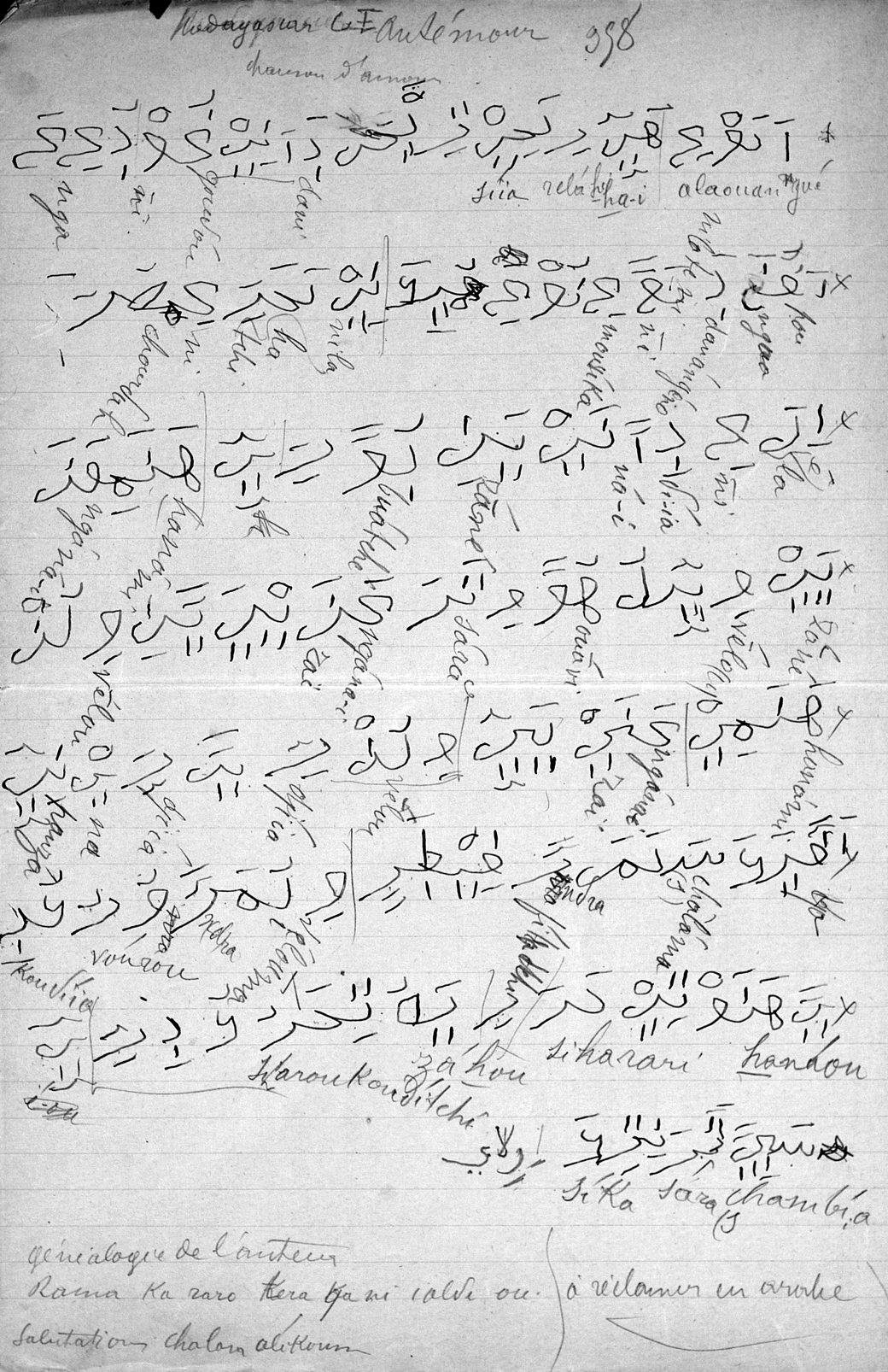
Transcribing songs, of course, was even more challenging, for – especially in non-western melismatic song – syllables and pitches are often in constant movement. For the melismatic singing of a love song from Antémour, Madagascar (358, Figure 6), Azoulay underlaid his phonetic transcription in words rather than phonemes, leaving spaces for the melismatic singing. But nothing about the Malgache script nor the sketchy phonetic transcription captures the five opening reiterations of the same basic melodic arch, each breath group clear and varied in length, according to the text. Given the nature of such songs and the difficulty he must have had in making out the lyrics, Azoulay extended his methodology to testing what he had written down, asking his recordees to repeat what they had said or performed. However, especially with musical material, some could not comply. Consequently, when it was ‘impossible for the phonographed to repeat himself several times’, Azoulay calls the transcription ‘approximate and non-systematic’.
Love song from Antémour, Madagascar, phonogram 358.
His ‘non-systematic transcriptions’ of a Swahili narrative (337) and love song (339) betray great frustration and, ultimately, the failure of his methodology. Of the first, he notes after the transcription and his pronunciation notes, similar to those discussed above, ‘this transcription only works from the phonetic perspective because, in spite of all our efforts, the phonographed could not repeat for dictation exactly what he had said to the phonograph’. Of the second, a Swahili love song (339), he wrote immediately after the phonetic transcription: ‘it was impossible for the phonographed to dictate, even approximately, what he had sung for the phonograph. He could not even repeat the same song twice with the same words. The transcription thus is only useful from the phonetic perspective’.Footnote 42 In such cases, Azoulay was faced with the essence of the oral tradition as ever-changing and the impossibility, even in recordings, of pinning it down, of ‘fixing’ it for posterity.
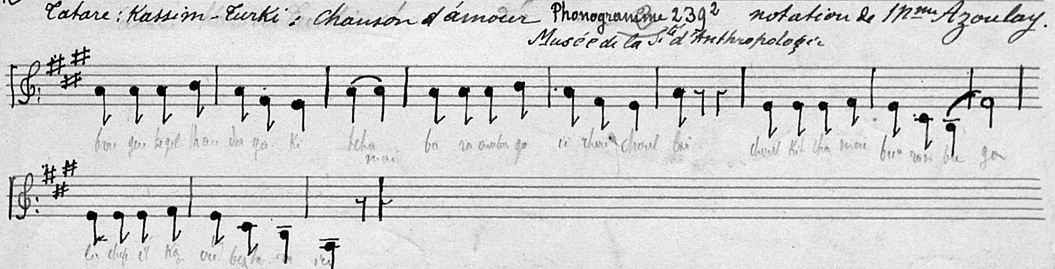
To overcome this problem and document these songs using traditional means, on a few occasions Azoulay reached out to his wife for help. In three cases – a love song from Turkestan (239), an old burlesque song from Marseille (66) and a Latvian one (43) – she made rudimentary musical transcriptions in simple metres and with basic pitches. In the first case, which Mme Azoulay set in A major, the tune was simple, straightforward and ‘catchy’, although ornamental slides between notes are not here notated (Figures 7a and b). However, whereas the singer leaps down a sixth to C♯ to begin his third phrase, Mme Azoulay moves down only a fourth to E. Most of all, Mme Azoulay's 2/4 metre is misleading. While she repeats virtually the same rhythms four times, the singer varies the time between the four phrases: in the first case, holding a minim; in the second, a quaver followed by a quaver rest; in the third one, approximately a dotted crotchet. This means that the phrase that follows, attacca, does not start on the downbeat, as earlier, but on an upbeat. The variable time between the singer's phrases makes its temporal dimension more interesting than her transcription suggests. The Provencal singer too uses clear pitches, and plays with the recurring phrases in many ways, only the first of which Mme Azoulay attempts to notate. However, perhaps overwhelmed by all the variants, she gives up on notating the rhythms, leaves out notes and concentrates on the overall arch of the opening verses.
Love song (dialect, Kassim-Turkestan), phonogram 239, no. 2; the text transcribed by Léon Azoulay.
Love song (dialect, Kassim-Turkestan), phonogram 239, no. 2; the melody transcribed by Mme Azoulay.
Azoulay recognized, if not the limited capacity of his wife to transcribe these songs, then certainly the ‘imperfection of European notation’. Nevertheless, he concluded that they would ‘render some help’ to future researchers.Footnote 43 Mme Azoulay's transcription of the Latvian song, arguably more than the other two, indeed had a clear purpose. On the phonetic transcription, Azoulay added, ‘melody A two times’ before the first couplet, then ‘melody B two times’ before the second couplet, then once more these two melodies alternating with the two remaining couplets of text – an analysis that recalls the basic units of Tiersot's and Hornbostel's analyses. Clearly, Azoulay needed a written form of this music for his annotation to be comprehensible. For this song, Mme Azoulay transcribed the two ‘melodies’ identified by her husband, giving their basic intervallic outline but again avoiding all complexities, including the dotted rhythms. Despite the advantages offered by the new medium of the phonograph, being an amateur when it came to music was not sufficient and did not serve the project well.
The thirteen recordings of instrumental music in Azoulay's collection needed the least amount of mediation. Included are music by a Bosnian clarinet, Japanese shamisen and bamboo flute, Malgache Valiha, Senegalese Kora, Annamite two-stringed violin and six-hole flute, and a five-stringed Persian tar. All are valuable for their tuning and scales. In his documentation, Azoulay added an interesting observation about the manner in which the Annamite violin was performed: ‘The silk parts of the bow make contact with the two strings and it is through the movement of the bow alternating between one string and the other that the artist obtains the sound’.Footnote 44 The performance of the national air of Iran and four other recordings of Persian music on the tar (251) are particularly virtuosic.
As far as his choice of material in the various languages was concerned, Azoulay concentrated on three genres for cross-cultural comparison: readings from one section of the Bible, love songs and war songs. While he could have asked for more stories about adulterous women to compare to those in Africa, Azoulay chose the story of the Prodigal Son, as told by Luke, perhaps because he assumed that it would be understood similarly by different peoples. As he explained to his anthropologist colleagues, bibles were easy to obtain in a wide range of languages because many were translated and in current use by missionaries around the world. There are twenty-two such readings on these phonograms, as opposed to only three from the Koran. Interestingly, the former are read straightforwardly, as if in church; the latter on one pitch, as a kind of monotone song.
If one assumes that love and war are human universals, then Azoulay's choice to record thirty-nine love songs from twenty-two ethnicities (including five Annamite, three Malgache, three Tunisian, and three Senegalese Wolof) and nineteen war songs from eleven ethnicities makes sense. These similar genres from different parts of the world also set a context for later comparative studies of a grand nature. There are also smaller-scale comparisons to make among these recordings, such as fishermen's songs in Norway and Madagascar; patriotic songs in Croatia and Hungary; dance songs in Hindoustan and Comoros; Christian songs of the Tamil and the Lebanese; marriage songs across these cultures; and even the only recording made of an Englishman, singing a popular song called ‘The Ten Little Negros’ (59) which could be compared with actual African music.
After five months of this work, Azoulay reported to the Société d'Anthropologie not only upon the 400 recordings he had made,Footnote 45 but also all he had done to make these useful to the public and researchers, with transcriptions, translations, and information sheets on each person recorded. The project went forward and Azoulay was appointed curator of the new ‘Musée phonographique’. In 1901, Azoulay even envisaged expanding his collection with other songs and music, without the use of phonograms. In 1902 he published the list of his phonograms in the Société's bulletin.Footnote 46 Word got around, and even Hornbostel came from Vienna in 1904 to examine his reproductive procedures and hear his musical phonograms.Footnote 47 It is possible that this visit had an important impact on Hornbostel's work at the Berlin Phonogramm Archiv, which opened under his direction in 1904, eventually becoming the largest such collection and one still functioning today. Indeed, besides a few additions, the categories of information he and Otto Abraham proposed that ‘field researchers and missionaries’ collect from those they recorded echo those Azoulay used in 1900.Footnote 48
Why, then, were these recordings never systematically transcribed in musical notation? Mindful perhaps of ownership issues, or the need to retain the support of the Société d'Anthropologie, in 1901 Azoulay included in his report this condition: ‘No musical transcription can be made without authorization and without giving a copy to the Société’.Footnote 49 Although he later expressed interest in attracting composers who might want to take inspiration from these recordings,Footnote 50 they may well have been put off by this prohibition. Or were they never aware of the recordings? This is quite likely, as Tiersot and the musical press never mentioned them. Additionally, after running the Musée phonographique and opening its doors to the public for an hour weekly since early 1902, Azoulay eventually had to return to Algiers, and the phonogram collection was left without a curator. In 1911, the recording company Pathé offered support to the University of Paris for a Musée de la Parole to house such collections.Footnote 51 Beginning in 1912, its director, the linguist Ferdinand Brunot, began his own phonographic collection, based on recordings he had made in one of the oldest regions in France, the Ardennes. Most likely, his focus on French language sources took attention away from the non-western parts of Azoulay's collection. In 1923, an ethnographic filmmaker in Bordeaux, aware of Azoulay's phonograms, bemoaned that they had been totally forgotten in the attic of the Société d'Anthropologie.Footnote 52
And yet, in many ways, Azoulay's processes and procedures heralded those promoted by the sociologist and founder of structural anthropology, Marcel Mauss (1872–1950). In his Manuel d'ethnographie (1926), Mauss too promoted the use of photography and the phonograph, recording not just human voices, but also music. He also called for transcriptions of the texts of all recordings and, if possible, ‘translations with commentary’. As in Azoulay's translations, ‘in principle, these must be word by word, with the French word under the indigenous word’. The reason for this, Mauss explains, is that in this way there would be ‘no violation of indigenous syntax, no embellishment in your translation’. Like Azoulay, Mauss also understood that, ‘a good way to learn the language of a country is to have access to bibles already published in missionary areas’. And finally Mauss, like Azoulay, recognized that the goal was not only a fixed understanding of the ‘masses’, but also the ‘individuals within those masses’.Footnote 53 As the phonograph grew increasingly important for anthropologists, it is ironic that, for so long, Azoulay's work fell into total oblivion.Footnote 54
Conclusions
Transcriptions, like the recordings of Voyager's ‘Murmurs of Earth’, distill and freeze in time complex sonorous and artistic expressions of a people. Azoulay's colleagues funded his project to help ‘fix the languages of the Far East’. He may have tried, seeking to understand not only the echo of these languages and their music in his own ear, but also the echo of distant times and places. But ironically there is nothing fixed about the notations he came up with, nor those of other transcribers. The transcriptions were limited by the agency of these co-creators of their productions, as well as by the untranslatability of much that they encountered. Indeed, in converting one kind of order into another, transcriptions represent a creative interpretation of what Tiersot, Hornbostel, and Azoulay heard and chose to embrace or resist in the originals. In some sense, they constitute what recent scholars have called an ‘écriture de l'écoute’, a ‘composition de l'écoute’, or an ‘interpretation composée’.Footnote 55
Understanding what they heard and translating it into others' languages depended on their linguistic and cultural competence. Tiersot and Hornbostel were trained musicians, but had not travelled beyond the West. Azoulay, though having lived in Algeria, may also have had little competence in most of these languages and cultures. But if many layers of meaning most likely escaped him, his notes nonetheless suggest that, arguably more than music ethnographers of the time, he was engaged in an open-ended negotiation with the materiality of sound and the distinction of cultures, including the elusive, at times inaccessible, and fundamentally ungraspable qualities of the oral. Yet even he could not come to grips with the failure of transcriptions to represent this absence, the flip side of western achievement, especially what is sacrificed in musical notation by clinging to the orderliness of metre and the purity of pitch.
Some have argued that the desire to fix and codify foreign languages was part of the modality of colonial control.Footnote 56 But, as someone who lived in Algeria, was Azoulay trying to make the subaltern more like us by giving her a voice? Or should the achievement of a voice in this manner, through the phonograph, be regarded as part of assimilationist colonialism?Footnote 57 In the context of non-western music, transcriptions, recordings, and the ideologies behind them thus encourage us to reflect on issues at the heart of the colonial process: new meanings and new functions for indigenous materials, when removed from their original contexts; the inevitable hybridities that result; and ambiguities of authorship and ownership when those who produce source material are not those who make new use of it in western contexts.