





Introduction
Empathy, the ability to understand and share the feelings of others, is vital for social relationships and prosociality and is generally associated with positive psychological outcomes (Swenson et al., Reference Swenson, Ehsanian, Tran, Petersen, Kennedy, Roche, Oppezzo, Noordsy and Fredericson2024; Van der Graaff et al., Reference Van der Graaff, Meeus, de Wied, van Boxtel, van Lier, Koot and Branje2016). However, its role may become more complex in the context of mass trauma, such as war exposure, where heightened emotional resonance with the suffering of others may increase vulnerability to personal distress. This issue is particularly relevant for children and adolescents, whose emotion regulation capacities are still developing, making them more susceptible to the psychological impacts of traumatic events (McLaughlin & Lambert, Reference McLaughlin and Lambert2017). Using a longitudinal design, we studied the role of empathy as a prospective risk factor for psychological distress during mass trauma, focusing on the October 7th atrocities and the subsequent Israel-Hamas war.
Empathy, psychopathology, and trauma
Empathy has been conceptualized in various ways across different theoretical frameworks, but it is broadly defined as the capacity to understand and share in another person’s emotional experience (Cohen & Strayer, Reference Cohen and Strayer1996). While empathy is a multifaceted concept, including cognitive and affective components (Lockwood, Reference Lockwood2016), we are interested in children’s emotional reactions to the war, and therefore our focus is in its affective dimension – emotional empathy. Emotional empathy involves experience sharing and emotional resonance with others (Zaki & Ochsner, Reference Zaki and Ochsner2012), including both empathic concern and empathic distress. Empathic concern refers to other-oriented feelings of care or compassion for another’s well-being (Decety, Reference Decety2010; Eisenberg et al., Reference Eisenberg, Fabes, Miller, Fultz, Shell, Mathy and Reno1989), whereas empathic distress reflects a self-focused emotional reaction – personal distress resulting from witnessing another’s distress (Eisenberg, Reference Eisenberg2000).
Several studies have examined the broader construct of emotional empathy and found it to be associated with internalizing symptoms, including depression (Grases et al., Reference Grases, Colom, Sanchis and Grases2023) and anxiety (Gambin & Sharp, Reference Gambin and Sharp2018). Notably, a meta-analysis indicated that the positive relationship between emotional empathy and depression is evident during adolescence but not in older adults (Yan et al., Reference Yan, Zeng, Su and Zhang2021), suggesting that the association between emotional empathy and depression varies by developmental stage. Studies focusing more specifically on empathic distress have shown that it is associated with depressive symptoms in individuals diagnosed with depression (Schreiter et al., Reference Schreiter, Pijnenborg and Aan Het Rot2013). This specific association may be expected, as empathic distress, by definition, involves self-oriented emotional distress in response to others‘ suffering.
Empathy has also been studied in the context of trauma exposure, with evidence suggesting that certain types of trauma (such as childhood adversity) may increase emotional empathy (Greenberg et al., Reference Greenberg, Baron-Cohen, Rosenberg, Fonagy, Rentfrow and Matosin2018). While some theories conceptualize empathy as a ‘risky strength,’ proposing that it may increase vulnerability in specific contexts (Tone & Tully, Reference Tone and Tully2014), empathy has rarely been examined as a prospective risk factor for emotional distress during traumatic events.
Exposure to extreme stressors, which are often inherent in trauma, may make individuals with high empathy particularly vulnerable – especially when the trauma involves witnessing intense suffering of others, as common during mass trauma events like war and terrorism. Such trauma often includes severe violence and the suffering of large groups. For many individuals, this exposure may be indirect, repeatedly transmitted through ‘third channels’ such as news, social media, or conversations, which inherently requires some form of empathic resonance.
Specifically, individuals with higher emotional empathy may be more affected by others’ suffering, increasing their risk for personal distress and internalizing symptoms like depression and anxiety. This can occur through strong emotional resonance, especially when exposure is continuous and intense, and in those who are lacking emotion regulation abilities. Some theories also suggest that empathy involves simulation, or re-enactment of fragments of another’s mental life (Ravenscroft, Reference Ravenscroft1998). In contexts of war and terror, simulating others’ intense suffering may amplify personal distress by reflecting it internally.
Development of empathy
Empathic reactions emerge early in development, already within the first year of life (Abramson et al., Reference Abramson, Paz and Knafo-Noam2019; Davidov et al., Reference Davidov, Paz, Roth-Hanania, Uzefovsky, Orlitsky, Mankuta and Zahn-Waxler2020). Traditional theories, such as Hoffman’s stage-based model (Reference Hoffman1975, Reference Hoffman2004), suggested that infants initially exhibit self-oriented empathic distress when witnessing others’ suffering, while more developed forms of empathy, which are other-oriented and reflect concern for others’ well-being, only emerge later on in life.
However, recent findings challenge this view, showing individual differences even in infancy, with some children demonstrating empathic concern, reflecting moderate arousal, and others experiencing self-oriented empathic distress reflecting elevated arousal (Abramson et al., Reference Abramson, Paz and Knafo-Noam2019; Davidov et al., Reference Davidov, Paz, Roth-Hanania, Uzefovsky, Orlitsky, Mankuta and Zahn-Waxler2020). Those individual differences have been attributed to regulation abilities (Eisenberg et al., Reference Eisenberg, Fabes, Murphy, Karbon, Smith and Maszk1996; Abramson et al., Reference Abramson, Paz and Knafo-Noam2019), specifically suggesting that the ability to self-regulate may shape whether empathic arousal takes the form of other-oriented empathic concern or self-focused empathic distress.
The likelihood of experiencing empathic concern versus empathic distress may also depend on contextual factors, particularly the intensity of the empathy-arousing stimuli. For example, healthcare professionals are especially vulnerable to feeling heightened distress due to exposure to others’ suffering (Adams et al., Reference Adams, Boscarino and Figley2006). It has been suggested that such continuous and intense exposure may shift empathic arousal toward self-focused empathic distress, rather than a more balanced and other-oriented concern.
Moreover, in specific contexts, there might be an interplay between characteristics of the individual and the specific context in predicting the likelihood of experiencing elevated personal distress when facing the suffering of others. Those who are initially more prone to empathic distress might respond with more internalizing symptoms in contexts in which they are exposed to intense, ongoing suffering of others. Such exposure may occur in the context of mass trauma, such as war and terror.
To address this possibility, we examined the role of empathy throughout development, beginning in toddlerhood and extending to early adolescence, as a prospective risk factor for internalizing symptoms in a sample of adolescents exposed to continuous traumatic stress, which refers to the prolonged experience of living under ongoing threat resulting from political conflict, war, or terrorism (Eagle & Kaminer, Reference Eagle and Kaminer2013).
The present study
This study investigates the prospective associations between empathy and internalizing symptoms during mass trauma exposure. The study focuses on Israeli adolescents participating in a longitudinal study spanning from toddlerhood stages to adolescence. The study was conducted in Israel prior to and following the October 7th, 2023, atrocities and during the Israel-Hamas war, which caused mass casualties, displacement, and suffering in Israel, Gaza, and Lebanon.
On October 7, 2023, over 1,100 Israelis were killed, thousands wounded, and many subjected to extreme violence. Over 250 Israelis were abducted to the Gaza Strip, including women, children, and the elderly (Human Rights Watch, 2024). The widespread media coverage of these events exposed the population to intense suffering in Israel, Gaza, and across the region (Madhani et al., Reference Madhani and Lidman2024), amplifying the relevance of empathic reactions as potential predictors of psychological distress.
In addition to media exposure, adolescents have been exposed to the suffering of close others even if they had been relatively less affected by war on a personal level. In Jerusalem, where most of our sample is based, there were 13 alarms in the first 2 months of the war (Israel Home Front Command, 2023), which means adolescents had many opportunities to observe distress in peers, parents, and siblings while seeking shelter. Moreover, adolescents have been exposed to the mass suffering and destruction in both Southern and Northern Israel, as well as to the extensive casualties and devastation in the Gaza region.
We examined empathy facets in toddlerhood (ages 1.5 and 3) and early adolescence (age 11.2) as predictors of internalizing symptoms during the war. Given that previous research showed stability of empathy across development (Knafo et al., Reference Knafo, Zahn-Waxler, Van Hulle, Robinson and Rhee2008), early empathic responses may be predictive of future distress in those contexts.
Different empathy facets were measured across development. At toddlerhood, both empathic distress and empathic concern were assessed. We expected empathic distress to predict internalizing symptoms during war, reflecting a tendency for elevated, unregulated distress when exposed to others’ suffering, which in the presence of mass trauma might potentially increase vulnerability.
The role of empathic concern in toddlerhood was tested in an exploratory manner due to mixed evidence: on the one hand, emotional empathy – which includes empathic concern – has been linked to internalizing symptoms (Yan et al., Reference Yan, Zeng, Su and Zhang2021). On the other hand, previous research has found that toddlers’ empathic concern was negatively associated with empathic distress, possibly reflecting better self-regulation (Abramson et al., Reference Abramson, Paz and Knafo-Noam2019). This suggests that higher empathic concern in toddlerhood may indicate the existence of adaptive developmental processes, possibly reducing vulnerability to later trauma.
In subsequent stages during early adolescence, the broader construct of emotional empathy was examined, without specific delineation between empathic concern and empathic distress (as common in studies relying on adolescent self-report, e.g., Gambin & Sharp, Reference Gambin and Sharp2018; Grases et al., Reference Grases, Colom, Sanchis and Grases2023). Emotional empathy was examined in an exploratory manner, as it may be associated with internalizing symptoms, as discussed above, but could also serve as a protective factor by promoting social connections and prosocial behavior (Swenson et al., Reference Swenson, Ehsanian, Tran, Petersen, Kennedy, Roche, Oppezzo, Noordsy and Fredericson2024; Van der Graaff et al., Reference Van der Graaff, Meeus, de Wied, van Boxtel, van Lier, Koot and Branje2016), which may support adjustment in the face of adversity.
We examined these associations while accounting for factors related to both empathy and internalizing symptoms: gender and negative emotionality. Research shows that females tend to score higher on both empathy and internalizing symptoms (Baez et al., Reference Baez, Flichtentrei, Prats, Mastandueno, García, Cetkovich and Ibáñez2017; Matos et al., Reference Matos, Salvador, Costa, Pinheiro, Arnarson and Craighead2017). Additionally, negative emotionality – a general tendency to react strongly to stressors (Nigg, Reference Nigg2006) – has been linked to empathic responses (Eisenberg et al., Reference Eisenberg, Wentzel and Harris1998) and was therefore included in the analyses to examine whether empathy contributes uniquely to internalizing symptoms beyond this broader dispositional reactivity. This also allowed us to assess whether empathy plays a distinct role as a risk factor during mass trauma.
Method
Participants and Procedure. Data for this study was drawn from a longitudinal study of family development among Jewish-Israeli children in the Greater Jerusalem area (see Abramson et al., Reference Abramson, Paz and Knafo-Noam2019 for details). For the purposes of this report, data was obtained from 4 waves of this longitudinal study. Of note, only one child from each family participated in the study. At Time 1 (T1, 1.5 years) and Time 2 (T2, 3 years), families participated in lab visits where parents completed questionnaires on their child’s temperament and additional information, and children engaged in behavioral tasks, including an empathy task. Data from an earlier wave at 9 months was excluded due to limited overlap with later waves (that is, only 13 children participated in both wave 9 months and the last wave during war). At all time points, the experiments and data collection were approved by the local ethics committee.
Subsequently, families were contacted again when the child was 10 years or older (Time 3 [T3]), and online questionnaires were sent to mothers, fathers, and children, either through the mother or directly to each participant. Parents completed questionnaires on child temperament and additional information, while children reported on their empathy, internalizing symptoms, and other variables beyond the scope of this paper. After the outbreak of the war (Time 4 [T4]), families were contacted again and online questionnaires were distributed similarly to T3. Data collection began in late October 2023 (3 weeks after the outbreak of the war) and continued for 3 months. At T4, adolescents self-reported their internalizing symptoms (empathy data was not collected). Empathy measures were available for 279 families at T1, 124 at T2, and 142 at T3. At T4, 122 adolescents reported internalizing symptoms. Inclusion criteria and sample sizes for analyses are detailed below.
Demographic Information. The mean ages (in years) of participating children at T1 – T4 were 1.52 (SD = 0.06), 2.9 (SD = 0.07), 11.18 (SD = 0.44), and 11.68 (SD = 0.57), respectively. At T3, parents provided data on household income and education levels. Income, reported on a 1-5 scale relative to the national average (1 = far below, 3 = average, 5 = far above), averaged near the midpoint (M = 3.4, SD = 1.22). Mothers’ education ranged from 12 to 25 years (M = 17.4, SD = 2.9), and fathers’ education ranged from 12 to 26 years (M = 16.27, SD = 2.7). The gender distribution varied slightly across waves, with the proportion of male participants ranging from 49 to 53%.
Measures
Empathic Responses in Toddlerhood. At T1 (1.5 years) and T2 (3 years), empathy was assessed using an observational task adapted from Zahn-Waxler et al. (Reference Zahn-Waxler, Radke-Yarrow, Wagner and Chapman1992). An experimenter pretended to hurt her knee, accompanied by rubbing the affected area and displaying moderate vocal and facial expressions of pain for 30 s, followed by gradual subsiding over another 30 s. Responses were coded by trained coders using a protocol modified for infant behavior (e.g., less emphasis on verbal behaviors, addition of half-points). Interrater reliability was tested for 15% of T1 videos and 18% of T2 videos and was found to be adequate (0.59 – 0.89).
To assess empathic distress, the mean of two variables was calculated after standardization: (1) level of distress (0 = no distress, 1 = visible distress expressed non-vocally, such as fussiness, jerkiness, or wary facial expressions; 2 = whimpering with vocal distress; 3 = full-blown crying) and (2) dysregulation of arousal (0 = under-arousal with no interest or body tension; 1 = moderate arousal with attention to the stimulus and some body tension; 2 = over-arousal, including crying or significant tension and inability to self-soothe). Correlations between these scores were high (r = 0.56, p <0.001 at T1 and r = 0.62, p <0.001 at T2).
To assess empathic concern, facial, vocal, or gestural-postural expressions were coded while the child focused on the experimenter. Responses were scored on a 0 – 3 scale: 0 = absent, 1 = slight (e.g., brief, low-intensity changes such as lowering mouth corners or frowning eyebrows), 2 = moderate (e.g., more pronounced, prolonged expressions), and 3 = great concern (e.g., fully engaged expressions of sadness or sympathy, often with sympathetic vocal tones and gestures toward the experimenter). Half-points were used for subtler distinctions.
Emotional Empathy in Adolescence. At T3, emotional empathy was assessed using the emotional empathy scale of the Basic Empathy Scale (BES; Jolliffe & Farrington, Reference Jolliffe and Farrington2006). Participants rated their own empathy (Exemplary items: ‘My friends’ emotions do not affect me much,’ ‘I often get swept up in my friends’ feelings’) on a 5-point Likert scale, ranging from 1 (strongly disagree) to 5 (strongly agree). The BES has been validated for use with adolescents, demonstrating strong reliability and validity (Jolliffe & Farrington, Reference Jolliffe and Farrington2006). In this study, the scale showed good internal consistency, as indicated by McDonald’s Omega (ω = 0.76).
Negative Emotionality. At T1 – T3, negative emotionality was assessed through parental reports using the Emotionality, Activity, and Sociability questionnaire (EAS; Buss & Plomin, Reference Buss and Plomin2014). Negative emotionality was computed as the mean of five items reflecting this trait (e.g., “often fusses and cries”), rated on a 5-point Likert scale ranging from 1 (not at all describing the child) to 5 (describes the child very well). The subscales demonstrated good internal consistency across all waves (ω = 0.85 at T1, ω = 0.86 at T2, and ω = 0.85 at T3).
Internalizing Symptoms. At T3, adolescents self-reported their internalizing symptoms using the emotional problems subscale of the Strengths and Difficulties Questionnaire (SDQ; Goodman, Reference Goodman1997), which includes five items (e.g., “I am often unhappy, depressed, or tearful”) rated on a 3-point scale (0 = rarely, 2 = often). The total score was computed as the sum of all items. At T4, internalizing symptoms were assessed using the Patient Health Questionnaire (PHQ-4; Kroenke et al., Reference Kroenke, Spitzer, Williams and Löwe2009), validated for use with adolescents (e.g., Materu et al., Reference Materu, Kuringe, Nyato, Galishi, Mwanamsangu, Katebalila, Shao, Changalucha, Nnko and Wambura2020; Watson et al., Reference Watson, Spurling, Fieldhouse, Montgomery and Wintergerst2020). It includes two items each for depression (e.g., “Little interest or pleasure in doing things”) and anxiety (e.g., “Not being able to stop or control worrying”), rated on a 4-point scale (0 = not at all, 3 = nearly every day). The total score was the sum of all four items. Both measures demonstrated acceptable internal consistency (ω = 0.76 at T3, ω = 0.78 at T4).
Analytic plan
We first conducted regression models to examine whether empathy at each developmental stage was individually associated with later internalizing symptoms, controlling for negative emotionality at that stage. Namely, for each wave, we examined whether empathy (empathic distress at T1 and T2, emotional empathy at T3) predicted internalizing during war exposure (T4) controlling for negative emotionality at that time point. Notably, in the model examining emotional empathy at T3, we also incorporated internalizing at T3 (alongside negative emotionality at that time) to examine whether the effect exists above and beyond previous internalizing levels reported by the child. These preliminary regression models served as a foundation to determine whether a more comprehensive developmental model was warranted.
As a next step, we utilized a structural equation modeling (SEM) approach and conducted a path analysis to examine a comprehensive developmental model which incorporated measures from all waves, as well as child gender as a covariate. This longitudinal model enables to simultaneously examine the longitudinal stability of the different constructs, as well as concurrent and longitudinal associations. This model was aimed at providing insight into the interplay between negative emotionality, empathic reactions, and internalizing symptoms over time.
For the path analysis, we utilized a specific inclusion criterion, which indicated that families were included in the analyses if data regarding the main variables of the research (empathy at T1 – T3 and internalizing at T4) was available for at least 2 waves. Namely, if families participated in at least 2 of the 4 waves (regarding the key variables aforementioned), they were included in the model. This criterion was obtained to avoid potential bias resulting from handling large amounts of missing data. Doing so resulted in 195 families being included in the final SEM model. Out of these families, 85 (43.59%) have participated in 2 waves, 68 (34.87%) have participated in 3 waves, and 42 (21.54%) have participated in all 4 waves.
To address missing data, we employed full information maximum likelihood (FIML) and used the maximum likelihood with robust standard errors (MLR) estimator in lavaan, which account for deviations from normality and data missing not completely at random. A diagram of the initial hypothesized model is presented in the Supplementary Material, and the model included the following paths:
-
1. Autoregressive paths for negative emotionality (T1 – T3), empathic reactions (T1 – T3), and internalizing (T3 – T4).
-
2. Paths from negative emotionality that captured the theoretical influence of negative emotionality on the development of empathic reactions, including empathic distress and emotional empathy, at subsequent time points.
-
3. Negative emotionality and empathic reactions at T1 – T3 were modeled as predictors of internalizing symptoms at T3 and T4.
-
4. Covariances within time points were specified between empathic reactions and negative emotionality at each time point. At T3, covariances between internalizing symptoms and both emotional empathy and negative emotionality were included.
-
5. Gender was included as a predictor for all variables in the model.
Models with CFI values > .90 were considered to have an acceptable fit and models with a CFI > .95 were considered to have good fit; RMSEA and SRMR values < .08 indicated an acceptable fit and <.05 indicated a good fit (Hu & Bentler, Reference Hu and Bentler1999).
Results
Preliminary analyses
Attrition Analyses. All analyses were conducted in R (R Core Team, 2022). A series of t-tests were used to compare study and demographic variables (parents’ education and income) between families who continued participation and those who did not in each pair of consecutive waves (e.g., compare wave 1 variables between participants that continued to wave 2 and those who did not, and a similar process for the following pairs of consecutive waves). No significant differences were found for income, education, or study variables (empathy, negative emotionality, and internalizing). Age was also examined and did not relate to attrition. Nevertheless, since previous research from this cohort indicated that attrition within this study was not completely at random (Abramson et al., Reference Abramson, Paz and Knafo-Noam2019; Vertsberger et al., Reference Vertsberger and Knafo-Noam2019), we addressed this by using a suitable estimator in the longitudinal model, as described below.
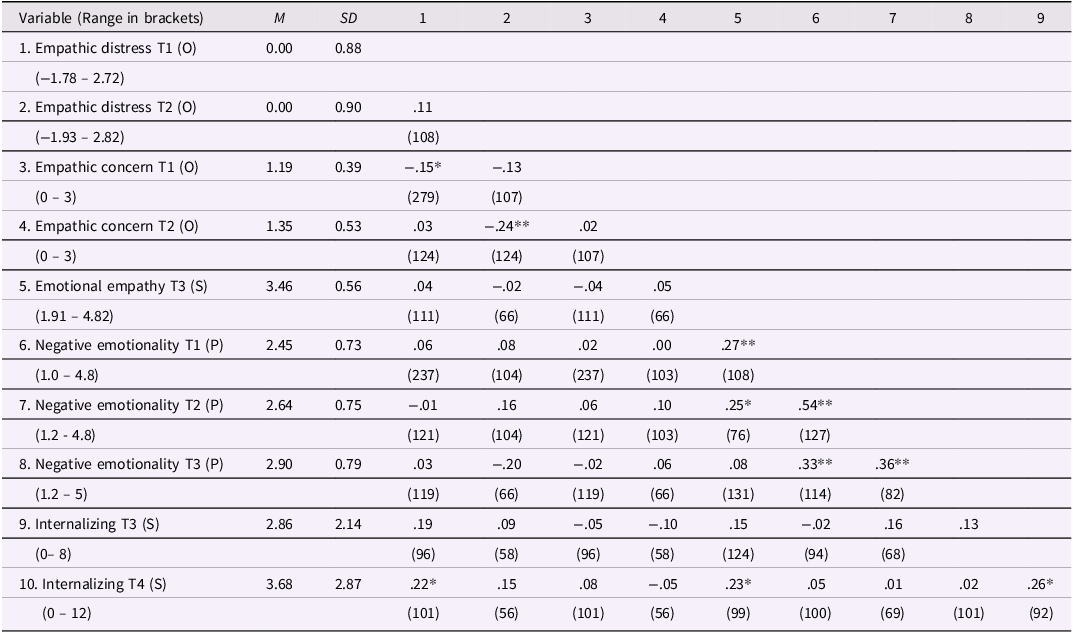
Descriptive Statistics. Table 1 displays the means, standard deviations, and correlations for all study variables. The following sections provide additional preliminary analyses.
Means, standard deviations, and correlations of main study variables
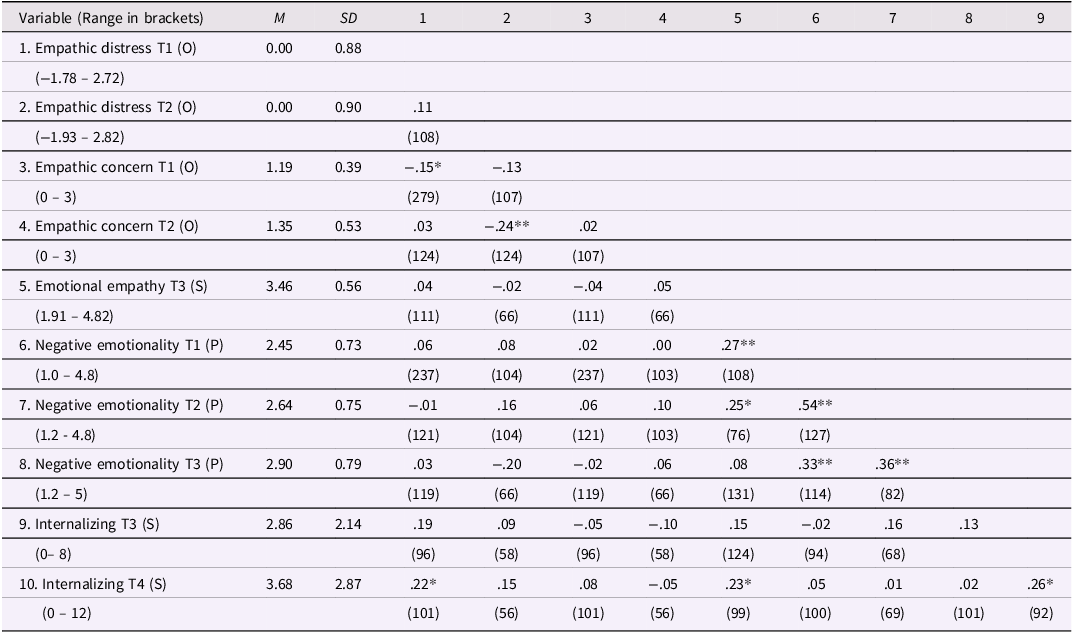
Notes. (1) M and SD are used to represent mean and standard deviation, respectively. * indicates p < .05. ** indicates p < .01. The mean of empathic distress at T1 and T2 is 0 as it represents a mean of two z-scored scales. Below each correlation coefficient the effective N is presented in brackets. After each variable name there is a coding representing whether it is an (O) observation, (P) parent report, (S) self-report. The range of each variable is presented after the variable name.
Gender Differences in Study Variables. No significant gender differences were found in the study variables. The only marginally significant difference was for internalizing symptoms at T4 (males: M = 2.97, SD = 0.78; females: M = 3.2, SD = 0.77), t(120) = −1.97, p = .051, 95% CI [−2.03, 0.003].
Internalizing Symptoms During War. Internalizing levels during the war were substantial, with 28 participants (23%) exceeding the clinical cutoff for internalizing symptoms (score ≥6 on the PHQ). When analyzed separately, 38 participants (31%) exceeded the clinical cutoff for anxiety and 29 (24%) for depression (score ≥3 on each subscale). While these cutoff scores do not indicate clinical diagnoses, they reflect clinically meaningful levels of symptoms (Kroenke et al., Reference Kroenke, Spitzer, Williams and Löwe2009).
Within-construct Associations. Longitudinal associations between variables were examined for continuity. Empathic distress and empathic concern at T1 and T2 were not significantly associated, nor were these measures linked to emotional empathy at T3. Negative emotionality showed consistency across all time points (T1 – T3). Internalizing symptoms at T3 were significantly associated with internalizing symptoms at T4.
Additional Noteworthy Associations. Although this was not the primary focus of the study, we note that negative emotionality at T1 and T2 was associated with emotional empathy at T3.
Associations Between Study Variables and Internalizing Symptoms. Negative emotionality and empathic concern in toddlerhood were not associated with internalizing symptoms at either wave. Internalizing symptoms at T3 were not associated with empathic reactions at earlier stages. Internalizing symptoms during the war (T4) were predicted by empathic distress at T1 (age 1.5) and emotional empathy at T3 (pre-war), but not by empathic distress at T2 (age 3).
Regression models
Prediction from Age 1.5 Years (T1). The first regression model included negative emotionality and empathic distress at age 1.5 as predictors. Negative emotionality did not predict internalizing during war (b = 0.08, SE = 0.41, t(90) = 0.19, p = 0.848). In contrast, empathic distress positively and significantly predicted internalizing during war (b = 0.85, SE = 0.4, t(90) = 2.15, p = 0.034).
Prediction from Age 3 Years (T2). The second regression model included negative emotionality and empathic distress at age 3 as predictors. Negative emotionality did not predict internalizing during war (b = −0.18, SE = 0.56, t(44) = −0.32, p = 0.754). Empathic distress did not predict internalizing during war (b = 0.82, SE = 0.54, t(44) = 1.53, p = 0.134).
Prediction from Age 11 Years (T3). The third regression model included emotional empathy, negative emotionality, and internalizing symptoms before the war as predictors. Negative emotionality did not predict internalizing during war (b = 0.01, SE = 0.37, t(83) = 0.04, p = 0.971). Pre-war internalizing symptoms significantly and positively predicted subsequent internalizing symptoms during war (b = 0.35, SE = 0.15, t(83) = 2.42, p = 0.018). Importantly, beyond the effect of pre-war internalizing, emotional empathy significantly predicted internalizing symptoms during war (b = 1.23, SE = 0.58, t(83) = 2.12, p = 0.037).
Path analysis
We conducted a path analysis to examine a developmental model incorporating measures from all waves, with child gender as a covariate. Empathic concern was excluded due to its lack of association with subsequent internalizing and to reduce model complexity.
We began by estimating the original hypothesized model presented in the Analytic Plan, which demonstrated excellent fit (χ2 (3) = 2.29, p = 0.514, CFI = 0.99, RMSEA = 0.03, SRMR = 0.02). However, as this model was nearly saturated, we aimed to test the robustness of the findings and enhance parsimony. To that end, we examined a modified version in which paths from the original model with standardized coefficients smaller than 0.1 in absolute value were removed, considered to reflect small effects (Cohen, Reference Cohen2013). This resulted in the removal of a total of 11 paths. This model had excellent fit: χ2 (15) = 6.46, p = 0.971, CFI = 1.00, RMSEA = 0.00, SRMR = 0.03. We conducted a Likelihood Ratio Test (scaled chi-square difference test), which showed no significant difference between the original model and the more parsimonious model (χ2 diff(12) = 3.83, p = .99). We therefore proceeded with the modified, parsimonious model. Full results for the original model and a list of removed paths are provided in the Supplementary Material.
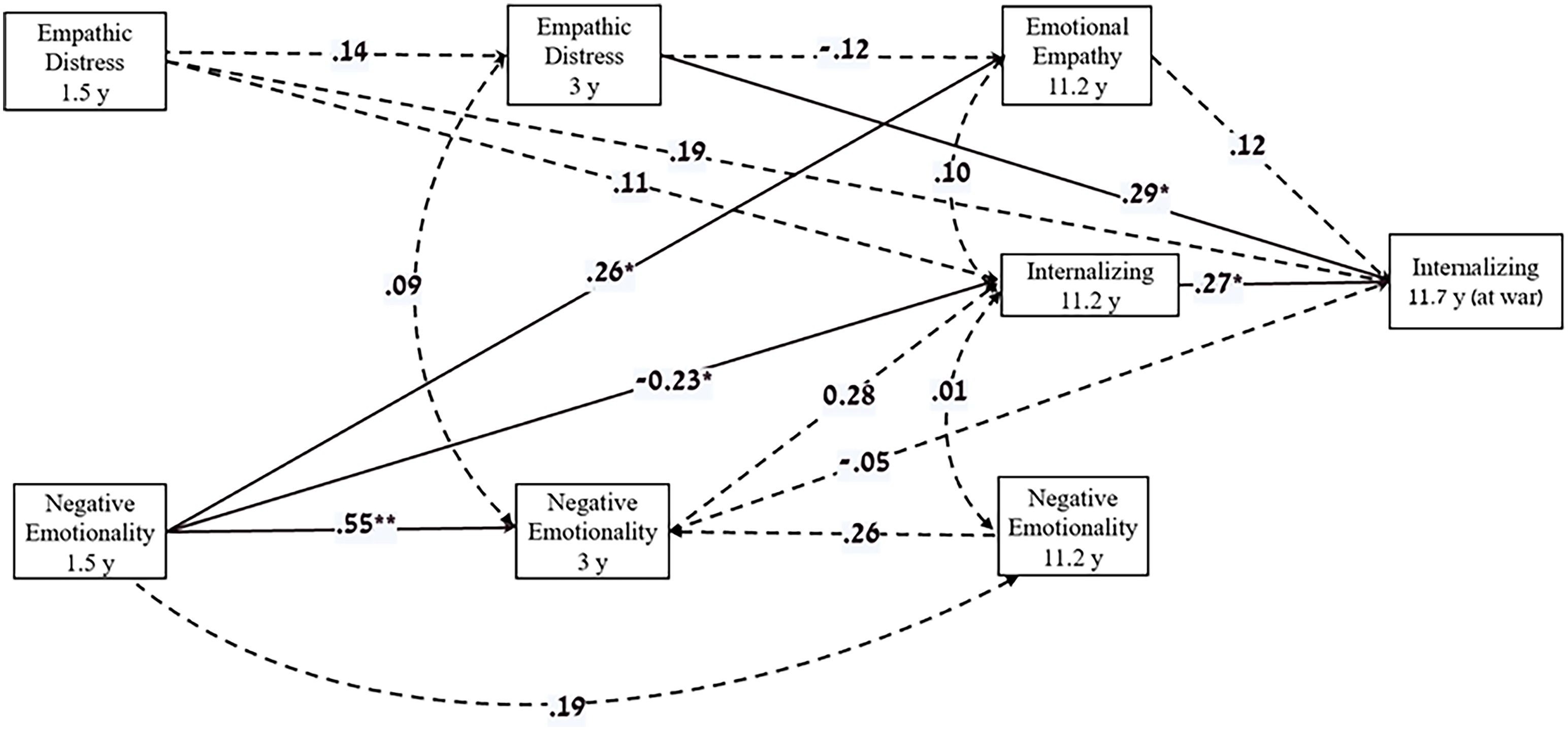
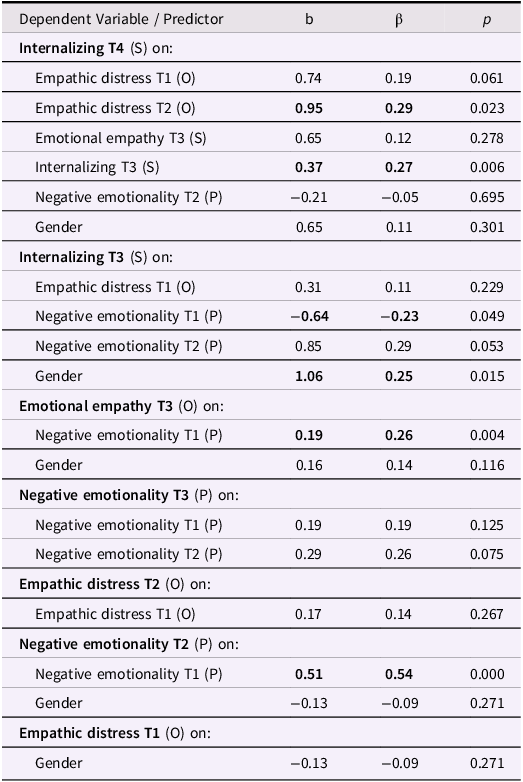
Figure 1 presents the results of the final path analysis model. As gender was considered a covariate, and for clarity of presentation, paths from gender were omitted from the figure but are reported in Table 2, which includes all path coefficients.
Results of the final path analysis model. For clarity of presentation, paths from gender were omitted (see Table 2 for full model results including paths from gender). Black lines represent significant effects (*p <0.05, **p <0.01), dashed lines represent nonsignificant effects.
Path analysis model results
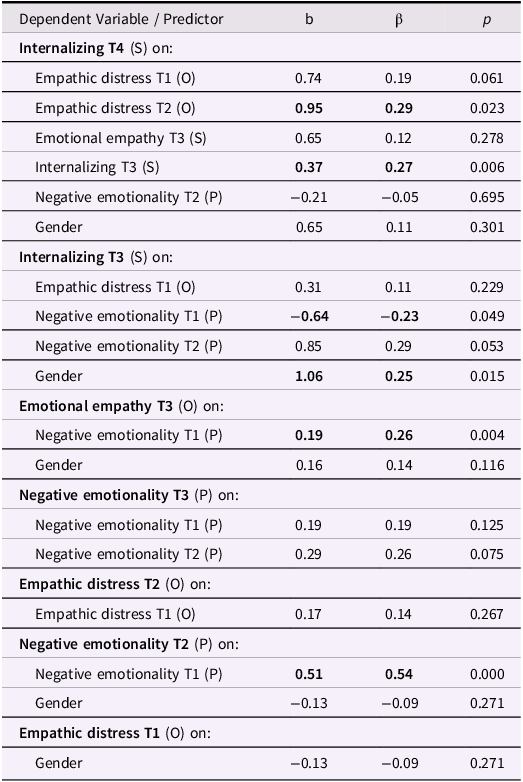
Notes. As in previous tables, each variable is followed by a code indicating the informant: (O) = observation; (P) = parent report; and (S) = self-report. (1) Significant paths are presented in bold. (2) Gender was coded as 1 = boy, 2 = girl; therefore, a positive path coefficient indicates higher scores for girls on that variable.
Summary of Model Results. Negative emotionality at age 1.5 positively predicted negative emotionality at age 3 and emotional empathy at age 11.2 and negatively predicted internalizing at age 11.2. Gender predicted internalizing symptoms at age 11.2 (prewar); namely, females were higher in internalizing symptoms at that age. Empathic distress at age 3 and internalizing symptoms at age 11.2 predicted internalizing symptoms at age 11.7 – during war exposure (see Table 2 for full model results).
Discussion
We examined the role of empathic responses (empathic distress and empathic concern in toddlerhood and emotional empathy in adolescence) in predicting internalizing symptoms in a sample of Israeli adolescents exposed to mass trauma, specifically the October 7th atrocities and the ensuant Israel-Hamas war. Empathic distress at age 1.5 predicted internalizing symptoms during war exposure occurring more than a decade later, when adolescents were 11.7 on average. Additionally, emotional empathy in adolescence (measured pre-war) predicted internalizing symptoms during war, controlling for pre-war internalizing symptoms. Finally, a path analysis revealed that when accounting for empathic reactions and negative emotionality at all ages and for internalizing before war, empathic distress at age 3 also predicted internalizing during war.
The findings that empathic distress predicted internalizing symptoms are consistent with prior research (e.g., Schreiter et al., Reference Schreiter, Pijnenborg and Aan Het Rot2013), but this is the first study to demonstrate this link prospectively from toddlerhood to adolescence. Interestingly, while empathic distress at 1.5 and 3 did not correlate, they both showed evidence supporting their associations with subsequent internalizing during war. Additionally, both empathic distress in toddlerhood and emotional empathy in adolescence predicted internalizing symptoms only during war (but not prior to war), aligning with a diathesis-stress model (Monroe & Simons, Reference Monroe and Simons1991). This model suggests that certain tendencies, like heightened empathic tendencies, increase vulnerability to psychopathology only under significant stress.
In this study, war exposure represented a continuous traumatic stressor, affecting individuals on both personal and national levels. Although participants in the Jerusalem area faced less direct threat from rocket attacks or invasion, they did have to deal with their own distress and with that of close others during weeks of repeatedly seeking shelter during alarms. Moreover, they were exposed to intense accounts of vicarious suffering through media, testimonies, and stories of victims and their families, highlighting the widespread psychological toll of such events. The exposure to others’ suffering as a fundamental stressor may explain the lack of association between negative emotionality and internalizing symptoms during war. While negative emotionality reflects strong reactions to personal stressors, empathic reactions may drive internalizing symptoms focused on others’ well-being.
The associations of early empathy facets with internalizing during war demonstrated the distinction between empathic distress (which predicted internalizing) and empathic concern, which did not. While empathic distress may reflect lack of self-regulation resources and relates to later internalizing, toddlers’ empathic concern may indicate adaptive, early-emerging self-regulation (Abramson et al., Reference Abramson, Paz and Knafo-Noam2019), possibly reducing susceptibility to later distress. Even in adolescence, the tendency for empathic distress may increase vulnerability to internalizing symptoms in highly stressful times.
Of note, we did not assess empathic distress in adolescence but rather a broader component of emotional empathy. Indeed, the BES questionnaire used to measure emotional empathy may not adequately distinguish between subtypes of emotional empathy (Chokri et al., Reference Chokri, Peyrotte, Zanna and Jarraya2024). For example, items such as “I feel sad after being with a sad friend” may actually reflect the self-focused component of empathic distress rather than other-oriented empathic responses. In future work, it would be preferable to use measures that more clearly distinguish between other-oriented and self-oriented empathic responses, as our observational measures in early childhood did. Nonetheless, the current findings suggest that, whether self- or other-oriented, intense emotional resonance with others’ distress may increase susceptibility to internalizing symptoms under conditions of continuous stress.
Another noteworthy point is the lack of correlations between negative emotionality and internalizing symptoms across most stages, including the prewar stage. Moreover, in the path analysis, negative emotionality negatively predicted internalizing symptoms at age 11.2. Given prior research linking temperament to psychopathology (Kiff et al., Reference Kiff, Lengua and Zalewski2011), a positive association between these variables might have been expected. One explanation may lie in the broad nature of negative emotionality, which encompasses both emotions linked to externalizing (e.g., anger, frustration) and internalizing (e.g., fear, sadness) symptoms. Although these symptom types are often correlated (Gjone & Stevenson, Reference Gjone and Stevenson1997), they may have different relations with subsequent related constructs (e.g., internalizing symptoms). Parents may be more attuned to outwardly expressed emotions: studies show that parents are generally more aware of externalizing than internalizing symptoms (Abera et al., Reference Abera, Robbins and Tesfaye2015). This might suggest that parents’ reports of negative emotionality might reflect observable behaviors like anger more than inward experiences of emotions reflective of internalizing.
Our findings highlight the impact of war exposure on adolescents’ mental health. Although our measure cannot be used for diagnosis, it did show that close to a quarter of participants had clinically significant internalizing symptoms. When depression and anxiety were examined separately, the proportions of participants exceeding clinical cutoffs were even higher. Such considerable levels of symptoms, even in a population with relatively less direct exposure, underscore the need for public attention to the mental health of adolescents in such contexts.
Strengths, limitations, and future directions
Our study has several strengths. First, the use of different methodologies, including observational tasks, parental reports, and adolescents’ self-reports, allowed to rule out the possibility that the effects were due to rater bias. Second, the extensive longitudinal period of the study, spanning over a decade and including two measurements in toddlerhood and two in adolescence, provided a unique opportunity to explore how early empathy facets were associated with later internalizing symptoms. Specifically, the findings showing that empathy facets predict internalizing across different methodologies and developmental stages further support the robustness of our results and underscore the important role of empathy in the context of mass trauma exposure.
The broad developmental span covered in this study, which follows participants from early toddlerhood through young adolescence, is a strength of the study. Nevertheless, the substantial gap between the second and third measurements warrants consideration. Empathy development is a protracted process, with changes occurring throughout infancy, childhood, and adolescence (Decety & Michalska, Reference Decety and Michalska2010; Uzefovsky & Knafo-Noam, Reference Uzefovsky and Knafo-Noam2016). Unfortunately, we did not have relevant data from middle childhood, although changes in empathy take place in middle childhood as well. Future work should seek to cover more closely the period leading from childhood to adolescence.
Since the war data collection wave occurred during the transition to adolescence, it would be valuable to study the role of additional developmental processes such as pubertal development, which may contribute to both empathy and internalizing (Cherewick et al., Reference Cherewick, Schmiege, Hipp, Leiferman, Njau, Dahl and Singh2022). We lacked data that allow to examine such factors, and this might be a task for future research. It would also be valuable to examine internalizing symptoms prior to adolescence, as this could help extend the investigation of associations between empathy and internalizing symptoms across development.
Other limitations of the study are also important to address. First, attrition rates were considerable, resulting in relatively small sample sizes for some pairs of data collection waves. We addressed this issue statistically in our analyses, but future work should aim to replicate the findings with larger and more complete samples. Additionally, prior to the war we used the SDQ, which covers a broad 6-month period, yet during the war we used the PHQ, which focuses on current depression and anxiety (over the last 2 weeks). This was done to better capture context-specific internalizing symptoms, making it more suitable for assessing responses to the current events. While our findings showed that empathic reactions predicted internalizing only during the war, this difference might partly reflect the use of different measures of internalizing symptoms before and after the war started.
In addition, adolescents did not report their level of exposure to the war. Given the intense media coverage of the atrocities, it is reasonable to assume that participants were substantially exposed to others’ suffering. However, other factors, such as parental or familial distress during the war, may have also contributed to internalizing symptoms.
Finally, we did not include measures of empathy and temperament at the latest stage of the study. This resulted from the urgency of conducting the research immediately following the eruption of the war and the need to reduce the number of questions due to participants’ very limited bandwidth, which prioritized the timely assessment of internalizing symptoms in the context of mass trauma. Nonetheless, the longitudinal design of the study, focusing on predicting subsequent internalizing, supports the sufficiency of the early measures, making additional assessments at the final stage less essential.
Of note, as researchers based in Israel, we were able to access the Israeli population which was the focus of our research. It is important to examine the effect of the war and risk factors in other populations in the region, particularly the Palestinian population in Gaza that has been severely impacted by the events of the war and suffered mass casualties.
Future research could benefit from more nuanced investigations of empathic reactions, focusing on clearly differentiating empathic distress from emotional empathy across development. This would allow for a better understanding of their distinct roles in predicting internalizing symptoms during both trauma exposure and regular times. Additionally, examining these processes in adults and incorporating measures of regulatory abilities could provide insights into how self-regulation influences the different components of emotional empathy and contribute to other-oriented versus self-oriented distress.
Other relevant notions include in-group versus out-group empathic reactions, which have been extensively studied (e.g., Xu et al., Reference Xu, Zuo, Wang and Han2009) and may be particularly informative for the current question. Additionally, empathy encompasses both state and trait components (Heyers et al., Reference Heyers, Schrödter, Pfeifer, Ocklenburg, Güntürkün and Stockhorst2025), each of which may play a role in the association between empathy and internalizing symptoms, specifically in the context of war exposure. While we did not differentiate these, future research might benefit from a more in-depth examination of these distinctions.
Conclusions
Empathy is typically regarded as a resilience factor; however, our findings indicate that in the context of continuous mass trauma – characterized by extensive exposure to the suffering of others – it may function as a risk factor for internalizing symptoms in early adolescents. Specifically, empathic distress in toddlerhood was identified as a predictor of internalizing symptoms during war exposure occurring over a decade later. Similarly, pre-war emotional empathy in adolescence was associated with internalizing symptoms during war, even when controlling for pre-war internalizing symptoms. Importantly, both empathic distress in toddlerhood and emotional empathy in adolescence were predictive of internalizing symptoms exclusively during war exposure and not during regular times, consistent with a diathesis-stress model. During mass trauma, empathy may contribute to increased internalizing symptoms through prolonged exposure to the suffering of others.
Ethical Information. At T1 and T2, the ethics committee of Hadassa Hospital has approved the study (reference number 920100007/021). At T3 and T4, the IRB at the Hebrew University has approved the data collection (reference number IRB_2023_117 for T3 and reference number IRB_2023_063 for T4). Parents have signed informed consent at all time points, and children signed informed consent at T3 and T4.
Supplementary material
The supplementary material for this article can be found at https://doi.org/10.1017/S0954579425100631.
Data availability statement
Code is available upon request.
Acknowledgments
The authors wish to thank Aviv Shafir for coordinating the final wave of data collection of this study and the research assistants who recruited the participants. The authors also wish to express deep appreciation to all the adolescents and parents participating in the Longitudinal Study of Family Development, whose commitment made this research possible. This study was not preregistered.
Funding statement
This work was supported by grant 240994 from the European Research Council to the last author and from research grant by the Hebrew University of Jerusalem social sciences faculty and by grant from the Israel Center for Addiction and Mental Health to the first author.
Competing interests
The authors declare no conflict of interests.



 Open access

