

Africa has an abundance of monumental architecture: pyramids, temples, mosques, palaces, and cities. Rural Africa also has vernacular riches: the nomads’ black tents and the farmers’ ornate granaries next to their circular and rectangular houses (Denyer Reference Denyer1978; Faegre Reference Faegre1979). Outside the farming orbit there are expedient shade and rain shelters built by fisher-hunters-gatherers in deserts and tropical forests (Kent & Vierich Reference Kent, Vierich and Kent1989; Fisher & Strickland Reference Fisher and Strickland1991).
Such architectural richness across a huge, environmentally diverse continent raises a question for archaeologists: why are the earliest dwellings in Africa, either houses, huts or shelters, no more than 20ka old? As Mason (Reference Mason2012, 229) put it after a lifetime in the field: ‘South African archaeologists have been finding and writing about Late Stone Age sites for nearly a hundred years. They have excavated scores of cave and open sites registering data on aspects of life from creating art to food preparation and burials, but none have been found with remains of shelter construction’.
This sits oddly with Africa as a continent of innovations throughout deep history: the earliest stone tools from Lomekwi, 3.3Ma (Harmand et al. Reference Harmand and Roche2015), and 1.5Ma ago the oldest evidence for fire at Koobi Fora and Chesowanja (Gowlett Reference Gowlett2016) and bone tools at Olduvai Gorge (de la Torre et al. Reference de la Torre, Doyon, Benito Calvo, Mora, Mwakyoma, Njau, Peters, Theodoropoulou and d’Errico2025). The pace picks up after 427ka ago during the Late Middle and Upper Pleistocene (MIS11-2) with widespread pigment use and ornaments of marine shells and ostrich eggshell (McBrearty & Brooks Reference McBrearty and Brooks2000; Barham Reference Barham2002; Wadley 2015; Reference Wadley, Pope, McNabb and Gamble2018). Africa was also the gestation locus for Homo sapiens long before this species dispersed to the rest of the world some 70ka ago. But they left Africa without houses in their conceptual luggage. Why?
In this paper, I argue that the presence of artificial dwellings is dependent upon the degree of food storage in any human economy — extractive, productive or a combination of both. I show, following Binford (Reference Binford2001), that among fisher-hunter-gatherers latitude is a reliable guide to the presence of food storage and therefore houses. That storage and dwellings appeared late in deep history depended not only on the intensified use of storable and therefore defendable resources, but also on creating dwellings that were, from the outset, gendered spaces. These developments followed the break from the ancestral socioecology of hominins when males began to control resources and hence the distribution of females within places and across landscapes (Foley & Gamble Reference Foley and Gamble2009, fig. 1).
The three principal house types of rural sub-Saharan Africa (after Walton Reference Walton1956, fig. 51; Raglan Reference Raglan1964, 191; Denyer Reference Denyer1978, 134–8). The map shows the characteristic, not exclusive, regional house type. Outside Walton’s survey area, the rectangular tents and village houses of pastoral nomads dominate in the Sahara and North Africa (Bourdieu Reference Bourdieu1979; Faegre Reference Faegre1979; Cribb Reference Cribb1991b).

From a different perspective, Engels (Reference Engels1884 [1902], 70) proposed the ‘downfall of maternal law’ as a major revolution in history, leading to the ‘historic defeat of the female sex’. When this happened ‘men seized the reins also in the house, the women were stripped of their dignity, enslaved, tools of men’s lust and mere machines for the generation of children’ (Engels Reference Engels1884 [1902], 70). Engels stated that the patriarchy ‘belongs entirely to prehistoric times’ (Engels Reference Engels1884 [1902], 69), by which he meant the move to agriculture and settled life. His revolution has fallen out of favour (Knight Reference Knight, Allen, Callan, Dunbar and James2008; Graeber & Wengrow Reference Graeber and Wengrow2021). But not his belief, championed by Childe (Reference Childe1951) and later Renfrew (Reference Renfrew, Mellars and Gibson1996), that the major tipping point in human social and cultural evolution hinges on the Neolithic. In this paper, I use three containers — hearths, dwellings, and stores — to argue that the transformation of gendered power relations occurred in small domestic settings during the later phases of the Palaeolithic.
Central to my argument is the increasing role that containers played during the long timespans of deep history (Gamble Reference Gamble2007, fig. 9.1; Shryock & Smail Reference Shryock and Smail2018; Nieuwenhuyse et al. Reference Nieuwenhuyse, Bernbeck and Berghuijs2023). Containers take many forms, among them dwellings, storage pits, boxes, bags, clothes, and masks, which provide many practical solutions to living. Containers keep people safe and warm and protect food. Containers also change a hominin’s appearance, allowing multiple, porous identities to be put on and taken off (Gamble Reference Gamble, Nieuwenhuyse, Bernbeck and Berghuijs2023a). But above all, containers are a way of thinking with, and through, objects (Malafouris Reference Malafouris2013) that arises from our 4E cognition (Newen et al. Reference Newen, De Bruin and Gallagher2018), that is embodied, embedded, enacted, and extended. Containers are ubiquitous. They are both a material and linguistic metaphor which we live by (Johnson Reference Johnson2017) and where, as Ingold (Reference Ingold2015, 41) observes, ‘[the] experience of containment influences our thinking about what it means to inhabit a world to an extent that even psychologists and philosophers, who are tasked with the investigation of such matters, are ill-prepared to recognise’.
Containers provide the material scaffolding that allows us to conceptualise many things: ontology, identity, kinship, history, and religion (Day Reference Day2004), or any aspect of culture that can be boxed up, classified and metaphorically referred back to the sensations arising from a 4E cognition (Gamble Reference Gamble2023b). My proposition is that using three commonplace artificial containers — hearths, dwellings, and stores — as scaffolding allows us to contemplate the 4E cognitive concept of gendered artificial spaces in deep history.
In this paper I focus on two questions for these contained spaces; what changed and when? Answers to how and why these changes happened will be addressed elsewhere (Davies & Gamble Reference Davies and Gamblein prep). I offer here some suggestions as to how these gendered spaces might be investigated with archaeological evidence. But the main aim of this paper is to broaden our understanding of how space was organised and conceived of during the Palaeolithic and to open up debate.
Circular and rectangular houses in Africa
In his history of world architecture Raglan (Reference Raglan1964) reproduced Walton’s (Reference Walton1956) distribution map of traditional African house forms across sub-Saharan Africa (Figure 1). Circular houses dominate in the drier, less forested regions, while in the tropical rain forests of west Africa rectangular forms are more common. Raglan drew on Walton’s work to chart the development of house forms from windbreaks to circular, domed houses made of one material (beehives), to those where roof and walls use different materials (cone-on-cylinder or rondavel), culminating in rectangular houses, often with different wall and roof materials. In his opinion these were the most evolved form (Raglan, Reference Raglan1964, 193–4).
Walton’s and Raglan’s scheme made the synchronicity of house forms into an evolutionary ladder. It is an example of turning ethnography into history without paying attention to the necessary methodological steps. Subsequent surveys (eg Denyer Reference Denyer1978) point to the importance of indigenous African state organisations, religion, habitat, subsistence, and colonialism for understanding architectural outcomes.
The significance of circular and rectangular houses has been a long-standing interest among archaeologists working in other continents. Their research has highlighted the importance of an expanded labour force (Flannery Reference Flannery2002), mobility (Binford Reference Binford1990), and cosmology (Bradley Reference Bradley2012) to account for different house forms. My interest here lies in the spatial scales (micro and macro) exemplified by Africa’s tents and houses. Ethnoarchaeological studies at the micro-scale reveal these dwellings as gendered spaces associated with gendered access to food stores. The African continent is the macro-scale. It allows an examination of the environmental hypothesis that in Africa, significant investment in storage is only expected with food production, rather than extraction. This late development is contrasted with much earlier evidence from Eurasia.
Micro-scale: gendered spaces and stores
Africa’s hunter-gatherers do not have substantial architecture. Neither are storage pits, pots, and bins part of their traditional cultural inventory (R.B. Lee Reference Lee1979; Marlowe Reference Marlowe2010, 92–3). The Hadza, Tanzania, build their small, 5–7 m2, grass shelters quickly (Porr Reference Porr1997). They sleep in these ephemeral dwellings during the wet season (Marlowe Reference Marlowe2010, 93–4). In the Kalahari, little, if anything, is kept within the circular Ju/’hoansi shelters and, unlike the Hadza examples (Mallol et al. Reference Mallol, Marlowe, Wood and Porter2007, tab. 1, 2037), many of them do not have internal hearths (Yellen Reference Yellen1977).
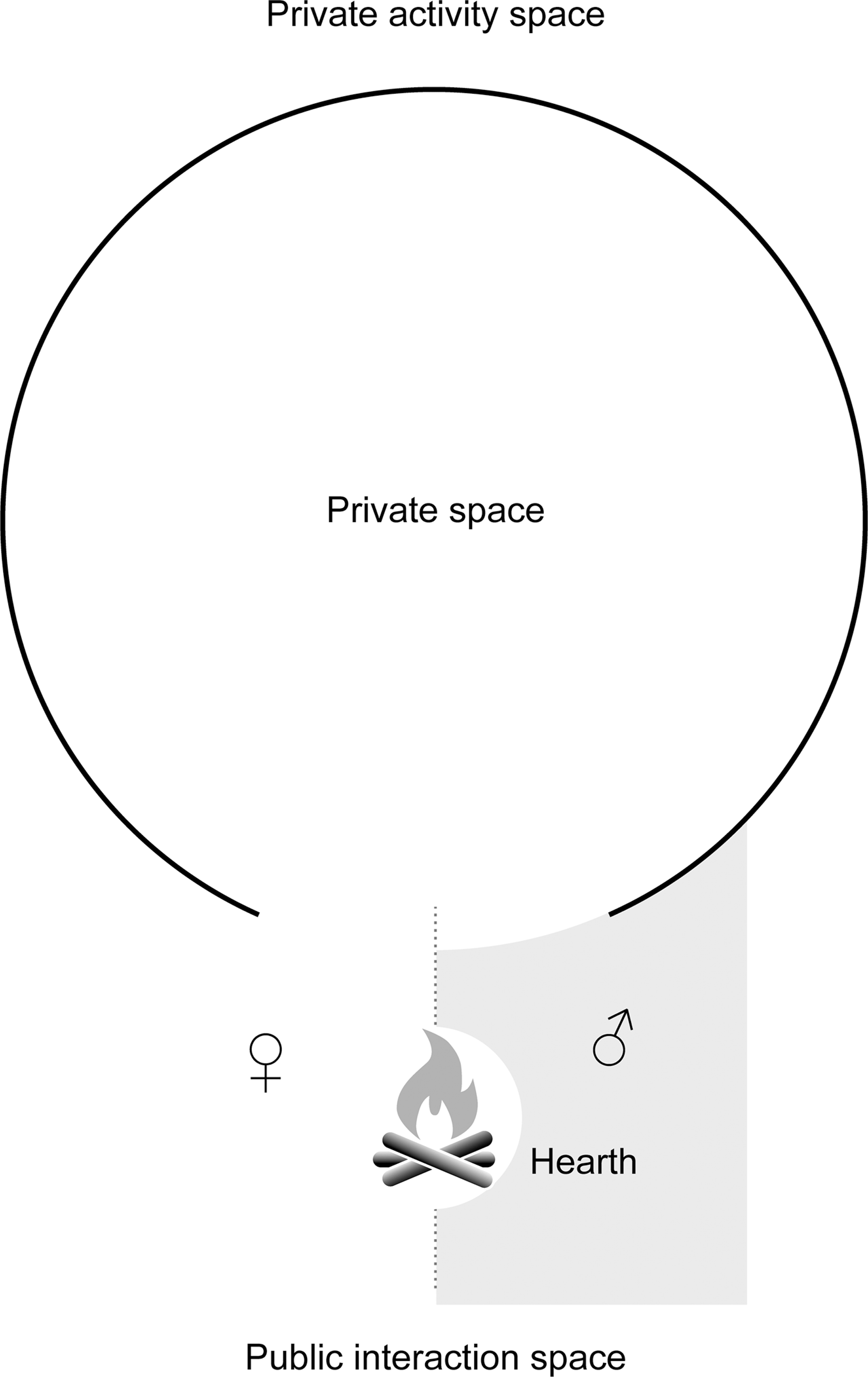
The Ju/’hoansi do, however, have gendered living spaces (Figure 2). These occur outside and around hearths in front of huts, with men sitting to the right and women to the left (Barnard Reference Barnard1978; Reference Barnard1992). Marshall (Reference Marshall1976, 88–9) accounted for this etiquette as a pollution prohibition on sitting where adults of the opposite gender have sat. She also found (Marshall Reference Marshall1976, 88) that when there is only a hearth, sticks are placed to define the doorway of a notional hut, so that men and women know where to sit. Where guests are expected to sit adds to the spatial pattern. When invited to join a !Xõ hearth they sit facing their hosts in front of the fire (Barnard Reference Barnard1992, 68–9).
Ju/’hoansi gendered space outside small shelters (after Whitelaw Reference Whitelaw, Parker-Pearson and Richards1994, fig. 11.4).

Neither the Hadza nor the Kalahari hunters and gatherers, Ju/’hoansi, !Xõ, G-wi, and Nahro, keep food for more than a few days. While women in the Kalahari expend considerable labour processing nuts, these are available at any fireside for family members and offered to visitors (R.B. Lee Reference Lee1979, 200–1). There are no gendered spaces other than the hearthside. Individuals can sit almost anywhere, with the important exception of a man’s mother-in-law. She makes a separate fire near her daughter (Barnard Reference Barnard1992, 69).
The round, cone-and-cylinder houses of Ilchalmus farmers in Kenya’s Baringo region have no internal partitions, but are divided into gendered spaces with male (left) and female (right) zones and the hearth on the woman’s side (Hodder Reference Hodder and Kent1987, fig. 9.2). This spatial division is reversed in areas of Baringo where there is socio-economic tension (Hodder Reference Hodder1982, 54, fig. 31). Comparable cone-and-cylinder huts, rondavels, are common in South Africa. In the eastern Cape, Ndude and Memla (Reference Ndude and Memela2024) found a similar pattern to Baringo. Within the village of smaller rondavels, the amaXhosa have a larger family house (indlu enkulu) where people meet to eat, socialise, and participate in ritual beer drinking (McAllister Reference McAllister2004). The family house studied by Ndude and Memla (Reference Ndude and Memela2024, fig. 6) has a floor area of 28 m2. Men sit to the left of the entrance and women to the right. They face each other across the central hearth (eziko). An upper area behind the hearth (entla) is associated with ancestors and food, meat, and beer is kept there for ceremonies. Seating positions are based on status so that, for example, irrespective of age a married woman has greater seniority than an unmarried one. In general, the front of the hut ranks higher than the back when it comes to seating places (McAllister Reference McAllister2004, 124). There are also designated sleeping areas for men and women.
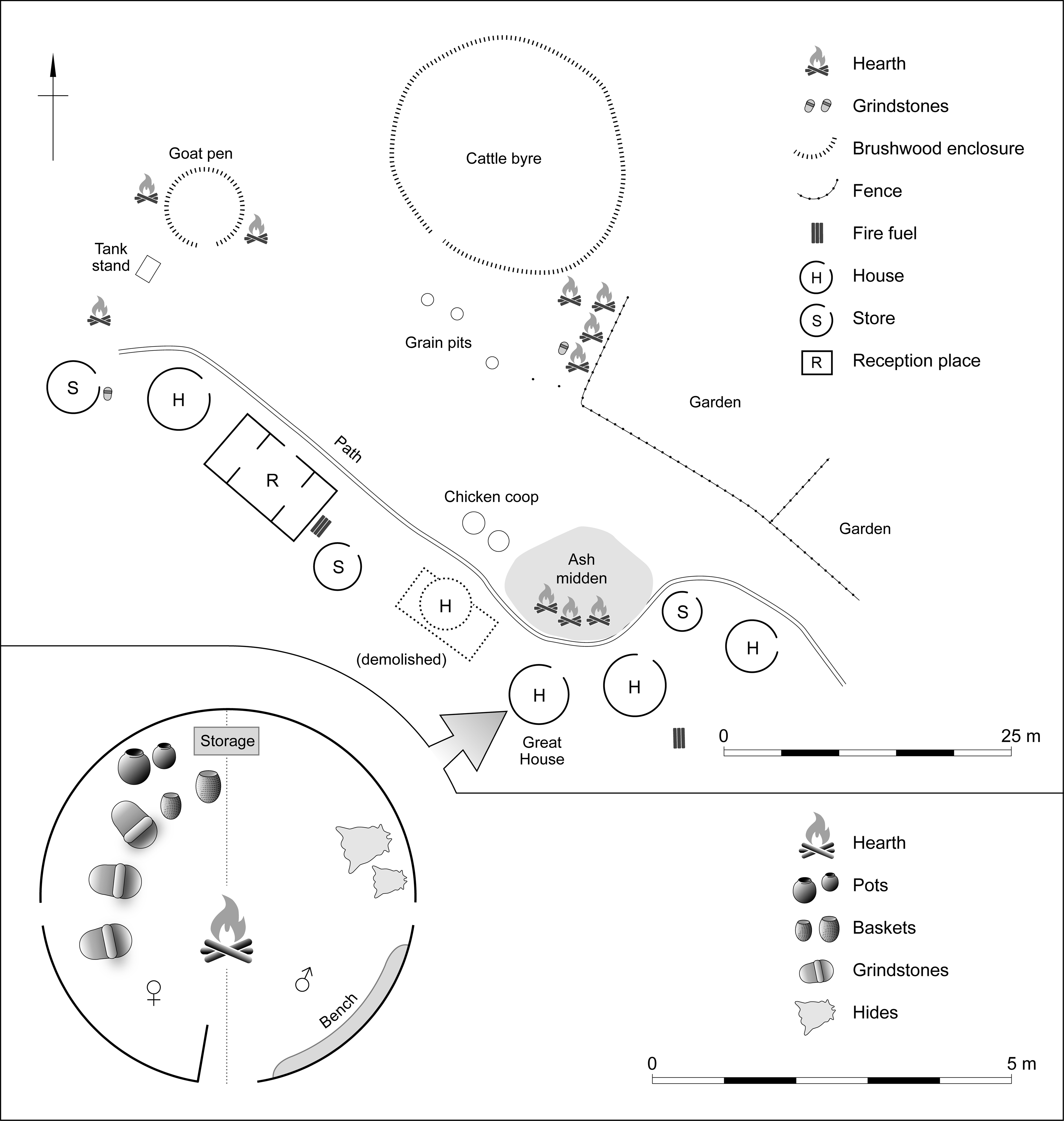
The Mpondo homesteads, KwaZulu-Natal (Davison Reference Davison1988), distinguish the female domain within the family houses from the male realm of the cattle corral (Figure 3). The thatched rondavels (indlu in Figure 3) have internal areas of c. 28 m2 and are spatially segregated by gender. The stones on which women grind maize for one to two hours every day (Figure 3) reinforce gendered spaces and their lower status (Davison Reference Davison1988, 105). The stores near the house are the women’s responsibility, but the grain pits near the cattle corral are controlled by men. Women are excluded from this area (Davison Reference Davison1988, 105).
Mpondo homestead, KwaZulu-Natal, South Africa (Davison Reference Davison1988, figs 1, 3). Each family house has a grain store nearby. In the Great House (indlu) gendered spaces are reinforced by the grinding stones for maize on the women’s side (left) and a low bench for the men to sit on while drinking beer (right). The men’s side has cattle hides and butcher’s tools associated with their realm, which is the corral outside. Other spatial divisions observed by men and women include back and front, centre and periphery.

McAllister’s (Reference McAllister2004) description of a Xhosa beer-drink, indywalo, found that domestic space is made meaningful by the allocation of seating places to kin and visitors. Women are invited to receive sips of beer by crossing into the men’s space. Their movement ‘dramatizes their formally inferior status but also the threat that they pose to the male order’ (McAllister Reference McAllister2004, 126). Women marrying into the household have to observe its gendered spatial divisions more strictly than those born into it (Davison Reference Davison1988, 105). This is sanctioned by an avoidance prohibition, hlonipha, which amongst others forbids a daughter-in-law from entering the men’s side of the indlu (Davison Reference Davison1988, 105). The gendered separation distinguishes spatially between affinal (left) and agnatic (right) kin (Davison Reference Davison1988, 104).
In Kenya, Marakwet men and women occupy cone-and-cylinder houses of their own within a shared compound (Moore Reference Moore1986, fig. 28). Compounds also contain food stores, as well as livestock corrals and goat-houses (Moore Reference Moore1986, 52–4). Marakwet women control the food stores and granaries, and the men are dependent on their agricultural and domestic labour (Moore Reference Moore1986, 72). This is also the case for the Karimojong in Uganda. The sorghum crop is grown by women, and is kept in their individually owned granaries within the stockaded homestead. Here they protect the grain from theft by humans and animal pests and control its use (Dyson-Hudson & Smith Reference Dyson-Hudson and Smith1978, 34). Men instead protect and defend the cattle as they move them between pastures.
The gendered spaces in South Africa’s circular beehive huts closely follow those in the larger rondavels (Figure 4). These unpartitioned houses are described by Walton (Reference Walton1956, 129–34) for the Xhosa, Swazi, Nguni, and Herrero. They are small with floor areas of 5–10 m2, central hearths, men and women’s sides, and a raised area reserved for offerings to ancestral spirits (Walton Reference Walton1956, 131).
Xhosa ‘beehive’ huts with central hearth and male:female sides, South Africa (after Walton Reference Walton1956, fig. 52).

Rectangular houses are common, but not exclusive to the rain forest areas of west and central Africa (Figure 1). Yakö villages on the border of south-eastern Nigeria and Cameroon have separate houses for men and women. The woman’s house has the food stores and its internal floor area is slightly larger, 26 m2, than the man’s house, 20 m2 (Figures 5). The houses are partitioned internally to demarcate living from storage areas. This is also the case for the rectangular Kabyle house, Algeria (Figure 6), where an animal byre is attached to the living quarters (Bourdieu Reference Bourdieu1979). Through gendered space Yakö architecture confirms women’s control over the household’s food stores and food preparation. While it is possible to partition circular dwellings, this is much easier in rectangular structures, which are frequently segmented (Walton Reference Walton1956; Denyer Reference Denyer1978; Kent Reference Kent and Kent1987; Reference Kent and Kent1990).
Yakö houses: women’s (top) and men’s (below) (after Denyer Reference Denyer1978, fig. 69).

Kabyle house (after Bourdieu Reference Bourdieu1979, fig. 1). No scale provided. There is no central hearth. Instead the Kanum is on the right, the women’s side.

The nomads’ tents of north Africa (Figure 7) are rectangular gendered spaces, with male and female sides usually separated by a physical partition, the Bedouin qata curtain (Faegre Reference Faegre1979, 24). Segregation follows Muslim seclusion rules, and gendered divisions in tents and houses are found across the mountainous nomad arc from north Africa to central Asia (Cribb Reference Cribb1991a; Reference Cribb1991b). This is not, however, universal. Tuareg tents in the southern Sahara are not spatially segregated. Women are not secluded and it is men who are veiled (Nicolaisen Reference Nicolaisen1963; Spain Reference Spain1992, 56). Neither is the living space in the Kabyle house partitioned, although Bourdieu (Reference Bourdieu1979) describes a binary division between its gendered spaces.
Bedouin black tent, north Africa (after Faegre Reference Faegre1979, 24).

Nomads store on-the-hoof, as with the Tuareg’s herds of camels and the Bedouin’s sheep and goats. They also have storage pots, baskets, bins (Figure 8) and sometimes pits alongside re-used foundations over which the tent frame is placed (Cribb Reference Cribb1991b, 96). These containers hold agricultural staples either grown by households or obtained through exchange. Women prepare food and manage the stores. They are also the owners of the tents and responsible for their transportation and erection.
Turkish nomad tent, alacik, on stone footings (Cribb Reference Cribb1983, figs 46, 47; author’s copies). Note the stores and hearth on the women’s side.

Gendered space and social knowledge
In her cross-cultural study, Spain (Reference Spain1992) recognises three gendered spaces in the non-industrial world: the domestic dwelling, the Men’s house and, outside the settlement, segregated workgroups. Spain is primarily concerned with farmers and pastoralists. Hunters and gatherers also divide extractive labour between workgroups of men and women, while their equivalent of Men’s houses are universal, for example Inuit karigi (M. Lee & Reinhardt Reference Lee and Reinhardt2003). These do not necessarily involve architecture, but a space prohibited to females where male rituals are enacted and boys and young men initiated (Elkin Reference Elkin1977).
In Africa, the gendered spaces around hunter-gatherer hearths are a link to the more formal arrangements found in the dwellings of farmers, pastoralists, and nomads as outlined above. Which side men and women sit on is not important. But the habitual segregation of space by gender is, because, as Spain (Reference Spain1993, 147) points out, ‘spatial arrangements typically fall into the category of things we do not think about. Therein lies their power; they have the ability to sustain the status quo without encountering resistance’.
This widespread separation by gender across a continent as diverse as Africa cannot be explained by religion, subsistence economy or political complexity. Spain’s (Reference Spain1992, 3) conclusion is that segregation within dwellings reduces women’s access to socially valued knowledge. When women are excluded, men are free to use this knowledge to produce and reproduce their dominant power and privilege. Gendered storage, which Spain does not discuss, can reinforce this spatial segregation, as in the Mpondo homestead (Davison Reference Davison1988). But when, as described for the Marakwet (Moore Reference Moore1986) and Karimojong (Dyson-Hudson & Smith Reference Dyson-Hudson and Smith1978), women not only fill their own granaries with the products of their labour but also control and defend them, then gendered storage can be a form of resistance to male power manifest in the gendered spaces of dwellings, compounds, and workgroups.
Dwellings are good to think with and through
From this brief survey it is apparent that houses are a microcosm of social relations (Bourdieu Reference Bourdieu1979). They are also an architectural interpretation of cosmological systems (Bradley Reference Bradley2012). Dwellings acting in concert with our 4E cognition are the material scaffolding for these concepts. As containers they define spaces for creating and reproducing the gendered divisions inherent in these systems.
Outside Africa, among the reindeer herding Nenets of north-west Siberia, men and herds are the first to arrive at a new campsite where the leader drives his herding staff, tyr, into the ground (Haakanson Reference Haakanson2000; Haakanson & Jordan Reference Haakanson, Jordan and Jordan2016). As soon as the tyr is planted the open tundra is transformed into a ‘place’ (Haakanson & Jordan Reference Haakanson, Jordan and Jordan2016, 168). The tyr is where the hearth of the circular chum, a tipi-like lodge, must be located. It also establishes the siyangi line that divides the chum into two halves and extends out into the campsite, controlling the movements and activities of men and women (Haakanson & Jordan Reference Haakanson, Jordan and Jordan2016, 168). When the women arrive at the new campsite carrying the poles and skins to erect the chum they ‘reconstruct the main aspects of [Nenet] cosmology in miniature’, while ‘the ordering of the lodge’s internal areas has a range of inter-locking associations with gender, ritual and status’ (Haakanson & Jordan Reference Haakanson, Jordan and Jordan2016, 164). The movements of women and children both inside and outside the chum are restricted by the siyangi line (Haakanson Reference Haakanson2000, figs 5.5–5.6). Men are only restricted within the chum, where habitus dictates which side and where they sit. Women use the entrance and storage areas at the back while men stay on their side of the siyangi line in the middle of the chum. A sacred area is located at the back of the dwelling.
Archaeological evidence for gendered spaces
The Nenets’s transportable chum is an example of how a container both creates and reproduces the habitus of gendered spatial relations. And habitus, as Spain reminds us, expresses things we do not think about. The African dwellings described above similarly result from the reasoning needed to build dwellings, feed fires, and store supplies. But these small, gendered spaces are also the result of unthinking action, habitus, scaffolded by a set of artificial containers — hearths, dwellings, and stores — and their relationship to each other. Placing hearths either inside or outside dwellings is one example.
Can such a prevalent habitus be traced archaeologically? Ever since Leroi-Gourhan’s (Leroi-Gourhan & Brézillon Reference Leroi-Gourhan and Brézillon1966) pioneering study at Pincevent, a Late Glacial open site in the Paris Basin, the analysis of Palaeolithic campsites, both open and naturally sheltered, has been prodigious. But despite great gains in knowledge about hearth-related behaviour as reconstructed from lithic refitting, faunal distributions and size analysis, the latter driven by Binford’s (Reference Binford1983) influential ethnoarchaeological study of a hunting stand, the issue of gendered spaces (as opposed to age-related ones, eg Langley Reference Langley2020) has rarely been investigated. At Pincevent, in unit T125 level IV0, Julien (Reference Julien2006, fig. 6) reconstructs a dwelling, c. 28 m2, with a central hearth. This is part of a winter camp dated to 14.5ka. Within this dwelling she identifies daytime activities involving seven apprentice flint knappers learning from a skilled artisan. Nighttime occupation sees possibly eight sleeping spaces in the same dwelling. A different and more complex pattern can be found on the autumn camp at the site (Karlin & Julien Reference Karlin and Julien2019). The differences are attributed to seasonal variations in temperature, length of stay, numbers of people, and different hunting decisions.
For all the precise spatial details involved in these and other studies, the absence of evidence for gendered spaces is not evidence of their absence. What has not been looked for cannot be discounted. As we have seen, gendered spaces are prevalent in ethnoarchaeology.
Some studies, however, do point the way. Stapert’s (Reference Stapert1992; Reference Stapert2003, figs 1, 5 & 7) ‘rings and sectors’ model applied to the Late Glacial sites of Gönnersdorf and Verberie started from the premise that internal dwelling spaces would be organised by gender. Using his ethnoarchaeological experiences with Evenki herders in Siberia, Grøn (Grøn & Kuznetsov Reference Grøn, Kuznetsov, Weber and Mackenzie2003; Grøn, Reference Grøn, Svart Kristiansen and Giles2014; Reference Grøn2020, fig. 4) analysed Mesolithic architecture in Denmark with a gendered model. Ethnoarchaeology also directed Oetelaar’s (Reference Oetelaar2000) analysis of a 2ka old tipi ring, EgPn375, excavated in north-west Calgary. The distribution of finds in the enclosed 11 m2 area produced differentiated sectors in terms of density, size, and artefact classes, as well as the positioning of key structural tipi components: the entrance, central hearth, and smudge altar. At Jubilee Shelter, c. 6ka, in the Magaliesberg, South Africa, there is a marked separation in the distribution of male (bone points) and female (ostrich eggshell) artefacts, suggesting that this small shelter was a gendered space (Wadley Reference Wadley1987, fig. 81; Reference Wadley1989).
These studies could also benefit from sedaDNA (Aldeias & Stahlschmidt Reference Aldeias and Stahlschmidt2024; Özdoğan et al. Reference Özdoğan, Gelabert, Hammers, Altınışık, de Groot and Plets2024), which offers the possibility of discriminating between spatial areas used by males and females, although the necessary methodological advances will be challenging. The identification of female aDNA in a deer tooth pendant from Denisova cave (Essel et al. Reference Essel and Meyer2023), c. 25–19ka, if combined with spatial data from hearths, dwellings, and stores, offers further research possibilities to understand gendered spaces and objects. For example, applying these techniques to the male/female artefacts from Jubilee Shelter could be transformative for spatial studies.
Macro-scale: storage and latitude
The African continent provides the macro-scale to examine food storage among hunter-gatherers. In his global survey of 337 hunter-gatherer societies, Binford (Reference Binford2001) classifies their investment in storage using a four-point ordinal scale, QTSTOR.
The scale ranges from None (1) to Massive (4) in the significance of stored foods and the effort put into acquiring and processing them (Table 1). With this global sample, Binford proposes (Reference Binford2001, 257) that the extent of food storage is related to latitude and the length of the growing season.
An ordinal assessment of the importance of stored foods in a worldwide sample of hunter-gatherers (Binford Reference Binford2001, fig. 8.04 QTSTOR)

Binford identifies latitude 35oN and S as a threshold for storage. This is significant for Africa, as its landmass falls between these two latitudes (Figure 9). Twenty hunter-gatherer cases in the sample of 337 are in Africa (Appendix 1). All score 1 on the QTSTOR scale. Effective Temperature (ET; Bailey Reference Bailey1960), a measure of the length of the growing season, adds another threshold at 15.25 ET, below which significant investment in storage is predicted (Binford Reference Binford2001, 260, generalisation 8.08). Three of the African hunters and gatherers in Appendix 1 fall just below this ET threshold, but have no food storage. Across the 337 case studies, the length of the growing season sees corresponding changes in the amount of food storage (Table 2).
The low storage latitudes between 35o N and S for hunters and gatherers without economic intensification (Binford Reference Binford2001, 257).

Length of growing season, investment in food storage and effective temperature (ET) for hunter-gatherers (Binford Reference Binford2001)

In a smaller sample of 49 hunter-gatherer groups, Binford (Reference Binford1990) tabulates by length of growing season (ET) the major changes in what is stored, and the technology involved (Table 3). The ET divisions he uses subdivide the nine-month growing season in Table 2. Storage technology is predominantly container-based (Table 3), except for drying racks for fish. African hunter-gatherers use containers such as gourds, baskets, nets, bags, and slings to carry plant foods, but not to store them (R.B. Lee Reference Lee1979, 124–8; Marlowe Reference Marlowe2010, 92–3).
Storage facilities, principal items stored, methods used, and the technology employed in 49 hunter-gatherer cases organised by length of growing season, as indicated by effective temperature (ET) (after Binford Reference Binford1990, tabs 13–15)

Would investment in stored foods and storage containers among African hunter-gatherers also have been minimal during deep history, when the Pleistocene’s climate cycles moved this latitudinal threshold? These cycles produced recurrent phases of a Green Sahara/Arabia during which temperate conditions extended south into the present tropical zone (Scerri et al. Reference Scerri, Drake, Jennings and Groucutt2014; Hamdan & Brook Reference Hamdan and Brook2015; Nicholson et al. Reference Nicholson and Fleitmann2020). This suggests that food storage might have been a possibility in some climatic periods at the northern and southern margins of the continent. But what was there to store? The Major (3) and Massive (4) storage in northern latitudes comprises marine mammals, anadromous fish and species such as caribou/reindeer, red deer, bison, and horse. In Africa, marine mammals and fish are the prime candidates for significant storage, especially on the southern coasts at sites like Blombos Cave, Pinnacle Point, Die Kelders and Klasies River Mouth (Wadley Reference Wadley2015). The habitat shifts resulting from climate cycles did not, however, significantly change the terrestrial fauna available. When compared to its Eurasian and North American counterparts, the African fauna, while forming large, dense aggregations, is fat-deficient and less attractive for making that storage investment; a situation highlighted in Binford’s (Reference Binford1978; Reference Binford1981) studies of Arctic and Pleistocene storage-focused terrestrial hunting.
There are exceptions (Binford Reference Binford2001, 256–7) to the 35o threshold (Appendix 2). None of these occur in Africa and they are accounted for by domesticated crops forming a component of hunter-gatherer subsistence. Binford’s proposition 8.04 (2001, 257), based on this evidence, is that any significant storage of food below 35o indicates that economic intensification has taken place for that hunter-gatherer society.
African hunters and gatherers are encapsulated by farmers and herders, and many San in the Kalahari work for them (R.B. Lee Reference Lee1979; Woodburn Reference Woodburn1980). This contact could explain their lack of storage (Appendix 1), as they were forced into agriculturally marginal environments. The Australian cases in QTSTOR suggests otherwise. This continent of unencapsulated hunter-gatherers lies below the equator and mostly above 35oS. While there was intensification of food sources (Lourandos Reference Lourandos1997) there was no food production. Only one case, the Kuareg in Queensland (Appendix 2), has a QTSTOR rank of 2. All 53 other cases are ranked at 1, comparable to the African hunter-gatherers in the dataset (Appendix 1). The Australian societies cover a wide geographical range from deserts to tropics, temperate forests, and coasts. Four are located below 35oS (Table 4) but with the lowest QTSTOR rank.
Low investment in stored foods among Australian hunter-gatherers who live at >35o latitude (Binford Reference Binford2001)

Binford (Reference Binford2001, 257) explains these as occupying distinctive, southern ocean Nothofagus environments with little seasonal variation in temperature and vegetation. The four exceptions from Australia have an ET range of between 14.95–12.74. Applying that same ET range to the 337-strong dataset produces a subset of 83 cases (Table 5). As expected, Major and Massive QTSTOR values account for 70% and are exclusively from North America. The three exceptions are in India: the Kadar, Cholanaikan, and Nayaka. They occupy low latitudes, between 10.1o–11.9o, so that minimal storage is predicted, as for the two South African cases (Appendix 1), the Xam and Xegwi. By comparison, the four Australian cases (Table 4) occupy latitudes >35o. Since these are the only exceptions to the 35o storage threshold, its general applicability is upheld.
QTSTOR for the Effective Temperature range 14.95–12.74

Finally, in their study of the same dataset, Freeman and Anderies (Reference Freeman and Anderies2015, 114) argue that the presence or absence of storage differentiates between societies with open access to resources and those who restrict access through corporate ownership (Table 6). Resources can be defended when they are stored, and African hunter-gatherers with minimal food storage do not restrict access through defence.
The relationship between storage and ownership of resources among hunter-gatherers (Freeman & Anderies Reference Freeman and Anderies2015, tab. 1)

Implications for deep history
Three inferences arise from this review of gender- and age-segregated dwellings and food stores:
-
1. Environmental constraints, as indicated by latitude and ET thresholds, would restrict food storage across Pleistocene Africa
-
2. Significant use of food stores in Africa depended upon agricultural crops and domestic animals
-
3. Without these stored foods there will be no evidence in Africa for artificial dwellings
These inferences, if supported archaeologically, should not lead to the conclusion that without dwelling-containers, there was neither storage nor gendered space. Food is not the only resource that can be stored. Symbolic knowledge is contained in cultural paraphernalia such as beads, ochres, composite artefacts, burials and the many media and messages of art, language, music, and dance. These objects and ceremonial performances (James Reference James2003) are kept, curated, and often revered. They are essential to the networks that radiate between people and across landscapes. Access to this valued cultural knowledge (Spain Reference Spain1992) is also gendered and hence differentially available. As shown by the Kalahari hxaro networks (Wiessner Reference Wiessner, Leacock and Lee1982) and the tradelines that traversed Aboriginal Australia (McBryde Reference McBryde1987), this can occur in the absence of dwelling-containers with segregated spaces and stores. Artificial dwellings are not another milestone towards modernity (Gamble Reference Gamble2007, chapter 2), but perhaps they reinterpreted gender relations already embedded in extended networks of material exchanges. One avenue to explore further is the role of domestic space in the rituals and performance of hospitality towards guests and strangers (Belfer-Cohen & Hovers Reference Belfer-Cohen and Hovers2020; Gamble in press a; in press b).
Dwellings in African deep history
Artificial dwellings are found only in the last 20ka of Africa’s deep history. An earlier claim for a circular hut at Olduvai Gorge, site DK (Leakey Reference Leakey1971), with a diameter of 4.5 m (16 m2) and an age of 1.75Ma, is no longer supported following taphonomic concerns with Leakey’s ‘living floors’ and alternative interpretations of lithic accumulations as stone-caching behaviour (Potts Reference Potts1988). The area excavations at Olduvai and Koobi Fora (Isaac Reference Isaac1997) recovered concentrations of artefacts which often refit, but no other candidates for Lower Pleistocene shelters have been found.
This absence of evidence continues into the African Middle and Upper Pleistocene (Barham & Mitchell Reference Barham and Mitchell2008; Mitchell & Lane Reference Mitchell and Lane2013). By contrast, evidence for kindled and conserved fire in hearths is known from many sites in southern Africa from the Middle Stone Age (MSA) between ∼250–30ka (Bentsen Reference Bentsen2014; Wadley Reference Wadley2015). This is predominantly found in caves and rockshelters, including the multiple, stacked hearths at Klasies River Mouth, 106ka (Morrissey et al. Reference Morrissey, Mentzer and Wurz2023), and Pinnacle Point, 127ka (Marean et al. Reference Marean and Williams2007). No shelters, pits or other sub-surface features have been found on these well-researched sites. Florisbad Springs, 121 ka (Henderson Reference Henderson2001), is the only open site with evidence for a hearth, but in spite of excellent preservation (Kuman et al. Reference Kuman, Inbar and Clarke1999, 1421) no other artificial structures were found. At a much earlier date, 476ka, modified logs have been found at Kalambo Falls (Barham et al. Reference Barham and Nkombwe2023). These did not form a structure, but demonstrate that preservation is not a bar to discovery.
It might be argued that caves and rockshelters fulfilled the role of artificial shelters, offering protection against predators, as at the Lower Pleistocene sites of Wonderwerk (Gowlett Reference Gowlett2016), Sterkfontein (Brain Reference Brain1981), and Swartkrans, 1.2Ma, where fire was present but not conserved (Brain & Sillen Reference Brain and Sillen1988). Caves and rockshelters are containers that afford many of the benefits of artificial dwellings. This argument is strengthened in the later MSA by bedding areas, for example at Border Cave (Wadley et al. Reference Wadley, Esteban, de La Peña, Wojcieszak, Stratford, Lennox, d’Errico, Rosso, Orange and Backwell2020; Backwell et al. Reference Backwell and Mauran2022), ∼200ka, and Sibudu Cave (Wadley et al. Reference Wadley, Sievers, Bamford, Goldberg, Berna and Miller2011), 77ka. Area excavations are rare in southern Africa’s Middle and Upper Pleistocene, making the recovery of shelters and dwellings less likely. But the question remains, when natural shelters are unavailable, where are the open-air sleeping sites with hearths that mirror a site such as Sibudu? Area excavations in north Africa, and in particular along the Nile (Wendorf & Schild Reference Wendorf and Schild1980; Vermeersch Reference Vermeersch2000), and into the Levant (Hovers Reference Hovers2017, tab. 65.1) have produced open-air hearths, but not artificial structures. In the face of these intensive, high-quality research excavations, the lack of evidence seems to be evidence of absence.
To summarise, the current MSA evidence across Africa points to the use of caves and rockshelters for a variety of purposes, including tool manufacture, cooking, and sleeping. Whether these were also gendered spaces needs further investigation. There was no construction of artificial shelters in the open air and associated with hearths or food storage. This absence continues into the Early Upper Palaeolithic of the Levant, 48–25ka (Goring-Morris & Belfer-Cohen Reference Goring-Morris and Belfer-Cohen2003; Belfer-Cohen & Goring-Morris Reference Belfer-Cohen and Goring-Morris2017), coterminous with the southern African MSA, which ends between 30–25ka (Wadley Reference Wadley2015, 159, tab. 1). Hearths, however, are common (Belfer-Cohen and Goring-Morris Reference Belfer-Cohen and Goring-Morris2017, 632).
After 25ka, built structures are present in the African Epipalaeolithic/Later Stone Age (LSA). Affad 23 in the Middle Nile Valley, Sudan, is a 16ka settlement with Epipaleolithic artefacts and evidence for dwellings and shelters (Osypiński et al. Reference Osypiński, Morley, Osypińska and Kotarba-Morley2016). Hearths, postholes, and pits are also present, but the latter are not interpreted as storage features because of the nature of their secondary fills (Osypiński et al. Reference Osypiński, Morley, Osypińska and Kotarba-Morley2016, 910). At 12ka in Wadi Kubbaniya WK26, Egypt, two area excavations have produced evidence for hearths, postholes, a pit, and the remains of features interpreted as drying racks (Banks et al. Reference Banks, Snortland, Cummings, Gatto and Usai2015; Reference Banks, Usai, Snortland, Cummings and Gatto2018). Older storage pits are known form Wadi Kubbaniya KH26, 16ka (Banks et al. Reference Banks, Snortland, Cummings, Gatto and Usai2015). These settlements lack stone-built structures. The earliest example from Africa comes from terminal Pleistocene/Early Holocene Mia Farm, Midrand, South Africa, 8–12 ka (Mason Reference Mason2012, 228). Excavations recovered a hearth and a semi-circle of local manuports, large diabase rocks interpreted as weights for a windbreak. Storage pits are rare in South Africa and only found in the last 2ka at sites such as Bomplaas Cave (Wadley pers. comm).
Contiguous with Africa and still below the 35o threshold for storage is the intensively researched Levant (30o–35oN) (Goring-Morris & Belfer-Cohen Reference Goring-Morris and Belfer-Cohen2003, tab. 1; Enzel & Bar-Yosef Reference Enzel and Bar-Yosef2017). During the Last Glacial Maximum (26.5–20ka) and subsequent Late Glacial (20–11.6ka), this region was sensitive to environmental changes that would favour food storage, as temperature and the length of the growing season reduced, shifting the storage threshold southwards. The impact in the southwards shift is seen at the 32oN waterlogged site of Ohalo II, 23ka, Sea of Galilee, Israel (Nadel Reference Nadel2002; Reference Nadel2017). Its six irregular oval brushwood huts range in floor area from 5–13 m2 with hearths between them (Nadel Reference Nadel2003). Their floors were dug into the ground. There is also one outside pit as well as a grave. Seed remains were prolific, with concentrations around a grinding stone in hut 1.
Kharaneh 4 in the Azraq Basin, Jordan, is an early Epipalaeolithic site that covers >21,000 m2 of dense lithics, and was occupied from 19.8–18.6ka (Maher Reference Maher2017, 681). In area B two hut structures have been excavated with a large stone-lined hearth between them (Maher Reference Maher2017, 681–4). The better-preserved structure 1 was dug into the ground and oval, c. 7 m2 (Maher et al. Reference Maher, Richter, Macdonald, Jones, Martin and Stock2012, fig. 3). Graves, pits, and midden deposits are also associated with these dwellings and gazelle was the main species hunted.
The Early Natufian settlement of Eynan (Ain Mallaha; 14.3–12.4ka) on the shores of Lake Hula points to subsequent developments in dwelling construction (Grosman & Munro Reference Grosman and Munro2017; Valla et al. Reference Valla, Khalaily, Samuelian, Bocquentin, Bridault and Rabinovich2017). It is a hamlet of semi-buried circular and semi-circular buildings with roof-bearing postholes. The largest dwellings are 7 m in diameter with a floor area of 38 m2. The excavated dwellings have at least one internal hearth and burials are found beneath the floor. Early Natufian hamlets are also known from Wadi Hammeh, Jordan, and el-Wad, Israel (Grosman & Munro Reference Grosman and Munro2017, 703). Within the Natufian more broadly, 15–11.5ka, interior features commonly include hearths, bins, work surfaces, storage pits, and paved floors (Grosman & Munro Reference Grosman and Munro2017, 703). Sickle blades indicate economic intensification, although animals were not yet domesticated and archaeobotanical evidence is lacking (Grosman & Munro Reference Grosman and Munro2017, 702). The Early Natufian falls in the warmer conditions of the LGI (Bølling-Allerød) and the Late Natufian in the abrupt environmental transition of GS-1 (Younger Dryas) that lasted from 12.9 to 11.6 (Grove Reference Grove2021, 14–5). This interlude of rapid cooling is one explanation given for the shift to subsistence intensification under environmental stress (Bar-Yosef Reference Bar-Yosef1983; Bar-Yosef & Meadow Reference Bar-Yosef, Meadow, Price and Gebauer1995). However, lower temperatures during the earlier LGM would have moved the latitudinal storage threshold below the Levant, reflected in the appearance of dwellings and storage pits. The response in Natufian architecture and storage follows an environmental change that began during the LGM at sites such as Ohalo II and was not significantly interrupted until the Holocene, when the current latitudinal threshold for hunter-gatherer storage is restored and plant domestication takes place (Grove Reference Grove2021, fig. 14).
Discussion
Macro-scale, dwellings, storage, and intensification
Africa is not alone in coming late to the concept of dwellings. There are no credible artificial structures in the European Middle Palaeolithic, 300–40ka (Gamble 1999; in press a; Kolen Reference Kolen, Roebroeks and Gamble1999; Stapert Reference Stapert2003). Open-air hearths are found throughout the Late Middle and Upper Pleistocene, as at Beeches Pit, England (414ka; Preece et al. Reference Preece, Gowlett, Parfitt, Bridgland and Lewis2006), and in France at Therdonne (178ka; Hérisson Reference Hérisson2012) and Beauvais (55.6ka; Roebroeks & Villa Reference Roebroeks and Villa2011). None of them are found with dwellings.
All of Europe lies above 35oN and stored foods would be expected to cope with the shorter growing season. However, there is no evidence this strategy was employed before 40ka. For example, at the well-preserved 52oN open site of Lynford, England (59–46ka), mammoths were exploited and selected limb bones taken away (Schreve Reference Schreve2012). Beetle and pollen evidence indicate temperatures 4oC lower than the present, and the locale’s ET is calculated as 11.06–10.86o (Gamble & Boismier Reference Gamble and Boismier2012, 291). This indicates a growing season of <6 months and the expectation of significant storage (see Table 2). As elsewhere, however, no evidence for storage was found.
The earliest dwellings in Europe appear after 40ka. At Pavlov and Dolní Věstonice II, Czech Republic (32ka; Svoboda Reference Svoboda2011; Reference Svoboda2016, 48; Reference Svoboda2022), there are many sub-surface features: pits and postholes (Svoboda Reference Svoboda2022, 191–3, fig. 7.28), hearths, graves, and dwellings with irregular outlines. These are described as tent/tipis with floor areas of between 7–12.5 m2 (Iakovleva Reference Iakovleva2015, tab. 1; Svoboda Reference Svoboda2022, 123–34). Southern Russia has circular mammoth bone constructions, among them Yudinovo at 18.2–17.6ka (Sablin et al. Reference Sablin, Reynolds, Iltsevich and Germonpré2025), although not all of them are dwellings (eg the third structure at Kostenki 11; Pryor et al. Reference Pryor, Beresford-Jones, Dudin, Ikonnikova, Hoffecker and Gamble2020). These sites do have numerous pits and some graves and, as at Kostenki 11/1A, internal hearths (Praslov & Rogachev Reference Praslov and Rogachev1982; Soffer & Praslov Reference Soffer and Praslov1993; Zheltova Reference Zheltova2024).
In Ukraine’s Late Glacial (15–14ka), there are distinctive yarangas, circular, roofed mammoth bone dwellings with internal hearths and pits outside, often containing bones (Soffer Reference Soffer1989; Pidoplichko & Allsworth-Jones Reference Pidoplichko and Allsworth-Jones1998; Iakovleva Reference Iakovleva2015, tab. 1). These include Mezhirich, Mezin, and Gontsy (Iakovleva Reference Iakovleva2015; Reference Iakovleva2021; Iakovleva et al. Reference Iakovleva, Djindjian and Moigne2021). In her overview of the regional evidence, Iakovleva (Reference Iakovleva2015, 328) recognises two sizes of yaranga dwellings: standard (20 m2) and large (50 m2). Of the 20 yarangas, twelve have internal hearths (Iakovleva Reference Iakovleva2015, tab. 1).
The ground plans of Late Glacial dwellings elsewhere in Europe, 18–12ka, form two major groups, circular/oval and polygonal/rhombic (Leesch & Bullinger Reference Leesch and Bullinger2012, 166, fig. 1). Floor areas range from 6–40 m2 and internal hearths are present, as at Gönnersdorf, Germany (Bosinski Reference Bosinski1979), while pits and other artificial sub-surface features, as well as a wide range of containers (Riethmüller Reference Riethmüller2018), are common.
In his comprehensive survey of Aboriginal architecture in Australia, Memmott (Reference Memmott2022) describes many forms of rain and shade shelters from across the continent. Circular and oval shapes dominate, and their sizes are small. Internal hearths are rare, as are settlements with pits. Australia was first settled ∼50ka (O’Connell & Allen Reference O’Connell and Allen1998), before the oldest artificial dwellings in Europe. The first Australians were moving from one non-storage area, south-east Asia, to another (Figure 9), only breaching the 35o threshold when they walked to Tasmania, ∼40ka, then part of the palaeo-continent of Sahul (Cosgrove Reference Cosgrove1999). Archaeological evidence for dwellings is scant and most are recent (O’Connor Reference O’Connor1987). Australia has a dynamic deep history with archaeological evidence for intensification in food extraction during the Holocene (Lourandos Reference Lourandos1997), leading Memmott (Reference Memmott2022, 346) to propose that ‘places of economic intensification are most likely to be places of architectural intensification’. Intensification can also increase the length of time spent in seasonal settlements. It remains to be seen through future fieldwork if such linked intensification is older than 10ka and if, in Australia, it forms another exception to the presence of storage among hunters and gatherers above the 35oS threshold (Figure 9; Table 4).
Micro scale internal, gendered spaces
How widespread are gendered spaces among mobile hunter-gatherers and pastoralists outside Africa? Table 7 shows how common they are within small, circular dwellings. A striking similarity exists in the spatial organisation of round tents and huts across Eurasia (Dukha, Mongolia; Evenki and Nenets, Siberia; Sámi, Arctic Scandinavia; see Table 7 for references) and North America (Blackfoot, Ojibway, Nunamiut, Iinnu). All have a central hearth and the interiors are segregated by gender (Figure 10). A place of honour for guests is often found behind the hearth, as with Dukha, Evenki, and Blackfoot. This model of gendered arrangements in circular dwellings also extends to African pastoralists and farmers (Table 7), suggesting it has a wider applicability to archaeological spatial studies. Food storage takes two forms, herds of domestic animals for Evenki and Dukha, and meat stores kept within or near the tipi for Blackfoot and Iinnu.
Gendered spaces in small circular dwellings. The QTSTOR ranks (see Table 1) are notional for the non-hunters and gatherers where P = pastoral and F = farmed resources. * = permanent dwellings

A model of gendered spaces within transportable, circular tents from comparable latitudes 48o and 52oN and continental environments in Asia and north America. The principal sources are Blackfoot, Iinnu, Evenki and Dukha (references in Table 7). Living space varies among these four groups from 17–27 m2. See Table 7 for further examples of this general model from other latitudes and economies.

There is also the storage of paraphernalia, socially valued objects. This occurs in areas with minimal architecture. In the Kalahari, ostrich eggshell beads and bracelets are exchanged through regional hxaro networks that both men and women participate in. These networks cross-cut social groups and act as a way to reduce risk in an uncertain environment (Wiessner Reference Wiessner, Leacock and Lee1982). They are in Barnard’s (Reference Barnard2011, 81) analysis an example of establishing kinship by choice rather than through descent and marriage. In Australia, these negotiated relationships allow access to other people’s ‘stores’, their land, and its resources should these fail locally, as well as a pool of marriage partners (Mulvaney Reference Mulvaney and Peterson1976; McBryde Reference McBryde1987).
Paraphernalia are stored as well as exchanged within small circular dwellings. In the Blackfoot tipi, sacred spirit bundles are kept in the place of honour behind the hearth and smudge altar (Wissler Reference Wissler1912; Zedeño Reference Zedeño2008). The same position in an Evenki duytchar is where carved spoons and wooden spirit dolls (barrilak), each in its own skin bag, are kept in a box (Kuznetsov Reference Kuznetsov2007, 122), while in the permanent Navajo hogan ceremonial masks are kept in a recess behind the place of honour (Jett & Spencer Reference Jett and Spencer1981, fig. 2.6; Kent Reference Kent1984, 199–201). These circular dwellings are both domestic and ceremonial spaces, a dual function that also characterises African rondavels (Figure 3).
The small circular dwellings in Table 7 are separated into private and communal spaces with areas of high and low status (Figure 10). Domestic politics are performed through the routines of daily life, and ceremonies enacted through dances, songs, stories, and sacred paraphernalia. These are the elements of a cultural treasury, the socially valued knowledge described by Spain (Reference Spain1992). Her conclusion is that males exert control by using gendered space to restrict women’s access to this knowledge. When dwelling spaces are gendered, men have an initial advantage (Spain Reference Spain1993, 139). But other than in the gendered spaces of Men’s houses, such as Inuit karigis (M. Lee & Reinhardt Reference Lee and Reinhardt2003), males do not automatically assume control over these levers of power. Instead, female resistance is a constant, seen in issues of ownership and the shared responsibilities for curating, singing about and unwrapping sacred paraphernalia such as North American ceremonial bundles (Wissler Reference Wissler1912; Thomas Reference Thomas1941; Zedeño, Reference Zedeño2008). In desert Australia, where there is no food storage and open access to resources is predicted (Table 6), male initiation ceremonies are secret and spatially separate (Kimber & Smith Reference Kimber and Smith1987). These male-only events are supported by the labour of women gathering food (Hamilton Reference Hamilton1980, 9), and women conduct their own separate ceremonies (Bell Reference Bell1993).
Where hunter-gatherers create large food stores, as in the Arctic and north-west coast of North America, their defence is practicable (Table 6). This is also the case for farmer-pastoralists (eg Dyson-Hudson & Smith Reference Dyson-Hudson and Smith1978; Moore Reference Moore1986). As we saw above, these intensive storage economies also have dwellings and compounds which are spatially gendered. But there is female resistance also to the projection of male power around the hearth and stores of the home.
Conclusion: combining the macro and micro scales to frame questions for deep history
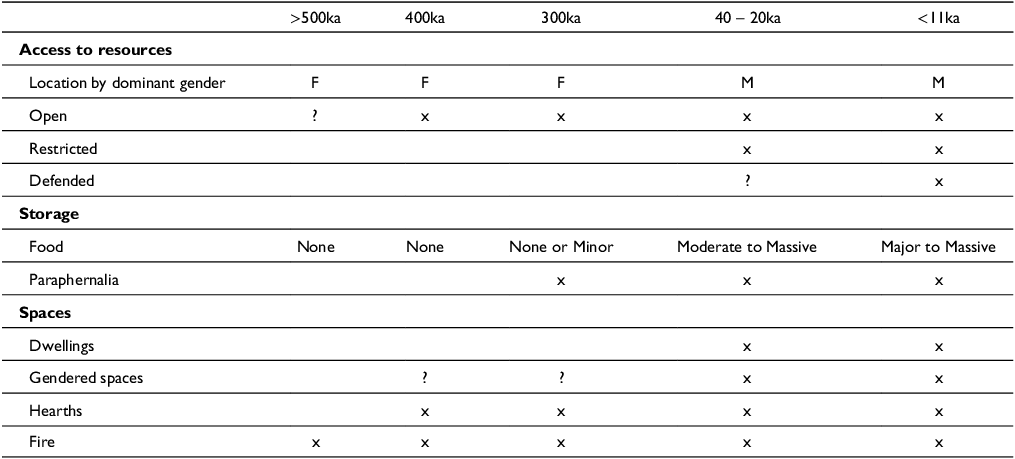
The lines of evidence are drawn together in Table 8. What began as an investigation of why Africa has no houses before 20ka has broadened into an overview of the structure of deep history. This involves evidence from the micro and macro scales of hominin life under three themes: access, storage, and spaces.
The changing structure of deep hominin history. Access: F = female, M =Male (Foley & Gamble Reference Foley and Gamble2009, Transition 5, fig. 1). Storage: see Table 1 for QTSTOR scale; paraphernalia are described in the text. Storage of stone tools is not included. Spaces: dwellings (Kolen Reference Kolen, Roebroeks and Gamble1999), hearths and fire (Roebroeks & Villa Reference Roebroeks and Villa2011; Bentsen Reference Bentsen2014; Wadley Reference Wadley2015; Gowlett Reference Gowlett2016; MacDonald et al. Reference MacDonald, Scherjon, van Veen, Vaesen and Roebroeks2021)

The evidence reviewed here answers when changes took place — after 40ka with the appearance of dwellings often with internal hearths and storage pits — and where — in regions where significant food storage was environmentally possible with intensification in food extraction and storage but not production. This bears out Binford’s (Reference Binford1990, 145) observation that ‘the simple practice of storage is environmentally conditioned’ and is not a measure of increasing social complexity, as has been suggested (de Saulieu & Testart Reference de Saulieu and Testart2015). Binford’s characterisation of the ethnographic present is correct. But the lack of evidence for storage and dwellings before 40ka invalidates his proposition that the environment alone is the explanation. Food stores and artificial dwellings are a recent addition to the survival strategies of people living above 35oN. Intensification in food extraction took place long before agriculture, but late in deep history when dwellings and storage containers appear (Memmott Reference Memmott2022, 346).
Moreover, we have seen that not all storage is about food. The evidence for dwellings and stored foods was preceded in the Upper Pleistocene by those paraphernalia of embodied display, pierced talons and necklaces, that are found in Europe before equally bedecked humans left Africa c. 70ka ago (Finlayson et al. Reference Finlayson and Rodríguez Llanes2012). Further research is needed to establish if these are the first signs of a cultural store, a treasury of paraphernalia and knowledge, over which males came to exert their control. If so, they possibly mark another route to intensification with storage. Later, this control was extended by using dwellings and storage technology to scaffold within these containers the concept of gendered space. As I see it, gendered spaces were an exaptation from the gendered use of objects that embodied and extended social life. It was within dwellings and around hearths that social life now came to be embedded and enacted in different ways. Humanity’s deep history became a world of containers with all the cognitive, metaphorical, symbolic, and ontological possibilities they now enshrined.
Socioecology also identifies a major shift in hominin spatial patterning. In deep history humans broke with the ancestral pattern of allocating the sexes to resources. Among apes and hominins, this pattern recognises the costs of reproduction that fall asymmetrically on females. Consequently, the distribution of female primates, and by inference hominins, follows the distribution of prime resources (Wrangham Reference Wrangham1980). Males follow this sequence as they seek access to females, but it is resources — not males — that determine where the females will be located. Humans are ecologically distinctive because they have disrupted the sequence based on reproductive costs so that males now control the distribution of resources and through them control over female reproduction (Foley & Gamble Reference Foley and Gamble2009, fig. 1). The outcome is the transition to ecological intensification (Transition 5 in Foley & Gamble Reference Foley and Gamble2009). This took place well before agriculture, but late in deep history, as shown by the evidence presented here for hearths, dwellings, and stores.
Primates do not store food. Neither do they make containers that might be used to store food. Containers are made by humans before 40ka, but it is after this date they increase dramatically in number and variety (Gamble Reference Gamble2007; Riethmüller Reference Riethmüller2018). One of those novel containers is the artificial dwelling. I argue that the appearance of dwellings so late in deep history, and associated with those continents where food storage is possible if food extraction is intensified, is a marker of a fundamental shift in both hominin socio-ecology and in gendered spaces. How and why needs further investigation that has now begun (Kuhn & Stiner Reference Kuhn and Stiner2019; Belfer-Cohen & Hovers Reference Belfer-Cohen and Hovers2020; Clark et al. Reference Clark, Ranlett and Stiner2022; Gamble in press a; Davies & Gamble Reference Davies and Gamblein prep.). But until archaeologists recognise that the appearance of hearths, dwellings, and food stores has less to do with the evolution of modern humans, the transition to agriculture or greater social complexity, and everything to do with the gendered politics of small, artificially contained spaces that are common to all humanity, then deep history will remain in its stone age.
Acknowledgements
I am grateful for the comments on earlier versions and QTSTOR from Matt Grove, Lyn Wadley, William Davies, Ole Grøn, Jan Kolen, William Davies, Jenni French and Alex Pryor. The comments from two referees sharpened the argument. Rob Goller expertly produced the figures. The paper is dedicated to the memory and insights of Pat Carter, Roger Cribb, Mike Smith, Ofer Bar-Yosef and Lew Binford. The research was supported by the Leverhulme Trust through the project Seasonality, Mobility and Storage in Palaeolithic hunting societies (RPG-2013-318).
Supplementary material
To view supplementary material for this article, please visit https://doi.org/10.1017/ppr.2025.10065





 Open access

