


Introduction
Federal countries comprise at least two orders of government – a federal government and several constituent units – which each have constitutionally entrenched legislative powers, allowing them to design public policy (Fenna and Schnabel, Reference Fenna and Schnabel2024). Most research on federalism examines how powers are divided between these two orders of government (e.g., Dardanelli et al., Reference Dardanelli2019; Schnabel and Souris, Reference Schnabel and Souris2025), whereas less is known about citizens’ preferences regarding where policy-making should occur. This is particularly notable given that existing research has increasingly recognized that citizens may evaluate policies not only based on their effectiveness but also on the policy-making process (Allen and Birch, Reference Allen and Birch2015; Ladam, Reference Ladam2020). It is, therefore, important to assess if citizens have preferences for policy-making by one order of government and if so, why they hold these preferences. This also helps to understand whether federal structures are “consistent with citizens’ preferences over governing arrangements” (Rendleman and Rogowski, Reference Rendleman and Rogowski2024, 112). Misalignment between institutional design and preferences can generate political dissatisfaction and detachment, undermining democratic stability (Henderson and Medeiros, Reference Henderson and Medeiros2021, 139–40).
While existing research suggests that citizens may hold preferences regarding the order of government in policy-making (e.g., Rendleman and Rogowski, Reference Rendleman and Rogowski2024), it has not yet demonstrated whether these are principled preferences similar to what Easton (Reference Easton1965) describes as diffuse support or rest on implicit assumptions about which order is capable of producing better results. The latter reflects performance-based preferences whereby citizens associate different orders of government with different capacities for policy success (e.g., Wlezien and Sorokay, Reference Wlezien and Sorokay2010; Proszowska et al., Reference Proszowska2023).
This research note addresses this question by using a vignette experiment, fielded in an online-access panel of 1893 respondents (final sample), representative of the German population in terms of age, gender, education, and regional distribution across the constituent units (Länder). We independently manipulate the order of government responsible for adopting a policy, the order who finances it, the policy’s effectiveness, and its impact on regional differences. By randomly varying these dimensions of policy-making, we can determine whether preferences reflect principled beliefs about which order of government should make policies or merely proxy for expectations about which order will produce better results. This is a distinction that observational research on federalism has not made yet.
Germany provides an ideal setting for this study. As an established federal democracy, it has seen ongoing debates on the division of policy-making powers, including periodic attempts at reallocation (Behnke and Kropp, Reference Behnke and Kropp2016). The Länder have legislative authority in several areas and play a considerable role as policy providers by implementing federal legislation (Mueller and Fenna, Reference Mueller and Fenna2022). At the same time, there are strong expectations for national policy uniformity and social equality, complemented by a constitutional commitment to “equivalent living conditions” across the country (Hesse, Reference Hesse1962; Erk, Reference Erk2003) – outcomes typically associated with federal government policies.
We find that citizens have weak preferences about which order of government should make a policy. Respondents show a modest preference for policy financing by the federal government, but they are largely indifferent regarding the order of government that should adopt a policy. Policy effectiveness has by far the strongest effect. These results suggest that previously observed preferences for one order of government may primarily reflect citizens’ performance-based expectations rather than principled preferences.
Theoretical framework
Citizens’ policy-making preferences in federal systems
There are several reasons why citizens in federal systems may prefer policy-making by either the constituent units or by the federal government. Because of cognitive proximity, lower orders of government are likely to be better known (van Assche and Dierickx, Reference van Assche and Dierickx2007; Klok and Denters, Reference Klok, Denters and Egner2013), leading citizens to prefer policy-making by the constituent unit governments over federal government policy-making (Henderson, Reference Henderson2010; Fitzgerald and Wolak, Reference Fitzgerald and Wolak2014). Citizens may also prefer policy-making by the constituent units because it can be better attuned to distinct regional contexts, including the specific political culture, economic conditions, or policy problems (De Tocqueville, Reference Tocqueville, Alexis1838; Kincaid, Reference Kincaid1995). At the same time, citizens also value uniformity and equality (Petersen and Grube, Reference Petersen and Grube2017, 302), which policy-making by the constituent units may fail to ensure. This may prompt citizens to prefer policy-making by the federal government, which tends to be associated with uniformity (Kincaid and Cole, Reference Kincaid and Cole2011).
Existing studies tend to examine citizens’ support for the constitutional values of federalism (Brown et al., Reference Brown2022) or their preferences regarding the general division of powers in federations (Arretche et al., Reference Arretche2016; Wolak, Reference Wolak2016; Rendleman and Rogowski, Reference Rendleman and Rogowski2024). Several studies examine whether citizens prefer policy-making of one order of government over the other. For example, Henderson et al. (Reference Fitzgerald and Wolak2013, Reference Henderson, Jeffery and Wincott2014) asked citizens in Western Europe about their preferences for regional versus central government, the locus of public policy provision, and uniformity and solidarity. Their survey suggests that citizens are generally supportive of regional government, yet they prefer uniformity when it comes to the actual provision of public services.
It is unclear whether preferences such as those found by Henderson and colleagues reflect diffuse support for an order of government or are driven by implicit assumptions about policy performance. Data from the United States indicate that “federalism considerations are not a first-order priority for the average American in many important areas” and that “Americans are outcome oriented – if they like the policy, they want it implemented at any level of government” (Jacobs, Reference Jacobs2017, 573). Kam and Mikos (Reference Kam and Mikos2013, 589), however, claim that “citizens are not single-mindedly interested in policy outcomes.” Other factors can also be expected shape their support for policies in federations, including the level of trust across orders of government (Rendleman and Rogowski, Reference Rendleman and Rogowski2024, 114) and federalism beliefs, ranging from intuitive orientations (Schneider et al., Reference Schneider2011) to core beliefs about the appropriate role of each order of government (Wolak, Reference Wolak2016).
To contribute to this literature, we examine not only whether citizens express preferences for the order of government that makes a policy but also whether such preferences are principled or performance-based. This requires a design that enables us to measure the independent impact of the order of government making a policy and its effect on citizens’ preferences regarding that policy. Therefore, we conducted a vignette survey experiment (Atzmüller and Steiner, Reference Atzmüller and Steiner2010). By explicitly stating (and varying) the expected performance of a given policy, we can rule out (potentially subconscious) conflations of government orders and their presumed policy performance and calculate their independent causal impact. We distinguish between the order that adopts a policy and the order that finances it. This distinction is important because these are separate dimensions of policy-making, which can have a different impact on citizens’ support for a policy. We also distinguish between two dimensions of performance in federal systems: the policy’s effectiveness and its impact on regional differences. Policy can be effective in one region or effective on average but result in different regional outcomes. Because these objectives can pull in opposite directions, they may shape citizens’ preferences in distinct ways.
The case of Germany
Germany is a particularly instructive case that allows us to formulate clear expectations regarding citizens’ preference for the order of government in policy-making. Despite the important role of the Länder, Germany’s political culture and its “non-federal society” (Erk, Reference Erk2003) are reflected in a strong preference for uniformity and social equality. Several studies find that German citizens largely want uniform policies across most issues, even though they think the Länder care more about their preferences and concerns (Jeffery and Pamphilis, Reference Jeffery and Pamphilis2016; Petersen and Grube, Reference Petersen and Grube2017; Petersen, Reference Petersen2019; Wintermann and Petersen, Reference Wintermann and Petersen2008). Petersen and Grube (Reference Petersen and Grube2017, 302) show that citizens favor Länder regulation in only three out of twenty issues and want all other issues to be decided by the federal government. This suggests that citizens want the federal government to adopt policy to ensure that all citizens, regardless of where they live, have access to the same level of services and benefits. Against this backdrop, we expect citizens in Germany to show a preference for policy adoption by the federal government.
Citizens may also prefer financing by the federal government, given its greater redistributive capacity that enables it to reduce regional disparities (Rodríguez-Pose and Ezcurra, Reference Rodríguez-Pose and Ezcurra2010, 622–23). This is likely to be a particularly relevant consideration in a political system like Germany’s, where the promotion of equivalent living conditions are a constitutionally enshrined principle and a political objective. What is more, while the Länder are responsible for implementing a wide range of policies, they have limited revenue-raising powers. Moreover, citizens may prefer financing by the federal government due to considerations of fairness, shared responsibility, and the desire to equally distribute the costs of policies across the federation instead of placing the financial burden on their own Land. Preferences for federal financing may also reflect fiscal opportunism, meaning citizens may seek the benefits of policies without wanting to bear their full cost at the regional level. Therefore, we expect citizens in Germany to show a preference for the financing of a policy by the federal government.
Control dimensions
As mentioned above, most existing studies that investigate preferences regarding policy-making by orders of government cannot distinguish between principled preferences and assumptions about the performance of a policy. Therefore, we include two additional dimensions concerning policy performance in our design (policy effectiveness and impact on regional differences) and explicitly vary these, and thus control for them.
It is very likely that citizens prefer policies that are effective, that is, those policies that successfully solve the problems they are designed to address (Reuchamps et al., Reference Reuchamps2021). Since we expect policy effectiveness to have a substantively large effect on policy preferences, explicitly controlling for it not only enables us to disentangle its effect from principled preferences for the order of government; its effect size also provides an important baseline to evaluate the impact of the other dimensions.
A second important control dimension concerns a policy’s impact on differences across the Länder. As we have outlined above, German citizens prioritize regional uniformity. Because of this, citizens may have a second implicit assumption regarding the order of government that adopts or finances a policy: that it amplifies differences, and thus potentially inequalities, across the Länder.
Citizens’ preferences may also manifest in more complex ways, meaning citizens may consider several dimensions simultaneously. They may, for instance, prefer policies that are adopted and financed by the same order of government, regardless of which order of government that is. Similarly, although they may want policy decisions to be made closer to home, they may want the costs to be more widely distributed and thus prefer policy-making by the Länder but financing by the federal government. Citizens may also prefer policies that are adopted by the federal government if they also reduce regional differences. This matters especially in Germany, where preferences for national policy uniformity and social equality are complemented by a constitutional commitment to ensuring “equivalent living conditions” across the country. While related work on blame attribution and policy responsibility offers some insights (Sulitzeanu-Kenan and Zohlnhöfer, Reference Sulitzeanu-Kenan and Zohlnhöfer2019; Kevins and Vis, Reference Kevins and Vis2023), the existing literature provides no clear theoretical guidance on these complex considerations. Therefore, we analyze them in an exploratory manner.
Data and methods
Data and sample
The sample for this study was recruited via the online panel provider bilendi in Germany. The study – conducted in September 2024 – applied quotas for age, gender, education, and region (Länder). Due to these quotas, the sample is largely representative of German citizens aged 18 to 69 years. 1933 participants took part with an average response time of 22 minutes. The mean age is 47.6 years (SD = 15.2). 50.9 percent of participants identified as men, whereas 48.9 percent identified as women, and 0.2 percent identified as nonbinary.Footnote 1 To enhance the sampling quality, an attention check was conducted at the beginning of the survey, and failure of completion led to participants being dropped from the sample. We also excluded other low-effort respondents and respondents who did not provide answers to the vignette.Footnote 2 After all data exclusion steps, the final sample consists of 1893 participants and 10,511 vignette totals. In correspondence with open science standards, all data replication material is freely available.Footnote 3
Method and experimental procedure
To analyze whether citizens place importance on the order of government that adopts and finances a policy even when controlling for their assumptions about the effectiveness and impact on regional differences, we employ a vignette experimental design that is characterized by experimental randomization (Atzmüller and Steiner, Reference Atzmüller and Steiner2010). Each respondent is shown six vignettes that outline a proposed policy scenario (see Appendix) and then asked to evaluate their support for that policy on an eleven-point scale (0 to 10), with higher values indicating greater support for the policy.Footnote 4 We expect that respondents’ preferences are reflected in such a way that they express higher policy support for a policy that is in line with their preferences regarding adoption and financing (and the control dimensions effectiveness and impact on regional differences). In other words, this measure should capture revealed preferences.
A key benefit of this research design is that we can evaluate the independent impact of each of the different dimensions in the vignette. Since the specific configuration of the policies proposed are randomly assigned and fully crossed across vignettes, each dimension is by design statistically unrelated to respondents’ prior beliefs and attitudes as well as to the other dimensions (Atzmüller and Steiner, Reference Atzmüller and Steiner2010). This breaks the typical correlations between these dimensions and prior attitudes on preferences regarding policy-making that exist in observational data. It also enables us to isolate the causal effect of each attribute on support for a given policy, allowing us to capture respondents’ revealed preferences. As a result, we can assess more precisely how strong citizens’ preferences are for the order of government that adopts or finances a policy, while controlling for the two key implicit considerations of effectiveness and differences between the Länder. Using realistic scenarios, we also account for the multi-dimensional context in which citizens’ preferences regarding policy-making are formed in federal systems.
Specifically, these vignettes vary among four key dimensions. Two dimensions explore our hypotheses regarding adoption and financing by varying the order of government that adopts the policy (federal government or the Land government) and the order of government that finances the policy (federal government or the Land government). Additionally, we leverage the experimental framework to explicitly control for outcome-related confounders that should also affect policy evaluations: the expected effectiveness of the policy (successful vs. unsuccessful in solving the problem that it is designed to address) and the policy’s impact on regional differences (no impact vs. either increasing or decreasing differences).
An additional benefit of the experimental design is our ability to account for more complex evaluations through interaction effects between different policy dimensions. However, this factorial design necessarily trades off statistical power as complexity increases and higher-order interaction effects are estimated with considerable uncertainty due to the number of conditions and a modest sample size (Lakens and Caldwell, Reference Lakens and Caldwell2021). Therefore, we present these analyses primarily to probe the robustness of our main findings and to inform future theoretical and empirical work on citizens’ preferences regarding policy-making in federal systems. To analyze the experimental data, we estimate a linear regression model with robust standard errors clustered at the respondent level to account for the non-independence of multiple vignette ratings per individual (Atzmüller and Steiner, Reference Atzmüller and Steiner2010).Footnote 5 Since the randomization automatically accounts for respondent characteristics, we do not include any socio-demographic controls in our model.Footnote 6
Empirical results
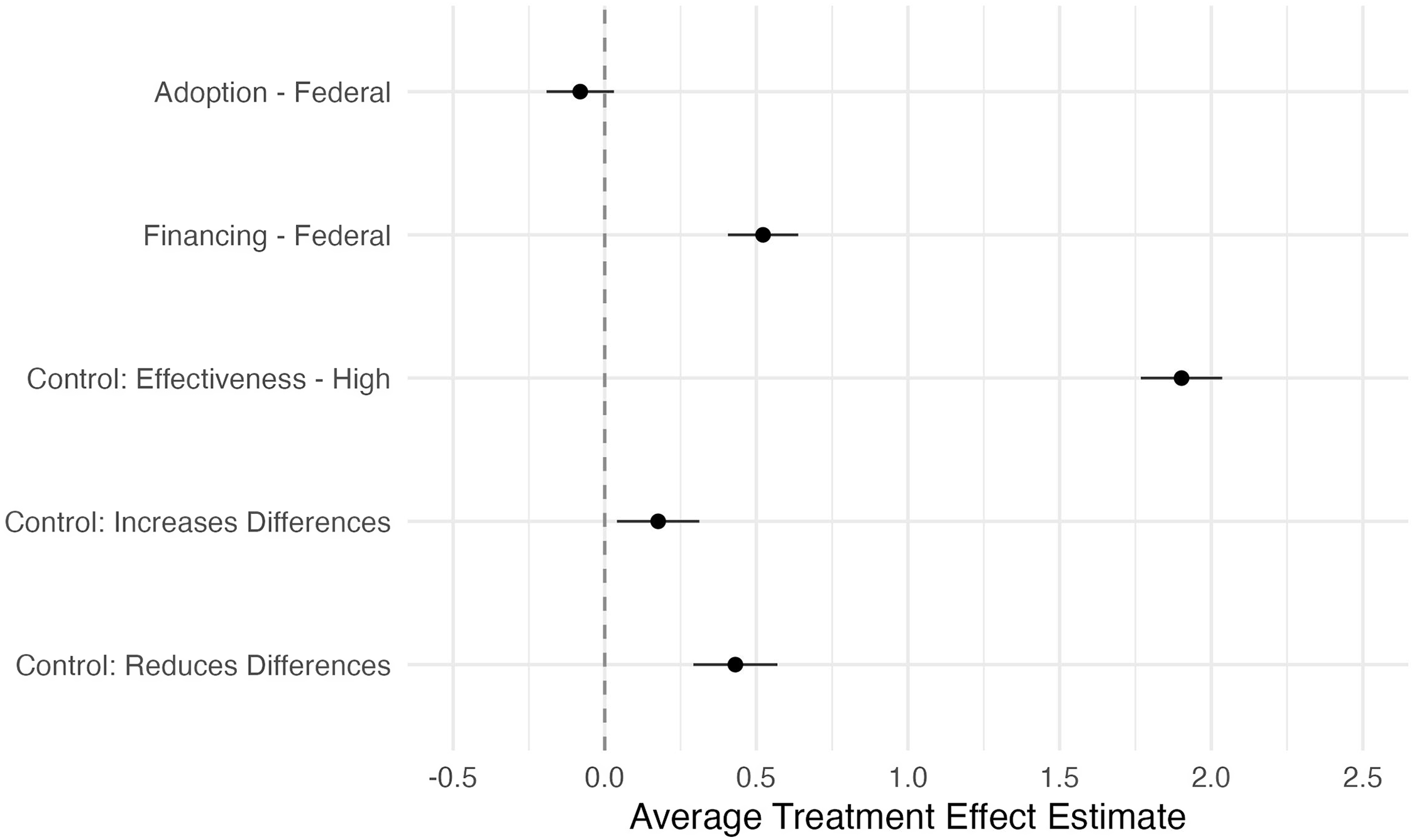
Do citizens have a principled preference for the order of government that adopts or finances a policy? Figure 1 shows the effects of all four experimental dimensions on respondents’ policy support. It finds no support for principled preferences regarding the order that adopts a policy but a slight preference regarding financing by the federal government.
Average treatment effect estimates of experimental dimensions on policy support.
Explanation: Average treatment effect estimates of all four experimental dimensions on policy support; coefficients from a linear regression model with robust standard errors clustered at the respondent level. Reference categories: adoption by the Land government, financing by the Land government, low policy effectiveness, and no change in regional differences. Points represent coefficient estimates; horizontal lines represent 95% confidence intervals.

Specifically, our study finds that the order of government that adopts a policy has no statistically significant effect on policy support once financing, policy effectiveness, and impact on regional differences are controlled for. While the coefficient points toward a slight preference for adoption by the Länder, we cannot distinguish this from zero. Citizens thus appear largely indifferent to whether the federal government or their Land government adopts a policy. This suggests that previously observed preferences for federal policy-making may be driven by citizens’ assumptions that federal government policies are more effective or that they produce more uniform outcomes, rather than by principled support for centralized policy-making.
We expected a preference for federal financing based on the federal government’s greater redistributive capacity, considerations of shared responsibility, and potential fiscal opportunism. This expectation is confirmed. Respondents rate policies financed by the federal government 0.5 points higher than those financed by their Land government. Although modest in absolute terms, this constitutes a substantively meaningful effect and supports the idea that citizens prefer costs to be distributed across the federation rather than borne by their Land.
The control dimensions perform as expected. Policy effectiveness has by far the strongest effect, confirming that citizens prioritize policies that successfully address problems. Policies that reduce regional differences and those that increase regional differences both receive more support than policies with no impact, which could reflect rejection of or dissatisfaction with the status quo (i.e., a general desire for change). Beyond these substantive findings, the statistically significant impact on policy support also suggest that these control dimensions have served their intended purpose and distinguished implicit assumptions about which order of government produces “better” outcomes from more principled considerations.
However, as we have outlined above, citizens’ preferences may be more complex, and they may evaluate several dimensions simultaneously. To explore this question empirically, we test several interaction models that analyze the effects of adoption and financing conditional on the other control variables.Footnote 7 Figure 2 reports the coefficient estimates of these analyses, while Figure 3 compares the marginal effects of adoption and financing by the federal government (compared to the Land government) conditional on the configuration of the other experimental dimensions.
Interaction models coefficient results.
Explanation: Coefficient estimates from interaction models testing whether the effects of adoption and financing vary across control dimensions (effectiveness and regional differences); estimates from linear regression models with robust standard errors clustered at the respondent level. Main effects are shown in the upper section, and two-way interaction terms in the lower section. Different point shapes indicate distinct interaction models as presented in the legend; horizontal lines represent 95% confidence intervals.

Conditional marginal effect results.
Explanation: Marginal effects of federal adoption (left panel) and federal financing (right panel) on policy support, conditional on each other experimental dimension; estimates from linear regression models with robust standard errors clustered at the respondent level. Points represent marginal effect estimates; horizontal lines represent 95% confidence intervals.

In general, we find very little evidence that respondents engage in more complex reasoning. Only one interaction reaches conventional significance levels: adoption by the federal government and effectiveness. This suggests that there may be a slight preference for Land adoption as long as citizens know that the policy is also effective. However, given the number of interactions tested, this finding should be interpreted cautiously. More importantly, the substantive impact is very small, suggesting that the order that adopts a policy does not play a large role. Beyond this result, all other interaction effects are not statistically significant. The absence of significant interactions reinforces our main conclusion. In general, citizens do not appear to engage in complex conditional reasoning about policy-making in federal systems. Instead, they seem to rely on additive heuristics, forming opinions by summing individual cues rather than integrating them. What matters most is whether a policy is effective and the order that pays for it, not the particular combination of adoption and financing arrangements.Footnote 8
Conclusion
The vignette experiment in this study disentangles citizens’ support for policy-making in the German federation by isolating preferences regarding the order of government that adopts and finances policies from policy effectiveness and the impact on regional differences. By explicitly varying these dimensions, our design breaks the typical correlation between government order and presumed performance that confounds observational research.
German citizens show a modest but consistent preference for policy financing by the federal government, but they are largely indifferent regarding which order of government adopts a policy. This null finding for adoption is particularly interesting given that previous survey research tended to show preferences for federal policy-making and uniformity. Our results suggest that these previously observed preferences may stem from citizens’ implicit assumptions that federal policies are more effective or produce more uniform outcomes, rather than from principled support for centralized policy-making. When experimentally controlling for effectiveness and impact on regional differences, the preference for federal adoption disappears.
Citizens also do not engage in complex conditional reasoning about policy-making arrangements. They do not, for instance, systematically prefer adoption by the federal government when policies reduce regional differences, nor do they prefer fiscal equivalence where the same order adopts and finances a policy. Instead, citizens appear to rely on additive heuristics, evaluating dimensions independently rather than in combination.
This being said, the current design does not explore respondent heterogeneity. It may well be that particular respondents do have more clearly defined, principled preferences. Future research that explores interactions between respondent characteristics, such as socio-demographics, place of residence, and socio-political attitudes, and treatment effects represents a promising next step for understanding heterogeneity in policy-making preferences. Due to low statistical power, our study also cannot show whether preferences vary across regions. With an increasingly prominent East-West divide in attitudes and electoral behavior, it will be particularly relevant in future research to test whether policy-making preferences vary between the Eastern and Western Länder.
While the findings of our study are limited to Germany, the fact that policy effectiveness is by far the most important dimension suggests that preferences for one order of government seen in the existing literature on citizens’ policy-making preferences in federal countries may stem more from citizens’ expectations regarding that order’s policy-making performance than from principled preferences. This most likely applies to other largely homogenous federations without territorially concentrated minorities such as Australia and Brazil, while principled preferences for policy-making by one order of government might be higher in more pluralistic federations with stronger regional identities like Belgium, Canada, Ethiopia, or Switzerland.
Supplementary material
The supplementary material for this article can be found at https://doi.org/10.1017/S175577392610037X.
Data availability statement
Data supporting the study as well as the analysis and output script are available at: https://osf.io/ztu87/?view_only=ae06cab2c20147748bf34e533b687e0c
Funding statement
No funding to declare.
Competing interests
The authors declare none.
Ethical standards
The study did not require approval from an ethics committee because no personally identifiable information was collected and the survey experiment based on informed consent posed minimal risk to participants.


 Open access

