




1 Introduction
The archetypical and quite inexhaustible source of examples of operator algebras are dynamical structures, which can be interpreted broadly; this could be classical topological or measurable dynamical systems, say with countable discrete acting groups, or also much more general setups, as long as they can be encoded as topological or measurable groupoids, and the latter often provide highly efficient tools to study the former. In the case of classical dynamical systems with amenable acting groups, the associated operator algebras are particularly well behaved and fall within the scope of spectacular classification results, most notably Connes’ classification of injective
$\mathrm {II}_1$
 factors on the von Neumann algebra side and, much more recently, the classification of simple, nuclear and
$\mathcal {Z}$
factors on the von Neumann algebra side and, much more recently, the classification of simple, nuclear and
$\mathcal {Z}$
 -stable
$\mathrm {C}^\ast $
-stable
$\mathrm {C}^\ast $
 -algebras.
In the measurable or von Neumann algebra case, such classification results tend to be particularly clean: there is only one injective
$\mathrm {II}_1$
 factor by Connes’ work, and by the Connes–Feldman–Weiss theorem, every countable amenable equivalence relation is generated by a single transformation. It then follows that the hyperfinite
$\mathrm {II}_1$
factor by Connes’ work, and by the Connes–Feldman–Weiss theorem, every countable amenable equivalence relation is generated by a single transformation. It then follows that the hyperfinite
$\mathrm {II}_1$
 factor up to conjugacy has only one Cartan subalgebra (as introduced by Vershik, and Feldman and Moore in [Reference Feldman and Moore22, Reference Vershik52]) which is a very strong uniqueness result for underlying dynamical structures in this setting.
In the topological or
$\mathrm {C}^\ast $
 -algebra situation, one has to deal with a more complicated picture, keeping track of both dynamical and topological information in terms of
$\mathrm {K}$
-algebra situation, one has to deal with a more complicated picture, keeping track of both dynamical and topological information in terms of
$\mathrm {K}$
 -theoretic invariants. There is also the much more fundamental problem that we do not know whether every simple, separable, nuclear and
$\mathcal {Z}$
-theoretic invariants. There is also the much more fundamental problem that we do not know whether every simple, separable, nuclear and
$\mathcal {Z}$
 -stable (
$\mathcal {Z}$
-stable (
$\mathcal {Z}$
 -stability is tensorial absorption of the Jiang–Su algebra
$\mathcal {Z}$
-stability is tensorial absorption of the Jiang–Su algebra
$\mathcal {Z}$
 )
$\mathrm {C}^\ast $
)
$\mathrm {C}^\ast $
 -algebra even has an underlying dynamical structure in the form of a Cartan subalgebra (this time in the
$\mathrm {C}^\ast $
-algebra even has an underlying dynamical structure in the form of a Cartan subalgebra (this time in the
$\mathrm {C}^\ast $
 -algebraic sense of Kumjian and Renault; see [Reference Kumjian28, Reference Renault41]). This question is in fact equivalent to the all-intriguing universal coefficient theorem (UCT) problem, which asks whether every separable nuclear
$\mathrm {C}^\ast $
-algebraic sense of Kumjian and Renault; see [Reference Kumjian28, Reference Renault41]). This question is in fact equivalent to the all-intriguing universal coefficient theorem (UCT) problem, which asks whether every separable nuclear
$\mathrm {C}^\ast $
 -algebra is
$\mathrm {KK}$
-algebra is
$\mathrm {KK}$
 -equivalent (a weak form of homotopy equivalence) to an abelian
$\mathrm {C}^\ast $
-equivalent (a weak form of homotopy equivalence) to an abelian
$\mathrm {C}^\ast $
 -algebra. While the existence of some Cartan subalgebra is necessary for the classifiability of the ambient
$\mathrm {C}^\ast $
-algebra. While the existence of some Cartan subalgebra is necessary for the classifiability of the ambient
$\mathrm {C}^\ast $
 -algebra, even when the latter is quite well understood as a simple nuclear
$\mathrm {C}^\ast $
-algebra, even when the latter is quite well understood as a simple nuclear
$\mathrm {C}^\ast $
 -algebra, we know very little about the entirety of its underlying dynamical structures. The present paper makes progress on this problem for the canonical anticommutation relations (CAR) algebra, the uniformly hyperfinite (UHF) algebra
$\mathrm {M}_{2^\infty } = \mathrm {M}_2\otimes \mathrm {M}_2\otimes \cdots $
-algebra, we know very little about the entirety of its underlying dynamical structures. The present paper makes progress on this problem for the canonical anticommutation relations (CAR) algebra, the uniformly hyperfinite (UHF) algebra
$\mathrm {M}_{2^\infty } = \mathrm {M}_2\otimes \mathrm {M}_2\otimes \cdots $
 as introduced by Glimm, which, in a sense, can be thought of as the most elementary
$\mathrm {C}^\ast $
as introduced by Glimm, which, in a sense, can be thought of as the most elementary
$\mathrm {C}^\ast $
 -algebra analogue of the hyperfinite
$\mathrm {II}_1$
-algebra analogue of the hyperfinite
$\mathrm {II}_1$
 factor. Let us be more precise now.
A Cartan sub-
$\mathrm {C}^\ast $
 -algebra is a
$\mathrm {C}^\ast $
-algebra is a
$\mathrm {C}^\ast $
 -pair
$(D\subset A)$
-pair
$(D\subset A)$
 where A is generated by the set of normalizers of D in A (that is, those
$v\in A$
where A is generated by the set of normalizers of D in A (that is, those
$v\in A$
 such that
$vDv^*\cup v^*Dv \subset D$
such that
$vDv^*\cup v^*Dv \subset D$
 ), D is maximal abelian in A (a masa) and there is a unique faithful conditional expectation
$A\to D$
), D is maximal abelian in A (a masa) and there is a unique faithful conditional expectation
$A\to D$
 . When
$(D \subset A)$
. When
$(D \subset A)$
 moreover has the unique extension property, in the sense that pure states on D extend uniquely to states on A, we say that it is a
$\mathrm {C}^\ast $
moreover has the unique extension property, in the sense that pure states on D extend uniquely to states on A, we say that it is a
$\mathrm {C}^\ast $
 -diagonal. This additional feature ensures precisely that the underlying dynamics have trivial isotropy, that is, they are free, a trait that justifies why
$\mathrm {C}^\ast $
-diagonal. This additional feature ensures precisely that the underlying dynamics have trivial isotropy, that is, they are free, a trait that justifies why
$\mathrm {C}^\ast $
 -diagonals are, in general, considered more robust than Cartan pairs.
Identifying Cartan sub-
$\mathrm {C}^\ast $
 -algebras and diagonals in a
$\mathrm {C}^\ast $
-algebras and diagonals in a
$\mathrm {C}^\ast $
 -algebra is a topic that has recently been intensively studied, motivated by the various implications of the presence of such intrinsic dynamics. A natural companion question in this framework is determining whether two Cartan sub-
$\mathrm {C}^\ast $
-algebra is a topic that has recently been intensively studied, motivated by the various implications of the presence of such intrinsic dynamics. A natural companion question in this framework is determining whether two Cartan sub-
$\mathrm {C}^\ast $
 -algebras with homeomorphic spectra are conjugate, in the sense that there is an automorphism of the ambient
$\mathrm {C}^\ast $
-algebras with homeomorphic spectra are conjugate, in the sense that there is an automorphism of the ambient
$\mathrm {C}^\ast $
 -algebra carrying one masa to the other. Establishing non-conjugacy is a problem that often proves to be rather difficult, and a common strategy for this is to distinguish the two pairs by topological properties of the spaces of state-extensions of the evaluations over points in the spectra of the masas; a method that is of course completely inapplicable when dealing with
$\mathrm {C}^\ast $
-algebra carrying one masa to the other. Establishing non-conjugacy is a problem that often proves to be rather difficult, and a common strategy for this is to distinguish the two pairs by topological properties of the spaces of state-extensions of the evaluations over points in the spectra of the masas; a method that is of course completely inapplicable when dealing with
$\mathrm {C}^\ast $
 -diagonals, the case of which requires the development of more sophisticated means of distinction.
For approximately finite-dimensional (AF) algebras, there are standard diagonals with totally disconnected spectra (called AF diagonals) obtained as inductive limits of masas in finite-dimensional
$\mathrm {C}^\ast $
 -algebras with connecting maps that preserve normalizers; and these are all conjugate to each other (see [Reference Power38, Theorem 5.7], where AF diagonals were called canonical regular masas). While not at all obvious, there is, in general, a rich supply of other, more exotic diagonals: in his celebrated paper [Reference Blackadar5], Blackadar showed that the CAR algebra surprisingly admits uncountably many pairwise non-conjugate
$\mathrm {C}^\ast $
-algebras with connecting maps that preserve normalizers; and these are all conjugate to each other (see [Reference Power38, Theorem 5.7], where AF diagonals were called canonical regular masas). While not at all obvious, there is, in general, a rich supply of other, more exotic diagonals: in his celebrated paper [Reference Blackadar5], Blackadar showed that the CAR algebra surprisingly admits uncountably many pairwise non-conjugate
$\mathrm {C}^\ast $
 -diagonals, all with the same one-dimensional spectrum (the product of the circle
$S^1$
-diagonals, all with the same one-dimensional spectrum (the product of the circle
$S^1$
 with the Cantor space), as well as that there exist diagonals with spectra that have both singletons and intervals as connected components. A problem that was left unresolved however is whether all
$\mathrm {C}^\ast $
with the Cantor space), as well as that there exist diagonals with spectra that have both singletons and intervals as connected components. A problem that was left unresolved however is whether all
$\mathrm {C}^\ast $
 -diagonals of the CAR algebra with Cantor spectrum need to be (conjugate to) an AF diagonal. This question has come to the forefront in view of increasing efforts to develop a structure theory for Cartan and diagonal subalgebras of a given classifiable
$\mathrm {C}^\ast $
-diagonals of the CAR algebra with Cantor spectrum need to be (conjugate to) an AF diagonal. This question has come to the forefront in view of increasing efforts to develop a structure theory for Cartan and diagonal subalgebras of a given classifiable
$\mathrm {C}^\ast $
 -algebra; cf. [Reference Schafhauser, Tikuisis and White44, Problems XLVII and XLVIII] and the remarks in between.
The particular interest in the Cantor space in this context comes from the fact that it is both universal and well accessible to
$\mathrm {K}$
 -theoretic methods; it has the additional feature that it is invariant under taking tensor products. Our results confirm the existence of an abundance of such diagonals.
Theorem A. The CAR algebra
$\mathrm {M}_{2^\infty }$
 admits a Cantor spectrum
$\mathrm {C}^\ast $
admits a Cantor spectrum
$\mathrm {C}^\ast $
 -diagonal that is not an AF diagonal.
While Blackadar’s method employed Elliott’s classification of AF algebras, our approach uses the more recent advances in the classification theory of stably finite
$\mathrm {C}^\ast $
 -algebras; cf. [Reference Tikuisis, White and Winter50, Reference White53, Reference Winter55]. More precisely, we first construct the crossed product
$\mathrm {C}^\ast $
-algebras; cf. [Reference Tikuisis, White and Winter50, Reference White53, Reference Winter55]. More precisely, we first construct the crossed product
$\mathrm {C}^\ast $
 -algebra of a certain action of the infinite dihedral group
$\mathbb {Z}\rtimes \mathbb {Z}_2$
-algebra of a certain action of the infinite dihedral group
$\mathbb {Z}\rtimes \mathbb {Z}_2$
 on the Cantor space and we use the results of [Reference Thomsen49] (largely based on [Reference Bratteli, Evans and Kishimoto12, Reference Natsume36]) to compute the
$\mathrm {K}$
on the Cantor space and we use the results of [Reference Thomsen49] (largely based on [Reference Bratteli, Evans and Kishimoto12, Reference Natsume36]) to compute the
$\mathrm {K}$
 -theory. Since we are aiming for the construction of a
$\mathrm {C}^\ast $
-theory. Since we are aiming for the construction of a
$\mathrm {C}^\ast $
 -diagonal in a simple
$\mathrm {C}^\ast $
-diagonal in a simple
$\mathrm {C}^\ast $
 -algebra, it is imperative that we start with a free minimal action, and so the natural initial question is which Cantor minimal systems (
$\mathbb {Z}$
-algebra, it is imperative that we start with a free minimal action, and so the natural initial question is which Cantor minimal systems (
$\mathbb {Z}$
 -actions at this point) extend to free actions of the infinite dihedral group. While the existence of such actions is well understood (e.g. by Thomsen’s analysis of one-dimensional solenoids [Reference Thomsen49]), producing an explicit example is non-trivial, let alone pinpointing one with the desired
$\mathrm {K}$
-actions at this point) extend to free actions of the infinite dihedral group. While the existence of such actions is well understood (e.g. by Thomsen’s analysis of one-dimensional solenoids [Reference Thomsen49]), producing an explicit example is non-trivial, let alone pinpointing one with the desired
$\mathrm {K}$
 -theoretic features. In fact, a compactness argument shows that equicontinuous
$\mathbb {Z}$
-theoretic features. In fact, a compactness argument shows that equicontinuous
$\mathbb {Z}$
 -actions can only extend to non-free actions of
$\mathbb {Z}\rtimes \mathbb {Z}_2$
-actions can only extend to non-free actions of
$\mathbb {Z}\rtimes \mathbb {Z}_2$
 , so odometer actions are notably of no use for this problem; observe however that the dyadic odometer, together with the involution on
$\{\mathsf {0},\mathsf {1}\}^{\mathbb {N}}$
, so odometer actions are notably of no use for this problem; observe however that the dyadic odometer, together with the involution on
$\{\mathsf {0},\mathsf {1}\}^{\mathbb {N}}$
 that swaps zeroes and ones, defines an action of
$\mathbb {Z}\rtimes \mathbb {Z}_2$
that swaps zeroes and ones, defines an action of
$\mathbb {Z}\rtimes \mathbb {Z}_2$
 on the Cantor space that does give rise to a Cartan sub-
$\mathrm {C}^\ast $
on the Cantor space that does give rise to a Cartan sub-
$\mathrm {C}^\ast $
 -algebra which is not a diagonal in a simple monotracial AF algebra with a free abelian summand in its
$\mathrm {K}_0$
-algebra which is not a diagonal in a simple monotracial AF algebra with a free abelian summand in its
$\mathrm {K}_0$
 -group (and which is thus not UHF) [Reference Bratteli, Evans and Kishimoto12].
Despite this obscurity, it turns out that such examples can be obtained from expansive actions; in particular, we consider a minimal subshift over the binary alphabet
$\{\mathsf {0,1}\}$
 , the language of which is the set of finite subwords appearing in the classic paper-folding sequence that curiously makes its appearance in this construction (cf. §2): this is the self-similar sequence of ones and zeroes obtained by repeatedly folding a strip of paper each time by a right turn, then unfolding it and marking
$\mathsf {1}$
, the language of which is the set of finite subwords appearing in the classic paper-folding sequence that curiously makes its appearance in this construction (cf. §2): this is the self-similar sequence of ones and zeroes obtained by repeatedly folding a strip of paper each time by a right turn, then unfolding it and marking
$\mathsf {1}$
 or
$\mathsf {0}$
or
$\mathsf {0}$
 for every right or left (respectively) turn that occurs in the resulting crest; see [Reference Dekking, France and van der Poorten16, Reference Tabachnikov48] for some intriguing characteristics of the paper-folding sequence. The involution that implements the action of the
$\mathbb {Z}_2$
for every right or left (respectively) turn that occurs in the resulting crest; see [Reference Dekking, France and van der Poorten16, Reference Tabachnikov48] for some intriguing characteristics of the paper-folding sequence. The involution that implements the action of the
$\mathbb {Z}_2$
 -subgroup in
$\mathbb {Z}\rtimes \mathbb {Z}_2$
-subgroup in
$\mathbb {Z}\rtimes \mathbb {Z}_2$
 is given by anti-reversing, that is, flipping bi-infinite sequences with respect to the
$0$
is given by anti-reversing, that is, flipping bi-infinite sequences with respect to the
$0$
 th coordinate and swapping all
$\mathsf {0}$
th coordinate and swapping all
$\mathsf {0}$
 s and
$\mathsf {1}$
s and
$\mathsf {1}$
 s. Freeness of the resulting action is guaranteed by the fact that the paper-folding sequence contains only finitely many anti-palindromes (that is, finite subwords fixed under anti-reversal), a fact that, albeit not too surprising, is far from obvious (cf. [Reference Berstel, Boasson, Carton and Fagnot4, Proposition 1.2]).
Using the techniques of [Reference Durand, Host and Skau18] for the computation of the
$\mathrm {K}$
 -theory of substitutional systems, we devise an ad hoc method to compute the
$\mathrm {K}$
-theory of substitutional systems, we devise an ad hoc method to compute the
$\mathrm {K}$
 -theory of the paper-folding subshift, and we then calculate the
$\mathrm {K}$
-theory of the paper-folding subshift, and we then calculate the
$\mathrm {K}$
 -theory of the crossed product of the obtained free minimal action of
$\mathbb {Z}\rtimes \mathbb {Z}_2$
-theory of the crossed product of the obtained free minimal action of
$\mathbb {Z}\rtimes \mathbb {Z}_2$
 via [Reference Thomsen49] (cf. [Reference Bratteli, Evans and Kishimoto12, Reference Kumjian29, Reference Natsume36]), in passing, answering a question raised by Scarparo in [Reference Scarparo43, Remark 2.3(ii)]. This crossed product is a classifiable
$\mathrm {C}^\ast $
via [Reference Thomsen49] (cf. [Reference Bratteli, Evans and Kishimoto12, Reference Kumjian29, Reference Natsume36]), in passing, answering a question raised by Scarparo in [Reference Scarparo43, Remark 2.3(ii)]. This crossed product is a classifiable
$\mathrm {C}^\ast $
 -algebra (by classifiable, we mean unital, separable, simple, nuclear, satisfying the UCT and
$\mathcal {Z}$
-algebra (by classifiable, we mean unital, separable, simple, nuclear, satisfying the UCT and
$\mathcal {Z}$
 -stable; equivalently,
$\mathcal {Z}$
-stable; equivalently,
$\mathcal {Z}$
 -stability can herein be replaced with having finite nuclear dimension—cf. [Reference Castillejos, Evington, Tikuisis, White and Winter14, Reference Winter54], and also see [Reference Toms and Winter51] for classifiability of integer crossed product
$\mathrm {C}^\ast $
-stability can herein be replaced with having finite nuclear dimension—cf. [Reference Castillejos, Evington, Tikuisis, White and Winter14, Reference Winter54], and also see [Reference Toms and Winter51] for classifiability of integer crossed product
$\mathrm {C}^\ast $
 -algebras) and its
$\mathrm {K}$
-algebras) and its
$\mathrm {K}$
 -theory turns out to be
$\mathbb {Z}_2\oplus \mathbb {Z}[\tfrac {1}{2}]$
-theory turns out to be
$\mathbb {Z}_2\oplus \mathbb {Z}[\tfrac {1}{2}]$
 with order structure determined by the dyadic rationals, and so the torsion part indicates that we have not yet acquired an AF algebra; nevertheless, upon tensoring with
$\mathrm {M}_{2^\infty }$
with order structure determined by the dyadic rationals, and so the torsion part indicates that we have not yet acquired an AF algebra; nevertheless, upon tensoring with
$\mathrm {M}_{2^\infty }$
 , the Künneth formula ensures that the
$2$
, the Künneth formula ensures that the
$2$
 -torsion summand is annihilated by
$2$
-torsion summand is annihilated by
$2$
 -divisibility of
$\mathrm {K}_0(\mathrm {M}_{2^\infty })$
-divisibility of
$\mathrm {K}_0(\mathrm {M}_{2^\infty })$
 . At this point, classification theory of (stably finite) nuclear
$\mathrm {C}^\ast $
. At this point, classification theory of (stably finite) nuclear
$\mathrm {C}^\ast $
 -algebras (cf. [Reference Lin33, Reference Rørdam and Størmer42, Reference White53, Reference Winter55]) allows us to conclude that we have constructed a Cantor spectrum diagonal in
$\mathrm {M}_{2^\infty }$
-algebras (cf. [Reference Lin33, Reference Rørdam and Størmer42, Reference White53, Reference Winter55]) allows us to conclude that we have constructed a Cantor spectrum diagonal in
$\mathrm {M}_{2^\infty }$
 , but it yet remains to argue that this is not conjugate to an AF diagonal. To this end, we use a result of Archbold and Kumjian [Reference Archbold and Kumjian1], which says that intermediate sub-
$\mathrm {C}^\ast $
, but it yet remains to argue that this is not conjugate to an AF diagonal. To this end, we use a result of Archbold and Kumjian [Reference Archbold and Kumjian1], which says that intermediate sub-
$\mathrm {C}^\ast $
 -algebras of AF diagonals are themselves AF algebras.
Employing the theory of diagonal dimension of
$\mathrm {C}^\ast $
 -pairs that was developed by Li, Liao and the second named author in [Reference Li, Liao and Winter31], by considering tensor powers of the non-AF diagonal and since
$\mathrm {M}_{2^\infty }$
-pairs that was developed by Li, Liao and the second named author in [Reference Li, Liao and Winter31], by considering tensor powers of the non-AF diagonal and since
$\mathrm {M}_{2^\infty }$
 is (strongly) self-absorbing, we obtain the following strengthening of Theorem A, which in passing resolves a problem raised in [Reference Li, Liao and Winter31, Remark 6.10].
Theorem B. For each
$n\in \{0,1,2,\ldots ,\infty \}$
 , there is a Cantor spectrum diagonal
$(D \subset \mathrm {M}_{2^\infty })$
, there is a Cantor spectrum diagonal
$(D \subset \mathrm {M}_{2^\infty })$
 such that

In particular, the CAR algebra admits (at least) countably many pairwise non-conjugate
$\mathrm {C}^\ast $
 -diagonals each of which has Cantor spectrum.
The existence of infinitely many pairwise non-conjugate
$\mathrm {C}^\ast $
 -diagonals with Cantor spectrum in a
$\mathrm {C}^\ast $
-diagonals with Cantor spectrum in a
$\mathrm {C}^\ast $
 -algebra also occurs in other contexts; for example, the Bunce–Deddens algebra of type
$2^\infty $
-algebra also occurs in other contexts; for example, the Bunce–Deddens algebra of type
$2^\infty $
 (that is, the crossed product of the dyadic odometer) admits uncountably many pairwise non-conjugate Cantor spectrum diagonals. Indeed, Boyle and Handelman have shown in [Reference Boyle and Handelman11] that for any
$0\le t\le \infty $
(that is, the crossed product of the dyadic odometer) admits uncountably many pairwise non-conjugate Cantor spectrum diagonals. Indeed, Boyle and Handelman have shown in [Reference Boyle and Handelman11] that for any
$0\le t\le \infty $
 , there is a Cantor minimal system that is strongly orbit equivalent to the dyadic odometer and with topological entropy t, so each of these systems gives rise to a Cantor spectrum diagonal therein (cf. [Reference Giordano, Putnam and Skau25]), and pairwise non-conjugacy of these is witnessed by topological entropy thanks to a result of Boyle and Tomiyama [Reference Putnam40, Theorem 10.4]; in fact, the analogous statement is true in any crossed product
$\mathrm {C}^\ast $
, there is a Cantor minimal system that is strongly orbit equivalent to the dyadic odometer and with topological entropy t, so each of these systems gives rise to a Cantor spectrum diagonal therein (cf. [Reference Giordano, Putnam and Skau25]), and pairwise non-conjugacy of these is witnessed by topological entropy thanks to a result of Boyle and Tomiyama [Reference Putnam40, Theorem 10.4]; in fact, the analogous statement is true in any crossed product
$\mathrm {C}^\ast $
 -algebra of a Cantor minimal system, due to a result of Sugisaki [Reference Sugisaki47]. What is particularly remarkable in Theorem B is that this phenomenon occurs in an AF (in fact, a UHF) algebra, which can never be realized as a crossed product of an integer action due to a
$\mathrm {K}_1$
-algebra of a Cantor minimal system, due to a result of Sugisaki [Reference Sugisaki47]. What is particularly remarkable in Theorem B is that this phenomenon occurs in an AF (in fact, a UHF) algebra, which can never be realized as a crossed product of an integer action due to a
$\mathrm {K}_1$
 -obstruction.
Constructing non-standard Cartan sub-
$\mathrm {C}^\ast $
 -algebras in AF algebras is a topic that has already been explored to some extent, employing methods inspired by graph
$\mathrm {C}^\ast $
-algebras in AF algebras is a topic that has already been explored to some extent, employing methods inspired by graph
$\mathrm {C}^\ast $
 -algebras which are quite different from ours. Classical Cuntz–Krieger algebras of acyclic graphs do not quite do the trick, since they either yield AF diagonals or purely infinite (hence, very much non-AF)
$\mathrm {C}^\ast $
-algebras which are quite different from ours. Classical Cuntz–Krieger algebras of acyclic graphs do not quite do the trick, since they either yield AF diagonals or purely infinite (hence, very much non-AF)
$\mathrm {C}^\ast $
 -algebras with non-diagonal Cartans. The latter happens due to non-trivial isotropy of the underlying groupoids in that case, which is typical behaviour for graph
$\mathrm {C}^\ast $
-algebras with non-diagonal Cartans. The latter happens due to non-trivial isotropy of the underlying groupoids in that case, which is typical behaviour for graph
$\mathrm {C}^\ast $
 -algebras. However, the generalization of Kumjian and Pask [Reference Kumjian and Pask30] to higher rank graphs gives grounds for producing more complex Cartan pairs, although with evidently greater difficulty towards deducing that the ambient
$\mathrm {C}^\ast $
-algebras. However, the generalization of Kumjian and Pask [Reference Kumjian and Pask30] to higher rank graphs gives grounds for producing more complex Cartan pairs, although with evidently greater difficulty towards deducing that the ambient
$\mathrm {C}^\ast $
 -algebras are AF (let alone UHF). This topic was thoroughly studied by Evans and Sims in [Reference Evans and Sims20], where in particular the authors give an application of their methods to produce an example of a Cartan sub-
$\mathrm {C}^\ast $
-algebras are AF (let alone UHF). This topic was thoroughly studied by Evans and Sims in [Reference Evans and Sims20], where in particular the authors give an application of their methods to produce an example of a Cartan sub-
$\mathrm {C}^\ast $
 -algebra (with totally disconnected spectrum) that is not a diagonal in a
$\mathrm {C}^\ast $
-algebra (with totally disconnected spectrum) that is not a diagonal in a
$\mathrm {C}^\ast $
 -algebra, which seems to resemble the CAR algebra in many ways (cf. [Reference Evans and Sims20, Proposition 6.12]). Whether this ambient
$\mathrm {C}^\ast $
-algebra, which seems to resemble the CAR algebra in many ways (cf. [Reference Evans and Sims20, Proposition 6.12]). Whether this ambient
$\mathrm {C}^\ast $
 -algebra in their example is indeed
$\mathrm {M}_{2^\infty }$
-algebra in their example is indeed
$\mathrm {M}_{2^\infty }$
 was left unanswered; however, one can bypass this obstacle by simply tensoring with
$\mathrm {M}_{2^\infty }$
was left unanswered; however, one can bypass this obstacle by simply tensoring with
$\mathrm {M}_{2^\infty }$
 . We address this in Remark 4.6. A similar construction was carried out by Mitscher and Spielberg in a slightly more general setting in [Reference Mitscher and Spielberg35], where the authors obtained Cantor spectrum Cartan sub-
$\mathrm {C}^\ast $
. We address this in Remark 4.6. A similar construction was carried out by Mitscher and Spielberg in a slightly more general setting in [Reference Mitscher and Spielberg35], where the authors obtained Cantor spectrum Cartan sub-
$\mathrm {C}^\ast $
 -algebras that are not diagonals, in simple monotracial AF algebras that are Morita equivalent to the Effros–Shen continued fraction algebras [Reference Effros and Shen19].
On the side of purely infinite
$\mathrm {C}^\ast $
 -algebras, Cantor spectrum diagonals have been produced in the Cuntz algebra
$\mathcal {O}_2$
-algebras, Cantor spectrum diagonals have been produced in the Cuntz algebra
$\mathcal {O}_2$
 by Sibbel and the second named author [Reference Sibbel and Winter46], and [Reference Evington and Sibbel21] generalizes this construction to
$\mathcal {O}_n$
by Sibbel and the second named author [Reference Sibbel and Winter46], and [Reference Evington and Sibbel21] generalizes this construction to
$\mathcal {O}_n$
 for
$n\ge 2$
for
$n\ge 2$
 (leaving the case
$n=\infty $
(leaving the case
$n=\infty $
 open). The present work also complements these results in the stably finite case, which altogether indicate that, at least among the known strongly self-absorbing
$\mathrm {C}^\ast $
open). The present work also complements these results in the stably finite case, which altogether indicate that, at least among the known strongly self-absorbing
$\mathrm {C}^\ast $
 -algebras, there is a vast supply of diagonals with universal spectra (see also [Reference Deeley, Putnam and Strung15] for diagonals with higher-dimensional spectra in the Jiang–Su algebra); an observation that may also contribute to our understanding of the notorious UCT problem for nuclear
$\mathrm {C}^\ast $
-algebras, there is a vast supply of diagonals with universal spectra (see also [Reference Deeley, Putnam and Strung15] for diagonals with higher-dimensional spectra in the Jiang–Su algebra); an observation that may also contribute to our understanding of the notorious UCT problem for nuclear
$\mathrm {C}^\ast $
 -algebras.
2 The paper-folding subshift
Given a finite alphabet
$\mathsf {A}$
 , we consider the set
$\mathsf {A}^{\mathbb {Z}}$
, we consider the set
$\mathsf {A}^{\mathbb {Z}}$
 of bi-infinite sequences in
$\mathsf {A}$
of bi-infinite sequences in
$\mathsf {A}$
 . Endowed with the product topology (where
$\mathsf {A}$
. Endowed with the product topology (where
$\mathsf {A}$
 is considered as a discrete space),
$\mathsf {A}^{\mathbb {Z}}$
is considered as a discrete space),
$\mathsf {A}^{\mathbb {Z}}$
 is a Cantor space and a compatible metric, for its topology is given by

where
$n{:=}q \min \{ k\ge 0: x_k\ne y_k \text { or }x_{-k}\ne y_{-k}\}$
 with
$x=(x_i)_{i\in \mathbb {Z}}$
with
$x=(x_i)_{i\in \mathbb {Z}}$
 and
$y=(y_i)_{i\in \mathbb {Z}}$
and
$y=(y_i)_{i\in \mathbb {Z}}$
 . Similarly, let
$\mathsf {A}^{\mathbb {N}}$
. Similarly, let
$\mathsf {A}^{\mathbb {N}}$
 be the set of infinite sequences in
$\mathsf {A}$
be the set of infinite sequences in
$\mathsf {A}$
 indexed by
$\mathbb {N}=\{0,1,2,3,\ldots \}$
indexed by
$\mathbb {N}=\{0,1,2,3,\ldots \}$
 , which is also a Cantor space with the product topology.
We also consider the free monoid generated by
$\mathsf {A}$
 , which is the set
$\mathsf {A}^*$
, which is the set
$\mathsf {A}^*$
 of all finite words with letters from
$\mathsf {A}$
of all finite words with letters from
$\mathsf {A}$
 , endowed with the (associative) operation of concatenation, and with neutral element the empty word. For a word
$v\in \mathsf {A}^*$
, endowed with the (associative) operation of concatenation, and with neutral element the empty word. For a word
$v\in \mathsf {A}^*$
 , we let
$|v|$
, we let
$|v|$
 denote the length of v and for
$a\in \mathsf {A}$
denote the length of v and for
$a\in \mathsf {A}$
 , we denote by
$|v|_a$
, we denote by
$|v|_a$
 the number of occurrences of a in v. A word of length
$0$
the number of occurrences of a in v. A word of length
$0$
 is by convention the empty word. For
$w=x_1\cdots x_{n}\in \mathsf {A}^*$
is by convention the empty word. For
$w=x_1\cdots x_{n}\in \mathsf {A}^*$
 and
$1\le k \le \ell \le n$
and
$1\le k \le \ell \le n$
 , we write
$w_{[k,\ell ]}$
, we write
$w_{[k,\ell ]}$
 for the segment
$x_kx_{k+1}\cdots x_\ell $
for the segment
$x_kx_{k+1}\cdots x_\ell $
 of w and we extend this notation in the obvious way to infinite or bi-infinite sequences on
$\mathsf {A}$
of w and we extend this notation in the obvious way to infinite or bi-infinite sequences on
$\mathsf {A}$
 .
.
For
$v\in \mathsf {A}^*$
 and w a word from
$\mathsf {A}$
and w a word from
$\mathsf {A}$
 that is either finite, infinite or bi-infinite, we write
$v\prec w$
that is either finite, infinite or bi-infinite, we write
$v\prec w$
 when v is a subword of w, that is, v appears as a segment in w. Clearly,
$\prec $
when v is a subword of w, that is, v appears as a segment in w. Clearly,
$\prec $
 is a transitive relation on
$\mathsf {A}^*$
is a transitive relation on
$\mathsf {A}^*$
 . An infinite or bi-infinite word w is called uniformly recurrent when for any
$v\prec w$
. An infinite or bi-infinite word w is called uniformly recurrent when for any
$v\prec w$
 , there is
$\ell \in \mathbb {N}$
, there is
$\ell \in \mathbb {N}$
 such that if
$v'\prec w$
such that if
$v'\prec w$
 with
$|v'|\ge \ell $
with
$|v'|\ge \ell $
 , then
$v\prec v'$
, then
$v\prec v'$
 . In other words, w is uniformly recurrent precisely when every finite subword of w appears infinitely many times in w with the gaps between any consecutive occurrences having bounded length. We say that
$w\in \mathsf {A}^{\mathbb {N}}$
. In other words, w is uniformly recurrent precisely when every finite subword of w appears infinitely many times in w with the gaps between any consecutive occurrences having bounded length. We say that
$w\in \mathsf {A}^{\mathbb {N}}$
 is periodic when there is a finite word that is being repeated from some slot onward, that is,
$w=v_0vvv\cdots $
is periodic when there is a finite word that is being repeated from some slot onward, that is,
$w=v_0vvv\cdots $
 for some finite words
$v_0$
for some finite words
$v_0$
 and v.
For
$X \subset \mathsf {A}^{\mathbb {Z}}$
 or
$X \subset \mathsf {A}^{\mathbb {N}}$
or
$X \subset \mathsf {A}^{\mathbb {N}}$
 or
$X\subset \mathsf {A}^*$
or
$X\subset \mathsf {A}^*$
 , we write
$\mathcal {L}(X)$
, we write
$\mathcal {L}(X)$
 for the language of X, namely

We write

for the shift map
$\varphi _{\mathsf {A}}(x_j)_{j\in \mathbb {Z}} {:=}q (x_{j+1})_{j\in \mathbb {Z}}$
 which we simply denote by
$\varphi $
which we simply denote by
$\varphi $
 when there is no confusion. A subshift on
$\mathsf {A}$
when there is no confusion. A subshift on
$\mathsf {A}$
 is a closed subset
$X\subset \mathsf {A}^{\mathbb {Z}}$
is a closed subset
$X\subset \mathsf {A}^{\mathbb {Z}}$
 with
$\varphi (X)=X$
with
$\varphi (X)=X$
 . Note that for a subshift X, we have an induced action
$\mathbb {Z}\curvearrowright X$
. Note that for a subshift X, we have an induced action
$\mathbb {Z}\curvearrowright X$
 implemented by the restriction of
$\varphi $
implemented by the restriction of
$\varphi $
 to X. We say that X is a minimal subshift when it is a subshift such that the induced
$\mathbb {Z}$
to X. We say that X is a minimal subshift when it is a subshift such that the induced
$\mathbb {Z}$
 action by
$\varphi $
action by
$\varphi $
 is minimal (which is then also automatically free). Minimal subshifts that are infinite are Cantor spaces [Reference Bruin13]. A subshift X is minimal if and only if
$\mathcal {L}(X)=\mathcal {L}(x)$
is minimal (which is then also automatically free). Minimal subshifts that are infinite are Cantor spaces [Reference Bruin13]. A subshift X is minimal if and only if
$\mathcal {L}(X)=\mathcal {L}(x)$
 for all
$x\in X$
for all
$x\in X$
 .
.
We obtain an action of the infinite dihedral group
$\mathbb {Z}\rtimes \mathbb {Z}_2$
 on X from
$\varphi $
on X from
$\varphi $
 together with a homeomorphism
$\sigma \in \mathrm {Homeo}(X)$
together with a homeomorphism
$\sigma \in \mathrm {Homeo}(X)$
 satisfying
$\sigma ^2=\mathrm {id}$
satisfying
$\sigma ^2=\mathrm {id}$
 and
$\sigma \varphi \sigma =\varphi ^{-1}$
and
$\sigma \varphi \sigma =\varphi ^{-1}$
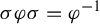 (that is,
$\sigma $
(that is,
$\sigma $
 anti-commutes with
$\varphi $
anti-commutes with
$\varphi $
 ), so that the homeomorphism corresponding to
$(n,j)\in \mathbb {Z}\rtimes \mathbb {Z}_2$
), so that the homeomorphism corresponding to
$(n,j)\in \mathbb {Z}\rtimes \mathbb {Z}_2$
 is
$\varphi ^n\sigma ^j$
is
$\varphi ^n\sigma ^j$
 and we write
$(\varphi ,\sigma )\colon \mathbb {Z}\rtimes \mathbb {Z}_2\curvearrowright X$
and we write
$(\varphi ,\sigma )\colon \mathbb {Z}\rtimes \mathbb {Z}_2\curvearrowright X$
 .
.
We now consider
$\mathsf {A}=\{\mathsf {0},\mathsf {1}\}$
 , and let
$\{\mathsf {0},\mathsf {1}\}^{\ast }\ni v\mapsto \hat {v}\in \{\mathsf {0},\mathsf {1}\}^{\ast }$
, and let
$\{\mathsf {0},\mathsf {1}\}^{\ast }\ni v\mapsto \hat {v}\in \{\mathsf {0},\mathsf {1}\}^{\ast }$
 be the map given by reversing and ‘bit-swapping’, that is, if
$v=x_1\cdots x_{n}$
be the map given by reversing and ‘bit-swapping’, that is, if
$v=x_1\cdots x_{n}$
 with
$x_i\in \{\mathsf {0},\mathsf {1}\}$
with
$x_i\in \{\mathsf {0},\mathsf {1}\}$
 for
$i=1,\ldots ,n$
for
$i=1,\ldots ,n$
 , then
$\hat {v} = (\mathsf {1}-x_{n})\cdots (\mathsf {1}-x_1)$
, then
$\hat {v} = (\mathsf {1}-x_{n})\cdots (\mathsf {1}-x_1)$
 . We refer to the map
$v\mapsto \hat {v}$
. We refer to the map
$v\mapsto \hat {v}$
 as anti-reversal. A finite word
$v\in \{\mathsf {0},\mathsf {1}\}^{\ast }$
as anti-reversal. A finite word
$v\in \{\mathsf {0},\mathsf {1}\}^{\ast }$
 is called an anti-palindrome when it is a fixed point of anti-reversal, that is,
$v=\hat {v}$
is called an anti-palindrome when it is a fixed point of anti-reversal, that is,
$v=\hat {v}$
 . We now define a specific
$\sigma \in \mathrm {Homeo}(\{\mathsf {0},\mathsf {1}\}^{\mathbb {Z}})$
. We now define a specific
$\sigma \in \mathrm {Homeo}(\{\mathsf {0},\mathsf {1}\}^{\mathbb {Z}})$
 as
as

It is directly seen that
$\sigma $
 is a free involution that anti-commutes with the shift map
$\varphi $
is a free involution that anti-commutes with the shift map
$\varphi $
 . As for
$\varphi \sigma $
. As for
$\varphi \sigma $
 , the set of its fixed points is described as

where the ‘
$.$
 ’ in (2.5) is placed between slots
$0$
’ in (2.5) is placed between slots
$0$
 and
$1$
and
$1$
 . Indeed, for
$x=(x_j)_{j\in \mathbb {Z}}\in \{\mathsf {0},\mathsf {1}\}^{\mathbb {Z}}$
. Indeed, for
$x=(x_j)_{j\in \mathbb {Z}}\in \{\mathsf {0},\mathsf {1}\}^{\mathbb {Z}}$
 , we have

and so
$x=\varphi \sigma (x)$
 if and only if
$x_j=\mathsf {1}-x_{-j+1}$
if and only if
$x_j=\mathsf {1}-x_{-j+1}$
 for all
$j\in \mathbb {Z}$
for all
$j\in \mathbb {Z}$
 . We call such bi-infinite sequences anti-palindromic.
Lemma 2.1. Let
$X \subset \{\mathsf {0},\mathsf {1}\}^{\mathbb {Z}}$
 be a subshift and
$\sigma $
be a subshift and
$\sigma $
 the free involution defined above. Then:
-
(i) $\sigma (X)=X$
 if and only if
$\mathcal {L}(X)$
is closed under anti-reversal, that is
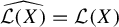
$\widehat {\mathcal {L}(X)} = \mathcal {L}(X)$
;
if and only if
$\mathcal {L}(X)$
is closed under anti-reversal, that is
$\widehat {\mathcal {L}(X)} = \mathcal {L}(X)$
; -
(ii) X contains a fixed point of $\varphi \sigma $
if and only if
$\mathcal {L}(X)$
contains anti-palindromes of arbitrarily large length, i.e. $$ \begin{align*} \sup\{|w|: w\in\mathcal{L}(X) \text{ is an anti-palindrome}\} = \infty; \end{align*} $$in particular, if X is a minimal subshift with $\sigma (X)=X$
, then the action
$(\varphi ,\sigma )\colon \mathbb {Z}\rtimes \mathbb {Z}_2\curvearrowright X$
is free if and only if
$\mathcal {L}(X)$
contains finitely many anti-palindromes.


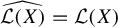




Proof. (i) Assume that
$\widehat {\mathcal {L}(X)}=\mathcal {L}(X)$
 and let
$x\in X$
and let
$x\in X$
 . Let
$N\in \mathbb {N}$
. Let
$N\in \mathbb {N}$
 and set
$v{:=}q x_{[-N,N]}$
and set
$v{:=}q x_{[-N,N]}$
 . Since
$\hat {v}\in \mathcal {L}(X)$
. Since
$\hat {v}\in \mathcal {L}(X)$
 , there is some
$y\in X$
, there is some
$y\in X$
 such that
$\hat {v}\prec y$
such that
$\hat {v}\prec y$
 and by replacing y with
$\varphi ^k(y)$
and by replacing y with
$\varphi ^k(y)$
 for some
$k\in \mathbb {Z}$
for some
$k\in \mathbb {Z}$
 if necessary, we can assume without loss of generality that
$y_{[-N,N]}=\hat {v}$
if necessary, we can assume without loss of generality that
$y_{[-N,N]}=\hat {v}$
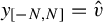 . Since
$\sigma (x)_{[-N,N]} = \hat {v}$
. Since
$\sigma (x)_{[-N,N]} = \hat {v}$
 , we have that y approximates
$\sigma (x)$
, we have that y approximates
$\sigma (x)$
 at a tolerance of
$2^{-N}$
at a tolerance of
$2^{-N}$
 . As
$N\in \mathbb {N}$
. As
$N\in \mathbb {N}$
 was arbitrary and X is closed, this shows that
$\sigma (x)\in X$
was arbitrary and X is closed, this shows that
$\sigma (x)\in X$
 . The reverse implication is immediate.
(ii) Suppose that
$\mathcal {L}(X)$
 contains anti-palindromes of arbitrarily large length, say
$(w_n)_{n=1}^\infty $
contains anti-palindromes of arbitrarily large length, say
$(w_n)_{n=1}^\infty $
 with
$|w_n|\nearrow \infty $
with
$|w_n|\nearrow \infty $
 . Since anti-palindromes necessarily have even length, we write
$|w_n|=2\ell _n$
. Since anti-palindromes necessarily have even length, we write
$|w_n|=2\ell _n$
 for
$n\ge 1$
for
$n\ge 1$
 . For each
$n\ge 1$
. For each
$n\ge 1$
 , we thus obtain
$x^{(n)} \in X$
, we thus obtain
$x^{(n)} \in X$
 such that
$w_n\prec x^{(n)}$
such that
$w_n\prec x^{(n)}$
 and by shifting
$x^{(n)}$
and by shifting
$x^{(n)}$
 appropriately, we can assume without loss of generality that
$x^{(n)}_{[-\ell _n+1,\ell _n]}=w_n$
appropriately, we can assume without loss of generality that
$x^{(n)}_{[-\ell _n+1,\ell _n]}=w_n$
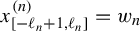 . By compactness, the sequence
$(x^{(n)})_{n=1}^\infty $
. By compactness, the sequence
$(x^{(n)})_{n=1}^\infty $
 has a cluster point
$x\in X$
has a cluster point
$x\in X$
 and by passing to a subsequence if necessary, we can assume that
$x^{(n)}\to x$
and by passing to a subsequence if necessary, we can assume that
$x^{(n)}\to x$
 . Let
$j\ge 1$
. Let
$j\ge 1$
 and pick
$n\in \mathbb {N}$
and pick
$n\in \mathbb {N}$
 large enough so that
$\ell _n\ge j$
large enough so that
$\ell _n\ge j$
 and
$x_{[-j+1,j]}^{(n)}=x_{[-j+1,j]}$
and
$x_{[-j+1,j]}^{(n)}=x_{[-j+1,j]}$
 . Since

is an anti-palindrome,
$x_i=\mathsf {1}-x_{-i+1}$
 for all
$-\ell _n+1\le i\le \ell _n$
for all
$-\ell _n+1\le i\le \ell _n$
 and, in particular,
$x_j=\mathsf {1}-x_{-j+1}$
and, in particular,
$x_j=\mathsf {1}-x_{-j+1}$
 . As
$j\ge 1$
. As
$j\ge 1$
 was arbitrary, we conclude that x is an anti-palindromic sequence.
The ‘only if’ part of the statement is immediate.
Finally, the last statement follows from [Reference Ortega and Scarparo37, Proposition 2.8].
Let
$\underline {t} \in \{\mathsf {0},\mathsf {1}\}^{\mathbb {N}}$
 be the so-called paper-folding sequence, also known as the dragon curve sequence, defined as the limit of the recursive rule
$t_0=\mathsf {1}$
be the so-called paper-folding sequence, also known as the dragon curve sequence, defined as the limit of the recursive rule
$t_0=\mathsf {1}$
 , and
$t_{n+1}=t_n \mathsf {1} \hat {t}_n$
, and
$t_{n+1}=t_n \mathsf {1} \hat {t}_n$
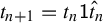 for
$n\in \mathbb {N}$
for
$n\in \mathbb {N}$
 : since
$t_n$
: since
$t_n$
 is an initial segment of
$t_{n+1}$
is an initial segment of
$t_{n+1}$
 for each
$n\ge 1$
for each
$n\ge 1$
 and
$|t_n|=2^{n+1}-1\to \infty $
and
$|t_n|=2^{n+1}-1\to \infty $
 ,
$\underline {t}$
,
$\underline {t}$
 is well defined (note that
$t_n = \underline {t}_{[0,2^{n+1}-2]}$
is well defined (note that
$t_n = \underline {t}_{[0,2^{n+1}-2]}$
 for all
$n\in \mathbb {N}$
for all
$n\in \mathbb {N}$
 ). The words
$t_0,\ldots ,t_5$
). The words
$t_0,\ldots ,t_5$
 are listed below:

Arguing similarly as in [Reference Berstel, Boasson, Carton and Fagnot4], we prove the following facts about the paper-folding sequence.
Proposition 2.2. Let
$\underline {t}\in \{\mathsf {0},\mathsf {1}\}^{\mathbb {N}}$
 be the paper-folding sequence. Then:
-
(i) $\widehat {\mathcal {L}(\underline {t})}=\mathcal {L}(\underline {t})$
, that is,
$v\in \mathcal {L}(\underline {t})$
if and only if
$\hat {v}\in \mathcal {L}(\underline {t})$
; -
(ii) $\underline {t}$
is uniformly recurrent and not periodic; and -
(iii) if $v\in \mathcal {L}(\underline {t})$
is an anti-palindrome, then
$|v|\le 6$
; in particular,
$\mathcal {L}(\underline {t})$
contains finitely many anti-palindromes.


Proof. (i) If
$v\in \mathcal {L}(\underline {t})$
 , then
$v\prec t_n$
, then
$v\prec t_n$
 for some
$n\in \mathbb {N}$
for some
$n\in \mathbb {N}$
 and so
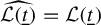
$\hat {v}\prec \hat {t}_n\prec t_{n+1}\prec \underline {t}$
and so
$\hat {v}\prec \hat {t}_n\prec t_{n+1}\prec \underline {t}$
 .
.
(ii) We claim that for
$p,n\in \mathbb {N}$
 , if
$t_n=x_1\cdots x_{2^{n+1}-1}$
, if
$t_n=x_1\cdots x_{2^{n+1}-1}$
 (
$x_i\in \{\mathsf {0},\mathsf {1}\}$
(
$x_i\in \{\mathsf {0},\mathsf {1}\}$
 ), then

Fix
$p\in \mathbb {N}$
 ; we shall prove the claim by induction on n. For
$n=0$
; we shall prove the claim by induction on n. For
$n=0$
 , this is clear by definition, since
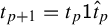
$t_{p+1} = t_p\mathsf {1}\hat {t}_p$
, this is clear by definition, since
$t_{p+1} = t_p\mathsf {1}\hat {t}_p$
 (and
$\mathsf {1}=t_0$
(and
$\mathsf {1}=t_0$
 ). Assume that the claim has been proved for some
$n\in \mathbb {N}$
). Assume that the claim has been proved for some
$n\in \mathbb {N}$
 , so
, so

with
$t_n = x_1\cdots x_{2^{n+1}-1}$
 . Then, since
$t_{p+n+2} = t_{p+n+1} \mathsf {1} \hat {t}_{p+n+1}$
. Then, since
$t_{p+n+2} = t_{p+n+1} \mathsf {1} \hat {t}_{p+n+1}$
 ,
,

and note that

as we wanted, and so (2.6) holds.
To see that
$\underline {t}$
 is uniformly recurrent, let
$v\prec \underline {t}$
is uniformly recurrent, let
$v\prec \underline {t}$
 be a finite subword. By definition, there is
$p\in \mathbb {N}$
be a finite subword. By definition, there is
$p\in \mathbb {N}$
 such that
$v\prec t_p$
such that
$v\prec t_p$
 . Let
$w\prec \underline {t}$
. Let
$w\prec \underline {t}$
 be any subword with
$|w|=3\cdot 2^{p+1}$
be any subword with
$|w|=3\cdot 2^{p+1}$
 . Let
$N\ge p+2$
. Let
$N\ge p+2$
 be such that
$w\prec t_N$
be such that
$w\prec t_N$
 and write
$N=p+n+1$
and write
$N=p+n+1$
 for some
$n\ge 1$
for some
$n\ge 1$
 . Note that by (2.6) and since
$|w|=3\cdot 2^{p+1}$
. Note that by (2.6) and since
$|w|=3\cdot 2^{p+1}$
 , we must have that
$t_p\prec w$
, we must have that
$t_p\prec w$
 and thus
$v\prec w$
and thus
$v\prec w$
 as we wanted.
Assume now that
$\underline {t}$
 is periodic, that is,
$\underline {t}=wvvv\cdots $
is periodic, that is,
$\underline {t}=wvvv\cdots $
 for some
$w,v\in \{\mathsf {0,1}\}^*$
for some
$w,v\in \{\mathsf {0,1}\}^*$
 . By replacing v with
$vv$
. By replacing v with
$vv$
 , we can assume without loss of generality that the length of v is even. Let
$c,d\ge 0$
, we can assume without loss of generality that the length of v is even. Let
$c,d\ge 0$
 be such that
$|v| = 2^{c+1}(2d+1)$
be such that
$|v| = 2^{c+1}(2d+1)$
 . By replacing v with some cyclic permutation of its letters if necessary (and thus without affecting its length), we can assume without loss of generality that
$w=t_{cq}$
. By replacing v with some cyclic permutation of its letters if necessary (and thus without affecting its length), we can assume without loss of generality that
$w=t_{cq}$
 for some
$q\ge 1$
for some
$q\ge 1$
 . By (2.6), we have that

with
$x_1\cdots x_{2^{c(q-1)+d+1}-1}=t_{c(q-1)+d}$
 . Note that
$t_{cq+d+1}$
. Note that
$t_{cq+d+1}$
 is an initial segment of
$\underline {t}$
is an initial segment of
$\underline {t}$
 and its initial segment

has length
$2^{cq+1}-1$
 , and so is equal to
$t_{cq}=w$
, and so is equal to
$t_{cq}=w$
 . Therefore, the periodic part
$vvv\cdots $
. Therefore, the periodic part
$vvv\cdots $
 has
$x_{2^{c(q-1)}} t_c x_{2^{c(q-1)}+1} \hat {t}_c \cdots t_c x_{2^{c(q-1)+d+1}-1}\hat {t}_c $
has
$x_{2^{c(q-1)}} t_c x_{2^{c(q-1)}+1} \hat {t}_c \cdots t_c x_{2^{c(q-1)+d+1}-1}\hat {t}_c $
 as an initial segment, which in turn has
$x_{2^{c(q-1)}}t_cx_{2^{c(q-1)}+1} \hat {t}_cx_{2^{c(q-1)}+2}\cdots \hat {t}_cx_{2^{c(q-1)}+2d} t_c$
as an initial segment, which in turn has
$x_{2^{c(q-1)}}t_cx_{2^{c(q-1)}+1} \hat {t}_cx_{2^{c(q-1)}+2}\cdots \hat {t}_cx_{2^{c(q-1)}+2d} t_c$
 as an initial segment of length
$2^{c+1}(2d+1)=|v|$
as an initial segment of length
$2^{c+1}(2d+1)=|v|$
 , so
, so

This is succeeded by
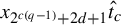
$x_{2^{c(q-1)}+2d+1}\hat {t}_c$
 , which is an initial segment of v, and so it follows that
$t_c=\hat {t}_c$
, which is an initial segment of v, and so it follows that
$t_c=\hat {t}_c$
 . This is a contradiction, as this would imply that
$|t_c|_{\mathsf {0}}=|t_c|_{\mathsf {1}}$
. This is a contradiction, as this would imply that
$|t_c|_{\mathsf {0}}=|t_c|_{\mathsf {1}}$
 , which is never the case since
$|t_c|_{\mathsf {1}}=|t_c|_{\mathsf {0}}+1$
, which is never the case since
$|t_c|_{\mathsf {1}}=|t_c|_{\mathsf {0}}+1$
 by construction.
(iii) Note first that any anti-palindrome has even length. Now, if
$v=v_1\cdots v_{2n}\in \{\mathsf {0},\mathsf {1}\}^*$
 is an anti-palindrome of length
$2n>8$
is an anti-palindrome of length
$2n>8$
 , then

is an anti-palindrome of length
$8$
 that is a subword of v. It thus suffices to show that
$\underline {t}$
that is a subword of v. It thus suffices to show that
$\underline {t}$
 contains no anti-palindromes of length
$8$
contains no anti-palindromes of length
$8$
 , that is, that none of the
$t_p$
, that is, that none of the
$t_p$
 contain anti-palindromes of length
$8$
contain anti-palindromes of length
$8$
 . We directly see that

contains no anti-palindromes of length
$8$
 . We continue with induction: assume we have shown that
$t_p$
. We continue with induction: assume we have shown that
$t_p$
 contains no anti-palindromes of length
$8$
contains no anti-palindromes of length
$8$
 for some
$p\ge 4$
for some
$p\ge 4$
 . By (2.6), we have
$t_{p} = t_3 s \hat {t}_3$
. By (2.6), we have
$t_{p} = t_3 s \hat {t}_3$
 for some
$s\prec \underline {t}$
for some
$s\prec \underline {t}$
 (with
$|s|= 2^{p+1}-2^5+1$
(with
$|s|= 2^{p+1}-2^5+1$
 ) and
$t_{p+1} = t_3 s \hat {t}_3 \mathsf {1} t_3 \hat {s} \hat {t}_3$
) and
$t_{p+1} = t_3 s \hat {t}_3 \mathsf {1} t_3 \hat {s} \hat {t}_3$
 . Since
$|t_3| = 2^4-1=15$
. Since
$|t_3| = 2^4-1=15$
 , if an anti-palindrome of length
$8$
, if an anti-palindrome of length
$8$
 occurs as a subword of
$t_{p+1}$
occurs as a subword of
$t_{p+1}$
 , then it is either a subword of
$t_3s\hat {t}_3=t_p$
, then it is either a subword of
$t_3s\hat {t}_3=t_p$
 , or a subword of
$\hat {t}_3\mathsf {1} t_3$
, or a subword of
$\hat {t}_3\mathsf {1} t_3$
 , or a subword of
$t_3\hat {s}\hat {t}_3=\hat {t}_p$
, or a subword of
$t_3\hat {s}\hat {t}_3=\hat {t}_p$
 . The first case and the third case are both impossible due to the inductive hypothesis (and upon noting that if
$v\prec \hat {t}_p$
. The first case and the third case are both impossible due to the inductive hypothesis (and upon noting that if
$v\prec \hat {t}_p$
 is an anti-palindrome of length
$8$
is an anti-palindrome of length
$8$
 , then
$v=\hat {v}\prec t_p$
, then
$v=\hat {v}\prec t_p$
 is an anti-palindrome of length
$8$
is an anti-palindrome of length
$8$
 ). As for the second case, we directly see that

contains no anti-palindromes of length
$8$
 and, thus,
$t_{p+1}$
and, thus,
$t_{p+1}$
 contains no anti-palindromes of length
$8$
contains no anti-palindromes of length
$8$
 . The proof is complete by induction.
Proposition 2.3. Let
$\mathsf {A}$
 be a finite alphabet and let
$\underline {s}\in \mathsf {A}^{\mathbb {N}}$
be a finite alphabet and let
$\underline {s}\in \mathsf {A}^{\mathbb {N}}$
 be a non-periodic, uniformly recurrent infinite word. If

then X contains a bi-infinite sequence
$\tilde {x}$
 with
$\tilde {x}_{[0,\infty )}=\underline {s}$
with
$\tilde {x}_{[0,\infty )}=\underline {s}$
 . Moreover,
$X = \{x\in \mathsf {A}^{\mathbb {Z}}: \mathcal {L}(x) = \mathcal {L}(\underline {s})\}$
. Moreover,
$X = \{x\in \mathsf {A}^{\mathbb {Z}}: \mathcal {L}(x) = \mathcal {L}(\underline {s})\}$
 , and X is a minimal subshift and a Cantor space.
Proof. To define such an
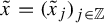
$\tilde {x}=(\tilde {x}_j)_{j\in \mathbb {Z}}$
 , we first define
$\tilde {x}_j$
, we first define
$\tilde {x}_j$
 for
$j\ge 0$
for
$j\ge 0$
 such that
$\tilde {x}_{[0,\infty )}=s$
such that
$\tilde {x}_{[0,\infty )}=s$
 . For
$j\le -1$
. For
$j\le -1$
 , we define
$\tilde {x}_j$
, we define
$\tilde {x}_j$
 recursively so that
$\tilde {x}_j\cdots \tilde {x}_{j+n}\in \mathcal {L}(\underline {s})$
recursively so that
$\tilde {x}_j\cdots \tilde {x}_{j+n}\in \mathcal {L}(\underline {s})$
 for all
$n\in \mathbb {N}$
for all
$n\in \mathbb {N}$
 . This suffices to conclude that
$\mathcal {L}(\tilde {x})=\mathcal {L}(\underline {s})$
. This suffices to conclude that
$\mathcal {L}(\tilde {x})=\mathcal {L}(\underline {s})$
 . Let
$j\le -1$
. Let
$j\le -1$
 and assume that
$\tilde {x}_{j+1},\tilde {x}_{j+2},\ldots $
and assume that
$\tilde {x}_{j+1},\tilde {x}_{j+2},\ldots $
 have all been defined so that

for all
$n\ge 1$
 . We claim that there is an
$a\in \mathsf {A}$
. We claim that there is an
$a\in \mathsf {A}$
 such that
$a\tilde {x}_{j+1}\cdots \tilde {x}_{j+n}\in \mathcal {L}(\underline {s})$
such that
$a\tilde {x}_{j+1}\cdots \tilde {x}_{j+n}\in \mathcal {L}(\underline {s})$
 for all
$n\ge 1$
for all
$n\ge 1$
 . Indeed, if this was not the case, then for any
$a\in \mathsf {A}$
. Indeed, if this was not the case, then for any
$a\in \mathsf {A}$
 , there is some
$n_a\ge 1$
, there is some
$n_a\ge 1$
 such that
$a\tilde {x}_{j+1}\cdots \tilde {x}_{j+n_a}\not \in \mathcal {L}(\underline {s})$
such that
$a\tilde {x}_{j+1}\cdots \tilde {x}_{j+n_a}\not \in \mathcal {L}(\underline {s})$
 . Setting
$n{:=}q \max \{n_a:a\in \mathsf {A}\}$
. Setting
$n{:=}q \max \{n_a:a\in \mathsf {A}\}$
 , we conclude that
$a\tilde {x}_{j+1}\cdots \tilde {x}_{j+n}\not \in \mathcal {L}(\underline {s})$
, we conclude that
$a\tilde {x}_{j+1}\cdots \tilde {x}_{j+n}\not \in \mathcal {L}(\underline {s})$
 for all
$a\in \mathsf {A}$
for all
$a\in \mathsf {A}$
 . However, since
$\underline {s}$
. However, since
$\underline {s}$
 is (uniformly) recurrent and
$\tilde {x}_{j+1}\cdots \tilde {x}_{j+n}$
is (uniformly) recurrent and
$\tilde {x}_{j+1}\cdots \tilde {x}_{j+n}$
 is a subword of
$\underline {s}$
is a subword of
$\underline {s}$
 , this finite subword occurs in
$\underline {s}$
, this finite subword occurs in
$\underline {s}$
 preceded by some letter
$a\in \mathsf {A}$
preceded by some letter
$a\in \mathsf {A}$
 , and so
$a\tilde {x}_{j+1}\cdots \tilde {x}_{j+n}\in \mathcal {L}(\underline {s})$
, and so
$a\tilde {x}_{j+1}\cdots \tilde {x}_{j+n}\in \mathcal {L}(\underline {s})$
 , which is a contradiction.
It follows from the preceding paragraph that X is non-empty and it is actually infinite, since
$\{\varphi ^k(\tilde {x})\}_{k\ge 0}$
 is infinite, due to
$\underline {s}$
is infinite, due to
$\underline {s}$
 being non-periodic. Note that
$\varphi (X)=X$
being non-periodic. Note that
$\varphi (X)=X$
 since
$\mathcal {L}(\varphi (x))=\mathcal {L}(x)$
since
$\mathcal {L}(\varphi (x))=\mathcal {L}(x)$
 for any
$x\in \mathsf {A}^{\mathbb {Z}}$
for any
$x\in \mathsf {A}^{\mathbb {Z}}$
 . That X is closed follows from the fact that
$\underline {s}$
. That X is closed follows from the fact that
$\underline {s}$
 is uniformly recurrent: let
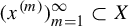
$(x^{(m)})_{m=1}^\infty \subset X$
is uniformly recurrent: let
$(x^{(m)})_{m=1}^\infty \subset X$
 be a sequence converging to
$x\in \mathsf {A}^{\mathbb {Z}}$
be a sequence converging to
$x\in \mathsf {A}^{\mathbb {Z}}$
 , let
$v\prec x$
, let
$v\prec x$
 and let
$N\in \mathbb {N}$
and let
$N\in \mathbb {N}$
 be such that
$v\prec x_{[-N,N]}$
be such that
$v\prec x_{[-N,N]}$
 . By taking m large enough,
$x^{(m)}$
. By taking m large enough,
$x^{(m)}$
 agrees with x on the slots
$[-N,N]$
agrees with x on the slots
$[-N,N]$
 and so
$v\prec x^{(m)}$
and so
$v\prec x^{(m)}$
 ; hence,
$v\in \mathcal {L}(x^{(m)})=\mathcal {L}(\underline {s})$
; hence,
$v\in \mathcal {L}(x^{(m)})=\mathcal {L}(\underline {s})$
 , which shows that
$\mathcal {L}(x)\subset \mathcal {L}(\underline {s})$
, which shows that
$\mathcal {L}(x)\subset \mathcal {L}(\underline {s})$
 and so
$x\in X$
and so
$x\in X$
 .
.
Now, if
$x\in X$
 and
$v\in \mathcal {L}(\underline {s})$
and
$v\in \mathcal {L}(\underline {s})$
 , since
$\underline {s}$
, since
$\underline {s}$
 is uniformly recurrent, there is
$\ell \in \mathbb {N}$
is uniformly recurrent, there is
$\ell \in \mathbb {N}$
 such that if
$w\prec \underline {s}$
such that if
$w\prec \underline {s}$
 with
$|w|\ge \ell $
with
$|w|\ge \ell $
 , then
$v\prec w$
, then
$v\prec w$
 . Since
$x_{[1,\ell ]}\in \mathcal {L}(x)\subset \mathcal {L}(\underline {s})$
. Since
$x_{[1,\ell ]}\in \mathcal {L}(x)\subset \mathcal {L}(\underline {s})$
 has length
$\ell $
has length
$\ell $
 , we get that
$v\prec x_{[1,\ell ]}\prec x$
, we get that
$v\prec x_{[1,\ell ]}\prec x$
 , and thus,
$\mathcal {L}(\underline {s})\subset \mathcal {L}(x)$
, and thus,
$\mathcal {L}(\underline {s})\subset \mathcal {L}(x)$
 . This shows that
$X = \{ x\in \mathsf {A}^{\mathbb {Z}}: \mathcal {L}(x)=\mathcal {L}(\underline {s})\}$
. This shows that
$X = \{ x\in \mathsf {A}^{\mathbb {Z}}: \mathcal {L}(x)=\mathcal {L}(\underline {s})\}$
 , and thus X is minimal since
$\mathcal {L}(x)=\mathcal {L}(X)$
, and thus X is minimal since
$\mathcal {L}(x)=\mathcal {L}(X)$
 for all
$x\in X$
for all
$x\in X$
 . In particular, X is a Cantor space as an infinite minimal subshift.
Definition 2.4. With
$\underline {t}\in \{\mathsf {0},\mathsf {1}\}^{\mathbb {N}}$
 the paper-folding sequence, the paper-folding subshift is defined as


Combining Lemma 2.1, and Propositions 2.2 and 2.3, we obtain the following corollary.
Corollary 2.5. The shift map
$\varphi $
 and the anti-reversal involution
$\sigma $
and the anti-reversal involution
$\sigma $
 restricted to the Cantor space
$\underline {X}$
restricted to the Cantor space
$\underline {X}$
 define a free minimal action
$(\varphi ,\sigma )\colon \mathbb {Z}\rtimes \mathbb {Z}_2\curvearrowright \underline {X}$
define a free minimal action
$(\varphi ,\sigma )\colon \mathbb {Z}\rtimes \mathbb {Z}_2\curvearrowright \underline {X}$
 .
.
3 K-theory computations
In this section, we compute the
$\mathrm {K}$
 -theory of the crossed product
$\mathrm {C}^\ast $
-theory of the crossed product
$\mathrm {C}^\ast $
 -algebra associated to the action of Corollary 2.5. We first compute (as a scaled ordered group) the
$\mathrm {K}_0$
-algebra associated to the action of Corollary 2.5. We first compute (as a scaled ordered group) the
$\mathrm {K}_0$
 -group of the crossed product
$\mathrm {C}^\ast $
-group of the crossed product
$\mathrm {C}^\ast $
 -algebra of the Cantor minimal system
$\varphi \colon \mathbb {Z}\curvearrowright \underline {X}$
-algebra of the Cantor minimal system
$\varphi \colon \mathbb {Z}\curvearrowright \underline {X}$
 given by the shift map restricted to the paper-folding subshift of Definition 2.4. The reader is referred to [Reference Blackadar7] for elements of
$\mathrm {K}$
given by the shift map restricted to the paper-folding subshift of Definition 2.4. The reader is referred to [Reference Blackadar7] for elements of
$\mathrm {K}$
 -theory of
$\mathrm {C}^\ast $
-theory of
$\mathrm {C}^\ast $
 -algebras as well as the relevant terminology and notation.
To compute
$\mathrm {K}_0(C(\underline {X})\rtimes _\varphi \mathbb {Z})$
 , we define an auxiliary substitution subshift over the four-letter alphabet
$\mathsf {A}{:=}q \{\mathsf {0},\mathsf {1},\mathsf {2},\mathsf {3}\}$
, we define an auxiliary substitution subshift over the four-letter alphabet
$\mathsf {A}{:=}q \{\mathsf {0},\mathsf {1},\mathsf {2},\mathsf {3}\}$
 . Consider the map
$\varrho \colon \mathsf {A}^*\to \mathsf {A}^*$
. Consider the map
$\varrho \colon \mathsf {A}^*\to \mathsf {A}^*$
 defined on the generators (that is, the letters) as

and extended on
$\mathsf {A}^*$
 as
$\varrho (x_1\cdots x_n){:=}q \varrho (x_1)\cdots \varrho (x_n)$
as
$\varrho (x_1\cdots x_n){:=}q \varrho (x_1)\cdots \varrho (x_n)$
 for all
$n\ge 1$
for all
$n\ge 1$
 and
$x_1,\ldots ,x_n\in \mathsf {A}$
and
$x_1,\ldots ,x_n\in \mathsf {A}$
 . Setting

we consider the subshift (cf. [Reference Durand, Host and Skau18, §3.3.1])

The map
$\varrho $
 is a primitive substitution, in the sense that there is
$n\in \mathbb {N}$
is a primitive substitution, in the sense that there is
$n\in \mathbb {N}$
 such that for any seed letter
$a\in \mathsf {A}$
such that for any seed letter
$a\in \mathsf {A}$
 , every letter of
$\mathsf {A}$
, every letter of
$\mathsf {A}$
 appears in the iteration
$\varrho ^n(a)$
appears in the iteration
$\varrho ^n(a)$
 (in our case, one can take
$n=3$
(in our case, one can take
$n=3$
 ) and the length of words arising as iterations of
$\varrho $
) and the length of words arising as iterations of
$\varrho $
 increases to infinity. It is well known that primitive substitutions give rise to minimal and uniquely ergodic systems (cf. [Reference Durand, Host and Skau18, §3.3.1]), where the latter means that there is a unique invariant Borel probability measure on the space. In particular,
$\varphi \colon \mathbb {Z}\curvearrowright X_\varrho $
increases to infinity. It is well known that primitive substitutions give rise to minimal and uniquely ergodic systems (cf. [Reference Durand, Host and Skau18, §3.3.1]), where the latter means that there is a unique invariant Borel probability measure on the space. In particular,
$\varphi \colon \mathbb {Z}\curvearrowright X_\varrho $
 is minimal and uniquely ergodic.
Remark 3.1. Since
$\varrho $
 is a primitive substitution and since
$\varrho ^n(a)$
is a primitive substitution and since
$\varrho ^n(a)$
 begins with the same letter (namely
$\mathsf {3}$
begins with the same letter (namely
$\mathsf {3}$
 ) for all
$a\in \mathsf {A}$
) for all
$a\in \mathsf {A}$
 and
$n\ge 2$
and
$n\ge 2$
 , the iterations of
$\varrho $
, the iterations of
$\varrho $
 (independently of the seed letter) converge to an infinite word
$\underline {r}\in \mathsf {A}^{\mathbb {N}}$
(independently of the seed letter) converge to an infinite word
$\underline {r}\in \mathsf {A}^{\mathbb {N}}$
 (cf. [Reference Fogg23, §1.2]), the first few digits of which read as follows:

By definition,
$\mathcal {L}_\varrho =\mathcal {L}(\underline {r})$
 . The word
$\underline {r}$
. The word
$\underline {r}$
 is closely related to the paper-folding sequence
$\underline {t}\in \{\mathsf {0},\mathsf {1}\}^{\mathbb {N}}$
is closely related to the paper-folding sequence
$\underline {t}\in \{\mathsf {0},\mathsf {1}\}^{\mathbb {N}}$
 ; see [Reference Bruin13, Example 4.10, p. 138]. In particular, observe that starting from the
$0$
; see [Reference Bruin13, Example 4.10, p. 138]. In particular, observe that starting from the
$0$
 th slot of
$\underline {t}$
th slot of
$\underline {t}$
 and replacing two-letter blocks according to the rule
$xy\mapsto \mathsf {2}x+y$
and replacing two-letter blocks according to the rule
$xy\mapsto \mathsf {2}x+y$
 (that is,
$\mathsf {00}\mapsto \mathsf {0}$
(that is,
$\mathsf {00}\mapsto \mathsf {0}$
 ,
$\mathsf {01}\mapsto \mathsf {1}$
,
$\mathsf {01}\mapsto \mathsf {1}$
 ,
$\mathsf {10}\mapsto \mathsf {2}$
,
$\mathsf {10}\mapsto \mathsf {2}$
 and
$\mathsf {11}\mapsto \mathsf {3}$
and
$\mathsf {11}\mapsto \mathsf {3}$
 ), one obtains
$\underline {r}$
), one obtains
$\underline {r}$
 . It follows from this observation that, since
$\underline {t}$
. It follows from this observation that, since
$\underline {t}$
 is uniformly recurrent and non-periodic, also
$\underline {r}$
is uniformly recurrent and non-periodic, also
$\underline {r}$
 is uniformly recurrent and non-periodic.
According to [Reference Durand, Host and Skau18, §6.4], we associate to
$X_\varrho $
 the
$4\times 4$
the
$4\times 4$
 matrix M with non-negative integer entries, indexed over
$\{\mathsf {0},\mathsf {1},\mathsf {2},\mathsf {3}\}$
matrix M with non-negative integer entries, indexed over
$\{\mathsf {0},\mathsf {1},\mathsf {2},\mathsf {3}\}$
 , where the
$(i,j)$
, where the
$(i,j)$
 entry of M is defined as the number of occurrences of the letter j in the word
$\varrho (i)$
entry of M is defined as the number of occurrences of the letter j in the word
$\varrho (i)$
 . Inspecting (3.1), we see that

Proposition 3.2. With
$\varphi \colon \mathbb {Z}\curvearrowright X_\varrho $
 the substitution subshift defined above,
$\mathrm {K}_0(C(X_\varrho )\rtimes _\varphi \mathbb {Z})$
the substitution subshift defined above,
$\mathrm {K}_0(C(X_\varrho )\rtimes _\varphi \mathbb {Z})$
 is isomorphic as a scaled ordered group to

Proof. Note first that the substitution
$\varrho $
 is left-proper (cf. [Reference Durand, Host and Skau18, Definition 16]), in the sense that there is
$p\in \mathbb {N}$
is left-proper (cf. [Reference Durand, Host and Skau18, Definition 16]), in the sense that there is
$p\in \mathbb {N}$
 so that the words
$\varrho ^p(a)$
so that the words
$\varrho ^p(a)$
 start with the same letter for all
$a\in \mathsf {A}$
start with the same letter for all
$a\in \mathsf {A}$
 ; in our case, one sees that for
$p=2$
; in our case, one sees that for
$p=2$
 , all words
$\varrho ^2(\mathsf {0})=\mathsf {3020},\varrho ^2(\mathsf {1})=\mathsf {3021},\varrho ^2(\mathsf {2})=\mathsf {3120}$
, all words
$\varrho ^2(\mathsf {0})=\mathsf {3020},\varrho ^2(\mathsf {1})=\mathsf {3021},\varrho ^2(\mathsf {2})=\mathsf {3120}$
 and
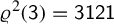
$\varrho ^2(\mathsf {3})=\mathsf {3121}$
and
$\varrho ^2(\mathsf {3})=\mathsf {3121}$
 start with the letter
$\mathsf {3}$
start with the letter
$\mathsf {3}$
 . We can thus apply [Reference Durand, Host and Skau18, Corollary 33] (together with [Reference Durand, Host and Skau18, §2.4.1, Remark(ii)]) and so
$\mathrm {K}_0(C(X_\varrho )\rtimes _\varphi \mathbb {Z})$
. We can thus apply [Reference Durand, Host and Skau18, Corollary 33] (together with [Reference Durand, Host and Skau18, §2.4.1, Remark(ii)]) and so
$\mathrm {K}_0(C(X_\varrho )\rtimes _\varphi \mathbb {Z})$
 is computed as an inductive limit: with M the matrix of (3.4), for
$n\ge 1$
is computed as an inductive limit: with M the matrix of (3.4), for
$n\ge 1$
 , consider the subgroups of
$\mathbb {Q}^4$
, consider the subgroups of
$\mathbb {Q}^4$
 given by


and the subsets

Note that
$G_n\subset G_{n+1}$
 ,
$H_n\subset G_n$
,
$H_n\subset G_n$
 ,
$H_n \subset H_{n+1}$
,
$H_n \subset H_{n+1}$
 and that
$(G_{n})_+\subset (G_{n+1})_+$
and that
$(G_{n})_+\subset (G_{n+1})_+$
 for all
$n\ge 1$
for all
$n\ge 1$
 . Set
$G{:=}q \bigcup _{n\ge 1}G_n$
. Set
$G{:=}q \bigcup _{n\ge 1}G_n$
 ,
$H{:=}q \bigcup _{n\ge 1}H_n \subset G$
,
$H{:=}q \bigcup _{n\ge 1}H_n \subset G$
 and
$G_+{:=}q \bigcup _{n\ge 1}(G_n)_+$
and
$G_+{:=}q \bigcup _{n\ge 1}(G_n)_+$
 . Then, by [Reference Durand, Host and Skau18, §6.4 and Corollary 33], we have that
$\mathrm {K}_0(C(X_\varrho )\rtimes _\varphi \mathbb {Z})$
. Then, by [Reference Durand, Host and Skau18, §6.4 and Corollary 33], we have that
$\mathrm {K}_0(C(X_\varrho )\rtimes _\varphi \mathbb {Z})$
 is isomorphic as an abelian group to
$G/H$
is isomorphic as an abelian group to
$G/H$
 , its positive cone is identified with the image of
$G_+$
, its positive cone is identified with the image of
$G_+$
 under the quotient map and the order unit is identified with the equivalence class of
$(1,1,1,1)$
under the quotient map and the order unit is identified with the equivalence class of
$(1,1,1,1)$
 in
$G/H$
in
$G/H$
 . By induction, one checks that

and so with the notation
$\vec {q}=(q_1,\ldots ,q_4)\in \mathbb {Q}^4$
 , we obtain


and

We thus define group homomorphisms
$\alpha _n\colon G_{n+2}\to {1}/{2^n}\mathbb {Z}\oplus \mathbb {Z}$
 given by
$\alpha _n(\vec {q})=(q_1+\cdots +q_4,q_1-q_2)$
given by
$\alpha _n(\vec {q})=(q_1+\cdots +q_4,q_1-q_2)$
 . It is clear that each
$\alpha _n$
. It is clear that each
$\alpha _n$
 is surjective, that
$\ker (\alpha _n)=H_{n+2}$
is surjective, that
$\ker (\alpha _n)=H_{n+2}$
 and that

Denoting by
$\tilde {\alpha }_n\colon G_{n+2}/H_{n+2}\to {1}/{2^n}\mathbb {Z}\oplus \mathbb {Z}$
 the induced isomorphisms, we see that we have a commutative diagram:

where the arrows on each row denote the inclusion maps. The abelian group that is the inductive limit of the bottom row is
$\mathbb {Z}[\tfrac {1}{2}]\oplus \mathbb {Z}$
 , so we obtain an isomorphism
$G/H\cong \mathbb {Z}[\tfrac {1}{2}]\oplus \mathbb {Z}$
, so we obtain an isomorphism
$G/H\cong \mathbb {Z}[\tfrac {1}{2}]\oplus \mathbb {Z}$
 . Moreover, the positive cone of
$G/H$
. Moreover, the positive cone of
$G/H$
 (being the image of
$G_+$
(being the image of
$G_+$
 under the quotient map) is carried by this isomorphism to
$\bigcup _{n\in \mathbb {N}}\tilde {\alpha }_n((G_{n+2})_+)$
under the quotient map) is carried by this isomorphism to
$\bigcup _{n\in \mathbb {N}}\tilde {\alpha }_n((G_{n+2})_+)$
 , which is precisely the set

which is in fact equal to
$\{(s,m)\in \mathbb {Z}[\tfrac {1}{2}]\oplus \mathbb {Z}: s>0\}\cup \{(0,0)\}$
 : the latter contains the set appearing in (3.14) which obviously contains
$(0,0)$
: the latter contains the set appearing in (3.14) which obviously contains
$(0,0)$
 . However, if
$(s,m)\in \mathbb {Z}[\tfrac {1}{2}]\oplus \mathbb {Z}$
. However, if
$(s,m)\in \mathbb {Z}[\tfrac {1}{2}]\oplus \mathbb {Z}$
 is such that
$s>0$
is such that
$s>0$
 , then we can write
$s={k}/{2^n}$
, then we can write
$s={k}/{2^n}$
 for some
$k,n\in \mathbb {N}$
for some
$k,n\in \mathbb {N}$
 . Now, take
$n'\in \mathbb {N}$
. Now, take
$n'\in \mathbb {N}$
 large enough so that
$|m|\le 2^{n'}k $
large enough so that
$|m|\le 2^{n'}k $
 , and note that
$s = ({2^{n'}k}/{2^{n+n'}}) \in ({1}/{2^{n+n'}})\mathbb {Z}$
, and note that
$s = ({2^{n'}k}/{2^{n+n'}}) \in ({1}/{2^{n+n'}})\mathbb {Z}$
 and
$2^{n+n'}s=2^{n'}k$
and
$2^{n+n'}s=2^{n'}k$
 .
.
Finally, the isomorphism
$G/H\cong \mathbb {Z}[\tfrac {1}{2}]\oplus \mathbb {Z}$
 maps the equivalence class of
$(1,1,1,1)$
maps the equivalence class of
$(1,1,1,1)$
 to the element
$(4,0)$
to the element
$(4,0)$
 . This shows that, as a scaled ordered group,
$\mathrm {K}_0(C(X_\varrho )\rtimes _\varphi \mathbb {Z})$
. This shows that, as a scaled ordered group,
$\mathrm {K}_0(C(X_\varrho )\rtimes _\varphi \mathbb {Z})$
 is isomorphic to

which is, in turn, isomorphic to the scaled ordered group in (3.5), since
$\mathbb {Z}[\tfrac {1}{2}]$
 is
$2$
is
$2$
 -divisible.
To make use of our auxiliary subshift, we need a transformation from the binary shift space. Consider the map
$\beta \colon \{\mathsf {0},\mathsf {1}\}^{\mathbb {Z}}\to \mathsf {A}^{\mathbb {Z}}$
 (where still
$\mathsf {A}=\{\mathsf {0,1,2,3}\}$
(where still
$\mathsf {A}=\{\mathsf {0,1,2,3}\}$
 ) defined as

and note that
$\beta $
 is injective. While
$\beta $
is injective. While
$\beta $
 is not equivariant with respect to the shift maps, one directly checks that

Lemma 3.3. Let
$\beta $
 be the map defined in (3.15). Then, there is
$\tilde {x}\in \underline {X}$
be the map defined in (3.15). Then, there is
$\tilde {x}\in \underline {X}$
 such that
$\tilde {x}_{[0,\infty )}=\underline {t}$
such that
$\tilde {x}_{[0,\infty )}=\underline {t}$
 and
$\beta (\tilde {x})\in X_\varrho $
and
$\beta (\tilde {x})\in X_\varrho $
 , with
$\beta (\tilde {x})_{[0,\infty )}=\underline {r}$
, with
$\beta (\tilde {x})_{[0,\infty )}=\underline {r}$
 , where still
$\underline {t}$
, where still
$\underline {t}$
 is the paper-folding sequence from §2 and
$\underline {r}$
is the paper-folding sequence from §2 and
$\underline {r}$
 comes from Remark 3.1. Moreover, with

and

we have:
-
(i) $\underline {X}^{(0)}$
and
$\underline {X}^{(1)}$
are both mapped onto themselves by
$\varphi _{\{\mathsf {0,1}\}}^2$
, and they are mapped onto each other by
$\varphi _{\{\mathsf {0,1}\}}$
; -
(ii) $\underline {X}^{(0)}\sqcup \underline {X}^{(1)}=\underline {X}$
(and so
$\underline {X}^{(0)}$
and
$\underline {X}^{(1)}$
are clopen sets); -
(iii) $\beta (\underline {X}^{(0)}) = X_\varrho $
.





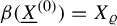
Proof. For the first part of the statement, from Proposition 2.3, we obtain
$y\in X_\varrho \subset \mathsf {A}^{\mathbb {Z}}$
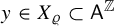 such that
$y_{[0,\infty )}=\underline {r}$
such that
$y_{[0,\infty )}=\underline {r}$
 . Consider
$\tilde {x}\in \{\mathsf {0},\mathsf {1}\}^{\mathbb {Z}}$
. Consider
$\tilde {x}\in \{\mathsf {0},\mathsf {1}\}^{\mathbb {Z}}$
 defined as
$\tilde {x}_{[0,\infty )}=\underline {t}$
defined as
$\tilde {x}_{[0,\infty )}=\underline {t}$
 and, for
$j\le -1$
and, for
$j\le -1$
 , we choose
$\tilde {x}_{2j},\tilde {x}_{2j+1}\in \{\mathsf {0},\mathsf {1}\}$
, we choose
$\tilde {x}_{2j},\tilde {x}_{2j+1}\in \{\mathsf {0},\mathsf {1}\}$
 in the unique way so that
$\mathsf {2}\tilde {x}_{2j}+\tilde {x}_{2j+1}=y_j$
in the unique way so that
$\mathsf {2}\tilde {x}_{2j}+\tilde {x}_{2j+1}=y_j$
 . By definition of
$\beta $
. By definition of
$\beta $
 together with Remark 3.1,
$\beta (\tilde {x})=y$
together with Remark 3.1,
$\beta (\tilde {x})=y$
 , so what we need to show is that
$\tilde {x}\in \underline {X}$
, so what we need to show is that
$\tilde {x}\in \underline {X}$
 . Indeed, let
$k,\ell \in \mathbb {Z}$
. Indeed, let
$k,\ell \in \mathbb {Z}$
 with
$k\le \ell $
with
$k\le \ell $
 and consider the subword
$\tilde {x}_{2k}\tilde {x}_{2k+1}\cdots \tilde {x}_{2\ell }\tilde {x}_{2\ell +1}$
and consider the subword
$\tilde {x}_{2k}\tilde {x}_{2k+1}\cdots \tilde {x}_{2\ell }\tilde {x}_{2\ell +1}$
 of
$\tilde {x}$
of
$\tilde {x}$
 . Since
$\beta (\tilde {x})=y$
. Since
$\beta (\tilde {x})=y$
 and
$\mathcal {L}(y)=\mathcal {L}(\underline {r})$
and
$\mathcal {L}(y)=\mathcal {L}(\underline {r})$
 , we have that
$w{:=}q (\mathsf {2}\tilde {x}_{2k}+\tilde {x}_{2k+1})\cdots (\mathsf {2}\tilde {x}_{2\ell }+\tilde {x}_{2\ell +1})$
, we have that
$w{:=}q (\mathsf {2}\tilde {x}_{2k}+\tilde {x}_{2k+1})\cdots (\mathsf {2}\tilde {x}_{2\ell }+\tilde {x}_{2\ell +1})$
 is a subword of
$\underline {r}=(\mathsf {2}\tilde {x}_0+\tilde {x}_1)(\mathsf {2}\tilde {x}_2+\tilde {x}_3)\cdots $
is a subword of
$\underline {r}=(\mathsf {2}\tilde {x}_0+\tilde {x}_1)(\mathsf {2}\tilde {x}_2+\tilde {x}_3)\cdots $
 , and so there exists
$m\ge 0$
, and so there exists
$m\ge 0$
 such that

Since
$\mathsf {2}a+b=\mathsf {2}c+d$
 implies that
$a=b$
implies that
$a=b$
 and
$c=d$
and
$c=d$
 for all
$a,b,c,d\in \{\mathsf {0},\mathsf {1}\}$
for all
$a,b,c,d\in \{\mathsf {0},\mathsf {1}\}$
 , it follows that

which is a subword of
$\underline {t}=\tilde {x}_{[0,\infty )}$
 as we wanted.
For the second part, item (i) is obvious. For item (ii), it is enough to show that
$\underline {X}^{(0)} $
 and
$\underline {X}^{(1)}$
and
$\underline {X}^{(1)}$
 are disjoint since by minimality, their union is equal to
$\underline {X}$
are disjoint since by minimality, their union is equal to
$\underline {X}$
 . To that end, observe first that
$\underline {X}^{(0)} = \overline {\{\varphi _{\{\mathsf {0,1}\}}^{2k}(\tilde {x}): k\in \mathbb {N}\}}$
. To that end, observe first that
$\underline {X}^{(0)} = \overline {\{\varphi _{\{\mathsf {0,1}\}}^{2k}(\tilde {x}): k\in \mathbb {N}\}}$
 and that
$\underline {X}^{(1)} = \overline {\{\varphi _{\{\mathsf {0,1}\}}^{2\ell +1}(\tilde {x}): \ell \in \mathbb {N}\}}$
and that
$\underline {X}^{(1)} = \overline {\{\varphi _{\{\mathsf {0,1}\}}^{2\ell +1}(\tilde {x}): \ell \in \mathbb {N}\}}$
 (cf. [Reference Putnam40, Lemma 5.2]). Now, since
$\tilde {x}_{[0,\infty )}=\underline {t}$
(cf. [Reference Putnam40, Lemma 5.2]). Now, since
$\tilde {x}_{[0,\infty )}=\underline {t}$
 , it is enough to show that for any
$k,\ell \in \mathbb {N}$
, it is enough to show that for any
$k,\ell \in \mathbb {N}$
 , we have that
$\underline {t}_{[2k, 2k+6]} \ne \underline {t}_{[2\ell +1, 2\ell +7]}$
, we have that
$\underline {t}_{[2k, 2k+6]} \ne \underline {t}_{[2\ell +1, 2\ell +7]}$
 , since this implies that

where d is the metric defined in (2.1). Let
$k,\ell \ge 0$
 and let
$n\in \mathbb {N}$
and let
$n\in \mathbb {N}$
 be such that
$\max \{2k+6, 2\ell +7\}<2^{n+3}-1$
be such that
$\max \{2k+6, 2\ell +7\}<2^{n+3}-1$
 . With
$t_{\mathrm {e}}{:=}q \underline {t}_{[2k,2k+6]}$
. With
$t_{\mathrm {e}}{:=}q \underline {t}_{[2k,2k+6]}$
 and
$t_{\mathrm {o}}{:=}q \underline {t}_{[2\ell +1,2\ell +7]}$
and
$t_{\mathrm {o}}{:=}q \underline {t}_{[2\ell +1,2\ell +7]}$
 , we have that
$t_{\mathrm {e}}, t_{\mathrm {o}}\prec t_{n+2}$
, we have that
$t_{\mathrm {e}}, t_{\mathrm {o}}\prec t_{n+2}$
 . Applying (2.6) with
$p=1$
. Applying (2.6) with
$p=1$
 and this n, we see that

for some
$x_i\in \{\mathsf {0,1}\}$
 . Inspecting (3.20), we see that

for some
$x,y\in \{\mathsf {0,1}\}$
 , while

for some
$x,y\in \{\mathsf {0,1}\}$
 , and from this description, it is clear that
$t_{\mathrm {e}}\ne t_{\mathrm {o}}$
, and from this description, it is clear that
$t_{\mathrm {e}}\ne t_{\mathrm {o}}$
 .
.
For item (iii), note that by (3.16), we have that
$\{\varphi _{\{\mathsf {0,1}\}}^{2k}(\tilde {x}):k\in \mathbb {Z}\}$
 is mapped by
$\beta $
is mapped by
$\beta $
 onto the orbit of
$\beta (\tilde {x})$
onto the orbit of
$\beta (\tilde {x})$
 under the shift map on
$\mathsf {A}^{\mathbb {Z}}$
under the shift map on
$\mathsf {A}^{\mathbb {Z}}$
 . Since
$\beta (\tilde {x})$
. Since
$\beta (\tilde {x})$
 belongs to
$X_\varrho $
belongs to
$X_\varrho $
 which is a minimal subshift,
$\beta (\underline {X}^{(0)})=X_\varrho $
which is a minimal subshift,
$\beta (\underline {X}^{(0)})=X_\varrho $
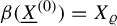 .
.
Proposition 3.4. As a scaled ordered group,
$\mathrm {K}_0(C(\underline {X})\rtimes _{\varphi _{\{\mathsf {0,1}\}}}\mathbb {Z})$
 is isomorphic to

Proof. Set
$A{:=}q C(\underline {X})\rtimes _{\varphi _{\{\mathsf {0,1}\}}}\mathbb {Z}$
 ,
$B{:=}q C(X_\varrho )\rtimes _{\varphi _{\mathsf {A}}}\mathbb {Z}$
,
$B{:=}q C(X_\varrho )\rtimes _{\varphi _{\mathsf {A}}}\mathbb {Z}$
 and let
$u_A\in A$
and let
$u_A\in A$
 ,
$u_B\in B$
,
$u_B\in B$
 be the unitaries that are implementing the respective
$\mathbb {Z}$
be the unitaries that are implementing the respective
$\mathbb {Z}$
 -actions, in the sense that
$u_Afu_A^* = f\circ \varphi _{\{\mathsf {0,1}\}}^{-1}$
-actions, in the sense that
$u_Afu_A^* = f\circ \varphi _{\{\mathsf {0,1}\}}^{-1}$
 for all
$f\in C(\underline {X})$
for all
$f\in C(\underline {X})$
 and
$u_Bfu_B^* = f\circ \varphi _{\mathsf {A}}^{-1}$
and
$u_Bfu_B^* = f\circ \varphi _{\mathsf {A}}^{-1}$
 for all
$f\in C(X_\varrho )$
for all
$f\in C(X_\varrho )$
 . We will show that
$A\cong \mathrm {M}_2(B)$
. We will show that
$A\cong \mathrm {M}_2(B)$
 , from which it follows that
$\mathrm {K}_0(A) \cong \mathrm {K}_0(B)$
, from which it follows that
$\mathrm {K}_0(A) \cong \mathrm {K}_0(B)$
 as ordered abelian groups, with
$[1_A]_0$
as ordered abelian groups, with
$[1_A]_0$
 identified with
$2[1_B]_0$
identified with
$2[1_B]_0$
 , and so by Proposition 3.2 and
$2$
, and so by Proposition 3.2 and
$2$
 -divisibility of
$\mathbb {Z}[\tfrac {1}{2}]$
-divisibility of
$\mathbb {Z}[\tfrac {1}{2}]$
 , it follows that
$(\mathrm {K}_0(A),\mathrm {K}_0(A)_+,[1_A]_0)$
, it follows that
$(\mathrm {K}_0(A),\mathrm {K}_0(A)_+,[1_A]_0)$
 is isomorphic to

Indeed, let
$p\in C(\underline {X})$
 be the indicator function of
$\underline {X}^{(0)}$
be the indicator function of
$\underline {X}^{(0)}$
 and set
$v{:=}q pu_A^*\in A$
and set
$v{:=}q pu_A^*\in A$
 . Note that
$vv^* = p$
. Note that
$vv^* = p$
 and that
$v^*v = 1_A-p$
and that
$v^*v = 1_A-p$
 , since
$\varphi _{\{\mathsf {0,1}\}}(\underline {X}^{(0)})=\underline {X}^{(1)}=\underline {X}\setminus \underline {X}^{(0)}$
, since
$\varphi _{\{\mathsf {0,1}\}}(\underline {X}^{(0)})=\underline {X}^{(1)}=\underline {X}\setminus \underline {X}^{(0)}$
 . Sending v and
$v^*$
. Sending v and
$v^*$
 to the matrix units
$e_{12}$
to the matrix units
$e_{12}$
 and
$e_{21}$
and
$e_{21}$
 , respectively,
$A\cong \mathrm {M}_2(pAp)$
, respectively,
$A\cong \mathrm {M}_2(pAp)$
 and so it suffices to show that
$B \cong pAp$
and so it suffices to show that
$B \cong pAp$
 . Let
$\vartheta \colon C(X_\varrho )\to C(\underline {X}^{(0)})\cong pC(\underline {X})p\subset pAp$
. Let
$\vartheta \colon C(X_\varrho )\to C(\underline {X}^{(0)})\cong pC(\underline {X})p\subset pAp$
 be the
$^*$
be the
$^*$
 -homomorphism

and let
$\tilde {u}{:=}q pu_A^2p$
 . Then,

and so we obtain a
${}^{\ast }$
 -homomorphism
$C(X_\varrho )\rtimes _{\varphi _{\mathsf {A}}}\mathbb {Z}\to pAp $
-homomorphism
$C(X_\varrho )\rtimes _{\varphi _{\mathsf {A}}}\mathbb {Z}\to pAp $
 that is injective since the domain is simple [Reference Archbold and Spielberg2]. Moreover, it is surjective since the range clearly contains
$pC(\underline {X})p$
that is injective since the domain is simple [Reference Archbold and Spielberg2]. Moreover, it is surjective since the range clearly contains
$pC(\underline {X})p$
 and
$\tilde {u}=pu_A^2p$
and
$\tilde {u}=pu_A^2p$
 , while
$pu_Ap=0$
, while
$pu_Ap=0$
 .
.
At this point, the auxiliary subshift
$X_\varrho $
 has done its duty and it can go; this also means we can return to the alphabet
$\{\mathsf {0},\mathsf {1}\}$
has done its duty and it can go; this also means we can return to the alphabet
$\{\mathsf {0},\mathsf {1}\}$
 and write just
$\varphi $
and write just
$\varphi $
 instead of
$\varphi _{\{\mathsf {0},\mathsf {1}\}}$
instead of
$\varphi _{\{\mathsf {0},\mathsf {1}\}}$
 .
.
Remark 3.5. Regarding the free involution
$\sigma $
 on
$\underline {X}$
on
$\underline {X}$
 , observe that the map
$\sigma _*\colon C(\underline {X},\mathbb {Z})\to C(\underline {X},\mathbb {Z})$
, observe that the map
$\sigma _*\colon C(\underline {X},\mathbb {Z})\to C(\underline {X},\mathbb {Z})$
 , given by
$f\mapsto f\circ \sigma ^{-1}$
, given by
$f\mapsto f\circ \sigma ^{-1}$
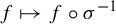 , satisfies
$\sigma _*(\mathrm {im}(1-\varphi _*)) \subset \mathrm {im}(1-\varphi _*)$
, satisfies
$\sigma _*(\mathrm {im}(1-\varphi _*)) \subset \mathrm {im}(1-\varphi _*)$
 since
$\sigma $
since
$\sigma $
 anti-commutes with
$\varphi $
anti-commutes with
$\varphi $
 . Clearly,
$\sigma _*$
. Clearly,
$\sigma _*$
 maps the set of non-negative valued functions onto itself and the constant function
$1$
maps the set of non-negative valued functions onto itself and the constant function
$1$
 to itself, so it follows that
$\sigma _*$
to itself, so it follows that
$\sigma _*$
 induces an isomorphism of scaled ordered groups, which (with a slight abuse of notation) we also denote by
$\sigma _*\colon ({C(\underline {X},\mathbb {Z})}/{\mathrm {im}(1-\varphi _*)})\to ({C(\underline {X},\mathbb {Z})}/{\mathrm {im}(1-\varphi _*)})$
induces an isomorphism of scaled ordered groups, which (with a slight abuse of notation) we also denote by
$\sigma _*\colon ({C(\underline {X},\mathbb {Z})}/{\mathrm {im}(1-\varphi _*)})\to ({C(\underline {X},\mathbb {Z})}/{\mathrm {im}(1-\varphi _*)})$
 and which moreover has order
$2$
and which moreover has order
$2$
 , since
$\sigma ^2=\mathrm {id}$
, since
$\sigma ^2=\mathrm {id}$
 .
.
The following lemma implies that the action induced by
$\sigma $
 on
$\mathrm {K}_0(C(\underline {X})\rtimes _\varphi \mathbb {Z})$
on
$\mathrm {K}_0(C(\underline {X})\rtimes _\varphi \mathbb {Z})$
 is non-trivial. This also settles a problem raised by Scarparo in [Reference Scarparo43, Remark 2.3(ii)].
Lemma 3.6. The automorphism
$\sigma _*\colon ({C(\underline {X},\mathbb {Z})}/{\mathrm {im}(1-\varphi _*)})\to ({C(\underline {X},\mathbb {Z})}/{\mathrm {im}(1-\varphi _*)})$
 is not the identity.
Proof. We show that there is some
$h\in C(\underline {X},\mathbb {Z})$
 such that
$h-\sigma _*(h)$
such that
$h-\sigma _*(h)$
 does not lie in
$\mathrm {im}(1-\varphi _*)$
does not lie in
$\mathrm {im}(1-\varphi _*)$
 , which is equivalent to
$[h] \ne \sigma _*[h]$
, which is equivalent to
$[h] \ne \sigma _*[h]$
 . Note that if
$g\in \mathrm {im}(1-\varphi _*)$
. Note that if
$g\in \mathrm {im}(1-\varphi _*)$
 , then by writing
$g=f-f\circ \varphi ^{-1}$
, then by writing
$g=f-f\circ \varphi ^{-1}$
 for some
$f\in C(\underline {X},\mathbb {Z})$
for some
$f\in C(\underline {X},\mathbb {Z})$
 , we have that

for all
$x\in \underline {X}$
 and all
$n\in \mathbb {N}$
and all
$n\in \mathbb {N}$
 , which is to say that

(Note that (3.24) is also a sufficient condition for g to lie in
$\mathrm {im}(1-\varphi _*)$
 due to the Gottschalk–Hedlund theorem, but we do not make use of this.)
Let
$[\mathsf {1}]$
 and
$[\mathsf {0}]$
and
$[\mathsf {0}]$
 denote the (clopen) subsets of
$\underline {X}$
denote the (clopen) subsets of
$\underline {X}$
 of those
$(x_j)_{j\in \mathbb {Z}}\in \underline {X}$
of those
$(x_j)_{j\in \mathbb {Z}}\in \underline {X}$
 such that
$x_0=\mathsf {1}$
such that
$x_0=\mathsf {1}$
 and
$x_0=\mathsf {0}$
and
$x_0=\mathsf {0}$
 , respectively. Note that
$\chi _{[\mathsf {1}]}-\sigma _*(\chi _{[\mathsf {1}]})=\chi _{[\mathsf {1}]}-\chi _{[\mathsf {0}]}$
, respectively. Note that
$\chi _{[\mathsf {1}]}-\sigma _*(\chi _{[\mathsf {1}]})=\chi _{[\mathsf {1}]}-\chi _{[\mathsf {0}]}$
 and for the specific
$g := \chi _{[\mathsf {1}]}-\chi _{[\mathsf {0}]} \in C(\underline {X},\mathbb {Z})$
and for the specific
$g := \chi _{[\mathsf {1}]}-\chi _{[\mathsf {0}]} \in C(\underline {X},\mathbb {Z})$
 , observe that for
$x\in \underline {X}$
, observe that for
$x\in \underline {X}$
 and
$n\in \mathbb {N}$
and
$n\in \mathbb {N}$
 , we have

Let
$\tilde {x}\in \underline {X}$
 be such that
$\tilde {x}_{[0,\infty )}=\underline {t}$
be such that
$\tilde {x}_{[0,\infty )}=\underline {t}$
 (cf. Proposition 2.3) and recursively define a sequence
$(m_n)_{n=0}^\infty \subset \mathbb {N}$
(cf. Proposition 2.3) and recursively define a sequence
$(m_n)_{n=0}^\infty \subset \mathbb {N}$
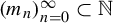 by setting
$m_0{:=}q 0$
by setting
$m_0{:=}q 0$
 and
and

Note that
$m_n$
 is odd if and only if n is odd (and so
$m_n$
is odd if and only if n is odd (and so
$m_n$
 is even if and only if n is even), and that
$m_n\le 2^{n+1}-2$
is even if and only if n is even), and that
$m_n\le 2^{n+1}-2$
 for all
$n\in \mathbb {N}$
for all
$n\in \mathbb {N}$
 . We claim that

which we prove by induction. For
$n=0$
 , the claim is directly seen to be true. Assume now that the claim is true for some even
$n\in \mathbb {N}$
, the claim is directly seen to be true. Assume now that the claim is true for some even
$n\in \mathbb {N}$
 and let us prove it for
$n+1$
and let us prove it for
$n+1$
 . Since
$m_{n+1}\le 2^{n+2}-2$
. Since
$m_{n+1}\le 2^{n+2}-2$
 and
$|t_{n+1}|=2^{n+2}-1$
and
$|t_{n+1}|=2^{n+2}-1$
 , we have that
$\underline {t}_{[0,m_{n+1}]}$
, we have that
$\underline {t}_{[0,m_{n+1}]}$
 is an initial segment of
$t_{n+1}$
is an initial segment of
$t_{n+1}$
 . By (2.6) (with
$p=0$
. By (2.6) (with
$p=0$
 therein),

with
$x_1\cdots x_{2^{n+1}-1}=t_{n}$
 and so
$x_1\cdots x_{m_n}x_{m_n+1} = \underline {t}_{[0,m_n]}$
and so
$x_1\cdots x_{m_n}x_{m_n+1} = \underline {t}_{[0,m_n]}$
 . Since
$m_{n+1}=2m_n+1$
. Since
$m_{n+1}=2m_n+1$
 and since
$m_n$
and since
$m_n$
 is even,

whence

while

and so

as we wanted. A similar argument proves the claim for
$n+1$
 under the assumption that the claim is true for some odd
$n\in \mathbb {N}$
under the assumption that the claim is true for some odd
$n\in \mathbb {N}$
 .
.
Since
$\tilde {x}_{[0,\infty )}=t$
 , by (3.27) and (3.25), we see that (3.24) is violated for this particular g and thus
$\sigma _*$
, by (3.27) and (3.25), we see that (3.24) is violated for this particular g and thus
$\sigma _*$
 does not act as the identity on the equivalence class of
$\chi _{[\mathsf {1}]}$
does not act as the identity on the equivalence class of
$\chi _{[\mathsf {1}]}$
 , which completes the proof.
Corollary 3.7. We have an isomorphism of abelian groups

Proof. By Proposition 3.4 together with [Reference Putnam39, Theorem 1.1], we get
${C(\underline {X},\mathbb {Z})}/{\mathrm {im}(1-\varphi _*)} \cong \mathrm {K}_0(C(\underline {X})\rtimes _\varphi \mathbb {Z})\cong \mathbb {Z}[\tfrac {1}{2}]\oplus \mathbb {Z}$
 with an isomorphism that carries
$[1]$
with an isomorphism that carries
$[1]$
 to
$(1,0)$
to
$(1,0)$
 . Under this isomorphism,
$\sigma _*$
. Under this isomorphism,
$\sigma _*$
 becomes an order
$2$
becomes an order
$2$
 automorphism on
$\mathbb {Z}[\tfrac {1}{2}]\oplus \mathbb {Z}$
automorphism on
$\mathbb {Z}[\tfrac {1}{2}]\oplus \mathbb {Z}$
 that maps
$(1,0)$
that maps
$(1,0)$
 to itself, and by
$2$
to itself, and by
$2$
 -divisibility of
$\mathbb {Z}[\tfrac {1}{2}]$
-divisibility of
$\mathbb {Z}[\tfrac {1}{2}]$
 , it follows that
$\sigma _*(q,0)=(q,0)$
, it follows that
$\sigma _*(q,0)=(q,0)$
 for all
$q\in \mathbb {Z}[\tfrac {1}{2}]$
for all
$q\in \mathbb {Z}[\tfrac {1}{2}]$
 . Moreover, there are group homomorphisms
$\alpha _1\colon \mathbb {Z}\to \mathbb {Z}[\tfrac {1}{2}]$
. Moreover, there are group homomorphisms
$\alpha _1\colon \mathbb {Z}\to \mathbb {Z}[\tfrac {1}{2}]$
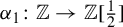 and
$\alpha _2\colon \mathbb {Z}\to \mathbb {Z}$
and
$\alpha _2\colon \mathbb {Z}\to \mathbb {Z}$
 such that

and so

We then have that
$\alpha _2^2=\mathrm {id}_{\mathbb {Z}}$
 , and so
$\alpha _2=\mathrm {id}_{\mathbb {Z}}$
, and so
$\alpha _2=\mathrm {id}_{\mathbb {Z}}$
 or
$\alpha _2=-\mathrm {id}_{\mathbb {Z}}$
or
$\alpha _2=-\mathrm {id}_{\mathbb {Z}}$
 . If however
$\alpha _2=\mathrm {id}_{\mathbb {Z}}$
. If however
$\alpha _2=\mathrm {id}_{\mathbb {Z}}$
 , then
$2\alpha _1(n)=\alpha _1(2n)=0$
, then
$2\alpha _1(n)=\alpha _1(2n)=0$
 for all
$n\in \mathbb {Z}$
for all
$n\in \mathbb {Z}$
 and so
$\alpha _1=0$
and so
$\alpha _1=0$
 (by
$2$
(by
$2$
 -divisibility of
$\mathbb {Z}[\tfrac {1}{2}]$
-divisibility of
$\mathbb {Z}[\tfrac {1}{2}]$
 ), whence
$\sigma _*=\mathrm {id}$
), whence
$\sigma _*=\mathrm {id}$
 , which is impossible by the preceding lemma. We thus have
$\alpha _2=-\mathrm {id}_{\mathbb {Z}}$
, which is impossible by the preceding lemma. We thus have
$\alpha _2=-\mathrm {id}_{\mathbb {Z}}$
 ; hence, for any
$(q,n)\in \mathbb {Z}[\tfrac {1}{2}]\oplus \mathbb {Z}$
; hence, for any
$(q,n)\in \mathbb {Z}[\tfrac {1}{2}]\oplus \mathbb {Z}$
 , we have

which shows that
$(1+\sigma _*)(\mathbb {Z}[\tfrac {1}{2}]\oplus \mathbb {Z})\subset \mathbb {Z}[\tfrac {1}{2}]\oplus 0$
 . The reverse inclusion is now also immediate since
$(q,0) = (1+\sigma _*)(q/2,0)$
. The reverse inclusion is now also immediate since
$(q,0) = (1+\sigma _*)(q/2,0)$
 and, thus, we conclude that
$(1+\sigma _*)(\mathbb {Z}[\tfrac {1}{2}]\oplus \mathbb {Z}) = \mathbb {Z}[\tfrac {1}{2}]\oplus 0\cong \mathbb {Z}[\tfrac {1}{2}]$
and, thus, we conclude that
$(1+\sigma _*)(\mathbb {Z}[\tfrac {1}{2}]\oplus \mathbb {Z}) = \mathbb {Z}[\tfrac {1}{2}]\oplus 0\cong \mathbb {Z}[\tfrac {1}{2}]$
 as we wanted.
We are now headed towards computing the
$\mathrm {K}$
 -theory of the crossed product
$\mathrm {C}^\ast $
-theory of the crossed product
$\mathrm {C}^\ast $
 -algebra of the action
$(\varphi ,\sigma )\colon \mathbb {Z}\rtimes \mathbb {Z}_2\curvearrowright \underline {X}$
-algebra of the action
$(\varphi ,\sigma )\colon \mathbb {Z}\rtimes \mathbb {Z}_2\curvearrowright \underline {X}$
 of Corollary 2.5.
Remark 3.8. The
$\mathrm {K}$
 -theory of crossed products of Cantor minimal
$\mathbb {Z}\rtimes \mathbb {Z}_2$
-theory of crossed products of Cantor minimal
$\mathbb {Z}\rtimes \mathbb {Z}_2$
 systems is treated in [Reference Thomsen49, §4], building on [Reference Bratteli, Evans and Kishimoto12] (and mainly using [Reference Natsume36]). In particular, let
$(\varphi ,\sigma )\colon \mathbb {Z}\rtimes \mathbb {Z}_2\curvearrowright \Omega $
systems is treated in [Reference Thomsen49, §4], building on [Reference Bratteli, Evans and Kishimoto12] (and mainly using [Reference Natsume36]). In particular, let
$(\varphi ,\sigma )\colon \mathbb {Z}\rtimes \mathbb {Z}_2\curvearrowright \Omega $
 be a free action on a Cantor space
$\Omega $
be a free action on a Cantor space
$\Omega $
 with
$\varphi \colon \mathbb {Z}\curvearrowright \Omega $
with
$\varphi \colon \mathbb {Z}\curvearrowright \Omega $
 minimal and let
$A{:=}q C(\Omega )\rtimes (\mathbb {Z}\rtimes \mathbb {Z}_2)$
minimal and let
$A{:=}q C(\Omega )\rtimes (\mathbb {Z}\rtimes \mathbb {Z}_2)$
 . In [Reference Thomsen49, Theorem 4.42], it is shown that

as abelian groups. This adjusts the respective calculation from [Reference Bratteli, Evans and Kishimoto12], where the summand
$\mathbb {Z}_2$
 was overlooked in the case of absence of fixed points, cf. [Reference Thomsen49, Remark 4.43]. In [Reference Thomsen49, (4.24)], Thomsen tacitly makes an identification when describing
$\mathrm {K}_0(A)$
was overlooked in the case of absence of fixed points, cf. [Reference Thomsen49, Remark 4.43]. In [Reference Thomsen49, (4.24)], Thomsen tacitly makes an identification when describing
$\mathrm {K}_0(A)$
 as the cokernel of the map
$(i_{1*},i_{2*})$
as the cokernel of the map
$(i_{1*},i_{2*})$
 (as opposed to the cokernel of
$(i_{1*}, -i_{2*})$
(as opposed to the cokernel of
$(i_{1*}, -i_{2*})$
 , in accordance with the exact sequences in [Reference Natsume36, Theorem A1] and [Reference Bratteli, Evans and Kishimoto12, Lemma 4.2]; cf. [Reference Kumjian29]). For our purposes, it is important to keep track of where
$[1_A]_0$
, in accordance with the exact sequences in [Reference Natsume36, Theorem A1] and [Reference Bratteli, Evans and Kishimoto12, Lemma 4.2]; cf. [Reference Kumjian29]). For our purposes, it is important to keep track of where
$[1_A]_0$
 is mapped through the isomorphism in (3.29), which is why below, we revisit Thomsen’s proof of [Reference Thomsen49, Theorem 4.42], yet bypassing the aforementioned identification.
Note first that freeness ensures that there are clopen sets
$K, L\subset \Omega $
 such that

cf. [Reference Thomsen49, Lemma 4.38]. Just as in [Reference Thomsen49, p. 302], set

We have isomorphisms
$\mathrm {K}_0(C(\Omega )\rtimes _\sigma \mathbb {Z}_2)\cong G_\sigma $
 and
$\mathrm {K}_0(C(\Omega )\rtimes _{\varphi \sigma }\mathbb {Z}_2)\cong G_{\varphi \sigma }$
and
$\mathrm {K}_0(C(\Omega )\rtimes _{\varphi \sigma }\mathbb {Z}_2)\cong G_{\varphi \sigma }$
 satisfying
$[\chi _E]_0 \mapsto \chi _E+\chi _{\sigma (E)}$
satisfying
$[\chi _E]_0 \mapsto \chi _E+\chi _{\sigma (E)}$
 and
$[\chi _E]_0\mapsto \chi _E+\chi _{\varphi \sigma (E)}$
and
$[\chi _E]_0\mapsto \chi _E+\chi _{\varphi \sigma (E)}$
 , respectively, for any clopen set
$E \subset \Omega $
, respectively, for any clopen set
$E \subset \Omega $
 (see [Reference Thomsen49, p. 302]). By [Reference Bratteli, Evans and Kishimoto12, Lemma 4.2] (based on [Reference Natsume36]), we thus have a commutative diagram with rows that are short exact sequences:

where
$\iota {:=}q (i_{1*},-i_{2*})$
 ,
$\pi {:=}q j_{1*}+j_{2*}$
,
$\pi {:=}q j_{1*}+j_{2*}$
 with
with

being the canonical embeddings,

and
$\bar {\pi }$
 satisfies

for all clopen sets
$E,F\subset \Omega $
 .
.
Consider the map
$\mathbb {Z}\ni z\mapsto (z,-z)\in G_\sigma \oplus G_{\varphi \sigma }$
 (essentially as in [Reference Thomsen49, p. 302]), which by minimality is seen to induce an injection
$t\colon \mathbb {Z}_2\to \mathrm {K}_0(A)$
(essentially as in [Reference Thomsen49, p. 302]), which by minimality is seen to induce an injection
$t\colon \mathbb {Z}_2\to \mathrm {K}_0(A)$
 exactly as in the lines following [Reference Thomsen49, (4.27)]. Note also that the
$2$
exactly as in the lines following [Reference Thomsen49, (4.27)]. Note also that the
$2$
 -torsion element
$t(1)\in \mathrm {K}_0(A)$
-torsion element
$t(1)\in \mathrm {K}_0(A)$
 is given by
$t(1)=[\chi _K]_0 - [\chi _L]_0$
is given by
$t(1)=[\chi _K]_0 - [\chi _L]_0$
 (cf. (3.30)).
We consider the map
$G_\sigma \oplus G_{\varphi \sigma }\ni (f,g)\mapsto f+g\in C(\Omega ,\mathbb {Z})$
 composed with the quotient map
$C(\Omega ,\mathbb {Z})\to C(\Omega ,\mathbb {Z})/\mathrm {im}(1-\varphi _*)$
composed with the quotient map
$C(\Omega ,\mathbb {Z})\to C(\Omega ,\mathbb {Z})/\mathrm {im}(1-\varphi _*)$
 , which vanishes on elements of the form
$(h+h\circ \sigma , -h-h\circ \varphi \sigma )$
, which vanishes on elements of the form
$(h+h\circ \sigma , -h-h\circ \varphi \sigma )$
 and thus induces a map
$s\colon \mathrm {K}_0(A) \to C(\Omega ,\mathbb {Z})/\mathrm {im}(1-\varphi _*)$
and thus induces a map
$s\colon \mathrm {K}_0(A) \to C(\Omega ,\mathbb {Z})/\mathrm {im}(1-\varphi _*)$
 . Upon making the necessary (albeit straightforward) modifications in the proof of [Reference Thomsen49, Lemma 4.41], we see that

is short-exact. Finally, by exactness of (3.33), since the quotient is torsion free and since
$\mathbb {Z}_2$
 is cyclic, one applies Kulikov’s theorem [Reference Fuchs24, Theorem 24.5] exactly as in the proof of [Reference Thomsen49, Theorem 4.42] to obtain that (3.33) is split exact, and in particular, as abelian groups,

Note that
$[1_A]_0 = \bar {\pi }(2,0)$
 by (3.32), whence
$s([1_A]_0)= (1+\sigma _*)([1])$
by (3.32), whence
$s([1_A]_0)= (1+\sigma _*)([1])$
 (which is equal to
$2\cdot [1]$
(which is equal to
$2\cdot [1]$
 since
$\sigma _*([1])=[1]$
since
$\sigma _*([1])=[1]$
 ), and so under the isomorphism above,
$[1_A]_0$
), and so under the isomorphism above,
$[1_A]_0$
 is identified with either
$(0,2\cdot [1])$
is identified with either
$(0,2\cdot [1])$
 or
$(1,2\cdot [1])$
or
$(1,2\cdot [1])$
 . We embrace this ambiguity for the time being also in the following proposition, which will give sufficiently precise information to prove our main result in the subsequent section.
Proposition 3.9. Let
$A{:=}q C(\underline {X})\rtimes (\mathbb {Z}\rtimes \mathbb {Z}_2)$
 be the crossed product associated to the action of Corollary 2.5. Then, A is a classifiable
$\mathrm {C}^\ast $
be the crossed product associated to the action of Corollary 2.5. Then, A is a classifiable
$\mathrm {C}^\ast $
 -algebra (cf. definition of classifiable appearing after Theorem A) that has unique trace,
$\mathrm {K}_1(A)=0$
-algebra (cf. definition of classifiable appearing after Theorem A) that has unique trace,
$\mathrm {K}_1(A)=0$
 and
$(\mathrm {K}_0(A),\mathrm {K}_0(A)_+,[1_A]_0)$
and
$(\mathrm {K}_0(A),\mathrm {K}_0(A)_+,[1_A]_0)$
 is isomorphic as a scaled ordered group either to

or to

Moreover, the pair
$(C(\underline {X})\subset A)$
 is a Cantor spectrum diagonal.
Proof. Clearly, A is a unital and separable
$\mathrm {C}^\ast $
 -algebra, which is also nuclear as the crossed product of an action of an amenable group on a compact metric space. Moreover, A is simple, as the crossed product of a free minimal action; see [Reference Archbold and Spielberg2]. By [Reference Downarowicz and Zhang17], since
$\mathbb {Z}\rtimes \mathbb {Z}_2$
-algebra, which is also nuclear as the crossed product of an action of an amenable group on a compact metric space. Moreover, A is simple, as the crossed product of a free minimal action; see [Reference Archbold and Spielberg2]. By [Reference Downarowicz and Zhang17], since
$\mathbb {Z}\rtimes \mathbb {Z}_2$
 has polynomial growth, the underlying action is almost finite and so A is
$\mathcal {Z}$
has polynomial growth, the underlying action is almost finite and so A is
$\mathcal {Z}$
 -stable by [Reference Kerr27]. (Alternatively, note that A has finite nuclear dimension by [Reference Bönicke and Li10, Corollary C] and, thus, is
$\mathcal {Z}$
-stable by [Reference Kerr27]. (Alternatively, note that A has finite nuclear dimension by [Reference Bönicke and Li10, Corollary C] and, thus, is
$\mathcal {Z}$
 -stable by [Reference Winter54].) The pair
$(C(\underline {X})\subset A)$
-stable by [Reference Winter54].) The pair
$(C(\underline {X})\subset A)$
 is a
$\mathrm {C}^\ast $
is a
$\mathrm {C}^\ast $
 -diagonal since the action
$\mathbb {Z}\rtimes \mathbb {Z}_2\curvearrowright \underline {X}$
-diagonal since the action
$\mathbb {Z}\rtimes \mathbb {Z}_2\curvearrowright \underline {X}$
 is free and, thus, A also satisfies the UCT by [Reference Barlak and Li3].
Note that the action
$\varphi \colon \mathbb {Z}\curvearrowright \underline {X}$
 is uniquely ergodic (this follows from the fact that
$\varphi \colon \mathbb {Z}\curvearrowright X_\varrho $
is uniquely ergodic (this follows from the fact that
$\varphi \colon \mathbb {Z}\curvearrowright X_\varrho $
 is uniquely ergodic and that the two Cantor minimal systems are (strongly) orbit equivalent in the sense of [Reference Giordano, Putnam and Skau25], due to Propositions 3.4 and 3.2, and thus have affinely homeomorphic simplices of invariant measures [Reference Giordano, Putnam and Skau25, Theorem 2.2]). Since the invariant measures of the dynamical system
$\mathbb {Z}\rtimes \mathbb {Z}_2\curvearrowright \underline {X}$
is uniquely ergodic and that the two Cantor minimal systems are (strongly) orbit equivalent in the sense of [Reference Giordano, Putnam and Skau25], due to Propositions 3.4 and 3.2, and thus have affinely homeomorphic simplices of invariant measures [Reference Giordano, Putnam and Skau25, Theorem 2.2]). Since the invariant measures of the dynamical system
$\mathbb {Z}\rtimes \mathbb {Z}_2\curvearrowright \underline {X}$
 are a subset of the invariant measures of the action of the
$\mathbb {Z}$
are a subset of the invariant measures of the action of the
$\mathbb {Z}$
 -subgroup and since any action of an amenable group admits an invariant measure,
$\mathbb {Z}\rtimes \mathbb {Z}_2\curvearrowright \underline {X}$
-subgroup and since any action of an amenable group admits an invariant measure,
$\mathbb {Z}\rtimes \mathbb {Z}_2\curvearrowright \underline {X}$
 is uniquely ergodic and, thus, A has a unique trace, since in this setting, there is an affine homeomorphism between the space of tracial states on A and the Borel probability
$\mathbb {Z}\rtimes \mathbb {Z}_2$
is uniquely ergodic and, thus, A has a unique trace, since in this setting, there is an affine homeomorphism between the space of tracial states on A and the Borel probability
$\mathbb {Z}\rtimes \mathbb {Z}_2$
 -invariant measures on
$\underline {X}$
-invariant measures on
$\underline {X}$
 (cf. [Reference Li and Renault32, §4.1]).
It follows from [Reference Thomsen49, Theorem 4.42] that
$\mathrm {K}_1(A)=0$
 , so it remains to compute the
$\mathrm {K}_0$
, so it remains to compute the
$\mathrm {K}_0$
 -group. Combining Corollary 3.7 with Remark 3.8, we have that
$\mathrm {K}_0(A)\cong \mathbb {Z}_2\oplus \mathbb {Z}[\tfrac {1}{2}]$
-group. Combining Corollary 3.7 with Remark 3.8, we have that
$\mathrm {K}_0(A)\cong \mathbb {Z}_2\oplus \mathbb {Z}[\tfrac {1}{2}]$
 , and
$[1_A]_0$
, and
$[1_A]_0$
 corresponds either to the element
$(0,4)$
corresponds either to the element
$(0,4)$
 or to
$(1,4)$
or to
$(1,4)$
 . Moreover, since the map
$\mathbb {Z}_2\oplus \mathbb {Z}[\tfrac {1}{2}]\ni (x,y)\mapsto (x,\tfrac {1}{4}y)\in \mathbb {Z}_2\oplus \mathbb {Z}[\tfrac {1}{2}]$
. Moreover, since the map
$\mathbb {Z}_2\oplus \mathbb {Z}[\tfrac {1}{2}]\ni (x,y)\mapsto (x,\tfrac {1}{4}y)\in \mathbb {Z}_2\oplus \mathbb {Z}[\tfrac {1}{2}]$
 is a group automorphism that maps
$(0,4)$
is a group automorphism that maps
$(0,4)$
 to
$(0,1)$
to
$(0,1)$
 and
$(1,4)$
and
$(1,4)$
 to
$(1,1)$
to
$(1,1)$
 , we obtain a group isomorphism
$\mathrm {K}_0(A)\cong \mathbb {Z}_2\oplus \mathbb {Z}[\tfrac {1}{2}]$
, we obtain a group isomorphism
$\mathrm {K}_0(A)\cong \mathbb {Z}_2\oplus \mathbb {Z}[\tfrac {1}{2}]$
 with
$[1_A]_0$
with
$[1_A]_0$
 identified either with
$(0,1)$
identified either with
$(0,1)$
 or with
$(1,1)$
or with
$(1,1)$
 .
.
Since A is simple, the ordered group
$(\mathrm {K}_0(A),\mathrm {K}_0(A)_+)$
 is simple and by [Reference Thomsen49, Corollary 4.33], A has tracial topological rank zero (in the sense of Lin [Reference Rørdam and Størmer42, Definition 3.3.4]), whence by [Reference Lin33], we have that the ordered group
$(\mathrm {K}_0(A),\mathrm {K}_0(A)_+)$
is simple and by [Reference Thomsen49, Corollary 4.33], A has tracial topological rank zero (in the sense of Lin [Reference Rørdam and Størmer42, Definition 3.3.4]), whence by [Reference Lin33], we have that the ordered group
$(\mathrm {K}_0(A),\mathrm {K}_0(A)_+)$
 is weakly unperforated. We can thus apply [Reference Blackadar6, Theorem 6.8.5] to conclude that
$\mathrm {K}_0(A)_+$
is weakly unperforated. We can thus apply [Reference Blackadar6, Theorem 6.8.5] to conclude that
$\mathrm {K}_0(A)_+$
 is equal to the set

where
$\mathrm {S}(\mathrm {K}_0(A),\mathrm {K}_0(A)_+,[1_A]_0)$
 denotes the set of states of the scaled ordered group
$(\mathrm {K}_0(A),\mathrm {K}_0(A)_+,[1_A]_0)$
denotes the set of states of the scaled ordered group
$(\mathrm {K}_0(A),\mathrm {K}_0(A)_+,[1_A]_0)$
 . If
$\gamma $
. If
$\gamma $
 is a state on
$\mathrm {K}_0(A)$
is a state on
$\mathrm {K}_0(A)$
 , then it induces a group homomorphism
$\mathbb {Z}_2\oplus \mathbb {Z}[\tfrac {1}{2}]\to \mathbb {R}$
, then it induces a group homomorphism
$\mathbb {Z}_2\oplus \mathbb {Z}[\tfrac {1}{2}]\to \mathbb {R}$
 upon composing with the isomorphism
$\mathrm {K}_0(A)\cong \mathbb {Z}_2\oplus \mathbb {Z}[\tfrac {1}{2}]$
upon composing with the isomorphism
$\mathrm {K}_0(A)\cong \mathbb {Z}_2\oplus \mathbb {Z}[\tfrac {1}{2}]$
 . This map is necessarily
$0$
. This map is necessarily
$0$
 on the
$\mathbb {Z}_2$
on the
$\mathbb {Z}_2$
 -summand since
$\mathbb {R}$
-summand since
$\mathbb {R}$
 is torsion free and maps either
$(1,1)$
is torsion free and maps either
$(1,1)$
 or
$(0,1)$
or
$(0,1)$
 to
$1$
to
$1$
 (depending on which element corresponds to
$[1_A]_0$
(depending on which element corresponds to
$[1_A]_0$
 ): in either case, since the map vanishes on the
$\mathbb {Z}_2$
): in either case, since the map vanishes on the
$\mathbb {Z}_2$
 -summand,
$(0,1)$
-summand,
$(0,1)$
 is mapped to
$1$
is mapped to
$1$
 and so this map is necessarily the canonical embedding of the
$\mathbb {Z}[\tfrac {1}{2}]$
and so this map is necessarily the canonical embedding of the
$\mathbb {Z}[\tfrac {1}{2}]$
 -summand into
$\mathbb {R}$
-summand into
$\mathbb {R}$
 . By this observation and (3.36), we conclude that
$\mathrm {K}_0(A)_+$
. By this observation and (3.36), we conclude that
$\mathrm {K}_0(A)_+$
 is carried onto
$\{(x,q)\in \mathbb {Z}_2\oplus \mathbb {Z}[\tfrac {1}{2}]: q>0\}\cup \{(0,0)\}$
is carried onto
$\{(x,q)\in \mathbb {Z}_2\oplus \mathbb {Z}[\tfrac {1}{2}]: q>0\}\cup \{(0,0)\}$
 and the proof is complete.
Remark 3.10. To expand the scope of our method to more examples like, say, other UHF algebras, it would be interesting to employ groupoid cohomology along the lines of [Reference Bönicke, Dell’Aiera, Gabe and Willett9] in the framework of Matui’s HK conjecture; cf. [Reference Matui34].
4 Non-standard Cantor spectrum diagonals in the CAR algebra
We are now ready for the proof of Theorem A. We denote by
$(\mathrm {D}_{2^\infty } \subset \mathrm {M}_{2^\infty })$
 the standard
$\mathrm {C}^\ast $
the standard
$\mathrm {C}^\ast $
 -diagonal of the CAR algebra obtained as the inductive limit of diagonal
$2^n\times 2^n$
-diagonal of the CAR algebra obtained as the inductive limit of diagonal
$2^n\times 2^n$
 matrices.
Theorem 4.1. The CAR algebra
$\mathrm {M}_{2^\infty }$
 admits a Cantor spectrum diagonal
$(D \subset \mathrm {M}_{2^\infty })$
admits a Cantor spectrum diagonal
$(D \subset \mathrm {M}_{2^\infty })$
 that is not an AF diagonal.
Proof. Let
$(\varphi ,\sigma )\colon \mathbb {Z}\rtimes \mathbb {Z}_2\curvearrowright \underline {X}$
 be the action of Corollary 2.5 and set
$A{:=}q C(\underline {X})\rtimes _{(\varphi ,\sigma )}(\mathbb {Z}\rtimes \mathbb {Z}_2)$
be the action of Corollary 2.5 and set
$A{:=}q C(\underline {X})\rtimes _{(\varphi ,\sigma )}(\mathbb {Z}\rtimes \mathbb {Z}_2)$
 . Set
$B{:=}q A\otimes \mathrm {M}_{2^\infty }$
. Set
$B{:=}q A\otimes \mathrm {M}_{2^\infty }$
 and
$D{:=}q C(\underline {X})\otimes \mathrm {D}_{2^\infty }$
and
$D{:=}q C(\underline {X})\otimes \mathrm {D}_{2^\infty }$
 . The spectrum of D is the Cartesian product of the spectra of its factors, whence D has Cantor spectrum. Moreover,
$(D \subset B)$
. The spectrum of D is the Cartesian product of the spectra of its factors, whence D has Cantor spectrum. Moreover,
$(D \subset B)$
 is a
$\mathrm {C}^\ast $
is a
$\mathrm {C}^\ast $
 -diagonal [Reference Barlak and Li3, Lemma 5.1].
We first show that
$B\cong \mathrm {M}_{2^\infty }$
 , which we do via classification theory. Note that B is unital, simple and separable, and it is moreover nuclear as the tensor product of two nuclear
$\mathrm {C}^\ast $
, which we do via classification theory. Note that B is unital, simple and separable, and it is moreover nuclear as the tensor product of two nuclear
$\mathrm {C}^\ast $
 -algebras. Since B admits a Cartan subalgebra (namely D), it satisfies the UCT [Reference Barlak and Li3]. By its definition B is
$\mathrm {M}_{2^\infty }$
-algebras. Since B admits a Cartan subalgebra (namely D), it satisfies the UCT [Reference Barlak and Li3]. By its definition B is
$\mathrm {M}_{2^\infty }$
 -stable, which implies that B is
$\mathcal {Z}$
-stable, which implies that B is
$\mathcal {Z}$
 -stable, and since both A and
$\mathrm {M}_{2^\infty }$
-stable, and since both A and
$\mathrm {M}_{2^\infty }$
 have unique trace, so does B. As abelian groups, the
$\mathrm {K}$
have unique trace, so does B. As abelian groups, the
$\mathrm {K}$
 -theory of B can be computed via the Künneth formula [Reference Blackadar6, Theorem 23.1.3]: since the
$\mathrm {K}$
-theory of B can be computed via the Künneth formula [Reference Blackadar6, Theorem 23.1.3]: since the
$\mathrm {K}$
 -theory of
$\mathrm {M}_{2^\infty }$
-theory of
$\mathrm {M}_{2^\infty }$
 is torsion free and since
$\mathrm {K}_1(A)=\mathrm {K}_1(\mathrm {M}_{2^\infty })=0$
is torsion free and since
$\mathrm {K}_1(A)=\mathrm {K}_1(\mathrm {M}_{2^\infty })=0$
 (by Proposition 3.9), we have

In addition, using at the fourth line below that the tensor product of abelian groups is distributive with respect to direct sums and the fact that
$\mathbb {Z}_2$
 has
$2$
has
$2$
 -torsion, while
$\mathbb {Z}[\tfrac {1}{2}]$
-torsion, while
$\mathbb {Z}[\tfrac {1}{2}]$
 is
$2$
is
$2$
 -divisible, we have group isomorphisms


with (4.5) the isomorphism satisfying
$q_1\otimes q_2\mapsto q_1q_2$
 on elementary tensors. Note that
$[1_B]_0$
on elementary tensors. Note that
$[1_B]_0$
 is mapped to the elementary tensor
$[1_A]_0\otimes [1_{\mathrm {M}_{2^\infty }}]_0$
is mapped to the elementary tensor
$[1_A]_0\otimes [1_{\mathrm {M}_{2^\infty }}]_0$
 via the isomorphisms in (4.1) and (4.2) (cf. [Reference Blackadar6, §23.1] and [Reference Schochet45]), and by Proposition 3.9, this is in turn mapped to either
$(0,1)\otimes 1$
via the isomorphisms in (4.1) and (4.2) (cf. [Reference Blackadar6, §23.1] and [Reference Schochet45]), and by Proposition 3.9, this is in turn mapped to either
$(0,1)\otimes 1$
 or
$(1,1)\otimes 1$
or
$(1,1)\otimes 1$
 via the isomorphism in (4.3). In either case, this is mapped to
$1\otimes 1$
via the isomorphism in (4.3). In either case, this is mapped to
$1\otimes 1$
 via the isomorphism in (4.4), which is then mapped to
$1$
via the isomorphism in (4.4), which is then mapped to
$1$
 via the isomorphism in (4.5).
As for the positive cone, we argue like in the proof of Proposition 3.9. Since B is a simple (and stably finite)
$\mathrm {C}^\ast $
 -algebra,
$(\mathrm {K}_0(B), \mathrm {K}_0(B)_+)$
-algebra,
$(\mathrm {K}_0(B), \mathrm {K}_0(B)_+)$
 is a simple ordered group and as B is the tensor product of a tracially AF algebra (in the sense of Lin [Reference Lin33]) with a UHF algebra, B is also tracially AF by [Reference Lin33, Proposition 5.9], whence
$(\mathrm {K}_0(B),\mathrm {K}_0(B)_+)$
is a simple ordered group and as B is the tensor product of a tracially AF algebra (in the sense of Lin [Reference Lin33]) with a UHF algebra, B is also tracially AF by [Reference Lin33, Proposition 5.9], whence
$(\mathrm {K}_0(B),\mathrm {K}_0(B)_+)$
 is weakly unperforated. By [Reference Blackadar6, Theorem 6.8.5], we have that
$\mathrm {K}_0(B)_+$
is weakly unperforated. By [Reference Blackadar6, Theorem 6.8.5], we have that
$\mathrm {K}_0(B)_+$
 is equal to the set

Any state on
$\mathrm {K}_0(B)$
 induces a group homomorphism
$\gamma \colon \mathbb {Z}[\tfrac {1}{2}]\to \mathbb {R}$
induces a group homomorphism
$\gamma \colon \mathbb {Z}[\tfrac {1}{2}]\to \mathbb {R}$
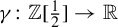 by composing with the isomorphisms of (4.1)–(4.5) and this will satisfy
$\gamma (1)=1$
by composing with the isomorphisms of (4.1)–(4.5) and this will satisfy
$\gamma (1)=1$
 (since
$[1_B]_0$
(since
$[1_B]_0$
 is carried to
$1$
is carried to
$1$
 ). There is however a unique such homomorphism by
$2$
). There is however a unique such homomorphism by
$2$
 -divisibility, namely the canonical embedding of
$\mathbb {Z}[\tfrac {1}{2}]$
-divisibility, namely the canonical embedding of
$\mathbb {Z}[\tfrac {1}{2}]$
 into
$\mathbb {R}$
into
$\mathbb {R}$
 . We conclude that
$\mathrm {K}_0(B)_+$
. We conclude that
$\mathrm {K}_0(B)_+$
 is carried to
$\mathbb {Z}[\tfrac {1}{2}]_{\ge 0}$
is carried to
$\mathbb {Z}[\tfrac {1}{2}]_{\ge 0}$
 by the isomorphisms in (4.1)–(4.5), and thus the scaled ordered group
$(\mathrm {K}_0(B),\mathrm {K}_0(B)_+,[1_B]_0)$
by the isomorphisms in (4.1)–(4.5), and thus the scaled ordered group
$(\mathrm {K}_0(B),\mathrm {K}_0(B)_+,[1_B]_0)$
 is isomorphic to
$(\mathbb {Z}[\tfrac {1}{2}],\mathbb {Z}[\tfrac {1}{2}]_{\ge 0},1)$
is isomorphic to
$(\mathbb {Z}[\tfrac {1}{2}],\mathbb {Z}[\tfrac {1}{2}]_{\ge 0},1)$
 . By classification (see [Reference White53, Reference Winter55]), we now have that
$B\cong \mathrm {M}_{2^\infty }$
. By classification (see [Reference White53, Reference Winter55]), we now have that
$B\cong \mathrm {M}_{2^\infty }$
 .
.
To show that
$(D \subset B)$
 is not an AF diagonal, it suffices to show that
$(D \subset B)$
is not an AF diagonal, it suffices to show that
$(D \subset B)$
 is not conjugate to
$(\mathrm {D}_{2^\infty }\subset \mathrm {M}_{2^\infty })$
is not conjugate to
$(\mathrm {D}_{2^\infty }\subset \mathrm {M}_{2^\infty })$
 (since all AF diagonals in
$\mathrm {M}_{2^\infty }$
(since all AF diagonals in
$\mathrm {M}_{2^\infty }$
 are conjugate [Reference Power38, Theorem 5.7]; also cf. [Reference Li, Liao and Winter31, Remark 4.2]). To that end, note that we have the intermediate sub-
$\mathrm {C}^\ast $
are conjugate [Reference Power38, Theorem 5.7]; also cf. [Reference Li, Liao and Winter31, Remark 4.2]). To that end, note that we have the intermediate sub-
$\mathrm {C}^\ast $
 -algebra

and note also that
$\mathrm {K}_1((C(\underline {X})\rtimes _\varphi \mathbb {Z})\otimes \mathrm {M}_{2^\infty })\cong \mathbb {Z}$
 (cf. [Reference Giordano, Putnam and Skau25]). In particular,
$(C(\underline {X})\rtimes _\varphi \mathbb {Z})\otimes \mathrm {M}_{2^\infty }$
(cf. [Reference Giordano, Putnam and Skau25]). In particular,
$(C(\underline {X})\rtimes _\varphi \mathbb {Z})\otimes \mathrm {M}_{2^\infty }$
 is not an AF algebra. However, if C is any intermediate sub-
$\mathrm {C}^\ast $
is not an AF algebra. However, if C is any intermediate sub-
$\mathrm {C}^\ast $
 -algebra
$(\mathrm {D}_{2^\infty } \subset C \subset \mathrm {M}_{2^\infty })$
-algebra
$(\mathrm {D}_{2^\infty } \subset C \subset \mathrm {M}_{2^\infty })$
 , then C is necessarily AF by the main result of [Reference Archbold and Kumjian1]. This completes the proof.
Remark 4.2. To confirm that the diagonal above is not AF, instead of using [Reference Archbold and Kumjian1], one could also observe that there is a unitary normalizer (coming from the paper-folding subshift) such that the induced homeomorphism has infinite orbits, which is not possible for an AF diagonal by a compactness argument.
Using the theory of diagonal dimension developed by Li, Liao and the second named author in [Reference Li, Liao and Winter31], we can use Theorem 4.1 to obtain countably many pairwise non-conjugate
$\mathrm {C}^\ast $
 -diagonals with Cantor spectra in the CAR algebra.
Remark 4.3. By [Reference Li, Liao and Winter31, Theorem 5.4], for
$G\curvearrowright X$
 a free action of a countable group on a Cantor space,
$\dim _{\mathrm {diag}}(C(X)\subset C(X)\rtimes _{\mathrm {r}}G)$
a free action of a countable group on a Cantor space,
$\dim _{\mathrm {diag}}(C(X)\subset C(X)\rtimes _{\mathrm {r}}G)$
 is equal to the tower dimension of
$G\curvearrowright X$
is equal to the tower dimension of
$G\curvearrowright X$
 , as defined by Kerr in [Reference Kerr27, Definition 4.3], which further agrees with the dynamic asymptotic dimension of
$G\curvearrowright X$
, as defined by Kerr in [Reference Kerr27, Definition 4.3], which further agrees with the dynamic asymptotic dimension of
$G\curvearrowright X$
 , denoted by
$\mathrm {dad}(G\curvearrowright X)$
, denoted by
$\mathrm {dad}(G\curvearrowright X)$
 , due to [Reference Kerr27, Theorem 5.14], since X is a Cantor space. It is clear from the definition of the dynamic asymptotic dimension (see [Reference Guentner, Willett and Yu26, Definition 2.1]; cf. [Reference Kerr27, Definition 5.3]) that if H is a subgroup of G, then
$\mathrm {dad}(H\curvearrowright X)\le \mathrm {dad}(G\curvearrowright X)$
, due to [Reference Kerr27, Theorem 5.14], since X is a Cantor space. It is clear from the definition of the dynamic asymptotic dimension (see [Reference Guentner, Willett and Yu26, Definition 2.1]; cf. [Reference Kerr27, Definition 5.3]) that if H is a subgroup of G, then
$\mathrm {dad}(H\curvearrowright X)\le \mathrm {dad}(G\curvearrowright X)$
 (see also [Reference Bönicke8, Lemma 2.2]). In particular,

For the course of the following proof, we write
$A^{\otimes n}$
 for the n-fold (minimal) tensor product of a unital
$\mathrm {C}^\ast $
for the n-fold (minimal) tensor product of a unital
$\mathrm {C}^\ast $
 -algebra A with itself and we use
$A^{\otimes \infty }$
-algebra A with itself and we use
$A^{\otimes \infty }$
 for the infinite tensor product of A with itself, defined as the inductive limit of the system
$A\to A^{\otimes 2} \to A^{\otimes 3}\to \cdots $
for the infinite tensor product of A with itself, defined as the inductive limit of the system
$A\to A^{\otimes 2} \to A^{\otimes 3}\to \cdots $
 with the connecting maps given by
$x\mapsto x\otimes 1_A$
with the connecting maps given by
$x\mapsto x\otimes 1_A$
 . For a compact space X, we write
$X^n$
. For a compact space X, we write
$X^n$
 for the n-fold Cartesian product of X with itself and we set
$X^\infty {:=}q \prod _{\mathbb {N}}X$
for the n-fold Cartesian product of X with itself and we set
$X^\infty {:=}q \prod _{\mathbb {N}}X$
 . For
$\mathrm {C}^\ast $
. For
$\mathrm {C}^\ast $
 -pairs, we write
$(D_1\subset A_1) \cong (D_2\subset A_2)$
-pairs, we write
$(D_1\subset A_1) \cong (D_2\subset A_2)$
 when there is a
$^*$
when there is a
$^*$
 -isomorphism from
$A_1$
-isomorphism from
$A_1$
 to
$A_2$
to
$A_2$
 carrying
$D_1$
carrying
$D_1$
 onto
$D_2$
onto
$D_2$
 .
.
Theorem 4.4. For each
$n\in \{0,1,2,\ldots ,\infty \}$
 , there is a Cantor spectrum diagonal
$(D^{(n)} \subset \mathrm {M}_{2^\infty })$
, there is a Cantor spectrum diagonal
$(D^{(n)} \subset \mathrm {M}_{2^\infty })$
 such that

In particular, the CAR algebra admits countably many pairwise non-conjugate
$\mathrm {C}^\ast $
 -diagonals each of which has Cantor spectrum.
Proof. The case
$n=0$
 is covered by the canonical AF diagonal, since
$\dim _{\mathrm {diag}}(\mathrm {D}_{2^\infty }\subset \mathrm {M}_{2^\infty })=0$
is covered by the canonical AF diagonal, since
$\dim _{\mathrm {diag}}(\mathrm {D}_{2^\infty }\subset \mathrm {M}_{2^\infty })=0$
 (see [Reference Li, Liao and Winter31, Theorem 4.1 and Remark 4.2]).
By (the proof of) Theorem 4.1, we have a free action
$\mathbb {Z}\rtimes \mathbb {Z}_2\curvearrowright X$
 of the infinite dihedral group on the Cantor space such that
$D{:=}q C(X)\otimes \mathrm {D}_{2^\infty }$
of the infinite dihedral group on the Cantor space such that
$D{:=}q C(X)\otimes \mathrm {D}_{2^\infty }$
 is a
$\mathrm {C}^\ast $
is a
$\mathrm {C}^\ast $
 -diagonal in
$A{:=}q (C(X)\rtimes (\mathbb {Z}\rtimes \mathbb {Z}_2))\otimes \mathrm {M}_{2^\infty }\cong \mathrm {M}_{2^\infty }$
-diagonal in
$A{:=}q (C(X)\rtimes (\mathbb {Z}\rtimes \mathbb {Z}_2))\otimes \mathrm {M}_{2^\infty }\cong \mathrm {M}_{2^\infty }$
 .
.
For
$1\le n<\infty $
 , let
$D^{(n)}{:=}q D^{\otimes n} \subset A^{\otimes n}\cong \mathrm {M}_{2^\infty }^{\otimes n}\cong \mathrm {M}_{2^\infty }$
, let
$D^{(n)}{:=}q D^{\otimes n} \subset A^{\otimes n}\cong \mathrm {M}_{2^\infty }^{\otimes n}\cong \mathrm {M}_{2^\infty }$
 and note that each pair
$(D^{(n)} \subset \mathrm {M}_{2^\infty })$
and note that each pair
$(D^{(n)} \subset \mathrm {M}_{2^\infty })$
 is a Cantor spectrum diagonal [Reference Barlak and Li3, Lemma 5.1]. Upon re-arranging the tensor factors and since
$(\mathrm {D}_{2^\infty }^{\otimes n} \subset \mathrm {M}_{2^\infty }^{\otimes n})\cong (\mathrm {D}_{2^\infty }\subset \mathrm {M}_{2^\infty })$
is a Cantor spectrum diagonal [Reference Barlak and Li3, Lemma 5.1]. Upon re-arranging the tensor factors and since
$(\mathrm {D}_{2^\infty }^{\otimes n} \subset \mathrm {M}_{2^\infty }^{\otimes n})\cong (\mathrm {D}_{2^\infty }\subset \mathrm {M}_{2^\infty })$
 ,
,

and so by [Reference Li, Liao and Winter31, Theorem 3.1(ii)],

Now, by [Reference Li, Liao and Winter31, Proposition 7.2], and since
$(\mathbb {Z}\rtimes \mathbb {Z}_2)^n$
 is finitely generated, virtually abelian with asymptotic dimension n (note that
$\mathrm {asdim}((\mathbb {Z}\rtimes \mathbb {Z}_2)^n)\le n\cdot \mathrm {asdim}(\mathbb {Z}\rtimes \mathbb {Z}_2)=n$
is finitely generated, virtually abelian with asymptotic dimension n (note that
$\mathrm {asdim}((\mathbb {Z}\rtimes \mathbb {Z}_2)^n)\le n\cdot \mathrm {asdim}(\mathbb {Z}\rtimes \mathbb {Z}_2)=n$
 , where the last equality follows from the fact that
$\mathbb {Z}\rtimes \mathbb {Z}_2$
, where the last equality follows from the fact that
$\mathbb {Z}\rtimes \mathbb {Z}_2$
 is virtually
$\mathbb {Z}$
is virtually
$\mathbb {Z}$
 and
$\mathrm {asdim}(\mathbb {Z})=1$
and
$\mathrm {asdim}(\mathbb {Z})=1$
 . In addition, since
$\mathbb {Z}^n$
. In addition, since
$\mathbb {Z}^n$
 is a subgroup of
$(\mathbb {Z}\rtimes \mathbb {Z}_2)^n$
is a subgroup of
$(\mathbb {Z}\rtimes \mathbb {Z}_2)^n$
 , we have that
$n=\mathrm {asdim}(\mathbb {Z}^n)\le \mathrm {asdim}((\mathbb {Z}\rtimes \mathbb {Z}_2)^n)$
, we have that
$n=\mathrm {asdim}(\mathbb {Z}^n)\le \mathrm {asdim}((\mathbb {Z}\rtimes \mathbb {Z}_2)^n)$
 ),
),

and, thus,

Let
$\Gamma $
 be the locally finite group
$\bigoplus _{\mathbb {N}}\mathbb {Z}_2$
be the locally finite group
$\bigoplus _{\mathbb {N}}\mathbb {Z}_2$
 . There is a free minimal action
$\Gamma \curvearrowright Y$
. There is a free minimal action
$\Gamma \curvearrowright Y$
 , with Y a Cantor space, such that
$(C(Y)\subset C(Y)\rtimes \Gamma )\cong (\mathrm {D}_{2^\infty }\subset \mathrm {M}_{2^\infty })$
, with Y a Cantor space, such that
$(C(Y)\subset C(Y)\rtimes \Gamma )\cong (\mathrm {D}_{2^\infty }\subset \mathrm {M}_{2^\infty })$
 , see [Reference Blackadar7, II.10.4.12(iii)]. Again upon re-arranging the tensor factors and since
$(\mathrm {D}_{2^\infty }^{\otimes n} \subset \mathrm {M}_{2^\infty }^{\otimes n})\cong (\mathrm {D}_{2^\infty }\subset \mathrm {M}_{2^\infty })$
, see [Reference Blackadar7, II.10.4.12(iii)]. Again upon re-arranging the tensor factors and since
$(\mathrm {D}_{2^\infty }^{\otimes n} \subset \mathrm {M}_{2^\infty }^{\otimes n})\cong (\mathrm {D}_{2^\infty }\subset \mathrm {M}_{2^\infty })$
 ,
,

Applying (4.6) with
$H= (\mathbb {Z}\rtimes \mathbb {Z}_2)^n\times \{0_\Gamma \} \le (\mathbb {Z}\rtimes \mathbb {Z}_2)^n\times \Gamma = G$
 therein, together with (3.7a),

Set
$B{:=}q (C(X^n)\rtimes (\mathbb {Z}\rtimes \mathbb {Z}_2)^n)\otimes \mathrm {D}_{2^\infty }$
 and let
$\vartheta $
and let
$\vartheta $
 be a character on
$\mathrm {D}_{2^\infty }$
be a character on
$\mathrm {D}_{2^\infty }$
 . The map
$\mathrm {id}\otimes \vartheta \colon B \to C(X^n)\rtimes (\mathbb {Z}\rtimes \mathbb {Z}_2)^n$
. The map
$\mathrm {id}\otimes \vartheta \colon B \to C(X^n)\rtimes (\mathbb {Z}\rtimes \mathbb {Z}_2)^n$
 is a surjective
$^*$
is a surjective
$^*$
 -homomorphism that carries
$C(X^n)\otimes \mathrm {D}_{2^\infty }$
-homomorphism that carries
$C(X^n)\otimes \mathrm {D}_{2^\infty }$
 onto
$C(X^n)$
onto
$C(X^n)$
 , and so by [Reference Li, Liao and Winter31, Theorem 3.2(v)], we have

whence by combining (4.7) with (4.8), we have

Putting (3.7i) and (3.7ii) together, we see that
$\dim _{\mathrm {diag}}(D^{(n)}\subset \mathrm {M}_{2^\infty })=n$
 as wanted.
Lastly, set
$D^{(\infty )}{:=}q D^{\otimes \infty } \subset A^{\otimes \infty } \cong \mathrm {M}_{2^\infty }^{\otimes \infty } \cong \mathrm {M}_{2^\infty }$
 , which is a
$\mathrm {C}^\ast $
, which is a
$\mathrm {C}^\ast $
 -diagonal arising as
$(C(X^\infty \times Y) \subset C(X^\infty \times Y)\rtimes (\bigoplus _{\mathbb {N}}(\mathbb {Z}\rtimes \mathbb {Z}_2)\times \Gamma ))$
-diagonal arising as
$(C(X^\infty \times Y) \subset C(X^\infty \times Y)\rtimes (\bigoplus _{\mathbb {N}}(\mathbb {Z}\rtimes \mathbb {Z}_2)\times \Gamma ))$
 for the product of the coordinate-wise action
$\bigoplus _{\mathbb {N}}(\mathbb {Z}\rtimes \mathbb {Z}_2)\curvearrowright X^\infty $
for the product of the coordinate-wise action
$\bigoplus _{\mathbb {N}}(\mathbb {Z}\rtimes \mathbb {Z}_2)\curvearrowright X^\infty $
 with
$\Gamma \curvearrowright Y$
with
$\Gamma \curvearrowright Y$
 (cf. [Reference Barlak and Li3, Lemma 5.2]). For
$n\in \mathbb {N}$
(cf. [Reference Barlak and Li3, Lemma 5.2]). For
$n\in \mathbb {N}$
 ,
,

and the latter pair can be written as a canonical crossed product pair of an action of
$(\mathbb {Z}\rtimes \mathbb {Z}_2)^n\times \Gamma \times (\bigoplus _{\mathbb {N}}(\mathbb {Z}\rtimes \mathbb {Z}_2)\times \Gamma )$
 . Applying (4.6) for the subgroup
$(\mathbb {Z}\rtimes \mathbb {Z}_2)^n$
. Applying (4.6) for the subgroup
$(\mathbb {Z}\rtimes \mathbb {Z}_2)^n$
 and arguing as in the preceding paragraph, we obtain
$n\le \dim _{\mathrm {diag}}(D^{(\infty )} \subset \mathrm {M}_{2^\infty })$
and arguing as in the preceding paragraph, we obtain
$n\le \dim _{\mathrm {diag}}(D^{(\infty )} \subset \mathrm {M}_{2^\infty })$
 . Since
$n\in \mathbb {N}$
. Since
$n\in \mathbb {N}$
 was arbitrary, this proves that
$\dim _{\mathrm {diag}}(D^{(\infty )}\subset \mathrm {M}_{2^\infty })=\infty $
was arbitrary, this proves that
$\dim _{\mathrm {diag}}(D^{(\infty )}\subset \mathrm {M}_{2^\infty })=\infty $
 as desired.
Remark 4.5. The theorem above in particular says that an AF algebra may contain a diagonal which itself is AF and such that its inclusion has non-zero diagonal dimension, thus resolving a problem that was raised in [Reference Li, Liao and Winter31, Remark 6.10].
Remark 4.6. In [Reference Evans and Sims20, §6], the authors construct a
$2$
 -graph
$\Lambda _{\mathrm {II}}$
-graph
$\Lambda _{\mathrm {II}}$
 (see [Reference Evans and Sims20, §2] for the relevant definitions) such that
$\mathrm {C}^\ast (\Lambda _{\mathrm {II}})$
(see [Reference Evans and Sims20, §2] for the relevant definitions) such that
$\mathrm {C}^\ast (\Lambda _{\mathrm {II}})$
 is unital, separable, simple, nuclear, in the UCT class, has a unique trace and contains a projection p such that the corner
$p\mathrm {C}^\ast (\Lambda _{\mathrm {II}})p$
is unital, separable, simple, nuclear, in the UCT class, has a unique trace and contains a projection p such that the corner
$p\mathrm {C}^\ast (\Lambda _{\mathrm {II}})p$
 has the same ordered
$\mathrm {K}$
has the same ordered
$\mathrm {K}$
 -theory as the CAR algebra, and which contains a Cartan sub-
$\mathrm {C}^\ast $
-theory as the CAR algebra, and which contains a Cartan sub-
$\mathrm {C}^\ast $
 -algebra
$D_0\subset p\mathrm {C}^\ast (\Lambda _{\mathrm {II}})p$
-algebra
$D_0\subset p\mathrm {C}^\ast (\Lambda _{\mathrm {II}})p$
 with Cantor spectrum that is not a
$\mathrm {C}^\ast $
with Cantor spectrum that is not a
$\mathrm {C}^\ast $
 -diagonal (see the discussion after [Reference Evans and Sims20, Remark 6.13]). While the conditions on
$\mathrm {C}^\ast (\Lambda _{\mathrm {II}})$
-diagonal (see the discussion after [Reference Evans and Sims20, Remark 6.13]). While the conditions on
$\mathrm {C}^\ast (\Lambda _{\mathrm {II}})$
 are not enough to apply the classification theorem and deduce that
$p\mathrm {C}^\ast (\Lambda _{\mathrm {II}})p$
are not enough to apply the classification theorem and deduce that
$p\mathrm {C}^\ast (\Lambda _{\mathrm {II}})p$
 is in fact isomorphic to
$\mathrm {M}_{2^\infty }$
is in fact isomorphic to
$\mathrm {M}_{2^\infty }$
 , this obstacle is surpassed by considering
$p\mathrm {C}^\ast (\Lambda _{\mathrm {II}})p\otimes \mathrm {M}_{2^\infty }$
, this obstacle is surpassed by considering
$p\mathrm {C}^\ast (\Lambda _{\mathrm {II}})p\otimes \mathrm {M}_{2^\infty }$
 , which is
$\mathcal {Z}$
, which is
$\mathcal {Z}$
 -stable due to the tensor factor
$\mathrm {M}_{2^\infty }$
-stable due to the tensor factor
$\mathrm {M}_{2^\infty }$
 and has the same
$\mathrm {K}$
and has the same
$\mathrm {K}$
 -theory (this follows from the Künneth formula) and traces as
$\mathrm {M}_{2^\infty }$
-theory (this follows from the Künneth formula) and traces as
$\mathrm {M}_{2^\infty }$
 . This leads to the somewhat surprising conclusion that
$\mathrm {M}_{2^\infty }$
. This leads to the somewhat surprising conclusion that
$\mathrm {M}_{2^\infty }$
 contains Cartan sub-
$\mathrm {C}^\ast $
contains Cartan sub-
$\mathrm {C}^\ast $
 -algebras with Cantor spectra that are not
$\mathrm {C}^\ast $
-algebras with Cantor spectra that are not
$\mathrm {C}^\ast $
 -diagonals, which are obtained as the tensor products of
$D_0$
-diagonals, which are obtained as the tensor products of
$D_0$
 either with
$\mathrm {D}_{2^\infty }$
either with
$\mathrm {D}_{2^\infty }$
 or with any of the diagonals obtained in Theorem 4.4.
Acknowledgements
This work was funded by the Deutsche Forschungsgemeinschaft (DFG, German Research Foundation) under Germany’s Excellence Strategy EXC 2044-390685587, Mathematics Münster: Dynamics-Geometry-Structure, by the SFB 1442 of the DFG, and by ERC Advanced Grant 834267-AMAREC.





 Open access

