





Highlights
-
• Children’s cross-speaker switches were coded from parent–child interactions
-
• Children’s language moderated the link between switches and inhibitory control
-
• Switching was associated with better control only in children with high language
-
• Language ability constraints the link between language control and inhibitory control
1. Introduction
The ease with which bilingual speakers switch between their languages seems like an astounding feat of mental agility, and yet in children, code-switching (use of two languages in discourse) is often perceived to signal lapses in language control (Giesbers, Reference Giesbers, Kroon, Liebrand and Cheshire1989). Green and Abutalebi (Reference Green and Abutalebi2013) define bilingual language control as the ability to effectively maintain separation between languages and relate language control to domain-general cognitive control. Their Adaptive Control Hypothesis (ACH; Green & Abutalebi, Reference Green and Abutalebi2013) states that bilinguals are faced with extra cognitive demand as compared to monolinguals due to the presence of multiple languages, and thus they regularly practice domain-general cognitive control to manage their language use. Given this hypothesis, studies linking language control to domain-general cognitive control should find a positive correlation, such that bilinguals who demonstrate better language control demonstrate better cognitive control skills. In past studies, language control has been operationalized in terms of code-switching (Soesman et al., Reference Soesman, Walters and Fichman2022). Yet, if we consider code-switching to be a natural aspect of bilingual behavior (Cheng & Butler, Reference Cheng and Butler1989), it is unclear whether increased or decreased rates of switching would reflect language control. Additionally, one must consider what types of code-switching, if any, reflect language control. Code-switching can take numerous forms, such as intersentential code-switching, where a bilingual uses different language from utterance to utterance; intrasentential code-switching, where a bilingual mixes their languages within an utterance (i.e., “look at the [English] perro [Spanish]”); and cross-speaker code-switching, where a bilingual responds in a different language than the one used by the interlocutor. Different types of code-switches may be grounded in distinct strategies and control mechanisms. For example, increased rates of intrasentential switching have been linked to lower levels of language-specific proficiency (Ribot & Hoff, Reference Ribot and Hoff2014; Green et al., Reference Greene, Peña and Bedore2013; Kapantzoglou et al., Reference Kapantzoglou, Brown, Cycyk and Fergadiotis2021) but not to lower levels of cognitive control skills, while higher rates of cross-speaker switches have been linked to lower broad language skills (Gutiérrez-Clellen et al., Reference Gutiérrez-Clellen, Cereijido and Leone2009), and to lower cognitive control skills (Kuzyk et al., Reference Kuzyk, Friend, Severdija, Zesiger and Poulin-Dubois2020). The vast majority of prior studies has used laboratory-based switching paradigms to study adult bilinguals; few have tested switching in naturalistic discourse to examine links between linguistic and cognitive control in children. The goal of the present study was to examine the relationship between language control and cognitive control in Spanish-English bilingual children. We tested how children’s omnibus language ability and language control, as defined by frequency of cross-speaker code-switches in a naturalistic, play-based interaction with their bilingual parent, predicts their domain-general inhibitory control skills.
1.1. ACH and code-switching
Green and Abutalebi (Reference Green and Abutalebi2013) have proposed in the ACH that several skills influence language control. These skills are practiced by bilinguals to a varying degree, as different environments demand varied use of certain skills. For example, a dense code-switching environment requires higher levels of opportunistic planning than a single-language or dual-language environment. A dual-language context may promote the involvement of a wider array of cognitive control skills, including task engagement, task disengagement, salient cue detection, goal maintenance, conflict monitoring, interference suppression, and selective response skills during language control and should be associated with higher levels of cognitive control. In this way, the ACH intersects with the bilingual executive function advantage literature (e.g., van den Noort et al., Reference van den Noort, Struys, Bosch, Jaswetz, Perriard, Yeo, Barisch, Vermeire, Lee and Lim2019), while neatly avoiding bilingual-monolingual comparisons that are prevalent in this work. ACH therefore provides a fruitful theoretical framework for connecting linguistic control and cognitive control within bilingual populations and allows for testing of mechanistic hypotheses regarding linkages between specific aspects of language control and specific components of cognitive control.
1.2. Language control and cognitive control in adults
Numerous studies have demonstrated a relationship between language control and domain-general cognitive control in adult bilinguals, consistently finding links between bilinguals’ code-switching behaviors (indexing language control) and performance on a range of cognitive control tasks, including response inhibition and interference suppression (De Baene et al. Reference De Baene and Brass2011; Lai & O’Brien, Reference Lai and O’Brien2020; Barbu et al. Reference Barbu, Orban, Gillet and Poncelet2018; Verreyt et al. Reference Verreyt, Woumans, Vandelanotte, Szmalec and Duyck2016; Prior & Gollan, Reference Prior and Gollan2011; Linck et al. Reference Linck, Schweiter and Sunderman2012; Festman et al. Reference Festman, Rodriguez-Fornells and Münte2010; Festman & Münte, Reference Festman and Münte2012; Festman, Reference Festman2012; Kheder & Kaan, Reference Kheder and Kaan2021; Soveri et al. Reference Soveri, Rodriguez-Fornells and Laine2011). For example, Kheder and Kaan (Reference Kheder and Kaan2021) utilized a Simon task (a conflict resolution and a response inhibition task) to measure cognitive control in bilingual adults and analyzed Simon data as a function of language proficiency and code-switching behaviors (all switching behaviors, via self-report using the Assessment of Code-Switching Experience Survey [ACSES; Blackburn & Wicha, Reference Blackburn and Wicha2011]). Results demonstrated that bilinguals who reported more frequent code-switching performed better on the Simon task than bilinguals who code-switched less frequently.
Gosselin and Sabuorin (Reference Gosselin and Sabourin2023) further investigated the relationship between code-switching experience and cognitive control skills in French-Canadian bilingual adults in a dual-language environment using an adaptation of the Bilingual Switching Questionnaire (Rodriguez-Fornells et al., Reference Rodriguez-Fornells, Krämer, Lorenzo-Seva, Festman and Münte2012). They found that participants’ self-reported likelihood to code-switch from French to English (across all switching types) was positively related to inhibitory control (measured via a flanker task). Additionally, results indicated that the intentionality of code-switching was important in moderating this effect; participants who reported more unintentional switching (i.e., lapses in language control) did not demonstrate the same positive relationship between code-switching experience and domain-general inhibitory control. These studies indicate a relationship between language control and domain-general cognitive control in adult bilinguals, such that more frequent code-switching (variously defined) is associated with higher levels of cognitive control (Declerck et al., Reference Declerck, Meade, Midgley, Holcomb, Roelofs and Emmorey2021; Festman & Münte, Reference Festman and Münte2012; Linck et al., Reference Linck, Schweiter and Sunderman2012; Soveri et al., Reference Soveri, Rodriguez-Fornells and Laine2011; Woumans et al., Reference Woumans, Ceuleers, Van der Linden, Szmalec and Duyck2015).
Similar linkages have also been observed in young children, although developmental work in this area is relatively sparse (Gross & Kaushanskya, Reference Gross and Kaushanskaya2018; Kuzyk et al., Reference Kuzyk, Friend, Severdija, Zesiger and Poulin-Dubois2020; Kubota et al., Reference Kubota, Chevalier and Sorace2020). For example, in a longitudinal study by Kubota et al. (Reference Kubota, Chevalier and Sorace2020), researchers examined how cognitive control and bilingual experience impacted the development of language control in Japanese-English bilinguals between the ages of 7 and 13 years old. Participants in this experiment were “returnee” bilinguals; that is, they returned to an environment where the predominant language was their L1 after having lived in an environment where the predominant language was their L2. Results of this study indicated that participants with higher accuracy on a language switching task also performed better on a Simon task. Exposure to the L2 modulated switching performance, in that children with less exposure to the L2 demonstrated more stable performance than those with more exposure. With a few exceptions (Gross & Kaushanskaya, Reference Gross and Kaushanskaya2022; Gross & Kaushanskaya, Reference Gross and Kaushanskaya2018; Kubota et al., Reference Kubota, Chevalier and Sorace2020), the majority of papers examining language control in children have focused on language skills, and not cognitive control, as the constraining factor in children’s ability to exercise language control.
1.3. Language control and language ability in bilingual children
Work examining language ability as a predictor of code-switching behavior in children has yielded mixed results. While some studies have found no significant relationships between bilinguals’ omnibus language ability and code-switching behaviors (Gross et al., Reference Gross, López González, Girardin and Almeida2022; Gutiérrez-Clellen et al., Reference Gutiérrez-Clellen, Cereijido and Leone2009; Greene et al., Reference Greene, Peña and Bedore2013) others have observed such linkages (Kubuta et al. Reference Kubota, Chevalier and Sorace2020). In these studies, omnibus language ability is captured by contrasting children with typical language skills (across both languages) to children with Developmental Language Disorder (DLD) or Specific Language Impairment (SLI), a developmental disorder characterized by difficulties producing and comprehending language (Bishop, Reference Bishop1992). For instance, Gutiérrez-Clellen et al. (Reference Gutiérrez-Clellen, Cereijido and Leone2009) found that sociolinguistic factors and language dominance but not language ability explained differences in code-switching behaviors between groups of Spanish-English bilingual children with typical language development and specific language impairment. However, Mammolito (Reference Mammolito2015) found that in bilingual children with DLD, lapses in language control during a narrative were seen more frequently in children with lower overall language skills. Similarly, in comparing bilingual children with typical language skills to those with DLD, Iluz-Cohen and Walters (Reference Iluz-Cohen and Walters2012) found that language ability was related to lapses in language control, such that children with lower language ability demonstrated more cross-speaker switches.
Research that has examined the relationship between language ability and language control in bilingual children has also considered how language-specific skills versus omnibus language ability may influence language control skills. The Lexical Gap Hypothesis (Nicoladis & Secco, Reference Nicoladis and Secco2000) posits that bilingual children strategically fill gaps in lexical knowledge by borrowing a word from the other language and inserting it into an utterance. However, Kapantzoglou et al. (Reference Kapantzoglou, Brown, Cycyk and Fergadiotis2021) found that language-specific proficiency alone did not significantly predict the frequency of code-switching. Their results revealed that children with low levels of Spanish proficiency in the DLD group showed more switches to English from Spanish, but this pattern was not observed for bilingual children with typical language ability.
1.4. Language control and cognitive control in children
There have only been a few studies to date that have examined the contribution of cognitive control to children’s language control (e.g., Gross & Kaushanskaya, Reference Gross and Kaushanskaya2020; Gross and Kaushanskaya, Reference Gross and Kaushanskaya2018; Kubota et al., Reference Kubota, Chevalier and Sorace2020). Gross and Kaushanskaya (Reference Gross and Kaushanskaya2020) found that Spanish-English bilingual children four to seven years of age with lower omnibus language skills produced more cross-speaker language switches when they communicated with a monolingual interlocutor in a scripted confederate dialogue task. Children with higher levels of cognitive control skills, measured by the Dimensional Change Card Sorting task (DCCS; Zelazo, Reference Zelazo2006) were less likely to produce cross-speaker switches in a dual language context, but this was only the case for children with higher omnibus language skills. Results of this study suggested that language ability played a primary role in language control while cognitive control was more influential in switching between language contexts. In a follow-up study, Gross and Kaushanskaya (Reference Gross and Kaushanskaya2022) found that cross-speaker switching, but not intra-sentential switching, was associated with cognitive control in Spanish-English bilingual children between four and seven years of age.
How do we reconcile findings that both higher frequency of code-switching (Declerck et al., Reference Declerck, Meade, Midgley, Holcomb, Roelofs and Emmorey2021; Festman & Münte, Reference Festman and Münte2012; Linck et al., Reference Linck, Schweiter and Sunderman2012; Soveri et al., Reference Soveri, Rodriguez-Fornells and Laine2011; Woumans et al., Reference Woumans, Ceuleers, Van der Linden, Szmalec and Duyck2015; Gross & Kaushanskya, Reference Gross and Kaushanskaya2018; Kuzyk et al., Reference Kuzyk, Friend, Severdija, Zesiger and Poulin-Dubois2020; Kubota et al., Reference Kubota, Chevalier and Sorace2020) and lower frequency of code-switching (Kuzyk et al., Reference Kuzyk, Friend, Severdija, Zesiger and Poulin-Dubois2020) have been positively correlated with higher levels of cognitive control? One very likely possibility is that these disparate results may be reflective of differences in methods for measuring language control. For example, self-reported and parent-reported measures of code-switching frequency may yield a different picture of code-switching patterns than experimental measures of switching agility, which, in turn, may or may not align with patterns of spontaneous language switching observed in naturalistic settings. Some evidence for non-overlap among different switching metrics already exists (e.g., Lai & O’Brien, Reference Lai and O’Brien2020). Similarly, there is evidence that different cognitive control measures may contribute to different switching behaviors (Hofweber et al., Reference Hofweber, Marinis and Treffers-Daller2020a), and that these may or may not align with measures of everyday behavior (Hofweber et al., Reference Hofweber, Marinis and Treffers-Daller2020b). In the present study, we measured children’s code-switching behavior in the context of a naturalistic, play-based interaction between children and their parent. If the link between cognitive control and children’s switching behaviors is observed in a naturalistic task where they communicate with a familiar bilingual interlocutor, it would indeed serve as strong evidence for an overlap between language control and cognitive control.
1.5. Current study
In both adults and children, past research has extensively studied the relationship between bilingualism and domain-general cognitive control. The theoretical framework supporting much of this work is the ACH (Green & Abutalebi, Reference Green and Abutalebi2013), which posits that the processes underlying language control overlap with domain-general cognitive control skills. Code-switching has been a behavior of particular interest in understanding language control in bilinguals. Previous work examining code-switching as a measure of language control has done so in a variety of ways, but with mixed findings. Some studies have utilized self-reports of code-switching behaviors and their frequency, while others have used experimental tasks of cued language switching, or elicited language samples that yielded frequencies of different code-switching behaviors. The overarching limitation of prior work is that it has rarely considered children and it has not examined bilingual children’s spontaneous, naturalistic language behaviors, especially ones observed in interactions with familiar bilingual interlocutors. Yet, these behaviors are especially important, considering the studies suggesting that ecologically valid instances of spontaneous code-switching differ from laboratory-based studies of code-switching and may entail reduced reliance on cognitive control (e.g., Johns & Steuck, Reference Johns and Steuck2021).
In the current study, we examined whether bilingual children’s naturalistic code-switching predicted their performance on the domain-general cognitive control task. Spanish-English bilingual children, between four and six years of age, engaged in a naturalistic, play-based interaction with their bilingual parents. The code-switching behavior of interest was cross-speaker switches because prior studies have suggested that in dialogic tasks, cross-speaker switches, rather than other kinds of switches, engage cognitive control (Gross & Kaushanskaya, Reference Gross and Kaushanskaya2022). We took children’s overall language ability into account, and predicted, in line with past work from Gross and Kaushanskaya (Reference Gross and Kaushanskaya2020), that language ability would moderate the relationship between cross-speaker switching and cognitive control. Our null hypothesis was that switching versus maintaining language choices when interacting with a familiar bilingual interlocutor may place few demands on cognitive control, and therefore, frequency of cross-speaker switches would not predict children’s cognitive control performance. Our first alternative hypothesis was that cross-speaker switches, even with a familiar interlocutor, would index lapses in language control, and therefore, higher frequency of cross-speaker switches would be associated with lower levels of cognitive control. Our second alternative hypothesis was that cross-speaker switches rely on cognitive control, and therefore, that higher frequency of cross-speaker switches would be associated with higher levels of cognitive control.
2. Method
2.1. Protocol
Participants completed the study across multiple lab-based testing sessions. Consent was given by parents prior to the start of the study using a University of Wisconsin–Madison IRB approved protocol. Parents of the participants completed questionnaires about their child’s language experience and exposure in another room while participants were administered a hearing screening, language assessment, non-verbal intelligence testing, and a flanker task. Participants’ hearing was screened to ensure normal hearing at frequencies of 1000, 2000, and 4000 Hz and 25 dB before moving on to language testing and the parent–child interaction task.
2.2. Participants
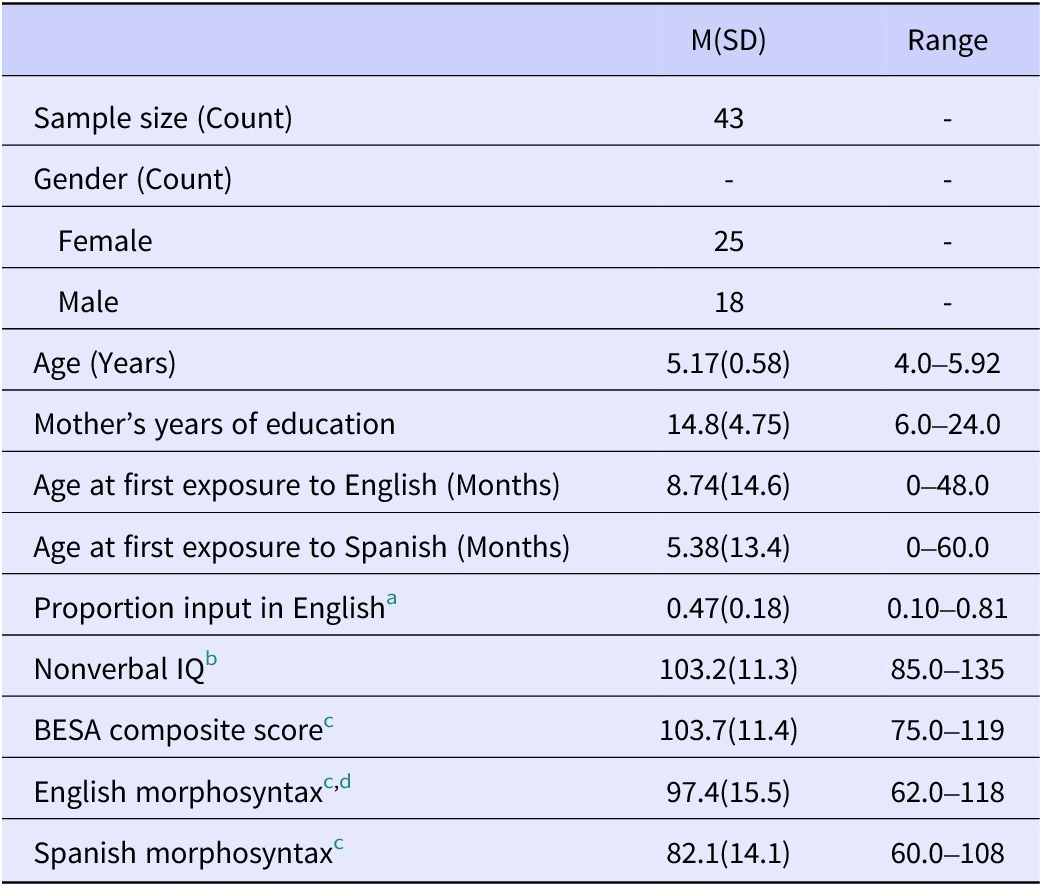
Forty-three child participants were recruited from the community through flyers posted in the Madison area or through direct contact based on previous study participation. These 43 participants (18 males) were between the ages of four and six years (M = 5.17 years, SD = .58 years), had no history of hearing loss or diagnosed neurological condition, and were Spanish-English bilinguals. Participants were first exposed to Spanish between birth and 60-months of age (M = 5.38 months, SD = 13.42 months) and first exposed to English between birth and 48-months of age (M = 8.74 months, SD = 14.56 months). No more than 5% exposure to another language was also required for participation. At the time of the study, participants were reported to have a current rate of English exposure between 10% and 81% (M = 47%, SD = 18.3%). Participant demographics are shown in Table 1.
Participant Characteristics
a Bilingual Input–Output Survey from the Bilingual English-Spanish Assessment (BIOS; Peña et al., Reference Peña, Gutierrez-Clellen, Iglesias, Goldstein and Bedore2014).
b Kaufman Brief Intelligence Test—Second Edition (KBIT-2; Kaufman & Kaufman, Reference Kaufman and Kaufman2004).
c Standard scores from the Bilingual English-Spanish Assessment (BESA; Peña et al., Reference Peña, Gutierrez-Clellen, Iglesias, Goldstein and Bedore2014).
d We were unable to calculate an English morphosyntax score for one child due to a raw score of 0 on the Cloze subtest.
2.3. Questionnaires and Assessments
The following assessments and questionnaires were administered: the Bilingual English-Spanish Assessment (BESA; Peña et al., Reference Peña, Gutierrez-Clellen, Iglesias, Goldstein and Bedore2014), the Bilingual Input–Output Survey (BIOS) from the BESA (Peña et al., Reference Peña, Gutierrez-Clellen, Iglesias, Goldstein and Bedore2014), the Visual Matrices subtest of the KBIT-2 (Kaufman & Kaufman, Reference Kaufman and Kaufman2004), a child-friendly flanker task, and a background history questionnaire and interview with questions pertaining to the participant’s language history and exposure. Parents also completed the Language Experience and Proficiency Questionnaire (LEAP-Q; Marian, Blumenfeld, & Kaushanskaya, Reference Marian, Blumenfeld and Kaushanskaya2007), to rate their own proficiency in speaking both English and Spanish and provide a self-report of their language dominance.
Language Ability
The BESA (Peña et al., Reference Peña, Gutierrez-Clellen, Iglesias, Goldstein and Bedore2014) was administered to all participants, and the BESA Language Index Standard Score was used to index participants’ omnibus language ability (see also Gross & Kaushanskaya, Reference Gross and Kaushanskaya2020; Kaushanskaya & Crespo, Reference Kaushanskaya and Crespo2019). The BESA is a standardized assessment designed to measure the expressive and receptive language abilities of Spanish-English bilingual children between four- and six-years-old to identify language disorders, differentiate language differences due to acquisition patterns from disorder, and broadly describe overall language skills. This assessment consists of separate subtests measuring skills in morphosyntax and semantics for English and Spanish. The BESA reports a sensitivity of 92% and specificity of 86% for identifying language disorder in four-year-olds and a sensitivity of 89% and specificity of 85% for identifying language disorder in five-year-olds.
After completing the BESA, four participants (9.3%) were identified as demonstrating clinically or sub-clinically low language ability with composite standard scores between 75 and 84; scores between 85 and 115 indicate average skills. Scores below the average range are indicative of a possible language impairment such as developmental language disorder (DLD). Five participants (11.6%) performed at levels indicating high language ability, with composite standard scores above 115. The remaining 34 participants (79%) scored within the average range. Overall, participants represented a broad range of language ability, with composite standard scores between 75–119 (M = 104, SD = 11.4).
Inhibitory Control
A traditional flanker task (Eriksen & Eriksen, Reference Eriksen and Eriksen1974) adapted to be child friendly with sea themed graphics was used to measure inhibitory control. Both response time and accuracy across trials were collected for each participant. Accuracy on incongruent trials was used to index inhibitory control (Eriksen & Eriksen, Reference Eriksen and Eriksen1974; Mullane et al., Reference Mullane, Corkum, Klein and McLaughlin2009).
Participants first received instruction and familiarization on the flanker task, followed by a practice phase. After completing the practice phase, participants completed the flanker task. The task consisted of 24 trials (twelve congruent trials, six incongruent trials, and six neutral trials). Brief cognitive control tasks similar to our version of the flanker task are common in developmental research, to ensure that children engage in the task and do not fatigue (Zelazo et al., Reference Zelazo, Anderson, Richler, Wallner-Allen, Beaumont and Weintraub2013). Participants were instructed that they would play a computer game in which they would see fish and seaweed on the screen; they were then instructed to pay attention to only the fish in the center and asked to press an arrow on a keyboard correlating to the direction of that center fish. During neutral trials, the center fish is flanked by two seaweed images on each side. During congruent trials, participants would see a line of five fish, all facing the same direction. In incongruent trials, the center fish is the only fish facing the opposite direction of the other four (two on each side). Therefore, the incongruent trials required participants to ignore the direction of the fish on each side, focusing only on the direction of the single center fish.
Children’s mean accuracy on the incongruent trials of the flanker task was 66.7% (SD = 47.2%). Their mean accuracy on the neutral trials was 89.5% (SD = 30.7%) and on congruent trials was 87.2% (SD = 33.4%). Children ranged in their overall accuracy from 41.7% to 100%, with a mean of 82.6% (SD = 15.6%).
Language Control
The proportion of cross-speaker language switches produced by the children was used to measure language control. Each parent–child dyad was recorded for 10 minutes while playing with their choice of a kitchen or farm toy set in a child-friendly laboratory at the University of Wisconsin–Madison. Participants and their parents were instructed to use any language(s) during their interaction. Audio recordings were then transcribed using Systematic Analysis of Language Transcripts (SALT: Miller & Iglesias, Reference Miller and Iglesias2008) software and coded for language use. Transcripts went through two phases of transcription; in the first, a bilingual research assistant transcribed each utterance for both the child participant and their parent, and a second bilingual transcriber made corrections after transcription was completed by the first research assistant. In the second transcription phase, a second pair of bilingual research assistants transcribed 20% of the original recording. This 20% was then compared to transcription from the first pair of research assistants for reliability. Agreement across the transcriber pairs was 94% for children and 97% for parents. Total number of utterances produced by parents and children within each transcript indexed talkativeness of each participant.
2.4. Coding Procedure
Each utterance was coded as English, Spanish, neutral, or intra-sentential code-switched for both parents and child. Utterances were coded as intra-sentential code-switched when both English and Spanish were used within the utterance. These utterances containing intra-sentential code-switches were observed with limited frequency, accounting for less than 1% of utterances overall. Due to their limited frequency, intra-sentential code-switches were excluded from the analyses. Utterances were coded as neutral when the language of the utterance was unclear, such as single-word utterances containing cognates or utterances consisting of sound effects, unintelligible speech, or vocalizations. Neutral utterances accounted for 30% of all utterances and were excluded from analysis.
Child utterances were coded as cross-speaker switches when the utterance was produced in a different language than the one used in the parent’s previous utterance. Agreement between transcribers for coding cross-speaker switches was over 80% across 20% of transcripts. Each child utterance was coded as 0 (switches) or 1 (matches). After exclusions (neutral or unintelligible utterances and intrasentential code-switches), 1961 utterances were retained for analyses, with 251 (12.79%) coded as cross-speaker switches. We calculated by-participant proportions of cross-speaker code-switches to index children’s cross-speaker code-switching behaviors (M = 0.12, SD = 0.14).
2.5. Analyses
We modeled the effects of child language ability (BESA Composite; continuous, mean-centered) and children’s cross-speaker switches (by-participant proportion, mean-centered) on children’s flanker data (accuracy on incongruent trials, coded as 1 or 0) in a single model, letting the predictors interact with one another (a two-way interaction model). We used mixed-effects logistic regression models in R (version 4.0.2; R Core Team, Reference Team2020) with the lme4 package (version 1.1–26; Bates et al., Reference Bates, Mächler, Bolker and Walker2015). We employed the “keep it maximal” approach (Barr et al., Reference Barr, Levy, Scheepers and Tily2013) and included by-participant random intercepts and slopes in our models.
We accounted for variability in language exposure profiles by including children’s current percent exposure to English, as measured via the BIOS (continuous, mean-centered). Because prior studies have linked language use to child age, socioeconomic status (indexed by mother’s years of education; Jackson et al., Reference Jackson, Kiernan and McLanahan2017), nonverbal IQ (Botting, Reference Botting2005), and talkativeness (e.g., Van Kleeck & Street, Reference Van Kleeck and Street1982), we included these in the model as covariates (continuous, mean-centered).
3. Results
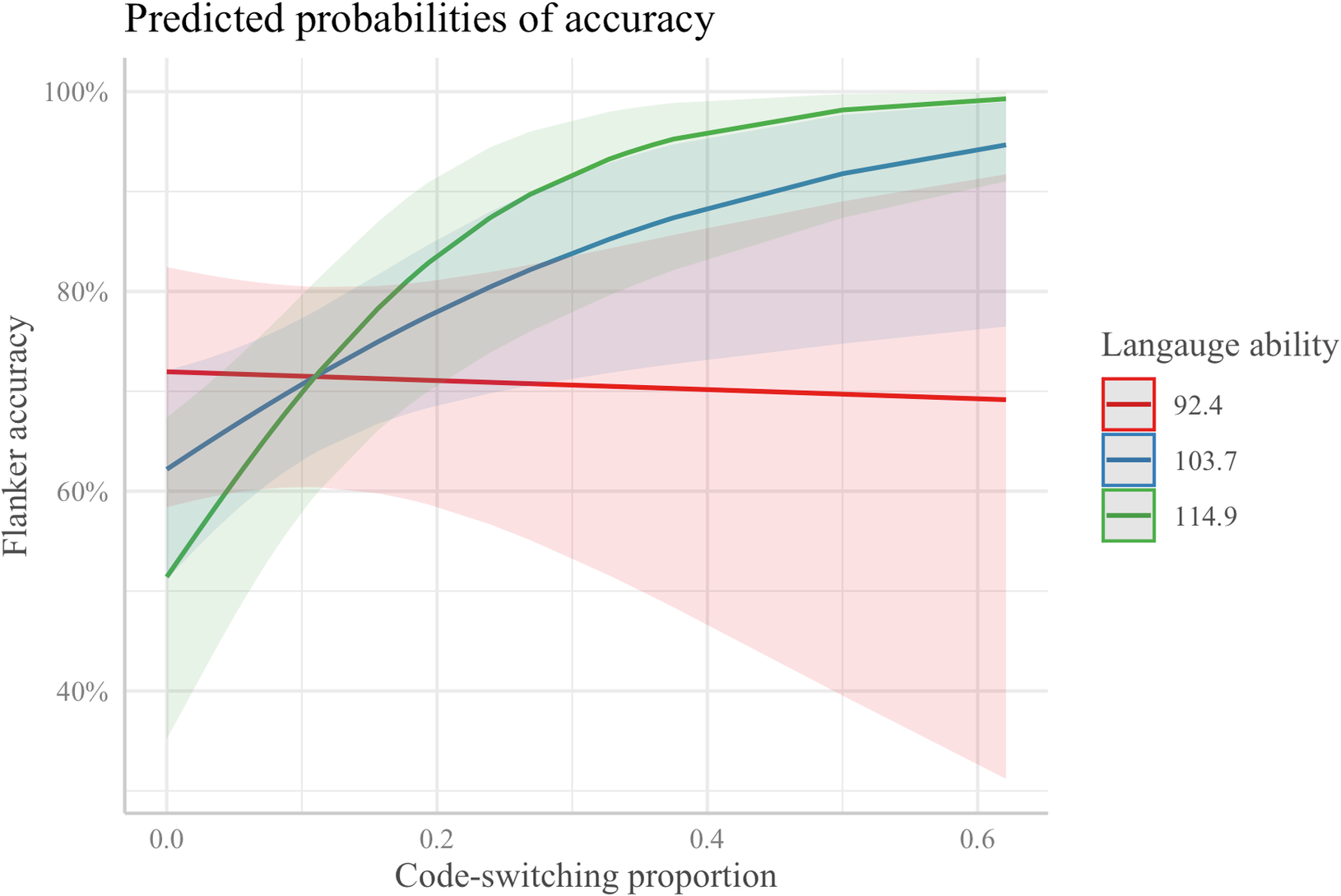
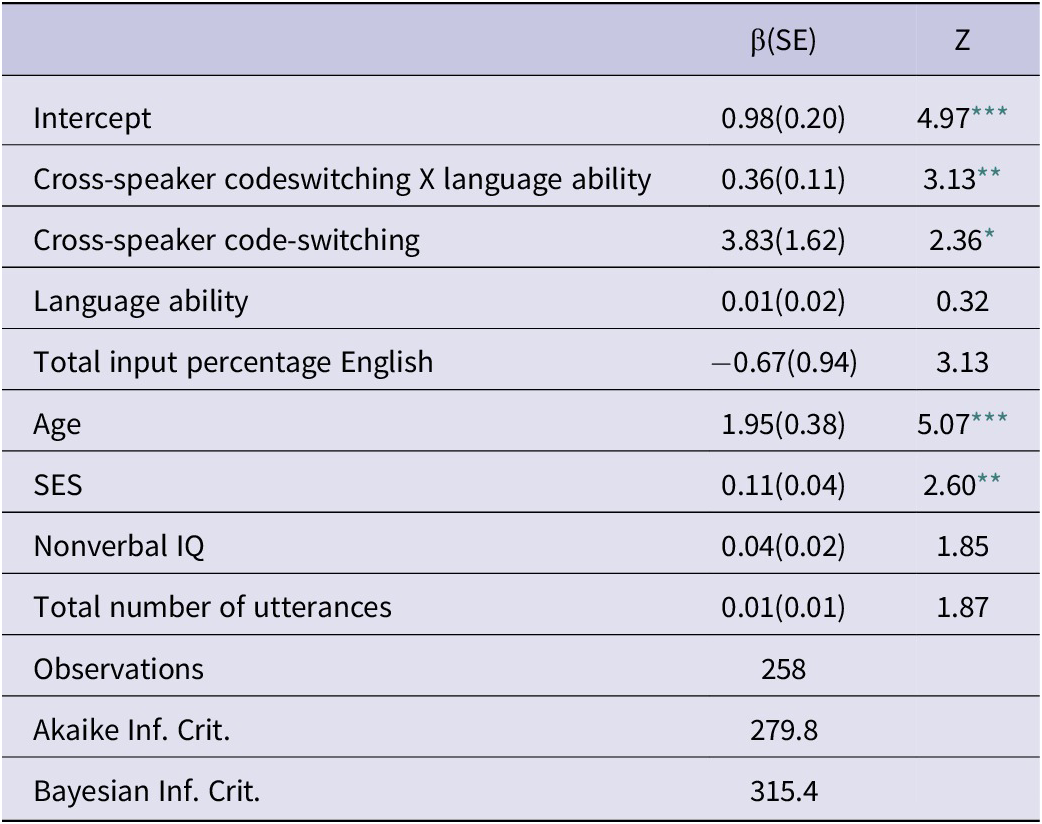
The model yielded a main effect of code-switching (B = 3.83, SE = 1.62 p = .018), such that children with higher proportions of switching behaviors demonstrated better performance on the flanker task. We also observed significant main effects of age (B = 1.95, SE = 0.38, p < .001) and socioeconomic status (B = 0.11, SE = 0.04, p < .01). Notably, the analyses revealed a significant interaction between children’s code-switching and language ability (B = 0.36, SE = 0.11, p < .01), such that children with higher language ability and higher proportions of cross-speaker code-switching demonstrated better performance on the flanker task. In contrast, children with lower language ability demonstrated consistent inhibitory control across language switching proportions (see Figure 1). Language ability on its own did not significantly predict inhibitory control. All other main effects and interactions were not significant. See Table 2 for full model results.
Predicted probability of accuracy on incongruent flanker trials as a function of children’s cross-speaker code-switching and language ability.
Full Model Results
* p < 0.05.
** p < 0.01.
*** p < 0.001.
Discussion
The current study focused on cross-speaker code-switches produced by bilingual children during a naturalistic interaction with their parents, and related this behavior to children’s non-linguistic inhibitory control, as captured by their performance on the flanker task. Children varied in their omnibus language skills, from clinically low (DLD) to above average. We found that both cross-speaker code-switching and omnibus language ability contributed to children’s non-linguistic inhibitory control, such that only children with higher language ability and more cross-speaker switches demonstrated higher inhibitory control. In contrast, for children with lower language ability, there was no association between cross-speaker switches and inhibitory control.
In line with the ACH (Green & Abutalebi, Reference Green and Abutalebi2013), some children in our study, and specifically children with higher levels of language ability, demonstrated higher inhibitory control with increased production of cross-speaker switches. This finding also converges with extensive behavioral work in bilingual adults (Declerck et al., Reference Declerck, Meade, Midgley, Holcomb, Roelofs and Emmorey2021; Festman & Münte, Reference Festman and Münte2012; Linck et al., Reference Linck, Schweiter and Sunderman2012; Soveri et al., Reference Soveri, Rodriguez-Fornells and Laine2011; Woumans et al., Reference Woumans, Ceuleers, Van der Linden, Szmalec and Duyck2015) and a sparser body of work in bilingual children (Gross & Kaushanskya, Reference Gross and Kaushanskaya2018; Kuzyk et al., Reference Kuzyk, Friend, Severdija, Zesiger and Poulin-Dubois2020; Kubota et al., Reference Kubota, Chevalier and Sorace2020), indicating that increased frequency of code-switching is associated with better inhibitory control skills. Critically, and in line with Gross and Kaushanskaya (Reference Gross and Kaushanskaya2020), this positive association between cross-speaker switching and inhibitory control, was observed only for children with higher levels of omnibus language ability. In contrast, for children with lower levels of omnibus language ability, increased frequency of cross-speaker switching was not associated with performance on the inhibitory control task.
Our interpretation of this finding is that cross-speaker code-switches may emerge for different reasons in children with varying language skills. Past work has interpreted code-switching as indicative of gaps in vocabulary (lexical gap hypothesis; Nicoladis & Secco, Reference Nicoladis and Secco2000), poor language control stemming from low language skills (Gross & Kaushanskaya, Reference Gross and Kaushanskaya2020; Iluz-Cohen & Walters, Reference Iluz-Cohen and Walters2012; Mammolito, Reference Mammolito2015), and strong domain-general cognitive control leading to strong language control (Kubota et al., Reference Kubota, Chevalier and Sorace2020). Our findings indicate that all these interpretations have merit, and that examinations of both children’s language ability and code-switching behaviors are critical to understanding the connection between code-switching and inhibitory control. Children with strong omnibus language skills who can easily access and produce linguistic content, may be more likely to engage in cross-speaker switches purposefully, to guide and control the language of discourse. For children with higher levels of omnibus language skills, therefore, a higher frequency of cross-speaker switches reflects the ability to exercise higher levels of language control, and over time, may feed into improved inhibitory control skills. In contrast, for children with weaker omnibus language skills, cross-speaker switches may reflect difficulties generating a message (in either language) and/or difficulties tracking language use of the communication partner rather than engaging in language control. Our explanation must remain speculative until longitudinal work examines the links among cross-speaker switches, language ability, and inhibitory control in a larger sample of bilingual children with and without DLD. Experimental manipulations would also be important to disentangle the (possibly) different mechanisms underpinning cross-speaker switches in children with different levels of language ability. In the meantime, our findings indicate an important (and heretofore largely unexamined) role of language ability in constraining the association between language control and inhibitory control in bilingual children.
These findings are not without limitation. Children produced cross-speaker switches during a naturalistic, play-based, child–parent interaction; however, the interaction did take place in a laboratory setting where participants were aware of their conversation being recorded. This awareness and an unfamiliar context may have resulted in language use that is different than that of typical, everyday language use between parent and child. The relatively small sample size is another limitation, although we note that our sample was similarly large or larger than in prior studies of bilingual children’s switching and cognitive control (Kuzyk et al., Reference Kuzyk, Friend, Severdija, Zesiger and Poulin-Dubois2020; Kubota et al., Reference Kubota, Chevalier and Sorace2020). Due to the limited number of intra-sentential code-switches, they were excluded from analyses; however, analyzing different types of code-switches may provide additional insight into the relationship between code-switching, language ability, and inhibitory control. Intrasentential (or dense) code-switches have been particularly prominent in prior studies linking language and cognitive control (Han et al., Reference Han, Li and Filippi2022; Hofweber et al., Reference Hofweber, Marinis and Treffers-Daller2016; Hofweber et al., Reference Hofweber, Marinis and Treffers-Daller2020a; Lai & O’Brien, Reference Lai and O’Brien2020; Ng & Yang, Reference Ng and Yang2022), and it would be important for future work to consider tasks that would be more likely to elicit these in naturalistic or experimental settings.
Another limitation of our study is the use of a single task to index cognitive control, and the fact that the task contained a limited number of experimental trials. While expanding the number of trials and/or administering multiple measures of cognitive control may be helpful in strengthening the ability to measure cognitive control, these strategies do not always work. In working with children, designing a task that the children can attend to and complete within a short timeframe competes with the need to design a psychometrically valid task, and reducing the number of trials is necessary if the children are to engage with the task throughout its duration (Fatzer & Roebers, Reference Fatzer and Roebers2013; Fisher et al., Reference Fisher, Thiessen, Godwin, Kloos and Dickerson2013; Oeri et al., Reference Oeri, Buttelmann, Voelke and Roebers2019). Administering multiple measures of cognitive control can also be problematic, because these measures often correlate poorly with each other (Schuch et al., Reference Schuch, Philipp, Maulitz and Koch2022). Our version of the flanker task contained too few trials to enable analyses that would validate its psychometric validity (such as the split-half reliability analysis). This is common for developmental research (Simmering et al., Reference Simmering, Andrews, Leuenberger and Kovach-Lesh2022), but it is a serious limitation that currently does not have a viable solution.
Finally, due to the cross-sectional nature of our analyses, the directionality of the associations among cross-speaker switching, language ability, and inhibitory control is impossible to determine. We framed our study with cross-speaker switching predicting inhibitory control performance, in the view of the ACH (Green & Abutalebi, Reference Green and Abutalebi2013) and prior work (Gosselin & Sabourin, Reference Gosselin and Sabourin2023; Festman et al., Reference Festman, Rodriguez-Fornells and Münte2010; Hartanto & Yang, Reference Hartanto and Yang2020; Hofweber et al., Reference Hofweber, Marinis and Treffers-Daller2016). However, it is equally feasible to frame these inter-relationships as inhibitory control contributing to cross-speaker switching, as indeed a few prior studies have done (Linck et al., Reference Linck, Schweiter and Sunderman2012; Gross & Kaushanskaya, Reference Gross and Kaushanskaya2018).
To address some of these caveats, a few clear avenues for future research can be charted. First, future work may utilize in-home recordings to capture more natural interactions and identify differences in children’s switching behaviors between different communication partners in the home setting. Using more naturalistic interactions in the home setting may also capture different code-switching behaviors, including intrasentential code-switches that we did not observe in the lab setting. Critically, longitudinal work is necessary to examine the directionality of the associations between cross-speaker switching (and other switching behaviors) and inhibitory control. In the meantime, the results of the current study suggest an important role of omnibus language skills in moderating the relationship between cross-speaker switching and inhibitory control. More frequent switching is associated with stronger inhibitory control skills only in children with higher levels of language ability. In contrast, in children with weaker language skills, switching is not associated with inhibitory control skills. These results highlight the possibility that the same switching behavior may be rooted in different mechanisms in children with different levels of language ability, and that engaging in code-switching – a very common bilingual linguistic behavior – has repercussions for domain-general inhibitory control skills.
Data availability
The datasets and materials used in the current study are available online (https://osf.io/y2sx6/?view_only=8e8557dd1cbf40cb85ca717a230c8e83).
Acknowledgements
This work was supported by NIH grant R01 DC016015 awarded to Margarita Kaushanskaya.
Ethics statement
The authors assert that all procedures contributing to this work comply with the ethical standards of the relevant national and institutional committees on human experimentation and with the Helsinki Declaration of 1975, as revised in 2008.


 Open access

