

Introduction
In central Europe, the earliest farming communities are represented by archaeological sites of the ‘Linearbandkeramik culture’ (LBK, e.g. Bickle & Whittle Reference Bickle and Whittle2013), a specific set of cultural traits that originates in the western Carpathian Basin around 5500 BCE and starts rapidly spreading into large parts of central Europe from 5350 BCE (Jakucs et al. Reference Jakucs and Whittle2016). Vráble-Veľké Lehemby/Farské, Nitra District, south–west Slovakia, is one of the largest known LBK settlement sites for which a complete settlement plan exists (Furholt et al. Reference Furholt, Cheben, Müller, Bistáková, Wunderlich and Müller-Scheeßel2020a; Reference Furholt, Müller-Scheeßel, Wunderlich, Cheben and Müller2020b). We started our work in 2012, in close co-operation with the Vráble-Fidvár Bronze Age team (Bátora et al. Reference Bátora, Eitel, Hecht, Koch, Rassmann, Schukraft and Winkelmann2009; Reference Bátora, Behrens, Gresky, Ivanova, Rassmann, Tóth, Winkelmann, Kneisel, Kirleis, Dal Corso, Taylor and Tiedtke2012; Rassmann Reference Rassmann2014), who had discovered the site in 2009 and invited us to work there. The first years of work focused on houses and settlement patterns, subsistence, and a social interpretation (Furholt et al. Reference Furholt, Müller-Scheeßel, Wunderlich, Cheben and Müller2020b; Wunderlich et al. Reference Wunderlich, Müller, Cheben, Bistáková, Furholt, Müller-Scheeßel, Furholt, Cheben, Müller, Bistáková, Wunderlich and Müller-Scheeßel2020). First burials were found in 2016 and 2017 (Müller-Scheeßel et al. Reference Müller-Scheeßel, Hukeľová, Meadows, Cheben, Müller and Furholt2021), but in 2022 the spectacular new find of a mass deposition of headless skeletons was uncovered at the bottom of the ditch surrounding one of the three Vráble neighbourhoods (Furholt et al. Reference Furholt, Cheben, Wunderlich, Bistáková, Fuchs, Hukeľová, Szilágyi and Kühl2023).
The aim of this contribution is a first more comprehensive presentation of this find to the archaeological community. Because of the spectacular nature of the mass deposition itself, the level of complexity with respect to the treatment of human bodies and depositional practices at the site is easily overlooked. In addition, the evidence from Vráble adds important information for the larger picture of Late LBK communities in Europe in terms of aspects of ritual, violence, social relations, and cosmology. This contribution presents archaeological data, new radiocarbon dates, and some preliminary osteological and taphonomic observations. Different scientific analyses – human osteology, aDNA, eDNA, stable isotopes, bioerosion, biomarkers – are under way, but we nevertheless hold that the find itself merits a detailed archaeological presentation and contextualisation.
The site of Vráble Veľké-Lehemby/Farské
The Neolithic settlement site of Vráble comprises at least 313 houses, whose positions were determined via an archaeomagnetic prospection carried out by Knut Rassmann in 2010 and 2012 (Winkelmann et al. Reference Winkelmann, Bátora, Hohle, Kalmbach, Müller-Scheeßel, Rassmann, Furholt, Cheben, Müller, Bistáková, Wunderlich and Müller-Scheeßel2020). The magnetic anomalies showed pairs of parallel elongated pits, which were interpreted – and subsequently confirmed by excavations – as the characteristic lateral pits regularly dug on both sides of the typical LBK post-built longhouses. The houses are grouped into three spatially distinct neighbourhoods, originally measuring around 15 ha each (Figure 1). From 2012 to 2017 we excavated – partly or completely – 16 houses in all three neighbourhoods, and conducted systematic coring of the lateral pits of the houses in the south–west neighbourhood, as well as some additional ones in the south-east neighbourhood (Furholt et al. Reference Furholt, Cheben, Müller, Bistáková, Wunderlich and Müller-Scheeßel2020a). This enabled us to date the settlement and the three neighbourhoods to roughly 5250–4950 BCE (Meadows et al. Reference Meadows, Müller-Scheeßel, Cheben, Agerskov Rose and Furholt2019). As is usual in LBK settlements, not all houses visible on the settlement plan are contemporaneous. We tested several possible scenarios of inhabitation, including a model of temporal succession of the three neighbourhoods as opposed to contemporaneity (Meadows et al. Reference Meadows, Müller-Scheeßel, Cheben, Agerskov Rose and Furholt2019). This latter turned out most likely, and thus is still our working hypothesis. In fact, the data from Vráble seem to correspond well to the idea of individual yards, or ‘farmsteads’, within which new houses were rebuilt next to older ones, in accordance with the ‘yard model’ (Zimmermann Reference Zimmermann, Cladders, Stäuble, Tischendorf and Wolfram2012), creating a loose agglomeration of spatially rather sparsely distributed farms (Furholt et al. Reference Furholt, Müller-Scheeßel, Wunderlich, Cheben and Müller2020b; Müller et al. Reference Müller, Müller-Scheeßel, Cheben, Wunderlich, Furholt, Furholt, Cheben, Müller, Bistáková, Wunderlich and Müller-Scheeßel2020; Wunderlich et al. Reference Wunderlich, Müller, Cheben, Bistáková, Furholt, Müller-Scheeßel, Furholt, Cheben, Müller, Bistáková, Wunderlich and Müller-Scheeßel2020).
The Neolithic settlement site of Vráble-Veľké Lehemby. A) Geographic location of the site in Slovakia and the distribution area of LBK societies; B) Settlement plan of the three neighbourhoods and the double-ditch system in the south-western neighbourhood based on magnetic measurements (see Winkelmann et al. Reference Winkelmann, Bátora, Hohle, Kalmbach, Müller-Scheeßel, Rassmann, Furholt, Cheben, Müller, Bistáková, Wunderlich and Müller-Scheeßel2020; base map A: maps-for-free.com; base map B: Google Satellite, URL: https://mt1.google.com/; credits: K. Furholt).

The enclosure
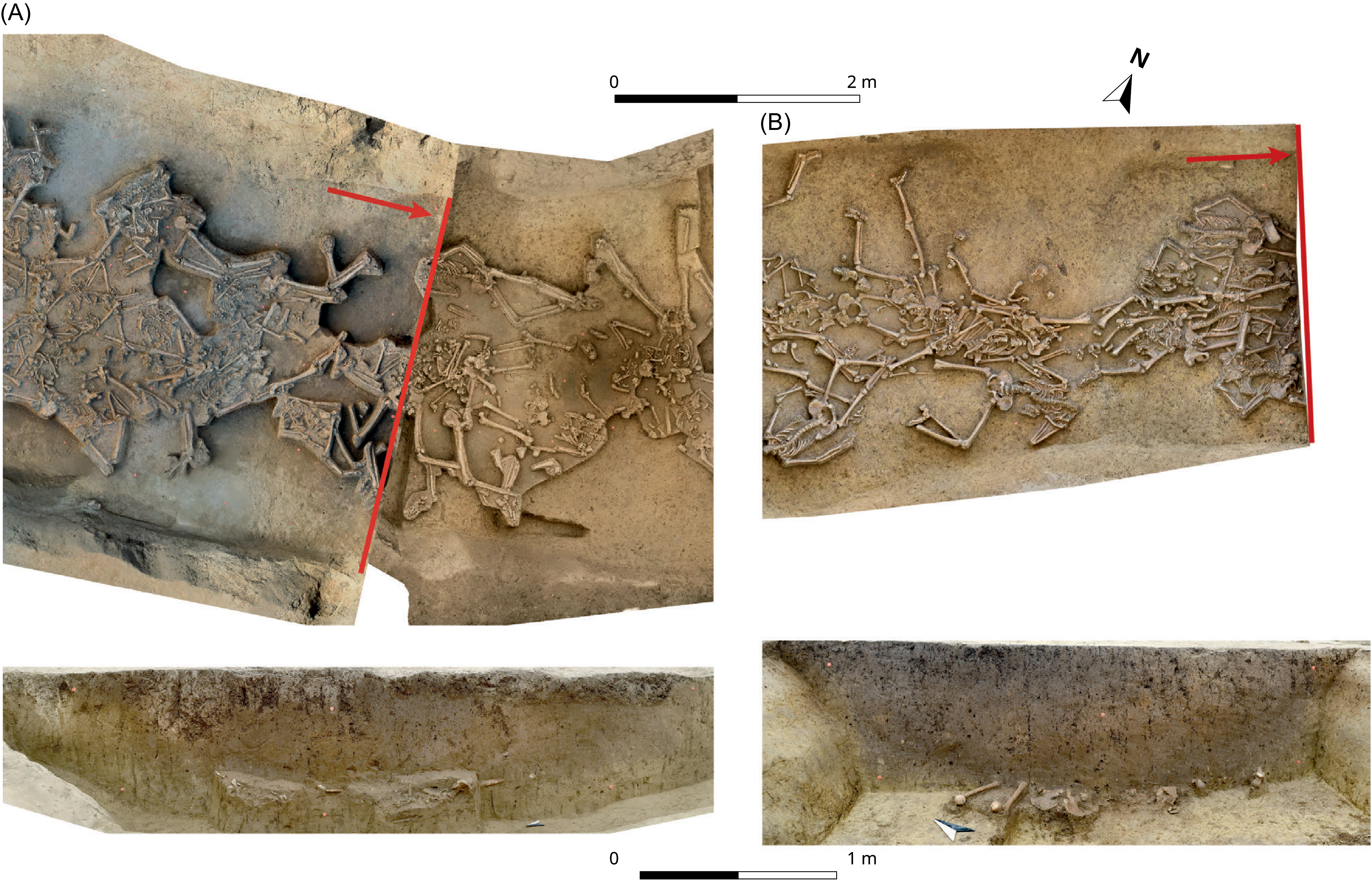
A special feature of Vráble is the fact that the south–western neighbourhood is surrounded by a 1.3 km long double ditch with at least six entrances (Winkelmann et al. Reference Winkelmann, Bátora, Hohle, Kalmbach, Müller-Scheeßel, Rassmann, Furholt, Cheben, Müller, Bistáková, Wunderlich and Müller-Scheeßel2020). The enclosure consists of a wider and deeper outer ditch, and a largely parallel smaller and shallower inner ditch. The outer ditch was 3–4 m wide at its top and 1.5–2 m deep when measured from the modern surface (Staniuk et al. Reference Staniuk, Furholt, Müller-Scheeßel, Cheben, Furholt, Cheben, Müller, Bistáková, Wunderlich and Müller-Scheeßel2020). The bottom was mostly slightly U-shaped. In some profiles, two phases of construction were identified, with a more flat-bottomed, or U-shaped ditch later recut by a more V-shaped one (Staniuk et al. Reference Staniuk, Furholt, Müller-Scheeßel, Cheben, Furholt, Cheben, Müller, Bistáková, Wunderlich and Müller-Scheeßel2020, 154). In other profiles, for example in trench 23, which revealed the mass deposition, such a recut is not visible, but the skeletons were deposited in a U-shaped ditch whose dimensions were extended to all sides (Figure 2). In those areas where two phases were visible, the skeletons were deposited in the later phase. All in all, in its second phase the outer ditch seems to have been reworked to a greater extent. It is possible that the older phase of the ditch did not extend around the whole south–western neighbourhood, or that the second phase was so extensive that the first ditch was completely destroyed. The first phase is so rarely preserved that we were so far not able to retrieve any datable material from it. Towards the entrance areas, the ends of the ditch segments widen and deepen and sometimes curve. Between the two terminals, in the space we describe as entrances, several short, but deep and narrow pits, so-called ‘Schlitzgruben’ were found, whose functions remain speculative (Staniuk et al. Reference Staniuk, Furholt, Müller-Scheeßel, Cheben, Furholt, Cheben, Müller, Bistáková, Wunderlich and Müller-Scheeßel2020). Most of the inner ditch is clearly visible on the magnetometry plan, but it is only partly preserved at the level beneath the modern plough zone. In the first planum, which we documented after the plough horizon had been removed, the inner ditch sometimes showed up as a line of oval but separate pits. This suggests that it was not dug in a single, continuous event, but represents a linear arrangement of successive digging and/or recutting events, as described for other LBK sites (Jeunesse Reference Jeunesse1996; Reference Jeunesse1997; Schmidt Reference Schmidt2004). In some places the magnetic signals indicate, and excavations show, that there is a narrow and shallow third line, which is interpreted as the remains of a palisade (Staniuk et al. Reference Staniuk, Furholt, Müller-Scheeßel, Cheben, Furholt, Cheben, Müller, Bistáková, Wunderlich and Müller-Scheeßel2020, 158 fig. 3.1.66).
Overview picture of the mass deposition of human remains and the profiles of the main ditches. A) Trench 23 (campaign 2022); B) Trench 32 (campaign 2024) (photo: T. Kühl; credits: K. Furholt).
Human remains
In addition to two areas around houses, we have excavated five entrances and two ditch sections of the enclosure of the south–western neighbourhood (Figure 3). Here, human remains were found mostly concentrated in the ditch entrance areas, and less concentrated further away from them. At the time of writing (summer 2025), 112 individuals have been identified, two of them in lateral elongated pits close to houses, the rest in or beside the outer or inner ditch of the settlement enclosure. Given the character of the mass deposition, the current minimum number of individuals will presumably increase significantly as a result of the detailed osteological analyses.
Results of the magnetic survey (by Knut Rassmann, Frankfurt) of the south-western neighbourhood and excavation areas, with trenches shown in outline (2016–2024).

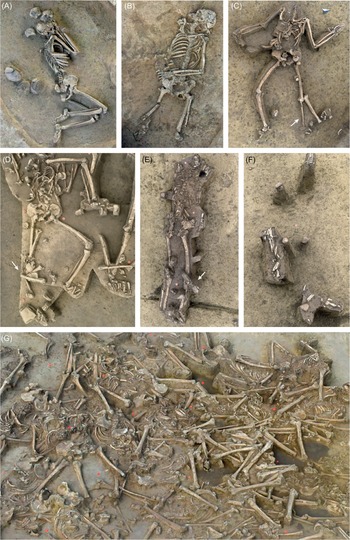
From what we have observed so far, there are different categories of human remains, based on their archaeological context, skeletal articulation, and skeletal completenessFootnote 1 . These categories include: complete skeletons in settlement features, as well as those in regular LBK grave pits; headless but otherwise complete skeletons in various body positions in the inner and outer ditch sections; and skeletal assemblages in different states of articulation, scattered in several ditch areas (articulated body parts, commingled complexes, and single bones) (Figure 4D, F–G). In this context, we define headless skeletons as (more or less) complete skeletons which obviously lacked their skull at the moment of discovery. Although the actual minimum number of individuals remains to be identified by the detailed osteological analysis, currently it appears that the majority of the headless skeletons and disarticulated elements were concentrated in one outer ditch section.
Examples of different treatments and states of preservation of human remains at Vráble-Veľké Lehemby. A) Complete skeletons in burial pits near the ditch of the south-western neighbourhood (S21; Müller-Scheeßel and Hukeľová Reference Müller-Scheeßel, Hukeľová, Furholt, Cheben, Müller, Bistáková, Wunderlich and Müller-Scheeßel2020, 178). B) Human remains from house contexts, here in a long pit (S14, south-eastern neighbourhood; Müller-Scheeßel and Hukeľová Reference Müller-Scheeßel, Hukeľová, Furholt, Cheben, Müller, Bistáková, Wunderlich and Müller-Scheeßel2020, 162). C–E) Headless skeletons and other human bones in the inner and outer ditches of the south-west neighbourhood. C) Well-preserved, articulated cervical spine; sporadic disarticulation in the lower spine and lower left leg (mass deposition outer ditch, S30). D) Well-preserved, partly intertwined with another headless skeleton; sporadic disarticulation in the right lower leg (mass deposition outer ditch, S30), together with disarticulated arm bones and a skull fragment of unclear association. E) Moderate preservation in the inner ditch (S32), with overlaying single and fragmented bones (arrow). F) Poorly preserved and fragmented bones in the inner ditch. G) Superimposed headless skeletons, articulated and disarticulated body parts, and single bones at the ditch terminal near entrance 2 (S23), discovered in 2022 (credits: K. Fuchs, T. Kühl, N. Müller-Scheeßel; for more examples see Müller-Scheeßel and Hukeľová, Reference Müller-Scheeßel, Hukeľová, Furholt, Cheben, Müller, Bistáková, Wunderlich and Müller-Scheeßel2020; Müller-Scheeßel et al. Reference Müller-Scheeßel, Hukeľová, Meadows, Cheben, Müller and Furholt2021).

Complete skeletons
Complete skeletons (Figure 4A) in burial pits were found in trench 21, which was excavated at the largest entrance (entrance 1). Excavated in 2017, their archaeological and osteological characteristics have already been published (Müller-Scheeßel & Hukeľová Reference Müller-Scheeßel, Hukeľová, Furholt, Cheben, Müller, Bistáková, Wunderlich and Müller-Scheeßel2020, 164–7, 172–81; Müller-Scheeßel et al. Reference Müller-Scheeßel, Hukeľová, Meadows, Cheben, Müller and Furholt2021). These individuals were placed in shallow burial pits, in crouched or irregular positions, some of them with typical LBK grave goods such as vessels, lithic tools, a perforated Spondylus disk, and remains of a young sheep. Nils Müller-Scheeßel et al. (Reference Müller-Scheeßel, Hukeľová, Meadows, Cheben, Müller and Furholt2021) assume that at least some of these individuals may have been originally placed on some elevated construction, which later collapsed. One individual, an adult male placed in the centre of the entrance with six ceramic containers and a long flint blade (Figure 4A), stood out by his location as well as the amount of grave goods. Another individual was an adult to mature male, buried with an assemblage of two chert blades, a flat adze, one ceramic vessel, and half a sheep. The remaining individuals in this group had one or two items as grave goods. To the west of this group, three burials with poorly preserved skeletons were excavated in 2024. One was the burial of a child, deposited with a ceramic vessel and a Spondylus disk, the other two unequipped graves contained the remains of one small child and an adult. A complete skeleton in a crouched position was found in a grave pit dug into the loess at the edge of the ditch in which the mass deposition of headless burials was discovered east of the second entrance. The bones of a foetus in the pelvic area clearly identified this individual as a woman.
Two skeletons in different states of preservation were found in the settlement, close to houses, in or next to the elongated pits. One (Figure 4B) was discovered in the south-eastern neighbourhood, the other in the south-west neighbourhood, close to entrance 1 (Müller-Scheeßel & Hukeľová Reference Müller-Scheeßel, Hukeľová, Furholt, Cheben, Müller, Bistáková, Wunderlich and Müller-Scheeßel2020, 162–3, 184–5). In the northern neighbourhood, the fragment of a human frontal bone was found in an elongated pit alongside one of the houses. Like the complete skeletons in burial pits, finds of human remains in settlement pits are also well-known from LBK settlement contexts.
Headless skeletons and skeletal elements
The headless skeletons (Figure 4C–E, G) show interesting differences in their spatial distribution within different sections of the ditch system. In 2017, two individuals were excavated at the bottom of the outer ditch (second phase) in trench 21, in the area to the west of entrance 1 (Müller-Scheeßel & Hukeľová Reference Müller-Scheeßel, Hukeľová, Furholt, Cheben, Müller, Bistáková, Wunderlich and Müller-Scheeßel2020, 168–71). The remains were identified as those of a 3–6-year-old child, extended on its back at the bottom of the ditch, and a young male (c. 15–24 years), also in a supine position. In trench 23, located in the area of entrance 2 and excavated in 2017, two additional headless skeletons were found, both very well preserved and stretched out along the base of the western ditch terminal (Müller-Scheeßel & Hukeľová Reference Müller-Scheeßel, Hukeľová, Furholt, Cheben, Müller, Bistáková, Wunderlich and Müller-Scheeßel2020, 186–9). These two individuals were placed opposite to the mass deposition discovered in the eastern ditch terminal of entrance 2 in 2022. Another ‘pair’ of seemingly headless skeletons was recovered from the inner ditch west of entrance 3. Unfortunately, the preservation of skeletal remains in the inner ditch is much worse than in the outer ditch (Figure 4E–F), and detailed osteological analyses still need to confirm the initial in situ evaluation, which concluded that the skulls are missing here, too. The fourth instance of two headless skeletons found next to each other was at entrance 4, in the western terminal of the outer ditch. They were accompanied by a third, complete skeleton. Interestingly, a 30 cm long flat rock was lying above its skull. The most striking find, however, was also made in 2022 in trench 23, the mass deposition of headless skeletons (see below).
Along the sections of the inner ditch, we recovered a considerable amount of rather badly preserved articulated skeletal elements (Figure 4F) or single bones, and the outer ditch contains complexes of unarticulated bones and single bones throughout (Figure 4D, G). The degree of preservation increases with greater depth, meaning the human remains from the inner ditch are in poorer condition. In most cases, only fragmentary diaphyses of long bones were recovered. Thus, the total number of individuals – headless or not – remains to be clarified by extensive osteological work. The fifth entrance, excavated in 2022, contained no human remains.
The mass deposition
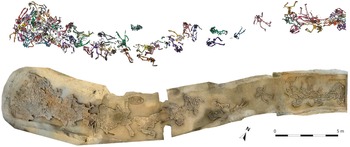
In 2022, a large concentration of headless skeletons was found and excavated in the ditch terminal east of entrance 2Footnote 2 . This has been presented in the TEA newsletter (Furholt et al. Reference Furholt, Cheben, Wunderlich, Bistáková, Fuchs, Hukeľová, Szilágyi and Kühl2023). Our further excavations of this mass deposition in 2023 and 2024 have, however, significantly altered the picture we had gained in 2022, when we reported a minimum number of 37 skeletons, 36 of them headless, from this section of the ditch. By now, our observations from the archaeological excavation arrived at a count of at least 77 headless skeletons and one complete skeletonFootnote 3 , all found within the first 25 m of the ditch – and we have not yet been able to determine the end of the deposition (Figure 5). The bodies were lying at the bottom of the ditch in different body positions: placed prone or supine, or even twisted, all with very variable positions of the torso, and with limbs angled, splayed, or lying underneath the body. There were no regularities in terms of orientations, i.e. the neck pointing north or south. Those mostly well-articulated headless skeletons sometimes overlay each other, surrounded and partly covered by numerous skeletal elements in different states of articulation. The majority of the skeletal remains were found in the ditch fill above the yellow, natural loess soil, and at different distances from the ditch edges. Underneath the skeletal remains, we observed a layer of almost unaltered loess fill of varying thickness (c. 10–15 cm). Only a few isolated bones were found scattered in the ditch fill above the main skeletal layer. As Figure 5 indicates, the skeletons were unevenly distributed.
The mass deposition in the outer ditch to the east of entrance 2 (trenches 23, 30, 32, 33). Identifiable skeletons are marked by different colours, disarticulated elements and bones are marked in black (credits: K. Fuchs, A. Heitmann, N. Müller-Scheeßel, T. Kühl).

Forty-four out of the 77 headless and one complete skeletons were found in the first 9.5 m from the ditch terminal. At those 9.5 meters however, there was a slight gap – in which the already mentioned regular burial of a pregnant woman was located – followed by another cluster of eight headless skeletons deposited over the following 5 m. Five more loosely interred skeletons delineate the main concentration of the mass deposition. However, further east, our excavation in 2024 uncovered a cluster of at least another 12 individuals over the next 5 m, which could not be fully excavated in 2024, as it reached beyond that year´s excavation area (see Figure 5).
First osteological and taphonomic observations
Alongside the well-articulated skeletons, the large number of articulated skeletal elements, bone complexes, and single bones invite further thoughts on matters of taphonomy and depositional practice. The degree of disintegration of the anatomical connections differs, but is largest in the centre of the westernmost 5 m of the ditch (to the east of entrance 2), where the concentration of skeletal remains is densest, and especially along the mid axis of the ditch (Figures 2 & 5). In other words, the majority of bone complexes and single bones were found in the centre of the ditch terminal, while overall anatomical integrity is higher the closer a skeleton is placed to the edge of the ditch (Figures 4G & 5). Further studies will investigate whether this pattern may have resulted from some form of chronological succession in the deposition, in the sense that bodies deposited earlier were pushed into the centre to make room for newer ones on the edges of the ditch, or if this arrangement was caused by taphonomic processes.
Grave goods, in the sense of intentionally deposited items to accompany the dead, are missing. In terms of finds, a complete LBK vessel was found in the ditch fill, while a needle made of animal bone and several pieces of a grinding stone lay among the headless skeletons. Furthermore, we found individual potsherds, flint and obsidian tools, and stone pebbles among the bones. In one case, a stone axe head was lying under a femur. Five perforated teeth, four of which were human and one from a deer, were also found near the skeletons. Such perforated human teeth are rarely known in the European Neolithic, but are also found in the contemporaneous LBK site at Werneck-Zeuzleben (Spieß pers. comm.), as well as at Catalhöyük (Haddow et al. Reference Haddow, Tsoraki, Vasić, Dori, Knüsel and Milella2019).
Having excavated 25 m along this section of the outer ditch, we have not been able to find the end of the mass deposition to the east, as the ‘skeletal layer’ continues eastwards. However, the other ditch terminal, located 158 m from the terminal with the mass deposition, also contained at least two headless skeletons. Further fieldwork will show whether or not the ‘mass deposition’ continues for this remaining distance of 158 m, and if there are additional, larger concentrations of headless skeletons.
The human remains of the regular LBK graves found during the 2016–2017 campaigns in and along the ditch and in the settlement are already published (Hukeľová & Krošláková Reference Hukeľová and Krošláková2021; Müller-Scheeßel & Hukeľová Reference Müller-Scheeßel, Hukeľová, Furholt, Cheben, Müller, Bistáková, Wunderlich and Müller-Scheeßel2020) and show a broad demographic structure. Those publications also provide insights into pathologies and survived injuries. For the human remains found between 2021 and 2024, first taphonomic and osteological observations were made on site during the excavation. Although full analysis of the osteological material is still to be carried out, we here offer some first insights.
Based on our preliminary osteological assessments of the state of epiphyseal closure (Scheuer & Black Reference Scheuer and Black2004), subadult skeletons seem to be underrepresented compared to adults. Strikingly, the only skeleton of a young child is also the only individual of this mass deposition that still had a head. On the question of the time interval between the severing of the heads and the placement of the headless corpses in the ditch, some in situ observations merit attention. Given the highly variable states of anatomical integrity, the cervical vertebrae of the headless skeletons were surprisingly often correctly aligned (Figure 4C). According to sequential tendencies of joint disarticulations during body decomposition (Mickleburgh & Wescott Reference Mickleburgh and Wescott2018), with the neck region representing a labile and prone articulation, this indicates that these bodies were not in an advanced state of decomposition at the time of their deposition in the ditch. Although changes in the mechanical processes due to the lack of the skull’s weight must be considered (Mickleburgh & Wescott Reference Mickleburgh and Wescott2018), the good preservation of hands and feet, which are also highly prone to early postmortem dismembering (Knüsel & Robb Reference Knüsel and Robb2016; Sellier & Bendezu-Sarmiento Reference Sellier and Bendezu-Sarmiento2013), supports this initial assumption. Furthermore, the position of some of the headless individuals, for example where the upper vertebrae are in direct contact with the ditch wall, suggests that at least some individuals were deposited in the ditch after the heads were removed.
First observations of cutmarks on different cervical vertebrae suggest a removal of the heads by cutting with sharp tools, rather than chopping using blunt force, but this needs to be validated in future studies. Additionally, since we found only a few individual fragments of the mandible, it appears that it was important that the head, including the face, remained intact. From what we currently understand, this appears to have been related to intentional body manipulation.
At the moment, we cannot assess in more detail what kinds of actions, intentions, and motivations were involved, nor do we yet know if or to what degree violence played a part in them. This requires a detailed and multidisciplinary investigation of cutmarks (e.g. orientation, location, relief, metrics) and fragmentation patterns (whether peri- or postmortem), as well as of traces of injuries and interpersonal violence, of each bone in each skeleton. Here, forensic approaches coupled with archaeozoological knowledge on dismemberment practices will aid in interpreting our observations, embedded in the investigation of the temporal and practical aspects of the overall body treatment through archaeothanatological methods (i.e. histotaphonomy, micromorphology, microfossils). As for the biological and social associations within and between the recovered individuals and their lifestyles as revealed by diet and mobility, we anticipate results from population genetics, genetic kinship analyses, and stable isotope analyses to be crucial. Further osteological analyses, such as pathologies and markers of physical activity, will add to insights into the biographies of these individuals.
Dating and chronological aspects
The mass deposition is dated by 14C analysis of rib samples from 12 headless skeletons and from seven single femora. They all yield very similar 14C dates, 5300/5210–5050/4950 cal BCE (Supplementary S1) and correspond well with the dates reported from regular burials next to the enclosure ditch and with the other headless skeletons outside the mass deposition (Supplementary S1; Meadows et al. Reference Meadows, Müller-Scheeßel, Cheben, Agerskov Rose and Furholt2019; Müller-Scheeßel et al. Reference Müller-Scheeßel, Müller, Cheben, Mainusch, Rassmann, Rabbel, Corradini and Furholt2020; Reference Müller-Scheeßel, Hukeľová, Meadows, Cheben, Müller and Furholt2021). While the analysis of taphonomic processes is ongoing, it does not seem that the placement of headless skeletons at the bottom of the ditch took place over a longer period. Arguments for this are that only a little fill sediment accumulated under the deposited bodies, as well as between superimposed bodies, and signs of ditch recuts are lacking. Instead, we are probably dealing with a few years, maybe even less; in principle, just hours or days are possible, too.
At the current state of knowledge, the deposition of the headless bodies could have happened any time between 5210 cal BCE, just two generations after Vráble was founded, and the end of the site’s occupation around 5000–4950 cal BCE (Meadows et al. Reference Meadows, Müller-Scheeßel, Cheben, Agerskov Rose and Furholt2019). So far, a more precise radiocarbon chronology has been prevented by the flat section of the calibration curve between 5210 and 5000 cal BCE (cf. Masclans et al. Reference Masclans, Tóth, Tvrdý, Hamilton, Bickle, Díaz-Zorita Bonilla and Morell-Rovira2025; Morell-Rovira et al. Reference Morell-Rovira, Bickle, Hamilton, Díaz-Zorita Bonilla, Francken and Masclans2025). However, to decide whether the head removal and body depositions in the ditch are a recurring and long-term practice, or by contrast, a one-off event, more precise and detailed dating is necessary. Current LBK chronologies are largely based on pottery decoration patterns, and a control via absolute dating methods is so far still prevented by the same calibration curve plateau that hinders our efforts in Vráble. It is thus worth keeping in mind that these chronologies, as well as the idea that the events taking place at the ditch in Vráble and at other LBK sites represent the final phase of LBK societies, is not yet well established through absolute dating methods.
Discussion
As spectacular as the mass deposition is, it is important to recognise that this find exists in the context of the overall depositional complexity along the enclosure ditches in Vráble. The very diverse ways in handling dead bodies – seemingly ‘regular’ burials, smaller groups (‘pairs’) of skeletons, as well as the mass deposition – likely indicate that we are not dealing with a singular event, but with an array of meaningful practices taking place along the southern part of the enclosure ditch. The site must be seen in a trans-regional context, as depositions of human bodies and body parts in enclosure ditches and pits are known from other contemporaneous sites in central and south-east Europe (see below).
Complex patterns of deposition in Vráble
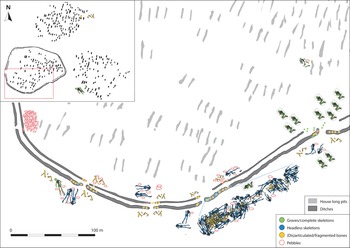
Depositions of human bodies took place in different parts of the enclosure ditch over a length of at least 320 m to the south of the settlement (Figure 6). We have not yet excavated the eastern and northern parts of the enclosure, including the remaining entrance 6 in the north, while the area of entrance 5 in the western part contained no human skeletal material from the Neolithic. In the southern part, treatment and depositional practices of bodies are complex and multilayered, as there are practices attested in nearly all excavated areas, and others that are spatially restricted to smaller sections of the enclosure. The first feature found in all sections of the ditch is the general prevalence of headless bodies in both the inner and outer ditch; the second is the deposition of ‘pairs’ of such headless bodies to the west of each of the four southern entrances. Among the spatially restricted practices are the regular burials, which are concentrated in the south-east, at the largest entrance (entrance 1). They are placed next to and along the ditch, and their orientation follows the curve of the latter. Apart from these, there is so far only one regular burial found to the east of entrance 2. The mass deposition itself, found to the east of entrance 2, is also a spatially restricted phenomenon.
Overview of different contexts with human remains and depositional practices in ditch areas and entrances at the south-western neighbourhood of Vráble-Veľké Lehemby (credits: K. Fuchs, M. Furholt, K. Furholt, N. Müller-Scheeßel).

A striking feature of the ditch are the pebble concentrations found among the human remains (Figure 7). These pebbles do not naturally occur in the loess, but must have been collected and brought from rivers, or dug up from the Pleistocene deposits. The pebbles vary in size and material, but usually do not exceed a diameter of 8–10 cm. Detailed use-wear analyses are still pending. Their placement among the human remains indicates some role in depositional practice. Alternatively, they could be seen as parts of the ditch construction, given that the westernmost entrance (entrance 5), while it did not contain human remains, was paved with one layer of pebbles, stretching along the bottom of the inner ditch (Figure 7F).
Different contexts of pebble deposition (pebbles are marked with white arrows) next to headless and complete skeletons in the outer ditch (A–C), around human bone complexes (D & E), and a pebble paving in the inner ditch near entrance 5 (F). A) campaign 2021, trench 26, object 2, quadrant G-H-J; B) campaign 2017, trench 23, object 203, quadrant 30-32; C) campaign 2021, trench 25, planum 2; D) campaign 2021, trench 25, planum 2; E) campaign 2021, trench 26, object 4, quadrant D, planum 2; F) campaign 2022, trench 27, objects 3 and 20 (photo: T. Kühl; credits: K. Furholt).

To sum up, the activities around the entrance areas in Vráble are structured by a set of common characteristics, which were complemented by spatially more constrained practices. How to interpret these patterns will become clearer once osteological and other analyses of the bones, archaeological finds, and sediments have been completed – but first speculations are tempting.
The apparent target of body manipulation, the head, makes it plausible to consider a headhunting practice (e.g. Andaya Reference Andaya2004; Hoskins Reference Hoskins1996), which in principle could have been preceded by natural deaths, but scenarios involving violence are just as likely. Given the large number of headless bodies, one might consider a massacre scenario. While this cannot be ruled out for the mass deposition, the different, but seemingly patterned placements of the other headless bodies rather contradict this. Instead of an event-like character, the practice of head removal and ditch deposition could have taken place over a longer period of time, for example, months or years, motivated by other reasons than interpersonal violence or trophy-hunting behaviour (e.g. Andrushko et al. Reference Andrushko, Latham, Grady, Pastron and Walker2005; Tung Reference Tung2008). Human sacrifice or the capture of someone’s head, probably in most cultures in one way or the other a symbol for personhood and life, could constitute the motivation for those practices; a burial rite with special attention to the skull is another likely possibility. However, since we found only a very small number of skull fragments in the outer ditch, the most obvious and significant problem is that it remains unclear where the heads were taken, placed, or deposited. Currently, the heads are archaeologically ‘invisible’ to us, making an assessment of the role of violence – often visited on the head – as well as ritual practices very difficult. Maybe the skulls were collected and displayed in one or several of the houses of the three neighbourhoods, and then it would be possible that at least some of these skulls or their fragments were preserved in the long pits along the house walls (as was perhaps the case with the single skull fragment I19 found in the northern neighbourhood, see Müller-Scheeßel & Hukeľová Reference Müller-Scheeßel, Hukeľová, Furholt, Cheben, Müller, Bistáková, Wunderlich and Müller-Scheeßel2020, 198). However, nothing was visible in the geophysical plots of the 50 ha settlement of Vráble which would hint at where to look, or which of the almost 300 unexcavated houses to pick for a targeted search. Of course, it is also possible that the heads did not remain at Vráble but were taken somewhere else.
Comparable finds? Skull cults and head removal in early prehistoric Europe
The removal of heads is a well-known phenomenon in different periods and in different parts of the world, often in the context of ancestor worship or other socio-political, ritual, and magical practices, both violent and non-violent in nature (Larson Reference Larson2014). In the Neolithic tradition deriving from south–west Asia, head removals are not uncommon at all, albeit not so much in the direct vicinity of Vráble (Bonogofsky Reference Bonogofsky2005; Reference Bonogofsky2006; Zalai-Gaál Reference Zalai-Gaál2009). They are especially frequent in the south–west Asian Pre-Pottery Neolithic (PPN), where heads were removed from bodies before or after primary burial, when single or multiple heads were deposited separately, at times plastered and/or painted (Perschke Reference Perschke and Müller-Scheeßel2013). Headless burials have also often been found (Bienert Reference Bienert1991; Goring-Morris Reference Goring-Morris and Clark2005; Lechevallier Reference Lechevallier1978). Indeed, Fanny Bocquentin et al. (Reference Bocquentin, Kodas and Ortiz2016) report that 6.1% of the more than 3000 burials they recorded for the period from the Natufian to the PPNB in the Levant showed some variant of head manipulation. While detailed osteological investigations are mostly lacking, it seems that in the majority of cases, crania were removed without the mandible, in other words, not the whole heads, which differs from the pattern in Vráble. In Göbekli Tepe, fragments of crania with perforations and cutmarks/incisions attest to some ritual manipulation of skulls (Gresky et al. Reference Gresky, Haelm and Clare2017). In Çatalhöyük, where more detailed osteological analyses were carried out, both crania and complete heads were often removed in the course of manipulations of already buried individuals, to be secondarily deposited in other contexts (Haddow & Knüsel Reference Haddow and Knüsel2017). In at least one case, cutmarks on the uppermost vertebra, the atlas, indicate a precise head removal (Haddow & Knüsel Reference Haddow and Knüsel2017), similar to initial evidence from Vráble.
In the Neolithic period in south-east Europe, the deposition of single or multiple human skulls occurs repeatedly. Without being able to present an exhaustive overview here, for a general impression it might suffice to mention a few examples: 11 skulls in a deposit in the Greek Early Neolithic settlement of Prodromos, 15 skulls from Alepotrypa cave, 11 skulls deposited during the Starčevo phase at Vinča, Serbia (Chapman Reference Chapman2000, 134), or three skulls from Smilčić, Croatia (Zalai-Gaál Reference Zalai-Gaál2009, 86). In the eastern Lengyel cemetery of Zengövárkony in Transdanubia, Hungary, 32 of the burials were found to lack their head (Dombay Reference Dombay1960; Lichter Reference Lichter2001; Zalai-Gaál Reference Zalai-Gaál2009, 19–30). A number of disarticulated skulls were found in the Starčevo phase of the nearby Alsónyék-Kanizsa-dűlő settlement (Bánffy et al. Reference Bánffy, Marton, Osztás, Kozłowski and Raczky2010; Oross et al. Reference Oross and Hamilton2016), and in the Lengyel period at Alsónyék, as in other eastern Lengyel sites, headless skeletons have occasionally been documented (Zalai-Gaál Reference Zalai-Gaál2009, 34–58). A group of five human skulls in a settlement pit in Poigen, and a skull deposit in Bisamberg, both Austria (Veit Reference Veit1996, 262; Zalai-Gaál Reference Zalai-Gaál2009, 59–60), indicate a similar pattern of occasional special treatments of heads in the western Lengyel region.
In the LBK settlement site of Halberstadt, two of nine skeletons found in a pit were missing their heads (Meyer et al. Reference Meyer, Knipper, Nicklisch, Münster, Kürbis, Dresely, Meller and Alt2018), a situation which parallels the find of Wiederstedt, central Germany, where three out of ten skeletons were headless (Meyer et al. Reference Meyer, Kürbis and Alt2004). The deposition of single skulls or skull parts, often calottes or clusters of them (see Veit Reference Veit1996, 154–68), is attested at several LBK sites, such as in Vaihingen/Enz (Krause Reference Krause1998), Asparn-Schletz (Pieler & Teschler-Nicola Reference Pieler, Teschler-Nicola, Balkowski, Hofmann, Hohle and Schülke2023), and most notably in Herxheim with around 500 calottes (Zeeb-Lanz Reference Zeeb-Lanz2016; Reference Zeeb-Lanz2019a), all of which indicates a different kind of special head treatment.
Pre-Neolithic examples of the deposition of either skulls or headless bodies come from the Iron Gates sites, i.e. Lepenski Vir, Vlasac, Cuina Turcului, or Padina (Srejović & Letica Reference Srejović and Letica1978; Veit Reference Veit1996, 348; Zalai-Gaal Reference Zalai-Gaál2009), or the Bavarian Ofnet cave (Orschiedt Reference Orschiedt, Parker-Pearson and Thorpe2005). Therefore, we are not dealing with a specifically south–west Asian Neolithic tradition brought to Europe by early farmers. Rather, head removals and special treatments of heads are a widespread anthropological phenomenon, which takes a great variety of forms (Bonogofsky Reference Bonogofsky2006). Vráble, with its vast number of headless skeletons, adds to this variety.
Comparable practices: human bodies in ditches
The second set of parallel practices that we can find in the same period as Vráble in central and south-east Europe is the deposition of bodies and body parts in settlement enclosure ditches. These are known from south-east Europe, such as the Butmir settlement of Okolište, Bosnia-Herzegovina (Müller-Scheeßel et al. Reference Müller-Scheeßel, Schmitz, Hofmann, Kujundžić-Velzagić, Müller, Rassmann and Zeeb-Lanz2009), the Vinča-Tisza site of Bordoš, Serbia (R. Hofmann et al. Reference Hofmann, Medović, Furholt, Medović, Pešterac, Dreibrodt, Martini and Hofmann2019; Reference Hofmann, Furholt, Medović, Stanković Pešterac, Medović, Dreibrodt, Wilkes, Martini, Staniuk, Furholt and Stanković Pešterac2024), and the Tisza tell-like settlements at Öcsöd-Kováshalom (Raczky et al. Reference Raczky, Füzesi, Anders and Adrian Luca2018, 130–4) and Polgár-Bosnyákdomb (Raczky & Anders Reference Raczky and Anders2016, 112) in Hungary.
Closer by, several LBK settlements show a similar pattern – human remains deposited in enclosure ditches surrounding larger LBK settlements – yet at the same time there is a remarkable variability when it comes to body manipulation and deposition practices. These tend to be largely contemporaneous, dating between 5100 and 5000 BCE, towards the end of the LBK (Riedhammer Reference Riedhammer and Zeeb-Lanz2019). In addition, in this period, indications of violence, even mass violence, seem to cluster markedly (Fontijn Reference Fontijn2021; Golitko & Keeley Reference Golitko and Keeley2007).
The site geographically closest to Vráble is Asparn-Schletz in Lower Austria. This settlement was probably a central place in the Zaya Valley (Maurer et al. Reference Maurer, Längauer, Hascher, Irrgeher, Teschler-Nicola, Prohaska, Puschenreiter, Schober, Pieler, Laussegger and Sam2023; Pieler & Teschler-Nicola Reference Pieler, Teschler-Nicola, Balkowski, Hofmann, Hohle and Schülke2023), and at the end of its existence (Teschler-Nicola Reference Teschler-Nicola, Schulting and Fibiger2012) more than 100 individuals (Maurer et al. Reference Maurer, Längauer, Hascher, Irrgeher, Teschler-Nicola, Prohaska, Puschenreiter, Schober, Pieler, Laussegger and Sam2023) were violently killed and left in the enclosure ditches. New aDNA evidence from 92 individuals from this site has shown that those killed did likely not represent the inhabitants of the settlement, as their rate and level of biological relatedness is much too low (Gelabert et al. Reference Gelabert and Reich2025). Rather, people from other settlements came or were brought to this place before ending up in the ditch. A new research project which will undoubtedly reveal more about the circumstances is ongoing (Maurer et al. Reference Maurer, Längauer, Hascher, Irrgeher, Teschler-Nicola, Prohaska, Puschenreiter, Schober, Pieler, Laussegger and Sam2023).
Violence seems to have played decisive roles at those LBK sites with body depositions in the ditches, but in different ways. For example, at Schöneck-Kilianstetten, central Germany (Meyer et al. Reference Meyer, Lohr, Gronenborn and Alt2015), 26 individuals deposited in a ditch had likely been tortured (their lower legs were broken before death) and then killed. In contrast, in Menneville (Thevenet Reference Thevenet2016) in the Aisne Valley, France, a small number of articulated human bodies and body parts were deposited in diverse ways in the ditches surrounding the LBK settlement, along with animals and parts of animals. Some of the human skeletons show signs that could be interpreted as postmortem manipulation. The whole ditch is, however, full of more bones, deriving from secondarily deposited human and animal remains. No signs of lethal violence were found on the bones (Thevenet Reference Thevenet2016).
In Vaihingen/Enz, south–west Germany, regular LBK burials, i.e. individuals in crouched positions and complete bodies, were found in the enclosure ditches (Krause Reference Krause1998). While this might not look like an obvious parallel, it shows another variant of the overall structural setting, the combination of dead people in ditches around larger LBK settlements. Another group of burials are found in elongated pits near houses in Vaihingen, and a few in refuse pits. Signs of violence are present in two cases out of 111 (Krause Reference Krause1998, 97–8).
The most striking parallel to Vráble is the site of Herxheim in western Germany (Zeeb-Lanz Reference Zeeb-Lanz2016; Reference Zeeb-Lanz2019a). As at Vráble, the peculiar practices observed in Herxheim occur after a century-long history as a ‘conventional’ LBK settlement, starting around 5300 BCE. Towards the end of its occupation in the 51st century BCE, complex ritual practices were carried out at the site (Zeeb-Lanz Reference Zeeb-Lanz and Zeeb-Lanz2019b, 425). As in Vráble, those practices are concentrated on a newly constructed double enclosure of trapezoid shape. The osteological studies document clear acts of violence towards the bodies, overshadowed by complex practices of body manipulation and deposition – chopping the bodies into small parts, depositing clusters of skull calottes, and the corresponding destruction of pottery, flint blades, and polished stone tools – which are clearly meaningfully and purposefully constituted (Chapman et al. Reference Chapman, Gaydarska and Jakob2023; Peter-Röcher Reference Peter-Röcher, Balkowski, Hofmann, Hohle and Schülke2023; Zeeb-Lanz Reference Zeeb-Lanz and Zeeb-Lanz2019b). Some of the research team members have postulated that cannibalism was part of these practices (Boulestin & Coupey Reference Boulestin and Coupey2015; Boulestin et al. Reference Boulestin, Zeeb-Lanz, Jeunesse, Haack, Arbogast and Denaire2009), but this claim has been strongly disputed by Heidi Peter-Röcher (Reference Peter-Röcher, Balkowski, Hofmann, Hohle and Schülke2023), and is also seen critically by other project members (Zeeb-Lanz Reference Zeeb-Lanz and Zeeb-Lanz2019b, 452). Jörg Orschiedt and Miriam Haidle (Reference Orschied, Haidle, Schulting and Fibiger2012), as well as Peter-Röcher (Reference Peter-Röcher, Balkowski, Hofmann, Hohle and Schülke2023), argue that the Herxheim evidence can be explained by secondary burial rituals.
Finally, a number of other largely contemporaneous sites with mass depositions of human bodies show signs of extensive violence, albeit not in enclosure ditches. At Talheim (Bentley et al. Reference Bentley, Wahl, Price and Atkinson2008; Wahl et al. Reference Wahl, König and Biel1987), south–west Germany, 34 people were violently killed and thrown into a settlement pit. They probably represent three extended families, which would make a significant part of a village population (Wahl & Trautmann Reference Wahl, Trautmann, Schulting and Fibiger2012). In Halberstadt-Sonntagsfeld, central Germany, a group of nine adult males seem to have been executed by relatively regular blows to the head and deposited in a pit (Meyer et al. Reference Meyer, Knipper, Nicklisch, Münster, Kürbis, Dresely, Meller and Alt2018). As a contrast to these sites, in Wiederstedt (see previous section) no signs of perimortem violence were found (Meyer et al. Reference Meyer, Kürbis and Alt2004).
Violence, ritual, cosmology? Towards a holistic interpretation
The repeated deposition of human bodies in settlement enclosures and pits in the 51st century BCE, towards the end of the LBK, is remarkable, and it seems hard not to see these sites as structurally connected by similar date, cultural association, socio-economic context (larger LBK settlements), and location of practices (enclosure ditches). They could be regarded, despite all the variability, as expressions of similar, or even the same underlying socio-political motives. Still, how can it be explained that the ways in which human bodies and objects are treated are so fundamentally diverse, ranging from a straightforward massacre as in Talheim to the complex fragmentation in Herxheim, and to the restricted focus on head removals in Vráble?
These phenomena are usually discussed in terms of crisis (e.g. Zeeb-Lanz Reference Zeeb-Lanz2007). Mark Golitko and Lawrence Keeley (Reference Golitko and Keeley2007) argue that the Early Neolithic period in central Europe is characterised by high levels of war and violence, and they see violent clashes between different LBK communities to be the most visible line of conflict. Reasons for those violent acts could have been, Golitko and Keeley argue, ‘revenge for prior attacks, land disputes, poaching, prestige, capture of slaves or capture of women’ (Golitko & Keeley Reference Golitko and Keeley2007, 339). They explain the intensification towards the end of the LBK by ‘environmental degradation or overpopulation’ (Golitko & Keeley Reference Golitko and Keeley2007, 339; see also Meyer et al. Reference Meyer, Lohr, Gronenborn and Alt2015, 11221). Christian Meyer et al. (Reference Meyer, Knipper, Nicklisch, Münster, Kürbis, Dresely, Meller and Alt2018, 7) add ‘climate induced drops in agricultural land and increasing hierarchical differentiation’. It is important to state that none of these potential reasons for violence or war are empirically attested, which admittedly does not rule them out entirely. It is, however, worth noting that many of the cases of human remains in ditches or pits towards the end of the LBK do not at all conform with the scenarios suggested by Golitko and Keeley (Reference Golitko and Keeley2007), or by Meyer and colleagues (Reference Meyer, Lohr, Gronenborn and Alt2015; Reference Meyer, Knipper, Nicklisch, Münster, Kürbis, Dresely, Meller and Alt2018). In addition, as Thomas Link (Reference Link, Link and Schimmelpfenning2014) points out, in many regions the transition from the LBK to the following cultures, such as the SBK (‘Stichbandkeramik’ or Stroke-Ornamented Pottery culture) in central and southern Germany or Lengyel further south and east, does not appear to have been disruptive at all, but to the contrary there is continuous settlement and gradual change of stylistic elements of material culture.
The main issue with Golitko and Keeley´s (Reference Golitko and Keeley2007) explanation for violence in the LBK is that it imposes a number of premises relying on a modernist and essentialist view on subjects, such as human nature and the relation of society to nature, as well as on an ahistorical understanding of property relations, individual aggrandising behaviour, prestige, and gender roles. The idea of land as a scarce resource is a cornerstone of modern economics, but whether it existed in the Neolithic is speculative at best (Furholt Reference Furholt2023). Many cases discussed here do not fit the definition of war in the modern sense, which usually is cast along the lines of identity-group-based, intentional, collectively organised, enduring series of inter-group violence on a larger scale for political reasons, such as conquest of land, people, or resources, or conversely the defence against such acts.
This model of warfare builds on the assumption that the actions of Neolithic people would have been guided by a worldview similar to modern Western rationality. This is, however, very unlikely. What should be assumed for Neolithic people is some variant of an ‘immanentist’ worldview, as defined by Marshall Sahlins (Reference Sahlins2022, following Strathern Reference Strathern2019), in which the world is filled with gods, ancestors, and spirits, nature is not seen as separated from society, and the earth, rocks, trees, lakes, or rivers are not viewed as lifeless resources to be exploited, but rather as animated beings, representing persons of their own – or rather, together with spirits, ancestors, and gods, meta-persons (Sahlins Reference Sahlins2022). According to Sahlins, our modern Western worldview should be seen as part of an historical development which emerged only during the Iron Age. From the 8th to the 3rd century BCE, during the famous ‘axial ages’, ‘transcendentalist’ philosophies and religions from China to Greece started to separate the world of human activities from an other-worldly realm of divinity, the dead, and other kinds of spirits. In this way these worldviews eradicated the idea of animated matter, and instead ‘disenchanted’ the material world, establishing the dualisms of body and soul, matter and spirit. Immanentist worldviews by contrast do not imagine any world other than the one in which we live, and gods, the ancestors, and other kinds of spirits are not supernatural and confined to a spirit-world, but are recognised as meta-persons that share the same world as humans and have to be reckoned and interacted with.
In other words, the social and political arena in which a possible Late LBK crisis would have been set is likely to have included complex relations between human persons and those meta-persons, actors to be reckoned with, whose approval would have to be sought and whose intervention needed to be taken into account and be addressed (Strathern Reference Strathern2019, 36–7). This would explain rather well why at many of the sites mentioned, there were clearly more layers of meaning involved and referred to than suggested by the war model discussed above.
What is more, instead of the modern image of clearly bounded, individualised, self-interested actors, personhood has to be seen as relational, dividual, and often distributed between human bodies and other entities of the world (see Brück Reference Brück2001; Chapman et al. Reference Chapman, Gaydarska and Jakob2023; Sahlins Reference Sahlins2022). For the Neolithic, several colleagues have interpreted the widespread fragmentation of human bodies and objects, as well as their often intentional (re-)combination in depositional contexts, in terms of dividual personhood and relational cosmologies (e.g. Chapman Reference Chapman2000; Fowler Reference Fowler2004; Reference Fowler2016; D. Hofmann Reference Hofmann, Devlin and Graham2015; Jones Reference Jones2005). In LBK contexts, treatments of the dead include a spectrum reaching from the display of complete, adorned human bodies to different kinds of fragmentation and recombination with other substances (see Haack Reference Haack and Hofmann2020; D. Hofmann Reference Hofmann, Devlin and Graham2015; D. Hofmann & Orschiedt Reference Hofmann, Orschiedt, Fowler, Harding and Hofmann2015). The special attention often given to human heads would indicate that this part of the body is associated with certain vital substances (D. Hofmann Reference Hofmann, Devlin and Graham2015, 121), or with specific aspects or parts of personhood – for example, the head could be seen as a representation of the lineage-derived part of a person, as suggested in different ethnographic accounts (Sahlins Reference Sahlins2022, 54).
At the site of Menneville, the frequent association of human remains with animal remains, as well as the frequent fragmentation of those bodies, might indicate that negotiations of inter-species relations and distributed personhood were being played out. In Vaihingen/Enz and Wiederstedt, the deposition of human remains is also clearly related to meaningfully patterned ritual practices, while remaining obviously different.
In Herxheim, the execution of violence is thought to play a pivotal role in depositional practices (Zeeb-Lanz Reference Zeeb-Lanz and Zeeb-Lanz2019b, 455). Andrea Zeeb-Lanz (Reference Zeeb-Lanz and Zeeb-Lanz2019b) proposes a scenario of repeated raids of villages and human sacrifice of forcibly captured people, involving ‘extreme processing’ as described for other parts of the world (Zeeb-Lanz Reference Zeeb-Lanz and Zeeb-Lanz2019b, 455–6). However, the deposition of bodies and body parts is also dominated by complex sets of meaningful, patterned acts. Orschiedt and Haidle (Reference Orschiedt and Haidle2006) propose that Herxheim is a place for partial secondary burial. John Chapman et al. (Reference Chapman, Gaydarska and Jakob2023) integrate this idea into the wider theoretical framework of fragmentation research (Chapman Reference Chapman2000), seeing these acts as involved in a relational cosmology. According to this view, people from multiple sites prepared the bodies of their deceased by chopping them up and bringing parts to annual rituals in Herxheim, where they were further fragmented and deposited in ways that created or re-created relations, or enchainments of the ancestors to other persons or communities (Chapman et al. Reference Chapman, Gaydarska and Jakob2023, 184). The dismembering of bodies would, according to this model, not be the sign of a crisis at the end of the LBK, but rather a way in which regional and transregional relations were maintained, while the end of this practice then indicates a crisis.
Whatever role violence played in the death of the people deposited in Herxheim, the complex fragmentation and deposition practices, including Zeeb-Lanz’s (Reference Zeeb-Lanz and Zeeb-Lanz2019b) and Chapman et al.’s (Reference Chapman, Gaydarska and Jakob2023) interpretations, are compatible with an immantentist, animist cosmology, as envisaged above (Sahlins Reference Sahlins2022). However, at the same time, the characteristics of these meaningful practices are so diverse between the sites discussed, including Vráble, that any more specific model about the underlying cosmology, such as the one proposed by Chapman et al. (Reference Chapman, Gaydarska and Jakob2023), equally fails to account for all of them.
Still there are some clues as to what could have been behind those practices. The cases of exceptional treatments of human bodies in ditches are connected to larger settlements of the LBK, and in this context relatively large population agglomerations. As argued elsewhere for Vráble (Furholt et al. Reference Furholt, Müller-Scheeßel, Wunderlich, Cheben and Müller2020b), it is thus likely that intra-community tensions played a crucial role, and considering the two main characteristics combined – enclosure ditches and human bodies – that those tensions relate to settlement or community delineation and group membership. In Vráble, this idea is corroborated by the fact that the enclosure only surrounds one of the three contemporaneous neighbourhoods, and the position of entrances, all facing away from the other neighbourhoods, indicates that the enclosure is not primarily directed against an outside threat, but against other members of the same settlement community.
Assuming that any Neolithic cosmology was very likely immanentist, involving an animated world, in which the communities in question would also include several kinds of meta-persons, the underlying, motivating forces would thus be cosmologies based on the possibility of affecting the world through acts which involve the manipulation of substances, either through meta-persons as middlemen, as suggested by Zeeb-Lanz (Reference Zeeb-Lanz and Zeeb-Lanz2019b), or directly, as with magical practices (Gosden Reference Gosden2020; D. Hofmann Reference Hofmann and Hofmann2020). Such practices would have involved attempts to directly influence any problems via the magical manipulation of community space, symbolised by the enclosure, or specific social collectives, symbolised by human bodies and body parts.
Crucial observations, then, are the simultaneity and structural similarity of those Late LBK contexts, and the striking differences in the specific ways in which body manipulations and depositions are carried out. This could well indicate that significant cosmological differences existed between those communities, leading to individual ways of addressing similar problems. If this was the case, this would in turn suggest that central European Early Neolithic cosmologies were very much in flux.
Outlook
The recent find of exceptional practices of human body manipulations and deposition at the Neolithic settlement of Vráble adds to the already apparent complexity of social relations and ritual practices, as well as to the discussion about the role of violence at the end of the LBK. The most unique feature found at Vráble-Veľké Lehemby, the vast number of headless skeletons in the ditch system, challenges ongoing controversies on the motivation, execution, and meaning of such occurrences and calls for a comprehensive examination of their connecting and specific characteristics. Future interdisciplinary investigations on the Vráble archaeological and osteological material will deliver significant insights on these points. Some central questions we are pursuing further address the biological and social kinship of the headless skeletons with respect to the Vráble inhabitants, their demographic profile, how skull removal can be reconstructed and interpreted on a possible ritual, magical, and/or violent background, and if there is other evidence for interpersonal conflict, cosmological beliefs, and socio-cultural traditions. We expect this future research to challenge modern perceptions of past humans’ response to crisis.
Supplementary material
To view supplementary material for this article, please visit https://doi.org/10.1017/ppr.2026.10082
Acknowledgements
This research has been financed through the German Research Foundation (DFG) project numbers 2901391021 – SFB1266; the Cluster of Excellence ROOTS, EXC 2150 – 390870439; and DFG Projects 528403098 and 560057566.




 Open access

