


1 Introduction
Belgium has a unique place in the history of sexuality and birth control during the mid-twentieth century. Sociologically, Catholicism was strongly implanted in Belgium during this period: in the late 1960s, almost 94% of children were baptised and 86% of marriages were Catholic. Nearly 93% of Belgian people were Catholics, and 43% of Belgian people still attended Church on a regular basis during this time – even if the percentage of churchgoers was higher in Flanders (52.9%) than in Wallonia and Brussels (35.4%) – and it was not until the late 1960s that the popularity of the priestly vocation started to decrease.Footnote 1 Politically, the Catholic party PSC-CVP remained in power during most of the twentieth century.Footnote 2 In a nutshell, Belgium was a bastion of Catholicism. Yet like most European countries, the mid-twentieth century was a time of low birth rates,Footnote 3 revealing that the prohibition of birth control by the Church through Casti Connubii (1930), was not strictly followed in practice, even in Catholic Belgium. The Belgian Catholic hierarchy itself was mainly perceived as progressive and powerful at that time, explaining the nickname given to them when going to Vatican II: the ‘Squadra Belga’.Footnote 4 The Belgian episcopate indeed lobbied, most notably through the international figure of Cardinal Suenens, to ease the Roman law on contraception.Footnote 5 Nevertheless, following the enactment of Humanae Vitae in 1968, ‘[R]eaffirming Casti Connubii’s broad ban on contraceptives, the long campaign on behalf of doctrinal change came to an abrupt end’.Footnote 6 Bishops from around the world published their own statements advocating for a softened version of the encyclical, contradicting the latter.Footnote 7 However, the softened version of birth regulation norms never came and the debates on the subject of contraception ended at the Vatican level.
This was not the case in Belgium, where debates on contraception, and later on abortion, were at their peak.Footnote 8 Two laws respectively forbade abortion (1867) and the advertising of methods of contraception (1923), which nonetheless did not prevent Catholics or non-religious women and couples from having an abortion or using contraceptive means. The Belgian organised laityFootnote 9 planned parenthood Famille Heureuse (literally, ‘Happy Family’), founded in 1962 on the French model of the planned parenthood movement Maternité Heureuse (literally, ‘Happy Maternity’),Footnote 10 together with the feminist movements,Footnote 11 started to fight for the modification of these laws. Initially, their fight focused on contraception, but it then broadened to the issue of abortion.
In the 1950s and early 1960s, Catholic centres were also created in French-speaking Belgium.Footnote 12 They were not yet identified as planned parenthood centres in Wallonia and Brussels but rather as counselling centres, which were often dismissed by the activist world for limiting their fight to a moral one.Footnote 13 However, the fact that they were Catholics and that they were dealing mainly with psychological issues did not prevent them from welcoming women and couples seeking contraception or abortion, which promptly forced them to take a position on the subject. Against all expectations, the centres and the people working there became advocates of both contraception and decriminalisation of abortion. If the tension created by the release of Humanae Vitae among Catholics has already been studied,Footnote 14 little is known about how Catholics became actively involved in family planning, in the spread of the contraceptive pill and in the defence of abortion.Footnote 15 This contribution aims to fill this gap by looking at Catholics working in Belgian conjugal centres,Footnote 16 by questioning the identity-related tensions of Catholics working in conjugal counselling centres and the type of commitment they had to both the conjugal centres and the Church in a moment where family planning was debated.
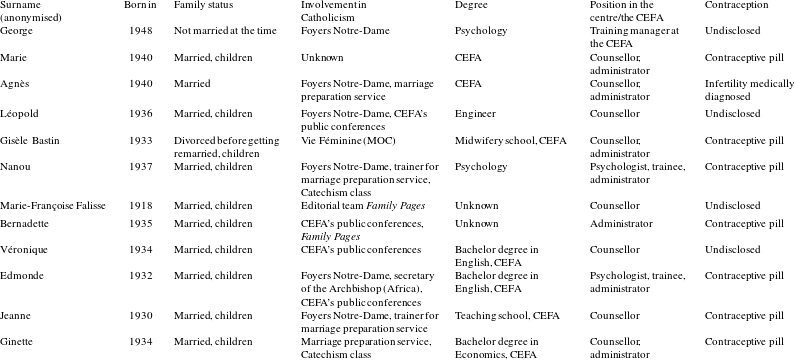
The paper relies therefore on the experience of eleven people, two men and nine women who volunteered as unpaid counsellorsFootnote 17 in the centres. They were among the first people to follow the training and to work with couples – but mostly women – coming to the centres. This means that they started training or working in the middle of the 1960s and the beginning of the 1970s. In order to help to trace the trajectory of these Catholic counsellors, five different types of sources are used: private archival documents from the centres (when available); a Catholic bulletin created in 1938 by former members of the Christian Youth Workers, Les Feuilles Familiales (henceforth Family Pages), and letters to the editor section dealing with conjugal and sexual issues; the memoirs of one of the counsellors who passed away, Gisèle Bastin; two Master’s theses written by former counsellors; and interviews conducted with ten counsellors, which will be the main sources of this contribution,Footnote 18 allowing us to analyse eleven experiences. The ten interviewees were approached in two ways: first through the Planned Parenthood Federation hiring Catholic counsellors, who broadcasted my request to meet former counsellors among their members; and then via snowball sampling from the first interview participants. It is worth noting that with the use of this methodology, the sample is not necessarily quantitatively representative of the counsellors working during the period in question in the centres: I interviewed more women than men, for example, although men were also counsellors at that time. Apart from Gisèle Bastin, who left documents which can be publicly accessed, the interviewees asked to be anonymised and their confidentiality preserved. I therefore assigned them pseudonyms (see Table 1).
Counsellors 1960–70.
The aims of the semi-structured interviews were several. First, they were a way to collect empirical data on the centres whose private archives were either destroyed or never added to public archive centres where they could have been consulted more easily. The interviewees gave information both on the centres and their involvement in them as counsellors: when they started to work there, their rationale for choosing such a centre, what happened in the day-to-day running of the centres. The interviews were first and foremost a way to access the subjectivity of those people, ‘to hear the observations and perspectives of eyewitnesses’Footnote 19 and of their ‘narratives’.Footnote 20 How did they define themselves? In what way did the social and political debates of their time have an impact on their subjectivities and activism, for instance, regarding the Encyclical Humanae Vitae or the political debates on abortion that arose in the 1970s? How did these people negotiate their allegiance to the Church and the Church’s dogma while at the same time getting more and more involved in resolving the problems faced by the women and couples consulting them? What does it say about their commitment to conjugal counselling centres? Finally, these interviews were also the only way to expose the hidden figures, or to articulate, as Paul Thompson calls them, ‘the hidden histories’Footnote 21 of the marital counselling centres in Belgium. Little is known about these centres, Catholic and secular alike. For example, Pierre de Locht, a well-known Belgian priest who was in charge of the counsellor training institute, was the voice of the Catholic centres I am interested in and yet he never worked as a counsellor, hiding the counsellors. The interviews were recorded, transcribed and classified according to the counsellors’ practices and representations regarding planned parenthood (mostly contraception, abortion and sexual education), commitment and activism, the Church, and personal and religious identity. This also helped to map the Catholic counselling network and to get to know people who were considered important but could not be found in archive documents or interviewed. The information provided by interviewees depended largely on their reaction to the social interaction in the scientific interview then: some were afraid of the recorder and it had to be turned off, some didn’t really understand that the questions could become ‘personal’, which explains why I could not manage to gather the same amount of information for every interviewee.
2 Catholicism and Counselling Centres
In 1938, Family Pages, the bulletin by former members of the Christian Youth Workers,Footnote 22 became the first initiative which aimed at dealing with marital and sexual issues in Catholic households,Footnote 23 in direct relationship with the Church’s interest in family, which was perceived as the basis of the society.Footnote 24 In 1947, the bulletin offered a new section to readers: letters to the editor, called ‘Entre-nous’ (‘Between us’).Footnote 25 This section, run by the editor-in-chief, Marie-Françoise Falisse, mainly dealt with issues the readers encountered regarding marital life and sexuality. The Family Pages archives contain thousands of letters, making this a highly valuable resource that is yet to be studied in depth.Footnote 26 The documents immerse the reader in very practical problems faced by Catholics – male, female, young or old – such as the lawfulness of orgasms, gender roles in a relationship, sexual violence, the lawfulness of birth control, etc.Footnote 27 Marie-Françoise Falisse, who worked on the bulletin with her husband, is representative of the Catholic family planning activist of the time – a layperson, married and working with their spouse. The group of authors was also identified as Catholic and working in direct concordance with Church norms. She thus described them as ‘animated by faith and by the desire to be the faithful sons of the Church’.Footnote 28 The imprimatur, an official publishing house authorised by the Church to publish the bulletin, reveals this link between the Family Pages with the Church. Based on Catholic philosopher Emmanuel Mounier’s personalism,Footnote 29 the advice was always highly normative and complied with the Church’s precepts. However, the advisers outlined the difference between the intention and the results of an action, choosing to emphasise the importance of the former. Moreover, norms were perceived as an inner morality the readers must find within themselves, to mark their responsibility.Footnote 30 ‘Between us’ therefore promoted a more equal relationship with the readers. Yet, the group of authors did not have direct confrontation with people’s problems, as they did not organise face-to-face consultations. They also worked through two pseudonyms, ‘Jean Durang’ and ‘Paul Leclerc’, as giving advice on sexuality and conjugal life was not something they were willing to do publicly.
The number of subscribers to Family Pages kept increasing, reaching its peak at the end of the 1960s with a total of almost 18 000 subscribers. Therefore, the bulletin quickly expanded and offered more than just familial advice: it started to offer services such as a library, spiritual guidance for engaged couples, conferences and marriage preparation services.Footnote 31 In 1953, the team dealing with the section ‘Between us’ also created a marital counselling centre, the Bureau de Consultations Conjugales (Office for Marital Counselling) under the framework of the same Marie-Françoise Falisse who was the editor-in-chief of ‘Between us’, making concrete the service they already offered in the bulletin. Founded in Brussels, the Bureau was a place to meet the authors of letters to the bulletin in order to delve deeper into their problems. The Bureau was in fact located in the same building as the bulletin and only opened upon appointment. The centre worked as a hub-service: the counsellors processed any requests after an appointment and sent the clients to an appropriate specialist if required (doctors, psychologists, jurists, marriage preparation service) or organised counselling themselves. This first Bureau lead to the creation of multiple centres in Belgium; at the end of the 1960s, Belgium counted three new centres, in Mons, Namur and Liège, and these were the basis of what is now known as Family Planning centres. The centres were created at a time of great development of planned parenthood centres and conjugal centres in Belgium, but even more broadly in Europe.Footnote 32 Because it was developing geographically and in numbers, they needed more than just a team in Brussels and started to ask for more volunteers.
Who were these volunteers and how did they end up in counselling? Their first characteristic was their religious identity: they all defined themselves as Catholic and as a churchgoer at the time of their involvement. They were all integrated into Catholic organisations in Belgium, which was a highly structured and developed network of organisations, and they were therefore socialised in Catholicism.Footnote 33 Thus, as children they studied in Catholic schools and Catholic universities and and perpetuated it as adults. They themselves chose to stay involved, as adults, in Catholic institutions or organisations such as the Christian Labour Movement or services provided by their Church, including marriage preparation services or foyer groupsFootnote 34 to develop their faith. At this time, the counsellors whom I interviewed were all married with children, except for one, who was still a university student at the time of their involvement. This trend can be explained by the way they were recruited: being socialised in a Catholic network of institutions, they decided to become more involved in the services provided by their Church. Except for two counsellors, they became facilitators in the marriage preparation service they attended as fiancés. Being a facilitator meant not only talking with young fiancés about marital life, but also receiving specific training. They were therefore very committed to the Catholic services and were already engaged in Catholic Action. Their involvement was key in their new occupation in the centres; by attending these services, but also the public conferences organised on conjugal life by the Family Pages, they were identified as potential recruits. The counsellors were also at a turning point in the history of Catholic counselling. Whereas the counsellors of the Family Pages were composed of couples, their involvement in the newly established centres required another form of participation. They were approached because of their involvement in Catholic services they attended as couples, but they were asked not to be involved in the centres as a couple. Jeanne, one of the counsellors, explained, for example, that she and her husband had to choose who would volunteer in their city’s conjugal centre, as it was ‘asked who would want to do the conjugal counselling training, but not as a couple’. She therefore pointed out that her husband actually did it, because ‘someone had to take care of the children’, namely her.
Family did indeed have an impact on the involvement of people in the centres, because the counsellors were unpaid volunteers. Becoming a counsellor was a side occupation and could not pay the bills. The counsellors were either men with a job or women who wanted to get involved after raising their children and who had a husband with a stable income. Both men and women were highly educated, with a high school or university degree, which at the time was not as common as it is nowadays, since only 11.5% of women and 16.5% of men had one in 1970 in Wallonia.Footnote 35 Yet, most of the women had taken the decision to stop working once they had their first child in order to raise their children. Their activism in the centres was for them a way to leave the privacy of their home once the children were old enough – it was not the case yet for Jeanne, who had to stay at home since her children were still too young for her to leave them. Hence, the invitation to become a counsellor arrived at the right time in the lives of many of these women. Why did men eventually drop out? Unfortunately, it was mostly women who participated in the interviews, so I can only try to hypothesise: women indeed had ‘free’ time – as free as a woman could have when taking care of a home – while men kept their full-time job, in a gendered division of labour. It is likely that with the rising demand for counselling, the activity became increasingly more time-consuming, a commitment that men, who already had full-time jobs, were not willing to make, unlike the women I interviewed. This hypothesis is confirmed by a former counsellor who, in his 1972 Master’s thesis, wrote: ‘Amongst the women whose family responsibilities have become less demanding, many would like to find a part-time occupation outside of their home. Counselling is by definition a “care service” and could fulfil the ideal of serving society, thus helping those women to feel less guilty, when their husbands or their socialisation prevent them from leaving home to “work”.’Footnote 36 Counsellors were therefore generally middle-aged men or women socialised in Catholicism and in the Catholic institutions. They were hired, unpaid, through their occupation in the foyer groups or the marriage preparation service. They also had an interest in family and conjugal life, which could explain why they attended the public conferences on the topics. They had a high school or university education and, mostly for the women, they were at a moment of their life where they wanted to find a new occupation after raising children. Unlike Marie-Françoise Falisse, they were not hired as couples but as individuals.Footnote 37 The group of authors of this new section based the advice given on their own experiences. Even if the counsellors needed a certain amount of life experience, the question of training started to be organised. Being ‘faithful sons of the Church’ was no longer enough to be a counsellor.
2.1 When Rogers Supplants God
The first team of counsellors, composed of the editorial team of the Family Pages, took responsibility for those who consulted with them, without any prior training on the issue except for their own experience as couples, which was mandatory to become part of the team. However, with the development of the centres, this experience was not enough, and formal training was gradually organised.
This training was the responsibility of the CEFA (Centre d’Éducation à la Famille et à l’Amour, which stands for Family and Love Educational Centre). Formerly in charge of the public conferences on family and conjugality, the CEFA was created in 1959 by the Belgian episcopate. Pierre de Locht, a notorious Belgian Canon and theologist, was appointed as the head of the organisation by the Belgian hierarchy. Already working in the Family Pages, Pierre de Locht became much involved in the conjugal counselling centres and was one of their driving forces. The CEFA was already deeply in touch with family and conjugal matters, since their goals were the study of moral and spiritual problems faced by the Church, and the publication of brochures on sexuality, love and conjugal life. From the beginning of the 1960s, the CEFA also led the training of future counsellors.
During the academic year 1959–60, when the very first counsellors-to-be started their training, the course gradually became more institutionalised, more systematic and mandatory in order to work in a centre associated with the CEFA. The conduct of the latter remained the same for decades: after an admission interview, the first two years were dedicated to theoretical studies. The instructors – scholars, psychological workers or doctors – held classes on sociology of the family and biology, where the topic of contraception was explored by doctors. Pierre de Locht himself was one of the instructors on the topic of morality. More precisely, he lectured on theology of the family. Finally, psychology was given great importance on both theoretical and practical levels. Young graduates of psychology from the Catholic University of Leuven (KUL) taught the psychological approach to counselling – an important part of the training.
It was there that the trainees discovered Carl Rogers’s work on counselling, an approach which later had an impact on the trajectory of the centres and on the counsellors’ representation of reproductive norms. Carl Rogers, born in the United States in 1902, moved away from his devoutly Christian family to study psychology.Footnote 38 He was appointed professor of psychology in 1940, and shaped a new approach to psychotherapy, criticising the authoritarian methodology of psychology and breaking from its traditions.Footnote 39 What is considered revolutionary in Carl Rogers’s work at the time in question is the attitude of the counsellor: the psychologist or counsellor considers that ‘individuals have in themselves vast resources for self-understanding and for altering their self-concepts, basic attitudes, and self-directed behaviour; these resources can be tapped if a definable climate of facilitative psychological attitudes can be provided’.Footnote 40 This ‘climate’ relies on the non-directive attitude in counselling – something Rogers called ‘client-centred therapy’Footnote 41 before calling it ‘person-centred therapy’.Footnote 42 This non-directive method relies on self-determination, which the therapist must grant to the client in order to avoid ‘disempowerment during the processes of helping’.Footnote 43 Empathy is also an important value in Rogers’s work, as it helps to understand the consultant’s subjective experiences. It also implies, in terms of the counsellors, that ‘for the time being you lay aside the views and values you hold for yourself in order to enter another’s world without prejudice’.Footnote 44
Carl Rogers’s work gained international recognition in multiple domains, such as education or counselling. The first book published on Rogers’s research in French was edited in Leuven, Belgium, in 1962Footnote 45 and Rogers was eventually translated into French in 1968.Footnote 46 Yet his methodology had crossed the borders well before its official translation. Rogers’s work was already known in France due to Max Pagès having studied with him in the United States.Footnote 47 In Belgium, Professor Jan Rombauts founded a counselling centre based on the Rogerian approach at the KUL – the Catholic Flemish UniversityFootnote 48 – from the 1960s. He also hosted seminars on the Rogerian approach in the New French-speaking Catholic University of Louvain-la-Neuve (UCL) from 1971 onwards. Both in France and Belgium, the Rogerian approach had great success and was perceived as revolutionary by the psychologists at that time as it gave a more prominent place to the clients. This development of Rogers’s work in Europe is significant in the understanding of how the CEFA started to teach trainees based on his method, since the psychologists teaching the class had attended the Catholic University of Belgium. It can also be explained by the CEFA and the centres’ ties with a French organisation founded in 1961 around the figure of the French psychiatrist Jean-Georges Lemaire: the AFCCC (Association Française des Centres de Consultations Conjugales, the French Organisation of Conjugal Counselling Centres). Defined as an organisation whose objective was to help couples in their sexual, social and emotional lives, the first unpaid volunteers in the organisation were Catholics and had many sociological similarities with the Belgian volunteers I presented in the first part.Footnote 49 They also used the Rogerian approach of counselling. The AFCCC and the Belgian centres formed close ties in the early 1960s, I assume through their membership of the Union Internationale des Organismes Familiaux (UIOF, for International Union of Family Organisations). In the 1960s and the 1970s, most notably through Pierre de Locht and Jean-Georges Lemaire, the bonds between the two organisations took the form of shared conferences on counselling and family,Footnote 50 both in France and Brussels. In 1966, the Belgian centres came together and formed the Belgian counterpart of the AFCCC: the Fédération Belge des Centres de Consultations Conjugales (Belgian Federation for Conjugal Counselling Centres), named after the French association. As the centres belonged to the French-speaking part of Belgium, they shared more ties with France – while Flemish centres at that time exchanged with The Netherlands.
Rogers became a reference for all the volunteers in the Belgian centres. Léopold, one of the former counsellors, even said: ‘At that time, Rogers was God.’ Léopold’s claim indeed symbolises what was happening in the centres at that time: Rogers’s work became to the counsellors what personalism was to priests and laypeople working for the Family Pages, creating an epistemic change. Even the characteristics of the trainees changed on a structural level: 1962 was the year when, for the first time, there were more secular counsellors receiving clients than priests, which was, according to a contemporary thesis written on the subject,Footnote 51 a voluntary decision from the centres’ executives. Secularism was developing both theoretically and empirically, which is illustrated perfectly by one of the former trainers: ‘Our mission was to help people who were experiencing difficulties, not to evangelise’ (George, counsellors and training manager at CEFA).
The counsellors wanted to be in line with Carl Rogers’s precepts more than with the Church’s. By using the plural ‘our’, George also expressed that it was not just him who followed this line of thinking, but that this prerequisite of the counsellors became a guiding ethical principle of the centres. All the counsellors incorporated the Rogerian idea of non-judgement, where religion indeed had no place at all: ‘Whether you’re Catholic or not is not an excuse to judge. It’s important to take some time with the person to discuss their problem. Because there was a time when it was like “Do not mention that”. It’s important to be able to listen, without judging, without condemning.’ (Agnès, counsellor and administrator). Agnès explained again how the rejection of judgement had a part in the ability to listen to every person’s problem. She expressed it through the comparison with former practices: ‘there was a time’ when it was difficult to talk about that, ‘that’ meaning here sexuality and conjugality, especially when it was to express a negative issue. She also emphasised the fact that listening without judging was not a non-religious monopoly. Judging is indeed harmful whether you are Catholic or not, an opinion shared by Nanou:
Is listening to someone’s problem different whether you’re Catholic or not? No! It’s not different. Listening and using the Rogerian method is not different [whether you’re Catholic or not]. (Nanou, psychologist, trainer and administrator)
Moreover, Nanou expresses the fact that the Rogerian method is not specifically a Catholic method. In 1961, the University of Leuven created a degree in sciences of the family and sexology where Carl Rogers’s theories were taught, as this theory was spreading all over the world. These quotes also reveal that the personal quality of being able to help non-judgementally was important but the personal values of the counsellors were to be left outside of the centres. It was about acting as a professional, trying to help consultants. The formation given by the CEFA allowed this, as Léopold, a former counsellor, acknowledges:
The training mainly revolved around self-reflection: on our position on the different values, on all these issues [divorce, married life etc.] in order to take some distance from it and help the person from where they were standing. (Léopold, counsellor and administrator)
The training indeed gave the future counsellors an opportunity to reflect upon what they considered to be right or wrong. What Léopold says is in a similar vein to what Nanou and Agnès explained: considered reflection on values is a way to be able to identify the barriers to a non-judgemental approach. Therefore, personal values are not norms to follow, but exactly that, personal values. This reflexivity can be understood as a path to professionalisation, which the systematic method Carl Rogers played a part in. Through the training course, the centres developed a professional ethic, to be understood as ‘standards for the behaviour of professionals’.Footnote 52 The counsellors indeed wanted to be taken seriously and to work according to a recognised psychological theory. Even if they were still first and foremost unpaid volunteers, they considered what they did very ‘professional’ as the consultation was all about the clients’ problems. The commitment to the centre therefore shifted from a purely ‘Catholic involvement’ to a professional one: all of the consultants were actively involved in the centres as professionals and as owners of a new expertise allowing them to receive clients seeking help, even if the status of ‘counsellor’ wasn’t recognised yet in Belgium. Being Catholic wasn’t important anymore. It just explained why they ended up in Catholic centres.
The development of a professional work ethic was revealed by the careful structuring of the training, and the counselling activity began to regulate itself, as revealed by the systematic recourse to supervisions from 1962 onwards. After two years of theoretical study, future counsellors had to complete an internship in one of the centres, at the rate of a few hours per week. These internships provided an empirical experience they only had through role-playing in the CEFA. They were experiencing what would be their main activity in the centres: listening to people’s issues regarding marital life, sexuality and family in general, speaking with them and helping them to find a solution that would suit them, according to their own values as a client. They also worked in partnership with doctors and priests for matters where they were not able to help, such as contraceptive prescriptions or moral issues. Since they were still trainees, their marital counselling sessions in the centre were discussed with a supervisor – a more experimented psychologist – a practice encouraged and used by Carl Rogers. The centres, in turn, started to implement these supervisionsFootnote 53:
All the work we did during the supervision consisted of getting to know our own ideas and, once aware of them, avoiding their projection or at least limiting it as much as possible. (Marie, counsellor, administrator and trainer)
Just like Léopold, Marie, who was also a trainer, expresses the idea that universal values are not always appropriate to apply to clients, who have their own system of values which needs to be respected. These values can be Catholic, but also might not be. Therefore, the place of Catholicism within their activity shifted from being a norm to apply, a reading grid, to becoming an issue to solve for those who saw Catholicism as an issue preventing them achieving happiness. When Marie-Françoise Falisse and her team answered letters, they always did it in line with the Church’s precepts. The team was a guiding light to the lawfulness of practices. The conjugal centres and their counsellors diverged from this posture: they rejected it. The place of Catholicism in the centres changed: it was still – sometimes – a problem, but not because a solution was needed to be found in compliance with the Church. It was because the counsellors needed to help the client to resolve their problems. An intern in one of the centres wrote in her thesis about a case she dealt with: in 1964, a 31-year-old Catholic woman, a mother of two children, came to her as she felt guilty for having had an abortion – an illegal one. She also acknowledged that periodic abstinence – avoiding sexual intercourse during certain periods of the menstrual cycle – could not be fulfilled and that her husband demanded that she ‘took precautions’ on the matter. Having been raised Catholic, the abortion had made her feel like a ‘criminal’ but she did not know any other way she could have handled the situation. Her action contravened her deep faith, yet she also admitted to the counsellor that ‘even if I wanted to confess, it would not be useful because I would do it again: were I to find myself in the same situation I couldn’t do it differently’.Footnote 54 What is interesting is the answers this woman received from the counsellor. When saying that she must be condemned by her counsellor for having had an abortion – ‘You must do it, otherwise you are not a Christian’Footnote 55 – the counsellor never replies to this solicitation and tries, on the contrary, to understand why the client felt that way. She obviously analyses it as the result of the woman’s deep religiousness and, instead of telling her that what she did was unlawful, she rather tried to question her about her relationship with her faith, and to listen to the tension having an abortion while being a Catholic created in her.
Catholicism therefore became a topic that counsellors had to face and not the dogma that they, or their consultants, wanted to follow, as the intern-counsellor wrote in her thesis: ‘In our centres, the same problem [birth regulation] is, for a large amount of households, mostly religious, moral or philosophical…[T]hey need to be given assistance in learning to become more mindful of themselves, so they can decide for themselves freely and take responsibility for their choices.’Footnote 56 The role of the counsellors was therefore to help people take responsibility for their behaviour and try to go beyond what they had been taught by the Church during their upbringing. I would like to emphasise that the counsellors did not try to convince the consultants that Catholicism has a wrong influence. They more tried to help them to merge their Catholic identity, while at the same time being able to take the responsibility of their choices regarding family planning and sexuality.
In a context of increasing debates around contraception and abortion, the counsellors’ assistance was increasingly sought after, since Catholicism was one of the many issues women encountered when wanting to decide by themselves when and if they would become a parent. The release of Humanae Vitae put an end to the hopes of Catholics waiting for a softening of the doctrine. The encyclical also had an impact on the counsellors and their ideas of reproductive rights.
2.2 Counsellors, Centres and Reproductive Rights
In the 1960s, birth control and abortion came knocking at the centres’ door. Although the centres were not meant to deal with these particular issues, it is the latter that came to find them. Despite the clear Catholic norms of reproduction, Catholics were facing the same difficulties every other person was facing in this realm. The story above of the Belgian woman who had an abortion tells the story of many other women: the impossibility of regulating birth through periodic abstinence, the female responsibility regarding contraception, the consequences of unwanted pregnancy, but also the contradictory feelings regarding abortion and religious norms on reproductive regulation.Footnote 57 Abortion became a political issueFootnote 58 in Belgium in 1973, when Dr Willy Peers was arrested for having illegally practised more than 300 abortions in a hospital in Namur.Footnote 59 Contraception was already an issue, especially among Catholics who were already discussing it on a theological level.Footnote 60 How were these two public issues perceived in the centres and how were they connected in the counsellors’ minds?
Contraception was an issue for the counsellors, on both a personal and professional level. On a personal level, the female counsellors were themselves affected by the 1923 law on contraception and had to figure out how to deal with it:
It is out of religious conviction that my mother-in-law and her husband accepted all the children they had, as a gift from God and they had the tremendous fortune of having twelve healthy children, and that was that. So, for them, it worked, but in my case, it was very clear that it was impossible, and I couldn’t see in whose name I shouldn’t be able to have my own destiny. (Ginette, counsellor and administrator)
Talking about Humanae Vitae and more broadly about contraception brought back personal memories to the female counsellors. Even if the male counsellors were probably affected as well, the two male counsellors did not feel concerned about it, at least in their personal life at the time, for one was still a student and was not thinking actively about it at the time, and the other one, married, could not have biological children with his wife. Therefore, the problem of contraception was not something they experienced, according to them. Ginette clearly marks in her interview that it was inconceivable for her to have twelve children and, moreover, to receive all the ‘gifts from God’. Contraception was very important for her as a decision to limit her potential to become pregnant (‘to have my own destiny’). Therefore, the female counsellors, at least, shared the issues of women regarding contraception and saw their work as a way to ease the problems couples could face. Their experience as women had an impact on their experience as counsellors. Each one of them told a story similar to Ginette’s, where periodic abstinence was considered impossible and the absence of control over their fertility unbearable. Therefore, they all eventually explained that they took the pill when they got the chance to do so. Contraception was seen as not just a way for women to be able to control their body, but also as a way to ease tension in couples regarding their sexual life:
Contraception, when it was used, was already saving couples. I think it saved couples. What happened in the relationship otherwise? You’d say ‘no’ all the time? That was marital duty. Let’s not push it. (Jeanne, counsellor)
By ‘marital duty’, Jeanne was expressing the fact that marital duty switched from being the obligation for women to have intercourse with their husband, to the fact women had to say no to their husbands and avoid intercourse in order to avoid pregnancy. Sexual difficulties faced by couples were sometimes the consequences of the impossibility of having a sexual relationship.Footnote 61 Therefore, contraception was perceived as the solution to improve relationships, both sexually and psychologically. That is why Jeanne considers contraception could ‘save couples’. Again, Jeanne’s point of view is very much one of a woman who faced these difficulties herself.
Contraception was also an issue for the counsellors on a professional level because the centres they were working in had to take a position on the subject. What would they do when asked about contraception? Contraception was the doctor’s prerogative in the centres, yet no sources have been found to tell us when the centres started to administer the contraceptive pill. Dr Leblanc, a Catholic gynaecologist from Brussels and one of the doctors working in the first centre, gave advice on birth regulation at the beginning of the 1960s, ‘at his own risk’, explains one of the counsellors and former patient, since the 1923 law forbade giving information on the topic. Some counsellors also acknowledged that pills were distributed or prescribed in the centres before the removal of the 1923 law in 1973, and the testament of a Catholic Belgian gynaecologist tends to confirm this statement.Footnote 62 For the counsellors, the contraceptive pill was linked to women’s ability to choose their own destiny. Thus, Léopold explains that the contraceptive pill had never been an issue in the centres, from its commercialisation at the beginning of the 1960s – an observation that needs to be taken with a pinch of salt, since contraceptive means (both mechanical and natural) had already been a problem both for the CEFA and the first centre during the 1950s and at the very beginning of the 1960s. The extent to which the counsellors would be free to express and follow their own opinion on the subject, as professionals, is impossible to speculate upon.
With the opening of Vatican II in 1962, the counsellors, like many Catholics around the world, hoped for ‘an approval of progressive Catholic movements, a movement that wasn’t born yesterday’ explains Yvonne: ‘We hoped for a hearing and an opening’. Since Vatican II was an aggiornamento, an update of the Church, it raised much hope on the issues of sexuality – and of contraception.Footnote 63 Moreover, in a context where laypeople were offered the opportunity of having more responsibility within the Church (notably through Lumen Gentium, the dogmatic constitution of the Church published in 1964 during the Council), many Catholics, all the counsellors from the centres included, hoped to see their everyday life taken into account – and their work acknowledged. Moreover, the pontifical commission on sexual matters seemed to predominantly call for a softening of doctrines.Footnote 64 Yet at the closure of Vatican II in 1965, Pope Paul VI decided to reserve the right to take the decision on birth regulationFootnote 65 and postponed the ruling. For three years, the centres and the CEFA – the school for counsellors – used this time to develop their positions on the topic of contraception and abortion. In 1968, Pierre de Locht published a book on morality and contraception,Footnote 66 where he called for a softening of doctrines and established the need for birth regulation. This book symbolises the counsellors’ positions: the responsible use of freedom provided by contraception, especially through sexual education which they had already set up in some schools. The volunteers of the centres therefore called for a personal responsibility where they didn’t have to say ‘Amen, Amen, Amen’ to the Church, as expressed vehemently by Nanou in her interview. They wanted to be listened to, as Catholics and as professionals being in contact with couples and women.
Pierre de Locht laterFootnote 67 justified his book as an attempt to prompt Paul VI to take a decision on the issue after three years of expectation. Paul VI eventually released Humanae Vitae in 1968, which was a great disappointmentFootnote 68: it banned birth limitation and claimed that sexual abstinence was the only way to regulate birth. The reaction to the encyclical was unanimous among the counsellors:
For me, Humanae Vitae was like being hit by a bamboo stick, it was awful. I told myself, well, the Church says that. As good Christians, we must obey. My husband and I, we left the Catholic Church at that time. (Nanette, counsellor, administrator, instructor)
Nanette clearly expresses that she did not even consider ‘obeying’, placing good Christians who did in opposition to her husband and herself, who decided to leave the Church. She rejected Humanae Vitae and obviously did not expect the twist the encyclical took. Marie, another counsellor, was on the same page:
I fought back, one hundred per cent. I have always been against it and that’s it. I have never lost sleep over it. (Marie, counsellor, trainer, administrator)
Marie did not leave the Church, but rather decided that Humanae Vitae was not her concern, since she never ‘lost sleep over it’. She considered that it was not the Church’s place to decide whether it was lawful or not to use contraceptive means. Humanae Vitae was definitely a complete disappointment for the counsellors and all the volunteers of the centres, who subsequently saw the Church as outdated regarding sexual and reproductive norms. In their personal life, they considered Humanae Vitae as the symbol of the distance, or a ‘gap’ as Ginette describes it, between the Vatican norms and the everyday life of couples:
There was a meeting with the bishops about family, and there came a point where I got so fed up of not being understood on the matter of contraception and the new pill, new opportunities, that I stood up and said: ‘Well, look, you’ve never woken up four times a night for a baby, or a sick or disabled child.’ With their methods, there were only eight days where it was possible to have sexual intercourse, and that was it! So, yes, that was not a lot. So, he [the bishop] was shocked and he came to see me afterwards. He said: ‘Are you sure?’ (Bernadette, administrator)
The bishop’s question marks this lack of understanding between the everyday life of laypeople and some of the Church’s executives. Bernadette’s feelings outline the gap between the everyday life of couples and of the Catholic hierarchy, as she ‘got so fed up’. The story she told the bishop about the sick child also tells the story of the verticality of the Church: single men without children were deciding the fate of women and couples with children. Compared to what they were experiencing in the centres and with the CEFA, the Church did not appear to have given much importance to the everyday experiences of couples and women. Moreover, with the CEFA being a centre for reflection, Humanae Vitae seemed, in comparison, to spell the end of any considerations on the matter:
The CEFA was a reflexive group that allowed itself to think. Right. Whereas the Catholic Church, at that time at least, it wasn’t about thinking, it was about saying ‘Amen, Amen, Amen’. (Nanou, psychologist, counsellor, educator and administrator)
Nanou clearly opposes the Church, who appeared to be stuck in the past, to the CEFA, which, because it ‘allows itself to think’, was perceived as progressive. The CEFA offered a space of reflection, where norms could be discussed. This process was allowed as the CEFA had a strong reflexive attitude, inviting to conferences scholars, doctors, psychologists or theologians to give an insight on the many issues the CEFA was involved in. The numerous brochures published by the organisation show this to go further than the established norms: they discuss contraception, sex education, abortion, the Church etc.Footnote 69 The CEFA took the time to talk collectively about the changes the 1960s and 1970s were facing, trying to understand them rather than condemning them right away. The CEFA also dared to face the Belgian Church on the question of contraception and abortion.Footnote 70 The counsellors defined this attitude as a ‘constant searching attitude’. It can explain why the encyclical was so badly received, as this research did not seem to exist at all in the eyes of the counsellors, who perceived the Church’s position as conservative. Moreover, the encyclical had consequences on their personal life. First, their investment in the Church changed:
Very quickly, because at that time, there were foyer groups. Very quickly within the group, we stopped practising. Because…it no longer complied with my vision of the world. I haven’t practised for the last 50 years now. I label myself as a converted unbeliever. (Léopold, counsellor and administrator)
Léopold, like many others, states that his involvement in Catholicism shifted and he became a ‘converted’, from a Catholic to a non-religious person. He stopped practising, going to the foyer groups and explains that he was not the only one (‘we stopped’). Léopold’s experience is not unique, but the distance from the Church sometimes took more subtle forms: some decided not to follow the Church on those questions, therefore becoming more detached from the Vatican (which is what Marie expresses when saying that she never ‘lost sleep over it’), some lost faith in the Church like Léopold, some redefined themselves as ‘Christians’ instead of ‘Catholics’ to keep a connection with the values they grew up with and still identified with. In any case, Humanae Vitae modified their ties to the Catholic Church and their practices in a more individual and ‘pick and choose’Footnote 71 way.
This estrangement from the Church, at multiple levels, also reveals that the CEFA and the centres had evolved. Marie-Françoise Falisse, decided it was time for her to stop working with the CEFA and also with Pierre de Locht, who publicly criticised the encyclical.Footnote 72 As a woman working in line with the Church, she did not agree with the direction the CEFA, the counsellors in the centres, and Pierre de Locht were taking. Step by step, the counsellors’ investment in planned parenthood, though the centres were not ‘Planned Parenthood’ centres, changed their identification with the Church, a change that is linked to the official position of the Vatican and Paul VI on contraception and abortion. Their allegiance shifted towards the centres where the counsellors were active. Whereas the counsellors became active in the centres as part of their involvement in Catholic Action, they became involved as counsellors and professionals in the centres, rejecting the Church’s norms. They became fully invested in their new activity, a finding already revealed by the time-consuming training the counsellors attended at an advanced stage of their adult life. In 1973, Dr Peers was arrested and imprisoned, as previously mentioned, for having publicly claimed that he was practising abortions to help women in need, and so abortion became a public and political debate. Pierre de Locht publicly supported Willy Peers, and so did the counsellors:
He [Pierre de Locht] was, we were, at one with Peers. I would say that he was the one who inspired us. We remained loyal to his school of thought until the end…despite having become unbelievers, miscreants if you like. We continued to hold him in high esteem, this wide-open guy. (Edmonde, counsellor, administrator, trainer)
While Edmonde became a ‘miscreant’, just as Léopold became a ‘converted unbeliever’, she kept supporting Pierre de Locht because she saw in him a progressive man who could understand people’s lives. Marie-Françoise Falisse, on the other hand, had to leave because defending the decriminalisation of abortion was too far away from the Vatican’s norms. She still wanted to be in line with these norms, and abortion was not something she could support. The counsellors started to support the decriminalisation of abortion – it is difficult to establish an exact date, but I assume around the end of the 1960s – as it became a common value amongst all the volunteers that the right to decide on motherhood resided primarily with the woman in question:
We were a team and we believed in women’s ability to decide. That was our conclusion: the women’s ability to decide. (Nanou, psychologist, counsellor, educator, administrator)
By using the pronoun ‘we’, Nanou talks not only about herself, but of the centres’ ethics regarding that issue: women were in charge of their body and the counsellors’ job was not to prevent this but rather to support it. The counsellors also considered legal abortion as a lesser evil, since women were having abortions anyway, which could be life-threatening. They diverged from the feminist movement claiming in the mid-1970s ‘My body, my choice’ across Europe.Footnote 73 Yet, the counsellors also defined themselves and their involvement in the centres as their way to express their feminism, in the way that they supported women’s freedom of choice. But this freedom of choice could be possible only through a sex education they were also giving in the centres. They considered abortion as a contraceptive failure, which explains why they emphasised the importance of contraceptive education and recourse to a successful and appropriate contraceptive method. Liberty could only be practised responsibly. This also explains why abortion was not only medicalised: it was not about doing the procedure but trying to prevent another one by talking to the women who came for it. The counsellors used this moment to talk about contraception: Were they using one? Why did it fail?
The centres remained focused on contraception more than on abortion. The latter was never practised in the centres and the problem remained on a psychological level: first because it was not considered to be ‘planned parenthood’ from the outset, but also because it was considered the responsibility of doctors. The counsellors acknowledged that it was challenging to find Catholic doctors willing to practise abortions. A brochure edited in 1973 by the CEFA called ‘Le médecin face à la demande d’avortement’ (‘Doctors facing requests for abortion’)Footnote 74 rejects the role of doctors in deciding on an abortion: only couples and women could choose to keep a child or not. The two authors, themselves doctors, refused to give doctors a greater role in decision-making and called for a responsible choice, supported by sexual education. Yet they also acknowledged the importance of freedom of conscience for doctors who do not feel comfortable practising abortion. However, the publication calls for psychological training for doctors to learn to listen to women and couples regardless of their own beliefs, as the counsellors actively did during their training. Doctors are thus expected, in the brochure, to take on a psychological role as active listeners and to help women, as much as they could, to find someone who would agree to do the procedure. The role of doctors was therefore more psychological than purely medical, except for the contraceptive pill, which they were in charge of prescribing.
Therefore, the counsellors and doctors worked in partnership either with hospitals – some were famous in Belgium for practising abortion, such as the one in Namur where Willy Peers worked – or with secular centres once they started to provide abortion in 1975.Footnote 75 Yet some counsellors, such as Gisèle Bastin, took the initiative of helping women to go abroad when it was necessary. The former counsellor and instructor wrote in her memoirs: ‘Many times I accompanied some women to Holland in my Citroën 2CV, paid by my own expenses, for them to terminate their pregnancy.’Footnote 76 Of all the interviews, Gisèle Bastin’s is the only one to recount such an experience. Nevertheless, Gisèle Bastin’s experience tells the story of the counsellors’ trajectories: they switch from being Catholics participating in social action in conjugal centres to be counsellors in a planned parenthood centre, defending contraception and the decriminalisation of abortion in spite of and against the norms established by the Catholic Church, which they tried to change from the inside. Indeed, they attempted to convince the Belgian Church and its Catholic representativesFootnote 77 to vote in favour of decriminalisation when the latter were the main opposition to any change of law on abortion.Footnote 78
The counsellors were actors of the change of norms in Belgium in the early 1970s: they rejected the Church’s traditional reproductive norms in favour of what they called ‘responsible freedom’. Their position highlights the progressive change of social norms on who should be able to control women’s fertility, shifting from a vertical imposition of norms to responsible (female) behaviour where women had the power to decide. Once they became aware of their inability to change the Church’s norms on the matter, they fully embraced their identity as counsellors of planned parenthood, and their Catholic identity, for those who still identified with it, became a private matter. They became activists in planned parenthood and not only in Catholic Action. When asked if they felt opposed to the Church, Léopold answered: ‘We weren’t really opposed. I’m not in opposition. We had our thoughts, we lived according to them, that’s it.’
3 Conclusion
The analysis of eleven counsellors’ trajectories, with reference to ten interviews and the memoirs of one former counsellor, was an entrance point in understanding the tension of Catholic people committed to conjugal centres and planned parenthood. These counsellors were deeply engaged in Catholic networks when beginning their training to work in the centres. The centres themselves were the results of the commitment of a devotedly Catholic woman, centres whose counselling expertise was based on the counsellors’ experience in their own couples. From volunteers engaged in Catholic social action, the counsellors became more and more professionalised, notably through the training that was given, and became mandatory in order to become a counsellor – even a voluntary and unpaid one. The everyday experience was not enough anymore to legitimate the counsellor’s positions, and their expertise relied more on the formal training. This training gave the counsellors more legitimacy and, moreover, a new ethics: they followed the Rogerian approach of counselling. This new approach changed the way the counsellors received the clients: it was not about being in line with religious norms but being able to listen without judgement. Catholicism was not at the core of their identity as counsellors any more. At the time of Vatican II, and while the Pope was about to release Humanae Vitae, the counsellors were starting to defend contraception and, more precisely, the pill. The release of the encyclical highlighted the gap between the counsellors and the Catholic hierarchy and crystallised the positions on contraception. While the counsellors tried to merge their Catholic identity in defence of contraception, Humanae Vitae marked the failure of it for most counsellors, who distanced themselves from the Church – but not necessarily from their faith. It also marked their new identity: whether they remained Catholic or not (or ‘converted unbelievers’), they actively participated in democratising the individualisation of reproductive norms by considering that women had to make their own decision regarding their reproductive ‘destiny’, as one of the counsellors put it. However, this defence of women’s freedom of choice was based on the concept of ‘responsible freedom’, meaning they advocated informed decisions, which required that women be provided with all necessary information before taking their decision, and therefore legitimated the creation of the centres they were working in. The counsellors defended the decriminalisation of abortion so that women could at least have a safe procedure if they chose to terminate their pregnancy. This resulted in a change in the definition of themselves: not only did the counsellors de-emphasise their ideological and religious background, but they also considered themselves as true defenders of family planning and of working to resolve couples’ problems. Looking at their trajectory is not only looking at how they perceive the Church, but at the question of ideological commitment. Not only did they participate in a moral struggle, they also created infrastructures that provided a safe space for women and couples to talk about the issues they were quite often experiencing themselves. Catholicism became a personal identity and not a political one, regarding sexual matters. In a nutshell, it is the question of active participation which is at the core of this article: being Catholic did not push these counsellors into a fight for morals, but into a highly political and social struggle, where they defended the access to information on contraception and abortion.



