Introduction
Bushmeat consumption is a major driver of overexploitation of wild animals as it is a source of protein for many people and provides income for hunters, transporters and vendors (Fa et al., Reference Fa, Juste, Perez and Castroviejo1995; de Merode et al., Reference de Merode, Homewood and Cowlishaw2004; Albrechtsen et al., Reference Albrechtsen, Fa, Barry and Macdonald2005). Impoverished households are often nutritionally dependent on wild sources of protein (Scoones et al., Reference Scoones, Melnyk and Pretty1992; Albrechtsen et al., Reference Albrechtsen, Fa, Barry and Macdonald2005; East et al., Reference East, Kümpel, Milner-Gulland and Rowcliffe2005). Wild animals are also killed for their symbolic cultural value (Ntiamoa-Baidu, Reference Ntiamoa-Baidu1997). Increasing extraction of natural resources is having a severe impact on wildlife and habitats (Kormos et al., Reference Kormos, Boesch, Bakarr and Butynski2003). For exploited species it is vital that the harvest rate does not exceed the reproduction rate because overexploitation leads to depletion. However, hunting demand often exceeds availability of wildlife, threatening the survival of some target species (Fa et al., Reference Fa, Juste, Perez and Castroviejo1995; Newing, Reference Newing2001; Refisch & Koné, Reference Refisch and Koné2005). Incidental hunting of non-targeted species also occurs because most hunters use unselective hunting methods such as wire snares (Hofer et al., Reference Hofer, East and Campbell1993; Newing, Reference Newing2001).
Uncontrolled use of natural resources is linked to limited conservation knowledge and a lack of local environmental awareness-raising (Harcourt et al., Reference Harcourt, Pennington and Weber1986; Infield, Reference Infield1988; Borchers et al., Reference Borchers, Boesch, Riedel, Guilahoux, Ouattara and Randler2014). Other studies have indicated that wildlife population declines as a result of hunting are determined by social and economic drivers, such as poverty (Loibooki et al., Reference Loibooki, Hofer, Campbell and East2002), cultural values and other traditional belief systems (Kaltenborn et al., Reference Kaltenborn, Nyahongo and Tingstad2005), and lack of access to alternative incomes (Johannesen, Reference Johannesen2005). Wildlife declines are also caused by a lack of control measures, frequent ranger patrols (Hilborn et al., Reference Hilborn, Arcese, Borner, Hando, Hopcraft and Loibooki2006) and respect for laws protecting fauna, and poor law enforcement (Newmark et al., Reference Newmark, Leonard, Sariko and Gamassa1993; Blom et al., Reference Blom, Van Zalinge, Mbea, Heitkönig and Prins2004).
Taï National Park, in south-west Côte d'Ivoire, has suffered from intense hunting pressure, which is the greatest threat to wildlife in the Park (Köndgen et al., Reference Köndgen, Kühl, N'Goran, Walsh, Schenk and Ernst2008; Campbell et al., Reference Campbell, Kuehl, Diarrassouba, N'Goran and Boesch2011; N'Goran et al., Reference N'Goran, Boesch, Mundry, N'Goran, Herbinger, Yapi and Kühl2012, WCF, 2012). Previous studies have reported that duikers and primates are the most affected taxa in the Taï region, where subsistence and commercial hunting are common (Caspary et al., Reference Caspary, Koné, Prouot and DePauw2001; Hoppe-Dominik et al., Reference Hoppe-Dominik, Kühl, Radl and Fischer2011). An estimated 895 tons of wild meat were extracted from the Park and surrounding forests in 1999, including > 68 tons of protected species (Caspary et al., Reference Caspary, Koné, Prouot and DePauw2001; Refisch & Koné, Reference Refisch and Koné2005).
As a response to hunting pressure in the Park several conservation projects have been established, with a permanent presence of researchers (Campbell et al., Reference Campbell, Kuehl, Diarrassouba, N'Goran and Boesch2011), ecotourism, ranger patrols (N'Goran et al., Reference N'Goran, Boesch, Mundry, N'Goran, Herbinger, Yapi and Kühl2012), community development projects and awareness activities (Boesch et al., Reference Boesch, Boesch, Goné Bi, Normand, Herbinger, Wrangham and Ross2008a; Borchers et al., Reference Borchers, Boesch, Riedel, Guilahoux, Ouattara and Randler2014). However, the impact of research stations is limited to the geographical area in which the research takes place (Refisch & Koné, Reference Refisch and Koné2005; Köndgen et al., Reference Köndgen, Kühl, N'Goran, Walsh, Schenk and Ernst2008). The assumption that ecotourism and ranger patrols have a positive effect on wildlife populations has been supported at research sites within the Park (Köndgen et al., Reference Köndgen, Kühl, N'Goran, Walsh, Schenk and Ernst2008; N'Goran et al., Reference N'Goran, Boesch, Mundry, N'Goran, Herbinger, Yapi and Kühl2012). Education and development projects have been shown to be the best way to raise conservation awareness and provide livelihood alternatives around the Park (Borchers et al., Reference Borchers, Boesch, Riedel, Guilahoux, Ouattara and Randler2014). However, prior to 2002, awareness activities involved meetings with local people, which did not demonstrate positive effects on behavioural change (Goh, Reference Goh2005). Moreover, no previous study has investigated the impacts of awareness activities on biodiversity conservation in Taï National Park.
To achieve this goal, the Wild Chimpanzee Foundation diversified educational activities through theatrical performances and film screenings around the Park between 2002 and 2012 (Boesch et al., Reference Boesch, Boesch, Goné Bi, Normand, Herbinger, Wrangham and Ross2008a). We analysed the impact of those environmental awareness activities in countering bushmeat consumption, and investigated economic and social constraints that determine bushmeat consumption in rural households. In this context, we examined whether environmental education can decrease bushmeat consumption in households. We also estimated the level of participation in environmental education needed to obtain a significant decrease in bushmeat consumption. The outcomes of this study are important for the park managers, to help them determine the best management strategy for long-term wildlife conservation in the Park.
Study area
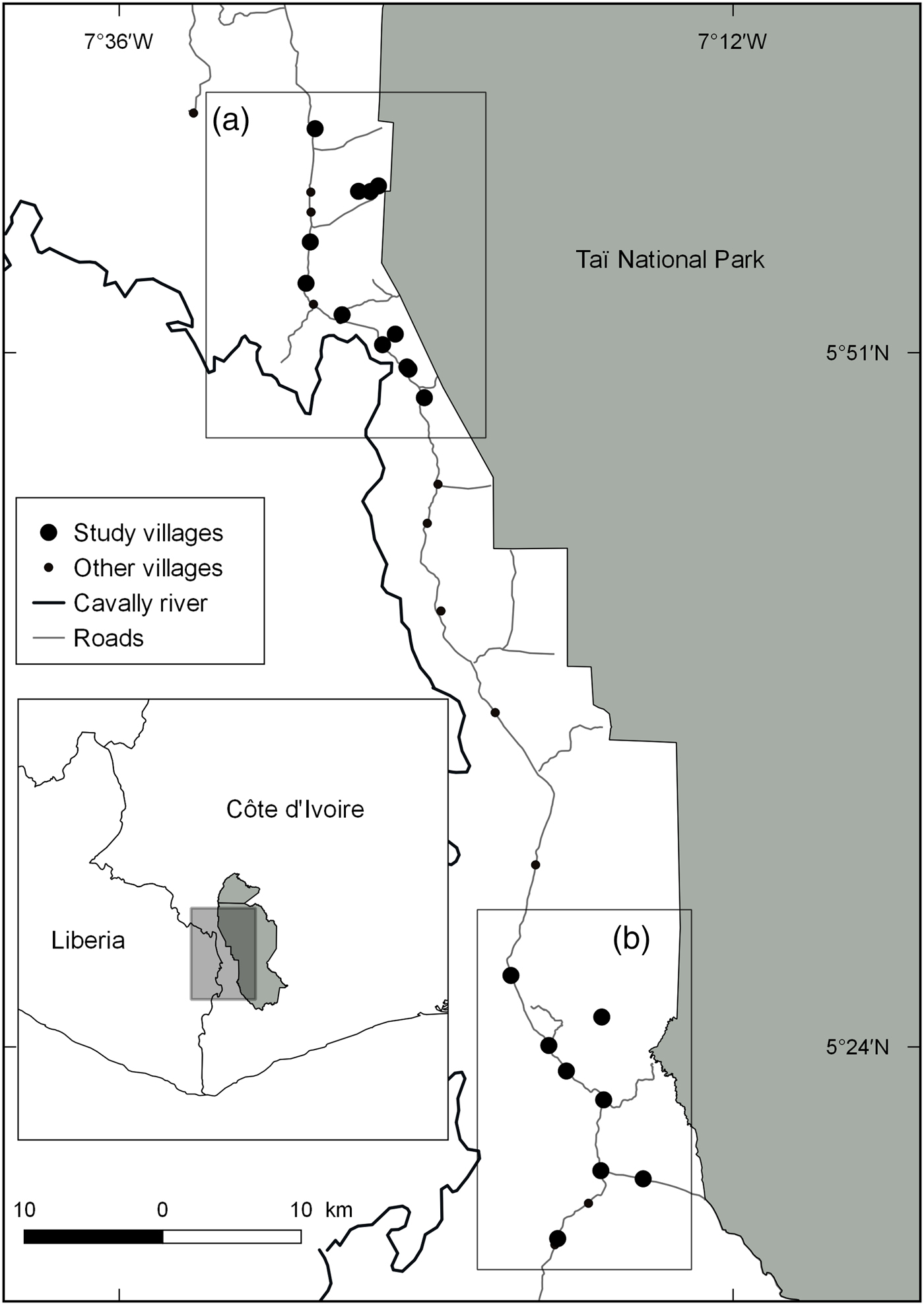
The study was conducted in 20 villages west of Taï National Park, a primary rainforest and UNESCO World Heritage Biosphere Reserve (Allport et al., Reference Allport, Boesch, Couturier, Esser, Merz, Piart, Riezebos, Vooren and Guillaum1994) in south-west Côte d'Ivoire (Fig. 1). The Park and surrounding forests act as a reservoir for endemic species in the Guinean forest region (Mittermeier et al., Reference Mittermeier, Gil, Hoffman, Pilgrim, Brooks and Mittermeier2004). Study villages were located in two regions: Taï and Djouroutou. Details of the study villages are provided in Table 1. Human populations in the vicinity of the Park include the Guéré, Oubi and Kroumen peoples, immigrants (from several ethnic communities in Côte d'Ivoire) and foreigners (from neighbouring countries); the major religions are Christianity, Islam and Animism. The economy of the region is dominated by subsistence agriculture, with intensive cash-crop farming, hunting, fishing and extraction of non-timber forest products as sources of additional income.
Locations of the study villages in the (a) Taï and (b) Djouroutou areas west of Taï National Park, Côte d'Ivoire.
Details of the study villages in the Taï and Djouroutou areas west of Taï National Park, Côte d'Ivoire (Fig. 1), with presence of schools, population, number of households, number of households surveyed, and number of awareness-raising activities.
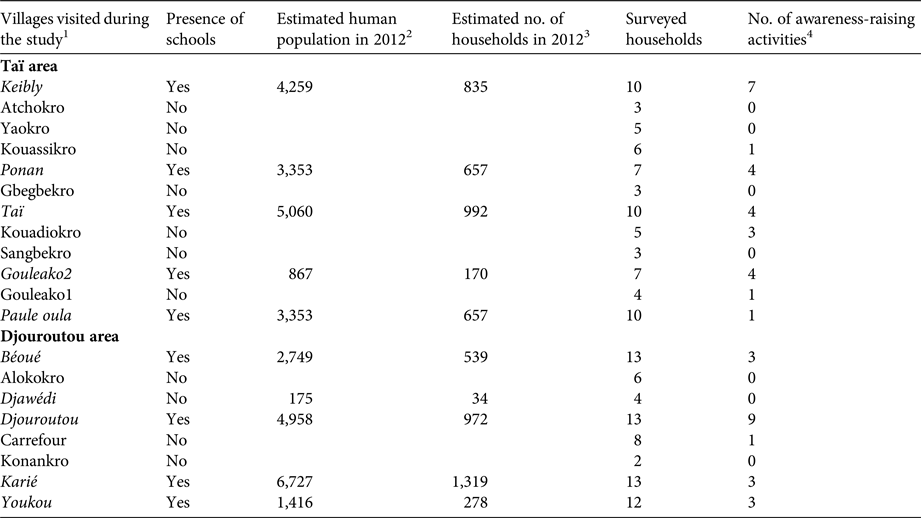
1 The main villages are in italics.
2 We multiplied the human population size in the study area in 1998 by the mean rate of population increase in Côte d'Ivoire during 1998–2012, which was c. 28.6% (estimated July 2012; CIA, 2012).
3 We divided the estimated population size in the study area in 2012 by the mean no. of people per household nationally, which was c. 5.1 (INS & ICF International, 2012).
4 Theatrical performances and/or film screenings (multimedia) conducted during 2002–2011 by the Wild Chimpanzee Foundation. Neighbouring communities were also invited to participate in these awareness campaigns.
Methods
Data collection
We conducted questionnaire surveys (Supplementary Material 1) with 144 household heads (with signed consent) during July–December 2012 (Fig. 1), using purposive sampling to select households (Ardilly, Reference Ardilly1994). The questionnaire comprised 22 multiple choice questions and was divided into three sections: (1) socio-economic aspects of interviewees, (2) their food consumption habits, and (3) their participation in various theatrical performances or film screenings conducted between 2002 and 2012 by the Wild Chimpanzee Foundation. During interviews the annual income of each household was estimated on the basis of existing financial resources and goods (Mbete et al., Reference Mbete, Banga-Mboko, Ngokaka, Bouckacka, Nganga and Hornick2011); i.e. wages, estimated plantation revenue and other goods declared.
Before or after each interview we weighed the meat and/or fish to be consumed that day, with weighing performed not only on survey days but also for 4 days at 1-week intervals for 1 month. This period is representative of market dynamics, as the availability and price of fish and meat (fresh and smoked) are relatively constant throughout the year, independent of season (Mbete et al., Reference Mbete, Banga-Mboko, Ngokaka, Bouckacka, Nganga and Hornick2011). We used a record sheet to record the state (fresh, smoked), weight and purchase price of meat and fish, the probable number of days on which meat and/or fish were consumed, the number of people who consumed various species, and the provenance of the meat/fish.
Data analysis
To determine the factors influencing bushmeat consumption in rural households, we used a binary logistic regression (Dobson, Reference Dobson2002) in R v. 2.14.1 (R Development Core Team, 2012). Bushmeat consumption was the dependent variable, Y, with a value of zero for no and 1 for yes, with a logistic regression model as follows: E(Y) = exp (Y)/(1 + exp(Y)). Independent variables that potentially affected a household's dependency on bushmeat included religion, area of study, education, number of multimedia campaigns in which a household participated, household annual income and number of dependent children going to school. We included an interaction between income and number of dependent children. In our analysis the interaction involves two independent quantitative variables with a regression equation as follows:
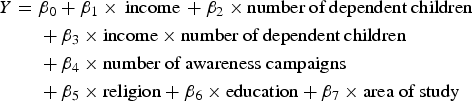 $$\eqalign{Y =\,\, &\beta _0 + \beta _1 \times \,{\rm income}\, + \beta _2 \times \hbox {number of dependent children} \cr & + \beta _3 \times {\rm income} \times \hbox {number of dependent children} \cr & + \beta _4 \times \hbox {number of awareness campaigns} \cr & + \beta _5 \times {\rm religion} + \beta _6 \times {\rm education} + \beta _7 \times \hbox {area of study}}$$
where β0 is the intercept term, and β1, β2, β3, …, β7 are the coefficients associated with each independent variable. All statistical tests were two-tailed, with statistical significance at P < 0.05.
Results
Wild animals consumed
Respondents reported consuming 18 wild animal species in total (Supplementary Table S1). Of these, three are categorized as Vulnerable (Phataginus tricuspis, Smutsia gigantea, Ceratogymna elata) and one as Endangered (Procolobus badius) on the IUCN Red List (IUCN, 2014). Overall, Cricetomys sp., Tragelaphus scriptus, Cephalophus maxwelli and Thryonomys swinderianus were the most frequently consumed species (20, 18, 13 and 12% of species, respectively).
Determinants of consumption
The location of households was the strongest factor explaining bushmeat consumption, which was less in the Taï region than in Djouroutou (Table 1). We did not find a factor that explained this difference.
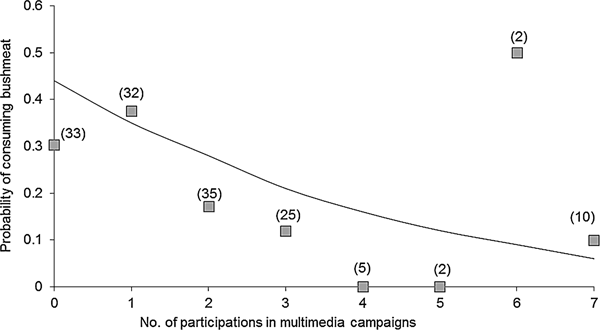
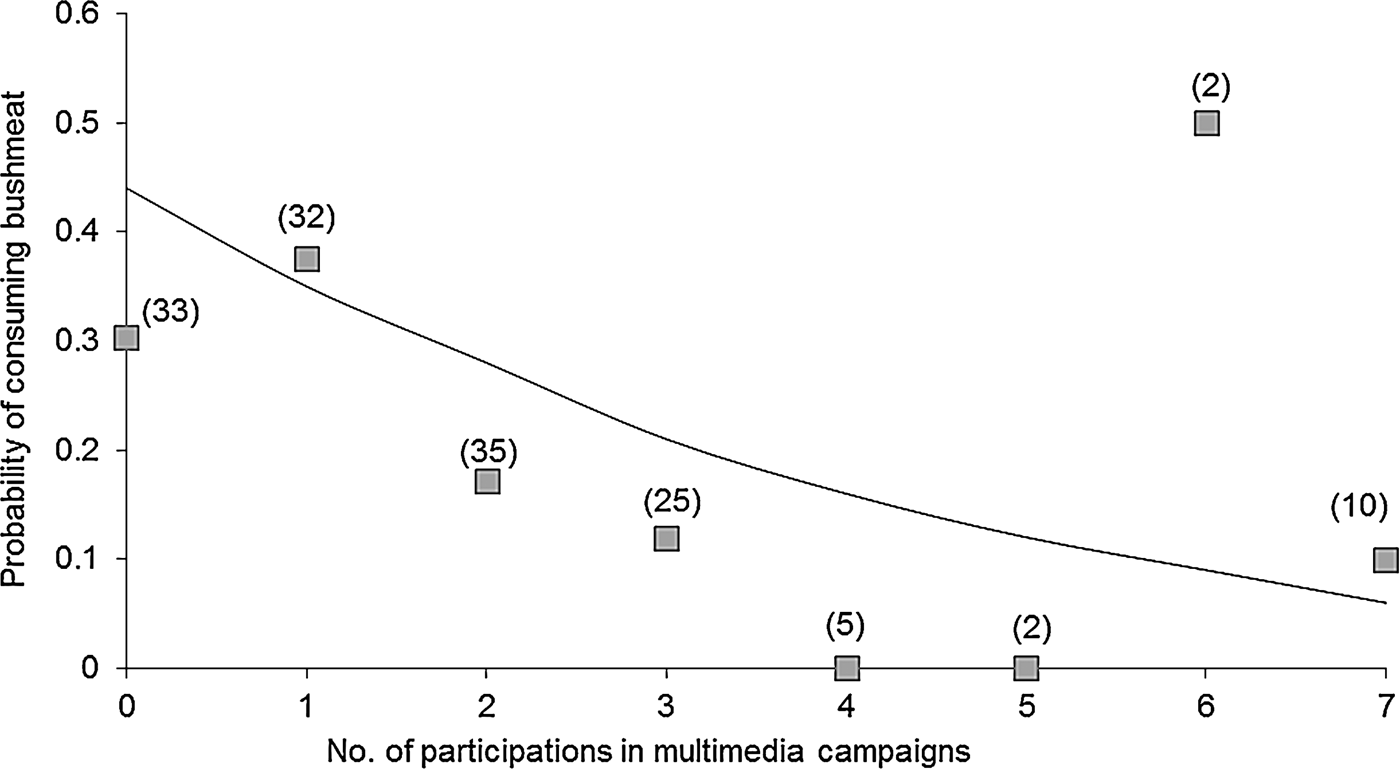
Independently, the probability of bushmeat consumption decreased with increasing participation in awareness campaigns (Table 2; Fig. 2). The more rural households participated in multimedia campaigns, the less they consumed bushmeat. Bushmeat consumption decreased by > 62% after participating in four theatre performances and/or film screenings. On average, bushmeat consumption in households decreased by c. 15% after each participation in a theatrical performance and/or film screening.
Probability of bushmeat consumption by households in the study villages west of Taï National Park (Fig. 1) as a function of the number of times they participated in multimedia campaigns. The line represents the model line. The numbers in parentheses indicate the number of people who participated in multimedia campaigns.
Factors affecting bushmeat consumption in rural households west of Taï National Park, Côte d'Ivoire (Fig. 1), with summary statistics from general linear modelling in which bushmeat consumption was the dependent variable.
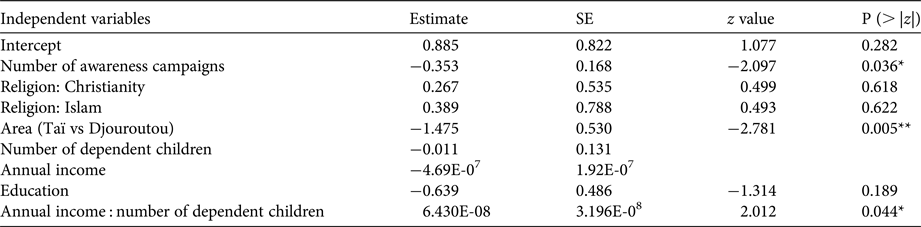
*P < 0.05; **P < 0.01
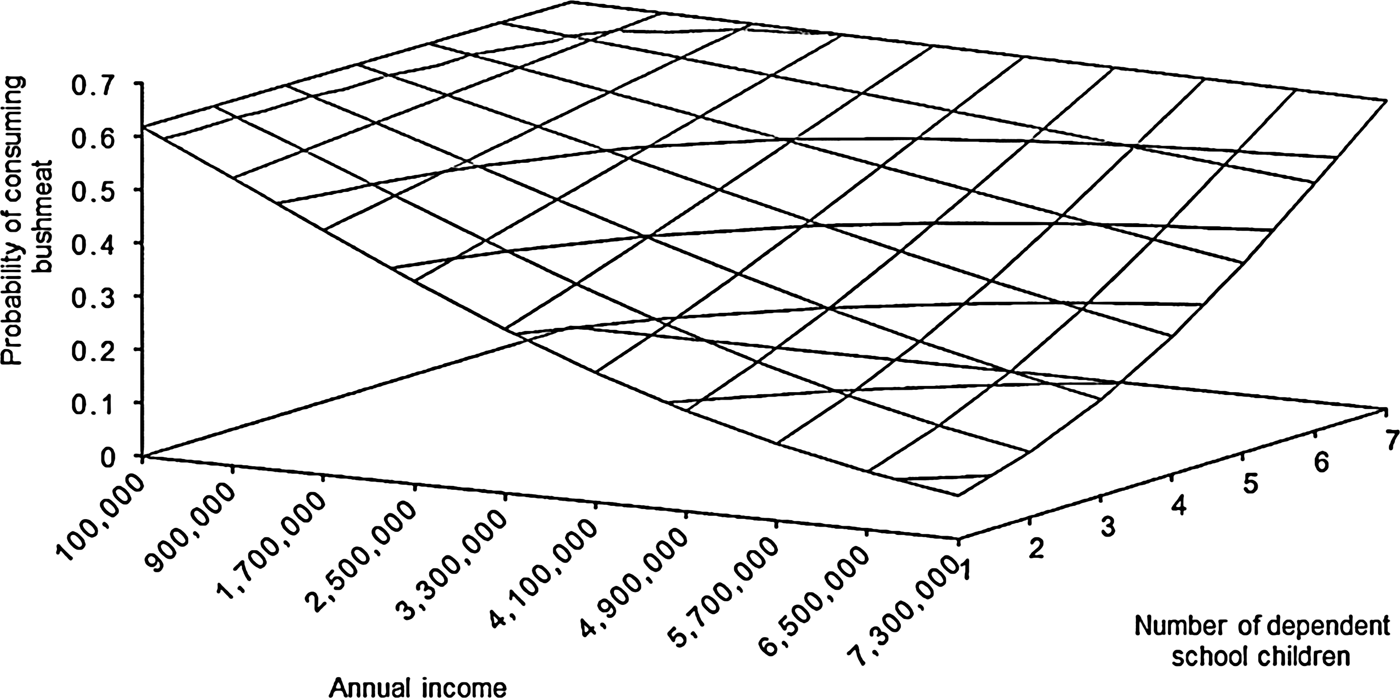
We found one significant interaction: bushmeat consumption decreased in households with larger annual incomes and fewer dependent school children. The more dependent children, the smaller the effect. When poverty increased (low annual income and more dependent children) the probability of consuming bushmeat was significantly higher (Table 1; Fig. 3). The consumption of bushmeat did not appear to be influenced by religion or level of education (Table 1).
Interaction between annual income, number of dependent school children, and consumption of bushmeat by rural households west of Taï National Park (Fig. 1).
Discussion
Our findings show that greater participation of rural households in awareness raising activities lead to a significant decrease in bushmeat consumption. Among the potential drivers of bushmeat consumption by rural households, only the interaction between a household's yearly income and the number of dependent school children had an effect, not religion or level of education.
To interpret these results it is important to understand the evaluation mechanisms for environmental awareness campaigns, and their effects on the food behaviours of the local population. The few previous studies that empirically tested a relationship between awareness campaigns for environmental conservation and an increase in positive attitudes towards nature partly confirm our results (e.g. Harcourt et al., Reference Harcourt, Pennington and Weber1986; Boesch et al., Reference Boesch, Boesch, Goné Bi, Normand, Herbinger, Wrangham and Ross2008a,Reference Boesch, Gnakouri, Marques, Nohon, Herbinger, Laugenie, Stoinski, Steklis and Mehlmanb; Borchers et al., Reference Borchers, Boesch, Riedel, Guilahoux, Ouattara and Randler2014). However, these studies reported people's attitudes but not their behaviour towards nature, and concluded there is no association between attitudes and poaching activity. In fact, poaching activity takes place despite local people expressing considerable concern for the targeted species (e.g. Newhouse, Reference Newhouse1990; Schultz, Reference Schultz2011; Heberlein, Reference Heberlein2012). An additional factor that may have led to such mixed results is that previous studies tested only for the impact of presence/absence of education campaigns (e.g. Infield & Namara, Reference Infield and Namara2001) and not for the number of instances of participation in awareness campaigns on bushmeat consumption. This more longitudinal dimension of our study revealed the positive effect of multiple education campaigns on reducing bushmeat consumption. It is with increased number of instances of participation that the effect becomes significant and detectable. This is supported by results from surveys carried out in Rwanda to investigate farmers’ attitudes, which found a marked improvement in attitudes after the fifth year of conservation awareness raising (Weber, Reference Weber1981, Reference Weber, Marsh and Mittermeier1989). Knowledge improvement is thus a prerequisite for behaviour change and reduced bushmeat consumption. These results indicate that education and awareness raising require a long-term commitment to counter natural resource extraction in Taï National Park.
Our results also indicate that low-income rural households with more dependent children attending school consume more bushmeat. This could be explained by one of the following hypotheses, confirmed by various studies. (1) Bushmeat can be divided and sold in small pieces, which can be acquired at an affordable price for the majority of households. This is supported by the study of Albrechtsen et al. (Reference Albrechtsen, Fa, Barry and Macdonald2005), which found that lower income households may rely more on bushmeat as their main source of protein because of lower prices. (2) Bushmeat may be exchanged as a gift between low-income households, increasing their level of consumption. (3) Some wild animals migrate into plantations from Taї National Park and are caught in traps for personal consumption, with no monetary transaction (e.g. Noss, Reference Noss, Robinson and Bennet2000; de Merode et al., Reference de Merode, Homewood and Cowlishaw2004; Albrechtsen et al., Reference Albrechtsen, Fa, Barry and Macdonald2005). This subsistence hunting is practised throughout rural Côte d'Ivoire (Caspary et al., Reference Caspary, Koné, Prouot and DePauw2001). A lack of financial resources combined with high expenses for school children results in poor rural households relying on bushmeat to meet their nutritional needs (Kümpel, Reference Kümpel2006), as they are unable to acquire the more expensive domestic meat available (Loibooki et al., Reference Loibooki, Hofer, Campbell and East2002; Johannesen, Reference Johannesen2005).
Poor rural households depend on wildlife as a source of food. Our surveys indicate that a long-term environmental awareness programme can result in behavioural change and reduce bushmeat consumption. Our results have encouraged the Wild Chimpanzee Foundation and other organizations to increase the number of awareness campaigns and run them across a number of years, as has been done in the villages around the Proposed Grebo-Krahn National Park in Liberia (WCF, 2014, 2015). There is accumulating evidence that constant human presence (tourists and researchers; Campbell et al., Reference Campbell, Kuehl, Diarrassouba, N'Goran and Boesch2011; N'Goran et al., Reference N'Goran, Boesch, Mundry, N'Goran, Herbinger, Yapi and Kühl2012), increased law enforcement (N'Goran et al., Reference N'Goran, Boesch, Mundry, N'Goran, Herbinger, Yapi and Kühl2012) and education campaigns (Borchers et al., Reference Borchers, Boesch, Riedel, Guilahoux, Ouattara and Randler2014) together provide an effective approach to protect threatened wildlife in tropical areas.
Acknowledgements
We are grateful to the Ivorian Ministère d'Enseignement Supérieure et de la Recherche Scientifique, and Université Félix Houphoüet-Boigny for permission to conduct this research. We thank the Wild Chimpanzee Foundation (WCF) for financial and technical support; the chiefs of sectors of the Parks and Reserves agency authorities, the WCF Taï and Djouroutou office staff, and the local communities and their traditional leaders in the surveyed areas for their help with fieldwork; Celestin Kouakou for valuable comments; and Julien Desre and Simon Furnell for translation and proof reading.
Author contributions
JK led the project, collected, analysed and interpreted the data, and wrote the article. EN contributed to analysis and interpretation of results. IK contributed to the writing and revision of the article. CB played a central role in determining assumptions, and contributed to the writing and revision of the article.
Biographical sketches
Joseph Kouassi’s research focuses on biodiversity conservation and the sustainable management of ecosystems. Emmanuelle Normand is a conservation biology and cognitive science specialist and Director of the Wild Chimpanzee Foundation West African office. Inza Koné is a primatologist and conservation biologist with interests in biodiversity and food security. Christophe Boesch is a conservation biology specialist and President of the Wild Chimpanzee Foundation.