





One main determinant of today’s high prevalence of overweight and obesity is food intake, and a factor that greatly influences food choice and dietary patterns is the food environment(Reference Adam and Jensen1). Glanz et al. (Reference Glanz, Sallis and Saelens2) conceptualise both the community food environment (food venues located in the community) and the consumer food environment (the foods and beverages available in each food venue). Access and proximity to food stores, or the community food environment(Reference Larson, Story and Nelson3–Reference Ohri-Vachaspati, Deweese and Acciai6), and the food store environment itself (consumer food environment) have been associated with the consumption of certain food groups such as fruits and vegetables(Reference Izumi, Zenk and Schulz7–Reference Machado, Claro and Martins11). Product variety available in supermarkets may be associated with intake(Reference Mendonca, Lopes and Freitas12,Reference Gustafson, Hankins and Jilcott13) . In addition, pricing of food items is a determining factor in consumption patterns. High energy-dense foods (such as fats and sweets) are often less expensive per calorie than lower energy-dense foods including fresh fruits, vegetables and meats(Reference Drewnowski and Darmon14–Reference Darmon and Drewnowski16). Taken together, the evidence suggests that access and availability to healthy and affordable foods in the consumer food environment influence consumers’ diet(Reference Gustafson, Hankins and Jilcott13,Reference Rose, Bodor and Hutchinson17,Reference Caspi, Sorensen and Subramanian18) .
National data indicate no differences in the intake of fruits and vegetables(Reference Mensink, Truthmann and Rabenberg19,Reference Lee-Kwan, Moore and Blanck20) or even sugar and fat(21,22) between Germans compared with Americans. Both Americans and Germans regularly consume above recommended amounts of meat and less than the recommended amount of vegetables(Reference Micha, Khatibzadeh and Shi23). However, there is a higher prevalence of overweight and obesity in the USA v. Germany(24). These differences may be due to dietary factors including cultural eating patterns (e.g., US residents eat more meals away from home)(Reference Kant, Whitley and Graubard25,26) and may also be due to physical activity-related factors(Reference Cawley27). Differences such as the percent of the budget spent for food away from home between these two countries likely play a key role(Reference Duquesne, Matendo and Lebailly28).
A study by Drewnowski et al. (Reference Drewnowski, Moudon and Jiao29) found that shopping at a lower-cost supermarket was associated with higher BMI when examining participants from studies in Seattle, Washington, USA and Paris, France. This suggests the importance of examining the food environment of discount supermarkets as well as larger, chain supermarkets, to determine potential reasons for these differences. Drewnowski et al. (Reference Drewnowski, Moudon and Jiao29) also emphasise the importance of studying the food environment across various cultures, in order to provide insights on the potential contributions of the consumer and community food environments with regard to unhealthy dietary patterns and obesity.
Availability and pricing of healthy foods have rarely been compared across countries as a possible explanatory factor for differences in consumption patterns and weight status(Reference Pettinger, Holdsworth and Gerber30). Two recent comparisons of the nutritional content of beverages and children’s breakfast cereals available in supermarkets in New Zealand, Australia, Canada, USA and the UK revealed substantial differences in mean energy between countries(Reference Chepulis, Mearns and Hill31,Reference Chepulis, Everson and Ndanuko32) . Another recent study looked at relative energetic prices of food categories across different countries and concluded that relative food price variations across countries might explain international differences in the prevalence of undernutrition and overweight(Reference Headey and Alderman33). While pricing has been explored in a few studies, the authors are not aware of any study that examined possible differences in available food variety or quality within food categories between countries.
Therefore, the aim of the current study was to examine differences in availability, quality, price and variety of different food products in supermarkets in Germany and the USA, examining both full-service and discount supermarkets, to understand potential consumer food environment differences that might contribute to unhealthy eating patterns.
Methods
Study setting
Supermarket audits were conducted in a German city (634 830 inhabitants in 2019) and a city in North Carolina, USA (92 156 inhabitants) by two researchers (each) in eight supermarkets in Germany (four full service of two different retailers, four discount of two different retailers) and seven supermarkets in the USA (three full service of two different retailers, four discount of two different retailers). The location of the supermarkets can be described as medium to high social economic areas. Both supermarket types were chosen as store settings using the distinctions already used by other researchers(Reference Morland, Wing and Roux34,Reference Chrisinger, Kallan and Whiteman35) . The two selected discount retailers were the same for both countries, while the full-service retailers were not, due to the fact that there are not the same chain supermarkets in both countries. In both countries, full-service supermarkets are most often used by consumers to buy groceries while discount supermarkets are much more popular in Germany compared with the USA(Reference Colla36). In general, grocery stores are smaller in size in Germany with less walking space, more consumer visits per week and less often located on the outskirts of the cities(Reference Gerhard and Hahn37,Reference Ellickson and Basker38) .
In both countries, two researchers conducted their assessments between Tuesday and Thursday between 9:30 and 16:30 h during March through May of 2019 (discounter on one day, full service on another day). It took between 30 and 90 min to complete each audit depending on store size.
Measures
For the assessment, an adapted version of the Bridging the Gap Food Store Observation Form(Reference Rimkus, Powell and Zenk39) was used. It was developed with input from several experts and adapted from validated tools such as the Nutrition Environment Measures Survey in Stores and the Communities of Excellence in Nutrition, Physical Activity and Obesity Prevention Food Availability and Marketing Survey(Reference Glanz, Sallis and Saelens40,Reference Ghiradelli, Quinn and Sugerman41) . The audit has been previously used in several studies assessing grocery stores and supermarkets(Reference Jilcott Pitts, Wu and McGuirt42,Reference Ghosh-Dastidar, Hunter and Collins43) . It was selected because it was validated in the USA and includes foods and beverages that are considered both healthy (fruits and vegetables) and less healthy (sugary beverages). The audit includes assessment of availability and price of several food and beverage items, with an emphasis on fruits, vegetables and sugary beverages, which are important elements of the consumer food environment. The prices of all selected products as well as the cheapest available option (e.g., for cola) were recorded. Interior and exterior store characteristics are also included. The inter-rater reliability of the tool ranged from 0·84 for food and beverage product availability, and intra-class correlation coefficient (ICC) was 0·82 for produce pricing and 0·90 for counts of fresh, frozen and canned fruit and vegetable options(Reference Rimkus, Powell and Zenk39). For the study purpose, the section on items available at check-out, number of cash registers, exterior marketing, store exterior features (e.g., parking) or tobacco products were not taken into account for the store audit. Many of these aspects cannot be compared across these two countries (e.g., many grocery stores in German cities have underground parking or no parking). In addition, brand or type details of selected products (e.g., orange juice – by ‘Minute Maid’, apple – ‘Red Delicious’) were not assessed given the country differences in brands and produce types.
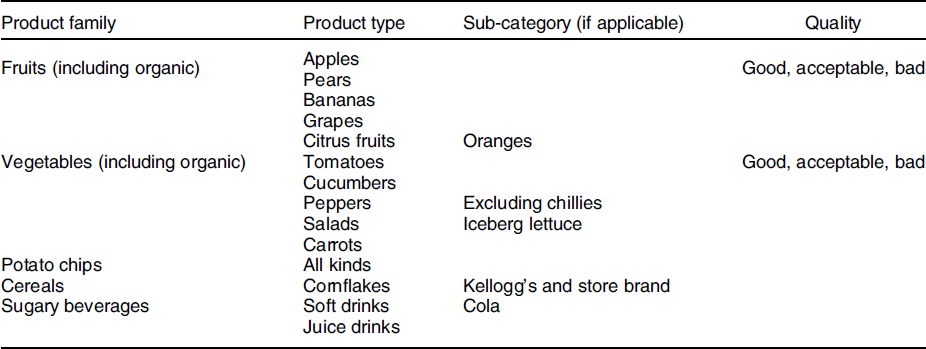
Based on a pre-screening in a German supermarket on product availability, the following types of foods in Table 1 were evaluated regarding quality, price and variety. The description for the quality assessment can be found in the original Bridging the Gap Food Store Observation Form(Reference Rimkus, Powell and Zenk39). The food types were selected based on their comparability across the two countries. At each store, an overall quality measurement was recorded for each product type (see online Supplementary Material).
Product family, type and sub-categories for the measured food products
Statistical analyses
To assess the inter-rater reliability of the audits, ICC were estimated for the US and German audits. All numerical variables including estimates of quality were used for this calculation. ICC and 95 % CI were computed using a single measure reliability two-way model ANOVA estimating absolute agreement between the raters.
To allow for comparison between US and German supermarkets, prices in US dollars per pound ($/lb) were converted into euros per kilogram (€/kg). The exchange rate on the 26 April 2019 (1 US dollar = 0·89578 euros) was used, as this was within the period in which the audits were conducted. Prices of lettuce and cucumber were provided per item, so these were converted into euros per kilogram using the weights of these items in their respective countries since both products are sold by piece and not by weight.
Summary statistics were used to compute availability, variety, quality and price of fruits, vegetables, cereals, potato chips and sugary beverages from the adapted version of the Bridging the Gap-Community Obesity Measures Project Food Store Observation Form(Reference Drewnowski, Moudon and Jiao29,Reference Rimkus, Powell and Zenk39) . Averages, sd and two-sample independent t tests were calculated. Energy density graphs were created using estimates of energy density per gram of each food item, and calculating the energy costs by identifying the price in Euros for 418·4 kJ (100 kcal) of each item, averaged across all supermarkets in the audit. Statistics were run using R version 3.6.1.
Results
The two-way, absolute agreement, single rater ICC was assessed for both countries. For Germany, all variables had an ICC of 0·999, 95 % CI 0·999, 0·999. For the USA, the ICC was 0·84, 95 % CI 0·764, 0·887.
Fruit and vegetable variety
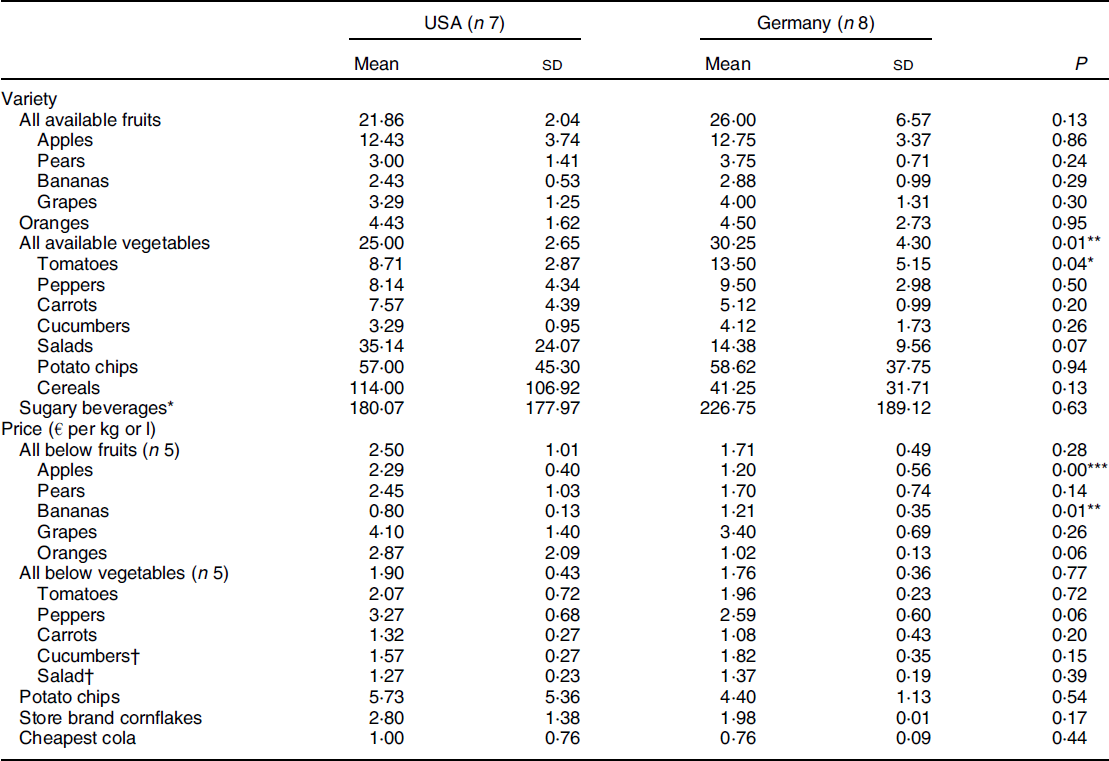
In both countries, all selected products were available. The variety of apple types was larger than the variety of types of pears, bananas, grapes or oranges (Table 2). The variety of available fruits did not differ significantly between the two countries.
Variety of types of fruits and vegetables available in Germany and the USA, mean number (sd). Welch’s two sample t tests
* Soft drinks, < 100 % fruit juice and 100 % fruit juice.
† Adjusted for average size.
Regarding assessed vegetable variety, results show that significantly more types of tomatoes were offered in the German supermarkets compared with the US supermarkets (t(11·2) = −2·26), while salad variety in the USA exceed offered varieties in Germany albeit not significantly (t(7·7) = 2·14). The remaining assessed vegetables such as cucumber, peppers and carrots were offered in similar varieties in both countries, but overall vegetable variety was significantly higher in Germany compared with the USA (t(11·8) = −2·88).
Fruit and vegetable prices
Supermarkets’ pricing per kg of fruit had the highest range for grapes in Germany, with the lowest price at €2·38 and the highest at €4·38. In the USA, oranges had the highest price variations between supermarkets, with the lowest at €1·72 and the highest price per kg at €7·48. Prices for fruit differed between the countries with lower prices for apples in Germany but higher prices for bananas.
Prices for vegetables appeared to be generally cheaper in German supermarkets compared with the US supermarkets; this seems to be particularly the case for peppers (t(12·0) = 2·04), carrots (t(11·9) = 1·34), salads (t(8·2) = 5·07) and cucumbers (t(12·3) = 2·15). The prices for tomatoes seem to vary widely between US supermarkets.
Differences in food products’ variety, prices and quality across supermarkets
When comparing the different types of supermarkets (discount v. full service), in both countries the mean number of different types of fruits and vegetables was higher in full-service supermarkets. Discount supermarkets offered 21·12 (sd 1·64) varieties of fruits and 25·25 (sd 2·96) varieties of vegetables, compared with 27·43 (sd 6·11) varieties of fruits and 30·71 (sd 4·11) varieties of vegetables offered in full-service supermarkets. The differences were significant for both fruits (t(6·8) = −2·65, P = 0·03) and vegetables (t(10·8) = −2·92, P = 0·01) as well as the number of different types of potato chips (t(6·5) = −8·02, P = 0·00), cereals (t(6·1) = −3·45, P = 0·01) and sugar-sweetened beverages (t(6·5) = −15·33, P = 0·00).
There were no significant differences for the aggregated mean prices of the assessed fruits or vegetables between discount and full-service supermarkets. Only tomatoes and cola were significantly more expensive in full-service supermarkets (t(8·5) = −3·32, P = 0·01 and t(8·4) = −2·43, P = 0·04, respectively), with a mean price of €1·70 per kg of tomatoes in discount supermarkets compared with €2·37 in full-service supermarkets, and €0·61 per litre of cola in discount supermarkets compared with a mean price of €1·19 in full-service supermarkets.
Product quality between the supermarkets did not differ; no product type was identified as being of overall ‘bad’ quality and all of the US supermarkets offered ‘good’ quality fruits and vegetables. ‘Acceptable’ quality pears, oranges, tomatoes, cucumbers and peppers were found in some German supermarkets. This was independent of the type of supermarket, as nine acceptable quality product types were found in discounter supermarkets and eight acceptable quality product types in full-service supermarkets.
Cereal, potato chips and sugar beverage variety and prices
For cereals, the variety of cereals was higher in the USA than Germany, but this was not significant. Price differences for store brand cornflakes were not significant; however, there was a higher range of prices among the cereals in the USA (between €1·73 and €5·11 per 1 kg) compared with German supermarkets (€1·98 or €1·99 per 1 kg in all stores).
Mean number of potato chip varieties for the two countries were similar, with fifty-seven varieties available in the USA and almost fifty-nine in Germany. Potato chips in German supermarkets were similarly priced, with only one full-service supermarket in Germany offering slightly higher priced potato chips at €0·72 per 100 g, compared with €0·40 per 100 g in all other supermarkets. There was a wider range in price for chips in US supermarkets, where the cheapest price for chips was €0·28 per 100 g, and the most expensive was €1·70 per 100 g in a full-service supermarket.
Variety of sugary beverages varied greatly between discount and full-service supermarkets in both the USA (between a mean of 27 sugary beverages in the discount supermarkets and a mean of 382 in the full-service supermarkets) and Germany (between 50 and 461 types available). The lowest number was in a US discount supermarket, with nineteen different types available and the highest number was in a US full-service supermarket, with 500 different varieties available. Prices for cola also varied considerably within US supermarkets, from €0·27 per the cheapest litre size bottle to €1·96 per bottle, while in Germany, prices across the tested supermarkets were relatively stable (€0·60 to €0·90).
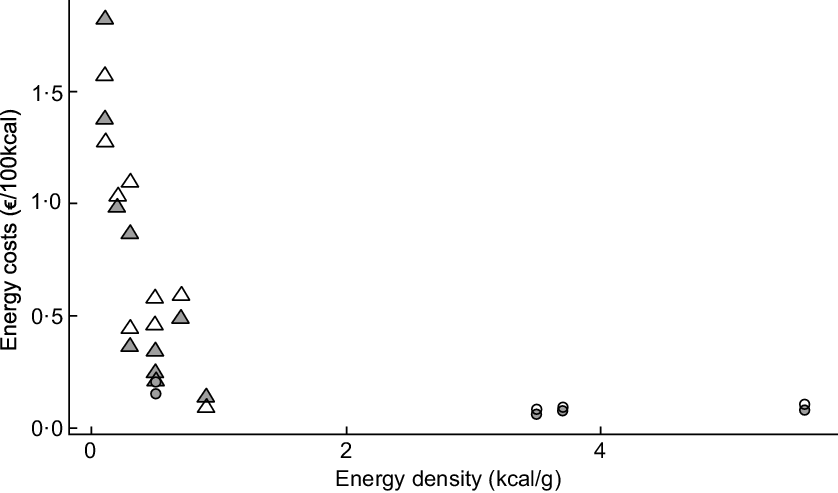
When looking at energy density of the assessed food products, it was confirmed that fruits and vegetables in both countries have higher energy costs (€/100 kcal) than chips or cereals. The results were similar for both countries, see Fig. 1.
Proportion of energy density (kcal/g) to energy costs (€/100 kcal) across the assessed food products categorised into ‘healthy’ (less energy-dense foods such as fruits and vegetables) and ‘unhealthy’ (high energy-dense foods such as sweets or savoury snacks) using the mean prices across all supermarkets. ( ), Germany; (
 ), USA; (
 ), Unhealthy; (
 ) Healthy
Discussion
The current study assessed various food products’ variety, prices and quality in supermarkets in the USA and Germany using a supermarket audit tool which demonstrated strong inter-rater reliability for both countries. There was a tendency for lower prices of fruits and vegetables in Germany v. the US stores, while produce quality and variety did not differ, with the exception of the variety of some vegetables. Interestingly, the range in prices in German supermarkets was lower, which would explain findings that showed that, compared with the US and other countries(Reference Liao, Tan and Wu44–Reference Kolak, Bradley and Block46), in Germany, no differences in the food environment between high and low socioeconomic areas were found(Reference Drewnowski and Darmon14). Furthermore, food product prices do not appear to be automatically cheaper in discount supermarkets in either country, questioning consumers’ assumption of a better deal in discount supermarkets. There is some research pointing in a similar direction mainly for selected everyday food items (e.g., milk, cola soft drink)(Reference Cataluna, Franco and Ramos47). But academic research in this area across all countries seems to be lacking.
It can be speculated that lower produce prices encourage greater produce intake. However, national data do not seem to show country differences in consumption of the studied food products(Reference Mensink, Truthmann and Rabenberg19–22) whereas differences in the prevalence of overweight and obesity between the countries exist.
While the intake of fruits and vegetables appears similar in both countries, our study found that all food and beverages were higher cost, on average, in US v. German markets. This could be due to the differences in study setting as the US stores were located in a city with a smaller population and potentially fewer stores and thus less market competition, which may contribute to the higher prices for food in the US v. German stores that were assessed.
Overall, the calculation of energy costs between the assessed food products demonstrates that healthy products (less energy-dense foods such as fruits and vegetables) are more expensive than energy-dense products (e.g., chips) in both countries. However, in Germany, there were lower overall costs for fruits and vegetables, raising the question of the influence of energy costs as a key part of the consumer food environment that could affect population-based purchasing behaviour(Reference Hawkes48). Additional studies are needed to understand the impact of food and beverage price on food consumption, particularly since price reductions and increased variety of healthy foods appear to increase consumption(Reference Adam and Jensen1,Reference Hartmann-Boyce, Bianchi and Piernas49) . There are several studies demonstrating that price discounts on healthier items can promote healthier purchases(Reference Mah, Luongo and Hasdell50), and additional studies are needed across countries to determine the most effective in-store strategies to promote healthier purchases.
Limitations of the study include the small convenience sample of stores included, and the differences in the study settings. Possible seasonal effects and the lack of direct consumer data are additional weaknesses. Furthermore, the assessment of produce quality was purely subjective and is thus a limitation in the current study. Nevertheless, this is the first study using a tool adapted from a validated instrument in both chain and discount supermarkets in two distinct countries. It is also the first study to compare prices, energy density and energy costs of selected products across these two countries.
In conclusion, it is thought that availability, variety, price and quality of food products influence dietary intake. Reciprocally, when consumers demand higher quality, or healthier foods, these foods may be more available in stores. The reciprocal nature of supply and demand within food stores is complex but given their economic and political power in the food system, supermarkets could be impactful and positive levers to improve dietary quality in both countries(Reference Pulker, Trapp and Scott51,Reference Pulker, Trapp and Scott52) . Our study can be a model for future studies using larger and more representative samples of stores for assessment, with a goal of additional health promotion efforts in supermarkets.
Acknowledgements
Financial support: Support for data collectors in North Carolina was provided by the East Carolina University Department of Public Health. Conflict of interest: None. Authorship: N.S.B. and S.B.J.P. were responsible for conceptualising the research idea, developing the study design and interpreting the results. K.W. and C.J.K. carried out the study and provided feedback on the manuscript. K.W. and K.P. analysed the data and provided feedback. N.S.B. wrote the first drafts of the manuscript. All authors approved the final version of the manuscript. No other individuals or organisations provided advice or support. Ethics of human subject participation: Not applicable.
Supplementary material
For supplementary material accompanying this paper visit https://doi.org/10.1017/S1368980020002645


 Open access

