





Introduction
Lettuce, grown mainly for consumption in the eastern United States, is an important cool-season crop cultivated from October to March on approximately 4,000 ha in the Everglades Agricultural Area (EAA) on the southern edge of Lake Okeechobee in south Florida (USDA-NASS 2019). Lettuce is a rotational crop with sugarcane (Saccharatum spp. hybrids), the main crop in the EAA. Although Florida has less lettuce acreage than California and Arizona (USDA-NASS 2021), the crop and other leafy vegetables makes a significant contribution to Florida’s economy, accounting for >$80 million annually (GM Sandoya, personal communication). However, production and further expansion of lettuce acreage in the region is limited by lack of effective weed management programs, particularly chemical control.
The EAA is dominated by organic, or muck soils (Histosols) characterized by organic matter content as high as 80%0 to 90%, with no significant clay or mineral content (Snyder et al. Reference Snyder, Burdine, Crockett, Gascho, Harrison, Kidder and Mishoe1978; Wright and Hanlon Reference Wright and Hanlon2009; Zelazny and Carlisle Reference Zelazny, Carlisle, Stelly and Dinauer1974). Lettuce cultivated on organic soils in the EAA is direct-seeded on raised beds. Lettuce production using transplants is limited in the region because of the cost associated with growing and establishing the transplants. The crop is planted at shallow depth because of the small seed size. After lettuce planting, fields are sprinkler irrigated until emergence, and thereafter, subsurface irrigated by raising the water table along ditches and canals surrounding the fields (Snyder et al. Reference Snyder, Burdine, Crockett, Gascho, Harrison, Kidder and Mishoe1978) to minimize leaf wetness and assist in mitigating occurrence of foliar diseases (Raid Reference Raid and SAMH2004). These practices provide ideal conditions for weeds to emerge simultaneously with lettuce. Weeds are competitive with lettuce due to the short stature and slow growth of lettuce early in the season, and if efficacious control measures are not implemented yields are adversely affected.
Weed competition for light, water, and nutrients can reduce lettuce yield and quality. In the naturally phosphorus-deficient organic soils of the EAA (Nagata et al. Reference Nagata, Sanchez and Coale1992), weed competition for phosphorus is an important consideration (Santos et al. Reference Santos, Dusky, Stall, Bewick and Shilling2004a, Reference Santos, Dusky, Stall, Bewick, Shilling and Gilreath2004b; Shrefler et al. Reference Shrefler, Dusky, Shilling, Brecke and Sanchez1994a, Reference Shrefler, Shilling, Dusky and Brecke1994b). Smooth pigweed (Amaranthus hybridus L.) competes primarily with lettuce for light by its taller canopy in addition to aggressively competing for phosphorus, while the low-growing common purslane (Portulaca oleracea L.) aggressively competes with lettuce for phosphorus (Santos et al. Reference Santos, Dusky, Stall, Bewick and Shilling2004a, Reference Santos, Dusky, Stall, Bewick, Shilling and Gilreath2004b; Shrefler et al. Reference Shrefler, Dusky, Shilling, Brecke and Sanchez1994a, Reference Shrefler, Shilling, Dusky and Brecke1994b). The critical period of weed control for a mixed population of weed species in lettuce on organic soil varies from 2.3 to 4.6 wk depending on the level of phosphorus fertilization (Odero and Wright Reference Odero and Wright2013).
Competition from spiny amaranth significantly reduces lettuce quality traits such as head firmness, ribbiness, and head weight (Shrefler et al. Reference Shrefler, Stall and Dusky1996). Carotene, an important quality trait in lettuce, is also highly sensitive to weed competition (Giannopolitis et al. Reference Giannopolitis, Vassiliou and Vizantinopoulos1989). Giannopolitis et al. (Reference Giannopolitis, Vassiliou and Vizantinopoulos1989) reported 51% to 83% reduction of carotene content in lettuce due to competition from several annual grasses and broadleaf weeds. The duration of weed competition on lettuce yields varies with weed species. Season-long competition by smooth pigweed and common purslane can result in 24% and 48% lettuce yield reduction, respectively, on organic soils (Santos et al. Reference Santos, Dusky, Stall, Shilling and Bewick1997). The critical timing of common lambsquarters, smooth pigweed, and common purslane removal in lettuce has been estimated to be 5 to 11 d, 24 to 34 d, and 37 to 47 d after emergence, respectively, on organic soils (Santos et al. Reference Santos, Dusky, Stall, Bewick and Shilling2004c, Reference Santos, Dusky, Stall and Gilreath2004d).
Broadleaf weeds are difficult to control in lettuce crops grown on organic soils in the EAA because of limited herbicide options. Limitations in herbicide options is attributed to low tolerance to herbicides by seeded lettuce compared with transplanted lettuce (Lati et al. Reference Lati, Mou, Rachuy, Smith, Dara, Daugovish and Fennimore2015). Broadleaf weeds including common lambsquarters, Amaranthus spp., common purslane, common ragweed (Ambrosia artemisiifolia L.), and American black nightshade (Solanum americanum Mill.) are commonly found in lettuce fields on these organic soils. Imazethapyr is registered for use on lettuce grown on organic soils in the EAA, with postemergence (POST) applications registered through special local needs labeling in Florida (Anonymous 2021c). However, erratic weed control with imazethapyr in lettuce does occur in the region (DC Odero, personal observation). Weeds that escape imazethapyr treatments are controlled using costly hand weeding. Consequently, more efficacious weed control options are needed for lettuce cultivated on organic soils in the EAA. This is imperative to reduce production cost and increase profitability.
Bensulide and pronamide are herbicides commonly used preemergence (PRE) for control of broadleaf and grass weeds in other lettuce production regions in the western United States (Anonymous 2021a, 2021b; Smith et al. Reference Smith, Fennimore and LeStrange2017; Tickes and Kerns Reference Tickes and Kerns1996). The efficacy and residual control of these herbicides on broadleaf weeds depends on soil type (Fennimore and Umeda Reference Fennimore and Umeda2003; Shaner Reference Shaner2014). Weed control with pronamide can be erratic on organic soil (Dusky and Stall Reference Dusky and Stall1996) because it is adsorbed to soil organic matter (Carlson et al. Reference Carlson, Lignowski and Hopen1975). Bensulide is strongly adsorbed to soil and is inactivated in soils with high organic matter (Shaner Reference Shaner2014). Oxyfluorfen, a diphenylether herbicide, has the potential to be used PRE to provide residual broad-spectrum weed control in lettuce on organic soils, but additional research is needed to evaluate crop tolerance. Fennimore et al. (Reference Fennimore, Rachuy and Valdez2011) reported safety of oxyfluorfen on lettuce following application to fallow beds prior to planting on soil with <2.1% organic matter. The level of injury on lettuce from oxyfluorfen is unclear when applied to soils with elevated levels of organic matter in the EAA compared with soils with low organic matter content. Because of the high potential for lettuce yield loss from weed competition on organic soils in the EAA, it is important to evaluate PRE herbicides that can provide residual weed control or develop efficacious weed control programs based on PRE herbicides followed by POST herbicide applications. Currently, limited information exists on comparing PRE, POST, and PRE followed by POST programs for weed control in lettuce grown in organic soils. Therefore, the objective of this research was to evaluate the efficacy of PRE application of pronamide, bensulide, imazethapyr, or oxyfluorfen alone or followed by a POST application of imazethapyr on broadleaf weed control and lettuce yield on organic soils in the EAA.
Materials and Methods
Field experiments were conducted at the University of Florida Everglades Research and Education Center in Belle Glade, FL (26.6584°N, 80.6260°W) in 2016 and 2017 to evaluate PRE and POST herbicides for broadleaf weed control in direct-seeded lettuce. Experimental plots were established on a Dania muck soil (Euic, hyperthermic, shallow Lithic Haplosaprists) with 80% organic matter, pH 7.3. Soil pH was measured in 1:2 soil/water suspension using an electronic pH meter (FiveEasy Plus™, Mettler Toledo, Columbus, OH), and organic matter content was determined using the loss-on-ignition method (Schulte and Hopkins Reference Schulte, Hopkins, Magdoff, Tabatabai and Hanlon1996; Wright et al. Reference Wright, Wang and Reddy2008). The fields were chisel plowed, disked with a harrow, and bedded before planting. Fertilizers were applied at 112 kg K2O ha−1 and 168 kg P2O5 ha−1 in two bands on top of the ground just before hilling and shaping beds. Beds were 1 m wide at the base, 0.2 m in height, and 0.5 m at the top. Two rows (30 cm apart) of lettuce were direct-seeded on December 23, 2016, and October 17, 2017, on each bed. Lettuce was planted 6 to 9 mm deep using a Stanhay S870 belt planter at a seeding rate of 10 seeds m−1 of row. Lettuce emerged on average 7 d after planting both years and was subsequently thinned to 30 cm intrarow spacing 3 wk after emergence to give approximately 3 plants m−1 of row. Alternating beds were seeded with ‘Cooper’ (3 Star Lettuce, Gonzales, CA) and the other with romaine lettuce ‘Manatee’ (3 Star Lettuce). Disease and insect pests were conventionally managed based on standard lettuce production practices for the region.
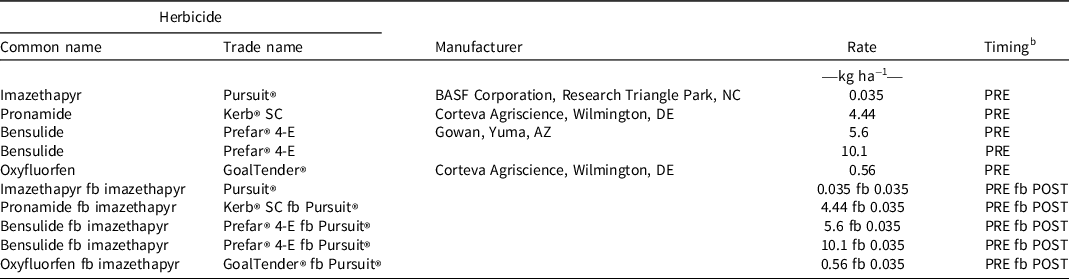
The experimental design was a randomized complete block with a split-plot arrangement and four replications. The main plot was herbicide treatments, and the subplot was the lettuce type. The main plots were two beds wide by 7.6 m long, and the subplots were one bed each planted with either iceberg or romaine lettuce. Herbicide treatments for main plots (two beds wide) consisted of a PRE application of imazethapyr, pronamide, bensulide, or oxyfluorfen applied alone or followed by imazethapyr applied POST (Table 1). Imazethapyr applied POST, with no PRE herbicide, was included as a comparison. Season-long weed-free (hand weeded) and weedy plots were also included.
Herbicide used in the studies. a
a Abbreviations: fb, followed by; POST, postemergence; PRE, preemergence.
b POST treatment applied at 7 d after emergence (average. 14 d after planting) at the cotyledon stage to before the 2-leaf stage of lettuce, which corresponded with the cotyledon to less than 2-leaf stage of growth of weed species present. POST herbicide applications included a nonionic surfactant at 0.25% vol/vol (Activator 90; Loveland Products Inc., Greeley, CO).
Preemergence applications were made immediately after planting and imazethapyr was applied 7 d after emergence (average, 14 d after planting). At the time of POST application lettuce was at the cotyledon to 1-leaf stage; and the corresponding weed stage was cotyledon to less than the 2-leaf stage. Postemergence application of imazethapyr at the 2-leaf stage was the most effective timing based on prior experiments (DC Odero, unpublished data). POST herbicide applications included a nonionic surfactant at 0.25% vol/vol (Activator 90; Loveland Products Inc., Greeley, CO). Herbicide treatments were applied with a CO2-pressurized backpack sprayer calibrated to deliver 187 L ha−1 at 276 kPa at 5 km h−1 using TeeJet® XR8002VS nozzle tips (Spraying Systems Co., Wheaton, IL).
Fields were sprinkler irrigated with 13 mm of water immediately after PRE herbicide application and as needed until the 4-leaf stage. Water was subsequently applied by subsurface irrigation from field ditches by maintaining a water table 61 cm below the soil surface (Snyder et al. Reference Snyder, Burdine, Crockett, Gascho, Harrison, Kidder and Mishoe1978). Totals of 68 and 208 mm of rainfall were received in 2016 and 2017 growing seasons, respectively (FAWN 2022).
Lettuce stand count was taken 7 d after POST herbicide application for each subplot before thinning. Lettuce injury and weed control were evaluated at 14 and 28 d after POST treatment (DAPT; equivalent to 28 and 42 d after PRE application). Injury was rated for each subplot and weed control for each main plot based on a scale of 0% to 100%, with 0% being no injury or weed control and 100% being complete plant death or weed control. Prevalent broadleaf weed species were common lambsquarters and spiny amaranth at densities of 338 and 42 plants m−2, respectively. Common purslane was present sporadically across experimental plots at evaluation but not rated for control. Sethoxydim at 210 g ha−1 was applied twice, at the 2-leaf stage and before head formation, to control fall panicum (Panicum dichotomiflorum Michx.) and goosegrass [Eleusine indica (L.) Gaertn.]. Marketable-sized lettuce heads were harvested by hand from 3-m-long sections from the two rows in each subplot on March 3, 2017, and December 22, 2017, and weighed to determine yield. Fairly well trimmed, fresh, green lettuce heads free of decay, visual diseases, and disorders were considered marketable.
Data were subjected to ANOVA using the lme4 package (Lenth Reference Lenth2021) of the R statistical language v. 4.1.0 (https://cran.r-project.org/bin/windows/base/). Lettuce type, herbicide treatment program, and their interaction were considered fixed effects for lettuce stand, injury, and yield data, whereas herbicide treatment program was considered a fixed effect for weed control data. Year and replication (nested within year) were considered random effects. Estimated marginal means (i.e., predicted means) for treatments were calculated and the post hoc Tukey test was performed for all pairwise treatment comparisons (P < 0.05) using the emmeans package of R (Bates et al. Reference Bates, Maechler, Bolker and Walker2021). Orthogonal contrasts were conducted on lettuce stand, yield, and weed control to compare PRE herbicides applied alone versus PRE herbicides followed by POST imazethapyr or POST imazethapyr alone.
Results and Discussion
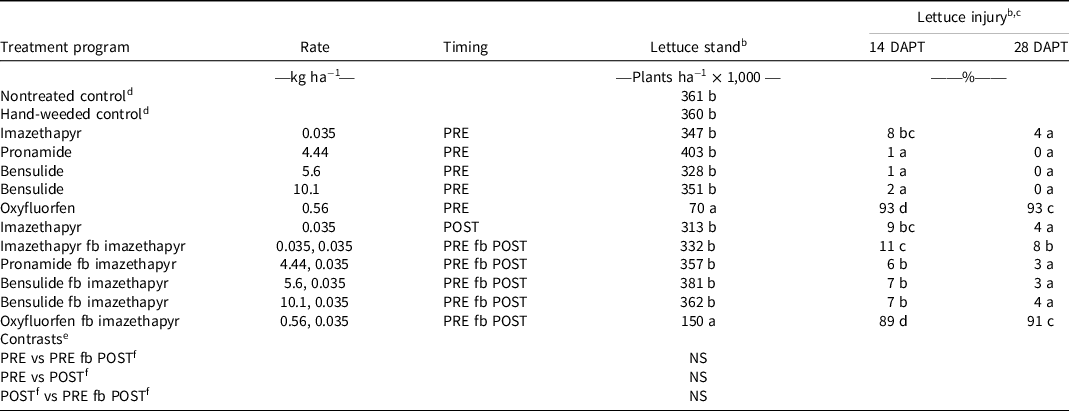
The main effects of herbicide treatment program and lettuce type were significant for lettuce stand. However, the interaction of the main effects was not significant. Lettuce stand was higher for romaine than iceberg, averaging 351,518 and 281,242 plants ha−1, respectively (data not presented). Germination and emergence of lettuce is temperature dependent, with optimum temperature for seed germination ranging between 15 and 22 C (Gray Reference Gray1975). In the present study, the average soil temperature was 22 C in the first 21 d after planting (FAWN 2022). The difference in stand between the lettuce types was probably not temperature related, which is an important factor that affects lettuce germination and emergence, but was probably attributed to seed quality or other nebulous or extraneous factors. All herbicide treatment programs were not significantly different from the nontreated and hand-weeded controls for lettuce stand with the exception of treatments that contained oxyfluorfen, which resulted in stand reduction (Table 2). Oxyfluorfen is strongly adsorbed to organic matter and slowly degrades in soil (Alister et al. Reference Alister, Gomez, Rojas and Kogan2009; Fadayomi and Warren Reference Fadayomi and Warren1977; Shaner Reference Shaner2014; Ying and Williams Reference Ying and Williams2000). Its immobility in most soils and stability to hydrolysis over a wide range of soil pH levels likely contributes to its slow degradation (Shaner Reference Shaner2014). While oxyfluorfen is strongly adsorbed to soil organic matter, which would make it less available in soil solution for plant uptake, it seems likely that some amount was still biologically available in the organic soil used in this study. Oxyfluorfen-treated soil coming into direct contact with cucurbit leaves caused crop injury (Bellinder et al. Reference Bellinder, Binning, Yourstone, Bonanno, Gorski, Majek, Neary, Baron, Holmdal and Wallace1993). In this study, oxyfluorfen-treated soil could have come in contact with leaves of emerging lettuce with sprinkler irrigation, causing soil to splash.
Influence of herbicide treatment programs on romaine and iceberg lettuce stand and injury. a
a Abbreviations: DAPT, days after postemergence treatment; fb, followed by; NS, not significant; POST, postemergence; PRE, preemergence; vs, versus.
b Means (combined over lettuce type) within a column followed by the same letters are not significantly different according to Tukey’s test (P < 0.05).
c Lettuce injury: 14 and 28 days after treatment are equivalent to 28 and 42 d after PRE herbicide application.
d Nontreated control and hand-weeded data for lettuce injury were not included in the analysis because there was no variance.
e Contrasts were not significant.
f POST imazethapyr applied alone.
The main effect of herbicide treatment program was significant for lettuce injury at 14 and 28 DAPT; however, the effect of lettuce type was not significant (data not presented). Imazethapyr, pronamide, and bensulide injury on lettuce was manifested as stunting, while oxyfluorfen resulted in stunting, foliage necrosis, and plant death. Maximum lettuce injury (89% to 93%) occurred with treatments that contained oxyfluorfen (Table 2). Treatments containing imazethapyr resulted in up to 11% and 8% injury at 14 and 28 DAPT, respectively. Injury from imazethapyr was most pronounced when applied PRE followed by a POST application. Dusky and Stall (Reference Dusky and Stall1996) reported 12% reduction in lettuce vigor following a POST application of imazethapyr at 33 g ha−1. They also reported <3% injury from pronamide and bensulide applied PRE on organic soils. Lettuce injury from pronamide and bensulide can occur, and injury severity will depend on soil type, herbicide placement, and movement in the soil (Tickes and Kerns Reference Tickes and Kerns1996). POST application of imazethapyr following PRE pronamide and bensulide treatments resulted in up to 7% and 4% injury at 14 and 28 DAPT, respectively. Observed lettuce injury from PRE-applied herbicides was mostly transient with the exception of injury from oxyfluorfen. Similarly, Dusky and Stall (Reference Dusky and Stall1996) reported transient injury on lettuce from POST-applied imazethapyr. Although herbicide injury is of major concern in lettuce production, herbicides with a slight risk of injury that prevent severe weed infestations can be acceptable for use in lettuce weed management programs.
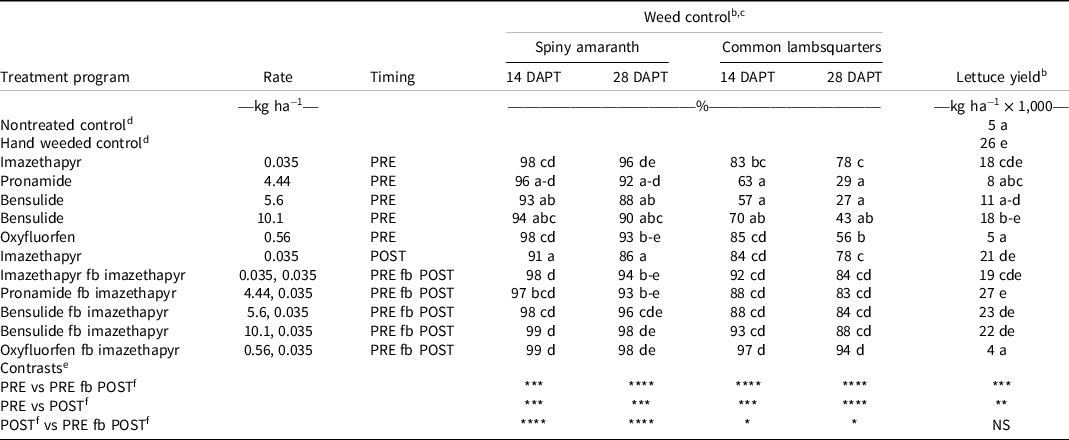
The most prevalent broadleaf weeds infesting the experimental sites both years were spiny amaranth and common lambsquarters. Fall panicum and goosegrass, the most common grass weeds both years, were controlled using sethoxydim. Weed control was analyzed separately for each weed species at 14 and 28 DAPT. Herbicide treatment differences were detected for spiny amaranth and common lambsquarters control at both rating dates (Table 3). Spiny amaranth control was >91% both years for all treatments at 14 DAPT. At 28 DAPT, spiny amaranth control ranged from 88% to 98%. Sequential herbicide treatments provide better spiny amaranth control compared to PRE-only or POST-only treatments at 14 and 28 DAPT.
Influence of herbicide treatment programs on weed control and romaine and iceberg lettuce yield. a
a Abbreviations: DAPT, days after postemergence treatment; fb, followed by; NS, not significant; POST, postemergence; PRE, preemergence; vs, versus.
b Means within a column followed by the same letters are not significantly different according to Tukey’s test (P < 0.05).
c Weed control: 14 and 28 days after treatment are equivalent to 28 and 42 d after PRE herbicide application.
d Nontreated control and hand weeded control data were not included in the analysis because there was no variance.
e Contrasts were either not significant, or asterisks denote significant at *P < 0.05, **P < 0.01, ***P < 0.001, and ****P < 0.0001.
f Imazethapyr applied alone POST.
Common lambsquarters control ranged from 53% to 85% with PRE-only treatments compared with 88% to 92% control provided by PRE followed by POST applications of imazethapyr at 14 DAPT (Table 3). At 28 DAPT, PRE-applied pronamide-only, bensulide-only, and oxyfluorfen-only treatments controlled common lambsquarters <56% compared to 78% control with PRE followed by POST, and POST-only imazethapyr treatments. The POST imazethapyr following PRE-applied treatments improved common lambsquarters control (84% to 94%) at 28 DAPT. POST treatment following PRE-applied oxyfluorfen controlled common lambsquarters by 94%. However, treatments containing oxyfluorfen resulted in the most severe lettuce injury and stand reduction (Table 2). Similar to results with spiny amaranth, sequential herbicide treatments provided better common lambsquarters control compared to PRE-only or POST-only treatments at 28 DAPT. Overall, weed control declined by 28 DAPT for the PRE herbicides followed by POST-applied imazethapyr but remained at more than 80% and 90% for common lambsquarters and spiny amaranth, respectively. The improved level of weed control with the PRE herbicides followed by POST-applied imazethapyr was attributed to POST applications of imazethapyr. Dusky and Stall (Reference Dusky and Stall1996) reported 93% spiny amaranth and 72% common lambsquarters control in lettuce with POST-applied imazethapyr at 33 g ha−1 at 15 DAPT. Vencill et al. (Reference Vencill, Wilson, Hines and Hatzios1990) reported 86% and 89% control of common lambsquarters in pea (Pisum sativum) with imazethapyr at 51 and 61 g ha−1, respectively at 28 DAPT.
Significant herbicide treatment program and lettuce type main effects occurred for lettuce yield, but not for their interaction. Lettuce yield was higher for romaine than iceberg, averaging 18,715 and 12,926 kg ha−1, respectively (data not presented). The higher yield observed for romaine compared to iceberg lettuce was probably attributed to higher stand observed in romaine lettuce. All herbicide treatments with the exception of PRE-only pronamide and oxyfluorfen treatments increased lettuce yield compared to the hand-weeded control for both lettuce types (Table 3). Lettuce yield was highest with PRE-applied herbicides followed by a POST application of imazethapyr compared to PRE-only or POST-only treatments for both lettuce types (Table 3). The higher yield in PRE herbicides followed by POST imazethapyr applications was attributed to their significantly greater common lambsquarters and spiny amaranth control in comparison to the PRE- or POST-only treatments. Overall, treatments containing oxyfluorfen resulted in the lowest yield for both romaine and iceberg lettuce (Table 3). Low yields from these treatments were attributed to unacceptable stand reduction and injury associated with oxyfluorfen application (Table 2).
Results from the current research indicate that common lambsquarters and spiny amaranth, which are among the most prevalent and troublesome broadleaf weeds of lettuce on organic soils in the EAA in southern Florida, can cause detrimental impacts on lettuce yield when not adequately controlled. Preemergence applications of imazethapyr, pronamide, or bensulide followed by POST applications of imazethapyr provided improved control of common lambsquarters and spiny amaranth compared to PRE-only treatments. These treatment combinations resulted in the highest yield despite causing transient injury to lettuce. Although herbicide injury is a major concern in lettuce production, the slight risk of injury from PRE-applied imazethapyr, pronamide, and bensulide followed by a POST application of imazethapyr that prevents severe weed infestations and result in improved lettuce yield can be acceptable for use in lettuce weed management programs on organic soils in the EAA in southern Florida. However, PRE-applied oxyfluorfen is not an option for weed control in direct-seeded lettuce on organic soils because of unacceptable crop injury and stand reduction. Whether to apply imazethapyr, pronamide, or bensulide PRE followed by a POST application of imazethapyr for weed control in lettuce on organic soils depends on the cost and ease of application, and other weed species present in the field.
Acknowledgments
We thank the staff at the Everglades Research and Education Center for their assistance with establishing, maintaining, and harvesting experimental plots. This project was funded by the Specialty Crop Block Grant Program through the U.S. Department of Agriculture–Agricultural Marketing Service, and through the Florida Department of Agriculture and Consumer Services, contract #22908. No conflicts of interest have been declared.


 Open access

