

Introduction
Migration is back, controversial as ever. Ancient DNA (aDNA) and isotope analysis have recently provided archaeologists with tools to gather direct evidence for prehistoric migrations (Kristiansen Reference Kristiansen2014; Reich Reference Reich2018, xxvi). Yet, similar advances in archaeological methods to assess the impact of migrations are lacking (Anthony Reference Anthony2023; Burmeister Reference Burmeister2000; Van Dommelen Reference Van Dommelen2014). As a result, prehistoric migrations continue to be interpreted according to culture-historical paradigms in which culturally and genetically homogeneous groups of migrants sweep across the map, introducing novel material culture and supplanting passive indigenous communities (Vander Linden Reference Vander Linden2024). Not only do such interpretations neglect the varied and complex nature of migration (Hofmann et al. Reference Hofmann, Frieman, Furholt, Burmeister and Johannsen2024), but they also feed into harmful stereotypes about migration in contemporary society (Hakenbeck Reference Hakenbeck2019). Novel approaches to migration are therefore needed, both to further our understanding of prehistoric migration and to contribute to broader societal debates (Altschul et al. Reference Altschul and Ortman2020; Clark et al. Reference Clark and Ware2019).
This problem is particularly salient in debates about the emergence of Corded Ware (CW) communities during the 3rd millennium BC. aDNA studies demonstrate that a major migration event occurred in Europe during this period (Allentoft et al. Reference Allentoft and Willerslev2024; see Allentoft et al. Reference Allentoft and Willerslev2015; Haak et al. Reference Haak and Reich2015 for early publications). This migration event has been linked to the spread of the material culture and funerary rites which make up CW, as well as lasting changes in language and connectivity across Europe (cf. Kristiansen et al. Reference Kristiansen and Willerslev2017; Iversen & Kroonen Reference Iversen and Kroonen2017). This identification of genetic signatures with cultural phenomena sparked major controversy (Booth Reference Booth2019; Eisenmann et al. Reference Eisenmann and Stockhammer2018; Furholt Reference Furholt2017; Heyd Reference Heyd2017; Vander Linden Reference Vander Linden2016) and archaeologists continue to debate the relation between cultural and genomic developments during the 3rd millennium BC (e.g. Bourgeois et al. Reference Bourgeois, Helmecke, Olerud, Djakovic, Guadalupe Castro González and Kroon2025a; Furholt Reference Furholt2021; Heyd Reference Heyd, Heyd, Kulcsár and Preda-Bălănică2021; Kristiansen et al. Reference Kristiansen and Willerslev2017). In other words, definitive evidence for migration has not resolved the debate on CW, but shifted it towards questions about the cultural impact of this migration (cf. Burmeister Reference Burmeister, Meller, Daim, Krause and Risch2017, 65).
This paper showcases a novel, bottom-up approach to assess the cultural impact of prehistoric migration, in particular during the 3rd millennium BC using two quantitative methods. First, Bayesian chronological modelling (Bronk Ramsey Reference Bronk Ramsey2009a) serves to infer whether migrants and indigenous communities co-existed and, if so, the likely duration of this co-existence. Second, a novel approach to ceramic chaînes opératoires infers the amount of shared technical knowledge between potters from ceramic assemblages (Kroon Reference Kroon2024). Potters acquire technical knowledge through social interactions with other potters (Gosselain Reference Gosselain and Spear2018; Roux Reference Roux2019, 4–5; cf. Lave Reference Lave2011). As such, detecting knowledge transmission between potters in migrating and indigenous communities is a proxy for meaningful cultural interactions between these groups, complementing information about potential chronological overlaps. Taken together, these two methods enable a better integration of archaeological and archaeogenetic data.
As a proof of concept, this approach is applied to the emergence of CW in the Netherlands, building on the work originally published in Kroon (Reference Kroon2024). The appearance of CW in the Netherlands is conventionally attributed to the arrival of migrant communities, which would rapidly supplant indigenous Funnel Beaker West (FBW) communities around 2800 BC (Lanting & Van der Plicht Reference Lanting and Van der Plicht2000, 32) and assimilate indigenous Vlaardingen (VL) communities around 2600 BC (Beckerman Reference Beckerman2015). The approach taken here demonstrates that this migration event had a different impact. CW, FBW, and VL communities likely co-existed for centuries. During this co-existence, CW potters in particular learned from the potters who fashioned FBW and VL ceramics. Moreover, the outcomes indicate such a scenario was not exceptional, but common during migration events in the 3rd and 4th millennia BC. Consequently, this study argues that co-existence and knowledge transmission from indigenous to migrant communities should become the default scenario for the impact of prehistoric migration.
On migration
The concept of migration has a long history in archaeology. A review of this history is beyond the scope of this article (see Hakenbeck Reference Hakenbeck2008). Put briefly, prehistoric archaeology has long relied on a narrow, determinist view of migration ultimately derived from culture history. Migration was envisioned as a process in which one group of people arrives in an area and replaces indigenous groups (e.g. Childe Reference Childe1929, vi; Kossinna Reference Kossina1911, 3). Given that prehistoric communities were argued to be recognisable in the archaeological record as coherent complexes of material culture, migration would thus be visible as an abrupt break in material culture (Hakenbeck Reference Hakenbeck2008, 13).
This view is narrow and determinist because a single migration dynamic, namely rapid population replacement, is set as the default scenario for (the impact of) all prehistoric migrations. In fact, various other migration dynamics are possible (Hofmann et al. Reference Hofmann, Frieman, Furholt, Burmeister and Johannsen2024, 18; Tsuda et al. Reference Tsuda, Baker, Eder, Knudson, Maupin, Meierotto, Scott, Baker and Tsuda2015, 21) and rapid population replacement may be a modern exception (cf. Gosden Reference Gosden2004, 30). Subsequent work on migration in European prehistory has often focussed on migration dynamics, but left this deterministic view on the impact of migration intact.
Early examples of the renewed engagement with prehistoric migration are the works of Neustupný (Reference Neustupný1982) and Anthony (Reference Anthony1990). Both authors challenge the notion that migrants arrive in (and settle) destination areas en bloc. Instead, they propose that small groups, or even individual migrants, explore and settle in destination areas before the arrival or larger migrant communities and/or major cultural changes. More recent work on prehistoric migration has shifted further towards such small-scale dynamics (e.g. Furholt Reference Furholt2021; Hofmann et al. Reference Hofmann, Frieman, Furholt, Burmeister and Johannsen2024). Some studies even argue that the concept of migration should be abandoned altogether in favour of small-scale mobility (Hakenbeck Reference Hakenbeck2008, 19).
Crucially, high-resolution aDNA analysis and isotope analysis underline the importance of small-scale mobility during the 3rd millennium BC. Initial aDNA studies of the European Neolithic painted a picture of population developments in broad brushstrokes (Allentoft et al. Reference Allentoft and Willerslev2015; Haak et al. Reference Haak and Reich2015; Lazaridis et al. Reference Lazaridis and Krause2014). However, subsequent high-resolution studies have shed more light on the small-scale dynamics which underlie these broader developments. For example, aDNA analyses of Corded Ware cemeteries in the Czech Republic demonstrate high genetic diversity among the individuals buried there, suggesting continuous admixture of people from various source areas (Papac et al. Reference Papac and Haak2021). Similarly, combined aDNA and isotopic analysis of Bell Beaker (BB) individuals buried in the Lech Valley shows several individuals were raised in the area, but moved away during their lifetime to return later on (Mittnik et al. Reference Mittnik and Krause2019; cf. Booth et al. Reference Booth, Brück, Brace and Barnes2021). Initial applications of ancIBD have also shown that individuals with close biological ties were buried far from each other during the 3rd millennium BC, again hinting at high personal mobility (Ringbauer et al. Reference Ringbauer, Huang, Akbari, Mallick, Olalde, Patterson and Reich2024). These findings show that migration in the 3rd millennium BC did not involve homogeneous blocks of migrants. Instead, migration appears as an erratic, small-scale process in which individuals or small groups moved back and forth between different source and destination areas (cf. Furholt Reference Furholt2021). This process only appears as structured and directional when viewed at a scale of continents and centuries (cf. Allentoft et al. Reference Allentoft and Willerslev2024; Racimo et al. Reference Racimo, Woodbridge, Fyfe, Sikora, Sjögren, Kristiansen and Vander Linden2020).
Such small-scale migration dynamics not only challenge the culture-historical view on migration, but on the past as a whole. Modern migration studies show that migrants in these small-scale processes tend to co-exist with their host societies, to adopt cultural practices from them, and to spread these back to source populations (Castles et al. Reference Castles, De Haas and Miller2014, 72; De Haas Reference De Haas2023, 162–3; 178–9; 217). The same outcomes are documented for historical migration events (cf. Cameron Reference Cameron2013; Halsall Reference Halsall2013; Oosterhuizen Reference Oosterhuizen2019). In other words, we should expect migration to result in co-existence and bricolage, not in a series of consecutive, categorically distinct cultural phenomena.
Following from this discussion, prehistoric migration is assumed here to be a small-scale, erratic process. Migration is defined as a form of geographic mobility whereby a person changes their habitual area of residence for at least half a year (De Haas Reference De Haas2023, ix–x). Systematic detection of such small-scale mobility and its impact in prehistory is impossible due to the fragmented nature of the archaeological record (Anthony Reference Anthony1990, 901–2; Burmeister Reference Burmeister2000, 547; Cabana & Clark Reference Cabana, Clark, Cabana and Clark2011, 5). Therefore, this study applies methods and approaches from probability theory to aggregated archaeological data. This means the focus is not on individual (groups of) migrants or hosts but on the patterns which emerge from their collective actions over a given span of time and area. In particular, the aim is to investigate whether migrant and indigenous groups in the 3rd millennium BC co-existed and whether practices were transmitted between these groups.
Background to the study area
At this point, a brief introduction to the study area, the Netherlands during the 3rd millennium BC, becomes necessary. The conventional culture-historical framework for Dutch prehistory is largely followed here (see Van den Broeke et al. Reference Van den Broeke, Fokkens, Van Gijn, Louwe Kooijmans, Van der Broeke, Fokkens and Van Gijn2005, fig. 1.10), but parts of this framework will be revisited in the following sections.
The conventional culture-historical framework for the Netherlands during the 4th and 3rd millennium BC (Louwe Kooijmans Reference Louwe Kooijmans2018, 466; Midgley Reference Midgley2008, fig. 1.1; Van den Broeke et al. Reference Van den Broeke, Fokkens, Van Gijn, Louwe Kooijmans, Van der Broeke, Fokkens and Van Gijn2005, fig. 1.10; Von Schnurbein & Hänsel Reference Von Schnurbein and Hänsel2009). Abbreviations: SW Swifterbant; VL Vlaardingen; FBW Funnel Beaker West; FBN Funnel Beaker North; FBS Funnel Beaker South; FBSE Funnel Beaker South-East; FBE Funnel Beaker East; CW Corded Ware; BB Bell Beaker.

A recurrent theme in Dutch Neolithic archaeology is the distinction between uplands and wetlands. Due to differences in subsoils (Louwe Kooijmans Reference Louwe Kooijmans and Gardiner1993, 73; Vos et al. Reference Vos, Van der Meulen, Weerts and Bazelmans2020), archaeological phenomena from the uplands (e.g. FBW, CW) are best known from anorganic artefacts in funerary contexts, whereas phenomena in the wetlands (e.g. VL) are best known from organic and anorganic finds in settlement contexts. Naturally, settlement and funerary contexts are not isolated domains (e.g. Brindley Reference Brindley, Van der Velde, Bouma and Raemaekers2022, 137; Van Zoolingen Reference Van Zoolingen, Zoolingen and Bulten2021, 56), but it should be clear that a comparison of only funerary contexts or only settlement contexts is impossible.
The inhabitants of the Netherlands prior to the migration event in the 3rd millennium BC are attributed to two archaeological phenomena: VL in the wetlands of the western and southern Netherlands, and FBW in the north-eastern uplands (Figure 1).
VL communities are part of a continuous development from the Late Mesolithic onward. They are characterised by a subsistence economy focussed on wild resources with some domesticated plants and animals, and a settlement system with both permanently occupied and temporary sites (Amkreutz Reference Amkreutz2013; Raemaekers Reference Raemaekers, Deeben, Drenth, Van Oorsouw and Verhart2005). Both in terms of these practices and their genomic history (Olalde et al. Reference Olalde and Reich2026), VL communities have strong ties to preceding Swifterbant (SW) communities via the transitional Hazendonk group (Figure 1). The distinctions between these groups are primarily based on ceramic typology (Beckerman & Raemaekers Reference Beckerman and Raemaekers2009; Raemaekers Reference Raemaekers, Deeben, Drenth, Van Oorsouw and Verhart2005, 271).
FBW communities are characterised by 1) a ceramic style (J.A. Bakker Reference Bakker1979; Brindley Reference Brindley1986); 2) the construction of megalithic passage graves (J.A. Bakker Reference Bakker2010); and 3) a subsistence economy focussed on cattle herding and agriculture (R. Bakker Reference Bakker2003, 268–7). FBW communities are argued to migrate into the Netherlands from southern Scandinavia around 3400 BC (Louwe Kooijmans Reference Louwe Kooijmans2018, 493–4) (Figure 1), potentially replacing SW populations in a period of 80 years (Menne & Brunner Reference Menne and Brunner2021, 1240). aDNA evidence for this migration event is sparse (but see Olalde et al. Reference Olalde and Reich2026) due to the poor preservation of skeletal remains in the uplands (cf. Louwe Kooijmans Reference Louwe Kooijmans and Gardiner1993, 73). The case for a migration event mostly rests on resemblances between the characteristic traits of FBW and Funnel Beaker North (FBN) communities in Denmark and contrasts with the characteristic traits of SW communities (Louwe Kooijmans Reference Louwe Kooijmans2018, 493–4).
FBW communities in the Netherlands are best known from funerary contexts (J.A. Bakker Reference Bakker2010). Settlement contexts are rare (Mennenga Reference Mennenga2017, chapter 4.4). FBW funerary rites show a chronological distinction. They either involve inhumation burials with a broad spectrum of ceramic shapes, or cremation burials, which almost exclusively contain large, closed decorated bowls (Kroon Reference Kroon2024, 40–3). Both types of burials appear in megalithic tombs and flat graves. Analysis of associated radiocarbon dates shows that inhumation burials tend to date to the 4th millennium BC and cremation burials to the 3rd millennium BC, with some overlap between c. 3100-2900 BC (J.A. Bakker Reference Bakker1992, 93; Kossian Reference Kossian2000, 50–2; 135; Kroon Reference Kroon2024, 44–5). This chronological distinction is relevant to the comparison of ceramic technology below.
In a broader context, FBW is considered to be the westernmost and youngest branch of the Funnel Beaker groups (Midgley Reference Midgley2008; Müller et al. Reference Müller, Brozio, Demnick, Dibbern, Fritsch, Furholt, Hage, Hinz, Mischka, Rinne, Hinz and Müller2012, 2) (Figure 1). These groups emerge out of Neolithic communities in central Europe during the early 4th millennium BC and initially share several traits such as monumental megalithic architecture and ceramic style. They then diversify into regional phenomena over the course of the 4th millennium BC (Furholt Reference Furholt, Noble, Mischka, Furholt, Hinz and Olausson2014b, 21).
FBW and VL communities are conventionally seen as largely isolated, because neither group adopts ‘characteristic cultural traits’ such as ceramic style from the other (J.A. Bakker Reference Bakker1982; Drenth Reference Drenth, Müller, Hinz and Wunderlich2019; Louwe Kooijmans Reference Louwe Kooijmans1983, 59). However, FBW and VL artefacts are known to occur on the same sites (Amkreutz Reference Amkreutz2013, 342; Beckerman & Raemaekers Reference Beckerman and Raemaekers2009, 79; Drenth Reference Drenth, Müller, Hinz and Wunderlich2019) and admixture of early farmer ancestry is attested in individuals from VL sites (Olalde et al. Reference Olalde and Reich2026). Therefore, clear evidence exists for interactions between these groups.
The emergence of CW in the Netherlands around 2900 BC (Figure 1) is attributed to another migration event. aDNA evidence for this migration is still sparse (cf. Olalde et al. Reference Olalde and Reich2018; Reference Olalde and Reich2026) and the primary arguments for a migration are the typological resemblances between Dutch CW ceramics and CW ceramics elsewhere (cf. Drenth & Lanting Reference Drenth and Lanting1991; Lanting & Van der Waals Reference Lanting, Van der Waals, Lanting and Van der Waals1976; Van der Waals & Glasbergen Reference Van der Waals and Glasbergen1955), as well as contrasts with the ceramic styles of FBW and VL. CW communities in the Netherlands are characterised by a specific burial rite (Bourgeois & Kroon Reference Bourgeois and Kroon2017; Wentink Reference Wentink2020; cf. Furholt Reference Furholt2014a), for which they are also best known. The attribution of several settlement sites in the wetlands to CW is contested (Beckerman Reference Beckerman2015; Kroon et al. Reference Kroon, Huisman, Bourgeois, Braekmans and Fokkens2019; Wentink Reference Wentink2020, 34–5).
Generally, CW communities are argued to supplant FBW communities in the uplands within 50 years of arriving, based on a survey of radiocarbon dates and ceramic typochronology (Lanting & Van der Plicht Reference Lanting and Van der Plicht2000, 32). However, several problematic exceptions are known for this scenario (e.g. J.A. Bakker & Van der Waals Reference Bakker, Van der Waals, Daniel and Kjaerum1973; Furholt Reference Furholt2003, 98–9; cf. Bourgeois et al. Reference Bourgeois, Kroon, Olerud, Hofmann, Mischka and Scharl2025b). The transition from VL to CW in the wetlands would occur around 2600 BC. In this case, VL communities are argued to import or adopt characteristic CW vessels (Beckerman Reference Beckerman2015, 225; cf. Kroon et al. Reference Kroon, Huisman, Bourgeois, Braekmans and Fokkens2019). However, the typical CW burial rite remains absent in the wetlands (Wentink Reference Wentink2020, 34–5) and in terms of subsistence economy, settlement location, and genomic signatures VL communities persist into the BB period (Amkreutz Reference Amkreutz2013; Olalde et al. Reference Olalde and Reich2026).
The final development in the 3rd millennium BC is the appearance of BB material culture and funerary practices (cf. Fokkens Reference Fokkens, Fokkens and Nicolo2012; Wentink Reference Wentink2020) around 2500 BC in both the Dutch uplands and wetlands (Figure 1). This transition is no longer thought of as a continuous development from local CW communities (cf. Beckerman Reference Beckerman2012; Fokkens Reference Fokkens, Fokkens and Nicolo2012; Fokkens et al. Reference Fokkens, Van As and Steffens2016, 280). Instead, recent studies point to another migration from central Europe with migrants admixing with local populations (Olalde et al. Reference Olalde and Reich2018; Reference Olalde and Reich2026).
The 3rd millennium BC in the Netherlands is thus perceived in classic culture-historical terms: as a sequence of distinct archaeological phenomena punctuated by migrations with little overlap between indigenous and migrant communities (Fokkens et al. Reference Fokkens, Van As and Steffens2016, 282–3). This culture-historical framework was largely established prior to the widespread application of radiocarbon dating. Consequently, the proposed duration of overlaps (or lack thereof) stem from later efforts to model radiocarbon dates onto ceramic typologies (e.g. Brindley Reference Brindley1986, 104–6; Lanting & Van der Plicht Reference Lanting and Van der Plicht2000). There are several reasons to revisit these efforts. Firstly, more (and more accurate) radiocarbon dates (cf. Fokkens et al. Reference Fokkens, Van As and Steffens2016) and more sophisticated methods for modelling them (Bronk Ramsey Reference Bronk Ramsey2009a) have become available since. Secondly, several problems have been found in the ceramic typologies (for VL: Bloo Reference Bloo, Van Zoolingen and Bulten2021, 87–8; for FBW: Furholt Reference Furholt2003, 98–9; Mennenga Reference Mennenga2017, 98; for CW and BB: Beckerman Reference Beckerman2012; Fokkens Reference Fokkens, Fokkens and Nicolo2012; Vander Linden Reference Vander Linden2024, 21–2). Therefore, the next section applies Bayesian chronological modelling to detect potential overlaps between these archaeological phenomena.
Bayesian chronological models
A full description of the radiocarbon dates and Bayesian chronological models is not possible within the scope of the article. The reader is instead referred to Supplementary Material S1.
Overall, 245 radiocarbon dates were collected from published overviews for SW (Dreshaj et al. Reference Dreshaj, Dee, Peeters and Raemaekers2022; Reference Dreshaj, Dee, Brusgaard, Raemaekers and Peeters2023a; Reference Dreshaj, Raemaekers and Dee2023b; Menne & Brunner Reference Menne and Brunner2021), VL (Kroon Reference Kroon, Kulcsár, Nicolis and Heyd in press .), FBW (Kroon Reference Kroon2024), CW (Kroon Reference Kroon2024), and BB (Bourgeois et al. Reference Bourgeois, Helmecke, Olerud, Djakovic, Guadalupe Castro González and Kroon2025a). The radiocarbon dates were selected based on two criteria: 1) a direct relation to the dated archaeological phenomenon, and 2) a sample material with a small intrinsic age and low risk of reservoir effect (Table 1). However, the latter criterion was relaxed if the number of suitable dates became too low for meaningful analysis. For example, radiocarbon dates from charred coffins and food crusts on ceramics have been retained for CW, due to the paucity of radiocarbon dates from CW contexts in the Netherlands (Table 1; Supplementary S1). Outlier models were applied to all dates to mitigate the resulting risk of offsets, but nevertheless the results below should be seen as a best effort based on the currently available radiocarbon dates.

Model outline
A Bayesian chronological model was formulated in OxCal v. 4.4.4 (Bronk Ramsey Reference Bronk Ramsey2021; see Supplementary S1) in which the radiocarbon dates for each archaeological phenomenon were placed into a phase in an independent sequence. This set-up avoids assumptions about the chronological relations between archaeological phenomena (see Bronk Ramsey Reference Bronk Ramsey2009a). The dates were calibrated with the IntCal20 calibration curve (Reimer et al. Reference Reimer and Talamo2020) and the general outlier model, charcoal outlier model (Bronk Ramsey Reference Bronk Ramsey2009b), or cremation outlier model (Rose et al. Reference Rose, Meadows and Henriksen2020) depending on the dated material. The calibrated ranges were summarised with the Sum() and KDE_Plot() functions for each archaeological phenomenon (Bronk Ramsey Reference Bronk Ramsey2017). The trapezoidal model was then applied to infer the start and end dates of each phenomenon, since this model provides the most realistic parameterisation of cultural phenomena (Lee & Bronk Ramsey Reference Lee and Bronk Ramsey2012). Lastly, the Order() and Difference() queries were used to infer the likelihood and duration of chronological overlaps between archaeological phenomena.
Results
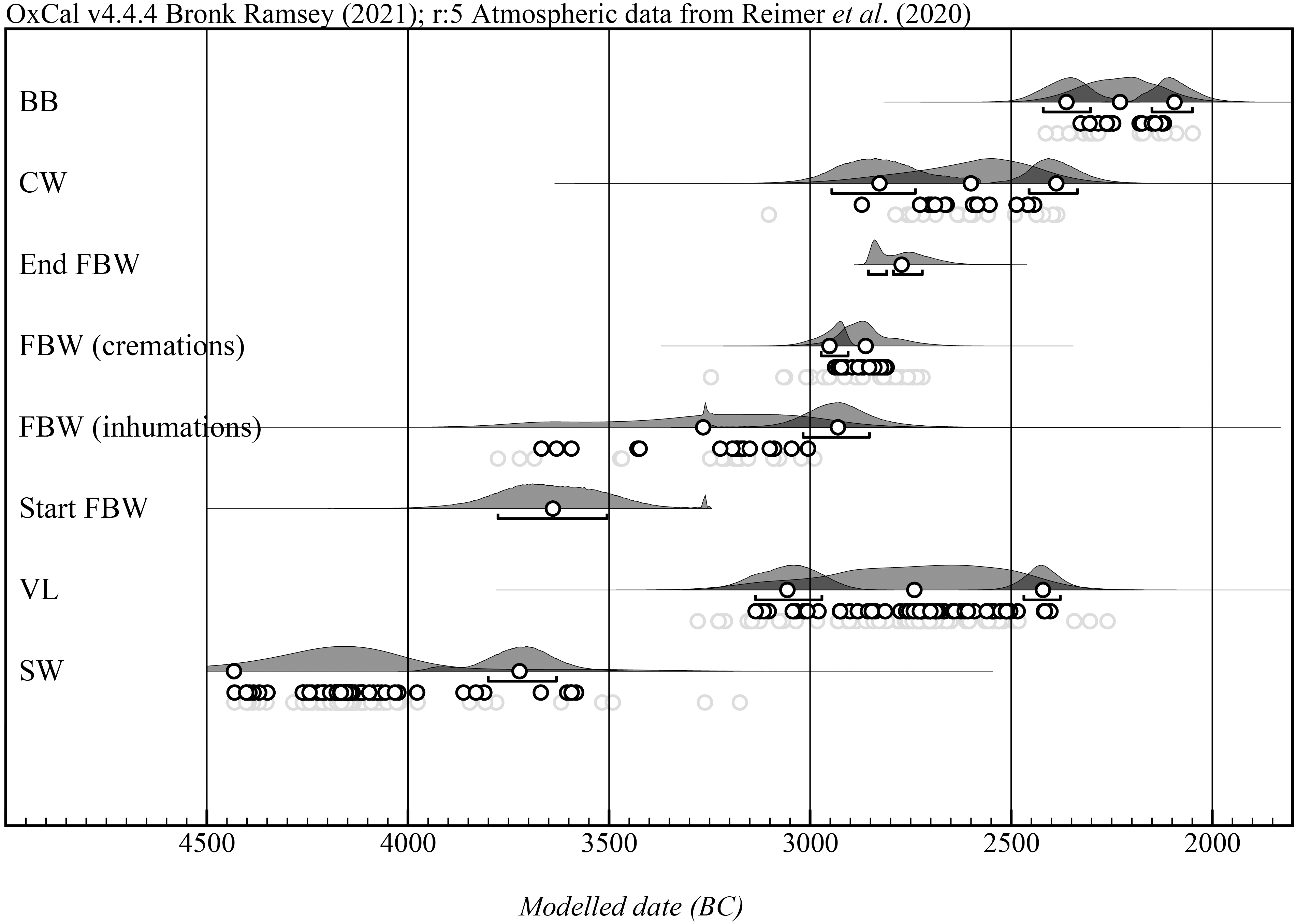
A visual summary of the output of the Bayesian chronological model is shown in Figure 2. The estimated likelihood and duration of chronological overlaps between phenomena are show in Figure 3 (see also Supplementary S1 for the data underpinning this section). Three outcomes of this Bayesian chronological model stand out.
Visual summary of the Bayesian chronological model for SW, VL, FBW (split into inhumation and cremation burials), CW, and BB in the Netherlands. For convenience, the distributions are cut off at 4500 BC and 1800 BC and only the normal boundaries are shown at CI = 68.3% (for all outputs and model set-up, see Supplementary S1). Solid distributions are the KDE plots for each archaeological phenomenon and transparent distributions the inferred start and end dates. Solid circles indicate the means of the posterior distributions and transparent circles the means of the radiocarbon dates prior to modelling.
Estimates for the likelihood and duration of chronological overlap between SW, FBW, VL, CW, and BB from the Bayesian chronological model in Figure 2 (see Supplementary S1). The odds of overlap derive from the Order() query. The duration is calculated as the start of the trapezoidal boundary for the youngest phenomenon minus the end of the trapezoidal boundary for the oldest phenomenon. Negative numbers indicate overlap and positive numbers a gap. The brackets show the estimated durations at 68.3% and 95.4% confidence interval, solid circles the means of a distribution.

Firstly, the model suggests a long co-existence between CW communities and indigenous FBW and VL communities (Figures 2–3). The model returns a chance of two in three that overlap existed between FBW and CW. The chance that VL communities persist longer than CW communities in the Netherlands is one in three (Figure 3). The estimated overlap between FBW and CW communities is 90–435 years (CI = 68.3%), and 304–514 years (CI = 68.3%) for the overlap between CW and VL (Figure 3). These outcomes are not consistent with a rapid replacement of indigenous FBW and VL groups by CW. Instead, a centuries-long co-existence between these groups is more likely (cf. Bourgeois et al. Reference Bourgeois, Kroon, Olerud, Hofmann, Mischka and Scharl2025b).
The Bayesian chronological model also sheds new light on the appearance of FBW in the Netherlands during the 4th millennium BC, albeit with a substantial error margin due to sparse data. The chance of an overlap between FBW and SW is about one in three, and the duration of this overlap is estimated to be 320–775 years (CI = 68.3%; Figures 2–3), which is substantially longer than the current estimate of 80 years (cf. Menne & Brunner Reference Menne and Brunner2021, 1240). This outcome is largely predicated on the estimated start date for FBW (3983–3705 BC at the earliest) which is several centuries older than the currently accepted start date of 3400 BC (cf. Van den Broeke et al. Reference Van den Broeke, Fokkens, Van Gijn, Louwe Kooijmans, Van der Broeke, Fokkens and Van Gijn2005, fig. 1.10). Such an early start date for FBW is consistent with other studies (Mennenga Reference Mennenga2017, 92) and not exceptional in a broader European context (Müller et al. Reference Müller, Brozio, Demnick, Dibbern, Fritsch, Furholt, Hage, Hinz, Mischka, Rinne, Hinz and Müller2012). However, radiocarbon dates for the earliest phases of FBW are sparse (cf. Mennenga Reference Mennenga2017, 91), meaning new data may change this outcome. In short, the currently available absolute dates suggest that the appearance of FBW in the Netherlands was likely not a rapid break, but the start of a long-lasting co-existence of migrant and indigenous communities.
The Bayesian chronological model also suggests a temporal gap between VL and SW (Figure 2). This is despite archaeological consensus that these two phenomena are part of a continuum (cf. Amkreutz Reference Amkreutz2013). However, this gap may be due to the lack of radiocarbon dates for the transitional Hazendonk groups (see above).
Lastly, the model outputs also suggest a short overlap between CW and BB communities in the Netherlands. The chance of such an overlap is slightly over one in three (Figure 3), and its duration is estimated to lie between 209 and 0 years; a gap of up to 27 years is also possible at CI = 68.3% (Figure 3). This outcome corroborates results by Marc Vander Linden (Reference Vander Linden2024, 21–2) and Quentin Bourgeois et al. (Reference Bourgeois, Helmecke, Olerud, Djakovic, Guadalupe Castro González and Kroon2025a).
Overall, the Bayesian chronological model shows that archaeological phenomena such as SW, FBW, VL, CW, and BB are unlikely to form a neat chronological series punctuated by migration events. Instead, the arrival of migrant CW communities, and potentially FBW and BB communities, likely resulted in a long-lasting co-existence of migrant and indigenous communities. This raises a crucial question: what sort of interactions took place between migrant and indigenous communities during these co-existences?
Knowledge transmission
Ceramic technology is well-suited to assess interactions between past groups for two reasons. Firstly, ceramics preserve well and are abundant at prehistoric sites from the point of their introduction onward (cf. Jordan & Zvelebil Reference Jordan, Zvelebil, Jordan and Zvelebil2009). Secondly, ceramics enable archaeologists to gauge knowledge transmission through the chaîne opératoire approach (cf. Roux Reference Roux2019, 4).
The chaîne opératoire approach studies technical traces on ceramic vessels to reconstruct the ordered sequence of techniques (or chaîne opératoire) which potters applied to produce the vessel (Leroi-Gourhan Reference Leroi-Gourhan1964, 164; Reference Leroi-Gourhan1965, 132–3; Roux Reference Roux2019, 1–2). Techniques are defined as specific gestures performed with or without a tool on a material to achieve a specific effect (Mauss Reference Mauss1936; cf. Roux Reference Roux2019, 1–2). Shorter, ordered sequences of techniques which recur frequently are referred to as methods (Roux Reference Roux2019, 41). Crucially, these techniques, methods, and the order in which to apply them are learned cultural information. Potters acquire this knowledge through meaningful social interactions with other potters, for example through apprenticeships or by appraising vessels in public spaces (Gosselain Reference Gosselain2000; Reference Gosselain and Spear2018). These interactions may cross group boundaries (e.g. Gosselain Reference Gosselain, Stark, Bowser and Horne2008, 169; Mayor Reference Mayor2010, 13; cf. Lave Reference Lave2011), depending on the structure of learning networks (Roux et al. Reference Roux, Bril, Cauliez, Goujon, Lara, Manen, De Saulieu and Zangato2017). Therefore, shared technical knowledge would be an indicator for meaningful social interactions and knowledge transmission between potters in migrant and indigenous communities in the 3rd millennium BC.
The difficulty in identifying shared knowledge in archaeological assemblages lies in their time depth and in the fact that potters are generally aware of multiple, alternative techniques for each step in the production process (Gosselain Reference Gosselain and Stark1998, 92; Reference Gosselain, Stark, Bowser and Horne2008, 169; MacEachern Reference MacEachern and Stark1998; Mahias Reference Mahias and Lemonnier1993, 160; Mayor Reference Mayor2010, 13; Wallaert Reference Wallaert and Wendrich2012, 34–7). This is because potters learn new techniques throughout their lives, for example when moving residence (Wallaert Reference Wallaert and Wendrich2012, 34–7) or through encounters with other potters (Gosselain Reference Gosselain, Stark, Bowser and Horne2008). Therefore, the chaîne opératoire of a prehistoric vessel is just one possible outcome of a potentially much broader technical repertoire.
Probabilistic comparison
To overcome these issues, this paper applies a probabilistic comparison for ceramic chaînes opératoires developed by the author (Kroon Reference Kroon2024). This approach combines network analysis and probability theory. Network visualisation (e.g. Miller Reference Miller2009, 108; Roux Reference Roux2019, fig. 2.42; Kuijpers Reference Kuijpers2018) and analysis (e.g. Mills et al. Reference Mills and Shackley2013) have previously been applied to (ceramic) chaînes opératoires, but the probabilistic method shown here a) leverages network analysis for a quantitative representation of potters’ choices; b) formalises comparisons between these choices by incorporating control groups; c) takes the ordered nature of the chaîne opératoire into account; and d) respects potters’ abilities to learn or choose new techniques and methods. For brevity, the text below only summarises the key parts of this method; an in-depth description is available in Kroon (Reference Kroon2024, chapters 3-4) and Supplementary Material S2.
Put briefly, the method builds a network in which nodes are ceramic production techniques and directed edges connect any two techniques which can form a consecutive pair in a ceramic chaîne opératoire (Kroon Reference Kroon2024, 60–3) (Figure 4). Since a chaîne opératoire is a longer sequence of techniques (see above), these sequences are represented as paths through this network (Kroon Reference Kroon2024, 63–5). An empirical dataset with ceramic chaînes opératoires reconstructed from an assemblage can be represented as a weighted subgraph of this network. This subgraph only contains the techniques and combinations of techniques (edges) observed in the dataset. The edge weights are the percentage of chaînes opératoires in the assemblage featuring a specific combination of techniques (e.g. Figure 5). As such, the subgraph captures the techniques, methods, and orders of techniques with which potters were familiar, as well as their preferences (Kroon Reference Kroon2024, 65–6).
Network representation of the ceramic chaîne opératoire. The nodes are techniques, directed edges represent techniques which can form a sequence (cf. Roux Reference Roux2019). Layout with the ForceAtlas 2 algorithm in Gephi (Bastian et al. Reference Bastian, Heymann and Jacomy2009; Jacomy et al. Reference Jacomy, Venturini, Heymann and Bastian2014).

Subgraph for FBW ceramic chaînes opératoires in A) the 3rd millennium BC and B) the 4th millennium BC. Layout with the ForceAtlas2 algorithm in Gephi (Bastian et al. Reference Bastian, Heymann and Jacomy2009; Jacomy et al. Reference Jacomy, Venturini, Heymann and Bastian2014). Edge weights are the percentage of vessels with a combination of techniques. Only edges and techniques which feature in the assemblage are retained.

Two such subgraphs are then compared with the Wasserstein distance. This metric from probability theory calculates a distance between two subgraphs by looking at the number of changes needed to transform the edge weight distribution of one subgraph into that of the other. The more changes required, the larger the Wasserstein distance (see Ramdas et al. Reference Ramdas, Trillos and Cuturi2017; Villani Reference Villani2009). As these edge weight distributions represent the technical knowledge and preferences of potters, the Wasserstein distance indicates the degree of overlap in technical knowledge and procedures between the two datasets (Kroon Reference Kroon2024, 66–7). The advantage of the Wasserstein distance over other metrics for comparing networks (see Tantardini et al. Reference Tantardini, Ieva, Tajoli and Piccardi2019; Wills & Meyer Reference Wills and Meyer2020) is that it explicitly takes into account that a change to one edge weight requires changes in the other edge weights. It therefore preserves the ordered nature of the chaîne opératoire.
The probabilistic comparison uses control groups to infer whether the Wasserstein distance between two empirical datasets indicates a significant amount of shared knowledge (cf. Kroon Reference Kroon2024, 68–9). Control groups come in two categories: 1) in-groups for which one can reasonably assume shared knowledge with one of the empirical datasets; and 2) out-groups for which one can reasonably assume no shared knowledge with the empirical datasets. These control groups can be used as thresholds in the interpretation of the Wasserstein distance. For example, we might say no knowledge was shared if the Wasserstein distance between the empirical groups exceeds that between one of the empirical groups and the out-groups, or vice versa. Therefore, the Wasserstein distance is not an absolute measure of similarity, but enables archaeologists to formally test and build upon hypotheses about shared knowledge.
Control groups can either consist of empirically established chaînes opératoires or simulated based on empirical data. The simulation procedure encodes the likelihood of specific combinations of techniques occurring in the edge weights, and then algorithmically generates paths from these data (see Kroon Reference Kroon2024, 69–73; Supplementary S2). This method can be used to generate paths based on fragmented chaînes opératoires or to buffer sparse data. However, the algorithm will reproduce the observed relative frequencies of techniques, meaning that biases in the base data will persist in the generated paths. If many alternative techniques are possible for each step, random path generation is also likely to produce more varied paths than those one might actually find by applying the chaîne opératoire-approach to the original ceramics, although the paths will remain within the variability of the assemblage (cf, Kroon Reference Kroon2024, 73, 194). To clarify this distinction, simulated control groups are indicated with the prefix ‘sim_’ below.
Supplementary Material S2 also contains two new functionalities relative to Kroon (Reference Kroon2024, appx F). The first is the ability to perform a permutation test with the Wasserstein distance. Rather than generating a single, large control group, this test generates many smaller control groups. Subsequently, the user can assess how exceptional the Wasserstein distance between two empirical datasets is relative to these control groups with the percentile rank (Virtanen et al. Reference Virtanen and Vázquez-Baeza2020). The lower the percentile rank, the more exceptional the observed distance. For example, the permutation test might show that the Wasserstein distance between FBW and VL is smaller than that between FBW and FBN in 98% of the cases (percentile rank: 2), suggesting an exceptionally close match. The percentile score is preferred for this application since it is non-parametric (see the distributions in Figure 10).
The second functionality is to assess the robusticity of a dataset with chaînes opératoires. This function subsamples the dataset and then calculates the Wasserstein distance between the subsample and the entire assemblage. It then calculates the mean squared error (MSE) of these Wasserstein distances relative to a Wasserstein distance of 0.0, which we assume to be the true value given that the subsample belongs in the assemblage. The resulting MSE indicates how dependent the Wasserstein distance is on a small subset of the chaînes opératoires. For example, if we find that removing 5% of the paths in each iteration results in a large MSE value, then a relatively small number of paths exerts a lot of influence on the Wasserstein distance. This means MSE is not a measure of sample representativity proper, but of sample homogeneity. Therefore, MSE is ill-suited to assess the robusticity of Wasserstein distances between sets of chaînes opératoires because it arbitrarily sparsifies the data.
Datasets for the comparison
Seven datasets with ceramic chaînes opératoires are incorporated here to shed light on the impact of the migration event in the 3rd millennium BC (Table 2). The two empirical datasets are discussed below, alongside the selected control groups.
Datasets and control groups in the probabilistic comparison of ceramic technology. The MSE was calculated by removing 5% of the chaînes opératoires in a dataset and calculating the Wasserstein distance between the resulting subsample and the original dataset for 1,000 iterations (see Supplementary S2)

Empirical datasets
The two empirical datasets are those for FBW and CW (Table 2; Figures 5–6). The FBW dataset is split into ceramics associated with inhumation burials (FBW_4MBC) and cremation burials (FBW_3MC) to add a diachronic dimension to the comparison (Figure 2). The chaînes opératoires in these datasets stem from FBW and CW vessels throughout the Dutch uplands to ensure a representative sample of the technical knowledge of potters in these communities (Figure 1) (Kroon Reference Kroon2024, fig. 5.1). Only vessels for which the complete chaîne opératoire could be reconstructed were used to avoid potential bias in the representation of techniques due to vessel fragmentation (cf. Kroon Reference Kroon2024, 75). Note that relatively few chaînes opératoires could be reconstructed for 3rd millennium FBW ceramic production (Table 2) but that these are also more homogeneous (Figure 5; see MSE in Table 2), meaning fewer would be required for an adequate sample. Further work on vessels from this period from the Netherlands (and/or adjacent Germany) would be highly relevant.
Subgraph for ceramic chaînes opératoires from A) VL and B) CW. Layout with the ForceAtlas2 algorithm in Gephi (Bastian et al. Reference Bastian, Heymann and Jacomy2009; Jacomy et al. Reference Jacomy, Venturini, Heymann and Bastian2014). Edge weights are the percentage of vessels with a combination of techniques. Only edges and techniques which feature in the assemblage are retained.

A full description of these ceramic chaînes opératoires and the diagnostic traces is provided elsewhere (Kroon Reference Kroon2024, 87–143, appx C–D). A summary is given below, using Valentine Roux’s (Reference Roux2019) descriptive vocabulary (Figures 5–6).
Both FBW and CW ceramic chaînes opératoires feature modelling and coiling techniques to fashion the vessel base and wall. However, the methods can differ. In FBW vessels, a lenticular clay mass is first modelled and a coil then applied to the top of this mass following the spiral procedure to form the base. Further coils may then be used to supplement the base (Figure 7A). In CW vessels, a disk-shaped mass is first modelled and a coil then affixed to the side of this disk (Figure 7B).
Traces of roughing-out techniques, with schematic drawings. A) base of a FBW vessel. The orientation of voids and particles indicates the potter placed a modelled, lenticular mass at the centre of the base and then affixed a coil with the spiral coiling procedure to the top of this mass. Next, the potter joined a larger coil to the side of the base (cf. Roux Reference Roux2019, 160–3, 168–70). B) a CW vessel base. The orientation of voids and particles indicates that the potter placed a modelled clay disk at the centre and then affixed a coil towards the periphery to create the base (cf. Roux Reference Roux2019, 160–3, 168–70). C) lower body of a FBW vessel. The horizontal breakage pattern indicates that the potter performed coiling with the segment or ring procedure. The coils were joined with pressure on the interior resulting in break profiles with internal bevels (cf. Roux Reference Roux2019, 160–1). D) upper body of the same FBW vessel as C). The procedure is the same, but the external bevels indicate that the coils were joined with external pressure (cf. Roux Reference Roux2019, 160–1).

The fashioning of the vessel walls is similar in FBW and CW chaînes opératoires: potters used the coiling technique in the segment or ring procedure. The coils on the lower body often feature signs of joining with internal pressure, whereas the joining method for coils in the upper body is more variable (see Figure 7C–D).
The vessels are then preformed while the clay is still wet by pressure with hands (Figure 8A–B) and sometimes through scraping (Figure 8C). FBW vessels may feature handles which can either be attached by joining a coil with the vessel wall through a perforation, or by pressing a clay mass against the vessel wall (Figure 8D-E). The latter method also appears in CW vessels, albeit rarely (Figure 8D).
Traces of preforming and finishing operations. A) lower interior body of a CW vessel with elongated, finger-sized hollows in diagonal orientation from preforming wet clay by pressure (cf. Roux Reference Roux2019, 174). B) hollows described in 8A outlined. C) traces of scraping on the upper exterior of a CW vessel. Bands of deep parallel striations with thickened edges and irregular microrelief (cf. Roux Reference Roux2019, 175). D) the handle of this CW vessel was joined directly to the vessel wall with pressure, as indicated by the break which separates the handle from the wall. E) the upper part of the handle of this FBW vessel was joined to the vessel wall by making a perforation and plugging it with the coil forming the base mass for the handle (above; cf. Roux Reference Roux2019, 90–1). The lower part of the handle was joined to the vessel wall through pressure and features no such plug (cf. D). F) surface on the upper body of a FBW vessel, showing irregular microtopography and partially covered, protruding particles (between lines). These traces indicate the potter smoothed the clay while wet without added water and with a hard or soft tool (cf. Roux Reference Roux2019, 196–7). The surrounding compact microtopography with gloss, inserted particles, and parallel bands of striations with scalloped edges results from subsequent burnishing on leather-hard clay (cf. Lepère Reference Lepère2014; Roux Reference Roux2019, 201).

The vessel surfaces are then smoothed with a soft (or rarely a hard) tool without added water (Figure 8F).
The next step is the application of decorative techniques (if any). CW potters primarily performed simple incisions or simple (oblique) impressions and more rarely excisions, appliqués, and tilted impressions (cf. Kroon Reference Kroon2024, 132–7). The most common tools used are spatulae and cords (Figure 9E, G); use of tools with more rounded and hollow points is rare (Kroon Reference Kroon2024, fig. 7.10). FBW vessels show more diverse decorative techniques, in which simple (oblique) impressions are most common (Figure 9C), but occur alongside simple impressions, simple incisions, excisions, appliqués, tilted impressions, and incrustation (cf. Kroon Reference Kroon2024, 103–10). Interestingly, this spectrum is narrower in the 3rd relative to the 4th millennium BC, as 3rd millennium FBW vessels have primarily been decorated through simple oblique impressions (Kroon Reference Kroon2024, tab. 6.5). Similarly, the range of different tools used for decorations in the 4th millennium BC narrows to just conical tools and rarely spatulae in the 3rd millennium BC (Kroon Reference Kroon2024, tab. 6.6).
Traces of decorative techniques, surface treatment, and firing. A) incisions on FBW vessel with thickened edges and irregular microrelief at the base (indicating simple incisions applied to wet clay, cf. Roux Reference Roux2019, 204); B) incisions on FBW vessel with compacted microrelief at the base and lacking thickened edges, (incisions on leather-hard clay; cf. Roux Reference Roux2019, 204); C) simple oblique impressions with a tool with a conical tip on a FBW vessel (cf. Kroon Reference Kroon2024, fig. 6.11; Roux Reference Roux2019, 204); D) FBW vessel with decorative depressions filled by a white mass (incrustation); E) simple impressions with cord on a CW vessel; F) excisions on a FBW vessel: the tool undercut the vessel wall below the excision (cf. Roux Reference Roux2019, 108); G) simple impressions with a spatula on a CW vessel (cf. Kroon Reference Kroon2024, 7.10); H) CW vessel featuring a compact microtopography, inserted particles, and smoothened protrusions from preforming. The potter likely applied shining to this part of the vessel (cf. Roux Reference Roux2019, 202); I) core of a FBW vessel with oxidised margins transitioning sharply into a darker core (cf. Roux Reference Roux2019, 209; Rye Reference Rye1981, fig. 104). The darker colours of the interior surface transition into a lighter margin within 1 mm, likely indicating smudging with a solid material (Drieu et al. Reference Drieu, Lepère and Regert2020); J) core of a FBW vessel with light outer margin transitioning abruptly into a dark core and interior margin (cf. Roux Reference Roux2019, 209; Rye Reference Rye1981, fig. 104).

Line plot of the Wasserstein distances of CW and control groups relative to FBW chaînes operatoires associated with A) 3rd millennium BC cremation burials and B) 4th millennium BC inhumation burials (see Figure 2; Table 2). Triangles: empirical datasets; solid circles: simulated control groups with 1,000 paths. The MSEs from Table 3 are too small to display at this scale. The grey distributionsFootnote 1 are from a permutation test with 1,000 subgroups of 100 paths each for the corresponding control group.

Following the application of decorative techniques, potters often chose to dry their vessels to a leather-hard state before applying surface treatment (Figures 8F, 9H). Fourth millennium FBW potters primarily used burnishing (Figure 8F) and in some instances shining (Figure 9H) and smudging (Figure 9I). During the 3rd millennium BC, FBW vessels only feature burnishing (Kroon Reference Kroon2024, 110–13). The potters who made CW vessels chose between shining (Figure 9H) and burnishing (Figure 8F) in roughly equal proportions, with smudging being rare (Figure 9I) (Kroon Reference Kroon2024, 137–40).
The next steps were drying to dry consistency and firing. The firing process most likely involved firing vessels in an open fire with the vessels covered by, and in some cases possibly filled with, fuel and positioned upside-down or on their sides. The vessels were removed from the open fire while still hot, causing rapid oxidation to the exterior and interior margins (Figure 9I), or just the exterior margin if the vessel was upside-down or filled with fuel (Figure 9J).
Control groups
The remaining five datasets in the probabilistic comparison are simulated based on previous studies of ceramic technology at VL (Table 2; see Kroon Reference Kroon2024, appx F and Supplementary S2 for data preparation). Control groups with empirical chaînes opératoires would be preferable over simulated data, but are not currently available.
FBN was chosen as a control group because FBN communities are argued to have migrated into the Netherlands and formed FBW (Louwe Kooijmans Reference Louwe Kooijmans2018, 493–4). Hence potters from both groups likely shared technical knowledge. Therefore, the Wasserstein distance to sim_FBN is used as a threshold for detecting shared knowledge in the comparisons below.
The second control group, sim_VL, is based on a study of ceramic chaînes opératoires at the VL type site Vlaardingen-Arij Koplaan (Stet Reference Stet2021; cf. Van Beek Reference Van Beek1990). Comparisons against other studies of VL ceramic production with a broader geographic scope but lower technological resolution (i.e. Beckerman Reference Beckerman2015; Kroon et al. Reference Kroon, Huisman, Bourgeois, Braekmans and Fokkens2019) show that ceramic production at Vlaardingen-Arij Koplaan is typical for, if not fully representative of, VL ceramic production. VL communities are thought to exchange little to no knowledge with contemporaneous FBW communities (J.A. Bakker Reference Bakker1982; Drenth Reference Drenth, Müller, Hinz and Wunderlich2019; Louwe Kooijmans Reference Louwe Kooijmans1983, 59) but are known to co-exist with CW (Beckerman Reference Beckerman2015). Therefore, VL ceramic chaînes opératoires have to be accounted for in the comparison.
For completeness, a further control group with paths for SW ceramic production (sim_SW) is included. This control group is based on ceramic production at the SW settlement S3 which is also argued to be representative of SW ceramic production in a broader sense (De Roever Reference De Roever2004). This control group should feature shared knowledge with VL ceramic production (Amkreutz Reference Amkreutz2013) but little to none with FBW ceramic production (Louwe Kooijmans Reference Louwe Kooijmans2018, 493–4).
Unfortunately, no data on BB ceramic technology in the Netherlands could be obtained. The pioneering work by Sander Van der Leeuw (Reference Van der Leeuw, Lanting and van der Waals1976) was never followed up and his key observations are now contested (cf. Wentink Reference Wentink2020, 52).
For the final two control groups, one may reasonably assume that no shared knowledge exists with the European Neolithic. These groups are randomly generated paths (see Supplementary S2) and paths based on ceramic production in modern-day Odisha, India (Behura Reference Behura1978). These control groups act as out-groups in terms of interpreting the Wasserstein distances (see above).
Results
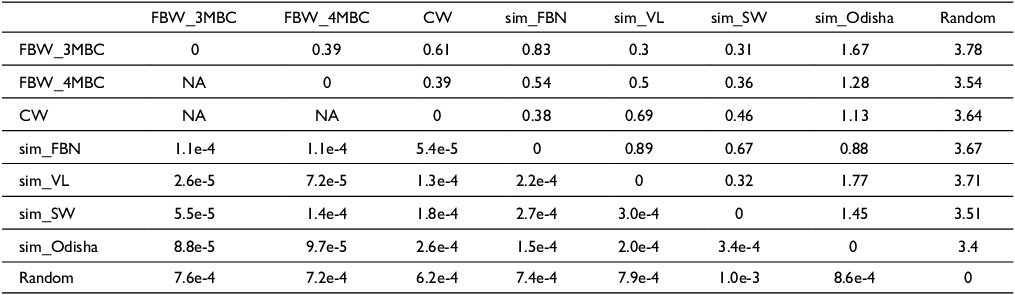
The Wasserstein distances between ceramic production in FBW, VL, CW, and all control groups are shown in Table 3. Parts of this similarity matrix have been converted to a line plot (Figure 10) which shows the Wasserstein distances (to scale) from the (chronologically ordered) FBW subgroups in the 3rd and 4th millennium BC to all other groups (see Table 2), so that inferences about shared knowledge can be made based on the relative positions of the control groups. Two developments can be observed.
Matrix of the Wasserstein distance between all empirical groups and control groups (see Table 2; Figure 10). The upper triangle of the matrix shows the Wasserstein distances, the lower half the mean squared error (MSE)Footnote 2 . For comparisons with and between simulated groups, random path generation was repeated 100 times to calculate the MSE; the distance shown is the mean of these comparisons
Development 1: convergence between FBW and VL
FBW is argued to appear in the Netherlands as FBN communities migrated from southern Scandinavia and supplanted SW communities in the uplands within 80 years (Louwe Kooijmans Reference Louwe Kooijmans2018, 293–4; Menne & Brunner Reference Menne and Brunner2021, 1240). In the wetlands, VL communities are thought of as a continuation of these same SW communities (Amkreutz Reference Amkreutz2013; Raemaekers Reference Raemaekers, Deeben, Drenth, Van Oorsouw and Verhart2005). As such, one would expect to find a relatively short Wasserstein distance between FBW and FBN on the one hand, and a larger Wasserstein distance from FBW to VL and SW on the other. However, the probabilistic comparison yields the opposite outcome.
Shared knowledge between SW and VL is evidenced, as VL ceramic production has a closer Wasserstein distance to that in SW than to contemporary 4th millennium BC ceramic production in FBW and FBN (percentile rank = 0 in both cases, see Table 3; Figure 10B). This indicates that potters in these groups likely learned and used a highly similar ceramic production process, corroborating arguments for continuity (cf. Amkreutz Reference Amkreutz2013; Olalde et al. Reference Olalde and Reich2026).
The comparison also points to shared knowledge between makers of FBW and FBN vessels. The Wasserstein distance between FBW chaînes opératoires of the 3rd and 4th millennium BC is much lower than that to ceramic production in modern-day India, let alone randomly generated paths (both in the 0th percentile; see Table 3). However, the Wasserstein distance between FBW and FBN ceramic production increases in the 3rd millennium BC (Figure 9; Table 3). This suggests that these potters came to practise and prefer different chaînes opératoires over time, indicating technological divergence.
Crucially, the Wasserstein distances from FBW to SW and VL are consistently shorter than that to FBN (Figure 9; Table 3). In particular, makers of 4th-millennium BC FBW vessels appear to have practised production processes which resemble those in SW, and to a lesser extent VL (the percentile ranks relative to FBN ceramic production are 0 and 6.9, respectively). FBW and VL potters then converge on a similar production process during their co-existence in the 4th and early 3rd millennium BC, leading to a decrease in Wasserstein distances (Figure 9; Table 3). This convergence may explain the divergence between FBW and FBN ceramic production during that period, given the relatively large Wasserstein distance between ceramic production in VL, SW, and FBN (Table 3).
This convergence is also evident in the chaînes opératoires from FBW and VL (see above; Figures 5, 6B). The production sequences in both groups are largely similar in terms of techniques and their ordering. However, FBW vessels of the 4th millennium BC show broader variation, particularly in surface treatment and decoration. This variation diminishes in FBW vessels of the 3rd millennium BC which tend to be highly burnished and sparsely decorated. These same choices characterise VL ceramic production (Kroon Reference Kroon2024, appx F; Stet Reference Stet2021). As such, potters in both groups practise distinct ceramic production processes which nevertheless converge over time.
To summarise, the probabilistic analysis indicates that potters in VL and FBW communities shared knowledge with SW and FBN potters, respectively. Over time, potters in FBW and VL communities converged on a similar ceramic chaîne opératoire which resembles that found in SW and VL ceramics. This coincides with a divergence between FBW and FBN ceramic production (Figure 9). As these Wasserstein distances are time-averaged, the relatively short Wasserstein distance between FBW and SW may show a continuous convergence from the arrival of FBW communities onward. However, the coarse temporal resolution of the archaeological record means we can only observe the aggregate result of this process.
Development 2: the emergence of CW
The convergence in FBW and VL ceramic production brings us to the migration event in the 3rd millennium BC. The emergence of CW communities is argued to result from a population influx from the Eurasian steppe (Heyd Reference Heyd, Heyd, Kulcsár and Preda-Bălănică2021; Olalde et al. Reference Olalde and Reich2018; Reference Vondrovský, Hrnčíř, Hlásek, Chvojka, Květina, Šída, John, Pokorný and Ptáková2025). As such, one expects to find little to no shared knowledge about ceramic production between CW potters and FBW or VL potters. Again, the outcomes of the probabilistic analysis contradict this expectation.
The makers of CW, 3rd-millennium BC FBW and VL vessels co-existed (Figures 2–3). The Wasserstein distance between 3rd-millennium BC FBW and CW is shorter than that to FBN ceramic production (percentile rank: 0), let alone the Wasserstein distance to randomly generated chaînes opératoires or modern-day India (Figure 9A; Table 3). In addition, the Wasserstein distances between CW and VL (and SW) ceramic production are larger than those to FBN (Table 2; percentile ranks are 100 and 99.8, respectively). Therefore, CW potters appear to have learned and used ceramic production techniques also used by FBW potters.
However, there is a paradox. The Wasserstein distance between 4th-millennium BC FBW and CW ceramic production is smaller than that between CW and 3rd millennium BC FBW (Figure 9; Table 2), even though CW communities in the Netherlands likely post-date these ceramics (Figure 2; Supplementary S1).
This paradox is also visible in the chaînes opératoires of CW vessels (Figures 5, 6A). Around half the CW chaînes opératoires follow the same production sequence observed in VL and especially 3rd millennium BC FBW ceramics, i.e. with a prominent role for simple impressions and burnishing. However, the other half of the CW chaînes opératoires features broader variation in decorative and surface treatment techniques (Figure 6A; cf. Kroon Reference Kroon2024, 121–43), which closely resembles 4th-millennium FBW ceramic production (Figure 5B). Therefore, CW ceramic production incorporates procedures and techniques similar to those in contemporaneous FBW and VL ceramic production, but is also distinct from them and bears closer resemblance to 4th-millennium FBW ceramic production.
Discussion
The probabilistic comparison points to a convergence between SW, VL, FBW, and CW ceramic chaînes opératoires. Before interpreting these outcomes, it is worthwhile to consider whether this convergence may be caused by factors other than knowledge transmission between the potters, such as a chance process, a similar socio-economic setting for pottery production, or use of similar raw materials.
A chance process is difficult to exclude, but the likelihood of such a scenario is remote. As an example, one can calculate the likelihood of a FBW potter producing any FBW chaîne opératoire from the 3rd millennium BC, given that the relative frequencies of the combinations of techniques in the chaîne opératoire are known for the 4th millennium BC (see Supplementary S2 for implementation). Performing this calculation for all 3rd-millennium BC FBW chaînes opératoires shows that these odds are only 0.019 on average. Since many alternative choices are open to the potter at any point in the ceramic chaîne opératoire (Figure 5B), the odds of any one chaîne opératoire occurring at random are low. The chances that this would happen consistently across multiple archaeological phenomena are even lower. The observed convergence of ceramic chaînes opératoires is therefore unlikely to be due to chance.
Another alternative explanation could be that the socio-economic embedding of pottery production in these groups is similar (e.g. small-scale household production). This might lead to similar efficiency values for specific techniques or methods, causing a convergence. This explanation runs into two problems. Firstly, little is known about the embedding of ceramic production at this time, and no rigorous studies of craft specialisation (e.g. Budden Reference Budden and Berg2008, 4) have been conducted. However, substantial differences in settlement structure, mobility, and subsistence economies exist between (for example) mostly sedentary, agricultural FBW communities and more mobile SW and VL communities with an extended broad-spectrum economy (Amkreutz Reference Amkreutz2013; R. Bakker Reference Bakker2003; Raemaekers Reference Raemaekers, Deeben, Drenth, Van Oorsouw and Verhart2005). Consequently, the context of pottery production is dissimilar for potters in these communities. Secondly, the (perceived) efficiency of ceramic production techniques depends on a range of factors, such as the time required to master techniques, the desired qualities of the vessels, and the degree of specialisation among potters (cf. Roux Reference Roux, O’Brien and Shennan2010). As such, the efficiency of ceramic production techniques is unlikely to have remained uniform across multiple archaeological phenomena for two millennia.
The last alternative explanation is the use of similar raw materials. Petrographic studies of CW, FBW, SW, and VL vessels have shown that potters used various clays, tempers, and paste preparation processes. Paste recipes were used for multiple vessel shapes and even crossed cultural boundaries (De Roever Reference De Roever2004; Kroon Reference Kroon2024; Kroon et al. Reference Kroon, Huisman, Bourgeois, Braekmans and Fokkens2019; Struckmeyer Reference Struckmeyer and Mennenga2017; Reference Struckmeyer and Menne2018; Reference Struckmeyer, Müller, Hinz and Wunderlich2019; Struckmeyer & Van Os Reference Struckmeyer, Van Os, Van der Velde, Bouma and Raemaekers2022). As such, the convergence in ceramic chaînes opératoires cannot be attributed to use of the same raw materials.
Instead, it is argued below that the convergence between SW, VL, FBW, and CW chaînes opératoires results from migrants learning from indigenous communities, not only in the Netherlands but further afield in Europe.
The impact of prehistoric migration
The probabilistic comparison points to a paradox. CW potters were contemporaries of FBW and VL potters in the 3rd millennium BC (Figure 2). Moreover, they learned and used a similar ceramic production process (Figures 5–6). However, CW potters also appear to have learned and used production procedures which predate their arrival in the Netherlands. Where did CW potters learn this technical knowledge?
The first step in explaining this paradox is to show that the co-existence of CW and indigenous communities in the Netherlands is not exceptional, but part of a broader pattern. Václav Vondrovský et al. (Reference Vondrovský, Hrnčíř, Hlásek, Chvojka, Květina, Šída, John, Pokorný and Ptáková2025) have recently demonstrated such co-existences for parts of central Europe. Similar proposals exist for FBN on the Danish isles (Iversen Reference Iversen2014) and Schönfeld communities in central Germany (Wetzel Reference Wetzel1979), although radiocarbon dates are sparse for both phenomena. To determine whether CW is likely to have co-existed with indigenous communities elsewhere in Europe, 459 radiocarbon dates have been collected from recently published radiocarbon datasets for indigenous Pitted Ware (PW) communities in Sweden and parts of Finland (Vanhänen et al. Reference Vanhänen, Gustafsson, Ranheden, Björck, Kemell and Heyd2019; Lindström Reference Lindström2024), Globular Amphora (GA) communities in central Europe (Müller Reference Müller2023), and CW burials across Europe (Bourgeois et al. Reference Bourgeois, Helmecke, Olerud, Djakovic, Guadalupe Castro González and Kroon2025a). These radiocarbon dates were collected following the same criteria as those described above (Table 4) and incorporated into a Bayesian chronological model with an identical set-up as that in Figure 2 (see Supplementary S1). This model juxtaposes the radiocarbon dates for indigenous groups with the radiocarbon dates for CW burials in the same area and estimates the likelihood and duration of overlaps.

The model shows that CW communities likely co-existed with indigenous PW and GA (Figures 11–12; Supplementary S1). The model is far from complete in terms of the indigenous communities existing in the early 3rd millennium BC (cf. Von Schnurbein & Hänsel Reference Von Schnurbein and Hänsel2009). In addition, the radiocarbon dates from PW contexts stem primarily from settlement contexts due to reservoir effects affecting the age of human remains (cf. Lindström Reference Lindström2024, appx 2), whereas those from GA and CW are primarily from funerary contexts (Supplementary S1). Nevertheless, the outcomes of this model, together with the results for the Netherlands (Figures 2–3) and Vondrovský et al. (Reference Vondrovský, Hrnčíř, Hlásek, Chvojka, Květina, Šída, John, Pokorný and Ptáková2025), are sufficiently robust to argue that the characteristic CW burial rites likely co-occurred with the practices of indigenous communities across a substantial part of the CW distribution (cf. Bourgeois et al. Reference Bourgeois, Helmecke, Olerud, Djakovic, Guadalupe Castro González and Kroon2025a). Therefore, the co-existence of migrant and indigenous communities in the Netherlands is not an exception, but a recurring feature of this migration event.
Visual summary of the Bayesian chronological model for CW, PW, and GA. GA is split into three subgroups based on the classification in Müller (Reference Müller2023): east (GAE), central (GAC), and west (GAW). For convenience, the distributions are cut off at 3500 BC and 1800 BC and only the normal boundaries are shown at CI = 68.3% (for all outputs and model setup, see Supplementary S1). Solid distributions are the KDE plots for each archaeological phenomenon and transparent distributions the inferred start and end dates. Solid circles indicate the means of the posterior distributions and transparent circles the means of the radiocarbon dates prior to modelling.

Estimates for the likelihood and duration of chronological overlap between CW, PW, and GA subgroups based on the Bayesian chronological model in Figure 11 (see Supplementary S1). The odds of overlap derive from the Order() query. The duration is calculated as the start of the trapezoidal boundary for the youngest phenomenon minus the end of the trapezoidal boundary for the oldest phenomenon. Negative numbers indicate overlap and positive numbers a gap. The brackets show the estimated durations at 68.3% and 95.4% confidence interval; solid circles the means of a distribution.

This co-existence also explains why CW potters in the Netherlands were familiar with ceramic production processes used by FBW potters in the 4th millennium BC. FBW is the youngest, westernmost branch of the Funnel Beaker groups (Midgley Reference Midgley2008; Müller et al. Reference Müller, Brozio, Demnick, Dibbern, Fritsch, Furholt, Hage, Hinz, Mischka, Rinne, Hinz and Müller2012). Funnel Beaker groups were relatively homogeneous in terms of ceramics and burial rites during the early 4th millennium BC but then diversified during the late 4th millennium BC (Furholt Reference Furholt, Noble, Mischka, Furholt, Hinz and Olausson2014b). In the Netherlands, this process may relate to the interactions between FBW, SW, and VL communities, attested by the exchange of artefacts (Amkreutz Reference Amkreutz2013, 342; Beckerman & Raemaekers Reference Beckerman and Raemaekers2009, 79; Drenth Reference Drenth, Müller, Hinz and Wunderlich2019) and the convergence in ceramic technology. This convergence set FBW apart from other Funnel Beaker groups, as can be seen from the increasing Wasserstein distance to FBN (Figure 10; Table 3). Therefore, FBW ceramic production may bear more resemblance to that in other Funnel Beaker groups during the 4th millennium BC than during the 3rd millennium BC.
The same diversification process led to the emergence of various new archaeological phenomena in central Europe. Of particular interest in this context are GA communities, which would closely resemble older Funnel Beaker groups in terms of ceramic production (Szmyt Reference Szmyt and Włodarczak2017, 220–1; 262; Wíslanski Reference Wiślański and Wiślański1970, 221) and admixed with migrant populations during the 3rd millennium BC (Ringbauer et al. Reference Ringbauer, Huang, Akbari, Mallick, Olalde, Patterson and Reich2024; Tassi et al. Reference Tassi and Barbujani2017). Little is known about the ceramic chaînes opératoires of the eastern and south-eastern Funnel Beaker groups which precede GA, but various features closely resemble those found in Dutch CW vessels, such as a reliance on simple incisions and simple impressions with cord (Midgley Reference Midgley1992, 54–5, 58; Nowak Reference Nowak and Włodarczak2017, 146; Rauba-Bukowska Reference Mittnik and Krause2019; Rauba-Bukowska et al. Reference Rauba-Bukowska, Szmyt and Żurkiewicz2020). As such, the following hypothesis can be formulated to explain the resemblance between CW and FBW ceramic production during the 4th millennium BC.
CW communities co-existed with (among others) GA in central Europe (Figures 11–12). During this co-existence, CW potters may have learned ceramic production techniques and methods from GA potters. These production techniques and methods closely resemble those from older Funnel Beaker East and South-East communities. As a result, CW ceramic production bears resemblance to FBW ceramic production even prior to appearing in the Netherlands. However, this resemblance would be most pronounced with 4th- rather than 3rd-millennium FBW ceramic production due to the divergent paths of Funnel Beaker communities in the Netherlands and central Europe in the late 4th millennium BC.
Unfortunately, no ceramic chaînes opératoires from Funnel Beaker East, South-East, or GA communities are available at present. However, studies of the characteristic CW burial rites support this hypothesis. CW burial rites do not resemble those observed in the source area of these migrations (i.e. Yamna), but instead appear to combine those burial rites with rites and grave goods found among the indigenous communities, including GA and Funnel Beaker, which migrants encountered in central Europe during the early 3rd millennium BC (Frînculeasa et al. Reference Frînculeasa, Preda and Heyd2015; Furholt Reference Furholt2019, 123; Reference Furholt2021; Heyd Reference Heyd, Heyd, Kulcsár and Preda-Bălănică2021; Preda-Bălănică et al. Reference Preda-Bălănică, Frînculeasa and Heyd2020). Similar borrowing processes also took place outside of central Europe. For example, the ‘battle axes’ (cf. Wentink Reference Wentink2020, 120) featuring prominently in CW burials were probably adopted from indigenous Funnel Beaker societies (Schultrich Reference Schultrich, Preda-Bălănică and Ahola2023).
In the Netherlands too, CW and BB communities adopted or co-opted indigenous practices, for example cremation burials and the deposition of axes in wetland contexts (Bourgeois et al. Reference Bourgeois, Kroon, Olerud, Hofmann, Mischka and Scharl2025b; cf. Visser Reference Visser2021, 58; Wentink et al. Reference Wentink, Van Gijn, Fontijn, Davis and Edmonds2011). CW funerary structures also appear in close proximity to FBW cemeteries (e.g. Van der Velde Reference Van der Velde, Van der Velde, Bouma and Raemaekers2022, 198) or even as part of FBW alignments (Arnoldussen & Drenth Reference Arnoldussen and Drenth2015; cf. Bourgeois et al. Reference Bourgeois, Kroon, Olerud, Hofmann, Mischka and Scharl2025b, 299). Lastly, the deposition of CW vessels inside FBW megaliths appears to deliberately break with CW funerary rites and to adhere to FBW funerary rites (cf. J.A. Bakker Reference Bakker1992, 59; Kroon Reference Kroon2024, 47–8). Therefore, migrant communities not only co-existed with various indigenous communities in Europe but also learned funerary practices from them, integrating these into their own notions of appropriate burial rites.
These findings run counter to mainstream scenarios for the emergence of CW, in which migrants introduce novel ideologies, or bring about large-scale societal changes (cf. Furholt Reference Furholt2021; Heyd Reference Heyd, Heyd, Kulcsár and Preda-Bălănică2021; Kristiansen et al. Reference Kristiansen and Willerslev2017). By contrast, this study shows that the emergence of CW is part of the cultural impact of indigenous communities on migrants. These migrants encountered various indigenous communities throughout Europe, learned from them, and incorporated these practices into burial rites and material culture which archaeologists recognise as CW (cf. Furholt Reference Furholt2021). This explains why the oldest CW burials do not appear near the Eurasian steppe, the source area for these migrant communities according to aDNA analysis, but in central Europe, where interactions with indigenous Funnel Beaker and Globular Amphora communities took place (cf. Bourgeois et al. Reference Bourgeois, Helmecke, Olerud, Djakovic, Guadalupe Castro González and Kroon2025a).
How should we imagine knowledge transmission between migrating and indigenous communities? Bearing in mind the absence of data about the sex, age, and specialisation of prehistoric potters (contra Kristiansen et al. Reference Kristiansen and Willerslev2017, 340–2; but see Budden Reference Budden and Berg2008; Fowler et al. Reference Fowler, Walker, Greenfield, Ross and Maeir2019; Reference Fowler, Ross, Walker, Barritt-Cleary, Greenfield and Maeir2020 for potential approaches), any answer to this question will remain speculative. The different procedures for fashioning vessel bases in FBW and CW chaînes opératoires may indicate two separate communities of learners co-existed (Pétrequin Reference Pétrequin and Lemonnier1993, 46–51; 69; Thebe & Sadr Reference Thebe and Sadr2017, 85–6). In contrast, the convergences in the fashioning of vessel walls (Gosselain Reference Gosselain2000, 192–3; Roux Reference Roux2019, 311) and shared decorative tools (e.g. spatulae; cf. Mayor Reference Mayor2010, 15) also indicate that potters from different communities met and learned from each other. Burial rites and depositional practices are also likely learned through attendance at these events (cf. Bourgeois & Kroon Reference Bourgeois and Kroon2017). Ironically then, the co-existence and knowledge transmission between migrant and indigenous communities equally point to the maintenance of differences in life and death.
These outcomes also shed new light on the outcomes of aDNA analysis. Modern migration studies show that distinctions between indigenous and migrant communities in deeply significant practices, such as funerary rites, may take several generations to break down (De Haas Reference De Haas2023, 162–3). As such, the individuals buried in ‘CW fashion’ are more likely to exhibit large amounts of steppe ancestry, whereas the resurgence of indigenous ancestry in later burials indicates a longer trajectory of integration between communities (cf. Bloxam & Parker Pearson Reference Bloxam and Parker Pearson2022; Booth et al. Reference Booth, Brück, Brace and Barnes2021; see Haak et al. Reference Haak and Reich2015; Mittnik et al. Reference Mittnik and Krause2018; Olalde et al. Reference Olalde and Reich2026 for genetic evidence).
Final remarks
Prehistoric migration has long been considered in culture-historical terms, as a rapid supplanting of indigenous populations by migrant communities (cf. Hakenbeck Reference Hakenbeck2008). This view is treated as a null hypothesis for prehistoric migration which needs to be proven wrong through detailed analysis of archaeological evidence from a given region (see Furholt Reference Furholt2021 on Kristiansen et al. Reference Kristiansen and Willerslev2017).
This modus operandi is deeply problematic in light of broader understandings of migration. aDNA analysis and isotope studies demonstrate a different, small-scale migration dynamic, both in the 3rd millennium BC (e.g. Booth et al. Reference Booth, Brück, Brace and Barnes2021; Mittnik et al. Reference Mittnik and Krause2019; Papac et al. Reference Papac and Haak2021) and potentially more broadly (cf. Furholt Reference Furholt2021; Hofmann et al. Reference Hofmann, Frieman, Furholt, Burmeister and Johannsen2024). Studies of modern and historical migrations demonstrate that such small-scale dynamics do not lead to rapid changes in cultural practices and populations, but rather to long co-existences of migrants and their hosts during which migrants tend to learn and integrate practices from indigenous communities (e.g. De Haas Reference De Haas2023; Halsall Reference Halsall2013). To detect such co-existences and bricolage in the archaeological record, this study proposes the use of two complementary, quantitative tools: Bayesian chronological modelling (Bronk Ramsey Reference Bronk Ramsey2009a) and a probabilistic comparison of ceramic technology (Kroon Reference Kroon2024). These tools are applied to the emergence of CW communities in the Netherlands. The outcomes demonstrate that CW communities are likely to have lived side-by-side with indigenous FBW and VL communities (Figures 2–3). In addition, the comparison of ceramic technology suggests that the potters who fashioned CW ceramics integrated technical knowledge from indigenous FBW and VL potters into the production of characteristic CW vessels (Figure 10; Table 3). Moreover, the outcomes point to similar co-existences and interactions between migrating and indigenous communities during the 3rd millennium BC (Figures 11–12). These interactions shaped the practices and material culture archaeologists associate with migrating communities.
In a broader context, these outcomes suggest that the impact of migration in the 3rd millennium BC resembles that of migration in modern (Castles et al. Reference Castles, De Haas and Miller2014; De Haas Reference De Haas2023) and historical (Cameron Reference Cameron2013; Halsall Reference Halsall2013; Oosterhuizen Reference Oosterhuizen2019) contexts. Perhaps more intriguingly, such a scenario likely also occurred during the 4th millennium BC, when FBW communities migrated into the Netherlands from southern Scandinavia (cf. Louwe Kooijmans Reference Louwe Kooijmans2018, 493–4) and likely existed side-by-side with indigenous SW and VL communities (Figures 2–3). Moreover, FBW potters over time learned and used ceramic production methods seen in SW and VL (Figure 10; Table 3). Therefore, such a scenario may be a common feature of prehistoric migration.
Thus, the null hypothesis for prehistoric migration should change in light of evidence from prehistoric archaeology, history, modern migration studies, and aDNA analysis. The proposed new null model envisions prehistoric migration events as the start of co-existences and knowledge exchange between migrants and host communities, until explicitly proven otherwise by bottom-up studies of cultural practices in a given region. This study has outlined a data-driven approach through which archaeologists can engage with this null hypothesis. Such a bottom-up approach will enable archaeologists to talk back to archaeogeneticists on an equal footing about relations between populations, while simultaneously providing a unique contribution to broader debates about the long-term impact of migration.
Supplementary material
To view supplementary material for this article, please visit https://doi.org/10.1017/ppr.2026.10083
S1
Bayesian chronological models.
S2
The code and raw data for the probabilistic comparison of ceramic chaînes opératoires. This material is also available in Zenodo: https://doi.org/10.5281/zenodo.19480851. Supporting documentation of the technical traces on all studied vessels is available online at: https://doi.org/10.17026/AR/FAXIOW.
Acknowledgements
The peer reviewers and editorial board of PPS are thanked for their constructive input on the original manuscript.
Funding Statement
This study is based on a PhD dissertation (Kroon Reference Kroon2024) funded by the Dutch Research Council (NWO) under project PGW.18.003/6330. The writing of this study was further supported by NWO grant VI.Vidi.191.149 (PI Q.P.J. Bourgeois); a post-doctoral study grant from the Fondation Fyssen; and a grant from the French National Research Agency (ANR-24-CE27-1795-01; PI S. Denis). Open access funding provided by Leiden University.

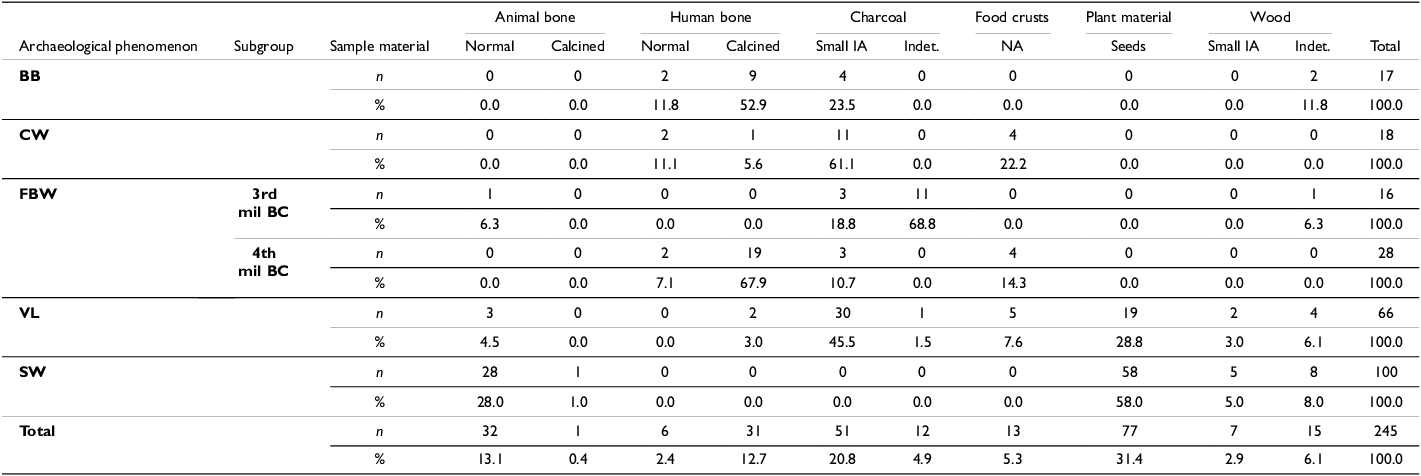

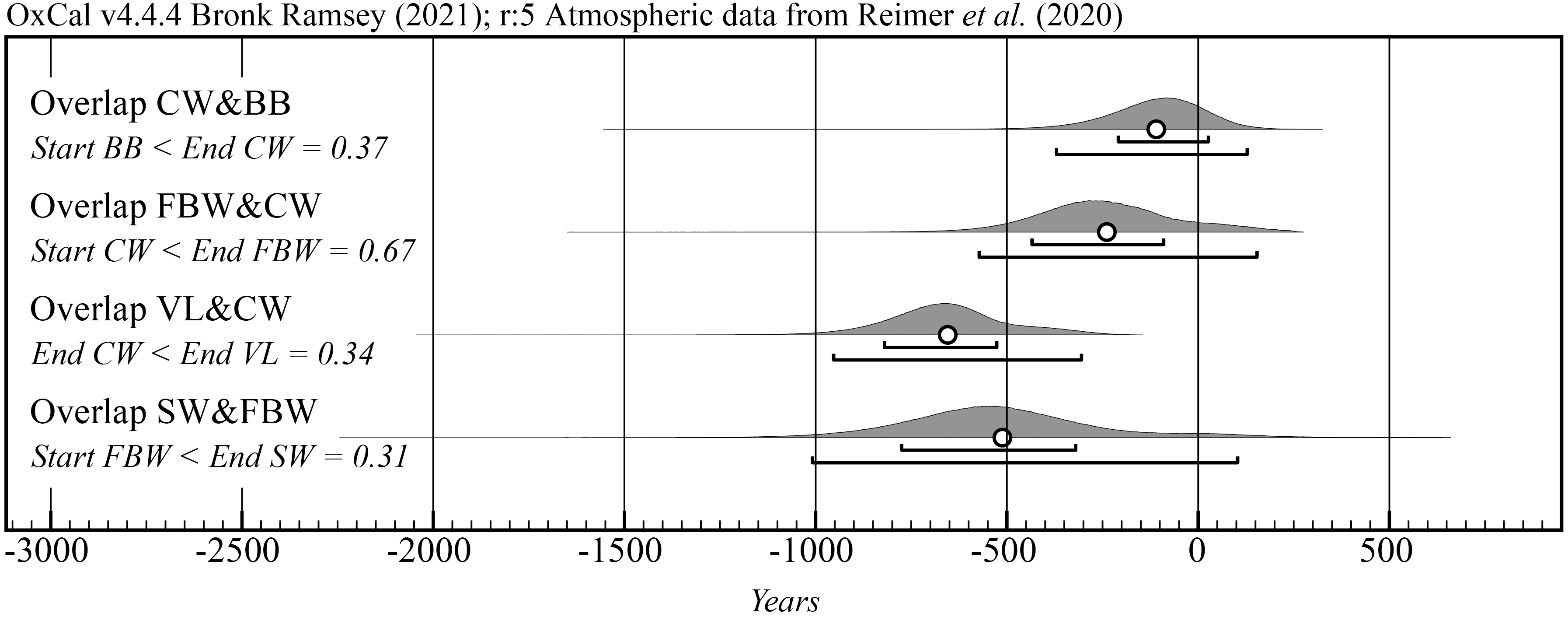
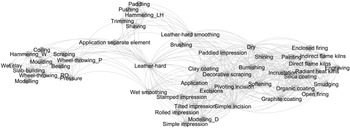

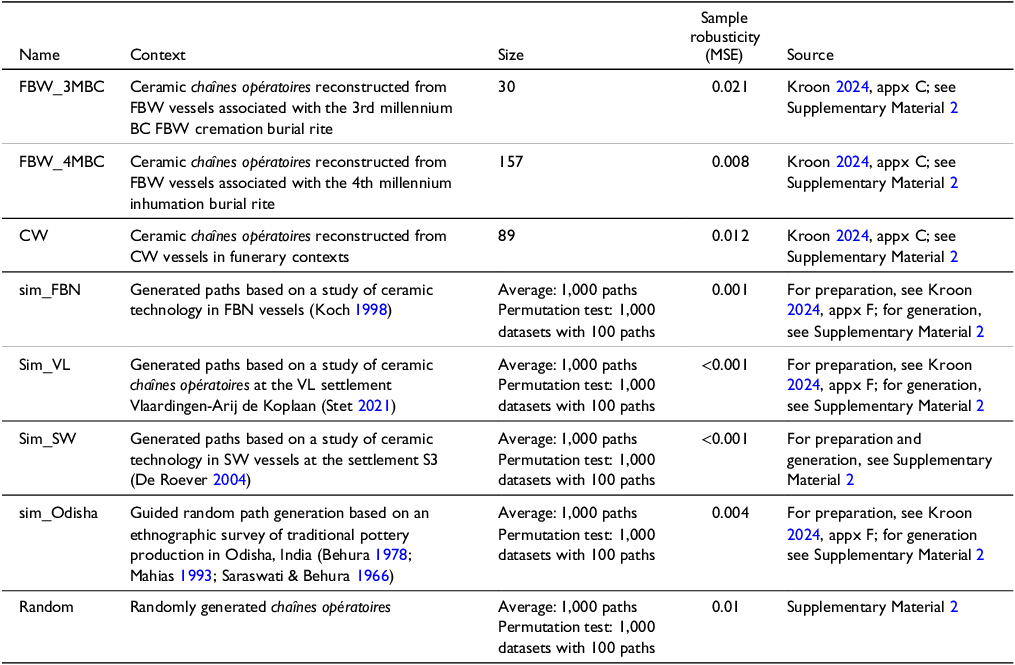
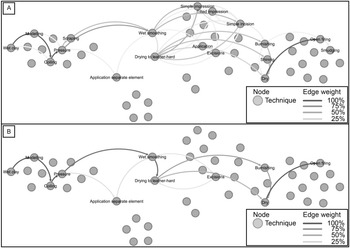


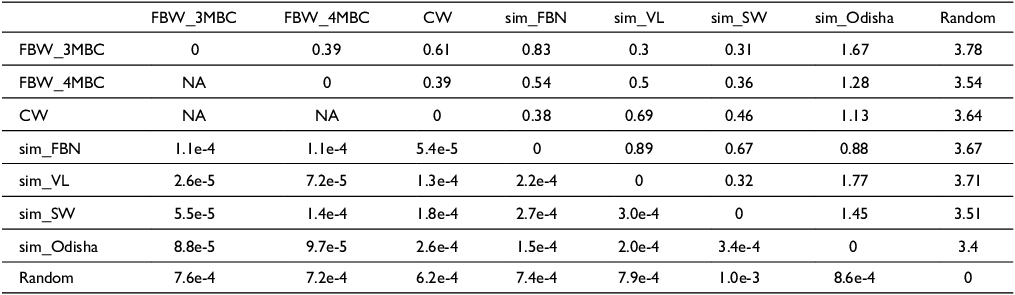
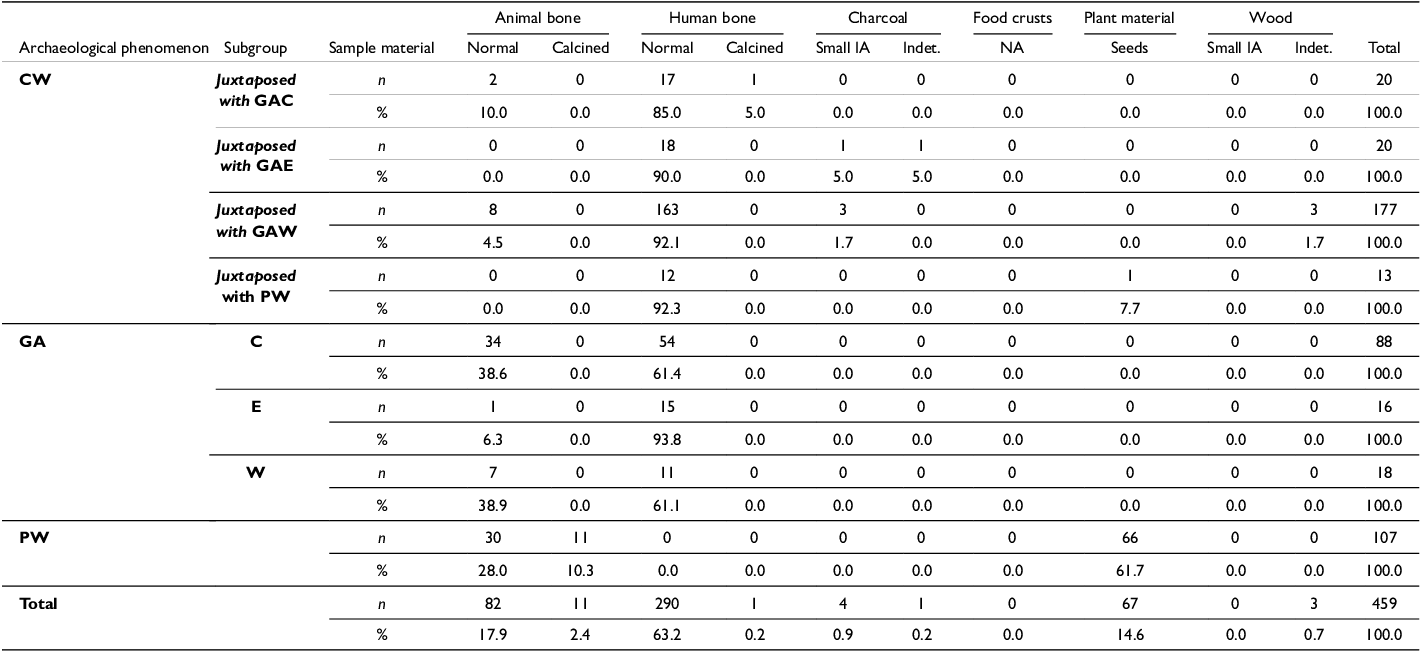


 Open access

