Introduction
Excavations at the Bronze Age site of Kalat-e Yavar, located in the Bojnord Plain (North Khorasan, Iran), have revealed new evidence for cross-regional interaction between the Iranian Plateau and Central Asia during the third and early second millennia BCE. Stratified deposits at the site document two successive cultural phases: an earlier occupation characterised by Grey Ware with applied decorations comparable to material from Ak-depe (late Namazga III and Namazga IV (late fourth to early third millennia BCE)), and a later mortuary phase associated with Bactria-Margiana Archaeological Complex (BMAC) traditions. This contribution presents the results of rescue excavations, conducted in 2023–2024, which aimed to verify the results of previous geophysical survey and to assess the extent, stratigraphy and internal chronology of the site, as well as the preservation of archaeological material.
Site setting
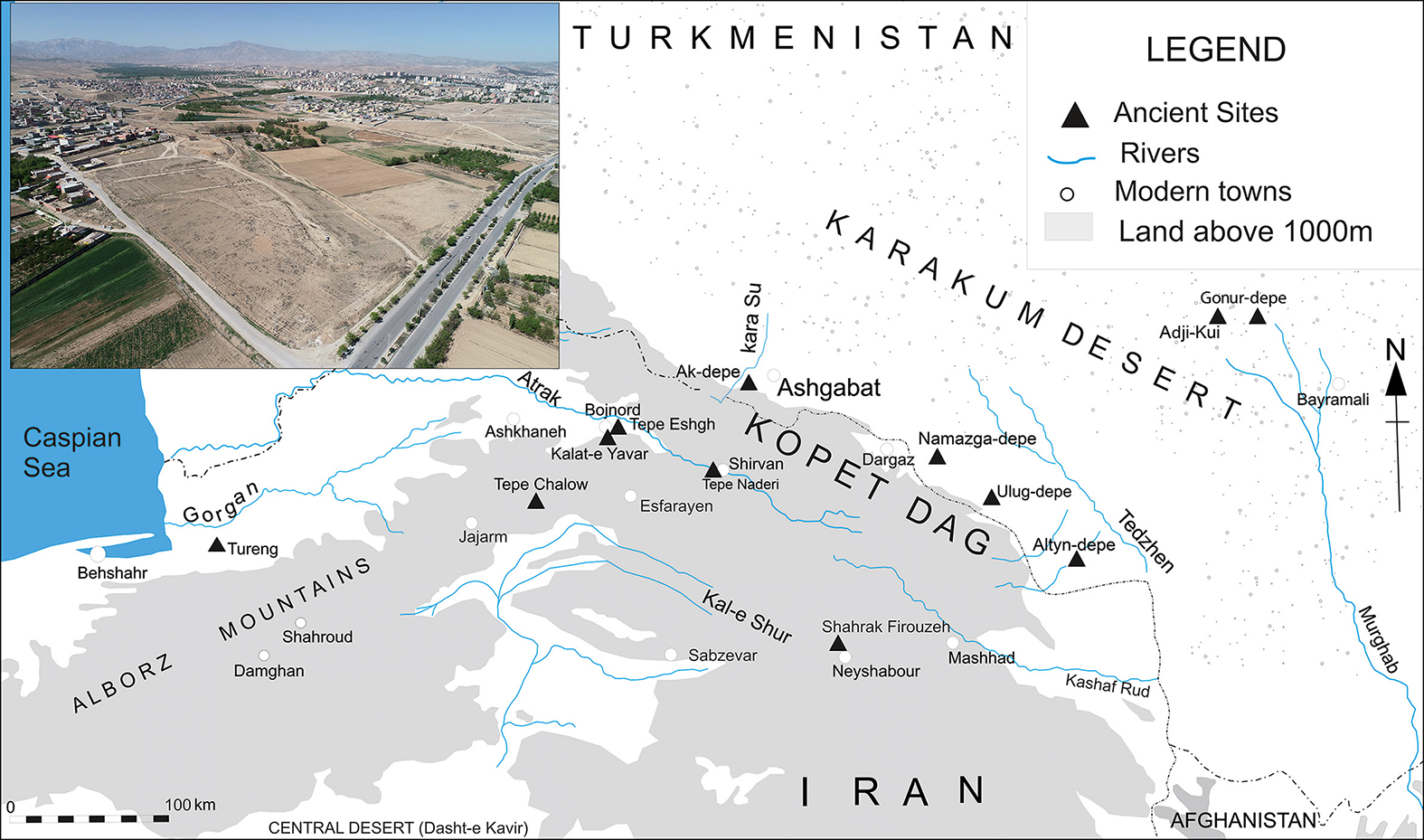
Kalat-e Yavar lies just north of the modern village of the same name, to the south-east of Bojnord (Figure 1). The mound occupies a natural rise (approximately 400 × 250m; 15m high; 1070m above sea level) between the Bazkhane and Charmaqan streams (37°27′20.9482″N, 057°21′07.7015″E). Despite damage from agricultural terracing and modern construction, substantial architectural and funerary remains survive, especially in the southern sector.
Map of north-eastern Iran showing the locations of BMAC sites, with an inset aerial photograph of Kalat-e Yavar looking west (figure by A. Vahdati).

Figure 1 Long description
The image contains a map of north-eastern Iran, highlighting the locations of BMAC sites. The map includes rivers, modern towns, and ancient sites, with a legend explaining the symbols. The inset shows an aerial photograph of Kalat-e Yavar looking west, providing a detailed view of the archaeological site.
Aims and methods
The site was identified in 2021 when a villager unearthed a burial containing Bronze Age artefacts. A subsequent magnetometry survey revealed scattered anomalies interpreted as graves and architectural features. Excavations in 2023 and 2024 targeted these anomalies, opening seven trenches and seventeen 1 × 1m test pits to assess stratigraphy, chronology and spatial patterning, and to evaluate geophysical interpretations.
Excavation results
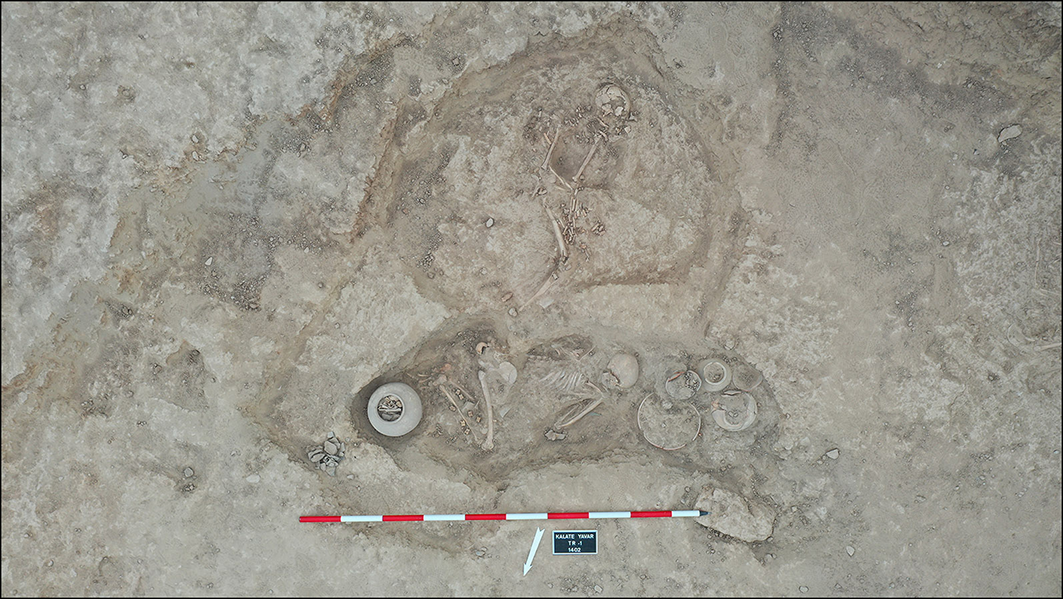
Trench 1 (6 × 8m), in the southern area, revealed a 3.5m sequence of cultural deposits (five layers). Upper levels contained ash and refuse pits rich in grinding-stone fragments, fired mudbrick fragments and faunal and botanical remains, and six human burials (Figure 2). A test pit (1.5 × 1.5m) opened in the north-east corner of the trench exposed mudbrick walls at 1.90m and 3.00m below the surface, constructed of rectangular bricks (0.42 × 0.20 × 0.10m) and preserved to heights of 0.45 and 0.35m, respectively.
Human burials from trench 1 (figure by A. Vahdati).

Figure 2 Long description
The image shows a trench excavation labeled as Trench 1, measuring 6 by 8 meters, located in the southern area. The trench reveals a 3.5-meter sequence of cultural deposits divided into five layers. The upper levels contain ash and refuse pits rich in grinding-stone fragments, fired mudbrick fragments, and faunal and botanical remains. Six human burials are visible within these layers. A measuring scale is present at the bottom of the image for reference.
Three out of six burials uncovered at depths of 0.90–1.10m, lacked grave goods, but the orientation (north–south with faces turned west) and positioning of the body (left side, slightly flexed) suggest an Early Bronze Age date (c. 3000–2500 BCE), consistent with early burials at Tepe Chalow (Vahdati & Biscione 2021). The other three burials, oriented northeast–southwest with individuals placed in tightly flexed positions with faces turned north-northwest, contained a juvenile accompanied by a single vessel (0.30m depth) and two adult burials, one with six objects and the other contained 13 objects (1.10–1.20m depth), all typical BMAC offerings.
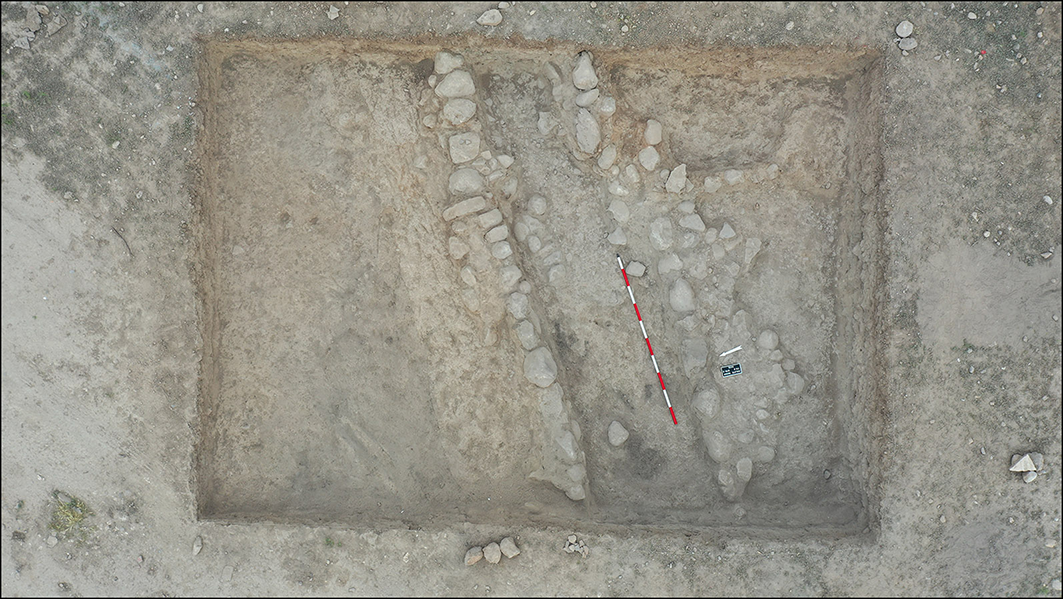
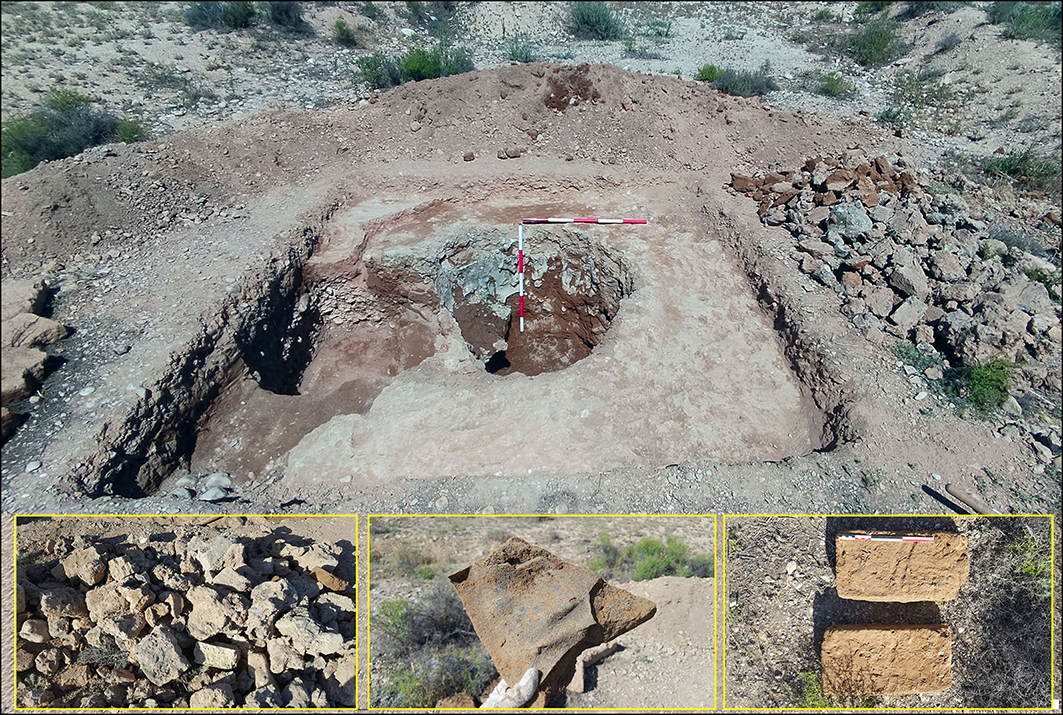
Trench 2 (7 × 5m), 30m west of trench 1, exposed the stone foundations of a substantial building (Figure 3), thick ash deposits and dense domestic refuse, including broken stone tools, animal bones and buff and red-slipped ceramics. Alternating occupation and deposition episodes indicate household and craft activities adjacent to funerary areas. Trench 3 (2 × 2m), opened in the north-east sector exposed two large storage jars set in natural sediment, likely used for storing agricultural produce. Test pit 8 uncovered a circular pottery kiln containing wasters and vitrified sherds (Figure 4), confirming on-site ceramic production. Other test pits clarified the horizontal extent of deposits and confirmed the Bronze Age association of domestic and funerary remains across the mound.
Stone foundations of a Bronze Age building (trench 2) (figure by A. Vahdati).

Figure 3 Long description
An aerial view of an archaeological excavation site showcases the stone foundations of a Bronze Age building. The excavation trench, measuring 7.5 meters by 5 meters, is located 30 meters west of another trench. The stone foundations are arranged in a rectangular pattern, with visible layers of soil and rocks. A red dashed line with an arrow points to a specific area within the trench, highlighting a particular feature or finding. The surrounding area is covered with loose soil and small rocks.
Pottery kiln with wasters (test pit 8) (figure by A. Vahdati).

Figure 4 Long description
The image shows a trench excavation site with exposed stone foundations of a substantial building. The trench reveals thick ash deposits and dense domestic refuse, including broken stone tools, animal bones, and buff and red-slipped ceramics. The alternating occupation and deposition episodes indicate household and craft activities adjacent to funerary areas. In the north-east sector, another trench exposes two large storage jars set in natural sediment, likely used for storing agricultural produce. A test pit uncovers a circular pottery kiln containing wasters and vitrified sherds.
Trenches 4–7 were opened in an area under development to the north and south of the site. Six burials were uncovered, mostly dug into alluvial sediments; all contained individuals in tightly flexed positions, oriented east–west, with five lying on the left side with faces turned north-northwest and one lying on the right side, and varying grave goods, typically placed near the head and feet, indicative of BMAC traditions.
Material culture
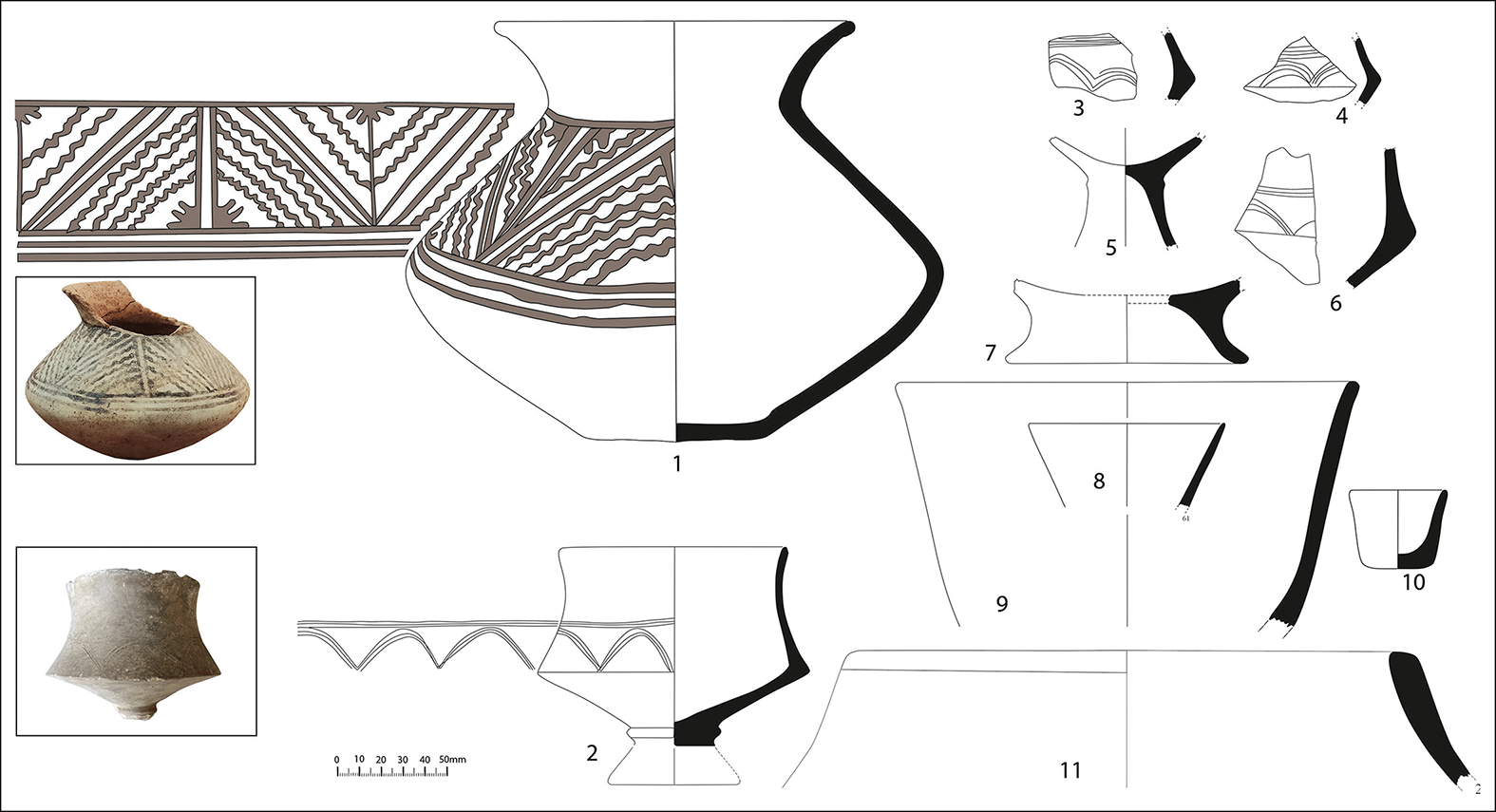
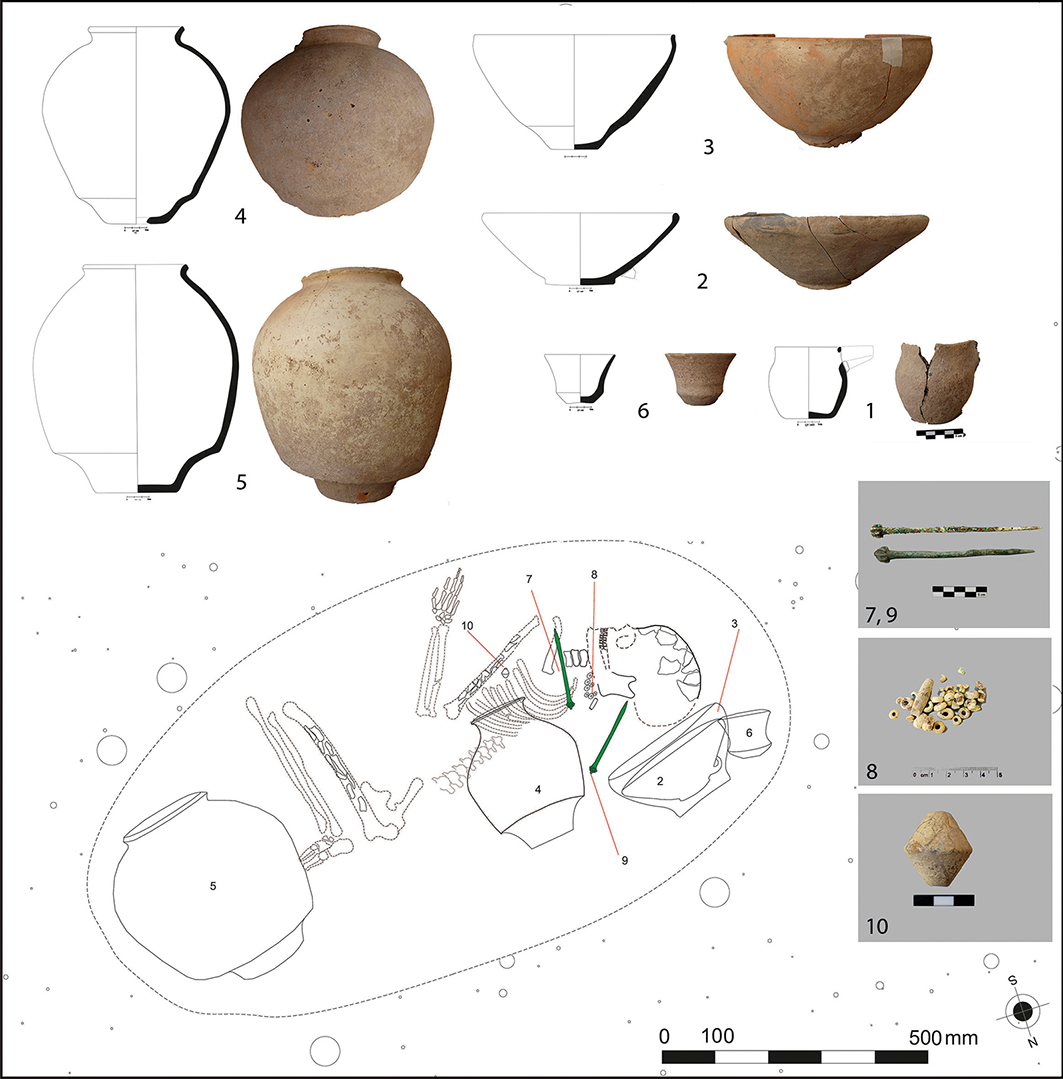
Finds include pottery, copper-alloy objects, stone and bone tools, and a gold foil. The ceramic assemblage comprises three main groups: a finely polished Grey Ware with incised and/or burnished decoration—pedestal goblets, sharply carinated bowls and biconical vessels—comparable to Ak-depe and Gorgan Grey Ware (Figure 5); a single black-on-buff jar of the Namazga IV period, contemporaneous with the Grey Ware; and simple buff and red-slipped wares corresponding to BMAC types (late third to early second millennia BCE). Pottery forms include molded-base jars, trumpet bowls, bowls with trough spouts, cylindrical beakers with concave bodies and occasional handmade coarse grit-tempered ‘Kitchen Ware’ (Figure 6). Other finds—clay animal figurines, spindle whorls, grinding stones, bone awls, gaming pieces and faience and semiprecious beads (lapis lazuli and carnelian)—reflect a broad domestic toolkit and personal ornamentation.
Selected Early Bronze Age Grey Ware and a buff-painted pottery jar found at Kalat-e Yavar (figure by A. Vahdati).

Figure 5 Long description
The image features a detailed illustration of Early Bronze Age pottery found at Kalat-e Yavar. It includes a buff-painted pottery jar and several pieces of grey ware with intricate incised and burnished decorations. The grey ware comprises pedestal goblets, sharply carinated bowls, and biconical vessels. The illustration highlights the craftsmanship and design elements characteristic of this period.
Plan of a BMAC burial and associated grave goods (trench 5) (figure by authors).

Figure 6 Long description
The image depicts a detailed plan of a burial site, labeled as trench 5. It includes various grave goods such as pottery, copper-alloy objects, stone and bone tools, and a gold foil. The pottery assemblage comprises different types, including finely polished Grey Ware with incised and burnished decoration, pedestal goblets, sharply carinated bowls, and biconical vessels. Additionally, there is a black-on-buff jar from the Namazga IV period and simple buff and red-slipped wares. The pottery forms include molded-base jars, trumpet bowls, bowls with trough spouts, cylindrical beakers with concave bodies, and occasional handmade coarse grit-tempered Kitchen Ware. The plan also shows the arrangement of these items around the skeletal remains, with specific labels and measurements provided for each object.
The well-preserved ceramic kiln and associated wasters attest to on-site pottery production, while abundant animal bones, seeds and grinding tools indicate a mixed agro-pastoral economy. The domestic assemblage, burials and diagnostic pottery indicate that the later occupation at Kalat-e Yavar was a BMAC-affiliated settlement.
Chronological context and significance
Burial practices, ceramic typology and associated artefacts place occupation of the site between the early third and early second millennia BCE. The assemblage links Kalat-e Yavar both to Early Bronze Age Grey Ware traditions of the Gorgan Plain and Kopet-Dagh piedmont, and to the mid–late Bronze Age BMAC horizon in eastern Iran and Central Asia. The Grey Ware ceramics, with their high polish, fine incised motifs and identifiable forms (pedestalled goblets and sharply carinated or biconical vessels), closely parallel finds from Tepe Naderi, Shirvan (Vahdati et al. Reference Vahdati, Alizadeh and Cifarelli2025) and Ak-depe (Sarianidi Reference Sarianidi, Masson and Atagarryev1976: figs. 7–13). The BMAC pottery corresponds to late Namazga styles known from Ulug-depe, Gonur-depe, Adji-Kui and sites such as Dashli and Djarkutan (Sarianidi Reference Sarianidi2007). Similar material at Tepe Esgh, the Tepe Chalow necropolis and Shahrak Firouzeh (Basafa Reference Basafa2022) highlights the broad distribution of BMAC traits across eastern Iran (Biscione & Vahdati Reference Biscione, Vahdati, Lyonnet and Dubova2021).
Kalat-e Yavar therefore occupies a space—both geographically and culturally—between the Iranian Plateau and southern Central Asia, illustrating how Bojnord Plain communities engaged in shared technological and symbolic systems. The archaeological assemblage reflects sustained interaction along routes linking Gorgan, the Kopet-Dagh and the northern Dasht-e Kavir, contributing to the growing picture of north-eastern Iran as a dynamic interaction zone within the broader Bronze Age Eurasian world.
Conclusion
Excavations at Kalat-e Yavar indicate that the Bojnord Plain was a crucial contact zone, linking the Iranian Plateau with Central Asia during the Bronze Age. Stratified deposits, domestic installations and the mixed ceramic assemblage provide valuable data for understanding regional cultural dynamics, mobility and exchange networks. Ongoing analyses will refine ceramic chronologies and explore metallurgical evidence and bioarchaeological data, contributing to our understanding of how frontier communities negotiated identity and exchange within the interconnected Bronze Age landscapes of north-eastern Iran.
Acknowledgements
Excavations at Kalat-e Yavar were undertaken under the auspices of Research Institute of Cultural Heritage and Tourism (RICHT) and the Iranian Centre for Archaeological Research (ICAR) at the Iranian Ministry of Cultural Heritage, Tourism and Handicrafts. We thank the ICAR and RICHT authorities for their project support, and the anonymous reviewers for their constructive comments.
Funding statement
Excavations at Kalat-e Yavar were financially supported by Iran’s Ministry of Cultural Heritage, Tourism, and Handicrafts and the Housing Foundation Office of North Khorasan Province, Iran.
Author contributions: using CRediT categories
Ali Vahdati: CRediT contribution not specified. Kourosh Mohammadkhani: Data curation-Equal. Zeinab Mahjoub: Conceptualization-Equal.